9 Nov 2016

Vatican Mediation in Venezuela Changes Political Equation for Washington

Mark Weisbrot

The Vatican’s participation in the mediation effort in Venezuela poses an unusual challenge to US policy in Venezuela and the region. On Sunday, October 30, three of the four major opposition parties and other prominent opposition leaders met with the government, with mediators from the Vatican and UNASUR (the Union of South American Nations). Some progress was made. The government released four people who the opposition considers political prisoners, and the opposition called off a political trial against President Maduro and a planned demonstration that most observers believed ran a high risk of violence.
Thomas Shannon, the number three official in the US State Department, also went to Venezuela this week, met with President Maduro and opposition leaders, and supported the dialogue. I wish I could say that this represents an actual change in US policy in the region, but all evidence still points to the contrary.
The US government is not looking at Venezuela in terms of dialogue or compromise. The Obama administration has economic sanctions against Venezuela, which President Obama renewed last March. In renewing these sanctions, the executive order again declared that Venezuela presented “an unusual and extraordinary threat to US security.” The world knows what happens to countries that the US deems to be “an unusual and extraordinary” security threat. Look what happened to Iraq. Look what happened to Nicaragua in the 1980s. It doesn’t matter how many people are directly affected by the specific sanctions against Venezuela. The threat is what matters, and it is ugly and belligerent enough to keep many investors from investing in Venezuela and to raise the country’s cost of borrowing. (Not to mention that the whole premise of Venezuela as a “security threat” is absurd.) And the US government has also directly pressured financial institutions not to do business with Venezuela.
For all of these reasons, it is clear that Washington’s goal in Venezuela is currently the same as it has been for almost all of the past 15 years. Shannon’s support for dialogue is almost certain to turn out the same as previous diplomatic thaws in the past: a brief and insincere interlude. President Obama initiated the longest period (about five months) of calm US-Venezuela relations ― since the US-backed military coup of 2002 ―between March and July last year. It soon became clear that this was only because the Cubans ― with support from the rest of the region ― made it a condition of progress in their own negotiations for opening relations with the US. This was something that Obama wanted for his legacy. But as Venezuela’s National Assembly elections approached, the Obama administration went back to its regime change strategy, supporting an international campaign to delegitimize Venezuela’s elections. (This turned out to be unnecessary, since the opposition won in a landslide.)
The Venezuelan opposition pursued a “strategy of military takeover” for the first four years of the Chávez government, including the 2002 military coup. But since 2004, they have been divided on whether to pursue change through legal means. Whenever they had people in the streets supporting a violent or extralegal overthrow ― as in 2002–03, 2013, or 2014 ― the US government has taken their side. Washington has also led various campaigns to delegitimize the Venezuelan government, a vital part of any extralegal “regime change” strategy.
But for the moment, Pope Francis has altered everyone’s calculations. It is not good optics for the hard-line Venezuelan opposition to condemn the pope. And the Obama administration cannot exert the kind of pressure on the Vatican that it does on, e.g., European governments to support its sanctions against Russia, or various unpopular military adventures. Also, the international media cannot marginalize or ignore the pope in the way they do the rest of the hemisphere’s governments, e.g., when these governments resist Washington’s support for regime change in Venezuela, Honduras, and other countries.
The pope is likely to look at the Venezuelan crisis in a pragmatic way, rather than through the lens of Washington’s imperial and ideological imperatives. There is a divided government in Venezuela, with the chavistas controlling the presidency and to a large extent the judiciary. The fractious opposition controls the National Assembly. Until the next presidential election, there is no way to resolve the political conflict except through dialogue and negotiation.
Pope Francis can be a pragmatic diplomat, but he has certain principles and is not easily intimidated. He is likely to understand that Venezuela’s divided government is a result of a divided country. From 2003, when the Chávez government got control of the national oil industry, until 2014, the large majority of the population experienced enormous gains in their living standards. That is why, in December of last year, in the elections for National Assembly, the ruling PSUV still got more than 40 percent of the vote ― despite inflation running at 180 percent and widespread shortages of basic consumer goods.
A big part of the gains of the Chávez era have been lost in the past nearly three years, and especially over the past year. But the governing party still has a political base that remembers worse poverty and exclusion, if not worse shortages, in the pre-Chávez era. They do not see the political opposition, which is a right-wing political movement that has always represented the upper classes, offering solutions that will make their lives better.
The Vatican will therefore likely seek negotiation and compromise on both sides of the political divide. This poses a unique challenge to Washington and some of its closest allies in Venezuela.

Trump vs. the National Security Establishment: Will There be a Revolution in US Foreign Policy?

James Luchte

Since the beginning of his presidential campaign, Trump had been savaged by the National Security establishment, castigated as unfit to lead, dangerous, incompetent, and ignorant.  These criticisms were woven together in an August 8 letter signed by fifty former National Security officers, denouncing a possible Trump presidency.   His national security team was also severely ridiculed by establishment media from the New Republic’s “Trump’s Court Jesters”, as “a rogues’ gallery of outcasts and opportunists, has-beens and never-weres, conspiracy-mongers and crackpots,” to the “Who?” of Top experts confounded by advisors to Donald Trump” from the New York Times.  Trump responded to the letter stating that these are the same people who brought us two decades of war – and his advisor Sam Clovis sardonically remarked that the National Security team is composed of people who “work for a living.”
Putting aside these castigations, Trump’s most egregious national security faux pas is his contestation of the Russophobic paradigm that has dominated US foreign policy since the end of WWII and the establishment of the National Security Act of 1947.  Trump’s contestation further amplifies his purported hubris to even raise the question of NATO – and his contemplation of the end of the seven decade US occupation of Europe (“We cannot afford it”).  Such perspectives fly in the face of the entire history of the National Security establishment, which, since the founding of the National Security Council (NSC), has sought to contain its former allies (Russia, and then, China) and maintain US hegemony on the European continent.
Trump could respond, of course, that Obama’s conflict with Russia is a distraction from the war on terrorism, especially in its current incarnation as ISIS.  Trump envisions Russia and the US working in tandem to defeat terrorism – and sharing the spoils of war in real estate, oil and infrastructure contracts.  Trump would of course have his war against radical Islam, but it will be fought alongside Russia.  If the presence of Carter Page and Michael Flyn on his National Security team tells us anything, it is that Trump does not see Russia as a threat, but as a potential partner in geopolitical and international business affairs.  Trump has substantial business interests in Russia and the Middle East and approaches the decade’s long conflict from a business security paradigm.  Indeed, Trump went so far as to suggest the US let Putin defeat ISIS on his own. “What do we care?”
It is clear from the intensity of its reaction to Trump’s faux pas that the National Security establishment will not tolerate deviation from the official script.  Since its beginning in the crucible of anti-Communism, the NSC – and through its surrogate organisations, such as the CIA and FBI – has waged a continuous war, internationally and domestically, on perceived threats to US global hegemony.  Russia has always been perceived as the greatest threat to a Pax Americana.  The NSC projected a strategy of full spectrum dominance from the outset, acting through political interference, regime change, assassination, cultural propaganda, psychological warfare, and domestic political repression.  This plethora of acts has come to be known collectively as the Cold War and it is Russia (and its potential supporters) which continue to be the primary target of global US national security strategy.
From this perspective, it was no accident that George H. W. Bush, a former CIA director, invaded the Middle East as the Soviet Union (a permanent, veto-wielding member of the UN Security Council) teetered on collapse.  Alongside Turkey, a longstanding NATO ally, the Middle East stood as the holy grail of global military and economic dominance – and the containment or destruction of Russia.  Before the dust settled in Iraq, Clinton undertook the eastward expansion of NATO which now stands with baited breath at Russia’s border.
Russia objected to the second Gulf War – and to Libya – but stood on the side lines of the Middle East until its 2015 intervention in Syria.  The root of Russia’s intervention lay in the dangers of regime change in Syria, especially following the US orchestrated coup d’etat in Ukraine in 2014.  What is at stake for Russia is the security of its European gas and oil markets which it sees threatened by the US and its allies.
On the one hand, Qatar, Saudi Arabia and Israel seek regime change in Syria in order to build a gas pipelines to Europe.  On the other hand, the US disrupts Russian supply chains – via the Ukrainian crisis and the European sanctions regime – to destabilize Russia and Russian-European relations.  Crimea is significant, in this light, as it is a primary distribution hub for Europe, a status threatened by the coup d’etat.  The reunification of Crimea with Russia took place directly against the background of the Syrian conflict as a response to the overall US strategies of containment and market displacement.  Further pressure has been placed on Russia through oil price deflation from shale gas and oil smuggling by ISIS.
US strategy in Syria has tragically metastasized into a policy of “nation destroying”, of proxy, mercenary warfare, destabilization, partition and ethnic cleansing (the “refugee crisis”).  Syria has made a horrific sacrifice for the US national security obsession with Russia.
For Trump to ask, “What do we care?” clearly exposes why the national security establishment has condemned his candidacy in such vitriolic terms.  In its view, to allow Putin to win in Syria would be not only to accept Assad, but also to give Russia a permanent presence in the region. To exclude and push Russia back has always been the US objective and Trump’s Russophilia is a direct challenge to the National Security establishment and its plan to throw Putin out of Europe.
Trump has however won the election and he is on a direct collision course with the National Security establishment.  Of course, Trump is an unlikely revolutionary.  He has never said he would defy the National Security Act of 1947 (no president has), which means that he will accept its shadowy apparatus and its bureaucratic methodologies. Indeed, he supports increased NSA surveillance, expanded military spending, CIA activism, FBI phone hacking, etcetera. He is simply suggesting a different target for business-as-usual, by reminding us of our last propaganda cycle, the “War on Terror”.
Yet, Trump has thus far failed to articulate the “big picture” of a Russian rapprochement in the context of the necessity of a US glasnost – of a deconstruction of the National Security state.  During a campaign characterised by serial violations of longstanding taboos (Sanders’ opposition to the CIA, his support of the Sandinistas and Cuba) and Wikileaks’ disclosure of sensitive and damaging government and campaign documents, Trump squandered his opportunity to lay out a credible vision for either radical reform or revolution.  Indeed, he has been happy to simultaneously endorse the NSA surveillance state and Wikileaks – and without irony.
Trump’s has thus far failed to articulate a coherent vision of a cooperative, multi-polar world – in other words, to invite ordinary citizens to demand a radical change in the concept of national security and of the place of the US in the world.  If he does not challenge the NSC, Trump’s insurgency will expose itself as a distraction to the urgent task of finding a pathway out of the labyrinth of empire.  In its naivety, Trump’s “revolution” would then serve to further merely consolidate the unquestioned impunity of the National Security state.
If Trump is serious, he will set forth a coherent critique of US national security and the constitutional disaster that is the National Security Act.  If Trump is serious, he will defy the National Security Act.

The Iraqi Christians Who Are Struggling to Survive After Isis

Patrick Cockburn

In the half-burned church of St Mary al-Tahira in Qaraqosh, several dozen Syriac Catholics are holding a mass in Aramaic amid the wreckage left by Isis. The upper part of the stone columns and the nave are scorched black by fire and the only artificial light comes from three or four candles flickering on an improvised altar. Isis fighters used the courtyard outside as a firing range and metal targets set at one end of it are riddled with bullets.
In his sermon, the Syriac Catholic Bishop of Baghdad Yusuf Abba calls for the congregation to show cooperation and goodwill to all. But the people of Qaraqosh, an overwhelmingly Christian town 20 miles south east of Mosul, wonder just how much goodwill and cooperation they can expect in return. .
The Christians are still traumatised by the disasters of the last two-and-a-half years. When Isis took Qaraqosh on 8 August 2014 it had a population of 44,000, almost all Syriac Catholics, who fled for their lives to Irbil, the capital of the Kurdistan Regional Government. Some 40 per cent of these have since migrated further to countries like Australia and France or, within the Middle East, to Istanbul and Lebanon.
But the 28,000 people from Qaraqosh who stayed inside Iraq have understandable doubts about going home, even if Isis is fully defeated and loses Mosul. “There is no security while Isis is still in Mosul,” says Yohanna Towara, a farmer, teacher and community leader in the town, but even when Isis is gone the Christians will be vulnerable. He says that “the priority is for us to control our local affairs and to know who will rule the area in which we live.” He adds that the need for permanent security outweighs the need to repair the destruction wrought primarily by Isis but also by US-led air strikes.
This destruction is bad enough, though it is not total. Isis fighters set fire to many ordinary houses in addition to the churches in the days before they left, but – possibly because there was no furniture left to burn since it all had been looted – most of these houses look as if they could be made habitable after extensive repairs. It will take time because not only has the furniture gone, but cookers and fridges so, even if light fittings or taps are still in place, there is no water or electricity.
Isis did not fight for Qaraqosh and there are no booby traps or improvised explosive devices. But they must at one time have thought of doing so because they dug networks of tunnels in the nearby Christian village of Karemlash as if they intended to wage an underground guerrilla war against the Iraqi army. In the event, there are few signs of Isis resistance, except the rather pathetic remains of burned out tyres which they set fire to in order to create a smoke haze to impede the visibility of the aircraft of the US-led coalition. There were not many air strikes, but where they did take place the results devastated whole buildings reducing them to heaps of rubble.
Visiting Qaraqosh from Irbil 40 miles away, it is easy to understand why people displaced from Qaraqosh and in the rest of the Nineveh Plain feel insecure and dubious about returning to their old homes, even where they are still standing. They know that if they do they will be at the mercy of Arab and Kurdish authorities eager to fill the vacuum left by the fall of Isis and wishing to stake new claims to territory and power.
Arriving at a Kurdish Peshmerga checkpoint on the main road from the Kurdish region to Mosul at 9am, we make our way through crowds of people originally from Qaraqosh waiting to pass through. “See how they are treating people,” says a critical Christian observer. “People have been waiting here since 5 or 6am, but the Peshmerga say they need a senior officer to give permission for them to pass.”
After another two Peshmerga checkpoints, we reach an Iraqi army checkpoint with whom the Christians have better relations. The Nineveh Plain east of Mosul was home to a mosaic of minorities and its abandoned villages show various levels of destruction, depending on their sectarian and ethnic complexion. For instance, some had once contained Sunni and Shia Shabak (a heterodox sect speaking a dialect of Kurdish), but Isis had destroyed the houses of the Shia but left the Sunni.
Closer to Qaraqosh the checkpoints are manned by soldiers of the Iraqi Army and local Christian members of the Nineveh Protection Units (NPU) with their multi-coloured red, white and blue flags. Relations between the NPU and the army appear good, but the soldiers are Shia and at one checkpoint they had laid out a table and were serving sweet tea and biscuits as part of the Shia Arbaeen commemoration. The diversity of officially-sanctioned armed groups appears never-ending: at some checkpoints there were also visible the dark uniforms of federal police, whom locals say are recruited from the Shabak and Turkmen communities.
Fear of Isis had united diverse groupings and communities, but that unity is showing signs of fraying. The Peshmerga are excluded from fighting inside Mosul city, but are building a rampart and ditch to denote their front line. The Kurds may be pleased to see Isis defeated in Mosul, but if it is defeated by a reconstituted and effective Iraqi army – very different from the large but ill-commanded and corrupt army that fled from Isis in 2014 – then the balance of power in northern Iraq will change against the Kurds.
The outcome of the war all over Iraq and Syria has ensured that minorities that were once spread throughout the two countries, now only feel secure if they can rule their own territory. But in Iraq the Christians do not have the numbers to defend themselves.

On The Eve Of The Vote: Trump Values, Islam And Militias

Binoy Kampmark


The chugging train of fear continues to drone away on the eve of what has been considered one of the most important elections in generations. Mind you, this was the sort of stuff spouted during the campaigns of 2008, when a disgusted electorate washed a mouth contaminated by George W. Bush’s years with Barack Obama’s honeyed promises.
Eight years after that wash, and other antidotes and options are being sought in the supermarket of populism.  It is precisely this sort of enthusiastic shopping that terrifies and torments, notably various groups who see a Trump presidency as the demon incarnate.
This take is particularly strong regarding the Muslim-American community.  With a persistent fear that Islamic fundamentalism will take root in US soil with weed-like tenacity, Trump’s messages strike an appealing note.  It is the rise of Trump that prompts such touchy headlines as that of Al Jazeera: “American Muslims brace for the worst after US election.”
Instances of planned attacks and foiled plots against Muslim communities abound.  The FBI revealed last month that it had frustrated the efforts of a Kansas militia to eliminate a Somali Muslim mosque and community centre by way of detonation in Garden City.
Researchers such as Ryan Lenz of the Southern Poverty Law Centre insist that disparate groups are coalescing in Trump’s America, and not in a good way for various, fearful minorities.  “In the aftermath of September 11, white nationalist groups teamed up with organised anti-Muslim groups, creating a dangerous and threatening alliance against members of the American Muslim community.”
Not all of this should be laid at the feet of Trump malignancy; in the United States, visions of utopia and promised land rhetoric have mingled with crude realities and hatreds long before The Donald held sway.  In typically crude businesslike fashion, he has marketised such fear.
The suspicions in some communities towards Islam’s endeavours are simply cognate realities that have found form in other countries, suggesting that the US, despite its melting pot credentials, is not immune.
Insecure, macho and pricelessly juvenile (the mix is standard), militia groups have also promised to protect a vision of the US that pre-dates Trump.  What matters here is the logic of repair that Trump has appropriated: the system is broken, and these are your patriotic handymen charging to the rescue.
Georgia Force III%, sounding more like a name given to an industrial solvent, is one such example.  In this case, it is a militia outfit led by Chris Hill.  Having given himself the rather longwinded title of Security Force Commander, Hill claimed that, “We have to be prepared to protect the country from all enemies foreign and domestic.”  A loss of “control” on various “fronts” had put American “liberties” and “freedoms” at risk. His solution?  Conducing armed manoeuvres in the woods.
The language of vote rigging has also found a home in discussions about the credibility of the electoral system itself.  While the arguments have merit in so far as they go to the core of how democracy is defined, the critique offered by many of Trump’s supporters is scatty.  In order to avoid rigging, a form of intimidation via excessive scrutiny, for instance, has been suggested.
In other instances, it has seen a surge of Republican volunteers wishing to serve as poll watchers.  Given the shoddiness in the management of some polling stations across this vast country, the concerns are not without merit. In a narrow election result, missing or miscounted ballots can prove a costly thing to the losing side.
What concerns such individuals as former US attorney general Alberto Gonzales, remembered for having a hand in the debates on torture during the Bush administration years, is the overly enthusiastic nature of the private response. “I would depend on the state and local officials to make sure of the integrity of the vote within particular precincts.”
It is exactly such statements, said without irony, that make the private efforts of overly zealous citizens so potent. Officialdom, with rules it supposedly follows yet breaks, is to be mistrusted. The Democratic Party, in various quarters, has insisted on its own reading of those rules, with the Ohio Democrats claiming in a lawsuit that their Republican counterparts in the state, along with the Trump campaign and Stop the Steal, have effectively suppressed minorities in urban areas from going to the polls. A sense of paranoia across the entire spectrum abounds.
What is clear is that such fears do have a habit of becoming self-fulfilling prophecies.  The threats of armed militias to carry arms to polling stations ostensibly to prevent rigging revives images more akin to Mugabe’s Zimbabwe than the United States: to make sure a result is fair is merely code to make sure the result is fair to us.
This election campaign has shown that a lack of noble spirit and generosity can get you elected in efforts of sheer disgust.  The only uncertainly as the queues gather is to what extent disgust and fear translates into votes. Not even a smug Nate Silver would be able to predict that.

Why Do The Poor Vote For The Rich? Trump, Berlusconi, And The Empire Of Lies

Ugo Bardi


The results of the US elections were not so surprising for me: after all, I live in a country where politics has been dominated by a financial tycoon, Silvio Berlusconi, for more than 20 years. Berlusconi and Trump share many characteristics, but the most curious one is that they are rich and that the poor vote for them. Why is that? Are the poor stupid or what?
But the poor are not stupid. They are badly misinformed by the Western media, but they perceive that they are facing a true Empire of Lies and that they are being lied to, consistently, brazenly, and gleefully. There are plenty of studies (*) showing that people detect lies not on the basis of rational consideration, but on a much simpler test: consistency. They take into account what a person does, not so much what that person says.
In other words, if you want to help the poor and gain their trust, you have to be poor. That’s why Franciscan monks wear a brown tunic, pledge to own nothing, and are forbidden even to touch money. If you want to have the vote of the poor, you don’t have to arrive to such extremes, but you have to be consistent: what you are has to bee in agreement with what you say. And, if you are rich, you shouldn’t even try to disguise yourself as being poor. As I said, the poor are not stupid.
That was the problem of the Italian Communist Party that was supposed to represent the workers. Over the years, it came to be led by wealthy people who claimed to represent the workers, but who were not workers; they were at best well paid bureaucrats, at worst thieves. Eventually, the workers started voting for Berlusconi and the Communist party was swept away from history. It turned into the present “Democratic Party,” a mongrel that we could define as “Berlusconi 2.0”.
Berlusconi was brash, silly, nasty, politically incorrect, a womanizer, and more, but he mainly said what he thought, he was not lying and people perceived that he was not the front man for someone else. Now over 80 and mostly retired from politics, he could probably come back and win again.
It is very much the same thing for Donald Trump. You may hate what he says, but there is little doubt that he says what he thinks; he is not lying. It was exactly the opposite for Hillary Clinton, who was perceived as having much to hide, despite what she kept saying. And, in the end, it makes sense to prefer a honest son of a bitch to a smooth-sounding liar, no matter how pleasant is what she says.
So, things went the way they should have. One thing that should never surprise us about the future is that it always surprises us. Will we ever learn that?
(*) If you have the time to read the book “Big Gods” by Ara Norenzayan, do so. It is an eye opener in this matter

American Liberals Unleashed The Trump Monster

Jonathan Cook


The earth has been shifting under our feet for a while, but all liberals want to do is desperately cling to the status quo like a life-raft. Middle-class Britons are still hyperventiliating about Brexit, and now middle-class America is trembling at the prospect of Donald Trump in the White House.
And, of course, middle-class Americans are blaming everyone but themselves. Typifying this blinkered self-righteousness was a column yesterday, written before news of Trump’s success, from Guardian journalist Jonathan Freedland, Britain’s unofficial stenographer to power and Washington fanboy. He blamed everyone but Hillary Clinton for her difficult path to what he then assumed was the White House.
Well, here is some news for Freedland and American liberals. The reason Trump is heading to the Oval Office is because the Democratic party rigged the primaries to ensure that a candidate who could have beaten Trump, Bernie Sanders, did not get on the ticket. You want to blame someone, blame Clinton and the rotten-to-the-core Democratic party leadership.
But no, liberals won’t be listening because they are too busy blaming Julian Assange and Wikileaks for exposing the truth about the Democratic leadership set out in the Clinton campaign emails – and Russia for supposedly stealing them.
Blame lies squarely too with Barack Obama, the great black hope who spent eight years proving how wedded he was to neoliberal orthodoxy at home and a neoconservative agenda abroad.
While liberals praised him to the heavens, he poured the last US treasure into propping up a failed banking system, bankrupting the country to fill the pockets of a tiny, already fabulously wealthy elite. The plutocrats then recycled vast sums to lobbyists and representatives in Congress to buy control there and make sure the voice of ordinary Americans counted for even less than it did before.
Obama also continued the futile “war on terror”, turning the world into one giant battlefield that made every day a payday for the arms industry. The US has been dropping bombs on jihadists and civilians alike, while supplying the very same jihadists with arms to kill yet more civilians.
And all the while, have liberals been campaigning against the military-industrial complex that stole their political system? No, of course not. They have been worrying about the mass migrations of refugees – those fleeing the very resource wars their leaders stoked.
Then there is the liberal media that served as a loyal chorus to Clinton, trying to persuade us that she would make a model president, and to ignore what was in plain sight: that Clinton is even more in the pocket of the bankers and arms dealers than Obama (if that were possible) and would wage more, not less war.
Do I sound a little like Trump as I rant against liberals? Yes, I do. And while you are busy dismissing me as a closet Trump supporter, you can continue your furious refusal to examine the reasons why a truly progressive position appears so similar to a far-right one like Trump’s.
Because real progressives are as frustrated and angry about the status quo as are the poor, vulnerable and disillusioned who turned to Trump. And they had no choice but to vote for Trump because there was no one aside from him in the presidential race articulating anything that approximated the truth.
Sanders was ousted by Clinton and her corrupt coterie. Jill Stein of the Greens was made invisible by a corrupt electoral system. It was either vote for Clinton and the putrid status quo, or vote for Trump and a possibility for change.
Yes, Trump is very bad. He is as much a product of the plutocracy that is now America as Clinton. He, like Clinton, will do nothing to fix the most important issue facing humankind: runaway climate change. He is a climate denier, she is a climate evader.
But unlike Clinton, Trump understood the rising popular anger at the “system”, and he was articulate enough to express it – all it took was a howl of pain.
Trump isn’t the antithesis of liberal America. You liberals created him. You unleashed this monster. It is you in the mirror. You stayed silent, you took no stand while your country was stolen from you. In fact, you did worse: you enthusiastically voted time after time for those who did the stealing.
Now the path is clear and the route fast. The precipice is ahead, and American liberals are firmly in the driving seat.

Papua New Guinea budget further undermines living standards

John Braddock

The Papua New Guinea government of Prime Minister Peter O’Neill handed down its 2017 budget on November 1, marked by falling revenues and deepening cutbacks across all sectors of the public sector. It is the last budget before national elections next year.
With revenues forecast to fall by 2 percent, the government has slashed spending by 3.5 percent in a bid to rein in the budget deficit. The shortfall will be met by seeking more off-shore loans. Overall debt to GDP ratio will remain at 28.8 percent, the same as 2016, but a further revenue downturn could take it over the legislated limit of 30 percent.
Treasury Minister Patrick Pruaitch said total spending will be down to 12.9 billion kina ($US4.1 billion), compared to K14.2 billion in 2016. Another swathe of cuts to public services is foreshadowed with “strict conditions” imposed across the public sector. An allocation of K20 million has been made to fund forthcoming public service retrenchments.
Public health and education services remain under heavy attack after budget cutbacks of up to 40 percent over the past year. For 2017, the health sector has been allocated K1.2 billion, down from K1.5 billion, while education will receive K1.1 billion, down from K1.3 billion.
Capital investment has been slashed by 21 percent. Transport, in a country plagued by geographic isolation, is to be cut by 12.5 percent, to K897 million. While the police and defence budget faces a reduction, it remains the fifth-ranked recipient of funds at 8.7 percent of the total, with K1.1 billion.
The biggest expenditure item is government administration, including funding for “improvement” projects. The provinces and districts will get K3.6 billion and K2.7 billion respectively, or taken together 48.9 percent of the budget.
No special provision has been announced to deal with the destruction caused by last summer’s devastating El Nino weather patterns, or to prepare for further drought conditions. An estimated 2.7 million people were affected with water shortages, food insecurity and disease. PNG has the highest percentage of people in the world—60 percent—living without access to safe water.
O’Neill told parliament that while K400 million had been allocated to run the 2017 elections, there will be increase in the nomination fee from K1000 to K10,000 to help fund the “expensive” exercise. The move has been heavily criticised on social media as discriminating against those without the necessary finances to stand. It was expected that more than 4,000 candidates would contest the 111 seats.
Pruaitch said it was “no secret” that the government faced a “tight” budget. The “weakening” global situation and low commodity prices has seen government revenues decline and “flatten” in the past four years. “We have been forced by circumstances to tighten our budgetary situation further through supplementary budgets in 2015 and 2016,” he declared.
The government’s chief secretary, Isaac Lupari, was more forthright, declaring last month that the country would have to “brace for the worst next year” as fiscal conditions will be “very tough”.
PNG’s growth rate is forecast to drop further in 2017. Figures from the Bank of PNG and the National Statistics Office revealed that PNG is two years into a severe recession. The real growth rate over 2014 and 2015 was negative 1.3 percent. The combined budget deficits of 24 percent of GDP over the past three years were the largest for any three-year period in PNG’s 40-year history. Employment has dropped by 7 percent over two years. Business sales have declined by 16 percent from 2014 to 2015, which, along with sharply reduced lending to the private sector, has undermined investment.
According to Australian economist Paul Flanagan, there was a “frightening” fall of 20 percent in government revenues in the past year. The government has imposed austerity measures similar in scope to those in Greece, greatly exacerbating the social crisis facing the working class and rural poor. The 2016 supplementary budget imposed a swathe of cutbacks to government programs, causing many essential services to begin failing.
The assault has fuelled a series of struggles by students and sections of the working class, including doctors, nurses, pilots and dock workers. The ruling elite has relied on police repression and the trade unions to suppress this movement and shut down strikes.
The unions have channelled hostility over declining living standards into support for the parliamentary opposition, which has no fundamental differences with the austerity agenda. In August, O’Neill, faced down an opposition motion of no-confidence over his alleged corruption.
Pruaitch boasted that the government was looking towards significant export growth. Export revenues stagnated at around K20.8 billion in 2014 and 2015, even though last year was the first full year of Liquefied Natural Gas exports. Export revenues, he claimed, were forecast to improve for copper, palm oil, coffee, cocoa and forest products. Pruaitch said the current foreign exchange “imbalance” will improve as the massive OK Tedi gold and copper mine ramps up to full production. The government is also counting on the APEC summit, which it is due to host in 2018, to also bring in new expenditure.
The government’s projections have already been questioned. Former planning secretary Valentine Kambori declared that the forecast budget revenue from dividends from state-owned enterprises (SOEs) was “unrealistic.”
Speaking to Australian Broadcasting Corporation last week, Flanagan, a former PNG treasury official, said it would take, even on optimistic figures, at least another six years for PNG to get back to the high levels of economic activity recorded in the 2013–14 financial year when global commodity prices were at their peak. This would mean years of minimal growth even as the population continued to increase.
Foreshadowing deepening attacks on living standards, Pruaitch warned of an increase in prices for basic goods and services. Inflation is expected to be 6.6 percent, alongside an ongoing depreciation of the kina against major trading currencies. The government will increase taxes on tobacco, alcohol and gambling. Personal income tax is expected to increase by K186.6 million after failing to reach the 2016 budget estimate of K2.9 billion.
According to a report by the National Research Institute in September, costs are “high and increasing almost every day” across the country, particularly in the capital, Port Moresby. Director Charles Yala said that the impact was not shared equally by all. “Those who receive higher income can happily live with the rising prices. This is not the case for the middle to low income earners,” Yala declared.
In other words, the government’s budget will place new economic burdens on those who can least afford it—the working class and the urban and rural poor.

Brazil’s high school students continue occupations in face of repression

Gabriel Lemos and Miguel Andrade


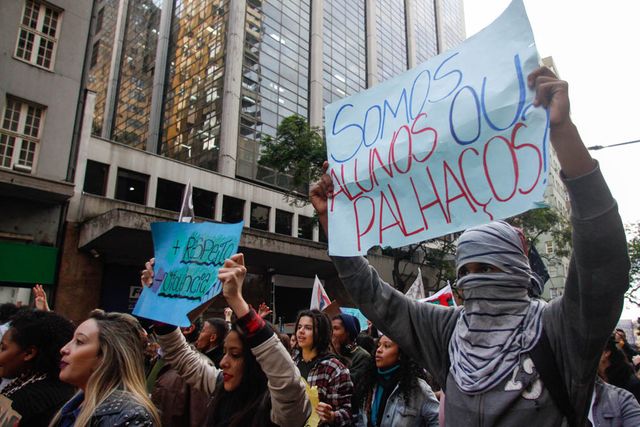
Brazilian high school students have been engaged since October 4 in their fourth wave of school occupations in less than a year against crippling attacks on the right to education by the federal and several state governments. Beginning in November 2015, threats of mass school closures, cuts to the education budget and attacks on teachers’ working conditions drove hundreds of thousands of pupils, many of them as young as 12, to shut down and camp out in schools.
Occupying students protest in Porto Alegre [Photo: Editorial J]
In every mobilization so far, students have resisted harassment by not only right-wing parents and petty school bureaucrats, but also the state, the police and organized crime. Hundreds have been detained over the year and taken to correctional facilities or even prisons, in the case of seniors, and hundreds more have faced retaliation in the form of suspensions, retentions and expulsions.
The escalation of harassment against the students reached a high point last week, when a judge authorized the Military Police in the capital Brasília to lay siege to an occupied school, cutting water and power, preventing parents from bringing food and cleaning supplies to their children and using sleep-deprivation techniques to force the students out. Frightened students decided to leave the school the following day.
The most recent movement has been largely concentrated in the southern state of Paraná, one of the country’s richest, where half of the 1,700 high schools are occupied. It has now spread, however, to 19 states and more than 100 universities, with more than 1,000 facilities blocked nationwide.
The occupations’ most immediate motivation is the imminent approval of a proposed constitutional amendment (named PEC 241 by Congress) to freeze government spending for 20 years, ostensibly to allow the country to overcome its worst economic crisis in a century following two consecutive years of economic contraction.
Economists estimate that the measure would withdraw from education and health funding more than 1 trillion reais (US$317 billion) over the 20-year period, an impact that led the population to ironically nickname the proposal the “end of the world amendment” (“PEC do fim do mundo”).
For students and teachers, the amendment comes on top of a sweeping education reform promulgated by the new government of President Michel Temer. The measure, imposed by decree just days after Temer was sworn in following the impeachment of Workers Party (PT) President Dilma Rousseff in September, is also expected to freeze teachers’ wages and cripple working and studying conditions in most schools.
Its pro-corporate character is an enormous attack on public education and will extend nationwide the privatization of education already experienced in the states of Pernambuco and Sao Paulo.
The education reform establishes a policy to implement full-time high schools, expanding from five to seven hours per day the time students spend in school, and allowing “flexible,” pro-market curriculums, supposedly at each student’s discretion.
In particular, the reform turns arts education, physical education, philosophy and sociology into optional subjects, raising the likelihood that they will rapidly disappear from the curriculum due to budget cuts, or even more likely, political intervention by right-wing and religious elements on local advisory boards. The optional character of art in full-time high school, and its possible end, means taking away from working class students one of their few accesses to culture.
A law for the extension of hours at schools has for years been demanded by educators with support of parents and students. Currently, 94 percent of Brazilian students attend one of three daily shifts—morning, afternoon and night. Of the 24 percent of high school students attending the night shift, the great majority work throughout the day. Parents have for a long time claimed that the three-shift system, which doesn’t allow students to stay in school before or after classes, makes pupils vulnerable to harassment by organized crime or exploitative family relations that amount to under-the-radar child labor occurring upon their daily return home.
Longer hours have also been considered for a long time as a solution to poor performance in schools. According to the results on Brazil’s standard testing exam, Prova Brasil, released in early September, 40 percent of high school students have extremely unsatisfactory educational results.
On the other hand, students fear that the change from a three-shift system to full-time schooling may force many out of school, not allowing them to combine attendance with work from the legal age of 16 in the context of the deep economic crisis.
The measures being proposed were first implemented in the northeastern state of Pernambuco in 2008 and involved the private Educational Co-Responsibility Institute (ICE—Instituto de Co-Responsabilidade Educacional) and Pernambuco’s secretary of education. At the time, ICE was chaired by a former CEO of Philips, and financed by educational institutes controlled by private companies and banks, such as Natura, Itau and Bradesco.
The participation of ICE in Pernambuco’s high schools takes place through reforms that fund and implement the management of schools by private companies. This means that the work regime of teachers includes periodic performance evaluations and bonuses if the students meet goals set in the standardized exams. Today, 44 percent of high schools in Pernambuco are full-time.
As usual in privatization drives, the Temer government alleges that expansion of hours would be impossible without the pro-corporate measures, given the state of the education system, in which teachers have the longest hours and the third-lowest wages compared with other OECD countries, and 84 percent of schools lack libraries, science laboratories and sports facilities. The privatization drive is further presented as an alternative in the face of the government’s proposed constitutional amendment that will cut the Brazilian educational budget to an extent never seen before.
The education reform also has the explicit aim of expanding the coverage of technical education, which is currently attended by 8 percent of Brazilian high school students, in alignment with the World Bank and the United Nations Children Fund (UNICEF) recommendations. As the Education Ministry wrote to Congress in justifying the decree, “otherwise there is no guarantee of an economically active population sufficiently qualified to drive economic development.”
The relationship between the World Bank and Brazilian education goes back to the 1950s, but was intensified during the 1964-1985 US-backed military dictatorship precisely in relation to technical education. Between 1971 and 1978, the World Bank financed the construction and reform of industrial and agricultural technical schools, with support from the Food and Agriculture Organization of the United Nations (FAO), the United Nations Educational, Scientific and Cultural Organization (UNESCO) and Ford Motor Company.
Prior to these agreements, the Brazilian military dictatorship reached a series of educational agreements with the United States Agency for International Development (USAID), which led to an enormous expansion of private higher education, with 75 percent of Brazilian students funneled into private faculties. At the same time, philosophy and sociology were removed from the curriculum. Only in 2008 were these subjects once again made obligatory.
While the educational reform and the brutal attack it represents on public education has been announced by Temer government, it was prepared by the PT governments of Lula da Silva (2003-2010) and Dilma Rousseff (2011-2016), and is based on a 2013 bill introduced by Workers Party federal deputy Reginaldo Lopes. Moreover, the whole standard evaluation framework that paved the way for the current measures was set up by the PT’s Sao Paulo Mayor Fernando Haddad when he was education minister in 2005.
Nonetheless, the fact that the pioneering states to implement such worked-out measures were, in the last election cycle, under control of the right-wing opposition to the PT, and that most officials implementing these policies have been drawn from those state governments after Rousseff’s removal from office, has been used as a pretext to corral the student struggles behind the PT-controlled teachers’ unions around the country. At the same time, this is being used to refurbish the image of the unions with students and teachers after their actions resulted in concessions contracts all over the country last year, which saw record strike activity among teachers.
Likewise, the historic association of the measures with the military dictatorship and traditional right-wing forces in Brazil, including Christian chauvinists, is being used by unions and the PT-linked media to foster the PT’s “coup” narrative, hiding the party’s complicity not only in the attacks on workers, but in strengthening the same political forces that removed it from power and which are now accelerating these attacks.

Sandinista President Ortega gains third term in Nicaragua

Andrea Lobo

Nicaraguan president and ex-guerilla leader Daniel Ortega and his Sandinista Front for National Liberation (FLSN) were reelected for a third consecutive five-year term, amid deepening inequality and increasingly autocratic methods of rule. Although they ran under their old slogan, “Nicaragua: Christian, Socialist, in Solidarity,” he and his wife, Rosario Murillo, who will be his vice-president, plan to deepen their pro-business and reactionary agenda.
The Supreme Electoral Council reported on Monday that out of 2.6 million ballots cast, a 68 percent voter turnout, the FSLN received 72.5 percent, followed by the Constitutionalist Liberal Party (PLC) with 15 percent and the Liberal Independent Party with 4.5 percent. Congress will be split similarly.
The main opposition front, the National Coalition for Democracy, did not participate, and called on voters to abstain or cast blank ballots. Even so, the turnout was only slightly lower than previous elections, and only 3.5 percent of votes were cast blank. Back in June, the Supreme Court had removed the Coalition’s top leader, Eduardo Montealegre, from his position in the party, leading to the invalidation of the Coalition’s candidates. This allowed Ortega to run without any significant opposition, but it still doesn’t explain the huge margin of victory.
The second-tier right-wing opposition parties offer no alternative to the masses of Nicaraguans concerned about reduced social spending and the widening gulf between the country’s rich and poor. As for the ruling elite, they offer no viable means of quelling an upsurge in the class struggle.
The absence of an independent party of the working class, along with popular disdain for the right-wing opposition, chiefly explain the in FSLN’s huge margin of victory.
Back in June, Ortega had announced that he would not accept any international observers, but given mounting international and national condemnation, he invited the Organization of American States (OAS) to send a delegation. The OAS accepted an invitation to be present throughout the elections and to start a “dialogue,” but it did not act as an official “observer.” The US ambassador to Nicaragua and the US State Department “embraced” this decision.
Ortega’s tightened grip over national politics, however, has given fodder to the international press and the US government to pressure the FSLN. Most significantly, the US House of Representatives passed a bill in September, the “Nicaragua Investment Conditionality Act” or Nica Act, which would place a hold on economic aid from the World Bank and other credit agencies until Ortega “adopts reforms that promote democracy.”
On Monday, US State Department spokesperson Mark Toner reacted to the elections, declaring: “The United States is deeply concerned by the flawed presidential and legislative electoral process in Nicaragua, which precluded the possibility of a free and fair election.”
Back in an August opinion piece, the Wall Street Journal called upon the Obama administration to act as it did in the US-backed 2009 coup in Honduras. The Journal stated: “He [Daniel Ortega] is believed to be one of the richest men in the country. Many in the business community went along with his gradual accretions of power, and now it may be too late to prevent a full-fledged dictatorship.”
After he cast his ballot right before poll stations closed on Sunday, Ortega gave what amounted to a victory speech. Referring to the US occupations during the 1920s, he remarked, “Now, we Nicaraguans have become the organizers of the electoral power. … It will not be the American troops ‘taming’ our fatherland, but Nicaraguans.”
“Thank God that elections here don’t need hate, confrontation, and death. This is a vote for peace,” concluded Ortega.
Rosario Murillo then repeated exactly what Ortega said, adding that they won “in the name of Jesus,” and stressed the importance of conserving the “alliance” ruling the country. Ever since its assumption of power, the FSLN has combined “liberation theology,” Marxist rhetoric and pro-business policies to consolidate—particularly after regaining the presidency in 2006—a reactionary coalition between the national business elite, the Church, the state and the unions.
The Ortega family, along with several other Sandinista leaders and prominent business people, have built a powerful business conglomerate, including large land holdings and media outlets.
Competing for a larger share of the profits from the exploitation of Nicaraguan workers and peasants, Ortega’s bourgeois nationalist clique and US and European imperialism are entering into a deeper conflict, particularly because global economic stagnation is eroding the economic basis to strengthen their relative power and curb class tensions.
Since 2007, Ortega’s government has depended on Venezuelan oil and $4.8 billion of out-of-budget loans and investments from the Venezuelan government to pay for social programs and establish generous concessions to local business groups. Ortega has desperately sought to increase its trade and economic and military assistance from a variety of other sources—including Venezuela, Brazil, the European Union, China, and Russia—to lessen its dependence on the US.
However, his government is increasingly finding itself facing a blind alley. Nicaragua’s $214 per capita social spending is already one of the lowest in the region, so the drawing down of Venezuelan aid and the yearly $250 million of assistance and loans now threatened by the Nica Act (19 percent of Nicaragua’s total social spending) are making Ortega’s short levers get even shorter.
During the 1980s, the Sandinista government was spending about 60 percent of its budget to fight the war against the CIA-backed contras, and the US embargo placed an enormous pressure on the economy. According to Mexican economic historian Mario Trujillo, “The choices taken by the Sandinista government were promoting the mixed economy, sustaining the free market, and seeking loans (mainly small and limited); and particularly, by February 1988, it resorted to the orthodox program of economic stabilization that adjusted itself to the norms proposed by the IMF for the Latin American countries to confront the economic recession and the foreign debt payments throughout the eighties.” (Nicaragua: Elections and perspectives of a neo-social-democratic government, 1990)
Once the Stalinist bureaucracy in the Soviet Union stopped sending economic aid, the country fell into a decade-long crisis that kept 75 percent of the population under the poverty line. This led to the Sandinistas’ electoral defeat in 1990 and their even further lurch to the right and, although with some rhetorical resistance, into the sphere of US imperialism. This process continues today, even through the so-called left turn of Latin American bourgeois governments that began in the early 2000s.
Ortega is still credited by the Western media with having maintained pro-business policies and, over the course of his two administrations, having reduced the official poverty rate by over 15 percent. While many of Nicaragua’s poor have partially benefited, the largest benefits have gone to the national bourgeoisie and its imperialist partners. According to data from the National Information Development Institute (INIDE), the Gini inequality index is almost the same as in 2007, and 62 percent of families still cannot afford the basic basket of goods and services.
At the same time, Oxfam reports that Nicaragua’s 254 multimillionaires have an average annual income more than 12,000 times that of someone in the poorest quintile.
While the IMF had closed its offices in Nicaragua this year in recognition of Nicaragua’s fiscal obedience, the government’s timely payments still amount to on the order of 35 percent of its public budget, a pressure that, under increasingly unfavorable economic conditions, will require deeper austerity measures. To prepare for this scenario and the intensification of the class struggle, Ortega and US imperialism both ultimately support more-autocratic forms of rule, including a strengthened military and police, both of which has been under expansion and modernization since 2013.
Washington is pressuring Ortega to move forward with unpopular economic and political measures and to distance himself from China and Russia in support of Obama’s “pivot to Asia” and increasing confrontation with Moscow.
As a sign of cooperation and of acknowledging its anticipated electoral victory, the FSLN government and the Central Bank presented in October their economic plan for 2017-2021, “Let’s Grow Together!” The document upholds the free trade agreements with the US (CAFTA) and with the European Union and notes the desire to join the US-led Trans-Pacific Partnership. In terms of financing, it calls for “the emission of sovereign debt titles to international markets” and developing “Public-Private association” investments.
The World Bank representative at the plan’s presentation, Luis Constantino, declared that, “It seems to me like a very good planning process and we like it very much.”
Most of the government’s projects for this period are in transport and telecommunications, while no health programs are mentioned, and only two unfinanced education programs are included regarding didactic technologies. Suggestively, the $50 billion interoceanic canal that the government granted a Chinese firm a concession to build is not even mentioned, and, in spite of claims of having all the financing needed, the beginning of construction on the project continues to be postponed.

Egypt plunges into economic and social nightmare

Jean Shaoul 

The Egyptian pound fell by 50 percent to E£14 to the US dollar following the announcement by the country’s Central Bank that it would allow the currency to float on the currency markets. The pound has previously been pegged to the dollar.
The oil ministry followed suit, announcing a 50 percent increase in the price of petrol and a 30 percent rise in fuel, both of which have been subsidised for decades. Food prices are likewise expected to soar. Egypt imports more than half its basic foodstuffs and is the world’s largest importer of wheat. Alongside cuts in subsidies and the introduction of VAT (value-added tax), this will increase the cost of living, stoking fears of hyperinflation.
Inflation is already running at 16.4 percent a year, under conditions where wages have not kept up with inflation and 40 percent of the population are officially below or only marginally above the poverty line.
Earlier last week, Egypt’s Supreme Investment Council approved a raft of pro-business measures in a bid to boost investment, extending a temporary suspension of capital gains tax on shares and introducing tax exemptions for producers in some sectors.
Another devaluation, hard on the heels of a 13 percent devaluation last March, was widely expected as part of the packet of measures demanded by the International Monetary Fund (IMF) in August. The measures, the full extent of which have not been made public, are in return for a $12 billion loan—with a further $9 billion to be raised elsewhere—to cover Egypt’s 2015-16 budget deficit of 12 percent of GDP, and a shortage of foreign currency. The IMF insisted last month that Egypt had to implement reforms, including a flexible currency, slashing subsidies, VAT, and privatisation of state-owned enterprises and banks, before receiving the loan, now worth considerably less than originally agreed.
Currency reserves have fallen from $36 billion in 2010 to about $19.6 billion in September, despite tens of billions of dollars in aid from Egypt’s Gulf allies since 2013. After the authorities introduced controls in early 2015 to stem the flight of capital, importers turned to the black market where the rate soared to more than double the official rate. In June, the Central Bank raised the interest rate to 10 percent, a 10-year high.
Many small producers complained that they were being forced out of business. Last month, two of Egypt’s largest listed companies said they would be forced to halt production if dollar shortages continued. Others have turned to China to source their imports where prices and quality are lower.
Both the timing of the devaluation—far sooner than expected—and the scale came as a shock. It reflects the depth of the economic, social and political crisis confronting General Abdul Fatah el-Sisi’s brutal dictatorship.
Rising prices and periodic shortages of state-subsidised foods have forced the government to increase costly imports. Deteriorating relations with Saudi Arabia, the junta’s sponsor, led to Riyadh suspending its agreement to supply Egypt with refined oil products, adding $500 million a month to the import bill and government spending.
So great was public anger over a shortage of sugar, which some have accused the military’s enterprises of seeking to monopolise as it has with other goods and services, that the Central Bank was forced to allocate $1.8 billion to build a six-month food reserve. At the same time, the military has prepared 8 million “ration” packages of basic foodstuffs to be sold at half price, predominantly in Cairo.
The IMF, which speaks for the Western banks that will profit from the deal, welcomed the decision. It said that the currency flotation would “make more foreign exchange available,” and “improve Egypt’s external competitiveness, support exports and tourism and attract foreign investment.” It will do nothing of the sort. Its only purpose is to put Egypt’s assets up for sale at knockdown prices and open up the Egyptian working class to super-exploitation by the transnational corporations and international banks.
The IMF’s brutal diktats, which will impoverish the Egyptian people, can only be implemented by brute force, which el-Sisi indicated he is more than ready to use on behalf of the Egyptian bourgeoisie and the imperialist powers.
Last August, when the deal was initialled, El-Sisi said he would not shy away from the reforms that previous rulers had shunned in a bid to avoid unrest, declaring, “The first attempt at real reform was in 1977.” Riots broke out in 1977, after then-President Anwar Sadat said he would end basic subsidies on wheat in return for a World Bank loan.
El-Sisi added, “The people’s reaction caused the state to backtrack, and it has continued to delay [the reforms] till now. All the hard decisions that many over the years were scared to take: I will not hesitate for a second to take them.”
Since overthrowing the Muslim Brotherhood-led government of Mohammed Mursi in a bloody coup in July 2013, el-Sisi has imposed a brutal dictatorship on behalf of the military, police and intelligence faction of the ruling class that has dominated Egyptian political and economic life since the 1952 Free Officers’ coup. He has ruthlessly targeted the military’s economic rivals, dominated by the Muslim Brotherhood, other bourgeois political opponents, liberal activists and, most importantly, the working class.
The junta has outlawed protests, imprisoned at least 60,000 of its political opponents, sentenced hundreds to death and introduced a sweeping counter-terrorism law vastly expanding the authorities’ powers. Mass trials, mostly of Brotherhood supporters, failed to establish individual guilt. Several thousand have been tried in military courts. Torture and enforced disappearances are commonplace, with many detainees dying in custody from mistreatment.
At the same time, el-Sisi has carried out extensive military operations against Islamic militants in the Sinai Peninsula who have capitalised on the seething unrest among impoverished Bedouin. The regime has imposed a state of emergency, killing hundreds of civilians, demolishing hundreds of homes and evacuating thousands of residents. The security forces’ brutality, which has included curfews, detention without trial or even charges, the shutting down of cell phone and internet networks and routine abuse, has only served to increase social tensions in Sinai and throughout the country.
The class tensions that exploded into the revolutionary events of January 2011, which led to the removal of long-time dictator Hosni Mubarak, are exploding once again in response to the economic disaster and the junta’s repression.
Last week, Egyptians took to the streets to protest the government’s failure to provide fast and adequate relief in the flood-stricken areas where 29 people were killed and at least 73 were injured at the end of October. In Ras Gharib in South Sinai, where hundreds of homes were under water and all of the main roads out of the town were closed, Prime Minister Sharif Ismail was forced to abandon his visit in the face of angry protests over power and water cuts in the town.
Two weeks ago, thousands took to the streets of the northeastern port city of Port Said to protest against the rising cost of housing, chanting, “House us or kill us” and calling for el-Sisi’s resignation.
In September, social media issued a call, known as Thawra el-Ghalabiya (revolution of the majority), for a mass anti-government rally on November 11 against the rising cost of living. The security forces responded by detaining eight people for 15 days on charges connected to calling the rally.
Last month, a video of a furious tuk-tuk (motorized rickshaw) driver filmed in a working class district in Cairo went viral. It showed the driver, surrounded by crowds, haranguing the government for its lavish spending at state ceremonies while the poor suffer.

German media calls for massive rearmament after US elections

Johannes Stern

The German elites are using the US presidential election and the “dirtiest election campaign of modern times” (Der Spiegel) as an excuse to promote the return of German militarism.
In the past week, the World Socialist Web Site commented on a paper of the German government-connected think tank Stiftung Wissenschaft und Politik (SWP), titled “Even without Trump much will change.” It calls for a more aggressive German and European foreign policy that is ready, “whatever the election result” to pursue economic and geopolitical aims independently of the United States and, if necessary, against Washington.
Just before the election, a column on Spiegel Online provided a taste of what this means. Under the title, “How Trump could force Germany to rearm,” a certain Henrik Müller forecasts: “Should Donald Trump be elected US president on Tuesday, Germany will face a great debate regarding rearming. It could become the decisive theme of the [German] federal elections in 2017—an intense controversy with the potential to divide the country.”
But “also if Hillary Clinton wins,” Germany would face high costs. Germany would “not be able to continue as before, neither politically nor economically.” The US elections were “a turning point.” With a win for Trump, “the post-war era, when America’s nuclear shield and its European military presence initially provided protection for the West and later the Central European countries, ... is finally over.” Europe “would have to provide its own security” and “in particular, Germany, the continent’s largest economy.”
“This will be expensive,” states Müller, a professor of journalism who teaches at the University of Dortmund and has a doctorate from the University of the Bundeswehr [Armed Forces] Hamburg. Until now, Germany spent “comparatively little for the military: just 1.19 percent of gross domestic product (GDP).” That lies “well below” the NATO limit of 2 per cent, to which the members of the military alliance had agreed in 2002. Britain “spends twice as much on arms and soldiers in relation to GDP, the United States three times as much.”
The scenario outlined by Müller recalls the German armaments madness on the eve of the First and Second World Wars: it ranges from the doubling of the military budget to the acquisition of nuclear weapons! “Instead of the current 37 billion euros per year, in future Germany must spend 80 billion, perhaps even more,” writes Müller. “In the event of NATO breaking apart and the complete elimination of the American security guarantee, a new arms race could be the result, as is happening elsewhere in the world already. Even a debate on Germany’s own nuclear weapons would be conceivable.”
Although this was “not desirable,” warns Müller, “Military instability and economic inefficiency would be the consequences. For Europe, it would be much better and cheaper if the United States remained involved.” But, “Given the isolationist mood across the Atlantic,” one must be “mentally prepared for such a scenario.”
Another reason for the armaments offensive cited by Müller is the deep crisis of the European Union. He writes: “Germany would be better prepared for the new situation if the EU was united and strong. But there can be no question of this. Europe is divided and threatened by decay. Accordingly, we must prepare ourselves for Germany facing high costs. One way or another.”
While the rearmament plans postulated by Müller are presented as being externally “imposed” by the deep crises in the US and the EU, in fact, they correspond to official government policy. At the 2014 Munich Security Conference, the Social Democratic Foreign Minister Frank-Walter Steinmeier, speaking for the entire ruling class, said, “Germany must be ready for earlier, more decisive and more substantive engagement in the foreign and security policy sphere.” It was simply “too big merely to comment on world affairs from the sidelines.”
At the time, the PSG warned in its resolution “The return of German militarism” that the post-war order had “resolved none of the problems that had led to war. The economic power of the US made possible a temporary stabilisation and the post-war boom. The Cold War not only kept the Soviet Union at bay, but also kept Germany under control. But with the reunification of Germany and the dissolution of the Soviet Union, the period in which German business could conduct its affairs in the wake of the US and the German army could restrict itself to national defence was irrevocably over.”
It continued: “The revival of militarism is the response of the ruling class to the explosive social tensions, the deepening economic crisis and the growing conflicts between European powers. Its aim is the conquest of new spheres of influence, markets and raw materials upon which the export-dependent German economy relies; the prevention of a social explosion by deflecting social tensions onto an external enemy; and the militarization of society as a whole, including the development of an all embracing national surveillance apparatus, the suppression of social and political opposition, and the bringing into line of the media.”
This analysis has now been confirmed. But there is a social force that is capable of halting the return of German militarism and the risk of renewed war between the great powers: the international working class. Following the US elections, the struggle waged by the International Committee of the Fourth International (ICFI) for the establishment of an international anti-war movement of the working class against imperialism and capitalism takes on even greater urgency.