12 Nov 2016

UK: Working-class families in record levels of debt

Joe Mount

New figures reveal that household debt in Britain has reached the record level of £1.5 trillion after growing by 3.5 percent since last year, according to the Bank of England.
This is equivalent to 82 percent of the value of the UK’s entire economic output each year. It is placing an unprecedented financial burden on working-class households due to rising house prices and depleted savings.
Indebtedness is becoming the “new normal” for families struggling to make ends meet. Economic stagnation and government austerity measures are eviscerating incomes and pushing thousands more into unemployment.
Mortgages secured against property comprise the overwhelming majority of the debt, with the remainder made up of personal loans and credit card debt. This is equivalent to an average of £30,000 per person, or 113 percent of average income, according to The Money Charity. In reality, household debt is unequally distributed across society and affects the poorest worst, with most having small or no savings. The figures also neglect student debt, which typically stands at £44,000 upon graduation.
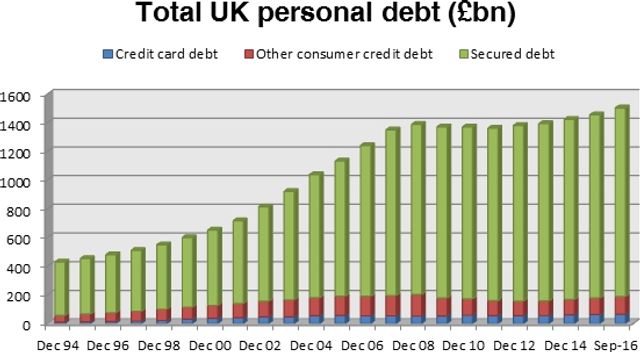
The rise in total UK personal debt 1994-2016. Source: Bank of England
The national total of personal debt ballooned at a rate of 10 percent per year during the 1990s and 2000s, trebling between 1997 and 2008, when it reached the previous record level of $1.39 trillion. The figure plateaued in the wake of the global financial crash in 2008 as consumer spending collapsed and has begun to rise again during recent years.
The renewed growth in personal debt is mainly due to increasing secured debt such as mortgages, driven by soaring house prices. The average house price for first-time buyers rose by 8 percent since last year to over £180,000, according to the Office of National Statistics. However, the British Bankers’ Association has noted that consumer credit is also growing more rapidly than at any time since the 2008 crash. Dependence upon credit increases the risk of serious debt problems caused by unexpected changes in economic circumstances. Trades Union Congress (TUC) research found that squeezed wages have pushed millions to rely on credit to cover essential costs, with over 3 million households unable to keep up with debt repayments.
The scale of the debt crisis is expressed by the following figures from The Money Charity. Every day in Britain:
* 1,322 people report being made redundant.
* 247 people are declared insolvent or bankrupt, up 22 percent since last year.
* 17 properties are repossessed and over 300 landlord possession orders are made.
* The Citizens’ Advice Bureaux deals with 4,495 debt cases, second only to benefit enquiries.
The crisis will intensify in the aftermath of the decision for Britain to leave the European Union (EU) following the June referendum. Economic growth and business investment are predicted to fall amid uncertainty over the outcome of the negotiations on the terms of Britain’s exit from the EU.
Living standards will be hit by rising inflation and the fall in the value of the pound. Inflation is expected to spike from the current rate of 1 percent to 4 percent next year, while the value of the pound sterling has fallen to a 31-year low, making imported goods more expensive.
The Bank of England reduced the base interest rate to a record low of 0.25 percent in August, after maintaining a 0.5 percent rate since 2009, in an attempt to boost the economy. This had little effect on consumer interest rates due to a rise in credit card interest rates.
The rate cut was seen as a political move by the governor of the Bank of England, Mark Carney, who supports Britain remaining in the EU and was seen to be casting a critical judgement on the outcome of the Brexit referendum. Expressing sharp divisions within the British bourgeoisie, he faced harsh criticisms from major pro-Brexit figures on the right wing of the Conservative party, but has remained in his post.
These trends, along with possible interest rate hikes, will make the debt burden more difficult to cope with. Money Advice Trust boss Joanna Elson, responsible for National Debtline, warned, “The spectre of significantly higher inflation is a real concern. Many households have still not recovered from the last big squeeze on incomes in the aftermath of the financial crisis. The risk is that this new pressure on household budgets could tip many more people into financial difficulty.”
Wages fell precipitously during the years following the 2008 crash, falling 10.4 percent in real terms, the largest fall among leading Organization for Economic Co-operation and Development (OECD) countries, according to a recent study. Political responsibility for these social attacks lies with the trade union bureaucracy, the Labour Party and their pseudo-left apologists. These forces have worked to systematically demobilise any collective defence of jobs, conditions and social services.
Wages will be cut further as the corporate elite impose the costs of economic contraction and market uncertainty on the working class. The National Institute of Economic and Social Research predicts a 0.5 percent fall in disposable incomes in 2017. If current trends continue, real wages will not rise before 2020, according to the Guardian.
This will only intensify the debt crisis facing workers. “A further squeeze on household incomes, made worse by the freeze on benefit uprating, will leave even more households struggling. With over 7 million people already using credit to pay for everyday essentials, there is a real danger of more falling into severe problem debt,” warned Peter Tutton of debt charity StepChange.
Chancellor of the Exchequer Philip Hammond is attempting to project a mood of calm control in the run-up to the autumn budget statement on November 23, having made statements that he will pull back from the harsh imposition of austerity associated with his predecessor George Osborne. This myopic and rose-tinted view has been buoyed by claims that the Brexit vote has not had the cataclysmic result predicted by the supporters of Britain remaining in the EU. This is merely the calm before the storm. The chancellor seeks to avoid spooking international markets and sparking a debt crisis on the scale of that which engulfed Greece after the financial crash.

Greece: Syriza government reshuffle prepares new attacks on working class

Katerina Selin

Greek Prime Minister Alexis Tsipras, who heads the coalition government under the pseudo-left party Syriza (Coalition of the Radical Left), reshuffled his cabinet at the beginning of November. This is in response to the growing political and social crisis in the country and is directed at working more closely with international lenders, in order to enforce the agreed austerity more rigorously. The new cabinet was sworn in on November 5.
Tsipras had “excluded all voices from the government or negotiations that represented an obstacle in relations with the creditors,” Greek newspaper To Ethnos commented on the reshuffle. He wanted to create “new political room for manoeuvre” and “demonstrate willingness to reform,” wrote Spiegel Online. Tsipras described the step as “a chance for a new beginning”—a typical Tsipras euphemism for a new wave of social attacks.
The losers in the reshuffle include the Shipping Minister Theodoris Dritsas, Minister for Economics and Development Panos Skourletis, Culture Minister Aristidis Baltas and Education Minister Nikos Filis—four veteran Syriza cadre.
Dritsas had served as shipping minister in two terms of the Syriza government, and is responsible for the privatisation of the Port of Piraus. He is part of the “53+ movement,” the so-called left wing of Syriza, and had several times expressed criticism of the privatisation plans, without fundamentally rejecting them.
Now Dritsas is being replaced by Panagiotis Kouroumblis, who was a member of the social democratic Pasok until 2011, voting for the first austerity memorandum as a parliamentary deputy at the time. He later switched to Syriza and served in its first cabinet as health minister, and as interior minister in its second cabinet.
He has been replaced at the Interior Ministry by Panos Skourletis, an old comrade of Tsipras, who had previously delayed several privatisations, such as the sale of the water and power plants.
Former minister for education, research and religious affairs, Nikos Filis, had come into conflict with the Orthodox Church because he wanted to replace Greek-Orthodox teaching with a more general religious instruction in schools. However, Tsipras adopted a more conciliatory attitude towards the Archbishop of Athens, who had expressed sharp criticism of Filis, implicitly demanding his sacking.
Tsipras has integrated a number of younger faces in his cabinet, whom he can rely on in the negotiations with the international creditors. Among his loyal apparatchiks are the Labour Minister Efi Achtsioglou, his new State Secretary Dimitris Liakos and government spokesman Dimitris Tsanakopoulos.
Before her appointment, the 31-year-old lawyer Achtsioglou headed the Political Bureau of the Labour Ministry and was involved in negotiations with the creditors concerning labour law and social security. According to the newspaper To Vima, shortly after entering office, she signed off on the “new negotiating guidelines” with the European experts group, which is demanding reform of Greek labour law. Achtsioglou had wanted to pursue several of their demands, including the introduction of short-time working. The European representatives also proposed extending the mass sackings, changing the minimum wage in the private sector and limiting industry-wide labour contracts and negotiations.
Achtsioglou has to introduce 21 ministerial decisions in the next days, including measures affecting pensions. Supplementary pensions are to be cut by a further €439 million in 2017. This year, pension cuts have already amounted to some €230 million.
This policy is meeting growing resistance. In October, the Syriza government had shown it was willing to attack protesting pensioners using tear gas. Last Wednesday, thousands of angry pensioners demonstrated again in Athens, loudly demanding their money back, which the government had “stolen from the pension fund.” The day before, new cuts in supplementary pensions came into effect, hitting over 248,000 pensioners.
The demonstration ended at the Labour Ministry, where several pensioners symbolically burnt the letter they had received from the Labour Minister about the pension cuts. Similar protests were held in Thessaloniki and the central Greek town of Larissa.
Tsipras’ reshuffle has also strengthened ties to big business. His right-hand in economic questions is now State Secretary Liakos, who enjoys the best links with financial and business circles. He has worked for years as an investment manager and leading stock market figure, and enjoys good relations with the European Commission and the Bank of Greece and its manager Janis Stournaras, who at the highpoint of the crisis between 2012 and 2014 was finance minister in the right-wing Samaras government.
Liakos’ political career was encouraged in 2012 by then vice premier Ioannis Dragasakis. He worked on the third memorandum and in 2015, under Finance Minister Janis Varoufakis, participated in negotiations with the European institutions. At that time, in contrast to Varoufakis, he supported a wide-ranging deal with the president of the European Commission, Jean-Claude Juncker.
A close associate of Tsipras is also the 34-year-old government spokesman Tsanakopoulos, who graduated in law at the University of London; between 2012 and 2014 he was legal adviser to Tsipras and in 2015 headed his political bureau.
Two other new appointments send a clear signal to the international creditors:
One is Dimitris Papadimitriou, professor and president of the Levy Economics Institute of Bard College in New York. The well-known economist, who enjoys extensive connections in US business circles and regularly writes for the Greek business newspaper Kathimerini, was a surprise appointment as minister for economics and development.
Papadimitriou’s state secretary is now Stergios Pitsiorlas, who since 2015 was head of the privatisation body TAIPED, which is organising the selling off of Greek state assets. These include the sale of several regional airports to Germany’s Fraport AG. In the 1990s, the lawyer was an EU adviser on economic aid to Greece, and since 2008 has held leading positions in construction companies and other businesses, including in renewable energy, an area in which Greece wants to work more closely with German business in the future.
In April, in an interview with Spiegel Online, Pitsiorlas made clear that he was an important man for Tsipras’ privatisation plans. Der Spiegel pointed to growing resistance in the government to the privatisation fund, which had been characterised by Shipping Minister Dritsas (since deposed) as a “state within a state.” Pitsiorlas responded optimistically: “There is conflict in the government, but Prime Minister Tsipras is personally engaged and intransigent ministers ordered to push forward the privatisations as planned.” He dubbed the new super-fund, which will conduct even larger privatisation projects, a successful concept for Greece, praising the German cuts diktat: “The pressure exercised by Germany to establish this fund will have positive consequences.”
Finance Minister Efklidis Tsakalotos, Foreign Minister Nikos Kotsias and Vice Premier Dragasakis retained their posts—a signal to the international institutions that the previous course will be maintained.
Defence Minister Panos Kammenos, from the right-wing populist coalition partner the Independent Greeks (Anel), remained in office. The new cabinet has even expanded the position of Anel. In future, the economically significant Tourism Ministry will be headed by Elena Kountoura. The daughter of a well-known general and monarchist, Kountoura came to Anel via an illustrious career as a model and as a politician in New Democracy (ND) for many years.
The cabinet reshuffle marks a further turn to the right by the pseudo-left Syriza government, which has capitulated to the international financial elite on every issue since coming to power in January 2015. Tsipras is closing ranks and pushing through a hard line against inner-party critics. He needs a government he can rely on in the coming period of class battles. After nearly two years of brutal austerity, the pseudo-left Syriza has lost all its support in the working class.
A recent poll by the University of Macedonia showed Syriza plummeting to 15 percent, while ND rose to 30 percent. The fascist Golden Dawn, with 7 percent, remained in third place, losing some ground. But the mood in the population is directed against the entire political establishment. This is reflected in the fact that all party leaders were rated negatively by over 60 percent of those questioned. The fascist Nikolaos Michaloliakos polled worst, with an 86.5 percent negative rating, followed by Anel boss Kammenos (82.5 percent) and Tsipras (75 percent). Panagiotis Lafazanis, who founded the pseudo-left party Popular Unity along with other ex-Syriza members in an effort to capture workers’ discontent, received a 72.5 percent negative rating.

Australian establishment concerns over future of US alliance under Trump

James Cogan

The Australian political, corporate and media establishment has responded with bewilderment to the fact that Donald Trump will be the next president of the United States—a development it did not want and had almost universally declared impossible, prior to November 8.
During the election campaign, Trump insisted that an administration he headed would repudiate the Trans Pacific Partnership economic agreement; impose sweeping tariffs, not only on China but on other key Australian trading partners, such as Japan and India; declare Beijing a “currency manipulator” and provoke open trade war; and demand that US allies in Europe increase military spending as the price for ongoing security relations with Washington. In Asia, Trump condemned the expense associated with maintaining US basing arrangements in Japan and South Korea, and expressed indifference to both countries assembling their own nuclear arsenals.
While there was general commentary on these declarations, none of them was taken particularly seriously within Australia’s ruling circles. The assessment made by the US and Australian media “opinion-makers”—that Trump was unelectable due to his populist rhetoric and manifest personality flaws—was simply accepted as fact.
Labor Party opposition leader Bill Shorten, who has the closest ties to the American establishment, was so confident of Trump’s defeat that he broke with diplomatic protocol and publicly commented on the US election in October. “By his own words and his own actions,” Shorten declared, Trump “has confirmed the worst fears of millions in the United States and beyond its borders that he is entirely unsuitable to be leader of the free world.”
Shorten continued: “I know I am not the only one relieved that with every passing day, with every disgusting, demeaning comment Mister Trump makes, the possibility of him being president fades.”
Summing up the view of the vast majority of the Australian elite on the eve of the election, Greg Sheridan, the pro-Republican Party, right-wing foreign editor of Rupert Murdoch’s Australian, wrote on November 8: “You can take it to the bank—the American election is effectively all over, Hillary Clinton has won.”
Since Clinton’s concession in the early hours of November 9, a panicked Australian political establishment has rushed to accommodate to Trump’s victory while seeking to work out the extent of its implications.
Australian Prime Minister Malcolm Turnbull, who heads an unstable conservative Liberal and National Party coalition government, was the second world leader after Israel’s to have Trump answer his phone call. Turnbull delivered personal congratulations and vowed to work closely with the new administration.
Labor’s Bill Shorten began his backtracking from his previous comments on Trump with a Facebook statement declaring: “Australians should also know our alliance with the United States has grown and thrived for seven decades—no matter who’s in charge.”
Reports indicate that the Australian embassy in Washington and diplomatic staff in Canberra are scrambling to establish contact with the somewhat unknown individuals who may be installed into key security, foreign policy and economic secretarial and under-secretarial posts of Trump’s administration.
Media commentators and strategic analysts, however, unimpeded by the diplomatic restraints of political office, are giving full vent to their fears and uncertainties.
Since World War II, Australian imperialism has looked to and relied upon the United States to assert its strategic and economic interests on the world arena and particularly in Asia. In exchange, Canberra has functioned as the loyal adjunct of Washington on virtually every international issue. It plays a major role as part of the ANZUS military alliance with the US, hosts critical American military bases and has dispatched its own armed forces to participate in every predatory war that US imperialism has waged to assert is global hegemony, from Korea and Vietnam, to Iraq in 1990–1991, and, over the past 15 years, to Afghanistan, Iraq and Syria.
Since 2011, Canberra has functioned as one of Washington’s main allies in the Obama administration’s “pivot to Asia.” It has become thoroughly embroiled in the US agenda of threatening China with war if it fails to bow to Washington’s demands, aimed at enshrining American dominance over the Asia-Pacific region. At the centre of the “pivot” has been its most crucial economic aspect, the Trans Pacific Partnership, which would establish a regional trading bloc that excluded China, putting pressure on the latter to radically open up those areas of its economy that remain protected from penetration by US, Japanese, Australian and other financial and corporate conglomerates.
The implications of the TPP’s collapse, and of the development of a US administration that retreats from both the economic and military aspects of the “pivot,” has been one of the main subjects in the post-election media commentary in Australian strategic circles.
On November 9, the Australian Financial Review (AFR) bluntly editorialised: “In a year when globalisation and open markets have been under pressure as never before, its greatest bastion has fallen to a political huckster with a contradictory and self-defeating agenda…. Strategically, it is a historic rupture in the post-war world. Mr Trump vows to abandon the global leadership that Washington assumed in 1945. Others may move into the vacuum…. Australia will need to look to the like-minded in East Asia to counterbalance the influence of rising regional giant China. The region will become more heavily armed and dangerous. With a less reliable America, we may find ourselves with greater regional strategic responsibility.”
Strategic analyst Hugh White, one of the few establishment critics of Australian involvement in the “pivot,” wrote the same day in the AFR: He [Trump] is not going to stand up for US allies. But without those allies America cannot remain the leading power in Asia. Indeed, without those allies, America cannot remain a significant strategic player in Asia at all. If Trump acts as he has talked, we might be seeing the end of the American era in Asia.”
Paul Kelly, Rupert Murdoch’s editor-at-large at his flag-ship Australian, has authored a stream of worried commentary on the US elections. In today’s edition, he wrote: “Beware confident predictions about what Trumpism means once the man sits in the Oval Office. This is a classic in Donald Rumsfeld’s notion of ‘known unknowns’—things we know we don’t know….
“It is imperative that Trump, in office, change the style and content of his proposed foreign policy. Threats to NATO and to US allies Japan and South Korea are reckless and a threat to world stability. They risk fuelling a huge anti-Americanism in democracies around the globe while achieving little for the US national interest.”
Kelly’s reference to “anti-Americanism” has been echoed by other commentators. What they are referring to, however, is not hostility among ordinary people toward the American population, but a potential turn by the ruling elites of various countries to develop alternatives to their longstanding alliances and relations with the United States.
James Brown, a former military officer who works with the United States Studies Centre at the University of Sydney, told the media on November 9 that Trump’s victory meant Australia “would have to be more cautious in how we cooperate and collaborate with the US in Asia. We would be more worried about the way the US would support us in any sort of security situation, so it might lead us to take another look at our defence strategy.”
Former Labor Party Prime Minister Paul Keating has been the most explicit. Speaking on an Australian Broadcasting Corporation current affairs program, Keating declared: “The foreign policy of Australia is basically we have tag-along rights to the US…. It’s time to cut the tag. It’s time to get out of it.”
Behind the perplexity gripping the Australian establishment lies the threat of the breakdown of its alignment with the US, which has provided the framework for the country’s foreign policy, defence and investment and trade relations for more than 75 years. The advent of a Trump presidency, which itself is a symptom of the collapse of America’s global primacy, is now compelling the Australian ruling elites to reassess how they can defend their interests in a world dominated by geo-strategic and economic uncertainties.

VW denies emissions fraud in Europe

Dietmar Henning

The emissions fraud discovered in September last year and the resulting penalties and fines, amounting to billions of euros, have already shaken the Volkswagen Corporation to its foundations. Since then, the arrogant denials of responsibility by those in positions of power in the company have driven the corporation and its 600,000 employees deeper and deeper into the abyss.
When Volkswagen CEO Matthias Müller declared in an interview in the US at the beginning of the year that the company was not conscious of any guilt and that the criminal emissions manipulation was a small “technical problem,” this was viewed as a mere public relations failure. Since then, VW has conceded that it not only “cheated,” but also swindled the authorities and customers with the help of the automatic cut-out feature for emission control.
Two months ago, a Volkswagen engineer pleaded guilty in a court in Detroit of taking part in emissions manipulations. According to Norddeutscher Rundfunk (NDR), the 62-year-old admitted that until May 2008, he took part in “a conspiracy” at the corporate headquarters “lasting ten years.”
According to the engineer, the work on special fraudulent software for the US market began around 2006 in the diesel engine development department. He is “one of many at Volkswagen” who are implicated in the emissions scandal, said his defense attorney.
In the US, VW is paying at least €15 billion in penalties and fines for just under a half million automobiles. At the last count, 11 million automobiles were sold with the fraudulent software, including 8 million in Europe.
Now the VW corporation is claiming that its actions were legal in Europe, unlike in the US. Press reports in the Süddeutsche Zeitung, the NDR and the Westdeutscher Rundfunk (WDR) have quoted company legal briefs, according to which the software built into the automobiles does not constitute “a prohibited switch-off device according to European law.” Accordingly, it claims that there are no grounds for accusing the company of manipulation.
Indeed, VW goes even further. The corporation even disputes that the nitric oxide emissions of the Diesel cars are harmful to health. “It is impossible to determine scientifically the number of cases of illness or even death for certain population groups on the basis of what we know.”
The reason for these obvious lies is clear. Claims for damages by customers in Europe have to be prevented at all costs. However, this attitude could have repercussions for the corporation and its 12 brands that go far beyond the feared compensation payments. In particular, its sales numbers could be damaged for years to come.
The situation is similar for Audi, its luxury subsidiary. Audi had long claimed that it did not manipulate emissions numbers, which turned out to be a lie. In fact, Audi developed a three-litre diesel engine with software that produced false emissions readings. The six-cylinder engine is in the VW Touareg, the Porsche Cayenne and the Audi A8. Audi is currently in negotiations with the US over penalties, fines and compensation payments for 85,000 US customers. Consequently, VW has raised its liabilities from about €400 million to €1.8 billion.
It has now emerged that Audi not only manipulated nitric oxide emissions, but also its carbon dioxide emissions, and it has done so in gasoline engines as well as diesel engines.
The Bild am Sonntag reported last weekend that the California environmental agency CARB discovered a software-based manipulation in the six-cylinder Audi engine and some automatic transmissions. If the steering wheel is not turned at startup in the usual way for a chassis dynamometer, the shift strategy is activated, which leads to a lower consumption and carbon dioxide emission reading. If, on the other hand, the steering wheel is turned more than 15 degrees, which it normally is, the normal switching program is activated—with higher emissions.
Axel Eiser, who was responsible for these motors at that time supposedly already knew about the “cycle optimized switching program” in 2013. Since then, Eiser has been promoted to head of motor development at VW.
VW stock holders have also made claims in the billions of euros. They accuse the VW executive of finding out about the emissions manipulation too late last year and thereby of violating the requirements of the ad hoc reporting obligations of the stock corporations.
The Federal Financial Supervisory Authority (BaFin) sued the entire VW executive board last year, but the Braunschweig Public Prosecutors Office only initiated proceedings against Martin Wintercorn, who was president at that time, and VW brand executive Herbert Diess. Now the Attorney General has announced that it has also initiated an investigation of VW Board of Directors Hans Dieter Pötsch. He was the chief financial officer and was responsible for stock market communications.
If VW is held responsible for the “manipulation of the capital markets,” this could become expensive. Investors have sued the company for more than €8 million in damages.
The owner families Porsche and Piëch, the Social Democratic Party (SPD)-ruled state of Lower Saxony, which has a market share of 20 percent in the company, and IG Metall, whose Chairman Jörg Hofmann sits on the VW supervisory board, have all lined up in support of Pötsch.
The owner families, the SPD and the union, as well as their representatives on the executive board and the works council, are like the representatives of an autocratic regime shortly before its collapse. Cut off from the outside world, they live in their own world and believe they can do whatever they want. This was already made clear when, at the end of April, the managers pocketed €63 million, while the employees were forced to endure heavy cuts.
It had already become clear at that time that the shareholders and managers were behaving so arrogantly because they could depend on their handsomely compensated union lackeys—IG Metall and the works councils. For decades, the so-called representatives of the workers have been part of the “archaic ruling structures at VW” (Süddeutsche Zeitung).
In the postwar period, this model was called the “German social partnership.” At that time, on account of the high degree of organization of the VW workers, IG Metall was able to fight the owner families for relatively good jobs and good working conditions. Now, IG Metall and the works councils make sure there is a highly productive workforce and “peace and order” in the factories.
With the globalization of production, this relationship has fundamentally changed. The union and the works councils have reacted to the possibility of the outsourcing of production by transforming themselves into advisors and an arm of management. They have developed mechanisms for imposing cuts on the employees and they now strangle all opposition in the factories.
This phenomenon has also been demonstrated by the negotiations over a future agreement over the VW core brand, which have been led for several months by former IG Metall functionary and current VW personnel head Karlheinz Blessing and by works council head Bernd Osterloh. The discussions have been carried out “very constructively,” VW brand head Diess recently told Handelsblatt.
Neither the management board nor the works council have revealed the concrete details of what is being negotiated. However, according to a report in the Hannoversche Allgemeine Zeitung on September 15, they are discussing slashing 10,000 jobs in Germany. The contract includes above all the six West German VW factories (Emden, Wolfsburg, Hannover, Salzgitter, Braunschweig, Kassel) as well as the three factories in Saxony (Zwickau, Dresden and Chemnitz).
Evidently, in the next few years, between 20,000 and 25,000 positions will be eliminated as a result of an expansion of partial retirement regulations. The expiration of many thousands of temporary employment contracts and the cutting of 3,000 positions in management have not yet been factored in. At a private meeting at the factory in Wolfsburg in the middle of September, Blessing warned: “We have a hard fitness program ahead of us. Qualifications, new tasks, new ways of working—all of that is required of us. A reduction in personnel through partial retirement, for example, is a part of this.”
In order to make up for the lag in the development of electric vehicles, the production of corresponding models and batteries will be regulated within the framework of the agreement. VW plans to produce more than 30 new electric models by 2025, of which two to three million are expected to be sold per year, that is, about every fourth car measured by car ownership today.
For the upgrade, VW estimates investment costs in the tens of billions. If this goal is only partially met, the approximately 6,500 job in engine plants in Salzgitter will be the first to be threatened. There are two other VW motor factories in Europe. Just under 2,000 workers are employed in Chemnitz, Germany and over 11,000 are employed in Győr, Hungary.
The works council will try to play the workers in these and other factories against one another in order to impose cuts.

Growing crisis surrounds US-backed offensive in Syria

Bill Van Auken

A US-backed offensive to seize control of Raqqa, the Syrian stronghold of the Islamic State (also known as ISIS), has become enmeshed in bitter conflicts between Washington’s main allies on the ground.
The opening of the drive south toward the city was first announced last Sunday by President Barack Obama’s counter-ISIS envoy, Brett McGurk, who proclaimed that the “initial phase” of the operation to liberate Raqqa, dubbed “Euphrates Wrath”, had begun.
What has followed, however, has been a series of recriminations between Turkey, Washington’s main NATO ally in the region, and the Syrian Kurdish forces of the Popular Protection Units (YPG) militia, which constitutes the principal proxy force in the drive against Raqqa. The YPG has been armed and funded by the Pentagon and accompanied into battle by US special forces units.
The government of President Recep Tayyip Erdogan initiated its own intervention into Syria, “Euphrates Shield,” beginning last August. Ostensibly launched in support of US-led operations against ISIS, the main thrust of the Turkish offensive has been directed at consolidating its own buffer zone along the Syrian-Turkish border and preventing Kurdish forces from joining together the territory they control in the same area.
With the so-called Syrian Democratic Forces (SDF), dominated by the Kurdish YPG, pushing further south toward Raqqa and seizing control of villages on the way, the Erdogan government has grown increasingly agitated, fearing that a successful offensive will strengthen the Kurdish enclave on Turkey’s border.
Ankara considers the YPG a branch of the PKK (Kurdistan Workers’ Party) in Turkey, regarding both as “terrorist” groups.
Gen. Joseph Dunford, the chairman of the US Joint Chiefs of Staff, was dispatched to Turkey on Monday for talks with his counterpart, General Hulusi Akar, on the offensive against Raqqa.
In his discussions with the Turkish general staff, General Dunford attempted to assuage Ankara’s hostility to the role being played by the Kurdish militia and made promises that the YPG-led SDF would not take Raqqa. According to the Pentagon’s web site, Dunford told Ankara that the Kurdish militia was moving south “to isolate the enemy that’s in the vicinity of Raqqa and in Raqqa,” in an operation that would take months.
“We always knew the SDF wasn’t the solution for holding and governing Raqqa. What we are working on right now is to find the right mix of forces for the operation,” the top US commander said. He claimed that the Pentagon would rely upon “the moderate Syrian opposition, the vetted Syrian forces and the Free Syrian Army forces.” “Moderate,” “vetted” and “Free Syrian Army” forces all refer to the same fiction of a viable secular, US-backed opposition capable of mounting a major military operation. Such forces simply do not exist. US officials have acknowledged that the main forces that have benefited from the vast amounts of money and weapons poured into Syria by Washington and its regional allies have been the Al Qaeda-linked militias such as ISIS and the Al Nusra Front.
In addition to the issue of the Kurdish advance on Raqqa, Turkish officials pressed Dunford on the continued YPG occupation of Manbij, a city in northern Syria west of the Euphrates River. Washington had previously told the Turkish government that the YPG, which seized Manbij from ISIS last June, would withdraw from the town, which Ankara sees as linking up Syrian Kurdish “cantons” in the east and west of northern Syria.
Foreign Minister Mevlüt Çavuşoğlu charged on Tuesday that some 200 YPG fighters are still in Manbij, warning that unless Washington saw to their withdrawal, Turkey would take “necessary actions.”
Speaking before a parliamentary committee, Çavuşoğlu also touched upon Dunford’s promises regarding Raqqa. “The YPG will only serve in seizing, as operations in the city will be conducted by special forces along with local forces. This is the agreement we have reached with the US, but we are still walking on thin ice as to whether they keep their promise or not, as we have experienced with Manbij.”
The Associated Press quoted a Pentagon official as saying that Dunford had not guaranteed that the Syrian Kurdish fighters would not go into Raqqa, only that the US would “work with” Turkey on organizing the final offensive against the city.
For its part, the YPG and SDF leadership have insisted that they will continue their offensive into Raqqa itself and have categorically rejected any Turkish role in the offensive.
Further complicating the situation, the minority of Syrian Arab fighters affiliated with the SDF have pulled out of the offensive, claiming that they have been double-crossed by the Kurdish militia and its American advisors.
According to a statement quoted by the web site Middle East Eye, the Syrian Arab brigade charged that the US was attempting to “sideline” its participation, while relying exclusively on Kurdish forces. It claimed this violated an agreement that the YPG “would only provide logistical support for the operation” and that the Syrian Arab fighters “would be in charge of the administrative and security management of the city afterwards.”
The charges appeared to echo concerns expressed by Ankara that a Kurdish invasion of Raqqa could lead to a form of ethnic cleansing of what has long been an overwhelmingly Arab city.
There is also the possibility that an attempt to seize the city with the Kurdish militia could provoke a response from the government of President Bashar al-Assad, backed by Russia, again raising the threat of a wider war.
Meanwhile, the Erdogan government appears to be hopeful that it can achieve a more favorable agreement with an incoming Donald Trump administration regarding Syria and the Kurds. While Erdogan had earlier condemned candidate Trump’s call for a ban on all Muslims entering the US, he delivered one of the earliest and most effusive messages of congratulation to the new president-elect.
An indication that the desire for rapprochement may be mutual came in the form an article published this week by The Hill, by Trump’s senior national security advisor, retired General Michael Flynn, the former head of the Defense Intelligence Agency.
Flynn criticized the Obama administration for “keeping Erdogan’s government at arm’s length—an unwise policy that threatens our long-standing alliance.”
Flynn went on to strongly suggest that the US should agree to Ankara’s demand for the extradition of exiled Islamic leader Fethullah Gulen, who resides under US government protection in Pennsylvania. The Erdogan government has blamed Gulen for the abortive July 15 military coup against his government and has carried out a massive purge of his suspected followers.
“It is time we take a fresh look at the importance of Turkey and place our priorities in proper perspective,” Flynn writes. “It is unconscionable to militate against Turkey, our NATO ally, as Washington is hoodwinked by this masked source of terror and instability nestled comfortably in our own backyard in Pennsylvania... We should not provide him safe haven. In this crisis, it is imperative that we remember who our real friends are.”

Philippine President Duterte continues US military basing deal, hails Trump election

Joseph Santolan

On November 7, the administration of Philippine President Rodrigo Duterte officially announced that Manila would continue the Enhanced Defense Cooperation Agreement (EDCA) military basing deal with Washington, as well as most joint military exercises, but would discontinue naval and amphibious assault drills. The decision represents a reversal of previous statements made by Duterte that he would end the basing deal as part of his “separation” from the United States.
The announcement was followed on Wednesday by Duterte’s enthusiastic hailing of the election of the Republican Donald Trump as the next US president. Leading members of Duterte’s cabinet declared that Trump marked a sharp departure from the “pivot” policies of the Obama administration, and they foresaw a restoration and strengthening of ties with Washington after the rocky first four months of the Duterte government.
Duterte, who assumed the presidency at the end of June, represents the interests of sections of the capitalist class in the Philippines who are alarmed at the threat to trade and economic ties with Beijing posed by the war drive launched by the Obama administration in the Pacific to military encircle and isolate China. Each new provocation staged by Washington in the South China Sea in alliance with the previous administration of Benigno Aquino, who served as a leading US proxy in the region, saw diminished investment from China and curtailed access to Chinese markets.
To Washington’s dismay, both The Hague ruling against China’s territorial claims in the South China Sea, and the Philippine Supreme Court’s final decision declaring the EDCA deal constitutional, were handed down in July, after Duterte took office. The US was thus not given the opportunity to immediately implement either of these decisions under the Aquino administration in the aggressive manner it intended.
In a volatile, at times almost unhinged fashion, Duterte sought to rebuild Manila’s ties with Beijing by publicly declaring his opposition to the interests of Washington. In late October, he announced that the Philippines was “separating from the United States” and he was ending joint military exercises and the EDCA agreement for the basing of US forces in the Philippines. During his travels to Beijing he deliberately sidestepped The Hague ruling, reaching an agreement with Beijing for the Coast Guard to permit Filipino fishermen to return to the disputed Scarborough shoal without resolving or even mentioning the territorial dispute.
Washington is prepared to tolerate a great deal of Duterte’s rhetoric—he can call the American president a “son of a bitch” without upsetting US geostrategic interests—but the EDCA basing deal is a red line whose transgression the US ruling elite will not tolerate. While Duterte declared in off-the-cuff remarks during his speeches that he was ending the US military presence in the country, at no point were formal measures presented to act on these statements.
On November 7, Duterte convened his cabinet. His top military advisors, led by Defense Secretary Delfin Lorenzana, presented their recommendations for continued US-Philippine military ties. The top military leaders in the Philippines have received extensive training in Washington and their core political allegiance is to the Pentagon. Lorenzana called for the continuation of the EDCA basing deal, which will allow for the unlimited basing of US forces throughout the country, and of the annual Balikatan military exercises, the largest joint military exercises between the two countries.
Lorenzana proposed to expand Balikatan to include extensive anti-narcotics training, thus directly incorporating US forces in Duterte’s murderous anti-drug crusade. At the same time, Lorenzana proposed to end CARAT, the joint naval exercises in the South China Sea, and Phiblex, the Marine Amphibious Assault drills, also in the South China Sea. The cancelled drills were those which openly targeted China.
Duterte accepted all Lorenzana’s proposals. Lorenzana will formally present these decisions to his counterpart, US Defense Secretary Ashton Carter, at the US panel of Mutual Defense Board-Security Engagement Board, which will be held later this month.
The decisions reached by the Duterte government over the basing and joint exercises with Washington clearly confirm the analysis of the World Socialist Web Site over the character of Duterte’s oppositional posture to Washington. He is proposing to curtail the measures most likely to inflame tensions with China, while continuing and developing the most crucial components of military ties with Washington. Duterte is engaged in a balancing act between ties with Washington and economic relations with Beijing that has become so untenable that it produces an alteration in policy on an almost weekly basis.
In a move to improve ties with Duterte, Washington has replaced its ambassador to Manila, Philip Goldberg, whom Duterte despised and had publicly cursed on a number of occasions, with Sung Kim, a US diplomat born in Korea, who previously served as US special representative for North Korea policy.
Duterte sees in the election of Trump an opportunity for the restoration and strengthening of ties with Washington. The isolationist and economic nationalist measures are being interpreted in Manila as the curtailing of the pivot while its economic wing, the Trans-Pacific Partnership, which Trump openly opposes, has been proclaimed “dead.”
Speaking in Kuala Lumpur, where he was meeting with Malaysian Prime Minister Najib Razak, Duterte congratulated Trump, and stated: “I no longer want to fight [with the United States] because Trump is already here. I’m just four months [in office] and there has been a lot of controversy around my person, including my quarrel with America. I don’t want enemies. Trump already won. Why don’t we just shut up?”
Duterte’s spokesperson, Martin Andanar, was more direct, claiming that Trump’s election meant diminished military tensions between Manila and Beijing. He stated: “The world cannot afford a Third World War or we are all finished.” Foreign Affairs Secretary Perfecto Yasay said: “The election of Trump signals an opportunity for change that can result in a stronger Philippine-US relationship.”
Never one for subtlety, Duterte immediately appointed Jose E.B. Antonio to serve as his special envoy to Washington. Antonio is Trump’s key business partner in the Philippines. The head of Century Properties Group, he was responsible for the construction of Trump Tower in the business district of Makati.
There are concerns, however, within the Philippine market that Trump’s economic nationalism will spell crisis for the country’s vital Business Process Outsourcing (BPO) sector, which includes a massive network of call centers. Seventy percent of BPO revenue in the Philippines comes from the United States, and the BPO sector in 2015 generated $22 billion in revenue and 1.2 million jobs.

Rattled by Trump victory, Canada offers to renegotiate NAFTA

Roger Jordan 

Canada’s Liberal government responded rapidly to the election of the fascistic billionaire Donald Trump as US president, proclaiming only hours after the votes had been tabulated that it is eager to cooperate with Trump and his incoming, far-right administration.
Prime Minister Justin Trudeau quickly sent Trump his congratulations and in a subsequent phone call invited him to visit Canada at his earliest convenience. Speaking of his Wednesday evening conversation with Trump, Trudeau stated yesterday, “It was a brief call, but it was a strong beginning to what is going to be a constructive relationship.”
In what the press is describing as a “goodwill gesture,” Canada’s ambassador to the US, David MacNaughton, announced Wednesday that the Trudeau government is prepared to renegotiate the North American Free Trade Agreement (NAFTA) if Trump so requests. Throughout his campaign to win the Republican nomination and then the presidency, Trump denounced NAFTA, vowing to scuttle it, if major changes were not made to it in favour of corporate America.
Said MacNaughton, “If they want to have a discussion about improving NAFTA then we are ready to come to the table to try to put before the new administration anything that will benefit both Canada and the United States and obviously Mexico also.”
The rapid moves to curry favour with Trump could not conceal the fact that the outcome of Tuesday’s election has been greeted with shock and trepidation by virtually the entire Canadian elite. Canada relies on the United States for around three quarters of its exports and has been Washington’s closest military-strategic partner on the global stage for the past seven decades. There are deep fears that Trump will pursue a more protectionist economic policy by abandoning NAFTA and the prospective Trans-Pacific Partnership (TPP), while shifting away from the traditional military alliances, such as NATO, through which the Canadian bourgeoisie has asserted its own predatory interests.
The Trudeau government made no secret of its support for a Clinton presidency. Liberal officials were reportedly in regular contact with Clinton campaign manager John Podesta and other leading Democrats so as to offer advice on the campaign and discuss the agenda of a Clinton-led administration. But Trump’s victory forced an abrupt shift, with Trudeau and his government quickly pivoting to offer their support to what will be the most right-wing administration in US history. According to the Globe and Mail, Trudeau issued instructions Wednesday for Liberal MPs not to publicly criticize the president-elect so as to underscore his government’s commitment to developing a close partnership with Trump and his administration.
MacNaughton revealed that talks involving Canadian diplomats and leading Trump campaign figures, including Senator Jeff Sessions, were held last month to examine areas for cooperation. Referring to NAFTA, he even raised the prospect of returning to the 1989 Canada-US Free Trade Agreement, NAFTA’s predecessor, if Trump chooses to abandon the trilateral pact.
Increased US tariffs and a “thickening” of the border due to increased security measures—another Trump campaign promise—would roil the Canadian economy and badly disrupt the cross-border production chains upon which the auto and other manufacturing industries depend. A recent study by the Canadian government trade promotion agency, Export Development Canada, said almost 1 million jobs would be lost if NAFTA were to be abrogated.
Seeking to make the best out of a bad situation, and in response to the rise of economic nationalism around the globe, Canada’s government has apparently decided to act preemptively on NAFTA. Its aim is to accommodate Trump, while also voicing corporate Canada’s own demands for changes to the 22-year-old tri-lateral trade pact. MacNaughton signaled that in any renegotiation of NAFTA, Canada would be seeking “free trade” in softwood lumber, a perpetual irritant in Canada-US relations.
The Liberal government is also concerned about Trump’s stance on climate change. Over the past year, Trudeau and Obama concluded agreements on “clean energy” with the goal of exploiting public concern over climate change to boost corporate profits through the development and use of renewable and clean energy alternatives to fossil fuels. Trump opposes such initiatives and this has raised doubts about the viability of Trudeau’s plans to implement a carbon tax.
Trump’s foreign and defence policies will have a major impact on Canada, whose military is closely integrated with the US armed forces. Trump’s “America First” policy and his sharp criticism of NATO allies for purportedly not pulling their weight in defence spending has caused consternation, because the Liberals recognize that there is no public support for the type of increases Washington is demanding. To meet NATO’s target of military spending equal to 2 percent of GDP, Canada would have to double its defence budget to more than $40 billion per year.
MacNaughton responded to questions on whether Trump would be pressuring Canada to hike military spending by emphasizing the Liberal government’s willingness to mount aggressive military operations. “Some people, when they want to talk about defence, send their accountants out and we tend to send our soldiers out. I think,” continued MacNaughton, “we have stepped up to the plate in terms of defence and NATO.”
Indeed, under the one year-old Trudeau government, Canadian imperialism has continued to expand its already significant role in Washington’s principal military-strategic offensives. The Trudeau government has expanded Canada’s role in the Mideast war, by tripling the number of Special Forces deployed to Iraq; pledged 450 troops to lead an anti-Russian NATO brigade in Latvia as part of NATO’s encirclement of Russia; and increased Canada’s involvement in the Asia-Pacific region as part of the US-led drive to isolate and confront China.
The demand that Canada provide even more support for the US in its drive to assert global hegemony unites the US political and military-security establishments. President Obama, in his speech to Parliament earlier this year, urged the Liberal government to move rapidly towards enacting NATO’s 2 percent defence-spending target.
To lay the political groundwork for military spending hikes, greater Canadian involvement in wars of aggression, and Canada’s participation in the US anti-ballistic missile shield program, the Liberals are currently conducting a defence policy review.
Nevertheless, substantial sections of the ruling elite have welcomed Obama’s and now Trump’s criticisms, seeing them as a means of pressing the government to massively hike military spending and rapidly proceed with the “modernization” of Canada’s armed forces, that is, rearmament. In response to a question about Trump’s demand US allies shoulder more of NATO’s costs, David Perry, an analyst at the Canadian Global Affairs Institute, told the Globe and Mail, “We’ve benefited since the Second World War from a whole number of co-operative arrangements with the United States on defence where the U.S. carries a disproportionate share financially.”
More troubling from the standpoint of the Canadian ruling class has been Trump’s ambivalence towards NATO, which is seen as critical for asserting Canadian imperialism’s interests in Europe and countering Russia, including in the Arctic. The Globe and Mail, which fully endorsed the Democrats’ right-wing, anti-Russian hysteria during the election campaign, has repeatedly accused Trump of having ties to Russian President Vladimir Putin.
The Trudeau government’s readiness to collaborate closely with the incoming Trump administration is a devastating exposure of its “progressive” posturing. In something of a contrast to the more confrontational tone being struck by some European politicians in the wake of Trump’s victory, Canada’s Liberals are going out of their way to pander to Trump.
Having made the deepening of the Canada-US alliance a key plank of their government, the Liberals are determined not to let the arch-reactionary, demagogue Trump get in the way. In this they are faithfully implementing the agenda of the Canadian bourgeoisie as a whole, which calculates that Canadian imperialism can only advance its rapacious global interests through a close partnership with US imperialism, the most aggressive and destabilizing force on the planet.
Although the vast majority of the Canadian bourgeoisie favoured Clinton, a small but important minority have welcomed Trump’s victory, because of his advocacy of massive tax cuts for big business and the rich, privatization, and deregulation. Thus the Financial Post ’s Kevin Libin penned a column titled “Cheer up, Canada, President Donald Trump just might be good for you.”
Trump’s victory has been welcomed by a large section of the opposition Conservative Party, which is currently in the midst of a leadership race to find a replacement for ex-Prime Minister Stephen Harper. Kellie Leitch, a right-winger who made her name in the previous government for her anti-immigrant positions, including calls for a snitch-line to denounce “barbaric practices,” is promoting herself as the Canadian Trump. Leitch is advocating all new immigrants be screened for their commitment to “Canadian values.”
Interim Conservative leader Rona Ambrose, who has sought to strike a more moderate tone, also embraced the Republican victory, noting that it paves the way for the revival of the Keystone XL oil pipeline project. Ambrose urged Trudeau, who also supports the project, to make its realization a priority now that it has the support of the incoming president, in addition to the Republican-dominated Congress.

Theresa May in India: Out of Touch with Reality

Harry Roberts


Ostensibly, British Prime Minister Theresa May’s India visit is about showcasing Britain’s economic potential in a post-Brexit world. That she would make India her first destination outside on the EU since assuming office is unsurprising, given that India is the world’s fastest growing major economy and it is hoped that Britain plc can tap into its success. Furthermore, her speech at the India-UK Tech Summit was used specifically to advertise Britain’s ‘innovative’ skills and technological know-how to the burgeoning Indian market. However, her government’s pledge to limit immigration effectively means that there is only a limited possibility that British economic interests stand to gain from such a visit.  Essentially, the UK is providing too few incentives for India on the immigration and visa issue to drastically change its economic relationship with the UK.
 
This trip is primarily about the UK government seeking areas in which India and the UK can open access to each other’s companies.  While the UK cannot begin any Free Trade talks before it triggers Article 50 of the Lisbon Treaty, it is keen to get informal trade talks underway with major non-EU states including India. In her speech at the Summit, May declared that she wants to “unleash” Britain’s “world-leading services sector to operate in the Indian market – benefitting India and the UK alike... This does not need to wait for us to leave the EU.”
 
However, there is at least one problem with this. According to Sir Thomas Harris - who ran the UK India Business Council for many years - during the Free Trade Agreements (FTA) negotiations between the EU and India, New Delhi consistently resisted lifting restrictions on professional services including accounting, insurance, banking and legal services. These are the very sectors that Britain is keen on exporting to India and May did not explain why she thinks Britain will have more luck with India than the EU did a few years ago.
 
However, apart from Britain’s reduced negotiating power post-Brexit, it is May’s uncompromising stance on immigration to the UK that is the biggest sticking point in building stronger trade relations with India. The UK Home Office’s poorly timed announcement only a few days before the visit that companies wishing to move employees to the UK would face a higher salary threshold is effectively aimed at limiting Indian migration to the UK and making it harder for Indian graduates to find work on leaving UK-based universities.
 
The unbending approach to Indian immigration is all the more disappointing coming on the back of Brexit and a reduced economic outlook for Britain. One would think that the UK government would come to India with more incentives for the Indians. However, the best May could do was hint at smoothening the UK visa application process for Indian citizens if Modi would help send home Indian nationals who were staying illegally in the UK. Modi can do no more towards this than the British government can to induce Britons who have overstayed their Australian visas to return to the UK.
 
The inherent contradiction in the UK's current approach is that if Britain wants more trade and greater access to the Indian market, it will have to accept more Indian workers, which would make a mockery of the May government’s policy of limiting immigration - the very raison d’être for her appointment as leader by the Conservative Party. Manoj Ladwa, a former advisor to Modi, summed up the ethos of the UK approach to India as “we want your business but we don't want your people.” India can go anywhere for investment and will be tempted to overlook the UK as a partner if such a stance on Indian immigration remains. As it stands, Germany, a country which is a leader in innovative technology, exports around three times the amount to India than the UK, and has a much more accommodating stance towards Indian immigration than the UK currently has.
 
May’s visit will perhaps lead to a few business deals and joint declarations on security cooperation but is unlikely to yield a long-term and (for the UK) much needed boost in the UK-India trade relationship. The timing suggests that her visit is not much more than a much-needed PR stunt for her government and lacks any real substance. Furthermore, her visit was in fact preponed from December 2016 at the request of the UK government. Amid fears of a post-Brexit economic crash, May’s visit is aimed at restoring confidence in British markets by showcasing the viability of Britain’s long-term economic prospects.
 
According to the BBC’s Justin Rowlatt, a top but unnamed Indian diplomat put it that May’s visit is "an afterthought...This is about politics in the UK, not about what we want.” The inherent contradiction that Britain now faces in trying to limit immigration while simultaneously seeking a greater share of non-EU world trade will handicap Britain’s post-Brexit ambitions to forge a “new global role” for itself. More importantly, May’s visit to India could set a precedent for Britain’s future trade-relationships with other major economic powers and even emerging ones in a post-Brexit world by highlighting Britain’s weak-hand at the negotiating table. 
 
After her India visit, the May government might finally realise that doing business in a globalised world while restricting free movement of people will be more difficult carry out than they had anticipated, highlighting just how out of touch her party really is with reality.

10 Nov 2016

Ethiopia: Hawassa University Fully-funded Masters Scholarships for African Students 2017/2018

Application Deadline: 19th November, 2016
Eligible Countries: African countries
To be taken at (country): Ethiopia
Eligible Fields of Study: Computational Mathematics, Mathematical and Statistical Modeling, Applied Statistics, Chemistry, Material Science, Eco-toxicology and Environmental Health, Micro-Biology, Veterinary Epidemiology, Veterinary Microbiology, Animal Production, Animal Breeding, Animal Nutrition, Soil Science, Crop Protection, Bio Technology, Agronomy, Plant Breeding, Climate Smart Agriculture, Horticulture, Wildlife Management, Production Forestry, Biodiversity, Agro-Forestry and Soil Management, Water Shade Management, Natural Resource Economics and Policies, Climate Change and Development, Communication and Cultural Studies, Linguistic and Multilingualism, Teaching English as a Foreign Language (TEFL)
Type: Masters Research
Eligibility: The scholarships are open to all qualified young African Nationals who meet the following Admission Requirements
  • Be a holder of a Bachelor’s Degree from a recognized university, with at least a second class upper division or its equivalent, in a relevant field.
  • Maximum age of 32 years
  • Fluency in the English language, as it is the teaching language
Number of Awardees: 10
Value of Scholarship: For successful candidates, the scholarship award covers the following:
  • Tuition fees
  • A round-trip economy rate air ticket from candidate’s home country
  • Boarding at campus of Hawassa University in provided facilities
  • Monthly stipend of 300 US$ to support living expenses
  • Total amount of 1,200 US$ to support Masters Research. (In case this fund is not sufficient, the student should find other supplementing sources)
Duration of Scholarship: Duration of programme
How to Apply: Interested candidates should complete the Application Form which is available on the Africa Union web-site: http://www.au.int/en/scholarship Applications must include the completed Application Form together with the following documents:
i. Summarized CV including education, work experience and publications if any;
ii. Certified copies of relevant certificates, and transcripts;
iii. Personal details page of national passport;
iv. Recent clear passport size photograph;
v. Recommendations from two academic referees with contact addresses; and
vi. An essay of not more than 500 words that explains the motivation for applying the chosen field of study, its importance to Africa’s development, and how the qualification will enable the candidate to serve the African continent.
Interested candidates should scan and produce electronic copies of all application documents (converted to PDF format) and send to the following e-mail addresses: To: OlgaA@africa-union.org;               LeonI@africa-union.org
Cc: info@hu.edu.et ;            atuesu@gmail.com
Award Provider: Hawassa University
Important Notes: Applications received after this deadline will NOT be considered.