15 Dec 2016

New French Prime Minister Cazeneuve prolongs state of emergency

Alex Lantier

Incoming French Prime Minister Bernard Cazeneuve spoke before the National Assembly and sent remarks to the Senate this week to lay out the policy of his government.
Following the Prime Minister’s speech, the National Assembly voted early Wednesday morning to approve a fifth extension of France’s state of emergency that Cazeneuve had announced earlier, meaning that basic democratic rights will continue to be suspended in France until July 15, 2017.
Cazeneuve’s government will last only five months, until the May 2017 presidential elections, and be the shortest of the Fifth Republic, the constitutional set-up in France created in 1958. He is replacing Manuel Valls, who stepped down last week to run as the Socialist Party (PS) candidate after President François Hollande declined to run due to his deep unpopularity. It was widely expected that a new candidacy by Hollande, whose approval rating is hovering around 4 percent, would lead to the PS’ disintegration.
As the political right is expected to win the election, and then continue extending the state of emergency, the PS’ extension of the state of emergency under Cazeneuve underscores that the entire ruling elite intends for the state of emergency to be permanent in all but name.
Cazeneuve, who as interior minister was formerly tasked with enforcing the state of emergency, is now set to control the government until May, amid unprecedented political uncertainty, as Donald Trump takes over the US presidency next month.
In his remarks to the National Assembly Tuesday, Cazeneuve laid out an aggressive agenda. Amid reports that the Trump administration plans to boost spending on opposition forces in Syria when it takes office, Cazeneuve denounced Syrian army units fighting NATO-backed Islamist militias in Aleppo and pledged to faithfully implement Hollande’s social cuts.
“I denounce the horror of these massacres and I affirm that those who perpetrated them will have to answer for the crimes they have committed before the international community,” he said, claiming that “innumerable atrocities” and “massacres” by the Syrian army were “war crimes or even crimes against humanity.”
With conservative The Republicans (LR) presidential candidate François Fillon sitting in the Assembly, Cazeneuve also implicitly criticized Fillon’s plans to slash health coverage under Social Security and eliminate 500,000 positions in the public service.
“You can cut without damaging and modernize without destroying,” Cazeneuve claimed, adding, “Proposing to eliminate hundreds of thousands of civil service positions in a few months, that simply means putting in question the state’s ability to carry out its most elementary missions.”
In fact, masses of workers have seen that the hundreds of billions of euros cut from public spending under Hollande and previous conservative administrations have undermined hospitals, schools, and other public services while enormously boosting social inequality. While France’s top multibillionaires doubled their wealth or more under Hollande, the main increase in state spending seen by workers and youth was on the military and the police build-up during the state of emergency.
Cazeneuve went on to hail the formation by the PS of the 85,000-strong National Guard, a key demand of the neo-fascist National Front (FN). In a cynical attempt to boost Valls in the elections by posturing as concerned about the youth, Cazeneuve also announced a tiny €80 million program to distribute €335 bonuses to industrial apprentices under 21 years old.
LR’s response to Cazeneuve in the Assembly came from Christian Jacob, who gave voice to the unrestrained greed and anti-Muslim sentiment that dominates the French ruling class. “You are also responsible for the disastrous record of Hollande’s debacle,” he told Cazeneuve, demanding an end to “absolutely iniquitous taxation” and affirming that France is the product of “a Judeo-Christian civilization.” He predicted an even greater defeat for the PS than in the 1993 elections, when it collapsed from 263 to 57 seats in the Assembly.
André Chassaigne spoke for the Stalinist French Communist Party (PCF), a decades-long ally of the PS that is now the largest party inside the Left Front of Jean-Luc Mélenchon. He weakly criticized its record under Hollande, while praising Cazeneuve as “someone who is very respectful of the different political outlooks represented in the Assembly.”
Cazeneuve’s government was approved 305-239 with 10 abstentions in the Assembly, which then proceeded to vote 288-32 early on Wednesday to extend the state of emergency. The state of emergency is also expected to be approved overwhelmingly by the LR-dominated Senate later today.
The fifth prolongation of the state of emergency points to the collapse of French democracy. The 20-month state of emergency will be the longest ever since the state of emergency was created in 1955, amid the mass carnage caused by French repression in the Algerian war for independence. Now, however, based only on a handful of terror attacks carried out by Islamist networks mobilized by the NATO powers themselves in Syria, the PS is effectively imposing a permanent state of emergency that will hand over drastic police-state powers to an LR or FN government.
Earlier this year, the main target of the state of emergency emerged clearly when the PS used it to organize violent police repression of youth and workers’ protests against its regressive labour law. Besides mobilizing tens of thousands of security forces during these protests, it also allowed the PS to attempt something never seen since the end of World War II and fascist rule in France: the banning of a legal workers protest called on an issue of labour legislation.
Far more is involved in the French state of emergency than the labour law, however. Another major aim of the state of emergency is to try to terrorize the population and, if need be, to crush opposition while another major military escalation is being prepared.
As the election of Trump and the PS’ bellicose denunciations of the Russian-backed regime in Syria make clear, a major military escalation is in the works. As Cazeneuve threatens to somehow bring Syrian officials to the dock for trial, Trump is threatening to escalate the war in Syria and to renounce the One China policy that underlies relations between China and the United States, and more broadly, the NATO powers.

Opposition mounts to German military advertising campaign

Stefan Steele 


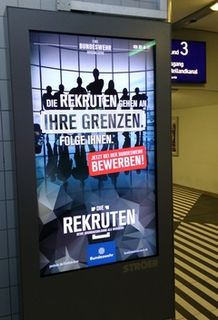
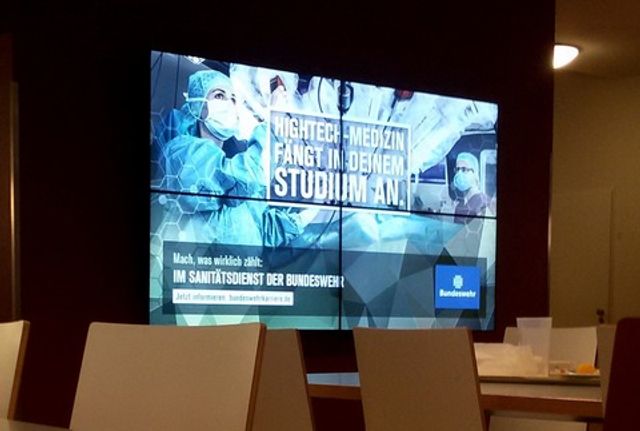
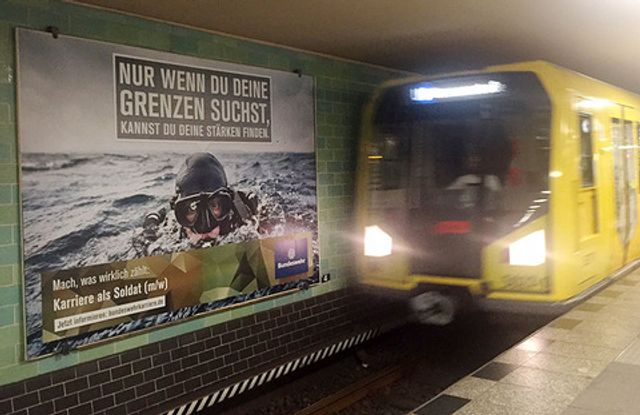
Almost every large German city now features signs and billboards praising the services of the German military (Bundeswehr) and calling on people to do their “duty.” In many bus, tram and underground stations, as well as at schools, universities and education centres, the Bundeswehr has been campaigning with provocative slogans like “Do something that really counts” and “You can’t solve crises by hanging around and drinking tea.”
The propaganda campaign is part of the return of militarism launched by President Joachim Gauck and the German government at the Munich Security Conference in 2014. Since that time the Defence Ministry has been working hard to create a combat-ready army and recruit soldiers for military interventions in the Middle East and Africa.
Bundeswehr propaganda on the Berlin underground
In early December, Defence Minister Ursula Von der Leyen (Christian Democrats, CDU) presented the Bundeswehr’s new human resources strategy. The issue, her report argued, was to “have men and women with the right qualifications in the right place at the right time.” It continued, “In this way we guarantee the readiness of personnel to deploy, fulfill our obligations in a broad, shifting spectrum of interventions and make it possible for Germany to play an appropriate role in security policy.”
Since the end of compulsory military service on July 1, 2011, the Bundeswehr has faced major problems in attracting and training new recruits. As the parliamentary representative for army affairs, Hans-Peter Bartels (Social Democrats, SPD), complained recently in Handelsblatt (a leading business newspaper), “In June 2016 we had the smallest Bundeswehr ever.”
To counter this trend, the Bundeswehr has organised an advertising campaign aimed at youth and young adults. In 2015 alone, the Defence Ministry spent €35.2 million [US$37.5 million] on career advertising. This is €23.2 million more than in 2010, shortly before the end of compulsory military service. Costs for career advertising have thus nearly tripled.
So-called youth officers visit schools to appeal to students to join up. They offer the prospect of stable living conditions, as well as training or studying at university. These are offers that, given the miserable social conditions and lack of opportunities on the labour market, certainly sound attractive. The Bundeswehr is even prepared to appeal to children. When pictures of this year’s “Bundeswehr Day” were published in the media in which children were visible while smiling soldiers showed them how to handle a machine gun, they provoked a wave of protests.
A look at the Bundeswehr’s web site underscores that the army is deliberately targeting very young people. A school practicum of between two and three weeks is offered for children as young as 10, involving the “civilian sector” as well as “the armed forces.” The practicum placements are located “generally in military institutions and the temporary colleagues are usually soldiers, so that our practicants have sufficient opportunities to get an impression of the Bundeswehr as an employer.”
Advertising in Wolfsburg's main train station
The Child Soldier Alliance, whose members include Amnesty International Germany and UNICEF Germany, regularly criticises the German government for recruiting minors. In its “Shadow report on child soldiers” from 2013, it warned, “It seems possible that the number of minors in the Bundeswehr will increase. The Bundeswehr undertakes comprehensive advertising campaigns that increasingly target minors.”
This is precisely what has occurred. The number of minors who are being trained to use weapons is steadily increasing. While in 2010, 496 minors joined the Bundeswehr, so far this year there have been 1,576 recruits.
The centrepiece of the recruiting campaign among youth is the online series “The recruits.” It appears five days a week on YouTube and chronicles the training of 12 young recruits over three months. The Bundeswehr spent €1.7 million on the series. An additional €6.2 million has been spent on advertising on Facebook and other social media outlets.
The series recalls the “docu-soaps” broadcast on private television channels. With music in the background and humorously constructed characters, the daily lives of the “recruits” are made out to be like an adventure holiday with sporting challenges. While the first episodes mainly focus on discipline and the tough life of a soldier, the army as a whole is presented as a “cool squad,” where everyone sticks together and supports each other. This fits in with the advertising slogan, “What do 1,000 online friends amount to compared to one comrade?”
Bundeswehr advertising sign at the Humboldt University Nord cafeteria
But none of this can conceal the actual purpose of the training: a new generation is to fight in foreign interventions in the interests of German imperialism and, if necessary, die. While Von der Leyen boasts of the great response her campaign has received, opposition is growing among young workers and students.
Numerous videos on YouTube comment on and question the Bundeswehr series. A web site set up by the “Peng! Collective,” which effectively mocked the Bundeswehr campaign, attracted some 150,000 visits, more than the Bundeswehr’s official site. On the deceivingly realistic web site, the career suggestions from the Bundeswehr were replaced by “doctor,” “teacher” and “refugee assistant,” and the slogans replaced with phrases such as “Your life for the powerful” and “War can destroy you.”
The campaign has also provoked resistance at universities. At the University of Hamburg, a protest by the general student representative committee led to the student centre no longer carrying the Bundeswehr’s advertising in the cafeterias.
At the end of November, the student parliament at Berlin’s Humboldt University (HU) spoke out against army advertising at the university. The university’s International Youth and Students for Social Equality (IYSSE) chapter introduced the resolution. The text, adopted by the majority in the parliament, read, “The student parliament opposes all forms of advertising for the Bundeswehr at our university and calls upon the Berlin student centre and university management not to permit any Bundeswehr advertising initiatives on the HU campus.”

In the wake of the Chapecoense tragedy, Bolivia arrests airline and government officials

Rafael Azul 

In the two weeks that have passed since 71 people, including 19 players of Brazil’s Chapecoense football team, lost their lives in a tragic plane crash near Medellín, Colombia, the disaster has raised questions in the Bolivian media and political establishment on the government’s links to the charter airline, LAMIA. In part to clear Bolivian President Evo Morales of any suspicion, the government launched its own investigation.
In a December 3 press conference calling for a government investigation, Morales made no secret of his close relationship with LAMIA’s general manager, Gustavo Vargas Gamboa, who he has known from his days as a leader of the agricultural coca growers union in the 1990s. Vargas Gamboa also piloted Morales’ presidential plane in 2006-2007. Morales promised to take “drastic measures” in response to the November 28 crash.
Last Friday, December 9, a Bolivian court ordered that Vargas Gamboa be held in prison while awaiting trial for negligence, cronyism, and transportation disaster. Vargas Gamboa, arrested on December 6, is a retired air force general. The arrest took place following a determination that the airplane that crashed had taken off with insufficient fuel to safely make the trip between Santa Cruz, Bolivia, and Medellín, Colombia. He is now under investigation for homicide.
Two days after detaining Vargas Gamboa, Bolivian authorities also arrested his son, Gustavo Vargas Villegas, a high-government official in charge of the National Registry of the Civil Air Command (DGAC); Vargas Villegas issued LAMIA’s license to operate.
Vargas Villegas is being charged with neglect of his duties and for allowing his family connections to influence the performance of his job.
Bolivian authorities are also seeking the extradition of Celia Castedo, who fled to Brazil following the crash. It appears that Castedo, who worked in air traffic control, signed off on the flight plan of the ill-fated LAMIA 2933 flight. Bolivian officials charge that Castedo had the authority to prevent the airplane from taking off and was negligent in not doing so.
Castedo has insisted that the sole authority to stop the flight rested with the Bolivian civil aviation agency. She claimed that she had told superiors the flight should be canceled but had been told to keep quiet.
The government also issued an international order of arrest against Marco Antonio Rocha, a LAMIA owner. In the wake of the tragedy, Rocha refused to return to Bolivia from Paraguay.
For his part, Bolivia’s defense minister Reymi Ferreira accused the pilot of the LAMIA flight of murder for ignoring regulations and for negligence; the pilot, Miguel Quiroga, died in the crash. Ferreira pointed out that Quiroga’s flight plan included a refueling stop in the Bolivian airport of Cobija, roughly one third of the way between Santa Cruz and Medellín; had the refueling stop taken place the Avro RJ-85 would not have run out of fuel and crashed on a mountain side just short of its destination.
This may have been only the first of Quiroga’s errors. According to the Mexico City news journal Proceso, as soon as fuel reserves ran low, Quiroga had the option of landing in the Bogotá airport, but did not do so. Finally, Quiroga could have declared a “Mayday” emergency. Such a message to the Rio Negro airport air traffic controllers would have triggered an accelerated response that perhaps could have saved the flight. Instead, the control tower placed the LAMIA plane on hold to prioritize another distressed flight.
Quiroga’s decisions may have been motivated by the fact that, as co-owner of the small airline (three RJ-85 airplanes, two of them in repair), he was under financial pressure. Each of the decisions not taken would have involved a financial cost to LAMIA and to Quiroga himself. LAMIA’s chief executive, Vargas Gamboa, in previous statements had made no secret that the airline confronted economic pressures.
Univisión, a US-based Spanish language TV network, has identified other LAMIA flights that had ended with fuel reserves well below the required fuel for 45 minutes’ flying time. The very same plane that crashed on November 28 had gone through eight low fuel-reserve incidents. Univisión also found that some of those flights also exceeded weight limits.
Pilot and security expert Estaban Saltos told Univisión: “This reflects that systematic violations existed in nearly every flight.” Saltos came to the conclusion that LAMIA “made it a practice to push their flights to the limit of fuel capacity.”
Among the flights cited by Univisión is one on October 29, between Medellín and Santa Cruz (the same endpoints, in the opposite direction as the November 28 flight), ferrying the Atlético Nacional team to a game for the South America Cup.
From the beginning, the Medellín plane crash raised questions about the relationship between the administration of President Evo Morales and LAMIA. Six days after the crash, Morales’ chief of staff, Juan Ramón Quintana, denied rumors that Vargas Gamboa had been rewarded with an operating license for LAMIA because he had been the president’s pilot in 2006 and 2007. He also denied any ties between the president and LAMIA management and expressed surprise that Vargas Gamboa possibly had taken advantage of his family connections to unlawfully obtain an operating license for the airline.
Quintana declared that Morales did not know whether LAMIA was properly licensed when the president flew in one of its planes between the Bolivian cities of Rurrnabaque and Trinidad on November 16. He also denounced the right-wing opposition for “placing the blame” on the Morales administration for the issues surrounding LAMIA.

Canada’s top spy “watchdog” says Edward Snowden should be shot

Roger Jordan

Michael Doucet—the director of the government “watchdog” agency tasked with ensuring the Canadian Security Intelligence Service (CSIS) doesn’t violate Canadians’ rights—has publicly declared that US National Security Agency (NSA) whistleblower Edward Snowden should be shot.
Far from being an individual outburst, Doucet’s remarks exemplify broad sentiments within establishment circles. More than three years after Snowden lifted the veil on the NSA’s illegal activities, including the major role that Canada plays in the NSA-led “Five Eyes” global spy network, the Canadian ruling elite remains outraged at his exposures.
The head of the Security Intelligence Review Committee (SIRC), Doucet responded to a question at a recent talk he gave at Toronto’s Ryerson University on what Snowden’s fate would have been had he been Canadian by saying, “Do you want my opinion on that? Do you really want it? I’ll give it to you. If Edward Snowden had worked for CSIS and did what he did, he should be shot.”
Doucet’s outburst underscores the fraudulent character of the SIRC and like government “oversight” bodies charged with ensuring CSIS, Canada’s premier intelligence agency, and other parts of the national-security apparatus don’t violate Canadians’ civil liberties. Such “watchdogs” are in fact lapdogs—state bodies committed to defending, and covering up for, the police and intelligence agencies and upholding the capitalist social order.
The Liberal government response to Doucet’s inflammatory comments is no less revealing. Asked about them, Public Safety Minister Ralph Goodale noted blandly, “That remark strikes me as highly inappropriate.”
Beyond this, there has been no official government response, let alone any suggestion that Doucet should be removed or otherwise sanctioned. Nor have the opposition parties seen fit to raise the issue. As for the corporate media, only the Globe and Mail reported Doucet’s remarks and Goodale’s tepid criticism of them.
The indifference among ruling circles to Doucet’s effective call for Snowden’s execution reflects the ruling elite’s general contempt for basic democratic rights. In the name of the “war on terror,” successive Liberal and Conservative governments have erected the framework of a police state over the past 15 years, including sanctioning the intelligence agencies to systematically spy on Canadians. They would rather see figures like Snowden, whose courageous actions brought some of the state’s illegal practices to public attention, silenced, or even eliminated, than lift a finger in defence of democratic rights.
No country’s national security apparatus is more closely integrated with that of the US than Canada’s. As a key Washington ally for over three quarters of a century, Ottawa is deeply implicated in US imperialism’s aggressive pursuit of its geostrategic interests around the world. Canada has participated in virtually every US-led war over the past two decades, is playing a major role in the US military-strategic offensives against Russia and China, and through the “Five Eyes” surveillance network both assists the Pentagon in its wars and helps monitor the political beliefs and activities of the world’s population.
In 2013, Snowden revealed that the Canadian Security Establishment (CSE), Ottawa’s signals intelligence agency, functions as a veritable arm of the NSA. This includes: assisting the NSA in developing surveillance programs; carrying out operations, especially in countries where US citizens have limited access; and training personnel. It also conducts economic spying to benefit Canadian corporate interests, as shown by Snowden’s revelation that CSE eavesdropped on mining companies active in Brazil.
Other documents revealed by Snowden provided evidence that the CSE systematically collects the metadata of Canadians’ electronic communications, a blatant violation of their constitutional rights, not to mention the mandate of CSE, which is authorized to spy only on foreign targets.
CSIS has been no less aggressive in its law-breaking activities. The domestic spy agency has been combing Canadians’ metadata since 2004 and has lied to the courts about its actions. Federal court judges have repeatedly chastised CSIS and CSE for deliberately withholding information from them.
Doucet, who is ostensibly the top watchdog tasked with holding CSIS to account, was himself deeply implicated in the CSE-NSA partnership and as such, no doubt, in the development of the mass surveillance of North Americans’ electronic communications and internet use. He told his student audience that in the mid-2000s, when he worked for CSE, he served as the embedded liaison officer at NSA headquarters.
From the outset, Canada’s ruling elite made no secret of its hostility to Snowden. Like all other Western governments, Canada refused to grant Snowden asylum, despite the fact that he faces almost certain execution or incarceration for life should he return to the United States. He currently resides in Moscow, where he was stranded in 2013 after the US made clear that it was determined to seize him. This included forcing down the Bolivian president’s plane, because they believed it might be carrying Snowden to asylum in South America.
Canada’s then foreign minister, John Baird, declared his full support for the US efforts to bring Snowden to “justice,” publicly demanding Snowden surrender to US authorities. For his part, Jean-Pierre Plouffe, the government-appointed commissioner tasked with overseeing CSE’s activities, denounced Snowden’s exposures of the illegal activities of the NSA and CSE, saying they had led “to a lot of misinformation.”
In his Ryerson appearance, Doucet continued in this vein, asserting that Snowden’s actions had damaged “national security.” Immediately following his declaration that Snowden deserves to be shot, Docuet claimed that if Snowden had concerns about the scope and legality of the NSA’s spying he should have raised them with his superiors.
“(I)f he worked for CSIS, there are all the mechanisms there, as there were in the States, to raise the issues that he felt needed to be raised,” claimed Doucet. “If he really cared about the US, the US system, he would have exhausted every avenue … he would not have released so much information that would have placed Americans, allies and others in risk of harm.”
This is a pack of lies. In the first place, the spying operations of the NSA, CSE and the “Five Eyes” alliance are not directed at safeguarding the population, but at upholding the predatory interests of US and Canadian imperialism and their British, Australian and New Zealand allies. Not Snowden, but the national security apparatus, which functions as a state within the state to spy on and suppress political opposition, constitutes the real threat to the population, as demonstrated by their systematic violation of basic democratic rights.
Second, bodies like SIRC and their counterparts in other countries have proven worse than useless at preventing the erection of a police state apparatus and the embrace of illegal surveillance methods by the agencies that they are supposed to oversee.
While Doucet boasts that in Canada “there are all the mechanisms” for would-be whistle-blowers to come forward, his call for Snowden’s death (subsequently qualified to include his criminal prosecution) constitutes—to say the least—a chilling warning as to how the SIRC and Canadian elite would receive any internal complaints of illegal activities by the national security apparatus.
Since Snowden’s revelations were made public, the Canadian ruling class has further strengthened the repressive powers of its state. In 2015 the Conservatives and Liberals collaborated to ram through parliament legislation (Bill C-51) that guts privacy protections, creates a new “speech crime” of “promoting terrorism,” and empowers CSIS to break virtually any law when “disrupting” vaguely-defined threats to national security.
Although they ensured Bill C-51’s speedy passage, the Liberals, recognizing it was highly unpopular, promised during last fall’s election campaign that they would amend it. Predictably, this promise has proven to be a fraud. To date, the only amendment they have introduced is to create a parliamentary oversight committee, a move, which as the populations of Britain and the United States can testify, will do nothing to hinder the intelligence agencies’ illegal mass surveillance.
The silence of the smaller opposition parties, the New Democrats, Bloc Quebecois, and Greens, on Doucet’s call for Snowden’s execution should come as no surprise. All of the established parties accept the “war on terror” narrative as good coin and refuse to challenge the intelligence agencies’ practices.
The muted reaction to Doucet’s comments underscore that as the deepening capitalist crisis heightens already explosive social tensions, the ruling elite is preparing to use the most ruthless measures to suppress opposition to its program of austerity and imperialist war. Earlier this month, Liberal Natural Resources Minister Jim Carr revealed the government is ready to use the military to suppress “non-peaceful” anti-pipeline protests.

Federal Reserve hikes key rate, signals faster monetary tightening

Barry Grey

The US Federal Reserve on Wednesday announced a widely anticipated quarter-percentage-point hike in its benchmark short-term interest rate, the first increase since last December and only the second since 2006. While the financial markets had expected the rise in the federal funds rate from 0.25–0.50 percent to 0.50–0.75 percent, they were surprised by the Fed’s projection of three further quarter-percentage-point increases in 2017.
The previous Fed outlook, released after the September meeting of the central bank’s policy-setting Federal Open Market Committee (FOMC), had predicted only two increases in 2017. The projection issued Wednesday similarly increased the number of rate hikes to three a year in 2018 and 2019.
As a result, the median projection made by Fed governors and Fed bank presidents for the federal funds rate—the overnight lending rate between banks—rose from 1.1 percent to 1.4 percent for 2017 and from 2.6 percent to 2.9 percent for 2019.
The response of the financial markets to this indication of a faster-than-expected tightening of the Fed’s monetary policy was a significant sell-off on the stock market and a sharp rise in bond yields and the dollar. US stocks have risen explosively since the election of Donald Trump on November 8, repeatedly setting new record highs. The Dow Jones Industrial Average was surging earlier in the week toward the giddy plateau of 20,000.
On Wednesday, however, the Dow fell 118 points to close at 19,792, a decline of 0.60 percent. The broader Standard & Poor’s 500 index dropped 18 points, or 0.81 percent, and the tech-heavy Nasdaq shed 27 points, a fall of 0.50 percent.
The Dow has shot up since Election Day on the basis of President-elect Trump’s pledges to slash tax rates for corporations and the wealthy, lift regulations on banks and corporations, sharply increase military spending, and provide tax incentives for companies to invest in infrastructure. His appointment of a cabinet of ultra-right billionaires, CEOs, generals and opponents of social spending and government regulations has further fueled a mood of euphoria within the financial and corporate elite.
Even with the losses registered Wednesday, the Dow has gained 1,459 points in the five weeks since the November 8 vote. This amounts to an increase of 7.96 percent, or 83 percent on an annual basis.
However, the rise in inflation and debt implicit in Trump’s policy has driven up government bond yields, which move inversely to price, and sent the dollar to new highs against the euro, the British pound, the Japanese yen and other world currencies. Bond prices have fallen by more than two percent since Election Day.
On Wednesday, the yield on 2-year Treasury notes, the government bonds most sensitive to Fed moves, shot up to a seven-year high of 1.27 percent. The 10-year Treasury yield, which was 1.867 percent on November 8, rose to 2.54 percent Wednesday afternoon. The dollar index also surged, jumping 1.2 percent to 102.24.
In its statement on Wednesday, the Fed’s FOMC repeated its previous language promising to raise rates only gradually and maintain them “for some time below levels that are expected to prevail in the longer run.”
Until the Fed’s quarter-point rate increase last December, the US central bank had kept its benchmark rate at near-zero since the height of the Wall Street crash in December of 2008. It had supplemented this flood of virtually free credit to the banks and financial markets with trillions of dollars in bank bailouts and “quantitative easing” bond purchases.
The Fed was then joined by all of the major central banks—the European Central Bank, the Bank of England, the Bank of Japan, the People’s Bank of China—in providing unlimited cash to prop up the financial system and prevent the world economy from descending into a full-scale depression. They are continuing to hold rates at record lows and pump funds into the markets via bond purchases, even as the Fed moves in the opposite direction.
The policy of virtually limitless monetary stimulus has failed to restore economic growth to anything close to the pace of previous recoveries from recessions, and instead fueled increasing trade conflicts and social tensions. The banks, particularly in Europe, remain financially unstable, with hundreds of billions of worthless assets on their books. The International Monetary Fund has warned of record debt levels that threaten to trigger a new and even more disastrous financial crisis.
World trade is growing more slowly, and productive investment and productivity are down in most major industrialized countries, including the US.
Recent developments—the British Brexit vote, the election of Trump, the referendum defeat and resignation of Italian Prime Minister Matteo Renzi—reflect a growth of economic nationalism and the breakup of the post-World War II economic order.
Despite the Fed’s pledge on Wednesday to keep interest rates well below previous norms, there were indications that, in the face of Trump’s inflationary policies, it could move quickly in the opposite direction. The FOMC statement pointedly referred to “solid” job gains and rising wages, declaring that “Market-based measures of inflation compensation have moved up considerably…”
In a press conference following the FOMC meeting, Fed Chair Janet Yellen showed little enthusiasm for Trump’s talk of a $1 trillion infrastructure program. Asked about her views on fiscal stimulus, she said that “the degree of slack [in the labor market] has diminished,” and “fiscal policy is not obviously needed to provide stimulus to get us back to full employment.” She also warned of a rise in the ratio of US debt to gross domestic product.
A number of financial analysts pointed to the signs of concern at the Fed over the prospect of a sharp rise in inflation. Luke Bartholomew, investment manager at Abderdeen Asset Management, told the Financial Times: “If there is a large fiscal stimulus then this will almost certainly create inflation pressure that the Fed will have to fight by raising rates.”
Steven Ricchiuto, chief US economist at Mizuho, told the Wall Street Journal, “The tone of the statement was also a bit hawkish, with the emphasis on the tightening labor market and inflation being highlighted.”
The Journal quoted Ian Shepherdson, chief economist at Pantheon Macroeconomics, speaking of the increased pace of monetary tightening. “We’re slightly surprised to see it,” he said, “but it is a welcome development, in our view. We remain very worried that the Fed and markets do not fully appreciate the extent of upside inflation risk for next year via the labor market, where wage growth is on the verge of a rapid acceleration.”
In other words, interest rates must be raised to undercut a possible push by workers for higher wages.

President Trump's Prospects for the Middle East

Derek Verbakel


Predicting the implications of Donald Trump’s presidency for the Middle East requires informed guesswork in drawing links from campaign rhetoric to a more coherent approach or ensuing foreign policy. Trump, who apparently favours ‘isolationism’, seems averse to the United States’ longstanding bipartisan pursuit of overambitious policies in the region. His discourse reflects a shallow and myopic worldview privileging winner/loser binaries over interdependency, and he identifies little to gain from a Middle East wracked by complex and chaotic conflicts. His administration appears poised to shift the methods of US military interventions in the region and recalibrate relations with several regional actors. Such an approach could further churn an already unstable Middle East. 

Trump's foreign policy direction will be heavily influenced by the advisors and officials surrounding him. The current roster portends an inflow of deeply ideological thinking ill-suited to apprehending the complexities of regional politics. National Security Advisor Lt. Gen. Michael Flynn sees an existential threat posed by so-called ‘Islamic terrorism’, which he conflates with ‘Islam’ and ‘Islamism’. Walid Phares, a key Trump advisor and former ideologue of a sectarian Christian militia during Lebanon’s civil war, also propounds a variant of long-discredited ‘Clash of Civilizations’ theory. The incoming Secretary of State can be expected to hold similar views. 

Such an outlook will guide US policy in Iraq and Syria, where Trump appears committed to reducing the presence of American ground personnel while sustaining military pressure to combat designated terrorist groups. Trump suggests he will coordinate – if not collaborate – with Russia, Syrian President Assad's main backer beside Iran, which would be interpreted by the pro-Assad coalition as a green light to intensify their brutal campaign to recapture territory from rebels. But untold consequences could emerge from resulting growth of Russian influence in the Middle East.

Also likely will be a withdrawal of US support to more ‘moderate’ opposition forces in Syria, who will continue to dwindle while targeted alongside extremist al-Qaeda-affiliates and IS by Assad-aligned forces. This would advance the narratives and leading position of extremists within the opposition, who will never disappear while Assad remains in power. Absent a widely accepted political ‘solution’, this would prolong the conflict and increase displacement of Syrians inside and outside the country. Trump advisors have also called for more US airstrikes in Iraq and Syria with less emphasis on avoiding civilian deaths, and this too would fuel radicalism in these countries and worldwide. 

Trump may also seek closer relations with regional leaders more sympathetic to his stance on Syria and whose authoritarian leanings elicit his admiration. Alongside Assad and others, Egypt’s Sisi and Turkey’s Erdoğan could reinforce a decades-old US policy of prioritising ‘stability’ under repressive leaders over the pursuit of democratic transformations and human rights in the region.

Also necessary will be to account for the wishes of regional allies, particularly among the Gulf Arab states, to see Assad unseated and Iran’s growing regional power thereby diminished. Indeed, Trump’s supposed Syria policy would spare Iran a huge geopolitical blow, as the Assad regime’s survival anchors Iran’s spheres of influence extending through Baghdad and Damascus to Beirut. 

Trump has stated the 2015 Iran nuclear deal will be renegotiated. Yet there would be no appetite for this from Iran or the remaining P5+1, who derive economic and security benefits from the agreement. Unilaterally dismantling the agreement would be infeasible, and given Iran's significant role in Iraq and Syria, he will be restrained by the need to maintain a working relationship with Tehran to fight IS. 

Trump could attempt to subvert the deal in various ways. However, widespread perception in Iran of Washington’s treacherousness could vindicate and benefit rivals of President Rouhani. Seeking re-election in May 2017 and to further ‘normalise’ Iran’s international relations, Rouhani touts the deal as a huge triumph. But with an electoral victory, hardliners could pursue an agenda to resume Iran’s nuclear program without international monitoring. A new phase of conflict drawing in the US, Israel, and the Gulf sheikhdoms could result from steps in this direction. 

Also of interest to Israeli Prime Minister Netanyahu is that unlike previous US presidents from both parties, Trump claims Israeli settlement expansion in the West Bank is not an obstacle to reaching an Israeli-Palestinian peace accord. While Trump is unlikely to pronounce dead the 'two-state solution' which all interested parties purportedly desire, there will be no significant pressure on Israel to halt construction of settlements deemed illegal under international law. 

Trump has claimed he will resolve the Israeli-Palestinian conflict. But due not only to alienation from much of the Republican foreign policy establishment, he lacks capable and inclined diplomats and a plan for them to carry out. A substantial diplomatic initiative from Washington is at best a distant prospect, and absent any progress towards curbing systemic violence against Palestinians or their accession to statehood, chances of another Palestinian uprising and more attacks inside Israel will increase. 

Of little concern to Trump will be the consequences of his policies for the welfare of the Middle East’s peoples. They, like regional leaders, hold mixed opinions on the promise his presidency brings. But widely anticipated is that as the Trump administration and its foreign policy trajectories take shape, so too will ramifications for stability in the Middle East.

Xi as "Core Leader", Re-emergence of Strongman Politics?

Tapan Bharadwaj


The sixth plenary session of the 18th Communist Party of China (CPC) Central Committee was held in Beijing on 24-27 October  2016. Plenary sessions are important in understanding the opaque political functioning of the Chinese government. The Central Committee decided to officially recognize President Xi Jingping as the “core leader”. With this Xi joins the league of leaders such as Deng Xiaoping, who had coined the word ‘core leader’. Deng called Mao Zedong and himself core leaders of their generations, and Jiang Zemin of the third generation of the CPC leadership. However, Hu Jintao, Jiang's successor, was never given this recognition.

Deng Xiaoping’s retirement from politics had brought an end to the era of strongman politics, centred around one man. For the past two decades, collective leadership of political bureau members of the Central Committee is the governing principal of the CPC. The convention of general secretary of CPC as first among equals in the political bureau emerged with Jiang Zemin’s succession to power. Will Xi’s recognition as core leader change or challenge this convention? This question needs to be assessed within the broader context of Xi’s presidency over the past three years and four documents issued by CPC. 

This article will highlight the important aspects of four documents issued after the plenary session, which includes the party communiqué. It will look at the importance of Xi becoming 'Core leader' and address the question whether collective leadership will remain the guiding principle for governance within the party?

Disciplining the party

The Political Bureau of the CPC Central Committee announced the agenda on 27 September itself, a month before the actual gathering.
 
The plenary session passed two related documents on the subject of discipline in the party. The first document titled “Some Norms Regarding Intra-party Political Life under New Circumstances” asks party members to act according to the CPC’s basic line by safeguarding the authority of the Central Committee and maintaining close ties with the people. The second document “Regulations Regarding Intra-party Supervision” asks to uphold the CPC’s leadership, strengthen party building, promote the comprehensive and strict governance of the party, and maintain the party’s status and purity. Both documents stress upon strict governance and centrality of the Central Committee in the CPC’s decision making. The objectives are to prevent old problems like corruption from recurring and new ones like income and regional inequality from spreading. The strict party governance will increase the CPC's capability to solve its internal problems and defuse the challenges of party governance at various levels.

The third document issued was Xi’s interpretation of the first two documents. Xi said that the documents were introduced to supplement the layout of the CPC’s four comprehensives, a strategy to promote reform and opening up, refine the socialist modernization drive, as well as to adhere to and develop socialism with Chinese characteristics. The four comprehensives stand for all-round moderately prosperous society, deepening of reform, advancement of the rule of law and strict governing of the CPC. According to Xi, the sixth session addresses the fourth comprehensive while the remaining three have already been addressed by the third, fourth and fifth plenary sessions.

Revisiting the idea of collective leadership in the present context

The major transition in leadership and governance has been witnessed in the past two decades with the emergence of the collective leadership principle. The 2007 Party congress communiqué defines collective leadership as “a system with a division of responsibilities among individual leaders in an effort to prevent arbitrary decision making by a single top leader.” The aim was to ensure that no individual dominated the party leadership.
 
Today, Xi is the most powerful leader in the party. His tough national anti-corruption campaign has achieved significant success. The CPC’s Central Commission for Discipline Inspection, the nodal agency on anti-corruption, has stated that 1.01 million officials have been investigated for corruption since Xi took charges. 

It has created an opposition of unknown nature within the party, where party loyalists are difficult to identify. Five out of seven Politburo members of the standing committee are retiring next year. A strong leader is needed to restore the collective leadership system in the party. Hence, CPC’s decision to recognize Xi as the core leader is a calculated move to avoid the emergence of any crisis in the party. This will help in continuing the policies without delay and disturbances. Xi’s national anti-corruption campaign, which has delivered its promise to target tigers and flies equally has had significant outcomes. 34 ministerial-level officials have reportedly been sentenced under this campaign, which will strengthen further in the future.

It is wrong to expect that Xi will become a figure like Mao only by being elevated to the title of "core leader". He has been central to the party since he took charge. Both the Communiqué and Xi highlighted the importance of collective leadership system as the core. Xi by the virtue of his personality has managed to become, what his predecessor failed to achieve, the core in the Politburo. This will maintain the system of the political bureau’s leadership under a strong leader without undermining the collective leadership principle.

14 Dec 2016

Fox International Fellowships for Bachelors, Masters and Doctoral Students 2017/2018 – Yale University

Application Deadline: Application deadlines are in January/February each year: specific dates will be announced by each Fox partner university.
Offered annually? Yes
Eligible Institutions: Yale University, United States  | University of São Paulo, Brazil  |  Fudan University, China | University of Cambridge, England  |  Institut d’Études de Politiques de Paris, France  |  Freie University of Berlin, Germany  |  University of Ghana, Ghana |  Jawaharlal Nehru University, India  | Tel Aviv University, Israel  |  The University of Tokyo, Japan  |  El Colegio de México, México  |  Moscow State University, Russia  | University of Cape Town, South Africa  |  Boğaziçi University, Turkey | University of British Columbia, Canada  | The Australian National University &  The University of Melbourne, Australia  |   The University of Copenhagen & The Copenhagen Business School, Denmark | National University of Singapore
To be taken at (country): Yale University, USA
Fields of Study: Fox International Fellowships seek applicants whose work has the potential to offer practical solutions to the problems which stand in the way of the world`s peace and prosperity. The fellowship focuses on such critical fields as: international relations and global affairs, law, environmental policy, public health, social sciences, economics, political science, business and finance, management, and contemporary history.
About the Award: The Fox International Fellowship is a graduate student exchange program between Yale and 19 world-renowned partner universities. Fox International Fellows are selected for their potential to become leaders in fields that are policy significant, historically informed, and socially meaningful. Such work is increasingly conditioned by the interdisciplinary and transnational character of knowledge and practice in the twenty-first century. Fellows’ research projects and academic interests reflect the areas toward which many of the world’s major decision-makers have gravitated, as well as those that have the potential to open new channels of debate.
The Fox Fellowship, through scholarship and civic engagement, aims to enhance “mutual understanding” between the United States and the home countries of our partner universities in order to provoke and contribute to productive dialogue around complex challenges and to offer current and enduring solutions. Initiated at the end of the Cold War, the focus on peace and conflict in general and U.S./Soviet interaction has expanded to include a host of twenty-first century challenges in every world region such as prosperity and development, poverty alleviation, environmental degradation, resource stewardship, and human rights.
Type: Fellowship, Doctoral, Masters.
The Fox Fellowship is NOT open to postdoctoral applicants. International student proposing projects in their home country are NOT eligible.
Eligibility: Graduate level students pursuing Doctoral or Masters level degrees and graduating master’s level students are eligible. Graduating bachelors’ level students of unusual merit and distinction may be considered but advanced, graduate level students are preferred. The Fox Fellowship is NOT open to postdoctoral applicants and international student proposing projects in their home country are NOT eligible.
Personal characteristics: The candidate must demonstrate commitment to serious research and also capacity for leadership and civic engagement in the larger community. The candidate clearly understands and has demonstrated commitment to being a “citizen ambassador.”
Strength of academic achievement: The candidate must demonstrate both excellence in relevant coursework as well as strong evidence of research ability in the field of endeavor they are proposing as their Fox Fellowship project.
Field of focus: A strong and specific research project with a focus in international relations and global affairs, environmental policy, public health, business and finance, social sciences, economics, political science, law, and contemporary history, with preference for topics of contemporary, applied and/or institutional relevance to enhancing the world’s peace and prosperity. The candidate’s overall program of studies or degree may come from different disciplines and departments as long as their project focuses on one or more of these fields.
Language skills: The candidate’s language skills must be sufficient both to succeed in their research project and to engage in the intellectual and social community of the host university and their colleagues in the Fox International Fellowship at Yale. Candidates for Fox Fellowships at Yale University have to provide recent TOEFL or IELTS scores demonstrating proficiency in English conversation, reading and writing. This requirement is waived only for applicants from partner institutions where English is the primary language of instruction.
Selection Criteria: The Yale Fox Fellowship selection committee makes the final decision based on the following criteria:
●    Quality of research proposal
●    Strength of academic achievement
●    Character and demonstrated leadership potential
●    Demonstrated personal commitment to being a “citizen ambassador”
Number of Awardees: Annually at least one student from each Fox exchange partner takes up residency at Yale, and at least one Yale student goes to each partner.
Value of Fellowship: All Fellows at Yale receive the same award, which is commensurate to the level of funding received by doctoral students in the graduate school.  Awards include round-trip travel, accommodations in rental housing provided by the Fox Fellowship and a generous living stipend to cover expenses not already provided for by existing funds that you may have at your disposal. The Fellowship will also cover health insurance. All fellows are also able to apply for grants from a research travel fund up to U.S.D $2000.
Duration of Fellowship: 10 months
How to Apply: All applicants are encouraged to read the Frequently Asked Questions (FAQ) section before applying. For students at Fox Fellowship exchange partner institutions, click here.
Award Provider: Yale University

Online Course: Learn to Create 3D Graphics for Web Developers

Enrolment: 2 January 2017 / Self paced
Timeline: 5 weeks @ 6 hours per week
Skill Level: Intermediate
Course of Study: 3D Graphics | Course Platform: FutureLearn
Created by: Pompeu Fabra University Barcelona
Cost: Free
About the Course
With the advent of WebGL, it is now possible to develop high-quality, interactive 3D graphics applications, which run natively in web browsers. However, to do this, you need to be proficient in both web development and 3D programming.
This free online course will provide web developers, who have existing knowledge of JavaScript, with the theoretical and practical knowledge to start programming 3D graphics applications for the web.
Learn to use WebGLStudio and Three.JS to create WebGL applications
The course is split into five weeks. In the first two weeks, Javi Agenjo will teach you the basics of 3D graphics from a non-programmer’s point of view, explaining concepts such as transformations and materials using a state-of-the-art web tool, WebGLStudio. There will be no programming in these two weeks.
Weeks 3, 4 and 5, however, are 100% programming-based. After showing you how to set up your computer for local development of WebGL applications, Alun Evans will lead you through the process of creating a series of simple scenes using the most common and popular library for creating WebGL applications, Three.JS.
In the final week, you will be able to load in meshes and textures from external sources, place lights and objects within a scene, and move the camera interactively.
Eligibility requirement
This course is designed for existing web developers who have little or no previous experience in creating 3D graphics applications. You should be capable of manipulating the DOM using JavaScript or JQuery, and familiar with the concepts of AJAX. You should also have at least intermediate-level programming skills and be comfortable manipulating arrays and objects.
Certificate offered? Yes
How to Enrol

University of Manchester Law Scholarships for International Students 2017/2018

Application Deadline: 10th March 2017
Offered annually? Yes
Eligible Countries: International, home/EU countries
To be taken at (country): UK
Field of Study: The scholarships are open to all new students both overseas and home/EU students in all research areas within the School.

Type: PhD/MPhil
Eligibility: Competition is intense, but we welcome applications from well-qualified graduates.
  • You must hold an offer for one of our PhD/MPhil programmes
  • You should have accepted your offer by 10 March 2017
  • You must hold a First Class Honours/ High 2.1 or equivalent in your undergraduate degree/ and a distinction/ high merit or equivalent in your postgraduate degree
  • You must be a self-funding student, e.g. you are not sponsored
Successful candidates who have a suitable postgraduate qualification will register onto the PhD Law/Criminology programme and the Scholarship will continue for three years, on condition that they continue to reach the milestones required for progression to the following year.
Successful candidates who do not possess a suitable postgraduate qualification but wish to undertake postgraduate research in law/criminology/bioethics will register in the first instance for the MPhil and are expected to upgrade to PhD for two further years.
Number of Awardees: Not specified
Value of Scholarship:  These awards cover tuition fees at EU/Home student rate and provide a maintenance stipend equivalent to that of the RCUK studentships £14,296 for 2017/18.
How to Apply: The application form is available for download via the link below:
E-mail your completed funding application form to:
In order to ensure that you hold an offer for a place on the programme by the funding deadline, you must submit your PhD application by 10 February 2017. If you are not in receipt of an offer you will not be included in the competition.
Award Provider: University of Manchester

Innovation in the Food Industry & How it’s Affecting Our Society – Take Online Course by University of Leeds

Enrolment: Self paced
Timeline: 2 weeks @ 2 hours per week
Skill Level: Beginner
Course of Study: Food Innovation| Course Platform: FutureLearn
Created by: University of Leeds
Cost: Free
About the Course
This course considers the ways in which the food industry has evolved over the past 70 years and has created the industry of convenience we have today. Introduced though a case study from Marks and Spencer, you will see how new innovations have changed the way we shop. You will also consider the issue of food waste; in a world where thousands suffer from malnutrition and starvation you’ll consider the attitudes in your own society to this global problem.
Eligibility requirement
No previous knowledge or experience of business or innovation is required, just an interest in innovations and the food industry.
Certificate offered? Yes
How to Enrol