17 Dec 2016

Significant rise in UK homelessness

Joe Mount 

Shelter has revealed that the number of homeless people in England has risen to over 250,000.
The homelessness charity included the following sources in order to record an accurate figure: national government statistics on rough sleepers, statistics on those in temporary accommodation, the number of people housed in hostels, and those waiting to be housed by social services departments (obtained through Freedom of Information requests).
Of these homeless people, almost half are children.
Shelter released the new figures to mark the 50th year since it was founded in response to the appalling social conditions of post-war Britain. Shelter chief executive Campbell Robb explained, “Shelter’s founding shone a light on hidden homelessness in the sixties’ slums. But while those troubled times have faded into memory, 50 years on, a modern-day housing crisis is tightening its grip on our country.”
Shelter explained that their analysis gives a conservative, lower-end estimate and real homelessness figures are much higher. They report that calls to their helpline are up by 50,000 since last year, so they now receive one call every 30 seconds. The number of families living in temporary accommodation rose by 15 percent. Further thousands do not qualify for formal housing assistance.
The geographical breakdown of the figures reveals homelessness hotspots in the urban centres. London is worst affected, with a shocking 2 percent of people facing housing insecurity. Here, the number of people sleeping rough has doubled in five years from 3,673 in 2009-10 to 7,500 last year. The city hosts widespread social deprivation alongside incredible wealth as one of the world’s major playgrounds for the corporate and financial oligarchy.
In Birmingham, Britain’s second-largest city, 9,650 people lack proper accommodation each night and dozens are forced to sleep on the street. At the end of last month Chiriac Inout was found dead after sleeping rough when temperatures plunged to six degrees below freezing.
The next worst affected cities are Luton, where one in every 63 people are housing insecure, Brighton (one in every 69), Slough (one in 164), Bristol, Coventry (one in 204), Reading (one in 170) and Manchester (one in 266).
Around 3,600 people sleep on the streets each night in England. Precise figures are not available and the real number is likely to be much higher. These numbers have doubled since 2010.
Homelessness is a frightening and isolating experience that causes difficulties finding employment and has a massive impact on mental and physical health. The life expectancy for homeless people is only 47 years of age, dramatically lower than the national average of 81. Rough sleepers are 35 times more likely to commit suicide and are extremely prone to mental health and drug problems. Homelessness causes permanent psychological damage to the children it affects.
Thousands are being forced out of their homes by rising rents and cuts to housing benefit. The biggest immediate factor is eviction from accommodation in the private rented sector, as many face tighter budgets and insecure tenancies. This causes two-fifths of homeless cases in London and the figure nationally has risen fourfold between 2010 and 2015, according to homelessness charity Crisis. The financial issues are often compounded by social problems, mental health disorders or relationship breakdown.
Existing state aid for homelessness is barely adequate, with hostels or bed-and-breakfasts often run-down and at a large distance from schools and local connections. Councillor Martin Tett of the Local Government Association stated, “Funding pressures are combining with housing and rents continuing to rise above household incomes to leave many councils struggling to cope with rising homelessness across all areas of the country.”
Tett is leader of the Conservative-led Buckinghamshire County Council and neglects to mention that his party has vastly exacerbated the homelessness crisis over the past seven years with its imposition of over £100 billion in austerity cuts to services and job losses.
Local authorities of all political stripes are imposing harsh measures affecting the homeless following central government spending reductions. Labour-run Birmingham City Council is cutting its “supporting people” budget, which covers homelessness among other social problems, by £10 million over two years. Another Labour-run authority, South Tyneside, recently imposed £100 fines, under draconian Public Spaces Protection Orders, on homeless people who accept food and drink from members of the public.
Fully 1.5 million private renters rely on some form of welfare benefits, rising to 4.6 million, including social housing tenants. Around 500,000 are in paid work but still rely on such support—a figure that has almost trebled since 2009. The Tory government freeze means that housing benefits are falling in real terms due to rising rents, affecting over 300,000 of the poorest households. The government’s £25 billion housing benefits budget has been cut by £7 billion in recent years. According to Shelter, by 2020 four-fifths of local councils will not be able to provide housing benefits sufficient to afford even the cheapest accommodation.
More broadly, a dearth of affordable housing has developed over the past few decades due to the anti-working class policies of consecutive Labour and Conservative governments. Council housing has been privatised and no new stock has been constructed to replace it. In 2013-14, only around 140,000 new houses were built, far below the 250,000 required to meet demand.
It is notoriously difficult to be accepted for homelessness assistance. Local authorities are only obliged to assist those who fulfil a strict set of criteria. Of the 275,000 people that applied for local authority support last year, only half were accepted, according to research by several homelessness charities. As Matt Downie of Crisis explained, “It’s only half a safety net.” In Wales, the proportion of accepted applications is only 36 percent.
Most single homeless people are not entitled to assistance and form many of the “hidden homeless” getting by in hostels and staying with friends. There are around 35,000 hostel beds for single homeless people nationally—down 4,000 since 2012—due to funding cuts.
The government denied the new figures, with the Department for Communities and Local Government claiming that rough sleeping had fallen to half its peak figure in 2003.
In reality, economic stagnation and government austerity measures are driving hundreds of thousands into poverty. The bourgeoisie requires that the bank bailouts that followed the 2008 global financial crisis be paid off by the working class through a new “age of austerity.” This agenda could only be imposed with the complicity of the Labour Party and the trade unions.
Alongside years of cuts to welfare entitlements, last month the Conservative Government of Prime Minister Theresa May imposed a draconian welfare cap, agreed by her predecessor David Cameron. This massively reduces the income of the most vulnerable layers of society.
Chancellor of the Exchequer Philip Hammond promised an additional £1.4 billion for housing in England in his Autumn Statement—enough to construct just 40,000 homes. Even if these houses are built, it is far below what is required to meet the real scale of the housing crisis.

Massive protests in Germany against deportations to Afghanistan

Marianne Arens & Martin Kreickenbaum

On Wednesday, 34 Afghan refugees were forcibly deported to Kabul from Frankfurt on a charter flight from the Frankfurt-Rhein-Main Airport. This is the first time such a mass deportation has taken place in Germany. A spontaneous demonstration at the Frankfurt airport involved about a thousand people, including many young people. They wore stop signs and chanted slogans such as “Deportation is torture, deportation is murder. A right to stay for all, immediately!”
Protests and demonstrations have already taken place. On Saturday, the “International Day of Human Rights,” thousands of people in Berlin participated in a demonstration to stop deportations to Afghanistan.
In spite of these protests, the German government went ahead with the deportations using extreme brutality. It is deporting refugees, many of whom have been tolerated for many years, back to a country where war rages and basic human rights are nonexistent.
In October, the EU agreed a repatriation agreement with the puppet government in Afghanistan and assured the payment of €1.7 billion when the Afghan government accepts refugees in return. The driving force behind the shabby deal was the German government. On this basis, the German Minister of the Interior, Thomas de Maizière (CDU), wants to expel up to 12,500 people from Germany to Afghanistan whose asylum applications have been rejected and only have “toleration” status.
It was originally planned to deport 50 Afghan refugees on Wednesday. Fifteen people had gone underground, however, de Maizière explained. He announced that “in future families and women would also be deported.”
The deportees were by no means “criminal asylum-seekers,” as had been claimed earlier. Most of them were refugees who had lived in Germany for years and were now being deported overnight. Twenty-two-year-old Babur Sedik told the Frankfurter Rundschau that he had been in Germany for four years and had lived exclusively in refugee homes and camps. Rahmat Khan, also 22, had fled from the fiercely contested region of Paktia and has now been deported.
The Bavarian refugee council reported that an Afghan refugee from Dingolfing had jumped out of the window at 3 a.m. when police sought to arrest him. He was taken to a clinic and apparently placed on the plane after short-lived treatment.
The ruthlessness of the security authorities against Afghan refugees is also shown by the case of 24-year-old Samir Narang from Hamburg, who went to the Aliens Office to extend his toleration status. Instead of the extension of his residence permit, however, he received an expulsion permit and was put into the deportation prison in Büren, and has now been deported to Kabul. Samir Narang is a Hindu and belongs to a persecuted religious minority in Afghanistan, and who now has to fear for his life there.
The deportation of one 29-year-old Afghan was stopped at the last minute by the Federal Constitutional Court, because he was still pursuing an asylum procedure. This means that the authorities planned to deport refugees whose asylum applications had not yet been finally rejected.
The Federal Constitutional Court reported that the question of whether deportations to Afghanistan were constitutional had been expressly left open. Despite the obvious concerns of the highest German court, the deportations on Wednesday were carried out in a hurry.
The collective deportation is a clear violation of human rights. This is also the position of the international medical organization IPPNW (Doctors for social responsibility). According to the European Convention on Human Rights (ECHR), which is also applicable in Germany, deportations of refugees to countries where they are threatened with death, persecution or torture are illegal.
But that is exactly the situation in Afghanistan. Even the guidelines of the Federal Office for Migration, which serve as the basis for asylum decisions, leave no room for doubt. “In all parts of Afghanistan there is a domestic armed conflict in the form of civil war and guerrilla fighting between Afghan security forces and the Taliban, as well as other opposition forces.” Human rights violations are widespread, food supplies are scarce and half of all children in Afghanistan are “endangered by long-term malnutrition.”
The security situation has dramatically intensified in the last 18 months. The UN mission to Afghanistan reported more civilian casualties in the first nine months of this year than since censuses began in 2009. The New York Times reported recently that Taliban militias killed 30 to 50 Afghan security forces every month. They have also increased their attacks on provincial capitals, destroyed roads and infrastructure. The government in Kabul is losing control in more and more parts of the country. According to data from the US government, Islamic groups are increasingly filling the power vacuum.
A commentary on German TV by the journalist Georg Restle described the deportations as a “Christmas present for the extreme right.” He demanded an immediate stop to the deportations.
Restle went on: “The truth is: Germany is safe, Afghanistan is by no means safe. Also because we have fought a war there, which has made things much worse, rather than better. This is why the federal government has a special responsibility for this country and the people who flee from it. That is why the deportations to Afghanistan have to be stopped. And now, immediately!”
The brutality with which the federal government is enforcing illegal deportations in the dead of night and fog recalls some of the worst crimes of German history. The Nazi deportations also began with resettlement, long before the trains rolled into the extermination camps.
As was the case in those days, racist attacks are a reaction to the growing economic and social crisis. The ruling class is trying to divert the growing opposition to unemployment, poverty and distress with racism. This is why xenophobia is systematically encouraged to incite workers against one other. The attacks on asylum law in Germany and the brutal deportation measures are the prelude to massive attacks on all workers.
The choice of the right-wing demagogue Donald Trump in the US has also given rise to a sharp turn to the right in European and German politics or, more accurately, accelerated the turn to the right. Bavarian Prime Minister Horst Seehofer (Christian Social Union, CSU) commented on the deportations on television: “I hope this is not a one-time action.” Hundreds of thousands more people would still have to be deported. He based his comments on Chancellor Angela Merkel, who had said that now “return, return, return” was the order of the day.
Just last week a conference of the ruling Christian Democratic Union (CDU) took up the main slogan of the far-right Alternative to Germany, “Foreigners Out!” in its main motion.
In the implementation of this policy, the federal government works closely with all other parties, which are governed by different coalitions at a state level. The states of Hesse, Bavaria, Baden-Württemberg, Hamburg, Saarland and North Rhine-Westphalia all participated in the collective deportation. The main responsibility fell to the Hessen state government, a CDU-Green coalition, which has ultimate control over the Rhein-Main airport and the deportations, which are decided upon at state level. The Greens in Hesse expressly agreed to the deportations.
In the Hessen parliament, Green Party chair Mathias Wagner declared the deportations to Afghanistan “difficult to bear,” but that the state parliament could not assess the security situation there and it was necessary to rely on the judgement of the federal authorities.
In Baden-Württemberg, Green Premier Winfried Kretschmann is working closely with Thomas Strobl (CDU). Strobl is the son-in-law of the federal minister of finance, Wolfgang Schäuble (CDU) and a right-wing rabble-rouser, who represents the politics of the AfD in the CDU. Green politician Boris Palmer, the mayor of Tübingen, also recently called for deportations to Syria.
As usual, the Left Party plays a miserable double game. It was involved in protests at the airport, but is careful not to jeopardize its coalition with the Social Democratic Party and Greens. In Berlin, it has recently formed a coalition with the SPD and Greens and is also preparing deportations.
In Thuringia, Premier Bodo Ramelow (Left Party) has boasted of his success in deportations. Apparently, deportations to Afghanistan are not taboo. In an appeal issued on the “Day of Human Rights” the Thuringian Refugee Council pointed out: “Many refugees living in Thuringia come from Afghanistan. Very long waiting times for a decision on their asylum application and more and more refusals lead to anxiety about their future among Afghan families, unaccompanied minors, women and men.”

Tennessee wrongfully imprisoned man for three decades, provided only $75 compensation

Shelley Connor 

Lawrence McKinney was imprisoned by the state of Tennessee for 31 years for a rape and burglary he did not commit. Under Tennessee law, McKinney could be compensated $1 million.
However, the Tennessee Parole Board has refused to grant him an exoneration hearing, and the only compensation he ever received was the paltry $75 given to him when he was released from prison in 2009. McKinney has now been forced to bring his case before Republican Tennessee Governor Bill Haslam, whose office received the application for executive clemency on November 21.
McKinney was charged in October of 1977 with having raped a Memphis, Tennessee woman and burgling her apartment. Six months later, he and his codefendant were found guilty after the victim identified them in court as her attackers. McKinney, then 22 years old, was sentenced to 115 years in prison for the crime. In 2009, DNA evidence from the victim’s bed sheets demonstrated that McKinney had not been present at the crime scene. He was then released from prison; the state issued him the $75 and the crime was expunged from his record.
Tennessee is one of 31 states with compensation statutes for the wrongly accused. It is also one of many states that complicate the compensation process. McKinney was forced to go before the Tennessee Board of Probation and Parole to seek compensation and exoneration, even though he was released from prison and the crime had been expunged from his record. The board voted 7-0 to deny his exoneration in November.
Patsy Bruce, who sat on the parole board that denied his first exoneration hearing, has stated that she is not convinced that McKinney is innocent, despite DNA to the contrary. She also claimed that the judge and the District Attorney failed to provide properly tested evidence to support McKinney’s innocence.
In the United States DNA evidence was used to exonerate a wrongfully-convicted inmate for the first time in 1989. Since then, nearly 350 people, including McKinney, have been freed on the basis of DNA evidence.
The states, however, have been criminally remiss in responding to the life-changing implications of this technology. Nineteen states—Alaska, Arizona, Arkansas, Delaware, Georgia, Idaho, Indiana, Kansas, Kentucky, Michigan, Nevada, New Mexico, North Dakota, Oregon, Pennsylvania, Rhode Island, South Carolina, South Dakota, and Wyoming—have yet to enact statutes providing compensation for those exonerated of crimes.
In the 31 states where compensation laws do exist, the processes to obtain compensation can be prohibitively time consuming and expensive. In New York, an exoneree has only a two-year window to file civil cases against state and municipal governments to receive compensation. These cases can take years to adjudicate, as demonstrated by the ongoing case of Alan Newton.
In 2010, Newton successfully sued New York City for $18.5 million after his exoneration. Newton had been convicted of rape, robbery, and assault in 1985 in a case that prosecutors had built around eyewitness testimony. He had requested DNA testing of evidence in 1994 and was denied; in 2006, after serving over 20 years in prison, he was finally released on the basis of such evidence.
The city appealed the judgment. In 2011, United States District Court Judge Shira Scheindlin set the judgment aside. Newton appealed Scheindlin’s decision. In 2015, the United States Court of Appeals for the Second Circuit vacated Scheindlin’s ruling and turned the case back over to her.
In March of this year, Scheindlin reduced the award to $12 million, claiming that the previous amount was excessive. If Newton did not accept the reduced amount, Scheindlin said, he would have to suffer another trial. She also cited the fact that Newton had been accused of a separate rape, although he maintains his innocence and no judgment has been made.
In another case, David Ayers, a Cleveland, Ohio man, served 11 years for a murder he did not commit. He was exonerated by DNA evidence in 2011, and two years later, he sued the two Cleveland detectives—Michael Cipo and Denise Kovach—upon whose manufactured evidence he had been incarcerated. The city of Cleveland was originally named in the suit, but was removed before it went to trial. The appellate court judge in the case stated that there was sufficient “evidence that Detectives Cipo and Kovach conspired to violate [Ayers’] civil rights.” Ayers was awarded $13.2 million by the jury.
Three months after the verdict in Ayers’ favor was delivered, Cleveland Law Director Barbara Langhenry helped Kovach and Cipo obtain a bankruptcy attorney. The city contracted to pay the attorney $1000 for each bankruptcy judgment, as well as the filing fee for the bankruptcies. The contract also stipulated that the attorney was required to obtain permission from the city’s law department to undertake legal research into the cases, effectively discouraging the officers and the attorney from exploring alternatives to bankruptcy. Cipo died a few months after Cleveland contracted with the attorney. Kovach declared bankruptcy. Ayers, now over 80 years old, fights on for his compensation.
McKinney, Newton, and Ayers all live in states where statutes provide for compensation for those exonerated of crimes. In each case, though, state and municipal governments have exploited loopholes designed to reduce payment to those they have incarcerated or avoid payment altogether. In some states, someone who has lost years in prison on false murder charges can lose compensation if they are later convicted of another, unrelated crime. As evidenced in McKinney’s case, a parole board can decide that it is not satisfied with exonerating evidence that has already been recognized by courts.
Those exonerated of wrongful convictions spend, on average, 14-15 years in prison. They are released into a society that has changed drastically, after enduring the myriad stressors and threats inherent to prisons. Parents and other loved ones die during their incarceration.
There is no uniform provision that would allow those exonerated to secure housing, employment, health care, or counseling so they can re-enter society successfully. To the contrary, the governments that energetically and enthusiastically prosecuted and imprisoned them expend just as much energy to avoid paying for the damage they inflict upon these exonerees.

Dylann Roof convicted on all counts in Charleston church massacre

Patrick Martin

After a week-long trial in which evidence of his guilt was undisputed, white supremacist Dylann Roof was convicted of all charges in his federal murder and hate crimes trial. A jury of nine whites and three blacks took only two hours to approve 33 counts against him, 18 of which carry the death penalty.
Family members of the victims sat in the courtroom holding hands as the verdicts were read out, with “guilty” sounded after every one. There had been little doubt about the verdicts, since video footage of Roof confessing to the massacre was played to the jury, and even his own attorneys did not suggest he was innocent.
The defense did not call a single witness, but was entirely focused on laying the groundwork for the sentencing phase, in which Roof declared he intended to represent himself. Federal prosecutors have said they will seek a death sentence. The sentence will be decided by the same jurors who heard the evidence in the trial, and that phase of the proceeding will begin on January 3.
The trial included not only Roof’s videotaped confession, but graphic testimony from the three survivors of the massacre, in which Rev. Clementa Walker and eight parishioners, all African-Americans, were slaughtered, as well as excerpts from Roof’s journal, including a list of churches he was considering as possible targets, and an online manifesto he posted, declaring his desire to trigger a race war.
On the second day of the trial, Roof’s mother Amelia Cowles suffered a heart attack after saying “sorry” out loud several times. She was hospitalized and survived. The 22-year-old defendant’s grandmother also attended the trial.
Defense attorney David Bruck, who specializes in death-penalty cases, told the jury in his closing argument that even though Roof was clearly motivated by racial hatred, he was also mentally ill. He called his client an immature young man who embraced the “mad idea that he can make things better by executing those kind, virtuous people.”
Roof apparently planned to kill himself or force police to shoot him to death in a final confrontation after the massacre, and he left one elderly black woman in the church alive, telling her that he needed her to be the only witness to his murders. In the event, however, he was taken without resistance the next day, after police pulled his vehicle over in Shelby, North Carolina, more than 200 miles from Charleston.
Media coverage of the trial has been completely superficial, repeatedly characterizing Roof as “evil,” without attempting to explain the deeper social roots of his terrible crime. The bloodbath in Charleston is only one of a seemingly endless series of such violent mass killings, many of them motivated by confused right-wing and racist sentiments, others without any discernible rationale except despair and alienation from society.
There has been zero mention in current media reports about the trial of Roof’s connections to ultra-right political circles in South Carolina, a hotbed of what is now termed the “alt-right,” or his “white nationalist” sentiments. Roof cited the web site of the Council of Conservative Citizens as crucial to his own development as a white supremacist.
The president of the Council of Conservative Citizens, which calls for opposition to “all efforts to mix the races of mankind,” gave $65,000 to Republican campaigns over the past few years, including the presidential candidates Ted Cruz, Rand Paul and Rick Santorum.
Roof cited the group’s web site as a source of his becoming “truly awakened” about racial tensions in the United States, particularly its commentaries on “brutal black on white murders,” justifying the 2012 shooting of Trayvon Martin, an unarmed black youth killed by vigilante gunman George Zimmerman.
The Council of Conservative Citizens has high-level connections in the Republican Party. One of its members, Roan Quintana, was a co-chair in the 2014 re-election campaign of South Carolina Governor Nikki Haley—chosen by Donald Trump to be his ambassador to the United Nations.
Worse than that, Steven Bannon, former head of the ultra-right Breitbart News, has been named by Trump as his senior policy adviser at the White House, co-equal with chief of staff Reince Priebus in the inner workings of the new administration.
Breitbart, considered a major forum for the alt-right, went on the warpath after the Charleston massacre to defend the Confederate flag, after Haley and other Republican politicians decided that the emblem of the old slavocracy had to be removed from the state capitol in Columbia in the wake of Roof’s racist massacre.
Two weeks after the massacre, Breitbart carried a commentary headlined, “Hoist It High And Proud: The Confederate Flag Proclaims A Glorious Heritage,” effectively declaring its solidarity with the racist murderer.
Beyond the overt white racist motivation of the massacre, the killings in Charleston followed in a long line of such atrocities, most involving young, alienated and deeply troubled young men.
As the World Socialist Web Site noted at the time, “What psychological and sociological features do the various perpetrators share in common? A highly advanced state of social alienation, great bitterness at other human beings, self-hatred, isolation, general despondency and the recourse to extreme violence to solve their real or imagined problems.
“These tendencies recur too often and too devastatingly to be mere personal failings; they clearly come from the broader society. They reflect a terrible malaise, the mentality of individuals living perpetually under a dark cloud, who have no hope for the future, who can only imagine that things will get worse. Only look at the Facebook photograph of Dylann Roof if you want some idea of this bleakness and despondency!”
The militarism, bullying and celebration of wealth and privilege that characterize the incoming Trump administration will only insure that such tragedies occur with even greater frequency and ferocity.

15 Dec 2016

Principals Career Development Scholarships at University of Edinburgh 2017/2018 – UK

Application Deadline: 1st February 2017 | Offered annually? Yes
Eligible Countries: UK/EU and International students
To be taken at (country): University of Edinburgh, UK
Subject Areas: Scholars will usually focus on one career development area. These include:
  • Teaching
  • Public Engagement
  • Entrepreneurship
  • Research
  • Data Science
About Scholarship: In order to attract the best and brightest PhD students, the University of Edinburgh seeks to offer not only unparalleled research facilities and superb supervision, but also to provide development opportunities which will support our research students as they progress beyond their PhD, through an innovative programme of integrated research, training and career development.
This exciting new scholarship scheme provides a valuable opportunity for postgraduate research students to undertake a package of training and development which will help them to develop the necessary skills required to meet their career choices and offer them a breadth of development opportunities in areas such as teaching, public engagement, entrepreneurship, and research.
Type: PhD
Eligibility: 
  • The awards are open to UKEU and overseas students applying to start their first year of study for a research degree in 2017-2018. Award applicants should contact the School with whom they intend to study before applying for the award to ascertain whether the funding is available for the discipline involved.
  • Applicants must have already applied for admission to a full-time PhD research programme of study at the University. Applicants intending to study a part-time PhD research programme will only be considered for the scholarship if they have the approval of the School they wish to study with.
  • Candidates are required to have good English Language skills with scholarship applicants normally requiring a minimum IELTS of 7.0 achieved within the past two years.  Please check the Entry Requirements for your proposed programme of study for details of other acceptable English language qualifications.  The requirement for an IELTS score of 7.0 (or equivalent) may be higher than the level required for admissions purposes.
  • You may apply for the scholarship prior to obtaining the necessary English language test results but the results should be uploaded as soon as possible.
  • Please also note that if you have applied for consecutive registration where you will start your Master’s programme of study in 2017 and your PhD the following year in 2018, that you will not be eligible to apply for a Principal’s Career Development Scholarship in 2017. Principal’s awards cannot be held concurrently with fully-funded scholarships but can be held with partial awards such as the Edinburgh Global Research Scholarships.
Selection Criteria: 
  • Applicants must be of outstanding academic merit and research potential. Candidates must have, or expect to obtain, a UK first class or 2:1 honours degree at undergraduate level or the international equivalent.
  • Other factors such as financial status, nationality and the proposed field of study are not taken into account.
  • The University will not generally consider candidates who have already obtained a PhD, or formal equivalent, as a result of direct research training.
Number of Scholarships: 45
Scholarship Benefits: Each scholarship covers the UK/EU rate of tuition fee as well as a stipend of £14,500. Subject to satisfactory progress, the scholarships are awarded for three years.
How to Apply
Eligible applicants should complete an online scholarship application before the application deadline of 1st February 2017.
Please be sure to outline the potential contribution you can make, and the career development opportunities you wish to take under the Principal’s Career Development PhD Scholarship scheme.
Sponsors: University of Edinburgh
Important Notes: Shortlisted candidates should expect to be invited to attend an interview which will take place either in person or by telephone.
The winners of the scholarship will be announced in May 2017.

University of Michigan Centre for the Education of Women (CEW) Scholarships for Women 2017/2018

Application Deadline: 15th February, 2017
Offered annually?
Eligible Countries: All
To be taken at (country): USA
About the Award: Thanks to the generosity of individuals, organizations, clubs, and foundations, CEW has awarded over 1,600 scholarships since 1970. CEW Scholarship Awards are invaluable they often mean the difference between completing a degree or not doing so, for many students at the University of Michigan. Due to the generosity of donors, CEW was able to expand the program in 2008 to include additional scholarships for students of all genders on the Ann Arbor campus.
Type: Undergraduate, Graduate
Eligibility: 
CEW Scholarship applicants must be attending the University of Michigan (Ann Arbor, Flint, or Dearborn campuses) during the year for which the scholarship is awarded and 2) Must have at least one (1) of the criteria listed below:
Undergraduates
  • A minimum two-year (24 month) consecutive interruption in education anytime since high school OR
  • Primary Caregiver*
Graduate Students
  • A minimum five-year (60 month) consecutive interruption in education anytime since high school  OR
  • Primary Caregiver*
*Primary Caregiver definition:
  • Lives in the same residence at least 50% of the time and consistently assumes major responsibility for housing, health, and safety of a minor, older adult, or disabled adult; anticipates this responsibility will continue during the upcoming academic year.
  • Lives in separate residence and provides care for a minor, older adult, or disabled adult for a minimum of 20 hours per week without monetary compensation for at least the past 6 months; anticipates this responsibility will continue during the upcoming academic year.
In addition to these criteria, preference will be given to undergraduate students who currently qualify for a federal PELL grant, and undergraduate and graduate students who are first generation students (no parent has completed a bachelor’s degree).
Selection: If you are selected to be a CEW Scholar you:
  • Must be enrolled at one of the three University of Michigan campuses for the next Academic Year (2017-18). If you will be a non-enrolled PhD student working on your dissertation for the terms you will be using your scholarship award, notify cew-scholarships@umich.edu.
  • Must respond to CEW communications regarding the submission of a digital photo of yourself, the approval of a biography written about you based on your personal statement and recommendations, and the submission of a thank you letter to your fellowship award donor.
    • Recipients are strongly encouraged to participate in the CEW Scholar Community (CEWSC) associated with this award, including:
      • Attendance at at least 2 CEWSC events or programs, and/or participation in a Scholar directory
Number and Value of Scholarship: Approximately 40 scholarships are awarded annually ranging from $1,000 to $10,000, with some larger scholarship awards given.
How to Apply: Before applying, please review the Eligibility criteria outlined above. The application process is online in M-Compass (use Apply Now* button on this page) and includes the following elements:
  1. Application Questionnaire, including short answer responses and transcript upload (current transcript only if applying based solely on Primary Caregiver status, all transcripts surrounding interruption if applying based partially or solely on Education Interruption).
  2. Financial Information Questionnaire: This is not shared with selection committees. It is used to determine the amount of the award should the applicant be selected, based on merit, as a CEW Scholar
  3. 3 Online Recommendations (faculty preferred but not required) – requested within M-Compass
  4. Once all requirements are met and all documents are uploaded, click the Submit Application button at the top of the Program Application Page.
Please Note: Apply Now button is visible only when applications are currently being accepted.
Award Provider: University of Michigan Centre for the Education of Women (CEW)

Israel’s West Bank Tourism Drive Makes Palestinians Invisible

Jonathan Cook


Nazareth: At first glance, it looked like a generous promotional stunt by Israel to aid the Palestinians’ struggling tourism industry. Israeli military authorities published this month a video on social media publicising Palestinian attractions in the West Bank.
Most are Christian, including Jesus’s birthplace in Bethlehem – now the Church of the Nativity – and more obscure locations such as the monasteries of Mar Saba and Wadi Qelt, in mountainous desert terrain few pilgrim coaches ever reach.
The video was produced by COGAT, the Israeli military body that rules over Palestinians. It appears to be the latest initiative in defence minister Avigdor Lieberman’s so-called “carrot and stick” policy – a programme that rewards and punishes Palestinians according to their behaviour.
Lieberman has vowed to bypass the Palestinian president Mahmoud Abbas and deal with Palestinians directly. The head of COGAT, Yoav Mordechai, has become a familiar face to ordinary Palestinians.
Last month, in his first live chat in Arabic on COGAT’s Facebook page, he answered questions from Palestinians on how they could receive Israeli work permits or resolve other bureaucratic headaches his officials created for them. Even Palestinians in Gaza defied Hamas to contact him.
The tourism video is similarly designed to reverse the Oslo accords, which held out a false promise two decades ago that the Palestinians would one day enjoy statehood and self-determination. Israel’s micromanagement of the territories is now such that it is even taking responsibility for attracting visitors to Palestine.
Except that is precisely not where COGAT’s video invites them. Instead it beckons tourists to visit “Judea and Samaria”, the Biblical names Israel uses to justify the illegal Jewish settlements that dominate much of the West Bank.
What is going on?
The deception at the campaign’s heart operates on several levels – and reveals much about Israel’s long-term policy towards the Palestinians.
Lieberman wants Palestinians to view Mordechai’s military administration as a benevolent father figure, the address for their problems, rather than Abbas. Who has the power to bring tourists to the territories and boost the Palestinian economy? COGAT, not the Palestinian Authority.
But Israel’s charity comes at a high price: Palestinians must jettison their national ambitions. The tourists can visit but Palestinians must first concede that these are Israeli sites.
A similar message is directed at the tourists. Christian pilgrims with little understanding of the Palestinians’ long history of dispossession are being encouraged to explore Greater Israel oblivious to which side of the Green Line they are on. The distinction between Nazareth and Bethlehem, in Israel and the occupied West Bank, respectively, is increasingly blurred.
Palestinians themselves are all but invisible. The video at no point mentions that they even live in “Judea and Samaria”. It shows buildings, not people.
This rebranding process is already well under way in Jerusalem, which Israel annexed in violation of international law decades ago. Tourism maps are littered with Jewish settler sites, marked as prominently as important holy places such as the Church of the Holy Sepulchre and Al Aqsa mosque. The latter is identified only by its Hebrew name, Temple Mount.
But in truth the tourism video is even less generous than it appears. Israel controls all entry into the West Bank, meaning that it is impossible for pilgrims to visit without contributing to the Israeli economy.
Israel announced in September a record budget for promoting tourism, a mainstay of its economy. The vast majority of visitors stay in Israeli hotels, are transported in Israeli coaches, eat in Israeli restaurants, visit Israeli gift shops to buy Israeli souvenirs using Israeli money.
In fact, most of the sites visited in the West Bank are controlled by Israel – from the Dead Sea and Hebron’s Ibrahimi Mosque to Herod’s acropolis near Bethlehem and the Baptism site on the River Jordan.
Tourists absorb the Palestinian presence only as a distant menace, highlighted by the bright red traffic signs warning that it is “dangerous to your lives” to stray from major roads. Pilgrims dart into Bethlehem for a brief tour of the Church of the Nativity, passing through a checkpoint in the oppressive, prison-like wall, hinting that Israel has good reason to treat Palestinians like felons.
If COGAT really wanted to change that impression, and help the Palestinian economy, it would encourage tourists to stay in Palestinian cities such as Hebron, Nablus, Ramallah and Jericho. And meet actual Palestinians.
Last week the Israeli parliament passed the first reading of a so-called legalisation bill, which will retroactively authorise the settlers’ theft of land and property privately owned by Palestinians in the West Bank. The legislation extends to the settlers’ criminal acts the same legal protection as the state’s theft of Palestinian land.
The privatisation of the looting of Palestinian territory is intimately connected to the authorities’ latest moves to plunder Palestine’s tourism economy. The overarching goal in both is the “creeping annexation” of the Palestinians’ homeland. Israel is ready to use any and every means at its disposal.

New French Prime Minister Cazeneuve prolongs state of emergency

Alex Lantier

Incoming French Prime Minister Bernard Cazeneuve spoke before the National Assembly and sent remarks to the Senate this week to lay out the policy of his government.
Following the Prime Minister’s speech, the National Assembly voted early Wednesday morning to approve a fifth extension of France’s state of emergency that Cazeneuve had announced earlier, meaning that basic democratic rights will continue to be suspended in France until July 15, 2017.
Cazeneuve’s government will last only five months, until the May 2017 presidential elections, and be the shortest of the Fifth Republic, the constitutional set-up in France created in 1958. He is replacing Manuel Valls, who stepped down last week to run as the Socialist Party (PS) candidate after President François Hollande declined to run due to his deep unpopularity. It was widely expected that a new candidacy by Hollande, whose approval rating is hovering around 4 percent, would lead to the PS’ disintegration.
As the political right is expected to win the election, and then continue extending the state of emergency, the PS’ extension of the state of emergency under Cazeneuve underscores that the entire ruling elite intends for the state of emergency to be permanent in all but name.
Cazeneuve, who as interior minister was formerly tasked with enforcing the state of emergency, is now set to control the government until May, amid unprecedented political uncertainty, as Donald Trump takes over the US presidency next month.
In his remarks to the National Assembly Tuesday, Cazeneuve laid out an aggressive agenda. Amid reports that the Trump administration plans to boost spending on opposition forces in Syria when it takes office, Cazeneuve denounced Syrian army units fighting NATO-backed Islamist militias in Aleppo and pledged to faithfully implement Hollande’s social cuts.
“I denounce the horror of these massacres and I affirm that those who perpetrated them will have to answer for the crimes they have committed before the international community,” he said, claiming that “innumerable atrocities” and “massacres” by the Syrian army were “war crimes or even crimes against humanity.”
With conservative The Republicans (LR) presidential candidate François Fillon sitting in the Assembly, Cazeneuve also implicitly criticized Fillon’s plans to slash health coverage under Social Security and eliminate 500,000 positions in the public service.
“You can cut without damaging and modernize without destroying,” Cazeneuve claimed, adding, “Proposing to eliminate hundreds of thousands of civil service positions in a few months, that simply means putting in question the state’s ability to carry out its most elementary missions.”
In fact, masses of workers have seen that the hundreds of billions of euros cut from public spending under Hollande and previous conservative administrations have undermined hospitals, schools, and other public services while enormously boosting social inequality. While France’s top multibillionaires doubled their wealth or more under Hollande, the main increase in state spending seen by workers and youth was on the military and the police build-up during the state of emergency.
Cazeneuve went on to hail the formation by the PS of the 85,000-strong National Guard, a key demand of the neo-fascist National Front (FN). In a cynical attempt to boost Valls in the elections by posturing as concerned about the youth, Cazeneuve also announced a tiny €80 million program to distribute €335 bonuses to industrial apprentices under 21 years old.
LR’s response to Cazeneuve in the Assembly came from Christian Jacob, who gave voice to the unrestrained greed and anti-Muslim sentiment that dominates the French ruling class. “You are also responsible for the disastrous record of Hollande’s debacle,” he told Cazeneuve, demanding an end to “absolutely iniquitous taxation” and affirming that France is the product of “a Judeo-Christian civilization.” He predicted an even greater defeat for the PS than in the 1993 elections, when it collapsed from 263 to 57 seats in the Assembly.
André Chassaigne spoke for the Stalinist French Communist Party (PCF), a decades-long ally of the PS that is now the largest party inside the Left Front of Jean-Luc Mélenchon. He weakly criticized its record under Hollande, while praising Cazeneuve as “someone who is very respectful of the different political outlooks represented in the Assembly.”
Cazeneuve’s government was approved 305-239 with 10 abstentions in the Assembly, which then proceeded to vote 288-32 early on Wednesday to extend the state of emergency. The state of emergency is also expected to be approved overwhelmingly by the LR-dominated Senate later today.
The fifth prolongation of the state of emergency points to the collapse of French democracy. The 20-month state of emergency will be the longest ever since the state of emergency was created in 1955, amid the mass carnage caused by French repression in the Algerian war for independence. Now, however, based only on a handful of terror attacks carried out by Islamist networks mobilized by the NATO powers themselves in Syria, the PS is effectively imposing a permanent state of emergency that will hand over drastic police-state powers to an LR or FN government.
Earlier this year, the main target of the state of emergency emerged clearly when the PS used it to organize violent police repression of youth and workers’ protests against its regressive labour law. Besides mobilizing tens of thousands of security forces during these protests, it also allowed the PS to attempt something never seen since the end of World War II and fascist rule in France: the banning of a legal workers protest called on an issue of labour legislation.
Far more is involved in the French state of emergency than the labour law, however. Another major aim of the state of emergency is to try to terrorize the population and, if need be, to crush opposition while another major military escalation is being prepared.
As the election of Trump and the PS’ bellicose denunciations of the Russian-backed regime in Syria make clear, a major military escalation is in the works. As Cazeneuve threatens to somehow bring Syrian officials to the dock for trial, Trump is threatening to escalate the war in Syria and to renounce the One China policy that underlies relations between China and the United States, and more broadly, the NATO powers.

Opposition mounts to German military advertising campaign

Stefan Steele 


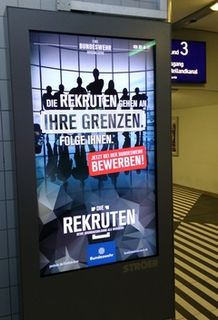
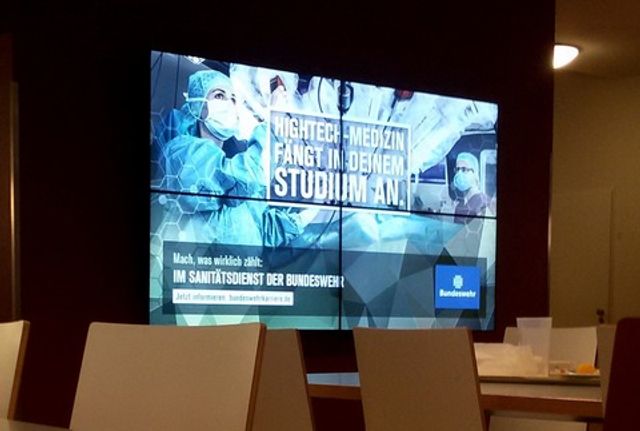
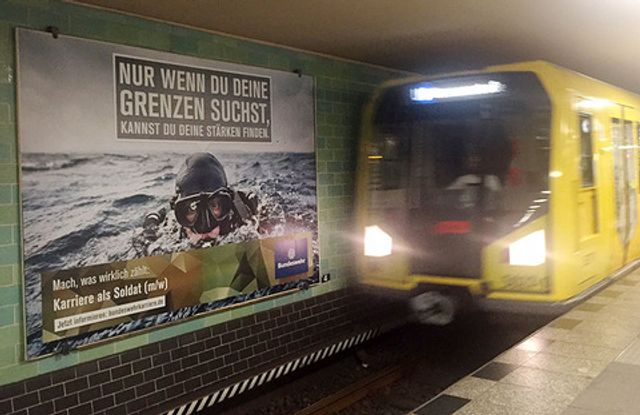
Almost every large German city now features signs and billboards praising the services of the German military (Bundeswehr) and calling on people to do their “duty.” In many bus, tram and underground stations, as well as at schools, universities and education centres, the Bundeswehr has been campaigning with provocative slogans like “Do something that really counts” and “You can’t solve crises by hanging around and drinking tea.”
The propaganda campaign is part of the return of militarism launched by President Joachim Gauck and the German government at the Munich Security Conference in 2014. Since that time the Defence Ministry has been working hard to create a combat-ready army and recruit soldiers for military interventions in the Middle East and Africa.
Bundeswehr propaganda on the Berlin underground
In early December, Defence Minister Ursula Von der Leyen (Christian Democrats, CDU) presented the Bundeswehr’s new human resources strategy. The issue, her report argued, was to “have men and women with the right qualifications in the right place at the right time.” It continued, “In this way we guarantee the readiness of personnel to deploy, fulfill our obligations in a broad, shifting spectrum of interventions and make it possible for Germany to play an appropriate role in security policy.”
Since the end of compulsory military service on July 1, 2011, the Bundeswehr has faced major problems in attracting and training new recruits. As the parliamentary representative for army affairs, Hans-Peter Bartels (Social Democrats, SPD), complained recently in Handelsblatt (a leading business newspaper), “In June 2016 we had the smallest Bundeswehr ever.”
To counter this trend, the Bundeswehr has organised an advertising campaign aimed at youth and young adults. In 2015 alone, the Defence Ministry spent €35.2 million [US$37.5 million] on career advertising. This is €23.2 million more than in 2010, shortly before the end of compulsory military service. Costs for career advertising have thus nearly tripled.
So-called youth officers visit schools to appeal to students to join up. They offer the prospect of stable living conditions, as well as training or studying at university. These are offers that, given the miserable social conditions and lack of opportunities on the labour market, certainly sound attractive. The Bundeswehr is even prepared to appeal to children. When pictures of this year’s “Bundeswehr Day” were published in the media in which children were visible while smiling soldiers showed them how to handle a machine gun, they provoked a wave of protests.
A look at the Bundeswehr’s web site underscores that the army is deliberately targeting very young people. A school practicum of between two and three weeks is offered for children as young as 10, involving the “civilian sector” as well as “the armed forces.” The practicum placements are located “generally in military institutions and the temporary colleagues are usually soldiers, so that our practicants have sufficient opportunities to get an impression of the Bundeswehr as an employer.”
Advertising in Wolfsburg's main train station
The Child Soldier Alliance, whose members include Amnesty International Germany and UNICEF Germany, regularly criticises the German government for recruiting minors. In its “Shadow report on child soldiers” from 2013, it warned, “It seems possible that the number of minors in the Bundeswehr will increase. The Bundeswehr undertakes comprehensive advertising campaigns that increasingly target minors.”
This is precisely what has occurred. The number of minors who are being trained to use weapons is steadily increasing. While in 2010, 496 minors joined the Bundeswehr, so far this year there have been 1,576 recruits.
The centrepiece of the recruiting campaign among youth is the online series “The recruits.” It appears five days a week on YouTube and chronicles the training of 12 young recruits over three months. The Bundeswehr spent €1.7 million on the series. An additional €6.2 million has been spent on advertising on Facebook and other social media outlets.
The series recalls the “docu-soaps” broadcast on private television channels. With music in the background and humorously constructed characters, the daily lives of the “recruits” are made out to be like an adventure holiday with sporting challenges. While the first episodes mainly focus on discipline and the tough life of a soldier, the army as a whole is presented as a “cool squad,” where everyone sticks together and supports each other. This fits in with the advertising slogan, “What do 1,000 online friends amount to compared to one comrade?”
Bundeswehr advertising sign at the Humboldt University Nord cafeteria
But none of this can conceal the actual purpose of the training: a new generation is to fight in foreign interventions in the interests of German imperialism and, if necessary, die. While Von der Leyen boasts of the great response her campaign has received, opposition is growing among young workers and students.
Numerous videos on YouTube comment on and question the Bundeswehr series. A web site set up by the “Peng! Collective,” which effectively mocked the Bundeswehr campaign, attracted some 150,000 visits, more than the Bundeswehr’s official site. On the deceivingly realistic web site, the career suggestions from the Bundeswehr were replaced by “doctor,” “teacher” and “refugee assistant,” and the slogans replaced with phrases such as “Your life for the powerful” and “War can destroy you.”
The campaign has also provoked resistance at universities. At the University of Hamburg, a protest by the general student representative committee led to the student centre no longer carrying the Bundeswehr’s advertising in the cafeterias.
At the end of November, the student parliament at Berlin’s Humboldt University (HU) spoke out against army advertising at the university. The university’s International Youth and Students for Social Equality (IYSSE) chapter introduced the resolution. The text, adopted by the majority in the parliament, read, “The student parliament opposes all forms of advertising for the Bundeswehr at our university and calls upon the Berlin student centre and university management not to permit any Bundeswehr advertising initiatives on the HU campus.”

In the wake of the Chapecoense tragedy, Bolivia arrests airline and government officials

Rafael Azul 

In the two weeks that have passed since 71 people, including 19 players of Brazil’s Chapecoense football team, lost their lives in a tragic plane crash near Medellín, Colombia, the disaster has raised questions in the Bolivian media and political establishment on the government’s links to the charter airline, LAMIA. In part to clear Bolivian President Evo Morales of any suspicion, the government launched its own investigation.
In a December 3 press conference calling for a government investigation, Morales made no secret of his close relationship with LAMIA’s general manager, Gustavo Vargas Gamboa, who he has known from his days as a leader of the agricultural coca growers union in the 1990s. Vargas Gamboa also piloted Morales’ presidential plane in 2006-2007. Morales promised to take “drastic measures” in response to the November 28 crash.
Last Friday, December 9, a Bolivian court ordered that Vargas Gamboa be held in prison while awaiting trial for negligence, cronyism, and transportation disaster. Vargas Gamboa, arrested on December 6, is a retired air force general. The arrest took place following a determination that the airplane that crashed had taken off with insufficient fuel to safely make the trip between Santa Cruz, Bolivia, and Medellín, Colombia. He is now under investigation for homicide.
Two days after detaining Vargas Gamboa, Bolivian authorities also arrested his son, Gustavo Vargas Villegas, a high-government official in charge of the National Registry of the Civil Air Command (DGAC); Vargas Villegas issued LAMIA’s license to operate.
Vargas Villegas is being charged with neglect of his duties and for allowing his family connections to influence the performance of his job.
Bolivian authorities are also seeking the extradition of Celia Castedo, who fled to Brazil following the crash. It appears that Castedo, who worked in air traffic control, signed off on the flight plan of the ill-fated LAMIA 2933 flight. Bolivian officials charge that Castedo had the authority to prevent the airplane from taking off and was negligent in not doing so.
Castedo has insisted that the sole authority to stop the flight rested with the Bolivian civil aviation agency. She claimed that she had told superiors the flight should be canceled but had been told to keep quiet.
The government also issued an international order of arrest against Marco Antonio Rocha, a LAMIA owner. In the wake of the tragedy, Rocha refused to return to Bolivia from Paraguay.
For his part, Bolivia’s defense minister Reymi Ferreira accused the pilot of the LAMIA flight of murder for ignoring regulations and for negligence; the pilot, Miguel Quiroga, died in the crash. Ferreira pointed out that Quiroga’s flight plan included a refueling stop in the Bolivian airport of Cobija, roughly one third of the way between Santa Cruz and Medellín; had the refueling stop taken place the Avro RJ-85 would not have run out of fuel and crashed on a mountain side just short of its destination.
This may have been only the first of Quiroga’s errors. According to the Mexico City news journal Proceso, as soon as fuel reserves ran low, Quiroga had the option of landing in the Bogotá airport, but did not do so. Finally, Quiroga could have declared a “Mayday” emergency. Such a message to the Rio Negro airport air traffic controllers would have triggered an accelerated response that perhaps could have saved the flight. Instead, the control tower placed the LAMIA plane on hold to prioritize another distressed flight.
Quiroga’s decisions may have been motivated by the fact that, as co-owner of the small airline (three RJ-85 airplanes, two of them in repair), he was under financial pressure. Each of the decisions not taken would have involved a financial cost to LAMIA and to Quiroga himself. LAMIA’s chief executive, Vargas Gamboa, in previous statements had made no secret that the airline confronted economic pressures.
Univisión, a US-based Spanish language TV network, has identified other LAMIA flights that had ended with fuel reserves well below the required fuel for 45 minutes’ flying time. The very same plane that crashed on November 28 had gone through eight low fuel-reserve incidents. Univisión also found that some of those flights also exceeded weight limits.
Pilot and security expert Estaban Saltos told Univisión: “This reflects that systematic violations existed in nearly every flight.” Saltos came to the conclusion that LAMIA “made it a practice to push their flights to the limit of fuel capacity.”
Among the flights cited by Univisión is one on October 29, between Medellín and Santa Cruz (the same endpoints, in the opposite direction as the November 28 flight), ferrying the Atlético Nacional team to a game for the South America Cup.
From the beginning, the Medellín plane crash raised questions about the relationship between the administration of President Evo Morales and LAMIA. Six days after the crash, Morales’ chief of staff, Juan Ramón Quintana, denied rumors that Vargas Gamboa had been rewarded with an operating license for LAMIA because he had been the president’s pilot in 2006 and 2007. He also denied any ties between the president and LAMIA management and expressed surprise that Vargas Gamboa possibly had taken advantage of his family connections to unlawfully obtain an operating license for the airline.
Quintana declared that Morales did not know whether LAMIA was properly licensed when the president flew in one of its planes between the Bolivian cities of Rurrnabaque and Trinidad on November 16. He also denounced the right-wing opposition for “placing the blame” on the Morales administration for the issues surrounding LAMIA.