19 Dec 2016

Microfinance Can Actually Harm The Poor

Moin Qazi

Microfinance continues to thrive despite   being under fire from legions of critics.  One plausible reason for the lingering faith in the power of microfinance is that it provides a convenient strategy for investors to demonstrate that that they are active fighters against    poverty   and are trying to save the poor while making a substantial amount of money from them.
Microfinance – including microcredits – is often considered to be an instrument that promotes empowerment. But this assumption is not as simple as it sounds. Whilst it can stabilise livelihoods, provide start-up funds for productive investment, broaden choices, help poor people to smooth consumption flows and send children to school, microfinancecan also lead to indebtedness and increased exclusion unless programmes are well designed.
In the world of microfinance, women borrowers are viewed as autonomous individuals who make independent choices in the marketplace. .But it is always not as simple as it appears. Even when women possess marketable, loan-worthy skills, women often find themselves beholden to their husband and male relatives. Rural women live in extended family structures. They negotiate complex kinship and social obligations. It’s not surprising to learn, therefore, that most cases men control the loans that women receive. The men may simply use the money for their own purposes. In case of default a woman has to suffer social shame which can create stress and tension affecting both her health and her relations within the family. The experience reinforced our belief: you can’t just give a woman a loan and then send her on her way—you have to accompany her as she struggles to make her way out of poverty.
Such humiliation of women in a public place gives males in the household and in the lineage a bad reputation. In an extreme case peers may take the defaulter to the police station. For a man, if he is locked inside the police stations for several days, it would mean almost nothing to other people in the village. But if this happens to a woman then it will bring shame to her household, lineage and village.
The biggest problem   is that people who get these small loans usually start or expand a very simple business. The most common business for microfinance is simple retail – selling groceries – where there are often too many people, fierce competition, and where they don’t really earn enough money to get out of poverty. We need to create more jobs, and microfinance does not help to do that yet. The debt trap is an under-reported problem. Quite a few people invest money, their business does not make money and goes under, and they are stuck with the debt. The interest rate on this debt, even with a microfinance loan, is quite high, so some are never able to repay it. Another reason why they get into a debt trap is that, in theory, you should take a microloan to invest in the business. But in practice a lot of people use microloans for a wedding, festival, or to buy something. A lot of these people don’t know how to use debt.
According to the World Bank, most microfinance programs are successful in reaching the moderately poor—those just above or just below the poverty line—rather than those with even fewer resources. Microfinance best serves those who are already in a position to capitalize on a small amount of ready cash.  In most cases, these clients tend to benefit more from microfinance than those poorer because of higher skill levels, better market contacts, and a more robust initial resource base. Areas with pre-existing opportunities for small enterprises are often more attractive for microfinance institutions because they are able to repay their loans more easily.
Microfinance should depend on three key variables: first we need to know whether lenders are offering well designed well managed responsible products to the right clients. Secondly in a buyer’s market we need to respect clients’ right to make informed choices and support their capacity to do so. Finally we need to recognize market imperfections and the risk of over indebtedness which is exacerbated by the ready availability of credit from multiple organizations. Addressing these concerns help not jus microfinance clients but also protect the interests of the microfinance industry. Good, healthy microfinance is a bedrock of  a robust sector
Indeed, one of those who have thoroughly studied the phenomenon, Thomas Dichter, says that the idea that microfinance allows its recipients to graduate from poverty to entrepreneurship is inflated. He sketches out the dynamics of microcredit: “It emerges that the clients with the most experience got started using their own resources, and though they have not progressed  very far–they cannot because the market is just too limited–they have enough turnover to keep buying and selling, and probably would have with or without the microcredit. For them the loans are often diverted to consumption since they can use the relatively large lump sum of the loan, a luxury they do not come by in their daily turnover.” He concludes: “Definitely, microfinance has not done what the majority of microfinance enthusiasts claim it can do–function as capital aimed at increasing the returns to a business activity.”
Although the poor obviously do not have enough money, the reason why they remain poor goes beyond the mere availability of cash, especially if it comes with a price tag of high interest rates. Poor people need to be economically empowered by addressing the underlying reasons for their exclusion from political and economic processes, not by providing them with just a small loan.
Vijay Mahajan, the doyen of Indian microfinance,  also cautions that  “access to microcredit alone is not a silver bullet. Poor people are poor not only because they don’t have access to money, but because they lack access to health care, employment, and education. Living in inhospitable regions, for many reasons the productive potential of the natural resources they depend are compromised. Micro-lending alone will not tackle the kind of poverty that still affects some 170 million rural Indians.”

Australian politician jailed in bid to restore “confidence” in political establishment

Mike Head

A former key Australian Labor Party factional powerbroker, Eddie Obeid, was sentenced to five years’ jail on Thursday on charges of “wilful misconduct in public office.” His jailing is an explicit attempt to shore up the country’s increasingly discredited parliamentary establishment.
Obeid, now 73, was given a non-parole period of three years after being found guilty in June of abusing his position as a member of the New South Wales (NSW) state parliament. He was convicted of concealing his family’s business interest in two Sydney harbourside cafés when lobbying a senior government official for the renewal of the lucrative café leases.
The NSW Independent Commission Against Corruption (ICAC) had evidence that the two restaurants were given extended leases in 2006 at reduced rents, a benefit that was worth up to $1 million for each restaurant. As is the norm in wealthy circles, Obeid had disguised his family’s ownership through several family trusts.
“The essence of the case is that he has intentionally abused the public trust,” NSW Supreme Court Justice Robert Beech-Jones said in explaining his heavy sentence. “The overwhelming majority of parliamentarians are not motivated by an intention to enrich themselves or their families,” he insisted.
“All the work of parliamentarians can be destroyed by the wilful misconduct of only some of their members,” the judge added. “Corruption by elected representatives consumes democracies. It destroys public confidence in democratic institutions.”
Media commentators, editorials and politicians quickly echoed the judge’s words. Acting NSW Labor leader Michael Daley said: “Confidence in public life has been weakened terribly on both sides of politics in the last few years, and so we hope this judgment today goes some way in restoring confidence in the parliament and in our profession.”
Former NSW Premier and federal Foreign Affairs Minister Bob Carr, who appointed and kept Obeid as state mineral resources and fisheries minister from 1999 to 2003 despite previous corruption allegations, said the sentence would be “warmly welcomed by all residents of NSW, not least by Labor people furious with Obeid for letting their side down.”
Such attempts to depict Obeid as a “bad apple” in an otherwise healthy political system defy the documented record. Obeid was a political kingmaker for decades, a wealthy businessman whose network of patronage ensured his influence not only with Carr but over subsequent Labor governments.
Obeid, who operated a right-wing Labor Party sub-faction known as the “Terrigals,” effectively installed three successive NSW premiers, Morris Iemma (2005), Nathan Rees (2008) and Kristina Keneally (2009), following Carr’s departure from that post in 2005.
By the time that Obeid himself decided to quit parliament in 2011, Labor was thrown out of office in a landslide at that year’s state election. It was despised throughout the working class for imposing pro-business policies, including the privatisation of electricity and other state assets, and for its notorious relationships with property developers and mining companies.
Obeid’s influence was not confined to NSW. As well as largely controlling the state branch, his faction played a key role federally for years. In fact, two Labor prime ministers, Kevin Rudd and Julia Gillard, mostly owed their elevations into the party leadership in 2006 to Obeid’s faction.
These connections extended to Labor’s supposed “left” factions. Anthony Albanese, who later became deputy prime minister, defended Obeid’s party pre-selection for parliament when it was under threat.
Moreover, Obeid’s café leases were small beer compared to the largesse and payoffs that leading figures in both the Labor and Liberal-National parties have rested upon for decades—via preferment for jobs and promotions, lucrative business deals and career paths into corporate boardrooms and consultancies.
Over the past decade, as economic conditions have worsened, the traditional ruling parties have been rocked by corruption revelations involving, for example, mining leases and illegal donations from property companies. In NSW alone, ICAC inquiries have resulted in multiple resignations of cabinet ministers and members of parliament from both parties, and further corruption charges are still pending.
The stench of corruption has risen sharply over the past few decades because of the collapse of the memberships of these parties, which has made them more financially dependent on soliciting donations from corporate interests, including developers, in return for political favours.
In particular, years of attacks on the jobs, social conditions and basic rights of working people by federal and state Labor governments on behalf of big business have reduced the Labor Party to a bureaucratic shell. It is dominated by factional kingpins and trade union apparatchiks, all faithfully servicing the needs of the corporate elite, as well as furthering their own careers and business interests.
With party branches and active union members virtually extinct, parliamentary pre-selections are determined by nominally “right” and “left” faction and sub-faction bosses, either via local branch membership-stacking or state or national executive votes controlled by party and union machines.
Rather than an exception, Obeid epitomises this rot and decay. A prominent property developer, he was originally handed a seat in the NSW parliament in 1991 by Graham Richardson—a senior minister in the Hawke and Keating federal Labor governments of the 1980s and 1990s—because he was a “successful businessman.”
Like its social democratic counterparts internationally, the Labor Party has become an overt party of big business over the past several decades. Under the Hawke and Keating governments, Labor and the unions, working closely together, responded to the globalisation of capitalist production by jettisoning their previous program of national economic regulation and limited social reforms in favour of pro-market economic “restructuring,” privatisation, job slashing and erosion of social services.
That is the underlying reason for the loss of “public confidence” in the parliamentary elite. While the media commentary surrounding Obeid’s jailing has focussed narrowly on “misconduct” and corruption, the public disaffection and political instability go far deeper.
Notably, Obeid’s sentence was handed down amid ongoing political turmoil in the wake of the July 2 federal election, which the current government barely survived, and with record numbers of votes going to right-wing populists. These formations, such as the anti-immigrant Pauline Hanson’s One Nation, have been the initial beneficiaries of the discontent, which they have sought to channel in reactionary and nationalist directions.
The financial markets and corporate elite have increasingly lost confidence in Prime Minister Malcolm Turnbull’s Liberal-National government to impose on the population their agenda of drastic social spending cuts, lower company taxes, and a further assault on workers’ wages and conditions.
This nervousness has been intensified by the election of the nationalist demagogue Donald Trump to be the next US president, with his threats of protectionism and trade wars that could have devastating consequences for export-dependent Australian capitalism.
By making an example of Obeid, the ruling class is desperately seeking to shore up the credibility of its parliamentary servants as it prepares for economic, social and political convulsions.

UN agency says government torture and abductions continue in Sri Lanka

Saman Gunadasa

The Committee Against Torture (CAT), a UN panel that monitors the international implementation of the UN Convention against Torture, has revealed that torture and abductions are ongoing under the Sri Lankan government. The allegations are contained in a report released by CAT early this month.
Contrary to the insistence of President Sirisena and Prime Minister Wickremesinghe that their administration represents “good governance,” CAT makes clear that seven years after the defeat of the separatist Liberation Tigers of Tamil Eelam (LTTE) in 2009, Colombo’s police-state apparatus is still being used against the working class and oppressed masses.
The report highlights the comments of UN Special Rapporteur Juan E. Mendez who declared in May 2016 that torture in Sri Lanka is “a common practice [and] carried out in relation to regular criminal investigations in a large majority of cases by the Criminal Investigation Department [CID] of the police,” irrespective of the nature of suspected offences.
CAT noted that Sri Lankan police have wide-ranging powers to arrest suspects without court warrants, to hold them without even registering the dates and times of detention, and to conduct investigations “as a means to obtain information under duress.”
The report said that these anti-democratic methods were covered up by the judiciary and that “neither the Attorney General nor the judiciary exert sufficient supervision over the legality of the detention or the conduct of police investigations to prevent this practise.”
CAT quoted UN Special Rapporteur Mendez, who noted that “magistrates often do not inquire into potential ill-treatment during pre-trial hearings, and accept the requests of police officers to keep suspects in remand custody without further scrutiny.”
The UN panel said that recent allegations of “white van” abductions and the brutal torture of numerous individuals in “unacknowledged places of detention” by the police and the military had not been investigated by the Sri Lankan government.
CAT rejected government claims that there were “no secret torture camps or detention centres” in Sri Lanka and said that torture was occurring at law enforcement headquarters, army camps and IDP (Internally Displaced Person) camps and “rehabilitation centres.” Individuals, it continued were held on suspicion of “having a link, even remote, with the LTTE.”
While it claims to be fostering “reconciliation” with Sri Lanka’s minority Tamil population, the government continues its communal oppression, maintaining the military occupation in the war-ravaged North and East provinces.
CAT referred to a report by the Office of the UN High Commissioner for Human Rights Investigation on Sri Lanka (OISL) which noted “allegations of widespread torture, including sexual violence, perpetrated against individuals detained at the Manik Farm camp and elsewhere in the aftermath of the conflict [war] by personnel of the CID and the TID [Terrorism Investigation Division].”
Colombo, moreover, had not concluded investigations into high-profile cases, such as the alleged execution-style killing of five high school students by the Special Task Forces personnel in Trincomalee and the murder of 17 Action Contra la Faim aid workers in Muttur. The students were killed in January 2016 as the Rajapakse government Colombo’s intensified military provocations in the lead-up to resumption of the war; the aid workers were murdered in August 2016, a month after Colombo restarted the bloody conflict.
CAT said that it had not been provided with requested information about the progress of 39 cases of rape and sexual violence since the war ended in 2009. It also voiced concern about the lack of legal action over allegations of torture against state forces.
CAT reported that the government-appointed Human Rights Commission of Sri Lanka (HRCSL) had received 2,259 torture allegations since 2012. The allegations had been presented to the Attorney General’s office which simply referred them to police without opening any independent investigations. In 2015, the HRCSL received 425 such accusations and 208 in the first eight months this year.
The HRCSL provided CAT with a detailed report on common methods of torture use by police. These practices included, “undressing the person and assaulting using the hand, foot, poles, wires, belts and iron bars, beating with poles on the soles of the feet (phalenga), denial of water following beating, forcing the person to do degrading acts, trampling and kicking, applying chilli juice to eyes, face and genitals, hanging the person by the hands and rotating/and or beating on the soles of the feet, crushing the person’s nails and handcuffing the person for hours to a window or cell bar.”
A medical examination of one person arrested by police for possessing illegal drugs in March 2016 at Kalutara in western Sri Lanka revealed that the suspect had “twelve wounds, including the loss of a front tooth, an abrasion wound on wrist, and abrasion and contusion wounds on the body.” The CAT report noted that “increasingly, physical torture is perpetrated using methods that cannot be easily detected by medical personnel.”
The HRCSL information indicated that torture was used, “not only during the process of interrogation but during the process of arrest” and that “usually, complainants are from low-income groups.” In a number of instances, the arrests were the result of mistaken identity.
CAT also said that Sri Lankan prisons were over-crowded and noted an instance where three prisoners were incarcerated in a seven-foot by five-foot cell, sleeping on the floor without bedding and forced to use a plastic bucket for sanitation during night-time.
The UN panel pointed out that most victims of torture cannot seek legal redress or compensation through the Supreme Court because of the high financial costs. It also referred to the large backlog of fundamental rights applications in the court.
Under Sri Lanka’s Prevention of Terrorism Act (PTA) detainees can be held without trial for up to 15 years. They can be detained without charge for 72 hours and up to 18 months before their case is even presented to a magistrate.
The report said that the government had not provided any information on the proposed new Counter Terrorism Act, which is to replace the PTA. The planned new law includes wider police powers and a broadened definition of terrorism that could be used to suppress any political activity, targeting the working class and socialists in particular.
CAT also expressed concerns about the presence of Sisira Mendis, Chief of National Intelligence and former the Deputy Inspector General of the Criminal Investigation Department (CID), as a government representative at its meeting in Geneva in November. Mendis exercised supervisory authority over Terrorism Investigation Department (TID) until June 2009.
The government sent Mendis to the CAT meeting to ensure that a lid would be kept on the widespread use of torture and abuses of democratic rights. It is determined to whitewash Colombo’s war crimes and other human rights violations and to continue to use the police and military forces to suppress working-class resistance its austerity agenda.

Terror attack claims at least 15 lives in central Turkey

Halil Celik

A suicide car-bomb attack Saturday in the city of Kayseri in central Turkey killed 15 soldiers and wounded and 54 others, including civilians. Twelve of the wounded are in intensive care, with three in critical condition.
No one has assumed responsibility of the attack, on a bus transporting civilians and off-duty military personnel. However, it was widely assumed to be the work of the Kurdistan Freedom Hawks (TAK), an offshoot of the Kurdish nationalist Kurdistan Workers’ Party (PKK).
A week ago, on December 10, TAK organized a twin bombing attack near a football stadium in Istanbul, killing 44 people and wounding 155. TAK claimed responsibility for the attack, stating that it was retaliation for Turkish army operations in Turkey’s Kurdish areas, and a protest against the continuing imprisonment of PKK leader Abdullah Ocalan, who was imprisoned in 1999.
After the Kayseri attack, President Recep Tayyip Erdoğan noted that terror attacks in Turkey were bound up with the wars in Syria and Iraq. “We will decisively fight these terror organizations in the spirit of national mobilization,” he said.
Prime Minister Binali Yildirim remarked, “These incidents cannot weaken our struggle, rather it increases our determination.” He said “foreign forces” were implicated in the successive bombings.
Opposition Republican People’s Party (CHP) leader Kemal Kiliçdaroglu said terrorist organizations would be defeated “if people stand right and proud after the attack,” while far-right Nationalist Movement Party (MHP) leader Devlet Bahceli called for intensified struggle against terrorism.
Turkish Chief of General Staff General Hulusi Akar joined in, telling the state-run Anadolu Agency, “The Turkish army is determined to combat terrorists until the last terrorist is neutralized.”
The pro-Kurdish People’s Democratic Party (HDP), the third-biggest party in the Turkish parliament and the main target of the Turkish government’s so-called “war on terror,” also issued a statement, in which it “strongly condemned the attack.” However, right-wing mobs attacked HDP offices in cities across Turkey. The Erdoğan government for its part is continuing its attacks on the Kurdish nationalists.
The US Embassy, the British ambassador to Turkey, and the German and French foreign ministries, as well as Russian Foreign Minister Serge Lavrov, condemned the attack.
The terror attacks in Kayseri and Istanbul, the latest in a series of bombings in Turkey, serve only to disorient masses of people and strengthen the most reactionary social forces. These successive terror attacks are rooted above all in the US-led imperialist interventions in the Middle East, and the bloody consequences of decades of war in Iraq and now in Syria—in which the Turkish government is participating.
Washington and its European and Middle East allies have relied principally on a series of Islamist militias to carry out terror bombings in the initial stages of the conflict and then to wage a protracted proxy war against the government of President Bashar Al Assad.
The imperialist powers’ reliance on Kurdish nationalist militias as proxies in Syria blew apart Erdoğan’s attempt to develop a “peace process” with the PKK and other Kurdish nationalist forces.
Given the organization’s murky background and identity, TAK’s claiming of the Istanbul attack hardly resolves the question of who is behind the attacks. The Turkish regime itself said that broader forces were involved than simply the Kurdish nationalists. Turkish Deputy Prime Minister Numan Kurtulmus told private news channel NTV, “Behind these terrorist organizations are the various supports of several countries.”
It is of course possible that the bombings were carried out by Kurdish nationalist forces. They have been active in the fighting in Syria and against the Turkish army’s repression of Kurdish areas in Turkey, as well as its offensive in northern Syria. In late August, Ankara launched its ongoing Euphrates Shield Operation against the Kurdish Democratic Union Party (PYD) and the People’s Protection Units (YPG), the main proxy force of the US in Syria, while heavily bombing PKK camps in northern Iraq.
The Kurdish nationalist groups are potentially threatened by the developing ties between Turkey and Russia, as well as the Syrian government, in the aftermath of the July 15 NATO-backed coup against Erdoğan. With the NATO-backed forces in the region in retreat, the Kurdish nationalists could find themselves isolated and facing a joint offensive of Moscow, Ankara and Damascus.
“Turkey and Syria will always be more important to Russia than a Kurdish experiment in self-governance opposed by both Ankara and Damascus,” wrote German state broadcaster Deutsche Welle .
It is conceivable that groups linked to the PKK could have decided to mount such an attack as a warning to Erdoğan not to move against the Kurdish nationalists in alliance with other regional powers.
On the other hand, each terrorist attack carried out by TAK or PKK has played into the hands of Turkish ruling elite. The attacks could lead to the proclamation of martial law, strengthening the military’s hand and implicitly threatening the Justice and Development Party (AKP) government after the July 15 NATO-backed coup, or strengthening Erdoğan’s drive to establish his own presidential dictatorship.
A day after the Istanbul bomb attack a week ago, Yildirim, CHP leader Kilicdaroglu and MHP leader Bahceli had reached a “consensus on a joint stance on the fight against terror”. At a joint press conference following the meeting, they claimed that the fight against terrorism was “an issue above politics.”
In their initial statements after the terror attack in Istanbul, Yildirim and Erdoğan vowed that the perpetrators would “pay a heavier price”. After visiting the wounded on December 11, Erdoğan said, “Our people should have no doubt we will continue our fight against the scourge of terror until the end. If they are aiming to scare us by means of such attacks, they should know that we have not degraded ourselves so much as to leave the ground to those scum.”
Since February 2016, the PKK and TAK have taken responsibility for 11 suicide bombings or car bombs, killing 103 and injuring some 800 others. The AKP government has escalated its attacks against HDP, the third largest party in the Turkish parliament, relying on growing popular anger over these attacks.
In May, the Turkish parliament lifted the immunity of 138 representatives, largely from opposition parties. Amid escalating attacks on opposition media and the HDP, the TAK claimed a car-bomb attack in central Istanbul on June 7, 2016, giving another pretext to the government for its dictatorial and militarist drive. Thus, immediately after the attack, Erdoğan approved the law lifting the immunity of 138 lawmakers, paving the way for criminal proceedings against them.
Based on the comments of Erdoğan and Yildirim after the most recent attacks, public prosecutors ordered the detention of some 400 people, including two HDP lawmakers. All detentions were on charge of having “links to or conducting propaganda for terrorist organizations.”
This followed the November 4 arrest of nine HDP lawmakers, including both co-chairpersons Selahattin Demirtas and Figen Yüksekdag. Since the last general elections in November 2015, thousands of Kurdish politicians, from both the HDP and its sister party, the Peace and Democracy Party (BDP), have been arrested on charges such as “terrorist propaganda and links with the PKK.”
The string of terror attacks have also enabled the Turkish ruling elite to promote Turkish nationalist and militarist propaganda justifying its military operations in Kurdish towns of the country. The price of months-long so-called anti-terror operations was the total destruction of Kurdish-populated towns, leaving over 1,000 dead and forcing some 400,000 people to flee their homes.

Berlin’s Humboldt University plans massive job cuts

Katerina Selin

Humboldt University in Berlin (HU) plans comprehensive cost-cutting measures in research and teaching. So far, however, the drastic austerity measures developed by the university management, currently causing unrest in all faculties, have been discussed exclusively behind closed doors.
Student sources have declared that HU President Sabine Kunst sent a letter requesting all faculties to submit savings proposals of 8 percent by the middle of January 2017. The cuts are aimed at offsetting the university’s current budget deficit.
The latest developments at HU are linked to the drastic austerity policy of the Berlin Senate in the education sector. In its 10-year term of office from 2001 to 2011 a coalition of the Social Democratic Party (SPD) and Left Party imposed a succession of cuts on the universities of Berlin. This political legacy is expected to be carried forward by the city’s recently sworn in SPD-Left Party-Green Party state government.
At regular intervals the universities are obliged to submit to the Berlin Senate “structural plans documenting their planned focus and profile formation as well as other services , ” according to the Senate’s Science Council in 2000. The plans are examined by commissions and checked by the Senate.
Up until now HU was subject to the structural plan issued in 2004. At that time, the SPD-Left Party Senate imposed a rigorous savings program of €75 million on all Berlin universities. At the same time, annual cost increases, e.g., for energy supply, personnel and pensions, have not been offset by the state administration for the past 10 years. As a result, the universities accumulated new deficits from year to year, to be offset by cuts in pay and jobs.
In 2004, HU reduced its staff by about 20 percent. Seventy-eight professorships and 500 employees lost their posts. The city’s Free University (FU) had to cut 86 professorial posts, although it had already slashed 306 of the university’s original total of 730 professorships between 1992 and 2002. Many study subjects have been discontinued in Berlin in recent years, including Indian Studies. The student body at the Institute of Asian and African Studies at HU fears that courses devoted to Central Asia and Islamism could also be axed.
After the collapse of the Stalinist countries in 1989-90 the Technical University (TU) also carried out austerity measures. In 2004, it wound up 59 of its total of 335 professorships. In May last year, TU adopted its current structural plan, which includes the curtailment of a further eight professorships. At the same time, so-called “innovation professorships” are being set up, which according to TU President Christian Thomsen aim to increase “competition within the university.”
While the management of Humboldt University is determined to push through the new savings plans at a rapid pace, resistance is growing among students and employees. Several student members of the Faculty of Cultural, Social and Educational Sciences sent an open letter to the president on December 5, in which they unanimously rejected the upcoming structural plan.
In the open letter, the student members of the faculty declare that the savings to be made “are not only of great concern to the teaching of all institutes.” They would also “significantly adversely affect” study conditions. They warn of “cuts to urgently needed posts in teaching.” It is already the case that the provision of courses and the supervision of examinations and dissertations are suffering due to staff reductions. Many students are unable to finish their studies within the regular study period. The cuts would “increase this already very tense situation to an intolerable level,” they said. The abolition of student help centres also has an impact on the future of students.
The structural planning leads to “a distancing from students” and threatens “to drive a wedge between the different faculties and institutes,” which demand “an end to all cuts in posts and resources in teaching.”
The students also criticize the opaque approach of the presidency. They were only informed of the plans “at short notice and incompletely.” It appears the cuts have been “decided over the heads of both teachers and students.”
In fact, there has been as yet no public statement by the university management on the structural planning, although the faculties are expected to respond by the middle or end of January. So far, the press office of HU has not announced any official figures or facts, as requested by the World Socialist Web Site .
The next meeting of the Academic Senate of HU to discuss the structural plans is due to take place on Tuesday. On Facebook, the Physics Initiative at HU calls for “participation in the meeting and making clear to the Senate, and in particular the Presidium, that meaningful structure planning is only possible with university participation, including all affected groups.”
The new HU president, who has only been in office since May of this year, is taking an uncompromising attitude towards students and staff. Her hard-line stance is not unexpected. The qualified engineer and political scientist Sabine Kunst (since 2014 member of the SPD) has many years experience in the implementation of austerity measures. From 2011 to March 2016 she was minister for science, research and culture in the state of Brandenburg, which has been governed by a coalition of the SPD and Left Party since 2009.
In its twin budget for 2013 and 2014, the state government decided to cut 12 million at the universities.
Kunst imposed the cuts in the face of broad popular resistance. The proposal to merge two universities in the state met with particular criticism. In 2013, Brandenburg Technical University of Cottbus was merged with Lausitz University of Applied Sciences in Senftenberg. Kunst described the fusion as a “new-type of college,” at the same time as scientific experts, students and professors protested against the threatened job cuts.
Subsequent increases in the budgets of the universities in Brandenburg remained far below their actual needs and could not compensate for the earlier cuts.
In 2014, a number of universities, especially in the east German states, were hit by massive cuts and this policy is being continued. In Baden-Württemberg, the minister of science, Theresia Bauer (Greens), recently proposed that non-EU citizens pay €1,500 per semester. Students seeking a further degree are also required to pay €650 per semester. Bauer plans cuts amounting to €47 million in the coming year.
The cuts are part of a European-wide austerity policy in the sphere of education. In mid-October, the Tagesspiegel cited a new study by the European University Association (EEA), which analysed the situation of European universities since the beginning of the financial crisis. In Greece alone, more than 60 percent of university funding has been cut since 2008. This year, the pseudo-left Syriza government slashed a further 16 percent.
Government grants were also reduced in other EU countries: in the Czech Republic by 5 percent, in Slovenia by 9 percent, and in Ireland and the UK by over 2 percent. In Ireland and Britain the cutback mainly affected apprenticeships, which have decreased by 70 percent since 2008. The lack of funding is offset in many countries by increased study fees—in Britain by £9,000 per year—and by the acquisition of third-party funding from companies and associations.
The investigative online portal hochschulwatch.de reports that €1.4 billion flow from the private sector to German universities every year. In Berlin, the percentage of commercial enterprises in third party funding is particularly high, at 15 percent. At the Free University the figure is 5 percent, and for HU it is 3 percent. In 2013, third-party funding at HU rose to around €96.9 million (from around €88.5 in 2012). Of this, about €3 million came from commercial sources. The renewed austerity measures could lead to professors being compelled to raise more funds through third-party funds.
According to a report by the German Interior Ministry, an average of every fourth euro of university funds to households in Germany comes from third-party funding. Often the exact contracts are unknown. The growing influence of business, politics and, increasingly, the military is encroaching on the independent status of research and teaching.
At Humboldt University, this development is already well advanced. The chairs of Prof. Jörg Baberowski (History of Eastern Europe) and Prof. Herfried Münkler (Political Science), who play a central role in the elaboration and ideological justification of the new German war policy, are financed largely from third-party funds. The “Berlin Correspondences” series, currently taking place in the Gorki Theatre in Berlin, is based on a deal struck between the SPD-led Foreign Ministry and Humboldt University.

Police break up opposition-led blockade of Polish parliament

Clara Weiss

In the early morning hours of December 17, police violently broke up a blockade of the Polish parliament (Sejm) by several hundred protesters. Protests had erupted last week throughout the country against a bill curtailing the right to assembly and another limiting the access of media outlets and journalists to parliamentary sessions.
As of this writing, 20 to 30 Sejm delegates from the liberal opposition party Civic Platform (PO) are still involved in a sit-in at the parliament building to protest the policies of the right-wing Law and Justice Party (PiS).
With this latest stand-off, the constitutional crisis in Poland that began over a year ago following PiS’ accession to government has reached a turning point, with the country entering its deepest political crisis since the collapse of the Stalinist regime and the beginning of the restoration of capitalism in 1989.
The blockade of the Sejm started on Friday evening after nationwide protests organized by the liberal opposition against the PiS law limiting media access to parliamentary sessions. Under the law, only five television stations will be allowed to record the sessions, and the number of journalists will be severely curtailed.
Earlier in the week, on December 13, the 35th anniversary of the 1981 declaration of martial law by General Jaruzelski, tens of thousands of people demonstrated in opposition-led protests against the law restricting freedom of assembly. As in previous demonstrations, the protesters on Wednesday and Friday waved Polish and European Union flags.
The bill on limiting media access to parliament was discussed in the Sejm on Friday. Civic Platform delegates protested loudly during the session, occupying the lectern and holding up banners declaring “Free Media” and “No Censorship.”
In response, the president of the senate moved a vote on the budget for 2017 to other facilities in the Sejm, banning media from reporting on the vote. The opposition questioned the legitimacy of the vote, pointing out that it had not been carried out in accordance with the Polish Constitution.
After the session, several hundred demonstrators followed the call of the leader of the KOD (Committee for the Defense of Democracy), which has been organizing the opposition protests since last winter, to block the doors to the parliament. Protesters announced that they would make the delegates, an estimated 200 members of PiS, sit in parliament “until Christmas.”
On Saturday night, the police started their crackdown on the protesters. According to the opposition, the police resorted to force. Earlier reports about the use of tear gas by the police were later retracted by the KOD.
At around 2:40 am, Prime Minister Beata Szydło and PiS leader Jarosław Kaczyński, who had been locked up in the Sejm, fled the scene in black limousines. According to some Polish press reports, the vehicles of both were attacked. The police continued to patrol the streets of Warsaw during the night.
On Saturday morning, Szydło appeared on Polish television and declared the protests to have been “scandalous.” The minister of the interior, Marius Blaszczak, accused the opposition of an “illegal attempt to seize power.” Both statements leave room open for far-reaching anti-democratic measures to clamp down on the protest movement, which will serve to further strengthen the authoritarian regime built up by PiS over the past year.
In an attempt to bring the situation under control, President Andrzej Duda, who is close to Kaczyński but formally not aligned with PiS, met with several opposition leaders. Protesters on Friday had appealed to the president to oppose the policies of PiS, and Duda declared he was “deeply concerned” about the situation and ready to “mediate.” The first politician from the opposition with whom Duda met was businessman Ryszard Petru, who founded and leads the Nowoczesna (Modern) party, which played a key role in organizing the protests.
The president of the European Council and informal leader of the opposition PO party, Donald Tusk, aligned himself with the protesters, urging the government to observe democratic norms and thanking the demonstrators for their protests. Tusk is currently involved in a sharp political dispute with the PiS government, which has accused him of betraying Polish national interests and opposed his renewed candidacy for EU Council president. In contrast to the PiS government, Tusk argues for a much closer orientation in foreign policy to Brussels, and particularly Berlin.
The laws introduced by PiS are in preparation for a military confrontation with Russia and the violent suppression of working class opposition. However, the perspective of the opposition movement offers no progressive way forward for workers and youth interested in fighting the reactionary policies of PiS.
The parties involved in the opposition movement include PO, the Nowoczesna party and, increasingly, the pseudo-left party Razem, which is modeled after the Greek Syriza and Spanish Podemos.
While in government, the PO not only enacted deeply unpopular austerity measures, it also curtailed democratic rights. Ironically, in 2012 the PO government took a step toward limiting the right to freedom of assembly, on which the PiS government has based itself in its attacks on the opposition movement. Under the pretext of preventing far-right demonstrations, the 2012 law extended the minimal time between the notification of an assembly and its occurrence and introduced a number of further restrictions.
The unpopular policies of the PO government, in the absence of a genuinely left-wing alternative to give voice to the social and political discontent of the working class, helped pave the way for a return of PiS to power in the fall of 2015.
The Nowoczesna party is an openly pro-business organization, expressing the interests of very privileged layers of the upper-middle class and bourgeoisie that feel economically and politically undermined by the policies of PiS.
Razem serves to channel growing social and political discontent back into the dead end of the liberal opposition. The extent of its democratic commitment can be judged by its alliance with Syriza, which has enacted brutal austerity measures and proceeded violently against refugees and anti-government protests.
These forces are not acting to defend the democratic and social rights of the working class. They are concerned about the anti-democratic laws of PiS only to the extent that they limit their ability to participate in bourgeois rule and influence the policies of the government.
Tensions within the Polish bourgeoisie are running high over what foreign policy to pursue in the wake of the victory of Donald Trump in the US presidential elections. The liberal opposition has long feared that the almost exclusive orientation of PiS toward an alliance with US imperialism threatens Polish national interests, and now feels confirmed in this regard by the victory of Trump.
In an article titled “What do the nominations by Trump mean for Poland?” the liberal Newsweek Polska wrote that “the most concerning [issue] from the Polish perspective is that the nominations by Trump confirm that one has to reckon with a reset in relations with Russia, the victim of which might be the hitherto pursued and, for Warsaw, beneficial US policy in the conflict in Ukraine and with regard to the Eastern flank of NATO.”
The article also noted anxiously that Trump’s cabinet of billionaires and generals would increase social tensions and destabilize the country, also “not good for Warsaw.”
Earlier, the newspaper had published a lengthy interview with Tusk on Polish foreign policy, in which he sharply criticized PiS’ foreign policy. Tusk argued that “the significance of Poland depends on the state of its relations” with Berlin and Paris. The “biggest problem,” Tusk warned, was the deterioration of relations with Berlin under PiS.

US coal miners hit by sharp rise in deadliest black lung disease

Clement Daly 

Reports released last week show that the prevalence of the deadliest form of black lung among US coal miners is far worse than previously expected. An investigative report conducted by National Public Radio’s (NPR) Howard Berkes found the number of miners suffering from so-called complicated black lung is more than 10 times what federal regulators previously reported.
In its investigation, NPR obtained data from 11 black lung clinics in Virginia, West Virginia, Pennsylvania and Ohio showing 962 cases of the most severe form of the disease, also known as Progressive Massive Fibrosis (PMF), in the past five years. The number is nearly 10 times the 99 cases of PMF identified by the National Institute for Occupational Safety and Health (NIOSH), the federal agency tasked with tracking black lung, over the same period. It is also more than double the 441 cases of PMF tabulated by NIOSH over the past 40 years.
NPR cautioned that even these staggering numbers underestimate the magnitude of the disease since some of the clinics provided incomplete data and another eight clinics contacted in the heart of the Appalachian coal mining region did not share any data.
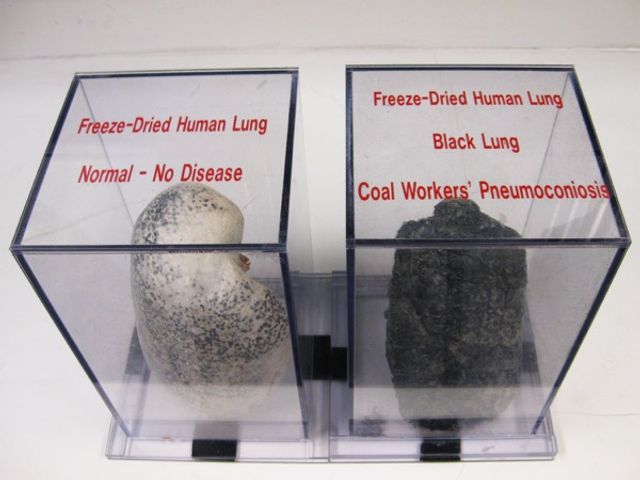
Black lung is the common name for coal workers’ pneumoconiosis, a debilitating and irreversible occupational lung disease contracted through the inhalation of coal dust. Miners afflicted with the painful disease gradually lose the ability to breathe and slowly suffocate to death over a period of years.
A display case at NIOSH shows a normal lung and a diseased black lung from inhaling coal dust and other harmful particles while coal mining. Credit: Howard Berkes/NPR
The dangers of black lung have been known for over a century. According to the Centers for Disease Control and Prevention (CDC), while black lung is incurable, it is “entirely man-made, and can be avoided through appropriate dust control.” Since government statistics began being collected in 1969, more than 78,196 miners have died from this preventable occupational disease.
The NPR story aired shortly after the release of a new report by NIOSH in the latest issue of the CDC’s Morbidity and Mortality Weekly Report, which identified 60 cases of PMF at a single clinic in eastern Kentucky over the course of 20 months.
The NISOH study was prompted by radiologist Brandon Crum who contacted the agency in June after he became alarmed over the number of miners in their 30s and 40s with less than 20 years underground being diagnosed with PMF at his clinic in Coal Run Village, Kentucky. The resulting study identified 60 cases of PMF at the clinic between January 2015 and August 2016, which had not been known to NIOSH. The afflicted patients had an average age of 60.3 years and an average career in the mines of 29.2 years.
NIOSH epidemiologist Dr. Scott Laney confirmed Crum’s fears over the cases. “The current numbers are unprecedented by any historical standard,” he told NPR. “We had not seen cases of this magnitude ever before in history in central Appalachia.” Dr. Laney, who co-authored the new NIOSH report, was also involved in a 2014 study by the agency, which concluded that black lung had reached its highest level in the US in four decades.
“This ongoing outbreak highlights an urgent need for effective dust control in coal mines to prevent coal workers’ pneumoconiosis, and for improved surveillance to promptly identify the early stages of the disease and stop its progression to PMF,” the latest NIOSH report warned. It concluded by noting, “The findings in this report serve as a reminder that more than 45 years after the Coal Act’s passage, one of its core objectives has not been achieved.”
Passage of the 1969 Coal Mine Health and Safety Act (Coal Act) and recognition of black lung as an occupational disease was granted only after a militant struggle waged by miners against both the coal operators and the United Mine Workers of America (UMWA) union bureaucracy. At that time, four out of every 10 coal miners were testing positive for black lung with about 1,800 dying each year from the disease.
The Coal Act set legal dust limits, implemented the federal black lung compensation program and established the Coal Workers’ Health Surveillance Program. Under the NIOSH-administered surveillance program, active coal miners are offered free chest X-rays upon entering the coal mines and at about five-year intervals thereafter.
While cases of black lung dropped precipitously following the implementation of the Coal Act, its loose provisions and lax enforcement prevented the complete eradication of the disease. The legal dust limit of 2.0 milligrams per cubic meter of air implemented in 1972 proved inadequate to fully protect miners and was long skirted by industry through widespread falsification of dust sampling used to determine compliance.
It has also been long known that the surveillance program is inadequate to the task of tracking the prevalence of black lung. The voluntary nature of the tests and its restriction to only active coal miners--excluding large numbers of retired and laid-off miners--coupled with industry intimidation ensures low participation and an incomplete picture of the scale of the disease. In its latest report, NIOSH admits that only 17 percent of Kentucky coal miners participated in surveillance program since 2011, leading the agency to conclude that “the actual extent of PMF in US coal miners remains unclear.”
In its story, NPR profiled Charles Wayne Stanley of Pound, Virginia, a 53-year-old who was diagnosed with PMF after he received his first screening after working 30 years in the mines. “If you’re working and you go and have that stuff done and the company finds out about it, they’ll find a way to get rid of you,” Stanley told NPR. “As long as you’re working and producing you’re an asset. But now when you get something wrong with you, you become a liability. And they’ll find a way to get rid of you.”
Health officials have been warning about a resurgence of black lung for more than two decades after the number of miners afflicted, as well as the aggressiveness and severity of the disease, began increasing in the 1990s. In 1995, NIOSH issued a recommendation that the dust standards, which had remained unchanged at 2.0 mg since 1972, be cut in half to 1.0 mg. The recommendation, however, remained a dead letter under both Republican and Democratic administrations.
By the time the Obama administration unveiled new dust standards in May 2014, more than 16,000 miners had died from black lung since NIOSH had issued its initial recommendation in 1995. Moreover, after meeting with coal industry representatives and UMWA officials, the Obama administration decided to tighten the dust standards by only 25 percent, down to 1.5 mg, instead of the 50-percent reduction argued for by NIOSH scientists.
As former US Mine Safety and Health Administration (MSHA) staffer Celeste Monforton explained in her blog The Pump Handle at the time, the agency had estimated that 20 out of every 1,000 coal miners would still develop PMF even if the standards had been reduced to 1.0 mg. Under the 1.5 mg limit, MSHA expected 50 cases of PMF for every 1,000 coal miners, thus leaving thousands at risk of contracting the disease.
The numerous studies and investigative reports over the past two decades have pointed to various objective roots for the resurgence of black lung: the eight-hour day being replaced by more typical shifts of 10 to 16 hours, increasing exposure times; increased mechanization and production rates leading to higher levels of dust; and thinning coal seams in the extensively mined Appalachian coal regions which release more silica rock dust when cut into. As NPR noted, “Every other industry cutting rock has strict limits on silica exposure, except mining.”
Under the impact of the global economic slowdown, increased competition from cheaper natural gas and the restructuring of the coal industry, 40,000 coal miners have lost their jobs and 600 mines have closed since 2011. With few prospects of being rehired, former miners are getting black lung screenings to secure some form of income. A successful black lung claim, however, provides just $600 to a maximum of $1,250 a month for a miner with three or more dependents.
Behind these conditions lies a massive social crime. The exploitation of the miners has produced vast fortunes for the coal and energy conglomerates, which are protected by the courts, federal, state and local agencies run by both big business parties, and the UMWA, which long ago abandoned the interests of miners and became a tool of the coal operators and the government.
The coal companies have used the bankruptcy courts to escape their obligations, threatening the health care and pensions of 120,000 retired coal miners and their families. The bankruptcy courts have also sanctioned the dumping of 1,000 black lung claims that were self-insured by the bankrupt companies into the federal Black Lung Disability Trust Fund, which is already nearly $6 billion in debt.

US deaths from synthetic opioids surge by 72 percent

Kate Randall 

The number of overdose deaths in the US from synthetic opioids surged 72 percent from 2014 to 2015, according to new data released Friday by the Centers for Disease Control and Prevention (CDC). The dramatic one-year rise follows a tripling of overdose deaths from opioids from 1999 to 2014, as tracked by the CDC.
The news follows CDC research released earlier this month showing that heroin overdose deaths in the US have reached epidemic proportions, with opioid overdose deaths rising 5,000 since 2014, surpassing 30,000 for the first time in recent history.
The reality of the opioid overdose crisis stands in stark contrast to President Obama’s rosy depiction of life in America as he prepares to leave office. At his last press conference of the year on Friday, he pointed to the low official unemployment rate, a modest increase in wages and, above all, a tripling of the stock market to claim that he leaves a legacy of economic “success.” He avoided any mention of the social crisis wracking the country, including declining life expectancy for large sections of the working class, rising suicides, and surging substance abuse and death from opioid overdoses.
Obama’s words provide cold comfort to the tens of thousands of families losing loved ones to the opioid epidemic, even as funding for treatment programs is cut. Despite the CDC’s stress in its report on the “urgent need for a multifaceted, collaborative public health” response to the opioid epidemic, there is no coordinated government effort to stem the tide of opioid abuse and overdose deaths.
According to the CDC’s latest report, a majority of US states reported significant increases in overdose deaths due to heroin and prescription painkiller abuse last year. In 2015 alone, drug overdoses killed 52,000 people, with nearly 66 percent of these deaths resulting from abuse of prescription or illegal opioids.
The CDC data shows that two synthetic opioids, fentanyl and tramadol, are largely responsible for the nationwide increase in drug overdose deaths. Fentanyl is a potent opioid pain medication estimated to be at least 50 to 100 times as strong as morphine. Overdoses from tramadol often involve other drugs, including alcohol.
Last year, 9,580 died from overdoses of synthetic opioids other than methadone, while painkillers such as Oxycontin and Vicotin had a 4 percent increase, resulting in 17,536 overdose deaths.
Over the last six years, deaths form heroin overdoses alone have quadrupled. For the first time ever, more people died from heroin overdoses last year, 12,989, than were killed by gun violence, 12,979.
Males saw a staggering 90.9 percent increase in synthetic opioid deaths from 2014 to 2015, with younger men the hardest hit. Men ages 15-24 saw a 91.7 percent increase; ages 25-34, a 94.1 percent increase; ages 35-44, an 80.6 percent increase.
Overdose deaths from synthetic opioids among women rose by 46.2 percent in 2015, with women ages 15-24 seeing the largest one-year rise in deaths--116.7 percent--of any age or gender group.
The CDC’s data shows blacks of all ages (non-Hispanic) with the largest one-year increase, 95 percent; followed by whites (non-Hispanic), 75 percent; and Hispanics, 50 percent.
Seven years into the so-called economic recovery, cities and towns across the country are gripped by an opioid and heroin epidemic that sees no signs of ebbing. Families seem helpless to deal with their members’ addictions, with their only apparent ally the drug naloxone (brand name Narcan), which reverses the effects of opioids within minutes. The drug is now widely available to the public in many states.
The Northeast region saw the biggest hike in synthetic opioid overdose deaths, rising by 107 percent in 2015 over 2014 figures. Three Northeast states registered overdose death increases in excess of 100 percent in one year: New York (135.7 percent), Connecticut (125.9 percent), and Massachusetts (108.7 percent). New Hampshire followed close behind (94.4 percent), as did Maine (90.4 percent).
In the face of the Massachusetts opioid crisis, Republican Governor Charlie Baker’s proposed budget for fiscal year 2017 slashes $1.929 million from the Bureau of Substance Abuse Services, affecting treatment programs across the state.
In Connecticut, another hard-hit New England state, there are 400 people on the waiting list for the substance abuse treatment and detox programs paid for by the state’s judicial branch on any given day, according to the CT Mirror. To cut $4 million from the judicial branch’s budget, the state has cut substance abuse treatment beds in Hartford, Middletown, New Britain, New London, Sharon and Waterbury.
The Midwest region saw the next biggest one-year increase, at 95 percent. Illinois saw a 120 percent increase, while Ohio had a 107.3 percent rise.
Among the 28 states meeting inclusion criteria for state-level analysis by the CDC, the largest absolute change in deaths from synthetic opioids other than methadone occurred in Massachusetts, New Hampshire, Ohio, Rhode Island and West Virginia. States seeing the largest absolute rate changes for heroin deaths were Connecticut, Massachusetts, Ohio and West Virginia.
Under conditions where budget cuts will only deepen under a Trump administration, little hope is offered to the tens of millions of people across the country facing a future of austerity and increased health problems, including addiction.
While one in seven Americans will become addicted to drugs or alcohol in their lifetime, according to a recent report from the US surgeon general, only 10 percent of those affected will ever receive help in treating their dependency.
Such is the true social legacy of Obama’s pro-corporate and militaristic policies, rooted in the defense of the capitalist profit system.

Trump and West Asia: Reading the Tea Leaves

Ranjit Gupta


Not only is Donald Trump the least-prepared president-elect in US history, but he compounds this handicap by showing little interest in preparing for perhaps the most important position in the world. He has been brazenly blasé about avoiding intelligence briefings, saying, “I don’t have to be told, you know, I’m, like, a smart person.”
Donald Trump, the first billionaire US president, has appointed to his cabinet or cabinet-level positions people having a combined net worth of about US$5.6 billion, the highest in US history. Success in deals and money-making seems to be a premium criterion for Trump’s evaluation of people, an unusual approach for successful governance. Having 4 former generals in his team is also unprecedented. Less than half of the appointees have government experience. Those who will have his ear on a daily basis are his cronies – his chief strategist, Steve Bannon, is an unabashed White-supremacist demagogue having headed right-wing news site Breitbart News, before chairing the president-elect’s campaign; Reince Priebus, Trump’s chief-of-staff, was chair of the Republican National Committee; Jared Kushner, Trump’s son-in-law, has emerged as a key power centre. None of them had worked in government. His daughter, Ivanka, has been sitting in Trump’s meetings with foreign dignitaries. His national security advisor, Gen Michael Flynn, is unabashedly racist and an Islamophobe; he was sacked as head of the Defence Intelligence Agency. He has a long record of being unable to work harmoniously with colleagues.
Trump’s foreign policy-related comments during the campaign were like throwaway remarks - seemingly consciously designed keeping in mind the next day's news headlines - conspicuously exhibiting a complete lack of serious thinking through on many critical issues. He has a dim view of long time US security alliances and of allies being freeloaders. Even after being elected he has continued to be off-handed. In a particularly conspicuous and potentially extremely dangerous break with the past, Trump took a congratulatory call from the president of Taiwan and later strongly defended his doing so against both domestic criticism and China’s continuing strong warnings. The Sino-US relationship is the most critical relationship in global geopolitics and must be treated with great sensitivity.

All this cannot but be a matter of considerable concern since the US is the world’s most powerful country and has been the linchpin of the global security architecture.

Trump has appointed Rex Tillerman, the CEO of ExxonMobil, as secretary of state, and South Carolina Governor Nicky Haley to be ambassador to the UN. Neither has any foreign policy experience. However, Tillerman has shepherded ExxonMobil’s work in over 50 countries remarkably successfully. Trump sees him as a pragmatist and a savvy dealmaker, viewing his strong personal ties with Putin and business relationship with Russia - including opposition to sanctions on Russia - favourably. This resonates well with his own personal warm feelings towards Putin as someone able to cut deals with strongmen, many of whom have traditionally been opposed to the US: “Rex is friendly with many of the leaders in the world that we don’t get along with…I like what this is all about.” All this said, Tillerman may prove to be an inspired choice.

Retired marine Gen James Mattis’ nomination as secretary of defence has been the most popular appointment. He is particularly well regarded in the US military and enjoys bipartisan political support.

It is to be hoped that both Tillerman and Mattis will bring a certain degree of sobriety and gravitas in the consideration of important foreign policy issues.

Currently, the most dangerous flashpoints in the world are in West Asia, which has been in flames for almost six years now, and there are few signs of the situation improving meaningfully any time soon. Issues in this region are likely to be amongst the earliest foreign policy decisions of the Trump administration. Each decision will have consequences that would adversely impinge upon Trump’s other regional priorities, and so it will not be easy to pursue many mutually contradictory components of his West Asian policy agenda.

Trump’s campaign remarks suggest that he attaches the highest priority to defeating the Islamic State (IS) through proactive cooperation with Russia, and that he wishes to establish a close personal working relationship with Putin. Particularly after Russia’s successful military intervention in Syria, such a partnership will inevitably ensure a fresh lease of life for Assad’s continuing in power until his patrons, Russia and Iran, decide otherwise. It will also further empower Iran in the region and enable Russia to consolidate its growing physical military presence and political influence in West Asia in the long-term.

On the other hand, Trump has repeatedly said that it would be his “number-one priority to dismantle the disastrous (nuclear) deal with Iran.” Vice-President Pence, NSA Flynn, CIA Director Pompeo, Chief of Staff Priebus and indeed even Defence Secretary Mattis are also hawks on Iran, but to his credit, Mattis has publicly suggested that the US must not unilaterally scrap the nuclear deal. Abrogating it will create complications with all other co-signatories, particularly Russia, apart from potentially causing Iran to take counter-actions with potentially highly destabilising consequences.

Trump has promised to shift the US embassy in Israel from Tel Aviv to Jerusalem. Announcing the appointment of a long time lobbyist for Israel, David Friedman, as the new US ambassador to Israel, Trump said, “the bond between Israel and the United States runs deep..I will ensure there is no daylight between us….He [Friedman] has been a long time friend and trusted advisor to me." Accepting the offer, Friedman inter alia said, “I intend to work tirelessly to strengthen the unbreakable bond between our two countries and…. I look forward to doing this from the US Embassy in Israel's eternal capital Jerusalem.” Long-term senior aide to Trump, Kellyanne Conway, later said, “this is a very big priority for the President-elect and I have heard him repeat it several times privately if not publicly” after being elected. Doing this will create a huge uproar all over the Muslim world, greatly complicating the new administration's relations with Muslim countries. This move will almost certainly provide a huge boost to greater radicalisation of increasingly larger numbers of Muslims and terrorism.

Trump has spoken highly of Erdogan and both Pence and Flynn have dropped hints that Gulen could be extradited to Turkey. This would greatly encourage Erdogan to become even more authoritarian. Given his visceral hatred of the Kurds and proclivity towards policy flip flops, this will serve to greatly enhance uncertainties in West Asia. At the same time, Trump has expressed great admiration and friendship for the Kurds of both Syria and Iraq. There is no clarity how this conundrum can be resolved.

If these campaign promises are carried out, it will almost certainly further inflame and destabilise the situation in West Asia. It would be in the interest of the region, the world, and indeed of the US itself to postpone decisions relating to the nuclear deal, shifting the embassy, and decision regarding Gulen for 6 months or so to enable a thorough evaluation of their inevitably serious consequences.   

Finally, it merits mention that the implementation of these promises will create huge dilemmas for India because it cannot sit silently on the fence as it has done advantageously in the past. India will perforce have to take stands, inevitably offending one or the other side, and each one of India's relationships in West Asia are very valuable for India. 

17 Dec 2016

Learn Social Media in Public Relations – Online Course by National University of Singapore

Enrolment: Take on demand
Timeline: 4 weeks @ 6-8 hours per week
Skill Level: Beginner
Course of Study: Public Relations for Digital Media | Course Platform: Coursera
Created by: National University of Singapore
Cost: Free
About the Course
Have you ever wondered why some videos go viral while others flop or how some companies have successfully leveraged Facebook and Twitter to reach out to their customers and clients? How are some companies able to effectively navigate the world of social media and build thriving online communities while others flounder, crash and burn? These questions along with many others concerning the use of, management and effects of social media in today’s world will be covered in this course.
Embark on a journey into the realm of social media in public relations and explore the dynamics and management of social media and how it has changed public relations. Get to examine the impact of digital influence, the relationship between traditional and social media as well as some of the pitfalls in the use of social media. You will also learn how to cultivate and manage relationships in social media, engage the online community, and plan and manage online content. We will also take a look at some ways to measure and evaluate social media campaigns.
Eligibility requirement
Anyone interested in digital media, social media and/or public relations can take this course.
Certificate offered? Optional
How to Enrol