20 Dec 2016

Germany’s low-wage sector is expanding

Elisabeth Zimmermann

In 2014, more than one in five Germans worked for a wage of less than €10 per hour, and the tendency is rising. This is clear from the government’s new poverty and wealth report, as covered by several newspapers last week. Publication of the full report is planned for spring 2017.
In east Germany, the low-wage rate is even higher, at over 33 percent, with Mecklenburg Pomerania standing in first place with 35.5 percent of wages less than €10 per hour.
According to Labour Ministry data collected every four years, the proportion of low-wage earners is increasing in west Germany. In companies with more than 10 employees, the low wage rate rose between 2006 and 2014 from 16.4 to 18.4 percent. It varies between 15.5 percent in Hamburg and 20.4 percent in North Rhine-Westphalia. In east Germany, the proportion of low-wage earners fell slightly over the same period, from 36.8 to 34.6 percent.
According to the official OECD definition, a low-wage is one at two-thirds of the average wage. In Germany in 2014, this corresponded to a gross wage of €10 per hour.
The expansion of the low-wage sector in Germany is shocking. Given the global intensification of the capitalist crisis, it can be assumed that the real extent of the low-wage sector will continue to grow. Tens of thousands of jobs have been destroyed in the last few years alone in many companies, in close collaboration between management and unions. New posts are overwhelmingly temporary with worse conditions.
For many young people, there is no chance of a job with a permanent contract and decent wages. Older workers who lose their job have no chance of finding a comparable position, and often end up in a low-wage job or claiming welfare benefits. Part-time, contract and temporary staff often receive low wages and face insecure working conditions.
Twenty-six years after the reunification of Germany in 1990, millions of people in the country live in severe poverty, while a rich upper layer squanders millions and determines the course of politics.
It is primarily the Social Democrat-Green Party government of Gerhard Schröder (SPD) and Joschka Fischer (Green Party) that is responsible for these conditions. It lowered the top tax rate from 53 to 42 percent and, with the Hartz welfare and labour “reforms,” created the conditions for a huge low-wage sector. More and more people are forced to work for low wages and, despite having a job, are unable to make ends meet and have to claim welfare benefits—a time-consuming and nerve-wracking experience.
The trade unions also share a major responsibility for this system, which it helped to design and implement. The larger than average low-wage sector in eastern Germany is also a damning indictment of the Left Party and its predecessors. Following the fall of the Berlin Wall, they organised the sale of state enterprises, destroying millions of jobs and workers’ social achievements.
Accompanying the low-wage sector, the number of highly indebted individuals has also grown. In 2015, there were 2 million German households blighted by high levels of debt; some 4.2 million people were no longer able to meet their obligations, such as regular rental payments and debts. Men living alone and single mothers are especially affected. Approximately 650,000 people in 2015 underwent debt counselling.
Among the factors contributing to high indebtedness are unemployment, separation, illness and failed self-employment. It is increasingly common that those on low incomes accumulate debt and are then not able to pay it off.
Matthias Bruckdorfer from a charity debt-counselling working group told the Westdeutsche Allgemeine Zeitung: “We have a very broad low-wage sector. The lower the income, the higher the risk of landing in debt.”
In the same newspaper, Ulrich Schneider, from the Federation of Welfare Associations, said, “The number of over-indebted people is increasing, because the proportion of those without savings is increasing. More and more people are living from hand to mouth.”

Putin-Abe talks in Japan fail to resolve territorial dispute

Peter Symonds

The Japanese government is bitterly disappointed that Russian President Vladimir Putin’s trip to Japan last week failed to make any progress in resolving a long-running territorial dispute that has prevented the conclusion of a peace treaty between the two countries to formally end World War II.
Japanese Prime Minister Shinzo Abe, who has held 15 previous meetings with Putin, met with the Russian leader over two days on Thursday and Friday. The high-profile visit had been planned well in advance but was delayed by Russia’s annexation of Crimea in 2014.
Expectations were high in Tokyo that steps would be taken toward a settlement in the dispute over the Kurile Islands, known as the Northern Territories in Japan, which were occupied by the former Soviet Union at the end of World War II. Japan has insisted that the islands, to the north of Hokkaido, are part of its territory.
The framework for a settlement was established in 1956 with the signing of a Soviet-Japanese Joint declaration that held out the possibility of returning the two islands closest to Japan—Habomai and Shikotan—while the Soviet Union would retain the larger two islands—Etorofu and Kunashiri. The handover, however, was conditional on the conclusion of a peace treaty, which was undermined by Cold War tensions, the strengthening of the US-Japan military alliance in 1960 and the continued presence of large US bases in Japan.
Putin was apparently aiming to use concessions to Japan over the Kuriles as a means of breaking Russia’s isolation following the imposition of US-led sanctions over Crimea. For his part, Abe was seeking better ties with Moscow as a means of weakening Russia’s relations with China and boosting his domestic standing by negotiating the return of at least some of the disputed islands.
However, two days of talks between the two leaders produced no breakthrough. There was no suggestion that a solution based on the 1956 declaration had been arrived at. Even before the discussions, Putin deflated expectations by linking any deal to an easing of Japanese sanctions on Russia, declaring to the media: “How are we going to have further economic relations on a new and higher basis, at a higher level under a sanctions regime?” Abe had ruled out any change to Japanese sanctions.
According to Abe, Putin put a question mark over the 1956 declaration by claiming that it did not specify the sovereignty of the two islands to be handed back. At his joint press conference with Abe, Putin also suggested that the two islands would have to be exempted from the US-Japan Security Treaty, forcing Japan to negotiate with the US and further complicating any resolution.
Both sides attempted to put the best possible face on the outcome. About 80 business deals were reached between companies and government bodies from both sides. A senior government official told the Japan Times that the total in investments, loans and credit lines to Russia was worth 300 billion yen ($US2.6 billion).
Even the proposals for joint economic activities on the disputed islands became bogged down after Russian officials insisted that Japanese companies operating in the Kuriles should pay taxes to Russia. The Japan Times noted: “The taxation issue may become the focal point at the talks, because allowing Moscow to collect taxes from Japanese firms on the islands would effectively amount to Tokyo’s recognition of Russian jurisdiction there.”
The failure of the talks led to comments and editorials that were uncharacteristically open in expressing displeasure. Lengthy diplomacy between the two sides had been underway that had led Tokyo to believe that a deal was about to be reached and that Russia was willing to make compromises.
Toshihiro Nikai, secretary-general of the ruling Liberal Democratic Party, told the media that “most of the Japanese public are disappointed at the results,” adding that it should be a lesson that “territorial negotiations are not easy.”
Various media commentators had speculated that Abe might call snap elections for the House of Representatives, the lower parliamentary house, to capitalise on a diplomatic triumph.
Mainichi Shimbun editorial declared that the summit “dashed our hopes that repeated talks would move the Northern Territories issue forward and only left us to ponder the harsh reality of the situation.”
The newspaper pointed to the obvious reason for Putin’s about-face: “The US administration is in the midst of transition from one led by President Barack Obama, who initiated the introduction of international sanctions against Russia, to one led by President-elect Donald Trump, who advocates cooperation with Russia.”
It declared: “Russia has likely begun reviewing its policy towards Japan in the face of the coming change of government in the United States,” then concluded: “The Abe administration is faced with the need to drastically review its foreign policy to determine how to proceed with territorial talks with Moscow.”
The talks between Russia and Japan and their breakdown are another symptom of the intensifying manoeuvring and rivalry between the major and regional powers amid the deepening global economic breakdown and heightened uncertainty generated by the Trump’s election to the US presidency.

IMF chief Christine Lagarde let off scot-free after negligence conviction

Alex Lantier

Christine Lagarde, a finance minister under former French President Nicolas Sarkozy who now heads the International Monetary Fund (IMF), was convicted yesterday of negligence in a long-running corruption case involving large state payments to businessman Bernard Tapie.
According to the Justice Court of the Republic (CJR) ruling, Lagarde “personally involved herself in the decision not to launch any appeals against the payoff.” Nevertheless, the CJR imposed no penalties on Lagarde for failing to do due diligence and defend taxpayers’ interests as Tapie pushed for a €405 million payoff from state funds in 2008.
The 2008 payoff came after Tapie, a corporate raider and favorite of Socialist Party (PS) President François Mitterrand in the 1980s and 1990s, jumped ship and supported Sarkozy, the winning conservative candidate, in the 2007 presidential elections.
Tapie claimed that he had been defrauded in 1994 by a state-owned branch of the Crédit Lyonnais bank, Société de Banque Occidentale, when he sold off sportswear company Adidas. While another group of private investors, including Robert Louis-Dreyfus, apparently benefited from the sale, Tapie demanded state compensation. While he received the payoff after Sarkozy’s election, the Paris appeals court ruled last year that the payment was illegitimate and that Tapie had to return the funds to the state.
Yesterday evening in Washington, the IMF shrugged off Lagarde’s conviction and kept her on as managing director. “In this context, the Executive Board reaffirms its full confidence in the managing director’s ability to continue to effectively carry out her duties,” the IMF Executive Board declared in a statement. “The Executive Board looks forward to continuing to work with the managing director to address the difficult challenges facing the global economy.”
The ruling underscores the judicial impunity enjoyed by leading officials supported, as Lagarde is, by the leading imperialist powers in North America and Europe. It also contrasts sharply with the removal of Strauss-Kahn in 2011, amid a trumped up sex scandal involving a hotel chambermaid in New York City that was stoked by US and Sarkozy administration officials.
Despite the massive defrauding of the public involved in the Tapie-Crédit Lyonnais scandal, the judiciary and France’s current PS government supported Lagarde. This is above all due to the vast power wielded by Lagarde—a former corporate lawyer in Chicago, who has served as IMF managing director since the resignation of Dominique Strauss-Kahn in 2011.
Remarkably, state prosecutor Jean-Claude Marin denounced his own case against Lagarde, stating that “pieces of evidence necessary to justify a penal condemnation … [had] not been assembled.” He added, “The court sessions have not borne out an accusation that is weak, or even simply incantational.”
During the trial, Lagarde maintained her innocence based on absurd claims that, despite her financial expertise, she had been manipulated by lower-ranking officials and failed to understand the workings of the French finance ministry. She also claimed that she had not seen 22 notes sent to her from finance ministry officials on the Tapie-Crédit Lyonnais affair, or revelations on the scandal in the Canard Enchaîné weekly paper.
Lagarde’s defense manifestly failed to convince the CJR judges, who ruled against Lagarde despite the advice of the public prosecutor. At one point, CJR presiding judge Martine Ract Madoux sarcastically said, “You said you didn’t read those notes, that you discovered them later. You must have been unhappy when reading them.”
“A finance minister is often unhappy,” Lagarde replied.
She did not even bother to wait in Paris for the verdict to be rendered, but left after testifying in order to return to IMF headquarters in Washington.
By failing to impose any penalties despite convicting Lagarde, the CJR bowed to broad political pressure from officials and press outlets across Europe to keep her in place as IMF managing director—a post traditionally held by a European, and often by a Frenchman.
After Lagarde’s conviction, France’s PS government hailed Lagarde’s public service. “Christine Lagarde holds her office at the IMF with distinction, and the government still has full confidence in her capacity to fulfill her responsibilities,” declared Economy Minister Michel Sapin.
In an editorial comment, the Financial Times declared: “The last thing the IMF now needs is a leadership vacuum. There is a running debate over the process by which the managing director is appointed—and justified resentment among emerging markets of the convention by which the post is given to a European.… This is not the moment to resolve such questions. The Greek bailout is at a delicate juncture, and Donald Trump’s election raises much broader questions over the future of the international financial institutions.”
The Financial Times ’ remark points to some of the vast financial, political and geo-strategic stakes involved in the selection of the IMF’s managing director. As a US- and European-led body that has intervened for decades to impose deep austerity against working people to restructure economies passing through financial crises in the interests of finance capital, it plays a critical role in the strategic affairs of world imperialism.
It has been at the heart of increasingly bitter divisions between the European powers, as well as with the United States over the financial conditions of bailouts and debt haircuts in Greece and across southern Europe.
Particularly as US president-elect Donald Trump signals that he will pursue an aggressive economic nationalist line against China once he is inaugurated next month, Lagarde’s position is increasingly sensitive. The economic weight of China and more broadly of Asia has risen enormously over the last 15 years—leading to sharp battles over the distribution of influence between various countries inside the IMF, and demands for Asian countries to be granted greater power.
Already in 2014, Chinese officials were demanding that Washington stick to its pledges to “enhance the voice and representation of developing countries within the IMF.”
In an October 2015 working paper, IMF officials wrote that conflicts over international influence inside the IMF reflect the fact that world capitalism is “on the cusp of an epochal change in terms of economic power, the type of which has not been witnessed in the past 200-250 years.”
Between the foundation of the IMF after World War II and the year 2000, they wrote, “The share of the AEs [advanced economies] in global GDP was around 60-70 per cent … The pace of change since 2000 has, however, accelerated with the fulcrum of economic weight rapidly shifting from the North Atlantic to Asia after more than 200 years. It is this dramatic development becoming manifest in the past 15 years that is fueling the current vigorous debate. With the expectation of such change accelerating further over at least the next couple of decades, changes in global economic governance will have to be more substantive than the current incremental change envisaged.”
Under these fraught international conditions, the French courts have intervened to let off Lagarde scot-free and keep the current leadership in power.

UK government denounces strike wave

Robert Stevens

In the face of a growing number of strikes involving thousands of postal workers, rail workers, airport workers and pilots, the Conservative Party government of Prime Minister Theresa May has denounced the strikers and Tory politicians and media outlets have called for stronger anti-strike legislation.
Workers throughout the UK are striking this week in disputes set to continue over the Christmas and New Year period. The strikes are indicative of mounting opposition in the working class to years of attacks by successive British governments, Labour no less than Tory. They are part of an expanding movement of the working class throughout Europe, which has seen an increase in strikes and demonstrations against corporations and governments of all political stripes.
From Monday, some 4,000 workers employed at the UK’s Crown Post Offices are striking for five days in a dispute over job losses, the closure of a final salary pension scheme, and the franchising out of post offices to commercial operators. On December 20-21, other Post Office workers who supply smaller sub-post offices will join the strike. In April, the Post Office announced plans to transfer up to 61 branches to WH Smith retail stores in a move to cut costs. Workers fear the restructuring will lead to as many as 2,000 job losses.
Also striking yesterday and today are conductors at Southern Rail who are protesting plans to introduce Driver Only Operated trains. This threatens the jobs of conductors and imperils the safety of train passengers. Further strikes are set for the New Year, with a five-day strike by train drivers planned from January 9.
On December 23, some 1,500 check-in staff, baggage handlers and cargo crew at 18 UK airports are to strike for 48 hours after rejecting a pay offer of 4.65 percent over three years--barely matching inflation--by Swissport. The action is to be followed by a strike Christmas Day and Boxing Day (December 25-26) of up to 4,500 British Airways (BA) cabin crew based at Heathrow Airport. Crew members have rejected a 2 percent pay offer. Those striking have joined the company since 2010 and are employed on “mixed fleet” contacts, starting at just £12,000 a year plus £3 per hour flying pay.
Virgin Atlantic pilots are to begin working “strictly to contract” from December 23 to demand that the company recognise the Professional Pilots’ Union rather than the British Airline Pilots Association.
The rise of working class struggles in the rest of Europe is reflected in a demonstration Sunday by thousands of workers in Madrid protesting the right-wing government’s labour “reform;” a 24-hour strike carried out earlier this month by transport workers, dockers, utility and bank employees and university and public school teachers in Greece against new austerity measures; a four-day strike by the Greek seamen’s union; and a series of strikes last month by Lufthansa pilots that forced the cancellation of thousands of flights.
The living conditions of millions in Britain have dramatically declined over the last decade, but the economic crisis prompted by June’s referendum vote to leave the European Union is driving down wages and conditions yet further. Figures from the Office for National Statistics (ONS) for the three months to October show the employment rate down for the first time in more than a year--the result of a 6,000 fall in the number in work. Those claiming unemployment benefits rose by 2,400 in November to 809,000. Working-age people deemed “economically inactive” jumped by 76,000 to 8.9 million.
ONS data released last week showed a significant increase in the annual inflation rate to the highest level in two years--up to 1.2 percent in November from 0.9 percent in October. This has been driven by the collapse in the value of the pound since June, leading to a huge increase in the cost of clothing and petrol prices, food and other essential imported goods. Richard Lim, chief executive of consultancy Retail Economics, said, “We expect inflation could hit 3 percent next year against a backdrop of rising unemployment and weaker wage growth.”
The outbreaks of strikes, following the year-long struggle by 50,000 junior doctors that was sold out by the British Medical Association in November, is being described as a new “Winter of Discontent.” This is in reference to the massive strike wave that broke out against the Callaghan Labour government in the winter of 1978–79.
Contrary to the assertions by Prime Minister May, who said on taking office in July that her government would reach out to protect the poor, the offensive against living standards is being intensified. On Monday, a Downing Street spokesman denounced the strikes, saying, “What the prime minister thinks is that the strikes are wrong and that they are causing untold misery to hundreds of thousands of people.”
The Daily Telegraph reported Sunday, “Around 20 Tory MPs have… used a private face-to-face meeting to tell Chris Grayling, the transport secretary, that he must consider bolstering legislation around striking.” Grayling said last week that he refused to rule out pressing for further anti-strike legislation.
On Sunday, the Telegraph editorialised, asking, “[W]hy is May not being more aggressive?” It called for “new legislation to limit strike action on critical infrastructure.”
The Telegraph counselled that, post-Brexit, quelling strikes was critical to the continued ability of British capital to compete globally. “They [workers] cannot--must not--be allowed to dictate the pace of change,” the newspaper insisted.
In the Daily Express, Leo McKinstry called for a “solution” that “would end all the strikes at a single stroke.” “The time for appeasement is over,” he declared. He argued that this required overturning legislation contained in the 1906 Trades Dispute Act, under which trade unions can claim immunity for damages arising from industrial action. The act reversed the Taff Vale judgement of 1901, which had been a major spur for the formation of the Labour Party to represent the trade unions in parliament.
Today, the primary function of the trade unions and the Labour Party is to suppress social discontent. In the lead-up to the latest strikes, the unions utilised the Guardian newspaper to play down the actions. An article commented: “Headline writers may well examine the current spate of December strikes and draw comparisons to the ‘winter of discontent,’ which helped bring down the Labour government of Jim Callaghan in 1979.”
Citing unnamed union officials, the article went on to say that this “would be an exaggeration of the powers of Britain’s unions in 21st century.” The “unions no longer have the financial muscle or the volume of members to bring down the government. Employment laws have all but halted widespread wildcat strikes, secondary picketing and public ballots, which characterised the 70s disputes.”
The message to the ruling elite is that the union bureaucracy will utilise its diminished support in the working class, resulting from the unbroken chain of defeats over which they have presided, to police and then betray any struggles that cannot be prevented from occurring, without the government needing to bring in any further anti-union legislation.
This pledge was reinforced over the weekend by Mick Cash, the leader of the Rail, Maritime and Transport (RMT) union, whose members are striking Southern Rail. He told the BBC, “We are a serious industrial trade union, and we are not part of some conspiracy to bring the government down--we are focusing on the concerns our members have over safety on the railways.” Speaking to the Press Association, Cash added that the “RMT is not party to any Trotskyist conspiracy to bring down the government.”
Speaking to Sky News Monday, Dave Ward, general secretary of the Communication Workers Union, whose members are striking the Post Office, also insisted that the unions would do nothing to challenge the hated government. “Let me make it absolutely clear, we would never sacrifice our members in some higher political objective,” he said.
Right-wing Labourites went further in openly opposing the strikes, with Labour MP Meg Hillier telling Sky News that the strikes were “very unfortunate.” She added, “I think if they’re not careful, they could be shooting themselves in the foot.”
For his part, Labour’s nominally “left” leader Jeremy Corbyn has not said a word about any of the strikes. His only Twitter posting Monday was about the passing of a British rabbi.

Russian ambassador to Turkey assassinated in Ankara

Bill Van Auken

An off-duty Turkish policeman shot and killed the Russian ambassador to Turkey, Andrei Karlov, Monday in front of a horrified audience at a photo exhibition in Ankara.
The gunman was identified as a 22-year-old member of the Ankara riot police, Mevlüt Mert Altintaş. Dressed in a black suit and carrying his police ID, he entered the art gallery where Karlov was introducing an exhibition of photographs titled “Russia through Turks’ eyes.” He drew a pistol, shot the ambassador repeatedly in the back, and then began shouting at the crowd in both Turkish and Arabic, “Don’t forget about Aleppo, don’t forget about Syria,” along with Islamist slogans.
Heavily armed Turkish police then stormed the gallery, killing the gunmen. At least three other people were wounded in the incident.
The chilling images of the ambassador’s murder and the subsequent ranting by his assassin were captured on video and have been widely circulated.
The assassination has taken place in the context of a ferocious anti-Russian campaign mounted by the Obama administration and the US media, in which Russia’s role in providing military aid to the Syrian government of President Bashar al-Assad in retaking the city of Aleppo from Western-backed Islamist militias has played a major role.
The killing of the ambassador also came on the eve of a scheduled meeting in Moscow between Turkish Foreign Minister Mevlüt Çavuşoğlu and his Russian and Iranian counterparts, Sergei Lavrov and Mohammad Javad Zarif, to discuss the ongoing ceasefire in and evacuation of previously opposition-held eastern Aleppo, along with proposals for a more comprehensive settlement of the five-and-a-half-year-old Syrian war.
Anger in the West over the loss of the last urban bastion of the Al Qaeda-linked militias—a strategic defeat in the US-orchestrated war for regime change—has been intensified by the collaboration of Ankara, Moscow and Tehran. Washington was excluded from today’s talks.
The Syrian regime change operation brought Russia and Turkey to the brink of war in November of 2015, when the Turkish air force ambushed and shot down a Russian warplane carrying out airstrikes near the Syrian-Turkish border. The incident resulted in a freezing of relations between Moscow and Ankara and Russia’s imposition of economic sanctions against Turkey.
Turkey’s President Recep Tayyip Erdogan sought a rapprochement with Moscow last June, offering an apology for the downing of the Russian plane. This was followed a month later by an abortive military coup, which supporters of Erdogan blamed on the United States and a movement led by opposition cleric Fethullah Gulen, who lives in Pennsylvania. Relations between Moscow and Ankara became closer following the coup, leading to the recent collaboration in brokering the plan for the evacuation of eastern Aleppo.
Both the Russian and Turkish governments condemned the assassination of Karlov as a “provocation” aimed at disrupting relations between the two countries. Both governments likewise described the killing as a terrorist act, though they appeared to differ in their assessment as to who was responsible.
“A crime has been committed and it was without doubt a provocation aimed at spoiling the normalization of Russo-Turkish relations and spoiling the Syrian peace process which is being actively pushed by Russia, Turkey, Iran and others,” Russian President Vladimir Putin told a televised meeting at the Kremlin. “We must know who directed the killer’s hand,” Putin added, addressing himself to Foreign Minister Sergei Lavrov, Sergei Naryshkin, the head of the SVR foreign intelligence service, and Alexander Bortnikov, the head of the domestic FSB security service, who were also in attendance.
Turkey’s President Erdogan, speaking in a televised address on Monday night, described the killing as a “provocation given our cooperation regarding Aleppo,” adding that he had spoken to Putin and stressed, “We are determined to maintain our ties with Russia.”
Both sides made clear that the planned tripartite meeting between the Russian, Turkish and Iranian ministers in Moscow would go ahead on Tuesday.
The gunmen’s statements about Aleppo and Syria and his shouting in Arabic about jihad strongly suggested that he was acting either in concert with or in support of the Islamist militias that have suffered a stunning reversal in Aleppo over the past several weeks.
According to some reports, the Islamic State (ISIS) denied any connection with the killing, while web sites connected with the Al Nusra Front, the Syrian Al Qaeda affiliate that has been the backbone of US-backed forces in Aleppo, hailed the killing.
Nonetheless, Turkish officials have indicated that they are pursuing an investigation aimed at proving that the riot policeman was actually a member of the Gulenist movement, which the government charged was behind last July’s coup attempt. Over the past several months, the Turkish government has purged thousands of civil servants, teachers, police and members of the military charged with being connected with the Gulenists.
Government officials have suggested that the slogans shouted by the gunman after the shooting were merely a diversion aimed at concealing his true affiliations. A spokesman for Gulen said that the cleric had condemned the killing and described the suggestions that he was responsible as “laughable.”
The Turkish government has obvious motives for denying that a member of an elite police unit was a sympathizer or operative of the Syrian Al Qaeda affiliate. Ankara covertly provided extensive support for the Al Nusra Front and similar Islamist militias, with its security forces collaborating in the funneling of arms and foreign fighters into Syria.
Any disagreements as to who was immediately responsible for the killing notwithstanding, leading political figures in both Moscow and Ankara blamed the US and the West for the assassination.
Ilnur Cevik, chief presidential advisor to Erdogan said Monday: “Growing relations and intensive cooperation in all areas between Turkey and Russia has created anger in the West, especially in the United States and Germany. The latest example has been the joint efforts of the two countries to save the civilian people of Aleppo. It was inevitable that the West would try to sabotage these relations. It is sad that they used a policeman affiliated to Fethullah Gulen’s terrorist organization to assassinate the ambassador.”
In Moscow Alexei Pushkov, a member of the Duma—the Russian legislature—and former chairman of its foreign affairs committee, charged that Western propaganda about Russia organizing a “massacre” and “genocide” in Aleppo served to incite the attack.
“The hysteria around Aleppo raised by the Western media has consequences,” Pushkov told Russian television. “This murder is precisely a consequence of attempts to blame Russia for all the sins and crimes she did not commit. They are completely ignoring the crimes of fighters in Aleppo, and that forms a distorted and false picture of what is happening in this city, which contributed to this terrorist act.”
Senator Frantz Klintsevich, deputy chairman of the Russian upper chamber’s defense and security committee, went further, charging that the assassination was “a planned action.”
“Everyone knew that he was going to attend this photo exhibition. It can be ISIS, or the Kurdish army which tries to hurt Erdogan.” he said. “But [it] may be—and it is highly likely—that representatives of foreign NATO secret services are behind it.”
Whatever the authorship of the assassination, the prospect of it further cementing ties between Russia and Turkey can only serve to heighten tensions with Washington, which, the impending change in administrations notwithstanding, remains committed to asserting US imperialist hegemony over the Middle East.

The United States of Inequality

Andre Damon


Earlier this month, economists Thomas Piketty, Emmanuel Saez and Gabriel Zucman, leading experts on global inequality, released a groundbreaking study on the growth of income inequality in the United States between 1946 and 2016.
While the economists’ earlier studies made substantial advances in documenting inequality in the United States, the most unequal developed country in the world, this is the first survey claiming to “capture 100 percent of national income,” including the impact of taxation, social programs such as Medicare and Medicaid, and income from capital gains.
The result is a fuller picture of social inequality in the United States than any previous attempts. The conclusions are staggering, revealing that over the course of the past four decades there has occurred one of the most rapid upward redistributions of income in modern history.
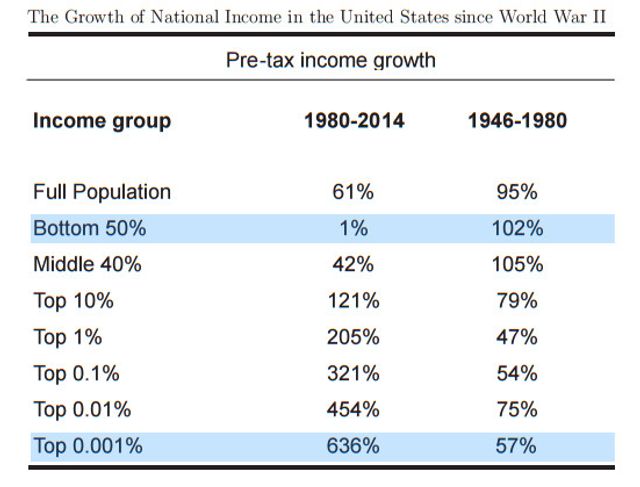
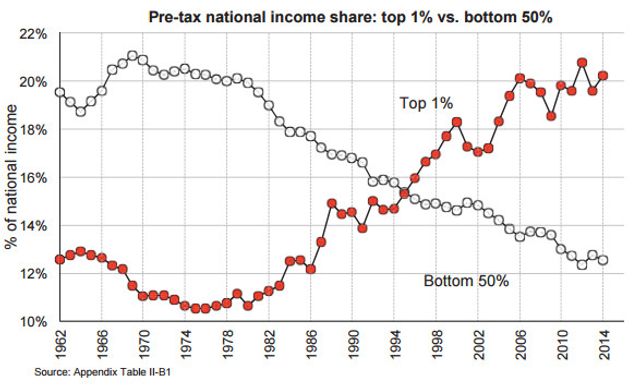
The economists found that the pre-tax share of national income received by the bottom half of the US population has been cut nearly in half since 1980, from 20 percent to 12 percent, while the income share of the top one percent has nearly doubled, from 12 percent to 20 percent. “The two groups have basically switched their income shares,” the authors note, “with 8 points of national income transferred from the bottom 50 percent to the top 1 percent.”
The study documents a sharp change between 1946-1980 and 1980 to the present. In the first period, the pre-tax incomes of the bottom 50 percent of earners more than doubled, growing by 102 percent, while the incomes of the top 1 percent increased by only 47 percent and the top 0.001 percent by 57 percent.
Since 1980, however, the incomes of the bottom 50 percent of earners have stagnated at about $16,000 a year (in current dollars), while the incomes of the top 1 percent have grown by 205 percent, and the top 0.001 percent by 636 percent.
After accounting for the impact of various tax credits and social programs, the economists found that the incomes of the bottom half of income earners increased by 21 percent since the 1980s. They note, however, that none of this increase has gone into disposable income. Rather, it is almost entirely the result of increased health care payouts from Medicare, which has simply been absorbed by the pharmaceutical giants and insurance companies engaged in price-gouging for vital health care services.
The principal factor in the surge in income inequality, particularly since 2000, has been the growth in “capital income,” that is, the stock market. The inflation of stock market bubbles has been the primary form through which the ruling class and its political representatives have engineered a massive transfer of wealth.
The figures contained in the report by Piketty, Saez and Zucman reflect historical transformations in the structure of American capitalism and class relations in the United States. The colossal growth of social inequality is bound up with the decay of American capitalism and decline in its world economic position.
Historians have often remarked that during its early days, the United States was the most socially egalitarian region of the Western world. The growth of monopolization and finance capital in the latter part of the 19th century transformed America into a land of “robber barons” at one pole and workers and immigrants whose living conditions were exposed in such works as Jacob Riis’ How the Other Half Lives, published in 1890, and Upton Sinclair’s The Jungle of 1906.
But along with these processes came the growth of the workers’ movement, which, largely through the efforts of socialists, fought to organize the American working class across its myriad ethnic, religious and regional divisions. The Russian Revolution of 1917 gave new impetus to these struggles, including the militant labor actions of the 1930s that led to the formation of the industrial unions.
The American ruling class, alarmed by the prospect that American workers would follow the example set by the Bolsheviks, and having at its disposal the economic might of the world’s largest and most advanced industrial economy, set out on a program of social reform exemplified by President Franklin D. Roosevelt’s New Deal, which introduced Social Security and curbed the worst abuses of Wall Street.
The United States emerged from the Second World War as the dominant global power, commanding more than 50 percent of world economic output. By the late 1960s, however, the economic domination of American capitalism began to decline, as the economies of Europe and Asia were rebuilt. A series of economic and political crises culminated in the combination of economic stagnation and inflation of the 1970s.
The US ruling class responded by embarking on a policy of class war, deindustrialization and financialization. With President Jimmy Carter’s appointment of Paul Volcker to head the Federal Reserve in 1979, the US central bank threw the United States into a manufactured recession. After coming to power in 1981, Ronald Reagan launched a full-scale social counterrevolution, initiated by the breaking of the PATCO air traffic controllers’ strike and firing and blacklisting of the strikers. Similar policies were pursued by the ruling classes throughout the world.
The trade unions played a vital role in facilitating this offensive, isolating and betraying every attempt at resistance by the working class throughout the 1980s and incorporating themselves into the structure of corporate management and the state. By the end of the decade, the unions had transformed themselves, for all practical purposes, into arms of the companies and the government. The bureaucratic elites that dominated them devoted all their efforts to suppressing and sabotaging working class struggle.
Every subsequent administration, Democratic and Republican alike, has pursued policies that promote social inequality, including successive rounds of financial deregulation, repeated tax cuts for corporations and top income earners, the slashing of social programs, and the elimination of workplace protections.
After the 2008 financial crisis, the Obama administration accelerated these processes. The White House continued and expanded the bank bailouts initiated under the Bush administration and helped funnel trillions of dollars to Wall Street through the Federal Reserve’s “quantitative easing” programs, while working, as in the 2009 auto restructuring, to slash wages.
Under the incoming administration of President-elect Trump, the offensive against the working class will sharply intensify. The election of Trump represents something new. He has staffed his cabinet with billionaires, far-right, pro-business ideologues, and generals—all of them dedicated to the impoverishment of the working class and the ever more violent suppression of popular opposition.
But Trump does not emerge from nowhere. He is not some aberration. Rather, he is the noxious culmination of the decay of American capitalism, growth of unprecedented levels of social inequality and collapse of American democracy.
These same processes have created the objective foundations for socialist revolution. In the mid-1990s, when the Workers League in the US and the sections of the International Committee of the Fourth International in the rest of the world began to transform themselves from leagues into parties, adopting the name Socialist Equality Party, we recognized the immense revolutionary significance of “the widening gap between a small percentage of the population that enjoys unprecedented wealth and the broad mass of the working population that lives in varying degrees of economic uncertainty and distress.”
The past two decades have confirmed this prognosis. The fight against social inequality requires the building of a new political leadership, embodied in the SEP, to organize and unify the struggles of the working class on the basis of a revolutionary program. The capitalist profit system must be replaced with a society based on equality, international planning and democratic control of production—that is, socialism.

19 Dec 2016

Kochi University of Technology (KUT) Doctoral Scholarships for International Engineering Students 2017/2018 – Japan

Application deadline: 17th  March, 2017
Offered annually? Yes
Eligible Countries: Scholarship is open for international students
To be Taken at: Japan
Program of Study: Doctoral Program (3 years), Department of Engineering, Graduate School of Engineering
About Scholarship
Kochi-University of technology Japan
The Special Scholarship Program (SSP) was established in 2003 in order to support the advanced research of the university by enlisting the help of highly capable students especially students from foreign countries. Every year in April and October, the university enrolls selected doctoral students for specific research projects. The students pursue the doctoral course in English (excl. Japanese students) while at the same time assisting their host professor as a research assistant (RA). Through this program KUT wishes to expand and deepen international ties with academic and educational institutions all over the world.
Offered Since: 2003
Type: Full International Doctoral scholarship
Eligibility Criteria                             
Applicants are required to meet all of the following
(1)To have or to be scheduled to acquire a master’s degree before the KUT enrollment date
(2) To be 35 years old or under at the time of enrollment
(3) To have an excellent academic record and strong bachelor’s and master’s degrees from reputable universities
(4) To have the intention, adequate knowledge and research skill to work in one of the designated research projects
(5) To have high English proficiency
Obligation
  • The SSP student must work 50 hours per month for a specific research project at the university.
  •  The SSP student must report his/her study and research achievements to the dean of the Graduate School of Engineering at the end of each semester. The submitted report will be evaluated by the dean of the Graduate School of Engineering.
Number of Scholarships: Fifteen (15)
Scholarship benefits:
  • Exemption from 30,000 yen entrance examination fee, 300,000 yen enrollment fee and 535,800 yen/year tuition fee
  • To support living expenses, 150,000 yen/month is paid for research project work.
  • 150,000 yen is provided for travel and initial living costs. (given only to international applicants who are living outside Japan, and who have, or have the intention to acquire, “Student” status of Japanese residence at the time of entry into Japan)
Duration of sponsorship: Doctoral Program will last for 3 years. Scholarship: 1 year.
The term will be extended for increments of one year up to a total of three years, unless the university terminates the SSP student status for any of the reasons stated in the Application Guidelines in the link below.
How to Apply
Sponsor: The Kochi University of Technology (KUT)

Government of Japan (Monbukagakusho: MEXT) Scholarships for Research Students 2017/2018

Application Deadline: 5th January 2017. Visit individual country embassies for more information.
Offered annually? Yes
To be taken at (country):  Japanese Universities
About Scholarship: The Japanese Government’s Ministry of Education, Culture, Sports, Science and Technology (MEXT) is offering scholarships to those who are enrolled in a master’s course, a doctoral course, or a professional graduate course at a graduate school, or who are conducting research in a specialized field at an undergraduate department, graduate school, institute attached to a university, etc. without the aim of completing the course, or who are receiving preparatory education in the Japanese language and other subjects prior to placement at the university, etc. (Excluding the Young Leaders Program(YLP) students or teacher training students.)
Type: Research (Post graduate students who wish to conduct research in Japan for the award of Ph.D/Master’s degrees in respective fields).
Fields of Study: Applicants should apply for the field of study they majored in at university or its related field. The fields of study must be subjects which applicants will be able to study and research in graduate courses at Japanese universities.
Those studying traditional entertainment arts such as Kabuki and classical Japanese dances, or subjects that require practical training in specific technologies or techniques at factories or companies are excluded from this restriction.
Selection Criteria and Eligibility: 
  • Nationality: Applicants must have the nationality of a country that has diplomatic relations with Japan. An applicant who has Japanese nationality at the time of application is not eligible. However, persons with dual nationality who hold Japanese nationality and whose place of residence at the time of application is outside of Japan are eligible to apply as long as they choose the nationality of the foreign country and give up their Japanese nationality by the date of their arrival in Japan. Applicant screening will be conducted at the Japanese diplomatic mission in the country of applicant’s nationality.
  • Age: Applicants generally must have been born on or after April 2, 1982.
  • Academic Background: Applicants must be a graduate from a Japanese university or have academic ability equal or superior to that of a Japanese university graduate. A person will be deemed to have academic ability equal or superior to that of a university graduate, if he/she:
    • has completed or will complete 16 years of school education in a foreign country (or 18 years of school education if he/she desires to enroll in a doctoral course in the field of medicine, dentistry or veterinary science, or pharmacy which is based on a 6-year course in a department or faculty); or
    • is or will be aged 22 or older and has taken an individual entrance qualification examination and has been judged by a Japanese graduate school as being equal or superior in academic ability to a university graduate (or 24 or older if he/she desires to enroll in a doctoral course in the field of medicine, dentistry or veterinary science, or pharmacy which is based on a 6-year course in a department or faculty). Eligible applicants include those who otherwise satisfy or will satisfy qualification requirements for admission to a Japanese graduate school. As a general rule, a person who has completed a doctoral course may not apply unless he/she seeks to obtain a degree.
  • Japanese Language Ability: Applicants must be willing to learn Japanese. Applicants must be interested in Japan and be willing to deepen their understanding of Japan after arriving in Japan. Applicants must also have the ability to do research and adapt to living in Japan.
  • Health: Applicants must be free from any mental or physical disabilities that would impede the pursuit of study at Japanese graduate school.
  • Arrival in Japan: In principle, applicants must be able to arrive in Japan between the 1st and 7th of April 2017, or by the date specified by the accepting university, which will fall within two weeks of the starting date for each semester (in general, in September or October) in that year designated by the accepting university. “Arrival in Japan” is considered to be the arrival period specified in the application form; changes will not be permitted after submission of the application.
  • Visa Requirement: Applicants must acquire College Student (ryugaku) visas before entering Japan. They then enter Japan with the College Student (ryugaku) residence status. Please also note that those who change their visa status to one other than College Student after arrival in Japan will lose their qualification to be Japanese Government Scholarship recipients from the date when their visa status changes.
  • While the applicant is studying in Japan, he/she shall contribute to mutual understanding between Japan and the home country by participating in activities at schools and communities with the aim of contributing to the internationalization of Japan. The applicant shall make efforts to promote relations between the home country and Japan by maintaining close relations with the university attended after graduation, cooperating with the conducting of surveys and questionnaires after the return home, and cooperating with all relevant projects and events conducted by Japanese diplomatic missions in the applicant’s home country.
Number of Scholarships: Not specified
Value of Scholarship:
  • Allowance: : 143,000yen (Research Students(non-regular students), 144,000yen (regular students in Master’s courses or professional graduate courses), or 145,000yen(regular students in doctoral courses) per month. (In case that the recipient research in a designated region, 2,000 or 3,000 yen per month will be added. The monetary amount each year may be subject to change due to budgetary reasons.)
  • Transportation to Japan
  • Transportation from Japan: The recipient who returns to his/her home country within the fixed period after the expiration of his/her scholarship will be supplied, upon application, with an economy-class airplane ticket for travel from the New Tokyo International Airport or any other international airport that the appointed university usually uses to the international airport nearest to his/her home address.
  • Tuition and Other Fees: Fees for the entrance examination, matriculation, and tuition at universities will be borne by the Japanese Government.
Duration of Scholarship: Determined by candidate’s course
How to Apply: It is important to go through the Scholarship Webpage and Application Guidelines before applying
Sponsors: The Japanese Government’s Ministry of Education, Culture, Sports, Science and Technology (MEXT)

European Extremism: Sourced in Germany

Aidan O’Brien


“The problem is that [the burkini is] not a bathing suit. It’s an Islamist uniform.”
— Marine Le Pen
“We show our faces….[the burqa] is not appropriate with us – it should be banned.”
— Angela Merkel
It’s almost impossible to spot the difference between Europe’s extreme right and Europe’s extreme centre. Europe’s extreme mainstream (the Guardian newspaper for example) would have you believe otherwise – it’s scaremongering ahead of key elections next year in Germany , France and Holland.
The liberals fear a “right wing” Europe. But that ship has sailed. Europe is so far right these days – it’s falling down. And doesn’t realise it. The centre paved the way. And the right is ready to pounce. Whether it’s Merkel or Le Pen doesn’t really matter. The damage has already been done. The “New Old World” – as it is – is profoundly anti-labor and profoundly anti-Semitic (a Semite being Jew and Arab). Hitler would feel right at home.
English may be the official language of Europe, but German is the official logic. Whatever Germany decides, the rest of Europe swallows. And the key German decision in the 21st century has been, in a word: austerity. Or in other words: wage depression. Or in old words: class war. And in the absence of working class resistance (working class consciousness) everything else neatly follows. Namely the scapegoating – primarily the antisemitism – in particular the (anti-Arab) islamophobia.
This is the German way. And Germany is proud of it. Germany admitted as much earlier this month when die führerin spoke in Essen at a Christian Democrat conference. Indeed die führerin declared indirectly that German “austerity” and German “antisemitism” are now the pillars that hold the whole European project together. Without German leadership, die führerin argued, Europe (the EU) would disappear. The message was that Europe (and in fact the world) needs German guidance. And the mainstream agrees! Now that Trump is in power in the USA – liberals are desperately clinging onto the German führerin. History indeed is ironic.
History is rational. There’s a reason for everything. And the reason for the liberal love of die führerin is Germany’s unconditional commitment to neoliberalism. The rewriting of the German social contract in the early 2000s (Agenda 2010 and the Hartz Plan) for the sake of German capital – crucified German labor. German labor was cheapened and made more precarious so that German capital could compete and profit more. This German embrace of aggressive neoliberalism set the stage for Europe’s extreme turn to the right.
It was Germany’s “Reagan” moment or “Thatcher” moment. And Europe was screwed. The introduction of the Euro currency at the same time – with Germany at the wheel – put Europe on the path to self destruction. Having depressed wages and weakened demand in Germany – German capital had no choice but to flood Europe in search of consumers (suckers). The Euro facilitated this. And the subsequent European bubbles and the bursting of those bubbles in 2008-10 unleashed the Berlin beast across the continent: austerity. From then on the path was clear for the new führerin. Germany über alles. And fuck Europe! And fuck Muslims too!
Before Obama fucked Europe in Ukraine, Germany fucked Europe in Greece. And while everyone was being fucked in Europe – the Arabs were being pulverised. This pulverisation of Europe’s closest neighbours has been the great distraction. As well as being the greatest crime. Germany’s utter contempt for European labor needed a smokescreen. NATO’s destruction of the Arab lands, and the ideology that accompanied it, provided it. Islamophobia became Europe’s convenient safety valve.
Is it a coincidence that Europe’s “refugee crisis” dramatically hit the headlines just days after Germany broke the legs of Greek resistance in the summer of 2015? Since then the media in Europe haven’t been talking about anything else but this “Arab invasion”. As if German austerity throughout Europe didn’t exist.
Instead of German neoliberalism being Europe’s problem, the Arabs were presented as being Europe’s problem. To make this “believable” the facts had to be turned upside down. NATO’s wars in the Arab lands disappeared from rational thought and the Arab refugees were to blame for their own predicament. The same way that German neoliberalism vanished from the scene of the Greek crime – Western imperialism and the prejudice and racism that makes it possible and responsible were hidden from view. A fake reality solidified. A decontextualised austerity and islamophobia took a grip of European life. Europe locked itself into a hellish dance without end. Hiding the causes has only perpetuated the consequences. And to hell with the victims.
Austerity and Islamophobia are now inseparable. One reinforces the other. More wage depression in Europe, equals more European stagnation, equals more European militarism, equals more European War for geopolitical advantage in the strategic Arab lands, equals more Arab refugees, equals more convenient scapegoats in Europe, equals more cover for even more wage depression in Europe. Or something like that. It looks like a never ending vicious downward spiral.
Is there a way to stop what Germany began in the 21st century? The good news is that there isn’t. There’s no way out for die führerin and her liberal minions. They are fucked. The right are swallowing them up. But that’s because they (the liberals) have already swallowed right wing policies. Which came first in Europe’s 21st century: the extreme centre or the extreme right? Answer: the extreme centre. And by swallowing neoliberalism it has morphed into the extreme right.
Today’s liberal fear of the right is therefore laughable. Nothing really distinguishes the liberals from the right. So instead of supporting them we should let them drown in their own contradictions. Russophobia being the latest contradiction. In search of more profit German capital is lashing out at everyone: European labor, the Arabs and now the Russians. By imposing austerity upon Europe, Germany has fanned the flames of antisemitism and irrationalism. And the fire today is raging! The Semites are being destroyed. And the Slavs are being targeted. Hitler indeed would feel right at home.
Some, like Varoufakis (the ex-finance minister of Greece), think we should save liberal Europe (the EU). They think we should reform it. But reform what? Is neoliberalism and it’s progeny, neofascism, reformable? Varoufakis & Co. have zero faith in people like us from the lower classes. They think that underneath we’re really fascists rather than communists. And so, they argue, we have to be saved from ourselves! And how do we do that? By saving German capital (the EU). They insult us. We say let the capitalists behind Merkel swing on the rope they themselves have made. Let the shit hit the fan in Europe. And let’s have a final reckoning with our class enemies. Let Europe as it is fall. And let a new Europe pick itself up again – a new Europe with multiple sources of inspiration – not just one monolithic right wing source. The Arabs would appreciate it. And so would the Germans. The left, too.