21 Dec 2016

US Army document on urban warfare advances strategy for “contemporary Stalingrads”

Eric London

The United States Army War College published a document this month outlining US plans for waging total war in major metropolitan cities around the world.
The 163-page report, “Military Contingencies In Megacities and Sub-Megacities,” is written by two military academics, Dr. Phil Williams and Werner Selle. Employing cold and calculating military jargon, the authors advance proposals that would likely result in nuclear war.
It is likely, the article begins, “that the United States will find itself at some point in the not-too-distant future engaged in military contingencies in large cities.” Elsewhere in the document, the authors call the invasion of major world metropolitan cities “as challenging as they are inescapable.”
The document pictures a future filled with historically unprecedented levels of death, destruction and human suffering. Urban warfare “ensures that the battlefield will be densely populated. Civilians will no longer be mere bystanders able to be circumvented or avoided, but an integral component of the battlefield.”
The authors recognize that such battles might result in massive civilian and soldier casualties. “Such cautions notwithstanding, an inhibition cannot be allowed to become a prohibition. If there is a highly compelling strategic rationale for action, the United States might not have the luxury of avoiding the dangers of an urban contingency.”

Preparing for “contemporary Stalingrads”

The authors explain that the closest comparisons for the urban battles of the “not-too-distant future” are the battles of Stalingrad and Berlin during the Second World War.
“[B]oth of these battles ultimately resulted in the utter destruction of the dense urban areas,” the authors note. “A more modern scenario, which although unlikely is by no means inconceivable, could involve a battle in Seoul, in the Republic of Korea. In some ways, such a scenario exemplifies the potential for a contemporary Battle of Stalingrad.”
Given the population of Seoul (23 million) and the exponentially more lethal military weaponry available today, such a battle would likely kill far more than the estimated 3 million who died in Stalingrad or the 700,000 who lost their lives in Berlin. The authors’ response is to propose better destructive armaments for the US occupation forces in South Korea: “The more US military forces are educated, trained, and equipped for a dense urban conflict, the more likely the numerical advantage of North Korea would not prove nearly as decisive as Pyongyang might anticipate.”
The authors explain that such “contemporary Stalingrads” would occur primarily in poor cities—what the military refers to as “fragile” or “feral” cities as opposed to more developed, “smart” cities. The destruction of the poorer neighborhoods will be a necessary component of “pacifying” the population.
“Given the trends in urbanization, especially in the global south and the concomitant problems of instability and fragility, it is more likely that the US Army will find itself in a fragile or feral megacity than in a smart city.”

US military strategy: “Bulldoze the slums” and target poor and working class districts

Large slums and shantytowns in impoverished cities present a unique challenge to American invasion:
“Megacities and dense urban areas also contain numerous slums or ‘sheet metal forests,’ which are very different from ‘concrete canyons’ [i.e., commercial centers]…These areas can provide significant concealment to the adversaries and even become strong operational bases. Apart from moving the population out and bulldozing the slum, there is very little that can be done .” (Emphasis added).
The military proposes to target young poor and working class men. Growing slum populations result in “a surplus of unemployed males with little to do but join gangs or engage in crime as a source of income. Joining extremist or terrorist organizations might also appear attractive as a way out. At the very least, in the event of some kind of conflict, these young men would provide a pool of potential recruits for those opposing the United States. In short, slums would be an inordinately difficult battlefield.”
The only alternative suggested by the US Army War College to razing the slums is for the US forces to ally with “forces of alternative governance,” including “criminal entities.” “A tacit or explicit agreement with the forces of alternative governance might make it possible to prevent adversaries from utilizing these ‘sheet metal forests.’ Of course, there would have to be something in return, even if only an implicit understanding that US military forces would not interfere with the illicit business of the criminal organizations.”
This admission reveals the fraudulent character of all the democratic, humanitarian pretenses given for US military intervention. To suppress opposition among the poor and working class, the military proposes to either bulldoze the slums or to give criminal gangs free rein to rape, kidnap, kill, extort, and sell into slavery the most impoverished and defenseless section of the population.

Crushing “civil unrest” and “anarchy”

The military is preoccupied by the likelihood of social opposition to a US invasion. The authors of the war college document list “civil unrest” as a main problem that will “plague the governance of such cities and play significant roles in the military operations conducted within them.”
There is a danger posed by “precipitating the collapse of a fragile city into a feral one. One only has to look at the experience of New Orleans under the impact of Katrina to see how a city can rapidly degenerate into anomie and anarchy, with the normal rules and norms of urban life abruptly jettisoned.”
The authors quote a leading industry strategist who writes: “The urban dilemma” involves “a risk of insecurity among the urban poor.” This applies beyond the global south: “Even cities like Amsterdam, London, New York, Paris, and Tokyo are not immune.”
The US Army War College article quotes an academic who explains that the problem stems in large part from “class conflict,” which “might greatly complicate the post-combat, pacification, and occupation periods.”
Where social opposition emerges, the authors note that “the restoration of order and stability would have to accompany if not precede major disaster relief operations. This effort could also create opposition.”
In its efforts to crush opposition, the military fears the “problem” posed by transparency:
“The other problem when dealing with cyberspace in relation to megacity contingencies is that adversaries can exploit the almost automatic transparency that it creates—both to show US forces in bad light and their own actions very positively.”
As a result, invasion plans must involve efforts to shut down the internet, cell phone service, and ensure the local media publishes only US military propaganda: “Part of IPB [intelligence preparation for the urban battlefield] prior to any action in a megacity or sub-megacity must be to identify the services providers for both telecommunications and the Internet. It is also important to identify online opinion-makers who could have a major impact in any controversy over US military intervention.”
The authors also note how “here in the United States, the release of videos showing killings by police has led to significant protests and political movements.”
Alongside Internet and telecommunications blackouts, the document places key importance on dominating the city’s infrastructure in order to “control the population.”
“There are certain areas you will always need to understand when entering an urban area—with the purpose of then controlling it and the population. These are the building layout and composition, transportation, electrical, sewage and water, and natural gas systems and the locations/status of key subcomponents—bridges, gas stations, power stations, high tension power lines, neighborhood substations/transformers, underground sewage canals, water purification plants, gas lines and their depth under roads…”
The war college authors praise an Israeli Defense Force commander who wrote that during its 2002 attack on the Palestinian uprising in the West Bank city of Nablus, the IDF “used none of the city’s streets, roads, alleys or courtyards, or any of the external doors, internal stairwells and windows, but moved horizontally through walls and vertically through holes blasted in ceilings and floors. This form of movement, described by the military as ‘infestation,’ seeks to redefine inside as outside, and domestic interiors as thoroughfares. The IDF’s strategy of ‘walking through walls’ involves a conception of the city as not just the site but also the very medium of warfare—a flexible, almost liquid medium that is forever contingent and in flux.”

Mass surveillance

The US Army War College report includes plans to establish a real-time map of an entire metropolis’ inhabitants, including their movements, social networks, friends, family and political thoughts. Quoting a group of European researchers, the authors state:
“The basic notion is that citizens with smartphones have become mobile sensors, reporting on events in the city with tweets, photos, messages, and the like. ‘This transforms human beings into potential sensors that not only have the ability to process and interpret what they feel and think but also to geographically localize the information (sometimes involuntarily) and spread it globally through the Internet, thus drawing people-generated landscapes.’”
At the same time, “Human intelligence assets will be able to offer far greater insight on adversaries because of their ability to capture emotions and relationships—things that will long remain outside the purview of even the most sophisticated drones.”
In other words, the US military will spy on the entire population of the cities it plans on invading, using drones and cell phones as real-time “sensors” to monitor entire populations. “Human intelligence” refers to the use of informants and government agents to infiltrate political groups and communities in order to suppress opposition.

Censorship and “the battle of the story”

Key to the military’s efforts to pacify and occupy major cities is its ability to win what it calls “the battle of the story.” The authors explain:
“Presenting compelling narratives can enhance legitimacy and authority in the eyes of many stakeholders (such as the urban population). Understanding the utility and power of digital media, therefore, allows for enormous reach and breadth that can indirectly alter the battlefield. The user-friendliness of mass media and mobile technology allows adversaries to manipulate and garner favorable public opinion and recruit support. For these reasons and more, civilian and military leaders cannot afford to ignore the requirement for compelling narratives.”
This fight over narratives is especially important in cases where the military is occupying American cities:
“In the final analysis, the battle of narratives and the contradictions of security are likely to be at the forefront, especially as the most likely contingencies will be humanitarian or stabilization operations. Moreover, such operations could even take place within the continental United States, as demonstrated by the Los Angeles riots and the responses to Hurricane Katrina and Superstorm Sandy. Presenting a positive image of the military to the American public is indispensable for continued support.”

The American ruling class prepares for future war crimes

The US Army War College article could serve as “Exhibit A” in a prosecution of leading military figures for war crimes. The article shows that US plans for invading, occupying and “pacifying” cities with tens of millions of residents are in advanced stages. In fact, the authors of this article consider such invasions “inescapable.”
No corner of the world is free from the threat of US invasion. The document lists several cities—including many in the United States—as hypothetical targets for invasion. Among those cities mentioned in the document are Mumbai, Beijing, Rome, London, Los Angeles, Abuja, Baltimore, San Salvador, Paris, Tokyo, Amsterdam, Dhaka, Nairobi, Delhi, Aleppo, Caracas, Rio de Janeiro, Frankfurt, Zurich, Hong Kong, Sao Paolo, Mexico City, Seoul, Manila, San Francisco, Tehran, Istanbul, Guangzhou-Foshan, Bangkok, Ho Chi Minh City, Rangoon, Alexandria, Jakarta, Johannesburg, Shanghai, Kabul, Cairo, Riga, Tallinn, Vilnius and Mogadishu.
The article flows from the US military’s analysis of its own activities over the last several years. The authors reference the National Guard’s occupation of Ferguson, Missouri during protests against a police killing in 2014, the occupation of parts of New Orleans during Hurricane Katrina in 2005, as well as foreign city operations like Kabul, Mosul, Fallujah and Baghdad. The US military is aware that it is preparing both to attack cities abroad and to suppress social opposition by the working class domestically.
If the US military is allowed to carry out its plans to invade major world cities using the tactics mentioned in the US Army War College document, tens or hundreds of millions will die while the number of refugees will be orders of magnitude higher. Capitalism presents a future of unprecedented death and destruction. Only a social revolution based on the international unity of the working class can prevent American imperialism from carrying out its plans.

Turkey, Russia, Iran sign deal on Syria after shooting of Russian ambassador

Halil Celik & Alex Lantier 

Yesterday, top Russian, Turkish, and Iranian officials met in Moscow and signed a declaration they billed as ending the US-instigated war in Syria. Coming after Russian-backed Syrian army units captured the key city of Aleppo from US-backed Islamist fighters, the deal shows that moves to improve ties between the three countries are continuing despite Monday’s assassination of Russia’s ambassador to Turkey, Andrei Karlov.
“Today, experts are working on the text of the Moscow declaration on immediate steps towards resolving the Syrian crisis. It is a thorough, extremely necessary document,” Russian Defence Minister Sergei Shoigu said at a meeting with his Iranian counterpart, Hossein Dehghan.
Shoigu dismissed US and European initiatives in Syria, declaring that “attempts to agree on joint efforts undertaken by the US or their partners were doomed. … None of them exerted real influence on the situation on the ground.”
The initiative was hailed by officials from Turkey, in a sharp turnaround from Turkey’s support for US-backed Islamist opposition militias in the early years of the war. “Now we are observing a very successful operation to liberate eastern Aleppo from fighters, the evacuation of the families of the opposition from Aleppo,” said Turkish National Defence Minister Fikri Işık.
Meeting with his Russian and Iranian counterparts, Sergei Lavrov and Javad Zarif, Turkish Foreign Minister Mevlüt Çavuşoğlu said cooperation between Russia, Turkey, and Iran had “brought about definite successes” in Aleppo. He said he hoped “to spread it to other districts of Syria.”
The expulsion of the Islamist opposition from Aleppo and developing collaboration between Moscow, Ankara, and Tehran mark a major setback for Washington and its European allies. For five years, US imperialism tried to topple Syrian President Bashar al-Assad by backing Islamist militias, a strategy it later expanded to include backing Kurdish nationalist forces in Syria, as well. While this operation was marketed as a revolution in the US and European media, it collapsed because the US-backed forces lacked any real popular support.
Though Turkey is a NATO ally of the United States, Ankara is reacting to the victory of the Syrian regime, Russia, and Iran in Aleppo by developing ever closer ties to Russia. During the launch of a Turkish-Russian joint investigation into Karlov’s murder, Turkish President Recep Tayyip Erdogan said Ankara and Moscow would “not let anyone harm Turkish-Russian relations.”
Anonymous Turkish officials told the media that Moscow and Ankara both “know” that the US-based movement of exiled cleric Fethullah Gülen was behind the assassination of Karlov.
This drew a protest from US Secretary of State John Kerry, who criticized “rhetoric coming out of Turkey with respect to American involvement or support, tacit or otherwise, for this unspeakable assassination yesterday because of the presence of Mr Gülen here in the United States.”
These events point to the deep instability in world politics and the rising danger of world war after the NATO powers’ setback in Syria, and the election as US president of Donald Trump, who has openly questioned whether the NATO alliance serves US interests. Turkey has been a NATO ally of the United States for six decades, with the second-largest army of the alliance. Yet, after five years of war in Syria during which the NATO powers launched a warmongering campaign against Russia, the Turkish regime is moving ever closer to Russia.
Since 2012, Ankara’s NATO partners have repeatedly expressed their concern over Turkey’s possible split from its Western allies, as conflict between Washington and Ankara came out over US support to Kurdish nationalists, which the Turkish government denounces as terrorist organizations.
Last year, after the territorial gains of the Islamic State in Syria and Iraq (ISIS), the Obama administration founded the so-called Syrian Democratic Forces. It engaged the Syrian Kurdish Democratic Union Party (PYD), the Syrian branch of the Kurdistan Workers Party (PKK), and its militia, the People’s Protection Units (YPG), as its main proxies in Syria. This terrified Ankara, which views Kurdish separatism in Turkey and neighbouring Syria as an existential threat.
The deep crisis of the Turkish regime’s foreign policy intensified when, in November 2015, Turkey shot down a Russian jet over Syria. While Moscow stepped up its deployment of missile units, fighters, and warships to the region—threatening an all-out war with Turkey that could have escalated into a world war between NATO and Russia—it ultimately only imposed economic sanctions on Turkey.
Amid escalating damage to the Turkish economy and fears that NATO allies, notably in Europe, might not intervene to aid Turkey in a war with Russia, the Turkish regime shifted its foreign policy. It began mentioning a possible rapprochement with Russia and the Syrian regime. In May 2016, Erdogan discharged his prime minister, Ahmet Davutoglu, who had previously declared that he ordered the shooting down of the Russian fighter, and apologized to Russia.
This set the stage for Washington and Berlin to tacitly back a coup attempt that nearly succeeded against Erdogan on July 15, and which Ankara blamed on Gülen’s movement. It was reportedly averted thanks to timely warnings from Russia. This inflamed the already explosive tensions not only inside Turkey, but above all, between Erdogan’s government and the major NATO powers.
The Turkish government has reacted by manoeuvring ever more desperately between its ostensible allies in NATO and the major Eurasian powers, Russia and China. In recent months, amid growing economic ties between China and Turkey, Erdogan has repeatedly declared that Turkey might join the China-led Shanghai Cooperation Organization (SCO), claiming this would allow Ankara “to act more freely.”
This drew a sharp reaction from NATO. Visiting Istanbul last month for the NATO Parliamentarians Assembly, NATO Secretary-General Jens Stoltenberg met with Erdogan and said, “I am sure Turkey will do nothing that could impair the concept of joint defence … and NATO unity.”
Above all, however, Ankara sought closer ties to Russia. Earlier this month, the Russian and Turkish prime ministers, Dmitri Medvedev and Binali Yildirim, met in Moscow. They agreed that “the normalization of the Syrian situation is a priority task for our countries and it will definitely serve to the benefit of the whole region, not to mention Syria, which is currently in a very complicated situation.”
On December 6, Yildirim criticized NATO for “hesitation” and “foot-dragging” in Syria: “Nice words are exchanged about defending civilization against terrorism. But the big terrorist networks challenging us today operate across borders.” He described the Turkish-Russian initiative as a push for a “forceful and united international front to eradicate terrorism.”
Erdogan’s government also seems to hope the Trump administration will take a “soft” line on Russia and offer Turkey more political leeway. Speaking to the pro-government Daily Sabah paper on December 5, Turkish Foreign Minister Çavuşoğlu said, “The Trump administration is one we could cooperate with,” claiming that Trump is “a pragmatic person. Many of our views overlap.”
Such hopes that Trump’s election will stabilize the situation and dampen explosive tensions in US relations with Turkey and the Middle East are built on quicksand. Trump has announced an aggressive “America first” policy and is signalling an offensive against China, as well as the cancellation of the nuclear treaty with Iran. What is emerging is not a stabilization of US imperialist policy, but the eruption of even more explosive crises.

Initial suspect freed in Berlin terror attack

Ulrich Rippert

Nearly two days after Monday’s a brutal attack on a Berlin Christmas market by a large truck, the circumstances and motivation remain unclear. The first man arrested by police has been released after forensic evidence cleared him of any connection to the attack, in which 12 people were killed and 48 injured, 18 of them severely.
This is an abominable crime that only serves to strengthen right-wing political forces. Although the circumstances of the crime are still unclear, the tragedy was immediately used by political leaders and the media to attack the German chancellor’s refugee policy from the right and justify a massive state build-up.
The interior minister of the state of Saarland, Klaus Bouillon (CDU), announced a massive upgrade of police forces, including equipping them with machine guns. On Tuesday, he told Saarland radio, “We have to declare that we are in a state of war, although some people who only want to see the good side of things cannot see this.”
On Tuesday, his Bavarian colleague Joachim Herrmann (CSU) criticised the refugee policy of the federal government. “We must now deal with the question of the risks we face from this large number of refugees,” Herrmann declared on Bavarian Radio.
Later, Bavarian Prime Minister Horst Seehofer (CSU) announced a special meeting of his cabinet Wednesday to discuss “possible consequences and proposals for federal policy.” We owe it to the relatives of the victims “that we rethink and re-adjust our entire immigration and security policy,” he argued.
The chair of the far-right Alternative for Germany in North Rhine-Westphalia, Marcus Pretzell, demanded that the state “hit back” and declared on Twitter: “Merkel is responsible for the deaths!” The federal president of the party, Frauke Petry, declared: “The milieu in which such acts can flourish has been negligently and systematically imported over the past year and a half.”
The attack was also used internationally to promote a far-right-wing agenda. The leader of the right-wing UK Independence Party, Nigel Farage, described the attack as “Merkel’s legacy.”
The US President-elect, Donald Trump, went further and suggested that “Islamic terrorists” were behind the crime. The “civilised world” must now rethink its position, he added on Twitter.
Immediately after the attack, it was stated that the incident was in all probability a terrorist attack resembling the terrorist act in Nice, in southern France, which also involved a large truck. That attack on the French national holiday last July killed 86 people.
Shortly after the attack Monday, police in Berlin announced that the suspected perpetrator had been apprehended. He was identified as Navid B. a 23-year-old asylum seeker from Pakistan, who had been arrested allegedly running away from the crime scene. He had entered Germany at the end of last year and was known to the police for minor offences.
Later on Tuesday, police announced that Navid B. had been freed. Police acknowledged that there were no DNA traces of the suspect found in the truck. In addition, the smudge marks usually created after a shooting were missing. Initially, it was assumed that the suspect had shot the Polish truck driver whose corpse was found in the cab.
General Prosecutor Peter Frank, who heads the investigation, admitted there was a suspect, but “we must entertain the notion that he is not the culprit,” but he continued to speak of a “terrorist” attack based on its similarity to the attack in Nice. According to Frank, the details of the attack in Berlin also suggested an Islamic background. When asked, however, he confirmed that there had been no claim of responsibility, as was the case with other attacks.
On Tuesday evening, more than 24 hours after the incident, news agencies reported that Amaq, the so-called news agency of the Islamic State (IS), announced that one of its “soldiers” had committed the attack in Berlin. The statement does not contain any insider information or information on the perpetrator, which according to experts, suggests that the attack was not coordinated by the IS leadership in Iraq and Syria.
Even if it turns out that this is a “terrorist attack with an Islamic background”—which is by no means certain at present—then it was not an “incomprehensible act”, as Chancellor Angela Merkel declared in her brief speech. A terrorist attack would be anything but “incomprehensible”, bearing in mind the aggressive militarist policy of the imperialist powers, which increasingly involves the German government.
For 25 years, NATO states, with the US at the head, have been waging unceasing war against largely defenceless populations in Afghanistan, Iraq, Libya, Syria and Yemen. Before that, imperialist interventions were carried out in Somalia, Bosnia, Serbia and a number of other countries. Millions have fallen victim to these imperialist wars and tens of thousands forced to flee every day.
Such war crimes have created the basis for the recruitment of fanatics intent on revenge. At the same time, Islamic terrorist groups such as Al Qaeda and its predecessors, IS, were built up, financed and equipped by the US and its regional allies, such as Saudi Arabia, Qatar and Turkey, before they became independent and turned against their erstwhile imperialist protectors. There remain to this day links between Western intelligence services and Islamic militia. In Syria, they are part of the alliance of Western-backed rebels.
Yesterday, the deputies of the French parliament stood for a minute’s silence for the victims of the Berlin attack. The president of the National Assembly, Claude Bartolone, took the opportunity to recall the terrorist attacks carried out in Brussels, Paris and Nice, and to praise the Hollande government, which he described as “intransigent in the fight against terror”.
But how has the French government responded to the terror attacks? By severely restricting democratic rights in the form of a never-ending state of emergency and by stepping up its policy of war. The German government has also been pressing ahead with the expansion of military operations following its announcement that the time of military restraint has passed. It is precisely this neo-colonial war policy that increases the terror threat.
Notwithstanding the crocodile tears and condolences of President Gauck, the chancellor and her ministers, those ultimately responsible for the terrible attack on the Christmas market sit in the seats of government power where military policy is decided.
It is by no means ruled out that a non-Islamic attacker may be responsible for the Berlin deaths.
Last summer an 18-year-old student shot nine people at the Munich Olympic shopping centre and severely injured four others. The immediate reaction was to claim it was a terrorist attack with an Islamic background. An anti-immigrant hysteria was whipped up, and a state of siege was imposed on the Bavarian state capital involving a large-scale civil war exercise. Later, it turned out that the crazed attack was carried by a teenager who had been radicalised in right-wing circles.
While the background to the attack on the Berlin Christmas market remains obscure, what is clear that the criminal act will be used to further the internal rearmament and strengthening of the intelligence services and security apparatus.

General Motors announces mass layoffs of workers in the US

Jerry White


General Motors officials on Monday announced that the company would eliminate one of the two production shifts at its Detroit-Hamtramck assembly plant and cut 1,192 of the factory’s 3,000 jobs. The cuts, which will begin March 5, are in addition to thousands of other temporary and permanent layoffs announced by the US’s largest automaker in recent weeks.
Citing a slowdown in less profitable passenger car sales, the company announced Monday it will close five assembly plants, including Detroit-Hamtramck, for one to three weeks in January, idling over 10,000 workers. The other plants affected are Fairfax Assembly in Kansas City, Kansas, for three weeks; the Lansing Grand River plant in Michigan for two weeks; and plants in Lordstown, Ohio, and Bowling Green, Kentucky, for one week.
In addition to the shift elimination in Detroit, GM announced last month that it was suspending third shifts at the Lordstown and Lansing Grand River plants, also in January, resulting in the layoff of 2,000 workers.
Other major firms are using the holiday season to slash their workforces. Boeing Commercial Airplanes has slashed 6,000 jobs in the state of Washington alone this year. The company’s CEO, Kevin McAllister, warned, “While we have made progress in reducing costs and improving affordability, we will need to do more in 2017.”
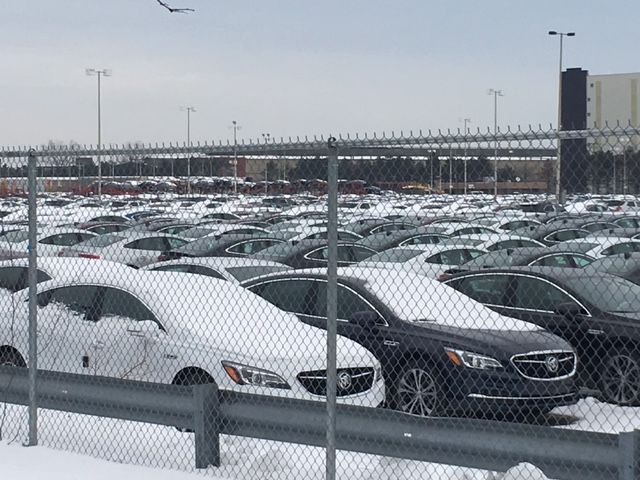
Unsold cars stockpiled outside of Detroit-Hamtramck plant
The earthmoving equipment manufacturer Caterpillar, after laying off 10,000 employees last fall, said last week that it will issue another round of pink slips without specifying how many. Xerox, which is splitting in two before the year’s end, warned of coming layoffs, which will likely hit the 39,000 employees at Xerox’s “legacy” copier business.
GM shares rose a quarter of a percent on the announcements as part of an orgy on Wall Street that saw the Dow-Jones Industrial Average rise to just short of 20,000 points on Tuesday. The corporate and financial elite has no intention of letting up on the relentless attack on the jobs, wages and health and pension benefits of workers. The ruling class anticipates huge profits as the incoming Trump administration slashes corporate taxes and regulations.
Trump has tapped GM CEO Mary Barra for a seat on his 16-member economic policy team, along with Stephen Schwarzman, CEO of the investment firm Blackstone; JPMorgan Chase CEO Jamie Dimon; and former General Electric CEO Jack Welch.
According to a Worker Adjustment and Retraining Notification Act (WARN) filing that GM sent to Michigan authorities Monday, about half of the affected workers at the Detroit plant are temporary workers, nearly 80 work at GM Manufacturing Subsystems LLC, a subsidiary of GM, and 32 are salaried workers being transferred to other plants.
In a callous statement, GM spokesman Tom Wickham said in an email, “GM adjusts its manufacturing plants’ production schedules to meet market demand as part of the normal course of business.” Company claims that it will relocate most of the workers are doubtful at best.
Detroit-Hamtramck Assembly
In October 2015, GM and United Auto Workers officials announced with great fanfare that a second shift would be added to the 4.1 million-square-foot Detroit-Hamtramck plant, which would absorb the 500 workers cut from GM’s nearby Lake Orion facility. The announcement was timed to dampen opposition from GM’s 53,000 US workers to the UAW-backed concessions contract, which Fiat Chrysler workers had rejected by a 2-to-1 margin.
In addition to retaining the hated two-tier wage and benefit system and keeping total labor cost increases below the rate of inflation, the UAW contract facilitated the layoff of workers in an economic downturn. It expanded the use of low-paid temporary workers who could be hired and fired at will and sanctioned the Detroit automakers’ plans to end mid-size and small car production in the United States.
As a result, GM has seen record profits, including $2.8 billion in the third quarter, exceeding Wall Street estimates and doubling profits from a year earlier. The company, which had a cash hoard of $21.5 billion as of September, spent $5 billion to buy back its own shares this year and plans to buy back another $4 billion by the end of 2017.
While throwing workers onto the street, billions have been squandered to boost the returns of its richest investors. This includes Barra herself, who saw her total compensation rise 77 percent in 2015 to $28.6 million. The UAW, whose former vice president Joe Ashton sits on GM’s board of directors, has also been a major beneficiary. The UAW still owns a substantial block of GM shares through its control of the multibillion-dollar retiree health care trust.
The UAW International and UAW Local 22 did not issue any statements on the layoffs, and neither returned phone inquiries from the World Socialist Web Site.
Workers at the plant, however, were livid over the announcement.
“I’m not happy,” Michelle, who has worked at the Detroit-Hamtramck plant for eight and a half years, told the WSWS. “People were upset at the plant meeting yesterday. No one could understand why they added the shift eight months ago if they were going to get rid of it eight months later.
“There were no union representatives on stage. It was getting ugly. Some workers had just bought GM cars to help the company, and this is how they were paid back.”
Many of the workers hired last April, she said, were being laid off before reaching one year of employment so that they would not qualify for Supplemental Unemployment Benefits (SUB) pay from the company. “They’re being laid off on March 5, just weeks before the April cut-off date,” she said.
“Everybody’s scared about the economy and Trump getting elected. They’re selling big cars, but that is going to dry up and we could all lose our jobs. The union agreed to a cap on our profit-sharing checks, even though the company is making billions.”
Carddears was hired in 2008. She worked six months and was then laid off for three years before getting a job at the Detroit-Hamtramck plant in November 2011. “It’s sad what they’re doing to people and shows that the economy is heading toward a dive. I don’t know what’s going to happen to me.
Carddears Jackson
“We do all the hard work in there building the cars, and they can just get rid of us. People were angry when they heard, and 17 workers just walked off the job. If we don’t fight then we are all going to be out of work.”
“Yesterday they told me I was out of a job after two years,” a young worker who did not give her name said. “The union told us we had job security. That was a fraud.”
The GM layoffs follow similar announcements by Fiat Chrysler and Ford in response to signs of a slowdown in the US automotive market, which has had three consecutive years of record sales. Most analysts say that the mini-boom in vehicle sales, largely spurred by low fuel prices, easy credit and pent-up demand from the Great Recession, is finally ending. GM’s inventories surged 28 percent between August 1 and December 1 to the highest level in nearly nine years, according to Automotive News.
At Dan & Vi’s Pizza on Chene Street across from the plant, a young welder at a nearby factory, Samantha, said, “They’re laying these workers off before the holidays—that’s ridiculous. I’m scared because I just got into the sheet metal trade, and we could lose our jobs.” Her friend Samuel added, “GM got a federal bailout, and they are throwing 1,200 workers out of their jobs.”
Sam and Samantha
Akia, a young Chrysler worker, said, “In the four-year contract the UAW got it takes seven years to get top dollar. I’m supposed to get it by 2019—if I last that long.”
Symbolizing the transformation of the former Motor City into a low-wage haven, the day after the GM layoff notice county officials announced that online retailer Amazon will open a distribution center in nearby Livonia next year and hire 1,000 workers. The facility will be built at the former site of GM’s Delco Chassis factory, shut in the 1990s and demolished in the early 2000s.

Limits of Practising Nuclear Brinksmanship

Manpreet Sethi


Thomas Schelling, a noted nuclear strategist who passed away recently, explained brinkmanship as a strategy that “means manipulating the shared risk of war. It means exploiting the danger that somebody may inadvertently go over the brink, dragging the other with him” (Arms and Influence, New Haven: Yale University Press, 1996, pp. 98-99). He graphically described this with the analogy of two cars heading towards an intersection from different directions. As one of the drivers accelerates his vehicle, he gives a signal to the other of his determination to cross first. By doing so, he has placed the onus of the decision on the other side to either slow down to let him pass, or to ignore his signal and carry on at the same speed even at the risk of a collision that would be equally harmful to both. If the second driver slows down, the first has successfully managed to use brinksmanship to deter the second driver by the threat of an accident. 

It is easy to apply this example to the Pakistan-India equation in order to understand the strategy of nuclear brinksmanship as used by Pakistan to buttress its deterrence. Pakistan may be compared to the first driver who accelerates his speed (or indulges in provocative acts of terrorism) and then seeks to deter India from crossing the intersection (or launching a military response) by suggesting the possibility of collision (or the threat of an all-out nuclear war). 
Besides India, Pak strategy of brinksmanship is also meant to magnify the fears of the international community. Pakistan's military works on the assumption that a ‘concerned’ international community (especially the US) would restrain India from using military force. This then, in Pakistan's perception, gives it the immunity to execute its strategy of bleeding India through a thousand cuts, while constraining India’s response to merely dressing its wounds without being able to strike at the hand making the injuries.

India has faced this behaviour for at least two decades by now and has understood the compulsions for Pakistan's behaviour, as well as its limitations. The response to Uri through a surgical strike was a move to explore other by-lanes that could be taken instead of being cowed down by the threat of collision on the main intersection. Meanwhile, Pakistan's  propensity to cry nuclear wolf every now and then is now well understood by India and the international community.

Another subscriber to the strategy of nuclear brinksmanship that has been well known to the international community is the DPRK. Since the conduct of its first nuclear test in 2006, it has paced its provocative acts of nuclear and missile testing in order to garner attention through the negative route of raising risks. The tests are aimed at not just perfecting technologies but more importantly at creating the dread of growing risks in the region as a way of drawing attention. However, Kim Jong-un’s nuclear brinksmanship has not elicited the desired response from the US. In fact, the Obama administration was wary of giving the impression that it was having to engage with DPRK with a nuclear gun to its head and hence refused to do so on terms set by Kim.

Meanwhile, more recently, another country seems to have joined the ranks of those exercising nuclear brinksmanship for deterrence. President Putin has been making extremely overt noises about Russian nuclear weapons capability since the annexation of Crimea, and ostensibly, to deter interference over Ukraine. In October 2016, Russia moved its nuclear-capable missiles close to Poland and Lithuania in a clear signal to NATO and the US.  A little earlier, Russian media held out stories on bomb shelters and conduct of exercises with nuclear weapons. Russian bombers have flown across and close to US borders often. Russia has also chosen to abandon the long held practice of keeping nuclear arms control issues independent of the overall political relations between Russia and the US. Its decision to walk out of the Plutonium Management and Disposition Agreement for political reasons is only one example of the display of its willingness to take nuclear chances. 

With the new presidency about to be inaugurated in the US and going by the not-so-encouraging utterances of President-elect Donald Trump, one is not sure about how the US would deal with Russian behaviour. Would Putin be met with Trump’s version of nuclear brinksmanship? Would that cancel out each other’s moves? Or raise the nuclear temperature?
While the purpose of brinksmanship strategies is essentially deterrence, the dangers of a cavalier acceptance of risks are well known. If anything, Cold War nuclear politics brought home the need for strategic stability between two nuclear nations. In contemporary times, when nuclear dyads have proliferated, the need for stability is even greater. 

Brinksmanship strategies that appear to be working raise the salience of nuclear weapons and increase their attraction for proliferation. None of this is good for international stability and security. It is therefore imperative that responsible nuclear powers around the world use every opportunity to drive home the limitations and uselessness of nuclear brinksmanship by exposing the hollowness of the threats to use nuclear weapons. 

Ironically, it would be better also for the countries playing the game of nuclear brinksmanship that the nuclear emperor is not exposed for not wearing any clothes.

20 Dec 2016

Shell Nigeria Niger Delta Postgraduate Scholarship Scheme in UK Universities 2017

Application Deadline: 30th  January 2017.
Offered annually? Yes
Eligible African Countries: Nigeria (Rivers, Delta, Imo and Bayelsa States)
To be taken at (country): The scholarship is offered in partnership with three prestigious and internationally recognised universities in the United Kingdom Imperial College LondonUniversity College London and the University of Leeds UK
Accepted Subject Areas? The following courses at the three institutions qualify for the scholarship:
  • Imperial College LondonMSC Petroleum Engineering
    MSC Petroleum Geoscience
    MSC Petroleum Geophysics
  • University College LondonMSC Chemical/Process Engineering
    MSC Mechanical Engineering (Rotating Equipment or Metallurgy)
    MSC Civil Engineering (Geotechnics)
  • University of LeedsMSC Exploration Geophysics
    MSC Electronic/Electrical Engineering
About Scholarship: Each year the Shell Petroleum Development Company of Nigeria (SPDC) offers scholarship awards to students form the Niger Delta region of Nigeria. For the 2014 scholarship award, the Oil and Gas company is delighted to announce the third annual SPDC Niger Delta Postgraduate Scholarship Scheme for applicants from Rivers, Delta and Bayelsa States.
The scholarship scheme is aimed to provide an opportunity for qualifying students from the three Niger Delta States to further their education in courses that are relevant to the oil and gas industry.
Offered Since: 2010
Type: Postgraduate (Masters)
By what Criteria is Selection Made? Candidates must have gained admission to study at any of the participating universities in one of the qualifying courses
Who is qualified to apply? To qualify for the scholarship, applicants must:
  • Display sound intellectual ability and leadership potentials
  • Meet the individual universities’ English Language requirements (usually at least 6.5 in IELTS score valid for Sept. 2017 admission).  Please note that TOEFL is no longer recognised by most UK universities. Candidates are advised that failure to meet each university’s English Language requirement at the time of selection may invalidate their application.
  • Be aged between 21-28 years by 30/09/2017
  • Be an indigene of Rivers, Delta, Imo or Bayelsa states (documentary proof of this will be required and will be verified)
  • Currently reside in Nigeria
  • Return to Nigeria on completion of the proposed programme of study
  • Have obtained a university degree (at least of equivalent standard to a UK Second Class Upper (Honours degree)
  • Not have studied previously in the UK or any other developed country
  • Have a Nigerian international passport valid to end December 2018
  • Be neither a current nor former employee (who has left employment less than 5 years before) of SPDC or the Royal Dutch Shell Group of Companies
  • Not be a spouse, child or ward of staff of Shell Companies in Nigeria
What are the benefits? The scholarship will cover tuition fees, one return flight from Nigeria to the UK and a contribution towards living expenses only.
How long will sponsorship last? One year postgraduate Masters Studies
How can I Apply?
  • Submit application for admission to the  any of the prospective universities for any of the qualifying courses
  • Application forms will be available ONLY through the participating universities, following admission;
  • Nominated applicants will attend an interview before being considered for final selection;
  • Visit the following university application page for more details on how to apply for admission.
Further information can be obtained at  info@nigerdeltascholar.org or through the individual universities.
Sponsors: Shell Petroleum Development Company of Nigeria (SPDC)
Notes: 
  • Please note that the stipends are based on the Association of Commonwealth Universities (ACU) published living rates and are limited to this only
  • This is a non-committal scholarship. Note that NEITHER SPDC  NOR any of its affiliate companies is obligated to offer employment of any sort to any candidate upon graduation neither are successful candidates bonded to SPDC for any period of time on account of the scholarship award.

Goethe-Institut KULTURAKADEMIE Cultural Management Training 2017 for MENA Countries. Fully-funded to Germany

Application Deadline: 5th January, 2017
Eligible Countries: MENA Countries. Algeria, Egypt, GCC Countries, Iraq, Jordan, Lebanon, Libya, Morocco, Palestine, Sudan, Syria, Tunisia and Yemen.
To be taken at (country): Germany
About the Award: Organising festivals, planning exhibitions, monitoring budgets and launching advertising campaigns: cultural managers shape the cultural scenes in the Arab region. While responsibilities have been expanding, practical experience alone is not always sufficient for success. Hence there is a strong demand for well-connected and adequately trained protagonists in the cultural scenes of the Arab region.
Therefore as part of the KULTURAKADEMIE Programme, the Goethe-Institut is offering a sixweek cultural management training for members of non-state cultural institutions from the Arab region between April 24 and June 2 2017 for the seventh time since 2011.
15 participants will be trained in Germany in fields like
  • Basics of Cultural Management
  • Cultural Policy
  • Communication and Marketing
  • Audience Development
  • Budgeting
  • Fundraising
Type: Training
Eligibility: “Independent”, non-state protagonists from various cultural fields from the Arab region (e.g. curators, (executive) employees of cultural centres, festival organizers, gallery owners as well as theatre and film professionals). Requirements for participation:
  • At least three years of relevant professional experience in the cultural sector
  • Very good command of English
  • Application with a specific project proposal
Selection: Participants will be selected by the respective Goethe-Institut in North Africa / Middle East (e.g. Goethe-Institut Tunis for applicants from Tunisia) and in consultation with the independent Arab cultural organisation Al Mawred Al Thaqafy (Culture Resource).
Number of Awardees: 15
Value of Scholarship: The Goethe-Institut is covering the costs for airfare, insurance and accommodation expenses as well as an allowance for the duration of stay in Germany. Depending on the grant approval by the German Federal Foreign Office to provide funds, the Goethe-Institut reserves the right to claim a deposit from the participants.
How to Apply: To apply, please fill out our online form.
For a first impression of the Kulturakademie NANO, please check this article at the end of the project year 2015.
Award Provider: Goethe-Institut

Of Mosques And Grassroots: The Sites Of Resistance In Kashmir

Waqas Farooq Kuttay


After the killing of Hizb commander BurhanWani, loudspeakers in mosques across Kashmir were abuzz with pro-freedom songs. An atmosphere of emotional commotion prevailed and sentiments were high. After Burhan’s killing, Kashmir witnessed one of the longest and largest strikes in her history under Indian occupation (Jean Dreze calls it one of the longest in Indian history, Kashmir’s Hidden Uprising, The Indian Express, December, 05, 2016). Curfew was imposed and without any provocation the state and its agents would resort toindiscriminate force and violence. All the while communication network across the valley remained suspended. In fact, internet services still remain suspended to a large extent. Much has been written about the various aspects of the prevailing situation in the valley but no serious attempt has been made to understand the use of the mosques as the sites of resistance.
Demographically, Muslims are in majority in the Kashmir valley. In every village and town, one would find one or more mosques. So it can be argued that the mosques would have wider coverage in mobilizing people and organizing protests. In past, particularly during Friday prayers, most of the preachers will ask people to stand against Indian atrocities but the practice has gained impetus in recent times (particularly last few years). Conglomerate of separatist group issue protest calendar and ask people to use the mosques during specified time periods for playing pro-freedom songs. The separatists are well versed of the fact that the mosques can be helpful in mobilizing people in a short span of time. They also know that mosques are sites were state has no control. The sheer numbers of mosques in the valley makes it difficult for state to effectively monitor or keep them under surveillance. Since most of the population is Muslim and Kashmiri struggle to large extent reflects this Muslim sentiment, the appeal of the mosques as sites for mobilization of masses is verytempting. These are some benefits of using the mosques as the sites of resistance.
In my opinion some serious damages accrue from use of the mosques as sites of resistance. The separatist groups in Kashmirare undemocratic and elitist in nature and are fomenting an unorganized revolution. The grass root mobilization is absent in Kashmir. The separatists, aware of the fact that they have failed organizationally, try to fill the gap by mobilizing people by usingthe mosques which further exacerbates current shabby situation. Making the mosques as sites of resistance also results in concentration of power in these mosques. The power then rests with those who are active members of the mosque committees or preachers. Although, the mosques are the important sites of resistance and can be helpful in the short term but this can’t be a long term strategy. Using the mosques as sole source of mobilization makes the separatist groups more ‘undemocratic and unaccountable’ because there is complete absence of checks and balances via this channel. ‘Accountability’ matters because if they demand sacrifices from people then the separatists have to be accountable to them. Now if anyone argues that the separatists are running a ‘movement’ and not a ‘democracy’ then, they should not garb their own decisions as those of the common people.
There are no institutions or structures present at village or town level which represent the separatist sentiments of people. There are no branches of organizations which represent ‘separatist groups’ even at the district level. Even if there is one, people are hardly aware of it. One can experience the presence of mainstream political parties almost in every village of Kashmir but same is not the case with the separatists. Some will argue that separatists are under the surveillance of the state and can’t do much in building grassroots organizational strength. But in my opinion separatists can’t hide behind the ‘veil of state surveillance’ for one of their biggest weakness. Intellectual debates seem absent in the separatist camp. People’s opinions hardly matter in the course of separatist action. They tend to keep things to themselves. Their actions (separatists) demand scrutiny in line with the larger aspirations of people and this is possible only with the wider and sophisticated network at grass root level. It would take time but yield better results.

Global agencies demand deeper budget cuts in Australia

Mike Head

Australia’s latest budget update, released yesterday, predicts a sharp economic slowdown and further blowouts in deficits for the next five years. It triggered renewed demands by big business, the media owners and the global credit ratings agencies, representing the world financial markets, for brutal cuts to social spending.
Although the three principal agencies—S&P, Moody’s and Fitch—left the country’s borrowing rating at AAA, they placed Prime Minister Malcolm Turnbull’s government and the entire parliamentary establishment on notice to deliver deep cuts in next May’s budget.
Markets analysts said the government had barely “kept the wolves at the door” and this was merely a “stay of execution.” They warned of a downgrade unless the government could impose S&P’s demand for “forceful” cuts, preferably with the assistance of the opposition Labor Party, which this year has already helped push through parliament spending cuts worth $22 billion over four years.
S&P stated that it did not believe the government’s assurances that it could still eliminate the annual budget deficit of nearly $40 billion by 2020-21. “We remain pessimistic about the government’s ability to close existing budget deficits and return a balanced budget by the year ending June 30, 2021,” it said.
An air of unreality hung over the government’s Mid-Year Economic and Fiscal Outlook (MYEFO) because of the worldwide uncertainty in the wake of the election of Donald Trump as US president. Trump has threatened trade war measures against China, which is the largest market for the commodity exports on which Australian capitalism’s fortunes depend extremely heavily.
In the anodyne words of the MYEFO report, “the outlook for global growth remains uncertain.” Buried away in an appendix, under the heading of “risks,” the document states: “To the extent that unanticipated changes in economic circumstances occur, their impact will flow through to government expense and revenue forecasts.”
Even on the government’s own optimistic assumptions, the MYEFO forecasts an ongoing slump. It foreshadows a further cut to federal tax revenues of some $30 billion more over the next four years than was admitted in last May’s budget, just seven months ago.
May’s economic growth forecast for 2016-17 has been downgraded from 2.5 percent to 2 percent, but this figure itself is dubious, given that the economy officially contracted by 0.5 percent in the September 2016 quarter, and entire regions of the country have been in recession for several years.
The biggest single factor in this downgrade is the lowest wages growth for decades, eroding income tax revenue. The MYEFO predicts that real wages will rise by just 0.5 percent this year and next. This figure indicates that substantial wage cuts are occurring throughout the working class, alongside soaring executive pay.
Behind these wage cuts is pressure of rising levels of unemployment and underemployment. The relentless destruction of full-time jobs, via mine and industrial closures and cost-cutting corporate restructuring has accelerated since the 2008 global financial breakdown.
There are now 51,000 fewer people employed full-time than there were a year ago. Most of the damage has been inflicted on young people. Full-time employment for 15- to 19-year-olds dropped by 15 percent in the past year and by 6 percent for 20- to 24-year-olds.
Only 39 percent of people aged 20-24 now work full-time—down from 54 percent before the 2008 crisis. The proportion of 15- to 24-year-olds working full-time is now the lowest recorded in Australia during the post-World War II period.
The government largely won its “stay of execution” by outlining more cuts to welfare and students. These include $13 billion from child care benefits, aged pensions and carers’ income support over the next four years, $7 billion from vocational education loans to students and $3.7 billion from a crackdown on alleged welfare over-payments. Jobs and training programs will be cut by $450 million, while criminal fines will be increased in value by almost 20 percent, raising $90 million.
These measures enabled the government to claim that, despite its $30 billion revenue slump, the budget deficits will blow out by “only” $10 billion to $94.9 billion over four years. Yet even that forecast makes a mockery of the government’s pledge to the markets to produce a budget surplus by 2020-21.
The forecast deficit in 2019-20 has worsened from $5.9 billion to $10 billion, highlighting the difficulty of posting a surplus in the following year. Likewise, the deficit for 2018-19 was increased to $19.7 billion. It was originally estimated at $6.9 billion in last year’s budget, then increased to $15.4 billion in this year’s budget.
Similar blowouts have occurred in the past 12 consecutive budgets and MYEFOs. Empty promises of returning to surplus have been made since 2010, first by the Labor government until 2013 and then by the current Liberal-National Coalition. The Australian’s contributing economic editor Judith Sloan observed that the pledges were based on “Pollyanna figures.”
This year, precisely because of the global turmoil, the government did not try to make revenue projections based on this year’s uptick in global iron ore and coal prices, which could reverse rapidly if China’s economy falters. However, the government still made unrealistic assertions, including that the mining investment collapse will abate and that the unsustainable property bubble will continue to shore up residential construction in Sydney, Melbourne and Brisbane.
Economic forecaster BIS Shrapnel’s Adrian Hart, said: “The decline of only 12 percent in mining investment in 2017-18 looks too small.” BIS Shrapnel expects a 26 percent slide this year, 24 percent next and 17 percent in 2018-19. It also predicts a 5 percent decline in housing investment by 2017-18, with a worse drop the subsequent year.
While the working class—particularly the young and most vulnerable—are already bearing the burden of the economic reversal, the government is pushing ahead with the key planks in its “jobs and growth plan.” They consist of company tax cuts worth $50 billion over a decade, military spending of $195 billion over the same 10 years, and programs to coerce young workers into low-wage “internships” as cheap labour for the corporations.
The government is also preparing for war, with a massive spending program on submarines, warplanes and other weaponry. Defence Industry Minister Christopher Pyne last week declared in Cherbourg, France, where Australia’s new fleet of submarines will be designed: “We are a very wealthy country, as a consequence we have a responsibility to do our part to, as Donald Trump says, not be strategic bludgers but actually lift our percentage of spending of GDP to 2 percent, which we’ll do by 2020-21.”
To pay for tax cuts and military spending, the Liberal-National coalition government is under pressure to make deep inroads into social programs despite widespread hostility to the austerity agenda that has been enforced by Coalition and Labor governments alike.
Prime Minister Malcolm Turnbull called a rare double dissolution election last July 2 in a failed bid to break through a parliamentary logjam produced by the opposition parties’ fear of electoral backlashes and social unrest. Instead the election reduced the government to a wafer-thin majority of one seat in the lower house and saw a record vote against the main establishment parties—the Coalition, Labor and the Greens—in the Senate. Despite their claims to be “anti-elite,” the right-wing populists elected to the Senate helped the government survive to the end of the year, voting for key spending cuts. But the financial elite is demanding far more savage measures.
Corporate media editorials today again voiced frustration with Turnbull’s failure to deliver this agenda, and appealed to the Labor Party to join hands with the government. The Australian declared: “Once again we see deficits widen and debt deepen. Once again we see incremental budget repair and an unambitious reform agenda in the face of obstructionist opposition. The song remains the same; it is a dirge.”

Finnish government prepares new attacks on working class

Ennis Wynne 

The attack on the living standards of the working class is set to intensify due to Finland’s escalating economic crisis.
A report in October by the National Institute for Health and Welfare estimates that already 440,000 Finns, almost one in eight, “do not earn enough to maintain a reasonable level of consumption.”
Last month, the European Systemic Risk Board (ESRB) noted that Finnish household debt levels are at a historically high level and “could pose a systemic risk to financial stability in Finland.”
On November 19, state-owned broadcasting service Yle reported comments from Juha Sipilä, prime minister of the Centre Party-led coalition, who said the trade unions were “spreading negative attitudes” and “whining about Finland’s employment situation.”
In light of Sipilä’s remarks, Yle’s morning politics programme invited both Jyri Haekaemies, CEO of the Confederation of Finnish Industries (EK), and Jarkko Eloranta, of the Central Organisation of Finnish Trade Unions (SAK), into the studio for comments.
Haekaemies said, “Everyone is waiting for positive news, but our task is to come out on the issues as they really are. Finland’s economy has been squeaking along for the past decade. Our employment percentage is 68 while in Sweden the figure is 76 percent. These are the facts that we need to base our actions on.”
Referring to Sipilä’s comments during a factory tour on November 15 that the trade unions “have been spreading a negative atmosphere in Finland’s economy,” Eloranta feigned an oppositional stance stating that SAK “has had its work cut out with the current government.”
However, he immediately reassured Haekaemies that while the unions have opposed some of the government’s attacks, “They have also put new agreements into action and at least the SAK will continue to propose reforms to Finnish society and social security.”
The principal “new agreement” is the Competitiveness Pact, to which, after months of wrangling, the trade unions signed up in the summer. The pact included a yearlong wage freeze, increased deductions from employees for pensions and sickness benefits—with a corresponding decrease in employers’ contributions—and a 30 percent cut in holiday pay for public employees for the period 2017-2020. The deal ensures that Finns work three additional days a year without a pay rise.
The pact was based on economic conditions as of 2015/2016 and played a central part in the drive to close a “10 billion euro sustainability gap” and enable Finnish capital to compete in the world market. It is clear, however, that the deepening global crisis has overtaken the Finnish bourgeoisie, the right-wing coalition government and the trade union bureaucracy.
Yle reported October 27 that the European Commission (EC) said Finland’s economy remained among the worst in the European Union (EU), and it suspects that Finland and six other European countries are “running afoul of EU budget rules.”
The EC recommended that Finland improve its structural deficit by 0.6 percent of GDP.
Further attacks on the conditions of the working class are being prepared. This is the content of the statement of Matti Hetemaeki, the permanent secretary at the Ministry of Finance, who declared in August, “The situation is a lot worse than is widely thought. We have a Nordic welfare state, with its benefits and services, but our employment rate is Southern European.”
Mikaeel Pentikaeinen, chief executive of the Federation of Finnish Enterprises, having complained that it is too difficult for small businesses to lay off employees, stated in the Helsinki Times that “small and medium (sized) enterprises have recently been practically the only source of job creation in Finland.”
The coalition government is seeking to further the attack on the working class, and it is clear that the Finnish bourgeoisie fears the response of the class, not the union bureaucracy. That the unions have signed up to the pact is one thing, their ability to deliver it is quite another.
With a union membership level of 69 percent, the Finnish working class is the most unionised in Europe. However, the unions have not been able to contain growing struggles by workers against the most sustained attacks on living standards in generations. As the Swedish industrial relations “expert” Henrik Malm Lindberg wrote in the Helsinki Hufvudstadsbladet November 3, “For several decades Finland has been a country marked by a high level of industrial conflict both by Scandinavian and European standards.”
He compared the situation in Finland today with a strike wave, including unofficial strikes that took place in Sweden in the early 1990s. Since 2000, strikes in Finland both lawful and unofficial have averaged 100 a year. There was mass action in the summer of 2015 against the imposition by decree of the Competitiveness Pact and in December broad support for the postal workers’ strikes. On November 3, Helsinki shipyard workers struck for two days over the interpretation of the pact.
Lindberg made some recommendations among which was that, as in Sweden, wage levels be determined by the needs of the export industries. While Finnish capital looks to such a solution, Jyri Haekaemies warned that whereas in Sweden “the benchmark—the wage level determined by the export industries—is not only the ceiling but also the floor… In Finland we ought not to have a floor unless it is flexible.”
The coalition government is thinking in similar terms. In an October 24 Bloomberg article, “Finland’s Millionaire Premier Freezes Pay in Bid to Save Economy,” reporter Raine Tiessalo interviewed Sipilä at some length. Sipilä stated, “We’re behind our main competitor countries. Our problem is that our exports are lagging and that growth relies on domestic demand…exports should become the growth motor again.”
Exports comprise 40 percent of Finland’s GDP, and Tiessalo notes that “the country has booked a trade deficit almost every month this year as exports have shrunk some 15 percent from December through August.”
From 2018, Sipilä said, “exporting industries will set the base for pay talks.”
In the Competitiveness Pact, the unions agreed that there would be no pay rises in 2017. Tiessalo wrote, “With pay levels under control, Sipilä says the next step is to ensure that Finns actually produce more—essentially forcing them to accept pay cuts per unit produced.”
“There the government does not have much influence as it depends on the companies,” Sipilä said, adding, “But my gut feeling from speaking with exporters is that 5 percent productivity is not a problem.”
Even this would not meet the demands of some representatives of the bourgeoisie. On October 4, Martti Ahtisaari, the president of Finland from 1994 to 2000, gaining election on the Social Democratic ticket, ranted, “[O]wing to globalisation we cannot succeed if we overprice ourselves. We could succeed by halving wages. Where can we find an administration that is willing to start cancelling benefits we cannot afford?”
Bjoern Wahlroos, an executive at the Swedish-based financial group, Nordea, declared on Yle’s Internet channel in October that digitalisation and “robotisation” had changed working life, “But low wage jobs are a necessity if there are to be enough jobs.”
Among the fresh attacks being considered by the governments are public spending cuts. Last month, Petteri Orpo, the finance minister, warned that a further 1 to 2 billion may need to be cut next year.