31 Dec 2016

US railroads demand concessions from 145,000 workers

Jeff Lusanne

Long drawn out contract negotiations between rail unions and the major US freight railroads have recently been terminated by railroad management, prompting the unions to seek federal mediation. The railroads leading the contract negotiation are demanding that workers pay more for health care, accept minimal raises and adopt even more concessions on working conditions.
The contract negotiation covers 145,000 employees in 11 unions, the largest of which are the United Transportation Union (UTU/SMART), Brotherhood of Locomotive Engineers and Trainmen (BLET), and Brotherhood of Maintenance of Way Employees (BMWED). Representatives from most of the largest US railroads—Union Pacific, Burlington Northern Santa Fe, Norfolk Southern, Kansas City Southern, and CSX—form the National Carrier’s Conference Committee (NCCC), which carries out the negotiations. Additional railroads and employees are covered or influenced by the contract, which sets the standard for the industry.
Negotiations began two years ago and agreements expired on December 31, 2015, but rail workers continue to labor under the previous contract. The railroads appear to be biding their time until the Trump administration takes office, a factor they apparently see working to their advantage.
Typical of railroad management’s attitude is a December 15 statement that declares, “Now is not the time for excessive demands. Railroad employees are among the most highly compensated in the nation.” That leads to a link describing compensation that is full of misleading data. That wages surpassed the inflation rate in the last 10 years is presented as an outrage. The wages that the railroad bosses decry often come from working far more than 40 hours a week, in potentially extreme circumstances.
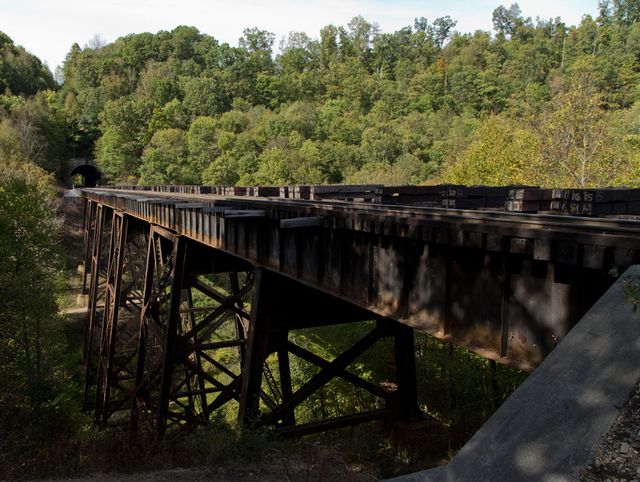
A bridge and trestle on a route between Mullens and Princeton, West Virginia, closed in 2015 after over a century of operation
Most egregious, perhaps, is the bulleted statement claiming that workers enjoy “11 national holidays and three weeks of vacation each year.” Railroads operate on nearly every major national holiday, and have strict “absenteeism” policies that penalize what they consider excessive time off. Notoriously, there is no schedule for operating employees, and they often work 12-hour shifts, longer if travel time is included, and are frequently away from home. A common challenge faced by many railroad workers is being forced to miss family events, holidays, and even funerals.
Presently, employees pay at least $229 a month for health coverage, but the railroads are insisting that this is “below average” and must rise. The BMWED notes that it offered “savings” in health care that do not cost any railway worker or the railroads any money, raising the question of whether the unions are proposing lower-quality health plans for workers. Nevertheless, the railroads rejected that proposal.
The railroads have welcomed the intervention of the National Mediation Board, a federal agency that coordinates labor-management relations. Its three members consist of two Democrats and one Republican, and membership will likely change with the new administration.
The Railway Labor Act of 1926 was designed to prevent any possibility of a railroad strike. Whenever the mediation board declares an impasse in the negotiations—which could take months or even years—a 30-day cooling off period begins, during which negotiations continue. After that period, railroads could lock out employees, or unions could call a strike, unless the president authorizes a Presidential Emergency Board. The unions, tied to the Democratic Party, entirely accept this framework, so that even as negotiations have progressed, railroads have been able to impose cuts without opposition.
For their part, the major railroad unions are concerned that the huge concessions demanded by railroads could spark a rebellion by workers. Dennis Pierce, the national president of the BLET, writes that “the level of concessions that were demanded on our health and welfare benefits [are] way beyond anything rail unions have seen in decades” and that the low wage increases would not even cover increased health care costs.
The rail unions have overseen decades of concessions and a dramatic drop in railroad employment (from 1.5 million in 1947 to less than 250,000 today.) The two crewmembers in the cab of a freight train are split between two unions, which have a history of working with the railroads to gain the edge by offering concessions. In 1994, the BLET asked engineers to cross the UTU (conductors) picket line at Soo Line railroad, though the engineers themselves refused by 98 percent. In 2014, the UTU/SMART tried to push a contract with one-man operation, under the condition that they got to collect union dues from the one remaining crewmember who now did two people’s work. Workers also rejected that. Whether the railroads are pushing one-person or even crewless trains in this round of negotiations has not been stated, but it is highly likely.
As certain traffic (particularly coal and oil) fell off over the last two years, many railroads imposed furloughs (layoffs) of thousands of employees. This is not uncommon with the increase and decrease of traffic, but this time, more permanent cuts were also made. Yards, shops, and maintenance bases were closed, and routes in the South and Appalachia closed, downgraded, or sold off to short line and regional operators. Those operators often pay less to employees, effectively serving as cheaper subcontractors to the large railroads, which often maintain the right to all traffic generated on the sold off routes.
Beyond that, there have been significant operational changes aimed at using fewer crews despite the fact they impose more difficult working conditions and increased safety hazards. CSX Railroad has made the most dramatic changes. Historically, the length and tonnage of freight trains has gradually risen, and it is not uncommon for a train traveling longer distances to be over a mile in length. CSX enacted new policies that suddenly have combined what used to be two trains into one monster train, which can be up to 3 miles long and 25,000 tons. The benefit to management is that they only need to employ one crew instead of two.
Employees point out that such monster trains are more prone to problems, operate more slowly and cause traffic delays because they exceed capacity. In the end, they may end up going so slowly that they require just as many crews. Despite this, managers know how to manipulate that data to make it look good for investors.

US government collecting social media accounts of visitors to country

E.P. Milligan

The US government has begun requesting foreign travelers to submit their social media information to Customs and Border Protection (CBP) before traveling into the country. The practice is claimed to be part of broader efforts to identify potential “terrorist threats.”
The request is part of the online Electronic System for Travel Authorization, a visa waiver application that many visitors must complete. The choices include Facebook, Twitter, Google+, Instagram, LinkedIn, and YouTube, as well as additional space for applicants to volunteer other lesser-known platforms.
Privacy rights activists have pointed out that there are few guidelines about how the information could be used by CBP or shared with other agencies. In effect, the practice represents an infringement on the First and Fourth Amendments, protecting freedom of expression and protection from unreasonable searches and seizures. This represents yet another development of a broader process of the erosion of democratic rights, as the US government assumes ever more increasingly the character of a police state.
While the CBP instituted the practice last week, the agency has claimed that—for now—it will not bar entry to applicants who decline to provide their social media information. The US Federal Register states that “collecting social media data will enhance the existing investigative process and provide Department of Homeland Security (DHS) greater clarity and visibility to possible nefarious activity and connections by providing an additional tool set which analysts and investigators may use to better analyze and investigate the case.”
The US government approves roughly 10 million visa applications a year and had 77.5 million foreign visitors in 2015 alone. The scooping up of such a vast amount of data will in effect lead to the creation of the largest government-controlled database of its kind virtually overnight.
The ACLU and the Center for Democracy and Technology have cautioned that the practice could potentially provide the state with “gateways into an enormous amount of [users’] online expression and associations, which can reflect highly sensitive information about that person’s opinions, beliefs, identity and community.”
The groups also warned that government surveillance will “fall hardest on Arab and Muslim communities, whose usernames, posts, contacts and social networks will be exposed to intense scrutiny.”
The Internet Association, a group representing companies such as Facebook, Google and Twitter, argued the policy violates freedom of expression.
Internet privacy group Access Now pointed out that while the DHS claims the data collection is not mandatory, most applicants will not know that they have a choice at all. It is also likely to serve as a dangerous precedent upon which the government could implement further information probes.
Nathan White of Access Now stated: “The process to enter the US is confusing, and it’s likely that most visitors will fill out the card completely rather than risk additional questions from intimidating, uniformed officers—the same officers who will decide which of your jokes are funny and which ones make you a security risk.”
The DHS is believed to already have the ability to perform limited scans of social media data. The idea was first floated by the government following the San Bernardino killings in California, in which social media profiles factored into the investigations alongside a locked iPhone 5C.
Fifteen years after the bogus “War on Terror” began, the United States has curtailed basic democratic rights and conducted mass illegal surveillance on the population. What is more, in every major terrorist attack on both US and European soil, the perpetrators have been known by intelligence agencies.
Clearly, the increasing surveillance of the population has done little to prevent terrorist threats. In reality, the impetus behind authoritarian measures has far more to do with strangling social opposition.
The most notorious and far-reaching anti-democratic measures were revealed by whistleblower Edward Snowden, who uncovered massive government spying of US citizens as well as foreigners through the illegal collection of cellphone metadata. He has been forced into exile over fear of arrest or even assassination.
The US government has already made enormous efforts to track the movements of citizens and foreigners alike. In early 2015, information obtained through the Freedom of Information Act revealed that the US Drug Enforcement Administration (DEA) has been tracking the movements of millions of Americans through a national license plate reader program.
The DEA operates a National License Plate Recognition program, started in 2008, that connects its license plate readers with other law enforcement agencies. Under the guise of the “War on Drugs,” the federal government is moving quickly to create a centralized database of all drivers’ movements throughout the country.
A report released by the ACLU in July 2013, called “You Are Being Tracked,” detailed a massive system of automatic license plate readers in use throughout the United States. Small, high-speed cameras mounted on police cars, road signs, bridges, and elsewhere capture thousands of license plates per minute.
Drivers’ information is kept for years or even indefinitely, with little to no protection for personal privacy rights. The information also can be shared with any other government agency regardless of whether or not it pertains to the “War on Drugs.”
An undated document shows the DEA has already deployed at least 100 license plate readers across the US, and that its database already held more than 343 million records. A 2010 document demonstrates that the agency had installed 41 plate reader monitoring stations in Texas, New Mexico and California alone.
The DEA uses the collected information to data mine in order to “identify travel patterns” of specific individuals “of high interest,” helping to track and even predict their movements. The report does not specify what constitutes a person of “high interest.” It goes on to describe how the system monitors drivers in real time, with the ability to notify law enforcement officers immediately when a certain plate is spotted.

Massive security operations planned for US New Year’s celebrations

Tom Hall

Police departments throughout the United States have seized upon the attack on a Christmas market in Berlin this month to justify a massive security buildup surrounding New Year’s Eve celebrations in major US cities.
These military-style operations accompanying New Year’s ceremonies, often placing whole sections of city centers on lockdown, have become as much of an annual tradition in the United States as the celebrations themselves.
The security buildup comes in spite of the absence of any credible threats of terror attacks within the United States.
“U.S. defence and security agencies said they believed the threat of militant attacks inside the United States was low during this New Year’s holiday,” Reuters reported yesterday. However, federal security bulletins have made unsubstantiated statements of concern over “homegrown violent extremists” carrying out attacks against celebrations.
The real function of these operations is not to ensure the safety of the crowds but to stoke fears over possible terror attacks in order to legitimize American imperialism’s wars abroad and to acclimate the population to police-state measures and attacks on democratic rights at home.
In New York City, where more than a million people traditionally flock to Times Square to ring in the new year, preparations will far exceed even the unprecedented military-style operation conducted last year, in the wake of the terror attacks in Paris and the mass shooting in San Bernardino, California, when thousands of officers, supported by snipers, bomb-sniffing dogs, surveillance cameras, and helicopters, herded revelers through multiple checkpoints before being cordoned off into one of dozens of enclosures in the square itself.
This year, more than 7,000 officers will descend upon Times Square and the surrounding neighborhood. According to the Wall Street Journal, “Highly visible heavy-weapons teams will be deployed in Times Square, as well as counterterrorism officers equipped with long guns and bomb-sniffing dogs. Throughout Saturday and into the night, detailed personnel will sweep hotels, theaters and parking garages for threats and suspicious packages, according to authorities. Plainclothes police officers will be in the crowds, hundreds of cameras will monitor the area and a fleet of helicopters will fly above Times Square.” Twenty-seven streets in the middle of Manhattan, the most densely populated area in the country, will be closed down to accommodate the operation.
But the “main event” of this year’s operation in New York City will be the placement of dozens of garbage trucks filled with sand to weight them down outside the event to act as barriers against attacks with trucks of the kind carried out in Berlin and Nice, France, earlier this year.
Over the past few months, the trucks have “become a regular feature of the city’s security infrastructure,” the New York Times observed, having previously been deployed outside Trump Tower on Election Day and at the Macy’s Thanksgiving Day parade. The paper noted that these trucks would also be deployed at Central Park and on the Coney Island boardwalk, where separate events are being planned.
Summing up the conversion of an annual holiday celebration into an armed fortification, New York Police Department Police Commissioner James O’Neill told the press, “We’re going to have one of the most well-policed, best protected events at one of the safest venues in the entire world, given all the assets that we’ve employed here.”
Similar buildups are being prepared in other major American cities. Officials in Chicago have not released any specific information about their security preparations, but it is expected to be formidable. The city’s main celebration at Navy Pier on Lake Michigan is expected to have an increased security presence, including “[s]ecurity officers with metal-detecting wands, uniformed and plain clothes police, and K-9 units,” according to Chicago’s CBS affiliate.
In Boston, which was subjected to an unprecedented military style lock-down in 2013 following the Boston Marathon bombing, Police Commissioner William Evans told a press conference, “You’ll see some heightened security out there, but you won’t see all of it. Also, we’ll have a lot of undercover officers. We’ll have some bomb assets in the area, so people shouldn’t be afraid to come out.”
Boston’s public radio station, WBUR, is telling people to “[e]xpect to see barricades blocking roads around the Copley Square area, similar to how BPD now blocks off areas along the Boston Marathon route using dump trucks.”
Atlanta’s police department has canceled all of its officers’ off days and instituted 12-hour shifts in order to patrol the city’s New Year’s celebrations as well as the Peach Bowl college football game between Alabama and Washington taking place today. “You’ll see more officers in high visibility uniforms, we’ll have our K-9 unit fully deployed, we have our special operations response team,” the head of the local transit agency’s Emergency Preparedness Unit told the press.
In New Orleans, the city will “dispatch heavy trucks to blockade much of Bourbon Street,” the main road in the city’s famous French Quarter entertainment district, USA Today reported. Additional personnel from both the New Orleans Police Department and the Louisiana State Police will be deployed to heavily trafficked areas of the city. At least some of them will be equipped with tactical gear, Mayor Mitch Landrieu announced, for the first time in the city’s history (although the city was infamously occupied by the National Guard for months following Hurricane Katrina).
In the Los Angeles suburb of Pasadena, home of the annual Tournament of Roses Parade and associated Rose Bowl college football game, last year’s unprecedented buildup involving 2,000 federal officers from dozens of agencies will be increased again this year. Water-filled barriers will be placed at over 50 intersections along the parade route, the Los Angeles Times reported, in response to the attacks in Berlin and Nice. Roughly 1,500 police officers will patrol the parade route, Pasadena Police Chief Phillip L. Sanchez said.
Citing the increased resources available after the Department of Homeland Security assigned the highest possible threat rating to the parade, a Pasadena police lieutenant told the local news website Pasadena Now, “We have not pulled back from increasing these resources and we don’t have plans to decrease by any means.”

More than 5,000 refugees drowned in the Mediterranean in 2016

Martin Kreickenbaum

The number of people who have drowned fleeing to Europe via the Mediterranean this year has risen to more than 5,000, according to the official data of the United Nations Refugee Agency (UNHCR).
According to UNHCR spokesman William Spindler, the new tragic record “means that on average, 14 people have died every single day this year in the Mediterranean trying to find safety or a better life in Europe.”
The International Organization for Migration (IOM) estimates that the actual number of victims is much higher than revealed by the UN statistics, which only record the officially registered death tolls. In particular there is a lack of reliable data on the route from North Africa to Spain, where many of the crossings across the Mediterranean remain undiscovered.
UNHCR reported that 3,777 refugees lost their lives on the Mediterranean Sea in 2015 and about 3,000 in 2014.  The subsequent death toll was regarded as a necessary price to pay to deter other refugees from seeking to reach Europe.
The threshold of 5,000 official victims was exceeded on the night of the 22nd of December, when two boats capsized shortly before reaching the coast of the Italian island of Sicily. The Italian Coast Guard was able to rescue 80 refugees, while 57 drowned. On the other vessel, a dinghy, 40 of 120 occupants could not be recovered.
The Mediterranean is by far the deadliest zone for refugees. Although only a fraction of the world’s 60 million refugees seek to reach Europe, two-thirds of the world’s 7,400 deaths occur here. In addition, there are 1,440 refugees who have been killed in the escape routes leading to Europe—in West Africa, the Sahara, the Horn of Africa and the Middle East. In Turkey, more than 100 refugees were shot dead by border policemen.
The number of deaths has increased despite the fact that the number of refugees arriving in Europe has fallen by almost two-thirds, from over 1 million in 2015 to 358,000 in 2016. The rapid increase in deaths is a direct result of the European Union’s closure of the Aegean and Balkan routes. The fugitives were thus forced to cross the much more dangerous routes via Egypt or Libya to Italy.
In the case of major boat disasters in the Mediterranean, such as in May when more than 1,000 refugees drowned within a week, European politicians regularly make hypocritical promises that such a tragedy should never happen again. In fact, “the number of deaths has risen even further. And politically speaking, nothing, absolutely nothing has been done to curb this tragedy,” Christopher Hein of the Italian Refugee Council explained.
The hypocrisy at work knows no limits. During the battle for Aleppo, politicians and the media accused the Syrian and Russian army of crimes against the civilian population. However, the same politicians have not lifted a finger to help bring the approximately 80,000 refugees from Aleppo to Europe. Instead, the EU has continued to set up new obstacles and expanded the measures to defer refugees to Europe’s neighbours. The driving force behind this policy is the German government under Chancellor Angela Merkel.
The border protection agency Frontex has been expanded to become the European Border and Coast Guard and has been given considerably more power. Dozens of warships patrol the Mediterranean. Their task is not to rescue refugees, but to destroy refugee vessels.
Internment camps have been set up in Greece and Italy, which are described as “hotspots”. Refugees have to stay there for months under catastrophic conditions and often have no way to apply for asylum. In Italy 120,000 people live in completely overcrowded camps. In Greece there are about 60,000, although a large number remain in tents in the winter, with snowfall and temperatures around the freezing point.
In March, Merkel negotiated a dirty deal with the Turkish government. As a result, Turkey erected fences and walls on its border with Syria and sealed off the border crossings. Since then, Turkish soldiers and border policemen have shot dozens of refugees, many have been ill-treated and brutally deported, according to human rights organizations. Nevertheless Merkel recently declared cynically that the deal with Turkey had saved lives every day.
Under the direction of the German Minister of the Interior Thomas de Maizière (CDU), the EU has concluded so-called “migration partnerships” with African governments. Pressure has been applied to the respective African regimes by linking the payment of development aid to accepting deported refugees and the closure of borders.
While the German government claims that the “migratory partnerships” are fighting the causes of the crisis, their real purpose is forcibly preventing refugees from fleeing and deporting them en masse back to Africa. The German ruling party, the CSU, has recently taken up another initiative from de Maizière, demanding that refugees who are rescued from distress be return to Africa— although this is a flagrant violation of the Geneva Convention on Refugees.
According to the German government, similar agreements involving refugee repatriation are to be concluded with Tunisia and Egypt, as was the case with Turkey. The refugees are to be interned in camps in North Africa, although it is well known that the Tunisian and Egyptian regimes trample human rights underfoot and arbitrarily abuse refugees.
The EU regularly assigns blame for the deaths in the Mediterranean Sea to the people smugglers, claiming they lure refugees with false promises onto unseaworthy boats. In fact, there is no other way for refugees to seek security than to trust the smugglers, bearing in mind that the possibility of joining family members already in Europe is now massively restricted.
In addition, more and more immigrants are trying to escape from Libya. Flavio di Giacomo of the UNHCR in Rome said there are more crossings than usual this winter: “This trend confirms the fact that the conditions in Libya are becoming increasingly dangerous for migrants.”
Di Giacomo said: “Many refugees have told us that they did not want to come to Europe when they left their countries of origin. Many of them just wanted to go to Libya. But there they have only experienced violence and abuse. As a result, they decided to come to Europe by sea and fell into the hands of unscrupulous smugglers, who forced them to go aboard unseaworthy boats. These people come to Europe on irregular routes because there are not enough regular routes.”
The situation in Libya has been aggravated mainly by the devastating 2011 NATO regime change operation which plunged the country into chaos. The refugees thus become victims of the imperialist powers in a double sense. With the wars in Afghanistan, Iraq, Syria, Libya and Yemen, the US and its European allies have robbed millions of people of their livelihoods and forced them to flee. At the same time, by blocking borders, revoking asylum law, and programmes of massive forced repatriation, they have prevented them from escaping the chaos.

US Army, German Bundeswehr dispatch thousands of troops to Eastern Europe

Johannes Stern

A massive deployment of US and NATO troops to Poland and the Baltic states is underway. According to a December 30 statement by the German Bundeswehr (Armed Forces) Press and Information Centre, “As part of the NATO operation ‘Atlantic Resolve,’ three US transport ships are expected in Bremerhaven in the first week of January.”
The statement noted that in early November, “Soldiers of the 3rd Brigade of the 4th US Infantry Division began loading the ships with vehicles and containers.” Overall, “more than 2,500 pieces of cargo (trucks, combat vehicles, trailers, containers) [were] initially shipped to Germany and then transported to Poland and other countries in Central and Eastern Europe.” The materiel is to “arrive in the period January 6-8 by maritime transport in Bremerhaven, and will then be transported to Poland by rail and military convoys by approximately January 20.”
Earlier this month, the newspaper Kieler Nachrichten called the arms build-up “the greatest redeployment operation of the US Army to Germany since 1990.” More than 2,000 tanks, howitzers, jeeps and trucks are being deployed for NATO exercises in Eastern Europe that will continue for nine months.
According to statements by the US Army Europe, 4,000 additional troops and 2,000 tanks will “contribute to and strengthen the alliance’s deterrence and defense.” Colonel Todd Bertulis, deputy head of logistics of the Stuttgart-based US Command in Europe (EUCOM), said the operation will ensure that “the necessary combat power is brought to the right place in Europe at the right time.”
Lieutenant General Frederick “Ben” Hodges, commander of US forces in Europe, said, “Three years after the last American tanks left the continent, we need to get them back.” He made the statement during a visit to the Logistics School of the Bundeswehr in Lower Saxony Garlstedt. He told journalists that the measures were a “response to Russia’s invasion of Ukraine and the illegal annexation of Crimea.”
Russia was preparing for war, the general claimed. All Russian ministries would, he declared, “prepare accordingly—mobilize, if you will.” He continued, “This does not mean that there necessarily has to be a war, none of this is inevitable, but Moscow is preparing for the possibility.”
This presentation turns reality on its head. The deployment of US combat troops is part of NATO preparations for war against Russia, the culmination of a continual eastward expansion of NATO since the dissolution of the Soviet Union 25 years ago.
In Ukraine, it is not Russia that is the aggressor, but the US and NATO. Washington and Berlin, in close collaboration with fascist forces, organised a coup against the pro-Russian president, Viktor Yanukovych, in early 2014, installing a rabidly anti-Russian, nationalist regime in Kiev. That move sparked a separatist rebellion by Russian-speaking regions in the country’s east, which Moscow has supported and the Kiev government, backed by Western arms and money, has sought, unsuccessfully, to violently suppress.
The events in Ukraine were seized on by the US, the European Union and NATO to impose economic and diplomatic sanctions and dramatically expand NATO military forces along Russia’s western border.
In advance of the January 20 inauguration of US President-elect Donald Trump, who has called for a ratcheting down of tensions with Russia in order to focus US aggression more directly on China, opposed forces within the US military-intelligence and political establishment are seeking to escalate the confrontation with Moscow.
This week, Republican Senator John McCain toured the Baltic States to assure them of the continued support of the United States. In an interview broadcast by Estonian radio, McCain called for a further build-up of NATO forces against Russia and declared that every “credible member” of the US Congress viewed Russian President Vladimir Putin “for what he is: a thug and a bully and a KGB agent.”
In the dangerous escalation against nuclear-armed Russia, which poses the danger of a third world war, the Bundeswehr is playing a central role. “Without the support of the [German] Army, we can go nowhere,” Lieutenant General Hodges said during an appearance at the Joint Support Service of the Bundeswehr.
Lieutenant General Peter Bohrer, deputy chief of the Joint Support Service, agreed. “In the past,” he said, “Germany was a frontline state. Today we are a transit zone, and one of our key tasks is to undertake common support… We are open to carrying out these tasks together with our American partners.”
After arriving in Germany, the American soldiers and their heavy equipment will be moved from Bremerhaven by rail through northern Germany to Eastern Europe. The Bundeswehr press office announced: “Some 900 cars with military materiel will be transported by train from Bremerhaven to Poland. There are also about 600 pieces of freight that will be transported by train to Poland from the military training ground at Bergen-Hohne. Nearly 40 vehicles will travel directly by road from Bremerhaven to Poland.”
Germany, which rolled over Eastern Europe in its war of extermination 75 years ago, is preparing to send combat troops to the Baltics. In January, 26 tanks, 100 other vehicles and 120 containers will be transported by train to Lithuania.
In an interview with the military newspaper Bundeswehr aktuell, General Volker Wieker confirmed that Germany had agreed with the United States, Canada and the UK at the NATO summit in Warsaw “to take the lead, with each establishing a battle group.” Germany will send the 122nd Infantry Battalion. He added that other supplies would follow, “so that we will achieve a so-called Full Operational Capability by mid-year.”
What is meant by “full operational capability” was underlined by a public Bundeswehr exercise in Grafenwöhr, where the German battalion prepared for deployment. According to a video report by the Frankfurter Allgemeine Zeitung, the manoeuvres involved “an enemy attack on the Lithuanian-Russian border.”
The future commander of the NATO Battle Group in Lithuania, Lieutenant-Colonel Christoph Huber, explained the “tactical purpose” of the manoeuvres as follows: “The comrades of the Second Company successfully carried out the battle here…winning time for their comrades and thereby destroying the enemy forces. This is high-intensity combat training.”

US bombs hospital amid escalating assault on Mosul

Bill Van Auken

At least seven people were reported killed Thursday when a US-led coalition warplane carried out an air strike against the Ibn-Al-Athir hospital compound in Mosul. The attack came as Iraqi government troops launched what has been described as the second phase of the bloody siege of Iraq’s second-largest city, which was overrun by fighters of the Islamic State (ISIS) in June of 2014.
The US command of the Pentagon’s military operations in Iraq and Syria, dubbed Operation Inherent Resolve, issued a rare statement immediately acknowledging the attack on the hospital, a war crime. It claimed that the strike had been launched against a van into which ISIS fighters had been seen loading a recoilless rifle. “The van was struck in what was later determined to be a hospital compound parking lot, resulting in possible civilian casualties,” the US military declared.
This marks the second time this month that the US military has acknowledged the involvement of its warplanes in attacks on a hospital in Mosul. On December 7, an air strike was launched against the Al Salem hospital complex in East Mosul, the area’s main medical facility, after the attack was requested by Iraqi ground forces. The Pentagon made no mention of civilian casualties in that attack, consistent with its response to most air strikes launched by US warplanes. According to some estimates, the US military has underreported the number of Iraqis killed in its operations by a factor of 10.
Thursday’s attack on the hospital came in the context of a marked escalation of the violence being unleashed on the besieged Iraqi city. Now in its third month, the offensive to retake Mosul from ISIS has been bogged down, with scant progress and heavy casualties for the US-trained Iraqi Counter Terrorism Forces that have borne the brunt of the fighting. The past two weeks have seen a so-called “pause” or “operational refit” to allow the battered Iraqi forces to prepare for a resumption of their assault. Federal police units have been called up from Baghdad and other areas to the south to strengthen the government’s depleted forces.
The Wall Street Journal reported Friday that Iraqi government forces have begun shelling densely populated parts of the city. The newspaper wrote: “Iraq’s military has begun using heavy artillery in the crowded city, in spite of the risk to civilians.” The Journal cited the commander of the Iraqi forces, Lt. Gen. Abdel Ghani al-Assadi, as saying that “his units have begun using artillery in eastern Mosul for the first time, after the government dropped its initial objections when the offensive bogged down.”
The US-backed Iraqi siege has been staggered by the fierce resistance mounted by ISIS, which in some cases has retaken areas previously captured by government forces. At present, the Iraqi troops hold only one half of eastern Mosul, while the on the other side of the Tigris river, which bisects the city, ISIS remains in control of far more populous and crowded western Mosul. The US-led coalition has bombed out all of the bridges connecting the two sides of the city.
Previously, Prime Minister Haider al-Abadi predicted that the government would retake Mosul by the end of this year. Earlier this week, he revised his prediction, saying that the siege would take another three months to complete. Many believe that this is once again an overly optimistic estimate.
Lt. Gen. Stephen Townsend, the commander of US operations in Iraq and Syria, has estimated that it will take another two years to clear ISIS out of both Mosul and the Iraqi city of Raqqa and defeat what remains of its fighters in the region. Some 5,000 US troops have been deployed in Iraq. That number is expected to rise, and it is anticipated that those on the ground will be embedded more closely with the Iraqi security forces.
Part of the problem facing the US and the Iraqi military is that ISIS has significant roots in Mosul, a predominantly Sunni city whose population was largely hostile to the Shia-dominated government in Baghdad. Even before the Islamist militia swept into the city in 2014, leading the US-trained security forces to desert en masse, ISIS operated openly in some areas of the city. Its strength is a legacy of the bitter sectarian conflicts that were sparked by the US invasion of 2003 and the subsequent utilization of divide-and-rule tactics by the US occupation.
Iraqi government troops have come under fire in areas that they have supposedly retaken, fueling suspicion that ISIS fighters have melted into the local population. This in turn has led to the imprisonment and torture of civilians suspected of sympathizing with the Islamist group.
Conditions for the civilian population, estimated at up to 1.5 million, have grown increasingly desperate as the US-backed siege has dragged on. Civilian casualties, which have soared along with the growing number of air strikes, will undoubtedly increase even more rapidly with the use of artillery against the city’s crowded neighborhoods.
According to Iraqi government estimates, at least 125,000 people have fled Mosul, with over 10,000 displaced in the last week alone.
Those remaining in the city are without electricity and clean water and face the threat of starvation as food stocks run out. Sewage is running in the streets and garbage piling up uncollected, creating the conditions for outbreaks of disease. Temperatures in Mosul are now falling towards the freezing point, under conditions where there are no means to heat homes.
“Civilians in Mosul face a stark choice. If they stay, they risk hunger and being caught in the crossfire. If they flee, they risk being killed by snipers or landmines,” Bruno Geddo, the representative of the UNHCR, the UN’s refugee agency, said Thursday.
The US and other Western media, which only weeks ago were waging a hysterical propaganda campaign decrying a “massacre” and even “genocide” in the Syrian city of Aleppo, little more than 300 miles to the west, have for the most part treated the humanitarian catastrophe unfolding in Mosul with silence and indifference.
The stark contrast in the approach to the Russian-backed siege of eastern Aleppo by Syrian government troops and allied militias, on the one hand, and the US-backed siege of Mosul, on the other, is clearly rooted in the geostrategic interests of US imperialism, which the media faithfully serves.
The defeat of the Al Qaeda-linked militias in Aleppo represented a devastating blow to the US-backed war for regime change in Syria—and therefore was portrayed as a war crime. The death and suffering being inflicted on the population of Mosul, on the other hand, is in the service of the same essential aims that underlay the US war launched against Iraq nearly 14 years ago: the assertion of Washington’s hegemony over the oil-rich Middle East.

The lying campaign on Russian hacking

Andre Damon

On Thursday, US President Barack Obama announced a series of measures targeting Russia, presented as retaliation for alleged cyber attacks carried out by the government of Vladimir Putin. The moves include the expulsion of 35 Russian diplomats and the imposition of economic sanctions against Russian intelligence agencies and officials.
The media, led by the New York Times, praised the actions, with the Times declaring in a lead editorial that “there should be no doubt about the correctness of President Obama’s decision to retaliate against Russia for hacking American computers and trying to influence the 2016 presidential election.”
The US media does not see fit to mention that the government making the accusations against Russia runs the world’s largest hacking and cyber espionage program, the aim of which, according to documents released by Edward Snowden, is to collect or hack all the data in the world, under the slogan “Collect it all… Exploit it all.”
This is the government that, with Israel, created and released the Stuxnet worm to attack Iran, and was shown to have tapped the phone of German Chancellor Angela Merkel and spied on Internet connections at the United Nations. As for “influencing” the elections of other countries, a history of the covert operations by the US and its intelligence agencies to manipulate political events, swing elections and overthrow elected governments around the world would comprise several volumes.
It does not take a great deal of imagination to surmise that Russia, like any other country, carries out espionage over the Internet. But in this case, the allegations that Russia hacked into the Democratic National Committee are unsubstantiated.
Neither the White House, nor the US intelligence agencies, nor the media, nor any private security firm has produced any information that would lead an impartial person with basic knowledge of communications technology to conclude that Russia carried out a major cyber attack against the United States.
In his statement announcing the moves against Russia, Obama declared, “In October, my administration publicized our assessment that Russia took actions intended to interfere with the US election process.”
Obama was referring, in a deliberately vague manner, to a statement published October 7 by James Clapper, the director of national intelligence, declaring that “the Intelligence Community… is confident that the Russian Government directed the recent compromises of e-mails from US persons and institutions, including from US political organizations.”
The aim of Clapper’s statement, issued in the run-up to the November election, was to discredit the revelations published by WikiLeaks that the Democratic National Committee rigged the primary process to secure the victory of Hillary Clinton over her challenger for the Democratic Party’s presidential nomination, Bernie Sanders.
Clapper’s statement, a mere three paragraphs in length, like all of the allegations by the White House on this issue, was characterized by its generality and lack of specific details. Its use of the term “confident” is highly significant, as it denotes a lower level of conviction than the word “certain.”
Simultaneously with Obama’s statement on Thursday, Clapper’s Office of the Director of National Intelligence released a report on alleged Russian hacking in the 2016 election.
The document contains no specific allegations, much less evidence, of attempts to access confidential data. Given that the actual content of the document is so scanty, it is not surprising that the statement hedges its findings, declaring, “The US Government can confirm that the Russian government, including Russia’s civilian and military intelligence services, conducted many of the activities generally described by a number of… security companies.”
The facts laid out in the document released by Clapper are so weak that the New York Times’ lead article on Friday was forced to point out that the evidence in the report “fell short of anything that would directly tie senior officers of the GRU or the FSB [Russian intelligence agencies]… to a plan to influence the election.”
Why then, in the absence of any evidence, does the New York Times declare, “It would have been irresponsible for [Obama] to leave office next month and allow President Vladimir Putin to think that he could with impunity try to undermine American democracy.”
That there are no facts to justify such retaliation does not concern the “newspaper of record.” This is because it, like the rest of the US media, does not serve to question or check the false assertions of the US government, but rather to propagate them.
There are echoes in the present campaign of the Bush administration’s false claims of “weapons of mass destruction” that were used to launch the war in Iraq in 2003. Then, as now, the Times and other publications not only repeated and amplified the administration’s lies, but actively developed a false narrative of events as part of the government’s propaganda effort to justify war.
Obama’s latest actions are part of an extended anti-Russian campaign by the White House and the New York Times, which has been accelerated by the collapse of the US-backed regime-change effort in Syria.
This campaign takes place in the context of substantial divisions within the American state over the target of US military aggression. The faction for which the New York Times speaks is seeking a more direct intervention against Russia, while President-elect Donald Trump and the section of the state with which he is aligned see a conflict with Russia as a distraction from the real enemy: China.
To this end, the Obama administration has sought to create new “facts on the ground” before leaving office that would lead the Trump administration into a confrontation with Russia. Earlier this month, the White House announced that it was accelerating the deployment of 4,000 US/NATO troops to the Russian border, meaning they will be in place by the time the new administration takes office.
Alongside this military buildup, the White House, the Times and much of the American media have sought to whip up the most hysterical anti-Russian campaign since the 1940s and early 1950s—carrying with it the stench of that period’s McCarthyite witch-hunts. The main concern of the Times, as spelled out in an editorial published four days after Trump’s election, is to ensure that the incoming administration does not “go soft on Russia.”

Trump and “America First”: The End of the Asia-Pacific Pivot?

Akanksha Narain


Donald Trump’s unexpected victory has not only shocked the world but is also likely to shake up US foreign policy. While Trump’s unpredictability, campaign rhetoric and unclear foreign policy stance have left analysts and policymakers confused, there are enough hints that indicate significant change in US foreign policy towards Southeast Asia. 

US Foreign Policy under President Obama 

US’ role in Southeast Asia has been that of a net security provider, both through partnerships and alliances. The ASEAN region is the US’ fourth largest trading partner and a significant receiver of foreign direct investment. Despite an aggressive and powerful China overshadowing the smaller and militarily weaker Southeast Asian economies, they have been growing rapidly. 

The Obama administration’s ‘pivot’ to the Asia-Pacific entailed increasing US influence in the region through new trade partnerships, free trade agreements (FTA), defence agreements, and establishing new security partners, like Vietnam. It also featured a growing US proximity to countries like India to act as a counter-balance to China in the region. 

An End to TPP: Economic Fallout of Trade Protectionism 
The president-elect’s rhetoric of “America First” and “Make America Great Again” seeks to shift US focus from external commitments to domestic politics. It is Trump’s belief that the country’s people and economy, among other things, have been losing out to trade deals that favour others at the cost of domestic economy. Similarly, military and security commitments abroad, be it with Japan or South Korea, are draining the US of its precious economic resources. Consequently, Trump, during his election campaign, promised to withdraw from the Trans-Pacific Partnership (TPP) and to make other countries also the shoulder economic burden of protecting them. 

The likely economic and strategic fallout of Trump’s future Southeast Asian policy is manifold. Stricter trade protectionism, including withdrawing from TPP, will negatively impact Southeast Asia. The resulting higher tariffs will affect the countries that rely on the US for their export revenue. Vietnam earns US$ 30.5 billion from its exports to the US and, according to Deutsche Bank, Singapore may stand to lose close to 30 per cent of its export revenue. Further, any change in immigration policy, as suggested by Trump, would mean great losses for the Philippines. Currently, nearly 4 million Filipinos reside in the US and their remittances significantly contribute to Philippines’ GDP. 

The impact will not be limited to Southeast Asia – the US itself will lose out on any potential gains from a FTA with the region. According to Singapore’s Prime Minister, Lee Hsien Loong, TPP is “an unmistakable indicator of region’s confidence in the USA.” The decision to dishonour its commitment will shake the region’s confidence in the US. Additionally, any trade barriers imposed on China by the US will trigger reciprocity, and trade wars will be detrimental not only to the US and China but also to Southeast Asia. 

US’ Retreat: Strategic and Social Costs 
Shifting greater cost for providing security to other countries will heavily hit Southeast Asia as increased military expenditure will come at the cost of infrastructure development and social welfare. Trump’s decision to move towards isolationism and reducing external engagements will also leave a power vacuum in Southeast Asia, which an expansionist China would quickly fill. With the US and TPP out of the picture, China-backed regional free trade agreements, such as the Regional Comprehensive Economic Partnership (RCEP) and the Free Trade Area of the Asia Pacific (FTAAP), would augment China’s influence in Southeast Asia. 

The inroads made by China at a time of a retreating US, however, will not bring stability to the region. With Trump planning to reduce its presence in the Asia-Pacific, the smaller states will lose out on their negotiating power with China. The region may be forced to appease China at a time when a number of ASEAN countries are also embroiled in territorial disputes with it. Philippine President Rodrigo Détente’s rapprochement with China despite a raging territorial conflict is a case in point. 

Lastly, the US has also played the role of moral police in the ASEAN region. It imposed sanctions on Myanmar during the brutal rule of the junta government, which are now being lifted as it makes its way to becoming a democracy. The Obama administration has time and again also expressed concern over the plight of Rohingya Muslims, human slave camps, and fishing boats in neighbouring Thailand and Malaysia. Moreover, it was during a US investigation that the alleged role of Malaysian Prime Minister Najib Razak, in amassing disproportionate wealth, was uncovered. Without the significant presence of the US in the region there are not many other countries that can flex their muscles on such issues. Therefore, it makes sense why the region’s authoritarian leaders like Cambodia’s Hun Sen or Thailand’s General Prayuth Chan-ocha and the Malaysian PM have welcomed Trump’s election. 

What Next? 
If the US were to indeed reduce its economic and military presence in the region, ASEAN countries will have to look to other trading and alliance partners such as the European Union, Australia, India, China, and Japan. The question that remains is: will they be able to fill the US’ big shoes and bring stability to the region?

30 Dec 2016

World Press Photo Masterclass for West Africa 2017. Full Scholarship to Program

Application Deadline: 15th January 2017.
Offered annually? Yes
Eligible Countries: Countries in West Africa
To be taken at (country): Accra, Ghana
About the Award: The masterclass aims to support the most promising young visual journalists in their professional development
The Masterclass West Africa will bring together a selection of the most promising professional photographers from the region who want to develop their career. All photographers who have worked on visual stories about daily life, nature, politics and society are encouraged to apply. The masters will share their expertise and provide individual advice to all participants, and they will be chosen to meet the learning needs and wishes of the selected participants. The masterclass curriculum is structured around photo essays based on a central theme that participants are required to work on in preparation for the masterclass. The masterclass week also includes lectures by and one-on-one time with all masters.
Offered Since: 2015
Type: Contest
Eligibility: Professional photographers with experience working on documentary photo stories who:
  • Are nationals or permanent residents of the following countries: Benin, Burkina Faso, Cameroon, Central African Republic, Chad, Democratic Republic of the Congo, Gabon, The Gambia, Ghana, Guinea, Guinea-Bissau, Equatorial Guinea, Ivory Coast, Liberia, Mali, Mauritania, Niger, Nigeria, Republic of the Congo, Senegal, Sierra Leone, and Togo;
  • Are under the age of 35; and
  • Have a good understanding of English.
Selection Process: An international, professional and independent committee will select a maximum of 12 participants based on the quality of work and motivation for participation. To ensure fairness, the selection will take place anonymously.
Value of Contest:  Participation is free, and all travel and lodging expenses will be covered by World Press Photo.
How to Apply: To apply, please send your portfolio, biography with age and nationality, full contact details, as well as a short statement of your motivation in English describing what the masterclass might mean to your professional development. Submit all this information to education@worldpressphoto.org before 15 January 2017.
Large files (25MB<) can be sent via WeTransfer. If you do not already have a portfolio, please prepare a selection of your work that includes at least two photo stories/series. You will receive a confirmation email once your application has been checked for completion.
Award Provider: World Press Photo Foundation

World Bank WeMENA Program for Women Entrepreneurs 2017. $150,000 Cash Prize & Silicon Valley Mentorship

Application Deadline: 17th January, 2017
Eligible Countries: Countries in MENA Region
About the Award: Through a business model challenge, WeMENA accelerates innovative solutions that will help eight cities across the Middle East and North Africa region build resilience and better adapt to chronic stresses and shocks.
As the region continues its fast-paced urbanization, city residents will become increasingly more exposed to the adverse effects of climate change, and subject to social, economic, and financial stresses and shocks.
In order to build more resilient cities capable of withstanding such hazards, we are looking for women entrepreneurs who are innovating in the following categories: Agriculture and Food Security Sustainable Energy & The Environment Water & Sanitation Urban Development (Transportation, Infrastructure and Housing) Governance and Civic Engagement Healthcare & Disease Prevention Technology, Fintech & Smart Cities Economics & Society Disaster Risk Reduction
Type: Entrepreneurship/Contest
Eligibility: The WeMENA Business Model competition attracts women who are seeking investment and support to accelerate their idea or solution into the market. This competition is open to women participating as individuals, as teams, or on behalf of a legal entity. Participants applying on behalf of the legal entity must prove they have partial or full ownership of the business model they propose.
Applicants from around the world may participate, but the solutions proposed must use principles of resilience-thinking and must address issues in the following cities:, Alexandria, Amman, Beirut, Byblos, Cairo, Casablanca, Ramallah or Tunis.
We don’t limit the contest, so don’t limit your ideas. However, give some thought to what you think will have the best chance to win, so pay attention to how the ideas are judged.
Value of Entrepreneurship: Contestants in this challenge will receive business training, guidance from mentors in the Silicon Valley and beyond, and a chance to win $150,000 in cash awards.
There is no cost to submit a venture, but participants will have to cover their travel costs to the Grand Finale in Casablanca, Morocco.
How to Apply: Click here to apply
Award Provider: The World Bank

Goethe-Institute BACKSTORY Residency Program 2017 for Film-makers in MENA Region

Application Deadline: 1st February, 2017
Eligible Countries Filmmakers from Algeria, Jordan, Morocco, Tunisia, Bahrain, Kuwait, Oman, UAE, Egypt, Lebanon, Saudi Arabia, Palestine, Iraq, Libya, Syria, Qatar, Yemen, Sudan and Germany can participate in a residency.
To be taken at (country): Beirut, Lebanon.
About the Award: The program is designed:
  • To support regional filmmakers in shaping their professional careers by providing creativity-enhancing working conditions
  • To initiate and facilitate networking in the region and between the region and Europe
  • To provide opportunities for exchange and exposure
  • To give Master Classes to enhance the capabilities of filmmakers
  • To give technical support for film projects by providing technical equipment
Type: Training
Eligibility: BACKSTORY invites emerging filmmakers:
  • Who have already professional work experience and are up to 40 years old
  • Who plan to realize a film project or part of it (pre-production, production or post-production)
  • Who are working on any film genre except commercial ads
  • Who must be citizens of, and currently residing in, an eligible country (list above)
Value of Residency: Fellows will receive a monthly stipend of US$1,000. The organizers will cover:
  • Accommodation at Beirut Art Residency
  • Stimulating workspace in the heart of Gemmayzeh, Beirut’s artistic district
  • Administrative and logistical support
  • Access to technical equipment according to project needs
  • Specialized master classes provided during the residency
  • Flights to and from Beirut
Duration of Residency: Residencies will take place May 29 to July 30, 2017 and Sept. 1 to Oct. 31, 2017.
How to Apply: The Jury selection will take place in March 2017.
Applicants will also be notified in March 2017.
Apply via the link in the Residency Webpage
Award Provider: Goethe-Institute Lebanon, Beirut Art Residency (BAR) and Metropolis Art Cinema Association