4 Jan 2017

MIT- Zaragoza Scholarships for Promising Professionals in Logistics and Supply Chain Management 2017/2018

Application Deadline: 1st March, 2017
Eligible Countries: International
To be taken at (country): Spain
About the Award: Zaragoza Logistics Center and the MIT-Zaragoza International Logistics Program will award scholarships in the academic year 2017 – 2018 for candidates who can show an extraordinary potential for leadership and professional success within the area of Logistics and Supply Chain Management.
Type: Masters
Eligibility: Scholarships are awarded only to students who have been admitted to the MIT-Zaragoza Master of Engineering in Logistics and Supply Chain Management (ZLOG) program through ZLC‘s regular admissions procedure.
Candidates will be expected to show extraordinary potential for leadership and professional success, bringing new vision and commitment to the area of Logistics and Supply Chain Management.
Furthermore, to be eligible candidates must comply with the following criteria:
  • Granted admission to the MIT-Zaragoza Master of Engineering in Logistics and Supply Chain Management (ZLOG) program.
  • Completion of a four year undergraduate program equivalent to a Bachelor’s Degree.
  • Professional excellence with a background or experience in Logistics and Supply Chain Management, or exceptional academic achievement.
  • Competitive GRE or GMAT score. Exceptions may be granted to individuals who have demonstrated strong professional and/or academic achievement in completing a college degree – including some quantitative training and evidence of advanced verbal and written proficiency in the English language.
  • Fluency in English, competitive IELTS or TOEFL score. Exceptions may be granted to individuals who have demonstrated evidence of advanced verbal and written proficiency in the English language.
Selection Criteria: Competition for the ZLOG scholarships is intense and highly competitive. The candidate will be chosen on the basis of the following criteria:
  • Preference will be given to candidates with background or work experience in Logistics and Supply Chain Management (25%)
  • Financial need (20%)
  • Academic merit as according to academic records (20%)
  • Essay explaining why the candidate should be awarded with the scholarship (to be filled out in the Application Form) (20%)
  • Demonstrated initiative and search for external funding opportunities (contacted the ZLC Financial Aid Office, individual search, other applications for scholarships and/or bank loans, etc) (10%)
  • Quality of the proposal: presentation, writing, punctuality in the application, etc. (5%)
Applicants will be notified by e-mail of the outcome. The scholarship holder will receive an award letter.
Value of Scholarship: ZLC will award a number of scholarships consisting of reduction in tuition for the MIT-Zaragoza Master of Engineering in Logistics and Supply Chain Management (ZLOG) program, which currently amounts to €24,000.
The reduction will depend on the applicant’s academic achievements and distinctive personal accomplishment in addition to an interest in pursuing a career in Logistics and Supply Chain Management. The available scholarships are:
Average evaluation grade of 6 – 7.9 Coverage: 25 % (€6,000) reduction in tuition
Average evaluation grade of 8 – 8.9 Coverage: 50 % (€12,000) reduction in tuition
Average evaluation grade of 9 – 10 Coverage: 100 % (€24,000) reduction in tuition
The scholarship will not include other costs such as the administrative fees, living or travel expenses to Zaragoza or to Boston for the international exchange.
How to Apply: Candidates must fulfil all of the above-mentioned requirements and submit by e-mail one copy of the following documents to the ZLC Financial Aid Office:
  1. Application Form: Each scholarship applicant will fill out the scholarship application form, including the following: a statement describing their economical situation, an essay explaining their reasons for applying for the scholarship, their interests, aptitudes, career plans, etc.
  2. Income Statement Copy of the current employment contract, the most recent pay slip or other official document that can account for the last salary received. (Not applicable for applicants who are currently full-time students).
  3. Copy of Passport
  4. Résumé
  5. Acceptance Letter Copy of the acceptance letter to the MIT-Zaragoza Master of Engineering in Logistics and Supply Chain Management (ZLOG) program.
All interested applicants should apply directly through the ZLC Financial Aid Office: E-mail: financialaid@zlc.edu.es · Contact person: Virginia Acosta · Phone: (+34) 976 077 609 · Edificio Náyade, 5 · C/ Bari 55, PLAZA · 50197 Zaragoza · Spain
Award Provider: Zaragoza Logistics Center (ZLC)

300 Sir Richard Stapley Educational Trust Scholarships for Second Degree in Medicine Fields & Postgraduate Studies in all Fields 2017/2018

Application Deadline: The deadline for submissions is either 31st March 2017, or the first 300 completed applications received, whichever comes first.
Offered annually? Yes
Eligible Countries: All
To be taken at (country): UK
About the Award: Founded in 1919 by the businessman and philanthropist Sir Richard Stapley (1843-1920), the Sir Richard Stapley Educational Trust supports the work of mature students of proven academic merit, and in financial need, who are pursuing further degree qualifications at an institution in the UK. Open to students from all countries, applicants must be resident in the UK at the time of applying, as well as during their course of study.
The Trust funds students pursuing degrees in medicine, dentistry and veterinary studies and postgraduate degree students from all fields of study. Applications are welcome from students beginning their first year of study, as well as from those already embarked on their degree course.
Type: Undergraduate, Postgraduate
Eligibility: In order to be eligible to apply for a grant, you must be:
a) over the age of 24 on 01 October of the proposed year of study
b) either accepted on, or applying for a place on a degree course in medicine, dentistry or veterinary studies taken as a second degree, or accepted on, or applying for a full- or part-time place on a Masters or Doctoral degree programme in any discipline, at a UK university
c) already resident in the UK at the time of application, and resident in the UK during the course of study.
d) be facing demonstrable financial need in the academic year for which funding is applied (details about how this is calculated are in the application pack).
NB: if you are a postgraduate student, or applying for a place on a postgraduate degree course, you must hold a first- or strong 2.1 honours degree (at least 65%) from a UK institution (or its equivalent from a non-UK institution) or hold a Masters degree from a UK institution, or its overseas equivalent.
We do accept applications from final year BA/BSc students, but the awarding of any grant is contingent upon the outcome of their first degree.
Selection Criteria: Awards are competitive and made on the basis of academic merit and financial need.
Number of Awardees: 300
Value of Scholarship: Grants are normally from £400 to £1,200 in value. They are intended to cover the shortfall incurred by educational and subsistence expenses upon payment of tuition fees.
Duration of Scholarship: All grants are awarded for a full year of academic study and for one year only.  Applicants for full time postgraduate degree courses may be supported for up to a maximum of three years, but new applications must be submitted each year. Part-time postgraduate courses can be funded for a maximum of six years, but new applications have to be submitted each year.
How to Apply: The Trust encourages electronic application submissions, and an electronic pack can be requested from the administrator at mailto:admin@stapleytrust.org?subject=Query%20from%20Stapley%20Trust%20website. If you do not have regular access to the internet, you are still welcome to apply; please request a printed application pack from the following address:
The Stapley Trust
P. O. Box 839
Richmond
Surrey TW9 3AL
It is important to visit the Scholarship Webpage to go through requirements for application before applying for this scholarship.
Award Provider: Stapley Trust
Important Notes: Before award money can be released, applicants must confirm any other grants obtained, and their amounts. Should a successful applicant have received a major award, or additional money from other granting bodies equivalent to a major award, the grant awarded from the Stapley Trust may be reduced or withdrawn. Students already holding a major award cannot apply.

Atlantic Fellows Programme for African Students (Fully-funded Residential and Non-Residential) 2017/2018 – UK

Application Deadlines:
  • Atlantic Visiting Fellowship: 22nd January, 2017
  • Atlantic Non-Residential Fellowship: 31st January, 2017
  • Atlantic Residential Fellowship: 31st January, 2017
To be taken at (country): UK
About the Award: The Fellowships are available in three fully-funded tracks:
  • Atlantic Visiting Fellowship: an opportunity for teams of three or four senior academics and practitioners to come together and undertake an intensive period of research that will create high profile advances in both academic understanding and in, developing practical responses to, the challenge of inequality.The teams will be fully-funded, including reasonable travel, accommodation in London where needed and office space within the International Inequalities Institute along with other reasonable research costs.
  • Atlantic Residential Fellowship: supports applicants in taking the one year MSc Inequalities and Social Science (MISS), with dedicated mentorship, as well as engaging with the wider work of the Atlantic Fellows programme (such as the Annual conference and Non-Residential Fellows activities).The Fellowship will cover all of your fees, a stipend of £15,000 p/a and expenses for attendance at Atlantic Fellowship events.
  • Atlantic Non-Residential Fellowship: a unique opportunity to study via a series of distinct, comprehensive short courses, with both academic and in-the-field work, comprising around seven weeks in total throughout the year. Elements of the course will be undertaken with our Node Partner, University of Cape Town. In addition the Non-Residential Fellows will undertake practical project work, and contribute to the Annual Conference and other activities as part of the Atlantic Fellows programme.The Non-Residential Fellowships are fully funded, with travel and accommodation costs covered where necessary, as well as reasonable daily expenses whilst taking part in the courses.
Type: Fellowship/Masters
Eligibility: 
  • Applicants for the Non-Residential Atlantic Fellowship must meet the Standard English Language requirements for the LSE. Proof must be included with your final application documents.
  • Applicants for the Atlantic Residential Fellowship must apply for the MSc Inequalities and Social Science. They must meet all the requirements as set out in the course page.
  • Separate eligibilities can be read on the application forms of each fellowship.
How to Apply: Please download and fill the Application forms of the fellowship you are interested in (links are in the Scholarship Webpage)
Award Provider: London School of Economics and Political Science

Onsi Sawiris Masters Scholarship Program for Egyptians to Study in USA 2017/2018

Application Deadline: 15th June, 2017
Offered annually? Yes
Eligible Countries: Egypt
To be taken at (country): USA
Type: Masters
Fields of Study: Business Administration or Construction Management.
Eligibility: Candidates should:
  • Possess GMAT score of 650 and above
  • GRE score of 302 or above
  • TOEFL iBT of 100 or above
  • 3.5 minimum gpa or equivalent
  • 3 years experience
  • be Looking to earn master’s degree at one of the top universities in the US in the field of Business Administration or Construction Management
  • be Involved in extracurricular activities (applicants should be able to provide proof of participation in extracurricular activities when required).
  • Be Egyptian nationals, who are residents of Egypt (preference will not be given to dual nationality applicants)
Selection Criteria: : The Onsi Sawiris Scholarships will be awarded based on character and merit as demonstrated through academic excellence, extracurricular activities, and entrepreneurial initiative.
Selection Procedure: 
  • Personal interviews at OC
  • Notification of selected scholars
  • Program orientation
Number of Awardees: Not specified
Value of Scholarship: The scholarships include full tuition, a living allowance, travel, books, Computer, Health Insurance, and Other Benefits.
How to Apply: Submit the Following:
  • Application Form
  • GMAT/GRE and TOFEL exam scores
  • Statement of Purpose
  • Reference Letter
It is important to go through the application instructions on the Scholarship Webpage before applying.
Award Provider:  Orascom Construction (OC)
Important Notes: 
  • The Onsi Sawiris Scholarship Program is only granted to the list of endorsed universities provided in the “Approved Universities” section of the application.
  • Selection as a nominee for the Onsi Sawiris Scholarship Program does not guarantee university acceptance. Applicants will be supported in applying for these universities. If nominated for the scholarship; the Onsi Sawiris Scholarship Program award will be made once university acceptance is obtained.

Manchester Metropolitan University Vice-Chancellor Scholarships 2017/2018 for International Students

Application Deadlines: For courses starting in September 2017, the deadline for receipt of applications is 31st May 2017. For courses starting in January 2018, the deadline for receipt of applications is 31st October 2017.
Offered annually? Yes
Eligible Countries: International
To be taken at (country): United Kingdom
Eligible Field of Study: Courses offered at the University
About the Award: Manchester Met is making a number of Vice-Chancellor scholarships available, each to the value of £5,000. These scholarships are open to international students who enrol on a full-time undergraduate or postgraduate taught programme.
Type: full-time undergraduate or Postgraduate
Eligibility:
  • If an application is successful, applicants must confirm that they accept the award within 14 days.
  • In order to apply, applicants must have accepted an unconditional or a conditional firm offer for a course at Manchester Metropolitan University.
  • If a student holds a conditional offer and applies for the Vice-Chancellor International Scholarship, the scholarship can only be awarded once the offer conditions have been met.
  • Applicants who defer their studies will not be eligible for the 2016/2017 scholarship.
  • The scholarship award is limited to Undergraduate and Postgraduate taught course applicants only.
  • Scholarships are only available for new Manchester Metropolitan University students who are classed as overseas students and are required to pay full overseas tuition fees.
  • Current students moving from one course to another are not eligible for the scholarship.
Value of Scholarship: £5,000. The scholarship will be deducted directly from tuition fees owed to the University. The scholarship is for the first year of academic study only.
How to Apply: If you meet the above criteria, you can download the Application Form. Please note, this scholarship cannot be combined with any other financial support from Manchester Met.
Award Provider: Manchester Metropolitan University
Important Notes: Students will be notified if their application has been successful in June 2017 or November 2017 for courses starting in September and January, respectively.

What Will Baghdad Face in 2017?

Cathy Breen

Being stuck in traffic is a daily fare in Baghdad. While checkpoints have been dramatically reduced in recent times, and the number of concrete walls appear markedly decreased, traffic jams still defy description. It doesn’t help in the least that everyone is leaning on their horns. A half-a-million taxis roam around Baghdad spewing pollution as they look for potential fares. Proposals to counter this problem have been put forth to authorities, for example, the creation of taxi stands throughout the city. All attempts to remedy this problem seem futile.
In my travels this trip to Najaf, Karbala, Babylon and Baghdad, the dilemma of widespread corruption is of predominant concern. Young and old, without exception, feel caught in and strangulated by this reality. One young person related how one of the bosses in their workplace substantially increased their salary by fudging figures. If someone were to speak up they would, at best, be let go.
This past Monday a woman journalist, Afrah Shawqu al Qaisi, was kidnapped from her home in the Saidiya district of Baghdad by men claiming to be security personnel. She had written an article expressing anger that armed groups could act with impunity (BBC news Dec. 27, 2016).
“How do you get up in the morning?” I gently asked a young woman from Baghdad. “How do you manage?”
“With no hope” she replied. “Each morning I get up with no hope.” Her mother is ill and worries each day that her daughter will not get home safely from work. “All Iraqis want hope,” she added, “but they are resigned to bad conditions.”
But a gentleman who was also part of this conversation responded “There is no future if we keep silent.” Although he himself lost his position for speaking out against the corruption, he fears for the future of his children if the problem is not addressed. He believes that an answer for corruption is to educate by setting an example.
I had the great joy of visiting a family we have not seen for over three years. Kathy Kelly first introduced me to this family in 2002, and we have tried to remain in contact throughout the years. As evening descended, some of us walked the streets of the old neighborhood where this family lives and where Voices rented an apartment, in 2003-2004.
We went to the site of the horrific suicide bombing of July 3, 2016, only two blocks away from the family’s apartment as well as where the Voices apartment was. The night of the bombings was on the eve of EID, ending the fasting month of Ramadan. Many people were out doing the final shopping for this celebration. Vendors with their wares on the sidewalks, children eating ice cream in the blistering heat of summer. It was about 10:00 p.m. The blasts took the lives of over 300 people, many of them children. Over 200 more wounded. In the apartment where some of this family lives, three families lost children, mothers and fathers, sisters and brothers in this explosion. I passed two of the survivors on the stairs this night.
I had my young friend take a photo across the street from one of the sites. We became silent as we looked at this blackened mass towering over us. Months later the area is still blocked off by a corrugated fence as you can see in the picture. Across the street was a second bombed building. All around us were people visiting, walking, looking at wares, etc. “It is good to see life” said my young friend as we walked arm in arm. Armed vehicles and police were very present as well in this area.
A pain for me during my stay in Baghdad was not to be able to contact another family with whom we are also very close. I’ve written extensively about this family as the father and oldest son fled to Finland over a year ago. I had hoped to be able to meet up with the mother and at least some of the children at a place that would be safe for them. Sadly, this was not possible.
Baghdad cannot be compared to the relative quiet and safety of Karbala and Najaf. As I write, we just got the distressing news of a double suicide bomb in a Baghdad market this morning. At least 28 people were killed. Many of the victims were people who had gathered near a cart selling breakfast when the explosions went off.
“Torn clothes and mangled iron were strewn across the ground in pools of blood at the site of the wreckage near Rasheed Street, one of the main thoroughfares in Baghdad,” an AFP photographer reported. “The targeted area is packed with shops, workshops and wholesale markets and usually teeming with delivery trucks and daily laborers unloading vans or wheeling carts around…Hugh crowds were expected to gather on Saturday evening in the streets of Baghdad to celebrate the New Year for only the second time since the lifting in 2015 of a year-old curfew.” (The Telegraph News, UK, Dec. 31, 2016)
I was on Rasheed Street only yesterday.
While in Baghdad I stayed with a gracious couple who made the pilgrimage to Mecca, the Haj, this past year. In one of our many conversations, my host asked somewhat mischievously, “Which of the four do you think is the greatest sin in Islam? Theft, illicit sex, drinking or lying?” I mulled this over not really knowing, but enjoying the exercise. The answer turned out to be “lying” and, curiously, I got it right.
But then the 2003 U.S. led invasion of Iraq was based on lies and deceit. Many in the U.S. accepted, without adequate investigation or even curiosity, the notion that the U.S. would improve conditions ordinary Iraqis faced following the 2003 invasion. Tragically, almost fourteen years later, nothing could be further from the truth. Yet we should ask now, with genuine care, what Iraqis will face in 2017 and how we can make reparations for the suffering we’ve caused.

Why Turkey Can’t Stop ISIS

Patrick Cockburn

The killing by an Islamic State (Isis) gunman of 39 civilians in a nightclub in Istanbul is the latest massacre in Turkey, where such slaughter is now happening every few weeks. The perpetrators may differ but the cumulative effect of these atrocities is to persuade Turks that they live in an increasingly frightening and unstable country. It is also clear that the Turkish government does not know what to do to stop the attacks.
These are likely to continue with unrelenting savagery whatever the government does, because Isis is too big and well-resourced to be eliminated. It is well rooted in Turkey and can use local militants or bring in killers from abroad, as may have happened at the Reina nightclub and was the cae in the assault on Istanbul’s Ataturk Airport earlier in the year.
As in France, Belgium or Germany, it is impossible to stop attacks when ordinary civilians are the targets and the killers are prepared to die. Their success is often blamed on “security lapses” but in practice no security will provide safety.
What makes “terrorism” in Turkey different from Europe and the Middle East is not the number of dead – more are killed by Isis in Baghdad every month – but the diversity of those carrying them out. Three weeks ago, the killing of 44 people — mostly policemen — outside a football stadium in Istanbul was claimed by the Kurdistan Freedom Falcons (TAK), allegedly an arm of the Kurdistan Workers Party (PKK). The assassination of the Russian ambassador to Turkey in Ankara on 19 December was blamed by President Recep Tayyip Erdogan on a third group, the followers of Feithullah Gulen, who are held responsible for the failed military coup on 15 July.
All these are powerful groups with thousands of committed members inside and outside Turkey and none of them are going to go out of business soon. The government in Ankara is making the usual noises about tracking these different groups “to their lairs”. but this will be easier said than done. Both Isis and the PKK have established powerful de facto states in Syria and Iraq, something that could only have happened because of Erdogan’s ill-conceived involvement in the Syrian civil war after 2011.
Isis, which once used Turkey as a transit point and a sanctuary, now denounces it as an enemy and has calibrated its assaults to cause maximum divisions. A striking feature of Turkish reaction to the attacks over the last two years is that it has not led to national solidarity but has, on the contrary, provoked pro and anti-Erdogan forces to blame each other for creating a situation in which terrorism flourishes.
There is another menacing aspect of the attack on revellers in a nightclub: it is evidently levelled at seeking the sympathy or support of puritanical Islamists. The Salafist creed is spreading in Turkey and providing fertile soil for Isis cells established over the last few years.
Erdogan makes threats to crush Isis and the Syrian Kurds by advancing further into northern Syria. Turkish forces are close to the Isis stronghold at al-Bab, North-east of Aleppo, but are meeting stiff resistance and suffering significant casualties. For all Erdogan’s tough talk, it is not at all clear what the Turkish army and its local allies hope to achieve in northern Syria where they have few real friends and many dangerous enemies. They are being sucked into a battle which they cannot hope to win decisively.

Venezuela on the Brink

John Wight

The crisis engulfing Venezuela appears to have reached the point of no return. Inflation is heading for 1000% while shortages of food and other essentials are now widespread. It has prompted many to speculate that it is just a matter of time before President Maduro is forced from office and Chavism is consigned to the dustbin of history.
The legacy of Hugo Chavez
When Hugo Chavez first came to prominence in the early 1990s, as a young military officer leading a failed coup attempt, Venezuela was a country that appeared ripe for revolution. Despite possessing some of the largest oil reserves in the world, it recorded some of the worst social indicators anywhere in Latin America. This was in contrast to its status in the 1970s as the richest and most stable country in the region, boasting high growth and low inequality compared to its neighbours.
But then came the eighties and the onset of instability – reflected in three failed coup attempts and one presidential impeachment – which sent economic growth south and with it social justice, as the rich and wealthy sought to maintain their wealth at the expense of the poor.
External factors were key in this regard, specifically the arrival of Ronald Regan onto the global political and geopolitical stage. The neoliberal reforms he introduced, authored by a clutch of ideologically driven madmen emanating out of the now infamous Chicago School – associated most prominently with the work of free market fundamentalist guru Milton Friedman – were a disaster not only for working people in the US but throughout the world, particularly the Global South. Countries such as Venezuela, despite its enormous oil wealth, were vulnerable to capital flight, particularly to the US, predicated on the role of the dollar as the world’s international reserve currency. The process of dollarization, in which those who could preferred to hold most of their money in dollars rather than their domestic currency, effectively reduced countries such as Venezuela to the status of US neo colonies, led by governments whose overriding priority was to appease Washington rather than serve the needs of their own people.
When Hugo Chavez came to power in 1999, having abandoned force and embraced democracy, it seemed the region was witnessing its political and economic rebirth, one that involved breaking the chains of servitude that had bound them to Washington’s agenda since the Monroe Doctrine laid claim to the region in the interests of US domination in the 19th century. Not only was Chavez a man of the left who took inspiration from the life of the continent’s Great Liberator, Simon Bolivar, he had risen to power as a member of the country’s much maligned indigenous population. This breaking of centuries of racial prejudice was of enormous historical significance, helping to lay the political ground upon which Evo Morales, likewise of indigenous heritage, was elected President of Bolivia in 2005.
Indeed prior to Chavez becoming Venezuela’s president in 1998, under the auspices of his United Socialist Party of Venezuela (PSUV), it was almost impossible for left wing leaders to win elections in Latin America. Afterwards it became almost impossible for them to lose. Inspired by his example and popularity with the poor, progressive governments arrived in Brazil, Argentina, Uruguay, Paraguay, Ecuador, Bolivia and Peru in the years following, producing a seemingly unalterable shift to the left in a continent that had long been accustomed to right wing dictatorships, military juntas, and proto-fascist governments in the decades previous.
Achievements of the Bolivarian Revolution
Chavez was intent on utilizing Venezuela’s oil wealth to transform the lives of the masses of the people, instead of allowing it to remain in the hands of the nation’s oligarchs, who used it to fund exorbitant lifestyles redolent of Miami Beach, Monaco, and Beverly Hills. The Venezuelan president undoubtedly kept his word, as over the next decade a social transformation took place in the country, measured in vast improvements in literacy, healthcare, housing, and the overall share of the nation’s wealth redistributed to the poor. Social spending doubled under Chavez from 11.3 percent of GDP in 1998 to 22.8 percent of GDP in 2011. The Gini coefficient, measuring income inequality, improved from one of the highest to one of the lowest in the region.
These achievements should be considered in the context of a relentless attempt by the forces of the right in Venezuela – the oligarchs in control of the private media, big business, and other economic interests – to block, derail, and even overturn the country’s democracy with an attempted coup in 2002, followed by a politically orchestrated strike within the oil industry in 2002-03.
The current crisis
Eighteen years on from 1999 and the crisis that has enveloped the country under Chavez’s successor, Nicolas Maduro, shows no sign of abating. A sharp decrease in global oil prices has had a grievous impact on an economy whose one export of note is oil. It is a factor commonly found in oil rich countries, wherein the abundance of oil can distort rather than enhance economic development.
However the real question is who or what is responsible for the price of crude plummeting a mammoth 60 percent since 2014? For the answer look no further than Riyadh.
In an article that appeared on the website of Forbes magazine in January 2016 – ‘Why Saudi Arabia Won’t Cut Its Oil Production’ – Yassin K Fawaz opines that the answer is to be found “in the global climate change accord agreed to by 195 nations in Paris”, which was reached at the end of 2015.
Fawaz goes on to assert that “Each step they take toward reaching that goal (ending the world’s reliance on hydrocarbons for energy) diminishes the value of Saudi Arabia’s vast crude oil reserves–the economic lifeblood of the kingdom. The Saudis apparently figure that they might as well sell as much as they can now for whatever they can get, rather than leave it in the ground and see its value wither.”
The key example of how energy production and use is transforming away from a reliance on oil is the shale gas revolution that is underway in the US, along with an upswing in domestic production of crude. The result is a sharp decrease in US oil imports, down 60 percent since 2008, from OPEC countries, with Saudi Arabia and Venezuela prime among those.
For good or bad, oil was the economic foundations of the Bolivarian Revolution inspired and led by Hugo Chavez. It is a commodity whose price is so volatile that it can only leave economies dependent on it vulnerable to global factors outwith their control. But this oil dependency cannot be laid at the door of either Chavez or his successor Nicolas Maduro. The country’s underdevelopment had taken root long before they arrived on the scene, a consequence of generations of Venezuela’s unofficial status as US neo colony controlled by a small clique of oligarchs who benefited from this state of affairs.
Those oligarchs and vested interests never went away. On the contrary, exploiting Chavez’s determination to uphold the most advanced example of mass participatory democracy Latin America has seen, the right in Venezuela has been hyperactive over many years in its efforts to undermine, oppose, and ultimately end everything to do with Chavez and Chavism. In this they have enjoyed Washington’s unflinching support.
It is capitalism not socialism that has failed the people of Venezuela. However it is socialism that is carrying the can. Consequently, as things now stand, the Bolivarian Revolution is teetering on the brink.

The Biggest Underreported Stories Of 2016

 Eresh Omar Jamal


The conscious and intelligent manipulation of the organised habits and opinions of the masses is an important element in democratic society. Those who manipulate this unseen mechanism of society…is the true ruling power…we are governed, our minds are moulded, our tastes formed…it is they who pull the wires which control the public mind.”
Thus wrote Edward Bernays in his book Propaganda, the nephew of Sigmund Freud and the father of modern propaganda, at whose suggestion, the United States’ War Department, at the time called the National Military Establishment, was renamed the Department of Defence in 1949.
In the ‘age of the corporate media’, where 90 percent of the American media is owned by six corporations — General Electric, News Corp., Disney, Viacom, Time Warner and CBS — down from 50 back in 1983, it is not difficult to understand how what the majority of the ‘public sees and doesn’t see’ depends and is controlled by the agenda of a small number of corporations and ultimately, by those who control them. This is especially the case as it is also the ‘age of the repeater journalists’. Where you have the majority of mainstream journalists worldwide simply ‘repeating the narrative’ portrayed in the powerful quarters of the world media, namely the Western (American) media, and the information they receive from the biggest news agencies (Western mostly), instead of doing their job — ‘questioning what happened’ and ‘investigating how’ it did.
When such impervious power rests in the hands of a handful of individuals, you will of course have a select number of stories being regularly reported by the media. And some stories, never. So what were some of those stories worthy of being covered in the news that were not?
Well one of them is related to the story perhaps most covered in the world media — the US elections. Or rather one who contested the elections — Hillary Rodham Clinton. Throughout 2016, as she was campaigning to become the next US President, Wikileaks constantly proved to be a thorn in her side. But the revelations made public by Wikileaks have largely gone unreported in the mainstream press.
And one of the main reasons is because they involved the media itself. For example, according to Wikileaks, 65 mainstream reporters were working “hand-in-glove with the Hillary Clinton campaign to rig the US elections” (Wikileaks exposes secret list of 65 mainstream media reporters who are part of the Clinton mafia, The Duran, October 28, 2016). And for those who find it hard to believe that she, or the Democratic Party itself, would dare to do something so un-democratic, 20,000 e-mails released by Wikileaks also showed how the Democratic Party worked against Bernie Sanders and “derailed his campaign” (Wikileaks Proves Primary Was Rigged: DNC Undermined Democracy, The Observer, July 22, 2016). Despite the near media blackout, the incident was so scandalous that the Democratic National Committee Chairwoman, Debbie Wasserman Schultz, was quietly forced to step down from her position.
The leaks also revealed that CNN’s political commentator Donna Brazile had sent Presidential Debate questions to Ms. Clinton prior to the debate which, again, forced CNN to drop her. But, perhaps the most important revelations came during an interview of Julian Assange, the founder of Wikileaks, by John Pilger, when he said that Hillary Clinton had urged John Podesta, the then advisor to Barack Obama, to “bring pressure” on Qatar and Saudi Arabia, “which are providing clandestine financial and logistic support to ISIL [Islamic State, IS, ISIS] and other radical Sunni groups”.
He further said, “All serious analysts know, and even the US government has agreed, that some Saudi figures have been supporting ISIS and funding ISIS… But that email says that it is the government of Saudi Arabia, and the government of Qatar that have been funding ISIS.” In the same vein, he added that what is most ironic is that some of the biggest donors to the Clinton campaign also happen to be the governments of Saudi Arabia and Qatar.
The next story which has criminally gone underreported also involves the Kingdom of Saudi Arabia. It is the war being waged ‘on’ Yemen. Journalists Rose Delaney wrote on September 2, 2016, for the Inter Press Service that “The sheer gravity of Yemen’s conflict should subsequently ignite a deafening global cry for justice, however, as long as the public are ‘strategically’ kept in the dark, little change can realistically be implemented.”
I have already written a piece highlighting the scale of the violence taking place in Yemen in a previous article titled ‘The Tragedy in Yemen’ published by The Daily Star on August 29, 2016. The article also includes facts and figures which show the massive amounts of weaponry being supplied by the US and the UK to Saudi Arabia that have been used on the Yemeni people. But what I would like to highlight now is the fact that no Saudi airstrikes would be possible without the help of the US and UK as Saudi Arabia has no means to refuel its own warplanes (also US and British manufactured) mid-air. Once you understand how damaging it would be for the US to have people learn about what is really going on in Yemen, it is not difficult to unravel why the media has so blatantly failed to cover it.
And while underreporting is what is most often used to shape public perception, one which is even more effective, is misdirecting the public through false reporting. And 2016 revealed further, the extent of the misconception created in the public mind by the media, in regards to the Syrian crisis.
And this relates to another topic that has gone underreported — the mountain of evidence that has come out in 2016 showing that the Syrian crisis, rather than being a civil war, is a proxy war being waged against Syria by outside forces. Some of these ‘evidences’ were presented at the United Nations on December 9 by activist Sara Flounders, lawyer and human rights and peace activist Donna Nassor, Member of the Coordinating Committee for the Hands Off Syria and Organisation Secretary of US Peace Council Dr. Bahman Azad, and independent Canadian journalist Eva Bartlett, ‘who have all visited Syria’ themselves, including Aleppo, recently.
At the conference, Bartlett, who has visited Syria six times in the past two years and has spoken with Syrians in Arabic, in agreement with the other panellists said, “whatever you hear in the corporate media is exactly the opposite of reality [of what is happening in Syria]… our media and the Gulf media has made Syria out to be sectarian which is something the Syrians themselves have denied…it’s a tool to make people confused…believe it’s Sunnis against Bashar al-Assad.”
When the truth, according to the panellists, was that people in Syria overwhelmingly support the government and the army. And they “are tired of the lies and are very well aware of the lies that our [Western mainstream] media and human rights groups are reporting”.
The last, but not least, important topic that has not been reported in the mainstream press has been the collapse of public confidence in the mainstream media. People across the world, as more and more stories are underreported or falsely reported by the media, have shown, more than ever in 2016, that they have lost all faith in the sincerity of the mainstream press to be truthful and unbiased.
Hence, we have had organisations such as Wikileaks filling the vacuuming created by the absence of an unbiased press, attracting more and more people to look towards it for information. And although it is a real shame that these stories and so many others have gone unreported in 2016, what 2016 has taught us is that they can no longer be blacked out completely, largely because of organisations such as Wikileaks and others. And that, dear reader, is the biggest story of 2016, regardless of whether it was reported, or not.

Some significant scientific developments of 2016

Joe Mount

Scientific advances during the past year shed light on a variety of topics, from the nature of space and time to the increasingly dire state of Earth’s environment. The exploration of our solar system continued and work in paleontology and genetics has deepened our understanding of the development and origins of life.
At the same time, research is still affected by the past year’s political events: the conflict in Syria, the near-coup in Turkey, the anti-Russian hysteria of the American media, Brexit and the election of Donald Trump. Rising tensions among various countries make it more difficult to do work across national borders even as more and more scientific endeavors are by necessity international. Funds and personnel are increasingly scarce as resources around the world are diverted to preparing the world’s militaries for war.
In spite of this, groundbreaking research has still occurred. In February, the Laser Interferometer Gravitational-Wave Observatory (LIGO) Collaboration announced the measurement of tiny ripples in spacetime caused by the merger of two black holes over a billion light-years from Earth. The observations confirmed predictions made by Albert Einstein in 1916.
The three stages of the collision of two black holes - inspiral, merger and ringdown - illustrated above. The signal detected by the two LIGO instruments is superimposed across the bottom. Credit: LIGO, NSF, Aurore Simonnet (Sonoma State U.)
As shown in Einstein’s General Theory of Relatively, space and time are not separate, but rather a unified spacetime throughout which matter travels. At the same time, matter itself distorts spacetime, causing ripples that sometimes become gravitational waves. As a result of this discovery, the new field of gravitational wave astronomy has begun, allowing for more detailed investigations into previously more difficult areas of research such as black holes, the moments after the Big Bang and dark matter.
Research by an international collaboration of astronomers using more traditional methods to study outer space have discovered a potentially Earth-like planet found in the habitable zone of Proxima Centauri, the nearest star to our Solar System. The exoplanet, Proxima b, was discovered by observing tiny variations in the light emitted by its parent star caused by gravitational effects as the planet orbits around the star.
The astronomers calculated that Proxima b is at least 1.3 times the Earth’s mass, though we have no knowledge yet of its size, its composition or the nature of its atmosphere (if any). Our limited knowledge of solar systems suggests that such a planet would be of rocky composition and retain some sort of atmosphere. The planets characteristics are likely to be very different from Earth’s due to its close orbit to the star, which is much smaller and dimmer that the sun, which results in an inhospitable combination (to humans) of low temperatures with high levels of stellar radiation.
While a large number of exoplanets have already been catalogued, the major significance of this discovery is that a potentially Earth-like world has been discovered at a close enough distance to make it potentially traversable within a single human lifetime.
Closer to home, studies of climate change have determined that 2016 was the hottest year on record and that the overall temperature rise since the industrial revolution, currently 0.8 degrees Celsius, is “very unlikely” to remain below 2 degrees. This warming, almost entirely produced by human activity, is causing rising sea levels, more common extreme weather patterns, and mass coral death, and poses an increasing threat to ecosystems and cities across the planet.
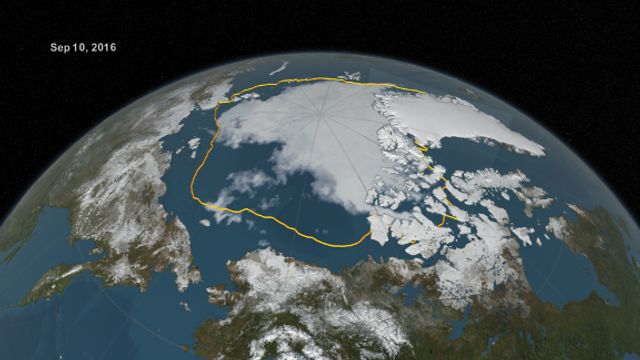
In particular, Arctic sea ice levels reached a new historic minimum, as part of a long-term trend of sea ice thinning due to warmer climate conditions. Decades-old ice formations are melting so that seasonal ice structures form an increasing proportion of the ice pack. This in turn speeds up warming as there is less ice to reflect sunlight back into space.
The Arctic sea ice extent during September 2016. The yellow contour represents the area of the average sea ice levels. Credit: NASA
Alongside the growing dangers of climate change are the increasing numbers of animal species being threatened with extinction. The Red List maintained by the International Union for the Conservation of Nature grew from 755 to 1,199 endangered species during the last three years while a total of one-sixth of all animals and plants on Earth are threatened with extinction due to global warming.
This year, cheetahs were among the most recognisable creatures to be added to the list. The global cheetah population fell to approximately 7,100 individuals, covering a geographical extent ten times smaller than its original range. It is already extinct in most of Asia and only a few dozen survive in an Iranian refuge. They are dying off due to a number of factors, such as the increasing use of their African habitat for farming and the hunting of their food sources. Their cubs are also trafficked to meet demand for furs in the Gulf states where they are sold for up to $10,000 on the black market.
The 0.1 percent of species driven to extinction each year is between 1,000 and 10,000 times greater than the natural rate as calculated through fossil records. Up to half of all species are threatened with extinction during this century. The number of vertebrate species has dropped by three-fifths since 1970, mainly due to human activity.
Even as growing numbers of species go extinct, biologists may have uncovered what allowed for the proliferation of so many forms of life in the first place. The origin of multi-cellular life is a major unsolved problem in evolutionary biology. Single-celled organisms are the oldest and simplest form of life, which evolved into multi-celled organisms independently many times at different points in the development of complex life. Early in 2016, researchers announced the discovery of an ancient molecule that likely played a key role in how multi-cellular organisms originally evolved.
The data suggests that approximately 800 million years ago, the GK-PID molecule evolved and allowed for the formation of tissue structure, in which cells must divide in the correct position relative to adjacent cells. The molecule is effectively a “scaffolding” protein that assists in the formation of complex organic structures. The researchers used “ancestral protein reconstruction” to extrapolate from the properties of modern proteins using computer models to recreate ancient proteins for experimental study.
Different research in this field of study has given biologists the most up-to-date estimate of the properties of the common ancestor to all life on Earth, an idea first developed by Charles Darwin in 1859: “Therefore I should infer from analogy that probably all the organic beings which have ever lived on this earth have descended from some one primordial form, into which life was first breathed.”
This is the outcome of the genetic sequencing of huge numbers of species during recent decades that has added an incredible amount of detail to the evolutionary history of life. The scientists analysed this data to find 355 genes that are common to all current species. These genes suggest that this last universal common ancestor may have been a single-celled organism adapted to the environment surrounding deep-sea hydrothermal vents, where water erupts due to heating by volcanic activity. This is consistent with the hypothesis that life originated in such underwater habitats approximately 3.8 billion years ago.
Other notable developments in 2016 include research on into the effects of the Agricultural Revolution on human evolution, the discovery of a dinosaur tail preserved in amber, evidence hinting at the existence of a fourth neutrino and the measurement of the spectrum of anti-hydrogen.

At least 23 dead, 17 missing in Indonesian ferry disaster

Oscar Grenfell 

A fire, which engulfed an Indonesian passenger ferry travelling from North Jakarta on Sunday morning, has killed at least 23 people. Another 17 passengers remain missing, prompting fears that the death toll will continue to rise over the coming days.
At least 32 survivors were taken to hospital to be treated for injuries, including the effects of severe smoke inhalation and burns. Nine remain in hospital.
While information is scanty, there are already indications that the tragic toll from the blaze was likely compounded by an excessive number of passengers, a lack of life jackets and other lax safety practices.
According to officials, the Zahro Express, which was transporting holidaying Indonesian nationals to Tidung Island, a popular tourist destination, left the port of Muara Angke at around 8:50 a.m. on New Year’s Day. Within half an hour of its departure, a fire began on the vessel and spread rapidly. The ship was just 1.6 kilometres from shore.
Spokespeople for the ministry of transportation have stated that the fire may have been caused by a short circuit in the craft’s engine room. Passengers said that they first saw smoke coming from the engine.
Officials have said that the speed with which the blaze spread may have been due to flames reaching the vessel’s fuel container, causing an explosion. It is not clear if the ship was equipped with fire extinguishers or whether they were used.
Survivors have described scenes of chaos and panic as the ship was rapidly engulfed by flames, leaving them with virtually no time to escape.
Evi, a female passenger told the local media outlet Metro TV: “Fifteen minutes after the boat set sail, people at the back of the boat started making noise... Then I saw smoke, there was more and more, the boat was crowded and people were fighting for life jackets.”
One passenger, quoted by Reuters, said: “All passengers panicked and ran up to the deck to throw floats into the water. In a split second, the fire becomes bigger coming from where fuel is stored.”
Juju Rukminingsih, another survivor, indicated that there were not enough life jackets for all of the passengers. “When we wanted to go, I panicked because I saw my son jump off the boat without a [life jacket] because somebody else had taken it,” she said.
Despite the chaos, survivors have reported stories of bravery and heroism, with passengers assisting one another during the disaster. According to Jakarta Coconuts, one of the victims, Jackson Wilhelmus, gave his life-jacket to a pregnant colleague, before drowning.
Other passengers reported having to leave the vessel without a life jacket. Many of them, including children, did not know how to swim. Between 194 and 224 survivors were plucked from the sea, the bulk of them by private boats fishing in nearby waters. Rescue operations have continued.
The wreckage of the boat was towed to shore on Sunday. Twenty of the 23 people who perished in the blaze received burns that were so severe that they could not be identified without an analysis of DNA and dental records. Some had been trampled or overwhelmed by smoke.
On Sunday, the Jakarta Disaster Mitigation Agency revealed that while the ship was carrying upwards of 200 passengers, its manifest had registered just 100 people and six crew members. The practice, which is common in Indonesia, allows private ferry operators to take full fares, without having to pay port operators or government taxes. Port officials are often involved in the scam.
It appears that the government is moving to scapegoat the captain and crew of the vessel, in order to prevent a broader examination of the widespread conditions that gave rise to the tragedy.
On Monday, the captain, Mohammad Nali, along with three other crew members were detained by Jakarta. Port officials are also reportedly being questioned.
On Tuesday, Nali was identified as a suspect over the discrepancy between the manifest and the ship’s actual number of passengers. The captain and some crew members have also been accused of being among the first to leave the ship after the fire began. Nali faces possible charges carrying substantial financial penalties and up to 10 years in prison.
In a bid to assuage mounting anger over the accident, Transportation Minister Budi Karya Sumadi announced on Tuesday that the government would provide survivors and families of the deceased with compensation. He gave no further details. Sumadi also declared that state-owned shipping lines would begin passenger services to the Thousand Islands, an island chain to the north of Jakarta that includes Tidung Island.
Ferry accidents, often involving substantial casualties, are a regular occurrence in Indonesia, with private operators slashing costs and neglecting the most basic safety practices, in order to maximise profits. Workers and the poor have no choice but to undertake the perilous journeys on faulty vessels to travel between the archipelago’s islands, which number more than 17,000.
Last December, 20 people were killed in a speed boat explosion in Bali, thought to have been caused by a malfunctioning battery near a fuel tank.
In December 2015, at least 80 people died after a ferry sank off the island of Sulawesi when its engine was overwhelmed by large waves in heavy seas.
Other disasters have claimed even more lives. In 2009, over 200 perished after a ferry went down between Sulawesi and East Kalimantan. Relatives held protests denouncing the limited search and rescue operations conducted by the government. In December 2006, 400 died in a sinking off the coast of East Java. Ferry disasters in 2000 and 2003, each claimed up to 500 lives.
There is no indication that these disasters have had any impact on safety practices or government policy. According to the National Transportation Safety Commission, the total number of maritime accidents increased from 15 in 2015 to 28 in 2016. A report by the Worldwide Ferry Association in 2015 found that since 2000, Indonesia had experienced a higher number of ferry accidents than any country, aside from Bangladesh.
Maritime deaths are one tragic expression of a broader transport infrastructure crisis. Over 30,000 Indonesian nationals are estimated to perish in traffic accidents each year. A McKinsey report in 2011 pointed to the culpability of successive governments, noting: “In Indonesia, infrastructure investments dropped from 5 percent to 6 percent of GDP in the early 1990s to 2 percent to 3 percent of GDP for much of the last ten years.”