6 Jan 2017

WikiLeaks data reveals close cooperation between German intelligence and NSA

Sven Heymanns

The German foreign secret service (BND) has not only delivered data to the US intelligence services on a massive scale, it has also worked directly with the NSA in developing detection software. This has been confirmed by extensive data published by the WikiLeaks platform at the beginning of December. It documents the close cooperation between German and American intelligence agencies and reveals new details.
The data contains about 90 gigabytes of information. It consists of a total of 2,420 files, which were forwarded in 2015 to the German parliamentary committee that is currently investigating the activities of the intelligence services. According to WikiLeaks, the data originates from several German federal authorities, including the Bundesnachrichtendienst (BND), the Federal Office for Constitutional Protection (BfV) and the Federal Office for Information Security (BSI).
How WikiLeaks acquired the data is unknown. The Frankfurter Allgemeine Sonntagszeitung immediately held Russia responsible. The paper alleges that it had been informed by “security circles” that the data could have stemmed from a hacker attack on the Bundestag in the spring of 2015 for which Russia was responsible. There was a “high plausibility” for this thesis because none of the documents had been digitized after January 2015. Furthermore, the documents were of the lowest degree of secrecy for circulation within the Bundestag.
But there is no independent confirmation of these accusations against Russia.
The close collaboration between the BND and the NSA is no secret. It was already clear in June 2013 from the material released by Edward Snowden. Snowden revealed that both intelligence services use the XKeyScore software to filter and search worldwide mobile and internet traffic.
The latest publications show that the BND not only used the software, but was also involved in its development. An internal document from June 2013, which reports on cooperation with the US intelligence agencies, shows that a BND employee had been seconded “to programme and manage XKeyScore for a period of two years.”
The BND was also aware of the spying activities of numerous US companies located in Germany. An email from the German chancellery in January 2014 names Lockheed Martin, Northrop Grumman, and Booz Allen Hamilton. Edward Snowden had last worked for the latter. Both Lockheed Martin and Northrop Grumman also cooperated with British intelligence services, “according to intelligence reports.”
The documents now published throw light onto the activities of the German parliamentary Investigation Committee as well as the reaction of the BND and the Registrar’s Office to the material released by Snowden and the inquiries undertaken by the Bundestag committee. A closer examination of the files gives some sense of how the “deep state” operates.
The immediate reaction of the BND to the revelations of Snowden was marked by panic. Countless frantic emails in rapid succession, all with short response times, are evidence of how concerned the secret services were to minimise public knowledge of the true extent of worldwide espionage.
Many of these emails dealt with the information that was to be provided to Germany’s relevant parliamentary committees. There is discussion about “speakers’ notes” to be given to representatives of the secret services in order to be prepared for all conceivable questions. Answers to queries from Bundestag representatives, following the first press reports, were checked and edited by the BND and the chancellery before publication. The answers were brief, noncommittal and generally worthless.
It is not only the intelligence services themselves that are concerned to preserve secrecy about their illegal practices and worldwide spying activities. It is remarkable how hostile the opposition parties in the Bundestag have been towards the WikiLeaks revelations.
Martina Renner, the Left Party deputy in the NSA Investigation Committee, complained that the committee would now have less insight into the secret documents necessary for its work. The intelligence services had always argued that the committee was a risk because information could reach the public. “The current leak gives further impetus to such attacks.”
With her comment Renner practically admitted that the “parliamentary control” of the secret services was based on parliamentarians themselves becoming part of the secret service conspiracy.
The representative of the Greens in the committee, Konstantin von Notz, argued similarly. On Twitter he wrote: “Anyone who releases such things deliberately torpedoes the information gathering and the necessary control of the services.”
In fact, the pretence of parliamentary oversight is torpedoed by the fact that the secret services work completely independently of any control, and all the Bundestag parties are interested in maintaining this situation. Against a background of intensifying political and social tensions, the ruling elite is more than ever dependent on an authoritarian security apparatus.

Macy’s, Sears announce mass layoffs, hundreds of store closings across the US

Niles Niemuth

US department stores Macy’s and Sears announced thousands of layoffs and hundreds of store closures on Wednesday following dismal holiday sales and declining yearly revenues.
Macy’s said that it will eliminate more than 10,000 jobs and will move forward with the planned closure of 68 stores by the middle of this year. The closures are part of 100 announced in August, representing a loss of nearly 14 percent of the 730 stores operated by Macy’s in the US and its territories.
The company reported that it will seek to maintain profits by eliminating a number of management positions across the company, cutting 6,200 people from the workforce. On top of this, 3,900 Macy’s store employees will lose their jobs, though the company indicated that some could be reassigned to other stores.
Macy’s reported that its sales during the holiday months of November and December had fallen 2.1 percent from the previous year. Retailers rely on sales at the end of the year to pad out revenue and profits.
Sears Holdings also announced on Wednesday that it was planning to shutter 150 stores by April; 108 of its Kmart locations and 42 Sears stores. The closures represent 13.5 percent of the 801 Kmart locations remaining at the end of 2016 and 6 percent of the 676 remaining Sears locations.
Holiday sales at Kmart and Sears stores in November and December were down by between 12 and 13 percent from 2015.
On top of the layoffs and closings, Sears announced that it was raising funds to prop up its operations by selling its Craftsman tool brand to Stanley Black and Decker for $900 million. Even before the onset of the 2008 economic crisis Kmart and Sears had begun to hemorrhage thousands of jobs and close hundreds of locations.
Sears Holdings was created in 2005 after Kmart emerged from bankruptcy and merged with the floundering Sears, Roebuck & Co. for $11 billion. Despite the efforts to salvage both companies, Sears has seen its total sales cut in half since 2007.
Other major US retailers, including Kohls, L Brands and American Eagle, also announced declining holiday sales but have yet to announce any layoffs or store closures. Kohls closed 18 stores and laid off more than 1,500 employees in 2016.
The closings and layoffs are an indication of the actual state of the economy, more than seven years after the beginning of the supposed economic “recovery.” The large traditional retailers have also come under immense pressure the growth in sales through online retailers such as Amazon over the last decade.
As American workers have seen their wages either stagnate or decline, they have increasingly turned to online retailers that offer goods at lower prices than the department stores and also offer the convenience of home shipping.
Amazon dominated the online holiday sales in November and December, accounting for 38 percent of all transactions. Meanwhile, the company reported that it shipped a total of 1 billion items worldwide in 2016.
Amazon has been able to capture an increasing share of the retail market by exploiting its workforce through low wages, imposing high productivity demands and implementing robotic automation.
A worker classified as an order picker at one of its massive fulfillment center warehouses earns less than $12.00 an hour. Amazon warehouse employees walk between 7 and 15 miles every work day and must pass through an airport-style security inspection when leaving to go home.
As part of efforts to shorten delivery times and keep up with growing demand, the company will open a number of new warehouses throughout the country. It was announced in December that Amazon would construct a 1 million square foot fulfillment center in Livonia, Michigan, a suburb of Detroit, on the site of a former General Motors plant, reportedly providing 1,000 full-time positions.
It is impossible to review the economic conditions in all of hundreds of areas which will be impacted by the latest store closures, but a small sampling gives a sense of the social conditions that prevail across the US.
The original Kmart store opened in 1962 in Garden City, Michigan, just south of where Amazon will open its new Livonia warehouse, and is one of those slated to be closed by April. Approximately 11 percent of the city’s population lived in poverty in 2015.
Jasper, Alabama, a city of approximately 14,000, will also lose its Kmart. The city, located in the northwestern Appalachian region of the state, formerly one of the leading coal producers in the United States, has been hit hard by the collapse in the global demand for coal. North American Coal Corporation closed its Jasper operations in 2015, leading to the elimination of 118 jobs.
Rochester, New York will lose the Macy’s department store, which serves as an anchor for its Marketplace Mall. In 2013, a third of the city’s residents lived below the poverty line, more than half of children lived in poverty, and an astounding 16 percent of the population lived at less than half of the federal standard for poverty.
The latest round of retail store closings and layoffs are only an indication of what is to come in the next four years under the Trump administration, which is being staffed by billionaire oligarchs, Wall Street bankers and generals. As corporate taxes and regulations are cut, even more jobs will be sacrificed and wages will be slashed in order to further boost profits.

Line (Out) of Control?

Joy Mitra


The Line of Control (LoC) between India and Pakistan is witnessing a fresh spiral of violence post the Indian “surgical” strikes of 29 September 2016. The spike in violence seems to suggest that the ceasefire agreement of 2003 between the two countries no longer holds water. Some within and outside government circles have begun speaking in terms of ‘war’ and the general impression created is that the agreement has lost its sanctity. This may however be jumping the gun too soon given that the ‘dialogue of violence’ is not happening along the entire stretch of the LoC and there are more conventional threshold levels to be crossed. The risks to general stability in the region, however, remain entrenched in the dynamics of the conflict and could lead to an uncontrollable conflict trajectory.

Sanctity of the 2003 Ceasefire-Agreement
It must be noted that even before the Uri attack and the Indian strike back, certain sectors along the LoC were witnessing higher concentration of violent incidents. Post the Indian strike back the first repercussions were more an increase in the intensity of violence along those sectors and not a general escalation of the conflict along the LoC. Therefore, the ceasefire accords had value until the first spatial threshold was crossed with the attack at the Indian military base close to the Jammu border, which India refers to as the ‘international border’and Pakistan as the ‘working boundary’. This may still not be a general breach of the geographical threshold on the military escalation ladder given that the current spate of violence is still confined to the state of Jammu and Kashmir and ceasefire violations do not necessarily imply a ceasefire breakdown. The intensity of violations may however go up at a certain spatial and temporal location.

Probable Escalation Dynamics
Additionally, while both sides have resorted to heavy artillery and mortar shelling, neither has vertically escalated in terms of introduction of air assets or other platforms. The pattern of attacks clearly demonstrate that military installations are the prime targets. A qualitative threshold can be breached here in terms of the choice of targets. This will lead to a geographical expansion of the threat-perception and spread the Indian security forces thin.

The prospects for any horizontal escalation could entail attacks south into Punjab. Going by the history of previous such episodes, this escalation should not happen. India and Pakistan seem to have systematised a periodic bout of violence along the LoC into their relationship that ebbs and flows conditional on the political milieu associated with it. In 2013, a similar episode of violence saw the ‘Mutually Hurting Stalemate (MHS)’ reached before any spatial escalation.

Subjective Stalemates
It is not necessary for an objective MHS to be realised. The stalemate could be a dynamic normal with both sides not necessarily sustaining equal measure of losses, albeit it is the perception of this normal that matters. MHS can be reached if both sides believe that neither can escalate to victory and a negotiated solution is possible, i.e. both sides perceive the other to be willing to negotiate. Additionally, the victory condition can also be subjective.

At present, the dynamic normal that exists between India and Pakistan may seem like an objective MHS to neutral observers but the rhetoric on the Indian side suggests that it believes it has established escalation dominance. This seems to be part of the victory condition that India has defined: escalation dominance which goes in conjunction with diplomatic efforts to internationally isolate Pakistan. Without going into the merits/demerits of the policy objective, it is reasonable to assume that the politico-military leadership believes it can achieve this victory condition and this translates into unwillingness to consider a negotiated settlement, when a better outcome can be achieved by coercive bargaining.

In Pakistan, public attention is occupied with events in the domestic polity. The civilian arm has made attempts to negotiate, and this option would not have been pursued without blessings from their security establishment. Even if Pakistan believes that the MHS has been reached, it is then left with the choice of preventing India from achieving its victory condition, only by sustaining the conflict long enough to impress upon India that a negotiated outcome is the only way to avoid the loss-loss scenario of a prisoner’s dilemma.

Unpredictable Conflict Trajectory
The Nagrota attack seems to be a demonstration of Pakistan’s intent to continue the mutual hurt if not in the form of a stalemate. This could also be a consequence of increased risk propensity due to loss perception that Pakistan might have because of cumulative losses it has incurred in diplomatic, military and reputational terms. The existence of loss perception can lead to increased propensity to continue the conflict, perhaps even escalate in the sub-conventional domain. Pakistan’s intent to continue the mutual hurt may however have consequences for public perception in India and not necessarily in favour of restraint because public perception is a double-edged sword. A sustained campaign to inflict losses can generate enough vitriol to bind the government to its rhetoric and could lead to uncontrollable consequences. 

In conclusion, periodic bouts of such violence, combined with loss perception in Pakistan and aggressive rhetoric in India despite the existence of an objective MHS, can take a trajectory which may not be in either side's control.

5 Jan 2017

University of Bedfordshire Scholarships for Students from Africa and Other Regions 2017/2018

Offered annually? Yes
Eligible Countries: International
To be taken at (country): UK
Type: Undergraduate and Masters
Eligibility: 
  • To be eligible for the International Scholarships, students must be classified as international or , must have applied for a course of study and hold an unconditional offer for a course at the University of Bedfordshire.
  • If you wish to be considered for this scholarship you will need to apply for admission into the University. Candidates cannot apply for the scholarship before being offered a study place at the University of Bedfordshire.
  • For undergraduate students after the first year of study with us standard published fees for 2016/2017 will apply for future years of study at the University of Bedfordshire.
Number of Awardees: Not specified
Value of Scholarship: 
  • £2,000 for some countries and £1,000 for some other countries. It is important to check the eligibility requirements for your country before applying.
  • There is also a £500 merit scholarship available for those scoring 60% and above marks in their academic subjects with an average IELTS score of 6.0 with 5.5 in each band.
  • There will also be a £750 Prompt Payment Discount available for continuing students progressing to their next year of study when full fees are paid on or before registration.
Duration of Scholarship: 1 year
Award Provider: University of Bedfordshire.

Imperial College Forté Foundation MBA Scholarships for Outstanding Women 2017/2018

Application Deadline: 17th March 2017
Offered annually? Yes
To be taken at (country): UK
Type: MBA
Eligibility: The Fellowships are open to all women applying to the MBA programme.
Selection Criteria: Successful candidates will demonstrate strong leadership skills through academic achievement, or in roles as team or community leaders, and show a commitment to helping women achieve their career potential through personal mentoring or community involvement.
The scholarships will be awarded to applicants based on the following criteria:
  • The information supplied in your original application to the programme, including a strong academic background, a high and well-balanced GMAT score, and an excellent track record of professional achievement
  • Your performance during the admissions process, where academic and professional merit will be judged
  • A demonstrable track record of leadership in in your field
  • Commitment to Forté’s mission of launching women into fulfilling, significant careers through access to business education, opportunities, and a community of successful women
  • Your professional references
Number of Awardees: Not specified
Value of Scholarship: £23,500
In addition to the financial support provided, Forté Fellows have access to a number of unique resources from Forté Foundation including:
  • Participation in the annual Forté MBA Women’s Leadership Conference held at the Amazon headquarters in Seattle
  • Access to exclusive networking groups of Forté Fellows, Forté Fellow Alumnae and sponsor companies on social media and through Forté Fellow listservs
  • Special e-introductions to Forté sponsor companies and inclusion in the Fellow résumé book, which is distributed to all sponsor companies
  • Free lifetime Forté Foundation Premium Membership
Duration of Scholarship: 1 year
How to Apply: Female candidates who apply before 17 March 2017 and receive an offer for the Full-Time MBA programme commencing in September 2017 will automatically be considered. All candidates should address the requirements of the scholarship in their personal statement.
Award Provider: Forté Foundation

Imperial College Future Leaders MBA Scholarship for International Students 2017/2018

Application Deadline: 5th May 2017
Offered annually? Yes
To be taken at (country): UK
Type: MBA
Eligibility: Successful applicants will demonstrate the ability and passion to become a visionary business leader. To be considered for this scholarship, you must display leadership qualities and exceptional career potential in your application.
The scholarship will be awarded to applicants based on the following criteria:
  • A strong academic background, a high and well-balanced GMAT score, and an excellent track record of professional achievement
  • Your performance during the admissions process, where academic and professional merit will be judged
  • Your professional references
  • Under six years’ postgraduate work experience preferred
Number of Awardees: Not specified
Value of Scholarship: Scholarships of up to £23,500 are available.
Duration of Scholarship: 1 Year
How to Apply: Candidates who apply before 5 May 2017 and receive an offer for the Full-Time MBA programme commencing in September 2017 will automatically be considered. All candidates should address the requirements of the scholarship in their personal statement.
Award Provider: Imperial College

From Agriculture to Demonetisation: Not ‘Make in India’ but Made in Washington

Colin Todhunter

Emerging evidence indicates that demonetisation was not done to curb corruption, ‘black money’ or terrorism, the reasons originally given. That was a smokescreen. Modi was acting on behalf of powerful Wall Street financial interests. Demonetisation has caused massive hardship, inconvenience and chaos. It has affected everyone and has impacted the poor and those who reside in rural areas (i.e. most of the population) significantly.
Who does Modi (along with other strategically placed figures) serve primarily: ordinary people and the ‘national interest’ or the interests of the US?
Convenient bedfellows
We don’t have to dig too deep to see where Modi feels at home. Describing itself as a major ‘global communications, stakeholder engagement and business strategy’ company, APCO Worldwide is a lobby agency with firm links to (part of) the Wall Street/US establishment and functions to serve its global agenda. Modi turned to APCO to help transform his image and turn him into electable pro-corporate PM material. It also helped Modi get the message out that what he achieved in Gujarat as Chief Minister was a miracle of economic neoliberalism, although the actual reality is really quite different.
In APCO’s India brochure, there is the claim that India’s resilience in weathering the global downturn and financial crisis has made governments, policy-makers, economists, corporate houses and fund managers believe that the country can play a significant role in the recovery of the global economy. APCO’s publicity blurb about itself claims that it stands “tall as the giant of the lobbying industry.”
The firm, in its own words, offers “professional and rare expertise” to governments, politicians and corporations, and is always ready to help clients to sail through troubled waters in the complex world of both international and domestic affairs.
Mark Halton, former head of Global Marketing and Communications for Monsanto, seemed to agree when he praised APCO for helping the GMO giant to:
“… understand how Monsanto could better engage with societal stakeholders surrounding our business and how best to communicate the social value our company brings to the table.”
If your name is severely tarnished and you need to get your dubious products on the market in countries that you haven’t managed to infiltrate just yet, why not bring in the “giant of the lobbying industry.”
As a former client of APCO, Modi now seems to be the go-to man for Washington. His government is doing the bidding of global biotech companies and is trying to push through herbicide-tolerant GM mustard based on fraudulent tests and ‘regulatory delinquency‘, which will not only open the door to further GM crops but will possibly eventually boost the sales of Monsanto-Bayer’s glufinosate herbicide. In addition, plans have been announced to introduce 100% foreign direct investment in certain sectors of the economy, including food processing.
Neoliberal dogma
This opening up of India to foreign capital is supported by rhetoric about increasing agricultural efficiency, creating jobs and boosting GDP growth. Such rhetoric mirrors that of the pro-business, neoliberal dogma we see in APCO’s brochure for India. From Greece to Spain and from the US to the UK, we are able to see this rhetoric for what it really is: record profits and massive increases in wealth (ie ‘growth) for elite interests and, for the rest, disempowerment, surveillance, austerity, job losses, the erosion of rights, weak unions, cuts to public services, bankrupt governments and opaque, corrupt trade deals.
APCO describes India as a trillion-dollar market. Note that the emphasis is not on redistributing the country’s wealth among its citizens but on exploiting markets. While hundreds of millions live in poverty and hundreds of millions of others hover above it, the combined wealth of India’s richest 296 individuals is $478 billion, some 22% of India’s GDP. According to the ‘World Wealth Report 2015’, there were 198,000 ‘high net worth’ individuals in India in 2014, while in 2013 the figure stood at 156,000.
APCO likes to talk about positioning international funds and facilitating corporations’ ability to exploit markets, sell products and secure profit. In other words, colonising key sectors, regions and nations to serve the needs of US-dominated international capital.
Paving the way for plunder
Modi recently stated that India is now one of the most business friendly countries in the world. The code for this being lowering labour, environmental, health and consumer protection standards, while reducing taxes and tariffs and facilitating the acquisition of public assets via privatisation and instituting policy frameworks that work to the advantage of foreign (US/Western) corporations.
When the World Bank rates countries on their level of ‘Ease of Doing Business’, it means nation states facilitating policies that force working people to take part in a race to the bottom based on free market fundamentalism. The more ‘compliant’ national governments make their populations and regulations, the more attractive foreign capital is tempted to invest.
The World Bank’s ‘Enabling the Business of Agriculture’ – supported by the Bill and Melinda Gates Foundation and USAID – entails opening up markets to Western agribusiness and their fertilisers, pesticides, weedicides and patented seeds.
Anyone who is aware of the Knowledge Initiative on Agriculture and the links with the Indo-US Nuclear Treaty will know who will be aware that those two projects form part of an overall plan to subjugate Indian agriculture to the needs of foreign corporations (see this article from 1999). As the biggest recipient of loans from the World Bank in the history of that institution, India is proving to be very compliant.
The destruction of livelihoods under the guise of ‘job creation’
According to the neoliberal ideologues, foreign investment is good for jobs and good for business. Just how many actually get created is another matter. What is overlooked, however, are the jobs that were lost in the first place to ‘open up’ sectors to foreign capital. For example, Cargill may set up a food or seed processing plant that employs a few hundred people, but what about the agricultural jobs that were deliberately eradicated in the first place or the village-level processors who were cynically put out of business so Cargill could gain a financially lucrative foothold?
The Indian economy is being opened-up through the concurrent displacement of a pre-existing (highly) productive system for the benefit of foreign corporations. For farmers, the majority are not to be empowered but displaced from the land. Farming is being made financially non-viable for small farmers, seeds are to be privatised as intellectual property rights are redefined, land is to be acquired and an industrialised, foreign corporate-controlled food production, processing and retail system is to be implemented.
The long-term plan is to continue to starve agriculture of investment and have an urbanised India with a fraction of the population left in farming working on contracts for large suppliers and Wal-Mart-type supermarkets that offer highly processed, denutrified, genetically altered food contaminated with chemicals and grown in increasingly degraded soils according to an unsustainable model of agriculture that is less climate/drought resistant, less diverse and unable to achieve food security. This would be disastrous for farmers, public health and local livelihoods.
Low input, sustainable models of food production and notions of independence and local or regional self-reliance do not provide opportunities to global agribusiness or international funds to exploit markets, sell their products and cash in on APCO’s vision of a trillion-dollar corporate hijack; moreover, they have little in common with Bill Gates/USAID’s vision for an Africa dominated by global agribusiness.
And, finally, to demonetisation
Modi rode to power on a nationalist platform and talks about various ‘nation-building’ initiatives, not least the ‘make in India’ campaign. But he is not the only key figure in the story of India’s capitulation to Washington’s agenda for India. There is, for instance, Avrind Subramanian, the chief economic advisor to the government, and Raghuram Rajan who was until recently Governor of the Reserve Bank of India. He was chief economist at the International Monetary Fund from 2003 to 2007 and was a Distinguished Service Professor of Finance at the University of Chicago Booth School of Business from 1991 to 2013. He is now back at the University of Chicago.
Aside from Rajan acting as a mouthpiece for Washington’s strategy to recast agriculture in a corporate image and get people out of agriculture in India, in a recent article, economist Norbert Haring implicates Rajan in the demonestisation policy. He indicates that the policy was carried out on behalf of USAID, MasterCard, Visa and the people behind eBay and Citi, among others, with support from the Gates Foundation and the Ford Foundation.
Haring calls Rajan the Reserve Bank of India’s “IMF-Chicago boy” and based on his employment record, memberships (not least of the elite Group of Thirty which includes heads of central, investment and commercial banks) and links, place him squarely at the centre of Washington’s financial cabal.
Haring says that Raghuram Rajan has good reason to expect to climb further to the highest rungs in international finance and thus play bow to Washington’s game plan:
“He already was a President of the American Finance Association and inaugural recipient of its Fisher-Black-Prize in financial research. He won the handsomely endowed prizes of Infosys for economic research and of Deutsche Bank for financial economics as well as the Financial Times/Goldman Sachs Prize for best economics book. He was declared Indian of the year by NASSCOM and Central Banker of the year by Euromoney and by The Banker. He is considered a possible successor of Christine Lagard at the helm of the IMF, but can certainly also expect to be considered for other top jobs in international finance.”
The move towards a cashless society would secure a further degree of control over India by the institutions who are pushing for it. Securing payments that accrue from each digital transaction would of course be very financially lucrative for them. These institutions are therefore pursuing a global ‘war on cash’.
Small, wealthy countries like Denmark and Sweden can bear the impact of a transition to a cashless economy, but for a country such as India, which runs on cash, the outcomes so far have been catastrophic for hundreds of millions of people, especially those who don’t have a bank account (almost half the population) or do not even have easy access to a bank.
But, regardless of the large-scale human suffering imposed as a result of demonetisation, it could kill two birds with one stone: 1) securing the interests of international capital, including the eventual displacement of the informal (i.e. self-organised) economy; and 2) acting as another deliberate nail in the coffin of Indian farmers, driving even more of them out of the sector. The US’s game plan remains well and truly on course.
Not really a case of ‘make in India’. Some 50 years after independence, as a state India remains compromised, weak and hobbled. More a case of made in Washington.
A version of the following piece was originally published in June 2016. However, since then, India’s PM Narendra Modi has embarked on a ‘demonetisation’ policy, which saw around 85 percent of India’s bank notes becoming invalid overnight.

The Dark Side of Obama’s Legacy

Melvin A. Goodman


There is a dark side to President Barack Obama’s legacy on national and international security matters that will enable President-elect Donald Trump to damage America’s political institutions as well as its standing in the global community.  President Obama, a Harvard-trained lawyer and an expert in constitutional law, was insufficiently scrupulous in protecting our moral obligations, creating an ironic and unfortunate page in U.S. history.  Instead of making the “world safe for democracy,” the clarion call of President Woodrow Wilson one hundred years ago, President Obama contributed to the furtherance of a national security state and a culture of secrecy.
The administrations of Presidents George W. Bush and Barack Obama tilted too far in the direction of the military, which already plays far too large a role in the policy process and the intelligence cycle.  Strategic intelligence has suffered from the Pentagon’s domination of a process that is now geared primarily to support the warfighter in an era of permanent war.  The strategic intelligence failures during the Obama administration include the absence of warning regarding events in Crimea and the Ukraine; the “Arab Spring;” the emergence of the Islamic State; and Russian recklessness in Syria.
The militarization of intelligence presumably will worsen in the Trump administration, which will be dominated by retired general officers and West Point graduates at almost all of the key departments and agencies in the foreign policy community. The CIA has become a para-military organization in the wake of the 9/11 attacks, with too much attention whitleblowerciagiven to covert action.
President Obama campaigned on the basis of transparency and openness, but ignored accountability for the CIA’s transgressions and fundamentally weakened the role of oversight throughout the national security community.  A statutory Inspector General was created at the CIA in 1989 due to the crimes of Iran-Contra, but President Obama made sure there was no IG in place at CIA during most of his eight-year presidency and acquiesced in the destruction of the Office of the Inspector General at CIA.
The Senate intelligence committee’s authoritative report on the CIA’s illegal use of torture and abuse could not have been prepared without the work of the Office of the Inspector General, but President Obama tolerated the CIA director’s interference with the committee’s staff and ignored calls for the release of the full report.  As a result, it will be easier for a Trump administration to reinstate the use of torture that violates constitutional and international law, let alone common sense and decency.  With regard to the now-banned practice of waterboarding, Donald Trump stated that “only a stupid person would say it doesn’t work,”
The Obama administration also conducted a campaign against journalists and whistle-blowers that was unprecedented, using the one-hundred-year-old Espionage Act more often than all of his predecessors combined.  In fact, he misused the act, which was designed to prosecute government officials who talked to journalists and not to intimidate legitimate whistleblowers who report crimes and improprieties.  Leonard Downie, a former executive editor of the Washington Post, called Obama’s control of information “the most aggressive I’ve seen since the Nixon administration.”
President Obama, in his high-minded rhetoric, denounced torture and abuse that “ran counter to the rule of law;” warned that our use of drones will “define the type of nation that we leave to our children;” and that “leak investigations may chill investigative journalism that holds government accountable.”  Nevertheless, he sought no accountability for those who broke laws in conducting torture and abuse; expanded the use of drone warfare; and, according to the executive director of the Freedom of the Press Foundation, “laid all the groundwork Trump needs for an unprecedented crackdown on the press.”
As long as Congress defers to the president on the conduct of national security; the courts intervene to prevent any challenge to the power of the president in national security policy making; and the media defer to official and authorized sources, the nation will have to rely on whistleblowers for essential information on national and international security.  Their role will be particularly essential in a Trump administration in view of the president-elect’s reckless statements on nuclear forces, nuclear proliferation, the use of force, and U.S. relations with key allies.  The fact that Trump remains hostile to intelligence briefings and that his first three appointments to the National Security Council are conspiracy theorists creates a horrifying scenario for furthering the dark side of the Obama legacy.

Holiness’ “Holy” Act: An Archbishop, Reportedly, Initiates Onslaught On The “Sinful” Venezuela

Farooque Chowdhury


The following news-report by Fox News says:
“On New Year’s Day, priests across Venezuela reportedly were instructed by Cardinal Jorge Urosa Savino, the archbishop of Caracas, to read […] a text during the homily encouraging parishioners to take a stand for democracy and not be intimidated by the socialist rule of Nicolas Maduro.”
The January 4, 2017 datelined news-report says:
“Spanish newspaper ABC reported that the Vatican itself is encouraging the Catholic Church’s involvement in Venezuela’s acute financial and humanitarian crisis.
“The text of the homily was sent by the Vatican, according to the paper.”
The news-report headlined “Priests in Venezuela reportedly instructed to give anti-Maduro homily” adds:
“In last Sunday’s homily, priests across the country referred to a ‘real dictatorship situation’ and urged Venezuelans ‘to put all their efforts into stopping the advance of the dictatorship and to eradicate it in a democratic way.’
“The extreme shortage of food and medicines, the text read, is caused by ‘an erroneous economic system, a socialist totalitarianism that gives government a total control of the economy.’”
It says:
“Vatican-sponsored talks between the two sides stalled last month after the opposition said they would not attend any further meetings unless more concessions were made by the government.”
The January 4, 2017 datelined and “La llamada de la Iglesia a rebelarse tensa aún más su relación con Maduro” headlined original ABC-report by its Caracas correspondent Ludmila Vinogradoff says:
“El llamamiento de la Iglesia catolica venezolana para que se celebren elecciones y sean liberados los presos políticos, como salida a la crisis generalizada que atraviesa el país, ha tensado aún más sus ya difíciles relaciones con el Gobierno de Nicolás Maduro. El Arzobispado de Caracas instó a sus feligreses a rebelarse contra la «dictadura» de forma «pacífica y democrática», en las homilías pronunciadas en las misas del pasado domingo.
“Los sacerdotes leyeron la homilía del cardenal Jorge Urosa, «Año nuevo en paz y familia», orientada desde la Santa Sede, en la que se aborda la crítica situación económica, política y social que vive Venezuela. La Iglesia católica venezolana califica de «dictadura» el régimen de Maduro por bloquear la Asamblea Nacional, de mayoría opositora desde las legislativas del 6 de diciembre de 2015.”
The news-report presents serious information if the news-report is factual, if there’s no fabrication in the news-report, if it’s not part of disinformation campaign against the forward march by the people in Venezuela: (1) With the beginning of 2017, at least a part of Holiness has formally begun its war against the people’s effort to build up a secured and dignified life in Venezuela; (2) with this call, onslaught on the people’s initiative has formally been initiated; (3) at least a part of Holiness has formally taken stand in favor of the propertied interests, which feels its better days of appropriation, loot, speculation, squandering and pillaging are facing resistance; (4) at least a part of Holiness has thrown away all shrouds of its original class allegiance, publicly and formally taken political stand, and formally and publicly joined the camp opposite to the people in the class war now going-on in Venezuela.
The reported instruction of Cardinal Jorge Urosa Savino, and the report that the Vatican is encouraging the Catholic Church’s involvement, and the text of the homily was sent by the Vatican are nothing but open political move by the part of Holiness. Now, if the report is not false, the part has begun acting openly as a political organization, has openly joined the alliance being fed by imperialist bosses, and has openly become part of the imperialist intervention process in Venezuela.
This role by the part is not new. It’s neither new in Latin America nor new in the world. Readers are aware of the part’s collaboration with Latin American tyrants-murderers-robbers. Readers are aware of the part’s role in Poland. The part’s fuelling of the Gdansk shipyard union led by Walesa is not a forgotten chapter of history.
But has the part ever issued any call to rise up against a system based on exploitation, based on appropriation of surplus labor, based on lies and deception? Has the part ever issued any call to rise up against a system having not an iota of honesty and moral standing? Has the part ever issued any call to resist imperialist intervention? Has the part ever issued any dictum that says: imperialism has no authority to violate people’s right to determine their way of living, their political and economic systems in all parts of the world, has no authority to intervene with, to trample political system in any country? Has the part ever issued any call that exposes corruption, political and financial, of the Brazilian elites, that calls upon the people in Brazil to revolt against the robbing scheme the Brazilian elites are now implementing? Has the part ever, in its total history, issued any call to extend health care system to the neglected, the forgotten, the citizens the rich consider non-existent in Venezuela, in Bolivia, in Brazil, in Honduras, in Africa? Was there any call ever issued by the part to provide safe housing to the poor in Venezuela, to dismantle the system that allows the Venezuelan rich to keep their mysteriously gotten land fallow for the sole purpose of speculation in the land market – higher and higher profit? Nay, nay, nay, the only answer facts produce. But were not children dying in these countries? Were not innocent people claiming rightful rights were murdered? Don’t two of the Ten Commandments say: Thou shalt not kill and Thou shall not steal? Doesn’t the rich class steal, don’t the imperialists kill? The system of profit survives by killing toilers, the poor, the laboring people.
Now, with the reported call the part has also begun another process: delegitimizing itself. It’s simple dialectics, the process idealists verbally ignore, but faithfully go by its rules in their material transactions including pocketing profit. The process of delegitimizing self by the part will get stronger and more vibrant the more class struggle sharpens, the more people educate themselves politically, the more mobilizations of people are organized, the more earthly issues of exploitation and class rule are discussed, the more superficial issues are thrown away from tables of discussion, the more class line is followed.
The part issuing the reported call to stand for democracy has not identified the question: Democracy for whom? Is it for the democracy of ravaging capital or for people? Is it the democracy of tyrants, tyranocracy, or of the toilers? No democratic system is class-neutral. But bourgeois academia and media never cite the fact although many prestigious mainstream studies have found the fact. And, sadly, this fact is also not told unequivocally and boldly by a part of scholars sitting in the camp of the people.
The part’s reportedly formal call is not new. It’s ingrained in its laughingly mystic character. Many years ago, it was written in the very first paragraph of the Communist Manifesto: the pope, the tsar, Metternich, Guizot, police have entered into a holy alliance against the toilers’ political fight. This world is still being ruled by these forces. Souls and pall bearers of Metternich and Guizot are very active, and are increasingly taking an offensive position. So, the toilers’ fight is still alive. It’s alive in Venezuela, in Brazil, in lands across oceans. And, the reported call, a provocation, is incapable of wiping out class struggle. So, the people’s fight in Venezuela, in all lands will continue.

More than 100 injured in Brooklyn train derailment

Philip Guelpa

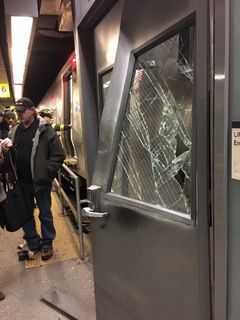
On Wednesday, at the height of the morning rush, a Long Island Railroad (LIRR) commuter train slammed into the bumper block at the end of the line at the Atlantic Avenue Terminal in downtown Brooklyn, New York. The two front cars derailed and crashed into a room beyond the end of the track. Reports indicate that at least 103 people suffered injuries, mostly minor. Eleven people were hospitalized. Luckily, there were no fatalities.
The LIRR train was carrying over 400 passengers, most bound for work in New York City. Commuters can connect with nine subway lines at Atlantic Terminal, next to the Barclays Center, making it one of the city’s busiest transit hubs.
This accident is similar to one that occurred last September at NJ Transit’s Hoboken terminal in New Jersey, across the Hudson River from Manhattan. In that incident, one person was killed and 114 people were injured, many seriously.
The relatively low level of injuries in Brooklyn is likely due to the slow speed of the train, which was reportedly traveling at only between 10 and 15 miles (16 and 24 kilometers) per hour. This is in contrast to the Hoboken train, which approached the terminal at twice the speed limit.
A section of the derailed train
An investigation of the Hoboken incident concluded that the train engineer suffered from undiagnosed sleep apnea, which causes drowsiness, possibly resulting in a loss of control.
However, safety technology known as Positive Train Control (PTC) would have automatically slowed the train’s approach, had it been in operation. In 2008, the federal government mandated that PTC be installed throughout the rail system by 2015, but many railroads, including both NJ Transit and the LIRR, have delayed, claiming a lack of funds.
Before a National Transportation Safety Board investigative team even reached the site of the Brooklyn accident, Metropolitan Transportation Authority Chairman Tom Prendergast and New York Governor Andrew Cuomo both immediately blamed “human error” as the likely cause.
The reason why the train did not stop before the bumper is, as yet, unknown. One passenger, Aaron Neufeld, told ABC News, “It didn’t seem like we were going unusually fast... I don’t think it was anything out of the norm.”
The train crew is being interviewed and the train’s event recorder, the so-called black box, is being examined. There are many possible reasons for the accident, including equipment malfunction. No firm conclusions can be drawn as to the cause of the accident until the investigation has been completed.
The Atlantic and Hoboken terminal incidents are by no means isolated events. These are only a few of the many rail transportation incidents that are occurring with remarkable frequency in the New York/New Jersey metropolitan area in recent years.
Just last October a LIRR train derailed near New Hyde Park, on Long Island, injuring 33 people, including four seriously.
A Metro North passenger train headed for Manhattan derailed in December 2013 while taking a sharp curve at high speed, killing four and injuring 67, 11 critically. If PTC had been in place, this accident would likely not have happened.
While each incident has specific characteristics, the pattern points to a criminal lack of investment in safety and maintenance. In recent years, audits of both NJ Transit and Metro North found numerous safety violations and a prioritization of on-time performance over safety. In other words, speedup and cost cutting were putting both passengers and workers at risk.