18 Jan 2017

Parliamentary crisis in Poland deepens amid US troop deployment

Clara Weiss

Amid the deployment of 3,500 US troops to Eastern Poland, which marks an open escalation of the preparations for war against Russia, the ruling Law and Justice Party (PiS) is continuing its offensive to undermine the parliament as an institution and build up a dictatorial regime.
Last Thursday, delegates of the liberal opposition parties Civic Platform (PO) and .Nowoczesna (Modern) ended their nearly one-month long sit-in protest in the plenary home of the Polish parliament (Sejm).
Their protest had started on December 16, when tens of thousands of people protested under the leadership of the liberal opposition against a planned bill that would restrict the access of media to parliamentary sessions. Several delegates of the opposition in the Sejm supported the protests by occupying the lectern.
In response, the Marshal of the Sejm, Marek Kuchciński, who is responsible for directing and organising sessions, moved a planned session for the vote on the state budget for 2017 to another hall, with both journalists and opposition delegates banned from the session. This effectively stripped the body of the Sejm of its fundamental right to determine the state budget.
The leadership of the opposition movement, KOD (Committee for the Defence of Democracy) reacted by calling for a blockade of the Sejm, which lasted into the morning hours of December 17, when it was broken up violently by the police. Since then, about a dozen opposition delegates continued their protest in the plenary room. When they announced the end of their protest action, only 6 percent of the population indicated in polls that they would still support it.
While PiS has at least for now withdrawn the bill on limiting the media access to parliamentary sessions, the government has flat-out rejected the demand of the opposition to hold another session for voting on the state budget of 2017. Media reports also suggest that the minutes of the session held December 16 were falsified in order to make the vote look legitimate.
Jarosław Kaczyński, the head of PiS, ridiculed the opposition’s demand for the Marshal of the Sejm to be dismissed and replaced as “irrational, if not cabaret-like”. He announced that PiS will consider changing the regulations for conduct in the Sejm, so as to make both a blockade and a sit-in protest impossible in the future. He also declared that criminal charges might be pressed against the delegates involved in the sit-in protest.
Moreover, in an ominous signal of his intention to build up a dictatorial regime, Kaczyński remarked during a speech he held before the Presidential Palace that “the day will come when Poland will once and for all free itself of all that, of the sickness that we see here. And no shouts, no screams, no sirens will change that. Poland will be victorious against its enemies, against the traitors.”
The Marshal of the Sejm has moved the next regular session of the parliament to January 25 with no votes on major policy issues scheduled.
The reaction of PiS to the parliamentary crisis makes clear that the party is now determined to press ahead full speed with the buildup of an authoritarian state. After the virtual paralysis of the Constitutional Court as a functioning and independent body, the impending elimination of the Sejm as a more or less functioning body would mean the total abolition of the division of powers in Poland, effectively placing the judiciary and the legislative in the hands of the government.
This marks the temporary culmination of more than a year of the rapid dismantling of bourgeois democratic rights and institutions that began in the fall of 2015. It includes:
· The take-over of the secret services by the government right after the parliamentary elections in 2015;
· The paralysis of the Constitutional Court for about a year and then a rapid reversal of its administration in December 2016, effectively placing it under government control;
· The institution of government control over state television and radio stations in December 2015, which entailed, in only the first few weeks, the dismissal of over 60 reporters and journalists;
· A law changing the criteria for admission to the police, which ensures that both the head of the police and individual policemen can be dismissed and replaced if their political views and behaviour is deemed incorrect by the government, also in December 2015;
· The placement of the office of the state prosecutor under the supervision of Ministry of Justice in early 2016;
· A new “anti-terrorism” law from the spring of 2016 allowing for the banning of public meetings under conditions of heightened alleged terrorist alert, as well as a massive extension of domestic spying, the expulsion of foreign citizens and arrests without trial;
· The creation and arming of a parliamentary militia that heavily draws from far-right forces and will be integrated into the Polish state as part of the preparations for war with Russia and a potential domestic civil war.
In addition, PiS has extended its already close ties to the Catholic Church, culminating in the proclamation of Jesus Christ as the “King of Poland” by President Andrzej Duda and the Polish Bishops in November 2016.
Behind the aggressive moves of PiS against the Sejm lies an increasing nervousness in the Polish bourgeoisie about the prospects of a reversal of US-foreign policy under a Trump administration and the prospect of the eruption of violent class conflicts in Poland and internationally. The conclusion PiS has drawn from the breakdown of the post-war order and the increasing social crisis in Poland and Europe as a whole, is that it has to prepare with whatever means necessary for the waging of war on two fronts: abroad, chiefly and foremost against Russia, and at home against the working class.
The parliamentary crisis in Poland coincides with the arrival of thousands of US troops to the eastern part of the country in what is the first stationing of US troops in Poland since 1989, right at Russia’s doorstep.
The first 2,700 out of the 3,500 troops planned were officially welcomed in a ceremony in the town of Żagań on Saturday by the defence minister. Shortly before that, the Polish senate had approved a plan to increase defence expenditures in 2017 by 3.4 percent, after an increase of 9.3 percent in 2016.
Both the increase in defence expenditures and the deployment of US troops put Poland, which has suffered tremendously from the past two world wars, at the forefront of a possible military conflict of the US with Russia. Nevertheless, no public debate is taking place on the question of war in Poland, with the liberal opposition welcoming and endorsing both the US troop deployment and the massive increase in defence expenditures.
It is in this context that the political prostration of the liberal opposition in the face of the buildup of an authoritarian police state by PiS needs to be understood.
Remarkably, the elimination of the Sejm as a constitutive political body in Poland has been taken basically as an all but established fact by the liberal opposition media.
In the lead article of the current issue of the liberal Polityka, the well-known commentator Rafał Kalukin provided a fairly critical summary of the evolution of the Sejm since 1989 and argued that “the main trump of the opposition has become the ability to block changes in the constitution.” Of course, this “ability” disappears with the elimination of both the Sejm and the Constitutional Court as bodies of influence.
Kalukin concludes his article with a gloomy rhetorical question, basically indicating that nothing can be done about the rise of authoritarian regimes and right-wing politics internationally: “Perhaps the [good] weather for democratic liberals and other legalists is conclusively ending and the world is entering a new epoch?”
The political impotence of the liberal opposition is rooted in its class position. It speaks for a section of the bourgeoisie and the upper-middle class that has tactical disagreements with PiS about the orientation of foreign policy—favouring closer collaboration with German imperialism and the EU. The liberal opposition also fears that the government’s policies will destabilise the country and decrease its significance on the international stage. However, just like PiS, it fears more than anything a mobilisation of the working class against the threat of dictatorship and war and the capitalist system from which they emerge.

US escalates Russia tensions on eve of Trump inauguration

Bill Van Auken

Over 300 US combat Marines arrived in Norway Monday as part of an increasingly provocative US-NATO buildup on Russia’s borders in the immediate run-up to Friday’s inauguration of Donald Trump as president.
The deployment, carried out under the pretext of training US Marines for combat in Arctic conditions, represents a radical break with nearly 70 years of Norway foreswearing the deployment of foreign troops on its soil in order to maintain peaceful relations with first the Soviet Union and then the Russian Federation.
As in Eastern Europe, Washington is maintaining the pretense that the deployment does not violate NATO’s pledge to Moscow in the run-up to the Stalinist bureaucracy’s dissolution of the USSR that it would not permanently deploy “significant” combat forces near Russia’s borders. It accomplishes this by establishing a system of rotation in which the 330 Marines deployed Monday will be replaced by a different unit of the same size within six months.
The Marines will be joined in March by British troops for what has been dubbed “Joint Viking” exercises with the Norwegian military. The clear aim is to escalate military pressure from NATO’s northernmost border with Russia.
The deployment in Norway, which Marine Maj. Gen. Niel Nelson described as a demonstration by Washington to its allies of “our willingness to support and defend them and NATO,” is part of a far larger buildup against Russia, which over the weekend saw the deployment of some 4,000 troops, backed by tanks, artillery and armored cars, in Poland. These forces are to be stationed across seven Eastern European countries, including the former Soviet Baltic republics of Estonia, Latvia and Lithuania, all of which share borders with Russia.
This larger deployment, which was set to take effect at the end of January, was speeded up with the apparent aim of having the troops in place before Friday’s inauguration as part of a bid to cut across Trump’s avowed intentions to make “some good deals with Russia.”
The stationing of US Marines on Norwegian territory has been prepared by a drastic realignment of Norwegian foreign and military policy under the right-wing government of President Erna Solberg.
Before joining NATO in 1949, Norway entered a so-called base agreement with Moscow pledging that it would not bring foreign troops to its military bases unless it faced an imminent threat or was attacked. Until now, the country has allowed the US and NATO to stockpile arms and ammunition in tunnels dug under the Norwegian mountains. In advance of the Marine deployment, these stockpiles have reportedly been beefed up with the latest weaponry.
In addition to allowing in the US Marines, the Norwegian government is deploying hundreds of additional troops to the Finnmark region bordering Russia in the country’s far north. “We do not consider Russia a direct threat to Norway today,” Norwegian Defense Ministry spokesman Audum Halvorsen told the British daily The Independent. “But we pay close attention to Russian military activity in the High North.”
In addition, the Norwegian government has reversed its earlier abstention from the bid by the US and NATO to establish a ballistic missile defense system surrounding Russia. Solberg’s government has indicated that it will now participate, including with the deployment of advanced radar systems near the Russian border and on Norwegian frigates close to the home base of Russia’s strategic submarines in the Murmansk region.
Moscow considers the anti-missile system part of a US attempt to create conditions in which it could limit any Russian response to a US nuclear strike.
With little more than two days until Trump takes office, the Obama administration continues to supplement the military provocations on Russia’s borders with a barrage of propaganda painting Moscow as a threat and an aggressor.
Samantha Power, the US ambassador to the United Nations and the standard-bearer for the Obama administration’s hypocritical policy of “human rights” imperialism, delivered what she described as her last speech in office to the Atlantic Council, a US-based think tank and unofficial arm of NATO, in which she described Russia as a “major threat” and “core threat” to the United States.
While heaping on the usual denunciations of Russia for “aggression” in Ukraine, “war crimes” in Syria, “hacking” and having “interfered in our presidential election,” Power insisted that Moscow’s alleged crimes went beyond “any particular actions” and were the product of a “broader strategy” of “weakening the rules-based order” imposed by Washington in the aftermath of World War II.
For his part, Joe Biden made his last foreign trip as US vice president to Ukraine in order to further escalate the war threats against Russia. Speaking in Kiev Tuesday, Biden affirmed that “the international community must continue to stand as one against Russian aggression and coercion.”
He praised the Obama administration for having “trained your national guard, conventional military forces, as well as special forces; helped you increase your readiness and make your force interoperable with NATO.”
Placing the entire blame for the conflict in eastern Ukraine on Moscow, he insisted that sanctions against Russia must remain in place. Toward the conclusion of his remarks, he warned, “This next year is going to be a very, very telling year—a very telling year.”
And finally, Obama spokesman Josh Earnest told a White House press conference that it appeared that Vladimir Putin was using the “talking points” of the “incoming administration.” The remark came in response to a speech in which Putin charged the incumbent administration with attempting to “delegitimize” the Trump presidency with false allegations.
Earnest went on to describe Trump as “deeply misguided” in criticizing the US intelligence agencies and, in particular, CIA Director John Brennan, who on Monday criticized Trump for lacking a “full appreciation of Russian capabilities, Russia’s intentions.”
“Particularly to call into question the integrity of somebody like John Brennan, somebody who has served at the CIA for three decades, somebody who has served the country in dangerous locations around the world to try to keep us safe. I'm offended by it,” Earnest said.
The bitter internecine struggles within the ruling establishment in the run-up to Trump’s inauguration express deep divisions over strategic aims. While the US intelligence agencies and the Obama administration are demanding a continuation and intensification of the military buildup against Russia, employing neo-McCarthyite rhetoric to counter any opposition, the incoming Trump administration has indicated its intention to shift toward a more direct confrontation with China. Both policies threaten humanity with the prospect of nuclear war.

Chelsea Manning sentence commuted after seven years of brutal imprisonment

Patrick Martin

President Obama commuted the 35-year prison sentence of Chelsea Manning, the military intelligence analyst who made public evidence of US war crimes in Iraq and Afghanistan, allowing Manning to go free on May 17, after completing over seven years in prison.
Army Pfc Bradley Manning was arrested by the Army in 2010 after he turned over military and State Department files to WikiLeaks. Manning had copied hundreds of thousands of internal Army “incident logs” describing US soldiers’ experiences in Iraq and Afghanistan, which proved that civilian deaths were far higher than reported. This material included the video of an American helicopter attack on civilians in Baghdad in which 16 people were gunned down, including two Reuters journalists. WikiLeaks published the video on the Internet with the title “Collateral Murder.”
Manning also provided WikiLeaks with some 250,000 diplomatic cables from American embassies around the world, which exposed official US lying, efforts to subvert governments, and dossiers on the prisoners at Guantanamo Bay, showing most of them had no significant role in terrorist operations.
Manning always maintained that her goal was to inform the American public about the criminal actions being carried out by US military forces in their name. She pleaded guilty to 20 of 22 charges in August 2013 and was sentenced to 35 years in prison. After the trial, Manning announced that she was transgendered and took the name Chelsea Manning. She said she was seeking hormone therapy and requesting gender reassignment surgery, which the Army has repeatedly denied.
The prosecution and horrific treatment of Manning is itself a crime, for which the US military and the Obama administration are responsible. The commutation of her sentence raises the obvious issue of why the media and the entire political establishment, including the Obama administration, continue to witch-hunt and persecute Julian Assange, the founder of WikiLeaks, and Edward Snowden, the NSA whistleblower now in forced exile in Russia.
While Manning has spent seven years in prison for her courageous anti-war action, not a single person has been arrested, charged or jailed for any of the crimes documented in the material published by WikiLeaks, let alone any of the higher-ranking war criminals, right up to George W. Bush and Barack Obama.
Manning’s treatment since her arrest, in both military detention cells and in Leavenworth Prison, has been nothing short of torture. After her initial arrest, Manning was held in solitary confinement for nearly a year and a half, 23 hours a day, and for much of that time stripped naked as a “security” measure.
Her 35-year sentence is 10 times the longest previous punishment imposed on any federal employee, military or civilian, for leaking classified information. It is in line with the Obama administration’s crackdown on whistleblowers, including the prosecution of more individuals under the Espionage Act than all previous administrations combined.
After conviction and sentencing, Manning was sent to the men’s prison where she was repeatedly targeted for brutal treatment because of her actions as a whistleblower and her status as transgendered. Manning has been experiencing extreme psychological and mental stress because of the Army’s continued refusal to provide for surgery to complete her transition to female, and she attempted suicide on two occasions in 2016.
Last Friday, White House Press Secretary Josh Earnest sent a signal of the possible commutation, telling a press briefing that there was a sharp distinction between the cases of Chelsea Manning and Snowden (more than 1 million people have signed a petition seeking a full pardon for the former NSA contractor, who exposed massive illegal spying by the US agency in 2013, and is now in exile in Russia).
Earnest said that since Manning had been convicted and sentenced in a legal proceeding, and had formally petitioned for clemency, she could be considered for clemency. There had been no judicial process for Snowden, who “should return to the United States and face the serious crimes that with which he’s been charged,” he said.
There are likely several considerations in Obama’s decision to commute Manning’s sentence, none of them having to do with humanitarian feelings about her torture in prison and suicide attempts. First and foremost, the commutation will be used for cynical political purposes to boost the standing of the Democratic Party—and refurbish Obama’s image—among young people, the LGBT community, and those opposed to the ongoing US wars in the Middle East.
The commutation will be used for that purpose by liberal and pseudo-left apologists for Obama, although the action only puts an end to one of the many crimes of which the Obama administration is guilty, and only after it has gone on for more than seven years. Moreover, by commuting Manning’s sentence rather than granting a full pardon, the precedent of her conviction remains on the books, as well as the savage sentence of a nearly lifetime term.
There was undoubtedly also concern in the military over the likelihood of Manning’s death, either by suicide or brutal mistreatment at Leavenworth, and the public scandal that would result. There has also been disquiet in the ranks over the double standard as it applies to high-ranking officers, like General David Petraeus, in contrast to privates like Manning. Petraeus received a slap on the wrist for deliberately conveying top secret information to his mistress and biographer, while rank-and-file soldiers have received sentences of several years in prison for less severe breaches of security rules.
It is noteworthy that in the same document that announced the commutation of Manning’s sentence, Obama issued a full pardon to General James Cartwright, former vice chairman of the Joint Chiefs of Staff, who pleaded guilty last October to lying to federal agents investigating a leak about the US cyberattack on Iran’s nuclear program.
The language of the commutation appears to rule out any future legal proceeding against Manning in either civilian or military courts, since it covers all 20 charges for which she was convicted and sentenced. Neither incoming President Donald Trump nor the Republican-controlled Congress has the legal power to overturn the commutation.
Congressional Republicans and some Democrats denounced the commutation as a reward for a “traitor,” essentially declaring that Manning should have been kept in prison until 2045, when she would be 57 years old.
Obama made one other politically controversial act of executive clemency, commuting the sentence of 74-year-old Puerto Rican nationalist Oscar Lopez Rivera, who has been in prison since 1981, more than 35 years. Lopez was a member of the Armed Forces of National Liberation, a nationalist group, influenced by Maoism, which carried out a series of bombings in US cities in the 1970s and 1980s. Six people were killed in these bombings, but Lopez was not directly linked to any of the deaths, and all those convicted of actual murders have been paroled or otherwise released.
Lopez refused a conditional commutation from President Bill Clinton in 2001, serving another 16 years in prison because he would not renounce the struggle for Puerto Rican independence. His attorney indicated that he would accept the commutation from Obama.

UK Prime Minister Theresa May pledges hard Brexit, threatens trade war

Chris Marsden

In a speech at Lancaster House Tuesday, UK Prime Minister Theresa May all but threatened economic warfare against Europe if the UK is not granted unlimited access to European markets after it exits the European Union.
May’s aggressive posture is bound up with efforts to forge an economic and political alliance with the incoming administration of Donald Trump in the United States. Only May’s readiness to act as a bludgeon on behalf of Washington against the EU, and particularly against Germany, can account for the combative stand she is taking prior to triggering Brexit by invoking Article 50 of the Lisbon Treaty.
May’s Lancaster House speech is a marker for gauging the extent of the breakdown in inter-imperialist relations both within Europe and between Europe and America. It came one day after an interview given by Trump jointly to Rupert Murdoch’s Sunday Times and the German Bild newspaper in which the US president-elect stated that Brexit “is going to end up being a great thing.” The EU was “basically a vehicle for Germany,” he added.
Speaking on Tuesday, the same day as May’s aggressive speech, British Chancellor Philip Hammond told the Die Welt Economic Summit in Germany that if Britain’s demands were not met, “[W]e will have to change our model to regain competitiveness. And you can be sure we will do whatever we have to do.”
Britain’s Daily Telegraph editorialised Tuesday that “the UK can go it alone and succeed” if it makes “a promise” of Hammond’s threat to make Britain “a magnet for international business by emulating Donald Trump’s expected deep cuts in US corporation tax and junking European regulation.”
The Spectator reported that Foreign Secretary Boris Johnson has been working with the “Trump team” on the outlines of a US/UK trade deal to be “pencilled in before the UK leaves the EU...”
Feeling the wind in her sails, May began her speech with platitudes stressing Britain’s desire for friendly and mutually beneficial trading relations with the UK’s “best friend and neighbour.” Though “many fear” that Brexit “might herald the beginning of a greater unravelling of the EU,” she added, “it would not be in the best interests of Britain.”
Nevertheless, she said, the UK was leaving the EU, the Single Market and the Customs Union in order to strike free trade agreements with other countries, including vital markets such as China. There could not be continued membership of the Single Market, as urged by powerful sections of UK business, because this would mean accepting free movement of EU labour.
May went on to detail the extraordinary demands the UK would be making. They included a free trade agreement with the EU that would not cut across signing trade agreements with other countries. Referencing a comment by President Obama on the eve of the Brexit vote warning of potential damage to Britain’s economic relations with the US, May boasted, “President-elect Trump has said Britain is not ‘at the back of the queue’ for a trade deal with the United States, the world’s biggest economy, but front of the line.”
She added that the UK would not remain a member of the EU Customs Union but would still want “tariff-free trade with Europe.”
To back up her demands, May stressed the UK’s military/security role in Europe. She declared, “Britain and France are Europe’s only two nuclear powers. We are the only two European countries with permanent seats on the United Nations Security Council, with servicemen and women based in European countries including Estonia, Poland and Romania.”
Then came threats of economic retaliation. Noting that “there are some voices calling for a punitive deal that punishes Britain and discourages other countries from taking the same path,” May warned that this “would be an act of calamitous self-harm for the countries of Europe.”
Excluded from access to the Single Market, the British government “would be free to change the basis of Britain’s economic model.” It could set the “competitive tax rates” and “embrace the policies that would attract the world’s best companies and biggest investors to Britain.”
For the EU, it would mean “new barriers to trade with one of the biggest economies in the world,” threatening half a trillion pounds of European investments, £290 billion in EU exports to Britain and even “a loss of access for European firms to the financial services of the City of London.”
May and Hammond’s economic model for post-Brexit Britain is, in reality, not dependent on whether or not the EU grants concessions. The government has stated its intention to lower corporation tax to 17 percent by 2020 as part of its plan to “complete the Thatcher revolution” through wholesale deregulation, tax cuts, privatisations and the elimination of what remains of the welfare state. This is a perspective for escalating trade war, combined with an ever sharper turn towards militarism.
The focus for such an economic offensive might initially be Europe, but May claims that on this basis the UK will “embrace the world.” This is delusional. Trump has expressed consistent hostility to China, the country cited by May as the main prize in the turn “out of Europe and into the world.” Even as she spoke, China’s President Xi Jinping was warning the World Economic Forum in Davos, in response to Trump’s threats, that “no one would emerge as a winner in a global trade war.”
Neither is the UK itself free from an eruption of national tensions. One of May’s 12 pledges was to “Strengthen the Union,” but it was made under conditions where First Minister Nicola Sturgeon of the Scottish National Party (SNP) has repeatedly threatened a second independence referendum, citing the threat to Scottish business interests posed by Brexit.
Immediately after May’s speech, the Scottish parliament passed an SNP motion stating that “in the event that the UK government opts to leave the Single Market, alternative approaches within the UK should be sought that would enable Scotland to retain its place within the Single Market and the devolution of necessary powers to the Scottish Parliament.”
Moreover, May had to appeal for a “spirit of unity” in upcoming Northern Ireland Assembly elections that will pit the pro-EU Sinn Fein against the pro-Brexit Democratic Unionist Party, and she felt obliged to promise to maintain the Common Travel Area with the Republic of Ireland to counter warnings of a “hard border” between north and south.
May’s speech was above all a declaration of class war, as working people will be made to pay for Hammond’s pledge to “do whatever is needed” to restore competitiveness.
She peppered her speech with rhetoric about building “a fairer Britain” for “everyone who lives and works in this country.” But only in order to promise to “control immigration”blaming migrants for every social ill inflicted on the working class by her government and previous ones.
The Tories’ real attitude to working people is expressed in demands raised this week by 50 MPs for banning strikes that affect essential services and are deemed not “reasonable and proportionate.” If the government has not yet resorted to such measures, it is only because they can rely on the trade union bureaucracy to police and betray workers’ struggles, as demonstrated by the decision that same day by the Aslef drivers’ union to suspend a planned three-day strike against Southern Rail.
May pledged a “smooth, orderly Brexit,” even as she warned the media and opposition parties that demands to know “details of our negotiating strategy” would mean not “acting in the national interest.”
With the Supreme Court expected to rule this month that the triggering of Article 50 must be debated in parliament, May promised a parliamentary vote and on the eventual Brexit deal, to be struck by 2019, while warning her opponents not to block the implementation of the referendum result. This led to a pledge on Sky News from Labour leader Jeremy Corbyn that “We have said all along that we will not block Article 50.”
He focused the rest of his remarks on expressing concerns over European “market access” and stressing that there was “a case for regulation of the labour market”a demand posed by Corbyn’s trade union backers exclusively in terms of combating the impact of migrant labour on wages.

Wealth distribution in the United States and the politics of the pseudo-left

Eric London


A report published in December by University of California at Berkeley economists Thomas Piketty, Emmanuel Saez and Gabriel Zucman reveals unprecedented levels of social inequality in the United States.
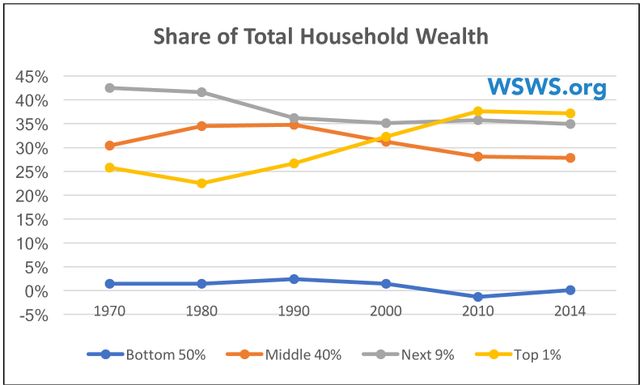
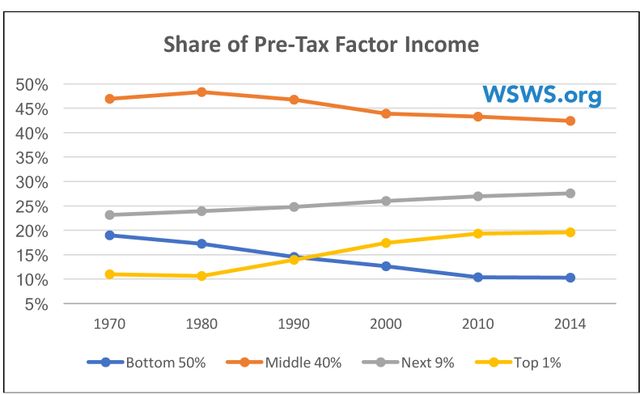
The report documents an immense redistribution of wealth over a period of several decades from the working class to the rich. The bottom 50 percent’s pre-tax share of national income has fallen from 20 percent in 1970 to 12 percent in 2014, while the income share of the top 1 percent has almost doubled to 20 percent. The wealthiest 1 percent now owns over 37 percent of household wealth, while the bottom 50 percent—roughly 160 million people—owns almost nothing, a mere 0.1 percent.
Though the Piketty, Saez and Zucman report focuses on the top 1 percent, the underlying data sheds light on another phenomenon that is essential to understanding American society: the role of the 9 percent of the population that falls below the 1 percent (the “next 9 percent”). This layer consists, broadly speaking, of more affluent sections of the middle class.
Among the pseudo-left organizations that orbit the Democratic Party, it has become popular to refer to the need to build a “party of the 99 percent.”
The call for a party of the 99 percent conflates the interests of the 9 percent of the population that falls just below the top 1 percent with those of the bottom 90 percent. In fact, a chasm separates these two social layers. The World Socialist Web Site has defined the pseudo-left as denoting “political parties, organizations and theoretical/ideological tendencies which utilize populist slogans and democratic phrases to promote the socioeconomic interests of privileged and affluent strata of the middle class.”

The material position of the next 9 percent

The next 9 percent is comprised of privileged individuals who possess net wealth of between $1 million and $8 million and whose household incomes are between $155,000 and $430,000. They are business executives, academics, successful attorneys, professionals, trade union executives and trust fund beneficiaries. Their social grievances are the product of their privileged position. In every index of quality of life—access to health care, life expectancy, water and air quality, housing and home location, college degrees, vacation time, etc.—they live a different existence from the bottom 90 percent.
Data from the UC Berkeley report shows that the next 9 percent owns more wealth than the bottom 90 percent combined. The next 9 percent’s share of national income increased from 23.1 percent in 1970 to 27.6 percent in 2014. Over the same period, the national income of the bottom 90 percent decreased from 65.9 percent to 52.8 percent. The share of national income of the bottom 50 percent was cut in half over this period, from 19 percent to 10.3 percent. (These figures refer to “pre-tax factor income,” defined as the sum of all income flows before pensions, taxes and transfers. These are the only value sets for which data on the next 9 percent is available.)
In terms of net wealth (that is, total possessions, as opposed to annual income), the next 9 percent has also seen an increase since 1970. However, its share of household wealth is declining, but that is due entirely to the immensity of the increase in the share going to the top 1 percent. The share of household wealth of the next 9 percent has declined from 42.5 percent in 1970 to 34.9 percent today. Over this same period, the share of household wealth of the top 1 percent has increased from 22.5 percent to 37.2 percent. The bottom 90 percent’s share of wealth has declined to just over one quarter.
The next 9 percent acquires its wealth in a manner that increasingly parallels the parasitic and speculative methods of the top 1 percent. From 1970 to 2014, the next 9 percent’s share of total fiscal income increased from 24 percent to 28.6 percent.
This increase parallels the financialization of the top 1 percent’s earnings profile (though at a slower rate), but contrasts with the bottom 90 percent, which relies less and less on stocks and capital gains. While the top 1 percent owns about 40 percent of all stock, about 70 percent is owned by the top 5 percent. In contrast, 53 percent of households own no stock.

The economic foundation of pseudo-left politics

The political outlook of the next 9 percent is based on this economic reality. In aggregate, this social layer owes its position to rising share values, the exploitation of the working class and the dominant global position of American capitalism. At the same time, it regards the 1 percent as having acquired an unfair portion of the spoils. The ideology and politics of the next 9 percent dominate at the universities, where many members of this social layer serve as professors, administrators and department heads.
The extent of the chasm separating the bottom 90 percent from the top 10 percent endows the next 9 percent’s struggle for privilege with a ferocious character. Figures from prior studies show that in the United States, the gross income of a member of the 90th percentile (i.e., the lowest end of the next 9 percent group) is nearly 60 percent higher than a member of the 50th percentile. The gap in terms of net wealth is much higher. The margin in the United States has expanded significantly in recent decades and far outpaces similar statistics in other advanced countries.
Brookings Senior Fellow Richard Reeves noted in his September 2015 article titled “The dangerous separation of the American upper middle class”:
“The American upper middle class is separating, slowly but surely, from the rest of society… For many, the most attractive class dividing line is the one between those at the very, very top and everybody else. It is true that the top 1 percent is pulling away very dramatically from the bottom 99 percent. But the top 1 percent is by definition a small group. It is not plausible to claim that the individual or family in the 95th or 99th percentile is in any way part of mainstream America.” Two further studies co-authored by Reeves provide insight into how this social distance has produced a high degree of social anxiety among the privileged next 9 percent:
“America is becoming a more class-stratified society… This separation of the upper middle class by income, wealth, occupation and neighborhood has created a social distance between those of us who have been prospering in recent decades, and those who are feeling left behind, angry and resentful, and more likely to vote for To-Hell-With-Them-All populist politicians,” one report notes.
Another study titled “Why rich parents are terrified their kids will fall into the ‘middle class’” explains: “As the income gap has widened at the top, the consequences of falling out of the upper middle class have worsened. So the incentives of the upper middle class to keep themselves, and their children, up at the top have strengthened.”

Identity politics and the next 9 percent

In the face of these powerful pressures, identity politics becomes an important mechanism for increasing status and financial position.
The main impact of racial politics, including affirmative action, has been the elevation of a small layer of minority groups into the next 9 percent and the top 1 percent. A study from the Pew Research Center showed that from 2005 to 2009, the share of total wealth held by the top 10 percent of households among different racial groups increased drastically across races. The concentration of wealth is most acute among Hispanics, where the share of wealth controlled by the top 10 percent rose from 56 percent to 72 percent over this period, and among blacks, where the figure rose from 59 percent to 67 percent.
The Piketty, Saez and Zucman report also shows that among the top 10 percent, the share of women has risen steadily over the past four decades to roughly 27 percent. But women make up only about 16 percent of the employed population in the top 1 percent. Among the most affluent, the authors write, “the glass ceiling is not yet close to being shattered.” This helps explain why women in the next 9 percent saw Hillary Clinton’s pro-war, pro-Wall Street presidential campaign as a vehicle for advancing their own struggle for wealth and privilege.

The party of the 99 percent vs. socialism

The pseudo-left opposes any politics based on an analysis of economic class. This is the political basis for the call by pseudo-left organizations for a “party of the 99 percent.” Socialist Alternative, for example, has called for the building of a “multi-class” party. It published an article in the aftermath of the US presidential election titled “We need mass resistance to Trump and a new party of the 99 percent,” which read: “We must start today to build a genuine political alternative for the 99 percent against both corporate dominated parties and the right so that in 2020 we will not go through this disaster again.”
The International Socialist Organization (ISO) has also called for “a mass, left alternative” comprised of “unions, movements and left parties.” It regularly advances the slogan of the “99 percent,” writing in 2014: “[W]e need a new party for the 99 Percent to confront the two parties of the 1 percent.” Other pseudo-left groups and publications like Jacobin and New Politics have echoed these slogans.
The use of this language is not accidental. The pseudo-left’s call for a “party of the 99 percent” serves two interrelated purposes.
First, the pseudo-left is seeking to subordinate the working class to the interests and grievances of the most affluent sections of the middle class, closest to the bourgeoisie. They are opposed to a socialist reorganization of society and even any measures that would significantly impact the distribution of wealth. Second, by employing empty “left” phraseology devoid of class content, the next 9 percent attempts to politically disarm the working class and channel social opposition behind the Democratic Party.
The pseudo-left’s orientation toward the Democratic Party is an essential component of its fight to advance its social interests. The Democratic Party is receptive to the use of race, gender and sexual orientation because it has rejected any program of social reform and instead appeals to the roughly 21 million people who comprise the next 9 percent as the constituency for a broader base. 
Clearly, the vast majority of the population does not have the same economic interests as those whose net worth is over $1 million. The wealthiest 10 percent has acquired its wealth through the exploitation of the working class in the US and internationally. Vast levels of social inequality are not the product of an accidental process, but of definite policies implemented by both the Democratic and Republican parties and by their bourgeois counterparts around the world. Private profit is the product of the exploitation of the working class, and this is the rule under capitalism.
Extreme social polarization is an international phenomenon. A report published January 16 by Oxfam shows that eight billionaires own the same amount of wealth as the poorest half of the world’s population, some 3.6 billion people. The wealthiest 1 percent own more wealth than the bottom 99 percent combined. A November 2016 Credit Suisse report showed that the top 10 percent controlled 89 percent of international wealth.
The class analysis made here with regard to the “party of the 99 percent” applies to similar populist appeals by the pseudo-left in countries all over the world.
The working class comprises the vast majority of the world’s 7 billion inhabitants and produces all of the world’s wealth. It possesses immense potential power. But it can advance its own interests only if it is armed with an anticapitalist and socialist program based on the class struggle. In advancing the slogan for a party of the 99 percent, the pseudo-left is perpetrating a fraud aimed at preventing the development of such a struggle and preserving the capitalist system.

Donald Trump's Counter-Terrorism Policy

Angshuman Choudhury & Husanjot Chahal


US President-elect Donald Trump proposed counter-terrorism (CT) policy is as vociferous in its tone as it is imprecise in its content. On this, Trump’s orientation and preferences can be drawn from his own statements and those of his emerging advisory-ministerial council on security and defence. So far, Trump's CT agenda appears to be an amorphous assortment of politico-military choices: tough border controls, affirmative community action, hard military offensives, multilateral security cooperation and an ideologically-framed war.
On a macro level, Trump's CT agenda rests on the singular idea of fighting “radical Islamic terrorism,” which he often uses interchangeably with 'Radical Islam'. In doing so, he directly analogises the proposed fight against ‘Radical Islam’ with the US’ global fight against communism during the Cold War.
While this outlook marks a discursive departure from the Bush administration's broad-spectrum 'War on Terror' and the Obama administration's war on specific terror groups, the particulars of Trump's plan bear strong elements of continuity. A closer look at his CT policy for home and overseas is in order.

COUNTERING TERRORISM AT HOME
In keeping with his ideological frame, and manifest through his rhetoric, Donald Trump has been offering a variety of suggestions to counter terrorism on US soil. Many of his ideas are neither new nor are they likely to represent a break from existing practices. They are however embedded in ill-defined logic and inconsistent statements.
ImmigrationOne of Trump's most widely discussed proposals was on restricting immigration. By linking past terror attacks on US soil to Muslim immigrants, Trump has called for new screening procedures that involve Cold War era-type ideological testing, extreme vetting, and even temporary suspension of immigration from the most “dangerous and volatile regions of the world.”
While these seem to indicate dramatic changes under the new government, not much is expected to change on the ground. To begin with, a host of ideological restrictions on entering or remaining in the US already exist. Even if the administration does manage to bring in new kinds of ideological questions, to what extent they would make a difference is debatable. For instance, few immigrants were actually barred from the US because of ideological screening, even at the height of fears over Communism. Additionally, with US visa and refugee application procedures already facing intense scrutiny, what comprises ‘extreme vetting’ remains to be seen. Even the idea of “dangerous and volatile regions” is vague and impractical.
Quantitatively speaking, if Trump’s recent stance on immigration is weighed against Obama’s deportation record , the numbers are not any different. The president-elect recently indicated that he would deport about 2 to 3 million undocumented refugees with criminal records, which is roughly similar to President Obama’s 2.7 million deportations. Additionally, the US Department of Homeland Security's (DHS) immigration enforcement priorities target national security threats, those with criminal records, and recent arrivals, for removal – a focus shared by the Trump administration. A shift from these vital activities is unlikely.
Commission on Radical IslamIn his August 2016 speech, Trump said that warning signs before a terror attack “were ignored because political correctness has replaced common sense in society.” As a measure, he has proposed to establish a Commission on Radical Islam, comprising of “reformist voices from the Muslim community” to “build bridges and erase divisions.” The Commission’s goal will be to “explain the core convictions and beliefs of Radical Islam, identify warning signs of radicalisation, and expose networks in society that support radicalisation.”
What Trump appears to propose is to directly outsource the work that various agencies within the US government are already pursuing under the Countering Violent Extremism (CVE) policy, to the American Muslim community. However, the Commission’s raison d’être overestimates the nexus between community centres and violent extremism, assuming these centres to be primary sources of radicalisation. This linkage automatically lays the onus of exposing radicalised individuals on the Muslim community; this not only sows greater distrust in the community, but also negates the fact that a majority of those who have carried out terror activities so far have been radicalised online or in small, cloistered groups, with little contact with the wider community.
In addition to the above are other throwaway remarks by Donald Trump and his transition team, like reinstating the ‘Muslim registry’ (initially hinted as a database of Muslim US citizens). Such an approach risks perpetuating the very problem it sets out to solve - straining the government’s relations with Muslims in the US and alienating instead of building bridges. Additionally, it is fraught with the danger of polarising opinions in the US Muslim community between those in favour and those against the government.
Interrogation TechniquesTrump has often stated his intention of reviving enhanced interrogation techniques (EITs), along with keeping the Guantanamo Bay facility open. This was reinforced by his recent choice for the Central Intelligence Agency (CIA) director, Mike Pompeo, an army veteran who has defended the Bush administration’s interrogation techniques such as waterboarding. Given that CIA chiefs can overturn presidential orders on interrogation techniques in practice, Pompeo’s selection seals Trump’s support on the issue of EITs.
On the other hand, several former and current CIA officials have doubted the efficacy of EITs, indicating that they are futile and have detrimental effects on national security, even drawing a correlation between torture and greater recruitment for extremist groups. Many, including former CIA director Michael Hayden, doubt whether anyone in the agency would volunteer to do it. This, coupled with the legacy of harm left by the controversial treatment of captives, indicates that Trump will find it hard to resume such tactics.
COUNTERING TERRORISM OVERSEAS
Trump's global CT policy is hinged on a much-touted fight against the Islamic State (IS) in Iraq and Syria through a set of strategic choices that are not entirely new. In this, he largely appears to equate 'radical Islamic terrorism' with the IS, a conflicting throwback to Obama's 'group identification' CT doctrine.
Islamic State: The Usual SuspectsThe primary subject of Trump’s proposed overseas CT design is the IS, which he presents as the single greatest threat to the US. He proposes neutralising the group through aggressive “joint and coalition military operations” and degrading its networks of mobilisation, including its cyber channels, through greater international cooperation and intelligence sharing. In this, he plans to collaborate with US allies in the Middle East, particularly Israel, Jordan, and Egypt. He also seeks some degree of cooperation with Russia to defeat the IS in Syria through the pursuit of common objectives.
The above plan mirrors Washington's current set of tactical choices: coalition offensives, strategic collaborations with regional allies, and the pursuit of collaboration with Russia. Having said that, Trump’s anti-IS military blueprint in Iraq-Syria could be more expansive in reach and direct in capacity: more airstrikes, US ground troops in core combat capacities, and force multipliers in offensive modules.
In terms of micro tactics, there is little indication that Trump would veer away from current choices, at least qualitatively: targeted killings through drone strikes, covert offensives in both core and ‘non-battlefield’ theatres (like Yemen and Somalia) through the Joint Special Operations Command (JSOC), and an air campaign against the IS. Even his strategy to bomb IS-controlled oil facilities is no different from the existing tactic of precision strikes against enemy-controlled critical infrastructure.
However, it remains to be seen whether Trump would actually deploy combat troops in Iraq-Syria to fight the IS. Notably, he has highlighted US failure at reaching a Status of Forces (SoF) Agreement with the Iraqi government. He has also argued, obliquely, for wresting control of Iraqi oil assets to accrue economic benefits. If accomplished, these would automatically entail the deployment of US troops, at least in Iraq.
It is too early to conclude if Trump would wholly replace Obama’s 'limited war doctrine' with a broader and more visibly offensive design.
Beyond Islamic StateTrump’s CT plan does not move beyond the Iraq-Syria conflict theatre and the IS as a blanket target. Even then, he is unclear on how to push the organisation back on other active fronts like Afghanistan and Libya. Notably, he has not presented a clear strategic plan to fight the Taliban and Haqqani Network, the anti-US groups operating in the Afghanistan-Pakistan theatre, and the oldest anti-US transnational terror group, al Qaeda.
Although Trump has stated his willingness to retain troops in Afghanistan, it is yet uncertain whether the number would be cut down from the current 8,000.
Trump has now proposed a closer collaboration with NATO, changing his stand from his electoral campaigns. This could mean a substantial degree of US presence in both Iraq and Afghanistan where NATO is engaged in training and capacity-building, and in auxiliary COIN support missions. Such interventionist engagements belie Trump’s vision of retracting US’ longstanding policy of ‘nation-building and regime change’.
The Privy CouncilTrump’s choice of advisors for security-defence hints at certain early presumptions. Both General Michael T Flynn (National Security Advisor) and General James Mattis (Secretary of Defence) come from hard military backgrounds and hold largely similar views on global terrorism. Both have served in forward roles in Iraq and Afghanistan and directly dealt with key groups like al Qaeda and Taliban. Their careers reflect a strong leaning toward aggressive battlefield tactics, both covert and overt.
Flynn, specifically, with his stark views on ‘radical Islam’ and former top role in JSOC, fit well with Trump’s proposed CT meta-narrative and the judgment that the new administration will continue to rely on covert strikes across a broadly defined conflict theatre. Mattis, with his in-depth familiarity of COIN operations in Iraq and Afghanistan, is expected to make up for Trump’s lack of strategy against localised insurgent networks.
CONCLUSION
Under a Trump presidency, a major tactical shift in US' CT policy, either at home or overseas, cannot be rationally anticipated. However, a normative revision of the overall counter-terror discourse appears to be on its way. Despite telling signs of a polarising CT vision that could cause divisions at home and legitimise terror agendas globally, it remains to be seen how the new administration deals with security threats from non-state entities.

17 Jan 2017

DAAD Scholarships For Master Of Research And Public Policy 2017/2018 for African Students

Application Deadline: 20th February, 2017
Offered annually? Yes
Eligible Countries: African countries
To be taken at (country): University of Nairobi; Maseno University; Egerton University; Uganda Christian University; Uganda Martyrs University; University of Dar es Salaam; and Mzumbe University.
About the Award: PASGR invites applications from eligible candidates for the DAAD In-Country/In-Region Scholarships for the MRPP.  The Partnership for African Social and Governance Research (PASGR) is an independent, non-partisan pan-African not-for-profit organisation working to enhance research excellence in governance and public policy that contributes to the overall wellbeing of women and men.
In its Higher Education Programme, PASGR works with twelve universities across seven African countries to implement a collaborative Master of Research and Public Policy (MRPP) programme. Seven of the twelve universities are located in East Africa.
Type: Masters
Eligibility: Eligible candidates must be citizens of a country in sub-Saharan Africa, admitted to study the Master of Research and Public Policy (MRPP) programme at any of the universities listed above. Applicants must hold a Bachelor’s and / or Master’s degree qualification with at least a second class honours upper division from any accredited university. The last university degree must have been completed less than six years ago at the time of application.
Note: Potential candidates who are not enrolled in the programme are advised to contact any of the universities listed above directly for admission first. Prospective students may request admission at a university within or outside their home country.
Female candidates and candidates from less privileged regions or groups as well as candidates with disabilities are especially encouraged to apply.
Number of Awardees: Not specified
Value of Scholarship: The scholarships include tuition fees to the university according to the submitted fees structure, a monthly stipend to cover living costs and accommodation (at DAAD rates), as well as an annual study and research allowance.
Duration of Scholarship: Scholarships are available for up to a maximum of two years. The scholarship will be initially granted for one year and may be extended upon individual request and receipt of a complete application using this form.
How to Apply: 
  1. Fully filled and signed PASGR Scholarship Application Form;
  2. Signed curriculum vitae scanned in PDF. Please use the Europass CV template: http://europass.cedefop.europa.eu
  3. Certified scanned PDF copies of all university degree certificates;
  4. Certified scanned PDF copies of all university transcripts;
  5. Proof of admission to the Master of Research and Public Policy, which may be a temporary admission letter including fee structure of the course (scanned PDF copy);
  6. Letter of motivation (maximum 2 pages in PDF); and,
  7. Academic reference from senior lecturer and proof of employment if applicable (scanned PDF copy).
A complete application form must be sent to PASGR – scholarships@pasgr.org – together with all the application documents listed above by Monday, February 20, 2017 at 1700hrs.
Award Provider: Partnership for African Social and Governance Research, DAAD

KAAD Germany Research Fellowship Programme (and Masters) for Developing Countries 2017/2018

Application Deadline: 30th June 2017 for the September academic session.
Offered annually? Yes
Eligible Countries: Countries in Africa, Asia, the Middle East or Latin America. Countries in Africa include: Ghana, Ethiopia, Zimbabwe and Kenya.
To be taken at (country): Germany.  There is also the possibility for Master-scholarships at local universities.
Eligible Field of Study: There is no specific subject-preference. However, the selection board has often given preference to courses and subjects that they felt to be of significance for the home country of the applicant. This holds true especially for subjects of PhD-theses. There is therefore a certain leaning towards “development oriented” studies – this does however not mean that other fields (cultural, philosophic, linguistic, etc.) can not be of significance for a country and are ruled out.
About the Award: The KAAD Scholarship Program is addressed to post-graduates and to academics living in their home countries who already gained professional experience and who are interested in postgraduate studies (or research stays) in Germany. This program is administered by regional partner committees, staffed by university professors and church representatives. Normally documents are submitted to the committee of the applicant’s home country.
Type: Postgraduate(Masters and PhD) scholarship
Eligibility: To be eligible,candidates must:
  • come from a developing or emerging country in Africa, Asia, the Middle East or Latin America and are currently living there
  • have a university degree and professional experience from their home country
  • want to acquire a master’s degree or a PhD at a German university or do a post-doctoral research project (2-6 months for established university lecturers) at a German university
  • be Catholic Christian (or generally belong to a Christian denomination). Candidates from other religions can apply if they are proposed by Catholic partners and can prove their commitment to interreligious dialogue
  • possess German language skills before starting the studies (KAAD can provide a language course of max. 6 months in Germany)
Selection Criteria: 
  • KAAD’s mission is to give scholarships mainly to lay members of the Catholic Church. This means, that – There is a preference for Catholic applicants.
  • However, among the scholars, there is a limited number of: Protestant Christians, Orthodox Christians (especially from Ethiopia)and Muslims.
  • Catholic priests and religious people are eligible only in very rare cases.
Expectations from KAAD: 
  • Above-average performance in studies and research
  • The orientation of your studies or research towards permanent reintegration in your home region (otherwise the scholarship is turned into a loan),
  • Religious and social commitment (activities) and willingness to inter-religious dialogue.
Number of Awardees: Not specified
Value of Scholarship: Not stated
Duration of Scholarship: Duration of research
How to Apply: Interested graduates can fill an online questionnaire, which they find on the application webpage www.kaad-application.de. For detailed information about application requirements and procedures, we recommend to read the FAQs.
Award Provider: Katholischer Akademischer Ausländer-Dienst, Germany