31 Jan 2017

Protests in Mexico continue against gas price hike, water privatization

Clodomiro Puentes

The gasolinazo protests, which erupted in Mexico early this month over the slashing of gasoline subsidies, continue throughout the country. In Baja California, these protests have coincided with enormous social anger over PAN (National Action Party) state Governor Francisco Vega’s attempt to ram through legislation that would privatize water services and implement severe rate increases, a measure backed by the ostensibly “center-left” PRD (Party of the Democratic Revolution) and Movimiento Ciudadano (Citizens’ Movement).
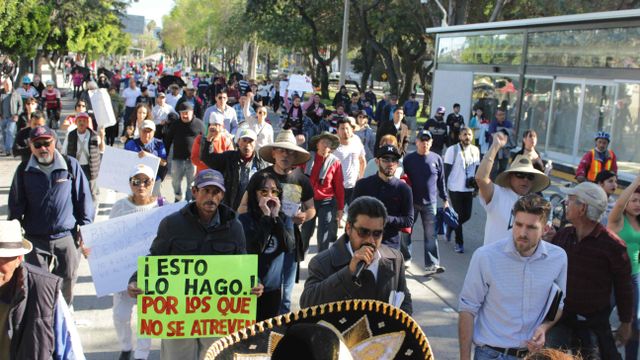
Protesters marching in Tijuana
On January 22, protests were coordinated across the country. In Tijuana, some 18,000 protesters gathered at the city’s Monumento a Cuauhtémoc roundabout in one of the main arteries of the downtown district and marched to the town hall. In Mexicali’s town hall, over 20,000 protesters convened. At these protests, the calls for the resignation of Governor Vega were added to the national calls for the resignation of President Enrique Peña Nieto.
The immense anger set off by the efforts to subordinate to private profit such a basic social right as access to water, forced Vega to repeal the measure earlier this month. The most extreme proposed rate hikes were in Tijuana, where the minimum rate of 59.1 pesos per cubic meter would have been raised to 99.5 pesos, and in Playas de Rosarito, from 81.2 to 99 pesos. In addition, the bill would have allowed private water concerns to cut off service for non-payment after 90 days, a measure which is deemed unconstitutional. Even at present prices, urban residential rates in Tijuana currently exceed those for similar services across the border in San Diego.
In spite of the repeal, the protests against the state government continue, alongside the ongoing protests throughout a country beset by inflation and a chronically underperforming economy, whose future looks increasingly uncertain with the election of Donald Trump.
Since coming to power, Trump has demanded that Mexico pay $12 to $15 billion for a border wall and has threatened trade war through the renegotiation of the North American Free Trade Agreement. The Mexican peso has lost approximately 13 percent of its value in relation to the dollar, while the cost of gasoline is expected to rise by 14 to 20 percent in the next year, driving up prices of all commodities and further straining the ability of working families to pay for basic necessities. Mexican President Peña Nieto’s politically-calculated cancellation of a planned meeting with Trump will do nothing to resolve the Mexican government’s state of crisis, with the president’s approval rating hanging precariously just above the single digits.
Members of the Socialist Equality Party and the International Youth and Students for Social Equality intervened at continuing protests this past Sunday to speak with those attending about social and political conditions in Mexico, the significance of a Trump presidency and the need for a socialist program which insists on the international unity of the working class.
Protesters chanted “Fuera Peña, fuera Kiko! (“Out with Peña, out with Kiko!”—the latter referring to the Baja California state governor) and carried signs expressing their outrage over not only the gasolinazo and the attempt at water privatization, but a range of long-standing grievances, including the counter-reforms aimed at the Mexican Social Security Institute (IMSS), the disappearances of many individuals in the state and of the 43 students who were kidnapped by the government in Iguala in 2014.
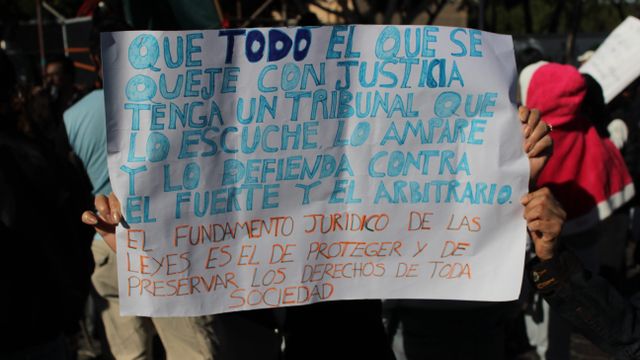
A placard held by a protester which reads: “Let all with a rightful grievance have a court that will hear, protect and defend them against the strong and the arbitrary. The juridical foundation of laws is to protect and preserve the rights of all of society.”
About 400 people attended the protest. A truck equipped with speakers and a microphone led the march through the city as angry citizens denounced the government. Professor Juan Ramirez, a member of the “non-party” political organization Ciudadanos Unidos de Tijuana, which has played a role in organizing the demonstrations over the past month, was the main speaker during the march. His remarks consisted mostly of the narrowest of demands to the municipal government.
That the protest’s final destination was an empty city hall seemed to symbolize the ruling elite’s indifference to the needs and aspirations of the masses of working people, and the dead-end protest perspective of the Ciudadanos Unidos de Tijuana leadership. Among those who joined in the demonstration, however, many were looking for a way to fight the government and the deteriorating social conditions in Mexico.
“I’m very pleased that people are protesting, it’s good to see Mexicans waking up,” said Lorena. “This protest shows that we won’t stand for privatizing water or paying 18 pesos more for a liter of gasoline.
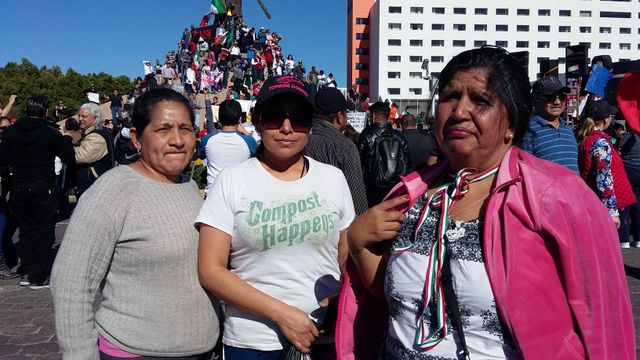
Lorena
“I don’t feel that working people are represented. They’re all equally dishonest—neither PRI, nor PAN, nor PRD; they’re all the same, corrupt, enriching themselves off of the people, and never following through with what they promise. I’ve voted for the PRI for 25 years, but with everything that’s going on, I’ve had it.”
While expressing hopes that a party like Morena (the National Regeneration Party headed by Andrés Manuel López Obrador-AMLO) might offer some sort of alternative, she noted that figures such as AMLO were cut from the same cloth as the rest of the political establishment. “It’s true, even the ones claiming to be outsiders are all from the same group as the rest. They haven’t been in power yet, so we’ll have to see how it plays out.”

Miguel
“It’s important that we’re here to defend the Constitution, which the water law would’ve gone against. We need a solution to the political parties that we have now, which only exist to benefit wealthy classes,” said Miguel, one of the protesters. “I wish that the media would cover these protests more extensively, and tell the truth about them. Too often, they attempt to portray us as just rabble rousers with nothing to do. That’s obviously not true, we’re here peacefully.”
Alicia, a domestic worker, said, “There could be a danger that this gets derailed. What we have now is a government that only represents the wealthy, the millionaires. It makes no sense that we have one of the richest people in the world, Carlos Slim, and yet we have a minimum wage of 80 pesos a day. That doesn’t cover anything, and the price of just about everything keeps increasing.”
Members of the Socialist Equality Party were able to address the assembled crowd, emphasizing the international dimension of the struggle facing workers, and the consequent need to unite Mexican and US workers across the border that divides them.
“We have to unite [internationally], and we have to be very conscious of which Mexico we’re talking about—the Mexico of workers. Long live the international working class!” said one SEP speaker. These remarks were met with shouts of “Viva!” and applause, with many in the crowd asking for leaflets and information.
The protests express a growing popular awareness that the whole of the Mexican political establishment is fundamentally hostile to the needs of the masses of working people. What is lacking, however, is a conscious revolutionary leadership in the working class, raising the danger that the protests will dissipate mounting anger behind one or another wing of the bourgeois political establishment. What is urgently required is the building of a section of the International Committee of the Fourth International in Mexico to link the struggles of working people across North America on the basis of a program of international socialism.

Six killed in terror attack on Quebec City mosque

Keith Jones

Six Muslim Canadians, all of North or West African origin, were killed and another 19 persons wounded, five of them gravely, by a masked gunman who assaulted a Quebec City mosque during evening prayers Sunday.
Yesterday afternoon, Alexandre Bissonnette, a 27-year-old Laval University student, was charged with six counts of first-degree murder and five of attempted murder during a brief court appearance.
Shortly after the mosque slaughter, Bissonnette contacted police and subsequently surrendered to them on a Quebec City bridge. An AK-47 and two handguns were found in his car.
Initially, police took a second person into custody in the vicinity of the Islamic Cultural Center of Quebec, the scene of the shooting. But later they conceded this was a case of mistaken identity and said they now believe Bissonnette acted alone.
Sunday’s attack was a heinous crime. The target of the attack and the profile of the presumed killer leave little doubt it was a political attack, motivated by Islamophobia and other extreme right-wing views.
Shortly after media began posting a photo of Bissonnette, a leader of a Quebec City group dedicated to helping Syrian refugees told reporters he was known to them for spouting anti-immigrant views. François Deschamps of “Bienvenue aux réfugiés” (Welcome to Refugees) said Bissonnette also routinely railed again feminists in his online posts.
According to the Montreal daily La Presse, Bissonnette’s Facebook page, which has now been taken off line, had hyperlinks to the National Front, the French neo-fascist party led by Marine Le Pen.
Global News said Bissonnette’s Facebook “likes” also included US President Donald Trump, the Israeli Defense Forces, and Christopher Hitchens, the British writer who became a propagandist for the illegal 2003 US invasion of Iraq and Washington’s phony “war on terror.”
Witnesses say that when Bissonnette opened fire on them, he screamed “Allahu Akbar!” in a thick French- Québécois accent.
Soon after the media reported the attack, Canadian authorities, beginning with Prime Minster Justin Trudeau and Quebec Premier Philippe Couillard, denounced it as an act of terrorism.
Quebec City media reports suggest Bissonnette is a psychologically troubled individual. Even if, as is likely, this is true, Sunday’s mass killing cannot be separated from the noxious political and social environment that has been created by North America’s governments and capitalist elite through their wars of aggression, gutting of democratic rights, and promotion of reaction, including anti-Muslim bigotry.
Since Friday, news reports around the world have been dominated by the fallout from and reaction to US President Donald Trump’s antidemocratic and patently discriminatory executive order barring refugees, visitors, and US permanent residents from seven predominantly Muslim countries from entering the US. All these countries—Iran, Iraq, Libya, Somalia, Sudan, Syria, and Yemen—have been the target of US aggression, either in the form of “regime change” wars, drone strikes or punishing economic sanctions.
Trump has systematically stoked anti-Muslim prejudice since he launched his bid for the Republican Party presidential nomination. This is exemplified by his naming of Stephen Bannon, the former Goldman-Sachs executive who made Breitbart News into a sounding board for the fascistic alt-right, as his “chief strategist.”
On Monday, White House spokesman Sean Spicer made a show of condemning the Quebec City attack “in the strongest possible terms.” But he did not mention that its target was a mosque or that its victims were Muslims. Without losing a beat, Spicer then brazenly sought to invoke the murders perpetrated by a sympathizer of the ultra-right as an argument for the Trump administration’s persecution of Muslims and immigrants. “It’s a terrible reminder,” said Spicer, “of why we must remain vigilant and why the president is taking steps to be proactive and not reactive on issues of national security.”
Like the Democratic Party in the US, Canada’s elite claims to be appalled by Trump’s anti-Muslim bigotry. But since 2001 it has promoted the false “war on terror” narrative, joining both parties of US big business in exploiting the atrocities committed by Islamist terrorists—often thanks to unexplained intelligence lapses—to legitimize militarism and war and sweeping attacks on democratic rights, while feeding anti-Muslim prejudice.
Stephen Harper and his Conservatives sought re-election as Canada’s government in the fall of 2015 with crude Islamophobic appeals, claiming Canada was at war with “Islamist terror” and promising to set up a snitch line so Canadians could denounce the “barbaric cultural practices” of their immigrant neighbours.
This was the culmination of a year-long campaign in which Canada’s ruling elite had rallied round the Harper Conservative government in using the deaths of two military personnel at the hands of psychologically troubled, recent Canadian-born converts to Islam to promote reaction at home and abroad. This included expanding Canada’s participation in the US war in Iraq and Syria—a war that arises directly from Washington’s previous ruinous Mideast wars, and like them is aimed at strengthening US hegemony over the world’s most important oil-exporting region. It also involved the ramming through, with the support of the opposition Liberals, legislation giving the national-security apparatus police-state powers (Bill C-51).
As for Trudeau—the politician who is being touted by the New York Times and the British Guardian as the new poster boy for international liberalism—he has been assiduously courting Trump ever since his election last November.
Trudeau’s Liberal government is in talks with top Trump officials to expand Canada’s already extensive participation in America’s military-strategic offenses in the Mideast and against Russia and China. It has also signalled that it is ready to throw Mexico to the wolves and support Trump in scuttling NAFTA, so long as Canadian big business keeps it privileged access to US markets.
Apart from one tweet Saturday declaring “Canadians will welcome” refugees, Trudeau has refrained from criticizing Trump’s trampling on democratic rights and steps to militarize the Mexican border, let alone his aggressive America First protectionist policies and plans to massively hike US military spending.
This is because Canada’s ruling elite views it as essential to asserting its own predatory imperialist interests that Canada be, as the Globe and Mail put it recently, behind Trump’s “walls”—that is, a partner in a “Fortress North America.”
Canada’s liberal media, like that in the US, systematically lies about the extreme right-wing forces, including Islamist terrorists, that Washington and its Canadian allies use on the world stage.
How many Canadians, for example, know that Canadian Armed Forces personnel who participated in NATO’s regime war in Libya referred to themselves as “Al Qaeda’s air force”?
While the entire Canadian ruling elite is complicit in the promotion of anti-Muslim bigotry and reaction, it is not mere chance that Quebec was the site of Canada’s first lethal attack on a mosque.
All sections of Quebec’s political establishment, including the pseudo-left Québec Solidaire, have legitimized a reactionary campaign gotten up by the right-wing tabloid press that claims immigrants and religious minorities are threatening Quebec’s values.
Muslims have been the principal target of this campaign.
Currently, the Quebec Liberal government has legislation before the provincial legislature that would ban Muslim women wearing religious face coverings from receiving public services, including education and health care, except in emergencies.
When it held office for 18 months in 2012-14, the trade union-supported, pro-Quebec independence Parti Quebecois sought to enact a Charter of Quebec Values under which public sector workers would have been threatened with the loss of their jobs if their wore a Muslim hijab, Sikh turban, Jewish kipah, or other “ostentatious” religious symbols. Underscoring the chauvinist character of this legislation, an exception was provided for “discreet” crucifixes.
The PQ’s new leader, Jean-François Lisée, has suggested it should be illegal for Muslim women to wear the niqab or burqa in public in Quebec because an AK-47 could be hidden under it.
As for the right-wing mayor of Quebec City, Régis Labeaume, he has at most issued pro forma condemnations, despite repeated acts of vandalisms at the city’s four mosques, while repeatedly suggesting refugees could constitute a terrorist threat.
In Quebec and Canada, as around the world, the ruling class is promoting anti-immigrant and anti-minority chauvinism so as to split the working class.
There is mass revulsion in Quebec and across Canada at Sunday’s horrific events. Trudeau, Couillard and the entire establishment are trying to manipulate these sentiments through hypocritical calls for unity and solidarity. These are aimed at suppressing any discussion of the real causes of the tragedy at the Islamic Cultural Center of Quebec.
A crisis-ridden, ever-more socially polarized and militarized capitalist society is dredging up all manner of reaction.
The defence of democratic rights requires the development of an independent movement of the working class against war and social inequality based on an unequivocally anti-capitalist and internationalist program.

Trump executive order vows elimination of government regulations

Nick Barrickman

On Monday, President Trump signed an executive order mandating that “for every one new regulation issued, at least two prior regulations be identified for elimination.” Trump declared the measure to be “the largest ever cut by far in terms of regulations,” adding, “If you have a regulation you want, number one we’re not going to approve it because it’s already been approved probably in 17 different forms.”
“Government regulation has actually been horrible for big business, but it’s been worse for small business,” Trump said, posturing as a friend to workers and small business owners. In addition to excoriating supposedly unnecessary regulations, the president stated that the order “goes way beyond that,” adding that the slate of minor regulations passed in the wake of the 2008 financial crisis, most notably the 2010 Dodd-Frank Act, were a “disaster.” Trump declared that his administration would do “a big number” on that legislation, without specifying what.
The “one in, two out” regulatory rule would mandate that for every new federal regulation introduced, two others must be singled out for elimination. In addition, the text of the order declares that for fiscal year 2017, “the total incremental cost of all new regulations, including repealed regulations … shall be no greater than zero.”
Business lobbyists lauded the action, with Jaunita Duggan, president of the National Federation of Independent Business, stating “[The] president’s order is a good first step on the long road toward eliminating ball-and-chain regulations so small businesses can create jobs and expand the economy.” Republican Speaker of the House Paul Ryan responded to the executive order by declaring, “President Trump’s executive order helps bring the nation’s regulatory regime into the 21st century by putting regulators on a budget, and addressing the costs agencies can impose each year.”
Trump sought to present the executive order as the fulfillment of campaign promises to do away with regulations which were supposedly “killing” American businesses. However, rather than supporting the interests of small businesses, Trump’s new rule would continue the consolidation of big business’s domination over American society, including the bankrupting of small businesses, while facilitating the exploitation of workers and the environment.
Elaborating on the administration’s intentions at a White House press briefing Monday, Press Secretary Sean Spicer noted that the goal of the administration would be to “unleash the American economy,” adding that Trump was focusing on “the energy sector, how to unleash America’s natural resources.”
The executive order comes on the heels of Trump’s meeting last week with manufacturing industry executives, where the president promised to eliminate “75 percent” of industrial regulations. In particular, Trump has been focused on environmental regulations which have placed higher fuel efficiency requirements on vehicles produced in the US.
Members of the scientific community expressed horror at the arbitrary measure. Ken Kimmell, president of the Union of Concerned Scientists, told the Washington Post the executive order was “absurd, imposing a Sophie’s Choice on federal agencies.”
“If, for example, the Environmental Protection Agency wants to issue a new rule to protect kids from mercury exposure, will it need to get rid of two other science-based rules, such as limiting lead in drinking water and cutting pollution from school buses?” Kimmell asked. The scientist asserted that Trump’s order was “likely illegal,” declaring, “Congress has not called upon EPA to choose between clean air and clean water, and the president cannot do this by executive fiat.”
Trump’s executive order would concentrate power in the hands of the Director of the Office of Management and Budget (OMB), whose agency is charged with overseeing federal regulations. Trump’s nomination for OMB director, Republican Congressman Mick Mulvaney, is an adamant opponent of federal spending.
According to the New York Times, “Within the Trump team, the views of Representative Mick Mulvaney... rank as among the most reactionary.” Mulvaney, who according to the Times possesses “an almost perfect conservative voting record,” has spent his six-year congressional career opposing disaster relief for victims of Hurricane Sandy as well as backing the 2013 government shutdown, which was instigated by right-wing Republicans in an effort to force the adoption of austerity measures.
Mulvaney is a proponent of ending government-provided health care, having declared that “[we] have to end Medicare as we know it” in 2011 while being interviewed on the Fox Business Network.
The onslaught against federal regulation comes as Trump’s nominees for cabinet secretaries continue to be placed at the head of departments of which they have a record of opposition. Scott Pruitt, Trump’s nominee for the Environmental Protection Agency, has a long career of leading lawsuits against the agency on behalf of the energy industry.
Myron Ebell, who led Trump’s EPA transition team, declared in a recent interview with the Washington Post that his prescription for the EPA would see the elimination of 5,000 employees and the halving of the agency’s $8.1 billion budget. “My own personal view is that the EPA would be better served if it were a much leaner organization that had substantial cuts,” stated Ebell in an interview to the Post .
The Senate Environment and Public Works Committee is scheduled to vote on Pruitt’s nomination on Wednesday. In addition, Rex Tillerson, former CEO of Exxon and Trump’s pick for Secretary of State and Treasury Secretary nominee Steve Mnuchin are set to receive committee votes this week. All three nominations would then proceed to the Senate floor for confirmation by the full Senate, where Republicans hold a narrow 52-48 edge.
Mnuchin’s vote was originally scheduled for Monday, but was postponed as Senate Democrats delayed the hearing in order to attend a candlelight vigil opposing Trump’s executive order which bans visitors from seven predominantly Muslim countries.

India: Acting East after the End of the TPP

Roshan Iyer


As the new US President Donald Trump signed his first set of executive orders on 23 January 2017, the world heard the final nail in (at least this iteration of) the Trans Pacific Partnership’s (TPP) coffin.
The proposed TPP would have linked 40 per cent of the global economy and revolutionised global value chains. This vacuum in the world economy may now purportedly be filled by China. However, this also provides an opportune moment for India to engage with Asia and fill a part of that space through its Act East Policy and engaging with Southeast Asia through the Regional Comprehensive Economic Partnership (RCEP) - a trade deal between the 10 ASEAN nations and the nations that have existing FTAs with the grouping.

Significance of the TPP’s Death
With the rejection of the TPP officially in place, doubts have arisen about the credibility of the US’s Pivot to Asia. Some also feel that this finally heralds the rise of China as the global economic leader. While a conservative US has always been alarmist when it comes to China, the situation might not be as dire as it has been made to be. China still has a long way to go before implementing any of its own initiatives on a trans-continental level.
 
Critics of the TPP targeted its opaque negotiation process and argued that it was created purely for the benefit of large corporations. It also faced criticism for its investor-state dispute settlement mechanism (ISDSM), which would have enabled foreign corporations to sue governments if the former felt that terms of its contracts were being violated by the latter. Meanwhile, the RCEP does not address certain issues like protections for labour and the environment which the TPP had attempted to. The RCEP also lacks an ISDSM, limiting the power that foreign investors hold in a host country (albeit this has not yet been finalised). These make the RCEP more palatable to developing countries.
 
At present, the death of the TPP has breathed new life into the RCEP. This partnership offers India the unique opportunity of engaging directly with China on this multilateral forum to push forward an agenda (that is acceptable to India) for greater regional trade integration.
 
Potential of the RCEP
Originally introduced at a 2011 ASEAN conference as an alternative to the TPP, the RCEP comprises 25 per cent of the global economy. The agreement promises to provide a basis for more open trade and investment in the region while also avoiding the hassle of multiple bilateral arrangements that currently exist between the RCEP countries. Simultaneously, the RCEP is an ASEAN-led agreement, i.e. in principle, both Beijing and New Delhi have an equal platform within the arrangement.
 
Although this grouping holds the potential to be a major trade bloc and possibly even the third pillar in the global economy (like the EU or the North American Free Trade Agreement), India is at loggerheads with the other RCEP nations over certain tariff and liberalisation related matters. Previously, India had proposed a three-tier tariff reduction plan based on its existing Free Trade Agreements, proposing 80 per cent tariff cuts to the 10 ASEAN countries; 65 per cent cuts to South Korea and Japan; and 42.5 per cent cuts to China, Australia and New Zealand. The plan was unilaterally rejected by the RCEP members, a decision that India accepted allowing for negotiations to continue. This worked out well as the RCEP members eventually agreed to include services and investments liberalisation in the negotiation agenda.
 
Previously, services and investments liberalisation found little support as structural disparities between the service and investment sectors of the RCEP countries (especially within the Singapore-led ASEAN grouping) had previously prevented them from negotiating the idea of bringing about a uniform policy in these sectors. However, India used the potential of access to its market as leverage to build a consensus on services and investments liberalisation. This demonstrated India’s considerable sway within the partnership. India requires liberalisation in these sectors to enable its service exports (which are highly competitive and profitable) to the region.

What Next?
At present, the RCEP is still in the negotiating process, with the 16th round scheduled to be held in Indonesia in December 2017. India’s negotiation appears to be heading in the right direction with its focus on services and investment. If the liberalisation of these sectors is implemented in full, India stands to gain the most and must hence work to capitalise those markets in the RCEP countries.
 
However, India must balance the pressure to reduce its own tariffs so that the country’s farmers and low-income manufacturing sector labourers are insulated from the substantial social cost this might have on them. It would be prudent for the Indian government to hold more consultations with the various farmers groups, industry associations, and labour unions to develop an optimal liberalisation plan for the country.
 
On a geopolitical level, the RCEP creates a Southeast Asia-centric economic system that aligns with India’s Act East Policy. The partnership would also work to exclude Trump’s US from the regional Asian economy, reducing the blowback from the US’ withdrawal from the global economy. India must use this window of opportunity to its greatest advantage. Its massive market is extremely attractive to other countries but this is only an asset if India is able to strategically leverage it to its benefit in the global economy.

Left Wing Extremism in 2017: Still Holding On

Bibhu Prasad Routray


Insurgency is a long drawn out affair and often defies attempts to bring it to a quick conclusion, whether by force, coercion, or strategies that are primarily geared at gaining fame for individual politicians or the leaders of security forces. 2016 proved just that, like the years that preceded it. The Communist Party of India-Maoist (CPI-Maoist) continues to be a source of instability in sizeable tracts of India's territory, although their potential for violence has declined considerably, owing partly to state initiatives and partly to its own follies. A comprehensive solution to the problem remains, however, a distant goal. 

LWE Status Report
LWE continues to be the source of the maximum number of fatalities in India, compared to other theatres of conflict such as Jammu & Kashmir (J&K) and the Northeastern states. According to provisional data by the South Asia Terrorism Portal (SATP), in 2016, LWE was the reason for 433 deaths, whereas 267 and 165 fatalities were reported from J&K and the Northeast respectively. This translates to Naxalites being responsible for over 48 per cent of fatalities in the country. In fact, the 2016 LWE-related figures represent not just a quantum jump of over 71 per cent in 2015, but surpass annual deaths recorded in the last six years. 2016 therefore was the bloodiest LWE affected year since 2011. Ministry of Home Affairs (MHA) data reveals that territories in five states - Chhattisgarh, Jharkhand, Odisha, Bihar and Maharashtra - either continue to remain under Maoist influence or are affected by the outfit's activities. LWE is only marginally influential in parts of states like Andhra Pradesh, Telangana and Madhya Pradesh, whereas West Bengal, where the CPI-Maoist once used to be predominantly active, continues to be Maoist-free.

Depleted Strength
On 24 October 2016, in the biggest counter-insurgency (COIN) success of the year, 24 CPI-Maoist cadres from the Andhra Odisha Border (AOB) zone were killed in a security force operation in Malkangiri district. Among those killed were Appa Rao alias Chalapathi, the East Division Secretary of the outfit; his wife, Aruna; Gajarala Ashok alias Uday, the military head of the AOB zone; and Munna, the son CPI-Maoist's central committee member, Ramakrishna. Chalapathi carried an INR 20 lakh reward on his head, and Aruna, another INR 5 lakhs. The killings, the result of a meticulous operation, inflicted a serious blow to the outfit's fledging presence in the area. The AOB zone today is among the weakest operational divisions of the outfit, having endured splits, killings, and alienation from the tribal community. Similarly, other zonal divisions of the CPI-Maoist, such as the Dandakaranya Special Zone and the Jharkhand-Odisha-Bihar Special Zone, too, are under immense pressure.    

In addition to these 24 fallen cadres, the outfit lost another 220 members throughout the country in 2016. Cadres suspected of belonging to the CPI-Maoist and other smaller groups accounted for 56 per cent of the total LWE-related fatalities. Of these 244 LWE cadres who were killed in security force operations, 215 (amounting to 88 per cent) were killed in Chhattisgarh, Jharkhand, and Odisha. This points to the fact that these three states are the worst LWE-affected in the country, necessitating a greater concentration of counter-LWE operations by the state. The rest of the country, probably with the exception of Bihar and Maharashtra which registered 194 LWE-related incidents, is only marginally affected. 

According to the MHA, in 2016 (till 15 December), 1,750 LWE cadres were arrested and 1,431 cadres surrendered, thus severely depleting the strength of the outfit. Since the outfit's capacity to recruit cadres among the tribal population is believed to have been weakened, such loss of cadres should have a telling effect on its activities in 2017. The narrative on surrenders, however, has remained problematic.  
    
COIN Weaknesses
Behind these seemingly impressive figures, which many believe have broken the back of the LWE movement in the country, however, is a COIN campaign marked by a range of infirmities. Police in most of the LWE-affected states remain incapable of dealing with the threat without central assistance. As a result, an estimated 109 battalions of the Central Armed Police Force (CAPF) are currently assisting the police and providing security to a number of infrastructure building projects that have not taken off due to the extremist threat. Police infirmities, ranging from lack of intelligence and adequate numerical strength, have allowed a dependence on policies that could be counter-productive in the long-run. These include the use of vigilante groups against Naxal sympathisers, persecution of activists and lawyers who have been working to provide legal aid to tribal victims of police atrocities, and overt state support to police officials who have indulged in a number of human rights violations. Most of these COIN facets are witnessed in Chhattisgarh, which remains the worst affected. However, states like Jharkhand, Maharashtra, and Odisha are also not immune to these policies. Killing tribals unconnected to Naxalism in fake encounters, including a nine-year old child, sexual exploitation of tribal women by security force personnel and vigilante groups, and burning tribal villages, continue. A number of these allegations have been found to be true by the National Human Rights Commission (NHRC) and the Supreme Court.   

'Mission 2016', Chhattisgarh police project to combat the extremist problem, had raised the hope of a Naxal-free state by the end of 2016. However, in hindsight, it predominantly allowed certain police officials to curb press freedom, generate a rogue band of state loyalists to pursue so-called Naxal-sympathisers among academics and civil rights activists, and create an atmosphere of fear in which none of their controversial actions could be questioned. 'Mission 2016' ended with the Chhattisgarh police claiming the killing of 134 CPI-Maoist cadres. The Mission has since been rebranded, and the 2017 edition has declared 'safedposh Naxals' (white collar extremists) as its principal target.
  
'Mainstreaming' Naxals
One of the multiple government strategies to deal with LWE is to inculcate values such as "national integration, patriotism, nation building, and communal harmony" among tribal groups. Strategies to attract tribal youth to the 'mainstream' rather than LWE has led to the implementation of employment generation schemes that include recruiting tribal youth in Bastar to a specially formed battalion of the Central Reserve Police Force (CRPF). Scripting a narrative of triumph is also leading the police establishment to organise mass-scale surrenders of just not active Naxal cadres, but almost anybody who chooses to declare allegiance to the state. This primarily explains the reason for the 2.5 fold increase in the number of surrenders in 2016 over 2015. The NHRC, in September 2016, found  the allegation of stage-managed fake ‘surrenders’ of well over a hundred ‘Naxal-operatives’ in 2011-12 as "prima facie true." Police in Chhattisgarh's Bastar division boasted of 1,210 Naxal surrenders in 2016, but a screening and rehabilitation committee of the state government held that 97 per cent of the surrenders did not adhere to the definition of “Naxal cadres” and were not eligible for benefits under the Centre or state government’s rehabilitation policy. Such adverse feedback notwithstanding, the Chhattisgarh police force is likely to use the surrender of manufactured Naxalites as a principal element of its perception management strategy. On 29 January 2017, 195 LWE cadres were shown to have surrendered in Narayanpur district. 

Future Prospects
At a time when its top leadership's interactions with the media has become a rarity, a somewhat honest assessment of the CPI-Maoist's past actions and future strategies was provided by Chalapathi, a few months before his death. In a media interview, he blamed the multi-pronged attacks by the security forces as well as the outfit's own mistakes for its weakened state. He admitted that the outfit's ability to wage a class struggle by mobilising people had not been very successful. Guerrilla warfare techniques, too, have been successfully challenged by the security forces, making the launch of counter-attacks on difficult. He, however, expressed hope for a revival of the outfit's fortunes in the coming months.  
It is, therefore, unlikely that the CPI-Maoist will perish without an attempt to stage a comeback. Its new war strategy, in vogue since 2013, includes recruiting new cadres to offset losses; protecting its leadership and cadres from security force operations; and inflicting losses on the adversary in carefully planned operations. An analysis of its pattern of attacks in 2016 demonstrates an attempt to mount small and focused assaults on security forces and police informers within tribal groups. 109 such attacks were carried out on the police in 2016. MHA data indicate a significant increase in the number of police informers killed by the CPI-Maoist in 2016 (162) over 2015 (92). Intelligence agencies also point to a plan of expansion by creating a new guerrilla zone along the Chhattisgarh-Maharashtra-Madhya Pradesh (MP) border region, which will serve as an extension of its Abujhmad stronghold. 

LWE is certainly on an ebb. But its capacity to delay its defeat by the state would probably be assisted by the state's follies. 

30 Jan 2017

Joint Japan World Bank Graduate (JJ/WBG) Scholarships for Developing Countries 2017/2018

Application Deadline: 23rd February, 2017
Offered annually? Yes
Accepted Subject Areas: Eligible applicants should propose a program of study related to development at the master’s level, in fields such as economics, health, education, agriculture, environment, natural resource management, or other development‑related subject.
About Scholarship: The World Bank and the Government of Japan, through the Joint Japan/World Bank Graduate Scholarship Program, offer scholarships for Masters Degree to postgraduate students from developing countries. It is anticipated that scholars would return to their countries to apply their enhanced knowledge and skills towards helping accelerate the pace of economic and social development.World Bank Scholarships
Type: Masters
Selection Criteria: Eligible applications are assessed according to three main factors: academic excellence, professional experience, and relevance of program of study. Priority is given to candidates from the public sector with a high potential to impact the development in their own countries after completion of their studies
Eligibility: To apply for a JJ/WBGSP scholarship under the Regular Program, an applicant must:
  • Be citizen of a World Bank member country eligible to borrow;
  • Not hold dual citizenship of a developed country;
  • Be under the age of 45 on the Application Deadline date;
  • Hold a Bachelor (or equivalent) degree earned at least 3 years prior to application deadline;
  • Have 3 years or more of recent development-related work experience after earning a Bachelor (or equivalent) degree;
  • Not be a staff member (which includes consultants) or relative of a staff member of the World Bank Group;
  • Be in good health;
  • Be accepted unconditionally to enroll in the upcoming academic year in one of JJWBGSP preferred master programs;
  • Submit a completed JJWBGSP application by the Application Deadline date
Number of Scholarships: Several
Scholarship benefits: The JJ/WBGSP scholarship provides annual awards to cover the cost of completing a master’s degree or its equivalent. The awards are given for one year and, provided that the academic program is longer than one year, may be renewed for a second consecutive year or a portion thereof, subject to satisfactory academic performance in the first year and the availability of funds.
The scholarship provides benefits for the recipient only, covering:
  • economy class air travel between the home country and the host university at the start of the study program and one return journey following the end of the overall scholarship period. In addition to the ticket, scholars receive a US $500 travel allowance for each trip;
  • tuition and the cost of basic medical and accident insurance usually obtained through the university;
  • a monthly subsistence allowance to cover living expenses, including books.
Duration: The proposed program of study should start during the academic year 2017/2018 for a maximum duration of two years.
Eligible Countries: Developing countries eligible to borrow from the World Bank
To be taken at (country): One of the preferred university (see link below)
How to Apply: Applicants are strongly encouraged to use the online application form available in  English, French, or Spanish
Visit the Scholarship Webpage for Details
Sponsors: The Government of Japan and the World Bank

Theresa May’s Dangerous Ride: Desperately Seeking Turkey

Patrick Cockburn

As the international political order fragments, Theresa May flies from seeing Donald Trump, who speaks approvingly of the use of torture, to a meeting with President Recep Tayyip Erdogan who is presiding over the reintroduction of torture in Turkey.
The opportunism and hypocrisy of British foreign policy, as the UK flails around for new allies to replace the EU, is better illustrated by the Prime Minister’s Turkish trip than by her ingratiating speech to Republican Party leaders in Philadelphia. She told them that as close allies the US and UK would always win the war of ideas “by proving that open, liberal, democratic societies will always defeat those that are closed, coercive and cruel.”
Yet within 48 hours of adopting this high moral tone, May will be in talks with Erdogan which will be seen as endorsing the destruction of Turkish democracy; he is replacing it with a presidential system as dictatorial and repressive as anything seen in Latin America in the 1960s and 1970s. Since a failed military coup last July, a sweeping purge has seen at least 137,000 judges, teachers, journalists, civil servants and military personnel arrested or sacked, according to the government’s own figures.
The mass arrests and trials include anybody who protests or dissents from government policy. Two Kurdish leaders, whose party won five million votes in the last election, face over 200 years in prison. A Human Rights Watch report into torture by the Turkish police cites a forensic specialist who says that a suspect related how “the police had forced him to sit on his knees, bent forward so his forehead touched the floor, with his hands tied on his back, for 36 hours. Whenever he tried to move, the police hit him on the head and the back with a belt.” The police then placed him in a cell with several enlisted soldiers who severely beat him. “There was not a part of his body that was not covered in bruises and he suffered from a frozen shoulder from the stress-position,” said the forensic specialist, though the detainee was too frightened to make an official complaint.
Erdogan will hold a referendum in April on the new presidential system in which all power is focussed on himself. But since he has closed down or taken over at least 150 news outlets and jailed 141 journalists, he is likely to win approval of legal changes that will strip almost all power from parliament and the judiciary.
It takes considerable cheek on the part of May to solemnly state just before her visit to Turkey that the US and Britain’s special relationship is rooted in “the promise of freedom, liberty and the rights of man”. An unpublicised motive for the trip is probably the prospect of a substantial Turkish order for Rolls Royce engines for a new Turkish fighter, though so many Turkish air force pilots have been purged that there are reportedly now too few to fly the existing aircraft fleet.
This is not May’s first visit to the political sewers of the Middle East. In December, she went to Bahrain, the tiny toxic sectarian island kingdom where a Sunni monarchy oppresses a Shia majority and 2,600 people out of a population of 65,000 are in jail. She told the kings of Bahrain and Saudi Arabia and the rulers of Kuwait, Qatar and United Arab Emirates, all arbitrary monarchs, that “we in the UK are determined to continue to be your partner of choice as you embed international norms and see through the reforms which are so essential for all of your people.”
May is alone in detecting these reforms, but her support for the Gulf States may have encouraged Bahrain to carry out on 15 January its first executions in six years. A firing squad shot three men who alleged that they had been tortured into making false confessions, according to Amnesty International.
British governments commonly defend the combination of pro-democracy rhetoric with practical support for the most vicious autocracies by claiming that they are not the moral arbiters of the world and must put the interests of their own country – often in the shape of a juicy arms contract – first.
Such government cynicism is traditional, but May’s speech to the Republican Party leaders on Thursday suggests that she and her government are underestimating the gravity and divisiveness of the political turmoil in the US. Up to the inauguration of President Trump, it was possible to believe that he was a populist nationalist demagogue, with good political instincts, whose views and actions would be sobered by high office and would in any case be restricted by constitutional and institutional limits on his power.
But the last week has shown this is not happening: Trump is becoming more, not less, paranoid and extreme. His petty and incoherent speech to the CIA, his obsession with the numbers attending his inauguration, his hostility to the press and his confrontation with Mexico suggest a man not only incapable of coping with contradiction, but somewhat demented and not fully rational. He and Erdogan may be similar in their authoritarian hubris – the Turkish leader applauded Trump for “putting in his place” a CNN journalist by refusing to take his question – but there is no evidence that Erdogan is insane.
The growing belief that the leader of the US may be unhinged is becoming a seriously destabilising factor in the US and around the world. This view is well put by the Turkish journalist Asli Aydintasbas who tweeted: “I really can’t handle American going so insane. One thing when we go astray, another when US sounds like it has lost its marbles.”
It is not only the US and Turkey which have their leadership problems. May presents herself as the hard-headed exponent of common sense, a Margaret Thatcher with a human heart, but, when her speeches are carefully read, they are almost as full of wishful thinking and nostalgia for a vanished American and British supremacy as those by Trump.
British politicians have been attracted for the last 75 years by the belief that they could be junior partners of the US. May evidently believes that the election of Trump as President offers an opportunity to ride the American tiger once again, giving the new administration a degree of international respectability while restraining its worst excesses. Of course, this will supposedly be very different from the blank cheque Tony Blair gave George W Bush which landed the UK in the Iraq and Afghan wars; May says there will be no return to the failed policies of “Britain and America intervening in sovereign countries”.
This does not mean much, since she went on to say that the US and UK are not “going to stand idly by when the threat is real and when it is in our own interests to intervene”. But Trump won the election with contradictory pledges: as an isolationist with the slogan “America First” and as a nationalist who would make the US great and respected again. May might imagine that she can manage such an unpredictable tiger, but it is going to be a very dangerous ride.

Worsening Inequalities: The Courage to Face the Challenge

CHANDRA MUZAFFAR

It is not surprising that the Davos Forum held in the middle of January 2017 chose not to examine the obscene, grotesque, ever widening economic inequalities in the world brought to its attention by Oxfam, the global aid and development confederation. Oxfam revealed on the 15th of January that “the richest eight tycoons on the planet are worth as much as the poorest 3.6 billion people” — half of the world’s population. It also emphasised that the richest 1% continues to own more than the other 99% combined.
These inequalities have been getting worse over the years. In 2010, a mere seven years ago, the wealth of 43 of the world’s richest people equalled to that of half of the human family. Between 1988 and 2011 the incomes of the top 1 % had increased by 182 times compared to the bottom 10%.
Critics of Oxfam’s findings such as the Adam Smith Institute argue that “it is not the wealth of the world’s rich that matters, but the welfare of the world’s poor and this is improving every year.” They claim that the proportion surviving on less than US 2 dollars a day has fallen from 69.9 % in 1981 to 43% in 2008. But they miss the point. While it is true that absolute poverty has been reduced on a global scale, there is greater concentration of wealth in fewer hands today than ever before. It is this disparity with all its dire consequences that poses a monumental challenge to the struggle for global justice.
Before we look at some of the possible solutions to this injustice, it is important to establish the underlying causes of current economic inequalities. The strengthening of a global economic system driven by the acquisition and accumulation of unfettered private wealth which regards the maximisation of profits in all spheres of activity as its credo is undoubtedly one of the root causes. In the last few decades this system has become even more rapacious as it pushes for the Liberalisation of trade and investments, the Deregulation of financial services and the Privatisation of public goods and resources. The LDP dimensions of the global economy have reinforced elite interests to such a degree that huge bonuses paid to the CEOs of major corporations even in the midst of a financial crisis are viewed as “a justifiable necessity.” Any wonder why Davos was not prepared to address the question of stark inequalities?
Indeed, the manner in which the global economy has institutionalised greed and legitimised selfishness today is without precedence in human history.
How do we meet this challenge? Currency markets will have to be regulated and speculative capital will have to be curbed. Transactions which are unrelated to output or productivity in the real economy should be discouraged. There should also be action against tax havens — a call which Oxfam had made to all world leaders last year. A global network of tax havens enables the very rich to hide 7.6 trillion US dollars. It skews economies at all levels — national, regional and global — in favour of the rich. It widens the chasm between those who have a lot and those who have a little.
To act effectively against tax havens there has to be global cooperation. This is also true of currency speculation. A State on its own cannot eliminate currency speculation given the nature of capital flows. What this means is that in an interdependent world, justice has to be a global commitment transcending national boundaries.
Nonetheless, there are some measures that can be initiated within national boundaries. The public sector for instance can be given a more extensive role in managing public goods and services on behalf of the people as a whole. Protecting the commons should be its duty especially in the face of the predatory lust for private gain. It would also act as a check against the widening gap between the rich and poor.
Paying workers a living wage would be yet another measure that would help to close the gap with the upper echelons of private and public corporations. A living wage which goes beyond a minimum wage would not only cater for the basic needs of a family but would also take into account inflationary trends in society. In this regard, compensating women for unpaid household work and ensuring equal pay for equal work with their male counterparts would go a long way in reducing inequality in society.
Plugging leakages in the economy, getting rid of wasteful expenditure and most of all, combating corruption would also contribute towards the quest for justice and equality. For the most part, these are tasks that come within the jurisdiction of the State. If there is a sincere effort to develop an ethically sound economy and society, it is quite conceivable that the disparities that deny the disadvantaged their rightful opportunities to advance in life would be minimised.
Whether it is at the national or global level, it is clear that the struggle against inequality requires sincerity, courage and determination on the part of those who matter.

How Poor Women Are Taking Charge Of Their Future

Moin Qazi

If you’re in trouble, or hurt or need – go to the poor people. They’re the only ones that’ll help – the only ones. ― John Steinbeck
The Indian women farmer, almost never publicly acknowledged, reviled by superstition and patriarchy, and increasingly troubled by entrenched social and cultural mores and taboos bears the real burden of farm labour. Nearly 98 million Indian women have agricultural jobs, but around 63% of them, or 61.6 million women, are agricultural labourers, dependent on the farms of others, according to 2011 Census data. There has been a 24% increase in the number of female agricultural labourers, from 49.5 million in 2001 to 61.6 million in 2011. Reflecting growing distress in Indian agriculture, millions of women have gone from being land owners and cultivators to becoming labourers over a decade
Poverty and vulnerability are not purely economic phenomena reflecting what people have; they are also social phenomena reflecting who they are and what are the everyday tragedies they have to cope with .We must remember that most poor  live on the edge, in constant fear of a catastrophe or tragedy.    The battle for women’s land rights in India pits progressive law against oppressive culture — and the culture has largely prevailed.  A study funded by the World Bank found that women own only 3.3 percent of the land in Odisha. Without title, female farmers acting on their own don’t have access to credit, subsidies, and government programs for seeds, irrigation or fertilizer. They cannot get loans and do not invest to improve their yields.  .
A raft of interventions have been initiated to empower these women .Multiple strategies have to be deployed in concert because it is now a fact that there is no one-size-fits –all mechanism. One of the ambitious programmes for empowering women through membership of a collective is the self help group.  A typical Indian self help group consists of 10-20 poor women from similar socio-economic backgrounds who meet once a month to pool savings.  Their collective strength is used as social collateral to avail loans from financial institutions. That ensures social pressure to repay . I was completely blown as I listened to the stories of these tenacious women. They have sophisticated credit algorithms: “Does the woman own a buffalo? Some chickens? Does she have a toilet in her home? What kind of roofing material does her home have? Does she bring a shawl to the village meeting? Does she come barefoot to the meeting, or does she wear slippers? Do her children come to the school properly washed and dressed?”
Our experience of working with poor women emphasises the fact that work is their foremost priority, around which their lives revolve. As they say, “If we work, we survive.” The women have the drive, ambition, and capability to create streams of income for themselves, but they often need a lump sum to get started. Through the group all manner of self-employment—sewing, delivering small items, making handicrafts—could be facilitated with a small amount of capital for a sewing machine, a bicycle, or tools. The mere act of leaving the isolation of family compounds and joining the weekly peer group discussions increase women’s confidence and motivation.
India’s flagship social programme National Rural Livelihoods Mission   has self help groups as its amoeba units and focuses on the formation of institutions of the poor and the aggregation of those institutions beyond the community level. The institutions and their aggregate federations will form an institutional platform—from the self‐help group to the district—with the scope and scale to leverage resources from the public and private sector and to interact favorably with markets.  These platforms create an ecosystem for innovation where the poor work together and with external agents to identify problems and design solutions
When Laxmi, in a depleted village of Charurkhati in Chandrapur, had first held Rs. 500 in her hands, they had trembled. It was money that gave strength to her hands, changed her life, and that of thirty other women in the village who had been rooted to a patch of soybean that glowed like emerald and scorched their bare feet. Laxmi’s eyes filled with tears while telling us that, as a widow, she couldn’t provide her four children with enough to eat. Today, although finances are tight, Laxmi and her family are getting back on their feet. “I’ve always wanted a better life but didn’t know what to do, but now I have this mushroom-growing skill and can support my family. Why didn’t you people come three years earlier?” she asks playfully. She did not have much else to look forward to and was expected to go on in the same way miserable way all her life.  . Fear of poverty and respect for society keep many women locked in bad marriage, as does the prospect of losing custody of their children. In a life bound to realities beyond the grasp of man, there was little room for an identity to emerge. Most important, Laxmi’s reputation for honesty made people adore her. Incidentally her name also means honesty. In a village where honesty was in short supply I was glad to see a woman who was respected just because her only wealth was honesty.
Experience worldwide shows that when   a woman receives money, her extended family usually benefits, as any profit percolates down and brings about the greatest amount of good to the greatest amount of people. We create the most powerful catalyst for lasting social change. For all interventions, the fundamental logic is plain: if we are going to end extreme poverty, we need to start with girls and women
Through exposure to various roles in these self help groups, women have become more self-confident in their activities. Previously, when government officials or the bankers interacted with the village women in the absence of their husbands, they generally responded with statements like – “I don’t know”: “What can I say””My husband has gone out”, , “Let him come” or “He only knows”.
Women   have become a lot more savvier about how to marshal their forces and have a much  better knowledge of the system .While the base issues are the same, how we are dealing with them is different  .The demands of  women’s movement are getting more sophisticated, more detailed on what needs to be changed exactly.
The hallmark of any intervention for the poor is that it should stand on the following legs:  empathy, humility, compassion, conscience. A lot of good programs got their start when one individual looked at a familiar landscape in a fresh way. But several of these programmes were difficult to scale up. The measure of success is always relative to the native culture, which is why it’s so important to work with local groups who are part of the culture and thus know what success looks like .As Bill Clinton noted during his presidency, “Nearly every problem has been solved by someone, somewhere.” The frustration is that, “we can’t seem to replicate [those solutions] anywhere else.” We know what to do if we just can summon the political will.