25 Feb 2017

Chinese Government – Chinese University Program (CUP) Scholarships for International Students 2017/2018 – Fully-Funded

Application Timeline: 15th April 2017 (Generally)
Offered annually? Yes
Type: Masters, Doctorate
Eligible Areas of Study: 
  • Public Administration
  • Public Health
  • International Communications
About the Scholarship: Chinese University Program is a full scholarship for designated Chinese universities and certain provincial education offices in specific provinces or autonomous regions to recruit outstanding international students for graduate studies in China. It only supports graduate students.
Eligibility: 
  • Applicants must be a citizen of a country other than the People’s Republic of China, and be in good health
  • The requirements for applicants’ degree and age are that applicants must:
  • be a bachelor’s degree holder under the age of 35 when applying for the master’s programs;
  • be a master’s degree holder under the age of 40 when applying for the doctoral programs.
Number of Awards: Not specified
Duration of Awards: This scholarship only supports master’s students for no more than 3 academic years or doctoral students for no more than 4 academic years. The scholarship covers both major study and Chinese language/preparatory study, as specified in the Admission Letter.
Value of Scholarship: The Chinese University Program provides a full scholarship which covers tuition waiver, accommodation, stipend, and comprehensive medical insurance. Please refer to Introduction to CGS—Coverage and Standard for details of each item.
How to Apply: 
  • Step 1 – Apply to the designated Chinese universities undertaking this program.
  • Step 2 – Complete the online application procedure at CGS Information System (Visit http://www.csc.edu.cn/laihua or http://www.campuschina.org and click “Application Online” to log in), submit online the completed Application Form for Chinese Government Scholarship, and print a hard copy. Please consult your target university for the Instructions of the CGS Information System and Agency Number.
  • Step 3 – Submit all your application documents to your target university before the deadline.
You need to apply between early January and early April. Please consult the Chinese universities for the specific deadline of each year.
Important Notes: Only applications of recommended candidates from designated Chinese universities will be considered by CSC.

Hundreds of Ahwazis demonstrate in Brussels against Iranian regime’s crimes

Rahim Hamid


Hundreds of Ahwazi Arabs led a demonstration in front of the European Union headquarters in Brussels on Tuesday in solidarity with the Arab people of Ahwaz currently experiencing the worst brutality to date in another crackdown by the Iranian regime.
The protesters, originally from the Arab Ahwaz region, which has been brutally occupied by successive Iranian regimes for almost a century to date,  were joined by hundreds of other Arab and non-Arab human rights activists  at the invitation of the Arab Struggle Movement for the Liberation of Ahwaz (ASMLA),  which organized the demonstration in protest at the Iranian regime’s brutality against the Ahwazi people. The region has witnessed renewed widespread protests in recent weeks as the long-brutalized and marginalized Ahwazi people expressing their anger at the Iranian regime’s systematic and brutal apartheid-style racism, and at the countless crimes perpetrated against the indigenous Arab people and their lands; these calculated policies have resulted in massive poverty amongst Ahwazis,  despite the region hosting over 90 percent of the oil and gas resources claimed by Iran, as well as large-scale desertification and toxic levels of pollution of the region’s air and water.
Protesters at Tuesday’s  peaceful demonstration in the Belgian capital carried placards and banners bearing a number of messages and chanted slogans including “Down with Iranian occupation”, “End the Iranian occupation”, “End crimes against Ahwazis”, and “Ahwazi Arabs are slaughtered in many ways – where is the world’s conscience?” The demonstrators also protested against the Iranian regime’s massively destructive environmental policies in the region,  including a large-scale program of damming and diversion of the rivers that once made Ahwaz a fertile agricultural area; with those waters now being redirected to other, ethnically Persian areas of Iran,  Ahwaz is now plagued by desertification and ever-worsening sandstorms which, accompanied by the existing heavy pollution from the oil and gas refineries in the region,  make for a toxic environmentally lethal cocktail.  Protesters’ chants and banners  also reflected their concern at this environmental devastation,  with the slogans including “Stop destroying Ahwaz’ environment”, “Stop the destruction of Ahwaz’ heritage and historic monuments”, “End water theft in Ahwaz”, and “Patience, patience o people of Ahwaz, that victory is coming”.
The protesters at the demonstration outside the EU headquarters confirmed that the protest was taking place to express solidarity with the people of Ahwaz who are paying a terrible price for renewing their uprising for freedom and justice, and for rejecting the Iranian regime’s brutal policies and racism, with many Ahwazi activists being arrested, imprisoned, tortured and often killed simply for calling for freedom and human rights.  The most recent protests in the town of Falahiyeh saw demonstrators attacked by police, with two of the protesters, all of whom were unarmed, shot dead and dozens imprisoned for protesting.
The protesters at Tuesday’s event in Brussels urged the European Union to meet its humanitarian responsibilities by opposing the inhuman and oppressive policies of the Iranian regime towards the Ahwazi people and to reject any connection with the regime’s savage racist policies,  urging the EU to instead take a principled stance in supporting the legitimate rights and aspirations of the Ahwazi people in their struggle to preserve their existence in the face of the Iranian regime’s state terror, despite being subjected to relentless injustice, oppression, persecution and murder.
The demonstrators pointed out that the Iranian regime not only denies the Ahwazi people their lands and Arab heritage, dispossessing and persecuting them for their Arab ethnicity, but even attempts to deny them any means of making a living,  seizing farms from families which have farmed the lands for generations,  forcibly evicting people from their homes for no reason before reducing the homes to rubble, expelling them from jobs,  polluting the air and water or diverting the rivers so as to make massive areas uninhabitable, all with no legal recourse for the Ahwazi peoples subjected to these inhuman policies.
While the Iranian regime likes to exploit the cause of Palestinian freedom, its own policies towards Ahwazi Arabs are every bit as racist, brutal and inhuman as those of Israel towards Palestinians, with Iran also building ethnically homogenous settlements solely for “ethnically pure” Iranians on lands ethnically cleansed of the indigenous people; as in Israel these settlements are provided with all amenities for the privileged non-Arab peoples resettled there, while even the most basic of rights are denied to the indigenous Arab peoples.   Even Israel does not forbid the Palestinian people from speaking their own Arabic language or wearing their Arab dress as Iran does to Ahwazis.
The protesters at Tuesday’s demonstration in Brussels said that the Iranian regime has been relentless in perpetrating acts of terror against unarmed citizens in Ahwaz  in an effort to undermine the people’s steadfastness and to cow the brutalized population into silence, with their protests and demands for justice now damaging the regime’s dishonest efforts to depict itself as civilized on the international stage, even while it expands the scope of its institutionalized crimes against the Ahwazi people on a daily basis.
The demonstrators at the EU headquarters lauded the steadfastness of the Ahwazi protesters and activists in Falahiyeh and in the regional capital, also named Ahwaz, as well as in Mashhor and across the Ahwaz region who continue to risk their lives and freedom in the struggle for their legitimate rights and for justice and liberty, adding that the international community should recognize the just and fair nature of the Ahwazi people’s cause and demand that the Iranian regime comply with international law in order to finally allow Ahwazis to have the voice and justice they have been denied for so long.
The demonstrators further demanded that the international community should recognize Ahwazis’ long-denied right to self-determination,  underlining the need for the UN to send an independent fact-finding delegation to Ahwaz to investigate the Iranian regime’s crimes extending back over a period of over 90 years to date, with these crimes including genocide, collective violation of human rights, ethnic cleansing,  mass displacement,  looting and destruction of property, persecution on the basis of race, ethnicity and religion, and efforts to enforce demographic change.
The protesters’ demands also included the right of displaced Ahwazis to return to their lands and reclaim their property, and the condemnation of the construction of ethnically homogenous settlements on stolen lands,  along with the need to release unjustly imprisoned detainees from regime prisons.
The list  of demands also includes the need to examine the Iranian regime’s ‘justice’ system and the grotesquely unfair sentences routinely handed down to Ahwazi activists, often or even usually after sham trialswithout legal representation and with detainees being tortured into signing false  confessions,  with the ASMLA emphasizing that these are universally recognizedas grave human rights abuses, and the people of Ahwaz who have suffered for almost a century should not have to endure such monstrous systematic injustice any longer.
Tuesday’s demonstration was one of several events held by Ahwazis  in recent days, in solidarity with the people of  Ahwaz  ,in light of their suffering under the Iranian regime’sbrutal oppression and persecution, with earlier demonstrations also taking place in Holland in front of the Iranian regime’s embassy in the Hague,  and in Austria in front of the UN headquarters building in Vienna.

‘Hindu’: Religion or Nationality?

Ram Puniyani


Debate around the words Hindu, Hinduism, Hindutva is not new. Recently the assertion by Mohan Bhagwat, the Sarsanghchalk (Supreme Dictator) of RSS that ‘everyone living in India is Hindu’ and that Muslims might be Muslim by religion but they are Hindus by nationality’, is yet another interpretation of Word Hindu. He said that this is Hindustan so all those living here are Hindu. Both these, Hindu is a nationality and we are Hindustan are erroneous formulations in today’s context and need to be examined from the point of view of Indian Constitution.   
Bhagwat at times says that Muslim’s way of worship-faith might have changed but their Nationality remains Hindu! Over nearly two decades ago when Murli Manohar Joshi, was the President of BJP, he had stated that we are all Hindus, Muslims are Ahmadiyya Hindus and Christians are Christi Hindus. These statements are part of the newer formulation of RSS which in a way are in tune with the ideology of RSS, which regards India as a Hindu nation. Their earlier ideologues had a different take on the issue.
Their current formulation is based on the confusion about the word Hindustan. Simply put the RSS ideologues state that this country is Hindustan, as all people living here are Hindus. This is a circular argument. The word Hindustan needs to be re-examined in today’s context as many words keep changing their usage historically. One knows that the word Hindu is not there in Holy Hindu scriptures. The word Hindu was coined by those coming from Western Asia. They identified this land in the name of the river Sindhu. They use the word H more often than the word S, so Sindhu became Hindu. The word Hindu thus begins as a geographical category. Built around this; the word Hindusthan comes up, the land on East of river Sindhu. 
The religious traditions prevalent in this part of the World were multiple and diverse. Unlike in Islam and Christianity Hinduism has no prophet. Origin of the diverse traditions here are of local origin. In due course the word Hindu came to be used for conglomeration of diverse religious traditions prevalent here, and these traditions were lumped together as Hinduism. Within Hinduism there are two major types of traditions, the dominant Brahmanical one and the Shamanic traditions, like Nath, Tantra, Bhakti, Shaiva and SIddhanta. During colonial period the identity of Hinduism was constructed more around Brahmanical norms.
This historical identification of our region as Hindustan was not around religion, but around geographical area, Hind-Hindu. The confusion is due to the fact that same word Hindu was initially used for the ‘area’ and then for religious traditions. Today the word Hindustan is not appropriate, as per the Indian Constitution and as per the global recognition now we are India not Hindustan. ‘India that is Bharat’ to be more precise! That’s what our Constitution says we are. So what is our Nationality, is it Indian or Hindu? RSS refused to be part of the process of ‘India as a nation in the making’, it was not a part of freedom movement. The rise of RSS politics came to oppose the concept of India. Concept of India was brought up by the modern sections of society, the industrialists, workers and modern educated classes. This concept had parallel and integrated aspirations of women and Dalits. Here it is important to see that India stands for Liberty, Equality and Fraternity. Hindu nation stands for pre-Modern values in the modern garb. India has the Constitution which recognizes diversity and pluralism. Hindu nation harps back to imaginary glories of the past where birth based hierarchies of caste and gender were the core aspect of social laws. That’s how RSS ideologues are uncomfortable with Indian Constitution and always invoke Holy books (i.e. Manusmriti for example) as the model code for current times.
What about the religious minorities, Muslims and Christians being Hindus? As per the founder of Hindutva ideology, Vinayak Damodar Savarkar, Hindu is one who regards this land from Sindhu to seas as his father land and holy land. In his definition of Hindus, Christians and Muslims are not called Hindus, as per him they have different nationality. The second major Hindutva ideologue Golwalkar also follows this line and in his book ‘Bunch of Thoughts’, regards Muslims and Christians as ‘threat to ‘Hindu nation’. It is lately that RSS after gaining political strength wants to assimilate the religious minorities and wants to impose Hindu norms on these minority communities, so the assertion that they may be so and so but their nationality is Hindu. As per the Indian Constitution our nationality is Indian. So the contrast between RSS ideology and ideology of Gandhi, Nehru, Ambedkar and myriad other; who stood for Indian nationalism. Indian Constitution with its libertarian message of justice and equality is in contrast to the injustice inherent in Manu Smriti, the holy Hindu scripture.
To say that Muslims have merely changed their mode of worship is a deliberate move to co-opt them into the fold of Hindu nationalism. Adopting Islam not merely change in ways of worship, it is a faith in a different religion. This can apply to Christianity also. So Muslims have Islam, Christians have Christianity, Hindus have Hinduism, but their nationality is Indian not Hindu. To expect that Muslims will also have Aarti and chant ‘Bharat Mata ki Jai’ is not as per Indian Constitution. Aarti is a Hindu ritual. If people of different religions wish to adopt the holy rituals of other religions it’s their choice. It may relate to Aarti or Namaz or a prayer in Church. But to expect that they should do it; is anti democratic and against the norms of Indian Constitution. Many Muslims do feel that they can bow only to Allah and no other deity, so many of them are opposed to chanting ‘Bharat mata ki jai’ (Hail mother India), so be it. It’s what is in tune with our Constitution.  

Ongoing investment plunge in Australia

Mike Head 

Australia’s precipitous four-year slump in corporate investment is set to continue, according to official statistics released this week. This has serious consequences for jobs, as well as economic growth and the Liberal-National government’s already large budget deficit.
Spending by companies on new buildings, equipment and machinery fell for a fourth straight quarter in the three months to December, sliding 2.1 percent from the previous three months—double the contraction forecast by business economists.
This extends a collapse that began when the country’s mining boom began to implode in 2012. New capital expenditure, seasonally adjusted, fell 15.5 percent during 2016. It has declined overall from about $42 billion a quarter in 2012 to $27 billion per quarter in 2016, a drop of 36 percent.
There was also another slide in investment intentions for 2017–18. Companies told the Australian Bureau of Statistics (ABS) they would spend just $80.6 billion, or about $20 billion a quarter, in the next financial year. That is 3.9 percent less than they forecast a year ago for the current financial year.
These indicators have ominous implications, because capital investment is the key driver of economic activity under the capitalist profit system. Workers and young people are already paying for the crash. Unemployment and under-employment now affects more than 2.4 million workers, or nearly 18 percent of the workforce, according Roy Morgan polling company surveys. Of these, 1.3 million are jobless and 1.1 million are under-employed, that is, they want more working hours.
Despite the government’s claims of delivering a “transition” to a new economy based on being “agile” and “innovative,” the slump extends beyond mining. Mining investment has plunged almost 60 percent since its peak in 2012, and is expected to fall by another 27 percent in 2016-17, but there has been no overall rise in non-mining investment.
Instead, the mining plunge has flowed onto other areas of the economy, especially in the former mining-dependent states of Western Australia, South Australia and Queensland. This trend is far from over. Plans for mining investment in 2017–18 are down by another 20 percent, and those for manufacturing investment by 1.2 percent. Plans for unspecified “other selected industries” are up 8.3 percent, but nowhere near enough to offset the overall slide.
The ABS figures are bleaker than those given by the government of Prime Minister Malcolm Turnbull in its December budget update, which forecast a decline of just 12 percent in mining investment, offset by an increase of 4.5 percent in non-mining investment.
The investment freeze-up highlights how reliant Australian capitalism has become on mining and mining-related financial activity since the turn of the century, primarily driven by China’s economic expansion.
Mining investment in Australia soared from 2 percent of gross domestic product (GDP) in the early 2000s to 9 percent in 2012, and has now plunged back to just above 3 percent. Over the same period, non-mining investment dropped as a share of GDP from about 12 percent to around 9 percent.
In a speech on Wednesday, Reserve Bank of Australia governor Philip Lowe conceded that non-mining investment has suffered “significant spill-over effects” from the mining slump. The results undercut his previous claim that “economic headwinds” from the unwinding of the mining boom would soon “blow themselves out.” The central bank chief told international investors in February that 90 percent of the slide had already happened.
Capital Economics chief economist Paul Dales said the new statistics left “question marks hanging over hopes that non-mining investment will soon rise significantly.” Dales said the figures were disappointing because iron ore and coal prices recovered somewhat during 2016. The results suggested that even if prices remain higher, businesses would “pocket the money rather than boost capex (capital expenditure).”
Dales further noted that the Reserve Bank has also counted on higher wages growth to boost the economy. But this week’s wages figures showed continued record low growth. Average weekly earnings rose just 1.6 percent in 2016, barely above the official consumer price index rise of 1.5 percent.
These results indicate that the recession gripping much of the country, outside the financial centres of Sydney and Melbourne, will persist. Despite record low official interest rates of 1.5 percent, the economy contracted by 0.5 percent in last year’s September quarter, and the result would have been worse except for a housing market bubble in these cities.
The latest fall in investment prompted global financial services firm UBS to cut its growth estimate for the December quarter from 1 percent to 0.7 percent, implying an annual growth rate of just 1.9 percent for 2016. This is far below the 3 percent forecasts on which the government has based its budget calculations.
Even that prediction will be shattered if the property market bubble and associated apartment construction boom unravels. In Wednesday’s speech, Reserve Bank governor Lowe warned of a “sobering combination” of record levels of household debt and slow wages growth.
“It is possible that continuing rises in indebtedness, partly as a result of low interest rates, increase the fragility of household balance sheets,” Lowe said. “If so, then at some point in the future, households, having decided that they had borrowed too much, might cut back consumption sharply, hurting the overall economy and employment.”
On Wednesday, in another symptom of the deepening destruction of manufacturing jobs, Coca-Cola Amatil, a partly-owned Australian subsidiary of the US giant, announced the closure of its bottling plants in South Australia. About 200 jobs will be eliminated, worsening the toll being produced by the closure of Australia’s auto assembly plants by Ford, General Motors and Toyoto.
The investment statistics compound the perplexity in the ruling class over the fact that annual foreign direct investment inflows halved, to less than $30 billion, between 2013 and 2015. Turnbull’s government recently tried to use the foreign investment plunge to ramp up its campaign to slash the company tax rate from 30 to 25 percent over the next decade, and match the sweeping cuts to US corporate taxes promised by President Donald Trump.
The financial elite is demanding that Turnbull’s government deliver deep cuts to business taxes and social spending, especially welfare, health and education, as well as to workers’ wages and conditions, in order to stem the haemorrhaging of investment. The implementation of these demands will only fuel the already intense popular discontent and escalate the crisis of the government, which only holds a one-seat parliamentary majority following last July’s federal election.

US retail chain J.C. Penney announces over 130 store closures

Niles Niemuth 

The US retail chain J.C. Penney announced Friday that it plans to close between 130 and 140 of its stores as well as two distribution centers. While the company did not say how many workers will lose their jobs, it did announce early retirement buyouts for 6,000 eligible employees to coincide with the closures.
The downsizing will eliminate approximately 14 percent of the 1,014 stores operated by the company in the US and Puerto Rico. The distribution centers slated for closure are located in Lakeland, Florida, between Tampa and Orlando, and Buena Park, California, southeast of Los Angeles.
The downsizing comes in the wake of a holiday sales season that failed to meet expectations. Sales in the fourth quarter of 2016 fell by 0.7 percent, more than double the rate of decline that had been anticipated.
J.C. Penney is only the latest in a string of clothing retailers and department store chains to announce major closures this year following poor holiday sales. Hundreds of store closures and thousands of job losses are expected this year.
Macy’s, which announced 68 store closures and 10,000 layoffs at the beginning of January, recently announced that it would increase the number of store closures to 100. Sears announced last month it is closing 150 Sears and Kmart outlets.
Teen clothing retailer Wet Seal, once a mainstay of shopping malls across the country, announced at the end of January that it would be closing all 173 of its remaining locations, two years after the company filed for bankruptcy, closed 338 stores and fired 3,695 employees. Women’s clothing retailer The Limited, another shopping mall mainstay, announced in January the closure of all 250 of its locations and the elimination of 4,000 jobs.
Clothing retailer American Apparel also announced in January that it would be going out of business, closing all 110 of its remaining stores. The company operated a clothing factory in Los Angeles that will also be shuttered, putting at least 3,400 workers out of a job.
Kohl’s, which has so far avoided announcing store closures this year, told investors on Thursday that it was planning to downsize the square footage of 500 of its stores and would seek to lease the vacant space to other retailers.
Retailers and department stores have come under increasing pressure from Internet retailers, including Amazon, which are able to provide clothing and other consumer goods at much cheaper prices. Workers who have seen their wages stagnate or decline over the last decade have increasingly avoided traditional stores and turned to the online outlets.
The closure of the large retailers will have a knock-on effect, since smaller businesses and kiosk operators at malls relied on the large department stores and clothing retailers to draw in customers. Shopping mall-based retail stores Aéropostale, Quicksilver, Pacific Sunwear, Sports Authority and Vestis Retail have all declared bankruptcy in the last two and a half years and closed hundreds of locations.
Abandoned and hollowed out strip malls and shopping malls have become a common sight, blighting the US landscape, particularly in once prosperous working class neighborhoods and suburbs.

Pentagon prepares for bigger, bloodier war in Iraq and Syria

Bill Van Auken

The Pentagon has prepared recommendations to be submitted to President Donald Trump at the beginning of next week for a major escalation of the US military intervention in Iraq and Syria.
According to unnamed US officials cited Friday by the Wall Street Journal, the proposal is expected to include “sending additional troops to Iraq and Syria” and “loosening battlefield restrictions” to “ease rules designed to minimize civilian casualties.”
The new battle plans stem from an executive order signed by Trump on January 28 giving the Pentagon 30 days to a deliver a “preliminary draft of the Plan to defeat ISIS [Islamic State] in Iraq and Syria.”
According to independent estimates, as many as 8,000 civilians have already died in air strikes carried out by US and allied warplanes against targets in both Syria and Iraq, even as the Pentagon routinely denies the vast majority of reported deaths of unarmed men, women and children resulting from US bombings. The new policy to be rolled out next week, which the Journal reports is aimed at “increasing the number and rate of operations,” will inevitably entail a horrific intensification of this bloodletting.
Speaking before the Center for 21st Century Security and Intelligence at the Brookings Institution in Washington on Thursday, the chairman of Joint Chiefs of Staff, Marine General Joseph Dunford, said that the Pentagon would be presenting Trump with a “political-military plan” to deal not only with ISIS in Iraq and Syria, but to “advance our long-term interests in the region.”
Referring to the intense contradictions besetting the US intervention in the region, which has relied on the use of Kurdish militias as proxy ground troops in Syria, even as Washington’s NATO ally, Turkey, has intervened to militarily counter their influence, Dunford insisted that Washington “can’t be paralyzed by tough choices.”
Pointing to the regional scope of the planned US military escalation, Dunford echoed earlier bellicose rhetoric from the administration against Iran, listing it alongside Russia, China, North Korea and “transnational violent extremism” as the major targets of the US military.
The US military commander stated that “the major export of Iran is actually malign influence across the region.” He said that the US military buildup against Iran was designed to “make sure we have freedom of navigation through the Straits of Hormuz, and that we deter conflict and crisis in the region, and that we advance our interest to include our interest in dealing with violent extremism of all forms.” All of these alleged aims are pretexts for continuous US provocations aimed at countering Iran’s regional influence and furthering the drive for US hegemony in the Middle East.
In relation to Iraq, Dunford signaled US intentions to maintain a US military occupation long after the campaign against ISIS is completed. He referred to a “dialog about a long-term commitment to grow the capacity, maintain the capacity of the Iraqi security forces,” adding that Iraq’s Prime Minister Haider Abadi had spoken of “the international community continuing to support defense capacity building.”
Dunford’s comments echoed those of Secretary of Defense James “Mad Dog” Mattis during a trip earlier this week to Baghdad. While disavowing Trump’s crude comments last month—“We’re not in Iraq to seize anybody’s oil,” Mattis said—he also suggested that plans are being developed for a permanent US military presence in the country.
“The Iraqi people, the Iraqi military and the Iraqi political leadership recognizes what they’re up against and the value of the coalition and the partnership in particular with the United States,” Mattis told reporters Monday. “I imagine we’ll be in this fight for a while and we’ll stand by each other.”
Currently, Washington has more than 5,000 US troops in Iraq and another 500 Special Forces troops operating inside Syria. These forces are backed by tens of thousands of military contractors as well as other military units that are rotated in and out of the region. The plan to be presented next week will likely involve the deployment of thousands more US combat forces.
Trump has repeatedly indicated his support for establishing “safe zones” in Syria, an intervention that would require large numbers of US soldiers backed by air power to seize and control swathes of Syrian territory. It would also entail threats of military confrontation with Russian warplanes operating in support of the Syrian government.
As the Pentagon prepares its plans for military escalation in the region, US ground forces have reportedly entered Mosul, operating on the front lines with Iraqi forces in the bloody offensive to retake Iraq’s second-largest city from ISIS. American Special Forces “advisers” joined Iraqi troops Thursday in the first incursion into western Mosul, with the retaking of the Mosul International Airport as well as a nearby military base. The operation was conducted with close air support from US warplanes.
The airport and the base, located in the southern part of western Mosul, are to be used as the launching pad for a major assault into the most densely populated area of the city, where an estimated three quarters of a million civilians are trapped with no means of escape.
The International Rescue Committee warned that this stage of the offensive would represent the “most dangerous phase” for civilians.
“This will be a terrifying moment for the 750,000 people still in the west of the city, and there is a real danger that the battle will be raging around them for weeks and possibly months to come,” said Jason Kajer, the Iraq acting country director for the humanitarian group.
Referring to the increasingly desperate plight of civilians in western Mosul, the International Committee of the Red Cross’s field coordinator in Erbil, Dany Merhy, said: “Supply routes have been cut from that side of the city and people have been facing shortages of food, water, fuel and medicine. We can only imagine the state people will be in.”
As in previous US-backed offensives against Fallujah and Ramadi, Mosul faces the prospect of being reduced to rubble. It is in this city where the proposed changes in the “rules of engagement” will find their first expression in the elevated slaughter of Iraqi civilians.

Lurid claims that North Korea used VX poison to kill Kim Jong-nam

Peter Symonds

Malaysian police stated yesterday that Kim Jong-nam, the older half-brother of North Korean leader Kim Jong-un, was killed by a potent nerve poison, VX, when he was attacked at Kuala Lumpur International Airport on February 13.
The American press immediately seized on the unsubstantiated claim to ramp up its demonisation of the North Korean regime over its alleged use of a banned chemical weapon and to suggest that the Trump administration take action against Pyongyang.
The New York Times, for instance, entitled its story “In Kim Jong-nam’s death, North Korea lets loose a weapon of mass destruction.” The Wall Street Journal headline declared, “Role of VX nerve agent in Kim Jong-nam’s death raises global alarm.”
What is publicly known about the murder is limited. The Malaysian police investigation is still underway. Three people have been detained—two young women, one from Indonesia and the other from Malaysia, along with a North Korean man. Malaysian authorities have named seven other North Koreans, including a diplomat, they are seeking in relation to the murder.
Kim Jong-nam was attacked by the two women, who allegedly smeared chemicals on his face then fled. Kim sought medical help, quickly collapsed and died on the way to hospital. Two autopsies have been performed but details have not been released. No one has come forward to claim the body or make a positive identification.
Relations between Malaysia and North Korea deteriorated sharply after Pyongyang demanded the release of the body without an autopsy and publicly criticised the Malaysian investigation. North Korea’s ambassador to Kuala Lumpur, Kang Chol, told reporters last week that “we cannot trust the investigation” and accused Malaysia of colluding with “hostile forces”—claims that Malaysian authorities have dismissed.
Kim Jong-nam lived much of his life abroad and had a reputation as a playboy, living in the Chinese territory of Macau. He was publicly critical of the North Korean regime headed by his half-brother and called for pro-market reform, but made no indication he would make a bid for power in Pyongyang.
Despite the lack of detailed evidence or formal police findings, a mountain of media speculation continues to grow as how and why Kim Jong-nam was killed, all pointing to North Korea. Whether or not Pyongyang carried out the assassination, the incident is being exploited to the hilt to further a reactionary political agenda.
An editorial in yesterday’s Wall Street Journal entitled “North Korean Terror Notice” blamed the murder on Pyongyang and declared: “This is one more reason the US should redesignate North Korea a state sponsor of terror, a status it never should have lost in 2008.”
The editorial is part of the mounting clamour in US foreign policy and military circles for diplomatic, economic and/or military action against Pyongyang as a high priority. The Obama administration reportedly recommended to Trump and his advisers that Pyongyang be placed at the top of its foreign policy agenda because of the alleged threat it would have a nuclear-capable intercontinental ballistic missile (ICBM) in the next few years.
When the North Korean leader Kim Jong-un announced on New Year’s Day that his country would soon test an ICBM, Trump, as president-elect, tweeted that “won’t happen,” implying military action to prevent it. His administration is reviewing US policy toward North Korea, having been critical of failure of the Obama administration to force Pyongyang to dismantle its nuclear and missile programs.
The call for North Korea to be redesignated as a state sponsor of terrorism only highlights the cynical character of US policy. The Wall Street Journal editorial claims that the Bush administration delisted Pyongyang “in exchange for denuclearisation promises that Pyongyang broke as always.” In reality, as part of a deal struck in 2007, the Bush administration only belatedly and reluctantly took North Korea off the US State Department list after Pyongyang had shut down and begun to dismantle its nuclear facilities and readmitted UN inspectors. The deal broke down after the US insisted on additional, more intrusive inspection protocols.
As the editorial admitted, branding North Korea as a state sponsor of terrorism would have little practical effect. It would, however, effectively sabotage China’s attempts to restart the six-party talks that led to the 2007 agreement and end any prospect of direct US negotiation with North Korea, which has been urged by a few US commentators.
The editorial also made clear that the chief target is not North Korea, but its neighbour and ally China, which the Trump administration has already threatened with trade war measures and military action to block access to its South China Sea islets. Relisting North Korea, it declared, “especially if followed by long-overdue sanctions on the Chinese firms that sustain the Pyongyang regime… would put Kim Jong-un and his Chinese patrons on notice.”
Trump has previously lashed out at Beijing for allegedly failing to use Pyongyang’s dependence on China to force North Korea to submit to US demands. Under pressure from Washington, Beijing, which has already imposed heavy UN sanctions on Pyongyang, announced this week that it would suspend all coal imports from North Korea for the rest of the year, compounding its economic crisis. Coal exports have been the country’s single largest foreign currency earner.
China has opposed North Korea’s nuclear and missile program, as it provides the US with a pretext for expanding its military presence in North East Asia and could trigger a nuclear arms race involving Japan and South Korea. At the same time, Beijing fears an implosion of the North Korean regime that could result in a unified Korea allied to the United States.
Relations between Beijing and Pyongyang deteriorated further this week when the North Korean state-run KCNA news agency castigated “a neighbouring country, which often calls itself a ‘friendly neighbour’”—a reference that can only mean China—for “dancing to the tune of the US.” Such explicit public criticism of China is unprecedented and will likely produce a reaction from Beijing.
The mounting media campaign against North Korea over Kim Jong-nam’s murder recalls the propaganda about the “war on terror” and “weapons of mass destruction” that was used as the pretext for the US-led illegal wars of intervention in Afghanistan, Iraq and Syria. Any US action to destabilise or take military action against the crisis-ridden North Korean regime threatens rapidly draw in other powers, including China, and plunge the entire region into conflict.

Italy: Pseudo-left founds Italian Left Party

Marianne Arens

Several hundred representatives of the Italian pseudo-left gathered in Rimini February 17-19 to found the Sinistra Italiana (Italian Left Party, SI). Its role is to defend bourgeois rule, the European Union and the euro in their deepest crisis to date.
The driving force behind the new Italian Left Party is Nichi Vendola, a former leader of the Italian Communist Party (PCI). He co-founded Rifondazione Comunista in 1991 and, in 2009, the party alliance Sinistra, Ecologia, Libertà (Left, Ecology, Freedom, SEL). In Rimini, he gathered together some 650 politicians, trade unionists and officials, mainly from the SEL and Rifondazione Comunista, as well as several defectors from Matteo Renzi’s Democratic Party (PD) and Beppe Grillo’s Five Star Movement (M5S).
The new party has an extremely amorphous programme based on the lowest common denominator, as the name “Italian Left Party” demonstrates. The only thing of which these “lefts” are certain is their commitment to Italy. For example, it says in the party statutes, the SI is a “union of men and women who have assembled to represent labour, as it is constituted in today’s Italy.”
The SI is not entirely new: It has existed as a parliamentary slate for two years. Nichi Vendola brought it into being in July 2015, in order to cover up the treachery of Alexis Tsipras in Greece and establish an Italian counterpart to Greece’s Syriza, Spain’s Podemos and Germany’s Left Party. Its predecessor was the Lista con Tsipras (List for Tsipras), an electoral alliance that contested the 2014 European elections three years ago.
In August 2015, the World Socialist Web Site wrote: “Vendola’s support for Tsipras’ austerity policies underscores that, like Tsipras in Greece, he is prepared to sacrifice all the social rights of the working class to defend the interests of European capitalism. Given the growing crisis of the Renzi government, he wants to establish a new political vehicle to this end.”
This was the focus of the congress in Rimini. The new pseudo-left party has the task of channelling opposition to the ailing centre-left government of Renzi confidante Paolo Gentiloni. Its role is to head off an independent movement of the working class by those turning to an international socialist perspective.
The new party elected Nicola Fratoianni as its secretary. The 45-year-old began his career as a youth leader in Rifondazione Comunista, the successor to the PCI, which he headed for years in Apulia before forming the SEL together with Nichi Vendola. He increasingly became the right hand of Vendola, who was regional president of the desperately poor Apulia region for 10 ten years, from 2005 to 2015.
In Rimini, Fratoianni stressed that the new party would represent “a broad political project.” He promised that it would cooperate with the PD as long as this precluded Renzi’s re-election. Even Vendola stressed, “Sinistra Italiana is ready to join with others.” He hoped to receive 10 percent of the vote in the next elections.
Artur Scotto, SEL parliamentary group leader, also expressed a fundamental willingness to cooperate with the PD. Scotto was a rival of Fratoianni for the new party leadership, but withdrew before the SI was founded. Before the congress, Scotto said, “We have to throw ourselves into the fray and not stand on the side-lines and watch. For me, the centre-left camp is the perspective. I am looking to the post-Renzi era.”
The PD is in a deep crisis and threatens to break apart after Matteo Renzi’s referendum on constitutional reform was clearly lost on December 4, 2016. The clear rejection by nearly 60 percent of the electorate expressed the social opposition to the austerity measures of the Renzi government and the European Union. Renzi subsequently resigned as Italian prime minister, leaving the post to his confidante Paolo Gentiloni.
In fact, Renzi’s resignation was a manoeuvre prior to his standing again as a candidate for prime minister in early elections. But in the meantime the crisis in the PD has intensified. On February 19, the same weekend the SI was founded, Renzi resigned as party leader.
At the same time, he announced he would stand in the PD primaries on April 9. “You can force me to resign, but you cannot stop me running again,” he told his inner-party opponents before he left on a trip to California.
He has been tweeting from there every day, and commented on the party crisis words like: “While politicians are arguing, I am thinking about the future” and “It’s nice to be a patriot—Long live Italy.” The newspaper Il Fatto Quotidiano speculated that Renzi wanted to transform the PD into a “party of the nation” or a “party for all.”
His opponents are rallying around the former party leader Pier Luigi Bersani, who fears that in this way the ruling party will whip up the working class against it. On the TV show “Martedì,” Bersani said he hoped people did not perceive the whole thing as a dispute over the person of Renzi.
Bersani, Massimo D’Alema and other PD bigwigs had demanded Renzi give up pushing for early elections and leave Paolo Gentiloni in office until the end of the legislative period in February 2018. They fear that early elections could benefit the EU opponents Beppe Grillo and the far-right Northern League. Renzi, however, has rejected this.
Bersani, D’Alema and other politicians from the early days of the Democratic Party now want to leave the PD. They have announced they will not participate in the next party congress. “The firm doesn’t exist any longer,” said Bersani. Even the ex-governor of Emilia Romagna, Vasco Errani, wants to leave Renzi, who had recently appointed him as special commissioner for earthquake reconstruction.
Romano Prodi, the former prime minister, European commissioner and representative of the banks, who was involved in founding the PD, recently declared that the party was committing “political suicide.” It is visibly losing support in the population. The reason is the desperate social situation, a youth unemployment rate of 40 percent, rampant poverty affecting pensioners, a wave of bankruptcies among small and medium-sized enterprises and the unresolved banking crisis.
The PD deserters and the new party SI have no progressive answer to this. They are merely trying to forestall the rapid breakup of the ruling party. Like the new Social Democratic Party chairman Martin Schulz in Germany, who allegedly wants to reverse parts of the Agenda 2010 welfare and labour “reforms” of the Schröder government, they want to support a referendum called by the Italian General Confederation of Labour (CGIL) to reverse Renzi’s labour market reform, called the Jobs Act. This is all a transparent manoeuvre to maintain control over an increasingly angry population.
The founding of Sinistra Italiana serves to cover up these manoeuvres and to prevent the outbreak of open class struggles. Like Syriza in Greece, these practised bourgeois politicians are quite ready to join the government to carry out the attacks on the working class themselves. At the same time, they are driving voters towards the right-wing populists with their nationalist and pro-EU policies.
Their programme does not differ fundamentally from Grillo’s Five Star Movement (M5S). This has already been shown by the fact that several M5S politicians have abandoned Grillo and joined the new SI, such as senators Francesco Campanella and Fabrizio Bocchino, and parliamentary deputies Adriano Zaccagnini, Leandro Bracco et al.
Grillo is trying to exploit the coming to power of Donald Trump for his own benefit, and is aggressively calling for elections to be held swiftly. He claims that his party is the only one that can achieve the necessary 40 percent for a one-party government. The M5S is currently polling just below 30 percent.

Far-right Front National surges in French presidential election polls

Kumaran Ira and Alex Lantier 

Little more than nine weeks before the first round of the French presidential election on April 23, neo-fascist Front National (FN) candidate Marine Le Pen is consolidating her lead over her main rivals. According to recent surveys, she will easily qualify for the May 7 runoff, most likely facing either Emmanuel Macron of En Marche or right-wing The Republicans (LR) candidate François Fillon.
Just as Donald Trump emerged as a viable and ultimately victorious candidate in the United States despite broad popular hostility, Le Pen could also win the 2017 elections due to explosive social anger against her opponents, particularly the Socialist Party (PS) government. An Elabe poll for BFMTV on Wednesday found that on the first round, she would get 27 percent of the vote, well ahead of Fillon (20 percent) and Macron (17 percent).
Even after François Bayrou, the president of the right-wing Mouvement Démocrate (MoDem), announced Wednesday that he would not run for president and endorsed Macron, Le Pen still led in polls. According to an Ifop-Fiducial poll held after Bayrou’s endorsement, Macron would receive 22 percent of the vote. The same poll found that he would win the second round, 61 percent to Le Pen’s 39 percent—more than double her father Jean-Marie’s score of 18 percent in the 2002 presidential elections, the only other time the FN advanced to the runoff.
Though Le Pen would currently lose the presidency, she is steadily increasing her score in polls on the runoff, having risen between 1.5 and 2 percent since the last poll. With 53 percent of voters still undecided, a last-minute shift in favor of Le Pen cannot be ruled out.
Amid broad anger at PS austerity policies, the FN is surging among manual workers: 44 percent intend to vote for Le Pen, compared to Left Front candidate Jean-Luc Mélenchon (17 percent), Macron (15 percent), PS candidate Benoit Hamon (12 percent) and Fillon (7 percent). The New Anti-Capitalist Party (NPA) and Workers Struggle (LO)—which received nearly 10 percent of the total vote in 2002—would get only 3 and 2 percent of manual workers’ vote, respectively, according to the polls.
The FN’s rise as a serious contender for power is part of an international collapse of the post-World War II, US-dominated world order. After Britain voted last year to exit the European Union (EU), Trump took office having dismissed the NATO alliance as “obsolete,” signaled sympathy for Russia and attacked the EU as a tool of Germany. The international framework of European capitalist politics is disintegrating.
If Le Pen has been granted media access and treated as a respectable candidate, this is due to deep divisions in the French financial aristocracy over how to now assert its interests. The Socialist Party and the campaign of Macron, the former PS economy minister, back NATO’s war drive against Russia and EU austerity led by Berlin. They were hostile to Trump during the US presidential campaign.
The FN, however, speaks for a faction that feels threatened by the euro, German rearmament and German economic hegemony in the EU, and seeks to partially revive France’s traditional alliance with Moscow against Berlin. Le Pen, whose nationalist foreign policy echoes that of Trump, hailed the latter’s election as the beginning of a “new world.” She also praised Brexit and called for France to leave the EU and the euro, returning to a French national currency, the franc.
“The euro is a major obstacle to the development of our economy,” she said. She has pledged several shock proposals, including organizing a European summit to renegotiate all EU treaties. She has repeatedly said she wants to devalue the currency to revitalize French industry, and that in the case of the failure of such talks, she would propose a referendum on France’s exit from the euro currency.
Should it take power, the FN would lead a regime of war and deep social reaction that would vastly accelerate the political disintegration of bourgeois Europe. Besides trying to slash workers’ purchasing power with a policy of competitive devaluation aimed above all at Germany, its stated policies include slashing attacks on basic social and democratic rights. It would rely on broad support for the FN in the police, which has been given virtually arbitrary powers by the PS’s state of emergency, to try to crush popular opposition.
In line with far-right parties across Europe, the FN plans to stir up anti-immigrant and anti-Muslim hysteria to divide the working class and cultivate a militarist atmosphere. It plans to expel undocumented immigrants, limit immigration and impose harsh conditions for obtaining French nationality. Le Pen has vowed to end free education for foreign children, declaring: “If you come to our country, don’t expect to be taken care of, treated, that your kids will be educated for free, that’s ended, game over!”
There is deep opposition in the population, above all in the working class, to the FN’s agenda. Opposition to Trump in France, at over 80 percent, gives an idea of the underlying unpopularity of the FN’s far-right nationalist program.
A columnist in Britain’s right-wing Spectator recently gave voice to the bourgeoisie’s fears of opposition a FN regime could provoke in the working class, writing: “If she did become president, France would face a genuine crisis, the worst for half a century. There would certainly be strikes and violent demonstrations by those who would see themselves as defending the Republic against fascism. How she could form a viable government or win a majority in parliament is unclear.”
The working class cannot ward off the threats posed by the FN by supporting Macron, the PS, or the PS’s various satellites—the Left Front, the NPA or LO. All helped pave the way for the neo-fascists’ emergence. They defended the PS as it tried to fashion a social base for its austerity policies, wars and attacks on democratic rights, imposing a perpetually renewed state of emergency and inviting Le Pen to the Elysée presidential palace as a mark of respectability.
More fundamentally, they are discredited by the failure of the PS and the global capitalist order. Macron, who laid out his economic proposals in the financial daily Les Echos yesterday, called for drastic spending cuts of €60 billion [$US63.5 billion], including €25 billion in public spending and cutting 125,000 public sector jobs. At the same time, he threatened Berlin with “frank and demanding” negotiations to obtain more favorable policies.
Reports suggest that inside the PS, where utter demoralization prevails, the idea of the inevitability of a Le Pen victory is gaining ground. In a February 16 article headlined, “Why the PS believes in a Marine Le Pen victory,” Le Point cited top PS officials including PS National Secretary Jean-Christophe Cambadélis, who said: “The alignment of planets was never so favorable to Marine Le Pen.”
It listed 10 reasons—including Brexit, Trump’s election and the impact of potential new terrorist attacks in France—why Le Pen could win. Remarkably, one of the reasons given was that the neo-fascists and allied pro-FN intellectuals, like journalist Eric Zemmour and writer Michel Onfray, had “won the cultural battle” of ideas. This comment, from a leading liberal publication in France, amounts to a devastating self-indictment by the ruling class of its own historical bankruptcy.

Capitalism and America’s addiction epidemic

Andre Damon

The US Centers for Disease Control and Prevention (CDC) released a report Friday showing that nearly 13,000 people died from heroin overdoses in 2015, up four-fold from the 3,036 deaths reported in 2010. The overall incidence of overdoses from all drugs has more than doubled since 1999.
The drug epidemic affects all ages, genders and races. The overdose rate for the 55–64 age group has gone up nearly five-fold, while the 45-54 age group had the highest rate of overdoses overall.
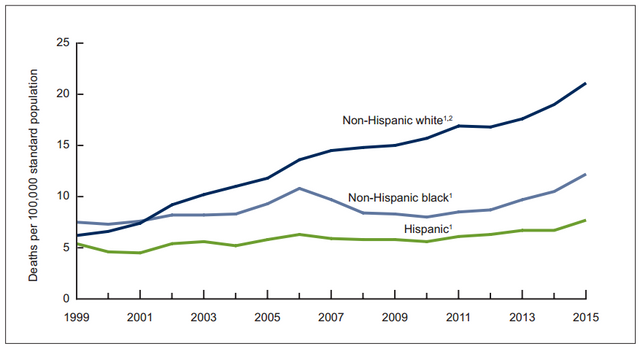
Whites had the highest rate of overdose deaths of any ethnicity, more than double the combined death rate for blacks and Latinos. The overdose death rate for whites, which was lower than that of blacks in 1999, has more than tripled since then.
What is behind the shocking and tragic growth in drug overdoses?
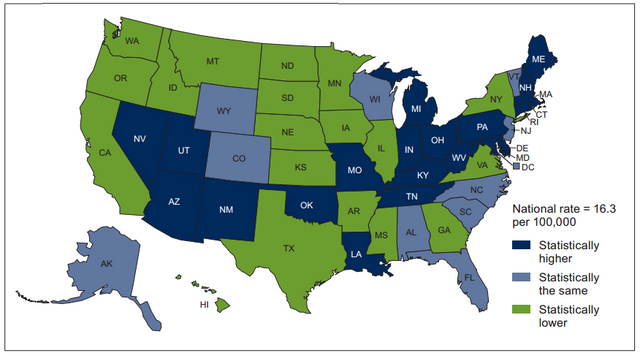
The drug epidemic has been concentrated in former coal mining regions such as Kentucky, West Virginia and Tennessee, along with so-called “rust-belt” states such as Michigan, Ohio, Indiana and Pennsylvania. These areas of the country have been hardest hit by decades of deindustrialization, mass layoffs and wage-cutting, beginning in the late 1970s and continuing ever since.
Age-adjusted drug overdose death rates by state- United States - 2015
Industrial and mining towns in these states have been turned into wastelands, littered with the rusting hulks of factories that once employed thousands of people. In places like Pontiac, Michigan; Akron, Ohio; and Huntington, West Virginia decent-paying jobs are scarce, while schools and community centers have been closed by the dozens.
The social distress that finds a particularly concentrated expression in the rust belt exists throughout the country. In 2015, for the first time in 23 years, US life expectancy decreased, led by a sharp increase in mortality rates for white Americans.
Last month, a survey by the Young Invincibles found that millennials earn 20 percent less than their parents did at the same stage in life, despite being better-educated. Homeownership rates have hit their lowest levels since 1965, with record numbers of young people being too poor to move out of their parents’ homes.
At the other end of the age spectrum, indebtedness among seniors has increased dramatically and household debt as a whole is soaring.
There is a palpable sense that American society is going backward. The drug epidemic is a malignant expression of the fact that millions of people see no prospect for living an economically secure and fulfilling life.
The conditions of life for working people, whose incomes have been stagnant or declining for decades, stand in the starkest contrast to the phenomenal enrichment of the ruling elite, whose wealth has more than doubled since 2009, driven by an unprecedented stock market boom.
Drug overdose death rates - by race and ethnicity in the United States
In its quest for cheap and easy profits at any social cost, the American health care system, dominated by the pharmaceutical industry, the insurance giants and for-profit hospital chains, has turned to over-prescribing opioid painkillers. As a result, over a third of Americans now use prescription painkillers, whether obtained legally or illegally. This is a higher percentage of the population than the portion that smokes or uses smokeless tobacco.
Alongside the economic underpinnings of the social crisis there are the crippling intellectual and cultural effects of a quarter-century of endless war and political reaction. War, xenophobia, chauvinism, the worship of money and power—all are extolled by the ruling elite, its political parties and the media and entertainment establishment. These are the symptoms of an economic and political system breaking down under the weight of its own internal contradictions.
The period since the baseline of the CDC report, 1999, has seen repeated eruptions of protest and struggle against the policies of war and social reaction carried out by Democratic and Republican administrations alike. Fourteen years ago this month, the largest anti-war demonstrations in US and world history took place in cities across America and around the world in opposition to the impending US war in Iraq. This movement against war was suppressed and dissipated by being channeled behind the Democratic Party and its presidential candidate John Kerry.
Four years later, millions of workers and youth went to the polls to express their hatred for the policies of war and austerity of the Bush administration and elect the candidate who promised “hope” and “change,” Barack Obama. The hopes invested in Obama turned into bitter disillusionment and anger as the Democratic administration continued and intensified the right-wing, militaristic policies of Bush and oversaw a further growth of social inequality.
The 2016 election was dominated by mass popular hostility to the political establishment and both parties of big business. This took a left-wing form in the mass support among working people and particularly youth for Bernie Sanders, who garnered 13 million votes in the Democratic presidential primaries by presenting himself as a socialist and opponent of the “billionaire class.” Sanders cynically used his anti-capitalist pretensions to divert popular opposition back behind the Democratic Party, throwing his support to the embodiment of the Democrats’ repudiation of social reform and open embrace of Wall Street and the CIA—Hillary Clinton.
This opened the way for Trump, the personification of the financial oligarchy, to exploit mass discontent on a right-wing, pseudo-populist and chauvinist basis and win the election.
The political impasse caused by the subordination of the working class to the Democratic Party and the two-party system, reinforced by the corporatist trade unions, has fueled the frustrations and dashed hopes that foster anti-social acts, from mass shootings to drug addiction.
But the readiness of the working class and youth to fight has once again found expression in the mass protests since Trump’s inauguration. The Women’s March one day after the inauguration was the biggest international protest since the February 2003 demonstration on the eve of the Iraq War, and demonstrations against Trump’s assault on immigrants and democratic rights more broadly have continued ever since.
Once again, there is a concentrated attempt to divert and dissipate social opposition by channeling it behind the Democratic Party, whose central preoccupation is creating the conditions for war against Russia. The urgent lesson that must be drawn is the need to reject all such efforts and break decisively from the Democratic Party and all parties and politicians of the capitalist class.
The social crisis expressed in the surge in drug overdoses can be overcome only in a struggle to mobilize the working class in the US and internationally against the capitalist system, the source of poverty, inequality and war.