1 Sept 2017

The Zionist Exception

Rima Najjar

Today, we hear a lot about White supremacy but very little about Jewish supremacy, as if the former stands for the latter.
It is true there are more similarities than differences between Jewish supremacy and White supremacy. Both are based on ethnic/nationalist bias and racism. They are both
“historically based, institutionally perpetuated system[s] of exploitation and oppression … a web of interlocking, reinforcing institutions: economic, military, legal, educational, religious, and cultural. As a system, racism affects every aspect of life in a country.”
Within Israel and militarily occupied Palestinian lands, Jewish supremacy is sometimes described as White supremacy, as in this headline:
“Israel’s White Supremacy Agenda Targets Other Jews, Arabs, Africans
Palestinians are not the only target for Israel’s animosity and ethno-centric policies.”
This is because, contrary to Zionist myth, Jews don’t all belong to one race. The Jews who created the racist ideology of Zionism (See Zionism = racism) and initially colonized Palestine (Between 1882 and 1903, at least 25,000 Jews arrived in Palestine, financially backed by European Jewish philanthropists, such as Moses Montefiore and Edmond de Rothschild, (see Palestine and the first Zionist Colony) are Ashkenazim, Jews of Eastern European origin.
Ashkenazi Jews are the elite of Israel and they dominate and discriminate against, not only Palestinian Arabs, but also other Jews and ethnicities in Israel.
The situation in the West Bank settlement of Immanuel exposes the deeply complex ethno-religious relations between European Jews and Middle Eastern Jews in Israel. Middle Eastern Jews have for many decades lived as stigmatized citizens of Israel; their traditional Arabic culture and form of Jewish religiosity frequently objects of scorn and prejudice…In spite of the fact that Sephardim comprise a substantial percentage of the Israeli Jewish population, in socio-cultural terms they find themselves in a subservient position vis-à-vis the Ashkenazim.
However, there are two major differences between the two racist ideologies, White supremacy and Jewish supremacy:
1) In so-called “liberal” circles, White supremacy is uniformly reviled, whereas Jewish supremacy, as it manifests itself in Zionism, is not only accepted but fiercely defended even by those Middle Eastern or Arab Jews mentioned above, who have internalized Zionist racism.
2) Jewish supremacy is wrapped up, not only in a secular Zionist ideology, but in a religious one as well, attracting Jews and evangelical Christians from all kinds of backgrounds and ethnicities.
In the wake of Charlottesville, for example, the ADL — Anti-Defamation League reported that it saw 1,000% spike in donations. The ADL is a Jewish supremacist organization, but it can masquerade in the United States as an anti-racist organization. As If Americans Knew reports, ADL “works to maintain the racist status quo in Israel-Palestine, which keeps Palestinians in Israel as third-class citizens and Palestinians in the occupied West Bank & Gaza stateless and without basic civil rights.” It also keeps Palestinian refugees and exiles from returning to their homes and land, an internationally recognized right.
In 1994, while eulogizing Baruch Goldstein, a Brooklyn born Jew who had emigrated to Israel and killed 29 Palestinian Muslim worshipers at Ibrahimi Mosque in Hebron, New York Rabbi Yaacov Perrin said, “One million Arabs are not worth a Jewish fingernail.” He was defining the essence of Jewish supremacy that now reigns supreme in all of historic Arab Palestine.
Accepting the concept of Jewish supremacy in Palestine, As Sari Nusseibeh wrote,
would be [among other things]to privilege Judaism above the religions of Christianity and Islam, whose adherents together comprise 55 per cent of the world’s population. Regrettably this is a narrative propagated even by renowned Jewish author and Nobel laureate Elie Wiesel, who, on April 15, 2010, took out full page ads in The New York Times and The Washington Post and claimed that Jerusalem “is mentioned more than six hundred times in Scripture — and not a single time in the Qur’an”. Now we do not propose to speak for native Palestinian Arab Christians — except to say the that Jerusalem is quite obviously the city of Jesus Christ the Messiah — but as Muslims, we believe that Jerusalem is not the “third holiest city of Islam” as is sometimes claimed, but simply one of Islam’s three holy cities. And, of course, despite what Mr Wiesel seems to believe, Jerusalem is indeed clearly referred to in the Holy Qur’an in Surat al-Isra’ (17:1) …
Zionist Jews in and out of Israel must confront the reality that Jewish supremacy in Israel, as David Lloyd wrote about Americans and White supremacy in the U.S., “is an intrinsic if shameful element in their history and institutions whose consequences have yet to be overcome.”
The question then arises why so many Jewish liberal Zionists are blind to their own racism against Palestinian Arabs while condemning racism by other groups.
In addressing this conundrum related to the Palestine exception (or Zionist exception) — an exception that involves not only censorship of pro-Palestine speech but also bald-faced, legitimized racism against Palestinian Arabs that extends to Muslims generally – Philip Weiss writes:
I make it a point to hear Rabbi Yehuda Kurtzer speak at J Street and other Jewish spaces. He is a very smart guy and very positive. While he’s too Jewish-communitarian for my taste (the touchstones of his political judgments are Jewish values rather than universalist ones), he’s an idealist who addresses Israel’s crisis. So, I was disturbed to discover on his Facebook page from June a promotion of a visit to rightwing “hilltop” settlements in the Occupied West Bank to get to know those folks better, sponsored by the Shalom Hartman Institute, of which Kurtzer is an executive.
Weiss is justifiably disturbed to hear this from Rabbi Yehuda Kurtzer on three grounds. One is because “those settlements are illegal under international law”. The second is because they are “segregationist” communities, and the third is because of the schizophrenia involved in “condemning and exposing” White nationalism on the one hand, and seeking to understand “the settler movement” (meaning the spread of Jewish Zionist colonization of Palestine to the remaining territory that was partitioned in 1948) on the other.
To me, there is no mystery in the conundrum with which Weiss is concerned.
These liberal American Jews (both religious and secular) don’t know any better because they are committed to Israel as a Jewish state, just as Jews on the right of the political spectrum are.
They see no shame or contradiction in that position because they have swallowed whole the Zionist narrative that defines their identity as Jews, including the inability to see Palestinian Arabs as fellow human beings with fundamental human rights.
So, to me, the problem of Jewish supremacy or nationalism as it manifests itself in Palestine is the fundamental problem of Zionism — its immoral racialist and racist premise.
It makes no difference which brand of Zionism got the upper hand in Palestine, whether it is the nationalism of Theodor Hertzl (i.e., as a response to external pressures that were impossible to avoid — meant for Jews “who do not wish or are unable to assimilate”) or the nationalism of Ahad Ha-Am, to whom the possibility of total assimilation of Jews into their host societies was unacceptable, because the Jewish people was morally superior to all other people.
Today we have a situation in which millions of Jews, whether “assimilated” into their countries of origin or not, believe that Israel has a “right” to exist as a Jewish state and that Palestine belongs to Jews worldwide and not to its indigenous inhabitants regardless of religion or ethnicity.
That, to me, is the disturbing element of all Zionists, including the liberal Zionists Weiss addresses. They want Israel to “exist” as a Jewish state on land forcefully usurped and stolen from under the feet of its true owner, the Palestinian people, who continue to suffer as refugees and in exile as well as in Palestine under military occupation and under Apartheid.
Israel’s existence as a Jewish state is disturbing. Jewish supremacy whether rearing its ugly head in West Bank settlements or embodying the very existence of Israel is the nightmare.
A recent survey has found that nearly half of Israeli Jews believe in ethnic cleansing. Israeli President Reuven Rivlin reportedly called the findings a ‘wake-up call for Israeli society’. But what is it that these people should wake up to? The Jewish state was founded on ethnic cleansing of Palestinian Arabs and defends its “existence” by continuing to ethnic cleanse Palestinians. That’s what they should wake up to — the end of Israel as a Jewish state.
The Jewish supremacist state of Israel must come to an end as such. The goal of exposing Israel’s crimes and the immorality of its supporters is to seek transformative justice in Palestine – to de-Zionize.

Durable Conspiracies: Twenty Years After Princess Diana’s Death

Binoy Kampmark

It has been two decades, and a stocktake of the conspiracy theories over the circumstances of Princess Diana’s death in the Pont de l’Alma road Tunnel will reveal the same inventory as were spawned in the immediate aftermath of her demise.  No response short of fanciful will do; no planned horror, however improbable, can be dismissed. Importantly, there must be some schema, a nefarious design intended to snatch away this figure’s life.
The nature of myth has its own powers, its own resilience.  Making the late princess into a myth served the ambitions of New Labour and the Blairite program, which promoted its own fictions through the dense web of spin and policy.  “Call me Tony” Blair was a perfect accompaniment to the pop assemblage that was the People’s Princess, confections of managed public relations.
The People’s Princess still exerts a profane power from beyond the grave. She is still deemed “extraordinary” (a common mistake), and worthy of floral tributes outside Kensington Palace. An example of this wearisome nonsense is provided by Mara Klemich, visiting from Sydney: “We had never met her and been nowhere near her, but I think she touched so many people because of who she was, the way she conducted herself in the context of where she was living and who she became.”
To be sustainable as a myth, it was necessary to develop, as Roland Barthes put it in his Mythologies, a set of meanings, essentially rendering them as natural, rather than crafted by the foibles of human intent.  This compelling point leads us to conclude that looking at the myth is less significant than the story teller behind it. The show is nothing without its producer.
And my, were there stories to pick from, a vast pantheon teeming with variants as to how Diana died.  One common conspiracy centres on a misunderstanding of causation.  Goldie Lookin Chain, a Welsh rap outfit, would summarise this neat point in Guns Don’t Kill People, Rappers Do. In the case of the princess, those with cameras did it, even if the ultimate responsibility should lie with a drunken driver and the poor choices made on the day on road safety.
The stubborn nexus with power – that the princess was somehow getting too big for her fancy boots – remains a noisy, if astonishingly misplaced theme.  One can’t make bricks without straw, as the expression goes, and straw was supplied at various intervals: in 2008 by former MI6 operative Richard Tomlinson, and then by former SAS sergeant, soldier N, in 2013.
Both figures were particularly keen to push the theory that Diana’s driver had been blinded with lethally intended consequences. For Tomlinson, the suggestion of using a strobe light to blind a chauffeur was penned own in an MI6 document from 1992 listing three methods of how best to kill Serbian leader Slobodan Milošević.
The mystery soldier N confided in his spouse about a flashing light deployed by a hit squad that distracted the driver at a crucial moment. Soldier N, we might say, was as pure as driven slush, arrested and detained along with SAS sniper Danny Nightingale in 2011 for having illegal weapons and ammunition. It did not take the Met long to dismiss his plagiarised account.
Mohamed Al-Fayed, whose son Dodi also perished with Diana, has been the most vigorous devotee of the conspiracy brand, blaming the Duke of Edinburgh. Here, the royal precedent to murder one’s own returns to form.
For Al-Fayed, the design on the princess was simple: the couple would die at the hands of the security services because they had intended to marry. (Those seeking current grist for the mill suggest that the princess was intending to reject any marriage proposal – the old business goes on.)
The fuss kicked up by the grieving, somewhat unhinged father led to the stripping of Harrods’ four warrants granting the store the right to declare its appointment by the Royal Family to supply goods.  But hate sustains, and Al-Fayed busied himself with sniffing around the Duke of Edinburgh’s alleged Nazi links.  The world was spared witnessing the ex-Harrods owner’s celluloid product claiming the same.  Unfortunately, it has not been spared much else.
Each body of evidence has failed to convince the punters.  The French Magistrates, for one, were never going to satisfy the Diana clan.  (Their scepticism was fuelled by a good deal of anti-Gallic passion: if the Frogs did not do it, they certainly made it easier.)
“The vehicle’s driver,” concluded the 1999 report, “was in a state of drunkenness and under the undue influence of medication incompatible with alcohol, a state that prevented him from keeping control of his vehicle when he was driving at speed.” Chauffeur Henri Paul hardly needed strobe lighting.
On the other side of the Channel, the Metropolitan Police’s Operation Paget revealed, after draining more resources, personnel and time, not to mention  800 pages, that “all the evidence at this time” pointed to “no conspiracy to murder any of the occupants in the car.  This was a tragic accident.” Instead of allaying doubts in December 2006, when it was released, there were those who refused to be convinced.
Nothing in terms of evidence would ever refute or repudiate the myth producing industry behind the princess.  On the contrary, this steadfast refutation of evidence, the fanatical resolve to reject the empirical, provided a foretaste of that modern staple we now know as “fake news”. The conspiracy complex was more Donald Trump than Donald Trump, and troublingly post-modern in turning all matters foundational and solid to dust. And in that dust is the grand sinister design.

Rohingyas: Jihadists?

Chandra Muzaffar

The Rohingyas — or at least some Rohingyas — are now being projected as terrorists, as “Jihadists” out to kill Myanmar soldiers and civilians. Myanmar leaders including Aung San SuuKyi have spoken along these lines.
This view of the Rohingyas is being propagated by the Myanmar government with greater zeal since a small armed group called the ArakanRohingya Salvation Army ( ARSA) attacked security forces on 9 October 2016. These attacks have continued in recent weeks. In this new wave of violence it is alleged that 12 security personnel were killed while the Myanmar military and border police have killed 77 Rohingya Muslims.
The way Aung San SuuKyiand her government colleagues have framed the clashes ignores the brutal massacres committed by the military over a long period of time. The oppression and persecution of the Rohingyas by the State and other forces has been thoroughly documented by the United Nations Human Rights Council and other independent human rights groups. It is well-known that as a community the Rohingyas were stripped of Myanmar citizenship in 1982, deprived of basic human rights, tortured, imprisoned, and forced to flee their home province of Rakhine. This is why there are tens of thousands of Rohingyas living in squalid conditions in Bangladesh or struggling to survive in a number of countries from Malaysia to Saudi Arabia. They have been described by the UN itself as one of the world’s most persecuted minorities.  Simply put, the Rohingyas are the victims of a slow genocide, to quote Nobel Laureate Professor Amartya Sen.
To condemn the violence of a miniscule fraction of the Rohingyas without taking into account their massive marginalisation and severe oppression is a travesty of truth and justice. It is extreme desperation and hopelessness that has forced some of them to resort to violence. Of course, violence is not the solution. It will not help to restore the rights of the Rohingyas, especially their right to citizenship.
Our concern is that the violence will escalate. The signs are already there. Given the underlying religious connotations of the conflict — though the conflict itself is not rooted in religion per se – it is not inconceivable that the violence will spread beyond Myanmar’s borders and engulf Muslim and Buddhist communities in other parts of Southeast Asia. This would be catastrophic for ASEAN, a regional grouping in which 42% of the population is Muslim and another 40% is Buddhist.
Finding workable solutions to the Myanmar – Rohingya conflict is therefore of utmost importance. It is in this regard that the ‘Final Report of the Advisory Commission on Rakhine State’ under the chairmanship of former UN Secretary-General, Kofi Annan, deserves the urgent attention of all stakeholders.  The Report announced in August 2017 calls for a review of the 1982 citizenship law and notes that “Myanmar harbours the largest community of stateless people in the world.” It urges the government to abolish distinctions between different types of citizens.
Other recommendations pertain to reduction of the poverty rate in Rakhine state which is 78%, improving the socio-economic condition of the people, enhancing access to health services and education, ensuring freedom of movement and encouragingpeople’s participation and representation. Though the Report is worded with a great deal of caution and diplomacy, it does send an unambiguous message to the powers-that-be in Myanmar that the status quo cannot be allowed to persist and that change has to take place. That message is significant considering that the Commission was actually initiated by the government.
Will the government take heed? So far there is no indication that it will respond positively to the Commission’s recommendations. This is not surprising. It is the harsh authoritarianism of the government embodied in the power of the military that is primarily responsible for the targeting of the Rohingya as the “ethnic other.” This is what has resulted in the genocide that we are witnessing today.
Even if the Myanmar government does not act of its own volition, the Kofi Annan Report can be used to persuade other governments to pressurise Myanmar to act. Apart from ASEAN governments, special efforts should be made by civil society groups and the media to convince Beijing, Tokyo, New Delhi, Islamabad and Washington and London that they demand that the Myanmar government protects all its citizens without discrimination. If it fails to do so, these capitals should review their economic and/or military ties with Naypyidaw.
It is with the aim of persuading the leadership in Naypyidaw to change its behaviour that the Permanent People’s Tribunal (PPT) is holding its concluding session in Kuala Lumpur on the treatment of the Rohingyas, Kachins and other minorities in Myanmar from the 18th to the 22nd of September 2017. As more and more voices plead for justice and compassion on behalf of the oppressed who knows they may eventually pierce the walls of Naypyidaw.

Australian government urges universities to tear up staff conditions

Mike Head

After nearly a decade of severely deteriorating conditions since the previous Labor government launched its free market “education revolution,” university staff and students across the country confront an even deeper and unprecedented assault on jobs, workloads and basic rights.
The Liberal-National government is urging universities to tear up all existing staff conditions, following an August 29 decision by the Fair Work Commission (FWC) to terminate the current enterprise agreement at Perth’s Murdoch University.
Education Minister Simon Birmingham told an Australian Financial ReviewHigher Education Summit on Wednesday the FWC ruling “should be seized, and hopefully can be replicated elsewhere” across the university sector.
Birmingham declared the FWC decision gave managements the capacity to cut costs and absorb a 4.9 percent efficiency dividend, which will cost universities $1.2 billion over four years, and other multi-billion dollar cuts announced in the government’s May budget.
FWC commissioner Bruce Williams ruled that many enterprise bargaining agreement (EBA) provisions, particularly those covering restructuring, redundancies, workloads, fixed-term contracts and staff discipline procedures, imposed “significant inefficiencies and costs” on Murdoch University.
As a result of his verdict, salaries could be cut by up to 30 percent, and redundancy payments could be slashed by at least 33 percent for academic staff and up to 80 percent for professional staff. Parental leave could become unpaid leave, workload restrictions could disappear and it would be easier to dismiss employees for alleged “misconduct” or “unsatisfactory performance.”
Williams terminated the EBA because there was “a financial imperative for Murdoch to make changes in its operations” and because it would encourage bargaining with the trade unions for a new agreement. Thus, while the unions formally opposed it, the thrust of the ruling is to rely on the unions to pressure their members, and all university workers, into accepting drastically reduced conditions.
In his judgment, Williams stated: “As the unions submit, if the Agreement is terminated this will change the bargaining dynamics. This is because the context for bargaining will be different.”
Just as significant as the FWC ruling is the response of the unions. Having helped university managements for decades to enforce their fiscal requirements—particularly since the last Greens-backed Labor government cut some $3 billion from university budgets—the unions will intensify their work to stifle all resistance by increasingly discontented university workers.
An email sent to National Tertiary Education Union (NTEU) members nationally on Wednesday said it was “committed to negotiating a replacement agreement at Murdoch University that, with members support, can recover much of the damage that has just been done.”
In other words, the union will endeavour to cajole its members into accepting a new EBA that will satisfy the management’s demands, while supposedly recovering some of the lost conditions. This response was pre-figured in the FWC hearing itself, where the unions argued that the EBA did not hinder the management’s agenda.
As Williams noted, the unions’ submission was that: “The provisions of the Agreement are unremarkable and comparable to provisions in other enterprise agreements in the university sector. If anything, the Agreement provides the University with competitive advantages.”
This sums up the role played for decades by the NTEU and the other main union covering university workers, the Community and Public Sector Union (CPSU). Their preoccupation is with providing universities with “competitive advantages”—at the expense of the conditions of staff and students. Union-negotiated EBAs already have helped managements casualise their workforces so much that only 6.4 out of every 100 new positions created at Australian universities between 2009 and 2015 were tenured teaching or research jobs.
Far from suggesting any mobilisation of members nationally against the new assault, Wednesday’s NTEU email asked members to send a “message of support” to anyone they knew at Murdoch University, and to falsely tell their own work colleagues that “it is only the union that can fight these cuts.”
About 28 universities across the country have agreements that have expired and are vulnerable to termination, including University of Queensland and La Trobe University. Representing the managements, Australian Higher Education Industrial Association executive director Stuart Andrews told the Australian Financial Review “virtually the entire university sector” was seeking to remove similar conditions and the decision would “strengthen their resolve” in negotiations.
The NTEU and CPSU will now try to foist new EBAs on their outraged members as quickly as possible. This especially will be the case at universities, such as the University of Sydney and Western Sydney University, where members have voted overwhelming to take industrial action to resist the management demands. At Western Sydney, the NTEU is simultaneously trying to suppress workers’ opposition to last Friday’s announcement that up to 150 jobs will be eliminated via a “shared services” restructuring and that all the security staff will be replaced by contractors.
The unions will work even more closely with managements as they scramble to enrol more revenue-generating students, especially full fee-paying international students, and attract funding from corporate investors, donations from the financial elite and research grants from government and military agencies.
With the help of the unions, universities are being transformed from public places of learning and knowledge into corporatised and increasingly privatised institutions serving the interests of big business and the military-intelligence apparatus. Universities also have become money-making machines for the Australian capitalist class, generating more than $2 billion a year in revenue, mainly by fleecing international students, who face ever-higher fees, larger classes and fewer full-time teachers, as do all the domestic students.
The university unions long ago enlisted—under the Hawke and Keating Labor governments of the 1980s and 1990s—in the corporatist efforts of the entire union movement to make Australian capitalism “globally competitive” by forcing workers to sacrifice previously hard-won conditions.
The implications of the FWC decision go far beyond the universities, signalling a new offensive against workers across the board. The ruling extends anti-working class precedents already set in several other industries, such as the railways, timber and electricity generation, where the FWC has torn up EBAs, to white collar and public service workers.
The ruling creates a precedent for employers to cite any “financial difficulties,” including those caused by workers’ opposition to employer attacks, government funding cuts and poor “market conditions,” to justify gutting workers’ jobs, wages, conditions and basic rights.
Williams said “a multitude of factors” caused Murdoch University’s “current financial circumstances.” He listed “market conditions, government decisions, corporate governance failures, poor strategic decisions, some employee resistance to change and at times poor management by Murdoch.”
Sections 225 and 226 of the Fair Work Act, imposed by the previous Labor government with the support of the union movement, give the FWC sweeping powers to terminate an EBA that has gone past its nominal expiry date if a commissioner considers it “appropriate” and in the “public interest.”
Despite the bitter experiences of the past three decades, the unions are urging their members to support the return of yet another pro-capitalist Labor government backed by the Greens. The need for genuine rank-and-file, or workplace, committees, completely independent of the unions and based on a socialist perspective of challenging the entire framework of cuts and corporate profits is becoming ever more urgent. This includes fighting for free first-class education for students at every level, instead of the ever-greater accumulation of wealth by billionaires.

Venezuela nears default after US imposes sanctions on economy

Andrea Lobo

Washington has moved to dramatically intensify Venezuela’s social crisis by imposing its first direct sanctions on the country’s economy. The measures, imposed as an executive order last weekend, represent a significant escalation of the Trump administration’s calculated stream of sanctions against top officials of the United Socialist Party of Venezuela (PSUV) government, reaching up to President Nicolás Maduro himself and aimed at forcing his downfall.
Trump’s order prohibits Citgo, the subsidiary in the US of Venezuela’s state-run oil company PDVSA, from sending dividends back to Venezuela, and bars transactions of US institutions and individuals involving new debt or shares issued by PDVSA or the government in Caracas. In response, the firm Cantor Fitzgerald announced on Tuesday the first restriction on Venezuelan bonds by a large US finance house.
Three weeks ago, Trump had threatened the possibility of military action against Venezuela in response to the election of a PSUV-controlled constituent assembly; however, his national security advisor H. R. McMaster stated in the announcement of the new sanctions that “no military actions are anticipated in the near future.”
While the trading of oil is still open, Reuters reports that debt refinancing and crude cargos had already begun struggling to find buyers in the United States since July, when sanctions were imposed on PDVSA’s financial vice president.
Other reports indicate, moreover, that US officials are considering banning dollar payments on Venezuelan oil imports or oil imports altogether, which would cut the country’s main source of foreign currency to import food and medical supplies.
Amid its worst economic crisis, the new sanctions have pushed Venezuela to the brink of default, which threatens to sink the country’s workers and poor to new depths of misery for the sake of furthering US imperialist plunder. Almost one-third of the country’s output has already been wiped out since oil prices plunged in 2014.
On Wednesday, Fitch Ratings downgraded Venezuela’s credit score, announcing that “a default is probable given the further reduction in financing options for the Government of Venezuela”—an announcement that itself will further impair Venezuela’s credit access. US sanctions, it adds, “will likely aggravate the economic crisis, heighten political polarization and increase social unrest.”
The Financial Times wrote Thursday that an eventual default would likely become an “indefinite financial purgatory for Venezuela” since the new sanctions prohibit a debt restructuring to reduce short-term payments. Creditors will nevertheless “try to seize the payments for PDVSA’s oil exports… the country’s only financial lifeline,” the FT writes. Earlier this year, a World Bank tribunal awarded a settlement of $1.4 billion against Venezuela to a Canadian mining company, which could encourage others to try to resolve their pending cases at the country’s expense.
At a time in which Citgo’s refineries are running at one-fifth capacity, Hurricane Harvey has shut down its installations in Corpus Christi as well as other major Texas refineries and ports. This adds further pressure because of Venezuela’s dependence on the importation of US light crude from US refineries, and on US oil purchases for foreign exchange that the “anti-imperialist” PSUV government has only deepened since it was voted into power in 1998.
Even if Maduro and the constituent assembly find a way to pay Venezuela’s debts until next year, it would need to impose further cuts to state expenditures, social and military. Greater demoralization among lower ranks in the armed forces, which Caracas has relied on to crack down on protests and distribute food and essential goods, under conditions of widespread social opposition represent an existential threat to the government.
Furthermore, PDVSA would need to deepen its reliance on extended credit from China and Russia and on oil deliveries through the Russian firms, which were recently granted claims to tap the world’s largest oil reserves in the Orinoco basin. It is this growing influence of America’s main economic rivals, an influence further consolidated as a result of US sanctions, that represents the most unacceptable reality for Washington and US corporations. This contradiction poses regime change as a question not of if, but of when and how.
Last Friday, the US ambassador to the UN, Nikki Haley, sought to place a humanitarian veil over the criminal sanctions, insisting that “we are not seeing any progress towards lifting up the Venezuelan people.” However, the incompetent response by US officials to the flooding disaster in Texas, itself the result of neglecting social infrastructure for decades, exposes the hypocrisy of such statements.
To continue servicing its debt to Wall Street, which the PSUV government has done diligently at the expense of social programs and importing essential goods, would mean to quickly use up Venezuela’s remaining foreign reserves of about $9 billion (having scheduled payments of $3.7 billion due this year and a total debt of more than $97 billion). This would quickly worsen existing sharp shortages of goods, amid hyperinflation, widespread poverty and unemployment.
Maduro and the constituent assembly have responded to the sanctions by imposing anti-democratic attacks ostensibly aimed against the right-wing opposition leaders. The assembly member and PSUV Vice President Diosdado Cabello announced the most recent decree on Tuesday, ordering a “historical trial for treason to the fatherland against those involved in the promotion of these immoral actions against the interests of the Venezuelan people.”
While directed in the first instance at right-wingers who voiced support for Washington’s sanctions, such vague language makes clear that the implementation of police state measures will be directed against the working class and impoverished masses, which the PSUV regards as the gravest threat to the vast wealth accumulated by the sectors of the bourgeoisie it represents.
Maduro stated Wednesday that a set of “important decisions will be taken to stabilize the economy, attack speculators, thieves, and defend employment,” which will be announced on Friday after discussions with the constituent assembly.
The UN High Commissioner for Human Rights released a report Wednesday based on interviews of “witnesses” attributing to government forces 73 of the 124 documented deaths during the wave of protests provoked by the opposition since April. “The generalized and systemic use of excessive force during the demonstrations and the arbitrary detention of protesters and perceived political opponents indicates that these were not illegal or rogue acts of isolated officials,” it concludes.
The Venezuelan government also announced on Wednesday a token $5 million donation for the flood victims in Texas. Instead of being a show of solidarity, the Chavista PSUV has exposed its inability to appeal to the working class in the United States and internationally, a task that only the organized Venezuelan working class can accomplish and that constitutes the only means to fight against US imperialist aggression, as part of an independent and internationalist movement for socialist revolution.
For its part, the US-backed opposition, organized behind the Democratic Unity Roundtable (MUD), has unapologetically supported the new, socially devastating US sanctions and called upon other governments for similar measures. By seeking to exploit the suffering of Venezuelans to bring down the Maduro government, the MUD demonstrates its unbridled right-wing nature and the extent to which it will defend the interests of the US financial and corporate elite.
The opposition leader, Lilian Tintori, who met Donald Trump at the White House earlier this year and has become the face of the MUD internationally, was found Wednesday driving with four crates stashed with 200 million bolivares—between $11,400 and $61,000 depending on which exchange rate is used. The widespread denunciations online that she was handling payouts from the CIA or other US organizations led Tintori to tweet that the money was for her grandmother’s medical care.

Trump begins campaign for huge tax cut for business and the wealthy

Patrick Martin 

At a rally Wednesday in Springfield, Missouri, President Donald Trump began a public campaign for slashing taxes on US corporations and the wealthy, an effort to funnel trillions of dollars into the pockets of the super-rich that would dramatically increase the already staggering economic inequality in America.
Trump’s remarks combined economic nationalism, glorification of the profit system and obvious lies, as he claimed that corporations gifted with massive tax cuts would immediately use these funds to invest in new equipment, hire more workers, and give generous raises to the workers they already employ.
The speech gave a completely potted account of economic realities in the United States, portraying giant American corporations as groaning under an onerous tax regime that takes so much of their profits that they cannot invest in production.
Actually, corporate profits are at record levels, but the funds are used mainly for speculative purposes like stock buybacks. And according to the Organization for Economic Cooperation and Development, the overall tax burden in the United States, at 26 percent of total economic output in 2014, is the fourth-lowest among the major industrialized countries.
The speech was reportedly written by Stephen Miller, the policy adviser who represents the fascistic wing of the White House staff, previously headed by Stephen Bannon. He supplied the nationalist demagogy and the empty claim that a windfall for American corporations would be good for American workers.
The policy substance is supplied by Treasury Secretary Steven Mnuchin and top White House economic adviser Gary Cohn, both veterans of Goldman Sachs and both possessing fortunes of a half billion or more. Mnuchin accompanied Trump to Springfield, along with Commerce Secretary Wilbur Ross, a longtime asset stripper with a fortune in the billions.
Trump outlined four principles underlying the tax plan, two in support of the populist demagogy, and two to deliver the bonanza for corporate America.
First was “tax simplification,” the standard promise by right-wing demagogues to reduce the complexity of the federal tax code so that ordinary people can understand it and fill out their tax returns on a postcard or single sheet of paper. There is not the slightest prospect of this ever happening, since complexity is one of the devices for shifting the tax burden from corporations and the wealthy, who can hire tax lawyers and accountants, to working people.
Trump also pledged “tax relief for middle-class families,” although he gave not a single detail in the speech. An initial draft released in the spring suggested doubling the standard deduction, which would provide modest benefits for families of middle income, but nothing to the 47 percent of workers who do not earn enough to pay income tax.
Estimates of the potential benefits—difficult to calculate because of the vagueness of the White House plan—suggest that middle-income families would gain $30 to $140 a year, while families in the top 1 percent would gain an average of $1.4 million.
In contrast to the vague and empty promises to working people, the benefits for corporate America from Trump’s remaining two principles are enormous and specific. Under the rubric of establishing a “competitive tax code,” Trump would slash the tax rate on corporations from 35 percent to 15 percent, below that in most other countries.
Finally, in an effort to “bring back trillions of dollars in wealth that’s parked overseas,” Trump would effectively legalize tax evasion by giant corporations like Google, Microsoft, Apple and General Electric. These and other corporate behemoths have nearly $3 trillion in accumulated earnings attributed, for bookkeeping purposes, to their overseas operations, in order to avoid US corporate income tax.
Trump would give a one-time tax holiday allowing these earnings to flow back into the US with only nominal taxation, claiming that the funds would be reinvested in American facilities and jobs. The last time this particular corporate swindle was performed, in 2001 under George W. Bush, the companies involved paid only 5.25 percent on their repatriated earnings, the $300 billion in “offshore” funds were used to buy back stock, pay out dividends to shareholders and boost the compensation of CEOs, and virtually no jobs were created. Now the sums involved are 10 times greater.
In packaging such a plan as a boon for working people, Trump and his speechwriter, Stephen Miller, must think that American workers are deaf, dumb and blind, as well as suffering from amnesia. Vague rhetoric about more jobs and higher pay cannot disguise an even bigger handout to the wealthy than the 2001 tax cuts pushed through by Bush with the support of leading congressional Democrats.
Wall Street and corporate America generally are hoping for a repeat of the 2001 deal between Bush and the Democrats, once the initial public posturing about “fairness” and prioritizing tax cuts for the “middle class” is dispensed with.
Senate Democratic leader Charles Schumer—who has collected more campaign contributions from Wall Street than any non-presidential candidate in history—served up the usual populist demagogy in response to Trump’s speech, speaking on a conference call organized by pro-Democratic groups that are lobbying against the Trump tax plan.
“If the president wants to use populism to sell his tax plan, he ought to consider actually putting his money where his mouth is and putting forward a plan that puts the middle class, not the top 1 percent, first,” declared Schumer. He said the Democrats were willing to deal on taxes, but rejected any plan that cut taxes for the top 1 percent of income earners, raised taxes on the middle class, or increased the federal budget deficit.
Notable in this list is the absence of any reference to reductions in the corporate tax rate, the centerpiece of the Trump administration tax plan, or to the repatriation of offshore earnings. There is widespread agreement among congressional Democrats with both proposals, since the Democrats, like the Republicans, take as their point of departure the interests of the American capitalist class.
Schumer’s opposition to reducing taxes for the top 1 percent hardly constitutes a serious obstacle, as press reports indicate that the White House may have already dropped plans to lower the top income tax rate from 39.6 percent to 35 percent.
More significant is the Democratic leader’s insistence on not increasing the federal budget deficit. That means that the expected corporate tax cuts would have to be “paid for” by cutting expenditures, almost certainly in domestic social spending or “entitlement” programs like Social Security, Medicare and Medicaid.

Social Democrat Chancellor candidate Schulz calls for well-equipped German army

Johannes Stern

Just days ahead of the televised debate between Social Democrat (SPD) Chancellor candidate Martin Schulz and Chancellor Angela Merkel (Christian Democrats, CDU), the SPD is trying to portray itself as a party committed to disarmament and peace.
During his trip to Washington, Foreign Minister Sigmar Gabriel gave his backing to Schulz’s call for the withdrawal of US nuclear weapons from Germany. “I am certainly convinced that it is important for us to once again speak about arms controls and disarmament,” the Social Democrat told the German news agency DPA. The issue concerned Europe and Germany in particular, he said, adding, “In that context, I found the statement by Martin Schulz that we have to focus on finally getting rid of nuclear weapons from our country to be correct.”
Estimates suggest that some 20 US nuclear weapons are stored at the German army’s (Bundeswehr) airfield in Büchel. Last week at an election meeting in Trier, Schulz called for the weapons to be withdrawn. “As Chancellor of the Federal Republic of Germany, I will advocate … for the withdrawal of nuclear weapons stored in Germany,” he declared.
SPD election strategists, who are desperately trying to turn around Schulz’s low poll ratings, have apparently been studying current opinion polls. According to a recent poll by research company Civey, 63.5 percent of Germans want the government to call for the withdrawal of US nuclear weapons stored in Germany. Almost half, 47.1 percent, think the government should “definitely” call for this. Less than one in three Germans (29 percent) are of the opposing view.
Nobody should be deceived by the pacifist phrases in the media statements by SPD politicians. The vast majority of the population favours the withdrawal of American nuclear weapons because they oppose militarism and war. However, Gabriel and Schulz are not concerned about peace and disarmament, but rather want to transform the widespread opposition to US imperialist wars into support for German militarism.
An interview Schulz gave to the Bundeswehr Association published on August 28 leaves no doubt about this. Schulz began by reassuring his interviewer that he would not “subordinate” himself to “rearmament policies à la Donald Trump.” He then portrayed himself as the best candidate to uphold the interests of the soldiers and the SPD as the leading party of German militarism.
“We want a well-equipped Bundeswehr that is up to the growing challenges of the future. We owe that to our soldiers. To meet the rising demands of international interventions, cyber-deterrence and defence, we need a modern armed forces capable of action,” stated Schulz.
The Social Democratic candidate repeatedly called for a major military build-up and an expansion of the army. “We need a Bundeswehr in which the best minds make decisions and with troops prepared for crisis situations ready to deploy,” he said. “For this purpose, we have to better equip the Bundeswehr with personnel and materially.” It was clear “that the Bundeswehr will need billions in additional funds.”
In response to the question “What value does defence policy have in your party’s election campaign,” Schulz answered, “A high one! I visited the Bundeswehr’s Joint Operations Command already in May in Geltow. I was able to get a precise picture of the current status of the Bundeswehr, beyond the discussions I regularly have with the chairman of the Bundeswehr Association, Lieutenant Colonel Wüstner, and many others.” This dialogue was “very important” for him. “It also creates trust. All politicians should talk more with the soldiers instead of talking about the soldiers,” he said.
The soldiers had to “be able to trust that the best possible equipment will be made available to them and that conditions of service will be adapted to today’s standards.” This included “more equipment and flying hours.” And “the urgently required securing of new recruits” can “only be improved if the conditions of service are changed.”
Asked about his “goals for the coming legislative period,” Schulz mentioned the establishment of an independent European foreign and defence policy and the building of a European army. The SPD wants “to press ahead with the European security and defence policy together with our partners in Europe. Already the permanent cooperation proposed in the Lisbon Treaty makes possible concrete measures for closer cooperation and division of labour on the path to a defence union and onwards to the long-term goal of a European army.”
Schulz, with whom the Left Party and sections of the Greens want to form a coalition, constantly attacked the CDU/Christian Social Union (CSU) from the right. “With the SPD, there would have been no boosting of personal profiles and career planning at the expense of the Bundeswehr. Had the successive CDU/CSU ministers listened to us, the failures of the recent structural reforms would not have occurred. They cannot continue to transfer new mandates and tasks to the Bundeswehr without giving it the personnel, military equipment and funding for this. The Bundeswehr cannot be equipped according to the financial situation.” Under SPD leadership, the Bundeswehr will “be treated better.”
The clearest demonstration of the extreme right-wing and militarist character of Schulz and the SPD is that they deem even the most toothless criticism of the Bundeswehr to be inadmissible—even when it concerns extremely troubling developments like the emergence of neo-Nazi terrorist cells. “We in the SPD thought it was very improper for Mrs. Von der Leyen to recently place all members of the Bundeswehr under general suspicion,” he said. This had “damaged trust.”

Earthquake on Italian island of Ischia: Grief is mixed with anger

Marianne Arens

Two dead, 42 injured and 2,600 homeless—this is the terrible result of the recent earthquake on August 21 on the Italian island of Ischia in the Gulf of Naples. The quake occurred almost exactly one year after the disastrous earthquake in Abruzzo, which claimed the lives of 299 people on August 24 last year.
Compared to this, the earthquake that shook Ischia last Monday just before 9 p.m. was relatively weak. Registering 4 on the Richter scale, it should not have caused buildings to collapse and whole communities to lose their homes.
“It is not normal for a magnitude 4 earthquake to bring down houses and lead to the evacuation of hospitals,” commented Egidio Grasso, head of the Regional Geological Association. Francesco Peduto, president of the National Geologic Council, said it was alarming that “people died from a tremor of this strength.” Had more time and resources been put into prevention, Peduto said, it would not have come close to such consequences.
The journal Spectrum of Science writes: “The fact the shock was only around magnitude 4, about one thousandth of the energy of the devastating quake at Amatrice in August 2016, is a bit bewildering. One of the richest countries in the world cannot manage to protect itself against a truly harmless natural event.”
What the comments do not mention is that there are earthquake-proof buildings in the affected region. However, they have only been built where the “rich and beautiful” live and go on holiday, or where wealthy property owners have the say. The grand hotels and tourist resorts by the sea, famous for their luxury and quality, experienced virtually no damage on Monday. These hotels, in which German Chancellor Angela Merkel spends her holidays, have undoubtedly been built to be earthquake resistant.
This proves that the destruction was not the product of a natural catastrophe but of the class nature of capitalist society.
Those who are not so rich must live with the ignorance and corruption of the building authorities and the Mafia structures in the construction industry. According to research carried out by the Legambiente environmental association, the Campania region, which contains the Naples area, is especially riven by corruption in the building industry. The consequences are now appearing again in the residential areas on Ischia in which working class families live. Numerous houses collapsed there, with schools and public buildings being turned into ruins in a matter of seconds.
The places most affected are Casamicciola and Lacco Ameno in the north of the island. These should be the best protected in the whole of Italy because they are situated in the Flegrean islands, a region of high volcanic activity near Mount Vesuvius. Over 130 years ago, in Casamicciola, the 1883 earthquake caused the complete destruction of the village and killed more than 2,000 people. The danger of earthquakes is well known here.
This is why a large school complex had been fundamentally redesigned in recent years by the Special Fund for Earthquake-Resistant Construction. The school was inaugurated in September 2016, and was considered “earthquake-proof” ever since. With the first weak quake on Monday, the building was again badly affected. Significant damage to the building structure has been established. The walls have moved several centimetres from the foundation, cornices and gables have crumbled, the concrete lintel over the entrance gate is cracked, and inside, everything is covered in plaster and glass shards. Starting school after the summer holidays is now unthinkable.
The school is just one example of many. In the same place, the town hall and an observatory were only recently renovated from the earthquake fund. Both buildings had to be evacuated, and since then entry to both has been forbidden. During the earthquake, the electricity supply failed for wide sections of the population. The hospital was also affected and had to be temporarily evacuated.
This was also very similar in Amatrice last year, where a recently renovated school and a hospital collapsed. A church tower, which had also been renovated by the earthquake fund, collapsed and buried a family of four in the ruins. In Amatrice, the investigating attorney concluded that corruption and the almost unbelievable indifference of the authorities dominated large parts of the construction industry, so that many buildings were built “with more sand than cement.” This has obviously not changed to this day.
More than 21 million people live in earthquake-stricken regions in Italy. They are sitting on a time bomb that can go off at any moment. However, governments of all parties have failed to implement effective safeguards. From Silvio Berlusconi, Mario Monti, Enrico Letta, Matteo Renzi to Paolo Gentiloni, every government has concentrated for years on the interests of the ruling class. In the name of the corporations and the Italian and European banks, they have implemented austerity measures and social attacks. In agreement with the EU, they had closed the borders to immigrants and provided the army and the police in the Mediterranean and the interior of the country with new powers and weapons.
For working people in the earthquake regions, they have at most a few fine-sounding words. “The government stands on the side of those affected!” declared incumbent premier Gentiloni on Tuesday after the quake. His predecessor, Matteo Renzi, had said the same a year ago in Amatrice. At the time, Renzi had promised everything would be rebuilt quickly according to new, earthquake-proof guidelines.
The result of these promises could be seen on Thursday, August 24, the anniversary of the earthquake disaster in Abruzzo. While in Amatrice, Accumoli, Arquata and Pescara del Tronto the communities were thinking of the victims, their mourning was mixed with anger: after a year, not even the debris of the previous quake has been removed, let alone buildings rebuilt. One year after Renzi’s promises, thousands still live in shipping containers, caravans, hotels, or with relatives far from home. Of nearly 4,000 prefabricated houses needed for those currently homeless, only 456 have been erected.

French President Macron unveils decrees to destroy Labour Code

Anthony Torres

France’s Prime Minister Edouard Philippe and Labour Minister Muriel Pénicaud yesterday unveiled President Emmanuel Macron’s decrees aimed at tearing up the country’s Labour Code. A year after the Socialist Party (PS) government imposed its labour law, trampling the opposition of the vast majority of the French people, Macron is unilaterally reinstating into law all the most unpopular measures the PS decided to withdraw in the face of mass protests.
The decrees—negotiated by Macron’s government, business federations, and the trade unions—are provoking broad opposition among workers. Over two-thirds of French people (68 percent) think their boss will exploit the decrees, using the greater freedom to negotiate contracts at the level of individual firms to reduce their wages and benefits, according to an Opinion Way poll. Four in five say they expect social protests against Macron’s decrees.
The ruling elite in France and internationally fear popular opposition to the decrees, but they consider it a critical step in the destruction of social rights won by workers over generations of struggle in the twentieth century. They hope to impose what the ruling class forced though in Germany with the Social Democrats’ Hartz laws, or the European Union (EU) austerity measures in Greece since the 2008 global crisis. As French capital’s competitiveness collapses and the EU plans a broad militarisation of its foreign policy, the ruling class is heading for a confrontation with the working class.
Germany’s Die Welt cited Jérôme Fourquet of the Ifop polling institute: “There is a definite sense that we are on the eve of a major struggle.” The German daily added, “No one knows who will win. Only one thing is certain: the coming weeks of September will be a moment of truth. Macron, who began as a candidate who stood no chance at all, then realised the exploit of winning a presidential campaign that was completely unpredictable from start to finish, now has a historic chance. He will not have a second one.”
The New York Daily News wrote that for Macron, the decrees are “ the first big test of his plans to reform the euro zone’s second-biggest economy. For decades governments of the left and right have tried to reform France’s strict labour rules, but have always diluted them in the face of street protests.”
Edouard Philippe echoed this position, declaring that the key question involved in the decrees was “making up for lost years, years of rendez-vous that we missed, maybe that were badly negotiated or badly explained, or poorly understood, but always pushed back or diluted.”
The methods Macron is using to impose his decrees testify to the deep-going crisis of democracy in France under the diktat of the financial aristocracy. The National Assembly, dominated by Macron supporters who emerged from legislative elections in which only a minority of the French population participated, voted an enabling act allowing Macron to impose his decrees without even the formality of a parliamentary vote.
The decrees facilitate mass sackings by limiting the constraints on businesses. They impose upper limits on fines labour courts can impose for unfair dismissal, and the maximum delay for launching a case in the labour courts is being cut from 24 to 12 months. To estimate the financial difficulties of a company that intends to announce mass sackings, now its financial health within France alone will be taken into account. Thus, complex financial transactions to organise bankruptcies or blacken the balance sheets of French subsidiaries will facilitate sackings.
The decrees also allow businesses to spread precarious working conditions and defy the terms of the Labour Code and industry-level contracts. Individual bosses will be able to negotiate firm-level contracts that violate industry contracts and the Labour Code, which are thus emptied of their substance. Industry-level contracts can, however, regulate the adoption of temp contracts, and in particular promote the use of the so-called project contract, a precarious contract Macron created.
As he presents these reforms, Macron is counting on the transformation, which is already largely completed, of the union bureaucracies into corporatist machines totally loyal to big business, as well as the collaboration of the PS and petty bourgeois “left” forces like Jean-Luc Mélenchon and the New Anti-capitalist Party.
The decrees reinforce the integration of the unions into management, by merging different forms of workforce representation. The four bodies will be transformed into two—on the one side, trade union delegates, and on the other workers’ delegates, the works committee, and the committee for hygiene, security and working conditions.
A worker who is unionised or wants to become so will be able to receive more training on this subject, and the state will create an organisation to monitor collective bargaining, on the German model, in an effort to buy total loyalty from local union officials. These organisations are indeed slated to play a key role in the imposition of firm-level contracts and accords to limit the bonus for overtime work from 25 to 10 percent of wages.
The massive sums to be obtained by thus increasing the exploitation of the workers would serve to fatten the profits of the billionaires who dominate Europe and to finance defence spending to militarise the European continent. Macron published his decrees only two days after speaking to a conference of French ambassadors. There, he presented plans for an aggressive and militaristic world strategy to assert French interests amid rising conflicts between the major powers, including in Europe.
At the conference, Macron declared, “We had forgotten that the last 70 years of peace on the European continent were an aberration in our collective history. … The threat is at our gates, and war is on our continent.” He called for making the French army “one of the best in the world.”
Macron is manifestly counting on the draconian police powers under the French state of emergency and on the complicity of the trade union bureaucracies to impose his decrees despite mass opposition. The national union confederations, which negotiated these measures at length with Macron, have no intention of carrying out a serious struggle against him.
Laurent Berger of the French Democratic Labour Confederation said he is “disappointed”, but his union, like Workers Force, will not even organise symbolic protests. The General Confederation of Labour, which also joined the talks with Macron, hypocritically declared that “All the fears we had have been confirmed, and the supplementary fear is evident and in writing: this is the end of the labour contract.” The Stalinist union is calling for protests on September 12.
The Parti de légalité socialiste (Socialist Equality Party) stresses that workers cannot rely on symbolic protests organised by the trade unions on a narrow, nationalist perspective. The natural allies of French workers in struggle against anti-social decrees, militarism and police repression under the state of emergency are the European and international working class. That is the objective social force upon which a revolutionary and truly socialist struggle against the militaristic and austerity policies of the EU can be based.

Government indifference leads to vast death toll in South Asian floods

Arun Kumar 

An estimated 1,200 people have been killed and some 40 million more affected by floods that have swept through India, Bangladesh, and Nepal since mid-July. Millions have fled their homes. Thousands of schools and hospitals have been inundated and closed.
It is an indictment of the corporate and political elite throughout South Asia that despite annual human and social tragedies caused by heavy monsoons and floods, no serious measures have been put in place to protect ordinary people or social infrastructure from devastation.
The victims, largely from impoverished rural and urban populations, received virtually no assistance prior to the inundations, and have been abandoned by authorities since flood-waters hit. The callous response of governments throughout the region underscores their hostility to the welfare and social rights of ordinary people.
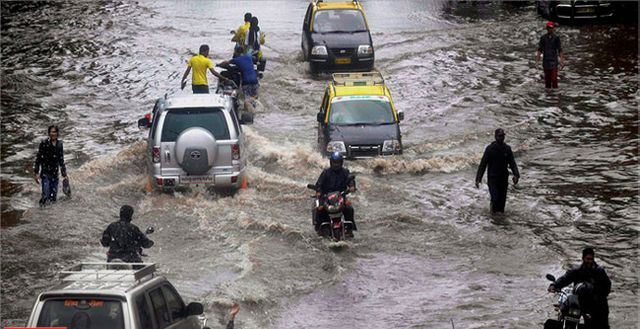
Floods in Mumbai
India’s financial capital, Mumbai, has suffered its worst flooding since heavy monsoonal rains in 2005. That disaster claimed 500 lives, most of them in makeshift shanty towns.
For the fourth day in a row, Mumbai was virtually paralysed today, with road, rail and air transportation heavily affected. On Tuesday, the city was hit by over 200mm of rain, the largest daily fall in 12 years. The equivalent of eleven days of standard monsoonal rains fell in less than 12 hours.
Yesterday morning, at least 12 people were killed and another 14 injured when a five-story building collapsed in a congested lane in the Bhendi Bazaar area of southern Mumbai, amid torrential rains. Another 25 people are believed to be trapped beneath debris.
A nursery school was located on the building’s ground floor. Infant children who attend the school had not yet arrived, meaning the death toll could have been far higher.
Building collapses are a common occurrence in India during monsoonal rains. Construction companies frequently use sub-standard materials and violate basic safety regulations, often with the active complicity of building authorities.
Commenting on the devastation, one Reuters article noted: “Unabated construction on flood plains and coastal areas, as well as storm-water drains and waterways clogged by plastic garbage, has made the city increasingly vulnerable to storms.”
According to the United Nations, more than 32 million people have been affected by the floods in India.
Save the Children reported that around 1.8 million throughout the South Asian region cannot go to school, after 18,000 school buildings were either destroyed or damaged by the floods. The charity warned that those children could be deprived of education permanently if it was not prioritized in relief measures. The indifferent attitude of the authorities to the disaster indicates that this is precisely what will happen.
In India’s eastern state of Bihar, 514 people have been killed and 17.1 million affected by flood-waters, according to disaster management officials. In the northern state of Uttar Pradesh, about 2.5 million have been affected and the official death toll stood at 109 by Tuesday.
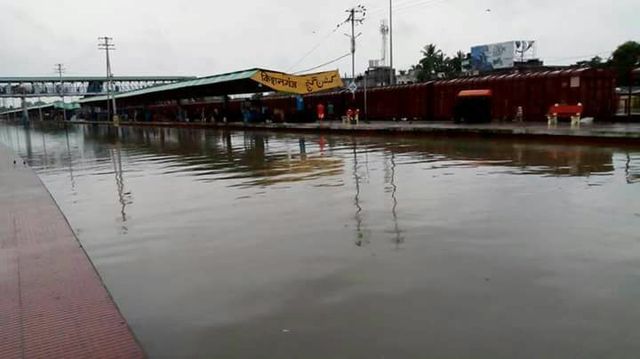
Flooded railway station in Kishanganj in North Bihar
At least 140 people have perished in Bangladesh. More than 700,000 homes have been destroyed and vast areas of farm lands ruined, posing the risk of long-term food shortages. In Nepal, 143 people have died and more than 460,000 people have been forced to leave their homes due to the floods.
It is already clear that virtually nothing was done by governments throughout the region to prepare for the inundation.
The failure of successive Indian governments to implement basic measures to mitigate the impact of annual floods is so blatant that the country’s Comptroller and Auditor General (CAG), an official body which audits government spending, felt compelled to issue critical comments last month.
A CAG report presented to the national parliament on July 21 stated: “There were huge delays in completion of river management activities and works related to border areas projects which were long-term solutions for the flood problems of Assam, north Bihar, and eastern Uttar Pradesh.”
The report, titled “Schemes for flood control and flood forecasting,” added: “Scientific assessment of flood-prone areas had not been completed in any of the 17 States/Union Territories [areas under direct control of central government]. Morphological studies, with a view to achieve better results in building, renovating and maintaining revetments, spurs and embankments to control and mitigate disasters caused by floods, were not completed by any of the 17 States/UTs.”
The report revealed that only 349 of 4,862 large dams across the country had emergency action/disaster management plans as of March 2016. It stated that “programmes for maintenance of dams were not prepared and adequate funds were not provided to carry out structural/repair work.”
It also stated: “Only 231 (5 percent) large dams evolved operating procedure/manuals. Out of 17 States/UTs, only two states had fully carried out the pre-monsoon and post-monsoon inspection of the dams, three states had carried out the inspections partially and remaining 12 states had not carried out these inspections.”
The contents of the report are a damning indictment of successive governments, including those that have been led by the Indian National Congress, and the current Hindu supremacist administration of Prime Minister Narendra Modi’s Bharatiya Janata Party (BJP).
Confronted with popular anger, Modi has frequently delivered hollow promises, and established a host of government bodies, that he claims will mitigate natural disasters. One of them, the National Disaster Management Authority (NDMA) was established three years ago, and is directly headed by Modi.
The CAG report made clear that the NDMA and similar bodies, however, have been window-dressing to cover-up the barely concealed contempt of the authorities for the plight of ordinary people most heavily-affected by flooding.
This week, Modi made empty assurances, via Twitter, that the national government would assist authorities in the state of Maharashtra, where Mumbai is located, with “all possible support.” Making clear that the victims of the disaster have been all but abandoned by the government, Modi also Tweeted to, “Urge the people of Mumbai and surrounding areas to stay safe and take all essential precautions in the wake of the heavy rain.”
Aditya Thackeray, the leader of Shiv Sena, a far-right party aligned with the BJP government, contemptuously told the people of Mumbai: “It isn’t a panic situation but only step outside your house [if it] is absolutely necessary.”