15 Sept 2017

Spain suspends Catalan independence law, escalating conflict with separatists

Alejandro Lopez

Spain’s Constitutional Court announced the suspension of the “transition” to independence law passed by Catalonia’s regional parliament last Friday. This comes after roughly 1 million people marched in Barcelona last Monday on Catalonia’s national day, and less than three weeks before the Catalan independence referendum scheduled for October 1.
The transition law was passed by the bourgeois separatist parties in the Catalan parliament, the Together for Yes coalition composed of the Catalan European Democratic Party (PdeCAT), the Republican Left of Catalonia (ERC) and the Candidatures of Popular Unity (CUP). It lays the basis for a constitution after a declaration of independence, if the “yes” vote carries in the referendum.
With the Catalan independence referendum and Madrid’s legal and police campaign to stop it, a profound crisis has erupted in the Spanish state system as it emerged from the post-1978 Transition to parliamentary democracy. It is fueling the breakdown of the European Union (EU) exemplified by Britain’s vote to leave the EU last year. After a decade of deep austerity and mass unemployment across Europe since the 2008 Wall Street crash, the ruling elite in Spain is violently divided.
The Popular Party (PP) government of Prime Minister Manuel Rajoy, whose political heritage extends to the pre-1978 fascist regime of Francisco Franco, is determined to take a hard line with the Catalan nationalists. The PP is under no illusion as to the class character of the Together for Yes coalition, whose constituent parties have supported or led pro-austerity governments in Catalonia.
Amid escalating social anger across Europe, however, the PP sees any initiative that might inadvertently trigger political opposition in the working class—in a region that was a center of opposition to Franco during the 1936-1939 Spanish Civil War—as a mortal threat. Despite warnings from the international press and from sections of the Spanish ruling class that it should negotiate a settlement with the Catalan separatists, the PP is pressing ahead with aggressive measures that threaten to provoke armed conflict inside the state machine.
Sections of the PP now propose to invoke article 155 of the Constitution, which would suspend the Catalan government and impose direct rule from Madrid. On Tuesday, PP parliamentary group spokesperson Rafael Hernando pointed out that article 155 “is a constitutional provision that is always on the table,” and Justice Minister Rafael Catalá said that “it is a tool that can be applied.”
Attorney General José Manuel Maza has ordered the four chief prosecutors in the Catalan provinces to investigate the 712 mayors who have expressed support for the referendum. This is three-quarters of the total number of mayors in Catalonia. If they do not appear before the Prosecutor’s Office voluntarily, Maza warned, police will be ordered to arrest them. The CUP has said its mayors will disobey the courts.
State prosecutors have also ordered the National Police, the paramilitary Civil Guards and the Catalan regional police to seize any material helping to prepare or hold the “illegal self-determination referendum, including ballot boxes, printed matter and computer equipment”. Printing companies have been raided in the search for ballot papers, and hundreds of additional policemen dispatched to the region.
Meetings held in support of the referendum have also been targeted, including one organized for September 17 in Madrid by Madrileños por el Derecho a Decidir (“Madrid residents who support the right to decide”), which has been banned. The judge responsible claimed that it is “not possible for an event that is openly against the Constitution and the resolutions of the Constitutional Court to be helped by a municipality that, as has been expressed, also has a duty to uphold the law.”
Despite the threats from Madrid, the Catalan separatists are pressing ahead with the referendum, setting the Spanish and Catalan bourgeoisies on a collision course in a conflict that is rapidly spiraling out of control.
The Catalan regional government under premier Carles Puigdemont (PDeCAT) refuses to back down, stating that “faced with judicial proceedings and threats” it “is more determined than ever” to hold the referendum. The campaign was launched Thursday night in Tarragona under the slogans “Hello New Country”, “Hello Republic”. “Hello Europe” and “Hello World”. The separatist parties have petitioned the Speaker, Carme Forcadell (ERC), to suspend the regional parliament during the campaign.
Concern is growing in the ruling class in Spain and internationally that the conflict between Madrid and Barcelona is sparking a crisis that could rapidly engulf Spain and the EU. Most are blaming PP Prime Minister Rajoy for his intransigence, arguing that Rajoy’s PP should be able to work out a deal with the Catalan nationalists.
The Spanish employers organisation, CEOE, has warned that whilst it supports the rule of law and “all actions” the government might take to enforce it, the “social co-existence and economic prosperity” of Spain are at stake. The CEOE declared that a political solution to the crisis had to be reached “with the greatest possible urgency.”
The Financial Times, under the heading “Time is running out for a Catalan compromise”, accused Rajoy of being “inflexible” and called on the Spanish government to see the referendum “as a political problem to resolve rather than sedition to be crushed”. It expressed its distaste for the “unedifying” scene of “Spanish security forces trying to hunt down illicit ballot boxes and voting slips”, comparing it to the “pageantry of civic protest” of the Catalan nationalists.
The referendum is not broadly popular among workers. While most polls show opposition to Madrid’s crackdown against the referendum, which 70 percent of Spaniards would like to see proceed, support for separation in Catalonia is also low, at 30 to 40 percent. Support for separation in Catalonia seems to be rising due to popular anger at Madrid’s crackdown, however.
The critical issue in this explosive situation is the independent political intervention of the working class in opposition to both the ruling elite in Madrid and the bourgeois separatists in Catalonia. Neither the division of Spain by the emergence of a new bourgeois state in Catalonia, nor the growth of a repressive police apparatus centered in Madrid, offer anything to workers.
The petty bourgeois “left” forces have devoted considerable resources to promoting a referendum led by bourgeois, pro-austerity and pro-NATO parties as a radical step forward. The Pabloite Anticapitalistas have described the referendum as a “political revolution” that, according to their leader Jaime Pastor, could “help democratize Spain, helping to stop the authoritarian tendencies of the regime.”
Nothing could be further from the truth. The Catalan separatists’ support for austerity and their indifference to the imperialist war drive unfolding in the Middle East, or indeed to anything occurring outside their region’s borders, is ultimately no less reactionary than Madrid’s policies.
They speak for sections of the Catalan ruling class who—conscious of that while Catalonia accounts for only 16 percent of Spain’s population, it represents a fifth of economic output and a quarter of Spain’s exports—are seeking a larger share of the profits. Angry that their taxes fund social spending in Spain’s other, poorer regions, they hope that by using Catalonia’s wealth, they could cut better deals for themselves on the world market if their region was autonomous or independent. They have proven themselves to be bitterly hostile to the working class.

Growing warnings of a stock market bubble

Nick Beams 

Concerns are starting to be voiced in the financial elites about how long the bull run in stock markets, which has delivered hundreds of billions of dollars to them in additional wealth, can continue.
Last Monday the S&P 500 index went past the record high it reached in early August marking the second longest-running bull market in US history, eclipsing the 1949-56 upsurge. It has risen by around 268 percent since the market low of March 2009, recorded in the wake of the 2008 global financial crisis. The longest bull run was from 1987 to 2000, which ended with the collapse of the dotcom bubble.
With the coming to power of the Trump administration, markets experienced a surge and have risen by about 16 percent. Initially this was fuelled by the belief that with its program of tax cuts for corporations, deregulation and promises of infrastructure spending it would be good for the bottom line. But even as doubts have arisen over how much Trump will be able to deliver the market rise has continued.
Now there is some degree of nervousness about how long the present upsurge can go on, which was voiced on Tuesday at a hedge fund conference in New York organised by the business channel CNBC.
The clearest warning came from long-time hedge fund operator Julian Robertson who said “we are creating a bubble” in the stock market. Stock market prices are too high because the low interest rate regimes established by the world’s central banks meant that investors are taking on too much risk.
“It’s the Federal Reserve’s fault and the Federal Reserves all over the world,” he told the conference. With interest rates at record historical lows there was “no real competition” for stocks, pointing out that until recently negative interest rates in the German government bond market meant that investors had to pay to hold its debt.
Leon Cooperman, the head of the hedge fund Omega Advisors, said while he did not expect a bear market, a 5 to 8 percent correction could happen at “any time” and bonds, where interest rates are at near all-time lows, “look like they’re in a bubble.”
Others are not so much concerned with the low interest rate policies of the central banks but with geopolitical risks, the most prominent of which is the threat of war on the Korean Peninsula.
The CEO of Blackstone Group, Stephen Scwarzmman said the issue was not so much economic or even the policies of the central banks. “It’s geopolitical and there’s some bad things going on in the world and conventional analysis says things will be fine.”
But whether it was North Korea or trade “there are a number of issues that people don’t want to focus on because the outcome would be really bad,” he said.
One of the indicators of the emergence of financial bubble conditions has been the rise and rise in the value of the cryptocurrency bitcoin, which has jumped by 335 percent this year to a price of more than $4,000. The astronomical increase in its value has attracted some attention from investors, prompting remarks by JPMorgan Chase CEO Jamie Dimon at a Barclays Investment conference this week.
He said the currency was a “fraud” and that he would fire anyone at the bank who traded in it “in a second,” likening its rise to the Dutch tulip mania of the 17th century. “It won’t end well,” he said, adding that it would eventually “blow up.”
But the speculation in bitcoin is only a very graphic expression of the forces at work in financial markets as a whole. This can be seen by contrasting the latest bull run with that the run up of the markets in the period 1949-56. In the earlier period, the market was sustained by the growth of US industry in the past war period. By contrast, the present bull run takes place under conditions of low growth—the US economy has been growing at only 2 percent or less, well below that of any previous “recovery”—coupled with falling productivity and stagnant or falling wages.
The present period also compares unfavourably with the record run from 1987-2000. While market growth in that period contained a large element of speculation—even the former chairman of the Federal Reserve Board Alan Greenspan had occasion in 1996 to refer to “irrational exuberance”—it was based, at least to some extent, on real developments.
These were the lowering of the cost structure of industry provided by the development of globalised production and the increased use of information technology. The present upsurge, however, has been virtually entirely driven by the ultra-cheap money policies of the Fed and other major central banks.
In fact the rise of the market is itself a reflection of the lack of investment opportunities in the real economy. Consequently, the share price bubble has been driven largely by financial manipulations such as the use of borrowed funds at low rates to finance share buybacks.
Evidence of the way in which the underlying weakness in the real economy has led to an increasing turn to financial operations was provided in an investigation by the Financial Times published this week.
It reported that Apple, Microsoft and Alphabet (the parent company of Google) are among a list of top US firms which have become a force in the global bond market. Some 30 major US corporations now hold more than $800 billion worth of fixed income investments and have become “asset managers in their own right” according to the head of JPMorgan’s corporate finance advisory group Ramaswamy Variankaval.
Overall the cash holdings of US corporations have risen to more than $2 trillion, an increase of 50 percent over the past decade and more than double their holdings at the turn of the century.
The Financial Times found that the 30 major companies which were the subject of its investigation, including firms such as Ford, Coca Cola and Boeing, hold more than $1.2 trillion in cash, cash equivalents and marketable securities.
These figures, which indicate the lack of investment opportunities because of low growth levels, point to the growing divergence between the rise of the stock market, and the real economy on which it ultimately depends.

What is Equifax and why does it have personal information on half the American population?

Kevin Reed

As further details emerge about the server breach at Equifax—one of the largest and most damaging theft of sensitive personal data in history—the magnitude and long-term implications of the credit reporting agency’s negligence are becoming clearer. The failure of Equifax to take the most basic security measures to protect the credit information of 143 million customers has rightfully provoked an angry response from people all around the world.
According to a company press release on September 7, hackers exploited a “website application vulnerability” at Equifax and gained access to huge volumes of consumer data—including Social Security numbers, birth dates, addresses and credit card account details—over a two-and-a-half-month period in the late spring and early summer of this year.
When the breach was discovered on July 29, company executives did nothing to alert anyone that their credit standing was in serious jeopardy. Instead, three top executives moved to sell $1.8 million of their company stock while they waited another six weeks to report the hack to the public.
Along with the press release, the CEO of Equifax Rick Smith appeared visibly shaken in a YouTube video where he promised to provide identity theft protection and credit file monitoring services at no charge to “every US consumer.” While he claimed that a preliminary investigation showed “no unauthorized activity on our core credit reporting databases,” he said that a dedicated web site and call center had been set up to “help consumers manage their personal situation.”
It quickly became clear that Equifax had no intention of responding to the flood of inquiries that came in, as phone calls went unanswered and the special web site ground to a halt. Meanwhile, it was revealed that the terms of service agreement for the free package contained provisions that prevented individuals from ever seeking injunctive relief from Equifax if damage to their credit caused financial harm.
Equifax has now reported that the server vulnerability was well known to the Apache developer community, and a patch had been developed for it months before the massive breach. In other words, Equifax never installed critical security updates on its public web site that had been available since March of this year. A company that is supposedly tasked with determining the financial responsibility of millions of people acted out of gross negligence.
Beyond the circumstances of the hack, the events of the past several weeks raise a broader question: What is Equifax, and why does it have the personal data of half of the American population?
Equifax—along with TransUnion and Experian—is a credit reporting agency (CRA) that collects information on the borrowing and repayment activity of private individuals. These companies do not receive permission from individuals to gather this data. They buy it from other companies, collect and package it, and sell to other companies.
The data on individuals maintained by the CRAs is held in a consumer credit report, which can include how often on-time payments are made, how much credit is available, how much credit is being used, and whether a credit account is in “collections” due to late or missed payments. The report can also contain public records such as liens, judgments, and bankruptcies that provide details about an individual’s financial status.
The report is distilled into a “credit score” that has enormous implications for individuals. This mystical number can determine whether you can get a credit card, a home mortgage, an apartment rental, an auto loan or even a job. It also is used to determine the interest rate on any loans you do get. An individual with a bad “credit score” can be forced to seek credit from loan sharks charging astronomical interest rates.
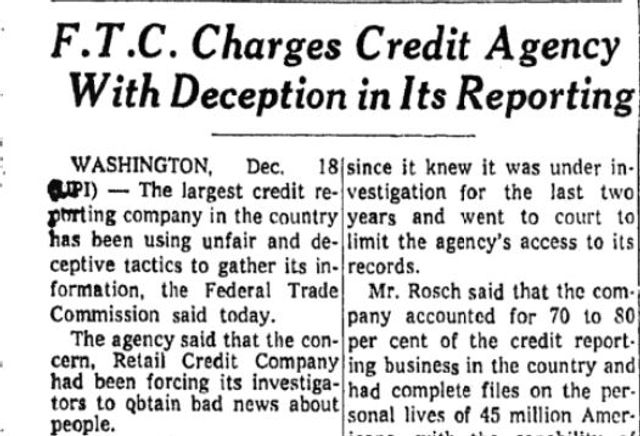
Equifax is the oldest of the three main CRAs. Founded in 1899 as Retail Credit Company, Equifax grew rapidly throughout the 20th century as a primary source of information for companies seeking to lend money or sell insurance to individuals. By 1960, it had grown into one of the largest CRAs. It pioneered the intrusive practice of maintaining millions of “files” on American and Canadian citizens about their personal health, habits, morals, use of vehicles, and finances. Employees of Retail Credit Company were rewarded for gathering negative information regardless of the basis in facts.
A clip from the New York Times, December 19, 1973, on the Retail Credit Company, predecessor of Equifax
As credit information went from paper to electronic form, the practices of the precursor to Equifax—including gathering information on an individual’s marital troubles, sex life, and political activities—began to come under public scrutiny. In the socially and politically explosive period of the late 1960s and early 1970s, the US Congress held hearings and passed the Fair Credit Reporting Act (FCRA), which restricted the activities of CRAs and granted consumers legal rights to the information contained in corporate databases.
As the reforms of the FCRA were enforced through an increasingly toothless system of slap-on-the-wrist fines, Retail Credit Company changed its name to Equifax in an attempt to distance itself from its past. However, the undemocratic and oppressive practices of the credit reporting industry continued and intensified with the expansion of computerization in business record keeping, data sharing, and the development of the Internet.
In the 1980s, the consumer credit scoring system devised by engineer William Fair and mathematician Earl Isaac was adopted as the standard for evaluating a consumer’s ability to repay loans. In 1989, the FICO score (for “Fair Isaac Corporation”), with the range of 350 (high risk) to 800 (low risk), was introduced. Since then, the FICO scores provided by CRAs for every individual have become the primary reference point for mortgages, auto loans, credit cards, and other forms of credit.
The development of the credit ratings agencies has correspondence to the financialization of the economy—the dominance of parasitic financial services over other forms of economic activity such as manufacturing. This same period has seen a steep growth in consumer debt. As the gap between the super-rich and the working class skyrocketed, tens of millions of working people were forced to rely upon various forms of credit to sustain living standards or just make it from day to day.
According to the Federal Reserve, American household debt as a percent of GDP was less than 20 percent in the years after World War II, and less than 50 percent in 1980. As the ruling class escalated the offensive against jobs and wages under Reagan and the administrations that followed, debt skyrocketed, to 97 percent by 2008. Even after the economic collapse of 2008, precipitated by the predatory lending practices of the financial industry, consumer debt stands at 80 percent of GDP today. Enormous profits have been generated for the lenders and their financial investors over this span of time.
Household Debt as a Percentage of GDP
Throughout this process, the credit reporting agencies like Equifax have played a crucial role as instruments of the big banks and investment firms to ensure that debts are collected and maximum interest rates are charged. Meanwhile, those who face the brunt of the economic crisis—the loss of a job, a wage cut, rising costs of health care, etc.— are doubly punished by credit reporting agencies, as they drop FICO scores just when workers are most in need of financial assistance.
There are, moreover, approximately 50 million people in the US who are so-called “credit invisibles,” with no credit records or with credit histories that are “unscorable.” This means that 10 percent of the eligible population does not exist for the consumer credit industry due to poverty or extremely low incomes. Lack of access to credit means these layers of the population are subject to the predatory lending of the payday loan industry and other forms of semi-legal or illegal lending.
The implications of the Equifax hack—as well as the outrageous behavior of company executives—are so damaging that both houses of Congress and several state governments have launched official probes. On Wednesday, the US House Financial Services Committee announced that Equifax CEO Richard Smith will testify on October 3 before a panel and be questioned about the breach and his company’s response to it.
Recognizing the growing hostility of millions toward the credit reporting industry, all manner of populist posturing has been mounted by Democrats and Republicans. For example, speaking about the $1.8 million sale of Equifax stock by three top company executives after the data theft was discovered, Senator Heidi Heitkamp of North Dakota—a prominent Democratic backer of Trump’s proposed corporate tax cuts—told Reuters, “If that happened, somebody needs to go to jail.”
Nothing of significance will come of the official proceedings in Washington, DC and the state houses in Rhode Island, Connecticut, Pennsylvania or Illinois over the Equifax debacle. This is because any penetrating examination of the big business of credit reporting, FICO scores and “identity protection” services will expose the truth of class relations under capitalism, i.e., the dictatorship of the financial elite over the whole of society.
The negligent practices of Equifax with the personal credit data of millions is one more indication of the real relationship between the oligarchy at the top of society and the rest of the population.
In the aftermath of Equifax data fiasco, it is entirely possible for workers to conceive of circumstances where there is no need for human beings to be identified as a three-digit FICO score, where there is no parasitic elite that rules over the whole of society, where everyone has the right to a decent, high-paying job, and is not subject to the whims of the credit reporting agencies and the financial institutions they serve.
This, however, will require the abolition of the entire financial industry, its transfer to public ownership based on workers’ control, and a massive redistribution of wealth from the financial elite to the working class that produces all the wealth of society. It will require, in short, a political movement of the working class to abolish the capitalist for-profit system and establish socialism.

US Census report shows increasing social inequality

Eric London

US Census data from 2016 released on Tuesday shows increasing social inequality amid a small gain in household income that is offset by a massive growth of personal debt and rising living costs.
The data tracks the ongoing redistribution of wealth from the working class to the wealthy as a result of the pro-Wall Street policies of both the Republican and Democratic parties. It substantiates the oligarchic character of the United States.

Social inequality

The Gini index, used to measure social inequality, with higher figures indicating a wider economic divide, rose slightly from 2015 (.479) to 2016 (.481). The 2016 figure, according to rankings in the CIA World Factbook, makes the US slightly more equal than Madagascar and less equal than Mexico.
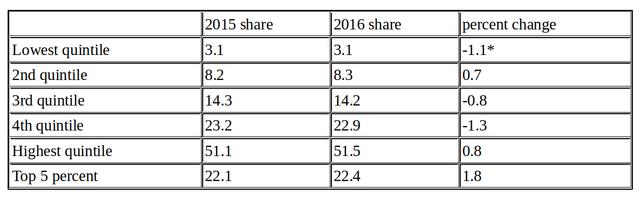
In terms of aggregate income share, the shift from 2015 to 2016 is as follows:
Income share from 2015-2016. *Census data reported to one significant figure, meaning percent decline is not reflected in 2015 and 2016 share columns.
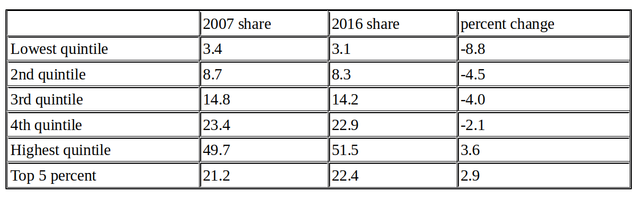
The growth in inequality is even starker when traced from 2007, the year before the Wall Street crisis.
The data reflects income and not wealth, thereby providing an incomplete and conservative indication of the scale of inequality. Even within the highest quintile, the income share increased only for the top 10 percent, and, in particular, the top 5 percent.
Income share from 2007-2016

Household income

The corporate media has portrayed the report as a sign of positive income growth, since it shows a slight rise in median income of 3.2 percent from 2015 to 2016.
But according to the Census data, the earnings of “full-time, year-round workers” remained stagnant. For men in this category, a total of 63.9 million people, earnings declined by 0.4 percent, from $51,859 in 2015 to $51,640 in 2016. For women in this category, 47.2 million people, there was a minor increase, 0.7 percent, from $41,257 in 2015 to $41,554 in 2016. In other words, families with 2 adults working full-time saw a paltry $78 increase in their yearly earnings from 2015 to 2016.
Claims of rising incomes mask the growth of inequality. The Census data shows that the household income of the 90th percentile (the 100th being the highest) was 12.53 times higher than the household income of the 10th percentile in 2016, up from 12.23 times higher in 2015 and 11.18 times higher in 2007. The degree to which income is concentrated in the richest 10 percent of the population is exemplified by the fact that the 5th percentile boasted a household income 3.82 times higher than the 50th percentile in 2016, up from 3.79 times in 2015 and 3.52 in 2007.
As Bloomberg News reported Wednesday, “Since 2007, average inflation-adjusted income has climbed more than 10 percent for households in the highest fifth of the earnings distribution, and it’s fallen 3.2 percent for the bottom quintile. Incomes of the top 5 percent jumped 12.8 percent over the period.”
For the working class, any income increase was transferred to the corporate elite in the form of rising debt payments and increasing living expenses, especially for health care.
According to figures from eHealth, a large private health exchange, average deductibles for families rose 5 percent from 2016 to 2017 (a year after the period covered by the Census report) and average individual premiums rose 22 percent over the same period.
The rising cost of student debt alone largely erases income increases seen by some young people. According to the Census, those aged 15 to 24 saw an income increase of 13.9 percent, from $36,564 in 2015 to $41,655 in 2016, while incomes for young people aged 25 to 34 rose 4.9 percent, from $58,091 to $60,932, nearly double the percentage increase for older age groups.
However, in 2016, student debt rose to an average of $30,000 per young person, up 4 percent from 2015, eliminating over 80 percent of the income rise for 25-34 year olds. For 15 to 24 year olds, the $4,000 increase in median income would hardly cover one sixth of the average debt payment, let alone make up for the fact that young people face a future in which they are unlikely to receive a pension, Social Security or Medicare.
Rising debt levels are not a phenomenon limited to young people. A Bloomberg report from August 10 notes that credit card defaults increased from the beginning of 2015—when roughly 2.5 percent of debt holders defaulted—to the end of 2016, when the total hit 3 percent. This figure subsequently climbed in 2017 to reach 3.49 percent.
Bloomberg notes: “After deleveraging in the aftermath of the last US recession, Americans have once again taken on record debt loads that risk holding back the world’s largest economy... Household debt outstanding--everything from mortgages to credit cards to car loans--reached $12.7 trillion in the first quarter [2017], surpassing the previous peak in 2008 before the effect of the housing market collapse took its toll, Federal Reserve Bank of New York data show.”
“For most Americans,” the report continues, “whose median household income, adjusted for inflation, is lower than it was at its peak in 1999, borrowing has been the answer to maintaining their standard of living. The increase in debt helps explain why the economy’s main source of fuel is providing less of a boost than in the past. Personal spending growth has averaged 2.4 percent since the recession ended in 2009, less than the 3 percent of the previous expansion and 4.3 percent from 1982-90.”
The Bloomberg report explains that income from wages minus household debt trended downward in 2015, meaning that debt is rising faster than wages, causing a loss of roughly $500 billion across the US economy in the space of just one year.

Poverty rate

Though the Census report shows that the poverty rate declined from 13.5 percent of households in 2015 to 12.7 percent in 2016, this figure is substantially higher than the 11.3 percent level that prevailed in 2000. In reality, individuals and families must make 2.5 to 3 times the official poverty rate of $12,000 for an individual, $15,500 for a married couple and $25,000 for a family of four just to make ends meet.
What the data really shows is that the poorest half of the country--over 150 million people--is in a desperate financial position, with the next poorest 40 percent facing constant financial strain and a declining share of the national income. In regard to poverty, the Census Bureau maintains figures that go up only to 200 percent of the official poverty level. The latest report shows that 95 million people—29.8 percent of the population—fall into this category. The share of those under the age of 18 in this category is much higher--39.1 percent.
This is the context for the drive by the Trump administration and both big business parties to slash corporate taxes, impose a health care “reform” that will increase costs for millions of people, and accelerate the transfer of wealth from the working class to the financial aristocracy.

14 Sept 2017

Nestlé Creating Shared Value Prize for Social Entrepreneurs 2017

Application Deadline: 31st October 2017.
Eligible Countries: All
To Be Taken At (Country): Prize winners will be awarded in Brazil
About the Award: Nestlé established the CSV Prize to reward initiatives that reflect the spirit of Creating Shared Value. We look for innovative projects, programmes or businesses that have already been tested either as a pilot study or at a small scale; that demonstrate positive social and environmental impact; and that need support to become commercially viable.
Nestlé invests financial and technical resources in the winning initiatives, to help them expand and achieve financial sustainability.
Type: Entrepreneurship, Contest
Eligibility: 
  • Entities eligible for the CSV Prize are social, private or hybrid enterprises as well as non-governmental organisations (NGOs). Applications from local, grassroots organizations are preferred over applications from international, large-scale
    organizations.
  • Teams of individuals, employees of Nestlé S.A., their parent companies, affiliates and subsidiaries, joint ventures, participating advertising and promotion agencies (and members of their immediate family, defined as parents, children, siblings and spouse, regardless of where they reside, and/or those living in the same household) are not eligible.
  • The aforementioned employees (and members of their immediate family as defined in the paragraph before) will not be eligible neither if they participate through an organisation that they have founded or where they hold a major participation or
    management position
  • Applications must be in English, French, Spanish, or Portuguese.
  • Applications covering programmes that have been awarded the CSV Prize in former nomination periods are not eligible for the CSV Prize again.
Selection Criteria: Winning applications will show strength in the following areas:
  • Innovation
  • Environmental Impact
  • Social Impact
  • Scalability
  • Financial Sustainability
  • Organizational Leadership
  • Potential for Creating Shared Value
Number of Awards: Not specified. The Creating Shared Value Council may decide to award the Prize to more than one, but a maximum of three, Winners.
Value of Award: For 2018, the Prize package includes a cash prize of up to CHF 400’000, a pitch opportunity at the World Water Forum in Brasil in 2018, and a prestigious Ashoka Fellowship.
Duration of Program: March 2018: Public announcement of the Nestlé CSV Prize Winner 2018
How to Apply: APPLY ONLINE
Award Providers: Nestlé

Glenna Luschei Prize for African Poetry (USD5,000 Prize) 2018

Application Deadline: 1st October, 2017
Offered annually? Yes
Eligible Countries: African Countries
About the Award: This Pan African Poetry Prize, established to promote African poetry written in English or in translation and to recognize a significant book published each year by an African poet, is the only one of its kind in the world.
Each year, a significant African writer judges the contest. Open annually from May to October to submissions from authors and publishers, a winner will be announced in early December.
Type: Contest
Eligibility: 
  • The Luschei Prize for African Poetry is open to any book of original poetry, in English, published during the previous calendar year in a standard edition of a full-length collection of poetry written by any African writer. Books must be submitted in the year after their publication, which means that books published in 2016 may be submitted for consideration between May 1 and October 1, 2017.
  • An “African writer” is taken to mean someone who was born in Africa, who is a national or resident of an African country, or whose parents are African.
  • A standard edition is 48 pages or more in length.
  • Only poetry submissions in English can be considered, but we welcome published works of translation for consideration.
  • Self-published books are ineligible.
  • Books published by the APBF and its African Poetry Series are ineligible.
  • There is no entry fee but an entry form is required for each title submitted. The winner will be announced in December.
Number of Awardees: 1
Value of Contest: USD $5,000
Duration of Contest: Open annually from May to October to submissions from authors and publishers, a winner will be announced in early December.
How to Apply:
  • Download the Entry Form.
  • Publishers may submit as many eligible titles as they wish. The publisher should send four copies of each book to the APBF, postmarked between May 1 and October 1, 2016.
  • Uncorrected galleys (including PDF galleys) of books will be considered as long as the publication date falls within the period of eligibility.
  • Please send four copies of each entry to the following address, postmarked between May 1 and October 1, 2017:
The Glenna Luschei Poetry Prize
The African Poetry Book Fund
Prairie Schooner
110 Andrews Hall
University of Nebraska-Lincoln
Lincoln, NE 68588-0334
Books will not be returned but may be donated to the African Poetry Libraries Initiative.
Award Provider: The Glenna Luschei Prize for African Poetry

Miss.Africa Seed Funding for African Women in Tech Businesses 2018

Application Deadline: 2nd February 2018
Offered annually? No
Eligible Countries: African countries
To be taken at (country): African countries
Eligible Fields: Projects eligible for grant funding include, but are not limited to:
– Computer science workshops and trainings for women and girls
– Early incubation of female tech entrepreneurs
– Programming and app development training programs
– Hackathons and coding boot camps for girls
About the Award: The Programme is interested in learning about successful activities that are currently supporting women and girls in STEM, and through this effort, we identify how we might support scalability and their impacts.
Type: Entrepreneurship
Eligibility: To apply for a Miss.Africa Seed Fund grant applicants must meet the following eligibility requirements:
–  Current resident of an African country (including North and Sub-Saharan Africa).
–  Application must be submitted in English.
–  Applying as an individual (at least 18 years of age), or a representative of a non-governmental organization (NGO) or social enterprise based in Africa.
–  Ability to demonstrate previous experience conducting activities supporting women and girls in computer science or STEM fields.
–  Commitment to developing and contributing to a virtual community for supporting women and girls initiatives.
–  Demonstrated leadership potential (references will be required for those applying for leadership funds).
–  Proposed projects MUST have a tangible impact for women and girls in computer science and/or STEM- related fields.
Selection Criteria: Preference will be given to projects that target under-served populations and locations, take a collaborative approach, have a high potential for growth and present an innovative use of technology.
Number of Awardees: 3
Value of Funding: 
  • The 2018 Seed Grant for the amount Five Thousand US dollars (USD 5,000) will assist the winning initiative to start or expand their capacity.
  • A second category of One Thousand United States Dollars (USD 1000) will be granted  as a prize for two other applicants from emerging African countries that create further socio-economic value for women by effectively leveraging tech opportunities.
Duration of Programme: Round One of Miss.Africa grants to be announced on the 2nd of March 2018
How to Apply: To apply, fill the application form then send an Expression of Interest  (EOI) to: eoi@dotconnectafrica.org.
Award Provider: Dot Connect Africa (DCA) Academy

IFFR Young Film Critics Talent Development Program (Funded to Rotterdam, The Netherlands) 2018

Application Deadline: 1st November 2017
Offered Annually? Yes
Eligible Countries: All
To Be Taken At (Country): Rotterdam, The Netherlands
About the Award: Young and upcoming film critics from outside the Netherlands get less opportunities to explore and sharpen their knowledge and views on independent and experimental cinema. International Film Festival Rotterdam recognizes the important role of film criticism and supports journalistic talent with a trainee project for the next wave of film journalists: the IFFR Trainee Project Young Critics.\
The IFFR Trainee Project for Young Film Critics, created in 1998, is a talent development programme that offers young (under 30 years), motivated and talented professional film critics from outside the Netherlands a chance to travel abroad, cover major international film festivals and, in particular, get acquainted with International Film Festival Rotterdam and the broad range of independent cinema it offers.
Type: Training
Eligibility: 
  • Age under 30 years
  • Fluent command of the English language (written and spoken)
  • Demonstrable experience in film criticism (print or online media)
  • Not yet established enough to profit from facilities as attending international film festivals outside your country
  • Have agreement(s) with relevant print and/or online media to publish reports on International Film Festival Rotterdam 2018
Number of Awards: Not specified
Value of Award: 
  • Complimentary IFFR 2018 press accreditation
  • Budget hotel accommodation in Rotterdam
  • Partial refund of travel costs when traveling from outside Europe
  • A full schedule. IFFR wants its trainee film critics to really participate in the festival and interact with other industry professionals. The trainees will form a team, hosted by the IFFR Press Office and the festival editorial staff. You get to explore all aspects of IFFR (screenings, exhibitions, Q&A sessions, and debates) as part of the program and to cover for your own media
  • If your participation is successful and you have published reports that meet IFFR standards (in both quality and quantity) you get the opportunity to visit the next edition of the festival as an accredited journalist
Duration of Program: 24th Jan – 4th Feb 2018
How to Apply: If you like to join the programme during IFFR 2018 please send the following:
  • CV
  • Motivation Letter
  • Three samples of your recent work
  • Recommendation Letter
  • Information about your affiliate (circulation, copies/page views etc.)
Award Providers: International Film Festival Rotterdam

University of Texas (Austin) Annual Africa Conference 2018

Application Deadline: 30th November 2017
Offered Annually? Yes
To Be Taken At (Country): University of Texas at Austin
About the Award: The 2018 Africa Conference will critically examine Africa’s political leadership and extant institutions vis-à-vis the continent’s history of underdevelopment, present challenges, and future trajectories within the global political economy. Scholars are invited to interrogate the nature and evolution of leadership and institutions in Africa from the pre-colonial era to contemporary times. Institutions in this context are broadly defined to include formal and informal institutions, including history, traditions and culture of the people. Is it leadership that shapes institutions or do institutions determine the quality of leaders that emerge? How can African states achieve the leadership and institutional transformation necessary to address the perennial development challenges of the continent? Are there lessons that could be drawn from the experiences of the pre-colonial era to inform contemporary issues of leadership?
Fields of Research: Submissions that include but are not limited to the following sub-themes and topics:
  • Institutions Conceptualized
  • Leadership and Institutions in Pre-colonial Africa
  • Leadership and Institutions in the Colonial Era
  • Colonial Legacies
  • The Nature of Political Leadership in Postcolonial Africa
  • Institutions in Postcolonial Africa
  • The Cold War and Africa’s Postcolonial Leadership
  • Multilateral Institutions in Africa
  • Information Technology and Social Media
  • Education
  • Creativity and Performance of Leadership/Institutional deficits
Type: Call for Papers/Conference
Eligibility: Participants will be drawn from around the world.
 Graduate students are encouraged to attend and present papers.
Each individual proposal must include: 1) title of the work, and an abstract of 200 words, 2) name of the presenter (with the surname underlined). 3) mailing address, 4) number phone, 5) email, 6) institutional affiliation, and 7) three to five keywords that best characterize the themes and topics relevant to your submission. Participants are encouraged to abide by these guidelines.
Proposals for panels (3-5 presenters) must include: 1) title of the panel and a collective summary of 250 words on the panel’s theme, including the title of each individual work 2) a 200-word abstract for the presentation of each speaker 3) mailing address 4) phone number 5) email and 6) institutional affiliation of each presenter. Panels with four presenters or less may be completed with other relevant presentations.
Number of Awards: Not specified
Value of Award: The conference will provide time for scholars from various disciplines and geographical locations to interact, exchange ideas, and receive feedback. Additionally, selected papers will be published in a series of book volumes. Submitted papers will be assigned to particular panels according to similarities in theme, topic, discipline, or geographical focus. Panel proposals (of 3-5 presenters) are especially encouraged.
A mandatory non-refundable registration fee of $150 for scholars and $100 for graduate students must be paid immediately upon the acceptance of the abstract. This conference fee includes conference t-shirt and bag, admission to the panels, workshops, and special events, as well as transportation to and from the hotel and conference events. Registration also includes breakfast for all three days, dinner on Friday night, lunch on Saturday, a banquet with DJ and open bar Saturday evening, and a closing celebration at Dr. Falola’s house including dinner and DJ. All participants must raise the funding to attend the conference, including registration fee, transportation and accommodation. The conference and the University of Texas at Austin does not provide any form of sponsorship or financial support. However, the Holiday Inn Austin Town Lake will have a special rate for conference participants, and transportation between the hotel and the university is included.
Duration of Program: March 29-31, 2018
How to Apply: Proposals will be accepted on the official conference website here
Award Providers: University of Texas at Austin

Iso Lomso Fully-funded Fellowships for Early Career African Researchers 2017

Application Deadline: 15th November 2017
About the Award: The Stellenbosch Institute for Advanced Study is a high-level research institute dedicated to innovative thinking, the production of new knowledge and the nurturing of emerging leaders. It was established in 1999 as an
independent Public Benefit Organization with its own Board of Directors. Over the past decade STIAS has emerged as a prime research destination on the continent of Africa.
Its aim is to provide a creative space for the mind where leaders in their respective disciplines can devote their undivided attention to innovative projects of their own choosing, free from the distractions of lecturing and administrative responsibilities.
While it belongs to the family of institutes for advanced study, for example Princeton, Berlin, Uppsala, Stanford, Harvard and Nantes, STIAS is distinguished by three aspects: It serves all disciplines, not only the natural sciences, social sciences or the humanities; it concentrates on interdisciplinary discourse and projects; and it has a special focus on Africa.
Iso Lomso aims to address the gap that exists between completion of the Ph.D. and becoming an established scholar in Africa. While there is increasing support for doctoral study and for post-doctoral fellowships, it is during the extended post-doctoral period that the greatest loss of talent occurs.
Iso Lomso takes its cue from the ethos and objectives of STIAS. It does not offer an alternative programme to the regular fellows’ programme, but complements and builds on the proven and successful model of the Institute. It aims at enhancing the existing cross-fertilization of minds by broadening its scope through the inclusion of a younger generation.
Fellows are expected to be present at STIAS for the duration of their STIAS residency, with no academic obligations other than pursuing the proposed research project. The only other duties are to share in the discussion over lunch which is served daily, and to participate in the Thursday STIAS fellows’ seminar where fellows in turn present their work to other fellows and invited academics from the local community.       
Type: Fellowship
Eligibility: The programme is aimed at African scholars who have obtained a doctoral degree within the preceding seven years and who hold an academic position at a university or research institution anywhere in Africa. Candidates should have established a research programme and have completed a post-doctoral fellowship or equivalent post-PhD programme. All disciplines are considered.
To be eligible applicants must:
• be a national of any African country;
• be born after the 1st of January 1976;
• have an affiliation at a research or higher education institution in an African country, and continue to do so for the foreseeable future;
• have obtained a doctoral degree from any recognised higher education institution (worldwide) after the 1st of January 2011;
• have completed a post-doctoral fellowship or equivalent post-PhD research programme;
• be in a position to commence a first period of residency at STIAS during the second half of 2018 or the first half of 2019.
Selection Criteria: Applications will be evaluated and selected on the basis of the following criteria:
• Level: the applicant’s academic excellence and the originality and scholarly strength of the proposed research project;
• Innovation: the project’s promise of new insights and the potential to produce new knowledge;
• Interdisciplinarity: whether the project methodology allows for drawing from different disciplines and its potential to facilitate an interdisciplinary discourse;
• Relevance: the project’s relevance for scholarship and knowledge production in Africa;
• Feasibility: whether the research design and the research plan are convincing and realistic.
During final selection, additional consideration will be given to:
• gender representation;
• diversity of nationalities;
• diversity of disciplines;
• participation in previous or current research projects;
• previous international experience.
Number of Awards: 20
Value of Award: Iso Lomso Fellows will enjoy:
  • a three-year attachment to STIAS during which time they may spend a total of ten months in residence at STIAS to develop and pursue a long-term research programme;
  • the possibility of a residency at a sister institute for advanced study in North America, Europe or elsewhere;
  • funding to attend up to three international conferences or training workshops anywhere in the world;
  • support to convene a workshop with collaborators at STIAS;
  • lecturer replacement subsidy for the fellow’s home institution during residency periods.
Duration of Program: 3 years
How to Apply: Download the Iso Lomso Application Form 2017
Award Providers:  Stellenbosch Institute for Advanced Study  (STIAS)

University of Newcastle Commonwealth Government Scholarships for Masters & PhD 2018/2019 – Australia

Application Deadline: 16th February 2018
Offered annually? Yes
Eligible Countries: International
To be taken at (country): University of Newcastle, Australia
About the Award: Full-time research students are eligible to apply for University and Commonwealth Government scholarships, which are awarded during one main round offer. They provide a living allowance so you can commit to full-time study. Historically over 90% of international students hold a scholarship from UON or a sponsor.
Type: Masters, PhD
Selection Criteria: Scholarships are granted on the basis of academic merit, which includes your undergraduate grade point average and extra research attainments.
Eligibility: To be eligible for scholarship candidate must:
  • written statement of support from a UON supervisor
  • an satisfy the English proficiency requirement (IELTS of at least 6.5, 7.0 in some disciplines)
  • met admission eligibility criteria
  • be no more than two full-time equivalent years into their PhD (or one year for Masters) at the scholarship closing date in which you are applying.
Successful international scholarship candidates usually also have:
  • A master degree with strong research component
  • International peer reviewed research publication or research experience
Number of Scholarships: Several
Value of Scholarship: A scholarship funded by the University of Newcastle or the Commonwealth Government provides:
  • An annual living allowance $26, 682 per annum (2017 rate – indexed annually)
The scholarship may also include:
  • a relocation allowance (up to $1,500)
  • a full tuition fee scholarship
  • overseas student health cover (OSHC) (international students and their dependents)
Duration of Scholarship: PhD scholarships are for three years and Masters scholarships are for two years, less any tenure already completed towards a research degree.
How to Apply
  • Currently enrolled candidates can apply for a scholarship by contacting researchscholarships[@]newcastle.edu.au
  • New applicants can apply for a scholarship at the same time as applying for admission.
Sponsors: The University of Newcastle and Commonwealth Government
Important Notes: ensure you attach the following documents to support your scholarship application:
  • Copies of research publications, exhibitions or conference papers
  • Curriculum Vitae
  • Details of previous research experience e.g. research work experience / study
  • Any additional documents that may add to your scholarship application e.g. evidence of the award of a University Medal