18 Sept 2017

World hunger increasing for the first time in 100 years

Shelley Connor

The number of people suffering from malnutrition worldwide rose to 815 million in 2016, rising by 38 million from the year before. According to a new report co-signed by five United Nations agencies and charities, and made public by the Food and Agriculture Organisation of the UN (FAOUN) on Friday, this was the first such year-to-year increase in a century.
The development of science and technology, and their spread around the world in the form of gigantic increases in food production, have made possible a century-long reduction in the number suffering from hunger and malnutrition. In 2016, the world produced more than enough food to provide an adequate and nutritious diet to every human being on the planet.
But these gains are now increasingly offset by war and the impact of climate change, according to the UN report. Another factor—on which the UN report is largely silent—is the impact of mounting economic inequality, which means that in both comparatively wealthy and poor countries, many people are too poor to purchase the food that exists in abundance.
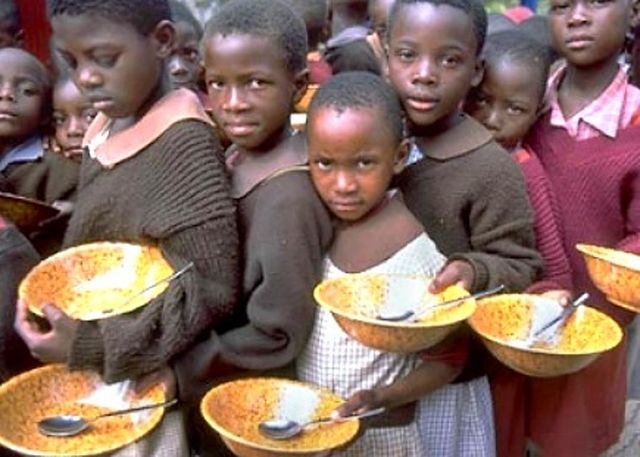
The five agencies involved in the study are the Food and Agriculture Organization, the World Health Organization, the International Fund for Agricultural Development, the World Food Programme, and UNICEF. As is typically the case in such reports, the language is deliberately restrained and the approach cautious and incremental, even when addressing what can only be described as a social catastrophe.
In 2016, for example, an estimated 155 million children younger than five were classified as “stunted,” too short for their age, because their physical development lagged significantly because of lack of food. Some 52 million children were considered undernourished, not heavy enough for their height. One-third of the population of eastern Africa, and one-fifth of the population of the entire continent, were undernourished. In Asia, 12 percent of the population were undernourished, mainly in South and Southeast Asia.
The report warns that significant progress in reducing malnutrition worldwide, from the level of 900 million people in the year 2000, is now in danger of being reversed. In just the last year, chronic undernourishment surged to an “extreme level” worldwide. Famine was declared in South Sudan in February. Yemen, northeast Nigeria, and Somalia teeter on the edge of famine.
The number of chronically undernourished people rose to 815 million in 2016—a number greater than the population of the entire European continent. Of that number, 489 million, 60 percent, live in countries affected by war or civil conflict.
The foreword to the report states that not only have conflicts “risen dramatically in number” over the past decade, but they have “become more complex and intractable in nature.” The residents of countries in conflict zones are almost two-and-a-half times more likely to be undernourished than those in other countries. In South Sudan, severe food insecurity afflicts around 4.9 million people—over 42 percent of the population.
In Yemen, 60 percent of the population—an estimated 17 million people—suffer from severe food insecurity. This number represents a 47 percent increase from June of 2015. Pediatric malnutrition has been “a serious problem for a long time” in Yemen, according to the report. However, acute undernutrition, or wasting, has risen sharply in the past three years. The report cites “the conflict-induced, economy-wide crisis that is affecting the entire population.”
War and internal conflict create food insecurity in myriad ways. One is through population displacement. According to the FAOUN report, the number of refugees and internally displaced persons (IDPs) has “increased significantly along with the greater number of conflicts,” doubling from 2007 to 2016 to a total of 64 million people.
One out of every 113 human beings is currently a refugee, an IDP, or seeking asylum. An estimated 70 million people worldwide are likely to suffer undernourishment as a result of displacement.
War also exacts heavy tolls on agriculture and food distribution systems, “from production, harvesting, processing and transport to input supply, financing and marketing,” states the report. In Iraq, for example, prior to the 2003 US invasion, the Nineveh and Salah-al Din districts produced a third of the country’s wheat and 40 percent of its barley. Yet by February 2016, 70-80 percent of Salah al-Din’s grain cultivations were damaged or destroyed; in Nineveh, which includes the city of Mosul, 32-68 percent of the land used for wheat cultivation had been either compromised or destroyed, as well as 43-57 percent of the land used to cultivate barley.
In Syria, where agriculture once thrived—and where many scientists believe it originated historically—six years of attempted regime change by the United States have devastated the country’s cultivation. Eighty-five percent of Syrians now live in poverty. An estimated 6.7 million faced acute food insecurity in 2016. Acute malnutrition—wasting—is currently seen at increased levels in most areas.
One of the most insidious ways that conflict drives undernourishment lies in “food … being used as a weapon of war.” The report mentions the use of trade blockades in South Sudan. It notably fails to mention the Saudi-led blockade against Yemen, where imported grains supply the bulk of the population’s nutrition.
Conflict is not the only source of undernourishment, as the FAOUN report makes clear. Climate extremes have led to sharp increases in food insecurity in Sub-Saharan Africa as well as Southwest and Southeast Asia.
In addition, as the World Socialist Website has reported in the past, diseases of malnutrition are once again on the rise in developed countries such as the United States and Great Britain. In these countries, it is not uncommon to find occurrences of morbid obesity alongside undernourishment in a single family. As wages stagnate and food prices continue to increase, many people can only afford heavily processed, starchy foods. Such products are more profitable for companies to supply, because they are less prone to spoilage and are therefore cheaper to transport and store.
This is a burgeoning health crisis, as the report points out: “food insecurity and poor nutrition during pregnancy and childhood are associated with metabolic adaptations that increase the risk of obesity and associated non-communicable chronic diseases in adulthood.”
As the report’s authors say, the results of the UN’s assessments have “set off alarm bells we cannot afford to ignore.” However, while the UN rightly points out that conflict engenders undernourishment, it blatantly omits the role that imperialism plays in these conflicts. It classifies the conflicts in South Sudan and Syria as internal conflicts, when, in fact, the chaos in both countries has been directly caused by the United States, its allies, and its proxies. It even fails to mention the United States at all in its assessment of Iraq, invaded, laid waste to and occupied by US military forces from 2003 to 2011, and still a battleground.
The report’s authors suppress any mention of the Saudi-led coalition’s attacks upon Yemen, as well as US complicity in those attacks; in many instances, the coalition has blocked humanitarian aid organizations from entering the country, and it has bombed numerous hospitals and mobile clinics. But the report details the same crimes at some length when perpetrated by “warring factions” in South Sudan.
Largely ignored are the long-range, ever more obvious effects of manmade climate change. No critique is leveled against the corrosive social effects of the profit motive, which is responsible for both climate change and the dearth of affordable nutrition in developed countries.
The worldwide capitalist crisis threatens new, more lethal wars. The imperialist nations cannot address food insecurity, not only because they have caused it with their militarism and unchecked industrial pollution, but because they are fundamentally incapable of solving their own contradictions. Even as this report was released, unprecedentedly violent hurricanes submerged entire cities, displaced thousands, and claimed lives throughout the American Gulf Coast and the Caribbean.
Global hunger can only be eradicated by putting an end to the contradictions of capitalism and replacing it with an economic system based upon social need. The UN may sound the alarm bell about widespread undernourishment, but only the struggle of a united international working class can put an end to it.

16 Sept 2017

Phanes Group Solar Incubator for PV projects in sub-Saharan Africa (Funded to Abidjan, Côte d’Ivoire and Dubai, UAE) 2017

Application Deadline: 1st October 2017
Eligible Countries: sub-Saharan Africa
To Be Taken At (Country): Abidjan, Côte d’Ivoire
About the Award: The Phanes Group Solar Incubator was initiated to select and support PV project opportunities in sub-Saharan Africa that for a number of reasons might not be able to reach beyond the planning phase. Secondly, it represents an opportunity for Phanes Group to utilize its expertise and experience to give back to the communities in the economies it serves.
The winning candidate(s) will enter a partnership with Phanes Group holding a long-term stake in the project. Jointly, we will bring the project to financial close. Phanes Group and its partners will provide extensive mentorship and knowledge transfer throughout the development partnership – kicking off with the incubator phase in Dubai, UAE, while also setting the foundations to deliver bankable projects in the future.
Type: Entrepreneurship
Eligibility: The Phanes Group Solar Incubator will only be open to PV projects, given Phane’s expertise and added value in this particular technology.
Selection Criteria: 
  • Project must be submitted by its owner(s) (or jointly “owners”) or by its/their representatives via a legally valid representation document (e.g. POA);
  • The project must be located in sub-Saharan Africa;
  • Project must utilize PV technology;
  • Project must have a capacity of minimum 10 MW up to 100 MW maximum on-grid;
  • Project must demonstrate a convincing CSR concept (e.g. community involvement).
Number of Awards: Not specified
Value of Award: 
Pre-Incubator Phase Benefits at a Glance:
  • Complimentary ticket for “Unlocking Solar Capital Africa”;
  • Complimentary return flight from country of origin to Abidjan, Côte d’Ivoire;
  • Complimentary accommodation for one night in Abidjan, Côte d’Ivoire;
  • Opportunity to present the project to a panel of high-level industry players.
Incubator Phase Benefits at a Glance:
  • Opportunity to present your project to a high-profile industry related panel;
  • Complimentary invitation to Phanes Group’s Dubai headquarters for face-to-face mentoring and remote online sessions for 2 months with the group’s finance and technical experts;
  • Knowledge transfer sessions from evaluation partners, raising your project to international standards;
  • Project funding and co-development with Phanes Group’s in-house project and finance team;
  • Implementation of strategic elements needed to obtain project bankability and financial close undertaken by Phanes Group and its partners;
  • Opportunity to find a mentor for your personal and professional development for a preagreed time if both of you are willing to commit.
Duration of Program: The final selection process will take place during the “Unlocking Solar Capital” conference in Abidjan, Côte d’Ivoire (October 25-26, 2017), where the winner(s) will be announced
How to Apply:  
  • Please fill out the application form in the Program Webpage (see Link below) send it to incubator@phanesgroup.com before October 1, 2017.
  • Application must be in English or French.
  • Candidate(s) should submit any supporting documents via WeTransfer (https://wetransfer.com/) as instructed in the application form
  • For more information, please refer to the Frequently Asked Questions (FAQ) document, also available for download
  • The submission deadline is October 1, 2017, at 11:59 pm CET (Central Europe Time)
  • Please e-mail all submissions to incubator@phanesgroup.com
Award Providers: Phanes Group

Berkeley Prize International Essay Competition for Undergraduate Architecture Students (USD25,000 Prize) 2018

Application Deadline: 1st November 2017
About the Award: The Berkeley Undergraduate Prize for Design Excellence endowment was established in the Department of Architecture at the University of California, Berkeley College of Environmental Design to promote the investigation of architecture as a social art. Each year  the PRIZE Committee selects a topic important to the understanding of the interaction of people and the built world that becomes the focus of the Essay Competition. This year the topic is: Architecture Reveals Communities.
The Committee poses a Question on this website related to the topic. Students enrolled in any accredited undergraduate architecture program or diploma in architecture program throughout the world are invited to submit a 500-word essay proposal in English responding to the Question. Undergraduate architecture students may team up with undergraduates from allied arts and social sciences programs.
Essay Question: WHAT IS THE SOCIAL ART OF ARCHITECTURE?
In answering this question, go out into your local community and find two buildings that you feel best typify the social art of architecture, one of which is no more than 10 years old.  Tell us what it is about these buildings that can act as a model for future architects in creating equally successful designs.
Offered Since: 1999
Eligibility: 
  1. The competition is open to all current full-time registered students in an undergraduate architecture degree program or undergraduates majoring in architecture in accredited schools of architecture worldwide. Diploma in Architecture students who have not yet completed their Diploma are also eligible.
  2. Essays must be submitted in English.
  3. Finalists will be required to provide proof of current registration in the form of copies of actual school transcripts. You are still eligible to compete if you were an undergraduate student on September 15, 2016, but graduate before the awards are scheduled to be given.
  4. Team Up: Two students (maximum) who meet the eligibility requirements above may collaborate as authors. An architecture student may team up with another undergraduate in architecture, landscape architecture, urban studies, arts and humanities, the social sciences, or engineering. If two students collaborate, then both names must appear on their essay and if awarded a prize, the prize is to be equally shared.
Selection Process:
  • From the pool of essay proposals received, approximately 25 are selected by the PRIZE Committee as particularly promising. The selected individual students, or student teams, become Semifinalists.
  • These Semifinalists are invited to submit a 2,500-word essay, again in English, expanding on their proposals. A group of readers, composed of Committee members and invited colleagues, selects five-to-eight of the best essays and sends these Finalist essays to a jury of international academics and architects to select the winners.
  • At the conclusion of the Essay Competition submittals, all Semifinalists are also invited to submit for a BERKELEY PRIZE Travel Fellowship. Details for the Fellowship will be announced in the spring 2018.
Essay Prize: A total of $12,500 in prize money will be awarded to the Essay Competition winners with $4000 first place prize.

Judging Criteria: Judging for the Berkeley Prize essay competition is on a numeric system. The members of the BERKELEY PRIZE Committee are asked to evaluate each essay in terms of the following criteria:
  1. Does the Proposal address the Question?
  2. How creative, or creatively developed, is the Proposal?
  3. Would the Proposal be clear to a broad audience?
  4. How does the Proposal rank in terms of writing style?
  5. How socially significant is the Proposal?
  6. What is the potential for developing this Proposal into a strong essay?
Value of Award: There is a total prize of 25,000USD, minimum 5,750USD first prize.  The remaining purse is to be allocated at the discretion of the Jury.
Duration/Timeline of Program: 
  • 15th September, 2017: Launch of 2018 Berkeley Prize Essay Competition.
  • 1st November, 2017: (Stage One) 500-word essay proposal due.
  • Mid-December, 2018: Essay Semifinalists announced.
  • February 1, 2018: (Stage Two) Essay Semifinalists’ 2,500-word essays due.
  • February 8, 2018: Launch of Travel Fellowship Competition for Essay Semifinalists.
  • Early-March, 2018: Essay Finalists announced.
  • March 12, 2018: Travel Fellowship Entries Due.
  • Mid-April, 2018: Essay winners and Travel Fellowship winners Announced
Visit Award Webpage for more details before you apply. Then Apply here

AFS Interculture Full Scholarship to the United States of America for South African Students 2018/2019

Application Deadline: 25th September 2017.
Eligible Countries: South Africa
To Be Taken At (Country): United States of America
About the Award: You will be living with a carefully selected host family and going to a local high school. The host families live in all corners of America, mostly in small towns or villages and they look forward to opening their hearts and homes to welcome you.
Type: Undergraduate
Eligibility: 
  • You are a South Africa resident.
  • You were born between 01/01/2001 and 01/08/2003.
  • You are enrolled in a secondary school at time of application.
  • Have the equivalent of a B average or better without failing grades (no grades below 50%)
  • Have not yet completed more than 11 years of primary education nor received a high school matric certificate.
  • You must be able to speak and understand English.
  • You are able to complete a preliminary application and have a teacher complete the school recommendation and email them to AFS at  prog.admin.rsa@afs.org
  • You have a valid passport, or are able to apply for one.
  • You must be Open-Minded, Flexible and Independent
  • Be able to transport yourself to the region closest to your city for the selection day. The three regions are JohannesburgDurban and Cape Town.
Number of Awards: Not specified
Value of Award: Full scholarship
Duration of Program: 10 months. August 2018 – June 2019
How to Apply:
Award Providers: Kennedy Lugar Youth Exchange and Study Programme and the Department of State.

Reuters Photojournalism Grants for Photojournalists and Students 2018

Application Deadline: 10th November 2017
Eligible Countries: All
About the Award: Reuters Pictures is offering up to eight $5,000 USD grants to passionate photojournalists or students of photojournalism who are interested in working on photo assignments and projects to advance their abilities and tell new stories.
Pictures taken by grant recipients will be distributed globally on Reuters platforms. Yannis Behrakis, Reuters photojournalist and senior editor, special projects, will advise recipients with their assignments and projects, providing advice or planning assistance.
Type: Grants
Eligibility: 
  • Any passionate photojournalist or student of photojournalism may apply.
  • Candidates need not be professional photojournalists but must demonstrate an ability to successfully conceive and complete their grant project. We are excited to work with emerging talents who can tell stories from new perspectives and as a global business we rely on diversity of culture and thought to deliver on our goals.
  • To ensure that, Reuters seeks talented, qualified employees around the world regardless of race, color, sex/gender, including pregnancy, gender identity and expression, national origin, religion, sexual orientation, disability, age, marital status, citizen status, veteran status, or any other protected classification under country or local law.
Number of Awards: up to 8
Value of Award: $5,000 USD
Duration of Program: 1 January 2018 to 31 December 2018
How to Apply: To apply:
Applicants must submit a CV and a 35-50 picture portfolio (JPEG format) of both single images and multi-image stories. Applicants must also submit a detailed cover letter explaining a project or idea to use the grant. A focused project about a subject in a community or location close to you that you can reasonably complete in a few weeks or months is advisable.
  • You must complete all the screening questions including the written proposal section.
  • Incomplete applications will be rejected.
  • Successful candidates will be contacted by Yannis Behrakis.
Award Providers: Reuters

University of Sussex Masters Scholarships for Nigerian Students 2018

Application Deadline: 1st August 2018
Offered annually? Yes
Eligible Countries: Nigeria
To be taken at (country): University of Sussex, UK
Eligible Field of Study: The scholarships relate to all full-time taught Masters degree courses at the University of Sussex (e.g. MA, MSc, LLM. MRes) with a few exceptions
About Scholarship: The scholarship is worth £3,000 for applicants that meet the eligibility criteria and will be awarded as a fee reduction upon registering at Sussex. For applicants holding/expecting to achieve a First Class degree, equivalent to a British Bachelors Honours degree from a Higher Education Institution in Nigeria, the award will automatically be enhanced to £5,000.
Type: Postgraduate taught (Masters)
Eligibility Criteria: In order to be eligible for a scholarship you must
  • be a national of Nigeria,
  • be a self-financing student
  • have accepted an offer of a full-time place on a Masters course at the University of Sussex commencing in September 2018.
  • meet the published academic requirements for your chosen course.
If your offer of a place is conditional you will need to meet the conditions of your offer before you are admitted to the University and awarded the scholarship. To receive the enhanced award, you will be required to provide evidence of your First Class degree from a recognised institution in Nigeria.
Number of Scholarships: not specified
Value of Scholarship: Scholarship will be awarded as a fee reduction of up to £5,000.
Duration of Scholarship: one year
How to Apply: 
  • Register your interest in the scholarship via PG Apply when you accept our offer of a place on an eligible Masters course. If you have applied via one of our overseas representatives, you will need to ask them to do this on your behalf.
  • If you are successful, information about the scholarship will be included in your CAS (Confirmation of Acceptance for Study) for your visa application. If the scholarship information is not showing on your CAS or you want to register for the scholarship after the CAS has been created, please contact the Admissions Office: pg.applicants@sussex.ac.uk
Visit Scholarship Webpage for details
Scholarship Provider: University of Sussex UK
Important Notes: You must accept an offer of a place on an eligible Masters course and submit the online declaration in order to receive the scholarship. You must allow sufficient time for the Masters application to be considered before the 1 August deadline. You must also have sufficient time to obtain a visa to study at Sussex, if you need one.

Women in News (WIN) Leadership Development Program for African Female Journalists 2018

Application Deadline: 2nd October 2017
Offered annually? Yes
Eligible Countries: Botswana, Rwanda, Zambia, Zimbabwe, Kenya, Tanzania and Malawi
About the Award: WIN works with media companies and their high potential female employees to overcome the gender gap in management and senior management positions. The programme seeks to equip women media professionals in middle and senior management positions with the right skills, knowledge and attitudes to help advance their careers. WIN provides them the support networks they need to take on a greater leadership role within their organizations and works with their organizations to create environments for high potential women to succeed.
In-keeping with the technological developments, this year the WIN programme launches for the first time an Online Media Management Foundation Course in association with Frayintermedia, which makes learning about media management a lot more exciting with the potential of reaching more people.
The successful applicants will be expected to volunteer time in the mentoring of up and coming journalists in their markets as a way of giving back something to the community.  This is a requirement of the WIN programme so as to help build the staying power for young  female  journalists in the media while creating a community of support  for the advancement of women.
Type: Training
Eligibility: Media women with a minimum of 2 years in a middle management position (editorial or a senior journalist)
Value of Program: Successful applicants will  benefit from the following:
  1. Online Leadership and Media Management Training
  2. One-on-one Coaching support
  3. Peer Mentoring
  4. National and Regional Networking opportunities
How to Apply:
  • Interested applicants should download the application forms through this link: womeninnews.org/join (Download form by clicking on Apply for WIN Africa)
  • For applicants from Rwanda, Zambia, Botswana and Zimbabwe, please send your applications to womeninnewsbrzz@gmail.com
  • For applicants from Kenya, Tanzania and Malawi, please send your applications to womeninnewseca@gmail.com
Award Provider: WIN is operated by WAN-IFRA, the leading association for the world’s press, with combined support from the Swedish International Development Cooperation Agency(Sida), the Norwegian Ministry of Foreign Affairs, and, the Danish Ministry of Foreign Affairs.
Important Notes: Successful participants will be expected to travel on specific occasions throughout the programme. Your availability for this will be crucial for the overall success of the programme.

Accenture Nigeria Graduate Trainee Program for Nigerian Graduates 2017

Application Deadline: Ongoing
Eligible Countries: Nigeria
To Be Taken At (Country): Nigeria
About the Award: Accenture’s graduate trainee programme provides an unparalleled opportunity to grow and advance. You will be working on projects that transform leading organizations and communities around the world. Choose Accenture, and make delivering innovative work part of your extraordinary career.
There are six different areas of our business: Strategy, Consulting, Technology, Digital, Operations and internal Corporate Functions. Each area offers a unique career experience and a compelling mix of work and training opportunities, work environment and structure for career progression.
Our work sees us acting as trusted advisors to our clients, we work directly with many of the FORTUNE© Global 500 companies across many different industry sectors.  You will be working with experts using your critical thinking skills to design and deliver realistic, achievable business strategies and solutions that address key client priorities. Much of the work we do is at the cutting edge of innovation and thinking.
Responsibilities may include:
  • Conducting industry and client research and analysis to identify opportunities for improvements
  • Gathering and documenting the client’s current business processes, people and technology capabilities and requirements
  • Performing financial assessments to support the development of new business processes and architecture
  • Assisting in the design and development of new business processes, capabilities and supporting technologies
  • Supporting the testing and implementation of new business processes
  • Developing communications, training and job aids to assist in change management activities.         
Type: Jobs
Eligibility: Fresh graduates with the following attributes are needed to join the Accenture Consulting team through the Graduate Trainee program:
  • Good leadership, communication (written and oral) and interpersonal skills
  • Desire to work in a result-driven business environment
  • Ability to transfer theoretical knowledge obtained during training into practical hands on skills
  • Ability to work independently with minimal supervision
  • Ability to work well in teams, confident and able to express your views clearly
  • Ability to capitalize on knowledge transfer
  • Ability to meet travel requirements, when applicable
  • Eagerness to contribute in a team-oriented environment
  • Ability to work creatively and analytically in a problem-solving environment
  • Desire to work in an information systems environment
  • Good communication (written and oral) and interpersonal skills
Number of Awards: Not specified
Duration of Program: Fulltime
How to Apply: Before applying, you must read and agree to the terms and conditions of the Accenture Recruitment and Hiring Privacy Statement. Then Apply on the Program Webpage.
Award Providers: Accenture Nigeria

Africa Oxford Initiative Conference on Economic Development in Africa (Funding Available) 2018

Application Deadline: Friday 27th October 2017
Eligible Countries: African countries
To Be Taken At (Country): St Catherine’s College, Oxford, UK
About the Award: Conference papers address economic analysis of the broad issues relevant for economic development in Africa. The conference consists of parallel sessions, with plenary sessions and a keynote.
Papers addressing economic analysis of the broad issues relevant for economic development in Africa are invited for the CSAE 2018 conference. Papers on countries other than those in Africa are welcome, providing they deal with issues central to African development.         
Type: Call for Papers
Eligibility: Only submissions which contain a Full Paper will go through the refereeing process as we cannot review incomplete submissions.
There is limited funding available to cover the cost of registration fees, flights and accommodation. In order to be considered for funding, the applicant must meet all of the following criteria:
  1. the applicant must be both the submitter and presenter of the paper
  2. the paper must be accepted to the Conference
  3. the applicant must be an African national
  4. the applicant must be currently living and working in Africa
  5. the applicant must be travelling to the conference from Africa
If your co-authors would also like to apply for funding, then they must be the submitter and presenter of their own unique paper that they have authored.
Applications for funding are made when you submit your paper online via Conference Maker: to apply for funding, please click on YES in the section “I would like to apply for funding…” when you complete the online submission form.
Number of Awards: Not specified
Value of Award: There is a limited budget to fund African presenters who are currently living and working in Africa and who will be travelling from Africa to the conference. If awarded, funding will cover flights, accommodation, and conference registration costs.
Duration of Program: 18-20 March 2018
How to Apply: FAQ It is important to take note of the submission information in the before applying.
  • All papers for consideration must be submitted via the online submission site at http://www.csae.ox.ac.uk/conferences/
  • If you would like to apply for funding please follow the detailed submission instructions at http://www.csae.ox.ac.uk/conferences/
Award Providers: Africa Oxford Initiative
Important Notes: Please note that due to the high demand to present papers at this conference, CSAE will only be considering FULL DRAFTS of papers for 2018. Please ensure your paper also includes a short abstract.

Manning At Harvard: The Fears of Veritas

Binoy Kampmark

“I have an obligation to my conscience – and I believe to the country – to stand up against any efforts to justify leaks of sensitive national security information.”
Michael Morrell, former Deputy Director, CIA, Sep 14, 2017
Michael Morrell could barely stomach the revelation, which tormented him like indigestible gruel. Chelsea Manning was coming to Harvard’s Institute of Politics.  “Harvard,” noted Alex Ward, “gained a celebrity, and it just lost a distinguished public servant.”
In a letter to Douglas Elmendorf, dean of the Kennedy School, Morrell, the former acting director of the Central Intelligence Agency, barely contained his disgust at the decision making Manning a visiting fellow.
In quitting his post at the Belfer Center for his scandalized conscience, one favourably attuned to drone warfare and torture, Morrell recycled and regurgitated the tried and untested themes that remain the staple of the secret state.  “Senior leaders have stated publicly that the leaks by Ms Manning put the lives of US soldiers at risk.” (Even Morrell stops short of citing deaths or injuries.)
Morrell saw in Manning the efforts of a celebrity criminal on the road of justification. “The Kennedy School’s decision will assist Ms Manning in her long standing effort to legitimize the criminal path that she took to prominence, an attempt that may encourage others to leak classified material as well”.
The last assertion is precisely the reason why Manning should be garlanded with floral tributes of acknowledgement on getting to the Kennedy School.  Even President Barack Obama, whose administration proved crack addicted to prosecuting whistleblowers under the Espionage Act, had to concede as a presidential candidate that revealing abuses and corruptions were indispensable to the health of the republic.
Despite hardening on getting to the White House, Obama did issue an executive order and sign a law beefing up whistleblower protections in 2012.  As ever, he preferred to keep the intelligence community in its traditional, singular nook, where officials remain squeamish about notions that a whistleblower might be anything better than a flag tarnishing traitor.
Obama did make one concession on Manning’s legacy in reducing her draconian 35-year old prison sentence, deeming it “very disproportionate relative to what other leakers had received.”  Not exactly the sort of statement to expect for a person who had supposedly put US soldiers at such mortal risk.
The president, nevertheless, made it unquestionably clear that Manning was an example of gold standard deviance, what should not be done when advancing a cause.  “I feel very comfortable that justice has been served and that a message has still been sent.”
The Manning appointment cast an eager cat amongst very puzzle pigeons.  Appearances were cancelled, notes sent more in sorry than anger.  Current CIA director Mike Pompeo was certainly one of those explicit in describing Manning as an “American traitor,” a point he made to Harvard’s Rolf Mowatt-Larssen after cancelling a scheduled appearance at the university.
While it was not a decision taken “lightly,” the CIA director had made the miraculous discovery of having a conscience, a troubled one which “will not permit me to betray [CIA staff] by appearing to support Harvard’s decision with my appearance at tonight’s event.”
Again, in robotic unison with other CIA officials past and present, Pompeo would assert that Manning’s actions, according to “many intelligence and military officials,” had “put the lives of the patriotic men and women at the CIA in danger.”
Even worse for Pompeo was that the Manning decision was something of a stab wound, cruel, indifferent to servicemen and women, not least of all the director himself, who had gotten a degree from that university.  “I am especially saddened because I hold a degree from Harvard Law School.”
Any academic institution worth its sacred salt ought to have a wide tent, suitably capacious, to accommodate the wounded, the tainted heroes, the credible deviants.  If an institution appoints fellows from an organisation that overseas insurrections, disruptions and the occasional off-the-record killing, it would surely be appropriate to have that person’s counter, the whistleblower, the person who reveals, to provide some context.  Patriotism, a refuge for the scoundrel that it is, affords space for the many.
Reading Pompeo’s letter reveals an exercise of acne-ridden disappointment, the pubescent whose voice is just breaking, a pain that the world of grey is far more evident in his circles than one of light and dark.  “The very motto of Harvard ‘Veritas’, truth, is a core principal [sic] of the agency I now lead.  We deliver the truth to America’s leaders everyday.”  Touching that an agency specialising in mendacity, dissimulation and disinformation should be so dedicated to the holy verities.
One such salient verity is worth recounting, notably in terms of its whistleblowing legacy.  Farcically bitter as this is, a former CIA employee was sentenced to 30 months in prison for revealing that waterboarding was deployed in the heyday of the “War on Terror”.  It proved to be the very person who exposed its practice, rather than any perpetrator, whose identity had been unlawfully revealed.  Presumably John Kiriakou would have such doors to academic fertilization and discussion closed, his mind forever caged by the law’s presumption that he had betrayed his country. Veritas indeed!
Manning’s role remains Socratic in its tragedy, remarkable in its endurance.  Far better a fallen individual who has served time in actually breaching laws to expose crimes and misdemeanours, than counterfeit saints or pious servants revered by the choristers of patriotism.

Killings Are Killing Secularism In India

Arshad M Khan

Gauri Lankesh was shot to death on September 5, 2017.  A consistent critic of Hindutva politics and right-wing Hindu extremism, the journalist-activist edited Gauri Lankesh Patrike her own weekly.  She was not the first.  In August 2015, Malleshappo M. Kalburgi, a noted scholar who was opposed to superstition in Hinduism, was assassinated.  Both Lankesh and Kalburgi were staunch proponents of the theory that their Lingayat religion was distinct from Hinduism.
Also in 2015, in February, it was Govind Pansare, a left-wing politician who also opposed religious superstitions (like, for example, the ritual to ensure a male child), and also lobbied vocally for the Anti-Superstition and Black Magic Act.  Then there was rationalist Narendra Achyut Dabholkar, who made debunking religious superstition and mysticism his life’s work.  In August 2013, he was shot and killed as he took his morning walk.  Following his death, the Anti-superstition act he had worked so hard without success to get through the Maharashtra state government was finally enacted.
The killings of three rationalists, i.e. atheists, and a strong dissenter have cast a pall.  Voices are being stilled.  There is much more as evidenced by the complicity of authorities in instances of mass killing, their mono-cultural narrow vision in a multicultural and multi-religious society, and insurgencies in many parts of the country.
Celebrating 70 years of independence last August 15, India has much to be proud of including strong economic growth.  Yet in this new century India’s steps are clearly faltering given its darker side, and, while it tries to assume a role on the world stage, the state within is cause for some despair.
Last month on August 25th, following the rape conviction of Gurmeet Ram Rahim Singh — a former Sikh, styled the guru of bling for his flamboyant lifestyle — thousands of his Dera religious supporters ran amuck burning buildings, vehicles, railway stations and bringing life to a halt in the states of Haryana and Punjab, and even in parts of Delhi.  More than 30 people died and a curfew was imposed.
Indeed gurus are popular:  Mr. Modi has appointed a saffron-robed, Hindutva firebrand religious leader, Yogi Adityanath as Chief Minister of Uttar Pradesh, India’s largest state.  This was after local elections there in which communalism was an essential ingredient of his party’s victory.
Also on August 25th, activists across the country observed Kandhmal day in memory of the victims of an anti-Christian pogrom in 2008.  Kandhmal is in the state of Orissa just southwest of Bengal and over a thousand miles east from Punjab.
A 2016 documentary directed by K. P. Sasi vividly illustrates this notorious incident.  Titled Voices from the Ruins:  Kandhmal in Search of Justice, it relates the story simply and without resort to emotion.  The effect is devastating as the horror of pitiless violence unfolds.  In this orgy of arson and bloodshed, the victims were Adivasi and Dalit Christians — converts continue to be remembered as Dalits in their communities.  Dalits are the lowest caste of Hindus formerly known as untouchables.  The Hindutva perpetrators destroyed over 350 churches and 6500 dwellings.  Eight years later fear and intimidation still rule, and the more than 56,000 people who were displaced have not returned.  Churches and homes remain the ruins they were after the pogrom.
Devastating as it was, it is an event not as well known as the 2002 Gujarat riots directed against another minority group, the Muslims, in which at least 1000 were killed.  Gujarat is a 1000 miles south of Punjab.  The geography of the three incidents is an indicator of how  communal hatred has infected people across the nation.
Rana Ayyub, (author of Gujarat Files: Anatomy of a Cover Up and a friend of Gauri Lankesh) is the journalist who, at tremendous personal risk, exposed administrative and police complicity through a sting operation sponsored by Tehelka magazine.  She has just been honored in Vancouver with a Courage in Journalism Award.   On her heels, the Citizens for Justice and Peace (CJP) has secured the convictions of 119 individuals including a minister (Indira Jaising, Outlook magazine, March 2015).  The founders of CJP are paying for their success:  Several cases have been filed against them, including criminal charges for such transgressions as accepting about $290,000 over a ten year period from the Ford Foundation.   Some use these cases to question their veracity; others say they are being subjected to a campaign of harassment in the courts.
The last twenty-five years have seen the delicate fabric of communal amity rent repeatedly for political gain by upper caste Hindu nationalist parties.  For instance, Prime Minister Modi’s new laws against cattle slaughter not only affect a $10 billion industry employing mostly Dalits and Muslims, but added to the incendiary rhetoric his ruling party have  fostered a climate of hate leading to tragic events.  Attacks against Muslims and Dalits have intensified.
On June 22, 2017, three days before the Muslim holiday of Eid, four boys were returning home to Mathura on the train from Delhi following a shopping trip.  Recognized as Muslims, they were taunted as beef eaters and then set upon.  In a moving train with other travelers looking on, they were beaten severely and 16-year old Junaid Khan stabbed fatally.  One should note that much of southern India eats beef as does the northeast, and of course Christians, Muslims and Sikhs.  Kerala’s legislature protested the Modi slaughter restrictions by having a beef breakfast.
Gau rakshak or cow protectors, whose vigilante bands now number over 200 in Gujarat alone, are terrorizing innocents.  Their attacks on meat-eating Dalits, who skin carcasses for sale to the leather tanneries, and on Muslims have led to several deaths hitting the headlines lately.
Thus on April 1st this year, a dairy farmer from Haryana was transporting cows purchased legitimately at a cattle fair in Rajasthan back to his home, when he was set upon by gau rakshaks.  Beaten mercilessly, Pehlu Khan died from his injuries two days later.  The police have done nothing so far to apprehend the suspects despite the man’s family traveling to the capital, New Delhi, and holding a vigil demanding justice.
Last year on September 13, 2016, two men again legally transporting a cow and a calf were attacked by a cow-protector gang and also severely beaten.  One of the men, Mohammad Ayub, died from his injuries shortly thereafter at a hospital in Ahmedabad.  The police first registered a case of attempted murder naming the vigilantes as Janak Ramesh Mistry, Ajay Sajar Rabari and Bharat Nag Rabari.  But as Pratik Sinha, a human rights activist, reported in a Facebook post after Ayub’s death, the police filed a second case underlining India’s present-day reality.  This time, instead of naming the assailants, they wrote down ‘unknown’.  The license plates of the cars involved in the attacks are also known.  Dalits and Muslims can expect little in the way of justice.   Except for a belated word, Mr. Modi has remained notoriously silent on the issue.
Overall figures for minority communal violence according to official statistics are  averaging 700 per year, leading to thousands of deaths.  In such an environment of hate, it is not surprising some were celebrating Pakistan’s recent victory over India in the 2017 ICC Champions Trophy finals by a record margin.  For this 15 celebrants were arrested in Madhya Pradesh and charged with sedition.  When this farce could not be sustained, they were charged with disturbing ‘communal harmony’.
Legislators in the U.S. became concerned enough to send Indian Prime Minister Modi a letter.  Dated February 25, 2017, it was signed by 26 congressmen and 8 senators and expressed grave concern over the ‘intolerance and violence’ against religious minorities.  They specifically cited the killings of Hasmat Ali in Manipur, Mohammad Saif in Uttar Pradesh, and two Sikh men during demonstrations protesting the desecration of their holy book.  Innocent Sikhs were also the target of revenge attacks after Indira Gandhi was assassinated by a Sikh bodyguard.  Almost 2000 were killed.
In the April 2015 issue of National Geographic, a magazine few would call political, an eye-popping map of India is displayed in its signature graphic style. A rusty, dried-blood light brown, mapped carefully adjacent to areas of government control, it reveals almost a quarter of the country where the Naxalite rebellion coupled with the Adivasi (another minority) struggle for land rights has taken hold. The area runs south from the Nepal border, to Kolkata (Calcutta), then along the Bay of Bengal almost to Chennai (Madras).  Westwards, it approaches close to Varanasi (Benares) on the Ganges, then towards Nagpur in Central India and to Bangalore (India’s IT capital) in the south.  Add the insurgencies in Assam, Manipur (minorities) and Kashmir (minority Muslim) which is bleeding again, and fully a third of the country is in strife.  Figures vary but frequently quoted is 100,000 dead in Kashmir with no end in sight.
Post independence the promise of the first prime minister’s socialist secularism brought forth a focus on education and heavy-industry development.  Flourishing first class technological institutes and rapid industrial growth was one result.  Yet illiteracy proved stubborn, and the country mired by corruption and strife became bogged down in an inequality stasis with crushing poverty, where it still remains.  Jawaharlal Nehru had fought for India’s independence, and as India’s first leader strongly emphasized a secular state.  Wealthy and highest caste (Brahmin), educated at elite Harrow and Trinity College Cambridge before taking law and the bar exams through Inner Temple, he became a Fabian socialist.  Is he turning over in his grave?

Water contamination widespread across regional Australia

John Harris

Official water safety reports, obtained by the Australian Broadcasting Corporation (ABC) after a protracted legal battle, provide an insight into the state of water supply in rural towns across New South Wales (NSW), Australia’s largest state. They reveal that state and local governments and corporations display complete indifference toward the health of working people.
In the past five years, more than 100,000 NSW residents have been issued with boil-water alerts because of water contamination. The five worst-affected areas are Grafton, Kempsey, Scone, Jindabyne and Merimbula.
The 40,000 people who live in Grafton, a town approximately 600 kilometres north of Sydney, are at risk of being exposed to cryptosporidium, a parasite that can cause respiratory and gastrointestinal illness. NSW Health reported that the cause is the discharge of faecal matter from cattle into the Clarence River.
Residents in Grafton and the surrounding areas have been issued 10 boil-water alerts since 2006—approximately one a year—in response “to the inability of the water supply system to manage risks.” The region lacks the appropriate infrastructure and standards to ensure safe drinking water.
A case study conducted by Ocean Watch revealed that industrial liquid wastes are licensed to be discharged directly into the Clarence River from surrounding businesses, including aquaculture (prawn farms), sewage treatment works and timber mills from Grafton and surrounding areas.
The Healthy Rivers Commission’s Independent Inquiry into the Clarence River System (1999) identified that the major causes of pollution in the Clarence River are run-off from urban and rural residential areas; erosion and run-off from grazing and cultivated land; discharges from sewage treatment plants and septic systems; and run-off from irrigation areas.
In the Kempsey area, approximately 200 kilometres south of Grafton, cyanobacteria, a toxic blue-green algae, has contaminated water systems and placed 15,000 residents at risk. The ABC reported that “grazing dairy cattle and raw sewage discharges near the Steuart McIntyre Dam” have been the source of the algae contamination.
The Steuart McIntyre Dam supplies water to Kempsey and the nearby towns of Jerseyville, Frederickton and Clybucca. The document presented by the ABC warned that “all pathogen groups,” including e-coli, are present in the region’s water systems.
In 2014, the Kempsey Shire Council made the decision to source its water supply from the Steuart McIntyre Dam. After the change, the Council declared that “residents may notice a slight difference in the taste of the water since this change. A slightly earthy taste in the water is normal due to the background algae growth that occurs during summer in the Dam. Residents are assured that the drinking water is monitored on a daily basis … and is safe to drink.”
An article published in the Macleay Argus in 2013, Kempsey’s local newspaper, declared that “sporadic issues with odour and discolouration of drinking water… are within national guidelines and pose no threat to public health.”
A spokesperson from shire council explicitly stated in the article that the installation, operation and maintenance processes associated with filtration were not being completed because of the cost. He stated: “No water filtration means lower costs and increased risk, but the risk can still be managed properly.”
Residents at Merimbula, a town 450 kilometres south of Sydney situated on the Bemboka River catchment, have received four boil-water alerts from the Bega Valley Council in the past decade.
The ABC report documented that the catchment is contaminated by “onsite sewerage system discharges,” “failures and presence of septic systems” and run-off from dairy farms upstream. It warned that chlorine-resistant pathogens had not been filtered or received chemical treatments, threatening more than 40,000 residents in the area.
In the Upper Hunter, approximately 6,000 residents in Scone, Murrurundi and Aberdeen, regional towns situated northwest of the industrial city of Newcastle, are rated at “very high risk” from dangerous pathogens flowing from an abattoir and septic tanks in the catchment.
Such contamination is not without precedent. Orica, the Australian transnational offshoot of the British giant ICI, one of the world’s largest manufacturers of mining and commercial explosives, discharged effluent containing high concentrations of arsenic into the Hunter River near Newcastle in 2011.
The revelations are by no means limited to regional and rural areas, Doctor Ian Wright, a Western Sydney University professor and leading water scientist, reported last month that millions of litres of highly toxic water were escaping from a derelict coal mine into one of Sydney’s water catchments.
Wright reported the existence of heavy metals far exceeding safe environmental in the Wingecarribee River, pointing to extremely high median concentrations of nickel (430 ug/L), manganese (12667 ug/L), and zinc (1400ug/L)—which is 120 times higher than the normal baseline level.
Across regional and rural NSW, the cost of introducing water filtration systems is estimated to be between $1.5 billion and $2 billion. Since 2012, only a measly $7.3 million has been invested into programs to improve drinking water quality.
Last year, the Sydney Catchment Authority axed 80 jobs, including five of its six leading scientists, after the NSW state government merged it with the State Water Corporation to form WaterNSW.
State and local governments insist that no money exists for the installation of high-quality filtration systems across the country to guarantee the provision of safe, healthy drinking water for all communities and families. Yet corporations are making record profits and the richest sections of society are amassing ever-greater amounts of wealth.
The exposure of contaminated drinking water in regional Australia recalls the lead contamination of the water supply in the US city of Flint, Michigan. The Flint council switched its water supply to the highly-polluted Flint River, away from the Detroit catchment, to slash operation costs.
Healthy water is one of the most basic requirements of life. From the US to regional Australia, the anarchy of the capitalist market and the class contempt of the ruling elite has placed the health of tens of thousands of people at risk.