19 Sept 2017

The Trouble With Conservation

Susan Haris

Before Hurricane Harvey had displaced hundreds of pets, a similar tragedy ravaged Kaziranga Wildlife Reserve in Assam killing more than 200 animals. Usually animals move to higher ground but the sudden onset of floods this time caused by severe monsoon rains meant there was very little time to do so. After floods in July drowned animals as well, it is unfortunate better measures were not in place to protect them. Is conservation a sufficient tool for human-animal co-existence? Are animals best served in sanctuaries and reserves? In our national discourse for sustainable development and renewable energy, how can we make visible animals and ‘wildlife’ as stakeholders?
I have seen a few photographs of animals escaping the floods and carcasses- a royal Bengal Tiger dead on its side, a young rhinoceros trapped in the vegetation- but of course it doesn’t compare to the vast types of documentation of Hurricane Harvey. There are videos going viral, photographs of abandoned pets, of pets with their owners at shelters, and perhaps most importantly, photographs and narratives that capture the role played by animal activists and rescuers in helping and accounting for the animals in a natural disaster.
These photographs are uncanny because they break down certain mental binaries, such as the wild animal that lives in the forest, and the pet animal that resides inside the home; that have been ejected and vie for shelter and care alongside humans. Perhaps the narrative doesn’t change; media tells us about animals rescued by ‘heroic’ men (mostly men), yet it is an instance where animals live out their lives in the public eye, not doing anything particularly animal, but just reacting to a natural disaster like any other human being.
John Berger has written poetically on the vanishing animal which has slowly all but disappeared from the modern life, after having been moved forcibly to embrace and become ‘wildlife’ thereby reducing the animal, leaving it to the mercy of the caretaker- the zoo keeper or the pet owner. The situation in India is even darker. The colonial ‘fencing’ of the forests for timber has been replaced by more universally appropriate concepts of ecology: national park, biosphere reserves, sanctuaries…and conservation.
How is wildlife conservation complicit in this kind of erasure? The pedagogical weight of these architectural concepts is larger in the popular imagination than the constituent animals and project wildlife reserves and parks as a paradise for animals from the destructive man. It is a negative self-fashioning that makes it look like some of us can protect the ‘wildlife’ from some others. But natural disasters eject them to public memory and display them outside these designated spaces. Like pets that are lovable as long as they are in the control of their masters, wildlife will also be enjoyed at a safe distance, in a separate space- outside our living space.
Of course it would be laughable to suggest a grand opening of all zoos and sanctuaries, firstly because the poachers would have a field day. Are all our animals microchipped as many pets that were caught in hurricane Harvey were? How can we ensure funds will be used efficiently to rescue animals and create highlands when entire swathes of human population need rehabilitation? Floods have killed more rhinos than poaching this year.
Kellyanne Conway, American Presidential Counselor when asked whether there can be a discussion about the role of the climate change expressed surprise in typical White House fashion saying, ‘…we’re trying to help the people whose lives are literally underwater, and you want to have a conversation about climate change?’. Bernie Sanders, meanwhile, has said that it is dumb not to have a conversation about climate change after the hurricane. If the probability of such events is increasing along with the average severity then we need to consider such links seriously at least. But even as unprecedented weather phenomena happen across the globe, human adaptability is beginning to condone it as part of our modernity or natural variability. Skeptics of Anthropogenic Climate Change (ACC) emphasize on improving human life and uplifting people out of poverty as things ‘we can actually do something about’.
If in the next few years it becomes evident that man has started an irreversible catastrophe, will conservation be enough to protect animals? Conservation is premised on the equality of life, then can natural disasters explain away the loss of animal life? 335 animals have died so far in the floods in Assam and we don’t have a serious national discussion about conservation or climate change. Conservation is theoretically a sound concept but it is certainly not a solution to all animals or environmental sciences. There is a need to think beyond, and not accept conservation as a panacea for everything environmental.

Sri Lankan power workers on strike

W.A. Sunil 

Despite government threats and a campaign of intimidation, 22,000 workers at the Ceylon Electricity Board (CEB) in Sri Lanka are continuing to strike. The stoppage, which began last Wednesday, has disrupted power supplies in several areas of the island.
The unions covering technical engineers and superintendents have also threatened to join the strike after the government reneged on a promised salary increase of 10 to 13 percent. Those unions said they may hold a two-day protest strike starting today, then consider whether to continue the action.
The power workers’ strike was called by the CEB Joint Trade Union Alliance (JTUA), a combination of unions. These include: the Ceylon Electricity Employees Union (CEEU), controlled by the opposition Janatha Vimukthi Peramuna (JVP) as well as the Sri Lanka Nidahas Sevaka Sangamaya (SLNSS) and Jathika Sevaka Sangamaya (JSS), affiliated to the ruling coalition of the Sri Lanka Freedom Party (SLFP) and the United National Party (UNP).
The unions have sought to limit the strike to demands that wage discrepancies be rectified. The stoppage, however, is an expression of growing anger in the working class over the government’s attacks on social conditions.
Other demands include an end to the exploitation of national vocational trainees and repressive measures directed at the unions, along with the payment of risk allowances to technical workers.
The unions are also calling for the resolution of a fraud case involving the CEB employees provident fund over accusations that up to 5 billion rupees was “misplaced” and allegedly invested in treasury fund bills.
The unions have sought to divert anger among workers into demands that top CEB officials and engineers be punished over large salary increases.
According to the JTUA, the salary disparity between lower grades and executive positions has expanded to a ratio of 1:9 because of pay increases for the latter. The unions are demanding it be reduced to the previous ratio of 1:6.
The CEB has employed hundreds of trainees from the National Vocational Training Authority and contract workers to slash costs. They are paid between 750 and 1,000 rupees a day. Though the JTUA has postured as an opponent of this exploitation, it has not demanded that they be given permanency and salary increases.
Amid government fears that the strike could become the focal point of a broader movement of the working class, the military has expressed its readiness to intervene.
Military spokesman Roshan Seneviratne told the media on Sunday that since the start of the strike, security forces have been on stand-by to assist in CEB operations. In July, the government imposed an essential services order, which was used as the pretext to deploy the army to break a strike of Ceylon Petroleum Cooperation (CPC) workers.
The union leaders are also in backdoor talks with the government aimed at ending the stoppage.
After the “failure” of negotiations with CEB authorities, the JTUA, headed by CEEU general secretary and JVP leader Ranjan Jayalal, held talks with labour minister W.D.J. Seneviratne last night. JSS union leaders met with law and order minister Sagala Ratnayake, reportedly asking him to request that Prime Minister Ranil Wickremesinghe intervene in the dispute.
These sordid union moves come amid a government campaign to intimidate workers. Before the strike, CEB authorities cancelled leave for all workers. Last Thursday, the government demanded that all casual and probation employees immediately report for work, warning that those who did not would “be deemed as having resigned from their posts.”
The JTUA was compelled to call the strike amid growing anger among their members over government attacks on conditions. However, the aim of the unions is not to organize a genuine struggle to defend workers’ rights, but to let off steam and suppress mounting opposition.
Since 2015, the JTUA has organized a series of campaigns over the same demands. Each time, it has used the government’s bogus promises to shut down any further action.
CEB workers who spoke to WSWS outlined the deterioration of their working conditions.
A technical worker from Chilaw said: “My monthly income is 50,000 rupees [$US326]. I have two children who are still at school. My salary is not enough to manage family expenses when the cost of living is rising.
“I am a member of the United National Party and I voted for this government in the last election. But it is no different from the former Rajapakse government. All of them are responsible for the situation at CEB. They are all complicit in handing over electricity generation and distribution to the private sector.”
A maintenance worker from Weligama in Matara said: “We are continuing our struggle and the workers in different unions have united for the fight. But I don’t believe that the government will give us our demands.”
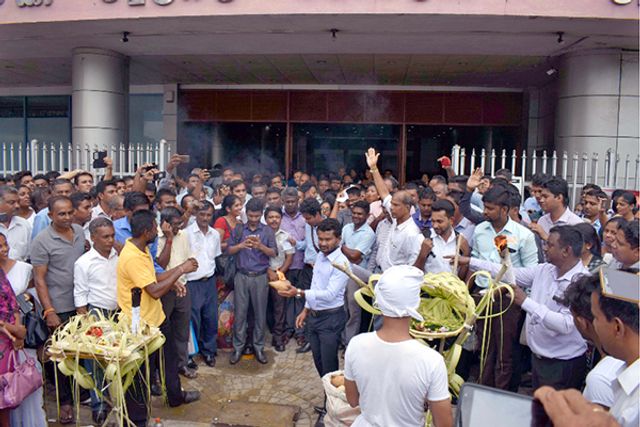
To prevent the emergence of working class pickets and demonstrations, the union has promoted religious spectacles as a diversion. On September 13, the unions organized an event outside CEB’s Colombo head office, breaking coconuts and calling for workers to pray to God.
The religious ceremony called by union leaders outside CEB’s Colombo office
Ranjan Jayalal said union leaders would meet with senior Buddhist leaders. He called on workers to meet monks in their villages to organise protest campaigns at CEB offices.
These actions show the utter bankruptcy of the unions, which promote religious and communal divisions along with the fraud that protests will force concessions from the government.
In reality, the attacks on CEB workers are part of a broader austerity agenda dictated by the International Monetary Fund (IMF), including for the privatization and restructuring of state-owned enterprises. The IMF has demanded that the CEB, CPC, Water Board and Ports should be fully commercialised, claiming their debts are a burden on the economy.
According to recent reports, the CEB operated at a loss of 16.6 billion rupees in the first four months of 2017. This was an increase of 197 percent over the same period last year. The IMF has also called for increased consumer prices and service charges to mitigate the losses. This will deepen the social crisis facing working people.
A partial privatisation of the CEB began in 1990. In 2009, the Rajapakse government passed a bill to outsource the generation and distribution of power, which provoked widespread resistance from workers. The unions diverted opposition into a bankrupt protest campaign based on limited demands. They have never called for a struggle against privatisation.
An IMF report on Sri Lanka on July 27 declared that the “further delay of SOE (state owned enterprises) reforms,” including at the CEB, was a major “risk” facing the country. The government will inevitably seek to eliminate this “risk” by pushing through further privatisation and by slashing jobs, working conditions and wages.

Bank for International Settlements voices concern over finance markets

Nick Beams

The Bank for International Settlements (BIS) has sounded a warning about the continued effect of low interest rates in bond and other financial markets in pushing up the value of stock markets and encouraging behaviour that could create new financial risks.
The warning was contained in the latest BIS Quarterly Review, published on Sunday just two days after Wall Street’s S&P 500 index reached a record high of 2,500 points.
The BIS is concerned that the slow pace in normalising central bank interest rates and ending financial stimulus through quantitative easing is setting up financial markets for a shock when interest rates do begin to rise.
Volatility in the US share market, as measured by the VIX index, is at its lowest point since 2005. As a result, financial investors are engaging in short selling of assets, essentially betting that market volatility will remain subdued.
Speaking on the review’s analysis, the head of the BIS Monetary and Economic Department, Claudio Borio, said the calm in financial markets was “remarkable.” Not only was share market volatility low, but in a “departure from usual patterns,” bond market volatility had also fallen dramatically.
“We do not fully understand the factors at work,” he said in a frank admission that global financial authorities are flying blind. “But surely the unprecedented gradual pace of monetary policy normalisation has played a role. Another factor could be market participants’ belief that central banks will not remain on the sidelines should unwanted market tensions arise.”
In other words, if a rise in interest rates does lead to market stress, financial investors are confident the central banks will step in to ensure the continued flow of ultra-cheap money that has sustained them since the global financial breakdown of 2008.
Borio said the financial market data underlined “just how much asset prices appear to depend on the very low bond yields that have prevailed for so long.” A “defining question” for the global economy, he continued, was “how vulnerable balance sheets may be to higher interest rates.”
Borio noted that since the 2008 crisis, “deleveraging,” that is, the reduction of debt, had not really taken place. While private debt had fallen to some extent, public debt had risen, and the fall in private debt was mainly due to the reduction in debt held by households.
Corporate debt was “considerably higher” than before the crisis and corporate levels had “reached levels reminiscent of those that prevailed during previous corporate credit booms.” Debt service ratios were low but this was only because interest rates have been falling so much.
“There is a certain circularity in all this that points to the risk of a debt trap: the protracted decline in interest rates to unusually low levels, regardless of the strength of the underlying economy, creates the conditions that complicate their subsequent return to more normal levels.”
Borio said the increase in the percentage of “zombie” firms, that is, corporations unable to cover their interest payments with their earnings, “does not bode well.”
The BIS review noted that US equity markets were being propelled by record levels of margin debt—debt subject to partial repayments if the value of the asset it financed starts to fall. The total had reached $250 billion, substantially more than during the peak of the 1997 to 2001 dotcom boom.
At the same time, traditional market valuation benchmarks, such as long-run price/earnings (P/E) ratios “indicated that equity valuations might be stretched.” They were above their long-run cyclically-adjusted levels in the US, and had increased in Europe and emerging market economies, though by a smaller amount than their American counterparts.
Interest rates in bond markets were “unusually compressed” in the US and drifting further into negative territory in Europe. This suggested that “equity markets continue to be vulnerable to the risk of a snapback in bond markets, should short-term premia return to more normal levels.”
In other words, should interest rates rise, the house of cards in equity markets, built on the basis of very low interest rates, could start to collapse.
The BIS also noted a significant increase in “covenant-lite” loans, which place “few to no restrictions” on the activities of the borrower. This could signal a “less discriminating attitude on the part of lenders while potentially fostering excessive risk-taking on the part of borrowers.” Moody’s has said the quality of these loans is at their lowest level since it started measuring this trend in 2011.
The BIS said this shift suggested that “in the event of the slowdown or an upward adjustment in interest rates, high debt service payments and default could pose challenges to corporates, and thereby create headwinds for GDP growth.”
The key determinant for setting official interest rates is the rate of inflation. Major central banks are keeping rates low because the inflation level has not yet reached the target of close to, but below, 2 percent.
With inflation as the “lodestar” for central banks, Borio said this put a premium on understanding the “missing inflation.” He asked: “Why has inflation remained so stubbornly low despite economies approaching or surpassing estimates of full employment and unprecedented central bank efforts to push it up?
“This is the trillion-dollar question that will define the global economy’s path in the years ahead and determine, in all probability, the future of current policy frameworks. Worryingly no one really knows the answer.”
Central bank monetary policy is determined to a significant degree by the so-called Phillips curve. This maintains that as the economy approaches full employment, inflation should start to increase because wage levels begin to rise.
This model has been completely thrown awry since the global financial crisis. In the US, for example, as in a number of other countries such as Japan and Australia, the unemployment level, according to official data, remains low and growth is positive. However, wage levels are stagnating or even declining, and inflation remains at historically low levels.
The reason lies in the fact that the financial crisis was the occasion for a major restructuring of class relations in all the advanced economies, through the introduction of part-time working, the rise of casual employment and the decline of full-time working. This means that “full employment” bears little or no resemblance to what it signified in the past.
Borio’s admission that “no one really knows” why inflation remains so low is an indication of the utter bankruptcy of official policy.
Having poured trillions of dollars into the financial system with measures never undertaken in the past, in order to prevent a complete collapse of the banks and major financial institutions, the bourgeoisie is, as Karl Marx once put it, “like the sorcerer, who is no longer able to control the powers of the nether world whom he has called up by his spells.”

Millions of the UK’s poorest families driven into deeper poverty

Dennis Moore

Two million of the poorest families in the UK face a £50-a-week cut in income by the end of the decade. This was the conclusion of a detailed study carried out by Policy in Practice (PIP), a social-policy software and consultancy business, in partnership with the Local Government Association (LGA) and the Learning and Work Institute (LWI).
Commissioned by the LGA, “The Cumulative Impact of Welfare Reform: A national picture,” shows the impact of welfare reform across the whole of the UK. It assesses the devastating impact of welfare cuts, growing inflation and ever-steeper rent rises in the private sector.
The study examined over 40 local authorities, representing 9.1 million households, receiving either a Department for Work and Pensions benefit, Housing Benefit, or Tax Credits. The data was examined via a modelling tool, the Benefits and Budgeting Calculator, used to measure the impact of reforms that have taken place and those yet to come.
It finds that reductions in household income will hit poorest families hardest, with more than 84 percent of lone parents or couples with children set to lose up to £50 a week or more in income.
The government’s overall agenda, dressed up as welfare “reform,” is underpinned by slashing welfare spending and encouraging people to move from benefits into work. By 2015, after five years of austerity, the Conservative/Liberal Democrats coalition had slashed nearly £17 billion from the social security budget. Theresa May’s current Tory government is committed to a further £12 billion in welfare cuts by 2018. This equates to a £1,500 cut for 8 million households in the two years to 2018.
For all the talk about work—which is generally low paid—being an effective way out of poverty, two thirds of those who will be worse off are in working households, not claiming any out-of-work benefits, but receiving working tax credits and housing benefit. Of the 2.14 million working age households set to lose over £50 a week by 2020, 1.34 million are in work.
The introduction of the government’s flagship benefit, Universal Credit (UC), was to supposedly combine living and housing costs, creating a seamless move into and out of work. It will affect 7.2 million households across Britain, with 3.1 million losing an average £46.48 a week. Analysis shows that the overall net impact, once transitional protection ends for the 7.2 million eligible households, will total £4 billion.
UC is currently being rolled out across the UK, yet there are serious reservations about its detrimental impact. Citizens Advice is calling for it to be halted, due to the problems claimants have encountered, with many getting into serious debt.
Charities and councils are warning of the rise in homelessness, attributed to increases in housing costs that take up a growing part of personal income. It is estimated that by 2020 more than 2 million low-paid private renters could face an average increase in rent of £38.49 a week—with rents rising faster than housing benefit costs, leading to rents not being covered. There are wide regional differences. In the south west it is estimated that by 2020 rents are set to rise by 20.7 percent, against 3.5 percent in the north east.
This is described as a looming “affordability crisis” and is exacerbated by significant cuts to housing benefit implemented via the introduction of Local Housing Allowance (LHA). LHA is paid to renters in the private rented sector, and is often not linked to the real cost of the full rent in a specific area. It has led to increasing poverty and homelessness. Since 2015 there has been a cap on LHA rates that will be in place until 2020, driving the growing disconnect between the rents households have to pay and the amount of support they will receive through UC and housing benefit.
Figures show that rents in 2020 are expected to be over 5 percent higher than in 2016, while the LHA rates will remain unchanged. The rise in rents, without a corresponding increase in housing benefit support, will mean more people having to ask local councils for help, which in turn will drive up homelessness and temporary accommodation costs. This will place more pressure on local authorities, who have already carried out significant cuts to many front-line services.
The proportion of households in the private rented sector receiving housing benefit is set to increase, due to a lack of new affordable social housing. This will push poorer households into more expensive private accommodation. DWP figures show that in the years 2007/2008 and 2013/14, those in the private rented sector claiming housing benefit rose from 23 percent to 33 percent, while those in the social rented sector fell by 10 percent.
Claire Kober, chair of the LGA resources board, warned that the problems highlighted in the report came as councils were “experiencing huge funding pressures and face an overall funding gap of £5.8 billion by 2020.”
The cutbacks by local councils of funding used to help poorer families via Discretionary Housing Payments (DHP) covering rent shortfalls will have an additional detrimental effect. In 2017-18, the budget for DHP totalled £185 million, yet the shortfall in costs associated with the welfare benefit cap, bedroom tax and those paying rent above housing benefit levels totalled in excess of £4 billion.
Most English authorities have made cuts to Council Tax Support, and the local safety net of discretionary support via community care grants. Crisis loans, administered by the Department for Work and Pensions, are all but abolished.
These changes will have a far greater impact on the most vulnerable, including families with children, or in a household claiming disability benefits. Of the 1.34 million households considered highly impacted by welfare reform, over 84 percent of working age households are either couples with children or are lone parents.
Families with a higher number of children will be most affected, with over one fifth of households including families with three or more children. It is estimated that by 2020, a family with three children will lose on average £58.93p a week, and a family with five children could lose £90.98p a week.
An estimated 42.4 percent of families with a working aged, disabled person will lose up to £50 a week by 2020 and £51.47p for someone disabled under universal credit. The impact on households receiving disability benefits, such as Disability Living Allowance or the Personal Independence Payment, will be greater as they lose specific disability premiums because they are in receipt of UC.

German Greens’ pro-war policy on display at think tank forum

Johannes Stern

Since the Greens, led by Foreign Minister Joschka Fischer, organised the first foreign combat operation by German soldiers since World War II, joining the 1999 NATO war against Yugoslavia, the former pacifists have been a leading party of German militarism. This was underscored by an event titled “Foreign and European Policy Challenges for Germany” held last Wednesday at the German Society for Foreign Affairs (DGAP) in Berlin.
The Green Party’s lead candidate in this month’s national elections, Cem Özdemir, was invited to discuss foreign policy issues before the next German government with DGAP Deputy Director Christian Mölling and the foreign policy editor of Die Zeit, Jörg Lau. The discussion was moderated by Jana Puglierin, who heads the DGAP department on European foreign, security and defence policy and Germany’s role within Europe.
Özdemir made clear in his 20-minute introduction that the Greens have the same response to the profound crisis of capitalism and breakdown of the post-war order as the current federal government: a drive to build up the military at home and abroad, a renewed turn toward dictatorship and war, and the assertion of German claims to leadership in Europe and the world. His audience, including senior security policy experts, journalists, military personnel and representatives of the arms industry, responded with enthusiasm.
He declared that in times of “turmoil,” when “our values” are not only endangered by “self-serving dreams of a despot like Vladimir Putin or Recep Tayyip Erdogan,” but “also attacked by the president of the United States,” Europeans “are being challenged in a special way.” What is necessary, he said, is “a policy of value-guided realism in Germany and Europe.”
When Green politicians speak of defending “values,” one is obliged to envision fighter jets taking off for the next “humanitarian intervention.” The Green leader continued: “We need a foreign policy with soft power and hard power, with a clear framework of values, but also with the courage to deploy military means in those extreme emergencies where diplomatic methods reach their limits.”
Concretely, Özdemir called for military intervention in Syria and a harder line toward Russia. “Every time in Syria or somewhere else in the world humanitarian international law is broken without the international community responding clearly and firmly, international law loses its power to influence,” he declared. “It is therefore fatal if we dismiss a violation of international law with the claim: that was bad, but let’s leave them to fend for themselves.”
It is “also fatal when election campaigners from other parties demand a relaxation of sanctions on Russia or call for Putin to be brought back into the circle of the G8 without any shift on the question of Crimea, and when the ink on the Minsk agreement is not even dry.”
Özdemir’s concept of “value-guided realism” serves to further Germany’s claim to a leadership role in Europe. “It doesn’t make the European Union look good,” he said, “when we raise a warning finger at international partners, but in our own family circle fail to bang our fist on the table when necessary,” as when “a Viktor Orban attacks the basic principles of European mutual cooperation or a nationalist-minded government in Poland suspends the rule of law.”
Özdemir would, of course, bang his fist only where he saw German interests at risk. In Egypt, a close ally of German imperialism, he is prepared to support one of the most brutal military dictatorships in the world. Although Egyptian ruler al-Sisi is someone who suppresses human rights “with a firm hand,” he is also someone who “at least partially secures the division between state and religion for us and keeps the Islamists under control.”
The entire event was an exposure of the unscrupulousness and aggressiveness of the German elites 75 years after the end of World War II. In the panel discussion, Lau made the statement, “Sometimes I wake up in the morning with the desire that someone should do something outrageous against Erdogan. But after the second coffee, it passes.” Much of the audience snickered at this barely concealed call for another coup or even assassination of the Turkish president.
Mölling said of the major military build-up planned for the army, “But it could also end up being more expensive than 2 percent [of Germany’s gross domestic product]. Yes, we have to spend more. We can’t get anywhere the way things are now. Probably 3 billion extra will be needed every year to have an army that is to some degree functional. And there, Europe can and must help, otherwise it will be even more expensive.”
He went on to complain that Germany and Europe have “driven their defence capabilities to the wall” and are “only now beginning again to rebuild.”
Özdemir seconded the DGAP deputy director and noted, “The Greens also think that the army has to be properly equipped. We are also responsible for the security of the soldiers we send into international interventions, and it is necessary to ensure that they can do their job reasonably. That doesn’t happen free of charge, it has to be financed.”
Like Mölling, he appealed for a combat-ready European defence policy in alliance with France.
Even though the representatives of the German ruling class who sat on the panel have thus far been vehemently pro-American and supported US-led wars, the growing conflict with Washington was on display throughout the event.
Bernd Ulrich, deputy chief editor of Die Zeit, spoke from the audience and asked, “Is the American century perhaps over? At least, I would say that what is over is the United States’ moral-military leadership claim in light of the internal instability we now see. Has the claim to leadership not been forfeited?”
Lau warned that “the American government is effectively opposed to the things its partners consider right: multilateralism, retaining Europe.” While all of this has “no value to America, for us it is the principal value of foreign policy.”
The American government, he continued, has “decided that with Brexit, the beginning of the end of Europe is commencing. This was a sort of declaration of war. And this is only one reason for the shock we are all experiencing—that nothing can be taken for granted any more.”
Trump is “a freak,” he went on, but it is hard to tell “if he is the beginning of something where more terrible figures arise who are terrible in another way.”
Ten days before the federal election, the DGAP event underscored that there is no lack of “freaks” and “terrible figures” in Berlin, who are shaping the debates and preparing for war. As in the last century, Germany’s ruling class is responding to growing international tensions and the global struggle for markets and raw materials by rearming and striving to establish its domination over Europe so as to operate more effectively as a world power.
In a paper entitled “Foreign policy challenges for the next federal government,” the DGAP demands that the incoming government “decisively implement the comprehensive security policy approach introduced under the rubric of ‘New responsibility.’” This is a reference to the paper “New power, new responsibility,” which proclaimed the return of German militarism prior to the last federal election and included in the drafting process representatives of the Greens and the Left Party.

French unions try to strangle workers’ opposition to Macron

Anthony Torres & Alex Lantier 

Faced with growing working class anger at French President Emmanuel Macron’s decrees attacking the Labour Code, facilitating mass sackings and unilateral cuts to wages and basic benefits, the union bureaucracy is trying to strangle opposition to Macron. It is organising rolling strikes in different industries, aiming to dissipate working class militancy and block the unification of strikes into a revolutionary mobilisation against austerity across France and Europe.
The unions are terrified of losing control and facing an eruption of workers’ struggles, and are closely coordinating their actions with the government. The different union federations are announcing multiple one-day protest strikes on various separate dates. Yesterday, truck drivers of the French Democratic Labour Confederation (CFDT) and the French Christian Workers Union (CFTC) organised blockades in Paris and in the provinces. The General Confederation of Labour (CGT) and Workers Force (FO) are calling a strike that will affect fuel depots for September 25.
A second national day of action is scheduled for September 21. Public television and Paris public transport unions have announced strikes for that day, and nine trade union organisations are calling for retirees to protest in Paris on September 28.
After having refused to participate in the September 12 protest organised by the CGT and Solidaires unions, attended by around 400,000 people, the CFDT is organising on October 3 a meeting at the Paris Event Centre. On October 10, the public sector workforce unions will call a one-day protest strike.
The unions have not, for now, announced strikes in the refineries. However, leading politicians are reportedly discussing the danger of such a movement, which rapidly led to a breakdown of fuel supplies to gas stations across France in 2010 and 2016.
In a sign of explosive conflicts inside the state machine itself, one quarter of France’s specialised riot police—9 of 36 brigades at the national level—are striking against budget cuts targeting them.
Local trade union bureaucrats are reporting escalating discontent among workers and, as in the case of the CFDT-Metallurgy federation, pressing the union leaderships to call symbolic protests in order to avoid being totally discredited with the workers.
“The choice was made not to call a national protest,” the CFDT-Metallurgy federation wrote to CFDT leader Laurent Berger in a letter seen by AFP. “This decision led to anger among many members who, since they belong to the largest trade union in the private sector, were expecting a far stronger response from the CFDT. … What the members are demanding, and what we are passing on by expressing our positions as members of the bureau of our federation, is a national call for protests from the CFDT.”
The incestuous links between the state, which imposes austerity and the state of emergency, and the union tops, who pretend to oppose these policies in order to channel workers’ anger into harmless protests, are in the open. The satirical weekly Canard enchaîné revealed that two secret meetings took place on August 28 between Macron, FO leader Jean-Claude Mailly, Laurent Berger, and Muriel Pénicaud, the labour minister. According to the Canard, the government was checking whether Mailly and Berger “could keep control of their trade union base.”
Such meetings occur constantly, notably during a September 14 debate between the leaders of business lobby groups and the heads of the trade union federations at the Senate, which was attended by Pénicaud and Prime Minister Edouard Philippe. At this debate, which Le Monde called “convivial” or even “a debate between old friends,” Edouard Philippe stressed to CGT chief Philippe Martinez that he understood “the legitimacy of the criticisms” made by the CGT.
Pénicaud claimed to be “very enthusiastic” about financing the training of union officials, one of the main avenues though which Macron’s decrees channels more corporate money into the unions’ coffers. The unions, which have been in a deep financial crisis since the 1980s due to the collapse of their working class base and thus of their dues base, depend currently on state and business funding for 95 percent of their budget, according to an official parliamentary report.
The government includes in its ministerial staffs several people closely tied to the union bureaucracies. Pénicaud recruited Stéphane Lardy, the ex-number two of FO leader Jean-Claude Mailly who last year began work at the general inspectorate for social affairs, as an advisor on training and apprenticeship issues. Marc Ferracci, an economics professor and wedding witness to Emmanuel Macron serves as the liaison with the CGT. Pierre Ferracci, Marc’s father, runs the Secafi firm, which provides advice and financial planning for the CGT.
Such links underscore the political bankruptcy of the strategy of sending workers’ demands to the trade union leaderships. Pressuring the state to negotiate with the trade union leaders signifies leaving all elements of the decision in the hands of various members of the same, anti-working class ruling elite. As Macron prepares to make the state of emergency permanent by writing it into common law, and to spend billions of euros on increased defence spending, workers are facing not a trade union but a political struggle.
Workers will be forced to create new organs of struggle to replace the trade unions, and above all a new revolutionary party, the Parti de légalité socialiste, to give these struggles political leadership.
The opposition to Macron is part of a broad radicalisation of workers and youth against austerity and the dangers of dictatorship and war across Europe. Sixty-eight percent of the French population opposes Macron’s labor decrees, and 55 percent supports strike action against these policies, while Macron’s approval rating has collapsed to 30 percent. This is part of a broader radicalisation of the masses across Europe that saw a majority of youth, in a poll earlier this year, declare that they would be willing to join a mass movement to overthrow the existing order.
This opposition cannot develop in the narrow and essentially false context of negotiations between union leaders and the Macron-Philippe government, all of which are seeking above all to boost the profitability of French firms on the world market. The task is to unify working class opposition that is rising across Europe independently of the trade union bureaucracies, in revolutionary struggles carried out on a socialist programme.
On this basis, no confidence can be given to the manoeuvres of Jean-Luc Mélenchon, who told Europe1 yesterday that he hopes to use the union protests and his media profile as the “leading” opponent to Macron to become Macron’s prime minister. He explained this via a reference to the French rail workers’ strike of November-December 1995 against then-Prime Minister Alain Juppé’s pension cuts.
Europe1 wrote that Mélenchon “has one example in mind: the 1995 protests against Juppé’s reforms. A powerful social movement ultimately led to the abandoning of Juppé’s cuts then, a year later, to early legislative elections [which brought the Plural Left and Mélenchon personally into the government.] ‘Chirac had understood that the relationship of forces that had existed after his election in 1995 no longer did,’ Mélenchon said. ‘I’m sure that we will govern this country! We are in a war of movements.’”
This strategy of entering into a Macron government is a trap for the workers. A Macron-Mélenchon regime would impose anti-worker policies just as the Plural Left government of 1990s France or, more recently, the Greek government led by Mélenchon’s ally, the Coalition of the Radical Left (Syriza). This government, after having pretended to oppose austerity, capitulated to the EU once in power and imposed deep attacks against the workers. Such a perspective, which Mélenchon is developing through his alliance with the trade unions, is a reactionary dead end for the working class.

Facebook turns over information on Russia-linked accounts to Special Counsel Mueller

Patrick Martin

Facebook has turned over detailed information on political ad purchases by accounts allegedly linked to Russia to special counsel Robert Mueller, according to a report Friday by the Wall Street Journal, confirmed in further media reports over the weekend.
Mueller is heading the Justice Department investigation into claims of Russian interference in the 2016 US election and collusion by the Trump campaign. He has hired more than a dozen top-level attorneys, including experts in financial crimes such as money-laundering.
The probe has focused recently on a handful of top former Trump aides, such as one-time campaign chairman Paul Manafort, who have well known ties to Russian investors. Last month, FBI agents staged an extraordinary pre-dawn raid on Manafort’s residence in Alexandria, Virginia, armed with a search warrant for documents and other materials.
The special counsel has told the White House that he intends to interview former chief of staff Reince Priebus; former press spokesman Sean Spicer; White House Counsel Don McGahn and his deputy, James Burnham; the new White House communications chief, Hope Hicks; and Josh Raffel, an aide and spokesman for Trump’s son-in-law and adviser Jared Kushner.
Mueller’s investigators apparently obtained another search warrant for information about several hundred Facebook accounts, purportedly set up by individuals linked to Russian companies, which engaged in forwarding political messages over a two-year period. According to Facebook’s public assurances to users, it will hand over information about accounts only in response to a judicially approved warrant.
The scale of this alleged Russian operation, in an election cycle that encompassed millions of online participants sending hundreds of millions, if not billions, of messages, is trivial. According to the New York Times, which first made public the existence of the Facebook accounts, the total expenditure on political ads was about $100,000, compared to the billions spent by the Democrats and Republicans in the course of the campaign.
Facebook itself estimated that information operations like those allegedly mounted by Russia, all combined, accounted for less than one-tenth of 1 percent of the total “civic content” on its platform related to the US elections.
Moreover, the bulk of the messages sent by the Russian-linked accounts, according to Facebook’s chief security officer, Alex Stamos, did not refer to either Trump or his Democratic opponent Hillary Clinton, or make any mention of the election, but rather focused on “divisive social and political messages” related to abortion, immigration, gay rights and similar issues.
Despite the ominous language in media reports reiterating that it is illegal for non-residents of the United States to make contributions to US election campaigns, the bulk of the Facebook messages described in these reports were perfectly legal.
Foreign governments lobby the US government, various state governments and the American population as a whole on countless political and social issues. Only a direct financial contribution from a foreign source to a US candidate is barred by American campaign finance laws, which reserve for US billionaires the privilege of buying and selling American politicians.
This has not stopped prominent Democrats such as Representative Adam Schiff, the ranking member of the House Intelligence Committee, and their media acolytes from suggesting that these Facebook ads could become a key link in a chain demonstrating illegal collusion between the Trump campaign and Russia. Schiff cited the finding by Facebook that about 25 percent of the ads allegedly purchase by Russian entities “were geographically targeted” as an indication that individuals in the Trump campaign had to be supplying information for the targeting.
This contention is absurd, given that the existence of “battleground states,” key “swing” counties and even precincts was not a state secret, but the stuff of endless commentary in the media. Any literate observer of the US campaign could identify dozens of such potential targets for advertising.
The US media seeks to promote the “Russian intervention” narrative as part of the campaign by the military-intelligence apparatus and the Democratic Party to compel the Trump administration to take a harder line on Syria, Ukraine and the broader range of US-Russian conflicts.
Largely covered up is the genuine threat to democratic rights in the collaboration of giant social media and telecommunications companies like Facebook with the American government and its vast intelligence-gathering operations.
The quantity of information handed over by Facebook to Mueller and the Justice Department in recent weeks is comparatively limited, reflecting the small scale of the alleged ad purchases by Russia-linked individuals and organizations. But Facebook’s positive response to the federal subpoena raises warning flags. If the company is prepared to do this, in the case of an investigation targeting the president of the United States and his 2016 campaign, what are they doing in relation to other targets of US government surveillance, who have neither Trump’s power nor his ability to retaliate?
A lengthy report in the New York Times Monday details Facebook’s assiduous collaboration with demands by authoritarian governments, including China, Vietnam and Kenya, which has included exposing dissidents to arrest and imprisonment for anti-regime postings as well as the systemic removal of such “offending” material from Facebook pages.
The Times report glosses over the demands placed on Facebook by US authorities, but the company functions in practice as an instrument of the US military-intelligence apparatus. Facebook, Google and other giant IT companies are engaged in an increasingly brazen campaign of political censorship against publications and organizations identified by the CIA, NSA and Pentagon as threats.
The World Socialist Web Site has exposed the censorship of our site by Google, which announced a change in its search algorithms last April aimed at reducing the audience for antiwar and left-wing web sites, with the WSWS seeing a two-thirds reduction in traffic from Google search results. Facebook announced a similar revamping of search algorithms in June.
The alliance of giant corporations and the US military-intelligence apparatus, not the comparatively paltry activities of Russian entities, is the main threat to the democratic rights of the American people.

UN General Assembly convenes under shadow of war

Bill Van Auken

President Donald Trump delivers his first speech to the United Nations today as the 72nd session of its General Assembly convenes in New York City under the shadow of war.
Little more than a week ago, UN General Secretary Antonio Guterres warned that the escalating conflict on the Korean peninsula resembled the events that led to the outbreak of the First World War over a century ago, implicitly raising the prospect of the world sliding into a nuclear third world war.
The American president, who during his “America First” presidential election campaign pointedly denounced the United Nations, appeared briefly at UN headquarters Monday for a forum on “reforming” the international body. He introduced his prepared remarks, which derided the UN for “bureaucracy and mismanagement,” by touting one of his real estate projects, the Trump World Tower, located across the street from the UN, saying that the building’s proximity to the UN had made it more profitable.
By “reform,” Trump means slashing spending. Earlier this year, administration officials suggested reducing the US contribution to the UN by half. The US president complained in his remarks about having to shoulder “a disproportionate share of the burden.” Washington’s annual contribution to the UN is roughly one-tenth of what it spent last year on its 16-year neocolonial war in Afghanistan.
The United Nations was established 72 years ago largely at the initiative of the United States, which emerged from the Second World War as the indisputably dominant imperialist power. At the time, this dominance was based not merely on military might, but above all on American capitalism’s unrivaled industrial strength and Wall Street’s unquestioned dominance over the affairs of world finance capital.
The UN was created as part of a global system designed to further American imperialist hegemony, which included the International Monetary Fund, the World Bank and various global and regional alliances and trade organizations.
Written into the UN’s Charter were the so-called Nuremberg principles derived from the post-World War II trials of the surviving leaders of Hitler’s Third Reich, which made “crimes against peace,” i.e., aggressive war, the greatest war crime. The first sentence of the founding document of the UN declares that its purpose is “to save succeeding generations from the scourge of war.”
That principle has been reduced to rhetorical window-dressing by Washington’s uninterrupted wars of aggression carried out over the past quarter-century, as the American ruling class increasingly relied on its military supremacy to offset the erosion of its global economic position.
In the person of Donald Trump, the ugly end product of American capitalism’s protracted decline—the rise of financial parasitism and the criminality of American militarism—is rising to the General Assembly’s podium on Tuesday. Trump will address the body under conditions where US imperialism is literally holding a gun to the head of humanity.
In advance of his appearance at the UN, his top aides issued multiple statements affirming that Washington is prepared to make good on the US president’s threat to unleash “fire and fury like the world has never seen” against North Korea. The US ambassador to the United Nations, Nikki Haley, warned in a television interview Sunday that “North Korea will be destroyed” if the US has “to defend itself or defend its allies in any way.”
She affirmed that Washington had “exhausted all the things we could do at the [UN] Security Council,” adding: “We wanted to be responsible and go through all diplomatic means to get their attention first. If that doesn’t work, General Mattis will take care of it.” She was referring to the US defense secretary, Gen. James “Mad Dog” Mattis, who has threatened North Korea with “total annihilation.”
Similarly, US Secretary of State Rex Tillerson stated Sunday that “If our diplomatic efforts fail… our military option will be the only one left.” And Trump’s national security advisor, Gen. H.R. McMaster, asked whether the US president “will strike” North Korea if it fails to give up its nuclear weapons, replied, “He’s been very clear about that, that all options are on the table.”
Amid these bellicose threats, American warplanes have carried out their most provocative exercises yet, with B-1B nuclear bombers and F-35 fighter jets flying Monday from Guam and Japan to drop bombs near North Korea’s border.
While placing the threat of a nuclear confrontation on the Korean peninsula on a hair trigger, Washington is also seeking to ratchet up tensions with Iran, with the aim of provoking a military confrontation with a country it sees as the main regional obstacle to its drive for hegemony in the oil-rich Middle East.
Trump and top administration officials have made repeated statements in recent days indicating that the US administration will refuse to certify that Iran is in compliance with the 2015 nuclear deal (the Joint Comprehensive Plan of Action), with the October 15 deadline for it to report to Congress approaching. Such a refusal would open the door to new rounds of unilateral American sanctions against Tehran. Prior to agreeing to the deal, Trump’s predecessor Barack Obama warned that the only alternative to the agreement was war.
While the International Atomic Energy Agency (IAEA) and the other major powers that are signatories to the agreement have all acknowledged that Iran is in full compliance with its restrictions on its nuclear program and the IAEA’s intrusive inspections regime, US officials have asserted that Tehran is violating the “spirit” of the agreement. By this they mean that Iran has failed to submit to the undisputed dominance of US imperialism over the entire Middle East.
Notably absent from the opening of the UN General Assembly are both Russian President Vladimir Putin and President Xi Jinping of China. Whether they chose not to make the trip to New York because they believed there was nothing to be gained in a face-to-face meeting with Trump, or because they feared that it would be dangerous to leave their capitals given the state of global tensions, is not known.
The US confrontation with North Korea is bound up with far broader strategic aims of US imperialism for domination of the Eurasian land mass, in which Washington regards both China and Russia as obstacles.
Even as US warplanes were carrying out their provocative bombing runs near the North Korean border, China and Russia were conducting naval exercises off the Russian far eastern port of Vladivostok, not far from the Russia-North Korea border.
In Eastern Europe, Russia, on the one hand, and NATO and Sweden—acting together with the US, France and other countries—on the other, are staging rival war games in Belarus, Ukraine and the Baltics in preparation for a potential military confrontation between the world’s two largest nuclear powers.
Meanwhile, in Syria, Syrian government forces backed by Russian air power and Iranian-backed militias, and US-backed Kurdish-dominated militias have advanced on the strategic eastern city of Deir Ezzor from opposite sides of the Euphrates River, heightening the threat of a military confrontation that could draw in both Washington and Moscow.
The UN General Assembly proceedings this week will only heighten the danger of one or more of these regional conflicts triggering a global conflagration. There exists no means of ending war outside of the overthrow of the profit system that is its source.

18 Sept 2017

Commonwealth Government Scholarships for Masters & PhD 2018/2019 at University of Newcastle Australia

Application Deadline: 16th February 2018
Offered annually? Yes
Eligible Countries: International
To be taken at (country): University of Newcastle, Australia
About the Award: Full-time research students are eligible to apply for University and Commonwealth Government scholarships, which are awarded during one main round offer. They provide a living allowance so you can commit to full-time study. Historically over 90% of international students hold a scholarship from UON or a sponsor.
Type: Masters, PhD
Selection Criteria: Scholarships are granted on the basis of academic merit, which includes your undergraduate grade point average and extra research attainments.
Eligibility: To be eligible for scholarship candidate must:
  • written statement of support from a UON supervisor
  • an satisfy the English proficiency requirement (IELTS of at least 6.5, 7.0 in some disciplines)
  • met admission eligibility criteria
  • be no more than two full-time equivalent years into their PhD (or one year for Masters) at the scholarship closing date in which you are applying.
Successful international scholarship candidates usually also have:
  • A master degree with strong research component
  • International peer reviewed research publication or research experience
Number of Scholarships: Several
Value of Scholarship: A scholarship funded by the University of Newcastle or the Commonwealth Government provides:
  • An annual living allowance $26, 682 per annum (2017 rate – indexed annually)
The scholarship may also include:
  • a relocation allowance (up to $1,500)
  • a full tuition fee scholarship
  • overseas student health cover (OSHC) (international students and their dependents)
Duration of Scholarship: PhD scholarships are for three years and Masters scholarships are for two years, less any tenure already completed towards a research degree.
How to Apply
  • Currently enrolled candidates can apply for a scholarship by contacting researchscholarships[@]newcastle.edu.au
  • New applicants can apply for a scholarship at the same time as applying for admission.
Sponsors: The University of Newcastle and Commonwealth Government
Important Notes: ensure you attach the following documents to support your scholarship application:
  • Copies of research publications, exhibitions or conference papers
  • Curriculum Vitae
  • Details of previous research experience e.g. research work experience / study
  • Any additional documents that may add to your scholarship application e.g. evidence of the award of a University Medal

International Reporting Project (IRP) Group Reporting Fellowship to Senegal 2017

Application Deadline: 24th September 2017
Eligible Countries: All
To Be Taken At (Country): Senegal
About the Award: Senegal, one of Africa’s most prosperous and democratic countries, has enjoyed an economic boom since the late 1990s, primarily reliant on agriculture. Political stability, religious tolerance and rich culture bind together the country’s 15 million citizens, though large segments of the population lack equal access to economic, health and educational resources. Its capital, Dakar, is the western-most point of the African continent, and standards of living vary greatly between the coast and the rural inland communities.
In this context, IRP fellows to Senegal will explore issues that tend to affect women and men differently, including education, infrastructure, agriculture and health. We will especially focus on the advancement of women’s rights and lingering inequities.
Fellows on the 10-day reporting trip will look at these issues and many more in Senegal, and possibly spend a few days in neighboring Gambia. We will meet with key government leaders, representatives of non-governmental organizations, members of the education and health communities, religious and media leaders, and others.
All fellows on the trip are required to participate in the sessions arranged for the group program. Much of the value of a group reporting trip comes from a combination of IRP-arranged meetings and the interactions the fellows have with each other. Some independent reporting time will be included in the schedule. However, if you prefer to have more flexibility in your reporting schedule, we strongly encourage you to extend your trip or to apply for our individual reporting fellowships instead.
All stories produced by the fellows will be re-posted on the IRP site after publication and co-owned by the fellow (or his/her distribution partners, depending on arrangements) and the IRP. In addition, the work produced as a result of the trip may be posted on the social media channels of the IRP funders. This trip is supported by a grant from the Foundation for a Just Society (FJS).
Type: Fellowship
Eligibility: 
  • This trip is open to experienced, full-time journalists and media professionals, including print and online journalists, writers, photographers, videographers, data journalists, social media producers and others.
  • This trip is not open to students. Citizens of all countries are eligible.
  • This is a working trip, and participants are expected to produce stories and/or other reported content in the form articles, slideshows, video, audio, blog posts, infographics, social media posts and more.
Number of Awards: Not specified
Value of Award: The IRP will purchase the fellows’ round-trip air tickets to Senegal and will pay for visas, hotel costs, local transportation and most meals. Fellows who wish to extend their stay after the fellowship will have the option to arrange that at their own expense.
Duration of Program: 10 days
How to Apply: All candidates must complete an application form, including a detailed essay of at least 800 words describing the types of stories they might pursue in Senegal and which outlets may publish their work.
Award Providers: International Reporting Project (IRP)