20 Sept 2017

CAMI autoworkers locked in fight against GM Canada over jobs and wages

Jerry White

Autoworkers at General Motors’ CAMI plant in Ingersoll, Ontario, 150 km southwest of Toronto, Canada, are locked in a critical battle that raises fundamental strategic questions for autoworkers in Canada and throughout the world.
Nearly 2,800 workers walked out Sunday night after the expiration of the four-year labour agreement between GM Canada and the Unifor union. In discussions with reporters from the World Socialist Web Site Autoworker Newsletter, striking workers picketing the plant Tuesday expressed their determination to win substantial wage and benefit improvements, end long hours and oppressive working conditions and secure their jobs against further layoff threats.
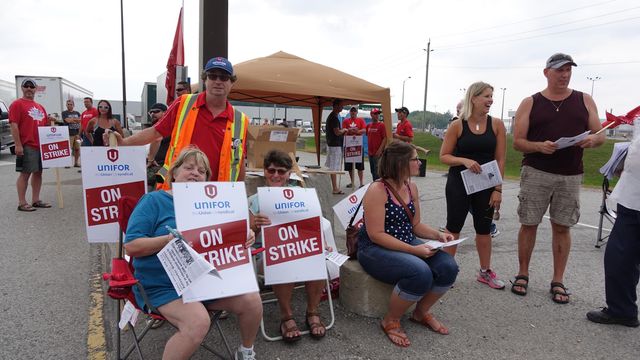
Striking workers at CAMI
An estimated 2,400 of the plant’s workers have less than 14 years seniority and a large portion are trapped in the so-called “in-progression” pay scheme, first accepted by the Canadian Auto Workers (CAW), the predecessor of Unifor, in 2007. Under the multi-tier wage and benefit system workers are forced to work for ten years before earning the top rate of $34.00 (US $27.67). There are currently hundreds of workers earning $23.91 (US $19.46) as tier-two workers and as low as $20.50 (US $16.68) as Temporary Part Time employees or TPTs.
A young second-tier worker told the Autoworker Newsletter, “We don’t need a bad deal. We need financial security, not just job security. It takes 10 years to get top dollar and every time there is a new contract they could make it even longer. We’re working for peanuts and there is a $14 difference between the highest and the lowest paid workers.
“$20 is not a good wage here in Ontario. If we didn’t work all this overtime we would have no money left at the end of the month. I want a good raise; this can’t continue. Unifor is keeping hush-hush about the talks. We don’t even know what they are asking for. I don’t want to stand out here on the picket line, if all we are going to get is the same as Oshawa got last year,” the young worker said, referring to the concessions Unifor gave up to GM last year, including ending employer-paid pensions for new hires, in exchange for worthless job promises. “If they come back with a bum deal I’m going to write my resume and move on.”
While workers are pressing the fight for both jobs and good wages and benefits, Unifor officials have insisted that the sole issue in the CAMI strike is securing a commitment from GM to make CAMI the “lead” plant for the production of GM’s hot-selling and highly profitable Equinox sports utility vehicle.
Running three shifts, six days a week, workers at the Ingersoll plant have produced 132,000 units so far this year, while workers at GM’s Mexican plants in Ramos Arizpe and San Luis Potosi have produced 40,000. While no new talks are presently scheduled, industry analysts say Unifor has made back-channel approaches to GM seeking to convince the automaker to reduce Mexican production of the Equinox.
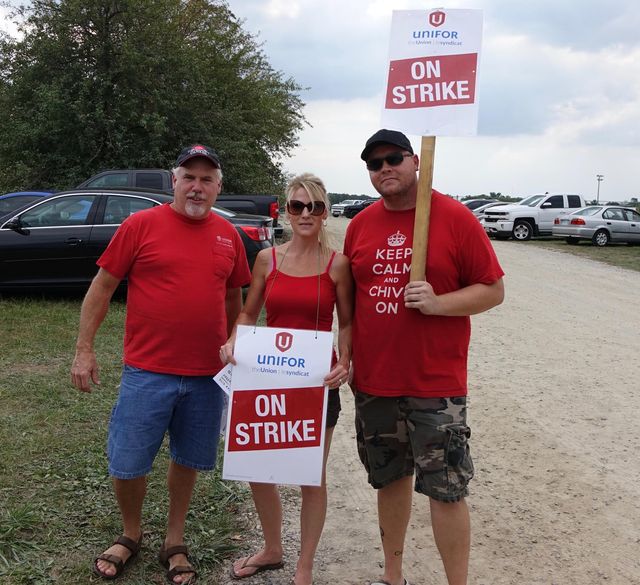
Striking workers at CAMI
At the same time, Unifor officials have sought to tie the strike to their efforts to get the Liberal government of Prime Minister Justin Trudeau and US President Donald Trump to renegotiate the North American Trade Agreement (NAFTA). Unifor President Jerry Dias said CAMI is a “poster child” for what is wrong with NAFTA, with GM shifting production from one of the most productive plants in the world to Mexico in order to pay workers $2 an hour.
Unifor rejects out of hand any appeal to Mexican and US workers for a joint struggle in defense of jobs and living standards. Like the United Auto Workers in the US, Unifor is embracing the filthy anti-Mexican chauvinism of the Trump administration while promising to impose even more concessions on Canadian workers in the name of “defending Canadian jobs.”
World Socialist Web Site Autoworker Newsletter reporters discussed the statement “For an international strategy to win the CAMI strike” with strikers, who expressed a strong, yet still politically inchoate, desire to unify their struggle with workers in the US and in Mexico.
“When I started here, under the joint venture of GM and Suzuki, you couldn’t read a newspaper unless it was put out by the company,” a worker with 28 years at the plant said. “All these corporations are the same; they want to drive down our wages and pensions. They use the workers in Mexico and other countries for cheap labour. It would be awesome to unite workers all over the world. The companies plan out their operations on a world scale but we don’t. There shouldn’t even be any borders to keep workers separated.
“Working six days a week destroys your home and family life. We’re completely tied to the company and you don’t have a life. The older workers have had our wages frozen for a decade and the young workers have an uphill battle just to survive.”
Another worker with 28 years at the plant said, “We’re fighting for the next generation, for the guys that are making $20 an hour. They have the right to make a good wage. The company has been pecking away at our wages and benefits for decades. Now they are making billions and we have stand up.”
Another veteran worker said, “This plant sets the pace for the other Big Three plants. We give up something big here like the defined pensions and then it’s spun out later to everybody else. I really get what you are saying about unifying autoworkers everywhere. The companies are all global and they play us off one against the other because we’re not united globally.”
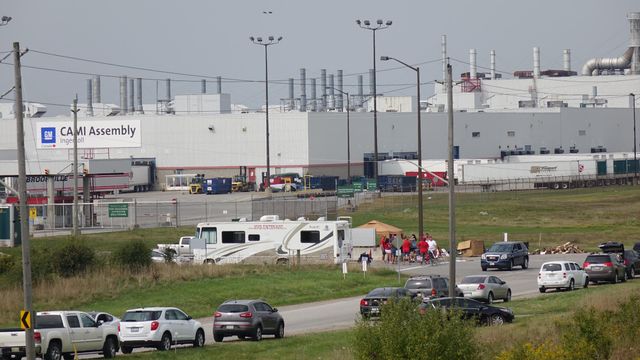
The strikebound plant in Ingersoll
Another long-term employee remarked on the bribery scandal in the United States where top UAW union officials in charge of negotiations at Fiat-Chrysler received millions of dollars in bribes from FCA management to impose concessions contracts. “I’ve read some stuff on that. It really makes you stop and think. Exactly whose side is everyone on? There’s been nothing but bad deals here lately. It makes you think there’s probably a lot more to negotiations we don’t know about.”
“We were surprised Unifor even called a strike,” another second-tier worker told the newsletter. “This must be the worst contract in history and the union knew it couldn’t sell it to the members. I think they plan to keep us out a week and then try to push through more concessions, like eliminating defined benefit pensions for senior workers. The union will tell us ‘you’re lucky to have a job’ and say they fought as hard as they could, but the company wouldn’t budge.
“Where do you draw the line when the company is making billions? GM has $22 billion in the bank. There are all these anti-bullying signs around the plant, but GM is the biggest bully there is.
“I knew back in my college days we lived in a global economy. There is no such thing as Canadian autoworkers, US autoworkers and Mexican autoworkers—only autoworkers. We all have the same interests and should be on the same page. The ‘Buy Canadian’ or ‘Buy American’ stuff only creates competition among labourers.
“It’s like the peaches in Grapes of Wrath. The Okies were supposed to get 5 cents for every bushel of peaches they picked. But 1,000 showed up for 500 jobs and instead of 5 cents, they got 2 ½ cents. It’s crazy that the problems Steinbeck was writing about in 1939 are still here today.
“If I were able to speak to the Mexican workers I would say we are not enemies. I’d tell them to not work for nothing. The Mexican workers have to demand better working conditions, better wages and conditions.”
Commenting on the deplorable conditions at the CAMI plant, which Unifor has sanctioned, she said, “I’ve seen more workers rubbing shoulders and arms because of pain than I ever did before. There are workers in their twenties who are on restrictive duties because of pain and injuries. The plan is to have a disposable workforce. They use and abuse workers until they can’t do the work anymore and then they let them go.”

Senate overwhelmingly approves record $700 billion military budget

Eric London 

Demonstrating the bipartisan support of Democrats and Republicans for militarism and war, the US Senate voted 89 to nine on Monday to authorize $700 billion in spending for the military and intelligence agencies, an $80 billion increase from 2016 and $54 billion more than President Donald Trump requested earlier this year.
The House of Representatives has already adopted a similar version of the bill, called the National Defense Authorization Act (NDAA). The House and Senate versions will now be reconciled and presented for Trump to sign into law.
The NDAA is a clear sign that the US is preparing to launch major wars of aggression, potentially involving nuclear weapons. The bill provides $200 million to upgrade nuclear launch facilities, $8.5 billion for missile defense systems in the US and in outer space, and $6.4 billion for Virginia class offensive nuclear submarines.
Trump hailed the bill’s $700 billion price tag in his warmongering speech to the United Nations on Tuesday, citing it as proof that “our military will soon be the strongest it has ever been.”
The bill passed with 42 Democrats and 47 Republicans voting “yes” and six Democrats and three Republicans voting “no.” Supporters included supposed “left” Democrats Elizabeth Warren of Massachusetts and Kamala Harris of California.
The bill’s total of $700 billion per year equals $80 million in military spending per hour and $22,000 per second. The latter figure is considerably greater than the median pre-tax yearly individual income for the bottom half of the US population—just $16,200, according to 2016 data compiled by economists Thomas Piketty, Emmanuel Saez and Gabriel Zucman.
The US now spends more than the 10 next largest militaries combined. It spends over three times more on its military than China and over 10 times more than Russia.
On the initiative of the Democratic Party, the budget measure was sharpened to target Russia. The bill authorizes millions of dollars to militarize Russia’s western border, including $500 million to provide weapons to the Ukrainian government and $100 million to “deter Russian aggression” in the Balkans. In all, the bill mentions Russia 72 times. One amendment attached by Democratic Senator Jeanne Shaheen blocks the Russian computer security company Kaspersky Lab from contracting with the government.
The House of Representatives’ version of the bill includes an amendment titled the “Fostering Unity Against Russian Aggression Act,” introduced by New Hampshire Democrat Carol Shea-Porter and co-sponsored by 21 Democratic representatives. This measure paves the way for censorship of the Internet in the name of combating “fake news.”
In introducing the measure, Shea-Porter said, “Russia’s aggressive actions make clear the need for a comprehensive US deterrence strategy.” She added that that the NDAA will “jumpstart needed improvements to our own and our allies’ readiness to counter unconventional modes of aggression, including propaganda and cyberattacks.”
Aside from $60 billion for ongoing US wars and military operations in Afghanistan, Iraq, Syria, Libya, Pakistan and elsewhere, the Senate bill includes $705 million for Israeli missile programs, a move aimed primarily against Iran. The Senate version authorizes the following expenditures for facilities and equipment:
* $300 million for hypersonic energy weapons
* $65 million to develop cruise missiles
* $12 billion for 94 F-35 jets, 24 more than the Pentagon requested
* $1 billion for 48 Black Hawk helicopters
* $1.3 billion for six heavy-lift helicopters
* $500 million for advanced weapons technological development
Last Wednesday, the Senate voted to reject an amendment proposed by the right-wing libertarian Rand Paul (Republican of Kentucky) that would have repealed both the Authorization for Use of Military Force passed in September 2001 in the aftermath of 9/11 and the Use of Military Force Against Iraq Resolution of 2002, measures that have been used by the Bush, Obama and now Trump administration to wage unending war in the Middle East and Central Asia.
The Senate defeated the amendment by a vote of 61 to 36. Thirteen Democrats voted against the measure, providing the margin needed to block it. This choreographed maneuver freed up other Democrats to take a phony “anti-war” position without affecting the outcome of the vote.
With $700 billion dollars, humanity could feed the malnourished population, some 815 million people, for 23 years, or provide free vaccines to all children in the world’s 117 poorest countries for 10 years.
In the US, $700 billion could provide each homeless person with a $500,000 home, cover the annual health care costs of 70 million Americans, pay off the student loan debt of 19 million borrowers, or finance the total rebuilding cost for every hurricane over the past 20 years. $700 billion could be used to create a high-speed rail network, provide flood and earthquake protection to every region in danger, or fund planning for safe and comfortable emergency evacuation in case of natural disasters.

19 Sept 2017

Trump’s War on the North Korean People

Gregory Elich

Amid renewed talk by the Trump administration of a military option against North Korea, one salient fact goes unnoticed. The United States is already at war with the Democratic People’s Republic of Korea (DPRK – the formal name for North Korea). It is doing so through non-military means, with the aim of inducing economic collapse. In a sense, the policy is a continuation of the Obama administration’s ‘strategic patience’ on steroids, in that it couples a refusal to engage in diplomacy with the piling on of sanctions that constitute collective punishment of the entire North Korean population.
We are told that UN Security Council resolution 2375, passed on September 11, was “watered down” so as to obtain Chinese and Russian agreement. In relative terms, this is true, in that the original draft as submitted by the United States called for extreme measures such as a total oil embargo. However, Western media give the impression that the resolution as passed is mild or mainly symbolic. Nothing could be further from the truth.
The resolution, in tandem with previous sanction votes and in particular resolution 2371 from August 5, is aimed squarely at inflicting economic misery. Among other things, the August sanctions prohibit North Korea from exporting coal, iron, iron ore, lead, lead ore, and seafood, all key commodities in the nation’s international trade.  The resolution also banned countries from opening new or expanding existing joint ventures with the DPRK.
September’s resolution further constrains North Korea’s ability to engage in regular international trade by barring the export of textiles. It is estimated that together, the sanctions eliminate 90 percent of the DPRK’s export earnings. Foreign exchange is essential for the smooth operation of any modern economy, and U.S. officials hope that by blocking North Korea’s ability to earn sufficient foreign exchange, the resolutions will deal a crippling blow to the economy. For North Korea’s estimated 100,000 to 200,000 textile workers the impact will be immediate, plunging most of them into unemployment. “If the goal of the sanctions is to create difficulties for ordinary workers and their ability to make a livelihood, then a ban on textiles will work,” specialist Paul Tija wryly notes. 
With around eighty percent of its land comprising mountainous terrain, North Korea has a limited amount of arable land, and the nation typically fills its food gap through imports. Sharply reduced rainfall during the April-June planting season this year reduced the amount of water available for irrigation and hampered sowing activities. Satellite monitoring indicates that crop yields are likely to fall well below the norm. To make up for the shortfall, the DPRK has significantly boosted imports. How much longer it can continue to do so remains to be seen, in the face of dwindling reserves of foreign exchange. In effect, by blocking North Korea’s ability to engage in international trade, the United States has succeeded in weaponizing food by denying North Korea the means of providing an adequate supply to its people.
The September resolution also adversely impacts the livelihoods of North Korea’s overseas workers, who will not be allowed to renew their contracts once they expire. They can only look forward to being forced from their jobs and expelled from their homes.
International partnership is discouraged, as the resolution bans “the opening, maintenance, and operation of all joint ventures or cooperative entities, new and existing,” which in effect permanently kills off any prospect of the reopening of the Kaesong Industrial Complex. With only two exceptions, all current operations are ordered to shut down within four months.
A cap is imposed on the amount of oil North Korea is allowed to import, amounting to about a thirty percent reduction from current levels, along with a total ban on the import of natural gas and condensates. Many factories and manufacturing plants could be forced to close down when they can no longer operate machinery. For the average person, hardship lies ahead as winter approaches, when many homes and offices will no longer be able to be heated.
What has any of this to do with North Korea’s nuclear program? Nothing. The sanctions are an expression of pure malevolence. Vengeance is hitting every citizen of North Korea to further the U.S. goal of geopolitical domination of the Asia-Pacific.
Like North Korea, India, Pakistan, and Israel are non-signatories to the nuclear non-proliferation treaty and have nuclear and missile arsenals. India and Pakistan launched ICBMs earlier in the year. North Korea is singled out for punishment, while the others receive U.S. aid. There is no principle at stake here. For that matter, there is something unseemly in the United States, with over one thousand nuclear tests, denouncing North Korea for its six. The U.S., having launched four ICBMs this year, condemns the DPRK for launching half that many. Is it not absurd that the United States, with its long record in recent years of bombing, invading, threatening, and overthrowing other nations, accuses North Korea, which has been at peace for several decades, of being an international threat?
North Korea observed the fate of Yugoslavia, Iraq, and Libya, and concluded that only a nuclear deterrent could stop the United States from attacking. It is the “threat” of North Korea being able to defend itself that has aroused U.S. ire on a spectacular scale.
The U.S. war on the North Korean people does not stop with UN sanctions. In a recent hearing, chairman of the House Foreign Affairs Committee Ed Royce called for Chinese banks that do ordinary business with North Korea to be targeted: “We can designate Chinese banks and companies unilaterally, giving them a choice between doing business with North Korea or the United States…It’s not just China. We should go after banks and companies in other countries that do business with North Korea in the same way…We should press countries to end all trade with North Korea.” 
At the same hearing, the Treasury Assistant Secretary Marshall Billingslea mentioned that his department had worked with the Justice Department to blacklist Russia’s Independent Petroleum Company in June, along with associated individuals and companies, for having shipped oil to North Korea. Despite the fact that there was no UN resolution at that time which forbade such trade, the U.S. seized nearly $7 million belonging to the company and its partners.
Acting Assistant Secretary of State Susan Thornton was, if anything, more aggressive in her rhetoric than her colleagues, announcing that “we continue to call for all countries to cut trade ties with Pyongyang to increase North Korea’s financial isolation and choke off revenue sources.” She cautioned China and Russia that they must acquiesce to U.S. demands, warning them that if they “do not act, we will use the tools we have at our disposal. Just last month we rolled out new sanctions targeting Russian and Chinese individuals and entities supporting the DPRK.” 
Treasury Secretary Steven Mnuchin had threats to deliver, as well, warning China that if its actions against North Korea fail to live up to U.S. expectations, “we will put additional sanctions on them and prevent them from accessing the U.S. and international dollar system.” Since all international financial transactions process through the U.S. banking system, this threat is tantamount to shutting down Beijing’s ability to conduct trade with any nation. It was a rather extravagant threat, and undoubtedly a difficult one to pull off, but one which the Trump administration is just reckless enough to consider undertaking.
There is nothing illegal or forbidden in a nation trading with North Korea in non-prohibited commodities. Yet, a total trade blockade is what Washington is after. U.S. officials are preparing sanctions against foreign banks and companies that do business with North Korea. “We intend to deny the regime its last remaining sources of revenue, unless and until it reverses course and denuclearizes,” Billingslea darkly warns. “Those who collaborate with them are exposing themselves to enormous jeopardy.” In essence, Washington is running an international protection racket: give us what we demand, or we will hurt you. This is gangsterism as foreign policy.
China opposed the UN sanctions that the Trump administration presented at the UN Security Council in September. However, according to U.S. and UN officials, the United States managed to extort China’s acquiescence by threatening to hit Chinese businesses with secondary sanctions.
Before the August UN vote, similar threats were conveyed to Chinese diplomats at the U.S.-China Comprehensive Economic Dialogue, as U.S. officials indicated that ten businesses and individuals would be sanctioned if China did not vote in favor of sanctions.
As a shot across the bow, the U.S. sanctioned the Chinese Bank of Dandong back in June, leading to Western firms severing contacts with the institution. 
Washington’s threats prompted China to implement steps in the financial realm that exceed what is called for by the UN Security Council resolutions. China’s largest banks have banned North Korean individuals and entities from opening new accounts, and some firms are not allowing deposits in existing accounts. There is no UN prohibition on North Koreans opening accounts abroad, so the action is regarded as a proactive measure by Chinese banks to avoid becoming the target of U.S. sanctions. 
The demands never cease, no matter how much China gives way. U.S. Secretary of State Rex Tillerson recently insisted that China impose a total oil embargo on North Korea. China refused to go along, but it can expect be subjected to mounting pressure from the U.S. in the weeks ahead.
U.S. officials are fanning out across the globe, seeking to cajole or threaten other nations to join the anti-DPRK crusade. Since most nations stand to lose far more by displeasing the U.S. than in ending a longstanding relationship with the DPRK, the campaign is having an effect.
In April, India banned all trade with North Korea, with the exception of food and medicine. This action failed to satisfy the Trump administration, which sent officials to New Delhi to ask for the curtailing of diplomatic contacts with the DPRK and help in monitoring North Korean economic activities in the region. The Philippines, for its part, responded to U.S. demands by suspending all trade activity with North Korea. Mexico and Peru are among the nations that are expelling North Korean diplomats, on the arbitrary basis of responding to U.S. directives. In addition to announcing that it would reduce North Korea’s diplomatic staff, Kuwait also said it would no longer issue visas to North Korean citizens. 
Many African nations have warm relations with the DPRK, dating back to the period of the continent’s liberation struggles. U.S. officials are focusing particular attention on Africa, and several nations are currently under investigation by the United Nations for their trade with North Korea. The demand to cut relations with North Korea is not an easy sell for Washington, as Africans remember the U.S. for having backed apartheid regimes, while the DPRK had supported African liberation. “Our world outlook was determined by who was on our side during the most crucial time of our struggle, and North Korea was there for us,” says Tuliameni Kalomoh, an official in Namibia’s Ministry of Foreign Affairs. This is not the kind of language Washington likes to hear. U.S. economic power is sufficient to ruin any small nation, and with little choice in the matter, Namibia cancelled all contracts with North Korean firms. 
Egypt and Uganda are among the nations that have cut ties with the DPRK, and more nations are expected to follow suit, as the United States turns up the heat. Outside of the United Nations, the Trump administration is systematically erecting a total trade blockade against North Korea. Through this means, the U.S. hopes that North Korea will capitulate. That aim is premised on a serious misjudgment of the North Korean character.
The Trump administration claims that UN sanctions and its policy of maximum pressure are intended to bring North Korea to the negotiating table. But it is not the DPRK that needs to be persuaded to talk. President Trump has tweeted, “Talking is not the answer!”  U.S. State Department spokesperson Heather Nauert laid down a stringent condition for negotiations: “For us to engage in talks with the DPRK, they would have to denuclearize.” The demand for North Korea to give the United States everything it wants upfront, without receiving anything in return, as a precondition for talks is such an obvious nonstarter that it has to be regarded as a recipe for avoiding diplomacy.
North Korea contacted the Obama administration on several occasions and requested talks, only to be rebuffed each time and told it needed to denuclearize. This sad disconnect continues under Trump. In May, the DPRK informed the United States that it would stop nuclear testing and missile launches if the U.S. would drop its hostile policy and sanctions, as well as sign a peace treaty ending the Korean War. The U.S. may not have cared for the conditions, but it could have suggested adjustments, had it been so inclined. Certainly, it was an opening that could have led to dialogue.
It is not diplomacy that the Trump administration seeks, but to crush North Korea. If the ostensible reason for UN sanctions is to persuade a reluctant party to negotiate, then one can only conclude that the wrong nation is being sanctioned. Chinese foreign ministry spokesperson Hua Chunying was scathing in her criticism of American and British leaders: “They are the loudest when it comes to sanctions, but nowhere to be found when it comes to making efforts to promote peace talks. They want nothing to do with responsibility.”  The months ahead look bleak. Unless China and Russia can find a way to oppose U.S. designs without becoming targets themselves, the North Korean people will stand alone and bear the burden of Trump’s malice. It says something for their character that they refuse to be cowed.

Dealing with North Korean Missiles

Mel Gurtov

Small powers often have leverage well above their size and capabilities.  North Korea is the example par excellence today: It has a primitive economy by all the usual standards, no reliable trade or security partners, and depends on the outside world for essentials such as fuel and food.  Yet by virtue of nuclear weapons and long-range missiles, Pyongyang has the ability to cause consternation among the great powers.
That needn’t be the case.  Sure, six nuclear weapon tests and frequent tests of intermediate- and intercontinental-range missiles, along with threats to incinerate all enemies, can be jarring.  But no one knows better than the North Korean military what use of those weapons would mean for their country: annihilation. They have been living with far more powerful US and allied forces ringing their country for more than half a century. Self- and national preservation are foremost among the aims of North Korean leaders. Thus, they frequently bluster and issue messages of doom, and occasionally attack specific South Korean targets.  But they are not so suicidal as to use weapons of mass destruction or fire a missile that would hit US or allied territory.
The real purpose of North Korea’s two recent missile tests over Japan is to cause a rupture in relations among the US, China, Japan, and South Korea.  Rather than attack Japan, which would galvanize the US-Japan security treaty, these missiles provoke debate in Japan—about US reliability, Japan’s constitutional limitations on taking defensive or offensive action against a threat, and choices of weapons systems (including everything from missile defense to nuclear weapons).  All these issues have implications for Japan’s relations with South Korea and China, both of which would strongly protest a major military buildup by Japan and undermine trilateral cooperation in dealing with North Korea.
What is particularly interesting from a human-interest point of view about the ongoing debate on how to deal with North Korea’s missiles is that only one of the major players—namely, China—has focused on a diplomatic resolution.  All the others are concerned with weapons options.  South Korea’s new president has made an about-face and is fully deploying the US THAAD anti-missile system, amidst talk about significantly upgrading the destructive power of its conventional bombs.  Japan is apparently considering investing more in missile defense and acquiring cruise missiles.  And Washington is trumpeting US weapons sales to both those countries.  China, on the other hand, has proposed a “freeze-for-freeze”—North Korea’s suspension of nuclear and missile testing in return for a US-South Korea suspension of military exercises—that might jumpstart talks with North Korea.
So far, China’s proposal has found no interest in Washington.  In Seoul, the government awaits a positive response from North Korea to a proposal for talks on resuming family reunions and other kinds of contact.  But in Pyongyang, only Washington’s behavior counts. The North Koreans take the US seriously as a threat. Negotiating depends on “an end to the hostile policy” of the US, a position North Korea has held since Kim Jong-il’s time and has restated at least three times this summer.  We have to ask why that view gets no attention from the Western media, and why US officials consistently and wrongly assert that North Korea has no interest in negotiations.
The latest UN Security Council resolution on sanctions includes a call to resume the Six Party Talks on the nuclear issue. It is long past time to craft a diplomatic initiative that is sensitive to North Korea’s security concerns and will test its interest in talking.

In Bangkok – “No Speak Your Language, Speak Thai or Die!”

Andre Vltchek

It is hard to calculate the cost of the stubborn refusal of the Thai population to learn foreign languages. Some daring estimates, however, calculate that the losses could be in tens of billions of dollars, annually. And the situation is not getting any better.
Bangkok wants to be the center of Southeast Asia, and by many standards it has already achieved this goal. Suvarnabhumi International Airport is the second busiest in the region. Almost all of the international news agencies are here, and not in Jakarta or Kuala Lumpur. Several UN agencies are now located in Bangkok, as well as mega malls and top private medical facilities, catering mostly for people who live in Burma, Cambodia, Laos and as far away as the Middle East.
For years and decades, Thailand was busy promoting itself, capturing the imagination of millions all over the world.
Some wonder whether it could really do even better than it is already doing. According to Forbes, Bangkok recently became the most visited city on Earth:
“According to Mastercard’s Global Destination Cities Index, the Thai capital had 21.5 million visitors who stayed at least one night in 2016. By comparison, London had 19.9 million overnight visitors last year while Paris had 18 million. The Big Apple was even further down the list with 12.8 million.”
32.59 million foreign visitors descended on Thailand in 2016 alone, and the numbers are not subsiding.
Statistics vary, but travel and tourism now account for approximately 20 percent of Thailand’s GDP. That’s a lot, much more than in other countries of the region.
***
For Thailand, that is all good news, or at least theoretically it is.
But despite its cosmopolitan flair, Bangkok remains a relatively closed and segregated society.
Now, there seems to be more Japanese eateries in the center of Bangkok than traditional Thai restaurants. However, try to order in one of them, for instance, an iced tea in any other language other than Thai, and you will be up with a great surprise. The chances are that, the staff will not speak any foreign languages.
And it gets much more serious than that: people working in banks, at least theoretically catering to foreign customers, hardly speak anything except Thai. Even the ‘tourist police’ cannot understand what you are talking about when you try to report a crime.
The other day, in Bangkok, I tried to retrieve a substantial payment from a foreign magazine, which for some reason utilized Western Union in order to transfer funds. Western Union in Thailand is teamed up with the large Krungsri Bank. In one of its branches, I spent a humiliating 90 minutes, trying to complete a simple transaction that would normally take 2 minutes, even in Beirut or Nairobi. The incompetence of the staff was covered up by spiteful facial expressions and outright rudeness (using Asian, not Western standards). More and more new ‘additional information’ was demanded sadistically, by pointing at some confusing printouts. Not one out of six people involved spoke anything but Thai.
***
Generally speaking, many Thais believe that making a decent income from foreign tourists and expats is their inherent right. The perception is that no high level of knowledge, language proficiency or provision of quality services is required from them.
Once my local interpreter told me:
“Everyone wants to come to Thailand, everyone loves it here, so they should accept things the way they are done in the Kingdom.”
Recently, trying to buy an item of professional video equipment at the SONY showroom in Bangkok, I realized that the assistants did not speak absolutely any foreign languages. I had the same experience in the studio, where I was attempting to capture two of my damaged HDV tapes.
This was all totally acceptable when Thailand was, many years ago, one of the cheapest places on Earth, a haven for backpackers and romantics. Since then, everything has changed. The country is desperately trying to provide high-end services. But comparable services and goods are now often cheaper in London, Paris or Tokyo, than in Bangkok. So is the food in supermarkets. And still, there is no foreign languages proficiency.
As a veteran traveller from Japan recently pointed out:
“It was much easier to accept an overcooked and tasteless bowl of pasta from a waitress who was rude and spoke no foreign languages, when it came at a symbolic price of US$2. It is much more difficult to remain ‘benevolent’, if the service is still terrible, nobody speaks anything but Thai, but the cost is twice that of a good spaghetti dish in some excellent restaurant in Venice.”
***
But Thailand is confident that hordes of people will keep coming.
Partially it is because of the extremely positive propaganda coming out from countless Western mass media sources. If there is any criticism of Thailand, it is of an exceptionally mild and ‘kind’ sort. All the basic elements of Western dogmas – about how great, relaxed, safe and comfortable the country is – are upheld in such reports.
No wonder! No matter which government is in charge, the country remains one of the staunchest US ally in Asia.
Thailand fully implemented the economic system promoted by the West. During the Cold War, it killed, tortured or at least imprisoned thousands of its own Communists and leftists (no need for interventions).
In the past, the Kingdom readily accepted and accommodated many defeated (in China), genocidal troops of Chiang kai-shek. It participated in the savage bombing campaigns of Vietnam, Laos and Cambodia, often lending its own pilots, and it brought poor young women from the countryside, in order to serve the US, Australian and other pilots and technicians based at Pattaya and other military airports, as prostitutes.
It adopted draconic laws that forbid all criticism, and often even mention of almost all the basic power elements injected into Thailand by the West.
The rewards have been great ever since.
No matter how rude an interaction between locals and foreign visitors often is; the country still maintains the reputation of the ‘land of smiles’.
While the murder rate is higher in Thailand than in the United States, the Kingdom is still perceived as a relatively safe place.
Endless military coups that overthrow democratically elected governments are generally accepted and after a few headlines, ignored by the Western mainstream press.
While virtually all coastlines are irreversibly over-commercialized, even ruined, Thailand is known as a ‘tropical paradise’.
***
There is actually one group of Thais, which speaks perfect English – the elites. Most of their members were educated in the United States, in the UK or Australia. Some of them are leading jet set, cosmopolitan lives, with several properties in different parts of the world.
But these are not people that foreigners stumble across during their two-week long vacations. I encountered several of them, on different occasions, and I can “testify” that their proficiency in foreign languages, particularly in English, is great.
***
Frankly and honestly, I actually love Bangkok. It is chaotic, overgrown but an extremely complex and exciting city. I have worked in almost 160 countries, on all continents, but Bangkok is still one of my favorite places on Earth. It drives me insane, it often defeats me, but I cannot imagine my life without it. It is one of the places where I come to think and to write.
But it is not a ‘friendly place, and it is not cheap. It is definitely not an easy and comfortable city. It is what it is. For me it is great, for many others it isn’t. But it is definitely not at all what it is being defined as by the Western positive propaganda.
Thailand could change; it could greatly improve, if its populations would take advantage of those tens of millions of foreign visitors every year, and learn about many other places, not just about the United States, Europe and Japan. People don’t travel here only from the West; they are also arriving from China, India, Russia and Latin America, even Africa.
And savage capitalism is not the only economic system now on offer. As the Western “truth” is not the exclusive one, anymore.
The best thing for Thailand would be to interact, to learn something new from those millions of visitors. And what better way to learn than through interaction, through learning languages.
Bangkok is now a world city, a cosmopolitan metropolis, but with a provincial mindset. All this can and should change. Not for the sake of foreign visitors, but for the sake of the people of Thailand!

Greek Debt Crisis: Why Syriza Continues to Lose

Jack Rasmus

This past August marked the second anniversary of the Greek debt crisis and the third major piling on of debt on Greece in August 2015 by the Eurozone ‘Troika’ of European Commission, European Central Bank, and the IMF. That 2015 third debt deal added $86 billion to the previous $230 billion imposed on Greece—all to be paid by various austerity measures squeezing Greek workers, taxpayers, retirees, and small businesses demanded by the Troika and their northern Euro bankers sitting behind it.
Studies by German academic institutions showed that more than 95% of the debt repayments by Greece to the Troika have ended up in Euro bankers’ hands.
But the third debt deal of August 2015, which extends another year to August 2018, was not the end. Every time a major multi-billion dollar interest payment from Greece was due to the Troika and their bankers, still more austerity was piled on the $83 billion August 2015 deal. The Troika forced Greece to introduce even more austerity in the summer of 2016, and again still more this past summer 2017, to pay for the deal.
Last month, August 2017, Syriza and its ‘rump’ leadership—-most of its militant elements were purged by Syriza’s leader, Alex Tsipras, following the August 2015 debt deal—-hailed as some kind of significant achievement that the private banks and markets were now willing to directly lend money to Greece once again. Instead of borrowing still more from the Troika—-i.e. the bankers representatives—-Greece now was able once again to borrow and owe still more to the private bankers instead. In other words, to pile on more private debt instead of Troika debt. To impose even more austerity in order to directly pay bankers, instead of indirectly pay their Troika friends. What an achievement!
Greece’s 2012 second debt deal borrowed $154 billion from the Troika, which Greece then had to pay, according to the debt terms, to the private bankers, hedge funds and speculators’ which had accumulated over preceding years and the first debt crisis of 2010. So the Troika simply fronted for the bankers and speculators in the 2nd and 3rd debt deals. Greece paid the Troika and it paid the bankers. But now, as of 2017, Syriza and Greece can indebt themselves once again directly to the bankers by borrowing from them in public markets. As the French say, everything changes but nothing changes!
What the Greek debt deals of 2010-2015, and the never-ending austerity, show is that supra-state institutions like the Troika function as debt collectors for the bankers and shadow bankers when the latter cannot successfully collect their debt payments on their own. This is the essence of the new, 21st century form of financial imperialism. New, emerging Supra-State institutions prefer weaker national governments to indebt themselves directly to the banks and squeeze their own populace with Austerity whenever they can to make the payments. The Supra-State may not be involved. But it will step in if necessary to play debt collector if and when popular governments get control of their governments and balk at onerous debt repayments. And in free trade currency zones and banking unions, like the Eurozone, that Supra-State role is becoming increasingly institutionalized and regularized. And as it does, forms of democracy in the associated weaker nation states become increasingly atrophied and eventually disappear.
Syriza came to power in January 2015 as one of those popularly elected governments intent on adjusting the terms of debt repayment. But after a tragic, comedy of errors negotiation effort, capitulated totally to the Troika’s negotiators after only seven months.
The capitulation by Syriza’s leader, Alex Tsipras, in July 2015 was doubly tragic in that he had just put to a vote to the Greek people a week beforehand whether to reject the Troika’s deal and its deeper austerity demands. And the Greek popular vote called for a rejection of the Troika’s terms and demands. But Tsipras and Syriza rejected their own supporters, not the Troika, and capitulated totally to the Troika’s terms.
The August 2015 3rd debt deal quickly thereafter signed by Syriza-Tsipras was so onerous—-and the Tsipras-Syriza treachery so odious—-that it left opposition and popular resistance temporarily immobilized. That of course was the Troika’s strategic objective. Together with Tsipras they then pushed through their $83 billion deal, while Tsipras simultaneously purged his own Syriza party to rid it of elements refusing to accept the deal. Polls showed at that time, in August-September 2015, that 70% of the Greek people opposed the deal and considered it even worse than the former two debt agreements of 2010 and 2012. Other polls showed 79% rejected Tsipras himself.
To remain in power, Tsipras immediately called new Parliamentary elections, blocking with the pro-Troika parties and against former Syriza dissidents, in order to push through the Troika’s $83 billion deal. This week, September 20, 2017 also marks the two year anniversary of that purge and election that solidified Troika and Euro banker control over the Syriza party—-a party that once dared to challenge it and the Eurozone’s neoliberal Supra-State regime.
The meteoric rise, capitulation, collapse, and aftermath ‘right-shift’ of Syriza raises fundamental questions and lessons still today. It raises questions about strategies of governments that make a social-democratic turn in response to popular uprisings, and then attempt to confront more powerful neoliberal capitalist regimes that retain control of their currencies, their banking systems, and their budgets–such as in the case of Greece. Even in the advanced capitalist economies, the message is smaller states beware of the integration within the larger capitalist states and economies–whether by free trade, central banking integration, budget consolidations, or common currencies. Democracy will soon become the victim in turn.
The following is an excerpt from the concluding chapter of this writer’s October 2016 book, Looting Greece: A New Financial Imperialism Emerges, Clarity Press, which questioned strategies that attempted to resurrect 20th century forms of social-democracy in the 21st century world of supra-State neoliberal regimes. It summarizes Syriza’s ‘fundamental error’—a naïve belief that elements of European social democracy would rally around it and together they—i.e. resurgent social democracy and Syriza Greece—would successfully outmaneuver the German-banker-Troika dominated Euro neoliberal regime that solidified its power with the 1999 Euro currency reforms.
Syriza and Tsipras continue to employ the same error, it appears, hoping to be rescued by other Euro regime leaders instead of relying on the Greek people. Tsipras-Syriza recently invited the new banker-president of France, Emmanuel Macron, who this past month visited Athens. Their meeting suggests Tsipras and the rump Syriza still don’t understand why they were so thoroughly defeated by the Troika in 2015, and have been consistently pushed even further into austerity and retreat over the past two years.
But perhaps it no longer matters. Polls show Tsipras and the rump Syriza trailing their political opponents by more than two to one in elections set to occur in 2018.
EXCERPT from ‘Looting Greece’, Chapter 10, ‘Why the Troika Prevailed’.
Syriza’s Fundamental Error
To have succeeded in negotiations with the Troika, Syriza would have had to achieve one or more of the following— expand the space for fiscal spending on its domestic economy, end the dominance and control of the ECB by the German coalition, restore Greece’s central bank independence from the ECB, or end the control of its own Greek private banking system from northern Europe core banks. None of these objectives could have been achieved by Syriza alone. Syriza’s grand error, however, was to think that it could rally the remnants of European social democracy to its side and support and together have achieved these goals—especially the expanding of space for domestic fiscal investment. It was Syriza’s fundamental strategic miscalculation to think it could rally this support and thereby create an effective counter to the German coalition’s dominant influence within the Troika.
Syriza went into the fight with the Troika with a Greek central bank that was the appendage, even agent, of the ECB in Greece, and with a private banking system in Greece that was primarily an extension of Euro banks outside Greece. Syriza struggled to create some space for fiscal stimulus within the Troika imposed debt deal, but it was thoroughly rebuffed by the Troika in that effort. It sought to launch a new policy throughout the Eurozone targeting fiscal investment, from which it might benefit as well. But just as the ECB was thwarted by German-core northern Euro alliance countries, the German coalition also successfully prevented efforts to promote fiscal stimulus by the EC as well. The Troika-German coalition had been, and continues to be, successful in preventing even much stronger members states in France and Italy from exceeding Eurozone fiscal stimulus rules. The dominant Troika German faction was not about to let Greece prevail and restore fiscal stimulus, therefore, when France and Italy were not. Greece was not only blocked from launching a Euro-wide fiscal investment spending policy; it was forced to introduce ‘reverse fiscal spending’ in the form of austerity.
Syriza’s insistence on remaining in the Euro system meant Grexit was never an option. That in turn meant Greece would not have an independent central bank providing liquidity when needed to its banking system. With ECB control over the currency and therefore liquidity, the ECB could reduce or turn on or off the money flow to Greece’s central bank and thus its entire private banking system at will—which it did repeatedly at key moments during the 2015 debt crisis to influence negotiations.
As one member of the Syriza party’s central committee reflected on the weeks leading up to the July 5 capitulation, “The European Central Bank had already begun to carry out its threats, closing down the country’s banking system”.
The ECB had actually begun turning the economic screws on Syriza well before the final weeks preceding the referendum: It refused to release interest on Greek bonds it owed under the old debt agreement to Greece from the outset of negotiations. It refused to accept Greek government bonds as collateral necessary for Greek central bank support of Greece’s private banks. It doled out Emergency Lending Assistance, ELA, funds in amounts just enough to keep Greek banks from imploding from March to June and constantly threatened to withhold those same ELA funds when Troika negotiators periodically demanded more austerity concessions from Greece. And it pressured Greece not to impose meaningful controls on bank withdrawals and capital flight during negotiations, even as those withdrawals and money flowing out of the country was creating a slow motion train wreck of the banking system itself. The ECB, in other words, was engineering a staged collapse of Greece’s banking system, and yet Syriza refused to implement any possible policy or strategy for preventing or impeding it.

Nikki Haley, Israel and Lebanon: When Ignorance is Not Bliss

Robert Fisk

Under a broiling hot midday sun on the south Lebanese-Israeli border this summer, an extraordinary and very angry meeting took place between two major generals: the 60-year-old Irish UN force commander in Lebanon and the 54-year-old deputy chief of staff of the Israeli army. Listening to them was the ambitious, pro-Israeli – but very inexperienced – US ambassador to the United Nations. The row between the two men appears to have been pre-planned by the Israelis to impress the highly impressionable Nikki Haley. It worked.
Haley had been helicoptered up to the border from Jerusalem on 8 June by Israeli General Aviv Kochavi for a tour regularly laid on for visiting – and gullible – US officials: a walk to the Lebanese frontier wire with many a fearful warning from the Israelis about Hezbollah “terrorists”, “secret” Hezbollah missile bunkers in UN-controlled territory and the failure of UN troops to “disarm” the “terrorists” in Lebanon. This is a familiar horror story, trotted out for American and other Western diplomats and politicians over more than 30 years.
All seemed bright sunshine and optimism when the UN force commander, General Mick Beary – one of Ireland’s most experienced UN peacekeepers with three tours of duty in Lebanon and postings to Iraq, Bosnia and Afghanistan behind him – explained to Haley that the situation on the Lebanese-Israeli border was stable, did not require further intervention and that the frontier was currently experiencing one of the most peaceful periods in its modern history. All true.
But not according to Kochavi – former Gaza divisional commander and Israeli ex-military intelligence director – who angrily told Beary that the UN was not doing its job and was frightened of entering Shiite villages in southern Lebanon for fear of confronting the pro-Iranian Hezbollah. Kochavi, say the Israelis, told Haley that the UN’s mandate should be changed to ensure its soldiers “disarmed” Hezbollah.
Beary stood his ground. He had heard this kind of stuff before. The UN is supposed to operate alongside the sovereign Lebanese army to ensure Lebanese government control (and peace) in a narrow sector along the Lebanese border – not battle with Hezbollah on behalf of the Israelis as part of their proxy war against Iran.
A wiser person might have checked all this out. Haley might have reminded herself, for example, how often the Israelis have cried wolf before, how frequently their claims of hidden rockets had turned out to be untrue – not many years ago, they showed drone-taken photo images of “missiles” being taken from a bombed garage in southern Lebanon under the eyes of the UN. One of the UN soldiers, however, had taken a snapshot of the “missiles” from a few feet away – in which the “rockets” were clearly no more than the damaged roll-up corrugated front doors of the bombed garages. Haley might even have read a few books about Lebanon – in which every Israeli incursion has ended in utter disaster.
But no. Within 11 weeks, Haley was sounding off in the UN about Major General Beary’s “embarrassing lack of understanding about what is going on” in southern Lebanon, of how “blind” he was to the spread of illegal arms. Beary responded to this attack on his competence as an officer – which, needless to say, went down very badly in the general’s native Ireland – by repeating that there was no evidence of any increase in weaponry. “If there was a large cache of weapons,” he said, “we would know about it.”
Now for the Department of Home Truths. Beary is right. But he also knows – as we all do who reside in Lebanon – that Hezbollah fighters live in the Shiite villages inside the UN zone. Of course they do. They are Shiites. These are their homes. And we also know that they have weapons. Hezbollah made this embarrassingly clear last April when they bussed a bunch of journalists down to the border – where reporters saw around a dozen Hezbollah men armed with rifles, machine guns and rocket launchers not far from the UN headquarters.
The UN were apparently unaware of the trip in advance and the Lebanese government was outraged afterwards, while Hezbollah preened themselves for showing to the reporters some new Israeli frontline listening devices on the other side of the border.
This was farce. But there are other, more disturbing elements to the story. There are indeed certain Shiite villages in southern Lebanon in which UN soldiers do not linger. And there is a small hilltop plateau – known locally as “the Iranian gardens” – inside which the UN do not stray. But it lies within their area of operations.
UNIFIL, the United Nations Interim Force in Southern Lebanon, has been around for almost 40 years, its 250 fatalities killed by an assortment of armed groups including Hezbollah, the Israelis and Palestinians. Its 15,000-strong force now monitors a ceasefire drawn up after the 2006 Israeli-Hezbollah war; their mandate also tasks them to ensure “the immediate cessation of all offensive military operations” by Israel. Israel’s constant overflights of Lebanon, going on for nigh on 40 years, are themselves in contravention of UN resolutions.
None of this, however, justified Haley’s ignorance of southern Lebanon. Beary, she said, “seems to be the only person in south Lebanon who is blind to what Hezbollah is doing”. Alas, Haley seems to be the only diplomat in the UN who is blind to just how dangerous the situation in south Lebanon would be if it wasn’t for older fellers like Beary.
Kochavi, a shrewd lad if ever there was one in the Israeli higher command, is the one man who does not want another war along the border. Which is why, every time there is the remotest sniff of violence on the frontier, the Israelis are on to UN headquarters in Naqqoura to ask for help.
The Lebanese still fear that – having failed to engineer the overthrow of Bashar al-Assad in Syria and thus Iran’s Arab ally in the Middle East – the Israelis will kick off another war in Lebanon to get rid of Hezbollah, something they hopelessly failed to do in 2006 during a war which Hezbollah may not have won but which Israel certainly lost.
But Israel’s own threats against Lebanon long ago lost their sting. In my own files, I have repeated warnings from Israel that civilian villages would be attacked in the “next” war, that Lebanon will be smashed back 400 years with the utter destruction of its infrastructure. But the Israelis destroyed much of Lebanon’s civilian infrastructure in 1982 and 1996 and again in 2006. And Lebanon simply rebuilt itself with Saudi, Qatari and Kuwaiti money.
Israel has spent millions of dollars bombing Syrian, Iranian and Hezbollah forces inside Syria over the past five years. Throughout the entire Syrian war, it hasn’t fired a shot at Isis and has even allowed Islamist fighters to go to Haifa hospitals for medical treatment. But the folk Israel didn’t shoot at appear to be losing and the Shiite forces it did bomb appear to be winning. Which is why Israel is wondering just what Hezbollah now has in store for them.
Unfortunately – as Kochavi is well aware – Hezbollah keeps its missiles well north of the UN lines. After all, with a range stretching as far as the Negev desert in southern Israel, why should Hassan Nasrallah, the Hezbollah leader – who admittedly sometimes talks as if he’s the President of Lebanon – bunker his rockets inside the UN zone which is right on the border?
In Washington, Donald Trump, who knows even less about Lebanon than Nikki Haley, talked to the Lebanese Prime Minister recently about the latter’s battle with Hezbollah – apparently unaware that Hezbollah has ministers in the Lebanese government and that Michel Aoun (the real President of Lebanon) supports the militia.
Under sane leadership, the US usually managed to broker ceasefires in past Lebanon wars. But the current problem is that the US President is mad. Nikki Haley is thus reduced to using a string of clichés in the UN worthy of Theresa May.
“Enough is enough,” she said of North Korea’s missile pirouetting. North Korea is “begging for war”. America would not go on “kicking the can down the road”. This kind of codswallop may have gone down well when she was governor of South Carolina, but it’s pretty sorry stuff to hear from a UN ambassador who tells a senior UN officer in Lebanon that he’s “blind” to his duties.
The French, with around 1,000 UN troops in Lebanon, have quietly told the UN they are more than happy with Beary’s leadership. The UN says the same. But how do you persuade Haley to do her homework, drop the pro-Israeli propaganda line and keep her mouth shut unless she knows what she’s talking about? Words, words, words…