20 Sept 2017

Courting the Global South: Will Israel Become A UN Security Council Member?

Ramzy Baroud

There is a great irony in the fact that Israel is seeking a seat at the United Nations Security Council (UNSC).
Since its establishment atop the ruins of Palestinian cities and villages in 1948, Israel has had the most precarious relationship with the world’s largest international body.
It has desperately sought to be legitimized by the UN, while it has done its utmost to delegitimize the UN.
Following a resolution at the UN Human Rights Council (UNHRC) condemning Israel’s human rights abuses in the Occupied Palestinian Territory in March 2014, Israeli Prime Minister, Benjamin Netanyahu, then accused the UN of being ‘absurd’. He vowed to “continue to denounce and expose” the UN “procession of hypocrisy.”
For many years, Israeli leaders and government officials have made it a habit of undermining the UN and its various bodies and, with unconditional support from Washington, habitually ignored numerous UN resolutions regarding the illegal occupation of Palestine.
To a certain extent, the Israeli strategy – of using and abusing the UN – has worked. With US vetoes, blocking every UN attempt at pressuring Israel to end its military occupation and human rights violations, Israel was in no rush to comply with international law.
But two major events have forced an Israeli rethink.
First, in December 2016, the US abstained from a UN resolution that condemned Israel’s illegal settlement activities in the Occupied Palestinian Territories.
By breaking with a decades-long tradition of shielding Israel from any international censure, it appeared that even Washington’s seemingly undying allegiance to Tel Aviv was uncertain.
Second, the rise of the Palestinian-led Boycott, Divestment and Sanctions (BDS) movement began changing the dynamics of international politics regarding the Israeli occupation.
The movement, which began as a call by Palestinian civil society to hold Israel accountable for its violations of Palestinian human rights, grew rapidly to become a global movement. Hundreds of local BDS groups multiplied around the world, joined by artists, academicians, union members and elected politicians.
Within a few years, BDS has registered as a serious tool of pressure used to denounce the Israeli occupation and demand justice for the Palestinian people.
UNHRC quickly joined in, declaring its intention to release a list, thus exposing the names of companies that must be boycotted for operating in illegal Israeli settlements.
The human rights group’s efforts were coupled by repeated condemnations of Israel’s human rights violations as recorded by the UN cultural agency, UNESCO.
This meant that UN bodies that do not allow for veto-wielding members grew in their ability to challenge the UN Security Council.
The actions of UNHRC and UNESCO spurred a determined Israeli-American campaign to delegitimize them.
Since the Donald Trump Administration’s advent to power, and with the help of his ambassador to the UN, Nikki Haley, Washington has waged a war against the UN, using intimidation and the threats of withholding funds.
UNESCO insisted on its position, despite the cutting off of funds. Meanwhile, UNHRC decided to go along with publishing the list of companies, despite US threats to pull out of the human rights body altogether.
According to Israel’s Channel 2, the list includes Coca-Cola, TripAdvisor, Airbnb, Priceline and Caterpillar. It also includes national Israeli companies and two large banks.
Israeli officials fumed. Deputy Foreign Minister Tzipi Hotovely charged that “The UN is playing with fire”, threatening that such initiative will cause further loss of UN budget.
She even declared that the US and Israel are working together to start a ‘revolution’ at the Human Rights Council through a joint ‘action plan.’
Signs of this oddly termed ‘revolution’ are already apparent. Aside from choking off UN bodies financially, Israel is lobbying countries in the South that have traditionally exhibited solidarity with Palestinians due to the common historical bonds of foreign oppression and anti-colonial struggles.
Netanyahu had just concluded a trip to Latin America, considered the first by a sitting Israeli Prime Minister. In the last leg of his trip in Mexico, he offered to ‘develop Central America.’
The price is, of course, for Latin American countries to support Israel’s occupation of Palestine and turn a blind eye to its human rights violations in Palestine.
The irony that, fortunately, did not escape everyone is that last January, Netanyahu declared his support of Trump’s promise to wall off the US-Mexico border and force Mexico to pay for it.
It remains to be seen how Israel’s efforts will win Latin America to Israel’s side, considering the latter’s terrible record of supporting fascist regimes and subverting democracy.
The Israeli Prime Minister’s charm offensive was planned to include Togo in October to attend the Israel-Africa Summit. Thanks to the efforts of South Africa, Morocco, among other countries, the summit was cancelled due to the fact that over half of African countries were planning to boycott it.
The setback must have been a major diplomatic embarrassment for Tel Aviv as Netanyahu has made African diplomacy a pillar in his foreign policy. Last June, he visited Uganda, Kenya, Ethiopia, Tanzania and Rwanda. He was accompanied by a large delegation of business executives. Earlier in June, he promised African leaders at the Economic Community of West African States (ECOWAS) summit in Liberia to supply them with agricultural technology that would stave off droughts and food scarcity.
The price? According to African News Agency (ANA), “Israeli technology would solve Africa’s most urgent issues – as long as African nations opposed UN resolutions critical of Israel’s occupation of Palestine.”
Not all African leaders allowed themselves to be manipulated by Tel Aviv.
But the Israeli tactic is certainly becoming more defined and emboldened. Tel Aviv’s aim is to undercut the support of Palestinians at the UN General Assembly, and sabotage the work of UN bodies that exist outside the realm of US power.
Meanwhile, it also wants to secure a seat for itself at the UN Security Council. The assumption is that, with the support of Haley at the UN, such a possibility is not far-fetched.
In addition to the five-permeant veto-wielding UN Security Council members, ten-member countries are elected on a two-year term basis. Israel’s charm offensive in Latin America, Africa and Asia is meant to ensure the needed vote to grant it a seat in the 2019-2020 term.
The vote will take place next year, and Israel will stand against Germany and Belgium.
Israel’s strategy of elevating its status at the UN can also been seen as an admission of failure of Tel Aviv’s antagonistic behavior.  However, if Israel wins that seat, it is likely to use the new position to strengthen its occupation of Palestine, as opposed to adhering to international law.
It is unfortunate that the Arabs and the Palestinian Authority are waking up to this reality quite late. Israel has been plotting for this moment for years – since 2005 under the premiership of Ariel Sharon – yet the PA is only now requesting an Arab League strategy to prevent Israel from reaching that influential position.
What Palestinians are counting on, at the moment, is the existing historical support that the Palestinian people have among many countries around the world, especially in the global South.
Most of these nations have experienced colonization, military occupation and had their own costly and painful liberation struggles. They should not allow a colonialist regime to sit atop of the UN, obstructing international law while preaching to world about democracy and human rights.

The Demise of Civic Journalism: The Xenophon-Turnbull Deal

Binoy Kampmark

It was never spectacular, but the Australian media scape is set to become duller, more contained, and more controlled with changes to the Broadcasting Services Act.  In an environment strewn with the corpses of papers and outlets strapped for cash, calls for reforming the media market have been heard across the spectrum.
The foggy deception being perpetrated by the Turnbull government, assisted by the calculating antics of South Australian senator Nick Xenophon, is that diversity will be shored up by such measures as the $60 million “innovation” fund for small publishers while scrapping the so-called two-out-of-three rule for TV, radio and press ownership. Such dissembling language is straight out of the spin doctor’s covert manual: place innovation in the title, and you might get across the message.
As Chris Graham of New Matilda scornfully put it, “The Turnbull government is going to spend $60 million of your taxes buying a Senator’s vote to pass bad legislation designed to advantage some of the most powerful media corporations in the world.”
Paul Budde of Independent Australia was similarly excoriating. “To increase power of the incumbent players through media reforms might not necessarily have an enormous effect on the everyday media diversity, but it will allow organisations such as the Murdoch press to wield even greater power over Australian politics than is already the case.”
As the statement from Senator Xenophon’s site reads, “Grants would be allocated, for example, to programs and initiatives such as the purchasing or upgrading of equipment and software, development of apps, business activities to drive revenue and readership, and training, all of which will assist in extending civic and regional journalism.” The communications minister Mitch Fifield went so far as to deem the fund “a shot in the arm” for media organisations, granting them “a fighting chance”.
The aim here, claims the good senator, is to throw down the gauntlet to the revenue pinchers such as Facebook and Google while generating a decent number of recruits through journalism cadetships.  Google, claimed Xenophon in August, “are hoovering up billions of dollars or revenue along with Facebook and that is killing media in this country.”
Google Australia managing director Jason Pellegrino had a very different take: you only had to go no further than the consumer.  “The people to blame are you and I as news consumers, because we are choosing to change the behaviour and patterns of (how) we are consuming news.”
Xenophon’s patchwork fund hardly alleviates the consequences that will follow from scrapping of the rules on ownership. Having chanted the anti-Google line that its behaviour is distinctly anti-democratic, his agreement with the government will shine a bright green light for cash-heavy media tycoons keen on owning types of media (radio, television, papers) without limits. The line between commercial viability and canned journalism run by unelected puppet masters becomes all too real, while the truly independent outlets will be left to their social Darwinian fate.
Labor senator Sam Dastyari saw the Turnbull-Xenophon agreement has having one notable target, and not necessarily the social media giants who had punctured the media market with such effect.  “They are doing in the Guardian.  You have thrown them under the bus.”
The measure is odd in a few respects, most notably because regional papers were hardly consulted on the measure. This, it seemed, was a hobby horse run by the senator through the stables of government policy.  In the end, the horse made it to the finishing line.
The very idea of linking government grants to the cause of journalism constitutes a form of purchasing allegiance and backing. How this advances the cause of civic journalism, as opposed to killing it by submission, is unclear.  The temptation for bias – the picking of what is deemed appropriately civic, and what is not, is all too apparent.
The package supposedly incorporates an “independence test” by which the applicant publisher can’t be affiliated with any political party, union, superannuation fund, financial institution, non-government organisation or policy lobby group.  Further independence is supposedly ensured by the Australian Communications and Media Authority (ACMA), which will administer the fund.
The decision about which organisation to fund is already implied by the scale of revenue.  The cut-off point, for starters, is an annual turnover of not less than $300,000 in revenue.  The other end of the scale is a ceiling of $30 million, which, for any media outlet, would be impressive.
This media non-reform package also comes on the heels of another dispiriting masquerade: an attempt to import a further layering of supposed transparency measures on the ABC and SBS, a position long championed by senator Pauline Hanson.  This reactionary reflex, claimed the fuming crossbench Senator Jacqui Lambie, was “the worst lot of crap I have seen”, the sort of feculence designed to punish the public broadcaster for being “one step ahead when it comes to iView and their social media platforms.”
Between the giants of Google and Facebook, and a government happy to sing before the tycoons, a small publishing outlet is best going it alone in an already cut throat environment, relying on the old fashioned, albeit ruthless good sense, of the reader.  Have trust that the copy will pull you through, or perish trying to do so.

Snowden’s EthiopiaLeaks; Reading Between The Lines

Thomas C. Mountain

Edward Snowden’s politburo for secret documents has finally begun to release NSA files on the highly classified (and not so highly classified) activities of the USA in Ethiopia. In an article in The Intercept by veteran Horn of Africa journalist Nick Turse we find the latest chapter of another long awaited expose of the role of Pax Americana in Ethiopia.
The NSA documents released show the US military was secretly running an anti-terrorist intelligence gathering operation for many years in Ethiopia. The lands surveilled include Sudan, Somalia and Yemen. Conspicuously absent from the documents is any mention of Eritrea, Ethiopia’s neighbor and arch enemy.
When you read between the lines you find that Eritrea is under UN Security Council Sanctions for allegedly supporting terrorism in Somalia in the form of Al Shabab. But no mention is made of Eritrea in the top secret cables of the US Army’s Intelligence Division when it comes to anything to do with terrorism in the Horn of Africa. If the US Army is not concerned about any link between Eritrea and terrorism then shouldn’t this be a word to the wise on the matter?
This should be the final nail in the coffin of the decade old tall tale of Eritrea as a supporter of terrorism (as Cuba was so slandered for decades).
Snowden’s Ethiopia Leaks follows in the footsteps of Wikileaks Ethiopia File where we find now Acting Assistant Secretary of State for Africa Donald Yamamoto way back in 2007 saying that Eritrea’s involvement in Somalia was “insignificant” (“Wikileaks Exposes UN Eritrean Sanction Lies”).
Later Wikileaks exposed how the UN Security Council Sanctions against Eritrea passed on Christmas Eve, 2009 were crafted by, amongst others, the US State Department’s Economic Sabotage office aimed as preventing international funding for Eritrea’s mining industry start up gold mine in Bisha and had nothing to do with any alleged support for terrorism as in Al Shabab in Somalia.
Now we have Snowden’s EthiopiaLeaks showing that no matter the lies told in public by the US State Department and their allies at HRW and Amnesty International, the US military wasn’t buying any of it and didn’t waste any time in wild goose chases concerning Eritrea and support for terrorism ie Al Shabab.
End of Story? No…in Nick Turse’s article he interviews Felix Horne, Horn of Africa specialist for HRW who along with Amnesty continues to insist that once upon a time Eritrea was supporting the Al Queda branch Al Shabab in Somalia. Never mind Wikileaks, never mind Snowden Leaks once a lie is told never admit what you have claimed is not real. This is so true of those who once surrounded Barack Obama and Hillary the Terrible and of course, their minions in their incestous relationship with Human Rights Watch. We are talking about Tom Malinowski and his “special relationship” with Hillary Rodham Clinton (HRC) and her Mafia, when he wasn’t serving as Horn of Africa specialist et al at HRW.
HRW to HRC to HRW to HRC, who could tell who he was working for. The guy who was so blatantly pro-Pax Americana while switch hitting for HRW that he caused numerous Nobel Peace Laureates to publicly protest in an Open Letter to HRW?
One thing Nick Turse’s article didn’t mention is the not so secret AFRICOM Drone Assassination and Surveillance Program long based in Ethiopia. Hopefully Snowden’s EthiopiaLeaks files will have something on this for as recently as February 2015 an AFRICOM drone fired a cruise missile from Ethiopian airspace that struck an arms depot in the Eritrean town of Decamhare. Apparently wreckage from the drone was found identifying it as a cruise missile of the type used mainly by Predator drones in their assassination campaigns.
We find the hand of AFRICOM again in June of 2016 when Ethiopia sent a couple of their army divisions across the border into Eritrea at Tsorona where a major battle took place. AFRICOM’s role was so blatant that the Eritrean government issued an all to rare public statement condemning such.
So here’s to more juicy tidbits from Snowden’s EthiopiaFile, maybe something that exposes a major crime or two will surface, we have given up finding any senior criminals being named and shamed a la Phil Agee. It has taken a while for EthiopiaLeaks to see the light of day and hopefully there is much more to come.

Rural New York schools grapple with declining population, increasing poverty

Jason Melanovski 

A recent report has highlighted the dire development of increasing poverty and declining enrollment many rural school districts are facing across New York state, forcing these districts to choose between making onerous cuts, combining with other districts, or closing schools within the district, thus forcing students to travel longer distances.
According to a report titled “Demographic Challenges Facing Rural Schools: Declining Enrollment and Growing Poverty” by the New York State Association of School Business Officials, the dual phenomena of increased poverty and lower enrollment are wreaking havoc on local school budgets, which are primarily funded by local property taxes.
Calling enrollment declines “omnipresent,” the report states that “96.7 percent of rural school districts had declining enrollment and 84.9 percent had drops of at least ten percent.”
While the rate and overall population in poverty is still higher in New York’s suburban and urban school districts, the poverty rate in rural areas is increasing at a noticeably faster pace.
From 2003 to 2015, the poverty rate for school-age children increased from 14 percent to 18 percent for children in rural school districts and from 19 percent to 21 percent for children in non-rural school districts. For both rural and non-rural school districts the greatest jump in poverty rates occurred between 2009 and 2011 following the 2008 financial crisis.
Another measure of the economic plight of school children is the percentage of children receiving free or reduced priced lunches. In rural school districts 48.3 percent of students receive free or reduced priced lunches, and that number rises to 53.2 percent of students in non-rural districts. A student is eligible for free or reduced priced lunch when his or her family makes less than 185 percent of the poverty level.
Although the report was released to shed light on the challenges facing rural school districts, it made clear that poverty among the state’s school children has no geographic limits. According the report, “The combination of poverty and Free- and Reduced-Price Lunch (FRPL) data show that a little more than one in every five schoolchildren in New York lives in poverty, while a little more than half of all school children face significant economic constraints at home.”
The report compiled data from the 340 rural school districts, which make up about half of those in New York State, but serve only a little more than 11 percent of the students.
The report noted that the population losses and increases in poverty cannot be separated from the financial crisis of 2008, stating “for a few years prior to the onset of the Great Recession, growth rates in urban and rural counties were closely related. Beginning in 2008, rural populations entered a period of sustained decline, while urban populations continued to grow, though their pace of growth slowed after 2011.”
According to United States Census data, the emptying of much of rural America can be directly connected to the shrinking number of jobs in non-metro areas, as the rural job market is now 4.26 percent smaller than it was in 2008.
Speaking to the Daily Star of Oneonta, NY, the rural Delaware Academy School District’s Superintendent Jason Thomson stated that the current 47 percent of students who qualify for free or reduced price meals is the “highest we’ve ever seen.”
In addition, many of the rural counties mentioned in the report have also been hit hard by the opioid epidemic, claiming the lives of young workers and reducing an already declining population. Tioga County, for instance, lost up to 10 percent of its population between 2002 and 2016 and averaged 16.7 opioid deaths from 2013 to 2015 according to New York state.
With rapidly declining enrollment, rural schools are forced to count on smaller and smaller budgets with each succeeding school year, resulting in cuts to classes, teachers, programs and extracurricular activities and an overall sense of living in a world with scant opportunities for future life.
As the report states, rural “schools may have to cut back on valuable academic and enrichment opportunities, from Advanced Placement courses to music and sports programs, when they no longer have the student numbers needed for viability. Any potential reductions in college readiness preparation are incredibly serious. Decreasing enrollment can also increase students’ sense of isolation as there are literally fewer peers for them to interact with.”
To add to an already dire state of morale in rural schools, despite the fact that poor rural schools often have significantly higher graduation rates than poor urban schools, diplomas from rural schools are often seen as “worthless” according to David Little, executive director of the New York State Rural Schools Association. Poor rural schools in New York are simply unable to afford the cost of offering advanced placement (AP) and college-level coursework that is seen as necessary by college admissions officers.
For its part, the New York state government and the Andrew Cuomo administration have failed to respond to the demographic and social declines in rural school districts and increase state aid. The state continues to use a formula created in 2008, prior to the financial crisis, which categorizes the majority of rural schools as “average need.” If current demographic and poverty data were used, the majority of rural schools would now be considered “high-need,” requiring increased state aid.
Increasing rural poverty is not unique to New York. It has been rising across the country after falling sharply over many decades to a record low rate in 2000 of 13.4 percent. 16.7 percent of rural Americans lived in poverty in 2015, compared to 13 percent in poverty within metropolitan areas, according to the United States Census Bureau.

Documentary exposes the fraud of New Zealand “peacekeeping” in Afghanistan

Sam Price & Tom Peters 

A recent documentary presented further evidence of the criminal character of the New Zealand Defence Force’s activities in Afghanistan. The Valley aired on TV3 on August 14 and is also available on Fairfax Media's Stuff.co.nz website. It describes in detail a tactic called “bait and hook”, used by the elite Special Air Service (NZSAS) to terrorise civilians and provoke battles, as well as the offensive and intelligence-gathering operations of the regular army’s so-called Provincial Reconstruction Team (NZPRT).
Successive governments have fraudulently portrayed New Zealand’s military operations in Afghanistan as a “peacekeeping” effort and part of the fight against terrorism. In fact, the ongoing war is one of several predatory imperialist ventures, including the wars in Iraq, Syria and Libya, undertaken by the US to reverse its historic decline and gain control over resource-rich regions. Now the US is threatening North Korea and building up its forces against nuclear-armed Russia and China.
New Zealand’s ruling elite joined the Afghan war to strengthen its alliance with the US, which it relies on to support New Zealand’s neo-colonial interests in the Pacific region. The NZSAS was first sent to Afghanistan in 2001 by the Labour Party government of 1999-2008, supported by its “left” coalition partner, the Alliance, whose MPs voted to endorse the mission. The 140-strong NZPRT was deployed in 2003. Under Labour, the NZ military also joined the occupation of Iraq.
The National Party government withdrew the bulk of New Zealand’s forces from Afghanistan in 2013, although 10 military personnel remain in the country. About 140 New Zealand soldiers are currently in Iraq.
The NZSAS are highly trained killers, valued by the US. They received a citation from President Bush in 2004. The new documentary follows revelations in the book Hit and Run, published in March, that NZSAS troops led a raid on a village in 2010 in which six civilians were killed and 15 others wounded. The government and Defence Force sought to cover up and deny NZ involvement in the raid. 
Two men from Uruzgan province interviewed in the Valley described a “bait and hook” operation in 2004. NZSAS troops entered their village and “kicked, slapped and punched” people in the bazaar, accusing them of collaborating with the Taliban. Later that night, the villagers heard gunfire nearby, where the SAS troops had set up camp.
The next day, SAS troops returned to the village with dead bodies of insurgents strapped to military vehicles. In front of terrified locals, the bodies were dumped on the ground. The soldiers then ransacked houses, tied several villagers’ hands behind their backs, shouted abuse and threatened to kill them. Sources within the military confirmed this version of events and “asked whether the firefight needed to happen at all.”
In 2007, corporal Willie Apiata was awarded a Victoria Cross medal for carrying a wounded soldier to safety during the 2004 Uruzgan firefight. The entire political establishment and the media glorified Apiata as one of New Zealand’s greatest heroes. He is regularly wheeled out at Anzac Day ceremonies to encourage young people to join the military.
The official Defence Force version of events was that Apiata’s team came under surprise attack—rather than the battle being deliberately provoked by the soldiers' brutal actions. In an email to military staff, leaked to Fairfax Media on August 30, Defence Force chief Tim Keating said “we never mistreated bodies as the documentary claimed” but gave no further details.
The Valley also shed further light on the role of the NZPRT in Bamiyan province. Officially a “peacekeeping” force, it in fact led offensive operations, including the botched Battle of Baghak in 2012, which resulted in the deaths of two New Zealanders and four Afghan Army soldiers. 
The NZPRT was an integral part of the US occupation. Part of its work was to forcibly collect biometric data such as eye scans and fingerprints from Afghan civilians and slain combatants. The data was uploaded to the International Security Assistance Force (ISAF) database, which passed the information on to intelligence agencies such as the CIA.
Former National Party defence minister Wayne Mapp defended the intelligence gathering, about which the New Zealand public was never informed. Interviewed for the documentary, Mapp declared that “you don’t send soldiers overseas” only to do reconstruction, even though this is precisely what New Zealanders were told the PRT was doing.
Former Labour Party Prime Minister Helen Clark responded to The Valley by claiming she had “no recollection whatsoever of hearing of the alleged events before and after the firefight involving Willie Apiata and his colleagues.” She continued to insist that Apiata was a “hero” and his decoration was a “proud” moment for the SAS.
In an attempt to appeal to widespread anti-war sentiment ahead of the September 23 election, Clark told Fairfax Media that if Labour had won the 2008 election it was “unlikely” her government would have continued the NZPRT deployment.
This is manifestly false. On September 21, 2009, then-Labour leader Phil Goff told Fairfax media the PRT continued to make an “effective contribution” to Afghanistan.
Current Labour Party leader Jacinda Ardern declared during a televised election debate on August 31 that she supported the National Party government’s decision on August 25 to send three more troops to Afghanistan, following a request by the Trump administration.
Former Green Party MP Keith Locke was interviewed for the Valley and feigned opposition to the war, describing it as “a waste.” The Green Party, however, was a key supporter of the Clark government and backed New Zealand’s involvement in Afghanistan. Following the death of a New Zealand soldier in 2010, Locke told parliament that the Greens were “proud of the good peace-keeping and reconstruction work that our Provincial Reconstruction Team has done in Bamiyan province and we mourn the loss of one of its members.” 
The Greens are contesting the election in a formal alliance with the Labour Party. Both parties support the military alliance with the US, including the government’s announcement last year of $20 billion to upgrade the military and strengthen New Zealand’s integration into the US military build-up against China.
Whichever parties win the election on Saturday, the next government will continue to deepen New Zealand’s involvement in US-led wars. Ardern told TVNZ on September 17 that she supports New Zealand’s membership in the Five Eyes intelligence network, in which the NZ intelligence agency, the GCSB, has played a major role in spying on China on behalf of the US. The Labour Party, like the National Party, has not ruled out joining a war against North Korea, which Trump has threatened with nuclear annihilation.

Australian government’s “media reform” boosts conglomerates

Oscar Grenfell

The Coalition government’s “media reform” legislation, which passed the federal Senate last week, abolishes the existing nominal constraints on the concentration of news broadcasting and publishing in the hands of the most powerful corporations.
The legislation was intended by Prime Minister Malcolm Turnbull as a sop to the corporate press, which has increasingly expressed frustration with his government’s inability to impose the sweeping austerity measures demanded by the financial elite.
At the same time, the Liberal-National government has exploited the issue to establish ever-closer ties with a host of right-wing populist crossbenchers in the Senate, whose support it requires to pass legislation. The “media reform” bill was backed by Pauline Hanson’s chauvinist “One Nation” party and the “Nick Xenophon Team.”
In response to the legislation, Labor and the Greens have postured as proponents of “media diversity” and a free press. Their claims are shot through with hypocrisy.
As a result of a decades-long process, spurred by the pro-business policies of Labor and Liberal-National governments alike, the Australian mass media is dominated by a handful of corporate publishers, who express the interests of the financial elite and the political establishment.
The 2012 Finkelstein inquiry into media ownership found that “Australia’s newspaper industry is among the most concentrated in the developed world.”
A 2016 report by IBISWorld, a market research firm, estimated that the Murdoch-owned News Corp Australia, along with Fairfax Media, Seven West Media and APN News and Media, netted over 90 percent of total newspaper revenues in 2015-16. Similar levels of concentration exist in the television and radio markets.
The government’s bill will deepen this process. It removes the longstanding restriction on any company or individual owning more than two out of three media platforms—radio, television and print—in a single licensing area. Metropolitan Sydney, for instance, with a population of 4.6 million people, constitutes one licensing area. Others encompass similarly large sections of the population.
The legislative change takes place in the context of a crisis in the media industry, caused by falling newspaper readerships, the emergence of new Internet-based platforms and a decline in traditional forms of advertising.
Earlier this year, TPG Capital, a private equity firm, was in negotiations to buy Fairfax Media, after the publisher carried out a major restructure prompted by declining revenue. In June, Channel 10, a free-to-air television company, went into voluntary administration and was later sold to the US-based network CBS.
Under these conditions, the removal of the “two out of three” clause will enable takeovers, and potentially facilitate the attempts by Murdoch’s News Corp, and other companies, to expand into free-to-air television and other mediums where they were previously excluded.
The bill also removes restrictions on any television network broadcasting to more than 75 percent of the population. It provides for a $30 million public grant to Foxtel, the main pay-television network, to broadcast women’s and niche sports. It also removes up to $90 million worth of licensing fees for commercial free-to-air television and radio broadcasters.
To obscure the fact that the legislation amounts to a cash bonanza for the major media conglomerates, Senator Nick Xenephon demanded the inclusion of an “innovation fund.” Capped at just $50 million, it will provide grants up to $1 million to regional and “smaller” publishers whose annual turnover is between $30,000 and $30 million. However, the bill’s restrictions will mean only a small number of publications are eligible.
The passage of the legislation has been welcomed by the financial press. An article in the Australian Financial Review, featuring comments from executives hailing the government’s new laws, was headlined, “Media bosses 'eagerly anticipate opportunities' after Senate passes media reform bill.”
In exchange for One Nation’s support for the bill, the government is seeking to pass separate legislation that will mandate a “competitive neutrality inquiry” into the Australian Broadcasting Corporation (ABC). The move reflects the interests of the corporate press which claims that the government-owned ABC provides online and digital content that cuts into “their share” of the market.
An article in News Corps’ flagship Australian newspaper declared the ABC “has been told to return to their public service roots, stop chasing viewers, provide more regional content and face restrictions on their ability to use taxpayer funding to smother commercial rivals.”
The bill would also include a clause in the ABC’s charter, stating that its coverage will be “fair and balanced.” The change was demanded by “One Nation,” which has repeatedly denounced the public broadcaster as “liberal” and “left-wing,” and wants greater weight given to Hanson’s racist anti-immigrant and anti-Muslim statements.
The inquiry is part of a broader government effort to whip-up a right-wing constituency on the basis of nationalism and anti-immigrant xenophobia to divert from its own deepening crisis.
It is also part of an ongoing campaign, waged by successive Labor and Liberal-National governments, to ensure that the ABC functions as little more than a mouthpiece for the government of the day, and refrains from any critical reportage.
Already the ABC has been among the most prominent proponents of recent right-wing campaigns, including McCarthyite witch-hunts alleging Chinese “influence” in Australian politics, and the uncritical promotion of Australian participation in US-led wars and military preparations.
The disciplining of the ABC has gone hand in hand with decades of funding cuts, which have provided a boon to corporate broadcasters. Under the Hawke and Keating Labor governments, operational funding for the public broadcaster fell from $1.1 billion in 1985 to $750 million in 1996. Since 1985, there have been an estimated 1,500 job cuts.
Amid growing public distrust, the “media reform” legislation is also aimed at shoring-up the establishment media. During the debate, concern was expressed over the growing popularity of “alternative” forms of news, especially online.
Nick Xenophon Team Senator Stirling Griff called for the government to take measures to ensure a “legislative environment that is more responsive to the modern operating landscape.” He warned that otherwise, “we may eventually be left consuming little more than mindless click-bait and ‘fake news’.”
Nick Xenophon has previously denounced Facebook for “not moving fast enough to stop fake news.”
Over the past 12 months, the term “fake news” has been used by governments and the corporate elite to denounce any critical analysis or alternate news sources. The attack is directed in particular against the exposure of wars and military intrigues of the major powers, the erosion of basic democratic rights, and the imposition of crippling austerity measures at the behest of the financial elite.
The term was invoked by Google in April to justify the introduction of new search engine algorithms that have led to a dramatic decline in search traffic to left-wing, socialist and anti-war publications, including the World Socialist Web Site.
Xenephon’s comments give a glimpse into discussions within the Australian political establishment about expanding Internet censorship to crack down on free speech and the dissemination of critical perspectives online.

Portuguese nurses strike against an 11-year pay freeze

Ajanta Silva & Paul Mitchell 

The overwhelming majority of nurses in Portugal’s National Health Service (SNS) went on strike for five days last week, defying demands by the Socialist Party (PS) government to call it off.
The government claimed the action was illegal because the nurses’ unions had not given the statutory 10 days’ prior notice. The authorities’ intransigence forced the union to call another three-day walkout next month.
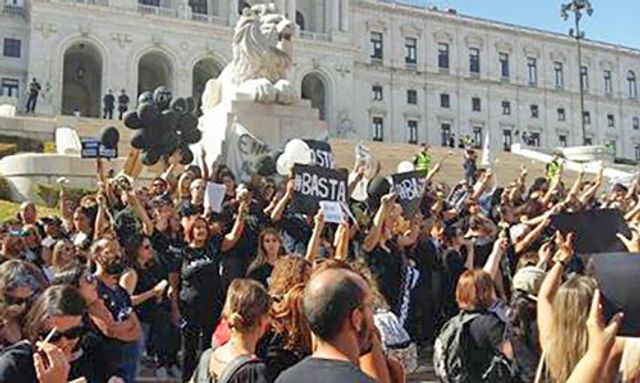
Nurses protesting in Lisbon
Despite the government’s threats, some 85 percent of the 70,000 nurses in the country took part in the strike, bringing services to a halt. José de Azevedo, president of the Union of Nurses (SE), speaking during a demonstration outside the S. João Hospital in Porto, told reporters, “The strike is going well. … Everything that is scheduled is closed. Paediatrics, psychiatry and the emergency room, emergency intensive care units, have no minimum services.”
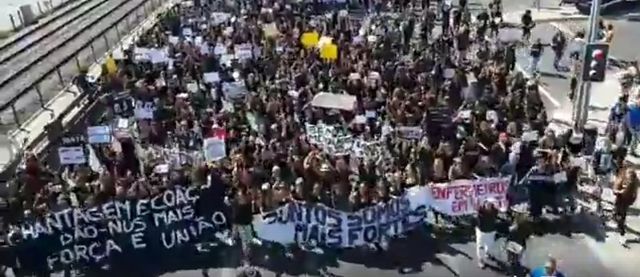
Around 3,000 nurses, dressed in black and wearing t-shirts with the word “Basta” (Enough), took part in a demonstration in the capital Lisbon on September 15. Well-attended protests and picket lines were held in other cities and towns across the country.
The nurses’ demands include an end to the 11-year pay cap, an increase in wages and a 35-hour working week for all nurses—especially those who work in specialist areas. There are around 2,000 such nurses who do not have any pay progression and some 16,000 non-specialist nurses who have the level of skills and training that could already qualify them as specialists.
Nurses earn only around €1,200 (US$1,450) a month regardless of their skills and whether their contracts are 35, 40 or 42 hours a week. Many are forced to work unpaid overtime by the hospital authorities, amid a dire shortage of nurses in Portugal.
This shortage was highlighted by Ana Rita Cavaco, the head of the nurses’ regulatory body, the Nurses’ Order, who declared, “I am not going to comment whether the strike is illegal or not, but I support the nurses.” Cavaco said Portugal needs at least 30,000 extra nurses to fill the gaps, and that over the five years preceding 2016 nearly 13,000 nurses had migrated to Switzerland, Sweden, Germany, France and the UK.
Maria, a Portuguese nurse who now works in a large National Health Service hospital in southern England, told the WSWS, “In Portugal, nurses are on strike for the last months [strikes have taken place in 2014 and 2016] because the pay cap has been on for 11 years. So, it seems like we are doing the same in England and Portugal.”
In England, nurses and other public sector workers have been subject to a seven years wages cap since 2011, resulting in wages dropping by between £6,000 and £9,000.
“The media in Portugal,” Maria continued, “does not give us any support because it would give the cause some strength. They are saying that ‘the nurses want to get more money than the doctors and if nurses get what they want we have to give them 126 million euros’. This is the same argument of the government.”
She continued, “If someone follows the media line, it is our fault that we are poorly paid! In Portugal, the media never show you that nurses are fighting here in the UK. Many don’t trust the media. They are giving the news in a twisted way, and they closely collaborate with the government. This makes us sick.”
The protest in Lisbon
Commenting on French President Emmanuel Macron’s plans to rewrite the country’s labour code, aimed at smashing the social gains of the working class, Maria said, “In Portugal that has happened already. Four years ago, they changed the law so that it’s easier to get employees dismissed with no legal compensation to be paid. The employers can simply dismiss you now. There are thousands of workers who are on Green Receipt [bogus self-employment] jobs. It means you don’t have any job security. You have to work under precarious working conditions and whatever meagre wages are forced on you by the employers.”
Maria added, “My colleagues in Portugal are saying that they were afraid of taking action for so long, because there was lot of pressure in hospitals. If you complain about your working conditions and patient care, then the hospital authorities will tell you, ‘okay then you go and work somewhere else’. There is lot of fear over the last five years. They are abusing and intimidating the nurses.”
Asking whether anything had changed since the PS came to power in 2015, Maria said, “No, nothing has changed. Working conditions are getting worse and worse. Nurses are earning a little bit more than during the previous government, as there are some changes to taxes, but not much. The main thing is some of our colleagues are still doing 40-42 hours. Our specialist nurses, despite having more experience, skills and responsibilities, get the same amount as general nurses. They are revoking their own specialist qualifications now.”
Describing working conditions among Portuguese nurses, Maria said, “You don’t have the right to leave the hospital even though you have finished your shift. If someone is absent they force you to stay, saying that if you leave we have many others to have your job. Nurses are doing thousands and thousands of unpaid hours because they are being coerced to do so.
“I worked in a major hospital in Portugal. There is a lack of equipment and essential resources in wards. Sometimes there aren’t enough towels to wash patients. I remember occasions when we didn’t have gloves to put on. Often, you have to look after 30 patients only by yourself. Last news I heard was one nurse for 46 patients. It is happening all the time.”
Maria’s experiences in Portugal and the UK are a product of the counterrevolution launched against the social position of the working class by the ruling elite internationally since the 2008 global financial crisis. As in other countries, successive Portuguese governments have cut expenditure on health and boosted private profit-making.
According to the Organisation for Economic Cooperation and Development, Portugal has seen a 2.4 percent reduction in health spending over the last seven years. Charges have been introduced and increased for virtually every area of health provision, including for over-the-counter drugs, vaccines, medical certificates, use of hospital emergency departments, GP visits, primary care services, and diagnostic and therapeutic services.
The PS came to power as a minority government in 2015 promising to “reverse austerity”. This fraud was legitimised by the Left Bloc (BE) and Communist Party (PCP), which claimed that, in return for its support, the PS could be pressured to oppose the “troika”—the European Commission (EC), International Monetary Fund (IMF) and European Central Bank (ECB). They claimed such pressure would result in social measures, including wage rises and a reversal of increases in working hours imposed by the previous Conservative government.
The callous treatment of the nurses, who have fought for years to improve their pay and conditions, is an indictment of the “socialist” government—and its pseudo-left and Stalinist apologists—who defend the capitalist state.
The BE attempted to distance itself from the latest actions of the PS government that it keeps in power and apologises for.
BE leader Catarina Martins pleaded with the PS government to recognise that “it is necessary to value the work of nurses in Portugal”. Martins declared that the 2018 State Budget (Orçamento do Estado, OE), which the BE and PS are negotiating, should mean a “recovery for the SNS” and more nurses.
Martins criticised the minister of health, Adalberto Campos Fernandes, saying, “The position of the minister who devalues the claims [of the nurses] that all of us in the country realise are essential does not help a negotiation process that is essential. The OE is not a substitute for negotiations and a spirit of negotiation between the Government and nurses in this country.”
Fernandes’s “devaluation” of the nurses’ claims thoroughly exposes BE’s contention that the 2018 OE gives an opportunity to raise wages and create jobs. During the OE negotiations between the PS and BE, Prime Minister António Costa made it clear that expenditure “has to be controlled.”

Japanese PM backs US “military option” against North Korea

Peter Symonds

In an op-ed article published in the New York Times on Sunday, Japanese Prime Minister Shinzo Abe gave his unalloyed support to the reckless and provocative US build-up to war with North Korea.
Referring to the supposed threat posed by North Korea, Abe stated: “Japan has responded by reaffirming the ironclad Japan-United States alliance, and Japan has coordinated in lock-step with the United States and South Korea.”
The Japanese prime minister continued: “I firmly support the United States position that ‘all options are on the table.’” The phrase, which has become shorthand for warning that the US will used military force to impose its demands, has taken on an even more sinister meaning under the Trump administration.
Trump threatened last month to engulf North Korea in “fire and fury like the world has never seen.” This was reinforced by his speech to the United Nations yesterday, in which he warned that the US might have to “totally destroy” the country. These comments can only mean that the US is preparing the nuclear annihilation of North Korea.
In backing a US war against North Korea, Abe emphatically ruled out any negotiated end to the escalating confrontation. “Prioritising diplomacy and emphasising the importance of dialogue will not work with North Korea. History shows that concerted pressure by the entire international community is essential,” he wrote.
What followed falsified the history of Washington’s aggressive stance towards Pyongyang after the dissolution of the Soviet Union in 1991, which amounted to a barely disguised strategy of regime change.
The US pulled its tactical nuclear weapons out of South Korea and demanded that North Korea denuclearise. After referring to North Korea’s decision to withdraw from the Nuclear Non-Proliferation Treaty, Abe cited the so-called Agreed Framework reached in 1994 as an example of a failed deal.
“We know what happened next: Several years after the heavy fuel oil was delivered and construction started on the light-water reactors, North Korea admitted to having a uranium enrichment program in violation of the agreement,” Abe declared.
Abe omitted the fact that in 1994 the US under President Clinton was on the verge of waging an all-out war on North Korea on the pretext of its “nuclear threat,” only to pull back at the last minute when faced with the scale of the likely casualties. By 2000, the building of lightwater reactors had barely begun and the US had fulfilled none of its other promises—above all, easing the decades-long diplomatic and economic blockade of North Korea.
Abe blamed North Korea for the breakdown of the Agreed Framework but it was the coming to power of President Bush in 2001 that was responsible. Bush immediately called for a revision of US policy towards Pyongyang and in 2002 branded North Korea as part of an “axis of evil” along with Iraq and Iran.
Likewise, Abe blamed Pyongyang for the collapse of a second agreement in 2007 to denuclearise. In reality, the Bush administration only agreed to the deal as the US military was hard pressed in maintaining its military occupation of Iraq, and never had any intention of keeping to it. Even though North Korea kept its side of the deal, Bush demanded a more stringent inspection regime, effectively nullifying the agreement. Obama made no attempt to revive it and pursued a policy of tightening the noose of sanctions around North Korea.
Abe’s tendentious account of “failed negotiations” parrots that which is endlessly recycled in the American and international media. His conclusion that “dialogue will not work with North Korea” amounts to a menacing threat to deal with Pyongyang either through regime change or war.
While praising the latest UN sanctions following North Korea’s sixth nuclear test this month, Abe declared that the world “must not be simply complacent with the adoption of these sanctions.” He insisted: “Now is the time to exert the utmost pressure on the North. There should be no more delays.”
What is the point, however, of more sanctions if negotiations are ruled out? Abe, like the Trump administration, is pushing for a crippling economic and financial blockade of North Korea that would generate a massive political crisis in Pyongyang and open the way for the US to intervene to oust the regime.
At the same time, Abe is exploiting the standoff with North Korea to put pressure on China, its formal ally and largest trading partner by far, as well as Russia. That is the import of his accusation that “there are countries, mainly in Asia, that continue trading with North Korea; and for some, as recently as in 2016, their trade even exceeded that of the previous year.”
Until last year, UN bans focused on North Korean missile and nuclear programs. Even the resolutions of the past year do not exclude all trade and business with North Korea. What Abe is pressing for is a complete trade embargo—an act of war that could precipitate rash action by the unstable regime in Pyongyang and trigger a conflict.
While marching “in lock-step” with the Trump administration, Abe is exploiting the supposed threat from North Korea to whip up an atmosphere of fear and panic at home, in order to push the government’s agenda of remilitarisation.
Abe has already pushed through unconstitutional laws to legitimise so-called collective self-defence—that is, Japanese military participation in US-led wars. He wants to create the political climate in which he can ram through a full revision of the constitution to remove all constraints on the use of the military to pursue the predatory interests of Japanese imperialism.
On Sunday, the US staged its most provocative military exercise to date against North Korea, sending two B-1B Lancer strategic bombers from Guam and four stealth fighters to release live weapons on a South Korean training range close to the demilitarised zone dividing the two Koreas.
South Korean war planes accompanied the US aircraft across the Korean Peninsula while Japanese fighter aircraft joined them over waters near Japan—underscoring Abe’s commitment to any US war against North Korea.

More than 140 dead and counting as a magnitude 7.1 earthquake rocks Mexico City

Andrea Lobo

A 7.1 magnitude earthquake shook the Mexico City megalopolis at 1:14 in the afternoon on Tuesday, knocking down dozens buildings, leaving large clouds of dust and smoke across the horizon. The scenes of solidarity were immediate, as thousands rushed to join rescue efforts and other disaster management tasks, such as directing appeals of aid and rescue on social media, organizing traffic, sharing transport and food, and helping the evacuation of hospitals.
Preliminary reports from the different municipalities indicated a total of 140 dead and dozens more injured at the time of writing, with victims largely concentrated in the impoverished central states of Morelos, Puebla and the state of Mexico. Hundreds of buildings and houses collapsed, including schools, and roads and airports were severely affected, with the damage extending across into Cuernavaca, Guerrero, Tlaxcala, and Michoacán.
The death toll is rapidly increasing as rescuers drag bodies out of the rubble in what constitutes the largest urban agglomeration in the hemisphere. Those dead, including many workers who died in their poorly constructed apartment buildings, are the victims of social murder carried out by a government and its US backers who have neglected spending on infrastructure and social programs for decades.
Rescues continued throughout Tuesday night, and the smaller cities and towns closer to the epicenter continue to regain communication and road connections. The National Seismological Service of Mexico announced that the epicenter was near the city of Axochiapan in the state of Morelos, about 75 miles (120 km) from the country’s capital, at a depth of 32 miles (51 km). The chief of the National Seismological Service of Mexico estimated that over 12 million people felt the earthquake.
Despite the fact that earthquakes in Mexico City are far from unexpected, the government has done next to nothing to prepare the population or the city’s buildings from a major quake. Mexico dedicates the least of its GDP to social infrastructure among Latin American countries, according to a 2015 Inter-American Development Bank study.
Only two hours earlier, about four million public and private workers, as well as students, participated in drills commemorating the exact anniversary of the 1985 earthquake that killed tens of thousands in Mexico City. Many residents compared yesterday’s tremor to the “nightmare of 1985,” which left 5,000 dead.
The difficulties of managing the continued dangers were vast, with many not willing to enter their homes for fear of the frequent aftershocks. Officials warned people not to smoke, fearing explosions from gas leaks. The Mexico City governor said many were trapped in buildings in flames, while the newspaper El Debate reported explosions.
Moreover, 3.8 million people in the country lost power. Social media reports and videos of the devastation and massive evacuations suggest that the extent of the disaster will only become clear in the next days.
Authorities have yet to clear the rubble from the September 7 earthquake that hit the southern states of Oaxaca and Chiapas. The 8.2 magnitude quake less than two weeks ago—the strongest in a century—left 98 dead and entire areas devastated, particularly Juchitán, the poorest city in Oaxaca.
Mexican President Enrique Peña Nieto, who decided to turn his flight initially headed towards the affected areas in Oaxaca back to Mexico City, quickly activated a state of emergency under Plan MX, tied to the deployment of Plan DN-III of Army and Marine officials for “public order.” Fearing the prospect that the earthquakes could trigger a social explosion, Peña Nieto later announced that 3,000 soldiers were going to be sent into the capital.
On Monday night, Peña Nieto spoke on Telefórmula ahead of his trip. He summarized the infrastructural damage of the September 7 disaster: 2,600 schools, 100,000 houses, 5,000 businesses, and 500 large public and cultural installations.
With these estimates, Nieto refused to give a calculated economic cost or budget, simply declaring that “we’ll define the mechanisms for that.” This evasion suggests that the funds that will be dedicated to those affected in these two devastating disasters will not go beyond the meager natural disaster fund, Fonden.
“Mexican society needs to put into dimensions what happened,” said Nieto on Monday, suggesting that the country is much better prepared than during the 8.1 magnitude earthquake of 1985. However, just hours later, his negligence and that of the Mexican ruling class he speaks for were exposed with the vast destruction and untold suffering in the greater Mexico City area.
Finally, Nieto finished his remarks by calling for the suppression of mounting social opposition against his government, escalated by the clear exposure of official indifference and ineptitude. “Let’s disregard any intervention of political actors wanting to take advantage of the tragedy,” he stressed.

Catastrophic Hurricane María heads for Puerto Rico

Rafael Azul

Hurricane María was expected to begin hitting Puerto Rico head-on in the early hours of Wednesday morning. Not since 1928 has a more powerful hurricane struck for the island nation.
Seventy-nine years ago, on September 13, 1928, Hurricane San Felipe 2 devastated Puerto Rico with winds of 160 miles per hour. María is the second Category 5 hurricane to affect Puerto Rico in recorded history. It is expected to hit Puerto Rico from the southeast with estimated wind speeds of 165 miles per hour.
An emergency has been declared across the island. Particularly hard hit will be the islands of Vieques and Culebra on the eastern side of the island, already reeling from Hurricane Irma. Directly in the path of the storm are Ponce, a city of 150,000 and Guayama, with 85,000 inhabitants. If, as expected, it continues on its current path, it will slice Puerto Rico diagonally, with a devastating impact on the mountains of the island, destroying the flower industry there.
There have been dire predictions that the cities in between Guayama and Ponce, such as Arroyo (population: 20,000) and Salinas (population: 32,000), will literally be wiped off the map. The storm surge is expected to raise water levels by six to nine feet near the center of the hurricane, which is predicted to bring 10 to 15 inches (25 to 38 centimeters) of rain across the islands, with more in isolated areas.
The devastation caused by San Felipe 2—at least 300 dead, the destruction of sugar and coffee plantations, the toppling of trees, the near total destruction of homes and buildings—gives an example of what may be in store this time.
On Monday, María smashed into Dominica (population 75,000) unleashing fierce winds and rain over the mountainous Antillean island, ripping the roofs of homes, including the prime minister’s residence. The prime minster, Roosevelt Skerrit, wrote on his Facebook page of “widespread devastation” and expressed his fear that there will be deaths from rain-fed landslides. “So far the winds have swept away the roofs of almost every person I have spoken to or otherwise made contact with,” reported the prime minister, appealing for emergency international aid.
María also struck the densely populated islands of Martinique and Guadeloupe, both French possessions (population 350,000 and 405,000 respectively). In Martinique at least two towns were left without water; 25,000 households have been left with no electricity. In Guadeloupe there are reports of flooded roads and homes as the rains continue.
Forecasters warned María could even intensify in its approach to Puerto Rico. The diameter of its “eye” has shrunk to 10 miles across. “María is developing the dreaded pinhole eye,” declared one. This signals that an extremely strong hurricane will become even stronger, according to Brian McNoldy, a hurricane expert from the University of Miami, comparing it to a spinning ice skater who brings her arms together to spin faster.
The popular mood in Puerto Rico is being described by media observers as desperate. There are still 70,000 people in towns that have been without electrical power for two weeks since the winds of Hurricane Irma. Roads are also damaged in the interior of the island, and hundreds are still in shelters since Irma. Neither the administration of Governor Ricardo Rosselló nor the US government have indicated any desire to mount anything but a minimal rescue operation.
Hector Pesquera, the public safety secretary, urged citizens to evacuate from the path of the storm, “otherwise you are going to die; I don’t know how to make this any clearer,” he declared. According to Pesquera it would be “suicide by hurricane” for citizens not to leave, particularly if they inhabit wooden structures. There are countless wooden houses along the hurricane’s path.
Despite all these warnings, as the hours count down, there is very little activity on the part of the Rosselló administration to help people flee, other than advise them to move in with relatives who live in sturdier homes. For those who cannot reach their relatives, or who don’t have any with secure homes, some 500 shelters are being provided that residents must reach on their own.
Rossello himself gave a cynical, fawning speech in English thanking President Trump for “his personal attention and the tremendous support that we have gotten from his administration in this process.”
“Before this hurricane season started, our island had been battered by a storm of fiscal and demographic challenges,” declared Rosselló, referring to Puerto Rico’s state of bankruptcy after defaulting on a $72 billion debt to Wall Street hedge and vulture funds, and to the continuing emigration of unemployed workers and professionals from the island.
Rosselló assured his audience that while major damage to Puerto Rico was “inevitable,” his government had done “everything within our power” to prepare for this hurricane. He praised the “resiliency” of all Puerto Ricans, their generosity towards Hurricane Irma’s victims on other islands, and called for prayers from all Americans.
In fact, Rosselló, Pesquera and the rest of Puerto Rico’s ruling elite have already washed their hands of any responsibility for actively evacuating people. The stage is being prepared to blame the victims of Hurricane María, those who are unable for whatever reason to move to safer buildings or to higher ground for whatever fate they suffer.
Puerto Rican officials assure that the 500 shelters are capable of receiving 133,000 and that the Federal Emergency Management Agency (FEMA) will provide water and other supplies to those in shelters. At the same time, the governor has warned that power outages will occur that will “last some time,” due to the electric company’s heavily damaged infrastructure.
As with the fiscal “storm” that has battered Puerto Rico, neither Rosselló, the Puerto Rican ruling class, n or the Financial Control Board appointed on behalf of Wall Street, intend to take any responsibility for the collapsing infrastructure that prevented an adequate response to Hurricane Irma, and that now stands in the way of rescue and aid efforts in the face of this very catastrophic Hurricane María. The impact of Hurricane María undoubtedly will be followed by renewed calls for sacrifice and “resiliency” by Puerto Ricans to make sure that the profit interests of Wall Street are taken care of.
On Tuesday there were reports of price gouging in markets in response to the extra demand for emergency supplies, extra food and water. Many residents expect to remain incommunicado during the three or four days before they can expect help from first responders.