21 Sept 2017

Who Will Pay for Huge Pentagon Budget Increase?

Michael Sainato

This week, the United States Senate overwhelmingly voted in favor of increasing military spending by $700 billion, pouring even more money into by far the most expensive military in the world and exceeding military funding from any time during the Iraq and Afghanistan Wars. The U.S. Military budget is larger than the next nine most expensive countries combined, and this new budget now makes it ten countries.
Though both political parties are abrasive toward spending on social programs, from expanding the social safety net through policies like single payer healthcare, to boosting welfare, medicare, and social security, military spending receives little resistance, even in the wake of a massive accounting error at the Pentagon in which trillions of dollars are still unaccounted for. The spending increases continue a trend of enormous military spending set under the Obama Administration, in which the United States’ military budget was the highest its been since World War II.
89 Senators voted in favor of the bill that increased spending than what even Trump’s Administration proposed for programs in funded in the bill, from North Korea defense missile systems to new ships and aircraft. The bill provides funding that far exceeds what is reportedly saved by kicking 32 million people off of healthcare through the proposed Graham-Cassidy Obamacare repeal efforts. The Intercept reported it would take just $80 billion a year to provide enough funding to enact free public college tuition across the country. But instead these policy proposals are dismissed or attacked with fear mongering, baseless rhetoric to frame them as intangible and too expensive. Pundits, think tank fellows, and lobbyists jump through hoops trying to come up with ways to discredit social welfare program proposals as far too ambitious, or down right socialist, to try to delegitimize them. Imagine if the same scrutiny was applied to military spending, but when it comes to funding war, the funding source is never up for debate.
Its disturbing how unanimous support is for significant boosts in military spending are compared to making investments and providing funding into a healthcare program that millions of Americans depend on to survive. Though there is no shortage of virtue signaling or criticisms toward universal healthcare proposals on the potential costs, often ignoring the savings yielded in return, when it comes to war, few elected officials are willing to challenge the military industrial complex. It also reveals a lot about the Democratic Party, who has branded itself on the Trump Resistance, yet poses virtually no resistance for boosting funds for the military that Trump and his administration presides over.
Only 8 Senators voted against the military spending boost, compared to 89 who voted in favor of it, a rare instance of bipartisanship in a highly polarized political climate. Senator Bernie Sanders (I-VT), Kirsten Gillibrand (D-NY), Patrick Leahy (D-VT), Jeff Merkley (D-OR), Ron Wyden (D-OR), Bob Corker (R-TN), Rand Paul (R-KY), and Mike Lee (R-UT) were the only votes against the spending increase.
This bipartisanship is reflective of special interests and war hawks who profit immensely off military spending, rather than representative of the interests of American voters. In 2017, weapons manufacturers and the Defense Industry have continued pouring millions of dollars in campaign contributions to both Republicans and Democrats. While less than 10 percent of Senators opposed this drastic boost in funding, several polls conducted over the course of the past few years affirm that a majority of voters support cutting military spending rather than adding to it. The military budget is just one prime example of how congress reflects the interests of corporations and wealthy donors, while ignoring and in many cases starkly opposing the interests of voters.

The Wage Dividend From Low Unemployment: Blacks and Whites

DANIELLA ZESSOULES & DEAN BAKER

As we previously pointed out, the most disadvantaged segments of the labor market benefit disproportionately from low unemployment. This shows up both in terms of getting a disproportionate share of the job growth and also from seeing more rapid wage growth as a result of the tightening of the labor market they face.
The logic is straightforward. When the economy goes into a slump, it is more likely that a retail clerk or person on the factory floor will lose their job than a manager or a highly educated professional, like a doctor or dentist.
This means that when the unemployment rate soars, as it did in the Great Recession, it is the workers at the bottom of the ladder who are at greatest risk of losing their jobs. They are also the ones who see the largest loss in pay, as their bargaining power diminishes with their employment opportunities.
This post looks at the difference in patterns between blacks and whites. The graphs below shows real wage growth for full-time black and white workers since 2008 at the cutoff for the tenth and ninth deciles of wage distribution as well as the cutoffs for the first quartile, the median, and the third quartile. These data show usual weekly earnings. (The base is the year-round average for 2007.) The changes in this measure reflect both changes in average hours and also in hourly wages.
As can be seen, both black and white workers at the cutoff for the top decile of the wage distribution (the 90th percentile) did reasonably well through the Great Recession and the weak recovery that followed. (The data for black workers is more erratic due to the fact that the sample is smaller.) In fact, the 90th percentile black worker seems to have done somewhat better than the 90th percentile white worker in the recession and immediate aftermath. By 2012, when the unemployment rate still averaged 8.1 percent, their real wages were more than 5 percent higher than in 2007, whereas the gain for the 90th percentile white worker was roughly 4 percent. (It is important to remember that these are changes, the 90th percentile white worker earns far more than the 90th percentile black worker.)
Black workers at the cutoff for the third quartile (the 75th percentile) also appear to do have done slightly better than white workers at the same point along the wage distribution. Their wage gains are roughly a percentage point higher than for whites at the same point along the wage distribution.
However, the story reverses sharply when we look at the lower end of the wage distribution. Black workers at the cutoff for the first decline (10th percentile) and the first quartile (25th percentile) both saw real wage declines of close to 5 percent by 2012. For whites, the wage loss was in the range of 2–3 percent. This gap holds true at the median also, with the median black worker seeing a fall in real wages of close to 3 percent at a time when the median wages were roughly even with their 2008 level. This is consistent with the view that lower paid black workers are the biggest losers when the unemployment rate turns up.
The situation for lower paid black workers has improved substantially as the labor market has tightened in the last five years. Real weekly earnings for black workers at the cutoffs for the first decile and first quartile of the wage distribution, as well as the median, were 3.8 percent above their 2007 level in the most recent data. This still indicates a gap with whites at the same points of the distribution, who all saw gains in real wages of just over 5.0 percent. However, this indicates that the tightening of the labor market has disproportionately benefited blacks at the middle and bottom of the wage distribution.
By contrast, blacks at the top end of the wage distribution have fared less well. Real average weekly earnings for workers at the cutoff for the 9th decile were just 7.2 percent higher than their 2007 level in the most recent data, pretty much unchanged since the 2012 level. By contrast, wages for white workers at the cutoff for the 9th decile were 8.9 percent higher than their 2007 level.
This pattern suggests that wages for black workers at the middle and bottom of the wage distribution are far more sensitive to the unemployment rate than for white workers at the same point of the distribution. The implication is that if the labor market is allowed to continue to tighten, black workers at the middle and bottom of the wage distribution will see the largest wage gains. This is in addition to the fact that they are likely to also get a disproportionate share of employment gains.

What Happened to the Arms Trade Treaty?

Harry Blain

April 2, 2013 was an unusually happy day at UN headquarters in New York. After years of pressure from civil society groups, the General Assembly adopted a new treaty establishing “the highest possible common standards” for regulating the “international trade in conventional arms.”
The Arms Trade Treaty (ATT) was variously described as a “landmark agreement” (by British Prime Minister David Cameron), “ground-breaking” (by Oxfam), and “a direct win that will help save thousands of lives” (by Amnesty International).
There were good reasons for optimism, with two major victories standing out: the enthusiastic backing of the British government and the United States’ reversal of its long-standing opposition to arms trade regulation. Yet since then, neither of these major arms exporters has reduced weapons sales, nor seriously regulated them.
Instead, their arms companies have cashed in on perhaps the world’s worst humanitarian disaster — the Saudi-led destruction of Yemen.
There, bombings led by the Saudis and backed by the U.S. have left thousands of civilians dead, precipitated a cholera crisis that’s infected thousands, and brought the Arab world’s already poorest country to the brink of famine. Yet neither Washington nor London has turned off the spigot of arms to the Saudi coalition.
What went wrong?
An Unprecedented Achievement
When it was passed, the Arms Trade Treaty was without precedent. Uniquely, it focused on so-called “conventional” weapons — from small arms and light weapons to battle tanks, combat aircraft, and armored vehicles — which do most of the world’s killing and maiming but haven’t received the same international attention as their nuclear, biological, or chemical cousins.
Article Six of the ATT boldly declares that a state should not transfer conventional arms if it has knowledge “that the arms or items would be used in the commission of genocide, crimes against humanity, grave breaches of the Geneva Conventions of 1949, attacks directed against civilian objects or civilians protected as such, or other war crimes as defined by international agreements to which it is a Party.”
The fact that a treaty containing this language passed the General Assembly by an overwhelming 154 votes to 3 — and has since been ratified by 89 UN member states — is a testament to the tremendous efforts of the Control Arms campaign that lobbied for it since 2003.
However, the most recent appraisal of the treaty published by Control Arms on September 11 strikes a mixed tone. It highlights “encouraging signs,” including better reporting of arms sales at the national level and the limitation of exports to South Sudan, where a ghastly civil war has given way to famine. Yet the review also describes how, in conflict-zones worldwide, “ongoing arms transfers are playing an acute destabilizing role – nowhere more so than in Yemen.”
Yemen, it continues, represents “one of the most urgently concerning cases in which arms transfers have continued despite information of clear risk of negative consequences.” No fewer than 19 state parties and three signatories continue to export “arms, ammunition parts, and components to Saudi Arabia” despite “mounting evidence” of war crimes. Each of these states is consciously undermining a treaty that they were praising so effusively four-and-a-half years ago.
Record-Setting Arms Sales
Britain and the United States have led the way.
In April 2014, Britain ratified the ATT, with the government promising that it would build on the UK’s “robust” licensing regulations. By December the following year, this claim was tested in a 91-page comprehensive legal opinion on arms exports to Saudi Arabia.
The British government, the authors argued, was “placing undue reliance on Saudi assurances that they are complying with international law” in Yemen, even though these assurances were “not supported by independent evidence from reliable sources.” Their conclusion was clear: “the UK Government has misdirected itself in fact and law in relation to its obligations arising under the ATT.”
While Britain licensed $3.7 billion worth of arms sales in the first year of the Saudi air campaign, the United Nations documented 119 Saudi-led sorties violating international humanitarian law, including airstrikes on targets such as refugee camps, weddings, buses, medical facilities, schools, and mosques. At the same time, as the director of Physicians for Human Rights has put it, the Saudi-led coalition has sought to “weaponize” disease by imposing a harsh blockade which has deepened Yemen’s cholera and malnutrition crises.
If Britain has disregarded the Arms Trade Treaty, then the United States — which is a signatory but not a party — has been even more dismissive. In May, President Trump sealed the largest arms deal in American history with Saudi Arabia, helping the State Department to set an all-time record for arms sales in the 2017 fiscal year.
Yet President Obama — who signed the ATT and attempted to get it through Congress — was if anything even more complicit in the destruction of Yemen, providing the Saudis with almost unquestioned support from March 2015, when the bombing started, to the end of his second term.
During the Obama era, Human Rights Watch cited numerous examples of U.S.-produced weapons striking civilian targets in Yemen, including a March 2016 attack on Mastaba market, which killed at least 97 civilians, and an October 2016 attack on a funeral hall which killed over 100. By the time he left office, President Obama had “overseen more sales of military weaponry than any other president,” Mother Jones reports. Saudi Arabia was among the top five customers.
A False Distinction
With such obvious disregard of its core principles, the Arms Trade Treaty is looking toothless. Critics anticipated this in 2013, pointing to the treaty’s lack of proper enforcement mechanisms. This, however, is a charge that can be made against all international treaties, which ultimately rely on the actions of self-interested and often duplicitous governments.
Instead, there’s a deeper problem with the ATT: its insistence on distinguishing between the “legitimate” and “illicit” arms trade. The treaty pledges to “eradicate” the latter, while protecting the former.
Although the black-market gun runner makes for a good movie plot, the biggest and most lethal arms dealers are governments. Legal sanctions don’t make a missile less deadly — as any Yemeni will tell you. Twenty-six countries legally sold weapons to both sides of the Iran-Iraq war, as the two countries nearly bled each other to death. And — at least according to the UK high court — there’s nothing illegal about selling weapons to the Saudi regime as it crushes its far poorer neighbor.
This is the “legitimate” face of the international arms trade. Until it is seriously confronted — nationally and globally — noble efforts like the Arms Trade Treaty will fail.

New Zealand election: The fraud of Labour’s “free education” policy

Tom Peters & Daniel Bradley

One of the New Zealand Labour Party’s main promises for this Saturday’s national election, printed on flyers sent to homes throughout the country, is to “introduce three years’ free university or trade education.”
Like all the party’s promises to reduce poverty and social inequality, its education policy is highly deceptive. Labour leader Jacinda Ardern told the Australian newspaper on September 8: “I believe in free education but I know we can’t afford that right now.” She described three years’ free study as an “aspiration.”
While attempting to appeal to widespread opposition to the National Party government’s drastic austerity measures imposed since the 2008 financial crisis, the Labour Party and the Greens have reassured big business that, if elected, they will continue National’s spending restrictions and preparations for war.
The Labour Party’s flyer does not explain that it would remove student fees for only one year of post-secondary study, starting next year. Its web site says it would fund another free year in 2021 and a third in 2024. In other words, “three years’ free” education would be implemented only after two more elections, making the promise worthless. There is ample time between now and 2024 for Labour to scrap the policy as “no longer affordable.”
The one year of “free” education would apply only to students who start their courses in 2018 or later. Hundreds of thousands of current, former and returning students, as well as foreign students, would get nothing. Moreover, new domestic students would still have to pay for textbooks and other course-related costs.
The Labour Party proposes a small increase in student allowances, from $170 to $220 a week, not enough to pay for accommodation and living costs in the main cities. These payments are available only to a small minority of students from low-income families. Eligibility criteria, tightened in recent years, would remain. In 2015, only 17.8 percent of students received the allowance, down from 21 percent in 2011.
A mountain of student debt, accumulated under successive Labour and National Party governments, will continue to expand, regardless of who wins the election. Most universities and other institutions routinely increase their fees each year by around 5 percent to compensate for repeated government spending cuts.
The 1980s Labour government of David Lange introduced the first tertiary education fees in 1989. A National Party government scrapped universal student allowances and introduced means-testing in 1991.
The 1999–2008 Labour government, which had promised to relieve the burden on students, provoked nationwide protests in 2000 as fees continued to rise. Despite Labour’s removal of interest on student loans—a ploy to win the 2005 election—by 2008, total debt had reached $10 billion. This year, debt soared above $15 billion, owed by more than 700,000 people. More than 100,000 people have defaulted on their loans and last year the government began arresting people at the border who had not made repayments.
A recent OECD report noted that New Zealand had the seventh-highest fees of 35 developed countries, and government funding provided only half of tertiary institutions’ income in 2014. Fees are around $NZ6,000 a year for a bachelor’s degree, but students in medicine, law and other advanced courses can accumulate debts of up to $100,000 or even higher.
Students face growing poverty and distress. A survey of 2,000 Unitec students in Auckland, released in May, found 17 percent “regularly go without food or other necessities” and 55 percent were unable to afford basic needs at some point in the previous 12 months. This situation is the outcome of attacks by Labour and National governments. Real median incomes for people aged under 25 plummeted between 1986 and 2006, from $18,900 to just $11,500.
The Tertiary Education Union (TEU) has falsely portrayed Labour’s election policy as “a credible and popular alternative to the clear failings of National’s market-based approach to tertiary education.” The union has a long history of suppressing resistance to pro-market restructuring by successive governments.
The TEU’s predecessor, the Association of University Staff (AUS), worked closely with the 1999–2008 Labour government to suppress resistance by university workers. When 79 percent of union members voted for a nationwide strike in April 2004 for better wages and more government funding, the AUS cancelled the industrial action and negotiated minimal pay rises, of about 4 percent, that were acceptable to the universities and the government. By 2006–2007, NZ academics’ salaries were still 44 percent lower than those in Australia and 14 percent below their British counterparts.
Under National since 2008, the TEU has refused to organise a nationwide industrial campaign against course- and job-cutting throughout the country, including 300 redundancies last year at Unitec in Auckland, and an announcement in July of 182 full time equivalent job cuts at Dunedin’s University of Otago. University entrance requirements also have been tightened, barring many students from working-class backgrounds.
These attacks would continue under Labour. In an attempt to whip up nationalism and scapegoat foreigners for the social crisis, the party is calling for immigration to be cut by up to 30,000 per year, or 40 percent. Backed by the trade unions, Labour has called for tighter restrictions on student visas and for foreign students in some courses to be banned from working in New Zealand during and after study. Announcing the policy in June, then-Labour leader Andrew Little echoed the viciously anti-Asian NZ First Party’s claim that foreigners were using study as “a backdoor entry” to residency.
Foreign students currently make up about 15 percent of the student population and they are charged even higher, unsubsidised fees. To compensate for reduced numbers of foreign students, universities and polytechs will further increase their fees and rely more heavily on private investment.
Whatever party wins the election on Saturday, students will quickly come into conflict with the new government and the education unions, as they continue to slash education and impose austerity on young people. To fight back, students will need to oppose every party of the political establishment and adopt a socialist perspective.
The demand must be raised for tens of billions of dollars to fund free, publicly-owned and accessible education for all, regardless of nationality or race. We appeal to students who agree with this perspective to form branches of the International Youth and Students for Social Equality, the youth movement of the Socialist Equality Group and the International Committee of the Fourth International, in universities, polytechs and high schools.

Australia: Two Ipswich meatworks to close, destroying hundreds of jobs

Gary Alvernia 

Two meat processing plants in the Queensland city of Ipswich have announced plans to shut down operations, eliminating as many as 900 jobs, by the end of this month. The announcements, made at the end of August without any prior warning to workers, are part of a deepening assault on the working class.
The meatworks slated for closure are the Churchill Abattoir and the Steggles Wulkuraka chicken plant, employing 500 and 400 workers respectively. The owners of Churchill intend to shut the doors on September 28, leaving their entire workforce unemployed. As for Wulkuraka, its owners Baiada Poultry will axe 250 jobs when it closes the plant in January. While claiming it will retain the remaining workforce in an adjacent distribution facility, the company has given no guarantee.
The closures are devastating for workers in Ipswich, a largely working class city, known historically as a regional centre of coal mining and manufacturing, about 40 km southwest of Brisbane, the Queensland state capital. Workers at both facilities have been shocked by the news. Many now face long-term unemployment and the accompanying social hardship for themselves and their families. In media interviews, workers have said they will be unable to pay their mortgages and could end up homeless.
Churchill’s owners claimed that the short time-frame given for the closure was necessary in order to fully pay entitlements owed to its workforce. Workers objected that, even if true, this would not ameliorate their difficulties. One worker noted that the entitlement amounts would be based on seniority, with most employees receiving meagre payments.
The state Labor government and the Australian Meat Industry Employees Union (AMIEU) issued perfunctory, hypocritical statements about the terrible social impact of the layoffs. At the same time, they will work to ensure there is no organised opposition by the employees, or meat industry workers nationally, to the closures.
In order to stifle resistance, the AMIEU and Premier Annastacia Palaszczuk’s government have said they will speak to other employers so as to assist workers in trying to find alternative employment. In reality, jobs are being destroyed across the industry, and wages and conditions are being gutted.
Both Churchill and Baiada blamed “market conditions,” saying their facilities had become “uncompetitive,” that is, unprofitable. Churchill director Barry Moule claimed that the abattoir was at a significant disadvantage because it produced meat cuts exclusively for Australian consumption, and was unable to exploit lucrative export markets, especially for locally unpopular products like offal.
Moule said recent increases in cattle prices had exacerbated the situation, causing a decline in profits for the abattoir’s investors. In recent years, the abattoir had already undertaken cost-cutting measures, reducing workers’ shifts and operating only four days a week.
While Moule expressed an intention to secure international investment to re-open the abattoir, both he and local media sources said this was highly unlikely. Churchill has been attempting to secure export markets and foreign investment for nearly five years, without success.
Baiada managing director Simon Camilleri said the chicken processing factory was no longer viable due to “market conditions,” requiring Baiada to “consolidate our national processing operations.”
Baiada is concentrating processing at its three New South Wales plants in Beresfield, Tamworth and Hanwood. The company also operates plants at Osborne Park in Perth, Western Australia, at Mareeba in Queensland and in Adelaide.
The Ipswich closures are part of a global meat and food industry restructuring, driven by the financial markets, that has produced shut downs across Australia and New Zealand in recent years. In each case, a similar pretext of “changing market conditions” was utilised to justify the sacking of hundreds of workers. Baiada boss Camilleri offered the same rationalisation when the company closed its Laverton processing plant in Melbourne this year, axing more than 100 jobs.
In response to the Ipswich announcements, AMIEU Queensland branch secretary Matt Journeaux tried to cover up the underlying process. “The meat industry is quite volatile so we definitely see this from time to time,” he told the local media.
The truth is that food production has been increasingly dominated by speculation and corporate takeovers since the 2008 global financial crisis, driving up prices and placing meat out of reach for significant layers of the working class. There have been declines of around 15 percent in red meat consumption in the US and Britain since 2005.
Protectionist measures in a number of countries, such as import tariffs, have also impacted the export markets on which much of Australian agriculture depends. As a consequence of the failure of the capitalist market system, the agriculture and food production industries perversely confront a crisis of over-capacity and reduced profitability. The corporate response is to intensify the exploitation of the working class.
For years, the AMIEU and other food industry unions, such as the National Union of Workers (NUW), have enforced cost-cutting enterprise bargaining agreements in the meat and food industries. They have also assisted in the wholesale destruction of jobs, notably at the two largest meat processors operating in Australia, Brazilian-based JBS and US-based Teys-Cargill, and the two dominant poultry meat companies, Baiada and Inghams.
In previous closures, union officials have complained only about a “lack of consultation” by the corporations, and expressed their desire for an “orderly process” in sacking workers. The unions, in fact, have worked hand-in-glove with companies to suppress resistance. In this year’s Laverton shutdown, Baiada managing director Camilleri said the company intended to “work closely” with the NUW, which was evidently forewarned of the restructure, to supposedly help the workers find other employment.
In 2011, workers at Baiada’s Laverton plant conducted a courageous 13-day strike for improved conditions. The NUW isolated and wore them down, refusing to mobilise any support from the thousands of meatworkers across Victoria and nationally.
Complying with the demands of the employers for ever-greater profitability enforced by the unions will not save jobs—as previous plant closures in Australia and internationally have demonstrated. What is necessary is a rebellion against the union, the formation of rank-and-file committees and a turn to meat workers and other workers in Australia and internationally who are facing similar attacks. A struggle against the dictates of the market can only be based on the fight for a workers’ government and socialist policies.

Burma’s “democracy icon” Aung San Suu Kyi defends ethnic cleansing of Rohingya

Kayla Costa

Amid a growing international outcry, Burmese political leader Aung San Suu Kyi defended the military’s murdering and pillaging of the country’s Rohingya minority in a televised address on Tuesday. She offered empty condemnations of human rights violations, in order to obscure and justify the systematic ethnic cleansing underway by the army.
Suu Kyi offered a thoroughly distorted and duplicitous explanation of the violence in the Rakhine state, where the army has forced hundreds of thousands of Rohingya people to flee the country in the past month. The state counsellor blamed Arakan Rohingya Salvation Army (ARSA) insurgents for causing violent rifts after “several months of seemingly quiet and peace.” She branded them as a terrorist organization that acted against the benevolence of the government and army. The rest of the Rohingya people were referred to only as “Muslims.”
This account may as well have come from Burmese military officials, who have justified their pogroms against Rohingya for years in the guise of defending the nation against “illegal immigration” and terrorism. The ARSA attacks, which are minor by comparison to the army’s brutal operations, are the outcome, not the cause, of military state repression.
Suu Kyi said: “It is not the intention of the Myanmar government to apportion blame or abdicate responsibility. We condemn all human rights violations and unlawful violence.” With this cynical statement, she sought to brush over the military’s decades of gross human rights abuses against the Rohingya, as well as the broader Burmese population.
Suu Kyi effectively gave the military the green light to continue their “clearance operations,” claiming it was bringing “peace, rule of law, and development” to the Rakhine state. She promised humanitarian access and a limited refugee acceptance process, but asked the world to offer more patience and understanding. Just weeks ago, when the army began the onslaught against the Rohingya, Suu Kyi praised the police and security forces for their “great courage” in handling the situation. She bluntly denied reports that the army’s violence constituted ethnic cleansing and refused external investigation or aid.
From the end of August, interviews, satellite imagery and first-hand observations clearly demonstrated the fallacy of Suu Kyi’s statements. The Burmese military systematically targeted the Rohingya population, burning entire villages and murdering civilians. Over 300,000 have fled across the border to Bangladesh, living in horrid conditions in some of the world’s largest refugee encampments.
As the ethnic cleansing of Rohingya provoked public outrage, world leaders and the establishment media issued their own muted criticisms of Suu Kyi, who has been promoted for decades as a “democracy icon” and awarded the Nobel Peace Prize.
UN Secretary General Antonio Guterres last week called on Burmese officials to “de-escalate the situation,” protect civilians and resolve the refugee problem. European leaders issued similar statements, with Britain placing extra emphasis on its concern for the reputation of Burma and Suu Kyi.
This week Guterres, in his opening statement to the UN General Assembly, “took note” of Suu Kyi’s positive statements, but reiterated his hope that “the authorities in Myanmar must end the military operations, and allow unhindered humanitarian access.”
Numerous media commentaries, written more in sorrow than in anger, have pointed to Suu Kyi’s duplicity and thinly-disguised apologetics for the military’s gross abuses. The British-based Financial Times, for instance, declared that the Nobel-prize winner’s speech “fails the Rohingya test.”
The United States, which has stayed nearly silent in the past month, expressed hopes of building “tighter relations” with Burma despite the current situation.
However, no-one openly condemned Suu Kyi nor offered any explanation as to why the much-hailed figure has rapidly transformed into an apologist for the very military apparatus that kept her under house arrest for decades.
Suu Kyi and her NLD opposed the military junta not because of its human rights abuses but because it stifled opportunities for sections of the Burmese capitalist class, blocked foreign investment and was oriented to China, not the West. The US and its allies backed Suu Kyi precisely because she was a staunch advocate of their economic and strategic interests.
Once the military junta signalled a shift away from China in 2011, Washington’s attitude also changed. Burma was no longer denounced as a rogue state but praised as “a developing democracy.” The Obama administration’s efforts to woo the Burmese military were part of its broader “pivot to Asia” throughout the region against China.
The US backed the NLD government, formed after the 2016 elections, despite the fact that the military still holds key levers of power—including all the security ministries, defence, home affairs and border affairs. Like the military, Suu Kyi and the NLD are mired in the Burmese Buddhist supremacy and anti-Rohingya chauvinism that exudes from their justifications of the ethnic cleansing.
For the US and its allies, the brutal “clearance operations” are nothing more than a temporary embarrassment and potentially a tool to pressure the government if it tilts toward closer relations with Beijing. So long as this “democratic” government protects their geostrategic and economic interests, no significant action will be taken to pressure it to end the human rights abuses.

Markets hail “gradual” moves by Federal Reserve

Nick Beams

The US Federal Reserve kept its official interest rate on hold at the conclusion of its two-day meeting yesterday, as expected, in a further indication that any return to “normal” conditions will be very gradual.
The main decision to come out of the meeting was to start winding back its holdings of the $4.5 trillion in financial assets, accumulated as a result of the program of quantitative easing. This decision was also expected as the Fed had indicated back in June that it would start the wind down.
But the pace will be very slow—Fed chairwoman Janet Yellen has previously likened the process to “watching paint dry.”
The financial markets were clearly pleased with the decisions as both the Dow and the S&P 500 indexes finished the day at new record highs.
Yellen said that although the Fed had decided to maintain its target interest rate at the current level of 1 to 1.25 percent, it expected that the “ongoing strength” of the economy would warrant gradual increases as inflation moved towards the target range of 2 percent. This was taken as an indication that a further rise of a quarter percentage point could be carried out in December.
But the Fed’s open market committee is divided on the issue. While Yellen claims that inflation has remained lower than expected because of one-off factors, such as reduced charges for phone services, and these effects are transitory.
But others maintain that with inflation at below the target rate of 2 percent for the past five years and with significant falls over five months this year before an upward spike in August, low inflation is the result of structural changes in the economy. Official policy is still based on the so-called Phillips curve which maintains that as unemployment falls inflation should rise due to increased wages. But wages in the US, as in other major economies, have either remained stagnant or fallen in real terms since the 2008 financial crisis.
During her press conference, Yellen did remark that the fall in inflation this year had been something of a mystery and it was not easy to explain why it had remained low.
The other key economic factor behind the Fed’s reluctance to move on interest rates is the low US growth rate which still remains at around 2 percent. Reflecting this trend, the Fed brought down its median estimate for the so-called neutral rate—the rate which neither boosts nor retards economic growth—from 3 percent to 2.8 percent.
Yellen said the neutral rate was “likely to remain below levels that prevailed in previous decades.”
On the wind-back of the Fed’s assets holdings, Yellen indicated that the process would start next month. From October to December the reduction in assets—treasury bonds and other forms of debt—would be reduced by $10 billion a month, thereafter rising to $50 billion a month starting in 2018.
Yellen was anxious to assure financial markets that this would not bring about an end to the flow of cheap money.
“By limiting the volume of securities that private investors will have to absorb as we reduce our holdings, the caps should guard against the outsized moves in interest rates and other potential market strains,” she said. The Fed would be prepared to resume investing in financial assets should a “material deterioration in the economic outlook warrant a sizeable reduction in the federal funds rate.”
All of this was music to the ears of the financial markets which rose after the decision. But there are concerns about how long the stock market rise can continue, and, even more significantly, what will be the political consequences of a downturn in the US economy.
In an op-ed piece published in the New York Times on September 15, Nobel prize-winning economist Robert Shiller noted that, according to his cyclically adjusted price earnings ratio (CAPE), market valuations were very high.
“The CAPE ratio is above 30 today, compared with an average of 16.8 since 1881. It has been above 30 in only two other periods: in 1929, when it reached 33, and between 1997 and 2002, when it soared as high as 44.”
While he described the present level as “troubling,” Shiller maintained that the present situation was not like that which preceded the Great Depression because there was not the same mass psychology and while valuations remained “very high” there did not seem to be a worry by investors that others were on the verge of selling.
But as a student of economic history, Shiller would be well aware that market crises have generally been preceded by the claim that “this time it’s different.”
“Why people are so calm about the high-priced market is a bit of a mystery. On this I can only speculate. … I don’t really know.”
In an interview with the business channel CNBC on Tuesday, he noted that the CAPE for the US market was the highest of 26 countries. “I wouldn’t call it healthy, I’d call it obese,” he said.
A different kind of warning, directly related to underlying class relations in the US, was issued by hedge fund manager Ray Dalio. Speaking to CNBC on Tuesday, he said that perhaps the biggest economic issue of our time is a social one.
With less than 1 percent of the population having a net worth that is equal to the bottom 90 percent of the population combined, “what is a big deal is if you had an economic downturn because we have two economies.”
Pointing to the presidential election result and other signs of political turbulence in the US, along with the rise of class tensions, he said: “If you were to have a downturn, I really do believe that the wealth conflict, the left, the right and all of that would be intolerable.”
Dalio repeated earlier comparisons he has made with the year 1937 when, after a recovery from the Great Depression, the US economy again experienced a major downturn. While he did not make specific references to the events of that time, 1937 saw major class battles, particularly in the steel and auto industries.
Dalio said economists generally dealt in averages. But averages could be misleading and while the economy was showing growth the situation for 60 percent of the population was “terrible.”

Dangerous developments in Germany: AfD leader praises the Nazi Wehrmacht

Johannes Stern

Just days before the federal election, the consequences of Germany’s return to a policy of war and militarism are becoming ever more apparent. At a meeting of the right-wing extremist Alternative for Germany (AfD) in the state of Thuringia at the beginning of September, the party’s leading election candidate, Alexander Gauland, called for Germany’s Nazi past to be seen in a positive light.
No other nation had “so clearly come clean on a false past as Germany,” Gauland roared out to his jubilant audience. Addressing the Nazi terror regime which ruled Germany from 1933 to 1945, Gauland declared: “We do not have to recriminate ourselves regarding these twelve years. They no longer impact our identity. And we will address this fact.” Germans therefore “have the right not only to win back our country, but also our past.”
By this Gauland means the glorification of the vile crimes committed by German militarism in the first half of the last century. “If the French are rightly proud of their emperor and the British proud of Nelson and Churchill, then we have the right to be proud of the achievements of German soldiers in two world wars,” he said at the end of his twenty-minute rant.
Germany’s past, he said, includes both the leader of a plot to assassinate Hitler, Graf von Stauffenberg, as well as the Wehrmacht general Erwin Rommel. It includes the Battle of Sedan as well as “the slaughterhouse of Verdun”. This was “German history, and we will not allow any Turkish-born German to cast it aside.” The AfD leader was referring to a previous statement in which he demanded that Germany’s Integration Commissioner Aydan Özoguz be “cast aside” in Anatolia.
Representatives of Germany’s mainstream parties reacted to Gauland’s fascist tirade with feigned displays of opposition and calls for more state surveillance. According to SPD parliamentary faction head Thomas Oppermann, “The statements expose Gauland as an ultra-right militarist. I cannot imagine how one could summon up even a grain of pride regarding the millions of dead, barbaric war crimes and destruction of all of Europe.”
For his part, the SPD’s leading election candidate, Martin Schulz, called upon the country’s intelligence agency to place the AfD under surveillance due to its extremist tendencies. “The rhetoric of the people at the head of the AfD shows that convictions prevail not only in the party base, but also in the leadership, which are incompatible with the fundamental values of our constitution,” Schulz declared in an interview in the current issue of Der Spiegel.
Representatives of other parliamentary parties took a similar line. Stephan Mayer, a speaker for the conservative union parties (CSU and CDU), told the business newspaper Handelsblatt, “Surveillance of the AfD by our domestic secret services should not be ruled out in future should the AfD become even more radicalized”. The Green Party MP Volker Beck said: “I cannot understand why factions of the AfD and state associations such as the ‘Patriotic Platform’ and ‘The Wing,’ which publicly appeal to the far right, have not been placed under surveillance.”
Do Schulz, Oppermann, et al. really think they can throw sand into the eyes of the vast majority of the population who are repulsed by the neo-Nazism and racism of the AfD? The fact is that the same parties and media which now rail against the AfD created the conditions for its rise to prominence. Seventy years after the downfall of Hitler, they bear ideological and political responsibility for the likelihood that this weekend a far-right party will once again enter the Bundestag.
For many years the media have provided a platform for the xenophobia and nationalism that are the hallmarks of the AfD. Seven years ago, the media hyped up the racist filth propagated by former Berlin finance Senator Thilo Sarrazin (SPD) in his book Germany Abolishes Itself. Barely a day goes by in the current election campaign without leading representatives of the AfD cropping up in prominent talk shows to spout their far-right nostrums at peak viewing times.
The leading political parties have asserted (so far) that they will not cooperate with the AfD after the election, but in effect they have largely adopted its program. In the course of the election campaign, the CDU/CSU, the SPD, the neoliberal Free Democratic Party (FDP), the Left Party and the Greens have all sought to outdo one another with demands for more rearmament and a more aggressive policy towards refugees.
The rehabilitation of the Wehrmacht and the trivialisation of its crimes is not only being carried out by Gauland, a man who, for forty years, was a leading member of the so-called “Stahlhelm” wing of the CDU in the state of Hesse. Following the uncovering of a neo-Nazi terror cell in the Bundeswehr at the beginning of May, representatives of all of Germany’s leading parties lined up behind the army. Defence Minister Ursula von der Leyen, who had initially made some critical remarks about the Bundeswehr’s links to the Wehrmacht, quickly shifted her line. Several army barracks still bearing the names of Wehrmacht generals are now not to be renamed—despite promises of the contrary.
The SPD also considers any criticism of the German army’s links to the Wehrmacht, however mild, to be beyond the pale. In an interview with the Bundeswehr Association, Schulz recently declared: “We in the SPD also regarded it as very unseemly when Frau von der Leyen recently placed members of the Bundeswehr under general suspicion.” Her action had “eroded trust”.
In his speech in Thuringia, Gauland merely expressed in an outspoken manner themes that the German ruling elite have been working on for a long time: It is seeking to minimise the historical crimes of German imperialism in order to prepare new wars and atrocities.
In January 2014, Humboldt University Professor Herfried Münkler, who has links to the highest government circles, stated in an interview with the Süddeutsche Zeitung: “It is hardly possible to assume a responsible policy in Europe if one has the impression: we were guilty of everything. With regard to 1914, this is a myth.”
Just one month later, his colleague, Jörg Baberowski, told Der Spiegel: “Hitler was no psychopath and he was not vicious. He didn’t want people to talk about the extermination of Jews at his table.” Baberowski went on to defend Ernst Nolte, the historian at the centre of the famous Historikerstreit (historians’ dispute) in the late 1980s, who undertook his own fundamental revision of Germany’s past under the Nazis. According to Baberowski: “Nolte was done an injustice. Historically speaking, he was right.”
There are many passages in Baberowski’s books in which he seeks to minimise the crimes of the Nazis. For example, he has asserted that Stalin’s army “forced” the Wehrmacht to carry out a war of extermination. The manner in which Baberowski agitates against refugees in countless articles and interviews also replicates arguments used by the AfD.
However, when the Sozialistische Gleichheitspartei (Socialist Equality Party, SGP) and its youth and students’ organization, the International Youth and Students for Social Equality (IYSSE) publicly criticised Baberowski, leading media outlets and academics reacted with fury and lined up behind the right-wing extremist historian. Today, no one can deny that there is a direct link between the revisionist stench issuing from Humboldt University and the return of German militarism. The AfD is merely the sharpest expression of this development.
Gauland is a declared supporter of Münkler’s call for German hegemony in Europe to defend its global geopolitical and economic interests. “What Herfried Münkler wrote about the Macht in der Mitte [Power in the Centrethe title of Münkler's book calling upon Germany to once again become the “taskmaster” of Europe] was all very clever”, Gauland told Die Welt.
Baberowski is now moving in AfD circles. He presented his most recent book, Räume der Gewalt (Spaces of Violence), in the Library of Conservatism, an extreme right-wing think tank in Berlin, which Gauland and other AfD politicians regularly frequent. Other figures like Björn Höcke, the chairman of the AfD in Thuringia, have spread Baberowski’s agitation against refugees on their personal Facebook pages.
The representatives of the established parties may seek to distance themselves from the AfD in the election campaign, but what they really think of Gauland’s speech is reflected in their attitude towards Baberowski. The latter is not only a welcome guest in the Konrad-Adenauer Foundation, associated with the CDU; he has also featured as guest speaker at meetings held by the Greens and the Left Party. The Social Democratic President of Humboldt University, Sabine Kunst, has even threatened critics of Baberowski with criminal prosecution, although a German court confirmed that Baberowski can be called a “right-wing extremist”.
The censorship of left wing and anti-militaristic websites by Google is not least a reaction to the criticism made of Baberowski by the World Socialist Web Site. Google’s search engine manger, Ben Gomes, met with German government representatives in Berlin in April. Since then, WSWS articles about Baberowski have virtually disappeared from Google searches in Germany.
As was the case on the eve of the First and Second World Wars, the German ruling class is once again seeking to intimidate and silence anyone who opposes war and militarism. Everything now depends on the independent intervention of workers and young people into political developments. This is the goal of the Sozialistische Gleichheitspartei. The SGP is the only party standing in the federal elections on a socialist program directed against war and capitalism, and which fights to build an international movement of the working class against social austerity, racism and the return of barbarism.

Spanish police raid Catalan government buildings, arrest officials

Paul Mitchell

Spain’s Civil Guard Wednesday arrested 14 senior public officials in the Catalan regional government and local Catalan businessmen, as the Popular Party (PP) government steps up its efforts to halt the independence referendum planned for October 1.
The Civil Guard seized voting cards, referendum posters, pamphlets and printing plates. They also raided the offices of the pseudo-left separatist party Popular Unity Candidacy (CUP), which has no executive positions in the Catalan state, and Fundació puntCAT, which oversees “.cat” regional internet sites. The government has launched an investigation into more than 700 local mayors who have backed the referendum and has ordered them to appear in court.
Spain’s Finance Ministry confirmed that the central government has taken over the Catalan government financing system, preventing it from borrowing money, and taking control of politicians’ and officials’ credit cards.
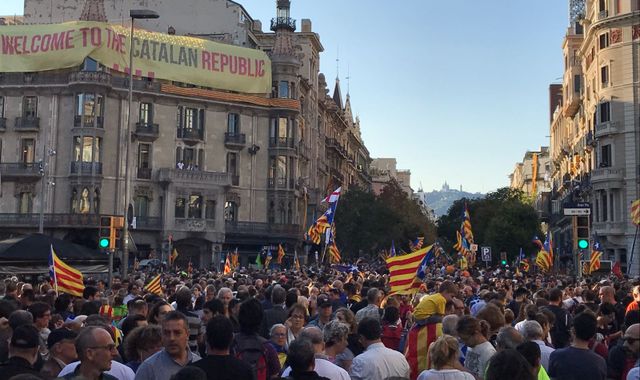
The demonstration in Barcelona
In response, large opposition demonstrations broke out in the regional capital Barcelona and other Catalan cities. A sympathy demonstration also took place in Madrid’s Puerta del Sol against the Spanish government’s police raids.
Catalonia Prime Minister Carles Puigdemont has called an emergency meeting of the regional government. Reports suggest it has made provisions in secret for voting on the day and lined up international observers led by Dutch diplomat Daan Everts and Helena Catt, who was chairman of the New Zealand electoral commissionalthough more prestigious observers have so far refused.
The Mayor of Barcelona, Ada Colau, spokesperson of Catalunya in Comú, a coalition involving Podemos, United Left and the Greens, who recently handed over some of Barcelona’s institutions to the regional government to allow voting to take place, called on her members and supporters to “defend Catalan institutions.”
“It is a democratic scandal that institutions are being searched and public officials arrested for political motives,” Colau declared.
The chairman of the umbrella separatist organisation, the Catalan National Assembly, Jordi Sánchez, said “The moment has arrived. Let’s resist peacefully. Let’s go out and defend our institutions in a non-violent manner.”
Catalan government spokesman Jordi Turull described the situation as “a police state of siege.”
In Madrid, Republican Catalan Left (ERC) MPs walked out of Congress, with one MP, Gabriel Rufián, telling the Popular Party (PP) Prime Minister, Mariano Rajoy, “I ask and demand that you take your dirty hands off Catalan institutions”.
Rajoy replied that “what is happening in Catalonia is an attempt to liquidate the Constitution and the [Catalan] Statute, and now there are people breaking the law, so logically the state has to react. They were warned. I ask Puigdemont to comply with the law.”
Reports suggest that on Friday the PP government will begin the formal process of activating Article 155 of the Spanish Constitution to suspend home rule in Catalonia, “until the situation of risk for the general interest in the autonomous community of Catalonia disappears.”
The PP has been spurred on by the bourgeois media, with many editorials criticising it for being too weak. Most revealing, the ostensible liberal pro-Socialist Party (PSOE) newspaper, El País, declared, “The democracy and constitutional order with which Spaniards bestowed themselves in 1978 following a long dictatorship are currently at a critical juncture. The challenge laid down by the Catalan government, and by the parliamentary majority behind it, is threatening to destroy our unity and social harmony.
“By acting irresponsibly… separatists have embarked on an unprecedented challenge against Spain. The central government, like all other institutions, has an obligation to act firmly and use all legal means to defend the Constitution, democracy and the rights and freedoms of all Spaniards.”
El País condemned the Catalan police force, the Mossos d’Esquadra, for “standing by while crimes are being committed against the Constitution and the Statute.”
It told Rajoy “he has the responsibility and the obligation to act in order to prevent Spain from becoming a state that is unable to enforce the law or uphold its own Constitution.”
It called on the prime minister to drive a wedge between the “true independistas” and the federalists that they have attracted over recent years by offering reforms, even though it “would very probably generate a great hostility in the rest of the autonomous communities.”
The right-wing newspaper, El Espanol, declared, “Rajoy’s lack of determination and clarity at the moment of stopping the independence coup weakens the counteroffensive of the state while at the same time emboldens the most hostile parties to the constitutional regime…”
“Rajoy and [Deputy Prime Minister] Sáenz de Santamaría have allowed the secessionist bloc to always go one step ahead for their fear of activating 155, which allows for autonomy to be suspended… This strategy not only generates unnecessary tensions… but also compromises the unity of the constitutionalist parties in the face of the challenge. The bewilderment is very visible in the PSOE, which has gone from opposing to not wanting to pronounce on a hypothetical application of 155.”
The PSOE is in crisis over Rajoy’s actions, with a leaked internal party document declaring, “The train crash in Catalonia is already irreversible.”
The party’s officials make contradictory statements. The PSOE is opposed to Catalan independence, but has objected to the invocation of article 155, saying, for fear of arousing popular outrage, that it is “a disproportionate measure”. While PSOE leader Pedro Sanchez more recently has stopped ruling out the invocation of article 155 in public, the party’s spokesman Óscar Puente this week declared, “It wouldn’t be desirable… We don’t know what will happen, [so] taking any categorical stance would be imprudent”.
The crisis became more acute in Congress on Tuesday when the right-wing Citizens party leader Albert Rivera introduced a motion of confidence in Rajoy's handling of the situation. Rivera said he wanted the Chamber to express “its support for the Government, the Constitutional Court, the Public Prosecutor’s Office and the other representatives of the Judiciary and Public Authorities, in defense of democratic legality in Catalonia and, in particular, in all those measures that are necessary and proportionally adopted to prevent the organization of the referendum on secession of Catalonia, convened by the Generalitat and declared unconstitutional by the Constitutional Court.”
However, when the PSOE proposed an amendment to open “a space for dialogue to seek an agreed and legal way to banish the divisions and strengthen the coexistence of all the sensibilities of our country,” Rivera refused.
As a result, the PSOE voted against the motion instead of abstaining as expected. It was defeated by 166 votes against and 158 in favour.
El Espanol complained, “The proposal could have served to show the unity of the constitutionalist forces against the referendum of Carles Puigdemont, but it has become a trap for the Executive after the PSOE disarmed and voted against. Although it has also divided the Socialists themselves, as four members of the group have abstained.”
Pressure is mounting on the Catalan separatists from the international ruling elite. European Parliament President Antonio Tajani and European Commission President Jean-Claude Juncker said that the law and constitution of member states must be respected. If Catalonia became independent it would not only be considered a third country, but would only be allowed to use the euro in a limited way, as in Kosovo.
In a Financial Times editorial published on September 17, the newspaper said the Constitutional Court was “the ultimate authority on these issues” and arbiter on the “indissoluble unity of the Spanish nation.” Any declaration of independence would be “an empty rhetorical gesture.”