23 Sept 2017

Sri Lankan plantation workers protest job cuts and new productivity demands

M. Thevarajah

Strike action and protests by plantation workers at several estates in Sri Lanka’s Nuwara Eliya district have erupted in recent weeks over new productivity demands, the dismantling of tea estates and cuts in wages and jobs. The management attacks have the full backing of the government and the trade unions.
* On September 10, nearly 200 workers from the Henfold tea estate in Hatton held a protest picket against the leasing of six hectares of land to a foreign-based business for corn cultivation. The estate is managed by the Watawala Plantation Company.
* On September 7, Strathdon estate workers, also in Hatton, walked out on strike and demonstrated against wage cutting and the abandonment of tea cultivation in a section of the estate.
* Nethastal division workers at the Glasgow estate also struck recently to protest against company plans to replace tea bushes with turpentine trees in some parts of the estate. Company management temporarily abandoned the plan in response to the walkout.
The strikes and demonstrations are part of a growing wave of industrial action and working-class struggles against Colombo’s big-business program.
Henfold workers, who were concerned about the destruction of jobs at their estate, contacted P. Digambaram who leads the National Union of Workers (NUW) and is also Sri Lanka’s plantation infrastructure minister. He brushed aside workers fears, claiming that management had assured him that the corn cultivation was only for three months and the land would revert to tea production. He demanded an end to the protest, telling workers that the manager was a good person.
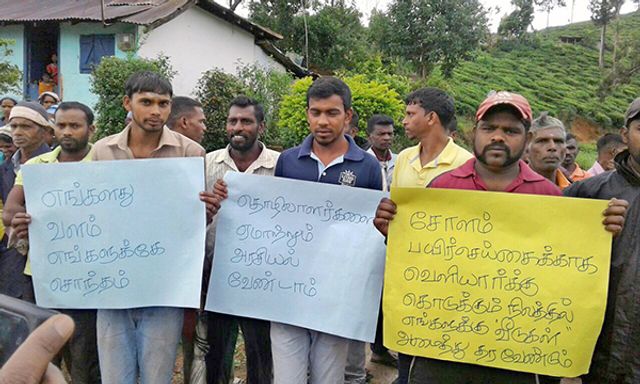
Plantation workers picketing Henfold Estate
As one Henfold estate worker told the World Socialist Web Site: “If tea cultivation is transformed into corn cultivation, many workers will lose their jobs. That is why we are protesting. The trade unions, however, support management implementing this plan. Management previously closed down and abandoned 22 out of 112 hectares of tea plantation in this division.”
Digambaram’s intervention, the worker continued, “helped the company. We don’t believe the company will stop corn cultivation if it is investing millions of rupees. Digambaram is cheating us.”
While the company now claims to have discontinued corn cultivation, its plan has not been abandoned. Two other divisions of the estate have already started cultivating corn over a total of four hectares.
Commenting on demands for increased productivity at other plantations, a Strathdon estate worker said: “Most of the workers have not been paid full wages since May this year and have lost about 3,000 rupees [$US19.60] per month. The company wants 19kg [of tea] plucked per day but we can’t reach this target.
“During the rain season the maximum we can get per day is only 15kg and because of that every worker lost the 140-rupee daily productivity allowance. Also, if a worker plucks less than 15kg they are only paid a half day’s wages. How can we live with these wage cuts under today’s skyrocketing cost of living?”
Other estate workers denounced the plantation unions and said they were betrayed when the unions signed the last collective agreement that allows management to cut wages and increase workloads.
Estate managements are deliberately abandoning estate land, not clearing weeds and bushes, and not using fertiliser and other chemicals. Where previously 15 workers were employed to clear and weed about two hectares a day, now only two workers have to cover the same areas. Wild shrubs have grown in many places, breeding grounds for leeches, snakes and sometimes wild leopards.
A Glasgow estate worker detailed the intolerable workload at her plantation: “We have to pluck 18kg of tea leaves per day but cannot reach this target during the rains in March, April and May. Because of that we lost the 140-rupee productivity allowance and the 60-rupee incentive payment.”
Another tea plucker said: We can’t reach [management’s] target because of the bad condition of the estate and so we lose allowances. Many workers are now employed on a casual basis, some of them even for seven years. Some retired workers have been reappointed as casual workers in order to cut costs.”
“I don’t have a house,” the mother of three children continued. “For several years we’ve been living at a relative’s house. The trade unions are doing nothing and the government has cheated us.”

Line-room accommodation for plantation workers and their families at Glasgow Estate
Management attacks on workers at the Henfold, Strathdon and Glasgow estates are part of a broader assault on plantation workers’ jobs and social conditions.
Watawala Plantations has initiated a dairy farm project at its Lonach estate with a Singapore-based investment company. Beginning with 400 cows, it will be expanded to carry 2,000 cows. The company wants to end all tea cultivation at Lonach and use the land for the dairy farm. Watawala Plantation plans to transfer workers from Lonach to its Tharawela estate.
At the same time, plantation companies have begun imposing a new revenue system that assigns plots of land with about 1,000 or more tea bushes to individual workers and/or their families to maintain.
The worker is provided with fertiliser, agricultural implements and other inputs but must handover the harvest to the company’s factory. In exchange the worker receives a share of the income but only after company has deducted its “input costs.” The system transforms waged tea plantation workers into share-croppers with the loss of previous hard-won conditions and rights.
Kelani Valley Plantations implemented this system in April at its Battalgalla estate in Dickoya. Mathurata Plantations began imposing these measures at its Mao Uva estate in October last year.
The new share-cropping system, demanded by the Planters Association, is fully backed by the Sri Lankan government. Prime Minister Ranil Wickremasinghe has called on planters “to go beyond a traditional tea cup and explore the industry from fresh perspective in order to outperform others in global arena.” He recently told a convention that the government was preparing new legislation to expand the share-cropping system.
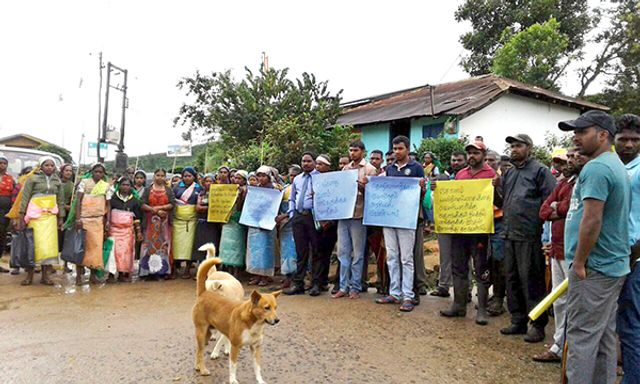
Workers at Henfold Estate
Addressing the “150 years of Ceylon Tea” celebration at the Bandaranaike Memorial International Conference Hall on August 9, the prime minister declared that the lower tea prices, higher cost of production, including wage increases, were impacting on plantation companies. “The industry should make a decision about whether it can continue with traditional workers, subcontract the land or think of a combined model,” he said.
Wickremasinghe urged Plantation Industry Minister Naveen Dissanayake to boldly implement the share-cropping plan and referred favourably to his father, Gamini Dissanayake, and his “Accelerated Mahaweli Project” in the late 1970s.
Gamini Dissanayake, then a minister in former President J. R. Jayawardene’s government, imposed the so-called Mahaweli Project, brutally expelling peasants from their land and crushing protests by plantation workers employed at several estates that were to be submerged.
Wickremesinghe’s reference to the Mahaweli Project is a warning that plantation workers will be confronted with similarly ruthless government attacks.
Naveen Dissanayake assured the convention audience that the government was studying the share-cropping model and appealed for more union support.
“The estate workers are given some land rights over land and the management companies will also have better yields. This model is commonly known as the outgrow model. I hope the union leaders will give us the support required to take the industry forward,” he declared.
Wickremesinghe and Dissanayake’s promises are to give the plantation companies more legal clout in suppressing the opposition of estate workers and intensifying the attacks on their basic rights. As the last wage agreement makes clear, the unions have already indicated that they will deepen their collaboration with the companies and the government.
The escalating attacks on plantation workers are part and parcel of the “economic reforms” dictated by the International Monetary Fund. The recent protests of plantation workers are another indication that there is deep-seated opposition to Colombo’s austerity measures in the working class and that major political and industrial struggles lie ahead.

New Zealand election: Bipartisan agreement on war and austerity

John Braddock

Today’s election in New Zealand is forecast to be the closest since the Helen Clark-led Labour government was ousted in 2008. Since the installation of Jacinda Ardern as Labour’s new leader on August 1, polls have gyrated wildly, alternately favouring the National Party government and a possible Labour-Green Party coalition.
According to a TV 3 poll released on Thursday, National has 45.8 percent support. With Labour on 37.3 percent, and the Greens at 7.1 percent, either camp could take office. Significantly, both major parties would need to strike a deal with the right-wing populist New Zealand First Party, currently at 7.1 percent, to form government.
The entire campaign has seen the vast dangers facing the working class and youth—specifically the accelerating threat of nuclear war—systematically suppressed by all the establishment parties.
This immense danger, highlighted by US President Donald Trump’s threat at the UN to “totally destroy” North Korea, has remained the great political unmentionable. Since Prime Minister Bill English declared in August that he would “consider” joining a US-led offensive against North Korea, this stance has not been opposed by any party.
In the final televised leaders’ debate on Wednesday, just hours after Trump’s speech, there was no mention of foreign policy. The official opposition parties—Labour, the Greens, NZ First and the Maori nationalist Mana Party—along with the trade unions and much of the media, have prepared for joining US hostilities against China by promoting nationalist attacks on immigration and anti-Chinese “influence” on house prices and business investment.
The ruling elite is preparing far-reaching attacks, by whichever parties assume office, on the working population at home and for war abroad. This bipartisan consensus was on display in the debate between English and Ardern. The event was not a “debate” in any real sense, but rather a friendly discussion between representatives of two wings of the political establishment.
Since the 2008 global financial crisis, the National Party government has carried out a deepening assault on jobs, living standards, public services and basic rights. English was allowed during the debate to assert, virtually unchallenged, that the housing market is expanding “faster than ever,” there is no housing crisis and National is tackling social issues by “changing lives one by one.”
Ardern had almost nothing to say about the depth of the social crisis. Aside from scapegoating immigrants, Labour’s main housing proposal is to build 100,000 houses over the next 10 years, to be sold at unaffordable prices of between $400,000 and $600,000. This will do nothing to help the 42,000 people who are homeless.
The final week of the election campaign was dominated by reports of a crisis in the health system due to decades of underfunding by Labour and National governments alike. Severe delays for vital cancer surgery in Southland will shorten people’s lives, while a baby recently died at Waikato because not enough surgeons were available to perform the ceasarian section operation on time. Ardern criticised the lack of funding, but Labour’s proposal is to inject only $2 billion extra per year, well short of what is needed to meet existing need and provide for population growth and ageing.
Ardern focussed on assuring the ruling elite that Labour’s policies are fiscally responsible and “fully costed.” Her most animated remarks came when she criticised National’s “dishonest” attacks on Labour’s tax proposals, which have included claims of seven new taxes, including on capital gains and water.
Ardern has ruled out any increase in tax to tackle severe social problems. Labour would set up a working party of “experts” to investigate a “fairer” tax system, she claimed, but any suggested changes would not be implemented until after 2020.
There is a discernible shift to the left among broad layers of the working class and youth, who are searching for an alternative to deepening inequality, child poverty and the housing crisis, for which all the parties carry responsibility.
To direct this into safe parliamentary channels, the corporate media, along with the trade unions and pseudo-left groups, have whipped up a wave of “Jacindamania,” featuring false claims that Labour will address the social crisis. Ardern’s elevation to Labour’s leadership was a desperate manoeuvre to stave off electoral disaster, not just for Labour, but for the increasingly discredited parliamentary system. A million voters abstained in both the 2011 and 2014 elections.
Labour and the Greens have stuck to their commitment to “budget responsibility rules” which mean reining in public debt and returning fiscal surpluses. Neither party has put forward any policies that will significantly reverse the social disaster of the past three decades.
All Labour’s proposals are fundamentally deceptive. Its pitch to young people to provide three years’ “free” tertiary education is merely an “aspiration,” that would be implemented only after two more elections, making the promise worthless.
On Thursday, Ardern promoted Labour’s reactionary changes to industrial legislation, which would allow the trade unions to negotiate “fair wage agreements” across selected industries. While details of the policy are unclear, Ardern told Radio NZ it would help the unions work “collaboratively” with employers and the government to impose wages and conditions acceptable to big business. She stressed that her government, with the agreement of the unions, would “legislate” to remove the right to strike during these negotiations.
The Green Party and commentators on the trade union-funded Daily Blog have appealed to “progressive” voters to ensure the Greens reach the 5 percent threshold to maintain a presence in parliament.
In fact, like their international counterparts, the Greens are a capitalist party representing “environmental” businesses and oriented toward affluent sections of the upper middle class. Ardern was instrumental in a right-wing campaign to force former Greens leader Metiria Turei to resign over allegations she committed “benefit fraud” as a solo mother 20 years previously.
In Wednesday’s debate, Ardern said the Greens would get Labour’s “first call” in forming a coalition, but refused to discuss which Greens policies would be considered. She said any “conversation” would not imply a “stitched-up deal,” leaving open the option of a deal with NZ First.
Key business leaders, anxious to suppress popular anger, have signalled they would be “comfortable” with a Labour-Green government. Mainfreight chief Don Braid told the New Zealand Herald on September 4 there is growing frustration with National. “I think they’ve [National] stopped listening to us. And I think they think they know better than us,” Braid said. He heaped praise on Ardern, describing her as “visionary.” SkyCity casino chairman Rob Campbell said “fear” of a Labour-Green government in the business community was “well gone.”

May’s overtures to European Union on Brexit terms falls flat

Robert Stevens 

UK Prime Minister Theresa May’s speech in Florence yesterday was hyped as crucial to breaking the deadlock in negotiations with the European Union (EU) over the terms of Britain’s withdrawal. But it did nothing to resolve growing tensions.
May chose to speak in Florence, Italy to prove that while the UK “may be leaving the European Union, but we are not leaving Europe.” Her tone was conciliatory, beginning with a paean to Florence, the birthplace of the Renaissance, which had began “a period of history that inspired centuries of creativity and critical thought across our continent and which in many ways defined what it meant to be European.”
But in her bid to placate her numerous critics domestically and internationally, May failed ultimately to satisfy anyone.
She heads a minority government, and a cabinet split over the terms of Brexit. Only last week, Foreign Secretary Boris Johnson, leader of the “hard” Brexit faction penned a 4,000-word manifesto widely seen as an undeclared leadership bid.
Britain’s major banks and corporations want an arrangement with the EU that will enable them to keep access to the single market or customs union. However, the EU insists there can be no preferential treatment for the UK, and that it must settle its divorce bill—estimated at up to 100 million euros—before any discussions can take place on future trade relations.
With Britain due to withdraw by March 2019, it is not even clear that the EU will agree at its summit next month that the May government has done enough to pass the first hurdle.
So while the prime minister made constant references to the UK’s European “partners” (nearly 40 mentions) and “friends”, no EU leaders were present in the Santa Maria Novella church. Instead, the audience consisted entirely of members of her cabinet, including Johnson, journalists, and a handful of Italian business leaders, diplomats and local dignitaries.
The Italian prime minister, Paolo Gentiloni, was nowhere to be seen, despite meeting with the EU commissioner in charge of Brexit talks, Michel Barnier, in Rome only the previous day. The EU has insisted that all negotiations on Brexit must pass through Barnier, to ensure that the UK does not try to exploit divisions within the 27-member states to its advantage.
In Rome, Barnier had said that no progress had been made in negotiations, leaving just 12 months to conclude a deal. In addition to the UK’s disputed financial liabilities, the rights of three million EU nationals living in the UK and future arrangements regarding the status of the border between the Republic of Ireland—which is an EU member—and Northern Ireland are still outstanding.
As the Financial Times commented, “Gentiloni’s huddle with Mr Barnier comes amid concern that Mrs May could try to sidestep Brussels and negotiate with national capitals to exploit any division between member states.”
Still May’s pitch, couched in the most diplomatic language, was that “it is up to [EU] leaders to set the tone”. She said that the UK had issued 14 “position” papers on Brexit, stressing in particular that relating to Foreign policy, defence and development. This was a none too subtle warning that the EU’s defence and security was heavily reliant on Britain’s substantial defence and intelligence capabilities. May cited North Korea explicitly as an existential threat and, in a reference to Russia, argued that, “Here on our own continent, we see territorial aggression to the east; and from the South threats from instability and civil war; terrorism, crime and other challenges which respect no borders.”
In the face of this, May said the UK would draw on the “full weight of our military, intelligence, diplomatic and development resources…,” adding, “Our determination to defend the stability, security and prosperity of our European neighbours and friends remains steadfast.”
But in turn the UK required an urgent agreement on trade. She warned, “At the moment, the negotiations are focused on the arrangements for the UK’s withdrawal from the EU. But we need to move on to talk about our future relationship… And this should span both a new economic relationship and a new relationship on security.”
May proposed that the EU agree to a Brexit transition period of “around two years”, during which the UK would continue to have access to the single market. This has long been the demand of big business in the UK, with CBI director-general Carolyn Fairbairn commenting after that, “Firms will welcome the proposal of a ‘status quo’ transition period for business that averts a cliff-edge exit.”
On this basis, the UK would meet its financial obligations she said, although no sum was mentioned. In equally vague terms, May said the UK would also accept the jurisdiction of the European Court of Justice until 2021 or beyond, and would give legal protection to EU citizens in the UK.
In return, she returned to her demand for the UK to have preferential trading terms. She ruled out a deal based on European Economic Area (EED) membership [as with Norway], or the type of agreement adopted by the EU recently with Canada. EEA membership required the UK adopting “new EU rules,” (which is opposed by the hard Brexit faction) while the Canadian option “would represent such a restriction on our mutual market access that it would benefit neither of our economies.”
The EU’s response to the speech was guarded, with Barnier describing it as “constructive.” What had to be agreed, however, were the “concrete implications of this pledge.”
Manfred Weber, the head of the conservative European People’s Party group in the European Parliament, and a leader of German Chancellor Angela Merkel’s coalition partners, the Christian Social Union, was openly hostile saying the speech offered “no more clarity to London’s positions.” He added, “I am even more concerned now. The clock is ticking and time is running faster than the government believes in London.”
May’s speech was peppered with pious references to the UK being steadfast in defence of shared “values” with the EU. “We share a deep, historic belief in the same values—the values of peace, democracy, human rights and the rule of law,” she proclaimed.
Just three days before, May and Johnson had sat silently while US President Donald Trump delivered his fascistic rant before the United Nations in New York. Asserting his doctrine of unbridled US militarism and war, he threatened to “destroy” the 25 million-strong population of North Korea, and menaced Iran and Venezuela amongst others.
Trump’s “America First” policy, backed by threats of nuclear annihilation, is both an expression of, and significantly increases, tensions between the main imperialist powers and threatens world war.
While Germany’s Chancellor Merkel and France’s President Macron absented themselves from Trump’s speech, afterwards May went into talks with the US President, with whom she hopes to conclude a post-Brexit trade deal. Reports state that Trump criticised the UK for “not doing enough” to pressure Pyongyang, and called for it to adopt a “tougher stance.”
For a faction of the UK bourgeoisie, Brexit was meant to facilitate the development of global financial and trade relations as a counterweight to the EU. But such plans risk placing it at odds with its more powerful international ally.
At the UN, Trump described the agreement signed with Iran in 2015 by the US, China, Russia, the UK, Germany, France and the EU over its nuclear programme as the “worst deal ever,” and has threatened to scrap it.
In his talks with May, the US President refused to provide any information on his intentions. Secretary of State Rex W. Tillerson said “Prime Minister May asked him if he would share it [his decision] with her and he said no.”
The UK moved rapidly to develop trade relations with Tehran after the agreement, with trade increasing by 42 percent from January to October in 2016 and 57 percent this year.
The day after Trump’s rant, a London-based firm, Quercus, announced a 500 million euro project to build one of the world’s largest solar power farms in Iran.

French President Macron signs labor decrees, trampling on social opposition

Anthony Torres 

Despite mass popular opposition and growing strikes and protests, French President Emmanuel Macron signed decrees destroying the country’s Labor Code yesterday. His government has also announced deep cuts to health, education, and unemployment insurance, while promising to spend billions of euros more on the army and cut taxes on the rich (ISF).
On live television, flanked by Labor Minister Muriel Pénicaud and government spokesman Christophe Castaner, Macron signed five decrees modifying the Labor Code after a meeting of the cabinet yesterday. The first measures are to be published in the legislative record starting tomorrow. Macron declared, “This reform will go into effect immediately upon publication. The first reforms will be in effect in a matter of days.”
He added that he would sign “maybe 20 or so decrees” before the end of the year, and that “all the reforms contained in these decrees” would go into effect “at the latest by January 1.”
This action underscores the contempt of Macron and of the entire financial aristocracy he represents for mass popular opposition to austerity across Europe. Macron’s approval ratings have fallen to 30 percent in the four months since his election, and 70 percent of French people opposed last year’s reforms of labor law on which Macron is building.
Macron is arrogantly imposing his diktat on the population via the state machine, which functions against the wishes of the people. While the September 12 union protest was being prepared, Macron declared in New York that “democracy does not happen in the street.” He insulted demonstrators opposed to the law as “lazy” and “cynical.”
Macron, the banks and the rest of big business in France are determined to destroy all the social rights won by the working class in the 20th century. Those gains were the products of international struggle. France’s Labor Code, passed in 1905, was the immediate product of European strikes that erupted in the wake of the Russian Revolution that year. The October Revolution of 1917, which terrified the ruling class everywhere, was more responsible than any other single event for improvements in the conditions of the working class.
By destroying the traditional framework of class relations in France, Macron’s decrees have set the stage for an intensification of the class struggle. Workers will only be able to defend themselves by building new organizations of struggle to replace the unions, which have been transformed into instruments for strangling workers’ resistance, and by constructing a new revolutionary leadership of the working class.
Macron’s decrees allow employers to impose workplace votes to blackmail workers into accepting sackings and cuts to wages and benefits. If workers refuse these demands, employers will be able to shut down factories, sack workers refusing the proposed agreements and cancel their rights to job re-training at Unemployment Centers.
Bosses will be authorized to hire workers on so-called “project” contracts, which are indefinite temp contracts. These will be regulated at the industry level in terms of how long and how many times workers can be hired on such contracts. Employers will be legally allowed to break “project” contracts once a project is done, without paying any severance pay.
Small businesses will be able to change established rules on pay and bonuses through these votes.
Employers will also be authorized to impose firm-level contracts that violate the Labor Code, industrial-level agreements and previously signed contracts, all of which would be a dead letter.
The Macron government and the international bourgeoisie are watching nervously as anger develops in the working class. Yesterday, Transport Minister Élisabeth Borne called in truckers’ unions to offer empty reassurances that the reforms should be “no cause for worry,” in an attempt to shut down the drivers’ strike and keep roads and gas stations open.
The ruling class is counting on the complicity of the trade unions, who are seeking to divide struggles against the law into a number of separate, rolling one-day strikes to exhaust opposition to Macron. They met the new president after his election to go over the schedule of his reform agenda. They then negotiated the labor decrees for weeks with Pénicaud and the employers organizations.
According to Le Canard enchaîné, two secret meetings took place between Macron, Pénicaud, and top officials of the CFDT (French Democratic Confederation of Labor) and FO (Workers’ Force) unions. The weekly reported that Macron wanted to make sure the unions “had their members under control.”
Le Monde reported that discussions between union officials and the government are “cordial” and Pénicaud is “very enthusiastic” about plans to fund training for union officials—one of the main avenues Macron’s decrees use to funnel corporate money into the unions’ coffers. The unions will then seek to impose on the workers the agreements they have arranged with the bosses and the government.
The aim of Macron’s reforms is to increase the profitability of the second-largest economy in the European Union (EU), above all to make it possible for France and Europe to rival the United States—including militarily—in the wars now being prepared.
A few days before publishing his decrees, Macron told an assembly of ambassadors, “My ambition is for our armies to demonstrate themselves, in terms of quality, capacity for deployment, and speed … as among the very best in the world, the best in Europe, to protect France, but also our continent. We have forgotten that the last 70 years of peace on the European continent are an aberration of our collective history. But the threat is on our doorstep, and war is on our continent.”
Amid the collapse of the post-war international order and of the world hegemony of the United States, brought to a head by the actions of the Donald Trump administration, tensions are exploding between Washington and the EU. Trump’s barbaric threats of nuclear genocide against North Korea are driving the European bourgeoisies to build up their military forces to prepare their own imperialist wars. They are determined to put the cost of this military build-up squarely on the backs of the working class.
The billions of euros saved by slashing workers’ social rights are intended to reinforce the armed forces and militarize France, as Macron aims to transfer the extraordinary police powers granted by France’s anti-democratic state of emergency directly and permanently into common law.
Faced with the EU austerity diktat and the growing dangers of dictatorship and war, workers in France and across Europe are confronted with the necessity of a political and revolutionary struggle.

General Motors and Ford announce thousands of US layoffs

Shannon Jones

General Motors announced Friday that it is indefinitely shutting down the third shift at its Spring Hill, Tennessee plant. The shift closure at the plant, which builds sport utility vehicles (SUVs), is slated for November. There are 1,000 workers on the shift, although GM says they may not all be affected.
At the same time, Ford has announced it will temporarily idle five car assembly plants employing some 20,000 workers before the end of the year in order to reduce swelling inventories. The company reported another US sales decline—two percent—in August. Ford’s overall sales in the US are down four percent for the year.
The GM Spring Hill plant builds the Cadillac XT5 and GMC Acadia midsize SUVs. The company said the cuts were needed to reduce inventories. GM has a 105-day supply of the Acadias; a 65-day supply is considered normal.
Three of the Ford plants being idled are in the United States and the other two are in Mexico. The Ford Flat Rock plant south of Detroit will be down for two weeks. It builds the Lincoln Continental sedan and the Ford Mustang sports car. The Michigan Assembly plant, also outside of Detroit, will be down for a week. The plant builds the Focus sedan and the C-Max hatchback.
Both of Ford’s assembly plants in Mexico are being temporarily idled as well. They include the Cuautitlan Assembly Plant, which builds the Fiesta sedan, and the Hermosillo facility, which makes the Fusion and Lincoln MKZ sedans. Cuautitlan will be down for three weeks and Hermosillo for two.
The fifth plant being impacted is Kansas City Assembly, which will see Transit van production halted for two weeks to fix a defect first reported in June. Ford is recalling about 400,000 of the vehicles due to a faulty drive shaft flexible coupling. The driveshaft could separate, causing loss of power, loss of control and damage to brake and fuel lines.
Kansas City Assembly will be down for a week starting September 25. Ford did not specify when the other layoffs would take place.
The massive Kansas City plant employs over 7,000 workers and produces the F-150 truck as well as the Transit commercial van. A worker with over two decades at the plant told the World Socialist Web Site, “They’ll be shutting down the entire Transit van side of the plant, where I work, even though the vans are selling like a son of a gun. They say it could be two down weeks between now and the end of the year, but that could change at any time. It’s pretty hush-hush.”
Citing the grueling character of Ford’s alternative work schedule and mandatory overtime, he continued, “There are actually a lot of people who had been looking for a down week. We were working five 10-hour days since about the beginning of the year. Everybody’s been working Saturdays.”
Permanent workers who are laid off at the factories will be eligible for Supplementary Unemployment (SUB) benefits, which pay some 80 percent of regular wages. However, with the collaboration of the United Auto Workers union, Ford and the other US auto companies have increased their hiring of temporary and part-time workers, who receive few, if any, benefits. This has made it less costly for all of the US-based car manufacturers to carry out layoffs.
Ford’s other layoffs are directly related to declining passenger car sales, which have offset gains in the sale of light trucks. Ford’s US car sales are down 20 percent for the year, while truck sales are up 3.6 percent. Overall, US car sales are down 12 percent for the year, with GM sales down 2.4 percent.
The layoffs at Ford and GM are a further indication that the seven-year boom in US auto sales is collapsing. Ford had an 81-day supply of vehicles in September, up from 77 days in August. The Transit van built in Kansas City is the best-selling van in the US, but sales fell 15 percent in August and are down 21 percent for the year.
In August, Fiat Chrysler US sales were off by 11 percent, the twelfth consecutive month the automaker has seen a year-over-year decline. Jeep Cherokee sales are down 25 percent for the year and fell 50 percent in August. The company ended passenger car production in the US at the end of last year to concentrate on more profitable trucks and SUVs.
Fiat Chrysler is temporarily halting production at its Windsor, Ontario van plant in Canada. The company said the four-week shutdown, starting October 2, was related to new US airbag requirements, which involve retooling. Only 4,000 of the 6,000 workers at the plant qualify for SUB benefits. The others are newer hires who are not covered.
On August 31, the company permanently ended production of the Dodge Viper sports car in Detroit. The 87 workers are being transferred to other plants, Fiat Chrysler said.
Ford has extended the temporary layoff of about 140 workers at its Avon Lake Assembly Plant in Ohio through the end of the year. Production at the plant, which builds the F-650 and F-750 truck, had been cut to one shift. A UAW spokesman at the plant told local media that the layoffs could extend into the first quarter of 2018. Ford has thus far avoided permanent layoffs at its plants in the face of slowing sales.
In addition to the layoffs planned at Spring Hill, General Motors has this year carried out some 5,000 permanent layoffs at several plants, including 1,300 at the Detroit-Hamtramck Assembly plant and 1,200 workers at Lordstown, Ohio Assembly. A full shift is slated to be laid off this month at the Fairfax, Kansas assembly plant. These cuts were first announced in June.
The United Auto Workers has not opposed the job cuts. Instead, it has justified them on the grounds of “market conditions.” The layoffs come as further corruption revelations emerge concerning the illegal diversion of money from the Fiat Chrysler UAW National Training Center to high-ranking UAW officials.
The 2015 national auto contract, which provoked massive opposition from rank-and-file union members, was a milestone in the betrayal by the UAW of the interests of autoworkers. The contract, initially voted down by a two-to-one margin by Fiat Chrysler workers, maintained the hated two-tier wage system and the alternative work schedule, while allowing the auto companies to expand the use of contingent workers. It gave senior workers a measly three percent wage increase after ten years of frozen wages, and failed to restore cost-of-living raises.
Now the so-called job protections in the contact are being exposed once again as worthless.
A worker with six years at the GM Detroit-Hamtramck plant who was laid off in March told the WSWS, “They are firing people right and left. It is a way they can cut jobs and not pay benefits.”
About the UAW, he added, “They are all crooks. We pay union dues for no representation. They manipulate the contract.”
The Ford Kansas City Assembly worker spoke about the UAW bribery scandal and the impact of the 2015 contract betrayal. He said, “The UAW doesn’t like anybody knowing their business. They’ll come down on your ass. They stole from our retirees. They’re crooks.
“The whole last contract, that really, really hurt. We had temps getting insurance, but now they’re no longer getting it. The morale sucks at the plant.
“Facebook and social media was the reason the last contract almost got out of their control. You can lie so much, but you can’t run from that.”
This month the UAW launched a website promoting its reactionary Build Buy USA campaign aimed at pitting American workers against their fellow workers in Mexico and other countries. The layoffs are not the result of Mexican workers “stealing” US jobs, as claimed by the union officials, but rather the outcome of the crisis of the capitalist profit system.
Autoworkers’ jobs and conditions are under attack all over the world by the massive transnational corporations, which, with the aid of the unions, pit workers in one country against those in other countries in a fratricidal race to the bottom. The attack on jobs can by fought only by autoworkers uniting across national boundaries in a common struggle against the auto corporations.

Spanish government dispatches police reinforcements to Catalonia

Paul Mitchell

The Spanish Interior Minister, Juan Ignacio Zoido, has announced that National Police and Civil Guard reinforcements are being dispatched to Catalonia in advance of the October 1 independence referendum.
In a letter addressed to the his Catalan regional counterpart, Joaquím Forn, Zoido declared extra officers were needed “to support” the Catalan regional police force, Mossos d’Esquadra, to “maintain public order” following the “tumultuous mobilizations” that erupted after the arrest on Wednesday of Catalan officials and businessmen involved in the preparation of the referendum. The arrestees face possible sentences of 15 years for “sedition.”
Three ships are docked in the ports of Barcelona and Tarragona to provide accommodation for the forces, although dockworkers have refused to supply them.
Behind Zoido’s announcement, however, are fears that the Mossos d’Esquadra are unreliable and that it is necessary to match their number—some 16,000 officers.
The chief of the Mossos d’Esquadra, Josep Lluís Trapero, has been accused of relaying orders from Madrid to his subordinates with insufficient enthusiasm or clarity. On Thursday the force was accused of “passivity” by PP officials when demonstrators prevented Civil Guards from provocatively taking over, without a warrant, the headquarters of the pseudo-left CUP party and besieged those searching the Catalan Economy ministry.
An El País editorial criticized the Mossos d’Esquadra for not acting against those “in the commission of crimes.” Other newspapers warned that the government could put the Catalan police force under the direct control of the Interior Ministry or disband it altogether.
The PP government, according to El Espanol has decided to “park although not discard” the process of invoking Article 155 of the Spanish Constitution allowing it to suspend autonomy and take over the functions of the Catalan government. The newspaper criticized the decision complaining bitterly that, “If [PP Prime Minister Mariano] Rajoy continues to act as a mere observer, the state will continue towards the coup”—the term used by Madrid to describe the referendum.
For their part, Rajoy and the PP are counting on the ability of police operations to prevent the referendum. Ballot papers, posters and polling booths have been seized and officials arrested and threatened with fines of up to 16,000 euros a day if they continue preparing for the vote. Catalan government finances have also been taken over by Madrid.
The Public Prosecutor's Office of the National Court has filed sedition charges against the Catalan National Assembly (ANC) and Omnium Cultural for the protest that took place in Barcelona and other towns on Wednesday. It accuses the two main separatist organizations of promoting violence, when in fact ANC leader Jordi Sánchez, is on the record for calling for peaceful demonstrations.
The PP is stoking up claims of violence to justify their drafting in of more police and further repression. They are pinpointing the CUP “a movement of an anarchist origin, with a very radical and violent nature” that “is very far from the reality of Catalan society.” These sorts of statements only assist the CUP, which dresses itself up in pseudo-socialist colors while acting as the foot-soldiers of the main Catalan bourgeois parties, the Republican Left of Catalonia (ERC) and the Catalan European Democratic Party (PDeCAT).
The PP is seeking to split the secessionists by declaring that as soon as they renounce the referendum of October 1, they will begin negotiations on political and economic reforms. There are suggestions of the PP supporting the proposal of the Socialist Party (PSOE), already put before Congress, to convene a “commission on the territorial model” in Spain.
Economy Minister, Luis De Guindos, told the Financial Times, “As soon as they abandon the independence plans, we can talk…Catalonia already has a great autonomy, but we could talk about a reform of the financing system and other issues.”
Whist welcoming PP support for negotiations, PSOE president, Cristina Narbona, has said that the government should not wait for October 2 to begin but start immediately. The PSOE, however, has refused to join an initiative launched by Podemos involving, “European parliamentarians, state and autonomous community representatives, as well as councils and councillors of all political formations, except PP and Citizens.” In addition, the PSOE president of the Provincial Council of Zaragoza has banned a conference this Sunday of these organiations and individuals, although organizers are seeking to hold it elsewhere.
Meanwhile Catalan President Carles Puigdemont has announced that referendum will take place and that the Catalan government has “contingency plans”. A map of polling stations has been published and some 55,000 people needed to man them are being notified. A call for “permanent protest” has been made by the secessionist umbrella organizations, the Catalan National Assembly and Òmnium Cultural.
The events in Catalonia have also had repercussions in other autonomous regions. The Basque Country President Iñigo Urkullu, declared Thursday for an “exit to the territorial political labyrinth” of Spain, “a redistribution of the sovereignty of the State” and discussions about the idea of a confederal “shared sovereignty”. The Congress deputies belonging to Urkullu’s Basque National Party, upon whom the minority PP government relies for its survival, have refused to vote for the Budget, forcing its postponement.
Few European Union leaders have spoken out openly on the Catalonia crisis for fear of worsening the existential crisis in the bloc, beset by Brexit and the rise of nationalism and separatism. This week, Scottish National Party Nicola Sturgeon made common cause with the Catalan separatists and called for the referendum to go ahead. In Italy two “advisory” referendums promoted by the Northern League, with the support of Forza Italia, will be held on October 22 on greater autonomy for the two richest regions of the country, Lombardy and Veneto.
A spokesperson for German Chancellor Angela Merkel summed up the official EU line that the Catalonia issue was an “internal Spanish matter” but that she had often told Rajoy that the German government had “great interest in the maintenance of stability in Spain”. The German co-leader of the Greens in the European Parliament, Ska Keller, was more forthright declaring, “Rajoy has put a lot of oil on the fire, fuelling the independentist debate. He has made a huge mistake” and called for other PP leaders to put pressure on him to “calm things down”.
European Commission (EC) President, Jean-Claude Juncker, criticized Catalan politicians for using his remarks last week that Catalonia could join the EU after independence to imply he supported secession. He said a newly independent state would only be allowed to join if he had done so in accordance with the constitutional law of the member state it had left.
An editorial in the UK’s Guardian called for a “step back from the brink.” It said that “All the Spanish prime minister, Mariano Rajoy, has achieved by being so oblivious to public sentiment in Catalonia is to harden opinion in the region and draw thousands onto the streets.
“If nothing is done to work towards a compromise, a political train wreck threatens in the EU’s largest southern member state” it warned.
The Economist declared, “If the rule of law is to mean anything, the constitution should be upheld. Mr. Puigdemont should thus step back from his reckless referendum…Mr. Rajoy should be less defensive: he should now seek to negotiate a new settlement with Catalonia, while also offering to rewrite the constitution to allow referendums on secession, but only with a clear majority on a high turnout.”

Sigmar Gabriel’s UN address: German great power ambitions in pacifist garb

Johannes Stern

Foreign Minister Sigmar Gabriel underscored Germany’s claim to great power status in an address to the United Nations General Assembly on Thursday, just days prior to Sunday’s federal election. After a flood of pacifist phrases, he concluded his remarks with an explicit call for greater German “responsibility” in world affairs, including a permanent seat on the UN Security Council.
“Ladies and gentlemen, Germany is ready to assume additional responsibility,” he declared to his international audience. “This is why my country is applying for a seat on the United Nations Security Council for the years 2019 to 2020.”
Germany, he added, has “a clear course. Peace and security, global justice and human rights are inseparably bound together.” Germany wants “to cooperate in partnership with all members of the United Nations—in Africa, Asia, America and Europe.”
Phrases about “peace,” “human rights” and “global justice” are rhetorical window dressing for Germany’s renewed turn to imperialist “Realpolitik.” Unlike the 1930s, when the German Reich left the League of Nations to rearm and prepare for war, today Berlin seeks to pursue its global imperialist ambitions within existing international organisations.
Now, as then, Germany identifies the United States as its chief rival. Gabriel did not once refer to US President Donald Trump. But his speech was a clear rejection of Trump’s “America First” strategy, to which Gabriel counterposes an ostensibly more “peaceful” German policy.
“If one looks around the world,” Gabriel declared, “it appears as though a world outlook has imposed itself that considers one’s own national interests to be absolute and avoids seeking to reconcile the interests of the world’s nations and states.” He rejected such an outlook, proclaiming “national egoism” to be unsuitable “as an organising principle for our world.”
He went on to say that “this world outlook” is dominated by “the international law of the strongest and not the strength of international law.” He was certain that “we must engage to oppose this world outlook.” Again wrapping himself in the mantle of international law, he declared, “We need more international cooperation and less national egoism, not the reverse.”
Leon Trotsky, the leader of the Russian Revolution along with Lenin, wrote in the founding program of the Fourth International: “The bourgeoisie and its agents use the war question, more than any other, to deceive the people by means of abstractions, general formulas, lame phraseology: ‘neutrality,’ ‘collective defense,’ ‘arming for the defense of peace.’”
In Gabriel’s case, the phrases of choice are “reconciliation of interests,” “international cooperation” and “international law.”
All such formulas, Trotsky continued, “reduce themselves in the end to the fact that the war question, i.e., the fate of the people, is left in the hands of the imperialists, their governing staffs, their diplomacy, their generals, with all their intrigues and plots against the people.”
Gabriel’s “lame phraseology” cannot conceal the fact that he and the Social Democrats (SPD) are playing a leading role in the return of German militarism and, like Trump, are preparing for war. Significantly, he did not utter a word of criticism of Trump’s fascistic threat to “totally destroy” North Korea, a country of 25 million people.
Just a few days earlier, in an interview with Handelsblatt, Gabriel laid out his own militarist programme for the German government. “In essence,” he said, “the issue is to make Europe a global political actor” capable of standing up to the US as well as China. To this end, he said it was necessary “to double the efficiency of the European defence policy.” He described the “abolition of military service” and cutbacks in the budget for the armed forces as mistakes.
In his recent book Remeasuring, Gabriel calls for the construction of a European army capable of imposing the continent’s global interests independently of NATO and the US, and, if necessary, in opposition to the latter.
“Europe’s security is Europe’s own responsibility,” he writes. “We have to become capable of acting strategically, because currently we don’t do so sufficiently. This includes defining our European interests and articulating them independently of the US. This requires an emancipation, to some extent, from adopting positions developed in Washington.”
He continues: “Anyone with his own goals should develop the capabilities to achieve them. The EU must see itself increasingly as a security policy power. Our defence budgets must be adjusted accordingly. Europe’s military equipment must be modernised and reoriented towards operational readiness and military tasks.”
Gabriel’s criticism of Washington has nothing to do with pacifism. He opposes Trump’s threats to destroy North Korea and blow up the Iran nuclear deal because they undercut German imperialist interests. Berlin, like Paris and London, has signed multi-billion-dollar deals with Iran and wants to further open up the country to secure new energy sources and new markets for Germany’s export-dependent economy in the Middle East.
With regard to North Korea, Germany, which is one of the few countries to have an embassy in Pyongyang and North Korean diplomatic representation in Berlin, is pursuing similar goals. German Chancellor Angela Merkel said in an interview with Deutsche Welle, “Even though in terms of distance it is far away from Germany, it is still a conflict that affects us. And that’s why I am prepared and the foreign minister is prepared to assume responsibility for this. In the Iran agreement, which I believe to be correct… we also took part in the negotiations.”
Behind the call for more “responsibility” in the North Korea conflict lie the economic and geo-strategic interests of German imperialism. Rüdiger Frank, the leading German North Korean expert, describes the North Korean economy in his recent book as an “uncut diamond.” He writes: “The geographical position, between some of the largest and most dynamic markets in the world, which have substantial deposits of raw materials and largely well-educated, disciplined populations,” offers “realistic prospects for growth and economic success.”

Death toll in Mexico City earthquake reaches 286

Don Knowland

By Friday afternoon, the official death toll from Tuesday’s earthquake in Mexico had reached 286. Mexico City, the nation’s capital, accounted for 148 of those deaths. Over 3,800 buildings were damaged in Mexico City alone, of which over 40 had entirely collapsed.
The building collapses led to intensive efforts to search through rubble to locate survivors. Nineteen students and six adults died when a school in Mexico City collapsed. Dozens are still missing or unaccounted for.
The epicenter of the quake was approximately 75 miles southeast of Mexico City, in Puebla State. Some small cities and towns in that and nearby states, such as Morelos and Mexico, also suffered a significant number of deaths and major damage, including the destruction of many adobe brick structures.
Seismologists are suggesting that the quake was not of a “subduction” nature, where one of the earth’s plates sinks below another. Such earthquakes generate the largest magnitudes and destructive power, including the 8.2 temblor that occurred on September 7 off the coast of the southern Mexican state of Oaxaca, and the massive 8.1 quake in 1985 centered on the Michoacán coast, 200 miles west-southwest of Mexico City, which led to the deaths of at least 10,000 people.
Mexico City, with a population of nearly nine million, and other portions of the neighboring metropolitan zone, encompassing 25 million people, are particularly vulnerable to the effects of earthquakes because much of the area once consisted of a series of interlocking lakes, which were later dried up and filled in. This includes Lake Texcoco, on whose lakebed the city now rests.
Given the thick deposits of sand and clay and the often muddy nature of much of these sedimentary basins, earthquake waves passing through them can be as much as one hundred times stronger than they would be otherwise. This is a phenomenon that does not occur on this scale in any other major urban area in the world. It is why Tuesday’s quake shook the Mexico City more violently than other areas that were a similar distance from the epicenter.
In a rational society organized to meet human needs, this hyper-susceptibility to earthquake damage in an area populated by tens of millions of people would result in massive efforts to maximize the protection of lives and structures. Not so in a highly unequal society dominated by an oligarchy that does not allow the needed resources to be diverted from its own enrichment.
The government of then-President Miguel de la Madrid of the Institutional Revolutionary Party, the PRI, the party currently in power, reacted with criminal indifference to the 1985 earthquake. The government’s rescue efforts in the first days after the quake were wholly inadequate, and it rejected international aid. The inept federal response left millions to fend for themselves.
The ensuing mass outrage led to a certain upgrade of building codes and some increase in enforcement. But the building requirements that were put in place fell far short of what was needed, even if adhered to. For example, in the massive slums that ring Mexico City, millions live in poorly constructed homes that building regulations do not address. Many dangerous structures in the city center were not torn down or adequately reinforced.
Many of the changes to building codes following the 1985 quake were aimed at reinforcing the 8th to 13th floors of buildings that suffered the most damage in the center of the city. But Tuesday’s quake affected lower floors and lower buildings to a much greater extent, most likely because the wave generated by the more local earthquake was not in the nature of a plate subduction.
As in the hugely inadequate response of the US government to the recent hurricanes in Texas and Florida, most rescue and aid efforts after Tuesday’s quake in Mexico fell to working class volunteers.
The city’s populace spontaneously took to the streets, distributing food, water and blankets, and digging people free from the rubble, often with bare hands. Experienced volunteer brigades of so-called “moles” undertook the most dangerous building searches.
The Mexican government once again conducted itself in a reprehensible manner. It engaged in a 30-hour media spectacle, broadcasting live the efforts of security forces and emergency workers who were searching the rubble of the collapsed school where 26 died in search of a 12-year-old girl, known only as “Frida Sofía.” Senior Mexican officials, including Education Secretary Aurelio Nuño, spent hours at the school in an attempt to portray themselves as lifesaving heroes. Later the government conceded that the girl never existed.
On Tuesday, Mexican President Enrique Peña Nieto cut short a planned visit to areas pummeled by the September 7 Oaxaca quake, heading back to the capital to deal with the new quake. But before he left for Oaxaca, he provided figures on the scale of the damage from the September 7 quake in the two hardest hit states, Oaxaca and Chiapas: 99 had died and 2,600 schools and upwards of 100,000 homes had been severely damaged, a large percentage beyond repair.
Almost half of all households live in poverty in these poor southern states. Some 70 percent of Oaxaca’s population earns less than what is needed to satisfy basic family needs, according to the government agency Coneval, and 77 percent of people in Chiapas. In both states, low-income families earn as little as 37 pesos (US$2) per day, less than half the Mexican minimum wage.
Such poverty necessarily makes the impact of earthquakes considerably worse. Yet these are the states that have the least influence with the federal government in terms of receiving disaster aid and reconstruction funding.
The 1985 earthquake ignited a move to the left among the populace. In response, a new party split off from the PRIthe Party of the Democratic Revolution. This party has by now been thoroughly exposed as just another handmaiden of the ruling elite. The earthquakes this month further discredit an already massively unpopular government.

Dam collapse threatens to kill thousands in Puerto Rico

Rafael Azul 

Sunlight finally shone intermittently in San Juan, Puerto Rico, on Friday following a night of heavy rain—more than three feet fell in the previous twenty-four hours. There are flash flood warnings and people are being told to seek higher ground. Stores that are still open are running out of water bottles. Those that still have them are rationing them. Two days after the hurricane, virtually every necessity is in short supply.
That food, fuel and other essentials are in short supply so soon, despite having been rationed since before Maria hit the island, is an indictment of the current administration of Ricardo Rosselló, the ruling Financial Oversight and Management Board, and the American government which has kept the island under colonial subjugation for over a century. All three are guilty of criminal indifference and lack of preparation.
All over the island streets are blocked by hundreds of toppled electric posts, leaving all of Puerto Rico with no public electric power. Hundreds of trees have also been yanked out by the sustained 150 mile-per-hour winds.
The heavy rains caused a partial failure in the Guajataca Dam, on the northern coast about 70 miles west of San Juan. The breach sent streams of water toward the cities of Isabela (pop. 45,000) and Quebradillas (pop. 26,000), prompting calls for the last-minute emergency evacuation of some 70,000 people.
Abner Gomez, executive director of Puerto Rico's emergency management agency, said "thousands of people could die" if the dam suffers a total failure.
On Puerto Rico’s southern coast, Ponce, a historic city and Puerto Rico’s second largest, is incommunicado from the central government. Its mayor, María Meléndez, declared that the city “is devastated.” While no casualties have as yet been reported, 1,295 people remain in shelters. There is no electricity in Ponce; many parts of the Ponce metropolitan area have no water. There has been extensive damage at Ponce Beach and in other tourist areas, as well as in the port of Ponce. Ponce leaders have launched an appeal for food, beds for the shelters, and fuel for the area hospitals.
Bernardo Márquez, mayor of the town of Toa Baja, a western suburb of San Juan, reported that eight people drowned there. Four thousand people have been rescued from the flooded parts of the town. On Wednesday, three elderly sisters that had sought refuge in an empty house in Utuado died from a mudslide.
Further to the west, there are reports that the city of Aguadilla (pop. 61,000) suffered massive damages, including destroyed homes, toppled traffic lights and dividing walls. Aguadilla’s mayor, Carlos Méndez, gave the following details: “Homes have floated away; roofs are gone; it is impossible to travel on highway 2; all this is a disaster… Aguadilla is no more.”
The death toll from Hurricane Maria’s waves of destruction and flooding of Puerto Rico and other smaller Caribbean islands, stands at 32; 15 died in Puerto Rico. Also hit with deadly consequences were Saint Croix, part of the US Virgin Islands chain, Dominica, Guadeloupe and Martinique.
Health professionals now predict that, like in Florida and Houston in the aftermath of Hurricanes Irma and Harvey, the mosquito population will explode in the coming weeks, leading to a potentially disastrous increase in infectious diseases such as Zika, Dengue, Malaria and Nile Virus.
The flooding of antiquated sewer systems in San Juan, Ponce, Arecibo and many other coastal cities increases the danger of cholera and other diseases.
On top of these natural disasters is the economic and financial disaster in which this semi-autonomous colony of the US is in after declaring bankruptcy a little over a year ago and then defaulting on $74 billion in fiscal debt. Puerto Rico does not have access to the International Monetary Fund or the World Bank.
This financial debacle did not materialize out of thin air; it is the product of decades of economic decline, coupled with 15 years of deindustrialization and capital flight, combined with flight of human labor-power, a record wave of emigration by young workers and professionals in search of jobs and better opportunities.
In the wake of these twin natural disasters, Puerto Rico is up against a wall, reeling as it is pushed back in time to the conditions of the nineteenth century. In a nutshell, conditions for the great majority of Puerto Ricans will more and more approximate those of Haiti, Honduras and other impoverished Caribbean and Central American nations.
Whatever economic activity remains will not be enough to spur a quick recovery. What is required is massive investment in housing, education, healthcare, roads, bridges, dams, sewers, and mosquito abatement.
An article in Miami’s Nuevo Herald marveled at how citizens of San Juan spontaneously took to the streets on Thursday to help in whatever they could, removing debris, clearing trees and power poles from the roads, directing traffic, and using their vehicles to transport people to clinics.
Be it in Mexico, Florida, Houston, Mexico City, or Puerto Rico, these demonstrations of popular solidarity contrast with the indifference and lack of preparation and effort of the ruling class and their political agents, such as governor Ricardo Rosselló and, in Puerto Rico’s case, the Financial Oversight and Management Board of Puerto Rico. For all their bombastic talk about the resiliency and spirit of the Puerto Rican people, the Puerto Rican capitalists and their Wall Street masters lick their chops over the “opportunity” of big profits at the expense of the Puerto Rican population.

22 Sept 2017

Bill & Melinda Gates Foundation (BMGF) Masters Scholarships at IHE Delft 2018 – The Netherlands

Application Deadline: 15th November 2017 (23.59 CET).
Offered Annually? Yes
Eligible Countries: All. Countries in South Asia and Sub-Saharan Africawill be given priority.
To Be Taken At (Country): The Netherlands
About the Award: In partnership with the Bill & Melinda Gates Foundation (BMGF), IHE Delft Institute for Water Education (IHE Delft) has launched a new Master of Science Programme in Sanitation. It is a unique, internationally recognized programme, designed for completion in 12 months.
The programme with scholarships available for top talents, is based at IHE Delft in the Netherlands, with thesis work abroad, while, in the near future, the programme will also be available at universities in Asia, Africa and Latin America.
The state-of-the-art content was developed and provided by the world’s top experts from both academia and practice. This demand-driven and practice orientated programme will yield graduates with fundamental understanding and knowledge, as well as the skills necessary for creating impact.
Type: Masters
Eligibility: 
  • The programme is dedicated to targeting needs and delivering specialists in a short time, with the necessary qualifications. It aims to attract talented and ambitious young and mid-career sanitation professionals, working in water supply and sewerage companies, municipal assemblies, government ministries, NGOs and consulting firms.
  • Ideally these individuals are dealing with urban and peri-urban sanitation, especially in informal settlements.
  • Participants should have a Bachelor’s or equivalent degree in sanitary, civil, chemical, agricultural, environmental engineering, chemistry, ecology, biology, natural science, environmental science, agriculture, environmental economics.
  • Candidates who do not have a degree in the relevant field, but do have various years of work experience in the field of sanitation can also apply.
  • Given the global mission of IHE Delft, regional relevance of partner universities, and the close cooperation with the BMGF and its focus on professionals from South Asia and Sub-Saharan Africa, the new programme encourages people from those regions to apply, without excluding applicants from Latin America, North America and Europe.
  • Women, irrespective of their geographical location, are encouraged to apply.
Selection Criteria: While being at MSc level, the programme has a professional orientation. It is demand-driven, delivering graduates with the qualifications required by the sanitation sector. These areas will be prominent in the programme:
  • the linking of the taught subject matter, not only to research outcomes, but also to sanitation practice;
  • the nature of the individual research topics of  the students;
  • the embedding of the development of generic professional skills in the programme.
As a result, graduates will possess both the fundamental understanding, as well as the knowledge and skills necessary, to create professional impact ‘on the ground’.
Number of Awards: 15
Value of Award: 
  • The scholarship covers: tuition fee; direct study related cost; insurance; visa cost; monthly allowance for living and accommodation; research allowance, international travel. Visa and accommodation will be arranged by IHE Delft.
  • In the subsequent editions, starting from the class 2019-2020, the programme will be open to more students (up to 50) and funding beyond scholarships provided by the BMGF will be necessary.
Duration of Program: 1 year
How to Apply: Read more about admission requirements and how to apply.
Award Providers: Bill & Melinda Gates Foundation, IHE Delft.