28 Mar 2018

Government of Colombia Master and PhD Scholarships for International Students 2018/2019

Application Deadline: 1st June 2018

Offered Annually? Yes

Eligible Countries: Addressed to all countries cooperating with Colombia, except ecuadorian, peruvian and frencha citizens as there is a program aimed to professionals from these countries.

To be taken at (country): Colombia

Type: Doctorate/ PhD, Masters, Research

Eligibility: Eligible candidates must:
  • be foreign professionals in the range of age between 25-49 years old
  • have undergraduate degree (university degree or bachelor) in different disciplines
  • have a grade point average of 4.0 on the Colombian scale of 1 to 5
  • at least 1 year of professional experience in their field of study.
  • The candidate must master the Spanish language (reading, writing and speaking)
  • He/she must deliver us a certificate of these competences and must have an admission letter from the Colombian educational institution in any career determined in the catalog annex to this call.
  • The candidate must not live in Colombia and must not have Colombian nationality
  • Prove minimum one year experience in their field of study, after obtaining the degree.
  • The candidate must have successfully completed college.
  • The academic program should start in the second semester of 2018. Admission to programs starting in 2019 will not be contemplated.
  • The documents must arrived through the embassies or directly to the International Relations Office of ICETEX in Bogotá-Colombia before the 1st June 2018.
Selection Criteria: 
  • Academic excellence
  • Coherence between the academic trajectory, work experience and academic program
  • Professional working experience
  • Study Project
  • Reciprocity on educational cooperation
Number of Awards: Not specified

Value of Program: :
  • TUITION: 100% coverage of all these costs granted by the Colombian universities (only for academic programs found in the catalog of this call).
  • INCIDENTAL: Grant of $208,853 COP) for once during the period of studies, just in case of circumstances beyond the beneficiary control.
  • STIPEND FOR BOOKS AND MATERIALS: Grant of $401.321 COP for once, at the beginning of the academic program
  • MONTHLY ALLOWANCE: Grant of the sum equivalent to 3 Minimum Monthly Legal salaries. $2.343.726
  • COP HEALTH INSURANCE: Wide coverage in medical assistance only in Colombia, during the period of studies.
  • INSTALLATION COSTS: Grant of {$401.321 COP for once at the beginning of studies.
Duration of Program: 
  • Postgraduate scholarships in Colombia will have a maximum of twelve (12) months for specialization and twenty-four (24) months to master and up to thirty-six (36) months for doctorate. The scholarship holder of doctorates that last more than 3 years have to assume by themselves the allowance for the rest of the program.
  • The scholarships are awarded on an annual term, for that reason, for more than 12 months academic programs (master and doctorate) the scholar must request an extension for his second year. The extension is subject to the requirements of the ICETEX. It is clear that ICETEX has no financial obligation to cover the economic expenses incurred once the academic program has ended. The scholarship does not cover the period of degree work
How to Apply: 
  •  It is important for interested candidates to go through the Application requirements (See in Link below) before applying.
  • Required documents, which are detailed in this call, should be at ICETEX on the date indicated in the notice.
  • No documents will be received outside the established dates.
  • The documents required in this call must be translated into Spanish
  • All application documents to this call should be sent to ICETEX through the Embassy from the country of origin of the applicant in Colombia. In case of absence of diplomatic representation in Colombia, the applicant must
    send it directly to ICETEX.
Visit Program Webpage for details

Award Provider: Government of Colombia

CUA-SIU International Scholarship Program for Urologists in Developing Countries 2018 – Canada

Application Deadline: 3rd April 2018

Eligible Countries: Developing Countries

About the Award: The objective of the CUA-SIU International Scholarship Program is to foster the improvement of
urological care in developing countries, through the financial support of international urological
fellow trainees planning to return to their home country.


Type: Grants

Eligibility: Applicants must:
  1. be fully-trained urologists, within five (5) years of a urology residency program;
  2. be residents of a developing country, as defined by the International Monetary Fund (https://en.wikipedia.org/wiki/Developing_country) ;
  3. have been accepted to a clinical and/or research urology fellowship at a Canadian institution;
  4. provide details on other sources of funding, and list of expected expenses; and
  5. must display intent to return to their home country following completion of fellowship training.
Prior to receipt of the Award:
  • The recipient must apply for CUA Candidate membership and SIU Trainee membership if not already a respective member of each; and
  • The host institution must provide the CUASF with confirmation of current enrollment of the recipient
Number of Awards: Not specified

Value of Award: 
  • Every year, a maximum of $20,000 will be awarded.
  • Each grant may cover a period of 1 month to one year, for up to $1,000 per month of training, up to a maximum of $10,000 per award.
Award recipients are required to submit a written report to the chair of the CUASF Scientific Council within twelve (12) months of the return to their home country, summarizing how their Canadian training has enhanced the urological care in their country. The CUASF will forward this report to the SIU National Delegates of both Canada and the recipient’s home country.

Duration of Program: Awards are not renewable, and are for a period of one (1) year.

How to Apply: The application deadline for the CUA-SIU International Scholarship Program is April 3, 2018.
Applicants must be commencing their first or second year of fellowship training within the same calendar year. All applications are to be submitted electronically (www.cuasf.org) and must include:
  1. Completed application form;
  2. Personal letter of support, including how the fellowship meets the Program’s “Objective” and a declaration of intent to return to their home country following completion of fellowship training;
  3. Confirmation of acceptance to a urology fellowship (clinical and/or research) at a Canadian institution, which includes stated length or dates of training period; and
  4. Letter of recommendation from a home country medical institute.
  5. Curriculum Vitae (Please submit a pdf version of your Common (CHIR) CV)
All submissions are reviewed by the CUASF Scientific Council chair and a committee.
All applications should be submitted online via: www.cuasf.org

Visit the Program Webpage for Details

Award Providers: Canadian Urological Association

Shanghai University New International Student Scholarship (Fully-funded) 2018/2019 – China

Application Deadline: 15th May, 2018 (fall intake only)

Eligible Countries: International

To be taken at (country): China

Programs: 
  • Bachelor’s degree programs
  • Master’s degree programs (except MBA and MTCSOL*)
    Note: MBA is short for Master of Business Administration;
    MTCSOL refers to Master of Teaching Chinese to Speakers of Other Languages.
  • Doctoral degree programs
Eligibility: 
  • Be a non-Chinese citizen in good health.
  • Not be an enrolled degree student in Chinese universities at the time of application.
  • Be a high school graduate under the age of 25 when applying for the undergraduate programs;                     
  • Be a master’s degree holder under the age of 40 when applying for doctoral programs.
  • Be a bachelor’s degree holder under the age of 35 when applying for master’s programs.
  • Be excellent in academic and extra-curricular performance and yet not be rewarded any other scholarships offered by Chinese government.
Number of Awardees: Not specified

Value of Scholarships: 
Type A: Full Scholarship:
  • a waiver of tuition fee
  • free on-campus dormitory accommodation
  • Stipend: Bachelor: RMB 1100/ month; Master: RMB 1700/ month; PhD: RMB 2100/ month
  • Comprehensive Medical Insurance and Protection Scheme for International Students in China.
Type B: Partial Scholarship:
(1) a waiver of tuition fee
(2) Free on-campus dormitory accommodation
(3) Comprehensive Medical Insurance and Protection Scheme for International Students in China


Duration of Scholarship: 
(1) Bachelor’s Degree Program: 4 to 5 years
(2) Master’s degree programs: 2 to 3 years
(3) Doctoral degree programs: 3 to 4 years


How to Apply: 
Step 1: Complete the online application procedure at SGS Online Application System (http://www.study-shanghai.org)
Step 2: Complete the online application procedure at Shanghai University online application (www.apply.shu.edu.cn).
Step 3: Complete the online payment for the non-refundable application fee RMB 500.

It is important to visit the Scholarship Webpage and go through the application procedures before applying.

Visit Scholarship Webpage for details

Award Provider: Shanghai government, Shanghai University

African Union Sixth Congress of African Economists (Fully-funded) 2018

Application Deadline: 30th June 2018

Eligible Countries: All

To Be Taken At (Country): Location will be announced in due course.

About the Award: The African Union Commission (AUC), through the Department of Economic Affairs organizes every two years the African Economists Congress (AEC), a continental Economic Policy Dialogue framework which aims to analyze economic issues that are critical to Africa’s economic and social transformation in order to design and propose optimal solutions. The Sixth edition will be held under the theme: “Public policies, Governance and structural Transformation in Africa” The Sixth edition is expected to attract prominent African Economists within the continent and its Diaspora to deepen the understanding of the role of Public Policies and Governance for Africa’s Economic Transformation.
Following two decades (80s and 90s) of slow growth, Africa has experienced strong economic growth, despite the recent slowdown. The average growth rate has been about 5% since 2000, at the time when other regions experienced a decline or stagnation of their economic activity. However, this growth has not substantially reduced poverty and inequality nor led to job creation. Conscious of this, the African Union through Agenda 2063 would like African economies to be structurally transformed to create strong, regular and inclusive growth, generating jobs and economic opportunities for all. It is within this framework that the Congress’s reflections will focus on the link between public policies, governance and the structural transformation of African economies.
The theme of the Sixth edition of the Congress of African Economists is therefore in line with the theme adopted by the African Union for the year 2018, ” Winning the Fight against Corruption: A sustainable path for Africa’s Transformation”. This theme will examine, inter alia, the following sub-themes: 1) Understanding structural transformation in Africa (drivers, dynamics, comparative analyses etc.); 2) Build strong institutions for structural transformation in Africa; 3) Informality, rural-urban migration, labour markets and Structural Transformation in Africa; 4) The role of agricultural development policies in promoting Africa’s Structural Transformation; 5) Industrial policies for Africa’s Structural Transformation: challenges and emerging solutions; 6) Financing the Africa’s Structural Transformation: domestic resource mobilization, Illicit Financial Flows, Public finance management and corruption; 7) Policies and incentives to support entrepreneurship and innovation for Africa’s development; 8) Policies and incentives to support entrepreneurship and innovation for Africa’s development; 9) Governance, growth and development in Africa; 10) Youth and governance; 11) Social policies for structural transformation in Africa; 12) Governance, productivity and structural transformation; 13) Regional integration policies and globalization to accelerate structural transformation in Africa; 14) Effective public policies (financial, monetary and fiscal) for structural transformation in Africa; 15) Evaluation of public policies in Africa: key to new governance; 16) State of public policy in Africa: how to make progress? 17) Public policies as tools to eradicate inequality, poverty and unemployment; 18) Regional public policies: a new dynamic for creating growth and jobs for young people; 19) Policy coherence for Africa’s structural transformation.

Type: Call for Papers

Eligibility: All African Economists within the continent and the Diaspora, all economists across the world interested to discuss the theme of the Sixth Congress of African Economists, as well as all the development partner institutions are invited to this important scientific event whose date and location will be announced in due course.

Selection Criteria: All manuscripts are reviewed and evaluated on content, language and presentation.

Number of Awards: Not specified

Value of Award: The cost of participation in the Congress of the authors of the Articles chosen will be borne by the African Union Commission.

Duration of Program: Date will be announced in due course.

How to Apply: 
  • The Articles must be accompanied by a summary not exceeding 500 words and must be sent to the Commission at the latest on 30 June 2018
  • Please specify the sub-theme that most closely matches your paper when submitting.
Visit the Program Webpage for Details

Award Providers: African Union Commission

Reuters/BCFN Food Sustainability Media Award for Citizen and Media Journalists 2018

Application Deadline: 31st May 2018 (London time)

Eligible Countries: All

About the Award: Media coverage of food is often limited to how it tastes. While that’s important, the Food Sustainability Media Award goes beyond taste – recognising that food is really ‘good’ when it benefits people and the planet.
The global food system faces unprecedented challenges. Poverty, over-consumption, growing population and climate change are some of the most critical threats to our Planet. Now, more than ever, there is a pressing need to shed light on some of the paradoxes affecting our food system.
  • Hunger & Obesity – for every undernourished person there are now two obese or overweight people in the world;
  • Food & Fuel – a third of agricultural cereal crops are used to produce animal feed or biofuels despite hunger and malnutrition;
  • Waste & Starvation – 1.3 billion tons of edible food is wasted every year, four times the amount needed to feed the 815 million undernourished people around the world.
Food sustainability is a global concern, and we believe the media has a key role to play. By informing and shedding light on today’s food paradoxes, the media at large can engage consumers so that – in turn – they can contribute to the creation of a more equitable and sustainable future, starting from their food choices.
The Food Sustainability Media Award aims to recognise the work of professional journalists and emerging talent from all over the world for excellence in reporting and communicating issues related to food security, sustainability, agriculture and nutrition.

Type: Award

Eligibility: Applications are invited for the following 2 categories. See full details of eligibility for each category both for published and unpublished works.
  1. Written Journalism
  2. Multimedia
  • For the Award’s two categories, both published and unpublished work can be submitted. Published and unpublished entries will be judged separately.
  • In addition, published and unpublished finalists in both categories will be put forward for the Best of the Web Award. The winner of this award will be chosen by the public.
Selection: All shortlisted entries for the Food Sustainability Media Award will be assessed by an independent panel of leading professionals from the fields of journalism, photography, food and agricultural sustainability policy and research.

Number of Awards: Not specified

Value of Award: 
  • Entries to the Food Sustainability Media Award will be judged in two categories: written journalism and multimedia.
  • For each category we will award both one published and one unpublishedpiece of work.
  • Winning published work in the written journalism and multimedia categories will receive a €10,000 cash prize.
  • Winning unpublished work in the written journalism and multimedia categories will receive an all-expenses paid trip to attend a Thomson Reuters Foundation media training course on food sustainability.
  • Both winning unpublished entries will be distributed via the Thomson Reuters Foundation and the BCFN websites.
  • The winning unpublished written work will also be distributed by the Thomson Reuters Foundation via the Reuters wire, reaching an estimated 1 billion readers.
How to Apply: APPLY HERE

Visit the Program Webpage for Details

Award Providers: Thomson Reuters Foundation and the Barilla Center for Food & Nutrition

Rave Foundation Training Scholarships for Developing Countries 2018 – Germany

Application Deadline: 30th July, 2018

Offered annually? Yes

Eligible Countries: Countries in Transition and Developing countries

To be taken at (country): Germany

Eligible Fields: 
  • curators
  • restorers
  • museum technicians
  • cultural managers
About the Award: Rave Scholarships support further practical training for young curators, restorers, museum technicians and cultural managers from countries in transition and developing countries who have arranged a guest period, a practical training or non-paid work at a museum, at a non-commercial gallery or at a non-commercial cultural institution in Germany.
The Rave Foundation is an independent charitable foundation administered by the ifa (Institut für Auslandsbeziehungen). Ifa is a mediating organization for German foreign cultural policy.

Type: Contest, Short courses

Eligibility: Scholarships will be awarded to candidates:
  • who come from a transformation or developing country and are still living there,
  • who did not have the opportunity yet to come for a longer stay or did not have further training or working stay in Germany,
  • who finished their professional training not longer than five years ago and are not yet over 40. Those still studying or training at the time of application will not be considered for selection,
  • who have found a non-commercial partner institution in Germany that has agreed to take care of them or agreed to a joint project,
  • who can provide a positive statement from their own country (reference),
  • Knowledge of one of the three languages German, English or French is a requirement.
Applicants who were rejected once cannot apply again.

Selection Process: The Rave Foundation committee will assess all applications. There is no legal claim to the award of a scholarship. The decision will be conveyed to the applicant in writing without stating reasons. Selections will be made within 3 months.

Number of Awardees: Not specified

Value of Scholarship: 
  • a monthly lump sum of 1,300 €uros
  • travelling expenses (to and from Germany)
  • health insurance
Duration of Scholarship: 3 to 6 months

How to Apply: The application should be accompanied by
  • a fully completed application form,
  • a CV (3 pages max.), including educational qualifications,
  • a project sketch (1 page) developed together with the German institution – informing about tasks and responsibilities of the planned visit to Germany,
  • consent form a non-commercial German institution to care for the applicant during the scholarship period in Germany,
  • a letter of reference from the home country,
  • an abridged report (1 page max.) on the current art scene in the home country
  • a letter of motivation (1 page max.)
Applications are submitted by e-mail or mail to

Rave Foundation
c/o Institut für Auslandsbeziehungen
Charlottenplatz 17
D-70173 Stuttgart
Fax +49.711.2225194
rave-stiftung(at)ifa.de

Visit Scholarship Webpage for details

Award Provider: ifa (Institut für Auslandsbeziehungen)

ISIS’s Last Gasps

Patrick Cockburn

The killing of three people in the south of France by a man claiming allegiance to Isis will make people doubt if this murderous cult is as dead as governments had announced and people had hoped. The answer is that the attack in the Carcassonne region by a single gunman, said to be a Moroccan petty criminal from the area, proves very little about the strength of Isis as a continuing threat.
It will always be easy for a single killer, who in this case has been named as 36-year-old Redouane Lakdim, to shoot down passers-by chosen at random or trapped in a supermarket. Lakdim demanded the release of Salah Abdeslam, a survivor of the Isis gang which killed 130 people in Paris on 13 November 2015, but there is no evidence so far that the killer, who has been shot dead by police, was part of a cell or that this was an attack organised from above or from outside the country.
Even if there was some degree of organisation behind the killings, it is important to take on board that atrocities carried out by Isis are geared to produce maximum publicity. Often, they happen close to iconic places in capital cities such as the Westminster or London Bridge attacks, or on the Promenade des Anglais in Nice in 2016 when 86 people were mowed down and killed by a lorry deliberately driven into them. The very cruel and arbitrary nature of the murders are designed to achieve the maximum publicity.
Isis is far less important than it was three years ago when it controlled territory in western Iraq and eastern Syria the size of Great Britain. At that time its terrorist operations in France and elsewhere could call on the resources of a de facto state that had money, weapons, expertise and the capacity to inspire its gunmen and suicide bombers.
This is no longer true to anything like the same degree.
The Islamic State died with the capture of its great strongholds, Mosul in Iraq and Raqqa in Syria, in the second half of 2017. It does still have its hideouts in the deserts of the region and has benefited from the dispersal of effort in the campaign against it by the Iraqi government’s confrontation with the Iraqi Kurdish authorities over Kirkuk, and the Turkish invasion of Afrin that has diverted the Kurdish People’s Protection Units (YPG) which had previously been fighting it. In a small way, Isis is back in business in its heartlands, though on nothing like the scale on which it previously operated.
Wherever there is chaos in Islamic countries, Isis will find opportunities to lodge itself and expand. Much of its most savage violence takes place largely below the radar of the international media, notably in Afghanistan where an Isis suicide bomber killed 33 and wounded 65 Shia celebrating the New Year in Kabul on 21 March.
Applause from social media sympathetic to Isis may give the impression that it still has a large base of support, but this is doubtful. Such support peaked when it was a new and rapidly expanding force in 2014 and 2015. Even then, it never became a vehicle in Europe for other social and political discontents and it is unlikely that this will happen now.

Sri Lanka records lowest economic growth in 16 years

Saman Gunadasa

Sri Lanka’s economic growth rate fell to 3.1 percent last year, from 4.4 percent in 2016, the worst result in 16 years. This slide points to serious economic problems facing the government, amid a worsening debt burden.
The Statistics Department said the services sector, which contributes close to 56 percent of output, grew last year only by 3.2 percent, a significant drop from the previous year’s 4.7 percent result.
The agricultural sector, which accounts for close to 8 percent of the economy, declined by 0.8 percent, mainly due to weather calamities. The industrial sector, which makes up around 27 percent of the economy, grew by only 3.9 percent, a marked fall from the previous year’s 5.8 percent.
The growth statistics appeared on the department’s web site on March 15 but were withdrawn the next day. The department’s head said it received the data “at the last minute” and wanted “full data calculations.” Whatever the reason, the withdrawal embarrassed the crisis-ridden government.
The Sri Lankan stock exchange last week reported its lowest share prices in more than eight weeks. “The market is moving sideways as investors are on the sidelines due to concerns over lower growth,” First Capital Holdings PLC senior research analyst Atchuthan Srirangan said.
In January, Central Bank Governor Indrajit Coomaraswamy predicted a lower economic growth rate for 2017. Together with floods and droughts, he blamed “the tight monetary stance of the Central Bank as well as the relatively tight fiscal policy stance of the government,” which “partly affected public and private investment spending.”
These Central Bank and government policies are the direct result of the International Monetary Fund’s (IMF) austerity program. In return for bailout loans, the IMF insisted that the fiscal deficit be cut to 3.5 percent of the gross domestic product (GDP) by 2020, half the 2014 deficit.
The “Troika”—the European Union (EU), European Central Bank (ECB) and IMF—prescribed similar policies to debt-ridden Greece. The IMF’s so-called economic recovery prescription has nothing to do with improving the conditions of workers and the poor. It is seeking a recovery of capitalism, but the impact of the 2008 global financial collapse is continuing.
The IMF’s concern is to impose the burden on working people by cutting subsidies, raising taxes and commercialising and privatising state-owned enterprises. The latest IMF staff report on Sri Lanka highlighted its vulnerability” given the still sizable public debt and low external buffers.” For “sustained growth, the reform momentum needs to continue,” it insisted.
Accordingly, major attacks on workers’ jobs and living and social conditions are underway.
From April 1, the government will open tax files for every citizen above 18 years. Direct taxes are to be imposed on almost all sections of society, including small businesses, self-employed persons, professionals, workers and pensioners.
The commercialisation of state-owned banks, the Electricity Board, Petroleum Corporation, Water Board and Ports is on the agenda. Sri Lanka Survey Department employees have been on strike for more than a week, opposing its planned privatisation and transfer of its functions to a US-based company.
This month the government is to implement a so-called price formula to increase electricity and fuel prices to international levels. The Indian Oil Company raised the price of petrol by nearly 8 percent and diesel by 5 percent last week, blaming the government for its “failure” to introduce the “price formula.” The state-owned petroleum company will soon match the increases.
The government is allowing other consumer goods prices to rise on the pretext of “increased costs.” On March 26, the government permitted milk powder prices to increase by 80 rupees a kilogram, a 10 percent hike.
The government is taking these measures as its debt repayment problems worsen. The debt service payment for this year is $US2.9 billion, rising to $4.2 billion in 2019 and continuing at $3.6 billion for each year from 2020 to 2022, according to the Central Bank.
There is much media debate about how the government will save money this year to pay next year’s massive $4.2 billion bill. A Sunday Times economics columnist declared on March 25: “It is vital for the country’s balance of payments to achieve a higher surplus than last year’s $2 billion to reduce foreign borrowing for debt repayment.”
The article noted that international tensions and the slowdown in the Middle East were reducing remittances from Sri Lankans working overseas, which covered around 70 percent of the trade deficit. It argued that one alternative was to limit imports, which will only prompt further price rises.
At the same time, the government is seeking more borrowing, increasing the debt burden. On March 23, the parliament passed the government’s “active liability management bill” to allow it to take out more loans overseas to “improve public debt management.” However, this means the government could exceed the borrowing limit approved by the budget bill for specific purposes like debt servicing.
President Maithripala Sirisena and Prime Minister Ranil Wickremesinghe came to power in 2015 promising to improve living and social conditions. They exploited the anger among working people to oust former President Mahinda Rajapakse. However, the conditions of working people have further deteriorated.
A Colombo-based DailyFT columnist, W. A. Wijewardena, noted the erosion of living standards in an article on March 26. Per capita income (PCI) slightly increased to $4,065 in 2017 from $3,842 in 2015. However, when adjusted for price increases, the PCI declined markedly from $3,032 in 2015 to $2,780 in 2017. The latter data, which revealed the real living conditions and well-being of the people, was “disastrous,” Wijewarda wrote.
The declining conditions have intensified public anger. As a result, the ruling coalition of Sirisena and Wickremesinghe suffered heavy defeats in the local government elections on February 10. In the ruling class there are ongoing concerns over the government’s fragility as Sirisena and Wickremesinghe blame each other for the election debacle. There are also fears that the government will pursue “populist measures” that undercut the austerity program.
However, the government’s ruthless attitude toward the working class has been shown by its refusal to meet the demands of nearly 16,000 university non-academic workers for a wage increase, and a medical and pension scheme. The government has bluntly told the workers it has “no money” to grant their demands.

US carries out first drone strike in southern Libya

Eddie Haywood

Over the weekend, US Africa Command (AFRICOM) conducted its first ever drone strike against Al-Qaeda militants in the southern Libya, killing two militants in the southern village of Ubari. The attack marks a new stage in the expansion of the American military offensive in Libya and northern Africa since the Trump administration took office. Notably, the strike was not accompanied by a public acknowledgement from AFRICOM.
While officials did not disclose the origins of the drone’s base of operations, AFRICOM has been preparing for a massive escalation of armed drone flights conducted across the African continent from its recently constructed base in neighboring Niger, at Agadez.
The strike occurred in an extremely remote region of Libya, located some 435 miles south of Tripoli and about 250 miles from the border with Algeria. The region is known as a haven for Islamist militants who have spilled into Libya and south into the Sahel since the 2011 US-NATO bombardment of the country.
Geographically, the area around Ubari is roughly equidistant to the borders of the neighboring countries of Algeria, Chad, and Niger, and has long functioned as a thoroughfare for the smuggling of weapons, drugs, and immigrants traversing the lawless, vast expanse of desert of the Sahara comprising the countries of Libya, Niger, Chad, Algeria, and flowing through to Mali.
Following the international outcry provoked by the killing of four Green Berets in an ambush last October in Niger, which exposed the advanced nature of American military operations in West Africa, AFRICOM has sought to keep secret subsequent operations, and did not provide a press release for the strike.
Only after Libyan media reported that the strike targeted a house frequented by foreigners, and published pictures taken in the aftermath of the strike which showed a mutilated corpse laying in the rubble of a house, with shrapnel-ridden vehicles nearby, did the deadly operation come to the attention of Western media.
When requested by the New York Times to provide a statement on the strike, AFRICOM gave a terse and brief reply, declaring that the strike targeted militants with Al-Qaeda in the Islamic Mahgreb (AQIM), and had been conducted in coordination with the US-backed Unity government in Tripoli, and that two militants were killed. “At this time, we assess no civilians were killed in this strike,” Robyn Mack, a spokesperson for AFRICOM, told the Times.
Speaking to the stakes at play in the US drone strike, Deborah K. Jones, the US Ambassador to Libya for the 2013-2015 period under the Obama administration, told the New York Times that the attack essentially constitutes an escalation of the US military’s offensive, “This appears to be the continuation of expanding AFRICOM activity in Libya’s ungoverned areas.”
Luke Hartig, a former senior director for counter-terrorism at the National Security Council during the Obama administration, told the Times, “Beginning a concerted strike campaign against AQIM or other AQ elements in the Sahel, akin to what we are doing in Yemen and Somalia, would mark a significant expansion of our counter-terrorism efforts.”
The strike marks the first time the US has openly targeted the Al-Qaeda-affiliated militants in Libya, which were armed and backed by the Obama administration during the US-NATO bombardment in 2011 that culminated in the removal and assassination of Libya’s leader Muammar Gaddafi.
In 2016, the US conducted over 500 air strikes against ISIS militants in the coastal city of Sirte, an area which comprises Libya’s oil crescent along the coast of the Mediterranean Sea, where much of the country’s oil infrastructure is located.
Taking advantage of the chaos brought to the country after the US-backed NATO offensive that destroyed much of Libya, ISIS militants had taken control of the Gaddafi-era state-owned oil company, leaving the militia with full command of the terminals overseeing the transport of oil to Europe.
The escalation of the AFRICOM offensive in the country comes amid the complete destruction of Libyan society after the 2011 regime change operation left the country an apocalyptic wasteland split between competing armed factions. Much of the country’s critical infrastructure was destroyed by US and NATO airstrikes, with entire cities reduced to rubble. Vital services such as water, sewage treatment and electricity have not yet been fully restored in many areas.
Libya is home to the world’s largest oil deposits, from which the majority of Libyans see no economic benefit. According to World Bank figures, 40 per cent of the population of 6.4 million lives below the poverty line, but the figure is certainly vastly understated, as an accurate accounting cannot be conducted due to ongoing conflict in the country.
Last year it was revealed by Amnesty International that the European Union was behind the development and funding of a vast network of prison camps in Libya, seeking to halt the flow of refugees fleeing to Europe.
The report documented that nearly 500,000 refugees from various countries in Africa languish in these camps. The detainees’ conditions in these camps are utterly barbaric, and refugees have experienced torture, rape, beatings, and even being sold into slavery.
In overseeing the upending of Libyan society, Washington under the Trump administration is escalating the American military offensive in the region in a desperate attempt to reestablish its dominance over a region with vast oil wealth.
The latest drone strike comes amid a broader US military offensive in West Africa, for which the Trump administration issued new rules of engagement last year, which essentially constitute the granting of broad authority to US forces in conducting open-ended warfare on the continent.
The expansion of the conflict in Libya coincides with the escalated US offensives conducted in Somalia, with a vast increase in drone strikes in the country over previous years, as well as the offensive role US special forces have taken in Niger, where AFRICOM has dropped all pretense to its claimed role of merely providing training and logistics to Nigerien troops, and now lead their Nigerien counterparts in waging all-out war.

North Korean leader holds unannounced talks in China

Peter Symonds

North Korean leader Kim Jong-un has just completed a two-day visit to Beijing, during which he met Chinese President Xi Jinping. It was Kim’s first foreign trip since becoming leader in 2011. Facing mounting threats from the Trump administration, both governments are under pressure to mend what has become an increasingly frosty relationship.
The secrecy surrounding the arrival in Beijing of an armoured train from North Korea is evidence of the sensitivity of the North Korean leader’s trip. The train—with similar markings used by former leader and Kim’s father, Kim Jong-il—was apparently spotted by locals crossing the border from North Korea into China.
The Australian reported: “The special train crossed the Yalu River that divides the countries at the Friendship Bridge at the centre of China’s border city of Dandong—where hotels told guests they were unable to take rooms facing the railway line. A security fence was erected alongside the line and Dandong station was surrounded with banners that prevented passers-by looking in.”
The Financial Times noted: “While China did not announce their guest in advance, it did not hide the fact that an important dignitary was in Beijing by providing Mr Kim with a high-profile motorcade normally reserved for only the most important visitors.” The special guest was housed at Diaoyutai, the state guesthouse, where North Korean leaders have stayed before, and reportedly left by train yesterday.
Chinese officials only today confirmed that Kim did travel to Beijing and meet with Xi. According to the Xinhua news agency, Xi noted that the visit came “at a special time and was of great significance” as it “fully embodies the great importance” that the North Korean leadership placed on relations between the two countries.
North Korea and China have been formal allies since 1961, in the wake of the 1950-53 Korean War, in which the two countries fought together against the US-led military intervention.
China has been caught in a bind by the North Korean regime’s determination to build nuclear missiles. On the one hand, Beijing has opposed Pyongyang’s nuclear program, which provides a pretext for the US to maintain and extend its military forces in North East Asia—in preparation for war with China. It also fears that Japan and South Korea will exploit North Korea’s limited nuclear arsenal to build nuclear weapons on their own.
On the other hand, China has reluctantly agreed to US demands for increasingly savage sanctions on North Korea—one of the most economically and diplomatically isolated countries in the world. Beijing is deeply concerned that Washington will exploit a political implosion in Pyongyang to install a puppet regime that is hostile to China, or to launch a war of aggression on China’s doorstep.
For its part, the North Korean regime is seeking to ward off American military attacks and, at the same time, to use its nuclear arsenal as a bargaining chip to end the isolation imposed by the US following the Korean War. It is also rightly suspicious of negotiations with the US, given that Washington, not Pyongyang, effectively broke agreements reached in 1994 and 2007 to end North Korea’s nuclear weapons programs.
Tensions between China and North Korea have only sharpened over the past year as the Trump administration has issued bellicose military threats against Pyongyang and pressed China to mount an economic blockade of North Korea.
The North Korean regime bitterly criticised its ally on several occasions last year for bowing to US pressure to tighten UN sanctions. A commentary in May by the country’s official news agency accused Beijing of “insincerity and betrayal” and warned of the “grave consequences entailed by its reckless act of chopping down the pillar of the DPRK [North Korea]-China relations.”
Kim Jong-un’s trip to China followed Trump’s announcement earlier this month that he would be willing to meet the North Korean leader. The offer came after a trip by senior South Korean officials to holds talks with Kim, who indicated he would freeze nuclear and missile testing and was willing to discuss the denuclearisation of the Korean Peninsula.
North Korean officials have since travelled to Sweden, which handles US diplomatic matters with Pyongyang, to begin making arrangement for a Trump-Kim summit in May. “Second tier” talks on denuclearisation followed in Finland involving North Korean, South Korean and US officials. South Korea also is proceeding with plans for a summit in April between Kim and South Korean President Moon Jae-in.
The talks between the US and North Korea are unlikely to lead to a negotiated end to the present dangerous confrontation. Trump’s recent nominations of Mike Pompeo as US Secretary of State and John Bolton as national security adviser can only lead Pyongyang and Beijing to conclude that Washington is preparing for war, not peace.
Both Bolton and Pompeo are well known for their belligerent, militarist stance toward North Korea, as well as their hostility to the 2015 nuclear agreement struck with Iran. If Trump does finally meet Kim in May, it will be to issue an ultimatum to North Korea to abandon its nuclear arsenal and to exploit any hesitation or refusal as a pretext for military strikes.
It is hardly surprising therefore that North Korea and China would want to repair their fraught relationship. The Chinese leadership agreed to impose extra sanctions on North Korea in part because Trump indicated he would be prepared to make concessions on trade, if Beijing did so. Having agreed to crippling sanctions on Pyongyang, Beijing now finds that Trump has reneged on his pledge and is ramping up trade war measures against China in particular.
The North Korean regime faces the imminent threat of a US-led war. Speaking in January when he was CIA chief, Pompeo declared that North Korea was just “a handful of months” away from having a nuclear-armed missile capable of reaching continental America. While arms experts have strongly questioned this unsubstantiated claim, it is the red-line that Trump has declared North Korea will not be permitted to cross.

US Congress passes FOSTA law attacking internet freedom

Will Morrow

The US Senate’s passage of the Allow States and Victims to Fight Online Sex Trafficking Act (FOSTA) bill on March 21 is the latest step in the American political establishment’s drive to censor the internet. The bill was passed by an overwhelming majority of 97-2, with one Democrat and one Republican voting against, and now awaits President Donald Trump’s signature.
The legislation alters Section 230 of the Communications Decency Act (CDA). This law, which was passed as the internet was emerging in 1996, protects internet service providers, websites and other platforms from being held legally responsible for content that is posted by users. FOSTA modifies the act to “prohibit construing section 230 to limit state criminal charges” for facilitating prostitution or child sex trafficking. It is necessary only that the platform “knowingly” assisted or facilitated such activity, or that it was in “reckless disregard” of the fact that such activity was taking place.
Underscoring the chilling effect of the bill, internet companies have already responded to the Senate vote by pulling down forum pages in order to avoid prosecution. Craigslist, which publishes classifieds and advertisements, removed its “Craigslist personals” section, which is used by people seeking romantic relationships and sexual encounters, as well as for prostitution. Craigslist stated of the removal, “Any tool or service can be misused. We can’t take such risk without jeopardizing all our other services, so we are regretfully taking craigslist personals offline.”
On March 21, Reddit updated its policies to ban any forums allowing users to “solicit or facilitate any transaction or gift” including not only “paid service involving physical sexual conduct,” but also firearms, drugs, and a range of other illicit goods. It has shut down a number of subreddits.
The purpose of the legislation is to provide a precedent for holding internet platforms legally accountable for the content posted by users. At present, the bill targets prostitution and sex trafficking to provide an apparently benevolent veneer to the change in policy. Sooner rather than later, an ever-broader number of other activities will be added to the list. The ending of Section 230 will allow for government authorities to place even greater pressure on internet platforms to censor and control what content is published online.
Comments by Democratic lawmakers in the wake of the vote make clear that they see FOSTA as only the thin end of the wedge. Senator Mark Warner, who has led the Democrats’ McCarthyite campaign to censor the internet in the name of combating “Russian influence,” declared that if Internet companies did not collaborate with the government, “you will see whole changes that will require some responsibility [for] the content.”
Senator Brian Schatz stated, “When they were a nascent industry they received special statutory carve outs and special dispensation from the Congress and that made sense—but you’re now looking at a mature industry.” Senator Kamala Harris stated that she would be “interested in seeing what would be proposed specifically” for adding other possible caveats to Section 230.
The political establishment views with fear the fact that billions of people in the US and around the world are now able, through the Internet, to access and share information independently of the corporate-controlled media, which function as propaganda outlets for the government.
Internet rights advocacy organizations have responded to the FOSTA bill by warning that it will significantly undermine online freedom.
The Wikimedia Foundation, a non-profit which publishes Wikipedia, currently used by hundreds of millions of people every day, published a statement in November in opposition to the legislation, noting, “The Wikipedia we know today simply would not exist without Section 230. User-driven projects could not thrive if websites were subject to greater liability for user content.”
The Electronic Frontier Foundation released a statement in response to the Senate vote declaring that the bill “silences online speech by forcing Internet platforms to censor their users.” The statement noted that the criteria that companies act in “reckless disregard” of sex trafficking activities was “worded so broadly that it could even be used against platform owners that don’t know that their sites are being used for trafficking.”
Underscoring the reactionary character of the law, it states that the changes to the CDA will apply retroactively, irrespective of whether the alleged crime occurred before or after the passage of the bill, potentially making it unconstitutional. It was left to the Justice Department of Donald Trump to note in a memo on February 27 that this “raises a serious constitutional concern.”
The bill’s passage has been supported by technology company Oracle, as well as 20th Century Fox, which sees the restriction of the Internet as advantageous to its business interests.
It is particularly notable that the big social media and technology companies, including Facebook, Google, Twitter and Amazon, have all endorsed FOSTA, despite the fact that it potentially opens them up to legal prosecution. Having previously opposed the FOSTA bill, these companies publicly reversed their position last September.
For years, these companies have opposed any restriction on their ability to host user-created content and any alteration to Section 230 in particular. They are now completely integrated into the campaign by the Democratic Party and intelligence agencies to censor the Internet.
Google, which revealed this month that it provides software used by the US military as part of its drone assassination program, changed its search result algorithms last April to prevent users from reaching left-wing, progressive and anti-war websites, including the World Socialist Web Site. Facebook has similarly announced a series of changes to its News Feed since the start of the year to block alternative news sites and promote pro-government outlets such as the New York Times and Washington Post.

Teachers’ rebellion spreads on four continents

Eric London

Teachers across the world are leading a global wave of worker militancy as strikes and protests spread across North and South America, Europe, and Africa.
In the United States, protests sparked by the rebellion of West Virginia teachers continued this week as Arizona teachers demanding higher wages protest at the state capitol in Phoenix today and 41,000 Oklahoma teachers prepare for a statewide strike on April 2.
Teachers’ anger boiled over Monday and Tuesday after Democratic and Republican state legislators in Oklahoma voted to pass a deal that increases school funding largely by hiking sales taxes on workers and poor people.
Oklahoma Teachers United (OTU), a Facebook page created by rank-and-file teachers with over 10,000 followers, posted, “Senate to vote this week on bill passed by house but teachers already saying no. TEACHERS HAVE HAD IT!!!!!! Legislators are so confused right now. I got 100 calls from the Dems and Reps asking, ‘What in the world is wrong with you?’” The bipartisan deal promised to increase teachers’ wages by $6,000—far below the $10,000 they have demanded.
Oklahoma teachers have little faith in the official trade union, which was roundly denounced by teachers for trying to postpone a strike until the end of April. An online poll published by Oklahoma Teachers United found that roughly half of teachers “believe the union will cave into pressures from the legislature and superintendents before teachers get fair wages.”
Last night, OTU page administrators were invited to participate in a call hosted by the American Federation of Teachers (AFT). OTU posted during the call: “AFT is in the middle of a town hall conference call explaining how teachers MUST take this deal.” Employing the same tactics as those used by the AFT in West Virginia, the union is telling workers they have no support in the working class: “They are saying that parents, teachers, and students will not stay in this fight past a week.” The comments from teachers are overwhelmingly hostile to the AFT scare tactics.
In Kentucky, a state with 42,000 teachers, “pension awareness walk-ins” took place this week while teachers plan to rally today at the state capitol in Frankfort. Republican governor Matt Bevin has denounced teachers as “selfish” and “angry people who want to destroy what’s good for this state.” He pledged to gut pensions “whether they like it or not” as the state Senate approved a two-year budget plan to slash $1.1 billion from the Teachers’ Retirement System.

Arizona teachers paint their cars red for education
In Arizona, with 51,000 teachers, “sickouts” and demonstrations have taken place this week as the likelihood of a strike grows. Teachers are using social media and distributing leaflets to neighbors and parents independent of the teachers union explaining that the state has made $371 million in cuts to education since 2008.
Teachers in New Dallas, Pennsylvania, the Quad Cities of Iowa-Illinois, and Denver, Colorado may be the next districts to strike. Teachers in Denver are demanding the first district strike authorization vote since the 1990s, according to the Denver Post. Sickouts and pickets have broken out in part due to anger over the ProComp pay-for-performance system, which has kept Colorado teachers wages among the lowest in the nation.
In the face of growing opposition, the Denver Classroom Teachers Association extended ongoing contract negotiations without any pledges from the school district. With typical cowardice, the union told teachers to place their faith in the passage of a November ballot initiative to fund public education—but the initiative is not even on the ballot yet!
Large numbers of teachers joined hundreds of thousands of young people during last Saturday’s nationwide protests against mass shootings at public schools, and demands from protesters for increased funding for schools, textbooks and supplies, not the arming of school teachers, were omnipresent.
As nearly 150,000 teachers in several parts of the United States threaten strikes, opposition to attacks on public education is emerging worldwide.

Africa

In North Africa, simultaneous strikes are taking place in Tunisia and Algeria. The demands of teachers across the world are fundamentally the same: higher wages, secure retirements and pensions, and the defense of the right to public education.
After the Algerian teachers’ union CNAPESTE shut down the month-long strike from January 30 to February 28, teachers at high schools, middle schools, and primary schools have announced they will relaunch the nationwide strike on April 9, threatening the country with what Reuters calls “the most important protest movement in Algeria since the troubles that were produced in 2011 after the uprisings in Egypt and Tunisia through the Arab Spring.”
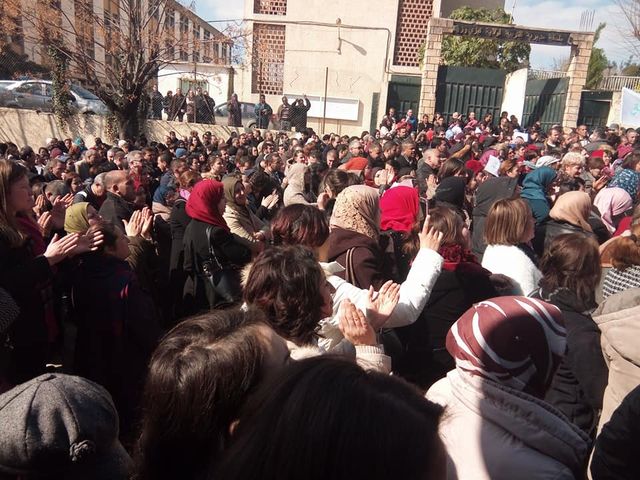
Algerian teachers strike in February
Doctors and medical students are already striking against deteriorating public health conditions. High school students had also joined the February teachers’ strike.
High school teachers in neighboring Tunisia, the birthplace of the Arab Spring, are joining their Algerian counterparts by holding a one-day general strike today. The strike is the second one-day strike the Tunisian General Labour Union (UGTT) was forced to call in the last six weeks as a result of growing opposition among Tunisian teachers.
In Tunisia, teachers are demanding 15 percent bonuses and the reduction of the retirement age to 55. In Algeria, teachers are striking over teacher pay and the Algerian government’s cuts to public education. Both the Tunisian and Algerian governments are threatening to fire strikers and dock their pay.

Latin America

Teachers’ strikes also spread across Central and South America this week. In Argentina, teachers in Buenos Aires province plan to set up a permanent “white tent” encampment on April 5 and are demanding a 20 percent wage increase to make up for 15 percent inflation. A two-day nationwide strike rocked the South American country earlier this month. On March 22, teachers in neighboring Uruguay also held a 24-hour strike.
In Mexico, 16,000 teachers in the state of Chihuahua struck on March 21 demanding back pay, culminating in a large demonstration of thousands in the city of Chihuahua. In the impoverished southern states of Oaxaca, Chiapas, and Michoacán, ongoing teacher strikes have shut down schools with over one million students enrolled. The government is promising to fire any teachers who strike for three days out of the month.
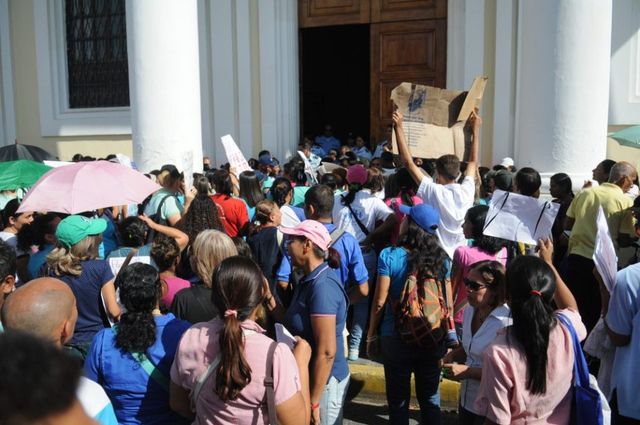
Teachers in Venezuela demonstrate in March
A two-day strike took place last week in Carabobo, Venezuela, where teachers struck for two days to demand large wage increases, prompting impromptu protests in the city of Valencia, two hours outside of Caracas. A strike of teachers in the Brazilian state of Amazonas began on Monday over wages and cuts to healthcare. The action coincides with an ongoing strike of Sao Paolo teachers against planned attacks on pensions.

Europe

In continental Europe, tens of thousands of French teachers participated in the March 22 general mobilization against the government’s plans to privatize the French railroad system, SNCF. In Scotland, a national teachers strike is on the horizon after teachers overwhelmingly rejected a proposed three percent wage hike, demanding 10 percent raises instead. Across the whole of the United Kingdom, lecturers are continuing their month-long struggle after rejecting a sellout deal by the University and College Union (UCU), and teaching staff at 12 Further Education colleges in London and the Midlands are holding limited strikes this week to demand higher wages and to oppose casualization.
Teachers across the world confront the same enemies: governments that cut wages, pensions, and education funding to boost the profits of the banks and corporations, and servile trade unions that isolate strikes and force workers to place their trust in the same capitalist political parties responsible for the attack on public education. Teachers’ greatest strength lies in linking with their coworkers, and the working class more broadly, across the world in a united fight to secure the social right to education with a good income and fully funded pensions for every teacher on earth.