18 Apr 2018

Government crisis in the Czech Republic

Markus Salzmann 

Over a dozen protests took place last Monday, April 9, in the Czech Republic against Prime Minister Andrej Babis, including in the capital city of Prague, where between 5,000 and 10,000 people demonstrated at Wenceslas Square, demanding the withdrawal of Babis and new elections.
The protests are the latest climax of an ongoing crisis in the Czech government. Babis’s right-liberal ANO won a strong victory in October of last year, taking 78 of 200 seats in parliament. Since then, however, he has failed to form a stable government.
After the elections, ANO tried to form a minority government, with ministers from its own party and independent experts. But this attempt failed in January, after a loss in a vote of confidence. Over a week ago coalition talks between Babis’s right-liberal party and the social democrats (CSSD) ended unsuccessfully. To this point, Babis has received the backing of the notoriously right-wing president Milos Zeman, but it remains to be seen how long this will last.
The CSSD dissolved the talks under the pretense of judicial problems in regard to the prime minister. Babis lost his position as finance minister in May 2017 due to a suspected subsidy fraud. He is accused of having diverted €1.6 million in European Union subsidies to a wellness resort while he worked in the private sector. Babis denies any involvement and claims that the accusation is politically motivated.
The millionaire businessman is renewing efforts to form an alliance with the radical right-wing party of the businessman Tomio Okamura, Freedom and Direct Democracy (SPD), and the Communist Party (KSCM). Babis stated at the beginning of last week, “The president requested that I continue negotiations with the KSCM and the SPD.” Previous attempts to build an alliance at the end of last year had proven unsuccessful.
The realization of Zeman’s request would inevitably create heavy tensions within the ANO. Transport Minister Daniel Tok has already declared that he would have no part in a government with radical right-wing elements.
To combat the lasting crisis, the social democrats, the conservative right-wing parties ODS and KDU-CSL, the Pirates, and two smaller Pro-EU parties are currently discussing the formation of a minority government.
In the event of new elections, it is believed that ANO would reach again a strong plurality. After the most recent polls, Babis’s party stood at the front with roughly 30 percent support. These results are strongly influenced by the current hatred of both the conservatives and social democrats.
Although many demonstrators are enraged by the corruption of the ruling elite, the organizers of last week’s protests have very different goals. Their demands for an “honest government” hide their hysterical anticommunism and their fear that Babis’s government will distance itself too far from the EU. Politically, they stand close to the conservatives and social democrats.
It is not acceptable that a head of government “has been registered as an agent of the communist secret police,” it says on the Facebook page of the protest organizers. They are specifically enraged by Babis’s attempts to form an alliance with the former Stalinist state party, which, in their eyes, represents socialism.
The organizers of the movement “A Million Moments for Democracy,” led by student Mikulas Minar, advocate for a pro-European government that is stable enough to enforce austerity policies against the working class. Under the title “Five Minutes Before Twelve,” the group warns of the dangers to the “independent police.” An important aspect of the protests was the appearance of the mezzo-soprano Dagmar Peckova, who sang the Czech national anthem with the demonstrators under dozens of Czech and European flags.
It is hardly surprising that the demonstrations began when Babis suggested a popular vote on the withdrawal of the Czech Republic from the EU, which was also supported by President Zeman. This suggestion alarmed many proponents of the EU.
The “Czexit Debate” has become “part of a political game,” explained Matthias Barner, leader of the German Christian Democratic Union (CDU)-aligned Konrad-Adenauer-Stiftung to the newspaper Handelsblatt. “Babis is still lacking a majority in the parliament and is now dealing with elements critical of the EU.”
The organizers of the protests are also worried of a continuing political crisis, which prevents the government from suppressing growing discontent among the working class.
Following protests by public servants in February, the workers of the auto manufacturer Skoda made preparations for strike action. In the face of the heated political situation, business leaders and politicians were ready to pay any price to avoid a strike, which could quickly expand to the entire auto industry in the Czech Republic, and thus the trade union, Kovo, was able to reach a deal providing employees of Skoda with a 12 percent raise starting in April.


University and College Union sells out UK lecturers strike

Robert Stevens

The struggle by around 50,000 lecturers, librarians, administration staff and technicians to defend their pensions and conditions has been betrayed by the University and College Union (UCU).
Last Friday, the union leadership achieved its desired goal. After 14 days of strikes—which the UCU, in collaboration with management, had sought to close down—members voted to accept an offer from the Universities UK (UUK) by a 64 percent to 36 percent majority.
UCU leader Sally Hunt hailed the result as a “clear majority” in favour of the proposals. In reality, despite the UCU’s incessant pressure on members to accept the offer over the nine-day balloting period, more than a third of the 33,973 who voted rejected the deal.
In addition, almost 20,000 (19,442) did not vote at all. This means that 31,672 members out of a potential 53,415, have not endorsed the deal--fully 59.2 percent of those balloted.
Nonetheless, in the absence of a political alternative to the trade union leaders, the bureaucracy has been able to shut down the action.
The strike was the largest ever held at higher education institutions in the UK, with workers at 65 universities striking to oppose the decimation of their pensions.
Under UUK proposals some members of the Universities Superannuation Scheme (USS) were set to lose more than £200,000 of their retirement income, and many others, tens of thousands of pounds. The ultimate aim of UUK, as stated in their August 2017 policy document, is to end a national pension scheme altogether in favour of “flexible schemes.”
The UCU leadership claims to have extracted concessions from UUK but this is a lie. Management has only committed to convening a “Joint Expert Panel, comprised of actuarial and academic experts nominated in equal numbers from both sides.” This will “deliver a report” on the valuation of the USS.
Further proposals will be made that will invariably fall far below staff demands, given that the USS trustees and the pension regulators are not obliged to accept the outcome.
The proposal states that current contributions and benefits from the USS, including Defined Benefits (DB), could continue for members, but only for another year--“until at least April 2019.” After that, management will be able to put in place mechanisms to end the DB system and move to an inferior Defined Contributions plan.
That is why management—with the backing of the UCU—refused to include a “No Detriment” clause in the eight-point offer supposedly guaranteeing that USS members will not suffer further pension cuts.
The UCU Higher Education Committee played the key role in getting the offer through by suspending the strikes after 14 days of action and referring it to an e-ballot. This was aimed at isolating staff, who were then subject to a battery of UCU propaganda insisting no better offer would be forthcoming.
This was essential under conditions in which there was widespread opposition to the proposed deal from UCU branches that had met and discussed the offer. Several branches passed motions of no confidence in Hunt’s leadership.
UCU strikers had already rejected the first shoddy deal the union agreed with UUK on March 12, which would have resulted in the loss by lecturers of an average 19 percent in the value of their pensions, and the maintenance of the current “defined benefits” scheme for just three years.
The following day thousands of UCU members met in universities nationally and rebelled against the UCU. Hundreds surrounded the UCU’s London headquarters and demanded the agreement endorsed by the union the previous evening be repudiated.
It was to demobilise this opposition that, before the ballot period had even begun, the UCU reduced the number of universities scheduled to be involved in strike action this week from 65 to 13.
The closing down of the strike is an indictment of the UCU Left, which functions as the political appendage of the bureaucracy.
The UCU Left comprises various pseudo-left organisations--who have members on the union’s leading bodies--most prominently the Socialist Workers Party (SWP). Having refused to wage a struggle against the efforts of the union tops to sabotage the action, the UCU Left now seeks to persuade workers that the union is a fighting organisation that requires only a few cosmetic changes at the top.
A UCU Left statement, issued as the e-ballot closed on April 13, hailed a growth in membership during the strike, which “produced a transformation in our union in just a matter of weeks, creating a broad layer of new activists and leaders throughout our union.”
The problem, however, is that workers had been recruited into an organisation preparing to sell them out. And the pseudo-left--rather than utilising this recruitment to mount a rebellion against the bureaucracy—was politically disarming workers in the face of these preparations. A subsequent statement issued April 13, after the Yes vote was confirmed, accepted that the union bureaucracy remains in control of pension negotiations, even while admitting that pension cuts were the only likely outcome.
“The union now has a complicated dual task: keeping up the pressure for the best outcome from the Independent Expert Panel,” the UCU Left wrote, “and, at the same time, maintaining our organisation so that if the outcome is a pension cut--as is likely--we are able to ballot for industrial action and carry it out effectively.”
After making, in its initial April 13 statement, a few token criticisms of an e-ballot that exposed “a deep democratic deficit in our trade union,” the UCU Left declared, “[W]e need democratic structures and a democratic culture that properly reflects our transformed union.”
As for Hunt, the UCU Left declared in its statement following the Yes vote, “We have no desire to personalise the issue but she must publicly affirm that [future] negotiations must go through the proper channels. And if she is not prepared to carry out UCU policy then she should stand down altogether.”
The SWP similarly declared in the run-up to the ballot result that “the strikes have created a stronger, more dynamic union,” insisting that all that is required is the refurbishing of a “transformed,” “fighting” union. The truth is that the UCU’s sell-out is not the result of deficient “structures” or a “culture,” just as Hunt’s actions are not simply a matter of her personality.
They flow organically from the nature of the trade unions themselves, which function as industrial policemen on behalf of the government and employers. Their ability to increase the exploitation of their members—through declining wages, the erosion of pensions and other social rights—therefore depends on the suppression of the democratic rights of the rank-and-file.
That is why the defence of workers jobs, conditions and living standards cannot be entrusted to the unions.
The pseudo-left seeks to conceal this fact because they speak for privileged middle-class layers, hostile to the political independence of the working class, and function as factions of the Labour Party and union apparatus.
Throughout the dispute the Socialist Equality Party and its Education FightBack campaign sought to arm workers with an understanding of the unions and the political context in which their struggle was unfolding—an ever-deepening crisis of global capitalism that was the source of austerity and war.
Only the building of new rank-and-file and workplace committees that reject the subordination of the working class to the capitalist profit system and which make the defence of the social needs of all workers the axis of their struggle can show the way forward.
This requires the adoption of a new, socialist perspective and the building of a genuinely socialist party—the Socialist Equality Party.

Barcelona: Hundreds of thousands protest against jailing of Catalan independence leaders

Paul Mitchell

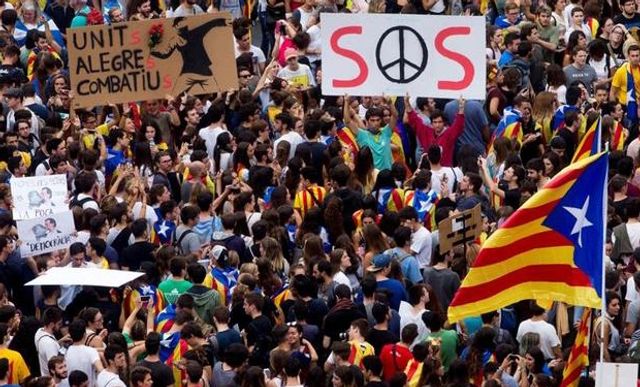
Hundreds of thousands protested in Barcelona on Sunday against the imprisonment of Catalan nationalist leaders and for those who fled abroad following the failed independence bid last October to be allowed to return.
Since October, Catalonia has remained under the control of Madrid after Popular Party (PP) Prime Minister Mariano Rajoy invoked Article 155 of the Spanish Constitution and sought to “decapitate” the secessionist movement through arrests with the support of the Socialist Party (PSOE) and the Citizens party.
The Catalan parliament has been unable to appoint a new premier or administration four months after Rajoy imposed elections on December 21, when the separatist parties were re-elected with a small majority. If a new leader is not elected by May 22, new regional elections must be held.
The Barcelona demonstration
Around 315,000 people took part in the demonstration, according to the Catalan municipal police. The organisers—Space for Democracy and Co-existence (Espai Democràcia i Convivència), which comprises social and cultural groups; the Catalan branches of Spain’s two largest trade unions, the CCOO and the UGT; nationalist political parties; and the pseudo-left Podemos-led coalition Catalonia in Common—all estimated the turnout at 750,000.
The demonstration was held under the slogan, “We demand the freedom of all politicians and imprisoned leaders, as well as the return of the exiles”—a reference to the nine jailed and seven exiled secessionist leaders who organised the failed independence bid. They are accused of sedition, rebellion and embezzlement and could face sentences of up to 30 years in prison.
Many of the protesters wore a yellow ribbon to show solidarity with the jailed leaders. However, there were far fewer independence flags than in previous demonstrations, as it attracted considerable numbers of workers and youth who did not support secession but opposed Rajoy’s repressive actions.
The manifesto of Space for Democracy and Co-existence calls for the “defence of Catalan institutions and the right of the Catalans to decide their future” and makes a “firm commitment to the outcome of 21-D [December 21 election].” It pleads that “Political problems have to be solved in the political sphere and through dialogue and negotiation.”
A message was read out to the demonstration from the president of Òmnium Cultural, Jordi Cuixart, saying, “There are moments of injustice but also of hope. All of you are the motor of the struggle for freedom for a future without sacrifices for anyone. Unity, dignity and courage. … Thank you for not forgetting us…do not let yourselves be frightened, continue fighting for civil rights in a peaceful way.”
A section of the Barcelona demonstration
For six months, Cuixart and Jordi Sànchez, the former president of the Catalan National Assembly (ANC), have been locked up in prison. Sànchez was elected a Together for Catalonia (JxCat) deputy on December 21, but attempts to propose him as a candidate to head a new Catalan regional government have twice been prevented by the courts refusing to let him out of jail to be sworn in.
Both men are accused of organising pro-independence demonstrations last September, which led to some policemen being trapped inside a government building and their vehicles being damaged…to the tune of around €17,000! They are also accused of mobilising people to obstruct police as the police attempted to close down polling booths and confiscate ballot boxes during the October 1 independence referendum.
Former vice premier and Republican Left of Catalonia (ERC) leader Oriol Junqueras; ex-ministers Joaquim Forn, Jordi Turull, Raül Romeva, Josep Rull and Dolors Bassa; and former parliamentary speaker Carme Forcadell also remain incarcerated.
Ousted regional premier Carles Puigdemont is in Germany awaiting a decision on his extradition following his arrest there on a European Arrest Warrant (EAW) earlier this month. The court in Schleswig-Holstein freed Puigdemont on bail on April 6 and rejected the charges of rebellion in the warrant. It has yet to rule on another, lesser charge of embezzlement. Last week, Spanish prosecutors sent new information claiming Puigdemont incited violence—hoping to bolster the rebellion charge.
Others nationalist leaders in exile are Toni Comín, Meritxell Serret and Lluís Puig in Belgium, Anna Gabriel and Marta Rovira in Switzerland, and Clara Ponsatí in Scotland. EAWs have been reissued against them.
During the demonstration, the spokesperson of Puigdemont’s Together for Catalonia coalition, Elsa Artadi, said it disproved claims that the independence movement had disintegrated: “To all those who say that the movement is demobilised, that people are tired, we show them once again that is not the case and that the result of 21-D is felt today in the streets.”
Lluc Salellashas, a national secretariat member of the petty-bourgeois nationalist Candidatures of Popular Unity (CUP), went further, proclaiming that the demonstration marked the “definitive beginning of the Catalan spring to end the authoritarianism and the regime of ’78 in Catalonia”—a cipher for the bourgeois democratic state set up after the end of the Francoist dictatorship.
Roger Torrent, the current speaker of the Catalan parliament, denounced the “repression that threatens the fundamental pillars of democracy that the Spanish State is making.”
Referring to the broad number of organisations on the demonstration, some of whom do not support independence—including the CCOO, UGT and Catalonia in Common—Torrent added, “When we are transversal, when we are plural and we join in the defence of rights and democracy, we are unstoppable.”
The theme of “transversality” was also stressed by Marta Vilalta, spokesperson for Esquerra Republicana, who repeated the party’s call for “a democratic front against repression,” and the head of Catalonia in Common, Xavier Domènech, who declared that “transversal mobilisation is the way to recover rights and freedoms.”
That broad layers of the population took part in Sunday’s protest against mass repression and authoritarianism shows the deep-rooted opposition that exists and is to be welcomed. However, the most urgent warnings must be made: Xavier Domènech’s words are a fraud. Spain’s Podemos party has played the central role in blocking an independent mobilisation of the working class against the PP’s attacks, adopting an impotent policy of issuing moral appeals to Rajoy to negotiate with Barcelona.
Last year, Podemos helped organise “White” demonstrations, since demobilised, under the slogan, in Spanish and Catalan, “Hablemos/Parlem” (Let’s Talk). But the manifesto was wrapped in the language of patriotism and an appeal for Podemos to be recognised as a potential saviour of Spain at a time of acute crisis.
This crisis is not simply one of the 1978 Spanish Constitution, as Podemos and the CUP suggests, but of European and world capitalism. The budget battles and fights over regional autonomy between the ruling elites in Madrid and Barcelona developed over a decade, as the European Union reacted to the global financial collapse with massive bank bailouts financed by devastating austerity measures against the working class across the continent. The formation of a Catalan capitalist republic, led by politicians who have long supported austerity and imperialist war, will do nothing to resolve this international crisis.

US CEO pay, bank profits, corporate cash set new records

Barry Grey

Across the United States, workers are being told by Democrats and Republicans alike that there is “no money” for decent wages, pensions or health care. Teachers from West Virginia to Oklahoma, Kentucky, Arizona and other states are rebelling against near-poverty wages and years of school cuts only to be told by the politicians and union leaders that their demands are “unrealistic” and cannot be met.
But a series of reports on CEO pay, bank profits and corporate cash released over the past week reveal that corporate America and the financial oligarchy are wallowing in record levels of wealth. The Washington Post reported on Friday that, boosted by the tax cut for corporations and the rich passed in December, the biggest US firms “find themselves sitting on an Everest of cash,” with “profits pouring in faster than they can find productive ways to spend it.”
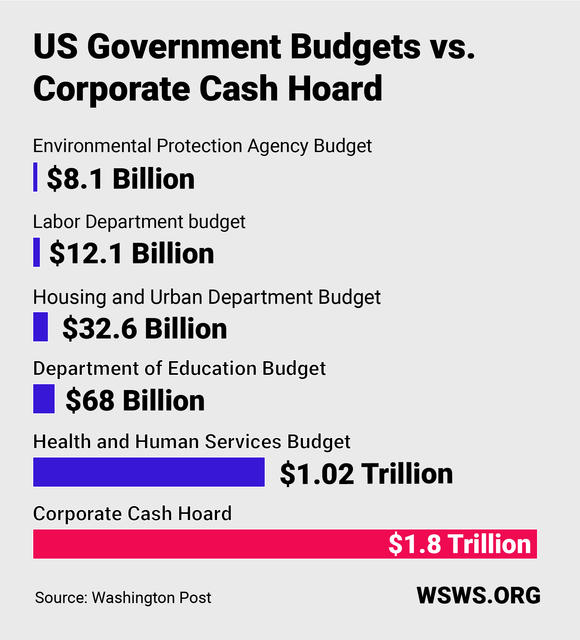
“As of the end of 2017,” the Post noted, “companies in the Standard & Poor’s 500 stock index were sitting on the largest cash pile in history: nearly $1.8 trillion.”
The windfall from the Trump tax cut, passed with no serious opposition from the Democrats, is not, contrary to the lies used to justify the law, going to create new, good-paying jobs and rebuild the country’s crumbing infrastructure. It is being used for stock buybacks, a parasitic squandering of the wealth produced by the labor of the working class to drive up stock prices and the portfolios of rich investors and corporate executives.
In February alone, US corporations announced a single-month record $150.7 billion in buybacks. They are expected to hit a new yearly record in 2018, surpassing the previous record of $589 billion set in 2007, the year before the Wall Street crash. Over the past 10 years, the American capitalist class has spent $5.1 trillion in stock buybacks.
To put this in perspective, the Oklahoma teachers, among the lowest-paid in the country, demanded $200 million in additional school funding to begin to address a decade of brutal cuts. The state government agreed to a mere $50 million, which the Oklahoma Education Association hailed as a “victory.”
The amount requested by the teachers represents a mere 0.01 percent of the cash being hoarded by US corporations.
This “Mount Everest” of cash controlled by perhaps one percent of the American people towers above the sums allocated by the federal government for basic social needs. The budget for the Department of Health and Human Services is only 60 percent of the corporate cash hoard. The corporate cash pile is 26 times the Department of Education budget, 56 times the budget for Housing and Urban Development, 150 times the Labor Department budget, and 225 times the budget of the Environmental Protection Agency.
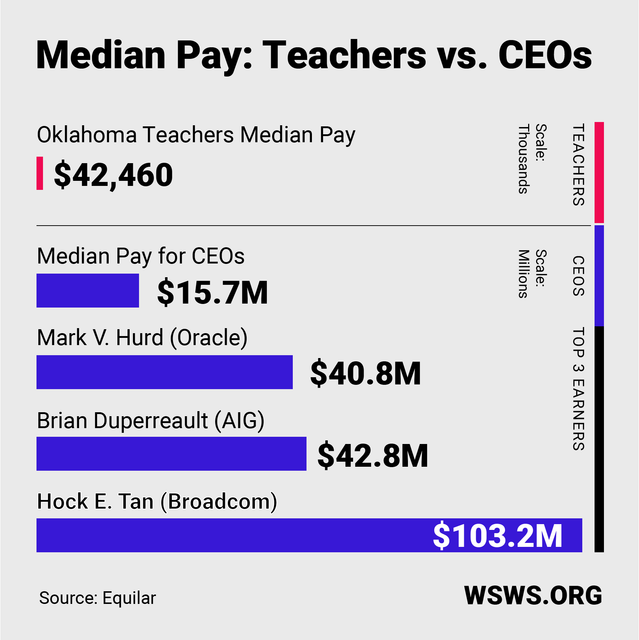
According to a report on CEO pay released last week, requisitioning the combined pay of the three highest-earning chief executives in 2017 would virtually cover the Oklahoma teachers’ funding demand. Hock E. Tan (Broadcom) took in $103.2 million, Brian Duperreault (American International Group) received $42.8 million and Mark V. Hurd (Oracle) was paid $40.8 million, for a total of $186.8 million.
These reports, taken together, give a picture of a society that is being ruthlessly plundered by an unaccountable and avaricious financial oligarchy. The waste of resources and diversion of social wealth into the hands of a fabulously rich elite make it impossible to address any of the social problems confronting the population.
The other major squandering of resources is in the form of ever-expanding spending on the military and the preparations of the US ruling class for global war.

CEO pay

On April 11, the executive compensation research firm Equilar published its annual “Equilar 100” report, which examines CEO compensation at the 100 largest companies, by revenue. The study showed that median compensation for the 100 CEOs rose by 5 percent in 2017 from the previous year to reach an 11-year high of $15.7 million.
The median ratio of Equilar 100 CEO pay to that of a worker at the given company was 235 to one. However, some companies on the list had ratios even worse than the median. Manpower Group, whose CEO received $12 million, reported the highest ratio at 2,483 to one. The median pay of the company’s 600,000 workers was $4,828. The retail chain Kohl’s had a ratio of 1,264 to one.
The average pay of an Oklahoma teacher is $42,460. Median pay for Equilar 100 CEOs is 374 times that amount. The increase in median pay for Equilar 100 CEOs in 2017—$700,000—is itself 17 times the pay of the average Oklahoma teacher.
The second-highest paid CEO, Brian Duperreault ($42.8 million), heads the insurance giant American International Group (AIG), whose speculation in subprime mortgage-backed securities and credit default swaps played a central role in the financial crisis a decade ago that destroyed the savings and livelihoods of millions of people around the world and ushered in the Great Recession. His firm was bailed out by the Federal Reserve and the US Treasury to the tune of $150 billion.

Bank profits

Over the past week the major Wall Street banks have reported record or near-record profits for the first quarter of 2018. On Friday, JPMorgan Chase, Citigroup and Wells Fargo reported a combined profit of more than $19 billion for the first three months of the year.
JPMorgan, the country’s biggest bank, reported a record quarterly net income of $8.71 billion. Its profits rose 35 percent over the same period a year ago. Earlier this month, CEO Jamie Dimon issued a letter to shareholders warning of rising wages and advising the Federal Reserve to jack up interest rates in order to stunt economic growth and drive up unemployment, so as to preempt the development of a nationwide wages movement.
It was a similar story at Citigroup (13 percent profit rise) and Wells Fargo (8 percent). Bank of America on Monday reported a 34 percent profit increase and Goldman Sachs on Tuesday said its profits jumped 26 percent.
A substantial part of the profit surge on Wall Street was due to the massive cut in the corporate tax rate. The five banks combined saved well above $2 billion as a result of a drastic reduction in their effective tax rates.
Speaking of the windfall from the tax law and other policies being implemented by Trump, with the tacit support of the Democrats, Citigroup Chief Financial Officer John Gerspach told reporters Friday that companies had only begun to take advantage of the changes. “I think the best is yet to come,” he said.
Putting an end to social inequality and the capitalist system that produces it are essential to providing employment, education, health care, housing, a comfortable retirement, access to culture, a safe environment and a modern infrastructure—that is, securing the basic social rights of the working class.

UN Human Rights Fellowship Programme for People of African Descent 2018 – Switzerland

Application Deadline: 1st June 2018

Offered annually? Yes

Eligible African Countries: Applicants of African Origin

To be taken at (country): Geneva, Switzerland

About the Award: The Fellowship Programme for People of African Descent provides the participants with an intensive learning opportunity to deepen their understanding of the United Nations human rights system, instruments and mechanisms, with a focus on issues of particular relevance to people of African descent. The Fellowship Programme will allow the participants to better contribute to the protection and promotion of civil, political, economic, social and cultural rights of people of African descent in their respective countries.

Offered Since: 2011

Selection Criteria: The selection of the fellows will reflect gender and regional balance. The human rights situation of People of African Descent in the respective countries will also be taken into consideration.

Eligibility
  • The candidate must be an individual of African descent living in the Diaspora. · The candidate must have a minimum of 4 years of work experience related to the rights of People of African Descent.
  • The candidate needs to have sufficient command of the English language to be able to participate fully in the programme.
  • The candidate has to submit a letter from an organization working on issues related to People of African Descent or minority rights certifying their status.
  • The candidates must be available to attend the full duration of the programme. The selected fellows will be expected to participate in different activities and to strictly follow the programme.
Number of Scholarships:  Not Specified

Value of Scholarship: Each fellow is entitled to a return ticket (economy class) from the country of residence to Geneva, basic health insurance, and a stipend to cover modest accommodation and other living expenses for the duration of the Programme.

Duration of Scholarship: In the framework of the Programme of Activities for the Implementation of the International Decade for People of African Descent, this year the Fellowship will be held from 19 November to 7 December 2018 in Geneva, Switzerland.

How to Apply: Visit Link below

Visit scholarship webpage for details

Women in Africa (WIA) Club Entrepreneurs’ Hub for Female Entrepreneurs in Africa (Fully-funded to Morocco) 2018

Application Deadline: 10th May 2018

Eligible Countries: African country

To be taken at (country): Marrakesh, Morocco

About the Award: WIA CLUB PHILANTROPY is a non-profit structure aiming at supporting and funding businesses led or managed by African women, through two main projects : the Women in Africa Entrepreneurs Hub and the Women in Africa Revelations Night.

Type: Entrepreneurship

Eligibility: 
  • The companies or initiatives meeting the following criteria can apply to the Entrepreneurs’ Hub:
  • Companies or initiatives based in one of the 54 African countries.
  • Created or managed by an African woman.
  • With a strong market traction (turnover, number of users, funds raised)
Selection Criteria: We will select the most innovative and high-growth potential companies or initiatives with already proven traction:
• Innovative product, service or technology and/or a strong human impact.
• With a first traction on the market (turnover, number of users, raised funds…).
• Proven business model, scalability.
• Large growth potential (in own country, Africa and globally).
• Ambitious team with deep execution skills.


Number of Awards: 54 women

Value of Program: 
  • Invitation to the WIA International Annual Summit in Marrakesh (27-29 September 2018): reimbursement of travel, accommodation and exhibition space decoration.
  • Unique visibility: Unique visibility from 500 delegates, including investors, top executives and media from all over the world plus visibility on Women in Africa Club print and media supports including WIA Mag, social media, press, offering key visibility.
  • High-level Networking: Business meetings organized during the WIA Club Annual Meeting in Marrakech and during all the events of the Club (Regional and Local meetings).
  • Special access to the WIA Link digital platform in order to exchange with each other and with international top executive. Real social network of entrepreneurs and all year long acres exclusive club.
  • Mentoring: Mentoring for 1 year from large companies (depending from the fundings and sponsors)
The African Revelations Night will invite women entrepreneurs to present their project on stage.

Duration of Program: 27-29 September 2018

How to Apply: Apply to Women Entrepreneurs Hub 2018

Visit Program Webpage for details

Award Provider: Women In Africa (WIA) Club

Alibaba eFounders Fellowship for African Entrepreneurs (Funded to Hangzhou, China) 2018

Application Deadline: 4th May 2018

Eligible Countries: African countries

To Be Taken At (Country): Alibaba Xixi Campus – Hangzhou, China

About the Award: The eFounders Fellowship is a two-week course for entrepreneurs in developing countries who are operating open, platform-based businesses in the ecommerce, logistics, big data, and tourism spaces. The program will provide first-hand exposure to and learning about ecommerce innovations from China and around the world that enabled growth and a more inclusive development model for all.
With a focus on highlighting breakthrough innovations that have transformed society in China, the program will inspire each participant to think of creative frameworks based on prior expertise and new learnings that can be applied to their own home markets.
Participating entrepreneurs will be given the tools to improve their own ventures, but as ‘New Economy’ pioneers they will be expected to serve as network builders and champions of new ways to approach commerce in their own markets. UNCTAD and Alibaba believe these entrepreneurs can spread powerful new ideas around the world by creating impactful communities and empowering their peers.
The course targets young entrepreneurs as part of an initiative on the digital economy for sustainable development that is jointly organized by the Alibaba Business School and the United Nations Conference on Trade and Development.

Type: Entrepreneurship

Eligibility: Candidates must be:
  • Under the age of 35;
  • Entrepreneurs in the digital and technology space operating open platforms related to eCommerce, Logistics, Fintech, Big Data or Tourism;
  • Authentic, open-minded and altruistic leaders of the new economy;
  • At an inflection point in their careers;
  • Looking to move from success to significance with integrity, vision and drive;
  • Founders or co-founders of an officially registered digital technology venture in a country in Africa;
  • Female entrepreneurs are strongly encouraged to apply.
Number of Awards: There will be 40 places available

Value of Award: 
  • The course will consist of a structured series of classroom workshops and lectures, site visits and a business hackathon and will primarily be held at Alibaba Group Headquarters in Hangzhou with site visits in other cities in China.
  • Upon completion of the course, participants are expected to make a commitment to share knowledge gained with their communities.
  • While the course tuition, accommodation and meals will be covered for selected candidates, participants will be expected to apply and pay for their visa application and travel to and from Hangzhou, China. A letter of support for a visa request will be provided by UNCTAD to facilitate the visa application process. Once in China, the Alibaba Group will arrange lodging and transportation during the course.
Duration of Program: June 19th – 29th, 2018.

How to Apply: Apply Here

Visit the Program Webpage for Details

Award Providers: Alibaba Global Initiative

17 Apr 2018

CODESRIA 2018 Democratic Governance Institute for African Academics and Researchers

Application Deadline: 30th April 2018

Eligible Countries: African countries

To Be Taken At (Country): Arusha, Tanzania.

About the Award: The 2018 Institute is being organised in partnership with the South African Research Chair in Social Policy. The Institute will be held in Arusha, Tanzania on the theme “Governing Africa’s Social Policy: Subverting Development and Democracy?”. The Democratic Governance Institute, launched in 1992 by CODESRIA, is an annual interdisciplinary forum which brings together about fifteen researchers from various parts of the continent and the Diaspora, as well as some non-African scholars who are undertaking innovative research on topics related to the general theme of governance.

Type: Conference

Eligibility: 
  • Applicants who wish to be considered as laureates should be PhD candidates or scholars in their early career with a proven capacity to conduct research on the theme of the Institute.
  • Intellectuals active in the policy process and/or social movements and civil society organizations are also encouraged to apply.
Number and Value of Awards: 
  • The number of places offered by CODESRIA at each session is limited to fifteen (15). CODESRIA will however provide for five (5 mics from the Diaspora and Non-African scholars who are able to fund their participation may also apply for a limited number of places. It is absolutely important that applicants demonstrate a serious engagement with this call for applications in their proposals.
Duration of Program: 18th-29th June 2018

How to Apply: Applications for participation as laureate should include:
  • 1. One duly completed application form;
  • 2. An application letter;
  • 3. A letter indicating institutional or organizational affiliation;
  • 
4. A curriculum vitae;
  • 5. A research proposal not more than ten (10) pages including a descriptive analysis of the work the applicant intends to undertake, an outline of the theoretical interest of the topic chosen by the applicant, the relationship of the topic to the problematic and concerns of the theme of the 2018 Institute;
  • 
6. Two (2) reference letters from scholars or researchers known for their competence and expertise in the candidate’s research area (geographic and disciplinary), including their names, addresses, telephone numbers and email addresses;
  • 7. A copy of the passport.
Applicants are requested to use the following link http://codesria.org/submission to submit their proposals.
The deadline for the submission of applications is 30 April 2018. Selected applicants will be notified by15th May 2018. Laureates are required to revise their proposals which will be presented during the Institute as a draft research paper. Draft papers should be submitted to CODESRIA not later than 10th June 2018. Laureates will be required to work on their papers during the Institute in preparation for publication after the Institute.

Visit the Program Webpage for Details

Award Providers: CODESRIA

Commonwealth Medical Fellowships 2018 for Students in Developing Countries

Application Deadline: 21st May 2018

Offered annually? Yes

Eligible Countries: Bangladesh, Cameroon, The Gambia, Ghana, India, Kenya, Malawi, Mozambique, Nigeria, Pakistan, Papua New Guinea, Rwanda, Samoa, Sierra Leone, South Africa, Sri Lanka, Tanzania, Uganda, Vanuatu, Zambia.

To be taken at (country): UK

About the Award: Commonwealth Medical Fellowships (Enhancing Clinical Skills) are offered for mid-career medical staff from developing Commonwealth countries. These fellowships are funded by the UK Department for International Development (DFID), with the aim of contributing to the UK’s international development aims and wider overseas interests, supporting excellence in UK higher education, and sustaining the principles of the Commonwealth.
The purpose of this fellowship is to provide mid-career medics with the opportunity to enhance their clinical skills, and to have catalytic effects on their workplaces.
These fellowships are offered under the second of the CSC’s six themes:
  1. Science and technology for development
  2. Strengthening health systems and capacity
  3. Promoting global prosperity
  4. Strengthening global peace, security and governance
  5. Strengthening resilience and response to crises
  6. Access, inclusion and opportunity
Offered Since: 1959

Type: Fellowship

Eligibility: To apply for these fellowships, you must:
  • Be a citizen of or have been granted refugee status by an eligible Commonwealth country, or be a British Protected Person
  • Be permanently resident in an eligible Commonwealth country
  • Be employed by a hospital affiliated to a university
  • Be available to start your fellowship in the UK in January 2019
  • Have qualified as a doctor between 1 October 2008 and 30 September 2011, or before 1 October 2003
  • Have qualified at a medical school recognised by the World Directory of Medical Schools
  • Have met the English language requirements of the General Medical Council (GMC) by 31 August 2018
You will be expected to participate in clinical practice during your fellowship, and to register with the General Medical Council (GMC). If your proposed programme does not require this registration, your application will be considered ineligible.
The CSC aims to identify talented individuals who have the potential to make change. We are committed to a policy of equal opportunity and non-discrimination, and encourage applications from a diverse range of candidates.

Selection Criteria: Each year, the CSC invites each nominating body to submit a specific number of nominations. The deadline for nominating bodies to submit nominations to the CSC is 4 June 2018.

The CSC invites around three times more nominations than fellowships available – therefore, nominated candidates are not guaranteed to be awarded a fellowship.
Each nominated candidate’s application will be considered firstly by an academic adviser with expertise in the subject area concerned, and then by the CSC selection committee in competition with other candidates.
Applications will be considered according to the following selection criteria:
  • Academic merit of the candidate
  • Quality of the proposal
  • Potential impact of the work on the development of the candidate’s home country
Duration of Fellowship:  Between three and six months

Value of Fellowship: Each fellowship provides:
  • Approved airfare from your home country to the UK and return at the end of your award (the CSC will not
    reimburse the cost of fares for dependants, nor usually the cost of journeys made before your award is finally
    confirmed)
  • Research support grant, payable to your host university hospital
  • Stipend (living allowance) at the rate of £1,627 per month, or £2,019 per month for those at university hospitals
    in the London metropolitan area (rates quoted at 2017-2018 levels)
  • Reimbursement of the fee for a single English language test and the fee for General Medical Council (GMC)
    registration
  • Warm clothing allowance
  • Study travel grant towards the costs of approved travel within the UK
  • If you are widowed, divorced, or a single parent, child allowance of £457 per month for the first child, and £112
    per month for the second and third child under the age of 16, if you are accompanied by your children and they
    are living with you at the same address in the UK
How to Apply: You must apply to one of the following nominating body in the first instance – the CSC does not accept direct applications for these fellowships:
  • Selected universities/medical colleges
  • In Bangladesh, India, and Sri Lanka, the national University Grants Commission
  • In Pakistan, the Higher Education Commission
All applications must be made through a nominating body in your home country. Each nominating body is responsible for its own selection process. You must check with your nominating body for their specific advice and rules for applying, and for their own closing date for applications.
You must make your application using the CSC’s application system. Your application must be submitted to and endorsed by one of the eligible nominating bodies listed above. The CSC will not accept any applications that are not submitted via the CSC’s application system to a nominating body in your home country.
All applications must be submitted by 23.59 (BST) on 21 May 2018 at the latest.
You must provide the following supporting documentation, which must be received by the CSC by 23.59 (BST)on 28 May 2018 in order for your application to be eligible for consideration:
  • Academic references from at least two individuals
Apply now

Visit Fellowship Webpage for details

Award Provider: Commonwealth Scholarship Commission (CSC) and UK Department for International Development (DFID).

HiiL Innovating Justice Challenge 2018 for Entrepreneurs in Africa and Middle East

Application Deadline: 31st May 2018

Eligible Countries: The HiiL Justice Accelerator particularly encourages applications from Uganda, Kenya, Nigeria, Mali, South Africa, Zimbabwe, Ukraine, Tunisia, Lebanon, Jordan, Morocco, the United Arab Emirates and the Netherlands.

To be taken at (country): The Hague, The Netherlands

Field of Award: The HiiL Justice Accelerator has identified a few key “pain points” across the world, in which areas we particularly encourage applications:
  • Family Justice
  • Land- and Neighbour Disputes
  • Crime and Law Enforcement
  • Employment Justice
  • Micro, Small and Medium sized Enterprises
Note that if your innovation does not specifically address one of these areas, you are still eligible to apply! Simply make sure to tell us how your startup 1) addresses a specific justice need in your community; and 2) has some sort of a legal element.

About the Award: The HiiL Justice Accelerator finds and supports the world’s best justice entrepreneurs in order to create access to justice for all.
Between 40-50 startups, selected as semi-finalists, will be invited to pitch at local Boostcamps. This year’s Boostcamps will take place in Johannesburg, Lagos, Nairobi, Kampala, Kyiv, and The Hague. In some cases, startups may pitch by Skype or be brought to the nearest Boostcamp. Additionally, these semi-finalists will be guided through a “market validation” process.

Eligibility: 
  • (New) Ventures with a strong potential of delivering concrete justice solutions for many people, including micro, small and medium-sized businesses.
  • Innovative justice initiatives that are already making a difference and have the potential and ambition to scale internationally or to many more users.
  • Unique initiatives that are solving the most pressing justice problems for people, based on evidence and data, in particular family, land, crime or employment issues.
  • Ventures that are financially sustainable and have measurable impact.
  • Innovative initiatives within existing justice systems or public institutions, spearheaded by driven intrapreneurs that want to see things work differently.
Criteria: who can apply?
  • The founder and applicant should be 18 years of age or older.
  • The venture must be committed to providing access to justice underpinned by evidence showing justice needs.
  • The person(s) with whom we engage should be the founder or a co-founder of the organization and should be able to make key, high-level, and direction-shifting decisions (such as whether or not to take investments and who to partner with) on behalf of the entire organization.
  • We can only accept innovations to be incorporated with a bank account in the name of the legal entity by the time they receive our grant funding.
Selection Criteria:
  • Scope (is it a justice innovation? is it solving pressing justice problem)
  • Impact
  • Uniqueness
  • Sustainability
  • Scalability
  • Team
Value of Award: Apply to receive seed funding, training and acceleration support, access to an international expert network and potential further investment opportunities.

How to Apply: Click here to apply

Visit Program Webpage for details

Scholarship Provider: HiiL

SOCAP18 Scholarship to SOCAP Conference for Promising Social Entrepreneurs 2018 – San Francisco, USA

Application Deadline: 1st June, 2018.

Offered annually? Yes

Eligible Countries: Scholarship recipients span across the globe

To be taken at (country): Fort Mason Center, San Francisco, USA

About the Award: SOCAP (Social Capital Markets) is a world-renowned conference series dedicated to increasing the flow of capital toward social good.Social entrepreneurs are the heart of SOCAP. They identify new solutions to pressing issues, balancing true impact with sustainable business models. We prioritize support for inspiring entrepreneurs, as they are the future of the social capital markets.
Every year, SOCAP offers scholarships to promising social entrepreneurs. We want your energy and your ideas at the conference! Past SOCAP entrepreneurs have come from over 35 countries on six continents, representing a wide variety of inspiring and innovative ventures.
The most common industries represented among past Scholarship winners are:
  • Energy
  • Health
  • Education
  • Agriculture
  • Community Development
  • Technology
  • and Environment
If you are an innovator who is using a market-based solution to solve a challenge that will create real impact, either social or environmental, you are invited to apply for a SOCAP Scholarship.

Offered Since: 2008

Type: Entrepreneurship

Eligibility Criteria: Entrepreneurs are recognized for their outstanding ideas, inspiring stories, and passion for creating sustainable business models

Number of Scholarships: Several

Value of Scholarship: The scholarship is an amazing opportunity for social entrepreneurs! Scholarship recipients receive support including:
  • Free SOCAP18 full conference pass (valued at $1495)
  • Free hostel accommodations (limited – prioritized for international entrepreneurs)
  • Impact Accelerator @SOCAP – a pre-conference program just for entrepreneurs
  • Recognition and high visibility in the SOCAP program
  • Mentorship from experienced social impact leaders
How to Apply: Apply Here

Visit Scholarship Webpage for Details

Scholarship Provider: SOCAP (Social Capital Markets)

Important Notes: Scholarship does not include travel expenses. If you know someone who would benefit from this opportunity, please spread the word.

Mozilla Fellowships for Research in Open Science and Data Sharing 2018

Application Deadline: 20th April, 2018 at 11:59PM EDT.

Eligible Countries: All. As long as interested candidate is legally allowed to work in the country they currently reside in.

About the Award: We’re looking for researchers with a passion for open source and data sharing, already working to shift research practice to be more collaborative, iterative and open. Fellows will spend 10 months starting September 2017 as community catalysts at their institutions, mentoring the next generation of open data practitioners and researchers and building lasting change in the global open science community.
Throughout their fellowship term, chosen fellows will receive training and support from Mozilla to hone their skills around open source, data sharing, open science policy and licensing. They will also craft code, curriculum and other learning resources that help their local communities learn open data practices, and teach their institutional peers.

Type: Fellowship

Eligibility: Fellows must be:
  • be currently employed at a research institution
  • have the ability to accept outside funds for this fellowship directly (i.e., not distributed through the institution)
  • be an early-career researcher (i.e., graduate students, post-docs, research scientists, lecturers)
  • specialize in scientific research: physical, life, social, library, or natural sciences
  • be able to travel
  • obtain support from their advisors. As fellows will be based at their home institutions, please note that a letter of support from their advisor is mandatory for consideration
  • have experience participating in open communities
Number of Awardees: Not specified

Value of Fellowship: Fellows will receive:
  • a stipend of $60,000 USD, paid in 10 monthly installments
  • a one-time health insurance supplement for Fellows and their families, ranging from $3,500 for single Fellows to $7,000 for a couple with two or more children
  • a one-time childcare allotment of up to $6,000 for families with children
  • an allowance of up to $3,000 towards the purchase of laptop computer, digital cameras, recorders and computer software; fees for continuing studies or other courses, research fees or payments, to the extent such purchases and fees are related to the fellowship
  • coverage in full for all approved fellowship trips – domestic and international
Duration of Fellowship: 10 months

How to Apply: Apply here

Visit Fellowship Webpage for details

Award Provider: Mozilla

Important Notes: Fellows are encouraged to continue their personal research for up to 20% of their time during the course of their fellowship (i.e., one day a week). Fellowship applicants must have buy-in from their supervisors in advance, and include Advisors’ contact information on the application. Advisors will be interviewed separately should applicants move on to the second round, and their support will be a critical consideration for acceptance of fellows.

Talent Meets Bertelsmann for Creative Student Entrepreneurs (Fully-funded to Berlin, Germany) 2018

Application Deadline: 13th May 2018

Offered Annually? Yes

Eligible Countries: All

To be taken at (country): Berlin, Germany

About the Award: This year, it’s all about data. And all about your ideas: Are you ready to shape the digital future?
We are looking for talents with an entrepreneurial, innovative mindset to take part in Talent Meets Bertelsmann (TMB) 2018. Are you creative and passionate about the media landscape and data-driven business models? Then take your chance: Get to meet members of our Executive Board and other top international leaders. You will participate in demanding workshops, working hand in hand with experienced entrepreneurs on key business ideas, which will be evaluated by a jury composed of Bertelsmann’s Executive Board members.
Use the opportunity to explore the different people working for Bertelsmann and make memories that will last a lifetime!

Type: Entrepreneurship

Eligibility: 
  • Bachelor, Master, MBA students or doctoral candidates, ideally in the field of economics, humanities, media management or business informatics with a keen interest in data science
  • Talents who are experienced in developing creative and innovative business models and fascinated by cutting-edge digital trends
  • Participants with a demonstrated affinity for media and data projects conducted outside of a school or university context
  • Students or graduates with an above-average academic performance as well as strong analytical and conceptual abilities
  • People with strong communication skills who are fluent in written and spoken English
Number of Awards: Not specified

Value of Program: 
  • An invitation to Berlin from July 2 to July 4, 2018.
  • The opportunity to take part in workshops on future trends in our business areas.
  • Attractive prizes for the best ideas and designs.
  • An unforgettable party, complete with a concert from a BMG Rights Management talent.
  • Individualized career consulting and outstanding networking opportunities.
  • Membership in the extraordinary “Talent Meets Bertelsmann“ network, which gives you the chance to build a long-term relationship with us.
How to Apply: To access the online application, click here!

Visit Program Webpage for details

Award  Provider: Talent Meets Bertelsmann Network