21 Apr 2018

Turkish government calls snap election for June 24

Halil Celik

Trapped by the war preparations of its NATO partners against Syria and confronting a deepening economic crisis, the Turkish government of President Recep Tayyip Erdogan has decided to hold parliamentary and presidential elections on June 24, 17 months ahead of schedule.
The decision came after a short meeting on April 18 between Erdogan and his key supporter, Devlet Bahceli, the leader of the far-right Nationalist Movement Party (MHP). Following the meeting, Erdogan told reporters that his ruling Justice and Development Party’s (AKP) executive board had “discussed ... and decided to give a positive response” to Bahceli’s proposal “on holding early elections.”
On January 8, Bahceli had stated his party’s unconditional support for Erdogan in the next presidential election—a crucial move at a time when it became clear that the AKP cannot win 50 percent of the vote to secure the presidency and a parliamentary majority. In return, the MHP, which remains below the 10 percent threshold needed to enter parliament, would get into parliament by means of an electoral alliance with Erdogan.
Admitting that it was “the intensification of Turkey’s internal and external agenda” which “obliged” his government “to remove the uncertainties through early elections, as soon as possible,” Erdogan was actually referring to growing pressure from Ankara’s NATO partners in the context of the escalating war drive against Syria and the worsening Turkish economy.
On the same day Erdogan declared the snap election, the Turkish parliament, with the votes of the AKP and MHP, extended—for the seventh time—the ongoing state of emergency for another three months. Thus, the upcoming early elections will be held under emergency rule.
On April 19, the constitutional committee of the Turkish parliament hastily approved a motion on early presidential and parliamentary elections that will be passed in parliament with the votes of the AKP and MHP. This is despite the fact that the Turkish parliament has yet to pass new laws regulating the electoral procedures in accordance with the constitutional amendments approved by an April 16, 2017 referendum, which replaced the parliamentary system with a presidential one with no checks and balance.
On the same day, the Turkish parliament stripped two more lawmakers from the pro-Kurdish Peoples Democratic Party (HDP) of their deputy status, increasing the number of HDP MPs who have been stripped of their parliamentary seats to 11.
The rush to new elections reveals that powerful factions of the Turkish ruling class are well aware of the growing unrest within the working class and the youth that could erupt into a revolutionary mass movement. This goes along with the danger of a Kurdish insurrection provoked by a further Turkish invasion of the Kurdish enclave in Syria.
The decision to hold elections on June 24 was welcomed by the main pro-Western opposition party, the Republican People’s Party (CHP). Its only fear is that the extended state of emergency could cast a shadow over the elections.
On April 18, CHP leader Kemal Kilicdaroglu boasted that his party would be victorious in the parliamentary and presidential elections. According to the Turkish daily Hurriyet, Kilicdaroglu told members of the Central Executive Board of his party, “We are ready for the elections. The statement Erdogan made shows that he will lose. The nation will get rid of them. 2018 will be the year for democracy. They will be given a lesson on democracy.”
The same position was expressed by the HDP. Speaking to a meeting of provincial party leaders in Ankara, its co-chairperson Sezai Temelli vowed that the AKP-MHP alliance would be defeated in the snap elections. He called on “all democratic forces and labor organizations” to join the HDP in “the struggle for democracy.”
Meanwhile, the nationalist Islamist Felicity Party, from which the AKP split in 2001, stated that it wanted to hold a meeting with Abdullah Gul, founding member of the AKP and its former chairperson, who also served as minister of foreign affairs, prime minister and Turkish president under successive AKP governments. The Felicity Party wishes to nominate Gul as its presidential candidate in the upcoming elections. The party’s chairperson, Temel Karamollaoglu, has also stated that it is ready for electoral alliances with other parties, saying, “We are open to dialogues. We’ll meet with everyone.”
The Kemalist CHP is also pursuing a policy of alliances, which provides its only possibility for winning the election. Speaking to reporters on April 19 in Istanbul, CHP leader Kilicdaroglu stated that his party was open to all factions that are for democracy. He will hold meetings with other party leaders and then make a decision. “Whoever stands for democracy, whoever is against a one-man regime, whoever wants people to live in peace and to express their thoughts freely, we invite them to the June elections,” he said.
Bringing together the wide range of Erdogan’s opponents, from Islamists to Kemalist and central-right secularists and Kurdish nationalists, however, is no easy task. They have not even agreed on a common presidential candidate, calculating on nominating their own in the first round of voting, and then lining up behind the one who would stand against Erdogan in the second round.
Moreover, a big question remains of how the pro-Kurdish HDP would form an alliance with the CHP, IYI Party and Felicity Party, all of which supported the AKP’s crackdown on Kurdish nationalists in Turkey’s Kurdish-populated areas and backed the Turkish invasion in northern Syria.
It is, however, not totally excluded that all these bourgeois forces will get together in desperation over Erdogan rule—a feeling that also reigns among petty-bourgeois pseudo-left circles, who now support the CHP as the only progressive alternative against what they call “Erdogan/AK fascism.”
None of these bourgeois opponents of Erdogan and his party, however, offer any solution to the deepening economic and political crisis of imperialist system other than escalating the drive to war and dictatorship in line with Ankara’s traditional imperialist allies.
They view the crackdown of the AKP government on workers and youth as a useful tool for manipulating democratic and anti-war sentiments, just as imperialist powers use them as a pretext for their regime change operations around the world.

Social inequality and oligarchy in the US and Europe

Eric London

A paper published in March by French economist Thomas Piketty cites data showing that the “democratic” political systems in the US, France and Britain are oligarchies in which all the major parties are tools of the super rich, serving to manipulate the population and crush social opposition from below.
The paper, titled “Brahmin Left vs. Merchant Right: Rising Inequality and the Changing Structure of Political Conflict,” shows that the traditional “left” parties of the political establishment—the Democratic Party in the US, the Labour Party in Britain and the Socialist Party in France—have become the preferred parties of significant sections of the ruling elite, abandoning any pretense of social reform. Though the study does not explicitly address parties such as the German Social Democratic Party, the Spanish Socialist Party and the Italian Democratic Party, the process Piketty describes is a universal one.
“The general conclusion is clear,” Piketty writes. “We have gradually moved from a class-based party system to what I propose to label a ‘multiple-elite’ party system. Back in the 1950s-1960s, the party system was defined along class lines: the vote for the left-wing parties was associated to both low-education and low-income voters, while the vote for right-wing parties was associated to both high-education and high-income voters.”
These days are gone. Today, the political systems in these three countries have “little to do with the ‘left’ vs. ‘right’ party system of the 1950s-1960s” because the formerly “left” parties now mirror in social composition and program their Republican, Gaullist and Tory counterparts. “Each of the two governing coalitions alternating in power tends to reflect the views and interests of a different elite,” Piketty writes.
The absence of any major party with working class support helps “explain rising inequality”, because there are no mechanisms through which the working class can influence the direction of government policy. This has produced widespread disillusionment in the working class, which Piketty claims is responsible for both the rise of mass abstentionism and the strengthening of right-wing populism “as low education, low income voters might feel abandoned.”
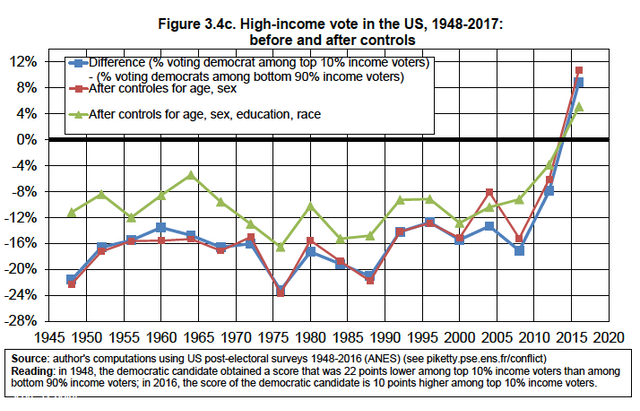
The chart below tracks the difference between the Democratic Party share of voters in the top 10 percent of the income scale versus the Democratic Party share of voters in the bottom 90 percent over time.
The chart shows that in the 1940s through the early 1970s, working class voters were far more likely to support the Democratic presidential candidate. This began to shift in the mid-1970s, changing drastically over the course of the Obama presidency and culminating in the 2016 election, in which the Democratic vote share was 10 percent higher among the top 10 percent than it was among the bottom 90 percent.
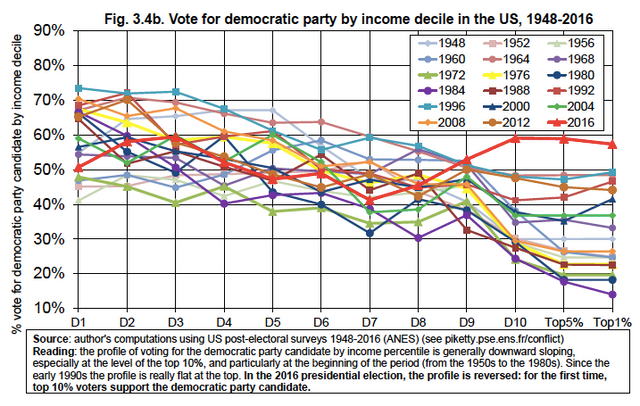
The following chart breaks down the share of the Democratic vote by income decile over the course of each presidential election from 1948 to 2016. The bright red line, showing the Democratic share in 2016, indicates that almost 60 percent of voters in the top 10 percent, top 5 percent and top 1 percent voted for the Democratic Party, the first time a majority of the wealthy and affluent voted for the Democratic candidate. The Democrats have won more than 40 percent of the wealthy vote only in the 1990s and 2000s. In the 1950s through 1970s, the top 1, 5 and 10 percent supported Republicans by margins ranging from 70 percent-30 percent to 85 percent-15 percent.
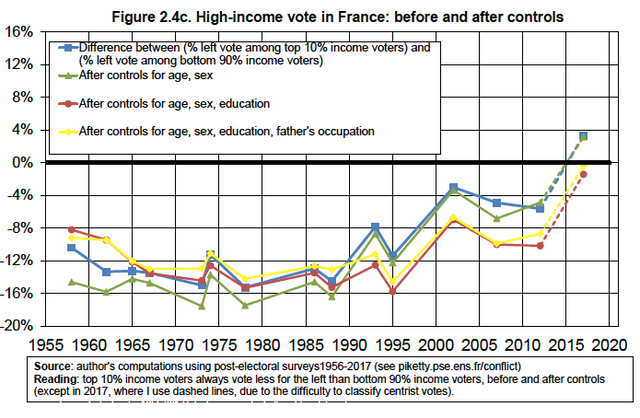
In France, a similar process is playing out. In the 2017 elections, for the first time in the history of the Fifth Republic, voters in the top 10 percent of the income distribution were more likely to support “left” parties (including the Stalinist French Communist Party, Jean-Luc Melenchon’s France Insoumise and Emmanuel Macron’s La République En Marche).
In Britain, the same basic shift is taking place, though the Labour Party’s share among the bottom 90 percent remains about 11 percent higher than among the top 10 percent. However, this figure is down substantially from the roughly 40 percent higher vote share which Labour received among workers in the 1964 and 1966 general elections, won by Labour candidate Harold Wilson.
The Democratic, Labour and Socialist parties have found new social constituencies among the elite as they have loyally prosecuted the interests of the capitalist class. In each country, they have slashed funding for social programs, reduced workers’ wages and provided trillions in bank bailouts and corporate tax cuts, paving the way for an unprecedented growth in social inequality.
The British Labour Party, despite the pacifist phraseology of Jeremy Corbyn, is no less pro-war than the Tories, while in France and the US the Socialists and Democrats are the most aggressive advocates of imperialist expansion. Under Democratic President Barack Obama, Socialist Party President Francois Hollande and Labour prime ministers Tony Blair and Gordon Brown, these parties have bombed, invaded or established a military presence in most of the Middle East, Central Asia and large parts of North and Central Africa. Just last week, these parties and their conservative counterparts joined forces to bomb Syria on the basis of a fabricated pretext.
The immense concentration of wealth within each country and worldwide has transformed the governments of the “democratic” imperialist countries into oligarchies that can brook no opposition to their programs of war and social counterrevolution. Such forms of rule are incompatible with basic democratic rights, as evidenced by the Democrats’ oversight of mass surveillance and police violence in the US, the Socialist Party’s implementation of a permanent state of emergency in France, and the Labour Party’s refusal to protect whistleblower Julian Assange from the looming threat of US prosecution.
The leaders and functionaries of the Democratic, Socialist and Labour parties have joined enthusiastically in the march to the right, which was made possible by the trade unions, which suppressed and isolated the struggles of the working class in each country. Employing the poison of nationalism, the unions responded to the globalization of the world’s productive forces by entering into a corporatist alliance with “their” ruling classes against the workers. They chained workers politically to the Democratic and Labour parties in the US and UK and to the Socialist and Stalinist parties in France.
The data underlying the Piketty report makes clear that the “left” bourgeois parties and the trade unions are institutions of oligarchic domination, which is why workers are abandoning these organizations in droves. But at precisely this moment, pseudo-left groups such as the International Socialist Organization (ISO) and the Democratic Socialists of America (DSA) in the US, Momentum and the Socialist Workers Party (SWP) in the UK, and the New Anti-capitalist Party (NPA) in France are urging workers and youth to put their faith in efforts to work with these parties and the trade unions, pressuring them to adopt pro-worker reforms.
This bankrupt orientation is not merely a political mistake. It a reflection of the rightward shift within the upper-middle class layers that form the base of these anti-Marxist and anti-working class organizations.
On a world scale, a massive political polarization is taking place. The top 10 percent, fearful of losing its privileged position, is shifting to the right. The bottom 90 percent—billions of workers worldwide—is entering into a conflict with the oligarchy and its political representatives that has revolutionary implications.

Nearly 30,000 single-parent families made homeless in England in 2017

Dennis Moore

New figures published by the UK government show that nearly 30,000 single-parent families were made homeless last year, an increase of 8 percent on five years ago. Up to three quarters of homeless households in England are single-parent.
Figures released for the period 2016–2017 by the Department of Communities and Local Government showed that single mothers represented 47 percent of the overall figure for those deemed as statutory homeless, yet they only represented 9.2 percent of households.
Most single-parent households are working households, with many of these parents struggling to balance work and child care costs. Many are faced with cuts to their income due to cuts to welfare benefit payments and increasing private rental costs.
Last year, single-parent charity Gingerbread published research showing that a third of single parents had been affected by welfare cuts, while 39 percent are struggling in low-paid, often insecure work. The numbers of single parents on zero-hours contracts—at the beck and call of employers with no guaranteed working hours—has increased tenfold over the last decade, with 40,000 now employed this way.
Dalia Ben-Galim, Gingerbread’s policy director, said many more single parents were reaching out to the charity for advice and support when facing eviction and homelessness. She described a “perfect storm of rising living costs, stagnating wages and changes to the benefit system eroding an essential safety net for families, single parents are hard hit and struggling to keep a roof above their children’s heads.”
The research highlights that the living standards of single parents, employed and unemployed, were decimated under welfare reform programmes introduced by the 2010–2015 Conservative-Liberal Democrat coalition government. Between those years, single parents were the worst affected household type, and are predicted to be the worst effected from 2017 onwards.
It is estimated that average single parent families will lose 15 percent (£3,800 annually) of their net income by 2021–2022 because of 2010–2017 tax and benefit reforms—constituting the biggest loss among different household types.
Child poverty is projected to rise sharply, with 63 percent of children in single parent families expected to be living in poverty by 2021–2022.
The statistics show that the number of households in temporary accommodation have risen by two thirds since 2010. Jon Sparkes, CEO of homeless charity Crisis, said, “Temporary accommodation is often cramped, unsuitable and sometimes even dangerous.”
A report by homeless charity Shelter last December described the conditions for many families living in temporary accommodation as “a national scandal.”
One of those interviewed, a 17-year-old girl, described how her parents and three siblings lived in one room for four months. She told researchers, “Three people sleep in the double bed with one person at the bottom and two people at the top.”
Research from Gingerbread concluded that many single-parent families are only just managing financially, with half of those surveyed, rarely, if ever, left with spare income after paying the main household bills. They have often accrued debts when trying to set up a new home and can barely survive on a low income.
This virtual hand-to-mouth existence can easily tip over into disaster when a financial crisis occurs, such as having to replace broken household goods or carry out essential car repairs.
Single parents face financial difficulties because the welfare benefit cap disproportionately affects this group.
The roll-out of Universal Credit (UC) will place many single-parent families at risk of not being able to meet “conditionality” to be able to claim this benefit.
Since April 2017, parents of preschool-aged children will need to look for work, as a condition of receiving out-of-work benefits, or face financial sanctions on their welfare payments. A claimant will now have to look for work as a condition of claiming when the youngest child turns 3, in contrast to a decade ago, when the age of the youngest child was set at 16.
The “in work progression” component of UC not only requires all claimants to look for work, but also expects them to progress while in work, requiring less dependency on work benefits. Claimants could be encouraged to increase hours to be able to earn more money, take on additional jobs, or find a new job.
The pressures on single household parents to find flexible working conditions and affordable child care places a greater burden on this group of claimants, with the cost of child care consuming a greater part of their overall income.
The cuts to the work allowance under UC will have a greater effect on single-parent households, with up to 1 million working single parents expected to claim. Gingerbread’s analysis shows that the cuts to the work allowance will leave the average working single parent losing at least £800 a year (3.9 percent of income) by 2020–2021. The poorest working single parents will lose most, with the poorest fifth losing 7 percent, equivalent to nearly a month of their income over a year.
Single parents face a far greater risk of being sanctioned than they did a decade ago, following the introduction of more stringent rules and harsher penalties in 2012.
This was most notable under the Labour governments of Tony Blair (1997–2007) and Gordon Brown (2007–2010). They introduced compulsory work-focussed interviews for single parents on income support who had previously been exempt from work preparation—and the introduction of Lone Parent Obligations. The latter removed entitlement to income support, by ending eligibility when a single parent’s youngest child turned 5 rather than 12.
This had the effect of pushing many single parents onto Job Seekers Allowance, with full-time job-seeking conditions attached.
In a report last year, Gingerbread found that that one in seven single parents on Job Seekers Allowance were sanctioned in a single year. In the last decade, more than 209,000 single parents were sanctioned, including some who had been referred more than once.
Single parents are disproportionately sanctioned unfairly, in comparison to other claimants with 62 percent of sanctions against them overturned when formally challenged, as against 53 percent of challenges to other sanctions.
The sadistic sanctioning system of ending or withholding benefit payments only increases the vulnerability and risk of debt, rather than moving them to a more-secure financial footing, and thus into work as the government claims.
Gingerbread’s report calls for action from the government and other “stakeholders” including employers, suggesting that senior politicians have a key role in leading the way.
The only action the government will take, as revealed by the creation of tens of thousands of homeless families under their rule, will be to pile up the misery of the poorest. Successive Labour and Tory governments have enforced changes to welfare that have led to a lack of secure and affordable housing, and inherently unfair conditionality demanded of benefits claimants.
The policies of the parties representing the ruling elite are predicated on the need to claw back everything that has been won by the working class in the post-war period, from the safety net of social housing to social welfare.

UK: Report by building research firm reveals scale of criminality that led to Grenfell fire

Barry Mason 

An interim report by building research body BRE Global is a devastating indictment of the callous indifference to the safety of residents that led to the deaths of at least 72 people in last June’s Grenfell Tower inferno.
The 210-page report, leaked to the Evening Standard, is dated January 31 and was commissioned as part of the Metropolitan Police investigation into the fire. BRE Global is the certification arm of the Building Research Establishment (BRE). It was established out of the 1997 privatisation of the national building laboratory.
More than 10 months after the fire, not a single person has been charged or even arrested for the deaths or the devastation caused to the many survivors and bereaved. The police claim that no such prosecutions can take place until their now-10-month-old “criminal investigation” finishes—which could take years.
These claims should be rejected with contempt. Alongside the public inquiry headed by Sir Martin Moore Bick, the police investigation is part of a concerted cover-up in order that the real criminals responsible for social murder evade justice. Moore-Bick’s inquiry, which has no powers to prosecute anyone, has still not called a single witness or heard a word of evidence. Its initial report is not set to be published until the end of the year.
The fact is that just the information contained in the BRE Report alone is ample evidence to allow for immediate arrests and charging to proceed. It shows that the deaths were entirely due to a criminal neglect for the safety of the Grenfell residents by the local council, its management organisation and the various corporate entities involved.
The report describes how the 2014-2016 “refurbishment” of Grenfell Tower transformed it from a relatively safe building into a death trap.
The Kensington and Chelsea Tenant Management Organisation (KCTMO) carried out the £10 million refurbishment. KCTMO is the arms-length organisation set up by the Conservative-run Royal Borough of Kensington and Chelsea council to run its social housing stock.
Kensington and Chelsea, in west London, has some of the most expensive residential properties in the world. The council’s main purpose in carrying out the refurbishment was to apply a cladding to the building and to cover its concrete façade, to make the view more acceptable to any of its rich residents casting an eye in that direction.
The June 14 fire started in Flat 16 on the fourth floor with the malfunction of a fridge-freezer. Flames from the flat spread through an open window and—due to the highly flammable cladding put on the building—quickly destroyed the entire 24-storey, 70-metre-high building.
The Evening Standard comments, “The first conclusion of the report is that the fire would not have spread beyond Flat 16…and would not have claimed even a single life if the original facade of the building had not been re-clad ” (emphasis added).
The BRE emphasises the relative structural integrity of the original building erected in the early 1970s. It notes, “Grenfell Tower as originally built, appears to have been designed on the premise of providing very high levels of passive fire protection.
“The original facade of Grenfell Tower, comprising exposed concrete and, given its age, likely timber or metal frame windows, would not have provided a medium for fire spread up the external surface. In BRE’s opinion…there would have been little opportunity for a fire in a flat of Grenfell Tower to spread to any neighbouring flats.”
The BRE explains that such was the ferocity of the blaze that it could have led to a partial or full collapse of the building. That it did not was due to the inherent fire resistance, “not the less stringent modern standards,” notes the Standard, engineered into the original building.
Grenfell Tower was deprived of even the most basic safety systems, with the BRE noting the lack of a sprinkler system and that the single staircase was narrower than regulations allow.
The BRE’s analysis of the aluminium frame holding the cladding in place showed it had a plastic, flammable core, which was instrumental in the spread of the fire.
The BRE found five areas where existing building regulations were significantly breached. When cladding insulation is applied to a concrete building, there is a gap between the cladding and the concrete so there is no build of condensation. This chimney effect, while helping overcome condensation build up, can help in spreading flames in the event of a fire.
To prevent this cavity, barriers are installed. These are designed to expand in the event of a fire and close off the gap. But in the case of Grenfell, the barriers installed were designed to close off a 25-mm gap when the gap was 50 mm. This meant they failed and the fire took hold. In addition, some of the barriers were incorrectly installed, being upside down or back to front.
Another major contributor to the deaths were the window frames installed as part of the refurb. These were also not wide enough to fill the space between the columns, leaving a gap of several centimetres at each side. The gap was plugged with various filling materials, none of which provided the necessary 30-minute resistance in the event of fire. BRE found that the insulation foam used was combustible, thus aiding the rapid spread of the fire up and across the building.
This meant when the fire took hold, smoke was quickly able to penetrate the gap entering flats, producing “a direct route for fire spread around the window frame into the cavity of the facade…and from the facade back into flats.”
In the case of Flat 16, the window refurb only provided “fuel” instead of a barrier, as “The construction of the window did not provide any substantial barrier to fire taking hold on the facade outside.”
The BRE addressed the automatic door-closing mechanisms on the front door of each flat. Closers fitted to these doors should have automatically closed the door as residents fled the fire. BRE found almost half the door-closing mechanisms were either missing or faulty, breaching building regulations.
As a result, when residents fled their flats on the night of the fire, a significant number of doors were inadvertently left open. “Where this occurred, the fire in each flat appears to have emitted large quantities of smoke and later fire directly into the immediate lobby, and these have gone on to affect the lifts and single stairwell.” The Standard comments that this “would have affected residents’ life chances as they sought to escape down the single stairwell.”
The BRE looked at issues relating to the firefighters’ response. Landscaping and the lack of space around the base of the tower block—about which the Grenfell Action Group had warned the TMO of what the “catastrophic” consequences would be—meant that only one fire engine could park adjacent to the tower. In addition, the riser allowing access to get water to the top floors was a dry riser making it difficult for one fire engine alone to pump water to the height needed to reach the upper floors. The BRE report notes the tower should have been fitted with a wet riser—with water present along the length of it making it easier to pump water to the top floors.
The Evening Standard showed the leaked report to a specialist architect who said, “The question is could this fire have been avoided? This damning report is saying it absolutely could have been and the refurb was to blame.”
He added, “These findings could result in people going to prison. But the report has left open the vital questions as to whether the design of the installation was at fault, whether the works were approved and/or inspected, or whether it was a combination of all of these. The buck stops with the owner of the building Kensington and Chelsea council, and its management organisation, which should have ultimate duty of care. Some people will not be sleeping well at night once this report is made public. You read it and think: heads are going to roll.”
A spokesman for Grenfell United, which speaks for survivors of the fire, told the Standard: “It was clear to us the refurbishment was shoddy and second rate. We raised concerns time and again. We were not just ignored but bullied to keep quiet. That a refurbishment could make our homes dangerous and unsafe shows that the contractors put profit before lives. It’s an industry that is broken.
“It’s also an industry that has been allowed to get away with this behaviour. Six people died in a fire at Lakanal House in 2009 and the Government failed to act and make changes to regulations that would have stopped a fire like that happening again. Tonight we know people are going to sleep in homes with dangerous cladding on them.”

Banks impose massive attack on Puerto Rican workers amid island-wide blackout

Genevieve Leigh

In the midst of another island-wide electrical blackout across Puerto Rico, the island’s Financial Oversight Management Board (FOMB) met in the capital of San Juan Thursday afternoon to pass a fiscal plan that amounts to a full-scale assault on Puerto Rican workers, who are still reeling from a catastrophic hurricane in late September 2017.
The plan will eliminate thousands of jobs, enforce the privatization of both the Puerto Rico Electric Power Authority (PREPA) and the water utility, consolidate dozens of state agencies, cut pensions by 10 to 25 percent for retired public employees, drastically reduce government subsidies to all of Puerto Rico’s 78 municipalities, cut funding to the island’s only public university, cut sick leave and vacation pay by half, and eliminate mandatory Christmas bonuses, among other “cost-cutting” measures, all of which are to be placed squarely on the backs of the working class.
The final addition to the fiscal plan was the brutal attack on pensions. The slashing of pensions for retirees, among the most vulnerable layer in society, is made all the more barbarous considering that in 2014 the Puerto Rican government changed the retirement system that guaranteed public sector workers a full pension after 30 years of employment to a system that forces workers to work up to 15 additional years for full benefits. In other words, over the course of the last four years, workers have been made to stay in the workforce an additional 15 years and will now receive up to 25 percent less in benefits upon retiring.
The cutting of pensions will create a life and death scenario for many elderly workers. In Puerto Rico, members of the “Employees Retirement System” receive an average of $1,092 monthly from pension benefits. This is nearly half of what retirees in the public sector receive in the US, according to the latest census report. The poverty rate on the island is nearly three-and-a-half times the official US rate, standing at 43 percent, with a median household income of $19,606 per year. These starvation wages and the struggling economy, exacerbated by the horrific hurricane last year, have created a social crisis of immense proportions on the island.
Despite this reality, the fiscal plan is being hailed by financial speculators as a major success as it forecasts a potential $6.7 billion in debt payments to bondholders, $400 million more than a previous estimate from Governor Ricardo Rosselló. The fiscal plan has been sent back and forth between the island government and the FOMB over the course of many months in order to scrape every dollar possible from the working class. The ruthless dedication to securing bondholder payments has caused bond prices to rise constantly this year, with Puerto Rico’s benchmark general obligation bond trading at 42.6 cents on the dollar on Thursday and senior sales tax-backed debt at about 60 cents, according to Thomson Reuters data.
The unelected seven-member board voted 6-1 to certify a plan, with only board member Ana Matosantos, president of Matosantos Consulting and director of the California Department of Finance, voting against it. Puerto Rican Governor Ricardo Rosselló is also on paper as opposing the final fiscal plan, insisting in a written statement to the board Thursday that it “lacks the authority to impose steps that would require legislation.”
If the Rosselló government refuses to implement the fiscal measures, the FOMB could sue to enforce them. However, any such “opposition” from Rosselló would only be for show and motivated purely to save face with the Puerto Rican working class—not from any genuine concern for the people. On the contrary, the Rosselló government has done everything in its power to assist the plundering of the island by financial interests. This includes enthusiastic support for the privatization of both public education and the previously largest publicly-owned utility in the United States, PREPA.
The role of the FOMB all along was to impose these savage austerity measures from the outside, providing a political cover to the local political establishment, the trade unions, and the US government. The nominal “opposition” from Rosselló poses no real threat to the rule of the FOMB. It is instead a protest staged in order to divert unrest among workers and youth on the island by promoting illusions in Rosselló’s government as constituting some form of “opposition.”
It is worth noting that this anti-democratic dictatorship of the banks was imposed upon Puerto Rico by former Democratic President Barack Obama under the guise of “debt restructuring” for the island; a code phrase that in essence means massive austerity measures on the Puerto Rican working class, much like measures imposed on workers and youth in Detroit, Greece, Spain, and across Europe.
The act that saw the creation of the board was called the “Puerto Rico Oversight, Management and Economic Stability Act,” or “Promesa” meaning “promise” in English.
At the time, the “promise” that Obama explicitly made, fraudulently, was that the new measures were being implemented to protect the pensions of 300,000 Puerto Ricans, and safeguard essential services. Thursday afternoon, as PREPA and PRASA were privatized and pensions slashed, it was proven the measures taken were in fact meant to carry out the exact opposite.
Those involved in the writing of this bill were lobbyists for the major Wall Street hedge and vulture funds that own most of Puerto Rico’s debt. The seven-member board hand picked to oversee the plundering includes front men for powerful financial interests, including former and current CEOs and bankers:
· Andrew Briggs is a former official of the Social Security Administration under George W. Bush, who supports privatizing the system. He is currently with the American Enterprise Institute.
· Carlos García is the CEO of BayBoston Managers LLC and managing partner of BayBoston Capital LP. He is considered the architect of Puerto Rico’s controversial Ley 7, which allowed the government to temporarily declare a fiscal emergency and lay off thousands of public sector employees in response to the fiscal crisis.
· David Skeel Jr. is a professor at the University of Pennsylvania Law School. He authored the book, “True Paradox: How Christianity Makes Sense of Our Complex World.”
· Arthur González is with the New York University School of Law. Judge Gonzalez previously served on the United States Bankruptcy Court for the Southern District of New York from 1995 to 2012, retiring as Chief Judge in 2010.
· José R. González has served in multiple banking and financial services positions, including with Credit Suisse First Boston and with the Government Development Bank of Puerto Rico. He is also the CEO and president of the Federal Home Loan Bank of New York.
· Jose B. Carrión III is president and principal partner of HUB International CLC, LLC. He previously served in various positions in the island government, including the Workers Compensation Board.
· Ana Matosantos is president of Matosantos Consulting and has been director of the California Department of Finance and deputy director of budgets for the state overseeing massive layoffs of California workers.
Both José Ramón Gonzalez and Carlos García were recruited to the job from the Spanish-owned Banco de Santander, which was one of the banks that profited greatly from the financial scheming that led directly to Puerto Rico’s debt crisis. These figures, along with the representatives of the local government, have no interest in the well-being of the working class in Puerto Rico.
The passing of the fiscal plan marks a watershed moment in the pillaging of the island of Puerto Rico, a defining feature of its history. However, the Puerto Rican working class, like the working class on the mainland US has also in its history a legacy of class struggle. In tandem with the upsurge of educators across the mainland and internationally, teachers, students, and workers in Puerto Rico have also begun large scale protests against the austerity measures and the attempts to privatize education.
There is a vast reservoir of anger among the workers in Puerto Rico. What is needed above all is a political perspective and leadership to fight for the independent interests of the working class and to link up the struggles of the Puerto Rican workers with those on the mainland and internationally.

Macron and the democracy of class war

Peter Schwarz & Andre Damon

On Tuesday, French President Emmanuel Macron, the former investment banker, made what the Western press hailed as an impassioned plea for democracy before the European Parliament.
Macron warned of a Europe where “the illiberal fascination grows daily” and “our national egoisms sometimes feel more important than what unites us against the rest of the world.”
“We are seeing authoritarianism all around us,” declared the French President. “The response is not authoritarian democracy but the authority of democracy.” For Macron, the embodiment of this democracy is the European Union, which represents “a unique democratic model in the world,” and “democracy conceived of as freedom.”
The speech elicited an enraptured response from the US, British, and French political establishment, with the New York TimesWashington Post and Financial Times running lead editorials lionizing Macron.
The New York Times compared Macron to a “biblical prophet” manning the barricades to defend “European democracy.”
But if Macron be a biblical prophet, he is clothed in filthy garments.
Just four days before his speech, Macron ordered air strikes against the Syrian cities of Damascus and Homs, on false pretenses, without a parliamentary vote, and over the opposition of most of the French population. The French President carried out his military adventure in the Levant in alliance with Donald Trump, a right-wing and fascistic demagogue, and British Prime Minister Theresa May, whose government is consumed with the effort to split Britain from the European Union.
The “prophet” Macron, who received less than a quarter of the vote in the first round of the 2017 French election, has, in his first year of office, inscribed France’s authoritarian state of emergency measures into the country's constitution, worked to gut social services and launched a frontal attack on France’s public-sector workers and students.
In the week before his speech, Macron oversaw a massive assault by over 3,000 riot police on demonstrators at an environmentalist camp and called for France to “repair” the “bond between the Church and the state” in a sweeping attack on the secular traditions of the French Republic.
And yet it is Macron that the Western press is heralding as the last best hope for democracy. As the Washington Post put it, “French President Emmanuel Macron articulated truths on Tuesday that resonate for the entire globe.”
Absent from both Macron’s speech and its rapturous reception in the press is any attempt to explain why the far right is gaining strength throughout Europe, or, just as importantly, why the “liberal” governments of Europe are pursuing policies that are increasingly indistinguishable from those of fascist regimes.
After all, Macron’s key partner in the European Union, Germany, is headed by a grand coalition government that has largely adopted the anti-immigrant platform of the far-right Alternative for Germany (AfD), has called for resurrecting the militarist (and, frankly, fascistic) traditions of the German army, and imposed one of the most draconian Internet censorship regimes anywhere in Europe.
Neither Macron nor his panegyrists make any effort to relate the rise of the far-right to the growth of social inequality, the dismantling of the welfare state or the rise of militarism—that is, to the fundamental characteristics of the capitalist system.
In reality, the greatest responsibility for the rise of the extreme right in Europe lies with the anti-working class policies pursued by the European Union on behalf of Europe’s banks and corporations. The EU’s austerity dictates, which Macron supported as an investment banker and was directly implicated in as French finance minister, have resulted in far-right parties winning growing support. The working class does not see the EU as the embodiment of freedom and democracy, but as the ruthless executor of the interests of the super-rich and the banks.
The extreme right can cast themselves as critics of a corrupt establishment and channel social anger in a nationalist direction only because the social democrats, trade unions and pseudo-left parties like Syriza in Greece, the NPA in France and Die Linke in Germany do everything in their power to block the emergence of a genuine movement of the working class and unconditionally support and implement austerity programs.
As a result, the National Front has risen to become the second-largest party in France, the AfD became the first far-right party to enter federal parliament in Germany since World War II, the right-wing extremist Freedom Party assumed government responsibility in Austria, the xenophobic Lega and Five Star Movement hold a parliamentary majority in Italy, and far-right parties are in power in Poland, the Czech Republic and Hungary.
The “reform” of the European Union being sought by Macron under these conditions has nothing to do with democracy, freedom or equality. It aims to transform Europe into a police state and a military great power dominated by France and Germany, able to compete with the United States in the imperialist redivision of the world.
In the run-up to the Second World War, the apologists for Anglo-American capitalism claimed that the fundamental division in the world—and the source of global conflict—was the conflict between “democracy” and “fascism.” But in the 1930s, as now, both the “democratic” and “authoritarian” governments were pressured to pursue essentially the same militarist and authoritarian policies by the global crisis.
No one described this process more clearly than Leon Trotsky, the co-leader of the 1917 October Revolution and the founder of the Fourth International, who argued that workers should have no illusions in the “democratic” pretenses of the capitalists. In his 1939 essay, “Marxism in our Time,” Trotsky wrote:
All attempts to represent the impending war as a clash between the ideas of democracy and fascism belong to the realm either of charlatanism or stupidity. Political forms change, capitalist appetites remain… The furious and hopeless struggle for a new division of the world follows irresistibly from the mortal crisis of the capitalist system.
In language that perfectly describes the combination of military rearmament and social austerity that Macron represents, Trotsky observed:
Mussolini advised the workers of Italy to learn to pull in tighter the belts on their black shirts. But does not substantially the same take place in the imperialist democracies? Butter everywhere is used to grease guns. The workers of France, England, the United States learn to pull in their belts without having black shirts. In the richest country of the world millions of workers have turned into paupers.
He continued,
The uncontrollable deterioration in the living conditions of the workers makes it less and less possible for the bourgeoisie to grant the masses the right of participation in political life, even within the limited framework of bourgeois parliamentarism. Any other explanation of the manifest process of democracy’s dislodgement by fascism is an idealistic falsification of things as they are, either deception of self-deception.
In a way, the Western press is correct in lionizing Macron as a spokesman of “democracy.” He is in fact the spokesman for bourgeois democracy in the epoch of its disintegration—that is, the untrammeled domination of the banks and the corporations.
The world is confronted with two forms of dictatorship, either the dictatorship of the bourgeoisie, or the dictatorship of the proletariat—that is, the conquest of power by the working class, the vast majority of the population, and the reorganization of society on the basis of social need.
The working class has shown itself ready to fight against the EU’s drive toward austerity and war. This is demonstrated by the militant struggles of rail workers and students in France, the scale of the strikes in Germany’s industrial sector and public services, the repeated eruption of general strikes in Greece, the reemergence of workers' struggles in Eastern Europe and many other strikes and protests.
The coming period will be characterized by bitter class battles and mounting opposition to war and state repression. But these struggles require a political perspective. They can be successful only if the working class breaks with the social democrats, trade unions and pseudo-left parties, unites internationally, and combines the struggle against war and austerity with the fight against the capitalist system. Only in this way can the ruling elite’s policies be opposed and the rise of the far right halted.
Leon Trotsky founded the Fourth International in 1938, in the epoch of the rise of fascism. It advanced the struggle against war, inequality and attacks on democratic rights under the banner of revolutionary proletarian socialism, opposing fascism as an integral component of the struggle to overthrow the decadent and obsolete capitalist system.

19 Apr 2018

Africa Center of Excellence in Materials, Product Development and Nanotechnology (MAPRONANO ACE) Masters and PhD Scholarships 2018/2019

Application Deadline: 4th May 2018 at 5:00pm.

Eligible Countries: East African countries

To Be Taken At (Country): Makerere University, Kampala Uganda

About the Award:  The scholarships tend to promote the core research mandate of the center in three key thematic areas; 1) Materials & Product Development 2) Nanotechnology Innovations 3) Nano medicine.

Type: Masters, PhD

Eligibility: The scholarship program is meant to support research costs for local and regional students in
their second year of study in the fields of Engineering and or Health Sciences.


Number of Awards: The center will fund a maximum of 30 students under this scheme.

Value of Award: Fully-funded

Duration of Program: The scholarships are tenable for a period of 3-4 years for PhD, and 2 years for Masters programs.

How to Apply: Applicants are required to provide the following:
1. A Motivation letter (one page)
2. Admission letter
3. Two recommendation letters preferably from the employer or previous academic supervisor
4. A recent Curriculum Vitae (CV), Maximum 2 –pages
5. A fully defended proposal approved by the host department

The above application documents shall be put in one PDF file and sent to; jbkirabira@cedat.mak.ac.ug and mapronanocedatmak@gmail.com.

Visit the Program Webpage for Details

Award Providers: World Bank

United Nations (UN) Reham Al-Farra Memorial Fellowship Program for Journalists in Developing Countries 2018

Application Deadline: 7th May 2018

Offered Annually? Yes

Eligible Countries: See list below

To be taken at (country): United Nations Headquarters in New York City.

About the Award: The Programme is sponsored annually since 1981 by the United Nations Department of Public Information as a fellowship programme for junior and mid-level broadcasters and journalists from developing countries and countries with economies in transition.
It also provides journalists with an opportunity to gain first hand experience in the work of the United Nations. It is also an opportunity to meet journalists from other countries and exchange ideas with UN communication professionals.
Upon completion of the Programme, participants are expected to continue working in journalism or broadcasting and help promote better understanding of the United Nations in their home country. The Programme is not intended to provide basic skills training to broadcasters and journalists as all participants are already working as media professionals. The Programme also does not lead to employment by the UN.

Type: Fellowship

Eligibility: The Reham al-Farra Memorial Journalism Fellowship is open to junior and mid-level media professionals from countries with developing economies or economies in transition.

To meet the eligibility requirements, candidates must:
  • be between 22 and 35 years old
  • be a fulltime working journalist
  • be proficient in English
  • possess a passport valid for at least 6 months beyond the start of the Programme (programme begins September 2018)
  • be a national of a developing country or country in transition, as defined by the UN Department of Economic and Social Affairs
Number of Awards: Up to 8

Value of Fellowship:  
  • It provides journalists with an opportunity to gain first hand experience in the work of the United Nations.
  • It is also an opportunity to meet journalists from other countries and exchange ideas with UN communication professionals.
  • Upon completion of the Programme, participants are expected to continue working in journalism or broadcasting and help promote better understanding of the United Nations in their home country.
  • The Programme is not intended to provide basic skills training to broadcasters and journalists as all participants are already working as media professionals. The Programme also does not lead to employment by the UN.
Duration of Fellowship: 4 Weeks

Eligible Countries: Afghanistan, Albania, Algeria, Angola, Argentina, Armenia, Azerbaijan, Bahamas, Bahrain, Bangladesh, Barbados, Belarus, Belize, Benin, Bhutan, Bolivia, Bosnia and Herzegovina, Botswana, Brazil, Brunei Darussalam, Burkina Faso, Burundi, Cabo Verde, Cambodia, Cameroon, Central African Republic, Chad, Chile, China, Colombia, Comoros, Congo, Costa Rica, Côte d’Ivoire, Cuba, Democratic Republic of Congo, Djibouti, Dominican Republic, Ecuador, Egypt, El Salvador, Equatorial Guinea, Eritrea, Ethiopia, Fiji, Gabon, Gambia, Georgia, Ghana, Guatemala, Guinea, Guinea-Bissau, Guyana, Haiti, Honduras, Hong Kong, India, Indonesia, Iran, Iraq, Israel, Jamaica, Jordan, Kazakhstan, Kenya, Kiribati, Kuwait, Kyrgyzstan, Lao, Lebanon, Lesotho, Liberia, Libya, Macedonia, Madagascar, Malawi, Malaysia, Maldives, Mali, Mauritania, Mauritius, Mexico, Moldova, Mongolia, Montenegro, Morocco, Mozambique, Myanmar, Namibia, Nepal, Nicaragua, Niger, Nigeria, Oman, Pakistan, Panama, Papua New Guinea, Paraguay, Peru, Philippines, Qatar, Republic of Korea, Russia, Rwanda, Samoa, Sao Tome and Principe, Saudi Arabia, Senegal, Serbia, Sierra Leone, Singapore, Solomon Islands, Somalia, South Africa, Sri Lanka, Sudan, Suriname, Swaziland, Syria, Taiwan (Province of China), Tajikistan, Tanzania, Thailand, Timor-Leste, Togo, Trinidad and Tobago, Tunisia, Turkey, Turkmenistan, Uganda, Ukraine, United Arab Emirates, Uruguay, Uzbekistan, Vanuatu, Venezuela, Viet Nam, Yemen, Zambia, Zimbabwe

How to Apply: Apply Here

Visit Fellowship Webpage for details

Award  Provider: United Nations

School of Data Fellowship Programme for Developing Countries 2018

Application Deadline: 6th May 2018

Eligible Countries: 8 positions are open, 1 in each of the following countries: Bolivia, Guatemala, Ghana, Indonesia, Kenya, Malawi, Tanzania, The Philippines

About the Award: Fellowships are nine-month placements with School of Data for data-literacy practitioners or enthusiasts. During this time, Fellows work alongside School of Data to build an individual programme that will make use of both the collective experience of School of Data’s network to help Fellows gain new skills, and the knowledge that Fellows bring along with them, be it about a topic, a community or specific data literacy challenges.
Similarly to previous years, our aim with the Fellowship programme is to increase awareness of data literacy and build communities who together, can use data literacy skills to make the change they want to see in the world.

Type: Fellowship (Career)

Eligibility: The 2018 Fellowship will continue the thematic approach pioneered by the 2016 class. As a result, we will be prioritising candidates who:
  • possess experience in, and enthusiasm for, a specific area of data literacy training
  • can demonstrate links with an organisation practising in this defined area and/or links with an established network operating in the field
We are looking for engaged individuals who already have in-depth knowledge of a given sector and have been reflecting on the data literacy challenges faced in the field. This will help Fellows get off to a running start and achieve the most during their time with School of Data: nine months fly by!

Selection Criteria: The School of Data will consequently prioritise individuals who:
  • possess relevant experience and expertise in the technical areas our local partners need help with
  • can demonstrate a strong interest in the field of activity of the civil society organisation they will be supporting
Number of Awardees: Up to 8

Value of Fellowship: 
  • While Fellows will be focused on ironing their skills as data trainers and build a community around them, Experts will focus on supporting and training a civil society organisation or newsroom with a specific project.
  • Fellows will receive a monthly stipend of $1,000 USD a month to cover for their work.
  • Experts, who will have a planning with more variations, will receive a total stipend of $10,500 USD over the course of the programme.
Duration of Fellowship:
  • May 14th, 2018 to January 31st, 2019
  • Level of activity: 10 days per month
  • How to Apply: Apply Here
Visit Fellowship Webpage for details

Award Provider: School of Data

Government of Turkey Undergraduate and Postgraduate Scholarships (Türkiye Burslari) Third Round for International Students 2018/2019

Application Deadline: 14th May 2018

Offered annually? Yes

Eligible Countries: See List below.

To be taken at (Universities): Turkish Universities

Fields of Study: Courses offered at the universities

About Scholarship: Türkiye Scholarships include both scholarship and university placement at the same time. Applicants will be placed in a university and programme among their preferences specified in the online application form. Candidates can apply only one scholarship programme in accordance with their educational background and academic goals.

Type: Undergraduate, Masters, PhD

Eligibility: To be eligible for Turkiye scholarship, applicants must;
  • be a citizen of a country other than Turkey (Anyone holding or ever held Turkish citizenship before cannot apply)
  • Candidates must not be older than 21 years of age for undergraduate degree
  • not be a registered student in Turkish universities at the level of study they are applying.
  • be a bachelor’s or master’s degree holder by 30th of July 2017 at the latest
  • There is also age condition candidates are required to meet:• For applicants applying to Undergraduate Degree: Those who were born no earlier than 01.01.1997,
    • For applicants applying to Master’s Degree: Those who were born no earlier than 01.01.1988,
    • For applicants applying to Ph.D Degree: Those who were born no earlier than 01.01.1983,
    • For applicants applying to Research Program: Those who were born no earlier than 01.01.1973,
    • Applicants shouldn’t have any health problems barrier to education.
  • have at least 75 % cumulative grade point average or diploma grade over their maximum graduation grade or have at least 75 % success in any accepted national or international graduate admissions test.
  • be in good health
Required Documents
  • Online application
  • A copy of a bachelor or master’s diploma or document indicating that the candidate is bachelor or master’s senior student
  • A certified bachelor and/or master’s transcript (indicating courses taken and relevant grades of the candidate)
  • A copy of a valid ID card (passport, national ID, birth certificate etc.)
  • Passport photo
Number of Scholarships: several

Value of Scholarship: The Scholarship Covers:
  • Monthly stipend (600 TL for undergraduate, 850 TL for master and 1.200 TL for PhD )
  • Full tuition fee
  • 1-year Turkish language course
  • Free accommodation
  • Round-trip air ticket
  • Health insurance
Duration of Scholarship: for the period of study

Eligible Countries:
  • The list of countries open for undergraduate applications in the third round are as follows:
Andora, Antigua and Barbuda, Bahrain, Bangladesh, Barbados, Belize, Benin, Belarus, United Arab Emirates, Bolivia, Bosnia and Herzegovina, Brunei, Bulgaria, Burkina Faso, Cape Verde, Algeria, Djibouti, Chad, China, Democratic Republic of Congo Ethiopia, Morocco, Ivory Coast, Palestine, Finland, French Guiana, Gabon, Gambia, Ghana, Guinea, Guinea Bissau, Grenada, Guyana, Georgia, East Timor, Dominican Republic, Dominica, Equatorial Guinea, Eritrea, Estonia, , Haiti, Croatia, Iraq, Iran, Israel, Jamaica, Cambodia, Cameroon, Montenegro, Qatar, Kazakhstan, Comoros Islands, Congo Republic, Kosovo, Kuwait, Turkish Republic of Northern Cyprus, North Korea, Cuba, Laos, Latvia, Liberia, Libya Mauritania, Mauritania, Niger, Nigeria, Central African Republic, Uzbekistan, Palau, Panama, Poland Romania, Russia, Saint Kitts and Nevis, Malawi, Mali, Mali, Marshall Islands, Lithuania, Lebanon, Hungary, Madagascar, Macedonia, Saint Lucia, St. Vincent and the Grenadines Sao Tome and Principe, Senegal, Serbia, Sierra Leone, Slovakia, Slovenia, Somalia, Sudan, Surinam, Syria, Saudi Arabia, Taiwan, Togo, Trinidad and Tobago, Tunisia, Oman, Jordan, Venezuela, Yemen, Greece.
  • The list of countries open only for postgraduate ad undergraduate applications in the third round are as follows:
China, Panama, Taiwan.

How to Apply: Applications can only be made through www.turkiyeburslari.gov.tr. Applicants are required to submit and upload the necessary documents to the application system.
Applications delivered by post, courier, or by hand will not be accepted.

Visit Scholarship Webpage for details

Scholarship Provider: Turkish Government

Important Notes: Most programmes in Turkish universities are instructed in Turkish. However, some departments and universities offer programmes in English, French or Arabic. The candidates who want to study in these languages need to have an internationally recognized certificate to prove their language proficiency.