4 May 2018

Global military spending at record $1.7 trillion

Niles Niemuth

Global military spending hit a record of more than $1.7 trillion in 2017, the highest level since the Cold War, according to figures published Thursday by the Stockholm International Peace Research Institute (SIPRI).
The report gives some idea of the scale of the squandering of resources for destructive ends. According to SIPRI, just 13 percent of annual world military spending would be enough to end world poverty and hunger; four percent would guarantee food security for the world’s population; five percent would meet health needs; 12 percent would provide everyone with an education; three percent would provide clean water and proper sanitation.
Feeding its vast military machine with more than $610 billion in 2017, the United States remains by far the world’s biggest military spender, dedicating a greater amount to military spending than the next seven countries combined. The 2018 defense budget recently signed by President Donald Trump will push this figure to $700 billion.
The US has been at war continuously for the past quarter-century, beginning with the 1991 invasion of Iraq, followed in the course of that decade by military interventions and strikes in Haiti, Sudan, Afghanistan and Iraq and the air war against Yugoslavia. The 2000s saw the launching of the global “war on terror,” beginning with the invasion and occupation of Afghanistan in 2001. That was followed by the invasion of Iraq in 2003, the extension of the Afghanistan war into Pakistan with the launching of drone attacks in 2004, the war for regime-change in Libya in 2011 and the beginning that same year of the continuing CIA-fomented civil war in Syria, followed by a third war in Iraq.
The war in Syria, which began as a regime-change operation by US-armed and funded Islamist proxy forces fighting to overthrow the pro-Russian and pro-Iranian government of Bashar al-Assad, has evolved into a confrontation between US forces and those of Russia and Iran, with Secretary of State Mike Pompeo boasting that the US has killed scores of Russians, the Israelis carrying out missile attacks on Iranian targets in Syria, and the US, Britain and France launching a joint missile strike against Syrian government facilities.
After the dissolution of the USSR by the Stalinist bureaucracy in 1991, the apologists for capitalism proclaimed the “end of history”—the final triumph of capitalism and defeat of socialism. They hailed the dawn of a new era of liberal democracy, peace and prosperity.
But more than a quarter-century later, capitalism has produced a nightmare world of feverish rearmament and war, millions of refugees confronting militarized borders and racist witch hunts, soaring inequality combined with brutal austerity, the growth of far-right and fascistic parties and a universal turn by governments to authoritarian rule.
Now the regional wars are metastasizing into a third world war to redivide the globe. Every major power is rearming, pushing international military spending up by nearly 10 percent since the global economic crisis of 2008.
The particularly sharp rise in military spending over the last decade in Central Europe (20 percent) and Eastern Europe (33 percent) reflects the preparations by the US and the NATO alliance for war with Russia. The 29 members of NATO now account for more than half of the world’s military spending.
Under Obama and now Trump, Washington has pressured its European allies to push their military spending even higher. Germany’s new grand coalition government has pledged to nearly double military spending to two percent of gross domestic product by 2024, while French President Emmanuel Macron plans to increase military spending by 35 percent and has called for a revival of the military draft. In all of these countries, rearmament has been accompanied by an onslaught on social programs and workers’ living standards.
Despite incessant US propaganda proclaiming Russia to be a military juggernaut menacing its neighbors, the country had one of the largest annual declines in military spending, falling 20 percent from 2016. The Kremlin spent $66.3 billion on its military in 2017, little more than one tenth what the US spends.
Meanwhile, Saudi Arabia, a key ally of the US in the Middle East, took the number three position from Russia, spending $69.4 billion in 2017. The oil-rich kingdom on the Arabian Peninsula expends 10 percent of its annual economic output on its military, the second highest percentage in the world. Much of Saudi Arabia’s military equipment, purchased from the US, has been dedicated to its slaughter in neighboring Yemen, but that is only a prelude to war against its main target, Iran.
Asia and Oceania have seen military spending increase for an unparalleled 29 successive years. The region witnessed a major military buildup under Obama’s so-called “pivot to Asia,” which is being continued under Trump. The arms race in the region is guaranteed to accelerate with India, under the government of Narendra Modi, initiating plans to expand and modernize the country’s military forces to prepare for war with China and Pakistan.
The US sees its war preparations against Russia as the prelude to a military confrontation with China, deemed to be Washington’s most dangerous rival. The US is rapidly building up its naval forces in the region and setting up missile defense systems and other military installations in the region to encircle China, which is responding with its own military buildup.
Japan is well on the way to casting aside all post-World War II pretensions to pacifism and remilitarizing.
As US military spending has grown to historic heights, the Pentagon has established ever closer ties with the technology giants, creating a special unit, the Defense Innovation Unit Experimental, based in Silicon Valley. Amazon has contracts with both the CIA and the Pentagon and Google has partnered with the Pentagon to expand the drone murder program.
Record levels of military spending have been accompanied by ever greater concentrations of wealth in the hands of billionaires, the integration of the corporations they control with the state apparatus, an assault on the living standards of the working class, and the erosion of democratic rights, including censorship of socialist and anti-war voices on the Internet.
The root cause of war, austerity and attacks on democratic rights is the decrepit and obsolete capitalist system, which subordinates every social need to the enrichment of the financial oligarchy that dominates society.
In 2016, the International Committee of the Fourth International spelled out the following principles for building an international movement of the working class and youth against imperialist war:
* The struggle against war must be based on the working class, the great revolutionary force in society, uniting behind it all progressive elements in the population.
* The new anti-war movement must be anti-capitalist and socialist, since there can be no serious struggle against war except in the fight to end the dictatorship of finance capital and the economic system that is the fundamental cause of militarism and war.
* The new anti-war movement must therefore, of necessity, be completely and unequivocally independent of, and hostile to, all political parties and organizations of the capitalist class.
* The new anti-war movement must, above all, be international, mobilizing the vast power of the working class in a unified global struggle against imperialism. The permanent war of the bourgeoisie must be answered with the perspective of permanent revolution by the working class, the strategic goal of which is the abolition of the nation-state system and the establishment of a world socialist federation. This will make possible the rational, planned development of global resources and, on this basis, the eradication of poverty and the raising of human culture to new heights.

Food factories closing across Britain

Steve James

Large food factories in Scotland and England face closure over the next few months, threatening thousands with unemployment.
The 2 Sisters chicken processing plant in Cambuslang, South Lanarkshire, a suburb of Glasgow, has been a major employer in the town for 55 years and currently employs 450 workers. The plant is set to close in August.
Pinney’s of Scotland’s salmon processing factory in the borders town of Annan, also employs around 450 workers and is due to close later this year. Annan’s entire population consists of only 10,000 people.
Grimsby’s Five Star Fish factory, also owned by 2 Sisters, is set to close. The fish processing factory, which received millions of investment only last year, is already in a 45-day “consultation” prior to closure. Grimsby, in the east central English region of Lincolnshire, despite a drastic collapse of its fishing industry, hosts one of the most concentrated food manufacturing locations in Europe, with over 500 food-related companies in operation, employing thousands of very low paid workers.
2 Sisters is seeking to restore its profits by closing operations deemed loss-making or marginal. The company has also announced the closure of two further plants in England’s West Midlands, at Smethwick and Wolverhampton, at a cost of 500 jobs. Some are likely to be taken on at another company plant, which is moving to more intensive seven-day working.
Most of the plants being closed are relatively modern. 
Workers’ lives are being turned upside down because of the insatiable global hunger of finance capital for profit, which is driving intense and destructive competition across the food industry.
The 2 Sisters plants’ current owner is Boparan Holdings, the business empire of “chicken king” Ranjit Singh Boparan. 2 Sisters employs 23,000 workers across 36 factories in the UK, the Netherlands, Ireland and Poland. Boparan Holdings also owns food producers such as Bernard Matthew, Fox Biscuits, and restaurant chains including the Harry Ramsden fish and chip shops. Boparan and his wife are on the Sunday Times rich list, having extracted £544 million of personal wealth from the labour of their workforce.
In Britain, the company supplies high street food retailers and supermarkets such as Iceland Frozen Foods, Tesco, Lidl and Marks and Spencer (M&S).
One of 2 Sisters’ major competitors is Young’s Seafood, also based in Grimsby. Young’s is being mooted as a potential replacement supplier to M&S for the products processed by Five Star. Young’s also own the Pinney’s plant facing closure in Annan. Young’s, which claims to have been founded in 1805 by a Greenwich fish monger, employs 1,700 workers in Grimsby and 2,000 in Annan, Fraserburgh, and Livingston in Scotland. Work from the company’s threatened Annan plant is also likely to move to Grimsby by the end of the year. Young’s claim the Pinney’s plant is not "financially viable."
Young’s has just been put up for sale in its entirety by the clutch of management funds that control it—Lion Capital, Bain Capital and HPS Investment Partners.
London-based Lion Capital, with £4.8 billion in assets worldwide but just 30 staff, specialises in buying and selling brand name food and clothing companies. Lion’s current portfolio includes American Apparel, Paige, Kettle, Weetabix, and Findus foods, among others.
Boston-based Bain Capital’s assets are worth as much as $75 billion. As well as controlling a range of venture capital, public and private equity, insurance, and debt-based funds, the company’s venture fund owns a wide range of disparate operations in healthcare, tech and consumer products. While Bain are considering selling Young’s Seafood, they also have a finger in bankrupt toy retailer ToysRUs, while its proposed $18 billion takeover of Japanese Toshiba Memory is being compromised by US President Donald Trump’s anti-Chinese protectionism.
HPS, formerly Highbridge Principal Strategies, has over the past eight years invested up to $13 billion in 175 companies. It also has a stake in ToysRUs among many other companies. Spun off last year from JP Morgan Asset Management, HPS claims $39 billion of assets under its control.
The bewildering global reach of both 2 Sisters and Young’s Seafoods ownership and organisation stands in stark contrast to the extraordinarily narrow focus of those claiming to be defending workers’ interests in the threatened factories.
Local and national politicians and trade union representatives in Cambuslang, Annan, Grimsby and Wolverhampton promised initiatives, campaigns, representations and bluster—all based on appeals to 2 Sisters, Young’s and other companies to marginally alter their plans based on retaining whichever site they claim to represent.
The Scottish National Party’s MSP (member of the Scottish parliament) Clare Haughey promised to write to one of 2 Sister’s local rivals in Cambuslang, Uddingston-based Dawnfresh, suggesting they take on 2 Sisters workers if Dawnfresh wins the M&S contract. The Labour Party’s James Kelly demanded that instead of a working group, a “full taskforce” be set up to help 2 Sisters workers. Kelly also complained M&S had “failed to step in and save workers serving on their production lines.”
In Annan, where the closure will be particularly devastating, Scottish Enterprise Minister Paul Wheelhouse insisted he would leave “no stone unturned” in efforts to retain jobs. Local Labour MSP Colin Smyth again invoked M&S, complaining that “M&S have walked away from any corporate responsibility.”
Labour’s recently elected leader in Scotland, Richard Leonard, proposed workers be offered the chance to organise their own exploitation. He called for legislation to allow redundant workers preferential terms to buy out their threatened factories, thereby pitting their small savings against the likes of Bain Capital.
The Unite trade union has members in all the threatened factories. Far from launching a struggle to save jobs, it is above all seeking to prevent any unified struggle emerging from the factory workers. Complementing the role of the politicians, the union’s representatives have worked closely with the local factory managements and dignitaries to defend “their” region as an investment base.
Grimsby’s Dave Monaghan, speaking for Unite, blandly admitted that the Five Star closure had been expected for two years and “comes as no surprise.” Indeed, Unite had two years warning and made no preparation. Scott Walker, the Unite convenor in Cambuslang, demanded nothing more from 2 Sisters management than an extension of the consultation period.
In Annan, faced with mass meetings of workers concerned for their and their town’s future, regional Unite organiser Andy MacFarlane presented his efforts as wholly framed by the company’s interests. “I don’t think anybody’s going to kid anybody on that there aren’t major challenges in terms of the business decisions that have been made by Young’s,” he said, sounding the part of a company spokesman. 
The closures expose the bankruptcy of all the mainstream parties and trade unions claiming to speak for the factory workers.
New rank-and-file workers’ organisations, independent of all the official parties and trade unions, are urgently required. They are posed the task of developing a struggle to subordinate the food industry to the needs of the working population, rather than the profit drive of the global investment corporations.

Germany: Grand coalition government discusses war budget

Johannes Stern

The new budget presented by the Social Democratic Finance Minister Olaf Scholz was discussed yesterday by the cabinet. It is characterized by two things: it maintains the notorious “black zero” (balanced budget) of his predecessor, Christian Democrat Wolfgang Schäuble, which has made Germany one of the most unequal European countries, and it massively increases defence spending to pave the way for an aggressive foreign and great power policy.
While there is supposedly no money for comprehensive social programmes, well-paid jobs, secure pensions and decent medical care, defence spending next year alone is set to rise from today's 38.93 to 42.25 billion euros. By the end of the 2021 legislative period, an increase of 5.5 billion euros is planned. This will continue the “turnaround in the financing of the Bundeswehr (Armed Forces),” according to the Ministry of Finance.
The Christian Democrats (CDU/CSU) and Social Democrats (SPD) signed the coalition agreement, which included raising defence spending to two percent of gross domestic product by 2024, however, this is not preceding quickly enough for sections of the ruling class. The Ministry of Defence said it was indeed a “significant increase”, but the estimated amount was “still insufficient” given the “huge catch-up and modernization needs” of the army.
According to a report by tabloid Bild am Sonntag, Defence Minister Ursula von der Leyen (CDU) is calling for the defence budget to be increased by as much as 12 billion over the next legislative period. If there was not significantly more money next year, the minister sees the billion-euro arms projects in danger, which the grand coalition has already decided. For this reason, the Bundeswehr Association is calling for an increase of the defence budget by 15 billion euros by 2021.
No matter what sum emerges at the end of the negotiations, it will be the largest German rearmament campaign since that of Hitler's Wehrmacht in the 1930s. Only a few days ago, the Bild newspaper published the “defence minister's secret order list”, containing 18 major orders, each exceeding the 25 million euro hurdle. These include combat drones, helicopters, mobile command posts, rocket launchers and articulated vehicles for transporting weapon systems.
At the weekend’s Berlin ILA air show, von der Leyen announced more billion-euro arms projects. In cooperation with France, Germany wanted to “develop a new generation of fighter aircraft, set to launch in 2035”. At the same time, both countries wanted to “jointly develop the next generation of armoured land combat systems over the next fifteen years,” and a “joint maritime reconnaissance craft to monitor large sea areas”. Such “joint projects” were about “optimally using the respective strengths of the industries of both countries”.
In Germany, these are the same arms manufacturers responsible for re-arming the German military before the two devastating world wars in the 20th century. Business daily Handelsblatt appeared last Thursday with the front-page headline, “New billions for tanks: The era of military disarmament seems over. The armaments company Krauss-Maffei Wegmann expects large orders from all over Europe”.
In an accompanying interview, Kraus-Maffei's boss Frank Haun provides an insight into the massive projects being prepared behind the backs of the population. Asked what the Bundeswehr needed for “its operations”, he answers: “Just to fulfil its obligations in the Alliance, Germany needs a new fully equipped mechanized division by 2027 and two more by 2032. That's nine mechanized brigades”.
And in terms of the planned tank upgrade, he calculates, “Let's say: 5,000 new battle tanks are needed in the next 20 to 30 years ... 5,000 new tanks times 15 million euros, that's 75 billion. And if I talk about howitzers, that's nearly another 40 billion”.
Four years after the German government announced the end of foreign policy restraint at the 2014 Munich Security Conference, there can be no doubt that the ruling class is again turning to war in order to pursue its geo-strategic and economic interests worldwide.
At the joint press conference with President Donald Trump last Friday, Chancellor Angela Merkel (CDU) emphasized, “We are growing out of a role in which for many years after the Second World War, Germany was happy if it did not get involved too much because we had done so much harm through the Nazi era. But this time of post-war order is over, the war is more than 70 years ago, and we also have to learn to be more responsible as Germans”.
Her government was “proud that Germany today is the second largest troop contributor in NATO”. We have “taken important steps, and we will have to continue with these steps. When conflicts occur on our doorstep, we cannot rely on others stepping in and that we will not have to contribute”. The German “contribution” would therefore have to grow in the next few years, “and that also has to do with military involvement”. Germany must “learn to play its role as a large and economically successful country”.

Trade talks in Beijing: China says it won’t back down to US

Nick Beams 

Talks begin in Beijing today between a high-level US economic delegation and Chinese authorities on trade, with little prospect of any significant movement by either side in the deepening conflict.
Ahead of the negotiations, which will last two days and involve China’s vice-premier, Liu He, state-owned media insisted that China would not back down in the face of US demands following the imposition of tariffs on $50 billion worth of Chinese goods and the possible addition of a further $100 billion worth of goods.
“Washington had better not expect that its trade-war stick will force Beijing to take whatever the US delegation offers. China won’t abandon its principles despite pressure,” the Global Times said in an editorial published on Wednesday.
The newspaper is often described as “hawkish,” but its views on this question reflect those within top government circles.
The South China Morning Post cited a government official “close to the trade talks” as saying that Washington could not set preconditions for the negotiations and China had the strength to fight a trade war to the end if it broke out.
“We will not offer concessions on anything we consider to be our core interest,” the official said.
The immediate demand of the US is for a reduction of $100 billion in the Chinese trade surplus with the US, which hit $375 billion last year and could go even higher this year.
But the conflict is over more than the trade numbers. The overriding concern of the US is China’s move under its “Made in China 2025” program to develop its high-tech capacities in communications and other areas. Washington regards the program as a threat to American economic and military supremacy.
“Whether it’s the 2025 plan or the $100 billion trade deficit … we will not bow to threats, nor will we accept any preconditions for negotiations,” the Chinese official said.
“There are too many issues that we may not be able to solve in one round,” he said. “Both sides can continue the discussions in Beijing or in Washington. If the talks break down and the US escalates their actions, we are also well prepared for it.”
The US delegation, which is being led by Treasury Secretary Steven Mnuchin, includes the two leading anti-China hawks within the Trump administration, White House National Trade Council Director Peter Navarro and US Trade Representative Robert Lighthizer.
Speaking on the eve of his departure for Beijing, Lighthizer said, “Our list of things that are troubling [in China] is very long.”
According to a report in the Financial Times, Lighthizer told a US Chamber of Commerce meeting on Tuesday that China’s economic model of “state capitalism” was a direct challenge to the US economy. The “Made in China 2025” plan, in which it is seeking to become a world leader in ten industries, represented a threat to the future of the US economy and the employment prospects of “our children,” he said.
Lighthizer claimed it was not his objective to change the Chinese system, “but I have to be in a position where the United States can deal with it, where the United States isn’t the victim of it.”
Lighthizer was the leading force behind a declaration from his office earlier this year that the US had “erred” in its decision to back China’s entry into the World Trade Organisation in 2001.
The report from the Office of the US Trade Representative said that China’s 2025 strategy had the “final goal” of capturing “much larger world market shares” in the targeted areas.
Anti-China rhetoric was also a theme of President Trump’s address to a Michigan rally at the weekend. “[China] became a major power after joining the World Trade Organization, which is a horror show for us,” he said.
Remarks by Commerce Secretary Wilbur Ross, who is also on the delegation, have been no less belligerent. In an interview with CNBC on the trade talks he indicated he had “some hope,” but made it clear the US was ready to proceed with more tariffs and other measures if it did not win concessions.
“President Trump is of the view that it’s now time for action,” he said. “Our trade deficit is too big, too continuing, too chronic and too inspired by evil practices.”
According to the US, these “evil practices” include Chinese theft of intellectual property, forced technology transfers in which US companies investing in China have to divulge knowledge to their joint venture partners, moves by Chinese companies to acquire US firms in order to gain access to technology advances, and the use of state funding to boost technological development.
In other words, China’s recourse to methods similar to those employed by US capitalism in its rise to global dominance represent an existential threat and must be halted.
Action is already being taken by the US. Legislation is now before Congress that would give the Committee on Foreign Investment in the US, which examines inbound investments for potential national security threats, the power to investigate joint ventures overseas on the same basis.
Yesterday, the Wall Street Journal reported that the Trump administration is considering action to restrict the ability of Chinese companies to sell telecommunications equipment in the US on grounds of “national security.”
China’s two leading manufacturers of telecommunications equipment, Huawei and ZTE, would be adversely affected by any ban. ZTE has already been hit by a decision to ban US firms from selling components to it for seven years, on the grounds that it breached an agreement reached after it had been found to be in violation of US restrictions on trade with North Korea and Iran. It has been reported that the US Justice Department is also considering action against Huawei over the same issue.
While there may be some limited announcements from the Beijing talks, which will have to go to Trump for final approval, the underlying conflicts are not going to be resolved and are set to intensify.

Apple hands out $102 billion to shareholders

Patrick Martin 

Apple, Inc. announced Tuesday that it would convert much of its overseas profits, held in a huge cash hoard for several years, into a $102 billion windfall for corporate executives and other shareholders. The financial bonanza for a single company is comparable to the GDP of Ecuador or Sri Lanka.
The maker of the iPhone, the Mac personal computer and other consumer electronics is raising its quarterly dividend by 16 percent, from 63 cents a share to 73 cents a share, a move that will provide $2 billion in increased income directly to owners of the company’s stock. Apple will become the largest payer of dividends in corporate America, surpassing ExxonMobil.
As princely as this payout is, it is dwarfed by the $100 billion buyback of Apple stock, to be carried out over the course of the year. Its effect will be to boost the company’s share price indirectly. Moreover, by reducing the number of Apple shares in circulation, it will dramatically increase such financial indicators as earnings per share, the principal measure by which Wall Street judges a company and which corporate boards use to set executive pay levels.
The $100 billion figure is not so much a record as it is another dimension in corporate plunder. With that sum, Apple could have bought every share of stock in UPS, Lockheed Martin, Goldman Sachs or Boeing. It is greater than the market value of 460 of the Fortune 500 largest US companies.
The funneling of $102 billion from Apple to its shareholders is a distribution of wealth within the ruling elite. The top five individual shareholders are all Apple executives, including CEO Tim Cook. The top three institutional shareholders, holding nearly 18 percent of the stock, are Vanguard, Black Rock and State Street, three giant investment funds. These and others like them will reap the bulk of the financial plunder from the dividend payout and buyback.
The bonanza for the super-rich is the product of two interrelated processes. First is the sweatshop labor of millions of workers in Asia, mainly China, who manufacture components and assemble the iPhones, laptops and watches Apple sells. Second is the tax cut pushed through last December by the Trump administration and the Republican Congress, with only token opposition from the Democrats.
Apple reaps superprofits from the labor of cruelly exploited workers in Asia, most of them employed through subcontractors, as well as through monopoly rents generated by its control of intellectual property rights to the underlying technology. As the WSWS has written elsewhere, “It has been estimated that the cost of an iPhone, retailing for around $650 to $700, is made up of $220 for the components and $5 for the labor of assembly.”
This accounts for the cash hoard accumulated abroad, and deliberately held there in a tax avoidance scheme, while the company’s paid lobbyists obtained the support of both Democratic and Republican lawmakers to back a “one-time” cut in the tax rate to induce American companies to return these funds to the United States.
Such a measure was initially proposed by Obama and backed by congressional Democrats, but it was not finally adopted until it could be incorporated into the broader tax cut for corporations and the wealthy proposed by Trump and congressional Republicans.
The resulting tax cut legislation slashed the basic corporate tax rate from 35 percent to 21 percent, the largest single business tax cut in US history. Apple was already paying an effective rate of only 26 percent on its current US earnings, because of various financial manipulations and tax breaks.
By far the biggest benefit for Apple came from the provision allowing global companies to bring home profits held overseas and pay a one-time low rate of only 15.5 percent, less than half the statutory rate of 35 percent. Apple had the largest single stockpile of such profits, a staggering $257 billion, accumulated in part from global sales and in part from bookkeeping transactions that artificially diverted profits to overseas accounts to escape US taxation, pending the passage of such a bill.
As part of the repatriation of this cash hoard, the company will pay $38 billion in taxes to the Treasury—an amount that will no doubt be hailed as the largest single corporate tax payment in history—but this represents a saving of $47 billion over what Apple would actually have paid if US tax laws had been enforced instead of being treated as a dead letter by giant corporations.
Trump’s Tax Cut and Jobs Act of 2017 would have been better named the “Amnesty for Corporate Tax Cheats Act,” or perhaps the “An Act to Give Apple $47 Billion While Starving Schools and the Poor.”
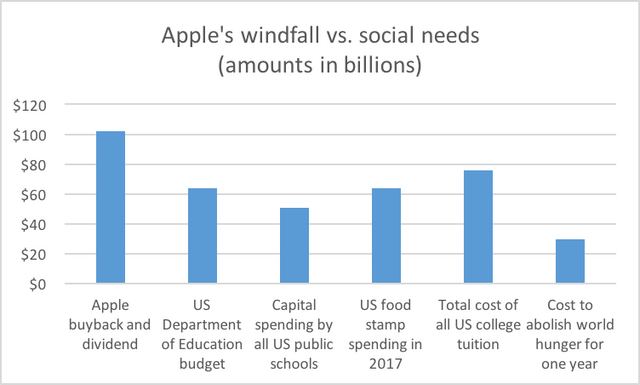
In a democratically organized and rationally planned society, much better use would have been found for the $102 billion being used to enrich those already wealthy. As the chart suggests, Apple’s $102 billion windfall could have paid for the entire budget of the federal Department of Education, or paid the full tuition cost for every US college student, with $20 billion left over. It is double what all US public schools spend on capital improvements (buildings, playgrounds, school buses, equipment) and nearly twice as much money as the federal government spends on food stamps for more than 40 million low-income families. It is more than three times what the United Nations estimates is needed to feed every hungry family in the world for the next year.
When the tax cut bill was passed last December, the White House began hyping a series of announcements by major companies of plans to raise wages, hire more workers, or invest in new facilities, in order to provide “evidence” for its phony claims that the legislation was aimed at benefiting American workers.
Apple, for example, has pledged to hire another 20,000 workers over the next five years, at a cost of $5 billion ($50,000 a year per worker, counting wages and benefits, below the median wage in the United States). Even if this $5 billion materializes, it would represent only 2 percent of Apple’s total repatriated funds. It is dwarfed by the $102 billion handout to shareholders.
In the past week, at least one prominent Republican, Senator Marco Rubio of Florida, has publicly admitted that the tax bill was sold under false pretenses. In an interview with British magazine The Economist , Rubio said, “There is still a lot of thinking on the right that if big corporations are happy, they’re going to take the money they’re saving and reinvest it in American workers … In fact, they bought back shares, a few gave out bonuses; there’s no evidence whatsoever that money’s been massively poured back into the American worker.”
Surveys by business groups have confirmed that the lion’s share of the tax cut gains will go the stock buybacks and dividends, while wage gains are estimated at 15 percent (which includes, of course, bonuses and salary increases for executives, as opposed to options and other stock-related compensation) to as low as 6 percent of the total.
Wall Street analysts now estimate that stock buybacks and dividend increases will top $1 trillion in 2018, nearly doubling the previous record set in 2007, the year before the financial crash. In the first quarter alone, stock buybacks and cash takeovers topped $305 billion, before Tuesday’s $102 billion declaration by Apple.
As for working people, nearly half own no stock at all, and the rest have minimal amounts in 401(k) retirement accounts and pensions. The bottom 80 percent of the population—the entire working class and sections of the middle class—own just 8 percent of stocks. The richest 10 percent of Americans own 80 percent of all shares.
Such figures only demonstrate the complete irrationality and bankruptcy of the profit system. The historical task of the working class is to organize itself as an independent political force, representing the vast majority of the human race, put an end to capitalism, and establish a planned socialist society under the democratic control of the workers.

3 May 2018

Leaked documents expose plans for internal surveillance by Australia’s electronic spy agency

Mike Head

For months, high-level Australian government preparations have been underway to allow the country’s electronic surveillance agency, the Australian Signals Directorate (ASD), to access emails, bank records, text messages and other sensitive data of citizens and other domestic residents without their knowledge.
These plans, partly revealed by the publication of internal documents leaked to the media this week, indicate a ruling class anxious about mounting domestic disaffection and unrest.
The ASD, originally a military agency named the Defence Signals Directorate, operates interception equipment capable of capturing the communications of millions of people, as part of the global Five Eyes network led by the US National Security Agency (NSA).
Under existing legislation, the ASD is meant to spy only on foreign citizens and governments, unless it obtains a ministerial warrant to target individual Australians. In reality, it has long side-stepped this limited restriction by sharing data with the NSA and its British, Canadian and New Zealand partners.
A leaked letter from Mike Pezzullo, the secretary of the new Home Affairs super-ministry, to his Defence Department counterpart Greg Moriarity, showed that the government is planning to sweep aside legal restrictions and conduct mass surveillance of the Australian population.
An unnamed intelligence source reportedly told the Sunday Telegraph the letter outlined “step-in” powers that could force banks, telecoms and companies to hand over citizens’ data.
There is clear evidence, despite subsequent denials, that the relevant cabinet ministers, Home Affairs Minister Peter Dutton and Defence Minister Marise Payne, discussed the plans.
In March, a ministerial submission signed by ASD chief Mike Burgess, stated: “The Department of Home Affairs advises that it is briefing the Minister for Home Affairs to write to you (Ms Payne) seeking your support for a further tranche of legislative reform to enable ASD to better support a range of Home Affairs priorities.”
Such was the government’s fear of public opposition that the three named officials, Moriarty, Pezzullo and Burgess, quickly issued an unprecedented joint statement on Sunday asserting that there was “no proposal to increase the ASD’s powers to collect intelligence on Australians or to covertly access their private data.”
The statement claimed: “We would never provide advice to government suggesting that ASD be allowed to have unchecked data collection on Australians—this can only ever occur within the law, and under very limited and controlled circumstances.”
Foreign Minister Julie Bishop also went into damage control on Monday. She denied any knowledge of the leaked plans and said she saw no “security gap” that would justify them. Dutton, however, yesterday publicly advocated a domestic role for the ASD, claiming it was needed to combat cyber attacks and child sexual exploitation.
Documents released by former NSA contractor Edward Snowden in 2013 revealed that the ASD already hands over to the NSA and its global partners so-called metadata of the phone calls, texts, emails, on-line address books and social media posts of millions of people in Australia and across the Asia-Pacific region.
One document recorded that in just one day, in January 2012, a previously undisclosed NSA program “harvested” 712,336 email address books globally, of which 311,113, or more than 40 percent, were provided by the ASD.
Earlier leaks by Snowden showed that the ASD tapped the phone calls of then Indonesian President Susilo Bambang Yudhoyono, and that Australian embassies throughout Asia operate as electronic listening posts for the US-led spying network.
Moreover, during the past four decades, and especially since the “war on terrorism” was declared in 2001, successive Liberal-National Coalition and Labor governments have handed the Australian Security Intelligence Organisation (ASIO), the domestic spy agency, and the Australian Federal Police (AFP) vast powers and resources to monitor and compile intelligence on Australians.
Last year, the current Coalition government of Prime Minister Malcolm Turnbull took this state apparatus build-up to a new level by establishing the Home Affairs Ministry to take command of seven surveillance and enforcement agencies, including ASIO, the AFP, the Australian Border Force (ABF) and the Australian Criminal Intelligence Commission (ACIC).
The ASD was elevated into a statutory body but remained part of the Defence Department because of its direct involvement in supplying battlefield, cyber warfare and other information to the military.
Turnbull also announced the creation of a new US-style Office of National Intelligence (ONI) in the prime minister’s office, to establish centralised control over all the internal and external spy agencies. This includes the ASD, as well as the overseas spy agency, the Australian Secret Intelligence Service (ASIS) and the military’s agency, the Defence Intelligence Organisation (DIO).
The Labor Party gave bipartisan backing to this unprecedented concentration of police-state powers, consistent with its own long record in office of bolstering the intelligence apparatus. Once the ASD plan was leaked, Labor leaders feigned concern about the accumulation of power in the hands of Dutton’s Home Affairs Ministry, but did not oppose the proposal itself.
Labor’s primary orientation was to attack the government for supposedly failing to protect “national security” because top-secret documents were leaked. Shadow attorney-general Mark Dreyfus wrote to Turnbull asking him to investigate how such highly sensitive national security information was handed to the media. The government subsequently launched an AFP investigation into the leak.
Deputy Labor leader Tanya Plibersek said the leaking of a “top-secret, for Australian-eyes-only, document” pointed to divisions within the government. She said Labor was happy to work with the government on national security, but had not been consulted on this plan and needed to know why any changes were necessary.
The Turnbull government’s reorganisation of the security apparatus is driven by concerns about the global turmoil and uncertainties produced by the Trump administration, the decline in the hegemony of the United States—to which the fortunes of Australian capitalism have been tied since World War II—and the rise of seething discontent in every country, including Australia, generated by ever-greater social inequality.
An intelligence review report prepared at Turnbull’s request last year stated that Australia’s “national security environment” was being re-shaped by intensifying conflicts between the major powers and “a growing sense of insecurity and alienation.”
In Australia, no government has lasted a full three-year term since 2007 because of widespread opposition to the bipartisan program of austerity, war plans and boosting the powers of the police, intelligence and military agencies.
The government’s nervousness about the leaked plan reflects its awareness of underlying hostility toward the surveillance agencies, particularly since the false intelligence claims about “weapons of mass destruction” used to invade Iraq in 2003 and the disclosures of Snowden and WikiLeaks, led by Julian Assange. WikiLeaks revealed many atrocities and war crimes, as well as regime-change coups and intrigues, committed by the US and its allies, including Australia.
Both the Coalition and Labor portray “national security” as being about protecting the Australian population. The opposite is true. Those in ruling circles are preoccupied with suppressing widespread opposition to their preparations for war and to the deepening attacks on the jobs, wages and social conditions of working class people.

Armenian parliament rejects pro-Western opposition leader’s bid to be prime minister

Clara Weiss 

After mass protests that forced Armenia’s prime minister Serzh Sargsyan to resign last Monday, the leader of the liberal opposition bloc, Nikol Pashinyan, failed to secure a majority vote in the parliament in his bid to be elected prime minister on May 1.
While the mass protests that led to the Sargsyan’s resignation were motivated not least of all by social grievances in a country where almost every fifth person is unemployed and every third lives beneath the official poverty line, the liberal opposition has been quick to assert political control over the movement to advance its own agenda.
The vote took place under extraordinarily tense conditions with media reports indicating that the entire country came to a stand-still as the parliament was heatedly debating Pashinyan’s candidacy. Thousands watched the nine-hour parliamentary debate live from the Republican Square in the country’s capital Yerevan.
In a call last week with the former acting prime minister Karen Karapetyan, who replaced Sargsyan as acting prime minister last Monday, Russian president Vladimir Putin stated that his government was insisting on a “peaceful transition” in keeping with the results of the 2017 parliamentary elections. This implied the Kremlin’s ongoing support for the ruling Republican Party, which secured an overwhelming majority of votes in the last parliamentary elections. The opposition bloc Pashinyan represents won, by contrast, only some 8 percent of the votes.
Over the past week, Pashinyan called for numerous demonstrations to pressure the government into accepting him as prime minister, drawing the support of tens of thousands of people. He warned the parliament of a “political tsunami” if they did not back him.
In a frenzy of meetings last week, Pashinyan met with foreign delegations for secret negotiations. The first meeting was with the EU ambassadors to Armenia. Shortly thereafter, he also met with Russian delegations and representatives of the American government. Details about the discussions have not been made public.
On Sunday, Pashinyan called upon his supporters to block the streets leading to the city center of Yerevan, the country’s capital. The ruling Republican Party, which maintains close ties to the Kremlin, announced on Saturday that it would not run its own candidate.
Pashinyan also managed to secure the support of the “Prosperous Armenia” party which is headed by the influential oligarch Gagik Tsarukyan and holds the second-largest number of seats in the Armenian National Assembly.
Nevertheless, he fell short of the necessary absolute majority in parliament, with the bulk of the Republican Party delegates and several opposition delegates declining to vote for him. Instead of the required 53 votes, he only received 45 (out of 105). Pashinyan declared that the vote amounted to a “declaration of war on the people.” He called for “peaceful, nonviolent disobedience” to continue and asked for his supporters to block all roads, including access to the international airport in the capital.
The parliament is set to have another debate and vote next week, on May 8.
Along with the deep class divisions in the country which helped trigger the protests, the main roots of the political crisis lie in the advanced preparations for imperialist war in the region. While fraudulently claiming to speak for the people, Pashinyan, in fact, represents a section of the Armenian oligarchy which, in the face of the US-led confrontations with Russia and Iran, is seeking a rapprochement with the EU and American imperialism.
Pashinyan and his team have been anxious to stress that they had no “anti-Russian agenda.” These statements, however, are belied not only by the fact that Pashinyan met first of all with EU ambassadors, but also by his previous statements. Pashinyan repeatedly criticized Sargsyan’s government for joining the Eurasian Economic Union (EAEU) in 2014, advocating instead an Association Agreement with the European Union which was signed, belatedly, in February 2017.
Last fall, Pashinyan reaffirmed his opposition to the EAEU, stating in a parliamentary debate that the main goal of his faction was to safeguard Armenian sovereignty, something he said would be impossible within the framework of the EAEU. “By joining the EAEU and in the context of the processes that accompanied it, the sovereignty of Armenia was seriously damaged, and these processes will continue, and will become uncontrollable for us starting at some point, if they haven’t become so already,” he declared.
While universally described as a “charismatic leader” in the Western press, what is most striking about Pashinyan’s political biography is his utter opportunism, and his decade-long, integration into the ruling establishment in Armenia which he now hypocritically decries as “corrupt.”
Pashinyan worked as a journalist for almost three decades. In 1995, he was thrown out of Yerevan State University two weeks before his final exams because he had criticized the policies of the government of Levon Ter-Petrosyan, the former leader of the Armenian nationalist movement of the late 1980s and first president of the Republic of Armenia after 1991. Ter-Petrosyan oversaw capitalist restoration, with the most devastating consequences for the working class.
In the years that followed, Pashinyan continued to work for opposition papers. In 2008, he became a member of the election campaign staff of Ter-Petrosyan, whom he had criticized in the 1990s, and who was now running as an oppositional candidate against Sargsyan. Pashinyan played a leading role in organizing the anti-government protests of 2008, which were suppressed brutally, with 10 protesters shot dead by the police.
Pashinyan fell-out with Ter-Petrosyan over the latter’s collaboration with the oligarch Gagik Tsarukyan and his party, which formed part of the government coalition until 2012. Pashinyan, however, now works with Tsarukyan himself.
Pashinyan’s deep ties to the Armenian political establishment and pro-EU positions are no doubt the reason that the Western press, although taken by surprise by the mass demonstrations in April, was quick to endorse him and the protest movement.
The major European powers, along with the US, are trying to encourage a shift in Armenia’s foreign policy orientation to ramp-up pressure on Russia and Iran, both of which have historically been closely aligned with the small nation. The coming weeks and months may well bring to light more information about the involvement of Washington and Brussels in the recent political upheavals.
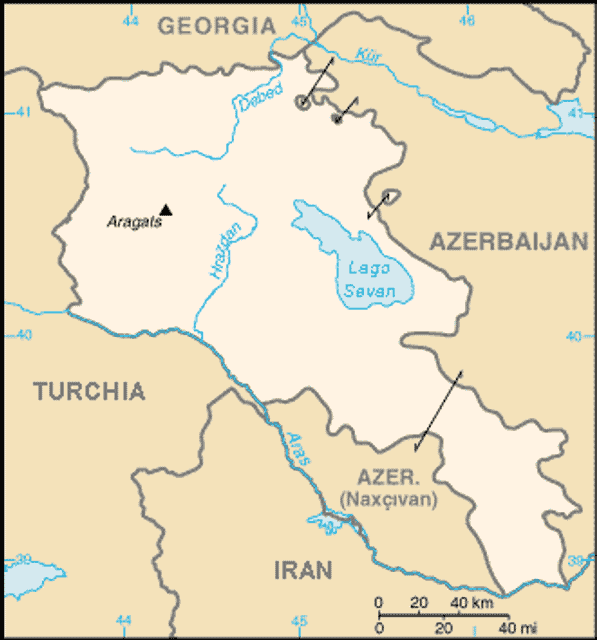
Armenia is a country of major geostrategic significance in the Caucasus, bordering Azerbaijan, a close ally of the US, as well as Turkey, a member of NATO, Georgia, and Iran, a central target of US imperialist aggression.
Russia maintains two military bases in the country and is by far Armenia’s biggest trading partner. Armenia has relied on Russian economic and military support in its decade-long conflict with neighboring Azerbaijan over the mountain enclave Nagorno-Karabakh.
A map showing Armenia and neighboring countries
Moreover, up to two million Armenians work and live in Russia which, poor as it is, still offers more employment opportunities than the economically decrepit Caucasian republic. The Armenian and Russian oligarchies also maintain close ties, and in part overlap, with numerous Armenian-born figures among Russia’s richest individuals. This includes Samvel Karapetyan, the brother of the acting prime minister Karen Karapetyan, who owns the real estate concern Tashir Group and has an estimated net worth of $4.6 billion.
However, while in no position to rival Russia’s economic ties with Armenia, the United States also has significant economic leverage. According to a report by the Russian online newspaper Gazeta.Ru, the US is Armenia’s main creditor, holding the lion’s share of the country’s foreign debts, which amount to about 60 percent of GDP.
Perhaps even more importantly, because its dependence upon the Kremlin, the Armenian elite has felt the growing imperialist pressure on Russia in both Eastern Europe, especially since the coup in Ukraine in 2014, and in the Middle East.
Iran, home to a large Armenian diaspora and the only one of the country’s neighbors that it maintains close political and economic relations with (especially in energy), is the target of a decade-long imperialist campaign by the US and Israel. Fears in the region of an imminent Israel-Iran war, or an attack by Washington, are running high.
Under these conditions, the Armenian oligarchy is torn by vicious infighting over whether or not to loosen its longstanding and economically crucial ties with Russia in favor of greater subordination to US and European imperialism.
Amid mass poverty and a growing danger of war in the region, Armenian workers and young people, sections of whom participated in the mass protests, must advance their own solution to the political crisis, independent of all sections of the oligarchy, and in opposition to imperialism and the profit system.

Trudeau defends Canada’s $15 billion arms deal with despotic Saudi regime

Laurent Lafrance 

Justin Trudeau’s Liberal government is continuing to defend Canada’s $15 billion arms deal with Saudi Arabia, even as new information reveals the murderous character of the military equipment Ottawa is shipping to Riyadh.
A recent report from CBC, based on documents it obtained, outlined for the first time specifics of the Canadian-Saudi arms deal that had previously been sealed under a confidentiality accord.
The $15 billion deal was initially approved by the former Conservative government in 2014, but was given the go-ahead when the Liberals signed export permits that allowed the sale to proceed. At the time, Trudeau and his Minister of Foreign Affairs, Stephane Dion, were caught out lying about the deal, which they claimed had been finalized by the previous government. It was subsequently revealed that the Harper Conservatives only signed permits to authorize the provision of technical details about the light armoured vehicles (LAV) to be sold. The delivery was only able to proceed after Dion signed permits stating that the sale conformed with Canada’s arms control and human rights policies.
Just like Dion, who fraudulently claimed that “there is no reasonable risk that the military equipment might be used against the civilian population,” Trudeau recently told the House of Commons that “permits are only approved if the exports are consistent with our foreign and defence policies, including human rights.”
While Trudeau boasted of “new processes of transparency and accountability to international sales,” his government is refusing to release details of a recent investigation by Global Affairs Canada staff into allegations that Canadian-made armoured vehicles were used by the Saudi regime in the protracted military conflict against the Shiite population in Al-Qatif, a hotbed of popular resistance to the Saudi regime.
Even though the Saudi embassy in Canada publicly stated that Riyadh has used Canadian-made armaments to suppress its own people in Qatif, Foreign Affairs Minister Chrystia Freeland declared that the Global Affairs report found “no conclusive evidence that Canadian-made vehicles were used in human rights violations.” Freeland refused to make the investigation public precisely because its findings could fuel public opposition and put the lucrative deal in jeopardy.
Both the Liberals and Conservatives exploited the lack of detail about the deal to lie to the public about the capabilities of the vehicles being sold. While former prime minister Stephen Harper absurdly described them as “trucks,” Trudeau no less disingenuously called them “jeeps.”
The documents obtained by CBC show that the 2014 agreement, to both Harper’s and Trudeau’s knowledge, called for the sale of 928 of the newly developed LAV 6s, including 119 with “heavy assault” 105-millimetre cannons. Another 119 are configured as “anti-tank” vehicles and a further 119 are designated as “direct fire” support, with a two-man turret and 30-millimetre chain gun. The remaining vehicles include ambulances, mobile command posts, VIP transports and recovery vehicles equipped with cranes. Almost 40 percent—354 of the total—are standard troop carriers.
According to the CBC , the documents also reveal that the contract goes far beyond the sale of the vehicles. It also includes “a 14-year support program that involves ammunition, crew ‘training in Canada/Europe’ and ‘embedded’ maintenance, with a fleet management team in 13 workshops located in Saudi Arabia.” The training of Saudi crews working on the gun system is supposed to take place in France.
Canada’s steadfast backing for the murderous Saudi regime is part of its efforts to aggressively pursue its predatory imperialist interests throughout the Middle East. In Syria, Canada is involved in providing support to the US-backed Islamist rebels engaged in a war for regime change against Bashar al-Assad. Trudeau rushed to applaud last month’s reckless missile strikes by the US, France and Britain on Douma, parroting the unsubstantiated claims that Assad used chemical weapons.
Canadian imperialist ambitions are closely bound up with the maintenance of the United States’ unchallenged hegemony over the strategically important Middle East. For this reason, the Trudeau government is fully behind Washington’s efforts to construct an anti-Iranian alliance in close collaboration with their regional allies Israel and Saudi Arabia, as part of advanced preparations for all-out war with Tehran. In Syria, this has seen US-backed rebels seize strategically-important areas in eastern Syria to prevent Iran establishing a land corridor to Damascus, while Israel has been given a free hand by Washington to target Iranian personnel in a series of air strikes that threaten to trigger a wider war.
The House of Saud has been the main pillar of US imperialist hegemony in the Arab world and, along with other reactionary Sunni sheikhdoms and Israel, has been massively financed and armed to fight Iranian influence over the Middle East. Saudi Arabia’s genocidal war in Yemen has claimed tens of thousands of civilian lives and left much of the country in ruins.
Despite the fact that the massacre of thousands of innocent civilians and the blockade imposed by Saudi Arabia on Yemen—which aims at starving its population and the Houthi rebels—has been broadly condemned as a major violation of human rights, the Trudeau government is proceeding with its arms deal undeterred.
There can be no doubt that the arms sold to Saudi Arabia will be used in Riyadh’s war against Yemen, one of the world’s poorest countries.
Canada’s backing for the brutal Saudi dictatorship is endorsed by the entire political establishment. During the 2015 election campaign, when New Democratic Party leader Thomas Mulcair sought to feign outrage at the agreement so as to cynically appeal to popular anti-war sentiments, the Unifor trade union quickly brought him to heel and demanded that Canada’s social democrats avoid raising the Saudi arms deal for the rest of the campaign. The NDP, which has backed every Canadian imperialist military intervention since the bombing of Yugoslavia, duly obliged.
The Saudi arms deal provides yet another demonstration of the fact that, like its Conservative predecessors, Trudeau’s Liberals are determined to advance Canada’s imperialist interests through the deepening of Ottawa’s military-strategic partnership with US imperialism. The policies of the Trudeau government, which is committed to hike military spending by 70 percent over the next decade, are creating the conditions for more death and destruction in the Middle East and beyond.
Canada’s Armed Forces are already fully implicated with the US military in the Middle East. In addition to backing Jihadist forces in Syria against Assad, the Liberal government has tripled the deployment of Canadian Special Forces to Iraq to help maintain a pro-Western government after years of US-led war. Canada also played a major role in the 2011 regime-change operation in Libya, which killed thousands and left the country in ruins.
Ottawa is a strong backer of Israel in its repression of defenceless Palestinians. Trudeau has picked up from where Harper left off on his policy towards Israel, siding with the building of Israeli settlements on Palestinian land. The Liberal government also collaborates closely with the Egyptian dictatorship of Abdel Fattah al-Sisi, whose regime has massacred and jailed thousands of political opponents.

T-Mobile and Sprint agree to $146 billion mega-merger

Gabriel Black

T-Mobile and Sprint announced a deal Sunday to combine their companies, the third and fourth largest US phone carriers, to form a new conglomerate valued at $146 billion, including debt. Under the agreement, T-Mobile’s parent firm, Deutsche Telekom, will acquire Sprint, which is owned by Japan’s SoftBank group, for $26 billion.
The merger, if allowed by the US Justice Department, will leave the US wireless market monopolized by three national carriers. The new company would have a combined subscriber base of 127 million, bringing it closer to Verizon’s 150 million and AT&T’s 141 million.
The announcement is the latest in a flurry of proposed or implemented mega-mergers between the largest media and telecommunications companies. The past few years have seen merger deals involving Disney and Fox, AT&T and Time Warner, and 12 separate acquisitions by Verizon, including AOL and Yahoo.
It is unclear whether the Trump administration’s Justice Department will allow the merger to occur. Currently, the administration is suing AT&T to prevent its merger with Time Warner.
The T-Mobile/Sprint merger deal reflects two interconnected processes. On the one hand, all major corporations are under intense pressure from their investors to combine and consolidate, slashing jobs and cutting costs, so as to weather permanently reduced growth rates. On the other hand, there is intense pressure between companies and countries, especially in high-tech, to make the necessary investments in the newest stage of development—in this case, 5G networks. Both the massive investments required and the pressure to reduce costs fuel the drive to consolidate.
In this merger, T-Mobile CEO John Legere and Sprint CEO Marcelo Claure have emphasized the geopolitical “criticality” of the consolidation in addition to its financial benefits.
“All roads lead to Washington,” Legere explained to CNBC on Monday. “We are behind. It’s the early innovation cycle of 5G. We are behind China. This is not something we can allow.”
Claure added, “The US needs to lead in 5G. The only way to lead 5G is by combining Sprint and T-Mobile.”
5G refers to the fifth generation of mobile Internet speeds. It will provide download speeds averaging at 3.5 gbps—sufficiently fast to download a high definition movie in a few seconds and ten times faster than current LTE networks. 5G speeds are necessary for developing the so-called “Internet of Things,” or IoT, connecting a multitude of everyday and industrial items, whether it be a car, a coffee pot or an oil rig, to the Internet, primarily to enhance automation.
Legere and Claure’s depiction of the merger as a question of national security is meant to increase the chances that the Trump Justice Department will approve the agreement. As the United States prepares for a confrontation with China, the financial, intelligence and military elites see 5G speeds as critical to maintaining an economic and military edge. As Aimen Mir, deputy assistant secretary for investment security at the US Treasury Department, wrote to US lawmakers last month, “a shift to Chinese dominance in 5G would have substantial negative national security consequences for the United States.”
US lawmakers have already prevented Huawei, China’s largest phone manufacturer and the third-largest in the world, from launching its new flagship phone with a major US carrier. At the end of last year, Huawei was finalizing deals to sell the Mate 10 Pro via AT&T and Verizon. However, congressmen proposed a law that would ban government business on any US carrier that used Huawei. Lawmakers also pressured AT&T to stop working on a 5G network with the Chinese company. This broke up Huawei’s contracts.
In March, the New York Times wrote an article, “China’s Huawei Is at Center of Fight Over 5G’s Future,” in which it warned that the company had been “pouring money into research on 5G,” and had “hired experts from foreign rivals and pushed them to guide international groups that are deciding the technical standards for tomorrow’s wireless gear.”
Earlier this year, President Trump vetoed Broadcom’s bid for Qualcomm, again with the issue of 5G front and center. Although Broadcom is a US company, albeit based in Singapore, the basis for the decision was that if the takeover went ahead, Broadcom would cut back on research and development expenditure in order to finance the deal, and this would advantage Huawei in the race to develop 5G phone technology.
These moves come as the US prepares to impose unprecedented tariffs against $150 billion worth of Chinese imports at the end of this month.
Legere, Claure and the investors they represent, while playing off of the threat of Chinese supremacy, are chiefly concerned with the financial windfall they will reap from the merger. Speaking on the New York Stock Exchange trading floor Monday, Legere said that the gains for investors through the merger were “off the charts.” He added that there would be $43 billion in “synergies.” The Communications Workers of America announced that at least 20,000 jobs could be lost from the merger.
Both T-Mobile and Sprint have huge quantities of debt, $29.7 billion and $32.5 billion respectively. Sprint’s debt surpasses its stock value. In the words of the Financial Times, Sprint is a “subscale operator that would benefit from huge synergies.”
Whichever company or country succeeds in developing and building the first 5G network will have definite advantages over its rivals. As Chris Lane, a telecom analyst, told the New York Times, “It’s hard to argue that 5G is not key to the next five to 10 years. Strategically, if you’re the US and you’re trying to plan industrial policy, this deal makes sense.”
This year, the United States government will auction off positions for two bands of next-generation wireless spectrum (24 GHz and 28 GHz). Both T-Mobile and Sprint worry that unless they combine their financial forces, they will not be able to effectively compete in these bids. As Sprint CEO Claure told The Streeton Monday, “We’ve looked at our spectrum positions and decided that this was the right time to put these companies together.”
The irrationality of bidding off spectrums of wireless frequencies to companies that will build identical expensive infrastructure to compete with each other cannot be overstated. A rational approach to the development of 5G would see Chinese and American inventors working together in a unified international effort to produce a technology with profound capacities to improve life for human beings. Instead, under private ownership and the system of competing nation-states, the drive for 5G is subsumed by the American ruling class’s war aims against China, dominated by the drive to improve cruise missiles, guidance systems and drones.