5 May 2018

Trump ends temporary protected status for 86,000 Hondurans

Eric London

The Trump administration announced yesterday that it is ending temporary protected status (TPS) for 86,000 Hondurans who have lived in the United States for nearly 20 years. To date, the Trump administration has terminated TPS status for 425,000 immigrants, which will lead to a mass deportation roughly equal to the population of Minneapolis, Cleveland or Oakland.
Protections for these immigrants will now expire in 2020, at which point those in the US under TPS will be forced to return to their war-torn, impoverished home country.
The TPS program is intended to provide temporary respite from deportation to immigrants from countries devastated by natural disaster or war. Yesterday’s decision signals that the government is effectively ending it. Including the Hondurans, 97.4 percent of all TPS beneficiaries will now see their protected status end.
In its decision announcing the policy change, Department of Homeland Security Secretary Kirstjen Nielsen said the DHS is “determined that the disruption of living conditions in Honduras from Hurricane Mitch that served as the basis for its TPS designation has decreased to a degree that it should no longer be regarded as substantial.”
Roughly 10,000 people died in the 1998 hurricane, from which the impoverished Central American nation has never recovered. Though TPS has been extended every 18 months since the hurricane, yesterday’s decision fails to indicate what has changed in the last year and a half. In reality, there is no legal basis for the TPS revocation.
Conditions in Honduras have only further deteriorated since the last extension of TPS. After the right-wing National Party led by incumbent presidential candidate Juan Orlando Hernández committed blatant election fraud in the November 2017 general elections, mass demonstrations broke out across the country.
The government declared a curfew and a national state of exception, and dispatched the military to suppress the protesters, killing 38 and arresting nearly 1,700. Even the imperialist-dominated Organization of American States appealed to the National Party to call new elections, but the Hernández regime ignored the request and inaugurated itself on January 27.
The National Party has ruled Honduras since the 2009 US-backed military coup overthrew then-President Manuel Zelaya. The coup was carried out with the approval of the Obama administration and then-Secretary of State Hillary Clinton. A number of protesters were killed in the demonstrations following the coup. Disappearances of oppositional figures and activists like the indigenous rights leader Berta Cáceres are increasingly common. Cáceres was murdered by elite government soldiers, two of whom were trained at Fort Benning, Georgia, the former site of the School of the Americas.
In the aftermath of decades of destruction wreaked by US imperialism on Honduras, gangs collaborate with the police and the state to terrorize the population. A 2015 Guardian study found that 35 Hondurans deported from the US were murdered over the span of the prior year.
San Diego State University Professor Elizabeth Kennedy told the Guardian: “These figures tell us that the US is returning people to their deaths in violation of national and international law. Most of the individuals reported to have been murdered lived in some of the most violent towns in some of the most violent countries in the world—suggesting strongly that is why they fled.”
The violence that pervades Honduran society has deep roots, including the US’s decision to station thousands of members of its “contra” deaths squads in the country in the 1980s. From bases in Honduras, the contras not only conducted its anti-Sandinista and ethnic cleansing activities in Nicaragua, but also assassinated left-wing activists and carried out brutal repression in Honduras itself.
About 80 percent of all participants in this year’s “Stations of the Cross” caravan are from Honduras. An estimated 1,200 people made the 3,000-mile journey from Central America through Mexico to the US-Mexico border. Two hundred people were forced to camp at the border crossing between Tijuana and San Diego for days before being allowed to submit asylum applications.
Throughout Trump’s first year and a half in power, the Democratic Party has not lifted a finger to stop the attack on TPS recipients. One by one, Trump has cancelled protected status for hundreds of thousands of residents of what he referred to as “shithole countries” in Africa, Central America, and the Caribbean, and the Democrats have waged no serious opposition. Instead, they have spent their political capital denouncing “foreign meddling” and “Russian interference,” cultivating a xenophobic climate that facilitates Trump and his fascist aides’ attack on immigrants.

4 May 2018

Peace Revolution Alafia Francophone Fellowship for Young Africans from Francophone Countries 2018

Application Deadline: 8th June 2018

Eligible Countries: Francophone countries in Africa

To be taken at (country): Bingerville, Ivory Coast

About the Award: Do you want to reach the peak of your performance? Are you ready to try something new in order to make the best version of yourself? With the tools of the “inner arts”, emotional intelligence and meditation, the World Peace Initiative Foundation through its project “Peace Revolution” offers you the opportunity to unleash the latent potential that lies dormant in you so that you become the unique person you deserve to be – through the principle of Peace Inside Peace Outside.
The Training begins with a first phase consisting in following 21 days of the Online Personal Development Program on our interactive platform aiming to offer you the basic theory and practice to cultivate your inner peace.
The second phase offers a 4-day intensive training program that allows participants to better understand the relationship between meditation and the various skills needed to improve efficiency in their professional and social life. Participants will learn more about the benefits of meditation in relation to:
  • Self-empowerment
  • Emotional intelligence
  • Work-life balance
  • Stress management, pressure and resistance
  • Nonviolent Communication
Type: Fellowship

Eligibility: 
  • Being a national of one of the following countries: Republic of Congo, Republic of Congo, Sao Tome and Principe, Gabon, Guinea, Equatorial Guinea, Republic of Congo, Republic of Congo, Chad, Ivory Coast, Mauritania, Cape Verde, Senegal, Niger, Guinea Bissau, Mali, Togo, Burkina Faso, Tunisia, Morocco, Libya, Algeria, Djibouti, Rwanda, Burundi, Madagascar.
  • Have completed at least 21 days of the Personal Development Program online by July 06, 2018. Note that applicants do not necessarily need to have completed the personal development program online at the time of submission of the application form. application. Have a good command of the French language (written and oral). Knowledge of the English language is an asset. However, the training will be conducted exclusively in French.
  • Be optimistic, open-minded, demonstrate leadership, take a particular interest in social change. Candidates can be peace activists, civil servants, journalists, entrepreneurs, young leaders of local, national or international organizations etc. change catalysts in general.
  • Applicants must commit to becoming involved with the World Peace Initiative Foundation after the training by submitting a project proposal that uses the practice of meditation as a tool to address various social challenges in their respective communities.
Everyone is welcome to join the fellowship. But to be eligible for the airfare support, candidates must be between 20-30 years old at the time of submitting application. However, if you are above 30 years old but still want to receive airfare support write us directly at the following email cwestafrica@peacerevolution2010.org

Number of Awards: Not specified

Value of Program:
  • Airfare (Full or partial)
  • accommodation
  • Restoration
  • Local transport
Duration of Program: September 12 – 15, 2018

Apply Here

Visit Program Webpage for details

Award Provider: Peace Revolution

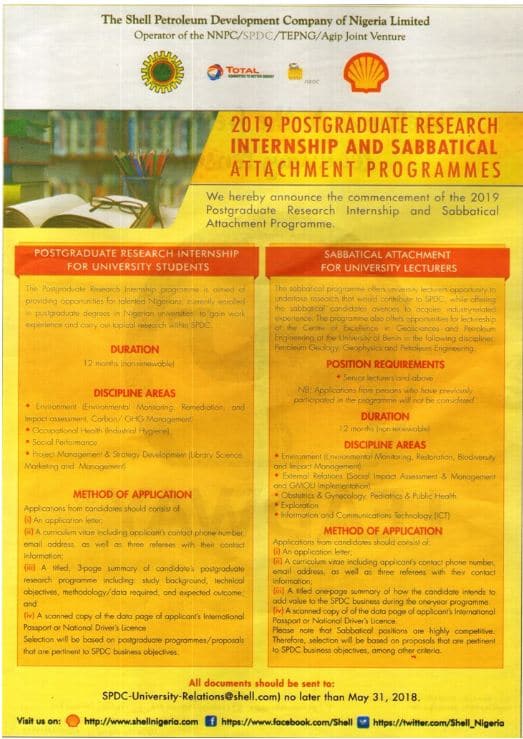
Shell Petroleum Development Company (SPDC) Postgraduate Research Internships for Students and Sabbatical Attachments for University Lecturers 2019

Application Deadline: 31st May 2018

About the Award: The Shell Petroleum Development Company (SPDC) is Nigeria’s oldest energy company, and has a long term and continuing commitment to the country, its people and the economy. As one of the world’s leading energy companies Shell plays a key role in helping to meet the world’s growing energy demand in economically, environmentally and socially responsible ways.

Applications are invited for the TWO programmes below:

. Postgraduate Research Internships for Students

Type: Research, Internship

Duration of Programme: 12 months (non-renewable).
  • The Postgraduate Research Internship programme is aimed at providing opportunities for talented Nigerians, currently enrolled in postgraduate degree in Nigerian universities, to gain work experience and carry out topical research within SPDC.
Discipline Areas 
  • Environment (Environmental Monitoring, Remediation, and Impact Assessment, Carbon / Energy Management).
  • Occupational Health (Industrial Hygiene)
  • Social Performance
  • Project Management & Strategy Development (Library Science, Marketing and Management)
How to Apply: Applications from candidates should consist of:
  • An application letter
  • A Curriculum Vitae including applicant’s contact phone number, email address, as well as contact information of three referees with their contact information
  • A titled, 3-page summary of candidate’s postgraduate research programme including: study background, technical objectives, methodology/data required, and expected outcome.
  • A scanned copy of the data page of applicants International Passport or National Driver’s Licence
All documents should be sent to: SPDC-University-Relations@shell.com 

Important Note: Selection will be based on postgraduate programmes/ proposals that are pertinent to SEPCiN business objectives and only students with the highest potential will pass screening

2. Sabbatical Attachment for University Lecturers 

Type: Research, Job

Duration of Programme: 12 months (non renewable)
Job Description
  • The sabbatical programme offers University lecturers an opportunity to undertake research that would contribute to SPDC, while offering the sabbatical candidates avenues to acquire industry-related experience
  • The programme also offers opportunities for lectureship at the Centre of Excellence in Geosciences and Petroleum Engineering at the University of Benin in the following disciplines: Petroleum Geology , Geophysics and, Petroleum Engineering.
Discipline Areas
  • Environment (Environmental Monitoring Restoration, Biodiversity and Impact Management);
  • External Relations (Social Impact Assessment & Management and GMOU Implementation)
  • Obstetrics & Gynecology, Pediatrics & Public Health.
  • Exploration
  • Information and Communications Technology (ICT)
  • Position Requirements
  • Senior lecturers and above.
  • Applications from persons who have previously participated in the Programme will not be considered.
How to Apply: Applications from candidates should consist of:
  • An application letter
  • A Curriculum Vitae including applicant’s contact phone number, email address, as well as contact information of three referees with their contact information
  • A titled, 3-page summary of how the candidate intends to add value to the SPDC business during the one year programme
  • A scanned copy of the data page of applicants International Passport or National Driver’s Licence
All documents should be sent to: SPDC-University-Relations@shell.com

Important Note: Sabbatical positions are highly competitive, therefore selection will be based on proposals that are pertinent to SPDC business objectives among other criteria.

Visit the Programme Webpage for Details

Award Providers: SPDC

Crick African Network (CAN) African Career Accelerator Awards for Early-career Researchers 2019

Application Deadline: 1st July 2018.

Eligible Countries: African countries

To Be Taken At (Country): The Fellowships will be undertaken in two locations:
  • At the Francis Crick Institute (‘the Crick’, UK) and
  • At one of the five African partner institutions: The University of Ghana (Ghana), Stellenbosch University (South Africa), University of Cape Town (South Africa), MRC Unit The Gambia at LSHTM (The Gambia) and MRC/UVRI and LSHTM Uganda Research Unit.
About the Award: The Crick African Network’s African Career Accelerator (CAN ACA) awards will provide Fellowship support for African Post-Doctoral researchers aiming to make the transition to becoming an independent researcher and launching their own research group.
The CAN ACA awards will invest in early-career researchers who have demonstrated strong scientific and leadership potential, as well as a commitment to continuing their research on the African continent. This call is made possible by funding from the UK’s Global Challenges Research Fund.
The fellowships will accelerate careers that have already shown great potential both scientifically and in leadership. These awards will identify individuals who will go on to make significant contributions to research as well as science and knowledge on the African continent and applicants should articulate how this award would establish them as a research leader.

Research Areas: The scope of the research themes which can be undertaken as part of this Award can be defined as the infectious diseases of poverty, with an emphasis on Tuberculosis, Malaria and HIV/AIDS, but also extending to neglected tropical diseases or non-communicable diseases with an infection component.
Clinical research is possible, but will have to be discussed specifically with potential supervisors/ advisors and institutions to confirm whether resources are available to support the research.


Type: Research, PhD

Eligibility: 
  • Applicants must be a citizen of one of the 55 African nations, as defined by the African Union.
  • Applicants will also have a PhD and have no more than 6 years’ post-doctoral research experience (with allowances for legitimate career breaks) but more than 2 years’ post-doctoral experience unless the applicant has an outstanding track record, supported by publication and employment history.
Competitive applicants
  • will have a strong track record of research.
  • will have a PhD, and have progressed to a postdoctoral role through which they are on a demonstrable path to independence.
  • Prior experience of applying for grant funding is desirable but not required.
  • Neither is it essential to currently be employed on the African continent, but applications should demonstrate the applicant’s desire to establish themselves as an independent researcher on the African continent.
Selection Criteria: Applications will be assessed predominantly on the quality of the science proposed, which will take into account the project, the individual, the research environments and the timeliness, relevance and feasibility of the project, by peer reviewers. The leadership potential of applicants and statements from supervisors will also be taken into account.

Number of Awards: Up to 6

Value of Award: Each Fellowship has a value of up to approximately £130,000.
  • Fellowships may include personal salary, visa costs and research expenses to implement the research.
  • Provision has been made to cover costs of travel for both relocation and conferences, as well as research related costs for consumables.
  • Each fellowship also includes the option of the purchase of up to two pieces of equipment, each up to a value of £10,000.
  • Fellows will be supported by two supervisors/advisors: one each from the Crick and the chosen African partner institution, as well as having the option of support from one of the 14 Crick Science Technology Platforms (STP) which specialize in specific techniques and technologies.
In addition to conducting the proposed research programme, Fellows will participate in advanced training which will provide the skills and competencies to make the transition to becoming an independent research leader on the African continent. To facilitate this, Fellows will be supported to submit a research grant proposal to major international funders in order to be able to continue their work after the end of the Fellowship.

Duration of Programme: Up to two years. Fellowships will commence no later than 31st March 2019.

How to Apply: To apply, applicants must first submit a mandatory Expression of Interest form (see Guidance Notes for Expression of Interest form) by emailing it to CAN-Fellowships@crick.ac.uk. The Expression of Interest form will be available between Monday 23rd April 2018 and 23:59 GMT on the 1st July 2018.

Visit the Programme Webpage for Details

Award Providers: Francis Crick Institute.
The Francis Crick Institute is a unique partnership between the Medical Research Council (MRC), Cancer Research UK, Wellcome, UCL (University College London), Imperial College London and King’s College London

African Programme on Rethinking Development Economics (APORDE) Conference Scholarships (Fully-funded to South Africa) 2018

Application Deadline: 28th May 2018

To Be Taken At (Country): Johannesburg, South Africa.

About the Award: APORDE is a high-level training programme in development economics which aims to build capacity in economics and economic policy-making. The course is run for two weeks and consists of lectures and seminars taught by leading international and African economists. This call is directed at talented African, Asian and Latin American economists, policy makers, academics and civil society activists who, if selected, will be fully funded to participate in the course.
APORDE will allow talented academics, policy makers and civil society representatives from Africa, Asia and Latin America to gain access to alternatives to mainstream thinking on development issues and to be equipped in a way that will foster original thinking. Participants will receive intensive high-level training and interact with some of the best development economists in the world and with other participants.
APORDE will cover essential topics in development economics, including industrial policy, rural poverty, inequality and financialisation. Lectures will equip participants with key information pertaining to both mainstream and critical approaches. The programme will mostly consist of daytime lectures, while a number of shorter evening talks and debates will also be organised.

Type: Conference

Eligibility: 
  • Applicants must demonstrate first-class intellectual capacity and (at least some) prior knowledge in economics/political economy, as well as proficiency in English.
  • The objective of APORDE is to attract participants from a broad range of backgrounds and preference will be given to persons who have demonstrated exceptional capacity in their professional experience.
  • The main body of participants will be drawn from Africa, but we welcome applications from Asians, Middle Easterners and Latin Americans who have research or work experience related to Africa.
Number of Awards: 25

Value of Award: The following costs will be covered for selected participants – travel, accommodation, conference fee and per diem.

Duration of Programme: 3rd to 14th of September 2018

How to Apply: In addition to completing the online form, you have to complete and upload the application form in a word format.
The following documents should be prepared to upload
  • An official transcript (showing courses taken and grades obtained);
  • A certificate of the highest qualification
  • A recent curriculum vitae not exceeding 5 pages in length
  • 2 (two) letters of reference, where possible 1 academic referee and 1 professional
  • For those whose main medium of instruction or work is not English, some proof of English proficiency will be necessary. Results of Standard English proficiency tests (e.g. TOEFL or IELTS) will be preferable, but other proof may also be accepted (e.g. a sample of written work in English).
  • The word format of the application form which you will find on the APORDE web page.
The application will be closed on Monday the 28th of May 2018 at 9 o’clock in the morning, Johannesburg time. Incomplete or late applications will not be considered.
Candidates will be notified by E-mail of the outcome of their applications at the latest by the 25th of June 2018.
Should you have any queries, please contact Christian Kabongo (christiank@idc.co.za).
To go to the online application form click here
To download the application form click here

Visit the Programme Webpage for Details

Award Providers: Supported by
– The South African Department of Trade and Industry (the dti)
– The Industrial Development Corporation (IDC)


Important Notes: Please note that we receive many high quality applications and that, as a result, entry into APORDE will be very competitive (only 25 applicants will be selected). It is therefore important that applicants complete and submit all the required documentation.

International Committee of the Red Cross (ICRC) Paid Traineeship in Law and Policy Forum 2018 – Geneva, Switzerland

Application Deadline: 18th May, 2018

Eligible Countries: All

To Be Taken At (Country): Geneva, Switzerland

About the Award:You will assist the Editor and the Editor-in-Chief of the Review in the conceptualization of the themes, contacts with authors, peer reviewers and the publisher, background research and substantive evaluation of articles.
Key Responsibilities:
  • Assistance to the Editor-in-Chief and the Managing Editor of the International Review of the Red Cross;
  • Substantial academic research;
  • Evaluation and legal editing of article submissions (checking the legal reasoning, arguments, structure and sources);
  • Identification of potential authors and peer reviewers;
  • Preparation and co-conduct of interviews of key experts in the field of humanitarian law, policy and action for the Review;
  • Liaison with the colleagues in-house on identifying potential topics to be covered in the Review;
  • Correspondence with authors and partners, and management of the Review files;
  • Authoring blog articles;
  • Occasional involvement in the organisation of launch events of the journal.
Type: Internship

Eligibility: ICRC is looking for candidates who meet the following mandatory requirements:
  • A Master’s degree in law or international relations.
  • A demonstrated interest in humanitarian work, IHL and human rights;
  • Excellent command of English with good French reading abilities;
  • Maximum one year paid professional experience.
  • Initiative and capacity to work independently under minimal supervision;
  • Excellent ability to work in a team;
  • Excellent communication skills including strong writing abilities;
  • Excellent organizational skills.
If you do not fulfil the conditions above, your application will not be considered.

Number of Awards: Not specified

Value and Duration of Award: Successful candidates will be recruited on a 12-month paid traineeship contract. The positions are based at ICRC headquarters in Geneva, Switzerland. Benefits include:
  • Rewarding work in a humanitarian and multicultural environment;
  • Attractive social benefits;
  • Paid traineeship.
How to Apply: Apply Here

Visit the Program Webpage for Details

Award Providers: ICRC

NNPC/Chevron Art Competition for Secondary School Students in Nigeria 2018

Application Deadline: 30th July, 2018.

Offered annually? Yes

Eligible Countries: Students in JSS1 – SSS 3 classes in Secondary Schools in Nigeria

To be taken at (country): Nigeria

Theme: The Nigerian Spirit

About the Award: The National Art Competition is an annual arts competition with each edition driven by pertinent themes in line with current social issues.

Type: Contest

Eligibility: 
  • Participants are advised to adhere strictly to the theme and rules of the competition.
  • All works must be original and unaided.
  • All works submitted remains the property of Chevron Nigeria Limited for Internal and External use and do not attract any grant thereof after the competition
Specifications:
  • Format: Painting
  • Medium: Posters, water colour, oil colour or acrylic
  • Size: Not exceeding 60cm x 45cm
  • Colour: Free
Number of Awardees: Not stated

Value of Contest: Not stated

Award Provider: The Nigerian National Petroleum Corporation (NNPC)/Chevron Joint Venture in partnership with the Federal Ministry of Education and the African Artists’ Foundation.

How to Apply: Please supply the following information at the back of each work:
  • Full Name
  • Age
  • Class
  • Full address, telephone numbers and email address of Student’s School
  • Phone number of Student, Art Teacher or Tutor, School Principal and Student’s Parents or responsible guardian.
Entries should be addressed and submitted to:

Abuja
Policy, Government & Public Affairs,
Chevron Nigeria Limited,
17, Hon. Justice Mohammed,
Bello Street,
Asokoro,
Abuja.


Mrs. M.O. Onyegbu
Federal Ministry of Education
Federal Secretary Phase III,
RM 812 (8th floor),
Abuja.

Lagos State

Policy, Government & Public Affairs,
Chevron Nigeria Limited,
2, Chevron Drive,
Lekki-Epe Expressway,
Lekki, Pennisula,
Lagos State.


Warri
Policy, Government & Public Affairs,
Chevron Nigeria Limited,
Km 4 Warri,
New Port Expressway,
P.M.B 1244, Warri,
Delta State.


Bayelsa
Chevron Liaison Office,
Major Oputa Street,
By Chief Amange Street,
GRA, Yenagoa,
Bayelsa State.


For more enquires please contact:Joy Oziomaaka
Phone: (01 – 2772222) Ext: 68210
Email: jozi@chevron.com

Peace and the Nuclear Paradox

Robert Koehler

Whenever the topic is nuclear weapons, I remain in a state of disbelief that we can talk about them “strategically” — that language allows us to maintain such a distance from the reality of what they do, we can casually debate their use.
Consider, in the context of the sudden rush of alarming news that Donald Trump may trash the Iran nuclear agreement on May 12, on the false grounds that Iran is in violation of it, this piece of news from several months ago:
The latest Nuclear Posture Review, released in early February, “calls for the development of new, more usable nuclear weapons, and expanding the number of scenarios when the first use of nuclear weapons would be considered, including in response to a non-nuclear attack,” according Global Zero, an international movement to eliminate nuclear weapons.
“The plan renews the calls for massive spending to replace all legs of the nuclear triad, including new strategic bombers, new ballistic missile submarines and new land-based ballistic missile systems. The proposed approach will make America poorer and less secure, and could greatly increase the risk of nuclear war.”
It’s as though humankind has evolved to its own endpoint and doesn’t know it. And those in charge of our future wear uniforms. Or have orange hair.
And these holders of the future declare the need for new, more usable nuclear weapons — tactical nukes, as they say — belying the trillion-dollar paradox at the foundation of international unity: “The most powerful weapons ever devised serve no other purpose but to prevent their use by others,” as Steve Weintz put it in The National Interest.
Maybe the human race is so spiritually complex in its makeup that it requires the suicidal — excuse me, omnicidal — threat of nuclear war, or mutually assured destruction, in order to live in a semblance of peace with itself. I don’t believe this is the case, but that remains the default setting of international politics. The only problem is that military thinking is utterly consumed in the mindset of victory vs. defeat and obsessed by the enemy of the moment. And small-minded militarists are the ones in control.
So the temptation is always present, among the players at the highest level of national and international politics, to skirt around the paradox of MAD and use nuclear weapons to achieve “victory” over some perceived threat.
American generals pushed to use nukes in both the Korean and Vietnam wars, for instance. They were contained then by the forces of (slightly) higher sanity, but that doesn’t mean at some point they won’t get their way. Say a bully with the intellectual acumen of a 12-year-old manages to become president . . .
I mention this in the context of the push by both the United States and Israel to scuttle the Joint Comprehensive Plan of Action — the Iran nuclear deal — and resume U.S. sanctions against Iran.
As Medea Benjamin pointed out, if the sanctions resume and Iran gets no economic benefit out of the deal, “the hardliners in Iran will get the upper hand, pushing Iran to end the intrusive inspections and accelerate its nuclear program. That will provide justification for Israeli Prime Minister Benjamin Netanyahu, as well as John Bolton and Mike Pompeo, to press for a direct military attack or support for an Israeli attack on Iran.”
As many commentators have pointed out, the hypocrisy in all this is overwhelming. Iran does not have a nuclear weapons program; it is in compliance with JCPOA. Israel, meanwhile, has at least 80 nuclear weapons and the United States has 6,800 of them, and ongoing plans to invest a trillion-plus dollars in the next generation of nukes and possibly the development, as I noted, of low-yield, usable nukes.
It’s all done in the name of deterrence. This is never seriously questioned, and the ever-expanding war budgets pass year after year after year. Meanwhile, the hardliners on all sides push one another’s buttons, playing with strategy and war, shrugging off the real-life consequences as collateral damage. When we talk about war, up to and including nuclear war, abstractly and politically, actual human life has no value. I find something profoundly wrong with this sort of conversation, which is all too common in the corridors of government and in the media.
The visionary reach of this conversation is miniscule. Even when the commentary is critical, there are often assumptions that keep the overarching reality of war in place. NBC News, for instance, in a report debunking Netanyahu’s recent public charges against Iran, quoted a number of security experts who pointed out the case he made — “that Iran once had an unauthorized nuclear program” — is old news.
OK, true enough. Iran halted its efforts to develop nuclear weapons. That’s evidence the multilateral agreement is working. But I choked on that phrase “unauthorized nuclear program.” Does it not imply, oh so unobtrusively, that some nuclear programs are “authorized”? And if so, by whom? The throwaway phrase assumes that there’s a legal — a moral — force at work protecting the security of Planet Earth. Only responsible, First World nations have been authorized to participate in the game of mutually assured destruction. Iran could never be trusted to play this game.
Then I think of the names of some of the players: Bolton, Pompeo, Trump . . .

Why Israel’s Bombing of Syria May Backfire

Patrick Cockburn

It is likely that Israel launched the missile attack in Syria that killed at least 26 pro-government fighters, many of them Iranians, late on Sunday night. The targets included a ground-to-ground missile depot that exploded with the seismic impact of a small earthquake.
Iranian news outlets first confirmed and then denied that Iranian facilities had been destroyed, suggesting that Tehran wants to deny that the incident took place because it does not intend to retaliate against Israel at this time.
Israel has not confirmed officially that it was responsible for the airstrikes, but the Israeli media is reporting them as if there was no doubt that Israel was behind them.
Iran may feel that retaliatory military action against Israel is not in its interests in the days leading up to Donald Trump’s likely withdrawal from the Iran nuclear deal on 12 May.
The Iranian leadership will want to avoid providing Mr Trump with an excuse for his actions, thus enabling them to put as much blame as possible on the US for pulling out of the 2015 agreement.
Israel may calculate that it can expect to benefit from Iranian restraint in Syria for the next few weeks or even months, even if Israel escalates its airstrikes against Iran-related targets.
Play VideoIt is a risky strategy: much depends on the extent of Israeli ambitions in Syria. It can expect strong support from the US and the new, hawkish US Secretary of State Mike Pompeo had just left Israel when the missile attacks took place.
But if the Israeli air war in Syria continues and begins to affect the balance of power in the seven-year civil war, then Iran will certainly retaliate. Iranian reaction to developments affecting its interests in the Middle East – such as the Israeli invasion of Lebanon in 1982 and the US invasion of Iraq in 2003 – have tended in the past to be long delayed but effective.
Sustained Israeli military action in Syria could not single out Iranian targets. It would draw in Russia which does not want to see the military successes of it ally, Bashar al-Assad, reversed by Israel. Relations between Israel and Russia are deteriorating: previously Israel informed the Russians about impending Israeli attacks, but this liaison is reported to have lapsed.
Israeli strikes in Syria have increased this year, primarily focusing on facilities where Iranian fighters and equipped were alleged to be based. Serious incidents include an Israeli warplane shot down returning from a bombing raid in Syria on 9 February and an Israeli attack on the Syrian government’s T4 airbase between Homs and Palmyra on 9 April that killed seven Iranians.
Israel is certainly capable of inflicting losses on Iran in Syria, but would not be able to force them out of the country. Trying to do so might well provoke a wider war. US policy in Syria is contradictory, with Mr Trump demonising Iran as the source of all evil which must be opposed, but also saying that he wants to pull US forces out of the country.
An Israeli-Iranian confrontation in Syria, would add yet another battle front to the conflict there that already has multiple fronts.
If sustained, it could draw in Hezbollah in Lebanon which has been an important ally of Assad. The US may back a more aggressive Israeli posture in Syria, but the single-minded obsession of the Trump administration with Iran as the source of all instability in the Middle East is dangerously simple-minded and injects more instability into a region already deeply unstable.

Irresistible Urges: Surveilling Australia’s Citizens

Binoy Kampmark

The authoritarian misfits in the Turnbull government have again rumbled and uttered suspicions long held: Australian residents and citizens are not to be trusted, and the intelligence services should start getting busy in expanding their operations against the next Doomsday threat.
This became clear from leaked material on discussions that illustrate in no subtle way the security paranoia afflicting officials in the nation’s various capitals.  A merry bunch they are too, featuring the Home Affairs Minister Peter Dutton and his advisor and department secretary, Mike Pezzullo.  These latest discussions disclose not so much a change of approach as a continuation of a theme the Australian national security has taken since 2001: we are menaced constantly, and need the peering folk and peeping toms to pre-empt the next attack, fraud or swindle.
Central to the latest security round robin is a familiar, authoritarian theme: the Australian Signals Directorate (ASD) should be given access to emails, bank records and text messages without the knowledge of citizens, tantamount to a data home invasion. A mutual role would thereby be cemented between defence and home affairs.
Minister Dutton has found it hard to contain his delight at the prospect of further influence, despite rejecting the notion that his moves would lead to carte blanche espionage on home soil. According to the ABC, which has attempted to make sense of the latest chatter, the ASD would be given a larger role on three levels.
The first would involve deploying shutting down or “cyber effects” powers against the usual gifts that keep giving alibis: organised criminals, child pornographers and terrorists.  “Penetration tests” on Australian companies to test the value of their cyber security against hacking would also be conducted.  The third arm of enlarged power would entail giving the ASD powers to coerce government agencies and companies to improve cyber security.
Over the weekend, the secretaries of Defence, Home Affairs and the ASD issued a joint statement claiming that the latter’s “cyber security function entails protecting Australians from cyber-enabled crime and cyber attacks, and not collecting intelligence on Australians.”
The secretaries insist on a scrupulousness that barely computes: “We would never provide advice to Government suggesting that ASD be allowed to have unchecked data collection on Australians – this can only ever occur within the law, and under very limited and controlled circumstances.”
The state of protections citizens have is hardly rosy as it is: ASIO is tasked with the issue of conducting espionage on Australian territory though it needs warrants signatured by the Attorney General.  The Australian Federal Police also require warrants.  The ASD, to date, been a helper rather than a controller, a two-bit player and data cruncher.
Not all ministers are on board with the plan, notably the Foreign Minister Julie Bishop.  A palpable shift of power is taking place in the bureaucratic machinations of Canberra, and the suggestions that the ASD be given enhanced powers to produce intelligence on Australians suggests a further circumvention if not outright evisceration of the Attorney-General’s department.
Dutton and his cadres are also mounting an offensive on other surveillance fronts, something typified by the weasel language of the “central interoperability hub”. The Home Affairs department already shows sign of bloating self-importance, floating more ideas about how best to keep the large eye of the state attentive to security threats.  A facial recognition system, for instance, is on the table, and is likely to be given the blessing of parliament.
The Law Council of Australia has reason to worry as, for that matter, does everybody else. Giving government agencies the means to identify a face in a crowd can only have a broadening effect, resulting in prosecutions for minor misdemeanours.
On this score, the governments of the states and territories are with the Home Affairs department, having agreed in October last year to the sharing of identity and facial recognition data between all levels of government to target the usual bogeys that threaten Australia’s cobbled civilisation: organised crime, terrorism and identity fraud.
The surveillance sorcerers, it would seem, are rampant, a point made clear in the Identity-matching Services Bill 2018.  This potentially insidious bit of drafting “provides for the exchange of identity information between the Commonwealth, state and territory governments by enabling the Department of Home Affairs to collect, use and disclose identification information in order to operate the technical systems that will facilitate the identity-matching services envisaged by the IGA.” (Crypto-authoritarians tend to be rather verbose.)
The Bill’s wording also abhors the state of current image-based methods of identification, these being “slow, difficult to audit, and often involve manual tasking between requesting agencies and data holding agencies, sometimes taking several days or longer to process”. The travails of a liberal democracy, ever a nuisance to those protectors citing omnipresent threats.
The Council’s president, Morry Bailes, has already hammered out the words he intends to tell the parliamentary joint committee on intelligence and security: “Clearly, provision of such capability has been desirable to facilitate detection of would-be terrorists scoping a site for a potential terrorist attack.  But that very same identity-matching capability might also be used for a range of activities that Australian citizens regard as unacceptable.”
Even Bailes effuses pieties, thinking that clearly drawn lines on the use of such data will somehow save the sacred cow of civil liberties.  (That cow, it must be said, is in a poor state of health as it is.)  He insists on such canons as legitimate use and proportionality, two features managers of the national security state are inherently incapable of.
“That line should also be assured by law to be fully transparent, understood and consistently applied by all relevant governments and their agencies.”  But such a line might creep, advancing “towards broad social surveillance” finding its way “to a full social-credit style system of government surveillance of Australian citizens.”
The issue common to the latest pro-surveillance bingers is an innate desire to remove the judicial arm from the equation.  Having a warrant takes time and resources; leaving surveillance to the discretion of state officials is far more expedient and tidy.
As the Australian Human Rights Commission notes, the “very broad powers” granted to Dutton as Home Affairs minister “could lead to further very significant intrusions on privacy.”  There are no discernible “limits on what may be done with information shared through the services the bill would create”.
The latest ASD affair, with other surveillance agendas in the wing, suggests that a very unfitting eulogy for Australian civil liberties is being written.  Authoritarianism is being kept in check by ever weakening forces and fetters.  The insecurity of citizens is deemed a suitable price for the security of the state – just the way Dutton likes it.

ExxonMobil gas project a disaster for Papua New Guinea’s people

John Braddock 

The massive $US19 billion ExxonMobil-led liquid natural gas (LNG) project in the Hela region of Papua New Guinea (PNG) has failed to deliver a promised economic boom for the country, a non-government organisation report has found.
The Jubilee Australia report, titled “Double or Nothing; the Broken Economic Promises of PNG LNG,” says the project “has contributed to PNG going backwards on most economic indicators.” According to the author Paul Flanagan, a former Australian treasury official, the country’s impoverished population would have been better off “on almost every measure of economic welfare” without the project.
ExxonMobil, the lead operator, is supported by the Australian-PNG company OilSearch. Both have stakes of just under one third in PNG LNG. The PNG government also has a large stake, as does Australian gas company Santos. The project, expected to run for 30 years, ships liquefied gas to Japan, South Korea and China.
The operation was substantially financed by the US Export-Import Bank, backed by a $A500 million loan from the Australian government’s Export Finance and Insurance Corporation. ExxonMobil invested primarily in order to profit from low labour and start-up costs. The company began exporting LNG in 2014, amounting to 7.9 million tonnes per year, delivering an initial boost to the country’s output. In 2016, however, the global economic crisis saw a precipitous drop in LNG prices to $US6.45 per million British thermal units (Btu), from a peak of $19.70.
The facility remains vital to Washington’s geo-strategic interests in the Asia-Pacific. Speaking to a Congressional committee in 2011 following a visit to PNG, then US secretary of state Hillary Clinton declared: “We are in a competition with China … ExxonMobil is producing it [natural gas]. China is in there every day in every way trying to figure out how it’s going to come in behind us, come in under us.”
Donald Trump’s nomination of ExxonMobil’s former CEO and chairman Rex Tillerson as US secretary of state in 2016 was welcomed by PNG Prime Minister Peter O’Neill, who declared him to be a “very good and genuine friend” of the country.
PNG became nominally independent from Australian colonial rule in 1975. US and Australian-based banks and conglomerates, however, still dominate much of the country’s economic and social life. Almost 5,000 Australian companies do business there, with total investments worth $A5.8 billion. PNG’s military and police are funded through Australian grants and trained and advised by Australian forces.
Proponents of the LNG project boasted it would be a “transformational” initiative for the PNG economy, contributing to a doubling of gross domestic product (GDP). The Jubilee report, however, catalogues a litany of economic failures. These included a GDP gain of just 10 percent, all “focused on the largely foreign-owned resource sector.”
The decline in the social position of ordinary people has been stark. A “significant recession” hit the non-resource sector from 2015. By 2016, household incomes fell by 6 percent, employment by 27 percent and government services, including education, health and infrastructure, by 32 percent. Imports fell by 73 percent, and agricultural exports by 40 percent, due to exchange rate increases following the expansion of gas exports.
The report notes that the “extremely disappointing” government revenues from the project cannot be put down to low global gas prices or cost blowouts in construction. Revenue, predicted to be around 1.4 billion PNG Kina ($A567.8 million) per year in 2016, despite low gas prices, was less than K0.5 billion. Including the interest costs of buying the government’s equity share and direct payments to landowners, the project had a negative impact on the budget of at least K200 million in 2016 alone.
Several reasons are advanced for the project failing to deliver on its promises. There were serious flaws in the Exxon-commissioned modelling produced in 2008 by consultants Acil Tasman. The model failed to take into account, among other factors, generous tax concessions and the “aggressive tax avoidance methods” of ExxonMobil and OilSearch, including their use of subsidiaries, shell companies and tax havens.
Luke Fletcher, executive director of Jubilee, told the Guardian there was generally little or no transparency about the assumptions made by economic modellers hired by resource firms proposing large-scale projects.
The report claims the PNG economy performed worse than would have been expected without any new gas projects at all. “Poor policy decisions” were made by the PNG government in response to the gas boom. They included ramping up expenditure on what the Sydney-based Lowy Institute criticised as “prestige projects” as gas prices fell, contributed to the largest budget deficits in the country’s history.
The only beneficiary has been a corrupt layer of business leaders and politicians who operate in the interests of the US and Australian-based banks and corporations, looting the country’s extensive natural resources at the direct expense of working people. While O’Neill has been embroiled in corruption allegations, his government’s austerity measures have further impoverished the working class and rural poor.
With none of the promised benefits to improve living standards realised, the government has turned to police-state methods to suppress social tensions that have produced student protests, workers’ strikes and, in the remote Highlands region, armed unrest.
In April 2017, the government intensified a police and military operation, involving 300 personnel, to protect the ExxonMobil operations. Traditional landowners in Hela province carried out protests and blockades over the non-payment of promised royalties, development levies and dividends from the project, estimated at over K1 billion.
During 2017, ExxonMobil and OilSearch boasted sharp jumps in profits on the back of rebounding energy prices and cost-cutting. OilSearch reported a net profit rise of 405 percent to $US129.1 million, from $25.6 million, for the first half-year, mainly from its PNG operations. ExxonMobil’s quarterly global income spiked to $8.38 billion, up from $1.68 billion in the same quarter a year previously. The result included a $5.9 billion non-cash benefit from recent US tax cuts.
While the transnational energy corporations amass huge profits, PNG remains ranked at 154 out of 188 countries on the UN Human Development Index. Nearly 40 percent of the population live in grinding poverty, subsisting on less than $1.25 a day. PNG has one of the world’s highest rates of maternal deaths. Nearly half the people live in squatter settlements, and illiteracy is rampant. PNG has the highest percentage of its population in the world—60 percent—without access to safe water.

Inhuman conditions in Germany’s largest refugee detention centre

Elisabeth Zimmermann

Germany’s grand coalition of conservative parties and the Social Democratic Party is intent on stepping up the deportation of refugees and expanding the country’s system of deportation centres. At the beginning of April, the administration of the state of North Rhine-Westphalia (NRW) also decided to tighten up its rules for deportations. A report in the current edition of Der Spiegel deals with the dire consequences of such policies for those incarcerated in the detention centre of Büren (NRW).
The prison in Büren, near Paderborn, is currently the largest detention centre in Germany, with about 140 detainees. This number is due to increase to 175 in the near future. So far, there are eight detention prisons in Germany, which can accommodate about 400 people. The number of such prisons is to be greatly expanded, with new detention centres being built in Dresden (Saxony) and Darmstadt (Hesse), and a new facility is planned for Glückstadt in Schleswig-Holstein.
“No one may be subjected to torture or cruel, inhuman or degrading treatment or punishment.” This is laid down in Article 5 of the Universal Declaration of Human Rights. The conditions outlined in the article in Der Spiegel clearly contradict this principle.
The article begins with a description of the special secure rooms located in the basement of the detention centre. In these cells, there is just a mattress and a toilet in the floor. The walls are equipped with surveillance cameras. The prisoners usually wear just paper underpants, so that they cannot strangle themselves with their clothes.
This type of detention is supposed to be a means of last resort to deal with violent prisoners, but in Büren such incarceration takes place with increasing frequency. Der Spiegel quotes several passages from a report by security guards, which apparently seeks to justify the inhumane practice. The report declares at the start that the situation in Büren escalated due to “death threats, riots, and attempts to escape”.
In one case, a 28-year-old Egyptian prisoner asked for tea, but then threw the tea at the guard who brought it. The report continues: “Later the detainee destroyed a television and armed himself with its remains, repeatedly threatening to kill colleagues. After reinforcement was requested, the detainee was brought down to the detention room by means of a protective suit and shield and then transferred to the special secure room 1.”
In this description, one can only guess at the manic state of the young man: He was on the verge of deportation to Egypt, a country ruled by the dictator General Abdel Fattah Al-Sisi, who, since taking power in 2013, has murdered thousands of opponents of his regime. Additional tens of thousands have been imprisoned and tortured for political reasons.
All those detained in Büren face deportation. Sufficient grounds for detention is “reasonable suspicion” that someone could evade his or her deportation, and it is enough for a police officer or immigration official to express such a suspicion. As a result, those concerned lose their basic right of freedom and are often locked away for months up to their deportation.
The Der Spiegel report states: “Those living in deportation detention are not be re-socialised. The prisoners have no work and have nothing to do except wait until they have to get on a plane against their will. “
Men between the ages of 18 and 40 are currently detained in Büren. They originate from Algeria, Morocco, Syria, India, Bangladesh, Tajikistan, Mongolia and some other countries. They are to be deported as quickly as possible to the countries from which they have fled, because they sought security from political persecution, war or extreme hardship. In addition to Muslims, considered in the eyes of the authorities to be “Islamist threats”, the centre contains Chinese workers detained following a police raid on a restaurant.
The “Accommodation facilities for people leaving the country”, UfA for short, as the deportation prisons are euphemistically named in German, are centres of hopelessness and desperation. The Büren deportation prison is located about 10 kilometres outside the city, in the middle of a forest. The 6-metre-high wall enclosing the site is reminiscent of a high-security prison. The refugees live in single cells equipped with a sink, a cupboard, a bed and a TV. The windows are barred and the cells locked at night. Most of the security guards are provided by a private security service.
The length of stay in the detention centre can be from one month to half a year and even longer, depending on the time taken by the authorities to complete the necessary formalities. During this time, the refugees must wait in prison, largely isolated, to await their deportation. It is not surprising that some then resort to acts of desperation.
One of the reports available to Der Spiegel centres on a Guinean inmate: “He showed significant signs of depressive moods, so self-harm is not ruled out. ... On February 11, 2018, the housed person was found completely apathetic and crying on the floor of his room. He also hit his head twice on the floor.”
Four years ago, the European Court of Justice (ECJ) ruled that deportation detention centres must clearly differ from a normal prison, but the situation for detainees in Büren has clearly not improved since then.
In January 2018, the public became aware of Büren when the lawyer of the association named “Help for people in the Büren deportation centre” laid charges against the chief of the prison with the public prosecutor’s office in Paderborn. Based on statements by former security guards, the prison head was accused of assault and mistreatment. In particular, she is said to have mixed “liquefied” medicine in the food of detainees to keep them quiet.
The association also criticised the fact among those detained in Büren were people who should not be in prison: “As an association we have taken up a total of 237 cases since 2015 and courts have determined that 60 percent of these people were illegally detained,” Frank Gockel, spokesman for the initiative, told the press.
Based on the indictment and several other reports, four members of the National Bureau for the Prevention of Torture visited the Büren detention centre on January 24-25. This organisation investigates possible ill-treatment in prisons and psychiatric clinics. Their report has not yet been published, but on site the inspectors criticised the fact that prisoners in the special secure rooms had been filmed when going to the toilet. This form of surveillance is not even practiced in prisons. One member of the delegation complained that some inmates did not know why they were in Büren.
The local administration in Detmold, which is responsible for the prison in Büren, reacted dismissively to the Spiegel account of abuses and violence in the detention centre. The listed cases had taken place, officials admitted, but over a period from 2016 up until now. In the eyes of the Detmold administration, there were no “daily” incidents.
The state government, a coalition of the Christian Democratic Union (CDU) and the neo-liberal Free Democratic Party (FDP) led by premier Armin Laschet, has failed to respond to criticism of the conditions in Büren. Instead, it recently decided to tighten up its law on deportation to allow prison staff in future to punish “dangerous prisoners” even more harshly. Anyone who makes trouble is to be isolated for even longer periods, denied the use of a mobile phone and the Internet or even visits.
According to the state minister responsible for children, families, refugees and integration, Joachim Stamp (FDP), deportation centres could not be run by social workers. Stamp is the deputy premier of NRW.
This brutal treatment of refugees is supported by all political parties. The expansion of Büren into a pure detention centre originates with the former Interior Minister Ralf Jäger (SPD), who declared that “deportation detention in Germany should not fail due to a lack of places.”
In fact, there is a competition to deport among states, regardless of the political composition of their respective governments. NRW, governed by a coalition of the SPD and the Greens until May 2017, bragged at that time that it had deported more people than any other state. In 2016, 5,121 people were forcibly deported, and last year 6,308.
The systematic tightening of asylum and immigration policy in recent years has been taken even further by the current federal government. The grand coalition sitting in Berlin has effectively adopted the refugee policy of the racist Alternative for Germany.
In the coalition agreement, the SPD and Union parties decided to strictly limit the admission of refugees, drive ahead with deportations, drastically curtail family reunifications, and extend the list of supposed “safe countries of origin”. The government also wants to permanently intern refugees in central camps, so-called AnkER centres. According to Interior Minister Horst Seehofer (CSU), AnkER stands for “arrival, decision, repatriation”—i.e., “staying” in Germany is apparently not an option.