8 May 2018

No solution to Italian government crisis

Marianne Arens

Two months after the Italian elections, all attempts to form a majority government have failed. President Sergio Mattarella announced on Monday night that he will try to form a “neutral” caretaker government to prepare new elections by the beginning of next year. If such a government is not supported by the political parties, new elections could take place in autumn or as soon as July.
On May 3, the second attempt to form a government failed when the leadership of the Democratic Party rejected a coalition with the Five Star Movement.
The March 4 election saw the Five Star Movement (M5S) emerge as the single largest party. Party leader Luigi Di Maio first tried to form a coalition with the Lega. The Lega is the strongest force in the right-wing alliance of Silvio Berlusconi, which also includes Forza Italia and the fascist FdI (Brothers of Italy).
However, a coalition of M5S and Lega failed due to the inclusion of Silvio Berlusconi: the Five Star Movement did not want to be part of government involving a man whom they had referred to as the epitome of corruption for years. But Lega leader Matteo Salvini did not want to leave out Berlusconi, because without the entire right-wing alliance backing the coalition he would have to let Luigi Di Maio take the post of prime minister.
As a result, the second option, a coalition of M5S and the Democrats, was explored last week. It failed on Thursday night, when Maurizio Martina, interim PD leader, declared this chapter “over” after a brief party congress.
Former PD chief Matteo Renzi, who vehemently rejects a coalition with the Five Star Movement, had prevailed. In the TV show “Che Tempo Che Fa,” he had strictly excluded participation in a government with the party of Beppe Grillo. He set up a website with the slogan “Senzadime” (without me). PD deputies were encouraged to sign up to make clear that they would not support such a coalition.
On Thursday evening, interim PD leader Martina said, “It was never our aim to make Di Maio premier.” In fact, in such a coalition government the role of the PD would have only been to secure a majority. The Democrats would have had no claim to the post of prime minister, because the M5S were the strongest party in the general election with 32.7 percent, while the PD received only 18.7 percent.
The Democrats only narrowly prevented an open split in their party on Thursday. But the government crisis remained unresolved. Since the parliamentary elections on March 4, three camps have confronted one another—the Democrats (PD), the right-wing alliance around Silvio Berlusconi and Beppe Grillo’s Five Star Movement. None of them can command a majority and they are also divided internally.
The reason for this is a deep social crisis, far deeper than five years ago, when eight weeks passed in spring 2013 between the election and the formation of a government. Two years earlier, the drastic cuts in social spending to offset the gigantic budget deficit had begun. The EU had ensured that the Berlusconi government was replaced by the non-elected technocrat government of Mario Monti. Monti began the cuts and “reforms” that continue to this day. In the process, health and social security spending has been cut, the retirement age increased from 58 to 66, and workers’ employment rights eroded.
The 2013 election was the first to take place under conditions of massive social cuts, and it led to a stalemate between the Democrats and Berlusconi’s party. It also saw the first election victory of the Five Star Movement, which acted as a protest party and made the “fight against corruption” its slogan. In its first electoral outing, Grillo’s party received 25.6 percent of the vote. The government crisis was finally ended through forming a grand coalition of the Democrats with Berlusconi’s party, at that time the PdL.
Enrico Letta (PD) was followed by Matteo Renzi (PD) and Paolo Gentiloni (PD) as prime minister—and each of these governments continued the social cuts. Nevertheless, Italy’s debt has not decreased to this day; on the contrary, it amounts to €2.3 trillion. The gulf between the ruling parties, above all the Democrats, and the working class has continued to widen.
This chasm between the population and official policy is also the deeper reason for the current government crisis: Whoever comes into government today will be confronted from the beginning with the growing anger and rebellious mood of the working class, and yet under conditions of capitalist crisis they will continue and intensify the cuts and increased military spending.
Italian President Sergio Mattarella is now trying to bring about a government that could at least agree a budget and run business for a while. Commentators are already mocking this as a “bathing” or “beach” government, i.e.. a transitional administration that could run the government over the summer months.
Mattarella could appoint a “government of the president” or a “technical government” led by a nonpartisan “expert,” such as a former president of the Constitutional Court or the State Council, or an EU and banking politician like Mario Monti.
The EU and the stock exchanges are pressing hard on the Italian president. The banking crisis is unresolved, and unless a national budget exists by October and is passed by an incumbent government by the end of the year at the latest, global speculators could attack Italian government bonds, as they did in 2011.
Before the talks on a new government failed, only the Five Star Movement was calling for new elections. M5S feels cheated out of its election victory on March 4, because neither the right-wing alliance nor the Democrats are ready to form a coalition with it. “I never thought it would be easy,” said Di Maio, “but I could not have imagined it was impossible.” The M5S boss has proposed new elections for 24 June and also asked Lega boss Salvini to support this demand.
Salvini, however, sees a chance to bring the Lega to power. The right-wing alliance feels itself bolstered by the outcome of recent regional elections. On April 22, elections were held in Molise, and on April 29 in Friuli Venezia Giulia, where Lega politician Massimiliano Fedriga, as a candidate of the right-wing alliance, won over 56 percent of the vote, and in Molise, where a Forza Italia politician won.
However, both regional elections are primarily an expression of a clear turn away from politics by voters. Voter turnout was extremely low; it was only 52 percent in Molise and less than 50 percent in Friuli Venezia Giulia.
The president could still try to form a minority government of the right-wing parties, which emerged out of the parliamentary election as the strongest coalition. The prerequisite for this would be that Mattarella receives the commitment of the Democrats to tolerate such a government.
To satisfy the Lega, Mattarella could appoint a leading member of the Lega as prime minister. Giancarlo Giorgetti, the Lega’s new parliamentary leader in the House of Representatives, is already under discussion. He is a more diplomatic and less polarizing figure than Matteo Salvini and has good relations with the PD. In the government crisis of 2013, the then President Giorgio Napolitano had already appointed Giorgetti to his “Group of Wise Men,” which prepared the then Letta government.
This would give Italy a government, in the background of which Silvio Berlusconi as well as Matteo Renzi, the leaders of parties that were firmly rejected in the March 4 election, would be pulling the strings. Both the Democrats and Forza Italia were the losers in the general election.

São Paulo’s high-rise fire collapse tied to city’s homeless crisis

Gabriel Lemos 

In the early morning hours of May 1, a 24-storey building caught fire and collapsed in Paiçandu Square, in downtown São Paulo, the largest city in the Americas. According to the city’s security secretary, the fire was started by a short circuit on the fifth floor of the building.
Built in 1966 and abandoned 17 years ago, the building had been occupied in 2013 by one of São Paulo’s homeless movements, Luta por Moradia Digna(LMD–Movement for Fair Housing). It housed 146 families and 372 people, 25 percent of them immigrants. One resident died when as was being rescued by firefighters at the moment the building collapsed. According to São Paulo City Hall, five people are still believed to be buried under the rubble, which is expected to take a month to remove.
The extensive and frenetic coverage of the collapse by the Brazilian corporate media, which attracted record audiences for all network television channels, focused on the attempt to blame the residents of the building for the fire, pointing to the accumulation of flammable materials in the building—garbage and wood that separated the rooms in each floor—and their supposed “neglect” of the building’s electrical system.
After media reports that residents of the building paid up to 500 reais (US$140) in rent to the coordinators of the homeless movement, the corporate media escalated its efforts to demonize the squatters.
Right-wing columnist Leandro Narloch in daily Folha de S. Paulo wrote that “a specialized group in invasions enters an abandoned place, takes possession of it, divides it into small spaces and transfers them to poor people, charging a good rate for the service. This is the way the militias of Rio de Janeiro act… It is also the way of action of the LMD.”
Narloch went on saying, “of course there are differences between the São Paulo homeless and the Rio militias. One has left-wing marketing, the other does not … In the real estate branch, however, the business of the militias and the homeless movement is the same: take a property for free and profit from the sale of possession or rent.”
São Paulo’s former right-wing millionaire mayor, João Doria (PSDB), who left office in early April to run in this year’s election for governor in the state of São Paulo, went further, charging that a criminal faction had occupied the building, and it “was a drug distribution center as well, and, unfortunately, a place of shelter for homeless families.” In May of last year, Doria sent 900 armed policemen into São Paulo’s so-called “crackland”, less than 1km from the fire, to beat and expel addicts and workers and demolish tenement buildings supposedly housing drugs and arms caches.
However, reports on the history of the occupied building and data on housing in São Paulo reported by the corporate media itself reveals the real cause of the spectacular fire and collapse of the building: the total negligence of the state in relation to the occupied building and the huge housing deficit in one of the most unequal cities in the world.
In 2015, after a complaint from a neighbor of the building, the public attorney’s office in São Paulo initiated an investigation into the lack of security in the building. Despite finding a series of irregularities, such as obstructed corridors and escape routes and a lot of flammable material, São Paulo’s civil defense and licensing office evaluated that its interdiction was not necessary, which led the public attorney’s office to close the investigation in March of this year.
However, another document released by G1 news web site, issued by São Paulo’s licensing office in January of last year, showed that “the building does not meet minimum fire safety requirements”, such as the lack of fire extinguishers, hydrants not working and an irregular electrical installation. This document was also shelved by São Paulo’s public attorney’s office. The state’s disregard for the dangers in the building is aggravated by the fact that it belonged to the federal government, having housed for two decades the São Paulo headquarters of the Federal Police.
The precarious and dangerous situation faced by the residents of the collapsed building is essentially the same as that confronting the other 206 homeless occupations in the city of São Paulo, which comprise more than 45,000 families. However, the number of families facing similar dangers in the city is much higher. Today, 1.2 million families live in a precarious situation in the city, spread mainly among the 1,700 favelas (shantytowns) of São Paulo. According to a report from G1, the city has a housing deficit of 358,000 homes, while there are almost 1,400 unoccupied properties.
Both the number of occupations and the number of people living on the streets in São Paulo has increased rapidly since the global capitalist crisis began to hit hard in Brazil in 2014, causing the destruction of nearly four million jobs in the formal sector and raising the unemployment rate to 13.1 percent. In São Paulo, the unemployment rate is 16.9 percent.
Official data show that almost 16,000 people live on the streets of São Paulo, a figure that has doubled since 2000. Other São Paulo City Hall estimates put the figure at 25,000.
In São Paulo’s downtown, however, this rise in homelessness and squatting has been driven by a rapid process of gentrification, a consequence of a housing boom in the city which caused a 175 percent increase in real estate values between 2000 and 2010. In the same period, the cost of living in the city of São Paulo – the 43rd most expensive in the world – has doubled, becoming, along with Caracas, Venezuela, the city with the highest increase in the cost of living in the world.
This has been the result, above all, of the collusion between successive governments and major construction conglomerates under so-called “requalification” plans—the same kind of corrupt for-profit operations responsible for the Grenfell Tower fire in downtown London and similar disasters in so many other cities.
While both right-wing and nominally “left” governments have implemented a years-long draconian austerity program, which slashed the housing budget by 51 percent last year and cut it by 34 percent this year, the number of privately built small and medium apartments for affluent upper middle class professionals has increased by 111 percent between 2011 and 2017. A few dozen meters from the building that collapsed, the price of “studios” between 28 and 54 square meters ranges from 190,000 to 300,000 reais (US$54,000 to US$85,000), with the most expensive apartments in the area costing up to 1 million reais (US$ 283,000).
The far-right rage over “protection of criminal squatters” by the nominal “left” notwithstanding, this gentrification process was vastly accelerated under the rule of the Workers Party (PT) in the city during Fernando Haddad’s term in office (2013-2016), while the nationwide property boom has coincided with the Workers Party rule at the federal level (2003-2016).
The enormous number of fires in the favelas of São Paulo—202 in 2016—led the São Paulo City Council to open a parliamentary commission of inquiry to determine the causes of the fires in 2012, but it ended up being canceled. News agency A Pública published a report in 2016 showing that the favelasmost affected by fires were located in the richest areas of São Paulo, and the frequency of fires—many suspected to be arson—is also higher in these areas.
The huge money handouts to the construction giants in for-profit housing programs during the PT rule, a major cause of the property boom, and the upper middle class-oriented “lifestyle politics” of Fernando Haddad—a mayor obsessed with a moralistic debate over cycling lanes and Harveyite discussions on the “right to the city”—are not only responsible for these tragedies, but also for the rise of the far-right Doria and his pro-repression politics.

Report shows NSA tripled its domestic surveillance operations in 2017

E.P. Milligan

A US intelligence agency report released on Friday revealed that the National Security Agency (NSA) collected 534 million records of phone calls and text messages made by Americans last year, more than triple the amount gathered in 2016. The revelations come five years after the leaking of documents by whistleblower Edward Snowden, who first revealed the US government’s mass electronic surveillance operations.
The sharp increase from 151 million recorded interactions from 2016 points to deep-seated anxiety amongst the American ruling class over historic and ever widening economic inequality, political instability, and growing social unrest. As the capitalist state slides deeper and deeper into crisis, it increasingly must resort to police state measures to maintain its rule. The growth in surveillance occurs within the context of the re-emergence of working class resistance to declining living standards.
In addition to spying on US citizens, the agency monitored record numbers of foreign individuals living outside the United States. The NSA targeted these individuals through a warrantless internet surveillance program, known as Section 702 of the Foreign Intelligence Surveillance Act, renewed by Congress earlier this year. The number of targets increased from 106,469 in 2016 to its current level of 129,080. This number has risen from 89,139 since 2013, a 45 percent spike.
The NSA’s illegal surveillance operations expanded rapidly after the still unexplained events of September 11, 2001 which were used to launch illegal wars against Afghanistan and Iraq. The agency first became the subject of controversy over illegal wiretapping in 2005 and again in 2013 when Snowden’s revelations concerning mass electronic surveillance sparked major public outcry.
The latest figures prove the fraudulent character of Obama’s so-called “reform” of the NSA in 2015, which was presented to the public as a measure to curtail the agency’s bulk telephone records spying program. The legal modifications by the Obama administration, drafted by and for the military-intelligence apparatus, actually served to expand the illegal and unconstitutional operations of the NSA.
As a parting gift to the current US President Donald Trump, in the last days of his administration Obama announced a further expansion of the spying power of American intelligence agencies. Under the new rules, the NSA was given the ability to share raw bulk data of private communications with 16 other intelligence agencies, including the FBI and the Department of Homeland Security. Edward Snowden responded to the news on Twitter with a warning: “As he hands the White House to Trump, Obama just unchained NSA from basic limits on passing raw intercepts to others.”
The fact that the expansion of NSA spying was the direct result of policies pursued and implemented by Obama once again demonstrates just how close the Democratic Party has merged with the military-intelligence apparatus.
A three-part World Socialist Web Site investigative report published earlier this year, titled “The CIA Democrats,” revealed the extraordinary number of former intelligence and military operatives from the CIA, Pentagon, National Security Council and State Department seeking nomination as Democratic candidates for Congress in the 2018 midterm elections. Regarding the right of the American government to unconstitutionally spy on the entire world’s population there is broad bipartisan agreement between the Democrats and Republicans, both parties of big business.
Under Bush, then Obama and now Trump, the NSA’s domestic spying program has been ever more closely integrated into the US military. In 2009, President Obama oversaw the creation of the Pentagon’s US Cyber Command, the US military’s cyberwarfare unit, and its simultaneous integration with the NSA. Under this arrangement, the agencies began operating under joint leadership, a policy known as “dual-hatting.”
On Friday, Army Gen. Paul Nakasone took over leadership of Cyber Command and the NSA. Nakasone’s installment represents a new milestone in the drive toward war against Russia and China in every sphere, including online. At his confirmation hearing in March, Nakasone argued for a more aggressive stance in the realm of cyber warfare. “Our adversaries have not seen our response in sufficient detail to change their behavior,”Nakasone told legislators. “They don’t think much will happen.”
At the same time Cyber Command has been elevated to an independent “unified command,” putting it on par with the nine other US warfighting commands. The command also boasts a brand new $500 million Integrated Cyber Center at its headquarters at Fort Meade in Maryland. This development constitutes “an acknowledgement that this new war fighting domain has come of age,” in the words of Deputy Defense Secretary Patrick Shanahan.
The Trump administration, using the tools crafted and honed under Obama, now seeks to further weaponize government spying in the current drive to war. The appointment of Nakasone and the elevation of Cyber Command, however, also highlights the bitter struggle that has erupted within the American state between rival factions within the ruling class. In particular, the US intelligence agencies have cited the bogus claims of Russian “meddling” in the 2016 US presidential elections as the reasoning behind the recent decision to back Nakasone. The Trump administration has shown itself to be no less bellicose, accusing Russia of employing hackers to gain remote access to energy sector networks earlier this year.
The continued development of NSA surveillance and the US military’s preparations for cyberwarfare again demonstrate the true purpose of the “War on Terror” as the pretext for the development of police state measures at home and an open confrontation against the rivals of US imperialism abroad. As well as gathering intelligence on Russia and China, the NSA also spies on its supposed allies. The increase in spying operations on foreign nationals points to the growth of inter-imperialist disputes, in particular with Germany. According to a heat map of NSA surveillance operations leaked by Snowden in 2013, Germany is by far the most spied on country in Europe.

5 May 2018

INSEAD Olam MBA Scholarships for sub-Saharan Africa Students 2018/2019

Application Timeline: 
  • December 2019 Class:
    Round 1:
    Applications Open: 23rd April 2018
    Deadline: 7th May 2018
    Round 2:
    Applications Open: 11th June 2018
    Deadline: 25th June 2018
Essay Questions:
 1).Describe (a) why you wish to undertake the INSEAD MBA (b) How you envisage contributing to the future development of your country or region (c) Why you should be selected for the INSEAD Olam International MBA Scholarships for Change Catalysts in African Markets. (Max 400 words for all the questions)
2).Provide a concise but accurate description of your financial circumstances as well as a cash flow forecast for the year at INSEAD (details of income set against all expenditures). Explain how you expect to finance your studies if you do not obtain this scholarship (200 words).
Eligible Countries: Sub-Saharan Africa countries

To be taken at (country): France

About the Award: Olam recognises the need to foster leadership and governance in Sub Saharan Africa by supporting aspiring and capable students to pursue higher education at international centres of excellence. Through the INSEAD MBA scholarship and Olam mentoring, we hope to play our part in developing the necessary skills and knowledge in a highly talented select group of change agents. They in turn will then have the opportunity to contribute towards economic transformation and catalyse change in their community.

Type: MBA

Eligibility: The INSEAD Olam International MBA Scholarships for Change Catalysts in African Markets will be open to meritorious candidates who are nationals of Sub-Saharan Africa, regardless of their current country of residence, but who are committed to working in their home country or region. Only candidates admitted to INSEAD’s full-time MBA programme will be considered (December 16 and July 17 Classes) .

Selection Criteria: Candidates for this scholarship will need to demonstrate:
  • academic achievement and promise
  • teamwork as well as personal ownership to deliver
  • leadership potential and entrepreneurial spirit
  • a commitment to contributing to their country or region at the end of the course.
Number of Awardees: Not specified

Value of Scholarship:  73000 EUR

How to Apply: To access the scholarship application form on-line, you will first need to register (important : your name should be indicated exactly as on your admission application).
Upon registering, you will receive your personal login ID and password to navigate through the scholarship website.   You will first need to answer all the profile questions (personal contact details, educational and professional information).  This will serve as a background for all applications.  Thereafter, you will have the option to apply for different scholarships.
Throughout the period that the on-line application is available, you can modify or withdraw your scholarship applications as you please. You can track the status of your on-line application with the help of your scholarship login ID and password. Please note that the scholarship portal is not part of the platform for the admitted candidates and therefore you will need to register for it separately.

Access the scholarship application form
You can access the scholarship application form on Monday 24th October.  To submit an application, first go through the Scholarship Application Guide and then register yourself.

Visit Scholarship Webpage for details

Award Provider: INSEAD  Business School

Armenia’s People-Power Revolution, Russia, and the Western Bloc

 David Boyajian

As we write this, massive peaceful civil actions against Armenia’s establishment have continued under the leadership of Nikol Pashinyan, a National Assembly (N.A.) member who is part of the opposition Yelk (Way Out) Alliance. Though widely unpopular Prime Minister Serzh Sargsyan has been forced to resign, his Republican Party (RPA) still has a narrow majority (58 of 105) in the N.A.  Most observers believe that the RPA members were elected through fraud, bribery, and intimidation.
The RPA’s politicians and oligarchs are also generally blamed for stealing billions of the country’s wealth; violating civil rights; debasing the judiciary and civil service; keeping the talented Armenian Diaspora at arm’s length; and failing to successfully address Armenia’s many problems: corruption, a less-than-robust economy, unemployment, outward migration, and more.
A bright spot: Christian Armenia and its brother Artsakh/Karabagh Republic survive, even though blockaded by genocidal Turkey and Turkic/Muslim Azerbaijan who outnumber Armenians by 90 million people.  This miracle is due to the tenacity of Armenia’s people and armed forces.
As Armenia is a long-time friend and admirer of our country, we Americans need to understand it.
Why Armenia Matters
The current revolution is home-grown and purely Armenian. Outside powers – whether countries or organizations – neither initiated nor control the revolution.  Still, major nations definitely have strong opinions, usually unstated, about the present crisis.
Russia loathes the revolution. Russia wants Armenia to continue to be highly dependent on it for natural gas, the nuclear power plant and energy grid, investments, sophisticated weapons, and the right to travel to Russia to work and sometimes deposit stolen money. Ongoing corruption in Armenia makes it easier for Russia to bribe, intimidate, and blackmail dishonest leaders and oligarchs, represented mainly by the RPA.  A Russian base guards Armenia’s border with Turkey.
Why is Russia so intent on controlling its small ally? Because without Armenia, Russia would lose its grip on the Caucasus, Caspian Sea, and probably Central Asia. The US/NATO/EU/Turkey (“Western Bloc”) would then move in. Thus perched along the Russian Bear’s soft underbelly, NATO would slice it open and have his insides for dinner. Thus, Russia needs Armenia far more than it cares to admit.
Georgia was coopted by the Western Bloc years ago. It has invested billions in Georgia, which desires NATO membership as protection against Russia.
Azerbaijan, corrupt and a virtual dictatorship, but flush with oil and gas income, has also expressed interest in joining NATO.  Over 27 years, the Western Bloc has invested untold billions in Azerbaijan in such sectors as energy, banking, hotels, aviation, agriculture, and consulting.  The Western Bloc has also constructed major oil and gas pipelines from Azerbaijan’s Caspian fields through Georgia and into Turkey and beyond.  More such pipelines (to supply Europe) are planned.
Interestingly, Israel receives around 40% of its oil from Azerbaijan and sells it billions in weapons. Major Jewish organizations such as the American Jewish Committee provide Azerbaijan political support while, sadly, a coterie of Jewish writers constantly and unfairly berate Armenia in the US and international media.
The Pan-Turkic Path
Turkey’s long-standing dream is a pan-Turkic path from Turkey to Azerbaijan, then across the Caspian Sea to the four Central Asian Turkic countries: Kazakhstan, Kyrgyztan, Turkmenistan, and Uzbekistan.  The Western Bloc has implicitly bought into pan-Turkism in order to exploit the region’s energy deposits and, as explained, perch along Russia’s underbelly.
Georgia – predominantly non-Turkic and Christian – serves as the Western Bloc’s door into the Caucasus.  Of course, Georgia remains under Russian pressure. Witness not only Russia’s support for Georgia’s breakaway regions of Abkhazia and South Ossetia, but also Georgia’s defeat in the 2008 Russian-Georgian war.  All that pressure becomes meaningless, however, were Russia to lose Armenia to the Western Bloc.
Russia would then have no military or operational base in the Caucasus.  Moreover, if Armenia got off its dependence on Russian energy and military equipment, Russia would have little ability to pressure Armenia, especially as the two lack a common border.
The Western Bloc’s path to the Caspian Sea (which a NATO fleet would dominate) and Central Asia would be wide open.  NATO would probably eventually sit along Iran’s northern border.
Russia could also lose its mainly Muslim North Caucasus regions (Chechnya, Daghestan, etc.) to the Western Bloc.
‘As Armenia goes, so goes the Caucasus, Caspian, and Central Asia’ is a fair statement. For Russia, Armenia is vital – perhaps a matter of life or death. Russia needs Armenia far more than it will admit.
Unfortunately, many Armenians who see Russia as a Christian “big brother” don’t realize that the Russian-Armenian relationship should be a two-way street.
Would Armenia ever join the Western Bloc?
Armenia’s Dilemma
To dissuade it from explicitly joining the Western Bloc, Russia is flattering Azerbaijan as a “strategic partner” (which it really isn’t) and sells it weapons that it will use against Armenia/Artsakh. Russia is also cozying up to Turkey to pull it away from the Western Bloc.  It won’t work.  Turkey and Azerbaijan (“One nation, two states”) are historically and inherently hostile to Russia.   But it makes Armenia nervous nevertheless.
Armenia’s main concern is security. Armenians remember the Genocide of 1915-23 and numerous anti-Armenian massacres committed by Turks against Armenians in the last 150 years.  Since 1991, Turkey has threatened several times to attack Armenia. In 1993, Turkey and the Muslim Chechen Speaker of the Russian Duma hatched a plan to invade Armenia while Russia stood aside. Turkey also arms and trains the Azerbaijani army.
And Azeris have long committed massacres against Armenians – as recently as the late 1980s, early 1990s, and currently against Armenians in Artsakh/Karabagh.
Armenians know this history very well. Western Bloc attempts to reassure Armenia that Turkish intentions are benign are understandably treated with derision. With Turkey’s return to its traditional authoritarianism and repression, and its ongoing alliance with jihadists in Syria, even the Western Bloc is reconsidering its long-standing sycophantic treatment of Turkey.
However, Armenians know that Russia may go too far in accommodating Turkey and Azerbaijan and thereby betray Armenia.
After WWI, Turkey used weapons supplied by Bolshevik Russia to exterminate the former’s remaining Armenian citizens and invade the independent Republic of Armenia.  Russia also gifted Armenian territory, including Artsakh and Nakhichevan, to Azerbaijan. Russia prevented Armenia from retaking Western Armenia (now eastern Turkey), which Armenia was entitled to according to the Treaty of Sevres (1920) signed by the European powers.  Russia could sell out Armenia to Turks and Azeris in similar ways today.
It’s possible, therefore, that Armenia could turn to NATO as a protector. This is risky, however. NATO member Turkey far exceeds Armenia in military weight. Moreover, the West, though historically sympathetic to Christian Armenians for hundreds and even thousands of years, has generally helped Armenians only in humanitarian – not military – ways.
Still, it is possible for Armenia to switch sides if Russia continues to treat Armenia as little more than a pawn. In fact, one pro-Russian writer just called Armenia a “pawn.”
Indeed, Armenia has excellent relations with the Western Bloc (except for Turkey) and recently signed a partnership agreement with the EU.  The Western Bloc, of course, silently hopes that the current revolution and possible internal liberalization in Armenia will someday turn it away from Russia.
Shaping its Own Destiny
The RPA, Russia’s favorite pin-up boys, is trying to depict Nikol Pashinyan as anti-Russian and thus a security risk.
However, Pashinyan has firmly stated that Armenia’s alliance with Russia will not change, nor will Armenia drop out of the Russian-led Eurasian Economic Union (EEU) and CTSO (Collective Security Treaty Organization) if he becomes Prime Minister.
The RPA claims that Pashinyan is anti-Russian because he once opposed his country’s entry into the EEU and preferred an association agreement with the European Union. The charge is absurd. Until Russia twisted his arm in 2013, even then-President Serzh Sargsyan was set to sign an agreement with the EU.
Armenians appreciate Russia’s help. But they refuse to be taken for granted and betrayed yet again.
Armenia’s populace simply wants Armenia to become stronger and more self-confident in every way – for Armenians’ own sake and so that Russia treats it equitably.
This is neither anti-Russian nor pro-Western Bloc.  It’s just the right thing to do.

Agrochemicals and Institutional Corruption: Pleading with the Slave Master Will Not Set You Free

Colin Todhunter

Environmental campaigner Dr Rosemary Mason has just written to President of the European Commission Jean-Claude Juncker, Vice President of the European Commission Frans Timmermans and Health Commissioner Vytenis Andruikaitis. As set out below, she asks these top officials some very pertinent questions about the EU’s collusion with the agrochemical corporations.
1) In authorising glyphosate on behalf of the Glyphosate Task Force led by Monsanto, why did President Juncker fail to state the European Chemicals Agency’ (ECHA) risk assessment in full?
2) Why did the EU collude with corporations that made nerve gases in WW2 for chemical warfare and for use in the Nazi concentration camps? These firms continued to use similar chemicals in agriculture to poison ‘pests’, beneficial insects, birds and people.
3) Could it be that is it is because biocides regulations in the EU are merely designed to make corporations money and are ultimately controlled by the agrochemical industry?
4) Why did Monsanto, the European Food Safety Authority (EFSA), the ECHA and the industry-funded UK Science Media Centre suppress the paper by Gilles-Eric Seralini of the two-year rat feeding study of GM crops and Roundup that produced organ damage and tumours at four months?
5) Do the commissioners know that Cancer Research UK was hijacked by the Agrochemical Industry in 2010 with the full knowledge of the UK government? Michael Pragnell, former Chairman of Cancer Research UK (CRUK), was founder of Syngenta and former chairman of industry lobby group CropLife International. The CRUK website says that there is no convincing evidence that pesticides cause cancer. Instead, CRUK links cancer to life style choices and individual behaviour and blames alcohol use, obesity and smoking.
6) Why did the EU regulators and David Cameron, on behalf of the British government, ignore the Letter from America in 2014 from nearly 60 million citizens, warning you not to authorise GM crops and Roundup because of their toxicity to human health and the environment?
7) Where have all the insects and birds gone as a result of intensive chemical agriculture? The UK, Germany, France, Denmark and Canada are rapidly losing biodiversity. US farmland growing GM Roundup Ready crops has become a biological desert.
8) Did Monsanto and President Juncker conceal the ECHA harmonised classification of glyphosate as “toxic to aquatic life with long-lasting effects” because it would explain the accelerating deterioration of coral in the Great Barrier Reef?
Mason concludes her letter by reiterating the damning advisory opinion of the International Monsanto Tribunal delivered in 2017. She also sent the commissioners a recent letter signed by 23 prominent organisations criticising the EU’s decision to renew the license for glyphosate and outlining Monsanto’s undue influence over decision making.
Along with her letter, Mason also sent a 22-page document containing detailed information on:
  • The European Commission’s flawed renewal of the license for glyphosate
  • The causes of decline in coral cover on the Great Barrier Reef
* European legislation existing for the benefit of the agrochemical industry
  • Contamination by glyphosate and neonicotinoid insecticides causing dramatic declines in insects and birds
  • Glyphosate being present everywhere
  • The International Monsanto Tribunal and various alarming reports on pesticides, their use and impacts
To date, there has been no response from the commissioners to Mason.
In 2003, the World Wide Fund for Nature (UK) concluded that every person it tested across the UK was contaminated by a cocktail of highly toxic chemicals, which were banned from use during the 1970s. Over the years, Mason has cited a range of sources to show the harmful impact of pesticides and that the amount and range of pesticide residues on British food is increasing annually. She also notes a massive rise in the use of glyphosate between 2012 and 2014 alone.
In her many detailed documents and letters (which contains her own views on all the questions she poses above to the commissioners) she has sent to officials over the years, Mason offers sufficient evidence to show that the financial and political clout of a group of powerful agrochemical/agribusiness corporations ensure that its interests are privileged ahead of public health and the environment to the detriment of both. Mason has gone to great lengths to describe the political links between industry and various government departments, regulatory agencies and key committees that have effectively ensured that ‘business as usual’ prevails.
The corporations which promote industrial agriculture and the agrochemicals Mason campaigns against have embedded themselves deeply within the policy-making machinery at both national and international levels. From the flawed narrative that industrial agriculture is necessary to feed the world to providing lavish research grants and the capture of important policy-making institutions, global agribusiness has secured a bogus ‘thick legitimacy’ within policymakers’ mindsets and mainstream discourse.
By referring to the Monsanto Tribunal, Mason implies that governments, individuals and civil groups that collude with corporations to facilitate ecocide and human rights abuses resulting from the actions of global agribusiness corporations should be hauled into court. Perhaps it is only when officials and company executives are given lengthy jail sentences for destroying health and the environment that some change will begin to happen.
From Rachel Carson onward, the attempt to roll back the power of these corporations and their massively funded lobby groups has had limited success. Some 34,000 agrochemicals remain on the market in the US, many of which are there due to weak regulatory standards or outright fraud, and from Argentina to Indonesia, the devastating impact of the industrial chemical-dependent model of food and agriculture on health and the environment has been documented by various reports and writers at length.
What is worrying is that these corporations are being facilitated by the World Bank’s ‘enabling the business of agriculture’, duplicitous trade deals like the US-India Knowledge Initiative on Agriculture, the Gates Foundation’s ‘opening up’ of African agriculture and the bypassing of democratic procedures at sovereign state levels to impose seed monopolies and proprietary inputs on farmers and to incorporate them into a global supply chain dominated by these powerful companies.
For the reasons set out in my previous piece, pleading with public officials to roll back the actions and influence of agrochemical/agribusiness corporations may have no more impact than appealing to a slave master to set you free.
Ultimately, the solution relies on people coming together to challenge a system of neoliberal capitalism that by design facilitates the institutionalised corruption that we see along with the destruction of self-sufficiency and traditional food systems. At the same time, alternatives must be promoted based on localisation, the principles of a politically-oriented model of agroecology (outlined herehere and here) and a food system that serves the public good not private greed.

The Politics of Nobel Peace Prize

Abdus Sattar Ghazali

A group of 18 GOP lawmakers led by Rep. Luke Messer of Indiana, have formally nominated President Donald Trump for the 2019 Nobel Peace Prize for his work toward peace in the Korean Peninsula.
The nomination letter states that President Trump has worked “tirelessly to apply maximum pressure to North Korea to end its illicit weapons programs and bring peace to the region.”
“His Administration successfully united the international community, including China, to impose one of the most successful international sanctions regimes in history,” the letter says. “The sanctions have decimated the North Korean economy and have been largely credited for bringing North Korea to the negotiating table.”
“Although North Korea has evaded demands from the international community to cease its aggression for decades, President Trump’s peace through strength policies are working and bringing peace to the Korean peninsula,” the letter reads. “We can think of no one more deserving of the Committee’s recognition in 2019 than President Trump for his tireless work to bring peace to our world.”
“The peace through strength approach to national security is delivering results, not just in North Korea,” Messer said. “ISIS is on the run and I think the world is waking up to the fact that there’s a new sheriff in town and the world’s most important leader today is Donald Trump.”
Sen. Lindsey Graham, R-S.C., also offered his possible support for a Trump Nobel prize on Sunday, saying on Fox News’ “Sunday Morning Futures” that if things work out, Trump deserves the award.
“President Trump, if he can lead us to ending the Korean War after 70 years and getting North Korea to give up their nuclear program in a verifiable way deserves the Nobel Peace Prize and then some,” Graham said.
This is the second time Trump is nominated for Nobel Peace Prize. In February 2016, the French news agency quoted Kristian Berg Harpviken, the director of the Peace Research Institute of Oslo, as saying that the Nobel committee received a letter nominating Trump for his “vigorous peace through strength ideology, used as a threat weapon of deterrence against radical Islam, ISIS, nuclear Iran and Communist China.”
Not surprisingly, the Nobel Peace Prize has always been a political tool used by the West to promote its political objectives. The Nobel Peace Prize has, more often than not, raised eyebrows and created controversies. The politics of the Nobel Peace Prize have been described as tragic, outrageous and sometimes cringe-worthy. While meant to recognize those whose work has greatly benefited or contributed to the advancement and unity of mankind, the Nobel Peace Prize has sometimes been given to those with violent pasts or who have been exposed for lying in the so-called factual work that earned them the award. In recent years the Nobel prize committee has made some controversial decision on those who were awarded the peace prize.
Here are some controversial awards:
In 2010, the Norwegian committee gave the Nobel Peace Prize to Chinese dissident and political prisoner Lu Xiaobo. An enraged Chinese government snapped political and economic ties with Norway. Norway could only restore relations in 2014, when the government refused to meet the Dalai Lama who was visiting the country.
President Barrack Obama was given Nobel Peace Prize in 2009 just nine months into office. Much of the surprise arose from the fact that nominations for the award had been due by February 1, 2009, only 12 days after Obama took office.
Former Vice President Al Gore won the Peace Prize in 2007 for creating a documentary to popularize environmentalist views. This prize had nothing to do with the establishment or seeking of peace, again it was an attempt to promote a viewpoint unconnected to peace.
The Dalai Lama won in 1989 for being a Tibetan exile, which has nothing to do with seeking to establish peace. Again, we see the same pattern: The peace prize was given as a sign of friendship, not as an acknowledgement of real work on the part of the recipient to promote peace.
In 1973, Henry Kissinger was given the Peace Prize with North Vietnamese leader Le Duc Tho. Le Duc Tho rejected the award, given for the pair’s peace work in South Vietnam, because he felt that peace had not yet been achieved in the area. Kissinger, President Nixon’s Secretary of State, accepted the award, but many felt that it should never have been offered to him in the first place. There were two reasons for this controversy: Kissinger was accused of war crimes for his assistance in America’s secret bombing of Cambodia from 1969-1975, as well as for helping to contribute arms to South American dictators who would slaughter thousands of people during the terror campaign Operation Condor. Two Norwegian Nobel Committee members resigned to protest Kissinger’s win.
In 1945, Secretary of State Cordell Hull was awarded peace prize for his prominent role in the creation of the United Nations, his peace efforts, and his trade agreements. But many felt he was undeserving of the award because his callous anti-immigration stance only years earlier meant almost 1,000 Jewish refugees were denied asylum. In 1939, the SS St. Louis attempted to carry 950 Jewish refugees from Hamburg to America in order to avoid the impending Holocaust. Although President Franklin D. Roosevelt seemed in favor of this action, it was largely due to Cordell Hull’s advice, and the opposition of Southern Democrats, that the ship was turned away and forced to return to Germany, where many of the refugees suffered torture and death at the hands of Hitler’s Nazis.
The 1918 Nobel Peace Prize winner was Fritz Haber, awarded for his significant discoveries in chemistry, specifically his discovery of a method to synthesize ammonia from its elements, something that was sought after for over 100 years prior to Haber’s solution. The controversy surrounding Haber’s win lies in his past. Haber was the director of the Institute for Physical Chemistry when it was making poisonous chlorine gas. Besides assisting in the development of the poison, which would go on to kill over 1.3 million people in World War I, Haber vehemently lobbied for its usage.
Tellingly, the process for Nobel Prize nominations and selections is secretive and has been so since the prize’s inception in 1901. The names of the nominees and any information about how the winners were selected cannot be revealed for 50 years.
The Nobel Committee has also been accused for picking no winner in 1948, when Mahatma Gandhi would have been the ideal choice. Gandhi — leader of India’s peaceful independence struggle — had died that year. He was nominated five times for the peace prize.
Another controversial award
Another controversial award was to a Pakistani teenager, Malala Yousafzai in October 2014. She got the award with an Indian child rights campaigner, 60-year-old Kailash Satyarthi.
At the age of just 17, Malala was the youngest ever recipient of the prize. The teenager was shot in the head by militants in October 2012 when she was on her way home from school.
Many Pakistanis were skeptical about the meteorite rise to fame of Malala propelled by the Western media and Western controlled international organizations and institutions.
Liaqat Baloch, a leader of the Jamaat-e-Islami, a major political party, said: “Malala is a Pakistani student and she is getting a lot of support and patronage abroad. On the surface this is not a bad thing and we welcome this, and there is no objection to the award, but the attack on Malala and then her support in the west creates a lot of suspicions. There are lots of girls in Pakistan who have been martyred in terrorist attacks, women who have been widowed, but no one gives them an award. So these out of the box activities are suspicious.”
The BBC quoted Tariq Khattack, editor of the Pakistan Observer, condemning the prize and Malala: “She is a normal, useless type of a girl. Nothing in her is special at all. She’s selling what the West will buy.”
Not surprisingly, Chinese media had also expressed skepticism over the Pakistani teenager being chosen for the award saying it was used to positively portray US intervention in Pakistan and Afghanistan.
Zhao Gancheng, director of the Centre for Asia-Pacific Studies at the Shanghai Institute for International Studies, told state-run Global Times: “The West is using Malala’s story to publicize the bright side of their effort of military presence in (Afghanistan) and other countries, such as improving the chances of women receiving education as well as their political participation. Meanwhile, they are downplaying the dark side of it, such as more conflict and mass civilian deaths.”
It may be recalled that Malala Yusufzai came to lime light when she was profiled in Adam B Ellick’s 32-minute documentary — Class Dismissed — produced by the New York Times in 2009. Malala was only 11 years old when this documentary was made. In the documentary she acts mature beyond her years. The documentary, which can be seen at the New York Times website and YouTube, shows her, along with her father and mother meeting with the late Richard Holbrooke, President Obama’s special representative to Afghanistan and Pakistan. The documentary indicates that Malala played vital role in anti-Taliban military operation in Swat.
There are scores of extraordinary Pakistani kids who blog online, write diaries in publications and appear on TV however, Malala was apparently selected by Western NGOs to be groomed into an anti-Taliban icon. Not surprisingly, she was routinely invited by a variety of senior government, military, diplomatic officials especially the US as indicated by the 2009 New York documentary.
Her father, Ziauddin Yusufzai was the spokesperson for the Swat Qaumi Jirga, which has helped the mercenary Pakistani Army in its Swat operation launched in January 2009 that displaced 2.2 million people.
Internet and Facebook were abuzz with stories that McKinsey & Co, Inc., the globalist management consulting firm was behind the Malala project. Not surprisingly, since October 2012 she was bestowed with 34 global and local awards and honors, according to her biography on Wikipedia.

Official report whitewashes financial crimes by Australia’s biggest bank

Mike Head

Yet another Australian government inquiry has allowed a major bank or finance house go scot-free after systematically defrauding or fleecing millions of customers, primarily working people, retirees and small business operators.
An Australian Prudential Regulation Authority (APRA) report this week into multiple financial crimes committed by the Commonwealth Bank of Australia (CBA), the country’s largest bank, recommends no punishment whatsoever.
Instead the bank agreed to a worthless “enforceable undertaking” to conduct vague “remedial action.” This essentially means it can carry on with the rapacious activities that drove its profit to near $10 billion last year.
The CBA will be required to keep an extra $1 billion in its capital reserve, which is an insignificant portion of its $64 billion in capital. If APRA later rules that the bank fails to implement any of its “undertakings,” the CBA might face fines of up to $210 million—about 2 percent of its annual profit.
The Liberal-National Coalition government commissioned the APRA report last August in a desperate attempt to prevent a wider inquiry after CBA had committed a litany of abuses for at least a decade.
These included mis-selling margin loans to customers to invest in financial products recommended by Storm Financial, which collapsed (2008); misconduct by financial advisers in Commonwealth Financial Planning, part of CBA’s wealth business (2010–11); fees for no service in financial advice (2012 to 2015); use of outdated definitions of heart attacks to deny insurance claims against CommInsure (2016); and misleading selling of credit card insurance (2013 to 2018).
On top of that, in seeking profits at any cost, CBA broke anti-money laundering legislation more than 53,000 times.
Media commentators and politicians described the APRA report as “scathing.” In reality, it is a whitewash. Its 35 recommendations—all readily accepted by the CBA—feature such vague and meaningless proposals as asking senior executives to become more “self-reflective” and to encourage staff members to ask “should we?” not “can we?” in interactions with customers.
This outcome provides an idea of what to expect from the government’s current royal commission into the finance industry. Despite the shocking revelations and evidence of outright criminality emerging daily from the inquiry’s public hearings, there is no possibility of any action being taken that will affect the super-profits extracted by the financial elite.
The government convened both the APRA inquiry and the royal commission in an attempt to head off seething popular hostility, not just toward the banks and other financial giants, but also the political establishment. Successive Coalition and Labor governments have enabled the financial criminality and protected its perpetrators.
Just a day after signing its agreement with the corporate regulator, the Australian Securities and Investments Commission (ASIC), the CBA was forced to admit—only after a media leak—that it had not told nearly 12 million customers for two years that in 2016 it lost electronic data tapes containing their names, addresses, account numbers and transaction records since 2000. The bank said it had not wanted to “unnecessarily alarm” them. Corporate regulators also kept the CBA customers in the dark about this massive privacy breach.
Like the CBA, all big banks and finance firms have happily accepted “enforceable undertakings” for the past 15 years, without the slightest impact on their predatory practices.
In 2006, ASIC signed such “undertakings” with AMP, the country’s largest non-bank investment company, after it gouged its clients by deliberately overcharging them. Over the past two weeks, royal commission testimony has shown that AMP continued to levy fees for no services, provided misleading financial advice that caused terrible losses and lied to corporate regulators at least 20 times.
In December 2016, ASIC signed another undertaking with the CBA and another “big four” bank, the National Australia Bank (NAB), over their involvement in rigging the foreign exchange market for five years until 2013. No executives were fined or held to account.
Just a fortnight ago, ASIC signed one more such agreement with the CBA over the theft of $118 million from its customers by deliberately charging for financial planning services it had no intention of delivering.
The official protection of financial criminals stands in stark contrast to the vicious treatment of working class people and youth accused of petty offences or breaching welfare rules.
In February 2000, a 15-year-old orphaned Aboriginal boy, “Johnno” Warramarrba, was found hanged in a northern Australian juvenile detention centre cell after being imprisoned for 28 days for allegedly stealing property, such as pens and paint, worth less than $90 on Groote Eylandt, an isolated island in the Gulf of Carpentaria.
Since 2015, crippling fines, including eight-week penalties, have been imposed on more than half a million people accused of failing to meet requirements for “work for the dole” or Newstart jobless payments, which are set at a sub-poverty level of about $40 a day.
The APRA report attributes the CBA’s criminality to “complacency” produced by its profitability, not to the drive for ever-greater profits itself. Yet the report reveals that the bank operates on the basis of extensive bonus payments, both short-term and long-term, tied to “shareholder value”—that is, to boosting profits and the CBA’s share price.
Outgoing CEO Ian Narev and senior executives received $7 million in short-term bonuses alone in the three years before 2016-17, as well as multi-million dollar salaries. Narev, who quit last month after six years at the bank’s top, was paid $12.3 million in 2016, of which nearly $10 million consisted of bonuses.
Narev’s replacement, Matt Comyn, headed the CBA’s retail banking operations for five years. For public relations purposes, he said this week he would forgo short-term bonuses of $2.2 million this year. That would still leave him with a salary of that amount, plus up to $4 million in long-term bonuses.
Turnbull government ministers, who vehemently opposed a royal commission for two years, labelled the APRA report a “wake-up call” for all company board members. In a bid to divert the public anger toward a few scapegoats, Treasurer Scott Morrison said he expected more CBA board members to resign.
Most telling of all was the response of the Labor Party, which cynically adopted the demand for a royal commission in 2016 as a means of containing the fallout from the mounting revelations of financial abuses.
Shadow treasurer Chris Bowen dismissed calls for further CBA resignations, saying the royal commission was already taking enough action. He also defended the use of enforceable undertakings, describing them as “a key part of our regulatory infrastructure.”
Labor governments have long propped up and shielded the banks, including by privatising the CBA during the 1990s, laying the platform for the bonanza reaped by the financial elite.
As the record proves, no “reforms” or regulation will stop the abuses committed by the financial giants. The entire political and corporate establishment is committed to imposing the requirements of the bankers, who dominate Australian capitalism as part of the global hegemony of finance capital.
Between them the “big four” banks—CBA, NAB, Westpac and ANZ—have a market capitalisation of almost $400 billion, which is more than most of the rest of the top 200 Australian companies put together. The banks are chaired by some of the country’s most prominent businesspeople, such as former Business Council of Australia president Catherine Livingstone at CBA, ex-investment banker David Gonski at ANZ and former Reserve Bank governor Ken Henry at NAB. They are part of an interlocking network of directors sitting on the boards of every other major company.
To end the financial crimes, what is required is a workers’ government to completely reorganise society along socialist lines. This would include expropriating the banks and financial giants, with full protection for small depositors, and placing them under public ownership, democratically controlled by the working class.

Local elections confirm growing class polarisation in UK

Paul Mitchell 

Local elections held in parts of the UK on Thursday gave a partial indication of the growing polarisation between the classes due to deepening social inequality.
As with any election in Britain, the results are politically distorted due to the electoral system which favours the domination of two parties—Conservative and Labour.
This was not alleviated by the nature of a poll which at least notionally prioritised local issues. Still, the basic framework presented was a choice between support for austerity and war (Tories) and criticisms of militarism and social inequality (Labour).
Polling took place in around 4,300 council seats across England in the first electoral test since last year’s general election—when Theresa May’s Conservative government lost its majority and Jeremy Corbyn’s Labour Party won an extra 30 seats. This was against all the predictions and hopes of the ruling elite and its mouthpieces in the media and Labour’s Blairites.
In London, Birmingham, Manchester, Leeds and Newcastle every council seat was up for election and the results there give a more complete picture of the political situation compared to the 100 or so other council areas where only a third were contested. Five council mayors were also up for election in London, as well as a mayoral election for the new Sheffield City region.
Around 40 percent of the seats up for grabs were in London, where Labour already controlled 21 of the 32 boroughs. Talk of the party capturing key London councils including Barnet, Kensington & Chelsea, Wandsworth and Westminster—some under Tory rule for decades and enclaves of the super-rich—was never likely to materialise.
The vote for Labour increased substantially in metropolitan areas, particularly in London, while the Conservative Party held on outside the large cities—helped by a collapse in the vote for the United Kingdom Independence Party.
The Royal Borough of Kensington and Chelsea, where the Grenfell Tower fire took place, was especially contentious.
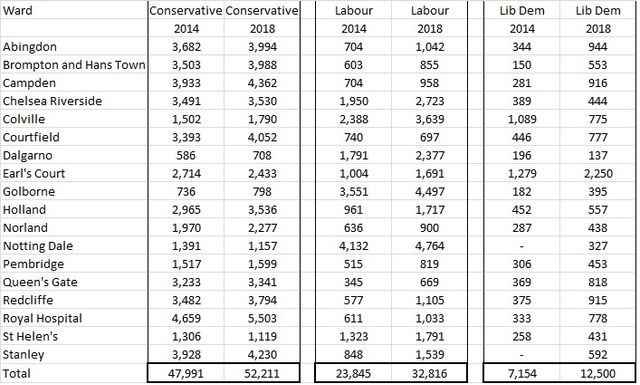
Kensington and Chelsea local council results
Overall the borough turnout increased from an average of 30 percent of voters in 2014 to around 40 percent. The Labour Party saw its vote go up by 27 percent—from 23,845 to 32,816 compared to just 8 percent for the Conservatives—from 47,991 to 52,211. If the popular vote was used to distribute seats it would have resulted in 27 Conservative councillors, 17 Labour and 6 Lib-Dems, but because of Britain’s first past the post system the result was 36 Conservatives, 13 Labour and one Lib-Dem.
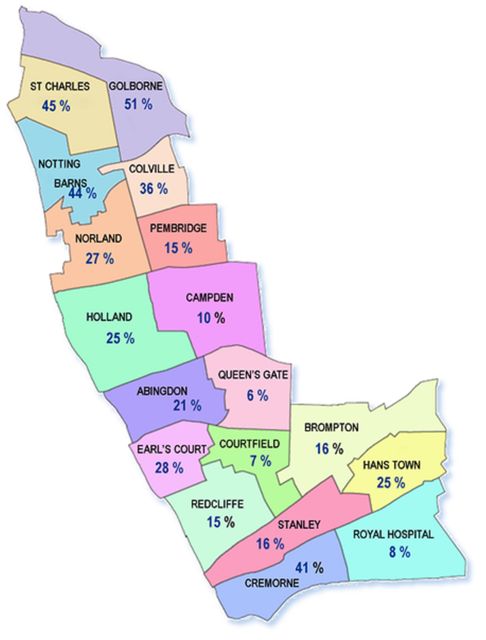
The split in the vote parallels the levels of social inequality expressed in the child poverty level per electoral ward. In Notting Dale, the ward with the highest poverty at 44 percent, Labour had its highest result, increasing from 4,132 votes to 4,764. In Queen’s Gate where poverty affects just 6 percent of the population, the Conservative vote barely changed (3,233 in 2014 and 3,346 in 2016.)
Kensington and Chelsea ward poverty map
Should the Tories have lost such key citadels of a super-rich clique, May’s already precarious existence as party leader would have been sealed. As it was, she claimed that “Labour thought they could take control, this was one of their top targets and they threw everything at it, but they failed.”
Quizzed as to why Labour had failed to make the gains predicted, Corbyn replied, “We have consolidated and built on the advances we made at last year’s General Election, when we won the largest increase in Labour’s share of the vote since 1945.
“In these elections we have won seats across England in places we have never held before. We won Plymouth from the Tories, who lost control of Trafford, their flagship northern council. And Labour has won even more council seats than at our high watermark of 2014.”
The Tories had “talked up our chances to unrealistic levels, especially in London.” However, Labour “came within a whisker of winning Wandsworth for the first time in over 40 years.”
In Trafford, one of only two metropolitan districts alongside Solihull under Conservative rule, Labour became the largest party.
In Newham, East London, Rokhsana Fiaz was easily elected mayor with 73 percent of the vote, 12 percent higher than her ousted predecessor, Blairite Sir Robin Wales, under whose 23-year leadership Newham Council had pioneered social cleansing policies, including seeking to disperse homeless families to social housing in other parts of the country. Homelessness in the borough currently stands at a national high of one in 25 people.
Elections analyst and Queen Mary University of London professor, Philip Cowley, said Labour’s results were the best for more than 30 years.
“In both Westminster and Wandsworth, Labour did better—in seats—than at any election since 1986. To have managed to so misjudge the politics of the election that this is presented as a bad result is quite spectacular.”
However, the theme of the night as results came in was that “peak-Corbyn” had been reached because Labour had not captured key London councils remaining under Tory rule. Typical was BBC Political Editor Laura Kuenssberg, whose mantra during the BBC’s night-long reporting was that Corbyn had failed.
Labour had “moved on slightly since the general election. But, in the words of [pollster] Sir John Curtice, Jeremy Corbyn’s party has come out of this more or less ‘empty-handed’, and they can’t show the kind of progress they would be shouting about if they were truly convinced they were on a rapid march to Number 10.”
The reality is that, to the extent Labour’s advances are in working class areas, then they are anathema to the party’s MPs—who measure political success by their ability to win acceptance from the financial oligarchy.
As an unnamed Labour shadow minister told the Sun, “Jeremy has not spent the 11 months since the General Election winning Middle England, and now never will.”
There is no doubt the result will unleash another campaign of slander and lies by the Blairites. An inkling of this was given by anti-Corbyn Labour MP Jess Phillips, who complained, “I see everyone is claiming failure as victory.”
One feature of the attack will be a renewed campaign alleging the party’s left wing to be anti-Semitic. Barry Rawlings, Labour Party leader in Barnet, which has a large Jewish community, laid the blame for the failure to capture the council directly on Corbyn’s failure to tackle anti-Semitism. Rawlings declared, “I want to speak directly to our Jewish brothers and sisters. I am extremely grateful to members of the Jewish community who cast votes for Labour. But too many didn’t.
“It wasn’t because they disagreed with our manifesto, but because they felt the Labour party has failed to deal with antisemitism on a national level. They are right,” he concluded.
Labour’s relative successes will, therefore, throw fuel on the fire of the one-sided civil war in the party, waged by the right with no serious opposition from Corbyn.