11 Jul 2018

The UK’s Brexit Shambles

Kenneth Surin 

Blighty this week has been frying in record warm temperatures. The army had to be called in to assist firefighters dealing with large moorland fires in the north of England.
Out of control fires are perhaps an apt metaphor for what is happening in UK politics.  Tory misgovernment gets worse with each passing day.
Tory handling of Brexit has been chaotic from the beginning, and is now beyond shambolic.
Ministers no longer leak surreptitiously against each other, since this has been superseded by denunciation and threats made brazenly in public by Tory Brexiteers and Remainers alike.  These two hate each other more than they do the opposition Labour party.
The EU has always been crystal-clear that Brexit means exactly that, namely, the UK’s exit will be a 100% departure from the EU.
The Tories, split among themselves, are either fine with this (the “hard” Brexiteers) and a range of ad hoc factions craving “more flexible” options tending towards  a “soft” or “softer” Brexit.
Theresa “the Maybot” May, a hack politician if ever there was one, is hopelessly out of her depth in dealing either with her own viciously divided party or the brutally uncompromising eurocrats in Brussels.
Where her own party is concerned, she tries to placate all sides, and of course ends up pleasing none.
It’s open season for the Tories when it comes to embarrassing the Maybot or undermining her in public.
In negotiating with the eurocrats who insist the UK’s exit will only be a 100% departure from the EU, the Maybot pleads for one that will be a 99%, or a 90%, or a 75%, or a 50%, or a 20% divorce, depending on which faction in her party seems to be in the ascendancy that week, or whichever fat cat CEO (it was the turn of Jaguar Land Rover and Airbus this week) issues a dire warning about the impact of Brexit on his company’s jobs and profit margins.
At the press conferences which follow her fraught and unproductive meetings with the eurocrats in Brussels, the brutes say time after time she is “delusional” for not accepting that Brexit can only be 100% and nothing else.
This hardline EU stance may however be an opening ploy to force the UK on to the back foot from the outset.
The eurocrats try to din into the Maybot’s head that the “soft” Brexit option has never existed, and that it is akin to a mirage tricking the exhausted and starving desert explorer of yore.
The brutal reality is that any post-Brexit modus vivendi between the EU27 and the UK will only come about with the agreement of both sides.
The UK has no power to force the EU27 to concede anything, a post-Brexit relationship with them cannot be brought about unilaterally by the Brits, and the future of Brexit is thus completely out of the UK’s hands.
The Tory cabinet held a “crunch” Brexit summit this weekend at Chequers, the prime minister’s official country residence.
May’s hope was that a Brexit façade can somehow be concocted which will be assented to by all cabinet members while being palatable to the EU27.
To guard against leaks, all participants at the Chequers summit had to surrender their cell phones on arrival.
What emerged at this meeting was a proposal for a version of the Norway-type arrangement with the EU27 (that is, an outside-the-EU linkage with the EU single market and the EU customs union).
In Norway’s case this entails the following:
No participation in EU decision-making, while having to abide by all the eurocracy’s decisions when dealing with the EU27.
Norway has incorporated nearly 75% of all EU law into its own legislation.
Norway has accepted the free movement of people, goods, services and capital between itself and the EU27.  The overwhelming majority of the UK’s Brexiteers are anti-immigration, but Norway has a higher per capita immigration than the UK.
Norway has had to accept the EU’s commercial standards, financial regulations, employment laws, and pay a substantial amount to the EU budget.
The UK will have to accept all the above, in line with the EU’s insistence that any post-Brexit arrangement with it must be predicated on the UK’s “regulatory alignment” with the EU27, all on the latter’s terms.
Blighty will thus be “independent” of Brussels while effectively being run from Brussels. In most areas to be negotiated under the Chequers proposal, the EU would be the “rule-maker”, Blighty the “rule-taker”.
The driver of the UK’s economy, for the worse rather than better, is its financial sector, and the EU will probably insist–  in the name of cyber security, money-laundering concerns (London is the world’s money-laundering capital), funding for “terrorist organizations”, tax-dodging, etc.– that all UK financial-sector transactions with the EU27 adhere to an EU regulatory framework.
The UK’s current options are snared in an inexorably simple trinary:  a complete divorce from the EU, Remain, or somehow this proposed modified Norway-type arrangement (which may still be rejected by Brussels).
The first two options are unpalatable to different wings of the Tory party.
Its Little Englander wing wants a complete divorce from the EU, motivated by the absurd and futile fantasy of regaining a lost imperial greatness, and, in a more sinister way, the fuller implementation of an even more vicious neoliberalism freed from “the bureaucratic red tape” and “big government” of the already neoliberal EU.
More than one Tory Brexiteer, with no apparent recollection of the Bhopal disaster, has lamented Blighty’s not having India’s health and safety standards.
May’s post-summit statement indicated that the UK will accept EU rules on commercial standards, including agricultural products after Brexit, in order to avoid “border friction”.  In other words: EU standards will prevail.
Protections in areas such as the environment, employment laws and consumer protection would not fall below current levels.  In other words: EU standards will prevail.
The Maybot arrangement proposes a looser arrangements for services, with the concession that this will involve less mutual access to post-Brexit EU markets.  In other words:  you win some, while losing some.
Where jurisdiction is concerned, decisions by UK courts will observe “due regard paid to EU case law in areas where the UK continued to apply a common rulebook”.  In other words: EU law will prevail.
A “combined customs territory” is proposed by the Maybot, allowing the UK to apply domestic tariffs and trade policies for goods entering the UK, and their EU tariffs equivalents for goods heading into the EU. In 2014, the proportion of all goods and services by the UK to the EU was 44% (55% for all of Europe).  In other words: a win for the EU27.
In a post-summit interview, May refused to rule out so-called “preferential access” for EU citizens after the UK leaves the EU.  In other words: if “preferential access” for EU citizens allows them almost unhindered entry into the UK, this will be a win for the EU27.
And all the above concessions involve no UK participation in EU decision-making.
There are a few other details not mentioned here, but for now the key terms of the Maybot’s proposal amount, in the eyes of all the UK media, to a “soft” Brexit.
So what are the hardline Tory Brexiteers hoping for next?
The Brexit hardliners may be hoping for two scenarios before attempting to take more conclusive steps: (1) the EU, holding all the cards, modifies May’s “soft” Brexit proposal in ways that require her total capitulation to the eurocrats, so the proposed deal falls apart, and in consequence the discredited May is easily deposed by the Brexit hardliners; and (2)  the Maybot proposal, once negotiated with the EU, is put to a vote in parliament (and gets defeated), or somehow a second public referendum is called, and the Leave verdict of the first referendum is confirmed (the hardliners will feast on this), or the Leave verdict of the first referendum is overturned (the Remainers will feast on this).
Who knows what will happen?
A clue as to what is likely to happen in the Tory party is supplied by the opinion of the right-wing and pro-Brexit Daily Telegraph:  “Theresa May won her battle with Eurosceptic ministers on Friday night as she announced the cabinet has signed up to a Brexit deal that keeps Britain tied to EU rules and regulations indefinitely”.
Given that such an arrangement has been repudiated by the Tory Brexiteers from the beginning, it would seem, therefore, that they have decided to save their ammo for a future battle against the Maybot’s version of the Norwegian option.
When a meda-shambles exists, a throw of the dice from all those involved is always the most likely outcome.  It happened at Chequers this weekend.
All Brexit bets are now off, because whatever the future is, it can last a very long time.
The next step is for the Chequers proposal to be turned into a White Paper which will be presented to parliament sometime next week. If approved, it will become the UK’s official negotiating position in talks with the EU.
The eurocrats will then have their say, and an early signal about their likely response has already been sent by them.  According to The Guardian:  “In Brussels… sources warned that May’s customs compromise looked very similar to the “new customs partnership” that the EU rejected as “magical thinking” 11 months ago”.
The same Guardianarticle also reported a response to the Chequers proposal from the business sector: “more than 100 entrepreneurs and founders of UK businesses dismissed it as unworkable….”
The UK foreign secretary, the sociopathic Boris “BoJo” Johnson, one of the leading Brexiteers, resigned after likening it to “polishing a turd”.   Also resigning was the woefully inept hardliner Brexit Secretary, David Davis, saying the Chequers plan was “unworkable”.
Labour has said it will vote against the Chequers plan in parliament, and if pro-Brexit Tory MPs vote with them in a “no confidence” parliamentary motion, May will almost certainly be toppled.
Next weekend Trump will arrive in the UK for a scaled-down “working visit”, after being invited by the ever-ingratiating Maybot for a full state visit.
He may not know which prime minister will be there to greet him.
The Orange Man will however be avoiding London, except for a night spent at the US embassy, because of the anticipated massive protests.
Demonstrators have promised to be outside banging pots and pans throughout the night.

Giant Killing, Heroes and Teams at the 2018 World Cup

Binoy Kampmark

They have been falling like ninepins at one of the most unpredictable World Cups in generations.  Even before the kick-off in the tournament, Italy’s absence was conspicuous.  By the time the first phase of matches had been concluded, Germany, whose teams have made it to the elimination phase for eighty years, found itself in exit mode, a victim of exhaustion, desperation and South Korean determination.  Die Welt deemed the performance an embarrassment of perfection, the team’s performance “harmless, unimaginative, listless”.
Spain, who won the 2010 World Cup, found its adventure prematurely aborted in the round-of-sixteen, falling to the inspired Russian team on penalties.  Portugal, in their defeat before the hard set Uruguayans, went the same way in that round.  (Christian Ronaldo was distinctly off the boil.)  Not enough credit, however, was given in shocked observations to the other side of the show, the performances of those giant killing teams which have added to the fogginess of any crystal ball.
One colossus did seem dangerously predictable in advancing.  Brazil threatened at points to overcome a furiously talented Belgian team, but failed to transform possession into goals.  The Belgians made their chances count and duly dispatched another giant from the competition.
A sense prevailed that Brazil were their own worst enemy.  This was not the team of jogo bonito, jaunty, ruthless representatives of the beautiful game.  Neymar was both talismanic and deficient, an asset rolled into a liability.  His drama strewn efforts, which involved diving and rolling as much as it involved natural ability, did not provide the ballast his team required.  Such attitude, it has been surmised, might have been born from past serious injuries, be it the broken back he sustained in 2014, and a broken foot in February this year.
“I can say,” wrote Neymar in an Instagram post, “that this is the saddest moment of my career, it is incredibly painful because we knew we could get there, we knew we had conditions to go further, to make history.”  It proved “hard to find the strength to play soccer again, but I’m sure God will give me strength enough to face anything”.
The shocks have been marked and frequent, with the ground left for exhilarating performances.  Giants Argentina did not vanquish Iceland, the match concluding with a goal a piece. In an absorbing match, it was that other footballer of genius Lionel Messi, who took the penalty after a collision between Sergio Agüro and Hördur Björgvin Magnússon.  He botched it, and Hannes Thór Halldórsson made the save.  Another team of minnows had done their country exhilaratingly proud.
Croatia, with its own smattering of talented players, subsequently rumbled Messi’s side with three answered goals, despite both sides going into the second half without having scored.  France, in a thrilling bout involving seven goals and the incessant efforts of the 19-year-old Kylian Mbappé, issued the coup de grace.
The host team Russia was a thrill with Croatia, also going down to penalties.  England, albeit with a soft line of the draw, found themselves in their first semi-final in major international competition since 1996.  An exorcism of sorts has been taking place with this team, with manager Gareth Southgate, waistcoat and all, becoming very much a figure of veneration in a nation bruised and battered by the trauma of Brexit negotiations.  Both dedicated Leavers and grieving Remainers have at last found something they can agree about.
As the BBC noted with a smattering of affection, this “affable man” had done what a host of experienced highly credentialed predecessors hadn’t.  Sven-Goran Eriksson, Fabio Capello, Steve McClaren and Roy Hodgson had failed “despite more than 80 [matches] between them.”  While the football nation has historical pedigree, and not short of its stellar complement, team efforts have tended to founder when it mattered most, notably during the psychological wear-and-tear of the penalty shootout. Southgate’s skill has been to temper expectations and the hysterical overconfidence that has accompanied previous World Cups.
The tournament has also thrown up a dilemma for managers: How best to incorporate the hero of the side, the glorious figure who shines in a team of lesser mortals who await for the powder to be lit, the flames to be stoked?  Teams studded with Neymar, Messi and Ronaldo may be Olympian on the field, but team value and effect is something else, material drawn from the machinery of collective spirit and mutual encouragement.
Truism as it is, teams, well functioning, telepathically linked and good of understanding, win matches.  Caesars deft of foot and brimming with talent are less significant, even if they are capable of landing killer blows.  “When you have somebody who can turn the game in a flash,” asks Kris Voakes, “do you select them at all costs regardless of their fitness in the hope that they supply that moment of genius?”  France, the sole giant and finalist in this competition, has no such dilemma, a team bristling with talent but compact in purpose.

The City of London and Grand Theft Ethiopia

Thomas C. Mountain

For decades now, going back to when Bob Geldoff handed over millions in cash to Meles Zenawi back during “We Are the World” circa 1983-4 supposedly for food aid for the victims of what was then the Great Ethiopian Famine, The City of London has been at the heart of Grand Theft Ethiopia, grand theft Africa really.
With out a place to stash your loot why steal in the first place? If you cant hide your dirty money where no one can take it from you why bother? And this is just what The City of London has been doing, laundering Billion$, some say Tens of Billion$, of stolen “aid” money for the late Ethiopian Gangster Government lead by Meles Zenawi. War, drought, famine followed by more war, drought and famine, The Horn of Africa maybe better called the Horn of Hunger and thanks to The City of London what was supposed to be used to feed the starving, house the homeless, nurture the sick and educate the illiterate was instead deposited in the financial cesspool calling itself a “City”, population seven thousand.
The City of London makes its own rules with some saying it was behind Brexit because it cannot survive if it must follow new EU banking regulations concerning money laundering and balance sheets. Cooking the Books is what its called and it is implanted in the DNA in the City of London.
Today Ethiopia is struggling to build a sustainable future free from debt bondage and beggary, and the Billion$ sitting in former Ethiopian leaders accounts in the City of London could go a long way towards turning the situation around.
The City of London is at the heart of international banksterism, and needs to be shut down and the ill gotten gains of crooks around the world returned to those they stole it from. The new Ethiopian peoples government has vowed to get Ethiopia’s money back and has promised a list of offenders and where they have stashed their loot. This could be the first step in helping expose how the City of London has been front and center when it comes to enabling Grand Theft Ethiopia.

Correcting The Record: What Is Really Happening In Nicaragua?

Kevin Zeese & Nils McCune

There is a great deal of false and inaccurate information about Nicaragua in the media. Even on the left, some have simply repeated the dubious claims of CNN and Nicaragua’s oligarchic media to support the removal of President Ortega. The narrative of nonviolent protesters versus anti-riot squads and pro-government paramilitaries has not been questioned by international media.
This article seeks to correct the record, describe what is happening in Nicaragua and why. As we write this, the coup seems to be failing, people have rallied for peace (as this massive march for peace held Saturday, July 7 showed) and the truth is coming out (e.g., the weapons cache discovered in a Catholic Church on July 9th). It is important to understand what is occurring because Nicaragua’s is an example of the types of violent coups the US and the wealthy use to put in place business dominated, neoliberal governments. If people understand these tactics, they will become less effective.
Sandinistas and followers of President Daniel Ortega wave their Sandinista flags in a march for peace, in Managua, Nicaragua, Saturday. From The Morning Sun.
Mixing up the Class Interests
In part, US pundits are getting their information from media outlets, such as Jaime Chamorro-Cardenal’s La Prensa, and the same oligarchical family’s Confidencial, that are the most active elements of the pro-coup media. Repeating and amplifying their narrative delegitimizes the Sandinista government and presents unconditional surrender by Daniel Ortega as the only acceptable option. These pundits provide cover for nefarious internal and external interests who have set their sights on controlling Central America’s poorest and yet resource-rich country.
The coup attempt brought the class divisions in Nicaragua into the open. Piero Coen, the richest man in Nicaragua, owner of all national Western Union operations and an agrochemical company, personally arrived on the first day of protests at the Polytechnical University in Managua, to encourage students to keep protesting, promising his continued support.
The traditional landed oligarchy of Nicaragua, politically led by the Chamorro family, publishes constant ultimatums to the government through its media outlets and finances the roadblocks that have paralyzed the country for the last eight weeks.
The Catholic Church, long allied with the oligarchs, has put its full weight behind creating and sustaining anti-government actions, including its universities, high schools, churches, bank accounts, vehicles, tweets, Sunday sermons, and a one-sided effort to mediate the National Dialogue. Bishops have made death threats against the President and his family, and a priest has been filmed supervising the torture of Sandinistas. Pope Francis has called for a peace dialogue, and even called Cardinal Leonaldo Brenes and Bishop Rolando Alvarez to a private meeting in the Vatican, setting off rumors that the Nicaraguan monseñores were being scolded for their obvious involvement in the conflict they are officially mediating.  The church remains one of the few pillars keeping the coup alive.
A common claim is Ortega has cozied up to the traditional oligarchy, but the opposite is true. This is the first government since Nicaraguan independence that does not include the oligarchy. Since the 1830s through the 1990s, all Nicaraguan governments– even during the Sandinista Revolution– included people from the elite “last names,” of Chamorro, Cardenal, Belli, Pellas, Lacayo, Montealegre, Gurdián. The government since 2007 does not, which is why these families are supporting the coup.
Ortega detractors claim his three-part dialogue including labor unions, capitalists, and the State is an alliance with big business. In fact, that process has yielded the highest growth rate in Central America and annual minimum wage increases 5-7% above inflation, improving workers’ living conditions and lifting people out of poverty. The anti-poverty Borgen project reports poverty fell by 30 percent between 2005 and 2014.
The FSLN-led government has put into place an economic model based on public investment and strengthening the safety net for the poor. The government invests in infrastructure, transit, maintains water and electricity within the public sector and moved privatized services. e.g., health care and primary education into the public sector. This has ensured a stable economic structure that favors the real economy over the speculative economy. The lion’s share of infrastructure in Nicaragua has been built in the last 11 years, something comparable to the New Deal-era in the US, including renewable electricity plants across the country.
What liberal and even leftists commentators overlook is that unlike the Lula government in Brazil, which reduced poverty through cash payouts to poor families, Nicaragua has redistributed productive capital in order to develop a self-sufficient popular economy. The FSLN model is better understood as an emphasis on the popular economy over the State or capitalist spheres.
While the private sector employs about 15% of Nicaraguan workers, the informal sector employs over 60%. The informal sector has benefitted from $400 million in public investments, much of it coming from the ALBA alliance funds to finance micro loans for small and medium-sized agricultural enterprises. Policies to facilitate credit, equipment, training, animals, seeds and subsidized fuel further support these enterprises. The small and medium producers of Nicaragua have led the country to produce 80-90% of its food and end its dependence on IMF loans.
As such, workers and peasants– many of whom are self-employed and who accessed productive capital through the Sandinista Revolution and ensuing struggles– represent an important political subject of the stable, postwar social development of the last decade, including the hundreds of thousands of peasant farmers who have received land title and the nearly one-quarter of the national territory that has been given collective title as territory of indigenous nations. The social movements of workers, peasants, and indigenous groups were the base of popular support that brought the FSLN back into power.
Land titling and assistance to small businesses have also emphasized equality for women, resulting in Nicaragua having the lowest level of gender inequality in Latin America and ranked 12 out of 145 countries in the world, just behind Germany.
Over time, the FSLN government has incorporated this massive self-employed sector, as well as maquiladora workers (i.e. textile workers in foreign-owned plants located in free trade zones created by previous neoliberal governments), into the health care and pension system, causing the financial commitments to grow which required a new formula to ensure fiscal stability. The proposed reforms to Social Security were the trigger for the private sector and student protests on April 18th. The business lobby called for the protests when Ortega proposed increasing employer contributions by 3.5% to pension and health funds, while only slightly increasing worker contributions by 0.75% and shifting 5% of pensioners’ cash transfer into their health care fund. The reform also ended a loophole which allowed high-income individuals to claim a low income in order to access health benefits.
This was a counter-proposal to the IMF proposal to raise the retirement age and more than double the number of weeks that workers would need to pay into the pension fund in order to access benefits. The fact the government felt strong enough to deny the IMF and business lobby’s austerity demands was a sign that the bargaining strength of private capital has declined, as Nicaragua’s impressive economic growth, a 38% increase in GDP from 2006-2017, has been led by small-scale producers and public spending. However, the opposition used manipulative Facebook ads presenting the reform as an austerity measure, plus fake news of a student death on April 18th, to generate protests across the country on April 19th. Immediately, the regime change machine lurched into motion.
The National Dialogue shows the class interests in conflict. The opposition’s Civic Alliance for Justice and Democracy has as its key figures: José Adan Aguirre, leader of the private business lobby; Maria Nelly Rivas, director of Cargill in Nicaragua and head of the US-Nicaragua Chamber of Commerce; the private university students of the April 19th Movement; Michael Healy, manager of a Colombian sugar corporation and head of the agribusiness lobby; Juan Sebastian Chamorro, who represents the oligarchy dressed as civil society; Carlos Tunnermann, 85-year-old ex-Sandinista minister and ex-chancellor of the National University; Azalea Solis, head of a US government-funded feminist organization; and Medardo Mairena, a “peasant leader” funded by the US government, who lived 17 years in Costa Rica before being deported in 2017 for human trafficking. Tunnermann, Solis and the April 19th students are all associated with the Movement for Renovation of Sandinismo (MRS), a tiny Sandinista offshoot party that nonetheless merits special attention.
In the 1980s, many of the Sandinista Front’s top-level cadre were, in fact, the children of some of the famous oligarchic families, such as the Cardenal brothers and part of the Chamorro family, in charge of the revolutionary government’s ministries of Culture and Education and its media, respectively. After FSLN’s election loss in 1990, the children of the oligarchy staged an exodus from the party. Along with them, some of the most notable intellectual, military and intelligence cadre left and formed, over time, the MRS. The new party renounced socialism, blamed all of the mistakes of the Revolution on Daniel Ortega and over time took over the sphere of non-governmental organizations (NGOs) in Nicaragua, including feminist, environmentalist, youth, media and human rights organizations.
Since 2007, the MRS has become increasingly close with the extreme right-wing of the US Republican Party. Since the outbreak of violence in April, many if not most of the sources cited by Western media (including, disturbingly, Amy Goodman’s Democracy Now!), come from this party, which has the support of less than 2% of the Nicaraguan electorate. This allows the oligarchs to couch their violent attempt to reinstall neoliberalism in a leftist-sounding discourse of former Sandinistas critical of the Ortega government.
It is a farce to claim that workers and peasants are behind the unrest. La Vía Campesina, the National Union of Farmers and Ranchers, the Association of Rural Workers, the National Workers’ Front, the indigenous Mayangna Nation and other movements and organizations have been unequivocal in their demands for an end to the violence and their support for the Ortega government. This unrest is a full-scale regime change operation carried out by media oligarchs, a network of NGOs funded by the US government, armed elements of elite landholding families and the Catholic Church, and has opened the window for drug cartels and organized crime to gain a foothold in Nicaragua.
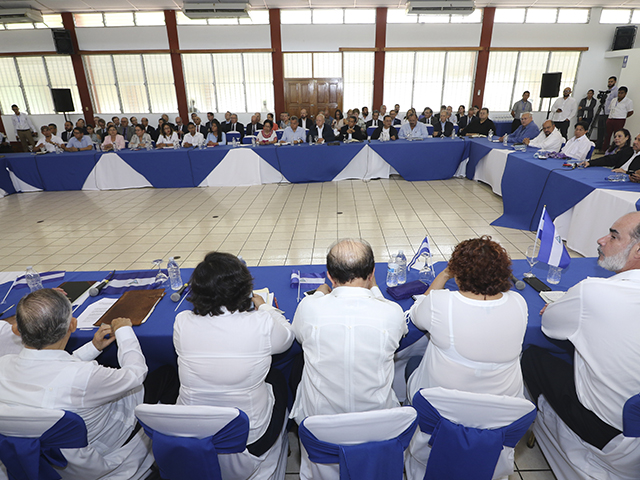
Nicargua meeting of the National Dialogue for Peace by Óscar Sánchez.
The Elephant in the Room
Which brings us to US government involvement in the violent coup.
As Tom Ricker reported early in this political crisis, several years ago the US government decided that rather than finance opposition political parties, which have lost enormous legitimacy in Nicaragua, it would finance the NGO civil society sector. National Endowment for Democracy (NED) gave more than $700,000 to build the opposition to the government in 2017, and has granted more than $4.4 million since 2014. The overarching purpose of this funding was to “provide a coordinated strategy and media voice for opposition groups in Nicaragua.” Ricker continues:
“The result of this consistent building and funding of opposition resources has been to create an echo chamber that is amplified by commentators in the international media – most of whom have no presence in Nicaragua and rely on these secondary sources.”
NED founding father, Allen Weinstein, described NED as the overt CIA saying, “A lot of what we do today was done covertly 25 years ago by the CIA.” In Nicaragua, rather than the traditional right-wing, NED funds the MRS-affiliated organizations which pose left-sounding critiques of the Sandinista government. The regime change activists use Sandinista slogans, songs, and symbols even as they burn historic monuments, paint over the red-and-black markers of fallen martyrs, and physically attack members of the Sandinista party.
Of the opposition groups in the National Dialogue, the feminist organization of Azalea Solis and the peasant organization of Medardo Mairena are financed through NED grants, while the April 19th students stay in hotels and make trips paid for by Freedom House, another regime change organ funded by NED and USAID. NED also finances Confidential, the Chamorro media organization. Grants from NED finance the Institute of Strategic Studies and Public Policy (IEEPP), whose Executive Director, Felix Maradiaga, is another MRS cadre very close to the US Embassy. In June, Maradiaga was accused of leading a criminal network called Viper which, from the occupied UPOLI campus, organized carjackings, arsons and murders in order to create chaos and panic during the months of April and May.
Maradiaga grew up in the United States and became a fellow of the Aspen Leadership Institute, before studying public policy at Harvard. He was a secretary in the Ministry of Defense for the last liberal president, Enrique Bolaños. He is a Young Global Leader at the World Economic Forum and in 2015, the Chicago Council on Global Affairs gave him the Gus Hart Fellowship, past recipients of which include Cuban dissident Yoani Sánchez and Henrique Capriles Radonski, the Venezuelan opposition leader who attacked the Cuban embassy during the coup attempt of 2002.
Remarkably, Maradiaga is not the only leader of the coup attempt who is part of the Aspen World Leadership Network. Maria Nelly Rivas, director in Nicaragua of US corporate giant Cargill, is one of the main spokespersons for the opposition Civic Alliance. Rivas, who currently also heads the US-Nicaragua Chamber of Commerce, is being groomed as a possible presidential candidate in the next elections. Beneath these US-groomed leaders, there is a network of over 2,000 young people who have received training with NED funds on topics such as social media skills for democracy defense. This battalion of social media warriors was able to immediately shape and control public opinion in Facebook in the five days from April 18th to 22nd, leading to spontaneous violent protests across the country.
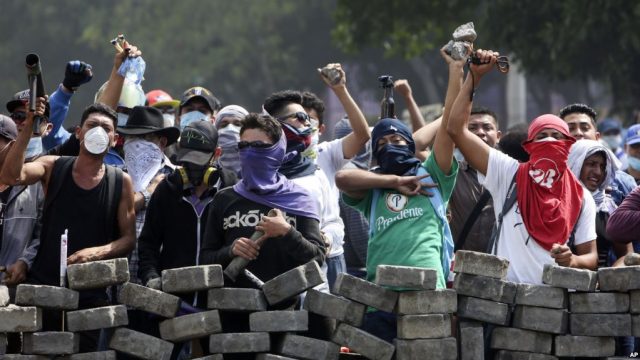
Protesters yell from behind the roadblock they erected as they face off with security forces near the University Politecnica de Nicaragua in Managua, Nicaragua, April 21, 2018. Source: Voice of America
On the Violence
One of the ways in which reporting on Nicaragua has ventured farthest from the truth is calling the opposition “nonviolent.” The violence script, modeled on the 2014 and 2017 guarimba protests in Venezuela, is to organize armed attacks on government buildings, entice the police to send in anti-riot squads, engage in filmed confrontations and publish edited footage online claiming that the government is being violent against nonviolent protesters.
Over 60 government buildings have been burned down, schools, hospitals, health centers attacked, 55 ambulances damaged, at least $112 million in infrastructure damage, small businesses have been closed, and 200,000 jobs lost causing devastating economic impact during the protests. Violence has included, in addition to thousands of injuries, 15 students and 16 police officers killed, as well as over 200 Sandinistas kidnapped, many of them publicly tortured. Violent opposition atrocities were misreported as government repression. While it is important to defend the right of the public to protest, regardless of its political opinions, it is disingenuous to ignore that the opposition’s strategy requires and feeds upon violence and deaths.
National and international news claim deaths and injuries due to “repression” without explaining the context. The Molotov cocktails, mortar-launchers, pistols, and assault rifles used by opposition groups are ignored by the media, and when Sandinista sympathizers, police or passers-by are killed, they are falsely counted as victims of state repression. Explosive opposition claims like massacres of children and murders of women have been shown to be false, and the cases of torture, disappearances and extrajudicial executions by police forces have not been corroborated by evidence or due process.
While there is evidence to support the opposition claim of sniper fire killing protesters, there is no logical explanation for the State using snipers to add to the death toll, and counter-protesters have also been victims of sniper fire, suggesting a “third party” provocateur role in the destabilizing violence. When an entire Sandinista family was burned to death in Managua, the opposition media all cited a witness who claimed that the police had set fire to the home, despite the house being in a neighborhood barricaded off from police access.
The National Police of Nicaragua has been long-recognized for its model of community policing (in contrast to militarized police in most Central American countries), its relative lack of corruption, and its mostly female top brass. The coup strategy has sought to destroy public trust in the police through the egregious use of fake news, such as the many false claims of assassinations, beatings, torture, and disappearances in the week from April 17th to 23rd. Several young people whose photos were carried in opposition rallies as victims of police violence have turned out to be alive and well.
The police have been wholly inadequate and underprepared for armed confrontations. Attacks on several public buildings on the same night and the first major arson attacks led government workers to hold vigils with barrels of water and, often, sticks and stones, to fend off attackers. The opposition, frustrated at not achieving more police conflicts, began to build roadblocks across the country and burning the homes of Sandinistas, even shooting and burning Sandinista families in atrocious hate crimes. In contrast to La Prensa’s version of events, Nicaraguans have felt the distinct lack of police presence, and the loss of safety in their neighborhoods, while many were targeted by violence.
Since May, the strategy of the opposition has been to build armed roadblocks across the country, closing off transport and trapping people. The roadblocks, usually built with large paving stones, are manned by between 5 and 100 armed men with bandannas or masks. While the media reports on idealistic young people running roadblocks, the vast majority of roadblocks are maintained by paid men who come from a background of petty crime. Where large areas of cities and towns are blocked off from government and police forces, drug-related activities intensify, and drug gangs now control many of the roadblocks and pay the salaries.
These roadblocks have been the centers of violence, workers who need to pass through roadblocks are often robbed, punched, insulted, and, if suspected of being Sandinistas, tied up, stripped naked, tortured, painted in blue-and-white, and sometimes killed. There are three cases of people dying in ambulances unable to pass roadblocks, and one case of a 10-year-old girl being kidnapped and raped at the roadblock in Las Maderas. When organized neighbors or the police clear roadblocks, the armed groups run away and regroup to burn buildings, kidnap or injure people in revenge. All of the victims that this violence produces are counted by the mainstream media as victims of repression, a total falsehood.
The Nicaraguan government has confronted this situation by largely keeping police off the streets, to prevent encounters and accusations of repression. At the same time, rather than simply arrest violent protestors, which certainly would have given the opposition the battle deaths it craves, the government called for a National Dialogue, mediated by the Catholic Church, in which the opposition can bring forward any proposal for human rights and political reform. The government created a parliamentary Truth and Peace Commission and launched an independent Public Ministry query.
With the police out of the streets, opposition violence intensified throughout May and June. As a result, a process of neighborhood self-defense developed. Families who have been displaced, young people who have been beaten, robbed or tortured, and veterans of the 1979 insurrection and/or the Contra War, hold vigil round the Sandinista Front headquarters in each town. In many places, they built barricades against opposition attacks and have been falsely labeled paramilitary forces in the media. In the towns that do not have such community-organized barricades, the human toll from opposition violence is much greater. The National Union of Nicaraguan Students has been particularly targeted by opposition violence. A student delegate of the National Dialogue, Leonel Morales, was kidnapped, shot in the abdomen and thrown into a ditch to die in June, to sabotage the dialogue and punish him for challenging the April 19th students’ right to speak on behalf of all Nicaraguan students.
There have been four major opposition rallies since April, directed toward mobilizing the upper-middle class Nicaraguans who live in the suburbs between Managua and Masaya. These rallies featured a whos-who of high society, including beauty queens, business owners, and oligarchs, as well as university students of the April 19th Movement, the moral high-ground for the opposition.
Three months into the conflict, none of the mortal victims have been bourgeois. All have come from the popular classes of Nicaragua. Despite claims of total repression, the bourgeois feels perfectly safe to participate in public protests by day — although the last daytime rally ended in a chaotic attack by protesters against squatters on a property of, curiously enough, Piero Coen, Nicaragua’s richest man. The nighttime armed attacks have generally been carried out by people who come from poor neighborhoods, many of whom are paid two to four times the minimum daily wage for each night of destruction.
Unfortunately, most Nicaraguan human rights organizations are funded by NED and controlled by the Movement for Sandinista Renovation. These organizations have accused the Nicaraguan government of dictatorship and genocide throughout Ortega’s presidency. International human rights organizations, including Amnesty International, have been criticized for their one-sided reports, which include none of the information provided by the government or individuals who identify as Sandinistas.
The government invited the Inter-American Commission on Human Rights (IACHR) of the OAS, a Washington-based entity notoriously unfriendly to leftist governments, to investigate the violent events of April and determine whether repression had occurred. The night of a controversial skirmish in the highway outside the Agrarian University in Managua ended a negotiated 48-hour truce, IACHR Director Paulo Abrao visited the site to declare his support for the opposition. The IACHR ignored the opposition’s widespread violence and only reported on the defensive violence of the government. Not only was it categorically rejected by Nicaraguan chancellor Denis Moncada as an “insult to the dignity of the Nicaraguan people,” a resolution approving the IACHR report was supported by only ten out of 34 countries.
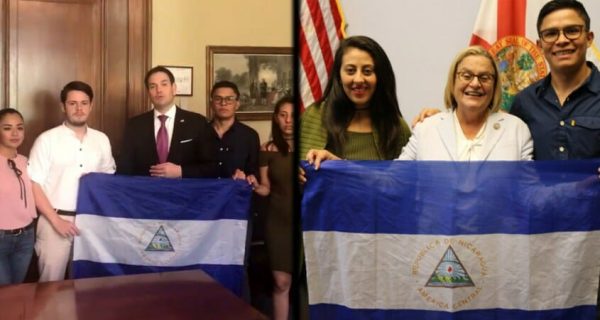
Meanwhile, the April 19th Movement, made up of current or former university students in favor of regime change, sent a delegation to Washington and managed to alienate much of Nicaraguan society by grinning into the camera with far-right interventionist members of the US Congress, including Rep. Ileana Ros Lehtinen, Sen. Marco Rubio and Sen. Ted Cruz. M19 leaders also cheered Vice-President Mike Pence’s bellicose warnings that Nicaragua is on the short list of countries that will soon know the Trump Administration’s meaning of freedom, and met with the ARENA party of El Salvador, known for its links to the death squads that murdered liberation theologist Archbishop Oscar Romero. Within Nicaragua, the critical mass of students stopped demonstrating weeks ago, the large civic protests of April and May have dwindled, and the same-old familiar faces of Nicaraguan right-wing politics are left holding the bill for massive material damage and loss of life.
Nicaraguan students meet with right-wing Republicans, Sen. Marco Rubio and Rep. Ileana Ros Lehtinen  in Washington, DC. Source Twitter Truthdig.
Why Nicaragua?
Ortega won his third term in 2016 with 72.4 percent of the vote with 66 percent turnout, very high compared to US elections. Not only has Nicaragua put in place an economy that treats the poor as producers, with remarkable results raising their standard of living in 10 years, but it also has a government that consistently rejects US imperialism, allying with Cuba, Venezuela, and Palestine, and voices support for Puerto Rican independence and a peaceful solution to Korean crisis. Nicaragua is a member of member of Bolivarian Alliance of the Americas and the Community of Latin American and Caribbean States, a Latin American alternative to the OAS, neither include the US or Canada. It has also allied with China for a proposed canal project and Russia for security cooperation. For all of these reasons, the US wants to install a US-friendly Nicaraguan government.
More important is the example Nicaragua has set for a successful social and economic model outside the US sphere of domination. Generating over 75% of its energy from renewable sources, Nicaragua was the only country with the moral authority to oppose the Paris Climate Agreement as being too weak  (it later joined the treaty one day after Trump pulled the US out, stating “we opposed the Paris agreement out of responsibility, the US opposes it out of irresponsibility”). The FMLN government of El Salvador, while less politically dominant than the Sandinista Front, has taken the example of good governance from Nicaragua, recently prohibiting mining and the privatization of water. Even Honduras, the eternal bastion of US power in Central America, showed signs of a leftward shift until the US-supported military coup in 2009. Since then, there has been massive repression of social activists, a clearly stolen 2017 election, and Honduras has permitted the expansion of US military bases near the Nicaraguan border.
In 2017, the US House of Representatives unanimously passed the Nicaraguan Investment Conditionality Act (NICA Act), which if passed by the Senate will force the US government to veto loans from international institutions to the Nicaraguan government. This US imperialism will cripple Nicaragua’s ability to build roads, update hospitals, construct renewable energy plants, and transition from extensive livestock raising to integrated animal-forestry systems, among other consequences. It may also signify the end of many popular social programs, such as subsidized electricity, stable bus fares, and free medical treatment of chronic diseases.
The US Executive Branch has used the Global Magnitsky Act to target the finances of leaders of the Electoral Supreme Court, the National Police, the city government of Managua and the ALBA corporation in Nicaragua. Police officers and public health bureaucrats have been told their US visas have been revoked. The point, of course, is not whether these officials have or have not committed acts that merit their reprimand in Nicaragua, but whether the US government should have the jurisdiction to intimidate and corner public officials of Nicaragua.
While the sadistic violence continues, the strategy of the coup-mongers to force out the government has failed. The resolution of the political crisis will come through elections, and the FSLN is likely to win those elections, barring a dramatic and unlikely new offensive by the right-wing opposition.
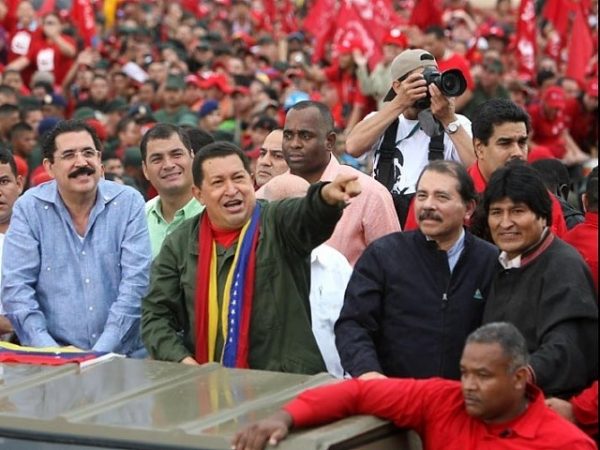
Latin American Presidents Zelaya (Honduras), Correa (Ecuador), Chavez (Venezuela), Ortega (Nicaragua), and Morales (Bolivia) celebrate Correa’s inauguration for a second term, in Quito, Ecuador. (Prensa Presidencial)
An Upside Down Class War
It is important to understand the nature of US and oligarch coups in this era and the role of media and NGO deception because it is repeated in multiple Latin American and other countries. We can expect a similar attack on recently elected Andrés Manuel López Obrador in Mexico if he seeks the changes he has promised.
The US has sought to dominate Nicaragua since the mid-1800s. The wealthy in Nicaragua have sought the return of US-allied governance since the Sandinistas rose to power. This failing coup does not mean the end of their efforts or the end of corporate media misinformation. Knowing what is really occurring and sharing that information is the antidote to defeating them in Nicaragua and around the world.
Nicaragua is a class war turned upside down. The government has raised the living standards of the impoverished majority through wealth redistribution. Oligarchs and the United States, unable to install neoliberalism through elections, created a political crisis, highlighted by false media coverage to force Ortega to resign. The coup is failing, the truth is coming out, and should not be forgotten.

More inconsistencies in account of second UK novichok poisoning

Thomas Scripps 

Yesterday evening in the UK saw the release of reports from Salisbury District Hospital that, “We have seen a small but significant improvement in the condition of Charlie Rowley. He is in a critical but stable condition, and is now conscious.”
Rowley is the second victim of a reported poisoning by a “novichok” nerve agent. His partner, Dawn Sturgess, died Sunday.
Events since the two reportedly came into contact with a nerve agent on June 29 have piled questions on top of questions.
Metropolitan police assistant commissioner Neil Basu claimed on Monday that Sturgess and Rowley received a high dose of novichok as a result of handling a container of some sort holding the nerve agent. The pair’s “reaction is so severe it resulted in Dawn’s death and Charlie being critically ill. This means they must have got a high dose.”
Rowley’s house in Amesbury, Sturgess’ Salisbury homeless hostel and the nearby Queen Elizabeth Gardens—along with several other sites—have been cordoned off and are being searched by around 100 police officers for the container, which has still not been identified in the 11 days since June 30, when they became ill and were hospitalised.
Twenty-one individuals—including police officers, hospital staff and members of the public—have been medically assessed over fears of exposure to the poison. All have been discharged.
Each development only adds to the opaque and contradictory descriptions of “novichok” first given during the Skripal affair. Dr. Mirzayanov, who claims to have worked on production of the nerve agent, states that it would have decomposed in the four months since the Salisbury events, raising doubts that it relates to Sturgess’ death. Leonid Rink, another claimed creator, agrees that the substance would have disintegrated.
But another scientist who also claims to have worked on novichok, Vladimir Uglev, now describes the substance as “very stable”, saying “it won’t decompose.”
“The substance can absorb itself into any soft surface, whether trees, leather or park benches. From there it can be absorbed onto people’s skin with all the consequences,” he stated.
The Office for the Prevention of Chemical Weapons (OPCW) report into the Skripal case raised serious questions as to whether a novichok weapon of the kind that has been described even exists.
Given these conflicting statements, by individuals whose motivations are themselves unclear, how a novichok nerve agent is alleged to have come into contact with Rowley and Sturgess, if such a substance was ever even present, is open to serious question.
If novichok is capable of lingering and being absorbed into various surfaces and was found in greatest concentration on the pairs’ hands, then one must ask how it did not end up more widely spread. As far as is known, none of the friends who were with Rowley and Sturgess at various points have even been screened for contamination or symptoms. Ben Milsom, whose van Rowley travelled in a few hours before he was taken to hospital, has even been told to hang on to items cleared from the van before it was sold and later quarantined. “I’ve told the police and the health authority about it but they have just told me not to touch it and leave it there”, he told The Sun .
Other questions raised include: What item is supposed to have contaminated Rowley and Sturgess? Where was it stored to enable such a high concentration of nerve agent, and how did it come to be there?
The Ministry of Defence Porton Down chemical weapons research centre lies midway between Salisbury and Amesbury and is just as capable of producing novichok as it is of analysing it.
No official consideration is being given to this. Instead, the main presentation is that the discarded agent was picked up and shared between Sturgess and Rowley somewhere in the Queen Elizabeth Gardens. This would have been in the afternoon of Friday 29 June, the day before they fell seriously ill.
The theory advanced by the government, now more stridently by Defence Secretary Gavin Williamson, is that “Russia has committed an attack on British soil which has seen the death of a British citizen.”
The specifics of the accusation, therefore, must include the assumption that, following or prior to an attempt on the Skripals’ lives, the assassins left dangerous and potentially incriminating evidence in a nearby public place. Whatever this item was, moreover, it was capable of applying a “high dose” of poison to Sturgess and Rowley, considerably more effectively than by supposedly smearing it on a doorknob during the intended assassination of Sergei and Yulia Skripal.
None of these hypotheses appear credible. Indeed, the basis of this explanation was undermined by the admission of Home Secretary Sajid Javid that the sample of the substance taken from Sturgess’ blood was not enough to confirm whether it came from the same batch as the substance alleged to have poisoned the Skripals. This leaves the “discarded container” of highly concentrated agent thesis, which must have been on their hands as well as in their blood, without any substantial justification.
The seizure and quarantining of a car in Swindon, some 40 miles away from Amesbury, opens a new unexplained chapter. The two vehicles quarantined in connection with this case prior to the car were the bus in which Sturgess and Rowley traveled from Salisbury to Amesbury and the van in which Rowley traveled around town the next day. What the pair’s connection with the car might be has not been revealed. If there is no such connection, then that would suggest another party to the events of last week whose involvement has not been disclosed.
Also unexplained by the government or police, hospitals across a number of counties in southern England were briefed on how to deal with nerve agent poisoning a few days before Sturgess’ death. According to the Daily Mirror, “The dossier circulated was written five days after mother-of-three Dawn, 44, and partner Charlie Rowley were contaminated” and reports a fear that more “novichok cases” may occur.
This is at odds with the “low risk to the public” message which has been put out to Amesbury and Salisbury residents. It suggests that an even wider section of the population is considered potentially at risk. Such a situation would hardly fit with accusations of a Russian operation against a specific individual. What events really prompted this advice to be distributed?
A coroner’s report on Sturgess’ death is currently being written up. Former British ambassador Craig Murray has raised a serious matter that has to be addressed if there is any hope of uncovering the truth of the events. He writes in his latest blog post, “I trust that Dawn Sturgess will get a proper and full public inquest in accordance with normal legal process, something which was denied to David Kelly. I suspect that is something the government will seek to delay as long as possible, even indefinitely.”
Dr. Kelly worked at Porton Down, and his suspicious death on July 17, 2003, officially by suicide, followed criticisms he made of the “dodgy dossier” used to justify pre-emptive war against Iraq. In 2010 it was revealed that the government had sealed medical records relating to his death for 70 years.

A striking feature of the latest chapter of the novichok saga is how restrained in their commentary newspapers such as the New York Times and the Guardian have been, compared with their blaring accusations against Moscow following the poisoning of the Skripals. This does not suggest a retreat from their anti-Russian stance, but rather a recognition that the British authorities have yet to get their story straight.