28 Nov 2018

Australian prime minister denounces students’ climate-change protests

Oscar Grenfell 

Australia’s Liberal-National Prime Minister Scott Morrison issued an extraordinary denunciation of high school students protesting over climate change from the floor of the federal parliament on Monday.
Morrison’s comments were in the lead-up to a national series of high school “walk-outs for climate action” this Friday, including in Sydney, Melbourne and other capital cities. Protests have already been held involving students in regional and rural areas over the past weeks. The actions have been shared and promoted by thousands of young people on Facebook.
Morrison contemptuously declared, during question time in the House of Representatives, that “kids should go to school.” He stated, “We do not support our schools being turned into parliaments… What we want is more learning in schools and less activism in schools.”
The clear message was the young people should keep quiet and that measures should be taken to discourage students from engaging in political action, and to punish those who do.
Morrison’s comments demonstrated that the Coalition government and the entire ruling establishment are intensely fearful of the entrance of students and youth into political struggle. They are well aware that there is widespread anger among young people over environmental destruction, endless wars, soaring social inequality and a turn to authoritarian and anti-democratic forms of rule.
Every opinion poll of young people has demonstrated growing hostility to Labor, the Liberal-Nationals and the entire political set-up. There is also mounting opposition to capitalism, and an attraction to a socialist alternative.
A report by the Centre for Independent Studies (CIS), a right-wing think tank, worriedly noted in June that the overwhelming majority of Australian young people have indicated that they favour socialism over capitalism.
The parliamentary parties know that their agenda of tax cuts for the wealthy, the destruction of public healthcare and education, an offensive against jobs, wages and conditions, and the ever-closer alignment of Australia with the US-led preparations for war with China, will produce mass opposition.
Amid a slowdown of the property market, acute social inequality and mounting poverty, the ruling class is sitting atop a social powder-keg. Throughout the 20th century, and the first two decades of the new millennium, social movements among students and young people have always presaged mass struggles by the working class.
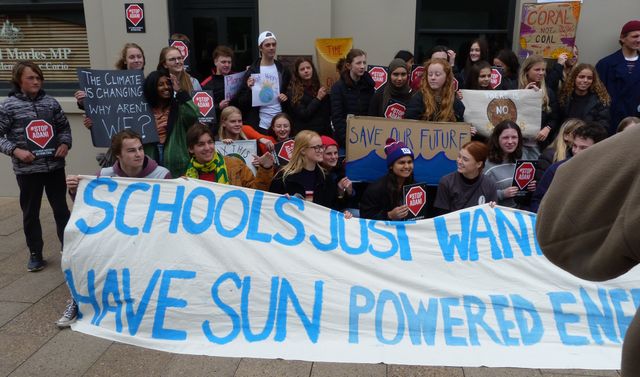
Students at the walk-out in Geelong last Friday
While they have been small thus far, the character of the high school climate protests has no doubt caused concern within ruling circles. They have been organised independently of the official political parties, including Labor and the Greens, as well as the unions, and inspired by similar protests by students in Scandinavia and throughout Europe.
The movement has largely been built through social media, amid an ongoing discussion in ruling circles in Australia, and internationally, on the need to crack down on the dissemination of political information online and the use of the internet to organise the struggles of workers and young people.
The issue of climate change, moreover, points to the urgent necessity for the reorganisation of the world economy in the interests of social need, not private profit.
A report released this week by the US Global Change Research Program found that the impact of climate change is “already being felt” and that it is “expected to further disrupt many areas of life, exacerbating existing challenges to prosperity posed by aging and deteriorating infrastructure, stressed ecosystems, and economic inequality.”
The Coalition government is particularly sensitive to growing concern over the environment. It is dominated by “climate change skeptics” who deny the global consensus of scientists that anthropogenic climate change is a reality, in large part because of the Coalition’s close ties to the coal industry.
While the federal government has responded to the high school protests with unbridled hostility, Labor, the Greens and environmental groups aligned with them are seeking to kill the incipient movement with kindness.
On Tuesday, Labor and the Greens joined to pass a motion through the Senate “commending” the protests. Their aim is to channel the demonstrations behind the official parliamentary establishment, which has always been the graveyard of social movements.
Labor and the Greens’ posturing on climate change is utterly hypocritical and bogus. Both are parties of the corporate and financial elite, hostile to any measures that would impact on the profitability of big business.
The Greens-backed federal Labor government of Julia Gillard did nothing to stem carbon emissions, when it was in office from 2010–2013. Under its signature carbon tax policy, Australia’s carbon emissions actually increased. According to Labor’s own 2012 modelling, if the tax had remained in place from 2012 to 2020, annual national carbon emissions would have grown from 582 million tonnes to 621 million tonnes by 2020.
Emissions trading schemes, touted by the Greens, are no less worthless. Where they have been introduced in Europe and elsewhere, they have succeeded only in establishing lucrative opportunities for “green businesses” and creating new markets based on financial swindling and speculation.
The claims of the Greens that they represent an alternative to Labor and the Liberal-Nationals lie in tatters. Wherever they have had the opportunity, at the state or federal level, they have joined big business coalition governments, committed to slashing social spending, driving up corporate profits and making the working class pay for the deepening crisis of the capitalist system.
This makes clear that the high school climate change walk-outs can only go forward on the basis of implacable hostility to Labor, the Greens and the entire political establishment.
What is required is a new political perspective, oriented towards the mobilisation of the international working class, the revolutionary social force that produces all wealth, and whose objective interests are opposed to the dominance of society by a tiny corporate elite, and the irrational division of the globe into competing capitalist nation-states.
Climate change is a product of the private market and is an inherently global issue. It can only be resolved through the abolition of capitalism, and the socialist reorganisation of society by the working class.
Under socialism, the vast productive forces and technological capacities developed by the working class would be harnessed to resolve all social problems, including climate change. Trillions of dollars would be allocated to ensuring the rapid reductions in carbon emissions required to halt climate change. The technologies for carrying this out, which already exist, would be developed on the basis of the collaboration of scientists from all over the world. The subordination of scientific work and research to the profit demands of the corporate oligarchy would be ended.

Australian government announces early budget

Mike Head

After his Liberal-National Coalition suffered a heavy defeat in last Saturday’s election in the state of Victoria, Prime Minister Scott Morrison yesterday brought forward the planned date for the 2019 federal budget by a month to April 2.
This is a desperate bid by Morrison to hold onto office until May, the latest possible date for the next election, as his Liberal-National Coalition government tears itself apart in a factional civil war.
Following the Victorian electoral debacle, the Coalition’s most right-wing elements are intensifying their push to transform it into a Trump-style, far-right movement. They are provoking a deepening rift with the self-titled “fiscally conservative, socially progressive” supporters of ex-Prime Minister Malcolm Turnbull, who was ousted by the right wing in an inner-party coup on August 24.
During the weekend, two prominent right-wing figures made public a potential split. Former military general Senator Jim Molan pulled out of a television appearance, declaring he could not “bring myself to defend” the Liberal Party after being relegated to an unwinnable position on its Senate ticket for the next election. Lower house MP, Craig Kelly, who backed Turnbull’s removal, threatened to stand as an independent if he were defeated in a Liberal Party pre-selection ballot.
Former Prime Minister Tony Abbott publicly aligned himself with Molan, saying he was “nauseated” by the Liberal Party’s treatment of the ex-general. Another Abbott supporter said Moylan’s demotion was “suicidal” for the Coalition.
The schisms are widening. Supporters of Home Affairs Minister Peter Dutton, who triggered Turnbull’s ouster before losing the subsequent party leadership ballot to Morrison, are openly agitating against the “progressives,” some of whom publicly blamed the knifing of Turnbull for the Victorian election debacle.
Even as Morrison announced the early budget, a Turnbull supporter, Julie Banks, told parliament she would sit as an independent for the rest of the parliamentary term. “The Liberal Party has changed, largely due to the actions of the reactionary and regressive right wing,” she stated.
Banks said she would support the government on votes of no-confidence and financial supply, but Morrison’s government now holds just 72 of the 150 votes in the House of Representatives, with Speaker Tony Smith, a Coalition member, making that 73 in the event of a tied vote.
The government lost its majority last month when a pro-Turnbull independent won a by-election for Turnbull’s former Sydney electorate. Its loss of control over parliament was illustrated on Monday when it voted for a resolution to establish an anti-corruption body rather than be defeated on the floor of the lower house.
The public feuding has reached the Coalition’s highest echelons. Cabinet Minister Kelly O’Dwyer told colleagues on Monday the Liberals are regarded as “homophobic, anti-women, climate-change deniers” thanks to the “ideological warriors” who hijacked the party’s positions on social issues. Former Foreign Minister Julie Bishop, who quit that post when Turnbull was axed, demanded that the government strike a deal with the Labor Party to revive the Turnbull government’s proposed National Energy Guarantee, which business leaders are backing in order to provide incentives for investors in renewable energy projects.
Labor, which has 69 MPs, could bring the government down if it gained the support of seven of the eight so-called “crossbench” MPs. They now number four independents, a dissident member of the National Party, one from the Greens, one from Bob Katter’s protectionist, anti-immigrant party and one from the pro-business Centre Alliance.
Labor, however, is intent on holding the government together, rather than take office amid widespread public discontent. In fact, it is working closely with the Coalition in a bipartisan partnership to ram four far-reaching pieces of anti-democratic legislation through parliament in the last brief two-week parliamentary session for 2018.
Significantly, these laws will allow the government to call out the military to put down domestic unrest, crack open encryption codes, fast-track a new “foreign interference” register and strip citizenship from anyone convicted of even a minor terrorism-related offence.
These bills are part of a barrage of measures in preparation to suppress mounting public hostility to the entire political establishment under deteriorating social conditions and the growing danger of frontline Australian involvement in a catastrophic US war against China or Russia.
Because of the chaos and division in the government, elements within the corporate ruling class are moving to back a Labor-led government to stabilise capitalist rule and impose deeper cuts to social spending and living standards.
Monday’s Australian Financial Review editorial warned: “The parties of the Coalition may be on the verge of being pulled apart by the increasing polarisation of Australian politics.” The Liberal Party was “dissolving into a group of warring ideological sects and ambition-driven factions.”
Tuesday’s editorial in the Australian denounced the government’s “disunity and self-obsession” and noted that Labor’s policies had the advantage of “clarity.” This reflects the views of the newspaper’s proprietor, Rupert Murdoch, who called for Turnbull’s removal, regardless of whether it meant Labor regaining office.
Two inter-connected driving forces are breaking apart the Coalition and the parliamentary order itself. One is the Trump administration’s aggressive trade war and military confrontation with China—Australian capitalism’s largest export market. Combined with a gathering downturn in Australia’s highly-inflated housing market, this could trigger a sharp economic reversal.
An economic collapse could fuel an explosive movement in the working class against years of falling real wages, destruction of permanent jobs, cuts to social programs and deteriorating public infrastructure. The elements around Abbott, Dutton and Molan are seeking to either refashion the Coalition, or form a new far-right movement, based in reactionary nationalism and anti-immigrant xenophobia, backed by repressive police-state powers, to be directed against the working class.
Morrison claimed his government would produce a “surplus” budget next April, for the first time since the 2008 global financial breakdown, but would not say which year would be in surplus. Deloitte Access Economics forecasts a $5 billion deficit for 2018-19. But all these calculations are premised on a continuation of an uptick in export commodity prices, which could reverse rapidly if the US-China conflict intensifies.
“The current global growth cycle may be peaking. Geopolitics have become unstable, and the dangers from that are quite unpredictable,” the Australian Financial Review warned yesterday. The financial elite’s mouthpiece doubted the government’s capacity to enforce austerity measures. “But does the Morrison government have the guile to sell this message of budget prudence in a volatile political atmosphere?” it asked.
Divisions in the Coalition are also being fuelled by Washington’s demand for Australia to line up unconditionally behind its aggressive plans to prevent China from challenging the post-World War II hegemony of the US in the Indo-Pacific region. Morrison and his right-wing backers are intent on enforcing that commitment, whereas Turnbull and his supporters, while totally loyal to the US alliance, were hoping to convince Washington to make some accommodation to China’s rise.
As for the Labor Party, its last government signed up in 2011 to the US military, strategic and economic “pivot” to the region to combat China, and it is totally aligned with Washington, along with the military and intelligence apparatus and most of the corporate ruling class.

US-South Korean tensions over stance towards North Korea

Peter Symonds 

South Korea announced last weekend that the UN Security Council had finally granted an exemption from sanctions for its plans to work with North Korea on a joint survey as the first step towards reconnecting rail and road links between the two Koreas severed during the Korean War of 1950–53.
While the US did not use its veto in the UN Security Council to block its ally, the Trump administration is increasingly dissatisfied with moves by South Korean President Moon Jae-in to foster closer relations with North Korea prior to a deal on its denuclearisation. Washington effectively delayed the planned survey in August, and again last month, by declaring that it could violate UN sanctions.
Trump is insisting that the US will not lift punitive sanctions on North Korea until it has met his demands for the dismantling of its missile and nuclear arsenals, production facilities and programs. He met with North Korean leader Kim Jong-un in Singapore in June which produced a vaguely-worded, joint statement agreeing to “the denuclearisation of the Korean Peninsula” in return for unspecified security guarantees from the US.
The US has wound back its joint military exercises with South Korea, and North Korea has halted all missile and nuclear testing. However, after more than five months, talks between the US and North Korea have stalled. Washington has rejected North Korean calls for moves towards a peace treaty to formally end the Korean War and a step-by-step lifting of sanctions in return for moves to denuclearise.
A meeting earlier this month between US Secretary of State Mike Pompeo and his North Korean counterpart Kim Yong-chol was cancelled. Last week a North Korean website criticised the failure of the US to make any concessions. “These acts by the US apparently came from a medieval-era way of thinking that only threatening, coercive and barbarian tactics could enhance its negotiating leverage,” it stated, adding that such tactics would not work.
South Korean President Moon, however, is keen to improve relations and reduce tensions with North Korea, which last year were threatening to engulf the Korean Peninsula in war. Speaking at the UN, Trump belligerently warned that North Korea faced “total destruction” if it threatened the United States.
At a summit in April, Moon and North Korean leader Kim agreed to take practical steps towards reconnecting the rail and road systems of the two countries. South Korea offered to renovate North Korea’s rail system and to send a train and engineers across the border to conduct a joint survey, to which North Korea agreed.
Re-establishing transport links is just part of the Moon administration’s broader plans to economically integrate the economies of the two Koreas. His Democratic Party has long been associated with the so-called Sunshine Policy aimed at transforming North Korea into a cheap labour platform for South Korean conglomerates.
Following the weekend announcement of a UN sanctions exemption, shares in South Korean companies linked to rail construction increased sharply—Korea Engineering Consultants and Yooshin Engineering by 30 percent. An IBK Economic Research Institute report this year estimated that the government’s plans for economic engagement with North Korea could increase South Korea’s GDP by more than 1 percent.
Rail, road and pipeline links through North Korea to China, Russia and on to Europe were central to the Sunshine Policy of President Kim Dae-jung. However, US President George Bush sabotaged these plans on assuming office in 2001 when he called for a review of US policy towards North Korea and scuttled the 1994 Agreed Framework to end Pyongyang’s ambitions to build nuclear weapons.
President Moon has also taken steps to ease military tensions with North Korea at the Demilitarised Zone (DMZ) that separates the two Koreas. Agreements were reached during talks in September to dismantle all guard posts and halt live-fire exercises along the DMZ, and disarm and limit the number of troops from both sides in the shared border village of Panmunjom. This month North and South Korea have each demolished 10 guard posts.
The Trump administration, however, has expressed its concerns about warming relations between the two Koreas. Last week Secretary of State Pompeo warned South Korea “to make sure that peace on the peninsula and the denuclearisation of North Korea aren’t lagging behind the increase in the amount of inter-relationship between the two Koreas.” He was speaking after a joint working group with South Korea to “coordinate” North Korean policy—that is, to ensure that Seoul toes Washington’s line.
While the Moon administration has not openly opposed or criticised the Trump administration’s hard-line stance towards North Korea, there is frustration in government ranks over US intransigence. “As long as this lack of confidence persists, the United States and North Korea will just be going around in a vicious circle,” Lee Soo-hyuck, a former South Korean negotiator and government lawmaker, told the Washington Post recently.
The Trump administration, however, shows no sign of making any concessions to North Korea. Earlier this month the US military provocatively held small-scale military drills with South Korea involving altogether 500 Marines. Last week, US Defence Secretary James Mattis foreshadowed that the annual joint Foal Eagle war games would proceed next year, albeit “reduced in scope” so as to keep from “being harmful to diplomacy.”
The Foal Eagle military drills are clearly a rehearsal for war with North Korea. Although delayed this year so as not coincide with the Winter Olympics in South Korea, these war games involved more than 300,000 US and South Korean troops backed by artillery, heavy armour, warships and military aircraft.
If the exercises proceed next year, they will certainly provoke an angry response from Pyongyang. While North Korea has frozen its nuclear and missile testing and destroyed the entrances to its nuclear test site, the only step taken by the US has been to wind back its joint military drills. North Korea is desperate for an easing of UN and US sanctions which have blocked much of its trade and crippled its economy.
While a second summit between Trump and North Korean leader Kim has been mooted, nothing has been announced. Instead, Vice President Mike Pence told NBC News that if Kim is to meet Trump, it is “absolutely imperative” that he hand over a verifiable plan to disclose nuclear and missile sites, open them for inspection and dismantle them.
Such ultimatums threaten a return to extreme tensions on the Korean Peninsula and to destroy South Korean efforts to improve relations with North Korea.

British PM May attacked from all sides ahead of parliament Brexit vote

Robert Stevens

Theresa May’s Conservative government faces days of brinksmanship and political infighting ahead of a vote in parliament on the agreement reached with the European Union (EU) over the terms of Britain’s exit.
Parliament will vote December 11, following five days of debate beginning December 4, on the 585-page Brexit deal. It regulates the payment of £39 billion that London must make to the EU coffers after it leaves on March 29, 2019, a “backstop” procedure for resolving the border issue between the British province of Northern Ireland and EU member Republic of Ireland, the transitional period after Brexit and the future status of EU citizens in the UK and of British citizens in the EU.
As it stands, there is no parliamentary arithmetic under which May can get the deal through parliament, given that the main opposition Labour Party (257 MPs) are opposed, along with the Scottish National Party, Liberal Democrats, Plaid Cymru and Green Party, who have 52 MPs combined. The Tories have 315 MPs and their coalition partners, the Democratic Unionist Party (DUP) have 10, allowing May to rule as a minority government. But 89 Tories are publicly opposed to the deal, according to a Guardian analysis, as well as the DUP, and only the size of the rebellion against the deal is now at issue.
May spoke to MPs on Monday in a question and answer session for more than two and a half hours, warning that rejecting the deal would mean going back to “square one” and further “significant uncertainty and division.” Her appeal fell on deaf ears. Such are the divisions in the ruling party that it took more than an hour in the debate before a Tory MP spoke in favour of the deal.
Backing May was European Commission President Jean-Claude Juncker, who told the BBC Sunday, “This is the best deal possible, this is the only deal possible,” adding, “I’m never changing my mind.” If MPs voted down the deal, he warned, “we would have no deal.”
Many are speculating that Juncker’s intransigence will not survive a no vote. In dutifully selling her agreement with the EU, May could either assume or have been told that a likely defeat in a first parliamentary vote and a threatened no deal Brexit will allow her to seek further concessions from Europe—aimed at satisfying the DUP and her hard Brexit wing prior to a second vote.
Writing for the Huffington Post, Paul Waugh noted that January 21 is “the date in the EU Withdrawal Act, by which May has to come forward with a new statement to Parliament if her deal is voted down at first attempt. Brexiteers and Remainers alike are holding onto that deadline as giving them vital wriggle room to get an alternative.”
The government has set up a new unit in the Cabinet Office dubbed “Project Vote,” tasked with winning MPs over to May’s deal. Yesterday, May met with MPs in Wales and then travelled to Belfast to meet DUP leaders, as well as the republican party, Sinn Féin. She will then meet MPs in Scotland and spend the following days speaking to MPs in England.
The DUP is opposed to any “backstop” arrangement that keeps Northern Ireland and the UK in an EU Customs Union for an indefinite period and wants a strict time limit placed on any such arrangement. DUP leader Arlene Foster denounced May’s trip as a “waste of time.”
The only way that May’s deal can pass is if she convinces a large number of Labour MPs that her deal, or one with amendments amenable to them, is the only alternative to a chaotic no-deal Brexit. After addressing MPs Monday, May commissioned a separate meeting with Labour MPs in parliament.
Sent to address them was her chief of staff Gavin Barwell, Minister for the Cabinet Office, David Lidington, described as the “de facto deputy Prime Minister,” and another leading Cabinet Office official. Barwell gave a 28-minute presentation to the Labourites and took questions for 30 minutes. Politics Home was leaked a tape of the meeting. It reported that a “significant chunk of the presentation was aimed at calming fears about the deal’s Northern Ireland backstop plan…”
Following the agreement between May and the EU, the Remain wing of the British ruling elite have largely shifted from outright calls to reverse Brexit to demands that the Article 50 legislative timetable, enabling Brexit to take place by March 29 next year, be extended. Speaking Monday to BBC’s Radio 4, Blairite Shadow Brexit Secretary Sir Keir Starmer said that his priority was preventing a no-deal Brexit and winning agreement to extend Article 50. Starmer said that “stopping no deal is something that’s going to have to involve the whole of the EU, but I think there would be a very strong push by the majority in parliament against no deal.”
Starmer confirmed to the pro-EU Observer Sunday that Labour is planning to make amendments to government Brexit bills over the next weeks to prevent a no-deal Brexit. He said that some Tory MPs were prepared to back him in binding votes as they “will not countenance the UK crashing out of the EU without an agreement. There is a clear majority in parliament against no deal, and Labour will work across the Commons to prevent no deal.”
Labour is seeking to claim the mantle of the most responsible party at a time when British imperialism is entering uncharted waters. It is because he is seeking to minimise the crisis that Labour leader Jeremy Corbyn is opposed to the Blairite moves to rush to a second referendum “People’s Vote,” agreeing with May that to do so would reopen dangerous political divisions.
Corbyn’s statements are those of an imperialist statesman in waiting, to the effect that May’s deal represents an “unparalleled and unacceptable loss of sovereignty, which Labour will not accept on behalf of our country.” In Monday’s debate, Corbyn opposed May on the basis that it was not in the “national interest for the Prime Minister to plough on when it is clear that this deal does not have the support of either side of this House or the country as a whole.” Rather, it was “an act of national self-harm,” and what was required was a deal “based on a comprehensive customs union and a strong single market” membership.
However, the crisis facing British imperialism cannot be so easily smoothed over given the extraordinary tensions between the major imperialist powers. US President Donald Trump has once again declared his open support for Brexit as a means of furthering his goal of breaking up the EU, which he previously denounced as a German-dominated cartel. The UK/EU deal “sounds like a great deal for the EU,” he declared, warning, “Right now if you look at the deal, [the UK] may not be able to trade with us. And that wouldn’t be a good thing… hopefully [May will] be able to do something about that.”
May tried to play down Trump’s damaging comments, stating, without foundation, “We will have the ability, outside the European Union, to make those decisions on trade policy for ourselves. It will no longer be a decision being taken by Brussels. As regards the United States, we’ve already been talking to them about the sort of agreement we could have with them in the future.”

From the Nazis to the AfD: Big business finances the far-right

Peter Schwarz

According to an investigation by the weekly Der Spiegel, the rise to prominence of the far-right Alternative for Germany (AfD) was facilitated by huge financial contributions from 88-year-old billionaire August von Finck. His father, also named August von Finck, financed Adolf Hitler and made a fortune by confiscating Jewish property through the process known as “Aryanisation.”
Der Spiegel concludes that several million euros that flowed into the founding and development of the AfD originate from Finck’s business and financial empire. In 2013, Finck was placed 10th on the Forbes list of the richest Germans, with a fortune of $8.2 billion. In order to avoid paying taxes, Finck has lived since 1999 in an old castle situated in Weinfelden, Switzerland.
Finck’s support did not take the form of public donations, but rather proceeded through middlemen and organisations that masked the real source of the money. For example, an organisation called the “Association for the Rule of Law and Civil Liberties” funded poster campaigns and free newspapers recommending a vote for the AfD to the tune of at least €10 million. Der Spiegel, which collaborated with the Swiss weekly WOZ in its research, clearly shows the close ties between this association and the director of Finck’s financial and property holdings, 74-year-old Ernst Knut Stahl.
Finck has been promoting right-wing parties advocating neo-liberal economic policies and opposition to the joint European currency since the 1990s. During that decade, he deposited €4.3 million with the League of Free Citizens, led by the Free Democratic Party (FDP) politician Manfred Brunner. The League was a forerunner of the AfD.
In 2003/2004, a group of anonymous entrepreneurs donated €6 million to the Association of Citizens’ Conventions. Sitting on the executive of the Association at the time was Beatrix von Storch, now a leading figure in the AfD. The largest part of this sum came from Finck.
In 2009, the hotel and restaurant group Mövenpick, which was owned by Finck, donated €1.1 million to the Free Democratic Party. Shortly thereafter, the FDP pushed through a reduction of the VAT tax in the hotel industry, which benefited Mövenpick directly. The “Mövenpick donation” developed into a public scandal.
Finck has promoted the AfD from the very start. Two of the founding members of the AfD, Bernd Lucke and Olaf Henkel, admitted to Der Spiegel that they met with Stahl or Finck in person. Hubert Aiwanger, chairman of the Free Voters and now deputy premier of the state of Bavaria, who was allied with Lucke for a short time in 2013, has also confirmed such meetings. A key role was played by Dagmar Metzger, who was the spokeswoman for the AfD after its foundation. Metzger provided the party with money via her agency Wordstatt, while maintaining contact with Finck and Stahl.
At a later stage, the AfD covered much of its spending by trading in gold coins. It was supported in this by Finck’s company Degussa, whose public relations were handled by Metzger. After the Bundestag at the end of 2015 put a stop to this trading in coins with an alteration to the laws governing party financing, the Association for the Rule of Law and Civil Liberties took over and provided millions to finance AfD campaigns.
The Spiegel report concludes that this secret and in part illegal financing played a major role in the ascent of the AfD. “Grey or black money is the starting point of most political scandals in the federal republic,” the magazine concludes. “What is new is that a party like the AfD was able to get started with the help of dubious financing and then move into German parliaments.”
While such financing is perhaps new for the federal republic, it certainly has its precedents in German history. Finck’s father, August von Finck Senior, had already supported the Nazis when they were still far from taking power. He and other industrialists met with Hitler in the middle of 1931 at the Hotel Kaiserhof in Berlin and promised to provide him with 25 million Reichsmark in the event of a left-wing uprising. This sum is equivalent today to about €100 million. At another secret meeting with Hitler on February 20, 1933, Finck and other business leaders provided the newly installed chancellor with €3 million for his upcoming election campaign.
August von Finck was one of the most influential business magnates of the Weimar Republic. His father, Wilhelm Finck, co-founded the bank Merck Finck & Co. and numerous other companies, including Allianz Insurance and the Munich Insurance Company. In 1911, Wilhelm Finck was elevated to the Bavarian peerage.
August von Finck’s support for Hitler paid off. He joined the NSDAP (Nazi Party) in 1933 and held numerous leading posts in business and politics. He benefited from the “Aryanisation” of Jewish property, and after the Nazi annexation of Austria took over the Jewish bank S. M. v. Rothschild in Vienna.
Following the collapse of the Nazi regime, Finck had to withdraw temporarily from some of his executive posts and hand over management of the family bank to a trustee. He was allowed to keep his fortune, however, which had increased in tandem with the crimes of the Nazis. In 1948, he was classified as a “fellow traveler” of the Nazis. Soon after, he returned to his leading posts. He then concentrated on warding off a planned land reform and increasing his property.
Today, the Finck fortune is based mainly on huge real estate properties in Munich, the most expensive city in Germany. The bank Merck Finck & Co was sold in 1990. In addition, August Jr. holds numerous investments in large companies, which he buys and sells off at short intervals. The companies in which he was or remains involved include the Munich Löwenbräu brewery, the Mövenpick restaurant chain, the machine manufacturer Von Roll, the armament manufacturer Oerlikon-Bührle, the construction company Hochtief and numerous others.
In 2010, Finck bought the brand name “Deutsche Gold und Silberscheideanstalt” (Degussa) for €2 million and entered the gold trade, as part of his plan to support the AfD. The name Degussa is closely linked to some of the worst crimes of the Nazi regime. A subsidiary of the company supplied Zyklon B gas for the Nazi extermination camps. Degussa himself melted down the gold extracted from the teeth of the murdered Jews.
Now the Finck fortune, a product of the greatest crimes against humanity in history, is once again being used to promote a party that increasingly embraces Nazi politics. This underscores the warning that has long been made by the World Socialist Web Site: Faced with growing social tensions and conflicts between the major powers, the German ruling class is returning to the fascist and militaristic traditions of its past.
The revelations about the AfD’s financial resources again confirm that this far-right party is not some sort of rank-and-file movement. As the preface to the book Why Are They Back? points out, the emergence of the far right is “solely due to the support they receive from political parties, the media, the government and the state apparatus”—and, one should add, from representatives of the financial aristocracy.

Taliban attack kills three US soldiers in Afghanistan

Bill Van Auken

Three US soldiers were killed in Afghanistan Tuesday when an improvised explosive device tore through their armored vehicle on a roadside in the southeastern province of Ghazni. Another three US soldiers and an American military contractor were wounded.
The attack inflicted the highest casualty toll on US forces in 17 months, when, in a so-called “insider” incident in June 2017, an Afghan National Army soldier opened fire on his ostensible US allies, killing three soldiers. The Taliban claimed credit for that incident as well as the most recent one.
Following Tuesday’s attack, US helicopters swept in, evacuating the dead and wounded and carrying out intense air strikes on the surrounding area.
The US losses in Ghazni follow on the heels of the death three days earlier of Sgt. Leandro Jasso, an Army Ranger who was shot dead in the southwestern province of Nimroz, apparently the victim of “friendly fire” from an Afghan soldier during a firefight with Al Qaeda elements. The Pentagon issued a statement insisting that “There were no indications he was shot intentionally.”
The two incidents bring the total number of US troops killed this year to 13, many of them victims of “insider” attacks.
They are symptomatic of the continuing deterioration of the US position in Afghanistan. After 17 years of unending war that have claimed the lives of tens if not hundreds of thousands of Afghans, killed nearly 2,400 US troops and cost Washington as much as $2 trillion, the US-backed puppet regime in Kabul has lost control of at least half of the country and is being contested for control over at least 70 percent of Afghan territory.
Ghazni, where the three American soldiers died on Tuesday, was the scene of major fighting in August after the Taliban overran the province’s capital of the same name, threatening to cut off Kabul from southern Afghanistan. While US and Afghan forces, backed by heavy bombardments by US warplanes, succeeded in retaking the capital, the Taliban has maintained strongholds throughout the province.
Insurgents have continued to operate within the city and, on November 21, they fired a rocket into the center of Ghazni while Gen. Austin Scott Miller, the US military commander in Afghanistan, was visiting the city. Miller was photographed during the visit with a loaded M-4 assault rifle, a highly unusual weapon to be carried by a four-star general. Last month, Miller found himself in the middle of an “insider” firefight that erupted inside an Afghan military compound in Kandahar, when an Afghan soldier opened fire killing two senior Afghan security officials and wounding the province’s governor.
Lack of control by US-backed forces over Ghazni forced the postponement until next year of parliamentary elections held in the rest of the country’s 34 provinces in October.
The southwestern province of Nimroz, where the Army Ranger was killed earlier, had previously seen no presence of Al Qaeda.
The corrupt and incompetent puppet government the US is attempting to prop up with close to 15,000 troops on the ground and massive air power is widely described as ruling not over Afghanistan, but rather over “Kabulstan,” and even its grip on the Afghan capital is often tenuous.
President Donald Trump’s escalation of US troop numbers and lifting of restrictions on US air strikes announced in August of last year has at best created a military stalemate in Afghanistan, but at the cost of a staggering increase in the civilian death toll.
According to figures released last July by the UN Assistance Mission in Afghanistan, 1,692 civilians were killed during the first six months of 2018. The death toll is the highest recorded by the UN over the last decade since it began keeping figures and is undoubtedly a serious underestimation of the real number killed. The most recent quarter saw a total of 2,467 civilians killed or wounded.
The soaring death toll has coincided with a sharp escalation of the US air war. The US Air Force is now flying double the number of sorties and dropping five times the number of bombs and missiles as in mid-2017. The dramatic escalation in air strikes is being carried out in response to mounting reversals on the ground.
Afghan security forces are continuing to suffer casualty rates that previous US commanders have described as “unsustainable.” While the numbers are so discrediting of the US war effort that they have become classified in Washington, Afghan President Ashraf Ghani recently stated that since 2015, nearly 29,000 have been killed. Given previous government estimates of 5,000 killed in 2015 and 7,000 in 2016, this would mean that since the beginning of 2017 nearly 17,000 have died, with at least 25 Afghan soldiers, on average, being killed every day.
The US Special Inspector General for Afghanistan Reconstruction (SIGAR), whose reports previously included estimates of Afghan casualties but which is now denied the numbers by the Pentagon, stated in the most recent report that “From the period of May 1 to the most current data as of October 1, 2018, the average number of casualties the (Afghan forces) suffered is the greatest it has ever been during like periods.”
Echoing the pessimism expressed in the SIGAR report, the chairman of the US Joint Chief of Staff, Gen. Joseph Dunford, stated at the Halifax International Security Forum earlier this month that the Taliban “are not losing.” He added, “We’re a long way from where we could say that we’re on the right path” toward a resolution of the Afghan war.
This “path” is supposedly aimed at utilizing US military might to force the Taliban to the negotiating table to achieve a peaceful settlement with the Afghan puppet regime.
Trump appointed Zalmay Khalilzad as special US envoy to Afghanistan for the purpose of brokering a peace deal with the Taliban. Khalilzad was a longtime protegè of former US Vice President Dick Cheney and a member of the Project for a New American Century, which advocated US imperialist war against Iraq and in the broader Middle East. Washington’s ambassador to Afghanistan in the wake of the October 2001 US invasion, he was dubbed the American “viceroy” because of his blatant manipulation of Afghan politics to ensure the elevation to the country’s presidency of the preferred US puppet, Hamid Karzai.
Khalilzad has previous experience negotiating with the Taliban, having dealt with the Islamist movement when it constituted the government of Afghanistan and when he was employed as an advisor to the oil giant Unocal, which was seeking a deal to run a natural gas pipeline across the country from the Caspian Basin to Pakistan.
Khalilzad reportedly met recently for three days of talks with the Taliban and is attempting to establish a peace process with the aid of Saudi Arabia and the other reactionary oil sheikdoms of the Persian Gulf. These efforts are being carried out in tandem—and in conflict—with negotiations that are being promoted by both Russia and China, with the support of Iran.
Last week, a five-member delegation from the Taliban attended an international conference in Moscow to discuss Afghan peace proposals. Also participating were representatives of the Afghan High Peace Council as well as officials from India, Iran, China and the former Soviet republics of Central Asia. Washington sent an observer delegation comprised of lower-level functionaries from the US embassy in Moscow.
Beijing, meanwhile, is also pursuing negotiations. A trilateral meeting between Pakistani, Chinese and Afghan foreign ministers is reportedly being prepared in Kabul. Washington’s attempt to cow Islamabad into submission through the cutoff of hundreds of millions of dollars in aid has led to a closer alignment of Pakistan with Beijing and Moscow, including in relation to Afghanistan.
Washington has no intention of allowing its regional rivals to broker a peace deal at the expense of US imperialist interests in the region. While launched in the name of a “war against terrorism,” the US intervention in Afghanistan has always been directed at achieving key geostrategic interests, including establishing a US military presence in Central Asia, which includes the vast energy resources of the Caspian Basin. The US occupation of Afghanistan also placed the US military within striking distance of Iran to the east, China to the west and Russia to the north.
The central demand of the Taliban is for the withdrawal of all US and allied troops from Afghanistan, something that Washington clearly opposes. The dueling peace processes over Afghanistan reflect the broader geopolitical and strategic rivalries between US imperialism, China, Russia and Iran, which threaten to erupt into global war.

27 Nov 2018

NELGA Short Course Training 2019 – Political Economy of Land Governance in Africa (Funded to Zanzibar, Tanzania)

Application Deadline: 30th November 2018

Eligible Countries: African countries

To be taken at (country): Zanzibar, Tanzania

About the Award: The course is funded by United Nations Economic Commission for Africa (UNECA), through the Network of Excellence in Land Governance in Africa (NELGA).

Field of Study:

Type: Short Course, Training

Eligibility: Applicants should hold an undergraduate degree and have 3-4 years of work experience. Applicants without a university degree may be considered, if they have 10-15 years’ work experience.

Number of Awards: 40

Value of Award: Funding is available for 40 participants to cover course registration fees, travel and accommodation.

Duration of Programme: 11 Feb 2019 to 15 Feb 2019

How to Apply: 
Visit Programme Webpage for Details

PanAfrican Youth Union Commissioners 2019 for Young Africans – Call for Applications

Application Deadline: 20th December 2018

Eligible Countries: African countries

About the Award: The commissioners will be answerable to the Executive Committee and will participate in all meetings of the Bureau without the right to vote until the end of the term of the Executive Committee. Their opinions are advisory. At this meeting, the Executive Committee tasked the Secretariat to draft the Terms of references in order for it to proceed with the designation of Commissioners.
The Commissions approved by the 5th Congress are :
Peace and Security, Employment and Youth Entrepreneurship, Health and Lifestyle, Political Participation, Civic participation.

Profile, Roles and responsibilities:

a. Commissioner For Peace and Security
His/her main role will be to advise on strategies that make the youth an important actor in the process of conflicts prevention and peace keeping. The Commissioner for Peace and Security must have a sound understanding of the UNSCR 2250, the AU Agenda 2063 / Aspiration 4 as well as other key documents promoting youth empowerment in the peace process. The Commissioner must speak one of the six AU languages. Additionally, he/she must be able to communicate in either French or English.
The Commissioner will have to :
1. Vulgarize UNSCR 2250 so that Youth are aware of their role in promoting peace;
2. Fill the gaps and set priorities in promoting and supporting youth’s active involvement in conflict prevention, conflict transformation, social cohesion and sustaining peace in their communities, institutions, countries and regions.


b. Commissioner for Employment and Youth Entrepreneurship
He/she has good knowledge in finances and have good project management and persuasive skills in one of the six AU languages. Additionally, he/she must be able to communicate in either French or English.
The Commissioner will have to :
1. Promote youth employment and entrepreneurship throughout the African continent through specific programs.

c. Commissioner for Education
His/her main role will be to develop strategies on how to raise awareness on youth access to quality education and to help the PYU contribute to the implementation of the Education’s pillar of the AU Agenda 2063. The Commissioner is expected to have a clear understanding of the challenges facing the youth in the education sector and be familiar with education policies aimed to overcome current challenges. He/she is expert in the field and have good critical skills as well as good research, reading and speaking skills in one of the six AU languages. Additionally, he/she must be able to communicate in either French or English.
The Commissioner will have to :
1.Vulgarize and implement UNESCO’s programs aiming at improving the quality and relevance of education on the African continent by strengthening national capacities to address challenges of teaching and learning including teacher-related challenges;
2.Propose innovative education policies and solutions helping to improve access to quality education.


d. Commissioner for Health and Lifestyle
He/she is an expert in the field and has good critical skills as well as good research, reading and speaking skills in one of the six AU languages. Additionally, he/she must be able to communicate in either French or English.
The Commissioner will have to :
1.Give the opportunity to all African Youth and the Diaspora to visit places in their continent, beyond their region;
2.Encourage Youth to travel in Africa to learn about other cultures and languages and share theirs.
3. Use efficiently available platforms to promote African cities
4. Award each year an African Youth City and develop its selection criteria.


e. Commissioner for Political Participation
The Commissioner will be expected to bring innovative ideas to help solve the problem at hand. The Commissioner for Political Participation will advocate for the rejuvenation of the political class, in a continent where the 5 longest presidencies in 2015 cumulatively amounted to 169 years.
Moreover, he/she will advocate for a better representation of youth in politics. He/she is an expert in the field and has good critical skills as well as good research, reading, and speaking skills in one of the six AU languages. Additionally, he/she must be able to communicate in either French or English.
The Commissioners will have to :
1. Advocate for a minimum quota of Youth representatives in politics and other decision- making bodies. This means that youth must be included in political parties

f. Commission for Civic Participation
The Commissioner will be expected to bring innovative ideas to help solve problems at hand. He/she is an expert in the field and has good critical skills as well as good research, reading and speaking skills in one of the six AU languages . Additionnaly, he/she must be able to communicate in either French or English. The actions of the Commissioner must be of the interest of African youth in the 6 Africa regions.
The Commissioner will work on :
Advocating for national civic education classes in secondary school so that young people are prepared to face the world knowledge of their rights and responsibilities
The vulgarization of the work of AU towards the youth.
The vulgarization of national and AU legal texts that concern young people ;
The implementation of the African Youth Charter especially Art.10.3b on Development, Art.11 on youth participation, and Art. 26 on Responsibilities of youth.


Type: Job

Eligibility: Be an inspiring young African with demonstrated commitment to youth issues and to working with youth; applications of young women are particularly encouraged;
  1. Have demonstrated leadership skills on youth issues; and be capable to mobilize resources;
  2. Have had national, regional, continental and international experience, be an excellent communicator and, able to express and cleary opinions, interests of African Youths.
  3. Have experience in facilitating multi-stakeholder dialogues and processes;
  4. To be between 23 and 35 years old.
Number of Awards: 5

How to Apply: 
  • Responses to all critical questions and justifications.
  • Up-to-date Curriculum Vitae (summarized in 3 pages)
  • Letter of motivation (1page)
  • Letter of reference from the Ministry of Youth of his/her country or the equivalent.
The application form must be typed and completed in full CLICK HERE TO ACCESS THE FORM. Note that we are not able to consider incomplete applications.
  • GOODLUCK!
Visit Programme Webpage for Details

Important Notes: The 13 countries already in the Executive Committee of the Pan-African Youth Union are not eligible for this application.

KU Leuven Masters Scholarships (VLIR-UOS) 2019/2020 for Students from Developing Countries

Application Deadline: 1st February 2019

Eligible Countries: Developing Countries

To be taken at (country): Belgium

Fields of Study: 
  • Master of Cultural Anthropology and Development Studies
  • Master of Human Settlements
  • Master of Science in Food Technology
  • Master of Science in Sustainable Development
  • Master in Water Resources Engineering
Type: Masters

Eligibility:
  1. The applicant must be a national and resident of one of the 31 scholarship countries (not necessarily the same country) at the time of application:
    • Africa: Benin, Burkina Faso, Burundi, DR Congo, Ethiopia, Guinea, Cameroon, Kenya, Madagascar, Mali, Morocco, Mozambique, Rwanda, Senegal, Tanzania, Uganda, Zimbabwe, South Africa, Niger
    • Asia: Cambodia, Philippines, Indonesia, Palestinian Territories, Vietnam
    • Latin America: Bolivia, Cuba, Ecuador, Guatemala, Haiti, Nicaragua, Peru
  2. The applicant must be eligible for admittance to the selected Master programme at KU Leuven.
  3. The maximum age for a Master programme candidate is 35 years for an initial masters and 40 years for an advanced masters. The maximum age for a training candidate is 45 years. The candidate cannot succeed this age on January 1 of the intake year.
  4. Application for admission in one of the VLIR ICP programmes listed below leads automatically to a VLIR UOS scholarship application. No further action is needed if you meet all the prerequisites.
Number of Awards: 12 scholarships per Master’s programme

Value of Award: Scholarships are provided for the full duration of the master programme. It is not possible to apply for a partial scholarship.

Duration of Programme: Duration of the Master’s programme, 1 to 2 years

How to Apply: 
  • Applicants are encouraged to follow the application instructions before applying here
  • GOODLUCK!
Visit Programme Webpage for Details

The War in Yemen is Not a War, It is a Massacre

Cesar Chelala

The numbers are mind-blowing: Since the beginning of the conflict in Yemen, an estimated 85,000 children under five may have died from extreme hunger and disease, according to the last analysis by Save the Children, the international health and human rights organization. Although children are the most affected by the conflict, 14 million people are at risk of famine, according to data compiled by the United Nations.
For almost four years, Yemen, the Arab world’s poorest country, has been ravaged by a bloody conflict between Houthi rebels and supporters of Yemen’s internationally recognized government. In 2015, Saudi Arabia formed a coalition of Arab states to fight the Houthis, which included Kuwait, the United Arab Emirates (UAE), Bahrain, Egypt, Morocco, Jordan, Sudan, and Senegal. These countries have either sent troops to fight on the ground in Yemen or have carried out air attacks.
Iran has reportedly sent armaments and military advisers to help the Houthis, thus exacerbating their long-held animosity against the Saudis. In addition to fighting the Houthis in Yemen, the Saudis are backing the rebels fighting against Bashar al-Assad’s government, while Iran has a strong influence over the Assad regime. In Lebanon, while Iran has shown strong support for Hezbollah, Saudi Arabia supports the Sunni Future Movement, led by Lebanon Prime Minister Saad Hariri.
The Yemen war, however, goes beyond a Saudi-Iranian geopolitical or Sunni-Shia conflict. The Houthis’ demands have been primarily economic and political, trying to take the Yemenis out of a cycle of poverty. The brutal and indiscriminate attacks of the Saudi-led coalition have left a ravaged country, with millions of civilians fighting for survival.
Fearing for their lives, more than 3 million Yemenis have become internally displaced persons, and almost 300,000 have sought asylum in other countries, including Djibouti and Somalia. Both the internally displaced, as well as those who have left to other countries often lack adequate nutrition and shelter. According to UNICEF, Yemen’s health care system is on the verge of collapse.
Those remaining in the country must cope with the relentless attacks by the coalition, which don’t distinguish between civilian and soldiers. In addition, across the country, aid organizations are unable to provide needed assistance. Hospitals have been bombed, provoking tens of deaths both as a result of the attacks and those left without urgent care.
Close to 15 million men, women, and children have no access to health care. An outbreak of cholera which started in October 2016 has not yet been controlled. It doesn’t help that water infrastructure in Yemen, one of the world’s most water-scarce countries, has been continuously attacked by the Saudi coalition.
As a consequence, 8.6 million children in Yemen don’t have adequate access to water, sanitation and hygiene services. “Since 2015, the escalation of the conflict has only exacerbated this already dire situation, with attacks and military action on and around water infrastructure cutting off even more people from access to safe drinking water,” states UNICEF.
Last August, a United Nations report on the situation in Yemen sharply criticized all parties in the conflict but placed stronger blame on the Saudi coalition’s attacks on Yemeni civilians. Three UN experts said that the Saudi-led coalition routinely failed to consult its own “no-strike” list of more than 30,000 sites in Yemen, including refugee camps and hospitals. According to the experts’ report, restrictions that Saudi Arabia has placed on the delivery of aid by sea or air have had such a severe humanitarian impact that “such acts, together with the requisite intent, may amount to international crimes.”
There is something pathetic when looking at some of the most powerful countries in the world: the United States, Great Britain, and France plotting with Saudi Arabia’s criminal regime to destroy the Houthis’ resistance movement in Yemen. In the last few weeks, hundreds of airstrikes by the Saudi-led coalition in and around Hodeidah have endangered the lives of 150,000 children. These coalition actions violate basic humanitarian rules and the rule of law. The War in Yemen is a massacre, and it is the responsibility of the international community to uphold justice in the face of such tragedy.