22 Dec 2018

Factional acrimony continues as Sri Lankan president appoints new cabinet

Pani Wijesiriwardena

Sri Lankan President Maithripala Sirisena finally appointed a new 28-member cabinet on Thursday, three days after Monday’s previously scheduled deadline.
The ministers were selected from the ruling United National Front (UNF) headed by Ranil Wickremesinghe, whom Sirisena reluctantly swore in as prime minister on Sunday. Sirisena had previously sacked Wickremesinghe on October 26, declaring that his government was mired in corruption and had destroyed the “good governance concept.”
Sirisena’s delay in appointing a new cabinet indicates that bitter factional infighting continues within Colombo’s political elite and points to the ongoing instability of capitalist rule within the island nation.
After sacking Wickremesinghe in October, Sirisena appointed former President Mahinda Rajapakse as prime minister and swore in a new cabinet. Sirisena’s political coup failed, however. Rajapakse was unable to win majority support in the parliament and the Supreme Court ruled that the president’s dissolution of the parliament was unconstitutional.
The US and its allies also made clear they would not allow Rajapakse to form a government because of his political orientation toward China. Washington will not tolerate any disruption to its anti-China agenda in the region. It placed intense pressure on Sirisena to reappoint Wickremesinghe as prime minister.
Sirisena swore in 28 ministers on Thursday, rejecting two of the 30 names submitted by Wickremesinghe. Under the constitution, the president is the commander-in-chief of the three armed forces as well as defence minister. Sirisena, however, has also appointed himself law and order minister, a position he assumed after sacking Wickremesinghe as prime minister. This decision is another indication that he wants to concentrate the most important state powers in his own hands.
According to media reports, Sirisena reluctantly handed over the media ministry to the UNF, but only after it agreed to allow his political supporters to be placed in control of key media institutions. Wickremesinghe told the media he planned future discussions with Sirisena over the ministerial appointments.
Wickremesinghe, who is acutely aware of the political and economic crisis confronting Sri Lankan capitalism, is attempting to consolidate his power. His government has the largest number of MPs in the parliament, but is 10 short of a simple majority, and depends on the support of 14 Tamil National Alliance (TNA) MPs.
The United National Party (UNP)-led UNF includes the Sinhala chauvinist Jathika Hela Urumaya, the All Ceylon Muslim Congress and the plantation-based Tamil Progressive Alliance (TPA). The National Union of Workers, Democratic People’s Front and Up-country People’s Front are members of the TPA. Many of its leaders were given cabinet, state or deputy ministerial positions to try to keep the unstable coalition glued together.
Yesterday a UNP working committee endorsed calls by Wickremesinghe for the UNF alliance to include other formations and be renamed the National Democratic Front (NDF). Wickremesinghe told a rally on Monday that the NDF is “needed to promote and protect democracy. I ask everyone here, and the public at large, to give us a two-thirds majority at the next general election.”
As the historical record demonstrates, the only thing that Wickremesinghe and his UNP “defend”—just like Rajapakse, Sirisena and their political parties—is the capitalist profit system, at the expense of the working class and the poor.
When parliament resumed on Monday, Speaker Karu Jayasuriya declared he had decided to appoint Rajapakse as parliamentary opposition leader. No explanation was provided as to why he removed the incumbent, TNA chief R. Sampanthan, as opposition leader.
Leading MPs from the UNP and TNA opposed Rajapakse’s appointment and pointed out that the former Sri Lankan president and his supporters were members of Sri Lanka Podujana Peramunam but had originally been elected to parliament as members of the United People’s Freedom Alliance. According to the 19th amendment to the constitution, any MP who changes party allegiance loses his or her seat. Factional acrimony will continue on this issue until Speaker Jayasuriya issues a ruling.
Irrespective of the immediate outcome of the factional manoeuvres in parliament, the key factors that produced the bitter infighting over the past two months remain. The government is highly unstable, the economic crisis is deepening and opposition is mounting from workers and youth over wages, jobs and austerity measures.
Plantation unions this month shut down indefinite strike action by hundreds of thousands of estate workers demanding a 100 percent wage increase. Fearful that the industrial action would escalate out of its control, Ceylon Workers Congress officials falsely claimed that Sirisena had promised to settle workers’ demands and ended the strike. The pledge was completely bogus.
Government railway workers are also calling for strike action over their long outstanding pay demands. Like the plantation union bosses, railway union officials sent their members back to work, claiming Sirisena would resolve their claims.
Yesterday, Wickremesinghe’s government passed a “Vote of Account” resolution, giving itself four months to present a full budget. Reappointed finance minister, Mangala Samaraweera, declared that the budget would provide economic concessions for the people.
These promises will come to nothing because the government will have to implement the International Monetary Fund’s austerity demands. Amid Colombo’s factional war, the IMF withheld the final $US500 million instalment of its latest $1.5 billion loan until “political uncertainty” ended.
Sunday Times economic columnist warned last week that “postponement or even cancellation of this IMF loan would not only have an adverse impact on the external reserves and debt repayment capacity.” It would undermine Sri Lanka’s credibility in “international financial markets and among investors.” The author pointed out that the government has to pay $1 billion in loan repayments next month and another $500 million by April.
While welcoming the new cabinet, Ruwan Edirisinghe, president of the Federation of Chambers of Commerce and Industry of Sri Lanka, bluntly declared that the big business lobby group was “not bothered” about which government was in power. “What we want from the government of the day is to ensure that they take responsibility for the economic development of the country”—that is, that corporate profits continue to climb.
Rajapakse told parliament yesterday that the government had to “take a look at the people’s side [and] reduce the price of goods. We need to make this change. People are facing a lot of hardship. If we had not come back then, the country would have had to face a similar situation experienced in France and Greece.”
Rajapakse’s speech amounted to empty posturing. While in power until 2015 he used the communal war against the Liberation Tigers of Tamil Eelam to justify imposing the dictates of national and international finance capital.
His “advice” to the government is another indication of the sensitivity of the entire capitalist class to the mounting anger among workers and the poor over the ongoing attacks on social and living conditions. Far from defending democracy, the ruling class as a whole is turning toward dictatorial forms of rule to suppress the inevitable eruption of mass struggles.

UK: Half of Royal College of Nursing leadership re-elected after being forced out

Ajanta Silva

Six of the 12 members of the Royal College of Nursing (RCN) leadership Council forced to step down from their positions in September have been re-elected.
These despised union functionaries exploited the widespread disengagement of members with the union to secure re-election, despite their role in selling a rotten three-year pay deal to National Health Service (NHS) workers. Turnout among the RCN’s membership of 430,000 members ranged from as low as 4.8 percent to 8.3 percent in different regions.
Maria Trewern, the former chair, and three others of the council who endorsed the sell-out pay deal to the members and contested for another term were voted out.
Members were asked to participate in a thoroughly undemocratic election process and had only four days to make objections to nominations. Some nurses and health care assistants told NHS FightBack that they had not even received emails about the nominations. Nor were some members informed about branch meetings in which they could select their own nominees.
Knowing that half of the council elected were people who were forced out in September, acting RCN Chief Executive Dame Donna Kinnair said, “The field of candidates was exceptionally strong and the College is fortunate to attract people with such broad experience to these top roles.”
Offering her personal gratitude to the council members forced out, she said that “they are a credit to nursing and our organisation.”
The re-elected union functionaries played a crucial role in selling the pay deal to their members after conspiring with other unions and the government. The RCN and 13 other health unions, including the largest public sector union Unison, were in negotiations with the Conservative government since the end of 2017, finally reaching a pay deal in March this year. The RCN and the unions sold it as “the best deal in eight years” and bombarded members with misleading information to get a favourable vote.
Pushing for acceptance, the RCN claimed, “it will amount to an increase of at least 6.5 percent over three years, but much more for some members, up to 29 percent” and that every member would get a 3 percent pay rise this July, backdated from April. It warned that if the pay proposals were not accepted, NHS pay for 2018/19 would be determined based on NHS pay review body recommendations—a well below inflation 1 percent offer.
The unions concealed the real facts:
  • A 6.5 percent pay “increase” over three years is a real-term wage cut, as the estimated combined Retail Price Index inflation hike in that period will be 9.6 percent. Moreover, health workers, like other public sector workers, have seen their pay eroded by 14 percent over the last eight years as a result of pay caps and pay freezers implemented by Tory-led governments with the tacit support of the unions.
  • Future pay progression is tied to performance. Former Health Secretary Jeremy Hunt welcomed the deal as imposing “profound changes in productivity.”
  • Sickness absence enhancements of low-paid workers will be slashed and unsocial hours payments amounts will go down by several percentage points for workers on band 1-3 of the Agenda for Change pay system.
  • Many workers will receive only a 1.5 percent pay rise until their incremental pay progression.
As soon as the concealed details of the pay deal came to light in July pay packets, health workers expressed outrage. Many condemned the unions on social media platforms and in work places, while RCN members put forward a petition calling for an Extraordinary General Meeting (EGM). More than 1,000 signatures required for an EGM were gained within 24 hours.
RCN Chief Executive and General Secretary Janet Davies was forced to step down in August. The resignations of RCN’s director of member relations Chris Cox and chief pay negotiator Josie Irwin followed.
A motion of no confidence “in the current leadership of the Royal College of Nursing” calling for them to “stand down” was passed overwhelmingly. Delegates from across the country lined up during the EGM held in September to denounce the union bureaucracy.
The RCN council stood down, stating that a vote of no confidence was “advisory” but the “Council recognises the moral weight of the vote, and has acted accordingly.”
Such moral concerns were soon set aside, as 10 members of the council put themselves forward for re-election a month after they were thrown out.
The RCN bureaucrats are on record that the pay deal will not be re-opened. Indeed, the RCN and other unions are working with the devolved governments on similar deals in Scotland and Wales.
Recognising the resurgence of the class struggle in the last year that has seen struggles by university lecturers and administrators, college workers and teachers, the union bureaucracy is moving to deepen collaboration with the employers to suppress growing opposition to attacks on jobs, wages and pensions.
The health unions are trying to head off growing anger of health and social care workers in Northern Ireland who have not received a pay award at all. Despite a consultative ballot of the members indicating that 92-98 percent of health and social care workers support a formal ballot for industrial action, the unions are doing nothing other than demand further talks with the Department of Health.
A joint statement of the unions, including the RCN, declares: “Good policies are made when Departmental officials, employers and Trade Unions work together in the best interest of the public and staff.”
The experience of the RCN members shows that the unions cannot be reformed by rank-and-file pressure. Such pressure only results in the union leadership turning even more ruthlessly against the interests of their members.
NHS workers are involved in a fight on two fronts—against a government hell-bent on the destruction of the NHS and against the health unions through which these plans are being imposed. We urge health workers to contact NHS FightBack to discuss the building of rank-and-file committees, independent of the unions. On this basis, a powerful joint offensive can be established of NHS workers, local government staff, education workers and employees throughout the public and private sector in defence of jobs, wages and essential services.

Protests in Portugal and Catalonia met with police repression amid rising wave of strikes

Paul Mitchell

Thousands of police were mobilised in Portugal and Catalonia to repress protests spanning the Iberian Peninsula.
The scale of the repression is dictated by rising concerns in ruling circles at a wave of industrial militancy and social discontent.
As the year ends, Portugal’s Socialist Party (PS) administration, supported by the pseudo-left Left Bloc (BE) and Communist Party (PCP), is being hit by multiple strikes against low wages and poor working conditions. Public sector workers have had their salaries frozen for the last 10 years and career progression stopped.
Labour Minister José António Vieira da Silva admitted the increase in strikes is because people have “now expectations of improvements in their working conditions” after “a long period of restrictions.” Yesterday, relatively small demonstrations, inspired by France’s Yellow Vest movement, took place in cities and towns across the country, in another indication of an upsurge in the class struggle outside the control of these parties and the unions.
Since Antonio Costa’s PS came to power in 2015, the number of strikes has doubled. This year there have been 173 strike notices in the public sector, compared to 85 in 2015. Nearly 50 strike notices have been issued for the Christmas period and New Year.
For over a year, nurses have been taking strike action and, since November, 5,000 surgeries have been postponed or cancelled. In October, 2,300 judges went on strike and action at Portuguese rail ticket offices disrupted rail traffic. Doctors and museum workers have also staged nationwide strike action in the past months.
Dockworkers in Setúbal began strikes on November 5 protesting the lack of job security for casual and part-time workers and against enforced overtime at the ports of Lisbon, Sines, Figueira da Foz, Leixões, Caniçal (Madeira), Ponta Delgada and Praia da Vitória (Azores). Exports have been affected. This week, workers employed by the state oil company Galp went on strike for five days protesting the “employer offensive” against collective bargaining arrangements, poor wages and attacks on overtime pay.
Supermarket and department store workers are stopping work on Christmas Eve in protest at “misery wages.” Tax office workers have called a strike from December 26 to 31 demanding the unfreezing of their career progression. Teachers have threatened to boycott the 2019 school year for the same reason. Workers from the National Lottery have begun a two-week hunger strike in support of better working conditions. Firefighters and border guards are also contemplating action.
Most of the strikes have been called by the PCP-led CGTP union to let off steam, kept to individual actions to prevent united action against the PS.
Costa’s government has been lauded by the troika of the European Union (EU), International Monetary Fund (IMF) and European Central Bank (ECB) for reducing Portugal’s budget deficit to virtually zero. Responding to the wave of strikes, Costa declared that the country’s economic recovery doesn’t always mean that “everything is possible for everyone.”
The Costa government’s major achievement has been to repay early the €78 billion given to Portugal to bail out its banks after the 2008 financial crisis, while claiming to be “anti-austerity.” This is due to its conceding a few hundred million to raise the minimum wage to €600 a month ($687)—still the lowest in western Europe—increase some pensions by €10 a month and unfreeze public sector promotions over a number of years. Most of the austerity measures imposed since 2008 remain. The BE has voted almost unanimously to ally with the PS for next October’s election.
The “recovery” in the Portuguese economy has been built on low interest rates, quantitative easing, increased tourism and overseas investment based on cheap casual labour. The Bank of Portugal now forecasts the economy will slow every year to around 1.5 percent in 2021, around half the current figure, with government debt still standing at 125 percent of GDP.
Meanwhile, the average wage in Lisbon is €860, not much more than the minimum, with a sharp rise in precarious employment, housing costs and threat of eviction. Nearly 20 percent of young people remained unemployed and tens of thousands have emigrated.
To stem rising social anger, the government secured an agreement from Facebook to close down the Yellow Vest protest organisers’ website and drafted in a massive force of 20,000 security police (PSP) in a country with a 10 million population. It declared that only 25 assembly points in 17 cities nationwide would be permitted, while the air force announced the creation of six-kilometre exclusion zones around main airports.
Under the slogan “Vamos Parar Portugal” (Let’s bring Portugal to a halt), the protests called for much bigger increases in the national minimum wage and pensions. In the Algarve capital, Faro, around 100 people demanded “Cut the cost of fuel,” “Increase the minimum wage,” “Lower VAT,” “Abolish motorway tolls,” “No to corruption” and “End public-private partnerships (PPP).”
In response, Arménio Carlos, CGTP general secretary and PCP central committee member, declared, “Instead of demanding progress and social justice, they are supporting extreme-right positions aimed at societal and civilizational regression.”
“This is a far-right operation,” declared Francisco Louçã, leader of the Pabloite Revolutionary Socialist Party (1978-1998) and founder of the BE. “They are using social media to whip up aggressive politicization in far-right terms.”
In Catalonia, the Socialist Party government of Prime Minister Pedro Sanchez also responded with police repression to pro-independence demonstrators protesting his decision to hold a cabinet meeting in the centre of the regional capital, Barcelona. Nine thousand extra police were drafted in to attack protesters who blocked roads across the region and clashed with anti-riot police in Barcelona.
At least 12 protesters were arrested and scores were injured during the clashes by the time the meeting in Barcelona finished, said the regional Mossos d’Esquadra police. Thirty officers were injured, it added. Officers wielded truncheons and shields and parts of the city were placed under lockdown. Some protesters wore yellow hi-vis vests, referencing the gilets jaunes in France and the yellow flag of Catalonia, prior to a pro-independence march in the evening.
That day, a strike called at the Spanish railway network Renfe caused the cancellation of 571 trains, about 30 percent of those initially scheduled for the day. The previous day the CCOO and UGT trade unions reached an agreement with the employers to suspend the strike, but the strikes went ahead under the Stalinist CGT union.
The eruption of social anger and the hostility to the existing parties and trade unions is palpable throughout Europe. But a way forward depends upon the development of an independent axis of struggle uniting the working class across the continent on the basis of a socialist programme and the formation of committees of action, to lay the basis in the working class for such a unified offensive in opposition to all Europe’s governments—of the so-called left, right and centre—and the political and organisational efforts of sabotage by the pro-capitalist unions and pseudo-left parties.

Malaysia files charges against Goldman Sachs over 1MDB scandal

Peter Symonds

Malaysian authorities on Monday filed criminal charges against the giant US investment bank, Goldman Sachs, over its involvement in the scandal surrounding the 1Malaysia Development Berhad, or 1MDB, that investment fund. Goldman Sachs received a massive $US600 million in fees—far higher than usual—for raising $6.5 billion in bonds and allegedly turning a blind eye to the corrupt use of the money.
Finance Minister Lim Guan Eng said that Malaysia would be seeking $7.5 billion in reparations as the proceeds from the sale of three bonds in 2012 and 2013 “were not used for national development but was siphoned out.” Another $1 billion in damages would be sought to cover the fees and bond coupons that were issued “higher than the market rate.”
The 1MDB scandal was a significant factor in the defeat at the national election in May of the government led by the United Malays National Organisation (UMNO). UMNO dominated coalitions have held power continuously since the end of British colonial rule in 1957 through its control of the country’s media and police-state apparatus.
Former Prime Minister Najib Razak has pleaded not guilty after being arrested in July on corruption charges of siphoning off money from the 1MDB fund. He claims that the more than $700 million that passed through his personal account was a donation from the Saudi royal family. US prosecutors claim the money came from 1MDB which Najib headed.
Malaysian Attorney-General Tommy Thomas said on Monday that he was filing charges against subsidiaries of Goldman Sachs and two of its former bankers, Tim Leissner and Roger Ng Chong Hwa. Leissner and Ng are accused of bribing Malaysian officials to secure Goldman’s involvement in the lucrative 1MDB bond auction. Two others—Malaysian businessman Low Taek Jho, also known as Jho Low, and the fund’s former counsel, Jasmine Loo Ai Swan, were also charged.
US authorities have also brought charges against Leissner, Ng, Low and others involved in the 1MDB scandal. Leissner, who headed Goldman’s operations in South East Asia, has pleaded guilty to money laundering and bribery. Ng was arrested in Malaysia in early November. Low is on the run. US prosecutors claim that up to $4.5 billion was siphoned out of the fund by the various people involved.
Responding to the Malaysian charges, Goldman Sachs denied any wrongdoing and insisted that it would “vigorously defend” itself. However, the scandal has provided a glimpse into the operations of the investment back, which, as US prosecutors commented, was “highly focused on consummating deals, at times prioritizing this goal ahead of the proper operation of its compliance functions.”
At his hearing in the US, Leissner confirmed that he attempted to hide his activities from bank’s legal department, which, he said, was “very much in the culture of Goldman Sachs.” In other words, the company, which was intimately involved in the shady operations that fueled the global financial crisis in 2008–09, put profit ahead of all else.
A statement issued by a Sydney law firm on Tuesday on behalf of Jho Low declared that their client would not hand himself over to “any jurisdiction where guilt has been predetermined by politics and there is no independent legal process.” It added that Low could not get a fair trial in Malaysia, “where the regime has proven numerous times that they have no interest in the rule of law.”
While prompted by self-interest, the comments also point to the political nature of the 1MDB scandal, which was exploited to oust Najib and the UMNO regime. The real concern in Washington’s eyes was not so much the illicit use of funds, but the close ties between the Najib government and China. Malaysia had signed up to more than $22 billion in contracts as part of Beijing’s huge Belt and Road Initiative (BRI) infrastructure plans to consolidate China’s strategic position by linking up Eurasia.
The new government headed by Prime Minister Mahathir Mohamad has promptly axed the projects, which he lambasted during the election campaign as being “unequal treaties.” While he has kept his distance from Washington, Mahathir has taken a markedly anti-Chinese stance. During a trip to Beijing in August, the prime minister declared that Malaysia did not want “a new version of colonialism happening because poor countries are unable to compete with rich countries.”
Mahathir is no stranger to the crony capitalism that has dominated Malaysia for decades. He served as prime minister for more than 20 years between 1981 and 2003. During the 1997–98 Asian Financial Crisis, he ousted his finance minister and deputy, Anwar Ibrahim, after the later embraced the IMF’s demands to open up the Malaysian economy to global finance. The measures threatened to bankrupt ethnic Malay businesses closely aligned to UMNO and Mahathir.
When Anwar launched a campaign against government corruption, Mahathir had him arrested and convicted on trump-up charges of corruption and sodomy. In a bizarre political twist, Mahathir, who quit UMNO to wage a campaign against Najib over the 1MDB scandal, formed an alliance with the opposition coalition headed by Anwar to contest this year’s election. This unstable alliance is now in power.
The 1MDB revelations could prove to be a disaster for Goldman Sachs and exposes the unscrupulous practices of American investment banks and finance houses. However, from the broader interests of US imperialism, the scandal, which the Wall Street Journal had a major hand in divulging and sensationalising, has served to undermine China’s position in a key South East Asia country.
The removal of Najib is part and parcel of a far broader US strategy, begun under President Obama and intensified by President Trump, to weaken China’s influence throughout the Indo-Pacific and internationally. This diplomatic offensive is linked to trade war measures and a US military build-up aimed at preventing China from challenging US global dominance.

Trump administration tightens work requirements for food stamps

Trévon Austin

The Trump Administration announced Thursday that it will impose tougher work requirements on adults seeking food assistance. The US Department of Agriculture (USDA) unveiled the proposed rule, which will strip food stamp benefits from hundreds of thousands of poor workers. The proposal came on the same day that a five-year farm bill, from which a similar work requirement rule had been removed, headed to the president’s desk for his signature.
The administration’s overhaul is a response to compromises made by House Republicans in the final version of the farm bill. Trump, along with Republicans in Congress, had pushed for the bill to mandate stricter work requirements or tightened eligibility criteria for the Supplemental Nutrition Assistance Program (SNAP), more commonly known as food stamps. Failing to obtain this through legislation, Trump is seeking to achieve the same ends by means of administrative action.
The proposed rule will make it harder for states to issue waivers for people who say they cannot feed themselves under current SNAP work requirements. The program already requires able-bodied adults without dependents to have jobs. Assistance is granted only for three months every three years unless a recipient is working or attends a training program 20 hours a week. However, states can waive the work requirement in areas with at least 10 percent unemployment or if there is an insufficient number of available jobs.
The new rule inhibits the ability of states to receive these waivers by narrowing the definition of an area with insufficient jobs, limiting states’ capacity to “bank” waivers for future years, and limiting waivers to only one year instead of up to two.
In 2016, 3.8 million people fell into the category that could receive waivers. About 2.8 million in this category were not working.
According to the Center on Budget & Policy Priorities, an estimated 755,000 individuals aged 18 to 49 will lose SNAP benefits over the next three years if the USDA rule is implemented. The liberal think tank says the proposal will cut the number of areas with waivers by three-quarters. One-third of Americans live in areas where work requirements are waived.
The USDA rule will limit carry-over exemptions. Currently, states can exempt up to 15 percent of their caseload from SNAP time limits. This is often used to extend the eligibility of recipients who cannot find work. States do not have to use all of their exemptions in one year, but are instead allowed to accumulate them indefinitely. The proposal would limit the carry-over allowance to one year.
The proposal also raises the minimum unemployment rate required for waivers to a strict 7 percent. Current rules allow states to distribute waivers in areas with unemployment as low as 4 percent, as long as they can demonstrate an insufficient number of jobs. Conservatives and the Trump administration argued that SNAP was never meant to supply long-term assistance and Americans should be able to find a job in the “booming economy.”
According to the most recent government statistics, approximately 43 million Americans currently receive SNAP benefits. To qualify for food stamps, a household must have a net income below 130 percent of the poverty line, or about $26,000 a year for a family of three. On average, individuals with SNAP benefits receive an average benefit of $123 a month, compared with $245 for families. The minimal assistance that is granted often does not cover a full month’s worth of food.
Nutrition advocacy groups say work requirements increase food insecurity. They argue that food, health insurance and housing are all keys to helping people get a job and stay employed. One Ohio survey found that many SNAP recipients have unidentified injuries, such as chronic pain, that prevent them from working. Factors such as language barriers, education and lack of transportation also prevent people from working.
Furthermore, a significant proportion of available jobs are volatile part-time minimum-wage jobs. Approximately 95 percent of jobs created since the 2008 financial crisis fall into this category. The notion that the 3.7 unemployment rate is indicative of a recovery for working people is false. But this idea is being used to strip workers of necessary assistance.
In a statement, Robert Greenstein, the president of the Center on Budget & Policy Priorities, called the USDA proposal “draconian” and said it would “cut off basic food assistance for hundreds of thousands of the nation’s poorest and most destitute people.”
He added: “Those hit the hardest would be those with the greatest difficulties in the labor market, including adults with no more than a high school education—whose unemployment rate is much higher than the overall unemployment rate—and people living in rural areas where jobs are often harder to find.”
A decent “Feeding America” report found that 40 million people, including 12 million children, face poverty and hunger in the US. Furthermore, 58 percent of food-insecure households participated in at least one of the major federal food assistance programs (SNAP, National School Lunch Program, WIC). The proposed USDA rule will only make it harder for poor people to purchase food, leading to increased food insecurity in the United States.

800,000 US federal workers hit by partial government shutdown

Barry Grey

In an attack on the US working population, most directly targeting the federal workforce, the Trump White House and Congress triggered a partial shutdown of the government at 12:01 AM Saturday. On the eve of the Christmas and New Year holidays, some 800,000 of the nation’s 2.1 million federal employees have been hit by the failure to fund a quarter of federal departments and agencies past a midnight Friday deadline.
Of these, an estimated 380,000 are indefinitely furloughed, i.e., put on unpaid leave, and another 420,000 workers deemed essential personnel are required to work without being paid. It is unknown at this time how long the shutdown—the third just in 2018—will last, but President Trump in an early morning tweet and a bill signing event later on Friday said it would continue “for a very long time.”
There was a three-day shutdown in January of this year, followed by a one-day shutdown in February. There have been 20 federal shutdowns over the past four decades, the longest extending for three weeks in the winter of 1995–96.
The main author of the current closure of federal services is Trump. Last week he insisted that he would shut down the government unless Congress allocated $5 billion for his wall along the US-Mexico border as part of any bill to keep the affected government departments and agencies funded.
Earlier this week, he appeared to reverse himself and signal his willingness to accept a potential deal being worked out between congressional Republicans and Democrats to temporarily extend funding without the wall money. In line with this, the Senate, by a voice vote Wednesday night, approved a bipartisan continuing resolution that would have kept the agencies open until February 8, following next month’s installment of the new Congress, with a Democratic majority in the House of Representatives.
Trump then came under concentrated attack from far-right personalities on Fox News and outlets such as Breitbart News, as well as the extreme-right Freedom Caucus in the House. On Thursday morning, he told congressional Republicans that he would refuse to sign a bill based on the Senate measure and would veto any bill that did not allocate $5 billion for the wall. He accompanied this with a new round of fascistic denunciations of immigrants as murderers, drug pushers and rapists.
This was part of a calculated move to counter mounting political and legal threats associated with the anti-Russia special counsel investigation by appealing for popular support outside of the normal two-party channels, including among racist anti-immigrant elements of his base. To this end, the White House sent its fascist adviser Stephen Miller to defend Trump’s ultimatum on the wall on CNN and other news channels.
At the same time, Trump sought to tap into broad anti-war sentiment by ordering the withdrawal of US troops from Syria and cutting in half the troop level in Afghanistan.
The House Republican leadership dropped its plans to push through a continuing resolution along the lines of the Senate bill and instead passed a funding extension that added $5.7 billion for the wall and $8 billion in disaster relief spending. This was adopted Thursday night on a near-party line vote of 217 to 185, with all Democrats voting against and eight Republicans joining them. This set the course for a shutdown.
On Friday, the Republican Senate leadership suspended voting on the House bill with the wall funding in order to continue negotiations with the Democrats on a possible resolution. However, the House adjourned at 7 PM, agreeing to reassemble at noon Saturday, thereby foreclosing any possibility of legislation being approved before midnight to avert a shutdown. The Senate adjourned soon thereafter.
The Democrats are complicit in the shutdown. They have aided Trump’s anti-immigrant witch hunt with their silence on his mass incarceration of children, his deployment of troops to the border and his illegal evisceration of the right to asylum. Last January, Senate Minority Leader Chuck Schumer agreed to give Trump $25 billion to build the wall in return for protections against deportation for hundreds of thousands of immigrants who were brought into the country without documents when they were children—the so-called “dreamers” covered by the Obama administration’s DACA program. However, Trump eventually rejected the deal.
Since winning control of the House in last month’s midterm elections, the Democrats have repeatedly declared their readiness to work with Trump, even as they escalated the reactionary anti-Russia campaign, including their attack on Trump for his alleged “softness” toward Moscow. They agreed to give the White House an additional $1.6 billion to further militarize the border in the Senate bill that was rejected by Trump.
Neither the Democrats nor the federal employee unions, such as the American Federation of Government Employees (AFGE), have made any attempt to mobilize opposition in the working class either to the attacks on immigrants or to the government shutdown. The home page of the AFGE website does not even feature the lockout of hundreds of thousands of federal workers and requirement that hundreds of thousands more work without pay.
Nine of the 15 cabinet-level departments and dozens of agencies are impacted by the shutdown. The affected departments include Homeland Security, Transportation, Commerce, State, Agriculture, Justice, Interior, Treasury and Housing and Urban Development. Impacted agencies include the Environmental Protection Agency (EPA), the Peace Corps, the Small Business Administration, the General Services Administration, the National Archives and the National Aeronautics and Space Administration (NASA).
Other departments, including Defense, Veterans Affairs, and Health and Human Services have already been funded for the next year and will be spared.
The shutdown will not affect the repressive operations of Immigration and Customs Enforcement or the Border Patrol, the vast majority of whose personnel will work without pay for the duration. The same applies to federal law enforcement personnel in the Justice Department.
However, the National Park Service will be decimated, with more than 80 percent of its employees on furlough, resulting in the partial or total closure of national parks and federal monuments. The Smithsonian Institution in Washington DC will be hit, potentially forcing the shutdown of its museums.
Ninety-five percent of Housing and Urban Development workers are being furloughed, as well as 95 percent at the EPA, 96 percent at NASA, 80 percent at the Forest Service, 87 percent at Commerce, 83 percent at Treasury and 76 percent at Interior.
After previous shutdowns, new funding bills included provisions for back pay for federal employees who were furloughed, but there is no guarantee of that happening in the current instance.

The resignation of General Mattis and America’s crisis of class rule

Bill Van Auken

Thursday’s resignation of US Defense Secretary James Mattis has provoked a reaction of panic and near hysteria from leading members of both major political parties, the media and former top military and intelligence officials.
Mattis, a former four-star Marine Corps general, made his resignation announcement in a letter that represented an open rebuke of President Donald Trump’s policies, essentially accusing him of failing to support the US alliances established by Washington in the post-World War II era or sufficiently counter “malign actors and strategic competitors,” i.e., China and Russia.
Before making the letter public, Mattis reportedly had 50 copies printed and distributed to top brass within the Pentagon.
The immediate trigger for the resignation was Trump’s order, made public Wednesday, to withdraw all 2,000-plus US troops from Syria and his reported decision to draw down at least half—approximately 7,000 soldiers—of the US forces still waging a more than 17-year-long war in Afghanistan.
Trump had campaigned in 2016 on his “America First” program, calling for an end to the protracted US wars in the Middle East and Central Asia. This rhetoric played a substantial role in winning the billionaire real estate speculator popular support against his presidential rival, Democrat Hillary Clinton, the favored candidate of Wall Street and the CIA, whose career was bound up with past US wars and advanced preparations for an escalation of the Syria intervention as well as a direct confrontation with Russia.
Trump’s decision to act on these campaign pledges now are bound up with the deepening crisis of his presidency, which is besieged by multiple scandals and investigations that are themselves driven by the bitter conflicts within the American ruling class, particularly over foreign policy.
If Trump has played this card, it is because he knows that bringing troops home from the Middle East and Central Asia will enjoy broad support, well beyond the far-right base he has attempted to cultivate with anti-immigrant chauvinism and his incessant demands for a wall along the US-Mexico border.
Within the US working population there is deep hostility to the never-ending wars waged by US imperialism for more than a quarter-century. Justified in the name of defending against “weapons of mass destruction,” waging a “global war on terror” and upholding “human rights” these wars have killed well over one million people, demolished entire societies and cost trillions of dollars.
What does Washington have to show for it? After 17 years of fighting in Afghanistan, the Taliban controls more territory than at any time since 2001, and the US has been forced to pursue talks with Taliban representatives in the UAE, including on the withdrawal of US and other foreign troops from the country.
Iraq remains crisis-ridden and deeply divided along sectarian lines as a result of the US war launched in 2003 to topple Saddam Hussein. Libya, where the US-NATO war for regime-change ended in the murder of Muammar Gaddafi, is in shambles, racked by continuous fighting between rival militias. And in Syria, the attempt of the US and its allies to overthrow Bashar al-Assad by arming and funding Al Qaeda-linked militias has failed, while claiming the lives of hundreds of thousands and creating millions of refugees.
Gen. Mattis, who earned the nickname “Mad Dog” for leading the bloody US campaign to retake the Iraqi city of Fallujah in 2004 and boasted to his troops during his command of US forces in Afghanistan that “it's a hell of a lot of fun to shoot” Afghans, is now being hailed as an American hero, a rock of stability and sanity whose departure has set the ship of state adrift.
The Washington Post published an editorial Friday titled “With Mattis leaving, be afraid.” It noted that the defense secretary’s departure “followed a pair of precipitous and reckless decisions by President Trump: the removal of all US forces from Syria and a 50 percent force reduction in Afghanistan,” and added that “Mr. Trump appears unhinged and heedless of the damage he might do to vital interests.”
Similarly, the New York Times ’ editorial carried the scare headline: “Jim Mattis was right: Who will protect America now?” It condemned Trump for having “overruled” Mattis and other national security advisors by “ordering the rapid withdrawal of all 2,000 American ground troops from Syria.”
Democratic Party leaders virtually wept over Mattis’ resignation and voiced virulent opposition to any end to the US wars in the Middle East and Central Asia.
Senator Mark Warner, the ranking Democrat on the Senate Intelligence Committee, tweeted, “as we've seen with the President's haphazard approach to Syria, our national defense is too important to be subjected to the President's erratic whims.”
What is he saying? National defense is too important to be determined by an elected president. The president should instead obediently follow the orders of the “deep state” of unelected military and intelligence officials.
Members of past Democratic administrations were even more vociferous in their support for Mattis and opposition to Trump’s troop withdrawals. Former CIA director, defense secretary and White House chief of staff Leon Panetta was quoted in the Washington Post as saying, “We're in a constant state of chaos right now in this country. While it may satisfy Trump's need for attention, it's raising hell with the country.”
Victoria Nuland, an assistant secretary of state during the Obama administration, infamous for her intervention in Ukraine to promote a fascist-led anti-Russian coup, declared: “With his decision to withdraw all US forces from Syria, President Donald Trump hands a huge New Year’s gift to President Bashar Assad, the Islamic State, the Kremlin and Tehran.”
For whom do these Democrats and ex-state officials speak? Certainly not for the American people, who are overwhelmingly opposed to the ongoing US wars.
None of them make any reference to the criminal character of these military interventions. In Syria, where they claim US troops are a “stabilizing force,” the illegal intervention—launched without congressional approval, UN sanction or the permission of the Syrian government—has destroyed entire cities and exacerbated sectarian tensions.
Its purpose is not to defeat ISIS, but rather to carve out a US protectorate consisting of one third of Syria’s territory and, most importantly, the country’s oil and natural gas fields. Unable to overthrow the Assad government, the US has continued bleeding Syria white while confronting Russian and Iranian-backed forces that have supported the Damascus government.
The Democrats and the media are openly appealing to the military and the intelligence agencies to act against Trump. NBC news Friday stated that US military commanders were “outraged” by Trump’s decisions, while the Washington Post quoted an unnamed “former senior administration official” who stated, “There’s going to be an intervention. Jim Mattis just sent a shot across the bow.” This is the language of military coups.
Anyone who believes that Trump’s decisions regarding Syria and Afghanistan signal a new era of peace in the Middle East or anywhere else on the planet is in for rude shocks.
Trump’s “America First” policies are themselves an expression of the protracted crisis of US and world capitalism and, in particular, the loss of US global economic hegemony and failure of a quarter-century of military aggression to reverse the decline of American capitalism on world markets.
Trump approaches US foreign policy on an entirely transactional basis. He sees the military interventions in Syria and Afghanistan as ineffective from a cost-benefit standpoint. But he is fully prepared to employ the US war machine in prosecuting his trade war policies against China, with the South China Sea and the Taiwan Strait the most likely arenas for the eruption of a major new war.
That Trump and his fascistic anti-immigrant advisor Stephen Miller—who appeared on CNN denouncing US wars involving “generation after generation, spilling American blood”—are able to posture as antiwar to win support for their reactionary, anti-working class agenda is thanks to the absence of a mass antiwar movement.
That such a movement does not exist is due in no small measure to the role played by the various pseudo-left organizations, from the Democratic Socialists of America to the International Socialist Organization, Socialist Alternative and others, which have supported US militarism, particularly in Syria. These groups have promoted CIA-backed Islamist militias as spearheading a “democratic revolution,” while invoking “human rights” and opposing “Russian imperialism.”
The resignation of Mattis leaves these elements high and dry. Reflecting the social interests of a privileged layer of the upper-middle class, whose rising incomes have been tied to the stock market and the fortunes of US imperialism, they will inevitably step up their defense of US wars, invoking the fate of the Kurds and other pretexts.
In a sign of what is to come, Mia Farrow, the godmother of the #MeToo movement, tweeted out: “As Trump pulls troops out of Syria, we must acknowledge the enormity of the world’s failure to halt a humanitarian catastrophe. US exit benefits Russia, ISIS—still active—Iran & Assad.” She added, “General Mattis was our last source of comfort that there was one ethical person in the Trump administration.”
The pseudo-left has no political independence whatsoever from the ruling class. Seeking to influence the Democratic Party, it inevitably lines up behind imperialist war.
The working class must chart its own course in the face of the deep divisions and crisis gripping the capitalist ruling class, developing an independent strategy to stop the drive toward world war. The most urgent task is the creation of an international antiwar movement of the working class based on socialist principles, and the building of the International Committee of the Fourth International and its sections as the revolutionary parties to lead it.

21 Dec 2018

Anita Borg Systers Pass-It-On (PIO) Awards 2019 for Women in the Fields of Technology

Application Deadline: 21st March, 2019

Eligible Countries: All

To be taken at (country): Online

Eligible Field of Study: Fields of technology

About the Award: The cash awards, funded by donations from the Systers Online Community and others, are intended as means for women established in technological fields to support women seeking their place in the fields of technology. The program is called “Pass-It-On” because it comes with the moral obligation to “pass on” the benefits gained from the award.

Type: Awards

Eligibility: 
  • Pass-it-on Award applications are open to any woman over 18 years old in or aspiring to be in the fields of computing.
  • Awards are open to women in all countries
Number of Awardees: Not specified

Value of Award: Awards are open to women in all countries and range from $500.00 to $1000.00 USD. Applications covering a wide variety of needs and projects are encouraged, such as:
  • Small amount to help with studies, job transfers or other transitions in life.
  • A broader project that benefits girls and women.
  • Projects that seek to inspire more girls and women to go into the computing field.
  • Assistance with educational fees and materials.
  • Partial funding source for larger scholarship.
  • Mentoring and other supportive groups for women in technology or computing.
How to Apply: APPLY NOW

Visit Award Webpage for details

Award Provider: Anita Borg Institute

Ecocide as Creative Destruction

Rob Urie

According to the WWF (World Wildlife Fund), since 1970 60% of the mammals, birds, fish and reptiles on the planet have been driven to extinction. To the extent that the WWF has it right, climate change accounts for less than 10% of these losses (graph below). As important and logistically complex as resolving climate change is, it is but one of a host of environmental ills in equal or greater need of resolution.
Habitat degradation and loss and animal exploitation (e.g. trawl-net fishing) explain most of this animal extinction. Habitat loss is primarily due to deforestation to feed factory farm animalsAccording to the Guardian, these animal losses would require 5 – 7 million years to recover from. But as of today, the causes of extinction continue unabated with no plausible plans being put forward by national governments to address it.
Graph: Of the mass extinction of animals that the WWF is reporting, most comes from habitat loss and degradation. Climate change explains less than 10% of the losses. The point isn’t to downplay climate change, but to express the breadth of the environmental crisis that the world now faces. While the role of global warming will increase in time, mass extinction is at present a related but separate crisis in need of resolution. Source:wwf.org.uk.
As reported here and here, the animal extinction isn’t anomalous. Over approximately the same time frame, 60% – 80% of insects have also been made extinct. The precise balance of causes is debatable, but putting climate change forward as the primary cause re-frames the concept of a ‘carbon budget’ in wildly alarming terms. If the one-degree Celsius warming experienced to date explains the insect extinction, where does that leave the IPCC’s 1.5 degree warming ‘budget?’
Most of the relation of climate change to mass extinction is based on an analogy. The ‘Great Dying’ extinction of 250 million years ago resulted from global warming caused by volcanic emissions of greenhouse gases. It mainly affected marine life through oxygen depletion. While there is a logical relationship between marine, animal and insect extinction— they are all extinctions, to date, oceanic oxygen depletion has more direct causes in agricultural runoff.
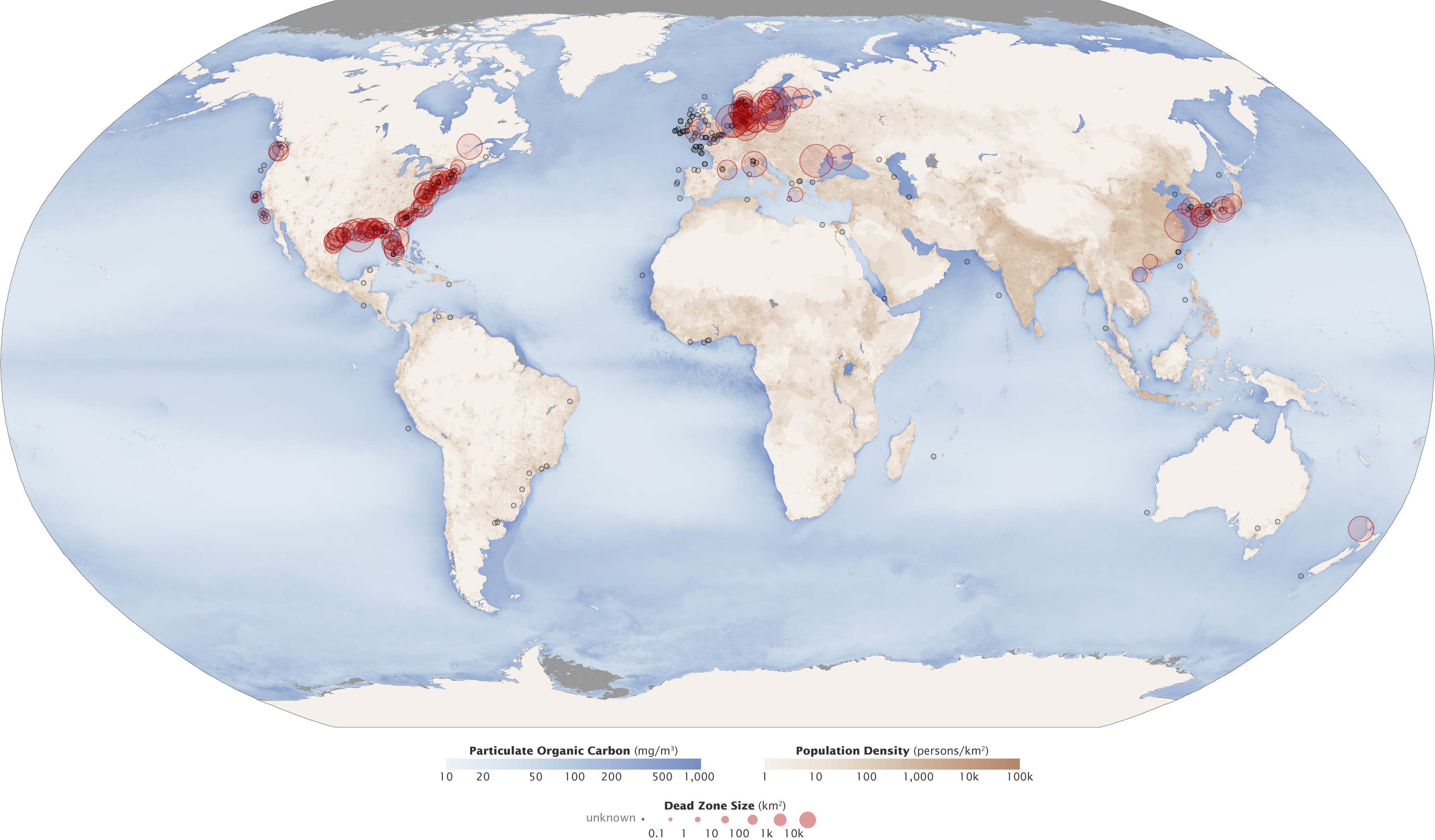
The appeal of assigning climate change as the cause of mass extinction is that solving climate change would in theory solve it. However, Raj Patel of the University of Texas-Austin is one of a number of environmental theorists who argue that industrial agriculture— including deforestation, monoculture planting and the use of pesticides, explains the insect and animal extinctions quite well. That oceanic dead zones ring industrial economies supports the interpretation that they are caused by agricultural runoff.
Graph: Oceanic dead zones, the product of runoff from industrial agriculture and industrial pollution, track American industrialization and the export of the American industrial model. The red circles surrounding industrial economies represent dead zones. Following WWII, the U.S. exported American-style capitalism to Germany and Japan through the Marshall plan. The U.S., Germany and Japan also feature prominently as cumulative emitters of CO2. Source: nasa.gov.  
The point here is analytical and tactical, not semantic. If industrialization is narrowly at fault for related environmental crises— say through greenhouse gas emissions, then ‘green growth’ is at least theoretically plausible through some combination of reduction and mitigation of greenhouse gas emissions. But this isn’t the case. The insect and animal mass extinctions appear to be related to climate change through a shared cause— industrialization.
The social, political and economic challenge is that ‘green growth’ is to tweak the status quo, whereas broader environmental resolution requires fundamentally reconsidering everything about capitalist modernity. Now. It is ultimately irrelevant that doing so has been a goal of some Left political programs for years and decades. There is no plausible exit from the current predicament emanating from the established order. The status quo is untenable, not a haven.
The habitat loss and degradation that substantially explains the insect and animal mass extinctions ties directly to animal agriculture— land is being cleared for animal grazing and to grow feed crops for factory farms. The crops grown are genetically engineered (GMO) to allow them to withstand systematic, late-stage applications of pesticides and herbicides. This agricultural ‘process’ is industrial from start to finish.
The industrial logic at work illustrates the conundrum. Factory farms are ‘efficient’ in the narrow sense of favoring commodity animals by decimating populations of non-commodity animals. This is done through monoculture planting of feed-crops to exclude / decimate non-feed crops. This decimation is accomplished using pesticides and herbicides that eliminate ‘losses’ to non-feed plants and insects. Annihilation is the point, not an accident.
The realm of interest— commodity production, excludes consideration of broader environmental relationships. Rendering each step of the agricultural process efficient assumes that the total process is efficient. Another way to say this is that what isn’t known— the unquestioned and unexplored reciprocal of this efficiency in nature, is assumed to be irrelevant, and therefore benign, by intent. Environmental destruction can be hidden by industrial food production until total extinction becomes inevitable.
This last point requires elaboration. Local, regional and global food chains are webs of relationships that once destroyed, take millions of years to regenerate. Through causing mass extinction, industrial agriculture leaves no ‘plan B’ in place. By the time that industrial food systems begin to fail, alternatives to it will have been destroyed. As of now, a return to pre-industrial agriculture is possible. However, technology will never replace large, complex and barely understood natural relationships.
In the 1980s pesticide and herbicide resistant GMO (Genetically Modified Organism) crops and a new class of neonicotinoid pesticides were introduced. It took twenty years for some of the causal mechanisms behind insect extinction to be linked to neonicotinoid pesticides. Early on GMO crops were planted next to non-GMO crops, guaranteeing cross contamination. This recklessness reflects a logic: industrial efficiency is the reciprocal of the broader relationships at work.
This is one possible explanation for the insect extinction measured in Puerto Rico despite a drop in the quantity of pesticides used there. Neonicotinoid pesticides can destroy the reproductive capacity of ‘non-target’ insects, meaning that they can adversely affect entire populations rather than just exposed insects. Amongst honeybees, Queens produce honeybees for the hive— the power to reproduce isn’t generally distributed. This particularity is antithetical to the commodity (generic) conception of industrial agriculture.
Recognizing that type and quantity are separate issues, the EU (European Union) is moving to ban the outdoor use of neonicotinoids linked to colony collapse in honeybees and mass die-offs of birds and bats. However, and here is the rub— with full knowledge of the adverse consequences of earlier pesticides, manufacturers promoted neonicotinoid pesticides with little to no understanding of their long-term consequences. For twenty years neonicotinoids were sold as the safe alternative to earlier pesticides.
The commercial logic behind this ‘product development’ strategy is that the narrower the research into adverse consequences, the lower the production costs and the lower the likelihood that adverse consequences will be found. This is more than a case of perverse incentives. Neonicotinoids were developed to replace earlier pesticides that also took twenty years for their adverse consequences to become known. In other words, the research process was known to be a serial failure before neonicotinoids were introduced.
The principle that ‘markets’ determine the ultimate social utility of products is even less probable. Ninety-nine-point nine percent of ‘consumers’ have no idea what pesticides are used in the production of the food they eat. Industrial farmers— corporations, care about crop yields. Until these are impacted, they have no reason to look further. The industrial scientists who create new pesticides answer questions derived from earlier problems. At no relevant point are adverse consequences known when ‘consumer’ decisions are made.
Industrial pesticides might even be ‘adequately’ tested, meaning to the full extent of what is knowable within the given logic. But ‘true’ knowledge of their impact has followed a predictable path. Earlier pesticides and herbicides produced unintended consequences despite being tested. In other words, adverse consequences are the predictable outcome of this production logic regardless of which methods are used to predict them. The evidence: neonicotinoids were (1) tested and (2) followed this same pattern of producing unintended consequences.
Graph: Every recession since WWII has been intentionally caused by the U.S. Federal Reserve raising interest rates to limit wage demands. ‘Recessions’ are another term for ‘degrowth.’ In other words, capitalists love degrowth when it serves their purposes. This is why economists on the Left tend to reflexively oppose degrowth. But if recessions are necessary to the proper functioning of capitalism, isn’t the problem capitalism? Source: St. Louis Federal Reserve.
Given the environmental stakes, arguing against the logic of capitalism would be pointless without bringing it back to environmental logic. Whether it is cause, effect or iterative, capitalism is deeply embedded in the social complexity that defines modernity. Most in the West buy their food in a store and have no idea how to produce it. This largely explains why market relations define so much of the realm of available social logic. Phrased differently, climate change and mass extinction strongly suggest that something is missing from the available social logic.
This social complexity— deeply interwoven social, political and economic relationships that make even small changes to the existing order dangerous for large numbers of people, constitutes a doomsday device of sorts given the environmental reckoning that is underway. Agricultural complexity— systems that billions of people rely on for sustenance, can be left to collapse on their own or their unwind can be planned. Lest this seem unduly alarmist, insect, animal and marine mass extinctions are already far along.
Question: if a group of people proposed killing 60% – 80% of the animals, insects and marine life on the planet while emitting enough gases into the atmosphere to cook the planet, should their stance as ‘centrists’ be taken seriously? And possibly more to the point, does it make a difference that until around 1980 they didn’t know they were doing so, and after they were told they accelerated the damage caused? The term ‘sociopaths’ seems more descriptively accurate.
Because animal agriculture is so resource intensive, were it to be abandoned, existing food production would greatly exceed what is needed to sustain people. This would facilitate a move away from industrial agriculture toward local, small scale and regenerative agriculture. It would also reduce greenhouse gas emissions by 20% – 50%, depending on whether deforestation is included in the calculation.
Otherwise, environmental problem solving begins with identification of the problems and then steps are taken to bring them to resolution. What doesn’t work is to spend decades ignoring and understating problems and then proposing half-measures under the theory that something is better than nothing. Half-measures proceed from the assumption that danger comes from action, rather than inaction. Mounting evidence suggests that this isn’t the case.
Another way to frame this is that problem solving can come through technological innovation, which has a long history of producing unanticipated adverse consequences, or through stopping doing what is causing problems. With the latter, the consequences are largely known— the problems are ended. To the extent that basic material needs could be met through ending animal agriculture and militarism, the capacity to resolve mounting crises exists even if the political will doesn’t.
According to decades of polls, most people want to do the right thing when it comes to the planet. This illustrates the divide between political and economic democracy. Economic concentration is used to crush political democracy. Without suggesting there are any simple or easy answers, breaking economic concentration is a necessary step to restoring the power to resolve environmental crises. Additionally, it would remove the logic of accumulation that is killing the planet.
Finally, the term ‘creative destruction’ in the title was conceived by Joseph Schumpeter to glorify the revolutionary nature of capitalism as replacement through innovation. With climate change and mass extinction at hand, what is being replaced is life on the planet. It’s good to know that there is a theory that ties to the process, although I’d hope for a better epitaph.