22 Dec 2018

Government of Flanders Mastermind Scholarships 2019/2020 for International Students – Belgium

Application Deadline: Varies by institution. Some institutions have as deadline 1st February 2019! Apply early!

Offered annually? Yes

Eligible Countries: All

To be taken at (country): Various universities in Belgium
  • KU Leuven / University of Leuven
  • University of Antwerp
  • Ghent University
  • Hasselt University
  • Vrije Universiteit Brussel
University colleges (Arts and Nautical Sciences)
  • Antwerp Maritime Academy
  • Artesis Plantijn University College Antwerp
  • Erasmus University College Brussels
  • Karel de Grote University College
  • LUCA School of Arts
  • PXL University College
  • University College Ghent
Eligible Field of Study: The program holds for all study areas.

About the Award: The programme aims to promote the internationalization of the Flemish Higher Education, as stated in the Action Plan for Student Mobility, Brains on the Move (September 2013).
Students cannot apply directly. Applications need to be submitted by the Flemish host institution.

Offered Since: 2015

Type: Masters

Eligibility: The Flemish host institution applies on behalf of the student.
General eligibility requirements
  • The applicant applies to take up a Master degree programme at a higher education institution in Flanders (hereafter ‘Flemish host institution’).
  • The applicant should have a high standard of academic performance and/or potential. He/she meets all academic entrance criteria, including relevant language requirements, for entering the Master programme in question offered by the Flemish host institution.
  • All nationalities can apply. The previous degree obtained should be from a higher education institution located outside Flanders.
  • Students who are already enrolled in a Flemish higher education institution cannot apply.
Selection: A Flemish selection committee awards the scholarships, in cooperation with the Flemish Department of Education and Training.

Number of Awardees: 30 to 40

Value of Scholarship: The incoming student is awarded a scholarship of maximum €8000,- per academic year.

Duration of Scholarship: The duration of mobility is minimum 1 academic year and maximum the full duration of the master programme. If the student obtains less than 45 ECTS in the first year, then he/she loses the scholarship in the second year.

How to Apply: 
  • You can find more information in the guidelines for application in the Scholarship Webpage link.
  • You need to contact the Flemish higher education institution to inquire about their internal selection procedures and deadline for submitting the application.

Visit Scholarship Webpage for details

Indian Agencies Snooping Into Your Computer: The Orwellian Nightmare Is Here

Kabir Deb

In 2001, for the very first time, I took George Orwell’s masterpiece “1984” in my hand. A dystopian novel having a dictator named “Big Brother” who believes in “WAR IS PEACE, SLAVERY IS FREEDOM, IGNORANCE IS STRENGTH” and used to spread his belief by hook or crook. Big Brother used to spy on every citizen of his rule because he wanted no one to go against him, either by technology or by marching in the street against him. The novel gave me chills even in my adolescence and it brought much more reality for me because I saw the Godhra Riot after the novel’s conclusion. Even when the novel showed its Big Brother slicing out freedom from every citizen it seldom brought so much tension in me until Narendra Modi government came into power with its nonsense policies.
Few days back I went through “1984” and “No Place to Hide” by Glenn Greenwald, a book on the much needed Edward Snowden. Snowden made 1984 seem a reality because he released the bitter truth of the spying American agencies like CIA, FBI etc., which used to observe every move of the citizens of America. He said, “I don’t want to live in a world where everything that I say, everything I do, everyone I talk to, every expression of creativity or love or friendship is recorded”. That’s right, he showed that even a Samsung TV to a refrigerator, everything was a means to gather information which can cripple the government and its evil motives.
Today after the BJP government legalised “Hacking or Spying of Data by 10 Agencies of the Central government” just replicated “1984” in India and just like Snowden showed the reality of America, today it feels that actually Edward Snowden released the reality of the governments of each and every nation. The ten agencies that have been authorised to intercept, monitor and decrypt “any information generated, transmitted, received or stored in any computer resource” include the two intelligence agencies — internal spy body Intelligence Bureau and external intelligence agency Research and Analysis Wing.
The other agencies include: the Narcotics Control Board (which polices illegal drug trade), Enforcement Directorate (which looks after economic crimes), the Central Board of Direct Taxes (which is responsible for income tax), the Directorate of Revenue Intelligence (an anti-smuggling agency) and the Central Bureau of Investigation (which is tasked with investigating high-level corruption and other crimes).
In 2017, when the Supreme Court declared Right to Privacy as a fundamental right, the decision gave us a relief that along with it the Big Brother of India will fall which can help in keeping what’s private as private. From our sexuality to computer data, everything which is ours would be ours forever without any external involvement in the form of spying. It made many debates appear rational because one fundamental right brought a fair conclusion to many irrational discussions. Today when the government released this evil decision to provide full power to these ten agencies to spy over each and every citizen it reveals the naked picture of our country and its present condition. The present time is poisonous, it’s insecure, intolerant and the leaders are insecure that the citizens might cripple them through computer data or by releasing the evil secrets which can lead to mass killing or framing anyone.
It says that the UPA government brought the Information Technology (IT) Act, for the very first time and just like the former party, the present party is doing the same. Ironically, it sounds like “He is a shit so I have to become a shit”. UPA government never gave full power to Central Agencies to survey on Indian Citizens to gather information. Instead it gave power to Intelligence Bureau only, for the protection of the nation from external means. But today, the BJP government released its dictatorial picture before the country by giving full permission to the agencies which never should have the power because it’s against everything, both Law and Ethics.
The Orwellian Era has returned back and the Big Brother sits on the throne with Saffron colour and framed, mythical Gods as his shield. He sits with everyone beside him vowing to convert everyone, I repeat, everyone into THE Saffron Army to stay in power and to build an irrational and fragile country out of its tradition full of mythology.

Macron and the Air France Experience

Peter Koenig

On an Air France flight from Paris to Latin America, the plane is full, mostly with working class Latinos, going home for Christmas to spend a few festive days with their families and friends. They have worked hard to save their money for the trip. The plane is old and decrepit. Has no properly working entertainment system – and that on a trajectory of over 12 hours without interruption. Who cares. Management knows that the humble passengers won’t complain. Anyway, they are under-people. Let’s reserve the better and newer planes for classier people. They pay better, are better clients. Isn’t that the thinking behind such decisions? – Of course, it is. It’s the greed-driven maximizing profit scheme to the detriment of the population. It’s not just AF, it’s everywhere, everywhere you look and are touched by a corporate giant. We the people, are not even sheepish anymore; we are silenced. We are not asked, not consulted, whether we agree to be photographed and face-read at every corner. It’s just the way it is. Its intimidation by control – by over-control, and by cattle treatment. In this, the French and the US TSA (Transportation Security Administration) are not far apart.
For airport security, you are pushed through what I call a “naked-machine” – Though they tell you that it’s not true, that nobody sees anything other than potential drugs or weapons hidden in human crevices – well if they see crevices, they must see you naked. Behind the scene hidden away in some dark room are the machine operators, they see every human passing through it naked, balls, vagina, breasts and all. Imagine, the absurdly obscene, pathological imagination of those operators – and those who command them!
A machine, a robot of sort, disposes over you. If you don’t conform, you are just left behind,or harassed no end – you may literally lose your plane or connection. Cases of the US TSA abound – some of them are violent and are brought before a court – but in most cases to no avail. The ‘system’is always right. And mind you the system, is a private system, its not even state owned, its outsourcing and privatization “ÜberAlles”. But no protests à la Yellow Vests. We are conveniently silenced. It’s Macron “ÜberAlles” – sounds like déjà vu? – Well, yes. It is. –Neofascism is undeniable.
Yes, that’s the way the ordeal begins. Actually, it begins earlier – at the check in, for example. AF weigh your luggage by the kilo – and, while some agents are a bit more lenient than others, if you are unlucky it hits you having a kilo in excess. Either you somehow dispose of it or reshuffle it to hand luggage – which also has a limitation of weight, you are charged the fee for an extra luggage. What to do? – You are at the airport. They have a captive “market”, because this money-profit centered “market” system has the power over you. You are at the airport, you have to fly, you charge this horrendous extra fee to your credit card, or else you are left behind; no scruples. That’s Macron 101. No concessions. And the French employees are well trained, lest they may lose their bad paid, but nevertheless vital jobs. You want to survive – bend over. No solidarity, no empathy, just hardball. Le Roi Macron says so. And you better obey —- or else — but the ‘or else’ has now suddenly gotten a yellow face – the Yellow Vests. We can just hope that they will propel the finance-mafia dictator into his overdue abyss.
Next, boarding the plane – an elderly passenger visibly with a hurting leg, kindly asked the flight assistant, alias the “cattle guard”, whether he could go through with the privileged ‘frequent flyers’, those who have given the company enough money to justify an extra discriminatory favor. She refuses. He insists, she refuses – until a man behind tells her, for human’s sake, please let him through. She hesitantly nods, then lets him go through.
What does all that have to do with Macron? – Everything. The sort of de-humanized civil behavior is what he instills in people, incorporations. Greed first, everything else, like solidarity, is not even second, it’s of no value. The young who want so desperately cling to their slave-paid jobs, have to obey, or else, they may lose their employment.But now it’s gone too far. Enough is enough. The Yellow Vests represent every industry, every citizen, every abject Macron law; they want to reverse the wheel, à la French Revolution. Enough is enough. Enough privileges for the rich and powerful. Even on the planes.
In ‘economy’,where the cattle is herded, those who saved hard to afford a trip to see their families, rows are getting narrower and narrower. Over time your legs get cramped; an increased risk of thromboses that can be deadly,especially when it happens on 10,000 meters altitude – far from an airport, above the sea. This, of course is quite different for those on first, business or economy plus class, they have more space, sit comfortably, and their entertainment system works fine even on an old decrepit plane. Proper maintenance for the rich and beautiful, neglect for the “less beautiful” populace.
When I complain about the inoperable entertainment system (ES), the chief of cabin arrives. He promises to see what he can do. After a while he returns with a tablet-screen full of my previous AF flights. I’m a good customer. So, he discretely offers me to be placed on an economy-plus seat, where the ES works. He whispers, you are a good customer, so we will do something for you. Amazing in an overcrowded plane he finds an unoccupied seat. I go and look at it – and as soon as they – the flight attendants for the better people – see me, they say, “Sir, the bathrooms are in the rear”. When I tell them that the cabin chief offered me a seat in their section, their tone changes: “Sir, can we offer you a glass of Champagne?” – I’m disgusted, but politely decline, deciding to stay with my kind of ‘cattle’. I prefer reading and writing – like this little essay – among my same-sakes. And am happy about it.
The cabin chief was admittedly nice. He fulfilled his duty, keeping a relatively ‘good customer’ happy, I have to admit. I’m fodder for the ‘maximizing profit’ doctrine.Yet, due to his friendly smile and body language, I give him the benefit of the doubt. Hopefully, not all those who have to make a living off the neoliberal Macron and greed driven money machine, have lost their innermost identity. That’s the cloud’s silver lining. That’s the remaining hope to build on. Hope is the last glow that dies.
Food service, used to be decent with AF. No longer. They don’t have you pay for it yet, but it is almost inedible. – But then, I think of the millions of Yemenis who thanks to the western and Macron-supported killing machine are suffering and dying from famine. So, I eat my portion happily.As a parenthesis, according to the UN, about 85,000 children below age 5 perished through the satanical Saudi-US-UK-French led war of horror. Most of the children died from famine and cholera induced diseases. I was thinking of those big eyed- and skeleton-like bodies, too weak to stand, let alone walk, destroyed for life from famine.
What does that have to do with Macron? – Everything, of course. Macron’s Airforce helped the crime regime of the Saudis bombing Yemen, a poor but proud people, to bits and pieces; to kill possibly hundreds of thousands – nobody counts – mainly children and women. Macron, siding with the elite – he surely has no reason whatsoever to bomb Yemen – helped the ‘allies’ of crime, destroy an entire nation. He of course is not alone, but accompanied by the best and the brightest of the western allies, even Germany – which, according to their non-aggression treaty (remnant of the WWII Armistice arrangement) – is not allowed to participate in any conflict hostility emanating from her territory – except, of course, if the Master of the treaty orders it.
The Yellow Vests want Macron out. Macron has become the enemy of the people. Literally. He is probably proud of it, because that’s testimony enough that he works for the rich and powerful, that he accomplishes the tasks he has been slanted and put in office for, with less the 25% of eligible votes. He lied, promising change, but change that benefited the people. Change to the detriment of the people is what he implemented. The result is an equation of dynamics, the right has not thought of. Well, thanks god for these dynamics; they brought about the storming of the Bastille in 1789, and a transformation of much of the world. Though, granted, not all that came out of the French Revolution has persevered. The rich and powerful have an unlimited and insatiable stock of wealth to draw upon. Never mind that it’s stolen wealth – as long as they dispose of it and are able to defend it with brute military and police power, they command.
And so, the merry-go-round continues. Air France will play the game; they have to. They are bound into the system, along with French corporatism. The name of the game is intimidation. “Inconvenient”, not-playing-by-the-rules staff are being dismissed. Of the face reading / passport machines, only one out of three is operable, causing long queues. Out of about 20 customs boots, only two are occupied by an agent. Macron saves at the cost of stressed passengers, who have to spend precious time in long lines, risking literally missing their connection planes.
But the Big shots don’t care. The populace’s time is worth peanuts – its like slave time. In any case – you have to go through ‘the system’ – if not, screw you, you remain stranded.
Good riddens Mr. Macron, very good riddens – to never appear again on the horizon. – Vivent les “gilets verts”!

Australian Labor Party rejects demands to increase unemployment benefits

Robert Campion

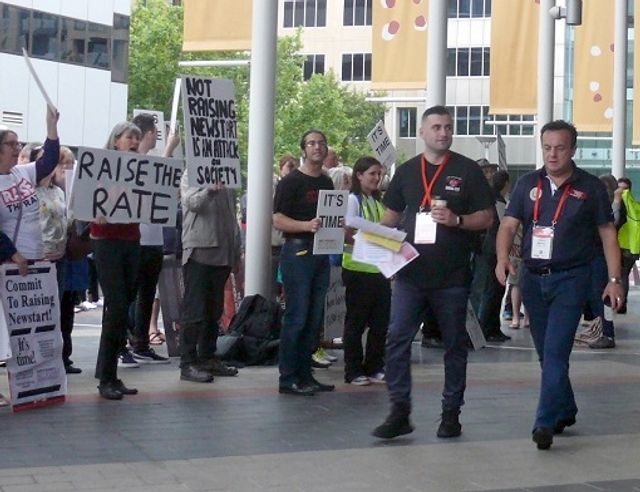
Despite “raise the rates” protests in the foyer, the Labor Party’s national conference in Adelaide this week rejected calls for a Labor government to immediately increase the sub-poverty levels of the unemployment payments, Newstart and Youth Allowance.
ALP delegates walk past protest for an increase in Newstart
More than anything else, this unanimous stand against the poorest members of the working class exposed the utter fraud of the “fair go for Australia” logo that dominated the conference stage, foreshadowing the party’s campaign pitch for the looming federal election.
Despite the endless claims at the conference about fighting inequality and low-wage exploitation of workers, the decision means that the allowances will remain at levels deliberately kept low in order to coerce unemployed workers into taking jobs on substandard wages and conditions.
In the lead-up to the conference, the Australian Council of Social Services (ACOSS) and a coalition of non-government organisations campaigned for an immediate rise in the rates, which have effectively remained frozen in real terms for a quarter century since the Keating Labor government of the 1990s.
Media reports forecast a passionate debate on the floor of the conference, with “Left” faction members committed to moving a resolution to back the demand. In his opening address to the conference, however, Labor leader Bill Shorten made plain that no such resolution would be accepted. He said the party’s policy would remain to merely promise an unspecified “review” of the issue, indicating that the party’s factional heavyweights would ensure that outcome.
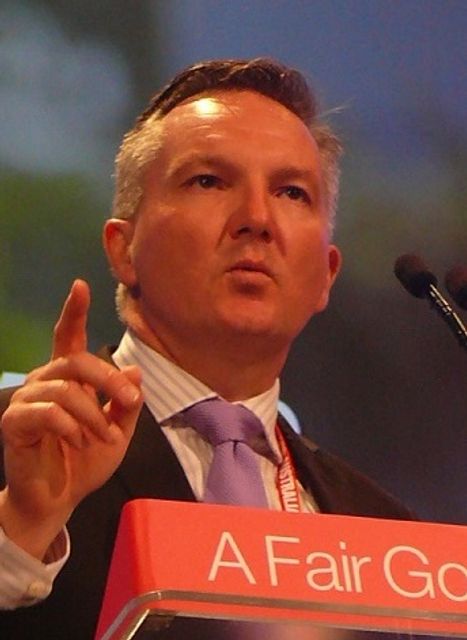
Chris Bowen
Shadow treasurer Chris Bowen soon reinforced Shorten’s words at a press conference where he responded to the Liberal-National Coalition government’s just-released Mid-Year Economic Outlook (MYEFO).
The World Socialist Web Site asked Bowen whether his frequent references to Labor taking “difficult decisions” to deliver bigger budget surpluses than the government meant keeping Newstart and other welfare payments at sub-poverty levels, deliberately imposing suffering on the unemployed. Bowen twice refused to answer the question, except to confirm that the party’s decision to “review” the rate had been announced already.
As with all the issues presented during the conference, the decision had been made behind closed doors in order to present a “unified” and “disciplined” party to the Australian and international ruling elite, ready for government and capable of presiding over economic and political turmoil.
Newstart is among the lowest unemployment allowances in the OECD. The cost of living has drastically increased since the 1990s, making it impossible to live on the allowances and cover the costs of rent, electricity, food, transport, a phone, clothing and other essentials.
According to the limited, semi-official Henderson Poverty Index, the poverty line as of June 2018 was $517 per week for a single adult. The Newstart base rate is little over half that—$275.10 per week, or less than $40 a day.
Youth Allowance rates—for unemployed youth under 18 living away from their parent’s home for study, training or job searching—are even lower, on $222.90 per week.
About 900,000 people are trying to survive on Newstart, Youth Allowance and other related benefits. Compounding the social crisis is the lack of job opportunities. For every job vacancy there are eight people looking for work.
Further exposing the fraud of Labor’s “fairness” slogan was the “Left” faction’s shameless endorsement of the consensus decision to reject the “raise the rates” demands during the “debate” on the conference floor.
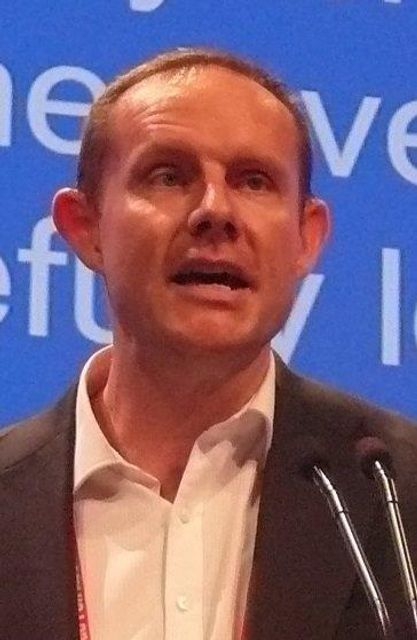
Darcy Byrne
The “Left” faction’s Darcy Byrne had declared before the conference that simply reviewing the Newstart rate was “not good enough.” He said he would be moving a resolution to commit a Labor government to substantially raise it during its first term in office.
When he spoke at the conference, he lamely announced that the increase was not supported by the party leadership “due to its expense” but his faction had “won” a commitment for a Labor government to “urgently review” the rate within 18 months of taking office. He provided no details of this review.
The amended resolution was seconded by another “left,” Rose Jackson, the party’s assistant general secretary in the state of New South Wales. For all her confected fiery rhetoric about inequality and appeals for the party to be “bold,” she sought to justify the agreed resolution by claiming that a review would be “useful” because it would “demonstrate” that the current rates are “inadequate.”
These comments fly in the face of the obvious inadequacy of the payments, and the strong public support for raising the rates. A poll commissioned by ACOSS in June found that over two-thirds (68 percent) of Australians supported an increase in Newstart payments. Furthermore, 92 percent agreed that no one in Australia should go without basic essentials like food, healthcare, transport and power.
The real issue is not the “cost” of raising the rates. A Deloitte Access Economics study released in September estimated the annual cost of raising the Newstart levels by $75 a fortnight would be $3.3 billion. This is dwarfed by the estimated $11.6 billion cut from social security spending over the past four years, let alone the massive increases in military spending. With bipartisan Labor-Coalition support, the federal government is currently spending more than $17 billion on buying 72 F35 war planes from the US.
The reality is that the allowance rates are kept low in order to drive desperate workers and young people into super-exploitative, insecure work. Shorten himself spelt out that fact in 2013, when he championed the Gillard Labor government’s refusal to raise the rates.
In a letter to a Greens senator, Shorten—then the Labor government’s employment minister—declared that lifting Newstart payments would have “unintended and undesirable” consequences, because the unemployed might “no longer have an incentive to work.”
Notably, the primary reasons cited by the Labor “Lefts” for addressing the issue had nothing whatever to do with the fundamental social right of all workers to a decent, liveable, income or social safety net.
Instead, they cited the concerns voiced by sections of big business that the low rates were restricting economic growth. The Business Council of Australia, representing the largest corporations operating in Australia, noted as far back in 2012 that Newstart levels “may now be so low as to represent a barrier to employment.”
On the first day of the Labor Party conference, “raise the rate” protesters handed delegates leaflets pamphlets asking: “Can you give us some decent policies to vote for—not just the lesser of 2 evils?”
This campaign sought to channel widespread working class disgust back into illusions that a Labor government could be pressured into a less cruel policy. But these pleas fell in deaf ears.
As with its “sister” social democratic parties around the world, the Labor Party has long been in the forefront of the assault on working class basic rights and social conditions, dedicated to serving the profit requirements of the financial markets.

Factional acrimony continues as Sri Lankan president appoints new cabinet

Pani Wijesiriwardena

Sri Lankan President Maithripala Sirisena finally appointed a new 28-member cabinet on Thursday, three days after Monday’s previously scheduled deadline.
The ministers were selected from the ruling United National Front (UNF) headed by Ranil Wickremesinghe, whom Sirisena reluctantly swore in as prime minister on Sunday. Sirisena had previously sacked Wickremesinghe on October 26, declaring that his government was mired in corruption and had destroyed the “good governance concept.”
Sirisena’s delay in appointing a new cabinet indicates that bitter factional infighting continues within Colombo’s political elite and points to the ongoing instability of capitalist rule within the island nation.
After sacking Wickremesinghe in October, Sirisena appointed former President Mahinda Rajapakse as prime minister and swore in a new cabinet. Sirisena’s political coup failed, however. Rajapakse was unable to win majority support in the parliament and the Supreme Court ruled that the president’s dissolution of the parliament was unconstitutional.
The US and its allies also made clear they would not allow Rajapakse to form a government because of his political orientation toward China. Washington will not tolerate any disruption to its anti-China agenda in the region. It placed intense pressure on Sirisena to reappoint Wickremesinghe as prime minister.
Sirisena swore in 28 ministers on Thursday, rejecting two of the 30 names submitted by Wickremesinghe. Under the constitution, the president is the commander-in-chief of the three armed forces as well as defence minister. Sirisena, however, has also appointed himself law and order minister, a position he assumed after sacking Wickremesinghe as prime minister. This decision is another indication that he wants to concentrate the most important state powers in his own hands.
According to media reports, Sirisena reluctantly handed over the media ministry to the UNF, but only after it agreed to allow his political supporters to be placed in control of key media institutions. Wickremesinghe told the media he planned future discussions with Sirisena over the ministerial appointments.
Wickremesinghe, who is acutely aware of the political and economic crisis confronting Sri Lankan capitalism, is attempting to consolidate his power. His government has the largest number of MPs in the parliament, but is 10 short of a simple majority, and depends on the support of 14 Tamil National Alliance (TNA) MPs.
The United National Party (UNP)-led UNF includes the Sinhala chauvinist Jathika Hela Urumaya, the All Ceylon Muslim Congress and the plantation-based Tamil Progressive Alliance (TPA). The National Union of Workers, Democratic People’s Front and Up-country People’s Front are members of the TPA. Many of its leaders were given cabinet, state or deputy ministerial positions to try to keep the unstable coalition glued together.
Yesterday a UNP working committee endorsed calls by Wickremesinghe for the UNF alliance to include other formations and be renamed the National Democratic Front (NDF). Wickremesinghe told a rally on Monday that the NDF is “needed to promote and protect democracy. I ask everyone here, and the public at large, to give us a two-thirds majority at the next general election.”
As the historical record demonstrates, the only thing that Wickremesinghe and his UNP “defend”—just like Rajapakse, Sirisena and their political parties—is the capitalist profit system, at the expense of the working class and the poor.
When parliament resumed on Monday, Speaker Karu Jayasuriya declared he had decided to appoint Rajapakse as parliamentary opposition leader. No explanation was provided as to why he removed the incumbent, TNA chief R. Sampanthan, as opposition leader.
Leading MPs from the UNP and TNA opposed Rajapakse’s appointment and pointed out that the former Sri Lankan president and his supporters were members of Sri Lanka Podujana Peramunam but had originally been elected to parliament as members of the United People’s Freedom Alliance. According to the 19th amendment to the constitution, any MP who changes party allegiance loses his or her seat. Factional acrimony will continue on this issue until Speaker Jayasuriya issues a ruling.
Irrespective of the immediate outcome of the factional manoeuvres in parliament, the key factors that produced the bitter infighting over the past two months remain. The government is highly unstable, the economic crisis is deepening and opposition is mounting from workers and youth over wages, jobs and austerity measures.
Plantation unions this month shut down indefinite strike action by hundreds of thousands of estate workers demanding a 100 percent wage increase. Fearful that the industrial action would escalate out of its control, Ceylon Workers Congress officials falsely claimed that Sirisena had promised to settle workers’ demands and ended the strike. The pledge was completely bogus.
Government railway workers are also calling for strike action over their long outstanding pay demands. Like the plantation union bosses, railway union officials sent their members back to work, claiming Sirisena would resolve their claims.
Yesterday, Wickremesinghe’s government passed a “Vote of Account” resolution, giving itself four months to present a full budget. Reappointed finance minister, Mangala Samaraweera, declared that the budget would provide economic concessions for the people.
These promises will come to nothing because the government will have to implement the International Monetary Fund’s austerity demands. Amid Colombo’s factional war, the IMF withheld the final $US500 million instalment of its latest $1.5 billion loan until “political uncertainty” ended.
Sunday Times economic columnist warned last week that “postponement or even cancellation of this IMF loan would not only have an adverse impact on the external reserves and debt repayment capacity.” It would undermine Sri Lanka’s credibility in “international financial markets and among investors.” The author pointed out that the government has to pay $1 billion in loan repayments next month and another $500 million by April.
While welcoming the new cabinet, Ruwan Edirisinghe, president of the Federation of Chambers of Commerce and Industry of Sri Lanka, bluntly declared that the big business lobby group was “not bothered” about which government was in power. “What we want from the government of the day is to ensure that they take responsibility for the economic development of the country”—that is, that corporate profits continue to climb.
Rajapakse told parliament yesterday that the government had to “take a look at the people’s side [and] reduce the price of goods. We need to make this change. People are facing a lot of hardship. If we had not come back then, the country would have had to face a similar situation experienced in France and Greece.”
Rajapakse’s speech amounted to empty posturing. While in power until 2015 he used the communal war against the Liberation Tigers of Tamil Eelam to justify imposing the dictates of national and international finance capital.
His “advice” to the government is another indication of the sensitivity of the entire capitalist class to the mounting anger among workers and the poor over the ongoing attacks on social and living conditions. Far from defending democracy, the ruling class as a whole is turning toward dictatorial forms of rule to suppress the inevitable eruption of mass struggles.

UK: Half of Royal College of Nursing leadership re-elected after being forced out

Ajanta Silva

Six of the 12 members of the Royal College of Nursing (RCN) leadership Council forced to step down from their positions in September have been re-elected.
These despised union functionaries exploited the widespread disengagement of members with the union to secure re-election, despite their role in selling a rotten three-year pay deal to National Health Service (NHS) workers. Turnout among the RCN’s membership of 430,000 members ranged from as low as 4.8 percent to 8.3 percent in different regions.
Maria Trewern, the former chair, and three others of the council who endorsed the sell-out pay deal to the members and contested for another term were voted out.
Members were asked to participate in a thoroughly undemocratic election process and had only four days to make objections to nominations. Some nurses and health care assistants told NHS FightBack that they had not even received emails about the nominations. Nor were some members informed about branch meetings in which they could select their own nominees.
Knowing that half of the council elected were people who were forced out in September, acting RCN Chief Executive Dame Donna Kinnair said, “The field of candidates was exceptionally strong and the College is fortunate to attract people with such broad experience to these top roles.”
Offering her personal gratitude to the council members forced out, she said that “they are a credit to nursing and our organisation.”
The re-elected union functionaries played a crucial role in selling the pay deal to their members after conspiring with other unions and the government. The RCN and 13 other health unions, including the largest public sector union Unison, were in negotiations with the Conservative government since the end of 2017, finally reaching a pay deal in March this year. The RCN and the unions sold it as “the best deal in eight years” and bombarded members with misleading information to get a favourable vote.
Pushing for acceptance, the RCN claimed, “it will amount to an increase of at least 6.5 percent over three years, but much more for some members, up to 29 percent” and that every member would get a 3 percent pay rise this July, backdated from April. It warned that if the pay proposals were not accepted, NHS pay for 2018/19 would be determined based on NHS pay review body recommendations—a well below inflation 1 percent offer.
The unions concealed the real facts:
  • A 6.5 percent pay “increase” over three years is a real-term wage cut, as the estimated combined Retail Price Index inflation hike in that period will be 9.6 percent. Moreover, health workers, like other public sector workers, have seen their pay eroded by 14 percent over the last eight years as a result of pay caps and pay freezers implemented by Tory-led governments with the tacit support of the unions.
  • Future pay progression is tied to performance. Former Health Secretary Jeremy Hunt welcomed the deal as imposing “profound changes in productivity.”
  • Sickness absence enhancements of low-paid workers will be slashed and unsocial hours payments amounts will go down by several percentage points for workers on band 1-3 of the Agenda for Change pay system.
  • Many workers will receive only a 1.5 percent pay rise until their incremental pay progression.
As soon as the concealed details of the pay deal came to light in July pay packets, health workers expressed outrage. Many condemned the unions on social media platforms and in work places, while RCN members put forward a petition calling for an Extraordinary General Meeting (EGM). More than 1,000 signatures required for an EGM were gained within 24 hours.
RCN Chief Executive and General Secretary Janet Davies was forced to step down in August. The resignations of RCN’s director of member relations Chris Cox and chief pay negotiator Josie Irwin followed.
A motion of no confidence “in the current leadership of the Royal College of Nursing” calling for them to “stand down” was passed overwhelmingly. Delegates from across the country lined up during the EGM held in September to denounce the union bureaucracy.
The RCN council stood down, stating that a vote of no confidence was “advisory” but the “Council recognises the moral weight of the vote, and has acted accordingly.”
Such moral concerns were soon set aside, as 10 members of the council put themselves forward for re-election a month after they were thrown out.
The RCN bureaucrats are on record that the pay deal will not be re-opened. Indeed, the RCN and other unions are working with the devolved governments on similar deals in Scotland and Wales.
Recognising the resurgence of the class struggle in the last year that has seen struggles by university lecturers and administrators, college workers and teachers, the union bureaucracy is moving to deepen collaboration with the employers to suppress growing opposition to attacks on jobs, wages and pensions.
The health unions are trying to head off growing anger of health and social care workers in Northern Ireland who have not received a pay award at all. Despite a consultative ballot of the members indicating that 92-98 percent of health and social care workers support a formal ballot for industrial action, the unions are doing nothing other than demand further talks with the Department of Health.
A joint statement of the unions, including the RCN, declares: “Good policies are made when Departmental officials, employers and Trade Unions work together in the best interest of the public and staff.”
The experience of the RCN members shows that the unions cannot be reformed by rank-and-file pressure. Such pressure only results in the union leadership turning even more ruthlessly against the interests of their members.
NHS workers are involved in a fight on two fronts—against a government hell-bent on the destruction of the NHS and against the health unions through which these plans are being imposed. We urge health workers to contact NHS FightBack to discuss the building of rank-and-file committees, independent of the unions. On this basis, a powerful joint offensive can be established of NHS workers, local government staff, education workers and employees throughout the public and private sector in defence of jobs, wages and essential services.

Protests in Portugal and Catalonia met with police repression amid rising wave of strikes

Paul Mitchell

Thousands of police were mobilised in Portugal and Catalonia to repress protests spanning the Iberian Peninsula.
The scale of the repression is dictated by rising concerns in ruling circles at a wave of industrial militancy and social discontent.
As the year ends, Portugal’s Socialist Party (PS) administration, supported by the pseudo-left Left Bloc (BE) and Communist Party (PCP), is being hit by multiple strikes against low wages and poor working conditions. Public sector workers have had their salaries frozen for the last 10 years and career progression stopped.
Labour Minister José António Vieira da Silva admitted the increase in strikes is because people have “now expectations of improvements in their working conditions” after “a long period of restrictions.” Yesterday, relatively small demonstrations, inspired by France’s Yellow Vest movement, took place in cities and towns across the country, in another indication of an upsurge in the class struggle outside the control of these parties and the unions.
Since Antonio Costa’s PS came to power in 2015, the number of strikes has doubled. This year there have been 173 strike notices in the public sector, compared to 85 in 2015. Nearly 50 strike notices have been issued for the Christmas period and New Year.
For over a year, nurses have been taking strike action and, since November, 5,000 surgeries have been postponed or cancelled. In October, 2,300 judges went on strike and action at Portuguese rail ticket offices disrupted rail traffic. Doctors and museum workers have also staged nationwide strike action in the past months.
Dockworkers in Setúbal began strikes on November 5 protesting the lack of job security for casual and part-time workers and against enforced overtime at the ports of Lisbon, Sines, Figueira da Foz, Leixões, Caniçal (Madeira), Ponta Delgada and Praia da Vitória (Azores). Exports have been affected. This week, workers employed by the state oil company Galp went on strike for five days protesting the “employer offensive” against collective bargaining arrangements, poor wages and attacks on overtime pay.
Supermarket and department store workers are stopping work on Christmas Eve in protest at “misery wages.” Tax office workers have called a strike from December 26 to 31 demanding the unfreezing of their career progression. Teachers have threatened to boycott the 2019 school year for the same reason. Workers from the National Lottery have begun a two-week hunger strike in support of better working conditions. Firefighters and border guards are also contemplating action.
Most of the strikes have been called by the PCP-led CGTP union to let off steam, kept to individual actions to prevent united action against the PS.
Costa’s government has been lauded by the troika of the European Union (EU), International Monetary Fund (IMF) and European Central Bank (ECB) for reducing Portugal’s budget deficit to virtually zero. Responding to the wave of strikes, Costa declared that the country’s economic recovery doesn’t always mean that “everything is possible for everyone.”
The Costa government’s major achievement has been to repay early the €78 billion given to Portugal to bail out its banks after the 2008 financial crisis, while claiming to be “anti-austerity.” This is due to its conceding a few hundred million to raise the minimum wage to €600 a month ($687)—still the lowest in western Europe—increase some pensions by €10 a month and unfreeze public sector promotions over a number of years. Most of the austerity measures imposed since 2008 remain. The BE has voted almost unanimously to ally with the PS for next October’s election.
The “recovery” in the Portuguese economy has been built on low interest rates, quantitative easing, increased tourism and overseas investment based on cheap casual labour. The Bank of Portugal now forecasts the economy will slow every year to around 1.5 percent in 2021, around half the current figure, with government debt still standing at 125 percent of GDP.
Meanwhile, the average wage in Lisbon is €860, not much more than the minimum, with a sharp rise in precarious employment, housing costs and threat of eviction. Nearly 20 percent of young people remained unemployed and tens of thousands have emigrated.
To stem rising social anger, the government secured an agreement from Facebook to close down the Yellow Vest protest organisers’ website and drafted in a massive force of 20,000 security police (PSP) in a country with a 10 million population. It declared that only 25 assembly points in 17 cities nationwide would be permitted, while the air force announced the creation of six-kilometre exclusion zones around main airports.
Under the slogan “Vamos Parar Portugal” (Let’s bring Portugal to a halt), the protests called for much bigger increases in the national minimum wage and pensions. In the Algarve capital, Faro, around 100 people demanded “Cut the cost of fuel,” “Increase the minimum wage,” “Lower VAT,” “Abolish motorway tolls,” “No to corruption” and “End public-private partnerships (PPP).”
In response, Arménio Carlos, CGTP general secretary and PCP central committee member, declared, “Instead of demanding progress and social justice, they are supporting extreme-right positions aimed at societal and civilizational regression.”
“This is a far-right operation,” declared Francisco Louçã, leader of the Pabloite Revolutionary Socialist Party (1978-1998) and founder of the BE. “They are using social media to whip up aggressive politicization in far-right terms.”
In Catalonia, the Socialist Party government of Prime Minister Pedro Sanchez also responded with police repression to pro-independence demonstrators protesting his decision to hold a cabinet meeting in the centre of the regional capital, Barcelona. Nine thousand extra police were drafted in to attack protesters who blocked roads across the region and clashed with anti-riot police in Barcelona.
At least 12 protesters were arrested and scores were injured during the clashes by the time the meeting in Barcelona finished, said the regional Mossos d’Esquadra police. Thirty officers were injured, it added. Officers wielded truncheons and shields and parts of the city were placed under lockdown. Some protesters wore yellow hi-vis vests, referencing the gilets jaunes in France and the yellow flag of Catalonia, prior to a pro-independence march in the evening.
That day, a strike called at the Spanish railway network Renfe caused the cancellation of 571 trains, about 30 percent of those initially scheduled for the day. The previous day the CCOO and UGT trade unions reached an agreement with the employers to suspend the strike, but the strikes went ahead under the Stalinist CGT union.
The eruption of social anger and the hostility to the existing parties and trade unions is palpable throughout Europe. But a way forward depends upon the development of an independent axis of struggle uniting the working class across the continent on the basis of a socialist programme and the formation of committees of action, to lay the basis in the working class for such a unified offensive in opposition to all Europe’s governments—of the so-called left, right and centre—and the political and organisational efforts of sabotage by the pro-capitalist unions and pseudo-left parties.

Malaysia files charges against Goldman Sachs over 1MDB scandal

Peter Symonds

Malaysian authorities on Monday filed criminal charges against the giant US investment bank, Goldman Sachs, over its involvement in the scandal surrounding the 1Malaysia Development Berhad, or 1MDB, that investment fund. Goldman Sachs received a massive $US600 million in fees—far higher than usual—for raising $6.5 billion in bonds and allegedly turning a blind eye to the corrupt use of the money.
Finance Minister Lim Guan Eng said that Malaysia would be seeking $7.5 billion in reparations as the proceeds from the sale of three bonds in 2012 and 2013 “were not used for national development but was siphoned out.” Another $1 billion in damages would be sought to cover the fees and bond coupons that were issued “higher than the market rate.”
The 1MDB scandal was a significant factor in the defeat at the national election in May of the government led by the United Malays National Organisation (UMNO). UMNO dominated coalitions have held power continuously since the end of British colonial rule in 1957 through its control of the country’s media and police-state apparatus.
Former Prime Minister Najib Razak has pleaded not guilty after being arrested in July on corruption charges of siphoning off money from the 1MDB fund. He claims that the more than $700 million that passed through his personal account was a donation from the Saudi royal family. US prosecutors claim the money came from 1MDB which Najib headed.
Malaysian Attorney-General Tommy Thomas said on Monday that he was filing charges against subsidiaries of Goldman Sachs and two of its former bankers, Tim Leissner and Roger Ng Chong Hwa. Leissner and Ng are accused of bribing Malaysian officials to secure Goldman’s involvement in the lucrative 1MDB bond auction. Two others—Malaysian businessman Low Taek Jho, also known as Jho Low, and the fund’s former counsel, Jasmine Loo Ai Swan, were also charged.
US authorities have also brought charges against Leissner, Ng, Low and others involved in the 1MDB scandal. Leissner, who headed Goldman’s operations in South East Asia, has pleaded guilty to money laundering and bribery. Ng was arrested in Malaysia in early November. Low is on the run. US prosecutors claim that up to $4.5 billion was siphoned out of the fund by the various people involved.
Responding to the Malaysian charges, Goldman Sachs denied any wrongdoing and insisted that it would “vigorously defend” itself. However, the scandal has provided a glimpse into the operations of the investment back, which, as US prosecutors commented, was “highly focused on consummating deals, at times prioritizing this goal ahead of the proper operation of its compliance functions.”
At his hearing in the US, Leissner confirmed that he attempted to hide his activities from bank’s legal department, which, he said, was “very much in the culture of Goldman Sachs.” In other words, the company, which was intimately involved in the shady operations that fueled the global financial crisis in 2008–09, put profit ahead of all else.
A statement issued by a Sydney law firm on Tuesday on behalf of Jho Low declared that their client would not hand himself over to “any jurisdiction where guilt has been predetermined by politics and there is no independent legal process.” It added that Low could not get a fair trial in Malaysia, “where the regime has proven numerous times that they have no interest in the rule of law.”
While prompted by self-interest, the comments also point to the political nature of the 1MDB scandal, which was exploited to oust Najib and the UMNO regime. The real concern in Washington’s eyes was not so much the illicit use of funds, but the close ties between the Najib government and China. Malaysia had signed up to more than $22 billion in contracts as part of Beijing’s huge Belt and Road Initiative (BRI) infrastructure plans to consolidate China’s strategic position by linking up Eurasia.
The new government headed by Prime Minister Mahathir Mohamad has promptly axed the projects, which he lambasted during the election campaign as being “unequal treaties.” While he has kept his distance from Washington, Mahathir has taken a markedly anti-Chinese stance. During a trip to Beijing in August, the prime minister declared that Malaysia did not want “a new version of colonialism happening because poor countries are unable to compete with rich countries.”
Mahathir is no stranger to the crony capitalism that has dominated Malaysia for decades. He served as prime minister for more than 20 years between 1981 and 2003. During the 1997–98 Asian Financial Crisis, he ousted his finance minister and deputy, Anwar Ibrahim, after the later embraced the IMF’s demands to open up the Malaysian economy to global finance. The measures threatened to bankrupt ethnic Malay businesses closely aligned to UMNO and Mahathir.
When Anwar launched a campaign against government corruption, Mahathir had him arrested and convicted on trump-up charges of corruption and sodomy. In a bizarre political twist, Mahathir, who quit UMNO to wage a campaign against Najib over the 1MDB scandal, formed an alliance with the opposition coalition headed by Anwar to contest this year’s election. This unstable alliance is now in power.
The 1MDB revelations could prove to be a disaster for Goldman Sachs and exposes the unscrupulous practices of American investment banks and finance houses. However, from the broader interests of US imperialism, the scandal, which the Wall Street Journal had a major hand in divulging and sensationalising, has served to undermine China’s position in a key South East Asia country.
The removal of Najib is part and parcel of a far broader US strategy, begun under President Obama and intensified by President Trump, to weaken China’s influence throughout the Indo-Pacific and internationally. This diplomatic offensive is linked to trade war measures and a US military build-up aimed at preventing China from challenging US global dominance.

Trump administration tightens work requirements for food stamps

Trévon Austin

The Trump Administration announced Thursday that it will impose tougher work requirements on adults seeking food assistance. The US Department of Agriculture (USDA) unveiled the proposed rule, which will strip food stamp benefits from hundreds of thousands of poor workers. The proposal came on the same day that a five-year farm bill, from which a similar work requirement rule had been removed, headed to the president’s desk for his signature.
The administration’s overhaul is a response to compromises made by House Republicans in the final version of the farm bill. Trump, along with Republicans in Congress, had pushed for the bill to mandate stricter work requirements or tightened eligibility criteria for the Supplemental Nutrition Assistance Program (SNAP), more commonly known as food stamps. Failing to obtain this through legislation, Trump is seeking to achieve the same ends by means of administrative action.
The proposed rule will make it harder for states to issue waivers for people who say they cannot feed themselves under current SNAP work requirements. The program already requires able-bodied adults without dependents to have jobs. Assistance is granted only for three months every three years unless a recipient is working or attends a training program 20 hours a week. However, states can waive the work requirement in areas with at least 10 percent unemployment or if there is an insufficient number of available jobs.
The new rule inhibits the ability of states to receive these waivers by narrowing the definition of an area with insufficient jobs, limiting states’ capacity to “bank” waivers for future years, and limiting waivers to only one year instead of up to two.
In 2016, 3.8 million people fell into the category that could receive waivers. About 2.8 million in this category were not working.
According to the Center on Budget & Policy Priorities, an estimated 755,000 individuals aged 18 to 49 will lose SNAP benefits over the next three years if the USDA rule is implemented. The liberal think tank says the proposal will cut the number of areas with waivers by three-quarters. One-third of Americans live in areas where work requirements are waived.
The USDA rule will limit carry-over exemptions. Currently, states can exempt up to 15 percent of their caseload from SNAP time limits. This is often used to extend the eligibility of recipients who cannot find work. States do not have to use all of their exemptions in one year, but are instead allowed to accumulate them indefinitely. The proposal would limit the carry-over allowance to one year.
The proposal also raises the minimum unemployment rate required for waivers to a strict 7 percent. Current rules allow states to distribute waivers in areas with unemployment as low as 4 percent, as long as they can demonstrate an insufficient number of jobs. Conservatives and the Trump administration argued that SNAP was never meant to supply long-term assistance and Americans should be able to find a job in the “booming economy.”
According to the most recent government statistics, approximately 43 million Americans currently receive SNAP benefits. To qualify for food stamps, a household must have a net income below 130 percent of the poverty line, or about $26,000 a year for a family of three. On average, individuals with SNAP benefits receive an average benefit of $123 a month, compared with $245 for families. The minimal assistance that is granted often does not cover a full month’s worth of food.
Nutrition advocacy groups say work requirements increase food insecurity. They argue that food, health insurance and housing are all keys to helping people get a job and stay employed. One Ohio survey found that many SNAP recipients have unidentified injuries, such as chronic pain, that prevent them from working. Factors such as language barriers, education and lack of transportation also prevent people from working.
Furthermore, a significant proportion of available jobs are volatile part-time minimum-wage jobs. Approximately 95 percent of jobs created since the 2008 financial crisis fall into this category. The notion that the 3.7 unemployment rate is indicative of a recovery for working people is false. But this idea is being used to strip workers of necessary assistance.
In a statement, Robert Greenstein, the president of the Center on Budget & Policy Priorities, called the USDA proposal “draconian” and said it would “cut off basic food assistance for hundreds of thousands of the nation’s poorest and most destitute people.”
He added: “Those hit the hardest would be those with the greatest difficulties in the labor market, including adults with no more than a high school education—whose unemployment rate is much higher than the overall unemployment rate—and people living in rural areas where jobs are often harder to find.”
A decent “Feeding America” report found that 40 million people, including 12 million children, face poverty and hunger in the US. Furthermore, 58 percent of food-insecure households participated in at least one of the major federal food assistance programs (SNAP, National School Lunch Program, WIC). The proposed USDA rule will only make it harder for poor people to purchase food, leading to increased food insecurity in the United States.

800,000 US federal workers hit by partial government shutdown

Barry Grey

In an attack on the US working population, most directly targeting the federal workforce, the Trump White House and Congress triggered a partial shutdown of the government at 12:01 AM Saturday. On the eve of the Christmas and New Year holidays, some 800,000 of the nation’s 2.1 million federal employees have been hit by the failure to fund a quarter of federal departments and agencies past a midnight Friday deadline.
Of these, an estimated 380,000 are indefinitely furloughed, i.e., put on unpaid leave, and another 420,000 workers deemed essential personnel are required to work without being paid. It is unknown at this time how long the shutdown—the third just in 2018—will last, but President Trump in an early morning tweet and a bill signing event later on Friday said it would continue “for a very long time.”
There was a three-day shutdown in January of this year, followed by a one-day shutdown in February. There have been 20 federal shutdowns over the past four decades, the longest extending for three weeks in the winter of 1995–96.
The main author of the current closure of federal services is Trump. Last week he insisted that he would shut down the government unless Congress allocated $5 billion for his wall along the US-Mexico border as part of any bill to keep the affected government departments and agencies funded.
Earlier this week, he appeared to reverse himself and signal his willingness to accept a potential deal being worked out between congressional Republicans and Democrats to temporarily extend funding without the wall money. In line with this, the Senate, by a voice vote Wednesday night, approved a bipartisan continuing resolution that would have kept the agencies open until February 8, following next month’s installment of the new Congress, with a Democratic majority in the House of Representatives.
Trump then came under concentrated attack from far-right personalities on Fox News and outlets such as Breitbart News, as well as the extreme-right Freedom Caucus in the House. On Thursday morning, he told congressional Republicans that he would refuse to sign a bill based on the Senate measure and would veto any bill that did not allocate $5 billion for the wall. He accompanied this with a new round of fascistic denunciations of immigrants as murderers, drug pushers and rapists.
This was part of a calculated move to counter mounting political and legal threats associated with the anti-Russia special counsel investigation by appealing for popular support outside of the normal two-party channels, including among racist anti-immigrant elements of his base. To this end, the White House sent its fascist adviser Stephen Miller to defend Trump’s ultimatum on the wall on CNN and other news channels.
At the same time, Trump sought to tap into broad anti-war sentiment by ordering the withdrawal of US troops from Syria and cutting in half the troop level in Afghanistan.
The House Republican leadership dropped its plans to push through a continuing resolution along the lines of the Senate bill and instead passed a funding extension that added $5.7 billion for the wall and $8 billion in disaster relief spending. This was adopted Thursday night on a near-party line vote of 217 to 185, with all Democrats voting against and eight Republicans joining them. This set the course for a shutdown.
On Friday, the Republican Senate leadership suspended voting on the House bill with the wall funding in order to continue negotiations with the Democrats on a possible resolution. However, the House adjourned at 7 PM, agreeing to reassemble at noon Saturday, thereby foreclosing any possibility of legislation being approved before midnight to avert a shutdown. The Senate adjourned soon thereafter.
The Democrats are complicit in the shutdown. They have aided Trump’s anti-immigrant witch hunt with their silence on his mass incarceration of children, his deployment of troops to the border and his illegal evisceration of the right to asylum. Last January, Senate Minority Leader Chuck Schumer agreed to give Trump $25 billion to build the wall in return for protections against deportation for hundreds of thousands of immigrants who were brought into the country without documents when they were children—the so-called “dreamers” covered by the Obama administration’s DACA program. However, Trump eventually rejected the deal.
Since winning control of the House in last month’s midterm elections, the Democrats have repeatedly declared their readiness to work with Trump, even as they escalated the reactionary anti-Russia campaign, including their attack on Trump for his alleged “softness” toward Moscow. They agreed to give the White House an additional $1.6 billion to further militarize the border in the Senate bill that was rejected by Trump.
Neither the Democrats nor the federal employee unions, such as the American Federation of Government Employees (AFGE), have made any attempt to mobilize opposition in the working class either to the attacks on immigrants or to the government shutdown. The home page of the AFGE website does not even feature the lockout of hundreds of thousands of federal workers and requirement that hundreds of thousands more work without pay.
Nine of the 15 cabinet-level departments and dozens of agencies are impacted by the shutdown. The affected departments include Homeland Security, Transportation, Commerce, State, Agriculture, Justice, Interior, Treasury and Housing and Urban Development. Impacted agencies include the Environmental Protection Agency (EPA), the Peace Corps, the Small Business Administration, the General Services Administration, the National Archives and the National Aeronautics and Space Administration (NASA).
Other departments, including Defense, Veterans Affairs, and Health and Human Services have already been funded for the next year and will be spared.
The shutdown will not affect the repressive operations of Immigration and Customs Enforcement or the Border Patrol, the vast majority of whose personnel will work without pay for the duration. The same applies to federal law enforcement personnel in the Justice Department.
However, the National Park Service will be decimated, with more than 80 percent of its employees on furlough, resulting in the partial or total closure of national parks and federal monuments. The Smithsonian Institution in Washington DC will be hit, potentially forcing the shutdown of its museums.
Ninety-five percent of Housing and Urban Development workers are being furloughed, as well as 95 percent at the EPA, 96 percent at NASA, 80 percent at the Forest Service, 87 percent at Commerce, 83 percent at Treasury and 76 percent at Interior.
After previous shutdowns, new funding bills included provisions for back pay for federal employees who were furloughed, but there is no guarantee of that happening in the current instance.