26 Dec 2018

Collision on Course? An Assessment of EU-US Fall-Out Over the JCPOA

Manuel Herrera

President Donald Trump’s decision to withdraw from the Joint Comprehensive Plan of Action (JCPOA) and resume US primary and secondary sanctions on Iran has positioned the EU and the US on a collision course.
There are signs of the EU possibly looking to carve out greater autonomy from US decision-making against the backdrop of these rising tensions. This commentary will analysis the feasibility of this move and the EU's capability to translate it into action, given the intrinsic (inter)dependencies between the US and itself.
Intent Vs Reality
EU’s positions show that the possibility of de-hyphenating itself in economic and security terms from the US is possible. For example, when asked about reactions to US sanctions resumption on Iran, Secretary General of the European External Action Service, Helga Schmid, stated that the EU “will do everything to make sure the JCPOA stays.” The European Commission announced that the EU will invoke the 1996 Blocking Statute and create a Special Purpose Vehicle (SPV) to protect European companies operating in Iran. Yet another instance supporting this argument is recent statements by EU governments (particularly France and Germany) regarding their willingness and interest creating an European Army to reduce EU’s dependency on NATO.
However, these statements and initiatives are better understood as attempts by the EU to build a common and cohesive narrative to overcome the current crisis rather than operationally deplorable proposals. Of course, they also suggest that the EU is planning to push back and stand firm in pursuing its own interests, but that does not necessarily imply that the EU can in fact push back in actual terms. This begs the question, what are the economic, military and institutional costs that a divergence from the US would entail for the EU?
Feasibility Assessment
Many European companies have major interests in the US. For example, French multinational corporation, Airbus, has one of its main manufacturing and production facilities in the country. North America alone generates US$ 14.6 billion in revenue, accounting for almost  20 per cent of the company’s total revenue. Additionally, many European companies with businesses in Iran transact in US dollars. The French oil and gas company, Total, has 90 per cent of its financing operations managed by US banks, and 30 per cent of its investors are US shareholders. As a consequence, European corporations with economic interests in the US may just abandon their current operations in Iran to avoid being sanctioned because the maths simply does not add up in their favour. In terms of balance of trade, Iran represents less than 1 per cent of EU's global trade, while the US is EU's largest trading partner, responsible for nearly 17 per cent of European trade.
In military terms, the North Atlantic Treaty Organisation (NATO) is considered key for the EU. 22 out of the 29 NATO members are EU member states. NATO is considered essential for the EU’s survival, particularly to balance Russia. The annexation of Crimea by Russia in 2014 and its military actions in eastern Ukraine led to a rethinking of how the EU should deal with emerging Russian expansionism. The decision on how to act was taken at NATO’s February 2015 meeting, not at the EU Council. It was agreed to support Ukraine and improve relations with Georgia through NATO and not through EU institutions. Additionally, EU Common Security and Defence Policy (CSDP) missions are still reliant on NATO assets in terms of access to classified information and NATO planning capabilities for EU-led Crisis Management Operations (CMOs).
Finally, in institutional terms, EU foreign policy decisions must be adopted by consensus among its member states. Due to the fear of possible US retaliation, it is unlikely that all 28 will agree on adopting measures that may be seen as hindering US interests. France has outlined its willingness to consider countermeasures against US secondary sanctions, including establishing the SPV and making the Blocking Statute effective, but Austria has opposed it. The  EU Commissioner for Trade, Cecilia Malmström, agrees that implementing the SPV will be very difficult due to this consensus principle.
Conclusion
At this point, despite having the will - which itself has its own set of shortcomings - the EU pushing back against the US appears untenable because of negative economic, military and institutional costs. Given the depth of economic and military ties between the EU (and its member states) and the US, as well as institutional shortcomings, the jury will remain out on whether the EU can eventually muster the political will and capacity needed to safeguard its interests from US actions.
Nonetheless, recent decisions made the US administration under Trump are a wake-up call for Europeans to think about developing the ability to act as an autonomous actor in foreign policy and international security. This will be possible if the EU is able to institute plans that can convert what are currently only narratives into action: the SPV, the Blocking Statute, and an European Army. As it stands, however, despite having some political will towards the preservation of its interests, it is neither feasible for the EU, nor does it have the capacity, to change the course of its relations with the US.  

24 Dec 2018

IAS/AVAC Media Scholarship Programme 2019 for Journalists Reporting on HIV (Funded to Mexico)

Application Deadline: 24th January 2019, 23:59 CET.

Eligible Countries: International

To be taken at (country): Mexico

About the Award: The IAS/AVAC Media Scholarship Programme makes the conference accessible to a select group of highly-qualified journalists who would not otherwise be able to attend and report on the conference proceedings. The programme also provides a training on HIV research, a series of briefings through the conference week and targeted support to help journalists strengthen their HIV reporting skills.

Type: Conference, Grants

Eligibility: Priority will be given to journalists:
  • Representing national top tier media outlets or wire services with a wide regional or national reach, regardless of the medium.
  • With a proven history of covering HIV and/or AIDS and/or infectious diseases. Scientific and broader reporting are both encouraged.
  • Based in resource-limited settings as well as journalists representing target countries/regions of interest, including South East Asia, Latin America and the Caribbean and sub-Saharan Africa.
  • Demonstrating a strong commitment to reporting on HIV and/or AIDS. Emphasis will be given to journalists and outlets with a background in reporting on global health topics, infectious diseases and HIV and/or AIDS more specifically.
  • Who are part of a key population or living with HIV.
Number of Awards: Limited

Value of Award: Recipients of the IAS/AVAC Media Scholarship will receive:
  • Travel to and from the 10th IAS Conference on HIV Science (IAS 2019) (roundtrip ticket at lowest fare available from the nearest international airport)
  • Accommodation (in a budget hotel for the days of the conference)
  • daily living allowance for each of the days of the conference (21-24 July 2019)
  • Participation in the IAS/AVAC Media Scholarship programme including a day-long training with HIV experts, briefings, press conferences and site visits, and dedicated support in the conference media centre.
Please note that the programme will not reimburse any costs incurred prior to receiving a scholarship. Scholarships do not include visa costs, transportation to/from the airport, or any other incidental cost.

Duration of Programme: 21-24 July 2019

How to Apply: 
  • The application process is entirely free. Applicants must create a user account to fill in an individual application form. A letter of recommendation and three bylined work samples are required to complete the application.
Visit Programme Webpage for Details

Reuters Institute Journalism Fellowships 2019 for Journalists in African/Developing Countries

Application Deadline: 11th February 2019.

Eligible Countries: African/Developing Countries

To be taken at (country): University of Oxford

About the Award: The fully-funded Fellowships are aimed at practicing journalists from all over the world, to enable them to research a topic of their choice, related to their work and the broader media industry, before returning to newsrooms. The Fellowships offer an opportunity to network with a global group of journalists, spend time away from the daily pressure of deadlines, and examine the key issues facing the industry, with input from leading experts and practitioners.

You do not need to specify which particular source of funding you are applying for – we will allocate the one most suitable for you based on your country of origin and research proposal.
  • Thomson Reuters Foundation Fellowships
  • Anglo American Journalist Fellowship
  • Google Digital News Journalist Fellowship
  • Mona Megalli Fellowship
  • Wincott Business Journalist Fellowship
  • David Levy Fellowship for International Dialogue
Type: Fellowship (Professional)

Eligibility:
  • To be considered for a Fellowship you must have a minimum of five years’ journalistic experience, or in rare cases demonstrate the equivalent level of expertise.
  • You will be able to write at a publishable level of English, allowing you to participate in the fellowship and produce papers when necessary. If English is not your first language, please present suitable evidence (this is an original certificate no more than two years old and issued by the relevant body) that you are at a suitable standard. More information on the university’s English language requirements is in the Programme Webpage Link below.
Number of Awards: Not specified

Value of Award: Most Journalist Fellowships are fully-funded and cover living costs and accommodation. There are some opportunities for self-funded candidates. Some Fellowships are open only to candidates who are employees of the sponsoring organisation.

Duration of Programme: Fellowships last one, two or three terms.

How to Apply

Visit Programme Webpage for Details

Imperial Interventions, Withdrawal from Syria and Self-Determination

L.H. Sartori

Trump’s sudden announcement to withdraw US troops from Syria is a good development that should be welcomed by everyone who proclaims to care about what the US does in their name around the world. American interference in that country starting in 2011 was never authorized by the UN according to international law and therefore has been illegitimate from the start. But that doesn’t mean there shouldn’t be serious debate about how that withdrawal should be carried out.
The Kurdish Question
One of the most pressing questions that arise is about the quasi-autonomous, Kurdish-majority region of Rojava in Northern Syria. After the civil war started, infrastructure quickly collapsed and Assad lost control of large chunks of the country. That was seen by the Kurds of Syria as the perfect opportunity to try and build a Kurdistan along the lines of what Kurdish activist and political prisoner Adbullah Öcalan calls Democratic Confederalism and Democratic Autonomy. These models involve communal ownership of the means of production, equal rights for women and a progressive view on ecology and sustainability, and the people of Northern Syria (mostly Kurds, but also Arabs, Armenians, Syriacs and other minority groups) have been trying to implement them in Rojava against all odds. They have struggled with the lack of resources stemming from economic embargoes from Iraqi Kurdistan and Turkey at the same time that they have had to fight an ISIS that was being given free passage into Turkish territory, from where they could launch attacks with impunity.
Turkey’s president, Recep Tayyip Erdogan, is openly hostile to the Kurds, who he considers terrorists, and has recently stated that an offensive on Rojava is imminent. In fact, he has already attacked the canton of Afrin, one of the three units that compose Rojava, on January of this year, causing hundreds of casualties and forcing around 167,000 people to flee for their lives. The reason why casualties weren’t worse back then presumably being because the YPG, which is the army branch of the PKK (Kurdistan’s Workers party), had already at that time secured an alliance with Washington, thus forcing Ankara to exercise some restraint lest it anger its main NATO ally.
Now with the US about to withdraw, what will happen to the people of that region should be of serious concern to anyone with a conscience. If history is any indication, the US empire has no qualms in abandoning their Kurdish allies to their fates. As a matter of fact, it seems possible that Erdogan himself played a part in Trump’s decision to remove his troops, meaning that a new betrayal has possibly already happened. Washington seems to be delivering the YPG to Ankara, and with them, thousands of innocent civilians.
If you listen to what a certain segment of the left has to say, Assad is the only legitimate leader of an undivided Syria and therefore the Kurds should be seen as terrorist separatists who should either surrender or be crushed. The fact that they are an oppressed people with a right to self-determination and who are trying to implement leftist ideals on the ground instead of only talking about them on the internet seems to matter little to them. Their logic seems to be: the US invaded Assad’s Syria; Assad has a right to defend himself and his country; the YPG allied itself with the US; the YPG is the enemy. This is a kind of knee jerk anti-imperialism that casts aside any sense of human decency, and presumably also of irony, in that they want to defend the oppressed by opposing the Empire that right now is the only thing standing between the oppressed and carnage. They seem to participating in a who’s more anti-imperialist game where anyone who doesn’t immediately oppose US presence anywhere automatically loses their leftist credentials.
That is not say the US should stay there forever. Of course it shouldn’t. As I said above, the US never had any right to intervene in Syria in the first place. But since Washington got itself in a position where it can prevent massacres, they should provide protection until the situation can be solved diplomatically.
There is no contradiction between supporting withdrawal and at the same time advocating that some amount of US troops stay temporarily in Northern Syria. There is no reason why it would be impossible to arrange a negotiation between Turkey, the Rojava administration and Syria. US troops could then be replaced with UN forces with a very specific mandate to keep the peace. None of this is outside the realm of possibility and therefore the left ought to fight for such an outcome.
If the Trump doesn’t take the initiative, however, then Rojava’s only hope lies in some sort of agreement with Assad, which, while possible, is unlikely to result in continuation of its socialist experiment. Rojava would join the Paris Commune and the Spanish anarchists in the hall of movements that had enormous potential but an antagonist federal government in a position to crush them.
The Russian Question
I have also seen some debate over whether to oppose Russian presence now the US is on its way out. My own opinion on the matter is pretty simple: Russia was invited into Syria by president Bashar Al-Assad to help fight the civil war which erupted during the so-called Arab Spring. So unlike the US, it has legitimate reasons for being there, but only for as long as they are welcome there.
Now, it needs to be said that Russia was invited not by popular will, but because Assad had very little choice but to ask for help before his country convulsed into one or several failed states. But the now the situation is different. ISIS has been almost completely crushed, the Arab Spring ended in disaster everywhere but in Tunisia, and large sections of the country are starting to pick up the pieces as Syrians try to resume their daily lives. Not that the war is over yet –wars in the Middle East have a tendency to reignite when you least expect it-, but the fact is that Syrians are in a position to speak for themselves, if not right now then very soon. So it should not be up to Assad, who in true Mediterranean tradition was “elected” with more than 90% of the vote, to decide when Russia goes; that choice should be made by Syrians (in the same way, they should be allowed to organize free and fair elections in order to choose their post-war government, regardless of whether that results in them legitimizing Assad or getting rid of the man once and for all).
Just like in Rojava, the moral position should be to support the notion that it is the people who should be deciding who stays or who goes, who rules and who is ruled.

Cyprus: Deadly UK Military Bases, Refugee Camps …And Tourists

Andre Vltchek

Believe it or not, but not long ago, Cyprus used to be the only country in the European Union that was governed by a Communist Party. And it was not really too long ago – between 2008 and 2013.
Also, relatively recently, unification of the Republic of Cyprus and the Turkish administered northern part of the island, appeared to be achievable.
And when Cyprus, like Greece, almost collapsed financially, it was Russia which offered to bail it out (before the EU did all it could to prevent this from happening).
Now it all seems like ancient history.
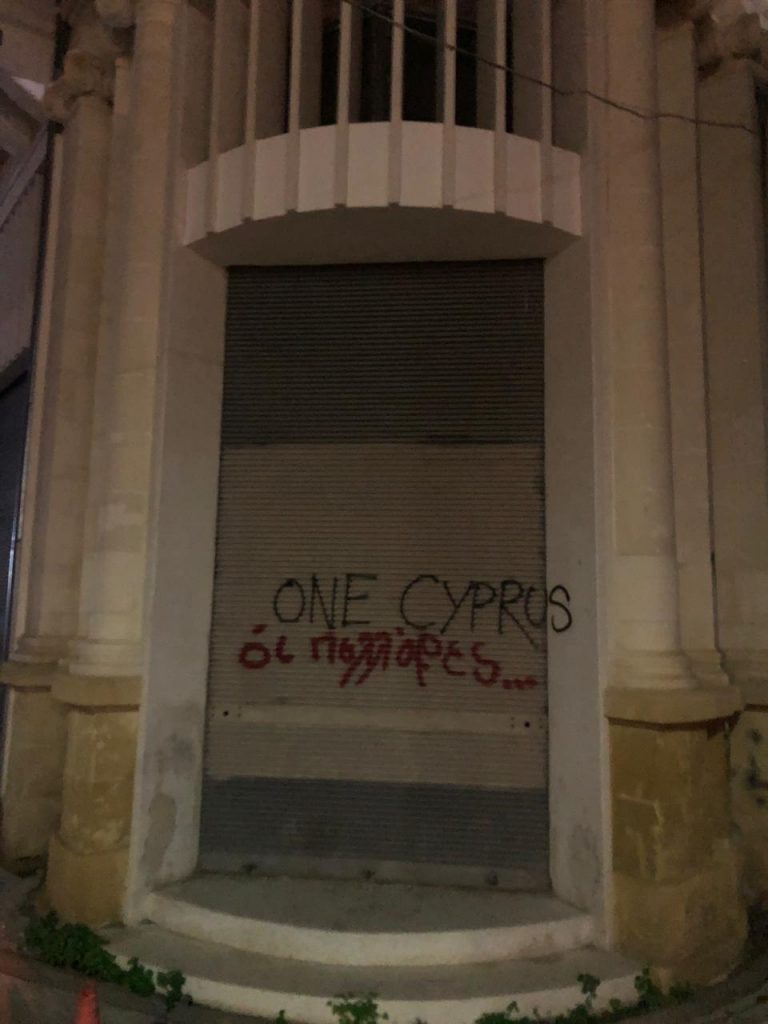
The city of Nicosia is still divided, with the Greek Cypriot and the Turkish immigration check-points located right in the middle of an old town. Graffiti painted in‘no man’s land’ demand an immediate end to the conflict: ‘One country; one nation solution’.
No man’s land in Nicosia
The crossing is busy.And to make it all somehow more colorful, perhaps, there is a huge white Pitbull, phlegmatically hanging around the border area. It does not bark; it is just there. Nobody knows whether he belongs to the Turkish or the Greek side, but it appears that he spends more time with the Turks, as, I suppose, they feed him better.
The Greek-speaking side of Nicosia looks like a slightly run-down EU provincial town. On their flank, Turks are smoking shisha (traditional Middle Eastern water-pipe), and their cafes appear to be more traditional, and the old architecture more elegant. In the southern part, freshly brewed coffee is called ‘Greek’, while a few meters north, you have to order ‘Turkish’, or at least ‘Arabic coffee’. Needless to say, you get the same stuff on both sides.
Otherwise, it is one island, one history and one sad and unnecessary partition.
*
The division of the nation is not the only madness here. Before you get used to the idea, you may go mental, finding out that there are two British administered territories still engraved into the island.
If you drive around, you will never notice that you are actually leaving Cyprus, and entering the U.K.Some car license plates are different to those regular Cypriot ones, but that’s about it.
You cross an invisible line, and you are in the UK; historically the most aggressive (militarily and ideologically) nation on the face of the earth.
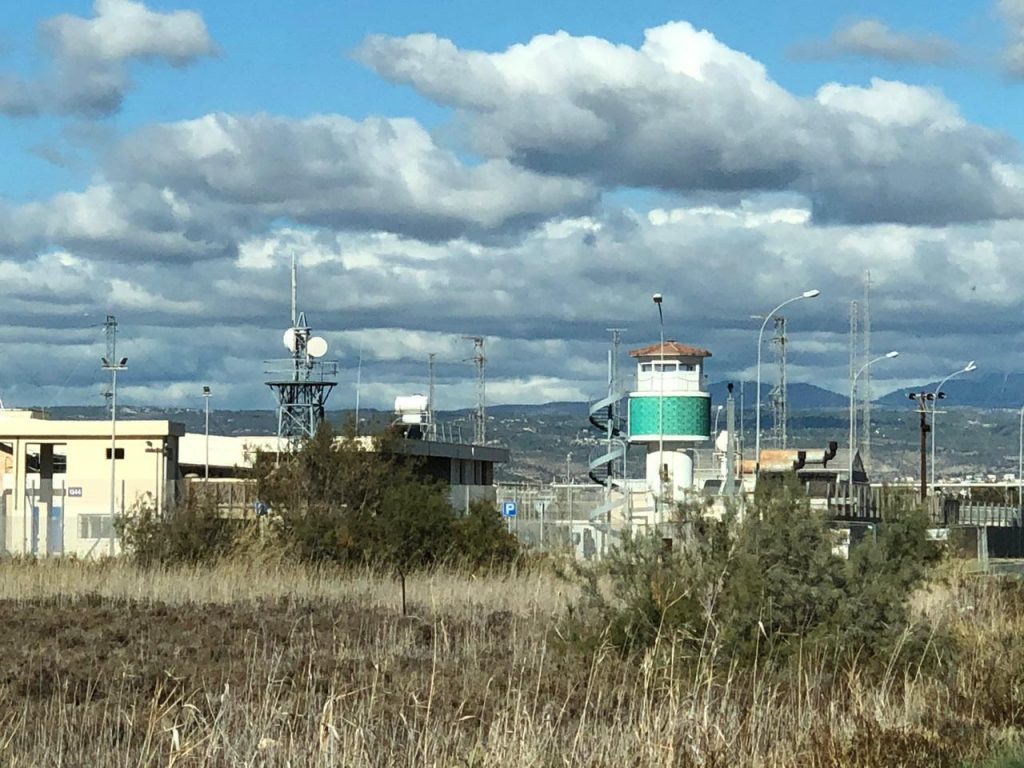
You drive through some agricultural fields, but soon you see something very eerie all around the road: a few kilometers after passing the historic Crusader’s Kolossi Castle, there is an ocean of masts of different heights and shapes, as well as concrete, fortified military installations.The masts are ‘decorated’ with strange looking wires. It all looks like some old Sci-Fi movie.
Vile British military installations in Akrotiri
Of course, if you come ‘prepared’, you know what you are facing: tremendous installations of the BBC propaganda apparatus aimed at destabilizing and indoctrinating the Middle East. But that is not all. This entire enclave – ‘Sovereign Base Areas of Akrotiri’(as well as Dhekelia a few dozens of miles to the east) -is here mostly in order to spy on the ‘neighborhood’ of the Middle East. While London is some 4 hours flight away, Syria is just a short distance across the water, and so is Lebanon.
Further south, after you leave the propaganda and spy installations behind, is a small village of Akrotiri; a typical picturesque Cypriot charming settlement, with an old church, narrow streets and humble local cafes.It sits on top of the hill. But you are, actually, inside the U.K. From here, you can see the blue sea, a salt lake and the city of Limassol; but you are on British turf. How come? Simple: after Cyprus achieved independence from the British Empire, in 1960, the Brits ‘were concerned’ that they could lose control over their military bases in Cyprus, and at least partially, influence over the Middle East.As this being unimaginable to the British imperialist mind, the U.K. arm-twisted the Cypriots into this bizarre arrangement which holds to this day.
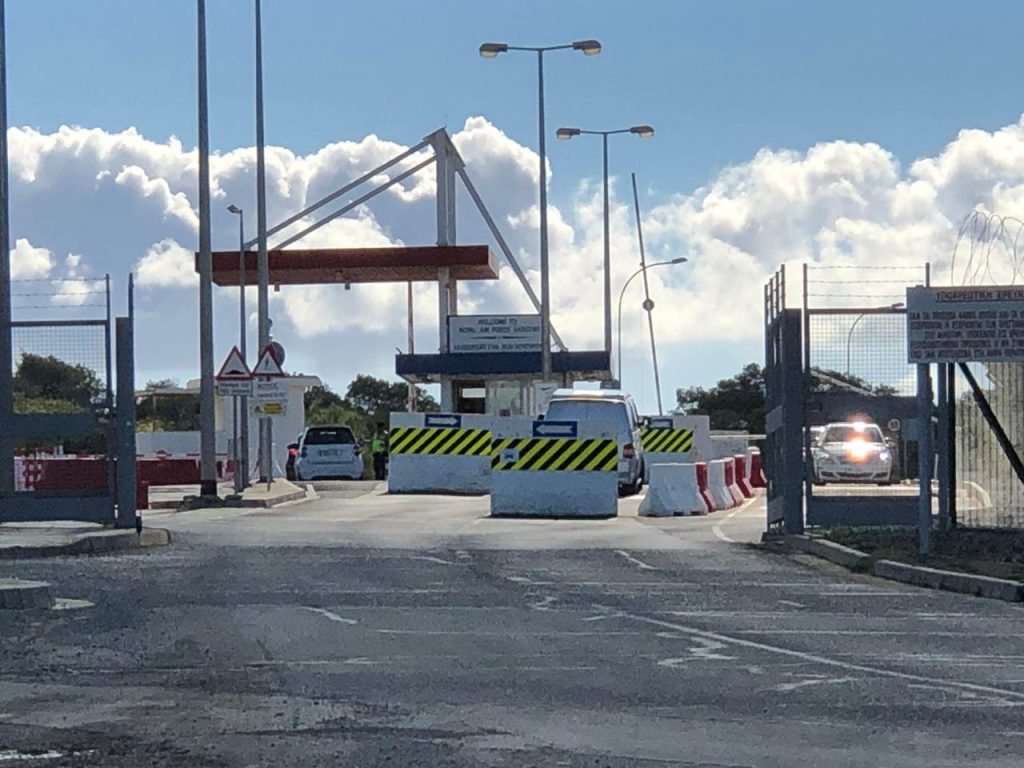
Entrance to Akrotiri RAF base
One more kilometer further south, and you hit the wall and a gate, decorated with threatening warnings. You are at the perimeter of the RAF Akrotiri base. From here, since December 2015, the RAF is carrying out illegal (according to international law) airstrikes against the sovereign Syrian Arab Republic.
According to Jeffrey Richelson & Desmond Ball, The Ties the Bind: Intelligence Cooperation between the UKUSA Countries, (Unwin Hyman, Boston/London and others, 1990, p.194 note 145):
“As of 2010, around 3,000 troops of British Forces Cyprus are based at Akrotiri and Dhekelia. Ayios Nikolaos Station, in the ESBA, is an ELINT (electronic intelligence) listening station of the UKUSA Agreement intelligence network.”
That was then, but now things are getting even deadlier. Practically, the U.K. is at war with Syria. Many in Cyprus are deeply concerned that Syria could retaliate, sending missiles against the RAF bases, from which it is being bombed (legally, independent Syria has the full right to defend itself against the attacks from abroad). Such retaliation could endanger the lives of the inhabitants of Cyprus.
There have been protests and demands for the British forces to return to Cyprus both of the ‘sovereign bases’, but the U.K. shows no interest in ceding what it controls.
As early as in 2008, former left-wing President Demetris Christofias (who was also the General Secretary of AKEL, the Communist Party of Cyprus) tried to remove all British forces from the island, calling them a”colonial bloodstain”.However, he did not succeed, and in 2013 he decided to step down and not to seek re-election.
Dhekelia Base is carved into the eastern part of Cyprus, bizarrely encircling both Turkish-controlled and Greek-speaking villages.
In the past, the Cypriots fought against the British presence. Nowadays, in the era of omnipresent surveillance, sabotages and resistance had been replaced by toothless protests. Still, hundreds of local people have been detained, demanding the departure of British troops from the island.
*
Cyprus is still divided, although reunification talks began, once again, in 2015. Now it is possible to walk between the Republic of Cyprus and Northern Cyprus (controlled by Turkey).
It was not always this way. As Papadakis Yiannis wrote:
“On 15 July 1974, the Greek military junta under Dimitrios Ioannides carried out a coup d’état in Cyprus, to unite the island with Greece.”
Thousands of Turkish residents were displaced, many killed. Turkey invaded and the island got divided. But inter-cultural violence dated even further back than 1974. The history can be felt on every corner of Nicosia, and in many villages of the island. Northern Cyprus was never recognized by any other country except Turkey, but the division is still there. There are still entire de-populated towns that used to belong to the displaced Turkish and Greek inhabitants.
One of the eeriest is Kofinou, in the south of the island, which suffered on at least two occasions, unprecedented ethnic violence, which could be defined as ‘cleansing’. Once inhabited mainly by the Turkish Cypriots, Kofinou is now a ghost town, dotted with collapsed houses and agricultural structures, with foreign guest workers and farm animals living in appalling conditions.
*
Cyprus has two faces. It is proud to be one of the famous European tourist destinations. It is an EU member.
Simultaneously, it is a symbol of division.
Border fences between the Republic of Cyprus and Northern Cyprus are scarring its beautiful countryside. Deadly British military installations, the air force bases, as well as propaganda warfare and disinformation campaigns are brutalizing, physically and morally, almost the entire Middle East.
Here, in Cyprus, European and Russian tourists coexist, uneasily. The ideological war between the West and the rest of the planet is clearly felt in Pathos and other historic areas of the island.
Some British residents (around 50,000 of them), as well as countless British tourists, often behave insultingly towards the generally humble Russian visitors. Here, the British Empire still appears to be ‘in charge’.
In the port of Pathos, I passed by an elderly Russian couple, who seemed to be simply admiring an old water castle. A British couple was passing by, then looked back and forged sarcastic, rude grimaces: “Those Russians,” uttered the man. This was not the only instance when I witnessed this sort of behavior.
In Cyprus, I drove exactly 750 kilometers, all around the island, trying to understand and define its present position, and its role in the ‘area’ and in the world.
I hoped to find reminiscences of at least some revolutionary spirit of the Communist (AKEL) government. But I almost exclusively found pragmatism, so typical for basically all European Union countries.Only questions like this were common: ‘Would Brexit be good or bad for Cyprus?’ Or: ‘Would the bombing of Syria be dangerous for the citizens of Cyprus?’
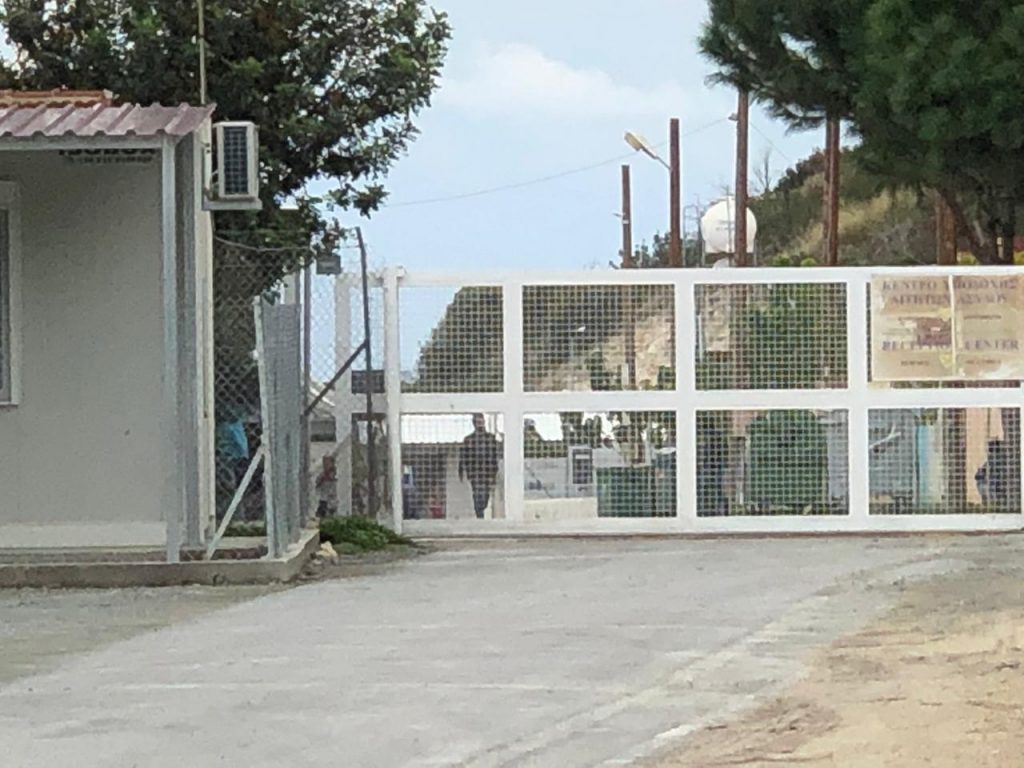
Refugee camp which is known as ‘prison’ near Kofinou
Symbolically, near the village of Kofinou, destroyed by the inter-cultural violence several decades ago, I found a tough-looking refugee camp, built mainly for the immigrants coming from the destabilized Middle East. It looks like a concentration camp. Locals call i
As I was driving around the area, I spotted, just a few kilometers from the camp, in front of an eerie and semi-abandoned farm, a huge goat.It was on its side; dying, in agony, in the middle of the road.
Cyprus has become a divided island with some hedonistic resorts, but also with terribly marginalized communities, located all over its territory.
One could easily conclude: this former British colony is still allowing, for a fee, the tremendous presence of the British/NATO military forces, as well as various spy facilities and propaganda outlets. RAF Tornado jet fighters are presently flying their ‘missions’ against Syria. Missiles are being fired from Akrotiri. People fleeing from the destroyed countries of the Middle East, are then detained in Cyprus, like criminals, behind barbed wire.
In the meantime, the people of Cyprus are calculating, whether all this is truly feasible, or not; whether to be an outpost of the empire is a good business, for as long as it pays, they will do very little to change the situation. Despite of its complex past and present, as well as its proximity to the Middle East, Cyprus is, after all, an integral partof Europe, and therefore of the Western empire.

What ails India’s women farmers?

Parvin Sultana

If one questions — what do women know about farming and agriculture, the answer will be pretty much everything. Women’s contribution to agriculture all across the world is exemplary. According to United Nation’s Food and Agricultural Organisation, if women had the same access to productive resources as men, they could increase yields on their farms by 20-30%. Nevertheless women continue to be invisible in the discourse on farmers’ suicides, agricultural crisis etc.
India recently witnessed massive farmers’ rally demanding relief. One dominant feature of these rallies was the presence of women farmers in large number. Their split, cracked bloody feet which bore witness to their hardships left many across the country stunned. While most mainstream news channels downplayed the importance of these rallies and emphasised on other trivial matters, few channels did manage to put a spotlight on them and focused more on the plight of women farmers. Women farmers across the states shared similar stories and most had to do with non-recognition of women as farmers.
The country continues to witness agrarian crisis of an immense nature. While the government policies fall short of providing any relief to the farmers, noted journalist P Sainath points out that the Fasal Bima Yojana is a total sham and benefits only the insurance companies and banks. The farmers are left out of its ambit. And the picture of farming crisis continues to be grim.
Maharashtra’s Vidarbha continues to be a region with a very high number of suicide cases. Over the last two decades, more than two lakh farmers committed suicide. Flawed insurance plans and delays in settling claims have worsened the distress. There is an increase in the number of households headed by women. There is a feminisation of agriculture with the number of female agricultural labourers in Maharashtra, Tripura and Kerala seeing an upward trend since 1961.
The Wire came out with a report titled “Surviving Stigma: Housing and Land Rights of Farm Widows of Vidarbha, Maharashtra”. It highlighted the plight of farm widows and the repeated human rights violation and economic exclusion. Nearly 90% of the women farmers lived in joint families indicating financial dependence on the in-laws. They complained of physical and emotional abuse upon demanding their share in the family house or land. On many instances, they faced social ostracisation. Most women are even unaware of their rights or are incapable of benefiting from the policies aimed at helping them.
Vidarbha once known for production of “white gold” or cotton is now known mainly for farmers’ suicides. In nearby Marathwada, a debt of as less as Rs 10,000 can push someone to suicide. The widows are pushed into more debts and forced to take job as farm labourers on other’s farms to sustain themselves. The education of their children is stopped midways.
Kota Neelima’s upcoming book “Widows of Vidarbha” gives an account of such women. For widows left behind, to die seemed easier than to live. Women farmers are usually rendered invisible in spaces of policy making. Farmers’ suicides are thrown around as statistics, used as propaganda, referenced in campaign speeches and dismissed as political ploy of the opposition.
In 2015, data reveals that 98 million women in India work in agricultural sector but debate around farmer’s suicides often revolve around men because women don’t own property and hence don’t qualify as farmers. Only 13% women own the land that they work on. Their status is worse than workers. While 60-80% of all agricultural work is done by women, they are just given the status of farm workers.
Added domestic responsibility does not free women of difficult jobs like sowing, seeding, threshing, harvesting, ploughing etc. Even at the local galla mandis, women farmers face serious discrimination. They are offered raw deals and often face sexual harassment.
There is already a spike in farmer suicides. Farmer suicides rose by 42% between 2014 and 2015. Out of the 8007 farmer suicides in 2014, 441 were by women farmers and cultivators.
The empowerment of Indian women will not be complete without empowering those who are living at the society’s periphery. These voices need to be heard at both the policy level and the implementation level.
An increasing male migration away from villages has brought about significant changes to the work village women do, both at the household and societal level. Migration has redefined women’s role in agriculture.
Women farmers need direct access to information on improved agricultural practices and links to markets. One positive step is marking October 15 as Women Farmers’ Day. But it has to be supplemented by policies. Lack of land rights is a big problem. They are unable to avail any benefit of government policies. The need of the hour is to change inheritance practices and give land rights to daughters as well.
A patriarchal social set up conveniently co-opts women’s agricultural labour but falls short of giving her the status of farmers. Women farmers’ rights need to be recognised as farming was never exclusively a man’s work. Policy benefits also should extend automatically to the wives of the farmers who commit suicide. While the overall agrarian crisis needs to be tackled with utmost urgency, the gendered aspect should also be looked into. Otherwise the women farmers will continue to be one of the most marginalised lot in India.

New Zealand government calls for greater US military presence in the Pacific

Tom Peters

During a recent visit to Washington, New Zealand Deputy Prime Minister Winston Peters signaled a further escalation in the Labour Party-led coalition government’s alignment with the Trump administration’s economic war and military preparations against China.
Peters is also Foreign Minister and leader of the NZ First Party, a right-wing nationalist, anti-Asian party. Despite receiving just over 7 percent of the votes in the 2017 election, NZ First was given several ministerial roles by Labour Prime Minister Jacinda Ardern and plays a major role in determining the government’s foreign and military policy.
Peters met with senior members of the Trump administration, including Vice-President Mike Pence, Secretary of State Mike Pompeo, Director of National Intelligence Dan Coats and National Security Adviser John Bolton.
Peters also delivered a major speech at Georgetown University on December 15, calling for a stronger US-New Zealand alliance in the Pacific. He declared that the South West Pacific was “becoming more contested and its security… ever more fragile.” He called on the US “to engage more” in the region, adding, “we think it is in your vital interests to do so, and time is of the essence.”
Clearly referring to China, Peters noted that “larger players are renewing their interest in the Pacific with an attendant element of strategic competition. The speed and intensity of those interests at play are of great concern to us.” He also pointed to the supposed “threat” posed by North Korea and by “militarised” islands in the South China Sea, which “challenge international law and norms.”
China’s territorial disputes with neighbouring countries in the South China Sea have been seized on by the Obama and Trump administrations as the pretext for a vast US military build-up in the region.
In an attempt to reverse its long-term economic decline, the US ruling elite is preparing for war against China, which it views as the main obstacle to its global hegemony. Washington is demanding unwavering support from all its allies, including Australia and New Zealand.
Despite New Zealand’s economic reliance on China, its largest trading partner, the Labour-NZ First government, which also includes the Green Party, has significantly strengthened New Zealand’s alliance with US imperialism. The government has redeployed troops to Iraq and Afghanistan and sent air force personnel to Japan to join the encirclement of North Korea. Most significantly, this year’s Defence Strategic Policy Statement echoed the Pentagon in labelling Russia and China the main “threats” to global stability.
In his Washington speech, Peters praised the historic collaboration of New Zealand with US imperialism in the Pacific, which he called a “vast canvas for the United States’ emergence as a global power in the nineteenth and twentieth centuries.” He listed the US colonies of American Samoa, Palau, Micronesia, the Marshall Islands, the Northern Marianas and Guam—some of which host important US military facilities and were the site of bloody battles in World War II.
Peters also mentioned New Zealand’s colonies Niue, the Cook Islands and Tokelau. For more than a century, NZ’s ruling class has relied on its major imperialist allies, Britain and the US, to support its own colonial ambitions in the Pacific.
The Deputy Prime Minister pointed out that since World War II “New Zealand has regularly answered the call when the United States has mobilised its friends in defence of its interests and international security more broadly.” Successive NZ governments have supported one US war after another, including in Korea, Vietnam, Iraq and Afghanistan.
The Labour-NZ First government, Peters said, had a “sense of urgency about Pacific risks” and recently purchased four new maritime surveillance aircraft “to do our share to promote regional security.” He praised US “military cooperation,” including “maritime security” and “support for training and equipment for Papua New Guinea, Fiji and Tonga.”
Peters’ call for further militarisation comes amid an intensifying anti-Chinese campaign in New Zealand, aimed at overcoming widespread anti-war sentiment and hostility to the Trump administration.
A central figure in the campaign is academic Anne-Marie Brady, who has denounced political donations by Chinese-born businessmen and demanded that New Zealand’s intelligence agencies monitor Chinese people involved in politics, business, universities, media and cultural organisations.
Without any evidence, Brady has accused Jian Yang, a Chinese-born MP in the opposition National Party, of being a Chinese Communist Party “agent,” a claim echoed by NZ First.
Brady has been promoted in the media as an independent “China expert”. One Fairfax Media columnist labelled her “New Zealander of the Year.” She is also backed by the Daily Blog, a nationalist publication funded by three trade unions.
Brady has received funding for her research from the Washington DC-based Wilson Center and the NATO military alliance and is supported by US Democratic and Republican politicians. In May, former US presidential candidate Hillary Clinton praised Brady for drawing attention to the “new global battle” against Chinese influence.
Visiting New Zealand this month, US Assistant Secretary of Defense for Asian and Pacific Security Affairs, Randall G. Schriver, revealed that he personally knew Brady and had spoken to her about “Chinese influence operations.” He told the media on December 11 that the Trump administration was ready to “collaborate” with NZ intelligence agencies in an investigation along the lines suggested by Brady.
Following Schriver’s and Peters’ statements, New Zealand’s spy agency, the Government Communications Security Bureau (GCSB), joined its US and UK counterparts in publicly accusing Beijing of carrying out a “global campaign” to steal intellectual property and commercial data, including from organisations in New Zealand. The agency provided no evidence for these claims.
Whistleblower Edward Snowden revealed in 2015 that the GCSB spies on China as part of the US-led Five Eyes intelligence network.
New Zealand’s integration into US war plans and provocations against China demolishes the claims by pseudo-left groups and trade unions that the Labour-NZ First-Greens government represented a shift to the left. In fact, the coalition was formed in October 2017, following the intervention of US Ambassador Scott Brown, who signalled that Washington wanted the new government to take a harder line against China.
With the anti-Chinese NZ First playing a central role, the Ardern government has ramped up the ruling elite’s agenda of austerity, nationalism and militarism, and is dragging the country into a potentially catastrophic confrontation between nuclear-armed powers.

As Australian government unravels, Labor prepares to take office

Mike Head 

This year is ending with Australia’s Liberal-National Coalition government being torn apart by factional warfare and the Labor Party steeling itself to take power under conditions of intensifying global tensions, economic slump and an eruption of working class struggles worldwide.
As in previous periods of crisis and war—during both world wars, the Great Depression of the 1930s and the global financial meltdown of 2008—key sections of the ruling capitalist elite are looking to Labor to protect their interests.
Today, however, the in-fighting wracking the Coalition marks a deeper political crisis that affects the entire parliamentary order. There is sweeping popular discontent with all the establishment parties, including Labor and the Greens. For decades, successive governments, both Coalition and Labor, have enforced a corporate assault on working class jobs, working conditions, living standards and basic services.
Feeding into the turmoil is the instability surrounding US President Donald Trump, combined with Washington’s escalating economic and military confrontation with China, Australian capitalism’s largest export market. These developments are sending shock waves through the Australian ruling class, which has relied on US global hegemony since World War II to pursue its own predatory interests throughout the Indo-Pacific region.
In response to this explosive situation, the Coalition’s most right-wing elements, orbiting around Home Affairs Minister Peter Dutton and ex-Prime Minister Tony Abbott, are striving to refashion the Liberal and National parties into a Trump-style populist and semi-fascistic movement to divert the unrest in nationalist directions.
Having ousted Prime Minister Malcolm Turnbull, a member of the Coalition’s supposed “socially progressive” wing, in August, these layers are prepared to destabilise the government of his successor, Scott Morrison, even if it means losing the looming federal election.
Last week the civil war inside both the Liberal and National parties reached new heights. A succession of scandals and politically-damaging leaks led to a split over energy policy with the New South Wales state Liberal government, which is desperately distancing itself from Morrison’s unraveling administration.
Morrison himself was accused of trying to protect a far-right parliamentarian by offering a lucrative Liberal Party job to a factional opponent.
The infighting then engulfed the rural-based National Party. One of its ministers was forced to quit, accused of sexual misconduct—now a prominent means of waging factional wars—followed by similar allegations against another as-yet unnamed government member.
Even with an election due by May, at the latest, National Party parliamentarians aligned with the Dutton-Abbott camp and former National Party leader Barnaby Joyce responded by making what media outlets described as a “flurry” of calls for the removal of current leader Michael McCormack. A previously unknown junior minister, McCormack was installed as the Nationals’ leader, and deputy prime minister, in February after Turnbull forced Joyce to quit—also via a sex scandal.
This instability has thrown into doubt the Coalition government’s ability to survive until May, when Morrison had said he would call a federal election after handing down an early budget in April.
Amid this worsening turmoil, last week’s Labor Party national conference in Adelaide became a platform for the Labor leaders, closely supported by the trade union bureaucrats, to assure the financial and corporate elite of their readiness to form a more unified pro-business and pro-US government, despite making anxious warnings about rising social unrest.
Carefully stage-managed performances brushed aside all the media speculation about likely “flash-point” differences on the floor of the conference, which had been designed to give Labor an image of a democratic party that could be pressured into adopting a more progressive course.
The power brokers of Labor’s various “Left” and “Right” factions and sub-factions, and the associated trade unions, came together to ensure a common front on every major issue, above all, unequivocal commitment to the US military and strategic alliance, and to “fiscal responsibility.”
Labor leader Bill Shorten concluded the conference by declaring that his party was “more united, energised and determined than ever.” At the same time, acutely conscious of the mounting social discontent and political disaffection, he ludicrously claimed it had been a conference of “passion and vision” under the logo of “Fair Go for Australia.”
Shorten’s message to the ruling class had been underscored during the conference by shadow treasurer Chris Bowen. He gave a press briefing to respond to the government’s Mid Year Economic and Fiscal Outlook (MYEFO), which predicted a budget surplus in 2019-20, for the first time since the 2008 crisis, despite growing signs of another global crash.
Bowen accused the Coalition government of “five years of confusion and chaos” since the last Labor government was defeated in 2013. He attacked the government from the right, accusing it of “giving up on budget repair.” By contrast, Labor was committed to a “good, prudent return to surplus” based on taking “difficult decisions.”
A Labor government, Bowen reiterated, would deliver “bigger budget surpluses” because Labor did not share the government’s assumption of “synchronised global economic growth.” Standing alongside Bowen, shadow finance minister Jim Chalmers said larger budget surpluses were essential as a “buffer for international circumstances.”
These comments were the only references made during the three-day conference to the prospect of another global crash, even though world financial markets had already fallen for several months and become increasingly volatile.
Nevertheless, despite Shorten’s assurances of Labor’s unity and determination, the conference was overshadowed by fears that working class struggles could break out of the control of Labor and unions. During his opening address, Shorten warned of mounting “distrust and disengagement, scepticism and cynicism” toward the entire political system.
In her address to the conference, Australian Council of Trade Unions (ACTU) secretary Sally McManus invoked the spectre of a tsunami of discontent. “Working people are crying out for action on insecure work and crying out for fair pay rises,” she warned.
Behind the empty rhetoric of a “fair go,” the Labor and union apparatus is preparing to seek to suppress working class resistance to the even deeper cuts to working conditions and living standards that the corporate ruling class will demand amid an economic slump and Australian involvement in a US war against China.
On the eve of the Labor Party conference, an Australian Financial Review editorial on December 14 drew attention to the conflicts engulfing governments and the old ruling parties in Europe and the US.
“Bill Shorten is likely to become only the fourth Labor Opposition Leader to take the party into government since World War Two,” it declared. The Coalition was “riven by the scars of leadership battles and disoriented by the wider instability of centre-right politics, such as the UK Conservative government’s civil war over Brexit and Donald Trump’s takeover of the US Republican Party.”
The editorial issued Labor its orders. It was “critically important” that a Shorten government “be more like Hawke-Keating than Whitlam or Rudd.”
The Hawke and Keating governments of the 1980s and 1990s repudiated the social reformist program of the Whitlam government of 1972 to 1975. They worked in partnership with the unions to restructure the economy along the lines required by global corporations, dismantling hard-won conditions of workers and imposing a massive redistribution of income and wealth in favour of the corporate elite.
The last Labor governments, those of Rudd and Gillard from 1996 to 2013, deepened this assault, and propped up the big banks and financial elite, while initially boosting social spending slightly as part of their efforts to restabilise the economy after the 2008 crisis.
The editorial welcomed the fact that Shorten “is no radical,” having been a long-time leader of the openly pro-employer Australian Workers Union. But it warned that Labor’s political pitch could be “overtaken by the populist politics of redistributing income and the backlash against big business.”
An editorial in the Murdoch media’s Australian on December 19 provided another indication of what the ruling class is demanding of a Labor government. It complained that the Coalition’s internal conflict, “drip-fed by scandal after scandal,” was corroding “political confidence.” This was making it “that much harder for true leaders to persuade voters to sacrifice something short term for reforms that serve an enduring national interest.”
This call for “sacrifice” is a warning. Any Labor government will be pledged to inflicting on the working class enormous cuts to living standards, working conditions, social services and basic democratic and social rights, under conditions of global economic breakdown and lurch toward another world war.

Nissan to lay off 1,000 Mexican autoworkers

Alex González 

On Thursday, Nissan announced that it would lay off 1,000 workers in its central Mexican plants in Aguascalientes and Morelos as a result of what the company calls “challenging market conditions.” The job cuts come in the wake of almost 15,000 layoffs by General Motors (GM) in the US and reports of potential job cuts by Ford as part of a new restructuring of the auto industry.
Given the complex auto production supply chain, the layoffs will have a devastating effect for tens of thousands of autoworkers across North America. Nissan currently sells one in five cars in Mexico and employs about 17,000 workers in the country. In Aguascalientes, Nissan has three assembly plants that employ 8,000 workers and 37,000 more workers indirectly through hundreds of auto parts plants that serve the facility. The CIVAC assembly plant in Cuernavaca employs another 3,500 workers and is the main direct and indirect job provider in Morelos.
Along with the job cuts, which are set to take effect in January, Nissan announced that it will decrease production at its two plants following a slowdown in the US and Mexican markets. The company’s sales dropped by 14 percent from January to December of this year, according to the Mexican Association for the Auto Industry (AMIA). The company has not released figures on how many workers will be laid off at each facility.
The job cuts will leave thousands of already vulnerable families scrambling for new sources of income under conditions of vast social want. According to government statistics, Aguascalientes had a poverty rate of about 30 percent in 2016, with about half of the population having at least one social deficiency, defined as a lack of access to adequate food, education, and other social services. In Morelos, about half of the population lives in poverty and about 75 percent of the population has at least one social deficiency.
The job cuts must be seen not as a state or national event, but as part of an international assault on the working class. While making massive profits, corporations are taking the offensive by demanding further concessions on wages and working conditions. The free-up of funds will be used to continue a program of stock buybacks to boost the portfolios of the wealthy shareholders.
Three weeks ago, GM announced that it would be closing five plants in the US and Canada, eliminating about 15,000 jobs in already heavily deindustrialized areas. This was shortly followed by Wall Street bank Morgan Stanley projecting that Ford may make 25,000 cuts. Earlier this year, about 950 Volkswagen and Audi Mexican autoworkers were laid off, as well as 500 workers at the CIVAC Nissan plant in Morelos.
Financial markets have rewarded the announced layoffs, with GM’s company stock rising by nearly 7 percent after the company’s announcement. This assault on workers takes place under conditions in which companies continue amassing billions in profits, with GM expected to make USD$10 billion and Nissan USD$4.5 billion in profits in 2018.
In response to these ruthless cuts, the nationalist unions in every country have defended the “right” of companies to destroy jobs and attack working conditions in order to maximize investors’ profits. Far from an organized fight to defend jobs, the Nissan Workers Independent Union’s response to the last round of layoffs in March was simply to promise to add workers to a shortlist to get rehired by the company.
The union’s pro-capitalist policies are coupled with poisonous chauvinism aimed at convincing workers that their enemies are not the elites that hoard all of society’s wealth, but poor workers in other countries that are exploited by the very same companies at different segments of the production process.
The government of Aguascalientes, like its counterpart in Morelos, bent over backwards to secure plants in the state. Nissan opened its first Aguascalientes plant in 1992 and its second in 2013. Its third plant, operating in conjunction with Daimler, started operations in December 2017. The CIVAC plant in Morelos opened its doors in 1966 and pays autoworkers among the highest salaries in the country at about USD$21 per day.
Now, the state government of Aguascalientes is seeking to contain anger by announcing limited support for thousands of affected families. Governor Alma Hilda Medina Macías announced a job fair in January, which, as workers know, is not a promise of job security or earning equal, let alone improved wages.
Mexican autoworkers are a key driver of the economy. Mexico is the seventh largest producer of motor vehicles, with the auto industry contributing 3.7 percent of GDP in 2017. The auto sector is the fourth largest employer in Mexico and counts among its forces some 700,000 autoworkers.
Autoworkers must use their objective economic and social strength to put an end to attacks on their living standards. They must link with other sections of workers, in Mexico and internationally, who face the same challenges and have the same class interests—well-paid and secure jobs, fully-funded pensions, an end to the assault on immigrants, and trillions for infrastructure, health and education.
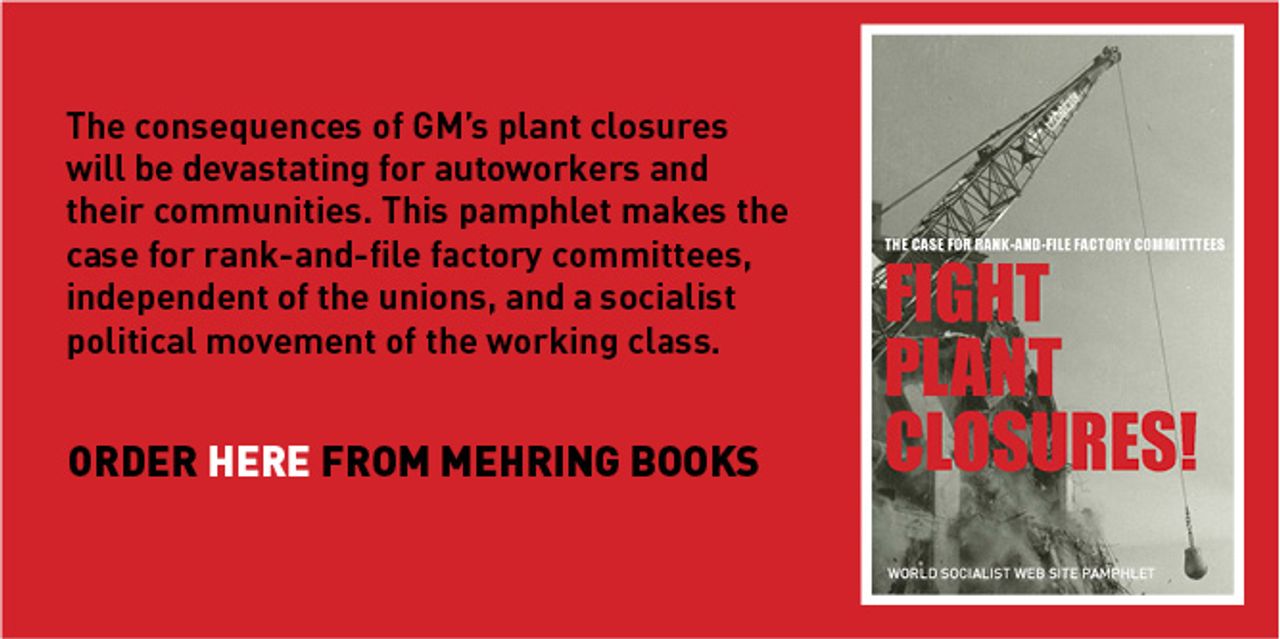
As the latest attack on jobs lays bare, the crisis of the capitalist system affects workers in every country. Nissan, GM and Ford are all international corporations that cannot be challenged with a national strategy. All autoworkers must carefully study the resolution passed by autoworkers in Detroit, Michigan to form rank-and-file committees, independent of United Auto Workers (UAW) and the Canadian Unifor, to coordinate and expand the struggle.
The resolution stated that the steering committee, which was formed after the meeting, must “mobilize workers on the basis of their own demands” and “establish lines of communication and collaboration with all workers—including auto parts workers, teachers, Amazon workers, service workers and others—and fight for the unity of American workers with our class brothers and sisters in Canada, Mexico and the rest of the world.”