12 Jan 2019

Microsoft 4Afrika Paid Internships 2019 for Young African Graduates

Application Deadline: 18th January 2019

Eligible Countries: All African countries

To be taken at (country): Internships are available across the African continent

Eligible Fields: There are internships available across the African continent in three distinct areas: sales, marketing and technical and we ask you to apply for one of these paths depending on where your skills and passions are. If you are successful in your application, you will be matched to great roles with Microsoft partners

About the Award: The Interns4Afrika program offers talented young people a unique experience with a dynamic and agile technology organization on the African continent. You will work for 6 months with a Microsoft partner on real projects, collaborating and learning from your colleagues. Whether you’re aspiring for a future in sales, marketing or technology, this is your chance to kick-start your future
To give you the best chance of success 4 weeks of your internship will be dedicated to developing world class business and technical skills. We’ll support you to rapidly develop your capabilities through the (virtual) classroom and the great work you will do.The competition for a place on Interns 4Afrika is tough but if you are entrepreneurial with a passion for technology, are keen to continue learning and have a flexible can-do attitude we want to hear from you. Join us today, and help shape the Africa of tomorrow.

Type: Internship

Eligibility: Apply if:
    • You are able to commit to completing full time internship for 6 months
    • You are currently in education or have graduated from an Undergraduate or Postgraduate course within the last 12 months
    • You have a BA/BSc in a business related or IT degree
  • You are based on the African continent and You have right to work in the country in which you are currently located
Number of Awardees: Not specified

Value of Internship: All interns will be paid a salary and will be located at and employed by the partner organization for the six-month internship period.

Duration of Internship6 months

How to Apply: Select your most suitable internship position and Apply now
Don’t forget to sell yourself on your application form and CV as the competition for this internship is tough!

Visit Internship Webpage for details

Award Provider: Microsoft

Digital Humanities – the perspective of Africa Conference 2019 (Funded to Leiden, The Netherlands)

Application Deadline: 31st January 2019

Eligible Countries: African Countries

To be taken at (country): Leiden, The Netherlands

About the Award: In 2019 the ADHO Digital Humanities conference will take place from 9-12 July in Utrecht, The Netherlands. In the week before DH2019, i.e. 1-5 July 2019, the Lorentz Center in Leiden (also The Netherlands) will host a satellite workshop aimed at the articulation of the specific developments in the field of DH that are taking shape in Africa and their potential to enhance the global DH agenda. In addition, attention will be given to capacity building and the planning of initiatives along the lines of ‘science4development’. The programme will include introductions into the infrastructural support for DH and the most widely used data analysis methods with the Humanities and Social Sciences.

Type: Workshop

Eligibility: The workshop will welcome students and early-career scholars from the African continent for a week of lectures, tutorials, presentations, networking and debate. The selected participants are expected to attend DH2019 in Utrecht as well.


Number of Awards: 20 

Value of Award: Grants to cover the costs for travel and accommodation during the Lorentz workshop and DH2019, plus the conference fee for DH2019 can be applied for. Participants and/or the institutions they are affiliated to will be asked for contribution to the costs of accommodation during the workshop and DH2019.

Duration of Programme:  1 July 2019 To 05 July 2019

Selection Criteria and Procedure: For the allocation of workshop places the following elements will be taken into account:
– motivation letter by applicant (700-1000 words)
– letter of support  by supervisor (max 1 page)

In their motivation letter applicants should indicate:
– their research interests and current or planned research;
– their digital skills and the DH competences they would like to develop
and/or to improve during the workshop;
– their earlier involvement in DH events (workshops, etc.) as a
participant or otherwise.

In the selection procedure extra weight will be attributed to applications from (co)authors of contributions proposed for the DH2019 conference programme. In addition diversity across the dimensions such as geography and gender will be sought.
The selection of participants is in the hands of a committee of scholars and experts involved in leading one or more workshop sessions.
Selected participants will be expected to prepare themselves for the workshop by submitting a personal profile that can be shared (template will be provided) with the workshop lecturers.


How to apply
  • It is important to go through all application requirements on the Programme Webpage see link below) before applying

Visit Programme Webpage for Details

Oil’s Wild Price Swings Set to Create Global Chaos

Andrew Nikiforuk

As the current global oil glut shakes up petro states around the world, oil prices are becoming more volatile than Donald Trump tweets.
Neither Canada, now the dumb owner of a marginal 65-year-old pipeline, nor Alberta, a key exporter of bitumen, a cheap refinery feedstock, has paid much attention to this revolution.
As a consequence Canada has no strategy to deal with the new normal of highly volatile oil prices.
Government incompetence explains the hew and cry in Alberta about its overproduction crisis and the various proposals to solve it, ranging from the purchase of rail cars (a bad idea) to the decision to order companies to cut production of heavy oil by about 325,000 barrels a day (a sensible idea).
Alberta’s panic attack is based on the idea that bitumen from the province’s oilsands producers is selling at a discount because of a lack of pipeline capacity.
The reality is that the dramatic 30-per-cent drop in oil prices since the beginning of October, from more than US$70 to US$50, is upsetting oil exporters, producers and markets around the world.
Different kinds of oil fetch different prices, based on their quality and transportation costs. And all are experiencing dramatic price drops. Alberta’s bitumen, a cheap refinery feedstock, is not the only crude languishing during a global market glut.
Refineries in Japan and Korea, for example, scooped up cheap U.S. oil earlier this year.
Texas is replaying the Alberta experience. Overproduction of light shale oil and gas in the Permian Basin in Texas has choked up pipelines and refineries and thereby lowered prices for West Texas Intermediate, much to the dismay of shale oil drillers.
Meanwhile China’s three biggest oil companies, including PetroChina, have lost $79 billion in market value since the beginning of October as oil prices plummeted this fall.
No one expects this growing oil price volatility to end soon, and many analysts suspect the unpredictability is signalling five important structural shifts in the global economy that political leaders have largely ignored.
1. Low oil prices can be a big problem
The physics of energy flows, not money, makes the world go around. The evidence strongly suggests that the last 300 years of economic growth were based on a constant supply of cheap energy.
For the last 150 years the quest for cheap energy has changed the planet. Humans, with the help of fossil-fuelled enterprises, now consume one-quarter of the world’s primary biological production. We have changed the atmosphere and made human beings the world’s number one predator.
As the master resource, oil and its affordability controlled the pace of the global economy and influenced the price of most other commodities. Economic recessions followed high oil prices just as booms generally accompanied low prices.
Societies that can increase energy consumption, such as China and India right now, generate more jobs, support higher salaries and service debt more easily. But societies experiencing declining levels of energy consumption, such as embattled Europe, are having trouble keeping people employed at decent wages. By any measure oil remains a keystone species in the complex ecology of a technological society.
Too much price volatility can cripple the entire global machine, and low prices for oil can trigger even greater disruption, argues Gail Tverberg, an actuary who writes about “Our Finite World.”
Tverberg says the problem is not demand for oil, but increasing problems with the affordability of oil.
“The maximum affordable oil price seems to decline over time,” she writes, as workers struggle with stagnant wages, income inequality and higher interest rates. While high oil prices slow consumption and lead to parked cars, low oil prices can disrupt the ability of oil producers to invest in new production capacity and lead to shutdowns.
Tverberg believes the global economy has entered a period where gyrating oil prices will clobber consumers and producers alike. Prior to the 1970s, oil prices worked for both consumers and producers, she writes. But now “the price that consumers can afford has tended to fall increasingly far below the price that producers require.” Price volatility guarantees that producers will find it harder and harder to assemble the capital they need to grow oil production, let alone service their debt levels.
Higher oil prices won’t solve the problem because they will only depress the global economy further. “The physics tie between energy and the economy makes major energy consumption cutbacks virtually impossible, without risking economic collapse,” concludes Tverberg.
2. Wild volatility emerges as the new normal
Tom Therramus, the pen name of a U.S. academic, argues that oil price volatility is a new cyclical trend that has been increasing rapidly over the last 15 to 20 years.
Writing in the blog Oil-Price.Net, he documents this new development. “Wave-like surges,” or spikes in price volatility, tend to erupt every three or four years like clockwork. In addition stock market volatility tends to follow oil price leaps and falls by six to 12 months.
This new volatility in oil prices is analogous to other trends like the increasing frequency of wildfires in forests destabilized by drought and climate change.
And oil price volatility is as dangerous as a wildfire. “Unpredictability in oil price, resulting from rapid changes (up or down) over short time spans, is bad news because oil, and more broadly fossil fuel, is the commodity that is most essential to the operation of a modern economy,” Therramus writes.
Therramus adds “that the world has not seen a phenomenon of this type previously and that its emergence marks the rise of a new dynamic with potential to shape our economic and political fate. The uncertainty that many of us feel thus may be far from nebulous, but a shared hunch that history’s engines are shifting gears.”
Therramus predicted the current bout of oil price volatility.
The Harvard Business Review now suggests that everyone should get used to “faster, shallower price rotations based on changes in production.”
For more than a decade the Alberta government has known that bitumen pricing is 60 per cent more volatile than prices for higher quality West Texas Intermediate. But it did little to buffer its economy or its industry.
3. The global economy is languishing
Economist Robert Gordon has written lucidly about the decline of economic growth in the U.S. In the world’s first petro state, economic growth has shrunk from 3.2 per cent a year in 1970 to 1.4 per cent in 2016. The author of The Rise and Fall of American Growth argues that the slowdown has been marked by rising inequality, stagnant wages and underemployment among college graduates. Taxi drivers with PhDs are one symptom. So, too, are the declining productivity of agricultural research and medical workers. Similar patterns have enveloped the economies of Japan, Korea and Europe.
Gordon suspects that society has exhausted the possibilities and benefits created by what he calls “the Great Inventions of the Second Industrial Revolution,” such as refrigeration, electricity and jet engines. It is becoming “ever more resource intensive” to find technologies or ideas that may have a major impact on the economy, he writes.
This analysis partly explains why populist leaders from Brazil to the United States now emphasize a return to greatness in their tweets and rallies.
4. The U.S. shale gale is disruptive
The U.S. fracking revolution has played a significant role in creating a temporary oil glut and destabilizing prices. Last summer the U.S. pumped 11.6 million barrels a day as its oil production surpassed Russia and Saudi Arabia. The U.S., still a net importer of oil, hasn’t been the world’s largest crude oil producer since 1973.
This novel increase has largely been achieved by shattering dense shale rocks with the brute force technology of hydraulic fracking.
Fracking requires mountains of sand and lakes of water: both sand and water demands have tripled since 2012. The technology also comes with enormous environmental liabilities including earthquakes, methane migration, flaring, land fragmentation and groundwater contamination.
The fracking of shale deposits costs more than mining conventional oil, and it can’t be done without cheap credit. Early this year the Wall Street Journal estimated that “the companies behind the U.S. oil boom together have spent $265 billion more than they generated from operations since 2010.” Only low interest rates and lax regulations have kept the fracking revolution alive.
Some U.S. analysts predict the shale boom will last until 2040. But other forecasters such as David Hughes and Art Berman predict the shale gale will peak much sooner — within 10 years — due to high depletion rates, increasingly hard to extract resources and high costs.
In the meantime, a global surge in oil production, largely driven by fracking in North America, has disrupted oil markets repeatedly and added to oil price volatility. Overproduction in shale formations contributed to the oil price rout of 2014 and the collapse of oil prices this fall.
If Canada had paid any attention to the shale gale over the last decade, it would have limited bitumen production rather than let regulators rubber stamp one oilsands project after another. Competent politicians would have encouraged limited refining near the oilsands instead of advocating for unlimited pipeline expansion.
5. Costly, hard-to-produce oil means diminishing returns
The quantity and quality of oil produced has changed dramatically, meaning diminished returns for all players. Mining bitumen in the boreal forest or fracking tight oil from the Permian require complex and expensive engineering.
Most of Canada’s bitumen production comes from high-cost steaming operations that use enormous amounts of natural gas (almost one-third of Canada’s annual supply) to boil water to produce steam that is pumped underground to increase bitumen production. In the U.S., about half of all oil production comes from dense shale formations requiring high-cost fracking and horizontal drilling.
Bitumen and light oil from dense shale formations share a common trait — poor quality that adds to the cost of refining them. Bitumen requires upgrading while light oil poses a different set of refinery challenges, including contamination with paraffin waxes and hydrogen sulfide.
French geologist Jean Laherrère notes that shale oil is of substantially lower quality than conventional oil. So an increase in the number of barrels being produced does not mean an equivalent increase in energy value.
The more energy and capital that technological society throws at oil extraction, the more fragile it becomes. A hundred years ago companies drilled a hole and oil gushed from the ground. Now they are smashing concrete-like formations with extreme force or melting oilsands with steam to coax out lesser-quality oil.
In the process, the world’s oil and gas industry has gone further and further into debt to cover the cost of mining these extreme resources.
Low prices and more volatile pricing are not only big problems for the industry, but even bigger problems for oil-exporting states dependent on oil revenues.
Art Berman, the Houston analyst, calculates that the global industry needs a world oil price between $60 and $70 to recover costs. The price today is $50.
What does it all mean?
The lessons from these new realities are complex, but important.
The global economy is failing, with diminishing returns for the 99 per cent. Elites around the world are fighting among themselves over the remaining spoils.
Economic stagnation has plunged oil prices into chaotic volatility. (Or has the irrational pursuit of extreme resources such as bitumen and tight oil helped to unhinge the global economy?)
Canada promoted oilsands production based on forecasts of $100-a-barrel oil. The price reached that level in 2008, and then plunged. Volatility has ruled since. Canada and Alberta have also pretended bitumen, a cheap refinery feedstock, would command the same prices as higher quality oil.
Global markets have delivered the truth. Garbage crude is always garbage crude until you add value by upgrading and refining it. And when prices swing, low-quality oil takes the biggest hit.
Companies can compensate for oil price volatility in the short term by hedging, storing the product or by operating refineries and adding value. Governments can curtail production, as Alberta Premier Rachel Notley reluctantly did. (And yes, the price of heavy oil rallied.)
But the increasing waves of oil price volatility ultimately create political and financial instability. Petro states then practice extreme politics to contain the resulting unrest. And the U.S. is one of the world’s most conflicted and dysfunctional petro states.
Technology does not create energy. It merely accelerates the depletion of resources by providing more complex, costly ways of extracting what poorer hydrocarbons remain.
And no, it’s not just fossil fuel resources that are depleted. Cheap oil lets companies build bigger boats with bigger engines to use bigger nets to catch smaller fish, even as stocks are destroyed.
These energy dynamics also explain the repeated global political failure to face the disruptive anarchy of climate change. Minds conditioned by Titanic economic thinking have lost all connections to traditional instincts for survival, and don’t believe in icebergs.
Just as they ignore the reality that, in the absence of courageous political leadership, complex energy systems, like cod stocks, can collapse without much warning.

Financial warnings point to Australia’s economic and political instability

Mike Head 

Two warnings by global financial firms about the precarious state of the Australian economy in the face of the US-China trade war and global financial turmoil have underscored the ruling elite’s deepening economic and political predicaments.
This week’s reports, one by the Fitch ratings company and the other by Morgan Stanley, the American multinational investment bank, raise the spectre of a financial crisis that would blow up the pre-election claims of both the Liberal-National Coalition government and the Labor Party opposition.
They also point to the possibility of Prime Minister Scott Morrison, who was installed via a backroom Liberal Party coup in August, calling a snap election to try to scrape back into office before the economic storm fully hits.
Last November, with the government wracked by electoral defeats and ongoing factional warfare, Morrison sought to hold it together for a few more months. He announced that Treasurer Josh Frydenberg would produce an early “surplus” budget in April, effectively paving the way for a federal election in May, which is the latest possible month.
However, this week’s reports expose the unreal assumptions behind the government’s claim to be ready to produce the first budget surplus since the 2008 global financial breakdown. They also indicate deep concerns in the ruling capitalist class that a sharp deterioration in economic conditions will intensify the discontent in the working class over decades of worsening social inequality and declining living standards, particularly since the last global crash in 2008.
According to Fitch, a slowdown in the world economy will cut anticipated government revenues, stopping the Coalition from reaching a budget surplus.
Fitch forecast a relatively small budget deficit of 0.1 percent of gross domestic product (GDP) for 2019–20, doubting Frydenberg’s December mid-year budget update, which predicted a surplus of $4.1 billion (0.2 percent of GDP) in 2019–20.
Fitch expected Australia’s economic growth to slow to 2.5 percent in 2019 from 3 percent in 2018, due to weaker corporate investment and exports. It said the Chinese government’s bid to diversify its economy away from heavy industries, combined with China’s “ongoing economic growth deceleration” would “bode poorly for Australia’s mining exports.”
“Gloomier economic growth prospects” would also “slow hiring and wage growth,” undercutting the government’s extraordinary “revenue growth projection of 8.1 percent in fiscal year 2019.”
Fitch’s predictions themselves understate Australian capitalism’s exposure to the fallout from the Trump administration’s economic confrontation with China. The Australian corporate elite is becoming “collateral damage” in the offensive launched by the US ruling class, its largest source of foreign investment, to assert America’s post-World War II global supremacy. Signs are emerging already of the impact on China, which has become Australia’s largest export market over the past 15 years.
The Fitch warning ignited speculation of a possible early election. “As the economy slows in certain respects and global headwinds grow stronger, the option of a March election remains open to Scott Morrison,” the Australian Broadcasting Corporation (ABC) reported.
Interviewed on ABC radio on January 10, Frydenberg played down talk of an early poll. Nevertheless, he acknowledged “some cold headwinds in the global economy, particularly some of the trade tensions we’ve seen.” He also admitted that rising US and global interest rates could affect “the credit dynamic in the domestic economy.”
This was a veiled reference to rising mortgage interest rates and falling real estate prices, which are threatening to cause widespread mortgage defaults. Already an estimated one million households are suffering mortgage stress, with their household income insufficient to cover living expenses.
Asked again on ABC television’s “7.30” program that night whether he could guarantee there would be no election before April, Frydenberg was evasive. “Well, the prime minister has been very clear that I’ll be delivering a budget on April the 2nd, this will be an important economic document,” he replied.
On the same day, the London-based Financial Times, a voice of global capital, published an article headlined: “Australia’s house price slide prompts worries about economy.” It reported the latest warning, issued by Morgan Stanley, of an accelerating reversal in the housing market bubble that largely underpinned Australian capitalism after a decades-long mining boom began to implode in 2012.
“National house prices fell 1.3 percent in December, the largest monthly fall since 1983, which resulted in an annual decline of 6.1 percent last year,” the newspaper reported. “Prices in Sydney, the country’s biggest property market, are down 11.1 percent from their peak, according to Morgan Stanley, which warned this week the slump could torpedo Australia’s run of 27 years without a recession—a modern global record.”
Daniel Blake, lead author of the Morgan Stanley report, told the Financial Times: “Our models show that Australian households are most exposed of any G10 country to a housing slump and face a period of deleveraging, leaving growth heavily reliant on public spending on health, education and infrastructure.”
After years of sky-rocketing dwelling prices, which have enriched a host of billionaire developers and speculators, total Australian household liabilities have increased to more than $2.5 trillion, according to the Australian Bureau of Statistics. Household debt has burgeoned from about 60 percent of disposable income in 1998 to around 200 percent—one of the highest levels in the world.
Morgan Stanley’s report followed a similar warning by Core Logic, which tracks property prices. A wider financial crisis could result because mortgage debt accounts for over 60 percent of the assets of most major Australian banks.
The Labor Party’s response to Fitch’s report was just as duplicitous as the government’s. Labor’s shadow treasurer Chris Bowen said the report was concerning, but made no mention of how the economic reversal would affect his party’s own pledges to the financial markets to produce bigger budget surpluses than the Coalition.
If Labor were to regain office by exploiting the widespread hostility to the unraveling Coalition, it would again form a pro-business government, as it did from 1983 to 1996 and 2007 to 2013, working closely with the trade unions to suppress workers’ opposition.
Sections of big business are looking to Labor to protect their interests as the Coalition’s most right-wing elements, orbiting around Home Affairs Minister Peter Dutton and ex-Prime Minister Tony Abbott, strive to refashion the Liberal and National parties into a Trump-style populist and semi-fascistic movement to divert the social discontent in nationalist directions.
At Labor’s national conference last month, the Labor and union leaders warned repeatedly of rising working-class unrest. They said a Labor-led government was essential to prevent the disaffection with the parliamentary order from boiling over.
Labor leader Bill Shorten warned of mounting “distrust and disengagement, scepticism and cynicism” toward the entire political system, while Australian Council of Trade Unions secretary Sally McManus warned of a tidal wave of discontent over casualised employment and falling wages.
The truth is that whichever party heads the next government, it will seek to make the working class pay for the emerging crisis by further gutting social spending, driving down real wages and breaking up working conditions. At the same time, it will boost military spending to meet Washington’s demand for Australia to remain unconditionally behind the aggressive US offensive against China.

Was the hack of German politicians data supported by the state?

Ulrich Rippert

News broke at the beginning of January that personal and political data from German politicians, well-known musicians, and journalists was stolen and published online. According to current figures, 994 active or former politicians have been affected by the hack.
The main content of the leaks was personal contact information, including phone numbers and addresses, as well as internal party documents like application letters to party congresses. In a few cases, highly sensitive personal information was made public, including pictures from personal ID cards, documents confirming direct debit payments from bank accounts, chats with family members, and credit card details of relatives. Some of the documents are several years old.
The data was published before Christmas on Twitter in the style of an advent calendar. The account which published the data has more than 17,000 followers. Personal details from celebrities have been repeatedly published there since 2017. Media reports have noted that multiple copies have been made of the data, making it almost impossible to delete.
At a press conference on Tuesday, federal Interior Minister Horst Seehofer (Christian Social Union, CSU) announced that the security agencies would take tougher measures in response to the hack. “The investigators responsible are working at top speed,” he said. A suspect has already been questioned and is cooperative, he added. The suspect is a 20-year-old student from the state of Hesse. The Interior Minister praised the “swift investigation,” and thanked the security agencies for “good and rapid cooperation.”
In the future, the cyber-security sector would be a focus around the clock, Seehofer declared. A new draft security law is almost complete and will be presented in the first half of 2019, he added. The Federal Agency for Security (BSI) will hire more personnel. The qualifications of BSI workers will also be reviewed more closely and improved in the future.
Seehofer said nothing about the fact that signs point to far-right forces around the Alternative for Germany (AfD) being involved in the attack. And it is well known that the right-wing party enjoys strong support from the security agencies.
A glance at the facts suggests that the data hack was part of the political conspiracy which the federal government has used to impose its policies of militarism and the strengthening of the repressive state apparatus to suppress all opposition in the population.
Firstly, it is noteworthy that of all the parties represented in parliament, only politicians from one remained unaffected by the hack: the AfD. 56 percent of parliamentary deputies, or a total of 398, have been affected, including 204 from the CDU/CSU, 90 from the SPD, 47 from the Left Party, 31 from the Greens, and 26 from the Free Democrats, but not a single one of the AfD’s 91 deputies.
The source of the attack also points to far-right circles. Die Zeit has carefully examined the case, and came to the conclusion, “It is not yet possible to say who exactly was responsible for stealing the data. But the people associated with the accounts provide further indications that those responsible are active in right-wing politics. The main account, 0 rbit, participated in right-wing extremist discussions on Twitter.”
According to Die Zeit, other far-right accounts have ties to the main account, including AN_Ofiziell (anonymousness), which is active in right-wing politics and presents itself as part of the Anonymous hacker group. The twin account anonymousnews.ru was also connected to the main account. The suspected person behind the account is a right-wing extremist from Erfurt who was sentenced to two years and ten months in prison in December 2018 due to illegally trading weapons. The man filed an appeal against the ruling and is currently free under strict police surveillance.
Julian Reichelt, editor-in-chief of the Bild newspaper, pointed to another aspect of the case Tuesday that undermines the official narrative of a lone 20-year-old student living out his fantasies of unlimited power online. It concerns the huge set of data he is currently reviewing and analysing with a trained team of specialist investigative reporters. “This wasn’t one or two boys eating pizza and drinking cola in a basement. It must have been a larger structure. The most likely explanation is that there was state support for this hack, regardless of where it came from,” Reichelt explained.
The Bild editor-in-chief indicated that a state “possibly with subversive intent,” tried to undermine the Federal Republic, but then wrote, “According to the investigators, there is no political motivation, nobody pulling the strings from Russia, China, or another country.”
The question is therefore posed: was the data hack organized by the AfD’s far-right network, which reaches deep into the state’s security apparatus and is used by the government to enforce its right-wing, anti-social, and militarist policies?
The right-wing extremist networks, which are present in all parts of the state apparatus, are well known.
Last summer, the head of the domestic intelligence agency, Hans-Georg Maassen, was removed from his post after defending neo-Nazi marchers in Chemnitz.
In its latest report, the domestic intelligence agency neglects to mention the AfD, even though it regularly agitates against immigrants, promotes racism, and trivialises the Nazis’ crimes and the Wehrmacht. By contrast, the Socialist Equality Party (SGP) is named in the report as a “left-wing extremist” party, with the justification that it criticises the capitalist system.
In the army, a neo-Nazi network was discovered when the terrorist plans of Franco A. were accidentally revealed. The army officer, who had procured firearms and apparently planned attacks on high-ranking politicians, had registered himself as a Syrian refugee. He seemingly planned to blame his crimes on refugees. Nonetheless, the Frankfurt Court of Appeals saw no reason to press charges against him.
When Focus magazine published new details in November about the “conspiratorial network of around 200 soldiers in the army,” other media outlets ignored the revelation and the issue was quickly dropped.
A far-right cell in the police in Frankfurt was recently exposed, which described itself as “NSU 2.0”—a reference to the neo-Nazi National Socialist Underground terrorist group.
The existence of a right-wing conspiracy within the state apparatus is thus not the product of conspiracy theories, but bitter reality.
This is the context within which the political campaign to defend the AfD which began immediately after the data leak must be understood. A violent attack on the leader of the right-wing party in Bremen served as the pretext for politicians to line up with statements of solidarity for the AfD. On Tuesday morning, contrary to all the facts, a report was spread claiming that the AfD member was beaten severely by three masked individuals with a wooden baton.
Later, after footage from security cameras was reviewed, it was confirmed that the AfD politician was pursued by three men, who attacked him from behind. A spokesman for the Bremen state prosecutor stated that the pictures showed “nobody kicking someone lying on the ground,” and nobody striking the victim with an object.
Despite this, media outlets have reported the attack as an attempted murder, and all parties have declared their support for and solidarity with the AfD.

Security personnel at German airports continue protest strikes

K. Nesan & Marianne Arens

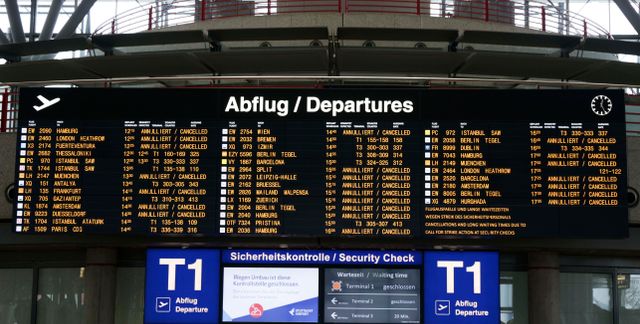
Security staff at three airports across Germany went on strike again Thursday for better pay and working conditions. Security personnel at Stuttgart, Cologne/Bonn and Düsseldorf airports took part in the all-day protest strike. Protest strikes had already taken place at Berlin Tegel and Schoenefeld on Monday. A further strike by security is expected to disrupt flights Tuesday at Frankfurt Airport, the largest airport in the country.
Striking workers in front of the Stuttgart Airport
Almost 650 flights, well over half, had to be cancelled Thursday: 131 of them at Cologne/Bonn (out of 199), 370 at Düsseldorf (out of 570) and 142 flights (out of 275) planned at Stuttgart.
The workers, who are employed by different companies, including Fraport Security and Securitas Aviation, started their strike at 3:00 a.m. with the early shift. At Cologne/Bonn airport, the strike began at midnight, as there is no ban on night flights at this location.
The work stoppages make clear the enormous anger of security staff and their willingness to fight. They confront extremely stressful working conditions combined with meagre salaries.
Over half of the planned flights were cancelled
There is a great deal of sympathy and solidarity with the strike among the wider population. “Everybody wants to earn his or her money, so I think the strike is right”, said one person in Düsseldorf, even though he lost a lot of time due to the strike and had to travel by bus from Düsseldorf to Paderborn.
Virtually all those affected who were interviewed by TV reporters expressed their understanding for the strike. One traveller said, “You have to see the big picture. We have had a miserable wage development here in the last year and a half. This is the result now.” Another says, “I have nothing against the strike, I can understand their anger.”
A woman who had to put up with a longer wait said, “People have to get their money too. Of course, it’s daft that it’s us who are affected. But when they achieve their goal, it should be okay.” A business traveller in Stuttgart said that although he was experiencing great difficulties due to the strike, he sympathized with the aim of the strikers.
There is no doubt that the security staff—and many other airport workers who have recently gone on strike—are prepared to take up a serious fight for a fundamental change in their miserable situation.
However, they cannot effectively defend their interests if the Verdi union controls their industrial action.
Verdi already conducted four negotiations last year with the German Air Security Association (BDLS), most recently on December 20 and 21. The employers are not prepared to raise wages by more than two percent per year—for many workers that is just forty cents more per hour.
The companies who work as subcontractors of the Federal Police at the airports formed BDLS in 2018. This is why Verdi is now, for the first time, negotiating a nationwide contract with this new employers’ association in Berlin. Nevertheless, according to the employers, East German workers should not receive the same salary as their colleagues in the West for another five years.
A discussion with two representatives of Verdi in Baden-Württemberg was very illuminating. Both made it clear that Verdi had no intention of mobilizing workers together to effectively push through the goal of a 20 euros hourly wages for all.
Eva Schmidt and Dominik Bollinger, Verdi Baden-Württemberg
Questioned whether it would not make sense to strike together for a uniform nationwide wage, Verdi secretary Dominik Bollinger said this was not possible. There were “clearly defined negotiation procedures, we must adhere to them... There is the Friedenspflicht [a union-agreed pledge of ‘industrial peace’]. There’s no point in escalating a negotiation.”
“We are conducting negotiations with the employer with a view to reaching agreement,” Bollinger continued. He made clear that Verdi had never seriously accepted the aim of 20 euros for all, when he added that “one must also be able to lose”.
Eva Schmidt, head of the services department in Baden-Württemberg, explained, “We are only in the protest strike phase and not an all-out strike.” Verdi wanted to “give employers the chance to call us back to the negotiating table with a better offer before 23 January”.
A reporter from the World Socialist Web Site raised the question of a joint strike by all airport workers. He pointed out that strikes had been happening at airports for several years: among ground staff, against exploitation at Ryanair, among Lufthansa crews—pilots and flight attendants, against dismissals following the Air-Berlin bankruptcy, etc. “Wouldn’t a joint strike make sense?”
The Verdi officials immediately sought to play down the issue. Schmidt said that these were all “different areas, different collective agreements with different terms.” She was only responsible for security personnel, but not for the other areas.
The WSWS reporter then confronted the Verdi functionaries with the fact that the “yellow vests” protests in France had originated outside the trade unions and independently of them. Neither Schmidt nor Bollinger wanted anything to do with this and spoke out against the yellow vest demonstrations.
“The protest in France takes place in completely different conditions,” declared Bollinger, there was a “completely different legal basis” in France. His colleague argued, “France has a very different strike culture.”
Significantly, both immediately resorted to the slanders that were spread in the bourgeois media about the “yellow vests.” Schmidt said that she “generally did not think it good to use violence,” and Bollinger stressed that violence against police officers was “unacceptable.”
Strikers at Stuttgart Airport
These statements alone make clear that the security staff cannot achieve their demands through the negotiations that Verdi is conducting with the BDLS. While the workers are willing to strike and conduct a real struggle for higher wages and better working conditions, Verdi is trying to prevent just that.
Verdi is on the side of the employers’ association and is conducting the fifth round of negotiations “in the spirit of agreement.” This means that Verdi will make sure a compromise is reached that secures the profits and competitiveness of the companies.
Security staff can only effectively fight for their concerns if they begin to organise independently of Verdi. Like autoworkers in the US, who took the first steps at a December 9 meeting in Detroit, they must build action committees linking up with all workers, including those in other areas, establishing contact with airports across Europe and fighting for the international unity of the working class.

Jaguar Land Rover announces nearly 5,000 UK job losses in global restructuring

Robert Stevens

Jaguar Land Rover (JLR), the UK’s biggest car maker, has confirmed that 4,500 jobs will be lost in Britain.
The redundancies represent around a tenth of its 44,000 strong UK workforce. The company, owned by Indian-based Tata Motors, has UK plants in Halewood, Solihull, Castle Bromwich and Wolverhampton. Internationally it employs a total of 53,000 workers, with operations in India, Ireland, Austria, Slovakia, Brazil, China and the United States.
The job losses are part of restructuring plans by the firm to cut costs by £2.5 billion. The announcement was made Thursday, the same day that the Ford Motor Company announced it would shed thousands of jobs in Europe. BBC Wales reported yesterday that this includes plans to slash 370 jobs at the Ford Bridgend engine plant in south Wales, which employs 1,700 workers, in a “first phase” of up to 1,150 job losses by 2021.
As with all car producers, JLR operates in a cut-throat environment and is constantly reducing its costs and increasing productivity. Last year, JLR shed 1,000 roles at its flagship plant in Solihull and reduced working hours at other sites amid falling demand for its diesel vehicles and saloon cars. Costs have been reduced further, with the company opening a plant in Slovakia employing 1,500 workers.
Last October, JLR posted losses of £90 million and has seen a collapse in sales by nearly 50 percent in its main and most profitable market, China. Reflecting growing trade tensions between the US and China, and a marked slowdown in its economy, last year the Chinese car industry recorded its first fall in sales for more than 20 years. The China Passenger Car Association reported that 22.7 million units were sold last year, a decline of six percent.
JLR manufactures a range of vehicles in Britain, with Castle Bromwich producing the Jaguar XE, XF and F-type models. Solihull makes the Jaguar F-Pace, Land Rover Discovery and Range Rover models. The Ryton and Halewood operations manufacture the Jaguar XE SV Project 8, Range Rover SV Coupé, Land Rover Discovery Sport and Range Rover Evoque. JLR is to shift production of its Land Rover Discovery model to Slovakia.
The company said the losses were the next stage of its “transformation programme” to be imposed over the next 18 months, resulting in “cashflow improvements” and “a leaner, more resilient organisation with a flatter management structure.”
By the end of 2019, it is estimated that JLR’s UK workforce will be down to 38,000. The company have not yet announced which positions will be lost, but it is expected that managerial, research, sales and design staff will be hit. Job losses in the car industry have a massive knock-on effect in the many linked sectors. Five other jobs are dependent on each manufacturing job at an auto plant. Around 800,000 jobs in the UK are bound up with the car industry, with 170,000 involved in production.
Announcing the redundancies, JLR chief executive Ralf Speth said, “We are taking decisive action to help deliver long-term growth, in the face of multiple geopolitical and regulatory disruptions as well as technology challenges facing the automotive industry.”
Central to these geopolitical disruptions is Brexit and the widespread fear among car manufacturers over its impact. The UK is scheduled to leave the European Union in less than three months, on March 29. If Prime Minister Theresa May is unable to get her deal with the UK accepted by parliament, the real possibility exists of a “no-deal” Brexit threatening the auto industry with unprecedented turmoil.
Over half of UK car exports are destined for the EU and two-thirds of car imports come from the EU. UK car industry bosses all supported a Remain vote in the 2016 referendum and lobbied May to opt for a soft Brexit, including tariff-free access to the single market. Losing access to the EU’s Single Market and Customs Union would disrupt supply chains and brings the spectre of queues of lorries choking up the ports. With something like 15,000 components going into the production of a single car, these factors are life and death issues for the industry.
Speth voiced these concerns again this week. When asked by Sky News if a no-deal Brexit could be problematic, he responded, “It would be a huge problem for the company because [of] … the physical logistics to produce 3,000 cars in the UK daily... if we miss a part, we have to stop production, and stopping production costs between £80 million and £100 million per day.”
Amid growing economic crisis, workers fear that implications of the loss of some of the last decent paying jobs in the declining manufacturing sector that now represents less than 10 percent of the UK economy.
There is a widespread sentiment to fight job losses. The BBC cited one worker, speaking anonymously, who works at JLR’s plant at Whitley near Coventry. He said, “It’s not clear what’s going on,” adding, “I’ve got a young child, so I could really do with not losing my job right now.” He insisted, “I’m fighting for my job... It’s not worth the risk for me to take voluntary redundancy.”
This willingness to fight was expressed in the wildcat strike by an entire shift last November of Vauxhall car workers at Ellesmere Port near Liverpool, just a few miles from JLR’s plant in Halewood, Merseyside. After being told by local Unite trade union representatives that 241 jobs were to be lost, workers immediately walked out. Vauxhall is owned by PSA, who also own Peugeot and Citroën.
This sentiment pits workers into direct conflict with the trade unions, who have never lifted a finger to defend jobs in the car industry. The main union, Unite, which has around 95,000 members in the industry, has done nothing to oppose job losses at Ellesmere Port and only called for “urgent assurances” over the plant’s future. It would instead be “pressing for guarantees of no compulsory redundancies”—which as every worker knows is code language for accepting job losses.
The unions at JLR and Ford operate no differently. In response to JLR’s announcement, Unite national officer Des Quinn said, “Unite will be scrutinising the business case for these global job cuts, and Unite expects that any UK redundancies will be on a voluntary basis amongst affected employees.”
The central concern of Unite, as a trusted partner of the company, was to ensure the continued competitivity of JLR, with Quinn stating that the companies UK workforce “have had to endure a great deal of uncertainty over recent months as they continue to work hard to ensure the carmaker remains a global leader.”
He added, “With record levels of new investment and models set to come on stream in its UK factories we look for Jaguar Land Rover to continue to be a global success and the jewel in Britain’s manufacturing crown.”
Autoworkers in Britain cannot fight job losses and further attacks on their pay, terms and conditions unless they adopt a perspective in opposition to that of the nationalist, pro-capitalist trade unions. The tens of thousands of JLR workers and 13,000 Ford workers in Britain must turn to building rank-and-file committees—independent of the unions.
These committees must establish the closest links with workers who face the same onslaught at auto plants across Europe, Asia, the United States and Canada to organise an internationally coordinated struggle. Autoworkers from the Big Three auto companies in the US, hostile to the constant sell-outs by the United Auto Workers union, have begun this fight by voting at a meeting in Detroit in December to establish independent rank-and-file committees to oppose General Motors’ planned layoffs of 15,000 workers internationally. The meeting was organised by the WSWS Autoworker Newsletter and the Socialist Equality Party (US).

The political significance of India’s two-day general strike

Keith Jones

Tens of millions of workers across India joined a 48-hour strike this Tuesday and Wednesday to voice their opposition to the “pro-investor” policies of the country’s rabidly right-wing government.
The strike involved vast sections of the working class— from mines and manufacturing to banking, transport and other government services—and cut across the caste and communal divisions the Indian ruling class has incited for decades as part of a deliberate “divide and rule” strategy.
This week’s general strike in India, one of the largest strikes in history, is part of a growing upsurge of the world working class.
In neighboring Bangladesh, tens of thousands of poverty-stricken garment workers mounted strikes and demonstrations this week in the face of escalating state repression and violence. On Tuesday, a 22-year-old worker was killed when police assaulted protesting workers.
In Sri Lanka, off India’s southeast coast, plantation workers have been mounting a months-long agitation against poverty wages. This included a nine-day strike by 100,000 workers in December launched in defiance of the state-supported unions.
Hundreds of thousands of workers have taken part in France’s “Yellow Vest” movement against the austerity policies of President Emanuel Macron.
In the US, the United Teachers Los Angeles union is desperately maneuvering to avert a strike by more than 30,000 educators against the dismantling of public education by the union-backed, Democratic Party-led school district and California state government.
Among autoworkers in North America and Europe support for a militant challenge to the plans of the transnational auto companies to slash jobs and shutter plants is growing. Acting independently of the corporatist Unifor union apparatus, workers at the GM plant in Oshawa, Canada staged a series of job actions this week after the automaker reaffirmed its decision to close the plant and four others in the US.
After decades in which the class struggle was artificially suppressed by the phony establishment “left”—the trade unions, social-democratic and Stalinist parties, and their pseudo-left appendages—the working class is beginning to assert its own independent interests.
India exemplifies the brutality of 21st-century capitalism. Seventy percent of India’s population or upwards of 900 million people eke out an existence on less than $2 per day. Meanwhile, the elite and its media celebrate the exponential growth of India’s billionaires, from two in the mid-1990s with some $3 billion in assets to 131 today, gorging on wealth equivalent to 15 percent of India’s GDP.
Narendra Modi and his Hindu supremacist Bharatiya Janata Party (BJP) were brought to power in 2014 to subject India’s workers and toilers to even harsher exploitation. The Modi government has implemented savage austerity, promoted contract labour, and accelerated privatization; while stoking communal reaction and transforming India into a frontline state in US imperialism’s military-strategic offensive against China.
But as this week’s strike palpably demonstrated, the Indian working class is not just an object of exploitation. It wields immense social power.
The re-emergence of the international working class provides the objective foundations for a counter-offensive against world imperialism—its globally-organized transnational corporations, its wars and intrigues, and its turn to authoritarian methods of rule and the cultivation of ultra-right and fascist forces.
The task now is to politically arm this insurgent movement of the working class with an international strategy and new organizations of struggle, so it can create a new social order, free of want and war—international socialism.
A key element in blazing a new political path for the working class is the merciless exposure of the pro-capitalist organizations that claim to speak in the name of the working class, whether it be the United Auto Workers (UAW) in the US, the CGT in France, or the Left Party in Germany.
The all-India protest strike was politically led by the Stalinist Communist Party of India (Marxist) or CPM and its trade union affiliate, the Centre of Indian Trade Unions (CITU). Also playing significant roles were the union federation of the CPM’s sister Stalinist party, the CPI, and the trade union appendages of the big business Congress Party and the DMK, a right-wing Tamil Nadu-based party.
All these parties have played a pivotal role in implementing the Indian bourgeoisie’s drive to make India a cheap-labour haven for global capital. Between 1991 and 2008, the CPM and CPI sustained in power a succession of governments, most of them Congress Party-led, that spearheaded the neo-liberal agenda and pursued closer ties with Washington.
Workers joined this week’s strike to oppose the social devastation wrought by more than a quarter-century of “pro-market” reforms. However, for the Stalinists it was a grubby political maneuver aimed at corralling the working class behind bringing to power of an alternative capitalist government—whether led by the Congress Party or a series of smaller, right-wing regional parties—after the April-May general election.
The Stalinists seek to justify their systematic subordination of the working class to the parties and institutions of the bourgeoisie by pointing to the crimes of the BJP and its Hindu right allies.
To be sure, Modi and his BJP are bitter enemies of the working class. But if the Hindu right has been able to grow into such a menace, it is because the Stalinists have fertilized the ground for reaction to grow. With the Stalinists preventing the working class from advancing its own socialist solution to the social crisis, the BJP has been able to demagogically exploit popular anger over the ruinous impact of the pro-market policies implemented by the various Stalinist-backed “secular” governments.
The only viable strategy to defend democratic rights and defeat reaction in India, as in the United States, France and around the world, is one based on the international class struggle and the independent political mobilization of the working class against the decrepit capitalist order.
Indian workers must prepare for struggle against the Modi regime and the next government—which, whatever its composition, will be tasked by its bourgeois masters with dramatically intensifying the exploitation of India’s workers and toilers—by building new organizations of struggle.
In this they should follow the example of the Abbotsleigh tea plantation workers in Sri Lanka, who under the guidance of the Socialist Equality Party have established a rank-and-file action committee completely independent of the trade union apparatuses that have connived in their brutal exploitation for decades.
Such rank-and-file workplace committees must develop a working class counteroffensive by unifying the struggles of workers across India and by reaching out to workers around the world, with whom they are closely interlinked by the very process of global capitalist production.
These committees should take up the fight to free the 13 Maruti Suzuki workers jailed for life on frame-up murder charges. These workers, whose only “crime” is to have fought against poverty wages and contract-labour jobs, have been scandalously abandoned by the Stalinists and the unions because they fear their militant example. A campaign linking the fight for the freedom of the Maruti Suzuki 13 to the broader struggle against sweatshop conditions and precarious employment would galvanize the widespread support for these class-war prisoners in the working class and serve as a rallying point for class struggle.
Indian workers and youth must join with workers across South Asia and around the world in building an international movement against imperialist war on the basis of a resolutely socialist program. By aligning itself with Washington, the Indian bourgeoisie has recklessly encouraged US imperialism in its war drive against China. Moreover, India’s ruling elite systematically manipulates its reactionary military-strategic conflicts with Pakistan and China to stoke communalism and jingoism with the aim of intimidating and splitting the working class.