14 Jan 2019

New Zealand doctors prepare nationwide strike

Tom Peters

About 3,300 Resident Medical Officers, known as junior doctors, employed at public hospitals across New Zealand, are preparing to strike for 48 hours starting tomorrow. The members of the Resident Doctors’ Association (RDA) also voted last week to hold a second two-day strike on January 29–30.
The strike was called after 10 months of negotiations between the union and the country’s 20 District Health Boards (DHBs) failed to reach a new agreement on pay and conditions. Last-ditch talks mediated by government representatives last week failed to reach a deal to call off the strike.
DHBs are pushing for major attacks on working conditions. In November DHBs reached a sellout pay deal with the recently-formed union Specialty Trainees of NZ (STONZ) covering about 100 doctors. It included pay rises of 2.5 percent and 3 percent over two years, essentially freezing pay against the cost of living. The deal also lengthened the number of consecutive days doctors can be rostered to work from 10 to 12.
The RDA says DHBs also want the power to extend shifts beyond 16 hours and to force doctors to relocate to any hospital in the country, regardless of where they want to work.
The doctors’ strike is part of an upsurge of working class struggle internationally in opposition to brutal austerity measures imposed over the past decade. Last week tens of millions of workers held a two-day general strike in India against privatisation, poverty wages and other pro-business policies. In France, hundreds of thousands of workers have taken part in “yellow vest” protests, which emerged independently of the trade unions, demanding large wage increases and greater social equality. In the US, 33,000 Los Angeles teachers are preparing to strike, following a wave of strikes in several states last year.
In New Zealand 2018 saw major strikes by tens of thousands of hospital workers, teachers, public servants and transport workers in opposition to ongoing wage freezes and other austerity measures under the Labour Party-led government.
The Labour Party-NZ First-Greens coalition came to power in October 2017 promising to resolve the crisis in the healthcare system. Last year’s health funding, however, was not nearly enough to keep pace with the growing and ageing population and address the unmet needs. Thousands of people are unable to access vital surgery and specialist care due to a severe shortage of staff and facilities.
Following two junior doctor strikes, in 2016 and early 2017, DHBs reached a deal with the RDA which both parties claimed would address unsafe work rosters. In reality, however, many doctors are still working lengthy shifts, often over 60 hours a week, in understaffed wards, inevitably putting patients at risk.
According to the Health Quality and Safety Commission, DHBs reported 631 “adverse events” resulting in serious patient harm in the 12 months to June 2018—up from 542 the previous year. Almost half of these incidents were caused by clinical management failures such as delayed diagnosis or treatment.
On December 5, the RDA told the New Zealand Herald that one or two junior doctors were frequently left to run emergency departments unsupervised by senior colleagues. A doctor from Wairarapa Hospital “often worried about someone dying under his watch because he didn’t have the necessary experience.” He told the newspaper “emergency medicine is a speciality of its own, so to be staffing doctors that do not have that training is dangerous and unsafe.”
In September, DHBs reported that nationwide there were 260 junior doctor vacancies—undoubtedly well below the number actually needed to meet patient demand. In addition, a recent survey by the Association of Salaried Medical Specialists, the senior doctors’ union, found a specialist shortage of 20 percent, or about 1,000 specialists.
A health worker who asked not to be named told the World Socialist Web Site the radiology department at Northland DHB was “hundreds of hours behind in reporting X-rays and CT scans. Many of these reports are critical for timely interventions. [The DHB] are neglecting their duty of care for these patients. I shudder to think of the adverse outcomes as a result of these delays.”
On December 30, Radio NZ reported that many cardiac patients in South Auckland had waited almost a year for potentially life-saving ultrasound scans due to a shortage of specialists.
Thousands of doctors and other health workers are determined to fight back against the worsening crisis. The main obstacle they confront is the trade union bureaucracy.
The RDA has limited itself to opposing the major clawbacks to working conditions accepted by STONZ. It has not claimed any increase in staffing or funding to resolve the already existing crisis. The RDA called for a pay increase of just 3 percent per year, the same rotten deal given to nurses last year, and not enough to match the increased cost of living. In the 12 months to October, official price inflation was 1.9 percent, housing costs went up 3.1 percent and transport 5.6 percent.
Workers must learn the lessons of the struggle waged last year by 30,000 nurses and healthcare assistants, which was sold out by the New Zealand Nurses Organisation (NZNO). The union deliberately dragged out the dispute, cancelled one of two strikes, and recommended one sellout offer after another.
The union bureaucracy echoed the Labour-led government’s false claim that there was “no more money” to increase the pay offer and resolve the staffing shortage. The NZNO ignored widespread demands from health workers for a pay increase of 18-20 percent and staffing ratios of one nurse to four patients. Following the sellout, NZNO leaders lashed out at criticism from its members on social media.
Like the NZNO, the RDA is led by highly-paid bureaucrats whose role is to enforce austerity within the health sector by preventing any unified political and industrial campaign against the government. The unions have kept the nurses' and doctors’ disputes isolated from each other and from thousands of anaesthetic technicians, midwives and ambulance workers who took industrial action last year.
New organisations are needed—rank-and-file committees controlled by workers themselves. In opposition to the unions, such committees should break the isolation imposed on workers and unite doctors with other health workers, teachers—who are preparing for a nationwide strike—and other sections of workers.
A real fight against austerity can only be based on a socialist perspective in opposition to the Ardern Labour government and all its supporters, including the unions. The needs of health workers and patients should not be subordinated to what the ruling elite claims it can “afford.” The billions of dollars thrown away on tax breaks for the super-rich, military spending and hiring thousands more police officers must be redirected to hospitals and other essential services.

Macy’s marks worst day ever on Wall Street, will shut eight stores in 2019

Jessica Goldstein

Retailer Macy’s, Inc. marked its worst-ever stock plunge on Thursday as share prices fell by 17.7 percent, the worst day for the company’s stock in its near 27-year history on Wall Street. The stock took another 2.64 percent hit on Friday.
The Cincinnati, Ohio based holding company operates the subsidiaries Macy’s and Bloomingdale’s department store chains, and the beauty store chain Bluemercury, altogether operating 875 stores in the United States, Guam and Puerto Rico. According to Deloitte, Macy’s, Inc. is the world’s largest fashion retailer and 36th largest retailer overall.
Despite a strong start to the holiday season according to CEO Jeff Grennette the retailer’s sales fizzled out in mid-December and never rebounded. The holiday season, from Thanksgiving until Christmas, accounts for a large chunk of all retailers’ earnings during the year due to the increase in consumer spending.
Other major department store retailers in the US also saw stock drops after the holiday season as well, although investors announced early on in the season that retail sales were the strongest of any holiday season in the past six years.
Kohl’s department stores saw a 4.8 percent drop in its stock price, and competitor J.C. Penney lost 4.5 percent. Kohl’s announced that it plans to shut down four stores and consolidate three customer service and operations locations as part of its corporate management’s evaluation program, aimed at reducing inventory and costs. J.C. Penney meanwhile began 2019 by announcing three store closures in 2019 following 146 store closures announced between 2017 and 2018.
Macy’s announced in August 2016 that it would close 100 stores, or about 15 percent of its total base at the time, in order to cut costs. Eight stores will close this year as a part of the planned closures.
The recent stock drops and store closures among the most prominent American department retailers occur against the backdrop of the threatened liquidation of Sears Holding Corp.—once the largest retailer and private employer in the US—as part of the ongoing US “retail apocalypse.”
Brick-and-mortar retailers face competition from online behemoths, particularly Amazon, which recorded a 17 percent increase in holiday sales in 2018, according to Rakuten Intelligence. Because of market competition, hundreds of stores have closed across the US in recent years and thousands of workers have lost their jobs.
Struggling department stores have tried to innovate in order to compete with the growth of online sales, including Macy’s, which has recently begun to shrink store sizes, expand its discount Backstage locations, and expanding into the buy online, pick up in-store business. Still, these programs have failed to stimulate the growth sought after by Wall Street investors.
Some analysts reported being initially puzzled by the large drops in share prices of major retailers, citing that the stage was set for strong sales in 2018 in particular because of the low unemployment level in the US and relatively higher wages compared to recent years, as well as lower gas prices. While department stores faced major losses, discount chains such as TJ Maxx and Target and online retailers like Amazon posted larger gains.
In reality, while official unemployment in the US is at 3.9 percent, any job growth has disproportionately come from low-wage part-time, precarious work and contract jobs—the “gig” economy. Wage growth remains very low when considering the rate of inflation, and a majority of workers in the US do not have enough savings to cover an emergency hospital bill or car expense.
Workers in the US do not have enough disposable income to support the hunger of retail investors for ever greater profits, and in response, corporations close businesses and slash jobs and wages in an effort to make short-term gains for Wall Street.
The capitalist system, which subordinates the entire productive forces of society to the profit interests of a wealthy few, is responsible for the crisis facing retail workers and all sections of the working class in the United States and around the globe. It is not workers in other countries, or other industries, who are the enemies of workers in the US—but the entire capitalist class and its servants in the Democratic and Republican parties and the trade unions.
Those employed in the retail industry are some of the lowest paid and most heavily exploited workers in the United States. According to the website Glassdoor.com, many positions at Macy’s stores start at little more than $9 to $11 per hour. In contrast, CEO Jeff Grennette earned total compensation of $10,760,134 in 2017. Macy’s, Inc. reported gross profits of $9.69 billion for 2018.
With such a massive amount of wealth hoarded at the top, there is no reason that any worker at the Macy’s stores should have to struggle with poverty or face a job loss. Retail workers at Macy’s should take the struggle against store closures, job cuts and poverty wages into their own hands by forming democratically elected rank-and-file workplace committees. These committees must link up with workers at Sears, J.C. Penney, Amazon, and with workers in the auto industry at General Motors, Ford, and Chrysler who also face threats of layoffs and plant closures in the name of corporate profit interests.

Massive campaign to defend Israeli religious students accused of killing Palestinian mother of nine

Jean Shaoul 

Far-right and ultra-Orthodox groups have created a media storm over the arrest of five Jewish youths on suspicion of carrying out “serious terror offenses,” including the killing of a Palestinian woman last October.
The defence of the accused is being used to stoke nationalist tensions in the run-up to the general election on April 9, and to shift Israeli politics further to the right. All the mainstream parties are complicit.
The five boys, students at the Pri Ha’aretz yeshiva (religious seminary) in the Rehelim settlement in the occupied West Bank, are accused of the stone-throwing attack on a Palestinian car October 12 that killed Aisha Mohammed Rabi, 47, a mother of nine, and injured her husband, Yacoub.
The past year saw a threefold increase in racist attacks on Palestinians over 2017, with 482 politically motivated crimes by Jews reported in the West Bank. These included beating and throwing stones at Palestinians, painting nationalist, anti-Arab or anti-Muslim slogans, damaging homes and cars, and cutting down trees belonging to Palestinian farmers.
The murder and its aftermath highlight the utter lawlessness and racism inherent in the Greater Israel project from which the settler movement stems. Speaking to Ha’aretz after the attack, Yacoub Rabi said, “I don’t have any doubt it was the settlers. There were six or seven of them, and it was clear that they were young.”
As is common in such stoning attacks, the police dragged their feet over their investigation, to the extent that few believed any action would be taken.
According to the public broadcaster Kan, the day after the stoning attack, settlers from Yitzhar broke with the strict religious rule of not driving on the Sabbath and traveled to the Rehelim yeshiva. One of those in the car was reportedly Meir Ettinger, a grandson of the extremist Rabbi Meir Kahane, whom the Shin Bet, Israel’s domestic intelligence agency, has accused of being a ringleader of an underground group that spawned the racist filth legitimising attacks on Palestinians.
In 2015, Ettinger spent time in administrative detention, which enables the state to order someone’s arrest without informing the detainee of the reason or providing any evidence of wrongdoing, and to detain him for unspecified periods and interrogate him without lawyers in attendance. Administrative detention orders are routinely used against Palestinians, but rarely against Jewish Israelis.
Ettinger’s arrest followed attacks on Palestinians in the West Bank and churches and mosques in Israel by right-wing Jewish extremists, including the torching of a Palestinian family in the West Bank village of Duma, which killed an 18-month-old baby.
The use of administrative detention orders under the pretext of combating militant Jewish nationalists facilitated the introduction of such methods as part of the build-up of repressive measures to be used against the working class.
On October 13, Ettinger and his companions went to the Rehelim yeshiva to brief the assailants before any investigation, arrest or interrogation, and thereby prevent them revealing the details of the stoning attack.
Two weeks ago, Shin Bet, not the police, arrested three of the suspects on suspicion of murder. They also arrested two others who were taking part in a protest in support of the alleged assailants. A gag order was imposed on the media to prevent any reporting on the details of the investigation, and the youths were banned from seeing their lawyers, the far right activist Itamar Ben Gvir and Nati Rom and Adi Kedar of the Honenu NGO, which provides legal aid to Jewish activists suspected of terrorist attacks.
The police also called all the yeshiva students in for questioning after entering the seminary amid claims from the staff that they did not have a search warrant. By last Thursday, 30 students had been questioned.
The settlers and their supporters, including religious leaders and the suspects’ lawyers, issued statements condemning the arrests and organizing protests outside the homes of Prime Minister Benjamin Netanyahu and other cabinet members, and later demonstrations outside the court proceedings. Neither Netanyahu nor any member of his cabinet had condemned the attack or demanded that those responsible be brought to justice. Rather, they actively encouraged the protests over the arrests and the investigation.
Following an appeal by one of the families over lack of access to lawyers, Ayelet Shaked, justice minister and leader, along with Naftali Bennett, of the newly formed New Right Party, called the mother of one of boys to say that she had discussed his case with State Prosecutor Shai Nitzan and urged the mother to “stay strong.”
A week after the youths were taken into custody, they were permitted to meet with their lawyers, who claimed the boys were innocent and accused Shin Bet interrogators of “severe manipulation” and causing “serious trauma.”
The Shin Bet was also forced to lift the gag order on part of the case. In response, it issued statements that it had discovered an Israeli flag with a swastika and “Death to Zionists” scrawled on it in the room of one of the suspects, who were now described as radical anti-Zionists. The lawyer for the five youths, Itamar Ben-Gvir, described this as “a spin” by Shin Bet, stating that there was “no real evidence” against his clients who “are good kids that love the State of Israel.”
On Thursday, a judge ruled that four of the suspects should be released and subject to house arrest, while the fifth should be kept in detention because of the nature of the allegations, the evidence against him and concerns over obstruction of justice.
The Shin Bet claimed that it had respected all the suspects’ rights under law, saying, “Claims of their denial are baseless and aim at diverting the discourse from the serious suspicions for which they were detained and at bringing the service in disrepute.”
The increase in violence and murderous attacks on Palestinians are bound up with the encouragement of all forms of extreme nationalism by Israel’s fascistic settler parties, which sit in Netanyahu’s government, as well as from recently elected municipal leaders. As the World Socialist Web Site explained in its statement on January 3: “The ultra-rightwing government of Benjamin Netanyahu in Israel is establishing the closest relations with extreme rightwing regimes and parties throughout the world. These alliances reflect the growing strength of fascist forces within Israel itself.”
The WSWS drew attention to a column in the Israeli newspaper Ha’aretz on December 31, by the Israeli human rights lawyer Michael Sfard, who warned:
“We have to face reality. We are witnessing the flourishing of a Jewish Ku Klux Klan movement. Like its American counterpart, the Jewish version also drinks from the polluted springs of religious fanaticism and separatism, only replacing the Christian iconography with its Jewish equivalent. Like white racism’s modus operandi, this Jewish racism is also based on fear mongering and violence against its equivalent of Blacks—the Palestinians.”
Such obnoxious and abhorrent phenomena mirror similar trends internationally and demonstrate the bankruptcy and reactionary dead-end of the entire Zionist project.

German political parties and media express solidarity with far-right AfD

Ulrich Rippert & Johannes Stern

The recent attack on AfD politician Frank Magnitz has been used by Germany’s parliamentary parties and leading media outlets to organise an unprecedented propaganda campaign on behalf of the Alternative for Germany and declare their solidarity with this right-wing extremist party. Magnitz is the chairman of the AfD in the city of Bremen and was attacked on Monday evening by three unknown persons. He suffered a head injury and was taken to the hospital where he was treated.
The AfD immediately declared the attack an “attempted murder” (according to AfD federal chairman Alexander Gauland) carried out by “left-wing terrorists” (AfD spokesman Jörg Meuthen). In a press release, the party leadership described the attack as follows: “They [the perpetrators] beat him unconscious with a square piece of timber and continued to kick his head when he was on the ground. It is only thanks to the courageous intervention of a construction worker that the attackers could not complete their plan and Frank Magnitz escaped with his life. He now lies seriously injured in hospital.”
It is now known that this account was entirely fictitious. The incident had been recorded by several surveillance cameras, and one day later the police announced that the version given by the AfD was false. What took place was clearly visible from the surveillance camera videos, declared Frank Passade, spokesman for the Bremen prosecutor’s office. On Monday evening Magnitz was pursued on the way to his car by three unknown persons. One of them hit Magnitz on the back or on the head with his elbow.
Magnitz then tumbled to the ground and hit his head as the three suspects ran away. Ten to 15 seconds later two workers attended to Magnitz. One of them made an emergency call. On the basis of the video recordings. prosecutor Passade said that any kicks to the head or the use of a piece of timber or other object could be ruled out. “We assume that the injuries suffered are solely due to his fall,” he said.
The claim made that one of the workers reported hearing footsteps and saw the piece of wood was also false. According to Passade, both of the workers stated to police that they had not even seen the crime. They were only aware that something had happened when they heard screams. They made no mention of a wooden club.
Notwithstanding these facts, during the following days the media printed the lies of the AfD as if they were established facts. Gauland, Meuthen and the already recovered Magnitz were interviewed as key witnesses on the main news programs. The trio raged against an alleged “attack by anti-fascists,” referred to a bloody hate campaign directed against the AfD and a “black day for democracy in Germany.”
In fact, the background to the incident remains unclear. Neither the perpetrators nor their motives have been identified, so it is not clear whether Magnitz was attacked for political, personal or criminal reasons. He is currently under investigation by the Bremen prosecutor on suspicion of embezzling party funds.
The rest of the parties represented in the German parliament (Bundestag) have reacted to the lies of the AfD with a campaign of support. The ruling grand coalition of the Christian Democratic Union (CDU), Christian Social Union (CSU), and Social Democratic Party (SPD), plus the opposition Free Democratic Party, Greens and Left Party, all published statements expressing their solidarity with Magnitz and the AfD. One has the impression they were all just waiting for the chance to embrace this far-right party.
Minister Heiko Maas (SPD) wrote on Twitter: “Violence should never be a means of political debate—no matter who or what the motives are. There is no justification for that. Anyone who perpetrates such a crime must be rigorously punished.” The CDU general secretary, Paul Ziemiak, stated that there had to be an end to “incitement, contempt, hatred and violence. This seed must not be allowed to grow.”
On Twitter, Green politician Cem Özdemir wished Magnitz to “get well soon” and condemned the “cowardly attack.” It was “a regrettable ground to make clear that violence is never justified, irrespective of the motivation.” The Left Party expressed similar sentiments in an official press release. “The attack on Mr. Magnitz” must be “clearly condemned,” the wrote, “Violence against persons is no way to resolve political or personal differences.” One hopes “that the background of the deed will be cleared up quickly and Mr. Magnitz will completely recover.”
Germany’s social democrat federal president Frank-Walter Steinmeier went so far as to write a personal letter to Magnitz. According to the dpa news agency, he described “any form of violence against elected officials” as “an attack on our constitutional state.” He then issued an appeal to the AfD: “We must unite and resolutely oppose this.”
The solidarity statements with Magnitz and Steinmeier’s approach to the AfD demonstrate how far the German ruling class has shifted to the right 74 years after the fall of the Third Reich. Magnitz is a representative of the extreme (völkisch) nationalist wing within the AfD and maintains close relations with far-right AfD deputy Björn Höcke, who has openly advocated National Socialist (Nazi) views in the past.
Steinmeier’s appeal for defence of the “constitutional state” in alliance with the AfD and other right-wing radicals should be taken as a warning. Steinmeier is clearly not referring to basic democratic rights, which are constantly attacked by the AfD, but rather to the state apparatus, which is constantly being rearmed. As was the case in the 1930s, the ruling class is once again relying on a powerful state apparatus and right-wing extremists to enforce its policy of militarism, social cuts and domestic rearmament against growing resistance from the working class.
All of Germany’s political parties have been collaborating with the AfD behind the scenes. In January 2018, all of the parliamentary groups agreed to allow the AfD to chair the most important committee of the Bundestag, its Budget Committee. The Bundestag Legal Affairs Committee and Tourism Committee are also chaired by the AfD. Especially with regard to refugee policy, the federal government and various state governments are all implementing the program of the AfD.
The domestic intelligence agency (Office for the Protection of the Constitution, BfV) report of the grand coalition was also drafted in close cooperation with the AfD. While the AfD and its far-right milieu feature merely as “victims” of alleged “left-wing extremists,” all opposition to capitalism, nationalism, imperialism and militarism is declared illegal and described as “left-wing extremist” and “anti-constitutional.”
The Magnitz case reveals the extent to which the AfD has been integrated into official politics in order to establish a right-wing authoritarian regime in Germany. Following the latest pro-AfD campaign in politics and the media, it is only a matter of time before the party becomes directly involved in government.
The Sozialistische Gleichheitspartei (SGP) is not prepared to tolerate such a development. It has undertaken legal action against the party’s surveillance by the BfV and is participating in the forthcoming European elections with a nationwide list to arm the massive opposition among workers and youth to the far right with a socialist program.

Mine collapse in northern China leaves 21 dead

Robert Campion

A roof collapse in a small, privately-owned coal mine in northern China on Saturday killed 21 workers. A total of 87 miners were underground in the Lijiagou mine in Shenmu when the cave-in occurred around 4 p.m.
Initial state media reports indicated that 19 workers had been killed and 66 had escaped. Rescue efforts continued through the night in the hope that the missing two would be found alive. Their bodies were found on Sunday morning.
The mine is located in Shenmu in northern Shanxi province which borders Inner Mongolia. Aerial photographs of the mine on Sunday revealed a large number of ambulances and personnel.
The cause of the accident at the mine, operated by the Baiji Mining Company, is still under investigation, according to the state broadcaster CCTV.
According to a government notice, the Lijiagou mine was granted approval in 2016 to produce 900,000 tonnes of coal a year. However, in 2017, as part of a government campaign, its owner was ordered to suspend operations while it “improved safety standards to prevent serious accidents.”
Whether or not the required safety improvements were carried out has not been made public at this stage.
China is the largest producer of coal in the world and notorious for its poor safety record. Information about mining-related tragedies, as well as the outcome of investigations, are heavily censored.
In December last year, seven miners were killed, and three others injured in a coal mine in Chongqing municipality in China’s southwest when the connecting segment of a mining skip broke, plunging down into the mine shaft.
In October, 21 miners died in eastern Shandong province after a rock blast occurred due to pent up pressure causing rocks to fracture and collapse, blocking the tunnel. There were 334 miners working underground at the Longyun coal mine at the time and only one of the 22 trapped workers was rescued.
The mine in Yuncheng County, Shandong, was operated by the Shandong Energy Group, China’s second largest producer. In response, the provincial authorities ordered a halt to production in 41 coal mines for security checks. The exercise was little more than a face-saving device to stem public anger over the deaths.
Similarly, in response to the weekend disaster, Xinhua reported yesterday that the coal mine safety bureau in Shaanxi, a province bordering Shanxi, had announced a six-month safety campaign of all its “high risk” mines. The focus will be on mines more than a kilometre underground, with increased risk of gas leaks or a high number of workers per shift.
In the early 2000s, at the height of China’s economic boom, around 5,000 coal miners were being killed each year.
These figures have dropped considerably. In 2017 there were 375 coal mining-related deaths, down by 28.7 percent year-on-year, according to China’s National Coal Mine Safety Administration. By comparison, the US had 15 coal mine deaths in 2017.
However, this reduction has less to do with improved safety standards than with declining production, mine closures and mass layoffs, and the consolidation of the industry by state-owned companies.
According to the China Labour Bulletin, a rapid rise in coal prices in 2016 led to an alarming spike in coal mine accidents. At the end of the year, there were nine major coal mine accidents in just three weeks, killing at least 86 workers. Some of these occurred at closed mines that were reopened to take advantage of higher coal prices.
In a statement January 2018, the safety watchdog announced it would be closing all coal mines capable of producing less than 90,000 tonnes a year to reduce excess capacity and safety risks at coal mines. In some regions, the limit was set at 150,000 tonnes.
The State Administration of Coal Mine Safety announced last August that it had inspected 59,000 mines nationwide in the first half of 2018. It had suspended production at 746 and issued fines totaling 677 million yuan ($US100 million) for safety violations.
In October 2018, China met its target of cutting annual overcapacity of coal production by at least 150 million tonnes, along with the slashing of its steel capacity by 50 million tonnes. The slowdown in coal production has been particularly felt in Shaanxi, which produces roughly 40 percent of China’s coal.
Last Friday, the National Coal Mine Safety Administration sent notices to major coal hubs in Shandong and Henan provinces and parts of north-eastern China asking them to halt operations for inspections lasting until June, the state-run Shanghai Securities News reported.
There is no guarantee, however, that any discovered deficiencies will be acted upon in order to prevent further tragedies such as Saturday’s roof collapse.

New year sees continuing strike wave in Portugal

Paul Mitchell 

The year 2019 is seeing a continuing strike wave in Portugal protesting the policies of the Socialist Party (PS) government.
The minority government of Prime Minister António Costa is being hit by multiple strikes protesting low wages and poor working conditions. In 2018, over 600 stoppages, some lasting weeks, were recorded, double the previous year.
Portugal’s leading financial paper, Jornal Económico, has warned that the “increased social unrest” that marked the end of 2018 will continue this year “because the problems that inflamed workers in more than 20 sectors persist.”
The paper noted that while Costa had “whistled in the air and said there was no reason for social alarm,” in her Christmas message Health Minister Marta Temido declared that “all the instruments under the law” would be used, including “civil requisitions,” in order “to ensure citizens do not become hostages to workers’ demands.”
Temido’s outburst is proof of the anti-working-class nature of the PS government that the pseudo-left Left Bloc (BE) and Stalinist Communist Party (PCP) put in power.
So far this year strike action has taken place or has been notified in the judicial system, dockyards, oil refineries and food industry and amongst teachers and nurses.
On Monday, workers began a series of rolling strikes in courts and other offices of the judicial system that will continue until the end of the month. They are demanding the unfreezing of 1,400 job vacancies—a third of the total number of jobs in the Ministry of Justice—and renegotiation of the salary scale, promotion system and the retirement scheme.
The action has been called by the Union of Judicial Officials (SFJ) and follows on from partial strikes between November 5 and December 31. The SFJ has also announced new strikes in February, March and April and a national strike April 29 to May 3 if there is “no positive response” from the government. The lack of jobs has delayed trials and led to a backlog of 100,000 applications for citizenship.
The Portuguese Union of Judges has announced that strikes which began last November will be extended until October this year. The Independent Union of Prison Guards Corps (SICGP) has announced that there will be a new strike period between January 16 and February 3 and further strikes during the year demanding salary increases, new shift allowances, a change of working hours and more jobs.
Workers at the state-owned Petrogal oil refineries at Sines and Oporto are on strike until January 31. Hélder Guerreiro from the Sines Refinery Workers’ Commission stated that the workers “do not accept the withdrawal of rights” and the “reduction of wages.”
“The situation of the company is good, every year it records profits and this year will be no exception, according to forecasts … workers should have better working conditions and better salaries, not the other way around,” Guerreiro said.
In Oporto, Fiequimetal union leader José Santos said that 85 percent of workers at the refinery were taking part in the strike and that “No vessel has docked or been refuelled, tanker trucks are still waiting unable to take supplies for distribution, maintenance services are completely paralyzed and production is only at the minimum service level imposed [by the government].”
Teachers, nurses and dockworkers are threatening to resume their militant strikes from last year if the PS government continues to renege on its anti-austerity promises.
The National Federation of Teachers (Fenprof) and other unions are meeting this week to discuss action if the government refuses to fully recompense teachers for the loss of wages that were frozen for over nine years after the 2008 financial crisis.
The Portuguese Nurses Trade Union (ASPE) is threatening to resume strike action scheduled for January 14 to February 28 if the government does not agree a proper career structure that recognises the role of specialist nurses and reduces the retirement age. The union is in talks with the government after it cancelled this week’s strike.
The Stevedoring and Logistics Activity Union (SEAL) has given notice of new strike action in Portugal’s ports from January 16 until July 1. Union president António Mariano has condemned “the growing proliferation of anti-union practices” in the ports, especially at Caniçal (Madeira) and Praia da Vitória (Azores), which includes “harassment, from persecution to coercion, from bribery to discrimination, from threats of dismissal to blackmail.”
Last November, dockworkers at Setúbal went on strike for a month, paralyzing the port and preventing export of cars from the huge Volkswagen Autoeuropa plant in protest at the large number of casual workers.
In its commentary on the continuing strike wave, Jornal Económico also noted the duplicitous role of the BE and PCP, which “support the Socialist government [but] now have to distance themselves from it in order to capitalise on all the discontent at the ballot box.”
Following the 2015 general election, the BE and PCP channelled mass disaffection that was expressed in a record low 57 percent turnout and the ousting of the pro-austerity right-wing Social Democratic Party (PSD) and People’s Party (CSD-PP) coalition behind the PS and its claims that it would “reverse austerity.”
The BE was an enthusiastic partner, giving Costa its support merely “on the condition that he give up some of his programme’s more neoliberal policies.”
All the BE’s pre-election rhetoric about repudiating Portugal’s debt and breaking with the European Union (EU) was abandoned overnight. Instead the PS has fixated on early repayment of the several billions remaining of the 2011 €78 billion (US$101 billion) bank bailout package provided by the “troika” (European Commission, International Monetary Fund, European Central Bank).
This is all money that could have been used to increase wages and improve Portugal’s crumbling public services.
After four years of demobilising working-class opposition, the BE and PCP are now using the strike wave to launch campaigns to present themselves as anti-austerity in advance of EU elections in May and a general election in October so they can continue to do so.
BE leader Catarina Martins, in her New Year’s message, declared that there is “much still to be done” to deal with the “injustices and difficulties that persist” and that 2019 will be “a year of decisions.” She claimed that the limited social measures that the PS has passed (although not fulfilled as the current strike wave proves), including the “recovery of pensions,” “increase of minimum wage,” “effective contracts for thousands of victims of precariousness” and a “moratorium on evictions,” were the result of BE pressure on the PS.
Many of these measures were promised by the PS and even the PSD/CSD-PP in their 2014 election manifestos because they wanted to stimulate consumption and dampen social opposition. The PS was quite prepared to concede some measures in order to introduce others, including the debt repayment. What took place was a pragmatic and unprincipled trade-off with the BE that did not fundamentally affect capitalist relations.
In a similar vein, PCP General Secretary Jerónimo de Sousa declared in his New Year’s message, “2019 will be a time of choices in which the Portuguese people will be confronted with decisive options regarding their future.” He called for party members to be mobilised to build the PCP as a “great national force in defence of national sovereignty” and to make sure “the PS does not have a majority government to implement its own programme.”

France’s mass “yellow vest” protests continue to grow in 2019

Alex Lantier

Demonstrations by French “yellow vest” protesters on Saturday, January 12, grew again, amid rising opposition among broad layers of the population to President Emmanuel Macron. Interior Ministry sources claimed 84,000 people demonstrated in the ninth straight weekend of mass protests against Macron, compared to 50,000 the week before—figures that, as even the official press noted, seemed to be substantial underestimates.
As the “yellow vest” protesters marched, teachers who have joined “red pen” groups on social media inspired by the “yellow vests” to protest cuts to school funding and living standards by successive French governments also held rallies and marched in several cities across France. The fact that sections of workers are advancing social demands in alliance with the “yellow vests” points to the growing strength of opposition and protest in France. There is also growing awareness of the mounting social struggles in Europe and America.
Protests took place in cities across France. A special protest called in the smaller city of Bourges, near the center of France, went ahead, as over 6,300 “yellow vests” defied a ban from the police prefecture, penetrating the police security perimeter around the center of town. Riot police charged the protesters and made 18 arrests. “Yellow vest” protesters also peacefully escorted BFM-TV reporters away from the city in retaliation for the channel’s attacks on the “yellow vest” movement.
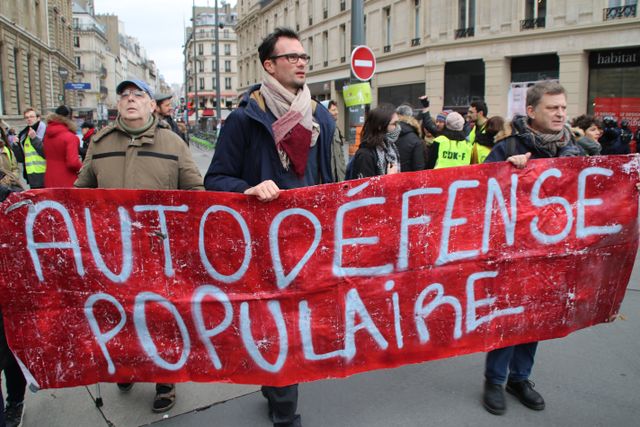
The banner reads, "Popular self-defense"
Mass protests and clashes with police occurred in smaller cities across France. In Nîmes, around 3,000 protesters clashed with riot police, who fired thick clouds of tear gas around the Roman arena and the police prefecture. Over 2,000 “yellow vests” mobilized in Rouen and expelled plainclothes policemen who tried to infiltrate their protest. In Caen, 4,000 protesters rallied and clashed with police around the train station, tearing up train tracks to throw material at the security forces.
In Bordeaux, 10,000 “yellow vests” protested and hundreds clashed with riot police later in the evening around Pey-Berland square. In Toulouse, riot police violently attacked at least 5,000 “yellow vests” who occupied Capitole square. In Lille, a peaceful protest of 3,000 “yellow vests” marched against Macron and Interior Minister Christophe Castaner, shouting “Castaner in prison,” “Macron resign.” In Marseille 3,000 protesters marched along La Canebière and clashed with riot police near the Old Port, while police clashed with 2,600 protesters in Nantes and arrested 15.
In Paris, at least 10,000 “yellow vest” protesters marched in four separate rallies, clashing with riot police around the Arch of Triumph, while “red pen” teachers also held protests in the capital.
WSWS reporters attended the protest at Bastille Square, where thousands of “yellow vests” were marching east into the heart of the city. Protesters shouted “Rise up, Paris,” “Macron resign” and “Release Christophe,” referring to the detention of former professional boxer Christophe Dettinger after he punched riot police attacking a female “yellow vest” protester a week ago.
Philippe
Philippe, a public service worker, said: “Like every week, we want the president to do something on taxation and to improve salaries. Getting the right to decide things via referendum is important, we vote in presidential elections and then for five years they have a green light, they do what they want and tell us to shut up and act like sheep.” He added, “It’s not right that people who paid in 40 years to Social Security get just 800 euros a month, then they’re told they will get housing benefits cut. When you see how the people in the government spend money, it’s a scandal.”
Philippe denounced police repression of the “yellow vest” protests: “I’ve been to all the protests from the beginning, each time we go we get tear gassed. … Then you look at the number of wounded!” Recalling the “yellow vests” who have lost hands to stun grenades or eyes to rubber bullets, Philippe said: “It’s not proportionate violence at all. Rubber bullets are supposed to be fired below the waist. But it’s not legs, but torsos and eyes that have been hit.”
Philippe added that it was now a matter of not just a French but a European struggle against international support for Macron in the ruling elite: “Many people had hopes in Macron when he first came in, he said he would blow up all the political parties. And he only sank us deeper into poverty. One has to say, he worked in finance anyway, they’re all directed by the European Union. Europe is the problem now.”
Asked about solidarity with Ford workers threatened with job losses across Europe and US teachers going on strike, Philippe said: “We’re in solidarity with all those who are oppressed and do not have money. Across Europe we have discussions with ‘yellow vests’ abroad. This could develop into a European movement, I think, that could be more serious and get a lot more people involved. But it’s been eight weeks we’ve been in the street and we’ve gotten nothing.”
Also near Bastille Square, Manu explained to the WSWS why he was protesting: “We pay so many charges, we have nothing left at the end of the month. We’re just the 12th today, already I have nothing left, and I’m working. It’s not just me, it’s everyone, all of France.”
Asked about the role of the trade unions, Manu said he did not see them as different from the ruling parties: “No, no one helps us. We’re alone. They should all get out, that is the only thing to be done. We struggle for months for miserly salaries, they get things for themselves and their families. It’s enough.”
WSWS reporters spoke to Thibault, a physics student and “yellow vest,” on Republic Square. He said, “Our votes are used to legitimize policies we didn’t vote for. What triggered the movement, the basic issue is that over the last decade we’ve seen an explosion of social inequality around the world. In France, dividends paid to shareholders in the companies rose 23 percent, the number of millionaires surged and the Tax on Wealth (ISF) was eliminated.”
Thibault stressed he had no hopes that Macron would change policies: “Police violence is constantly hidden, there are serious wounds, limbs torn off.”
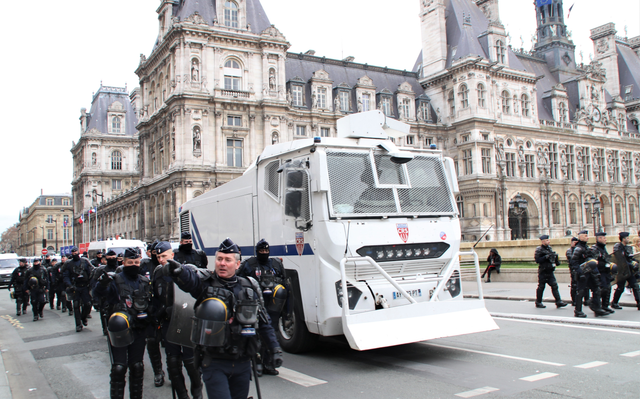
A police water cannon in front of Paris City Hall
He also refuted claims that the “yellow vests” are a right wing movement: “I’ve seen a few people with royalist flags. I would like to think it is a very minority fringe of the movement, as the demands of our movement up until now have precisely been in opposition to what the far right defends today. If people come tell us our problems are caused by immigrants, we don’t want to hear that.”
WSWS reporters also saw “red pen” teachers protest in Paris. Aline mocked government spokesman Benjamin Griveaux’s denunciation of “yellow vests” who broke into his ministry in protest: “I just laugh when I hear people from Griveaux’s ministry complain about their broken-down door, given what we see at our school’s door. I come from Drancy,” a working-class suburb of Paris, “and I’ll invite you to see the state of our schools, holes in the floors and broken doors.”
She added, “In education our wages have been frozen for about 20 years. We’ve lost about 20 percent of our real wages in that many years. Now you start at 1,350 euros per month if you are tenured, less if you’re a contract worker who won’t even get paid during summers … We are seeing in education the labor relations of the private sector.”
Mélanie told the WSWS, “we will have to take the money where it is.” She added, “We have very few resources in our schools, we pay a lot out of pocket. I bring lots of my kids’ toys to school. We buy our own pens, supplies, calendars, paper, ink, we also ask parents to help with photocopying.” She added, “The ‘yellow vests’ motivated us to do something.”
Denouncing criticism of teachers strikes in the media, she said: “We’re not privileged, we’re not lazy. … Starting salaries are under 1400 euros.” She added, “I’ve wanted to be a teacher since elementary school. I had a fantastic teacher … Her dedication to her students stunned me. Since then I knew I wanted to teach, I wanted to help kids in trouble and help make them citizens.”
She added that she saw this as an international issue: “I’ve seen that teachers in the United States are also taking action. It’s necessary, it must be international because it’s not just in France, everywhere it’s basically the same, education is ignored compared to other things. At a certain point it has to stop and I am in solidarity with their struggles.”

12 Jan 2019

Royal Society Africa Prize 2019 for African Scientists

Application Deadline: 28th January 2019 15:00 GMT

Eligible Countries: African countries

About the Award: The Royal Society Africa Prize is to recognise research scientists based in Africa who are making an innovative contribution to the biological sciences, including basic medical science, which contributes significantly to capacity building in Africa.


Type: Award, Research

Eligibility:
  • The Royal Society Africa Prize will be made to an individual for an outstanding, innovative contribution to biological science, including basic medical science, which contributes significantly to capacity building in Africa.
  • The Prize is intended for researchers at an early stage of their research career (usually having received their PhD within the last 10-15 years) with the potential to build a research project to follow on from the prize.
  • The research must be based in Africa.
  • Nominations can be made by senior academics and members of the national academies of science.
  • The project and nominee should be linked with an African centre of excellence, which would normally be a University, or equivalent research centre.
  • Normally the Prize is given to an individual who has not yet reached full Professorship status.
Number of Awards: 1

Value of Award: The winner will receive a bronze medal, accompanied by an £11,000 grant towards their research project and a gift of £1,000.

How to Apply:  Nominate now
  • It is important to go through all application requirements on the Programme Webpage see link below) before applying
Visit Programme Webpage for Details

Kellogg-Morgan Stanley Sustainable Investing Challenge 2019 for International Graduate Students

Application Deadline: 1st February, 2019

Offered annually? Yes

Eligible Countries: Any

To be taken at (country): Teams will be funded to London UK and Los Angeles, USA.

About the Award: The Kellogg-Morgan Stanley Sustainable investing Challenge harnesses the power of capital markets and student creativity to create positive impact in a world of perpetual resource scarcity and continued population growth.
The Challenge seeks to identify the next generation of sustainable finance practitioners, connect emerging leaders with industry professionals, and foster even greater emphasis on sustainability at graduate schools around the world.
The Kellogg-Morgan Stanley Sustainable Investing Challenge seeks to identify outstanding proposals offering novel investment strategies to meet some of the most pressing global challenges ahead. As the world’s population approaches 9 billion people by the year 2050, the challenge of meeting human demand for scarce global resources will intensify. Finance has a key role to play in meeting this challenge.
Moreover, an increasing number of institutional investors are seeking sustainable investment opportunities for their portfolios. Specifically, these investors seek to identify investment strategies that can meet the financial needs of their organizations by investing in funds, investment vehicles, or direct investments that are consistent with the principles of sustainability and impact. Teams are encouraged to think beyond social enterprises, venture capital fund vehicles and strategies.
This competition requires you to propose and defend a sustainable impact investment strategy that uses finance and investment tools to create an innovative solution to an environmental or societal challenge. Integral to this competition are first, that you are creating a financial vehicle, and second, that your financial vehicle will have social impact.
Contestants must propose and defend a strategy that uses finance and investment tools rather than an operating enterprise to address an environmental or societal challenge. The competition is an opportunity to apply core finance principles to target the economic, social and environmental challenges that drive the field of sustainable investing.

Type: Contest

Eligibility: 
  • Graduate students from around the world are invited to participate in the Kellogg-Morgan Stanley Sustainable Investing Challenge.
  • Teams are limited to a maximum of four members, all of whom must be enrolled in a graduate program at the time of the prospectus submission, and the team cannot include more than one member who is pursuing an Executive MBA.
  • A team may include members from different graduate schools. All ideas must be the original ideas of the team members.
  • Each team is required to submit a two-page prospectus outlining their proposal.
  • From the submitted prospectuses, ten teams will be selected to present at the finals competition. At least one team member should be available to present at the finals competition, if the team is chosen to advance to that round, and all team members attending the finals competition should plan to stay for the entire event.
  • Please note that any team member not in attendance at the finals competition will not share in any prizes awarded to that team.
Judging Criteria: The following criteria are applicable to both the first and final rounds of the competition:
  1. Creativity & Financial Innovation (25%)
  2. Impact and scale (25%)
  3. Feasibility (25%)
  4. Quality of due diligence and financials (20%)
  5. Presentation (5%)
Value of Contest: $15,000 in prizes will be awarded to the winning teams. Awards will be made for the overall quality of the proposals based on the judging criteria.
  • Overall First Place:  $10,000
  • Overall Runner-Up:  $5,000
How to Apply:  
  • Two-page prospectuses must be submitted by February 1, 2019, 11:59PM CT. The prospectus should outline a unique sustainable investment strategy. The selection committee is familiar with the broad area of sustainable investing, so avoid overemphasizing general observations about this section of the market.
  • Ten finalist teams will be announced by Feb 25, 2019. These teams will be flown to London and will be provided with two nights of lodging, and are expected to present their proposal at the finals competition
  • Please click on “Submit a Prospectus” to submit your two page prospectus. Remove all identifying student name and school information from the prospectus before submission.
  • GOODLUCK!
It is important to properly go through the Contest Webpage before applying.

Visit Contest Webpage for details


Award Provider: Kellogg School of Management, Morgan Stanley

Swedish Institute She Entrepreneurs Program 2019 for Women in MENA Region

Application Deadline: 5th February 2019.

Eligible Countries: Countries in the Middle East and North Africa (MENA) regions: Algeria, Egypt, Iran, Iraq, Jordan, Lebanon, Libya, Morocco, Palestine*, Sweden, Syria, Tunisia or Yemen

To be taken at (country): Sweden

About the Award: She Entrepreneurs is a recognised leadership programme for young emerging women social entrepreneurs in the Middle East and North Africa region (MENA) and Sweden. Intended for women who have already started to build a social business, She Entrepreneurs offers participants a chance to take their social business initiative to a whole new level.
The She Entrepreneurs programme is an intensive programme with a full-day schedule and many evening activities and all selected participants have to commit to participating in all activities of both module 1 and 2.

Type: Entrepreneurship

Offered Since: 2011

Eligibility: To apply to She Entrepreneurs you have to:
  • have the drive, ambition and interest to use social entrepreneurship to implement a social business initiative that you have already started working on
  • your social business initiative should be based and implemented in your country of citizenship or in one of the countries of the She Entrepreneurs programme listed above
  • be between 20 and 36 years old
  • have a good working knowledge of both written and spoken English.
Selection Criteria: A selection committee consisting of staff from the Swedish Institute as well as representatives from partner organisations and field experts evaluates the applications according to the following criteria:
  • applicant’s social business initiative that will be the focus of the programme
  • applicant’s drive, motivation and commitment, as well as her answers to the questions of the She Entrepreneurs application form
  • assessment of the applicant’s CV.
Selection Process: Around 60 shortlisted applicants are called for interviews as a second step in the selection process. The interviews are conducted through Skype. This offer is valid only under the condition that the participant obtains a visa to travel to Sweden. SI will facilitate the visa application process, but cannot guarantee a visa. In recent years, applicants living in conflict-ridden areas have in a few cases seen their visa applications rejected.
She entrepreneurs will accept references who speak English, Arabic and French.

Number of Awardees: Around 28

Value of Programme: She Entrepreneurs participants will build on their knowledge of business elements, from branding to risk-taking. The programme offers a competitive advantage as participants develop their own social business initiative and acquire personal skills and innovative tools.
The programme also allows women entrepreneurs to meet, inspire each other and share experiences on common challenges. Participants will emerge with a strong and active network of likeminded women who support each other in driving important changes in society.

Duration of Programme: A total of two and a half weeks

How to Apply:

Visit Program Webpage for details

UK Government Go Global Africa 2019 for African Entrepreneurs (Fully-funded)

Application Deadline: 30th January 2019 (12 pm)

Eligible Countries: Kenya, Nigeria and South Africa

To be taken at (country): UK

About the Award:  The UK Government’s Department for Digital, Culture, Media & Sport is launching a new International Tech Hub Network in 2019, in partnership with the British High Commission in Kenya, Nigeria and South Africa. The hubs are one pillar of a broader Digital Access Programme which aims to catalyse digital inclusion across Africa.
This is a fantastic opportunity for start-ups using technology to solve local issues, to participate in an exciting and intensive programme in the UK to learn how to build their business to develop global solutions.

Type: Entrepreneurship

Eligibility: We are currently accepting applications from companies based in Kenya, Nigeria and South Africa who meet the following criteria:
  • – Post MVP stage with a live product in the market
  • – Demonstrable evidence of some customer traction
  • – Have not raised more than £2m of investment
  • – Active in fields aimed to create a better future for Africa, with a specific focus on Transport, Energy, Water, Connectivity, Digital Health, Fintech and Agritech.
  • – Led by a founder/s who have a strong sense of commitment and drive to strengthen the local ecosystem for other start-ups to grow and thrive by passing on the learning from this opportunity to their communities and acting as future champions of the Tech Hub’s work.
  • – Ambitions to expand regionally and internationally in the future.
Number of Awards: Not specified

Value of Award:
  • Travel costs, accommodations and most meals.
  • Successful applicants will be sponsored to join a delegation of ambitious African start-ups to the UK for a 2-week immersive programme in March 2019.
  • The programme will help companies to improve their business skills and capability, build links with the UK’s thriving tech sector and work with UK expertise to take their business to the next level.
Duration of Programme: 
  • 23 March – 4 April 2019
  • The programme will run from Monday to Friday from 9:00 – 17:00 (including 2 evening engagements weekly).
How to Apply: 
  • It is important to go through all application requirements on the Programme Webpage see link below) before applying
Visit Programme Webpage for Details