22 Jun 2019

Canada rules out overture to China, vows to extradite Huawei CFO to US

Roger Jordan

Canada’s Justin Trudeau-led Liberal government has rejected out of hand a plan to defuse tensions between Canada and China by using its powers under Canadian law to block extradition to the US of Meng Wanzhou, the chief financial officer of Chinese tech giant Huawei.
Relations between Ottawa and Beijing have dramatically deteriorated since Canadian authorities, acting at Washington’s behest, seized Meng while she was changing planes in Vancouver last December 1. The daughter of Huawei’s founder and principal shareholder, Meng is currently under house arrest awaiting the outcome of a hearing on a US request she be extradited to face trumped-up charges of circumventing US sanctions against Iran.
Last week, the Globe and Mail revealed that former Liberal Prime Minister Jean Chrétien was advocating in discussions with business leaders that Ottawa seek to mend fences with China by using its legal prerogative to shut down the Meng case and send her home.
Foreign Minister Chrystia Freeland hastened to shoot the idea down, reiterating the government’s phony claims that global geopolitics played no role in Meng’s “lawful” arrest.
In the preceding weeks Chrétien had been widely touted in establishment circles as a possible special emissary to Beijing. Canada’s prime minister from 1993 to 2004, Chrétien has numerous contacts in China’s oligarchy and capitalist restorationist political elite due to his role in spearheading Canadian-Chinese business ties in the wake of the 1989 Tiananmen Square massacre and his family connections to the Desmarais clan. The billionaire Desmarais family were among the earliest western investors in China.
Those supporting dispatching Chrétien to Beijing had argued he would be well-positioned to plead for a reset in Canada-Chinese relations. Beijing has responded to Meng’s arrest, and to Ottawa’s initiation—again at Washington’s urging—of an inquiry into Huawei’s possible exclusion from the country’s 5G network, by arresting former Canadian diplomat Michael Kovrig and businesman Michael Spavor on charges of undermining state security. Beijing has also restricted imports of Canadian canola and pork.
Speaking in Washington last Thursday after meeting with US Secretary of State Mike Pompeo, Freeland declared that any talk of releasing Meng would set a “very dangerous precedent.” Canada, she insisted, must not “alter its behavior when it comes to honouring an extradition treaty in response to external pressure.
“We could easily find ourselves in a situation where, by acting in a single specific case, we could actually make all Canadians around the world less safe,” Freeland continued. “And that is a responsibility I take very seriously.”
Freeland’s argumentation is absurd, given that Canada initiated “external pressure” on China when it chose to arrest Meng on Washington’s behalf, knowing full well that her effective kidnapping could only be viewed by Beijing as a calculated provocation.
In reality, it is the aggressive policies pursued by the Trudeau government, including in multi-billion dollar modernization of Canada’s armed forces, and the deepening of Canada’s partnership with US imperialism in its aggressive policies around the world—including in its reckless military-strategic offensives against Russia and China and its drive for regime-change in Venezuela—that represent the chief danger to Canadian citizens, wherever they may be.
Freeland also repeated the government’s lying claim that there has been “no political interference” in the Meng case.
In reality, Trudeau was informed about the plans to detain Meng at Vancouver airport several days ahead of time. She was seized on the very day that US President Donald Trump met Chinese President Xi Jinping on the sidelines of the Buenos Aires G20 summit with the aim of bullying Beijing into accepting US trade demands or face the imposition of tariffs on hundreds of billions of dollars worth of goods and services.
Moreover in the half-year since her arrest, it has become ever more apparent that Huawei is in Washington’s cross-hairs as part of an economic, diplomatic and military offensive aimed at thwarting China’s ambitions to become a major player in cutting-edge high tech industries.
Trudeau and Freeland’s determination to support the US in its confrontation with China is bound up with Canadian imperialism’s dependence on American economic and military power in advancing its own predatory global interests. Since 2013, the Canadian Armed Forces has been party to a secret pact with the American military that allows personnel and information sharing as part of a military build-up in the Asia-Pacific region aimed at isolating and preparing for war with China. Canadian warships and submarines have participated in provocative US “freedom of navigation” exercises in and around the South China Sea.
Freeland’s firm rejection of any rapprochement with China sets the stage for Trudeau to meet with Trump at the White House tomorrow. During their talks, Canada’s prime minister is expected to urge the US president to publicly pressure Beijing to release Kovrig and Spavor. Trudeau and Freeland are thus providing Trump with yet another pretext to escalate his reckless trade war with China, which threatens to plunge the world economy into a deep crisis and is laying the basis for a global military conflict.
Trudeau is also expected to confer with Trump about speedy passage of the renegotiated North American Free Trade Agreement, which goes even further than its predecessor in transforming the North American continent into a protectionist trade bloc, from which US and Canadian imperialism can vie with their rivals around the world for markets and profits. Rebranded by Trump as UMSCA, the new agreement gives Washington a veto over any free trade deal that Canada or Mexico might strike with China.
None of this means that those in the capitalist establishment like Chrétien and former Business Council of Canada head John Manley who advocate Canada defy the US in the Meng affair represent any sort of progressive alternative. Their differences are simply over how best to advance the rapacious interests of Canadian imperialism.
Their efforts to avert the further unraveling of Canada-Chinese ties are driven by their fears that Canadian big business is too reliant on the US economy, and thus highly vulnerable to Washington’s turn to “America First” protectionism and unilateralism.
When the Trudeau government came to office in the fall of 2015, there was widespread support within ruling class circles for its objective of significantly expanding economic ties with China. Reversing the policy of the previous Conservative government, Canada joined the Chinese-led Asia Infrastructure Investment Bank (AIIB) and announced exploratory talks with Beijing on a Canada-China free trade pact.
But long before Washington, to use Chrétien’s words, “trapped” Canada into arresting Meng, this had begun to unravel as a result of the intensifying conflict between Washington and Beijing.
The Trudeau government effectively abandoned its free trade initiative some 18 months ago, and the corporate media, spearheaded by the Globe and Mail and National Post, initiated an increasingly shrill campaign to portray China as a strategic threat and menace to “Canadian democracy.”
The Meng arrest and Beijing’s retaliatory moves have been used to effect a further shift in Canada’s foreign policy.
While under Trudeau and Freeland Canada has become ever more deeply integrated with US aggression and intrigue the world over, important sections of the ruling elite are pressing for Canada to tack even closer to the US in its anti-China drive.
The Globe and Mail has published numerous editorials denouncing China as the aggressor and portraying Canada as an innocent victim of Chinese bullying. It has also regularly turned over its columns to US political leaders like Democratic Senator Mark Warner and Republican Marco Rubio, so they can rant against the threat Huawei purportedly represents to US and western security. Last week, the Globe trumpeted the results of a poll it had commissioned and which it claimed shows that a majority of Canadians want Huawei banned from the country’s 5G network.
With Canada’s federal election only four months away, Conservative Party leader Andrew Scheer is staking out an even more hardline position vis-à-vis China than Trudeau. In a foreign policy speech last month, Scheer vowed to launch a complaint against Chinese trading practices at the World Trade Organization, restrict Chinese state-owned companies’ access to the Canadian market, and pull Canada out of the AIIB. Underscoring the incendiary implications of such steps, Scheer also denounced China as a threat to Canada’s “security and prosperity in the 21st century,” and promised to open negotiations with Trump on joining the US-led ballistic missile defence shield, which is aimed at making a nuclear war “winnable.”
For their part, the trade union-backed New Democrats have endorsed Meng’s detention, claiming they have confidence in the “rule of law” in Canada, and have signaled their support for banning Huawei from the country’s 5G network.
While remaining conspicuously silent on Canada’s military alignment with Washington against Beijing, the NDP and their union backers have championed economic nationalist and protectionist measures aimed at China. The most prominent example of this was the role played by leading union officials, like Canadian Labour Congress (CLC) President Hassan Yussuf and Unifor’s Jerry Dias, in supporting the Trudeau government during the NAFTA renegotiations. The CLC and United Steelworkers opposed Trump’s tariffs on Canadian steel and aluminum imports with the argument that Canadian-produced steel and aluminum is needed for US warplanes and other weaponry.

Massive blackout affects 50 million in Argentina and Uruguay

Rafael Azul 

On Sunday, June 15, the most massive blackout in Argentine history took place in the South American southern cone. The blackout had its biggest impact in Argentina and Uruguay; it affected virtually the entire territory of both countries. Bordering sections of Brazil, Chile and Paraguay were also affected. Except for the southernmost province (Tierra del Fuego), Argentina suffered a total blackout. Twelve hours after the lights went out, power had still not been fully restored.
Public transport was virtually paralyzed. In Buenos Aires, the subway and light rail systems stopped running, and buses were delayed due to non-performing traffic signals.
The immediate cause of the blackout appears to have been a sudden imbalance between the demand and supply for electricity. A sudden collapse in supply, even at a time of low demand (Sunday at 7:07 a.m.), triggered a series of shutdowns that resulted in this calamity.
The electricity shutdown was tentatively blamed on the “collapse of the Argentine Interconnection System (Systema Argentino de Interconexión, SADI),” which links up several sources of electricity generation, including parts of nations that border Argentina. Initially, spokespersons from the Argentine Department of Energy speculated that the SADI failure had to do with “some meteorological event” that damaged transmission lines.
While the exact cause of this blackout has yet to be revealed, the underlying cause is the collapse of the electrical infrastructure as a result of capitalist Argentina’s decades-long economic crisis and high levels of corruption.
The SADI grid links two main subsystems of high-tension power lines between generating plants and distribution plants; the latter send electricity into homes and factories. Tierra Del Fuego province is independent of the SADI network; for that reason, along with some regions in eastern Uruguay, it did not experience the shutdown.
On the day of the blackout, government authorities appeared flummoxed about the exact causes of this catastrophic event. Energy Secretary Gustavo Lopetegui expressed regrets on behalf of the Macri administration and assured everyone that Macri himself was closely following events. “We have no information of why it [the blackout] happened. … It was an extraordinary event that should not happen again,” said Lopetegui. He promised additional information in the next few days, and assured his listeners that the electrical grid was “a robust system.”
Lopetegui’s words notwithstanding, it is no secret the Argentine electrical grid is suffering from decades of neglect, despite massive subsidies to electrical utilities and substantial hikes in electricity rates, supposedly to maintain and improve the infrastructure. As a result of the collapsing electrical infrastructure, the number of brownouts and blackouts across Argentina has increased year to year. Sunday’s multinational blackout was in fact totally predictable.
The Department of Energy at one point suggested that the origin of the imbalance was linked to problems at the hydroelectric Yacyretá Dam, on the Paraná River, and the Salto Grande Dam on the Uruguay River between Argentina and Uruguay. Yacyretá’s electricity is shared by Paraguay and Argentina.
According to this account, the entire grid shut down due to a malfunction at Yacyretá, followed by the shutdown of generation in Salto Grande, leading to a chain reaction along the SADI grid.
In recent decades, there have been many warnings in Argentina of the lack of proper maintenance and investment in the electrical grid. Despite substantial subsidies to firms and massive increases in electricity prices, needed investments have not taken place.
The Yacyretá Hydroelectric Dam, at the center of the current catastrophe, is illustrative of this crisis.
While the Yacyretá Dam may not have been the source of the blackout, it is in urgent need of repair. In May of this year, Ricardo Colombi, governor of Corrientes Province, issued a serious warning: “Due to lack of maintenance, the [Yacyretá] dam has already lost some of its defenses; two of its turbines have been shut down and the others are operating at 75% capacity.”
Colombi also warned of the cracks in the dam. Beyond the resulting blackout from a rupture of Yacyretá, he sounded the alarm that the collapse of the Yacyretá Dam would affect “half the country,” putting the lives “of millions” in danger.
Calling for emergency measures to repair Yacyretá, Colombi warned of the consequences of its rupture: “The enormous amount of water that would flow would wipe out in minutes the cities of Resistencia and Corrientes, and also the cities of Santa Fé and Paraná; not to mention the other cities that are on the margins of the river including the entire Paraná Delta and the Federal Capital” (the city of Buenos Aires is 600 miles south of Yacyretá).
There have been many warnings in Argentina of the lack of proper maintenance and investment in the electrical grid over the last 30 years. Despite substantial subsidies to firms and massive increases in electricity prices, needed investments have not taken place, and in many cases have been siphoned off through a network of graft and corruption.
Furthermore, true to their pro-business approach and general level of capitalist corruption, successive Argentine governments have taken a hand-off approach when it comes to policing the utilities and protecting their profits. Yacyretá is no exception.
From the time construction began in 1983, during the Videla military dictatorship, until its opening in 1998, Yacyretá has been a legendary case study of the corruption and cronyism that characterizes Argentine capitalism. Included in this web has been the Macri family itself, through its various holding companies, which have profited from Yacyretá contracts, according to a 2018 investigation published in Primera Hora, city of Misiones’ daily newspaper.
In 2016, as part of its program of “shock therapy,” the Macri administration announced increases in the price of energy, transportation, and water of between 200 and 500 percent. In reality, however, as the bills came in the mail, the actual hikes in many cases exceeded 1,000 percent. These tarifazos provoked mass popular protests. The tariff hikes were repeated in 2017 and 2018.
As a result of the collapsing electrical infrastructure, the number of brownouts and blackouts across Argentina has increased annually, particularly during the summers. Adding to the human cost of the blackouts are cuts in water supplies for many communities, as electrically operated pumping stations shut down.
The Argentine working class, in the face of these and other attacks on its living conditions, is more and more at the edge of a massive popular explosion.

Australian whistleblower trials shrouded in secrecy

Mike Head

Two prominent criminal trials of whistleblowers, whose leaks exposed war crimes and illegal operations by the country’s US-linked military and intelligence services, are likely to be largely conducted behind closed doors after the Australian government issued “national security information” certificates.
Defence lawyers are still contesting the full extent of the secrecy orders, one of which was issued this month, and the other last year. Such certificates can lead to entire trials being held behind closed doors. Defendants and their lawyers also can be excluded from hearings or viewing the evidence being used by the authorities.
The Liberal-National government’s determination to block any public scrutiny of these crucial hearings constitutes wartime-like censorship. It violates the basic principle of open trials and the basic legal rights of the accused—essential centuries-old protections against authoritarianism.
Not a word of criticism has appeared in the corporate media. This is another demonstration of the Australian establishment’s commitment to the US military alliance and its preparations for war.
The secrecy edicts have the same basic purpose as the two major police raids conducted this month against Australian Broadcasting Corporation (ABC) and News Corp journalists accused of reporting similar leaked exposures. As the Australian Federal Police chief declared, the raids were conducted to protect Australian involvement in, and access to, the US-led global Five Eyes surveillance network.
One raid, on the home of a News Corp journalist, concerned leaked plans to legalise spying on Australian citizens by the Australian Signals Directorate (ASD), the electronic monitoring and cyber warfare service.
The latest secrecy certificate relates directly to the ABC raid. David McBride, a former military lawyer, is accused of leaking information about the killing of civilians, including children, the desecration of bodies and other abuses carried out by Australia’s Special Forces as part of the US-led invasion and occupation of Afghanistan.
These leaks are potentially devastating because Special Forces commandos have undertaken all the frontline ground attacks conducted by Australia in Afghanistan and Iraq. They are also the troops who would be mobilised internally to deal with “domestic violence” under last year’s expanded military call-out legislation.
Even though McBride was committed to stand trial in May, police conducted an eight-hour search of the ABC headquarters, clearly seeking to also incriminate the journalists to whom McBride allegedly gave the material.
McBride is charged with theft of Commonwealth property, three counts of breaching the Defence Act and one count of the unauthorised disclosure of information. He has pleaded not guilty to all charges. He does not dispute leaking the material, but insists that it was his duty to reveal it to the public.
During a brief hearing this month, a prosecution lawyer said the full brief of evidence could not even be served on McBride, despite him being arrested more than nine months ago. That was because of the government’s certificates, issued under the National Security Information (Criminal and Civil Proceedings) Act 2004. He requested a two-to-three week delay to allow the prosecution and government to work out how to deal with sensitive material.
Speaking to reporters outside the court, McBride said everything involved in the case was classified secret, but the case was “not about secrets, it’s about lies.” His defence, he said, was “that it is an army officer’s duty to rebel against an unjust and illegal and immoral regime.” McBride said he would not agree to a proposed plea bargain which would keep the evidence hidden.
Inside the Australian Capital Territory (ACT) Supreme Court, McBride sought to limit further delay in the case by consenting to a private hearing to determine the bounds of “national security” information before he receives the full brief of evidence. He is representing himself to avoid having a security-vetted lawyer—another requirement of the legislation.
The case was adjourned until June 27 for a further mention.
The other trial relates to the illegal bugging of the East Timorese government’s cabinet room by the Australian Secret Intelligence Service (ASIS) in 2004, conducted during negotiations on a lucrative oil treaty with the tiny state.
ASIS’s electronic surveillance was just part of a concerted campaign of economic and diplomatic bullying by Canberra, from the day that it sent troops to occupy the territory in 1999, supposedly to protect the Timorese people.
ASIS is the country’s external spy agency. It is a key part, together with the Australian Signals Directorate (ASD), the electronic monitoring and cyber warfare service, of the Five Eyes network, which is crucial to Washington’s escalating trade war and military build-up against China.
In the case, currently before the ACT magistrates court, a former ASIS officer, known only as Witness K, and his lawyer Bernard Collaery are charged with communicating information about an ASIS operation. They face jail terms of up to two years.
By charging Collaery, as well as Witness K, the government is also attacking the principle of lawyer-client privilege, a centuries-old protection against authoritarian rule.
This case too has been subject to extraordinary secrecy and delay. A preliminary hearing, closed to the public, to decide how to deal with sensitive evidence is set down for August. Witness K and Collaery will have faced the courts for more than 14 months by that time.
In both cases, Attorney-General Christian Porter issued certificates declaring that evidence in the trials was “likely to prejudice national security.” Like all the police-state laws imposed on the pretext of the “war on terrorism,” the 2004 Act extends far beyond alleged terrorist plots or acts.
Initially used to help convict “terrorist” suspects, the Act is now being utilised in “security” trials. As the WSWS warned from the outset, these measures can be used to cover-up and suppress opposition, even internal dissent, to the criminal wars and abuses—past, present and under preparation—of the US and its allies, including Australia.
Pushed through federal parliament in 2004 with the backing of the opposition Labor Party, the Act hands the government vague and far-reaching powers.
Any certificate issued by the attorney-general is “conclusive evidence”—making it virtually impossible to challenge. “National security” is defined to mean “Australia’s defence, security, international relations or law enforcement interests.” That covers all the predatory interests of Australian imperialism and its US and other Five Eyes partners.
The Act permits trials on terrorism, espionage and “other security-related” charges to be held in complete secrecy. In closed-court sessions, judges also can allow government witnesses to testify in disguise via video and exclude lawyers who fail to obtain security clearances.
The staging of secret trials is another component of a global war on journalists and whistleblowers, in order to intimidate and persecute anyone who exposes the criminal operations of the US-led military-intelligence apparatus. This offensive is being spearheaded by the bid to extradite Julian Assange, the WikiLeaks founder and journalist, to the US, and the re-imprisonment of the whistleblower Chelsea Manning, who laid bare Washington’s murderous and anti-democratic operations around the world.

New York Times reports secret US cyberattacks on Russia

Patrick Martin

An article published on the front page of the Sunday edition of the New York Times reveals that US intelligence agencies have carried out extensive cyberattacks against targets in Russia, including the country’s electrical grid.
President Trump denounced the article as “treason” but there were no credible denials of the factual content of the article, which appears to originate among sections of the intelligence apparatus concerned that the attacks on Russia’s infrastructure were in danger of escalating to full-fledged cyberwarfare, provoking a Russian response.
The Times article was co-authored by Nicole Perlroth, who specializes in reporting on cyberwarfare, and David Sanger, the newspaper’s senior national security correspondent and a longstanding conduit for material that the military-intelligence apparatus wants to see in print.
In a sense, the report is not so much an exposé of a US campaign of sabotage that is illegal under international law—and incredibly reckless, given that it is directed against a nuclear-armed power—as a kind of boasting by the military-intelligence apparatus of its capabilities.
The article is based on interviews with current and former officials who “described the previously unreported deployment of American computer code inside Russia’s grid and other targets…” Some US “reconnaissance probes” have been inside the Russian electrical power system since 2012, the Times reported, indicating that the penetration of Russian targets was initiated under the Obama administration (if not earlier) and predated the flare-up of US-Russian tensions in 2014 over Ukraine.
As opposed to passive monitoring, however, more recently “the American strategy has shifted more toward offense, officials say, with the placement of potentially crippling malware inside the Russian system at a depth and with an aggressiveness that had never been tried before. It is intended partly as a warning, and partly to be poised to conduct cyberstrikes if a major conflict broke out between Washington and Moscow.”
The article suggests that the US and Russian intelligence agencies have already carried out a series of trial cyberattacks on each other’s infrastructure, mainly in the form of power outages inflicted on the population of the two countries.
The article presents a chilling scenario: “The critical question—impossible to know without access to the classified details of the operation—is how deep into the Russian grid the United States has bored. Only then will it be clear whether it would be possible to plunge Russia into darkness or cripple its military—a question that may not be answerable until the code is activated.”
In other words, US military commanders, right up to the commander-in-chief in the White House, could well assume that cyber-attacks could actually prevent the Russian military from being able to respond to a preemptive US nuclear strike, allowing the Pentagon to incinerate its longtime enemy, killing tens of millions of people, without the danger of Russian retaliation.
This is the type of nuclear Pearl Harbor that US strategists dreamed of carrying out in the late 1940s, before the Soviet Union developed its own atomic bomb and established the balance of “mutually assured destruction.”
One can only imagine the reaction in the Russian military command to the publication of this article, which confirms their worst nightmares about the intentions and capabilities of Washington. Imagine the reaction in the American media if a similar Russian (or Chinese, or Iranian) capability to interfere with or even shut down the US electrical grid were suddenly made public.
The response of the Trump administration to the publication of this report was revealing. No top US security official disputed the validity of the report, and both National Security Advisor John Bolton and National Security Agency Director Paul Nakasone indirectly confirmed it. This demonstrates that the report was not a journalistic “scoop,” but a semi-official warning to Russia by the Pentagon, using the New York Times as its press agent.
The media reaction to this seemingly blockbuster revelation was also instructive. There was virtually no follow-up in the press and little discussion on the Sunday television interview programs. It seems that the corporate media as a whole understood that the publication of the article on the front page of the New York Times had as its intended purpose getting the attention of the Kremlin, not the American people, and that any further attention to the story risked causing popular alarm.
Regardless, Trump responded to the publication of the article by declaring its publication a “virtual act of treason,” declaring the New York Times “must be held fully accountable!” He called the newspaper “the Enemy of the People,” before implying that he might remain in office beyond the term limit specified by the US constitution. “Do you think the people would demand that I stay longer? KEEP AMERICA GREAT”
Trump’s denunciation of the article was in sharp contrast to the statements of his aides, but it seems to have been sparked, not by the cyberwarfare revelations, but by two brief paragraphs in the article which claim that the president was deliberately given a less than fulsome account of the cyberattacks, for fear that he would either order the program halted, or leak the details to the Russians.
This particular claim, whether true or not, is another instance of the long-running campaign spearheaded by the Times and a section of the military-intelligence apparatus to portray Trump as either a dupe or an outright agent of Russian President Vladimir Putin, who cannot be trusted with the most important secrets of American imperialist skullduggery against Russia.
The Times article claims that approval for the latest escalation of the program was “slipped into the military authorization bill passed by Congress last summer,” adding that “Under the law, those actions can now be authorized by the defense secretary without special presidential approval.” The implication of both claims is that Trump, with his well known inattention to details, was not aware of the full implications of the program and that it was being carried out to some extent behind his back.
There is one further aspect of the Times report worth noting. From a formal standpoint, the newspaper is carrying out exactly the journalistic activity for which Julian Assange now faces US demands for extradition and trial under the Espionage Act with a potential penalty of 175 years in prison: publishing information about closely held US national security secrets.
The difference, of course, is that Assange is an actual journalist, seeking information that the US government did not want to see made public, exposing US war crimes in Iraq and Afghanistan and diplomatic conspiracies around the world. The New York Times, Sanger & Co. serve as glorified stenographers, publishing what the military-intelligence apparatus wants to make public, not what it wishes to conceal.

Former Egyptian President Mohamed Morsi dies during show trial

Alex Lantier

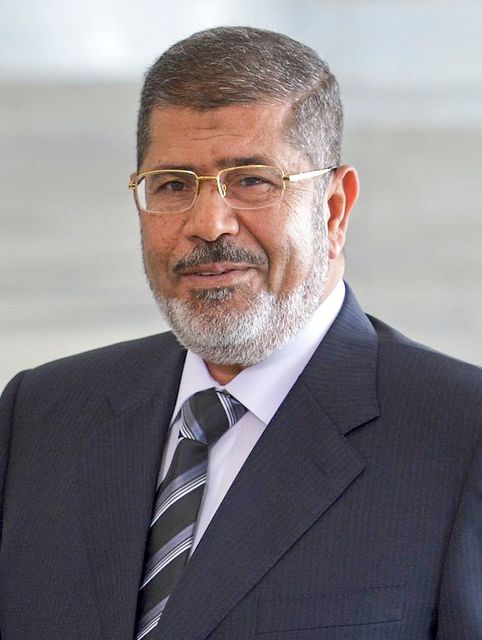
Yesterday, Egypt’s former Islamist president, Mohamed Morsi, collapsed inside a glass cage while on trial on espionage charges and died shortly thereafter in hospital, of a heart attack. A member of Egypt’s now-banned Muslim Brotherhood (MB), Morsi was 67.
Egyptian Attorney-General Nabil Sadiq issued a statement, declaring: “The accused, Mohammed Morsi, in the presence of the other defendants inside the cage, fell unconscious, where he was immediately transferred to the hospital. The preliminary medical report stated that by external medical examination they found no pulse, no breathing, and his eyes were unresponsive to light. He died at 4:50 p.m., and no apparent injuries to the body were found.”
Mohamed Morsi
The Egyptian army and Interior Ministry have reportedly placed their forces on high alert, fearing protests or riots by MB members or supporters.
Morsi’s death was a cold-blooded act of state murder for which the Egyptian military dictatorship of General Abdel Fattah el-Sisi, Washington and its European imperialist allies are politically responsible. For six years after toppling him in 2013 in a bloody coup, the Sisi junta relentlessly prosecuted him on a series of concocted charges, sentencing him to death and multiple prison terms. All throughout, Sisi had close relations with US and European heads of state, who saw his regime as an indispensable instrument to suppress revolutionary struggles of the Egyptian working class.
While Morsi was in prison, the Sisi junta prevented him from taking his medicine even though he suffered from diabetes, high blood pressure and liver disease. It kept him in solitary confinement for 23 hours a day, limited visits from his family, and served him rotten food.
Morsi’s family and human rights groups repeatedly issued statements warning that the conditions of his imprisonment threatened his life. His family told the New York Times in 2016 that they were afraid Morsi might fall into a diabetic coma and Human Rights Watch issued a statement in 2017 warning that the Egyptian regime was denying Morsi vital medical care.
In 2018, the Detention Review Panel, a British-based human rights group, launched an investigation of Morsi’s detention commissioned by Morsi’s family. It concluded that Morsi’s treatment was “cruel, inhuman and degrading” and could “meet the threshold for torture in accordance with Egyptian and international law.” By that point, Morsi was periodically falling into diabetic coma, suffering from untreated abscesses in his jaws, neck injuries from sleeping on a cement floor, and losing kidney and liver function due to malnutrition.
Crispin Blunt, a British conservative parliamentarian serving on the Detention Review Panel, issued a statement yesterday on Morsi’s death, declaring: “We feared that if Dr. Morsi was not provided with urgent medical assistance, the damage to his health may be permanent and possibly terminal. Sadly, we have been proved right.”
Turkey’s Islamist President Recep Tayyip Erdogan, the Palestinian Islamist group Hamas, and the emir of Qatar, Sheikh Tamim bin Hamad Al Thani, all issued statements of condolences. The Muslim Brotherhood, the Islamist organization to which Morsi belonged, issued a statement on its web site yesterday, declaring: “Neither the shock of the news nor the haste in spreading information about the details of his death will change the features of this full-fledged murder.” It called upon masses of people to attend Morsi’s funeral.
Morsi’s son, Abdullah Mohamed Morsi, told Reuters yesterday that Egyptian authorities had denied them the right to bury Morsi in the family cemetery and had not returned his body to the family.
Morsi was a right-wing figure, who legitimately provoked deep opposition among workers while in office. He won election in 2012 by default, because petty bourgeois parties like the Revolutionary Socialists (RS) had blocked a seizure of power by the working class during the initial revolutionary upsurge in 2011, when millions of protesters battling riot police and a general strike of the Egyptian working class brought down military dictator Hosni Mubarak. As president, Morsi continued Mubarak’s austerity and police-state repression and his alignment with US and European imperialism.
But while Morsi’s ouster in July 2013 unfolded amid protests by tens of millions of workers against the MB, it was led by the army, acting under political cover provided by the Tamarod (“Rebel”) alliance of pro-military parties, backed by the RS. It transferred power to Sisi, who launched a bloody crackdown, shooting thousands of protesters in the streets. This crackdown, which aimed to restore a ferocious military dictatorship, unfolded based on propaganda claiming that the army was repressing Islamist terrorism.
As such, Morsi’s trial became the spearhead of attempts by the Egyptian general staff, supported by Washington and the European imperialist powers, to criminalize all opposition to Egypt’s military regime and install a regime of police-state terror aimed primarily at the working class.
Morsi was indicted and later condemned to death in 2015 on trumped-up charges of plotting attacks on police to spring MB members from jail just before Mubarak’s overthrow. These charges, which criminalized millions of Egyptians who battled riot police in those weeks, sent an unambiguous message: that revolutionary struggle is punishable by death. At the same time, the army issued mass death sentences to hundreds of people in show trials in which the accused had no opportunity to present any defense, and arrested as many as 60,000 people, many of whom were tortured.
Virtually overnight, imperialist politicians in Washington and the European capitals—who had hailed Morsi as Egypt’s first “democratically elected” president when they hoped his election would prevent revolutionary struggle by the working class—abandoned Morsi, leaving him to rot in jail.
Perhaps the most sinister and grotesque comments came from then-European Union foreign policy chief Lady Catherine Ashton, who visited Mursi in prison shortly after the coup, in late July 2013. Affixing the European bourgeoisie’s seal of approval on Sisi’s coup, Ashton said she and Morsi had had been able “to talk about the situation, and we were able to talk about the need to move forward. The people around him do care for him. I looked at the facilities.”
Since then, US administrations both under the Democratic President Barack Obama and Republican President Donald Trump showered the Egyptian army with billions of dollars in aid. Trump, German Chancellor Angela Merkel, then-UK Prime Minister David Cameron, and French President Emmanuel Macron all rolled out the red carpet to Sisi for state visits in their capitals. Macron’s predecessor, François Hollande, who like Sisi ruled using a state of emergency to ram through deep social attacks on working people, reportedly considered himself Sisi’s friend.
Today, amid mass protests by workers and youth demanding the fall of military regimes in Algeria and neighboring Sudan, as well as rising strikes and protests across the United States and Europe, the imperialist powers rely ever more closely on the hangman of Cairo. This year, US Secretary of State Mike Pompeo traveled to Cairo to issue war threats against Iran, while Macron visited Sisi to sell him weapons amid the “yellow vest” protests at home. In March, shortly after Macron’s return from Cairo, where Sisi has banned the sale of yellow vests, the French general staff announced that it had authorization to shoot “yellow vest” protesters in the street.
All of these governments are politically implicated in the Sisi regime’s horrific abuse of Morsi in prison that led to his death.

German police threaten climate change protesters

Harold Hambacher

Ahead of the cross-border protest for climate justice planned in the German city of Aachen on June 21, the city’s police presidium has sent a letter to the organisers of Fridays for Future that can only be described as a blatant attempt to intimidate protesters.
The threatening letter, which was also sent to parents’ associations, the education ministry of North Rhine-Westphalia, Germany’s most populous state, and district administrations in Cologne and Düsseldorf, explicitly threatened youth with a police response and criminal prosecution. The letter warned against “aggressive confrontations” and informed “disrupters” that they should expect to be kettled: groups could be “‘enclosed’ by the police” and “individuals could be taken into custody.”
The letter to students, teachers, and parents, which was undoubtedly sent with the agreement of the state government and North Rhine-Westphalia’s Interior Minister Herbert Reul (Christian Democrats, CDU), was also published on the police website, where it is declared in large type, “Police can also take measures against children and young people.”
The provocative letter comes in the lead-up to the “Climate Justice without Borders” student strike and march planned for Friday, June 21. Some 20,000 participants are expected. School students, university students, academics, and artists from 16 countries have already announced their intention to participate in the protest in Aachen, which is located on the borders of Germany, the Netherlands, and Belgium.
To give their threats extra weight, the police employed the tried and tested tactic of pointing the finger at an alleged “minority prepared to commit violence” in order to justify the use of ruthless violence from the outset. Based on the fact that the group “ende Gelände” is protesting the logging of the nearby Hambacher forest by the RWE energy concern on the same weekend, the police wrote, “Keep your distance from groups ready to commit violence like ‘Ende Gelände’, don’t allow yourselves to be instrumentalised to conduct illegal acts! Do not fall into the ‘criminality trap’.”
Further on in the letter, another threat is made, “The police are also obliged to protect private property rights,” and the police will not hesitate to provide “those damaged” with the personal details of the culprits, as has happened in the past. In a first draft of the letter, the police even claimed that protesters in the past had been ordered to make compensation payments totaling €2.1 million. However, this false report on an ongoing legal trial, which RWE is pursuing, had to be removed by the police.
In fact, the Fridays for Future organisers have explicitly declared their solidarity with the protests against the logging of the Hambacher forest. They call for participation in a protest planned at the Garzweiler mine, and declare together with the Hambacher forest protesters on their Facebook page to make “the holiday weekend into a weekend for climate justice.”
The police letter threatening all of these protests represents a frontal assault on the right to demonstrate. For several weeks, until the European elections in May, the climate protests organised by students were tolerated. But now, with the elections over, the authorities are showing their true colours and the police state is rearing its ugly head.
As in France, where the state cracked down violently against Yellow Vest protesters six months ago, German authorities are now preparing to brutally attack peaceful protests. The police are even threatening children and young people with kettling, detention, and criminal prosecutions.
The warning in the letter that young people could “fall into the ‘criminality trap’” merely by taking part in the protest is particularly revealing. This statement is entirely in keeping with the new Police Obligations Law, which criminalises under certain circumstances the mere participation in a protest, and similar laws in almost every German state. North Rhine-Westphalia’s new police law, passed in December 2018, permits people to be detained for up to 28 days for a mere suspicion that they may conduct a criminal act.
Tens of thousands have taken to the streets on several occasions to protest against the law. The letter from the Aachen police thus is not merely directed at the students who are organising the climate justice protest, but also against all workers and young people who are moving into struggle against militarism, war, and social inequality. At one stroke, it sheds light on the true balance of power, while at the same time underscoring the hopelessness of appealing to any of the bourgeois parties which keep the state running smoothly.
It is clear that there is only one way to fight for the preservation of natural resources and the basic necessities of life: young people must turn to the working class, which is the only force capable of overturning the source of this destruction: the capitalist profit system. They must take up the fight for a socialist society based on the needs of the vast majority, and not the profit interests of the banks and major corporations.

Suicide rates for doctors and young physicians among highest in the US population

Alex Johnson

Doctors in the United States confront a high suicide rate as a result of stressful working conditions and excessively long work hours.
Director and chairman of the Southern California Permanente Medical Group, Dr. Edward Wilson, told CNBC that it is estimated that one doctor dies every day by suicide in the US due to “stress and rigorous work schedules.”
Doctors and health professionals within the US, according to Ellison, are “stressed to the breaking point” due to stifling work schedules and mounting pressures that stem from patient care.
Depression, the primary cause of suicidal ideation, affects an estimated 12 percent of male physicians and 19.5 percent of female physicians, but doctors are often hesitant to seek treatment due to the stigma associated with mental health problems.
As a result, doctors have the highest suicide rate among any profession in the country: 28 to 40 per 100,000 persons compared to 12.3 per 100,000 for the general population.
According to Ellison, recent data shows that 44 percent of physicians show signs of physical and emotional exhaustion, or “burnout,” which can lead to further mental health problems as doctors have difficulty adequately taking care for themselves, such as eating and sleeping properly.
Changes made to the way hospitals and medical centers operate in recent years may have improved the efficiency of the American healthcare system, but at the cost of longer and more exhaustive work schedules for doctors. Doctors are now spending less time with patients in traditional care settings and more time fulfilling extraneous tasks traditionally performed by adjunct staff and employees.
As a result, the suicide rate among physicians has exploded in recent decades. The suicide rate among male and female physicians is 1.41 and 2.27 times higher than that of the general male and female population, respectively.
For example, Dr. Benjamin Shaffer, a renowned surgeon from Washington D.C., hung himself in 2015 after taking his son to school. He had struggled his entire life with anxiety and a severe form of insomnia, which afforded him little time to sleep before operating on and treating patients.
Just days before he committed suicide and in the face of growing personal turmoil, his psychiatrist prescribed two new drugs which merely exacerbated his anxiety and insomnia and even led to paranoia. After he was told that he would need medication for the rest of his life, he concluded that he could never live a normal life again and decided to kill himself.
High suicide rates are also prevalent among medical students. Suicide is the second leading cause of death for medical students. They are three times more likely to kill themselves than their peers in the same age group. As many as 30 percent of medical students suffer from depression.
The work schedules for young doctors transitioning from medical school, customarily referred to as “residents,” are extremely onerous. Residents are expected to work up to 80 hours a week with single shifts that can last up to 28 hours.
These grueling schedules are largely the result of the centralized matching system for residency applicants in the hospital labor market and the monopoly held by a handful of hospital chains. Although employer-controlled labor markets are typically prohibited by anti-trust laws, the system remains the only avenue for residents to become fully licensed doctors.
Centralized matching, commonly referenced as “the match,” allows a handful of employers to select residency applicants without them having any legal right or ability to negotiate the terms of their contracts. This grants hospital conglomerates free rein to implement excessive hours and lower pay.
In 2002, a group of residency students filed a lawsuit against the for-profit selection system, deeming it an unlawful “contract” or “conspiracy” designed to undermine federal antitrust laws. After a federal district court initially ruled that “the match” may be illegal and give an unfair advantage to healthcare institutions, Congress passed legislation immunizing medical training programs from antitrust lawsuits.
Thus, residency programs give hospital employers access to a well-educated, but super-exploited and over-burdened workforce. As a 2017 article in The Atlantic noted, “while residency-program administrators no doubt take their educational obligations seriously, residents are also a cheap source of skilled labor that can fill gaps in coverage.” Resident salaries are generally equivalent to those of the hospital cleaning staff and about half of what nurse practitioners get paid even though residents typically work much longer hours.
The long hours residents are compelled to work causes tremendous physical and psychological stress. In response, the Accreditation Council for Graduate Medical Education (AGGME) implemented a “duty-hour” reform policy in 2003, which lowered the maximum weekly hospital working hours from 120 to 80 and the length of single shifts from 48 to 28 hours.
However, this change did little to lessen the severity of residents’ schedules. Surveys show that the reforms led to virtually no changes in work and sleep hours.
A large reason behind the failure of the reforms is that hospitals have not increased the rate of new hires to keep up with the rising demands of healthcare operations. Between 1990 and 2010, the number of patients admitted to teaching hospitals rose 46 percent, but the number of residency spots only increased 13 percent.

Spain’s Supreme Court endorses 1936 fascist coup

Alejandro López

Spain’s Supreme Court has issued a ruling endorsing the 1936 fascist coup led by Generalissimo Francisco Franco. It led to the three-year Spanish Civil War, in which the victory of Francoite forces backed by Hitler and Mussolini established a fascist dictatorship that lasted until 1978.
The Supreme Court handed down an injunction halting the acting Socialist Party (PSOE) government’s plans to remove Franco’s remains from a state-run mountaintop monument, the “Valley of the Fallen.” It argued that removing Franco’s remains to a less prominent location would be “extraordinarily harmful” not only to the general’s family but to the “public interest.” It added that the public interest required understanding the “significance of don Francisco Franco,” don being an honorific prefix in Spanish.
Explaining why it had decided to suspend the planned exhumation to give Franco’s family more time to appeal, the court referred to him as “head of state from 1 October 1936 until his death in November 1975.” Court sources told media outlets who sought confirmation that there was no mistake in the document, and that the court has no intention to rectify the ruling.
Traditionally, Franco was treated as the head of state starting on 1 April 1939, amid his final victory in the civil war and the ensuing mass murder of his political opponents. The ruling’s unprecedented wording signifies that Spain’s highest court considers the proclamation of Franco as generalissimo and head of state by a gang of fascist generals and coup plotters on October 1, 1936 as legitimate. Mass opposition of millions of workers and peasants in the civil war and the ensuing four decades of the dictatorship would be illegitimate, even criminal.
Franco’s proclamation came only months after his July 17-18 coup against the elected Popular Front government and head of state Manuel Azaña. The resulting civil war shattered cities across Spain and led to the murder of 200,000 political oppositionists, left-wing intellectuals and militant workers, and the detention of 400,000 people in concentration camps. For four decades thereafter, the Francoite regime and its secret police arrested, tortured and killed thousands, outlawed strikes, political parties and trade unions, and censored newspapers and books.
In the international court of working class opinion, Franco was never accepted as head of state, despite his regime’s savage repression. He was an odious and bloodstained criminal. The only powers to recognize Franco as “head of state” in October 1936 were fascist Italy and Nazi Germany, led by Benito Mussolini and Adolf Hitler, respectively—along with the pope in the Vatican, which described the fascist uprising as a “crusade” against communism.
The fact that Spain’s highest court publicly defends one of the most brutal counterrevolutions in the 20th century is a warning. After nearly three decades of increasing war and militarism since the Stalinist dissolution of the Soviet Union, and a decade of deep austerity since the 2008 global economic crisis, ruling circles worldwide are again envisaging such policies.
The ruling class is reacting to the emergence of mass “yellow vest” protests in France, mass strikes in Portugal and Poland, and mass movements demanding the overthrow of military dictatorships in Algeria and Sudan with a sharp shift to the right.
The international character of the ruling elite’s shift to the far right underscores its political significance. It is a warning to the working class. French President Emmanuel Macron has made statements extolling Vichy regime head Pétain, and a renewed effort, led by Humboldt University Professor Jörg Baberowski, is underway in Germany to whitewash the crimes of the Nazi regime. Far-right parties and politicians are already in government in Italy, Hungary, Poland, Austria, Brazil and beyond.
Terrified by growing anti-capitalist and socialist sentiment, the ruling class is reviving all the political filth of the 20th century. As the WSWS has repeatedly warned, fascism was not an accident of the 20th century, but the inevitable political outgrowth of capitalism. If Franco is rehabilitated, it is because powerful factions of the ruling class are again considering a break with legality and democratic forms of rule.
In Spain, a fascist party openly defending the legacy of Francoism, Vox, has entered parliament for the first time since the Franco era and is backing right-wing coalitions in regions and cities throughout Spain. Promoted in the media, it has recruited six former generals. Two signed the pro-Franco manifesto signed by over 1,000 officers, including 70 former generals and admirals, roughly one-third of the total active number of general officers in the Spanish armed forces.
The Supreme Court’s endorsement of Francoism testifies to the criminalisation of the Spanish bourgeois state after the brutal crackdown on the 2017 Catalan independence referendum. The political establishment came out in favor of the brutal police crackdown and the ongoing show trial of Catalan bourgeois nationalists who organized it. This went hand in hand with the holding of pro-Francoite, anti-separatist rallies legitimating fascism and the Vox party.
The same court has denied the leader of the Catalan Republican Left, Oriol Junqueras—who is standing in the show trial—permission to leave prison to be sworn in as a member of European parliament. This strips the millions who voted for Junqueras of their vote, as Junqueras will not be able to assume his position as an MEP. This enjoys the full support of Brussels, and the acquiescence of the PSOE government and its ally, the pseudo-left Podemos party.
The only way to oppose the bourgeoisie’s drive to rehabilitate fascism is to mobilize the working class in political struggle independently of these parties. There is powerful opposition in the working class to Francoism, which is well within living memory of Spain’s population. But this historically-rooted opposition to fascism finds no expression through Podemos or the PSOE. The only reason that the court feels free to announce its fascist colors is that popular opposition is suppressed by Podemos and its various pseudo-left allies.
Podemos is currently trying to form a pro-austerity and militarist coalition government with the PSOE, and reacted to the Supreme Court ruling with a few minor and impotent protests. Podemos leader Pablo Iglesias tweeted that the court’s wording was “a real travesty”. The leader of the Stalinist Communist Party of Spain, Alberto Garzon, said that it “says a lot, too much, about the high judicial bodies we have in this country.”
The PSOE itself, which is running a caretaker government since last month’s elections, has not commented on the ruling.
The fact that the ruling class itself hails Franco vindicates the International Committee of the Fourth International’s (ICFI) defense of the heritage of Leon Trotsky, who fought the Stalinists and centrists to bring a revolutionary perspective to the struggles of the working class during the Spanish Civil War. The “Transition to Democracy” in Spain during the 1970s, hailed by the Stalinist and Pabloite forces that built Podemos, is proving to have been only a passing episode. Amid a new era of capitalist crisis, the European Union is again incubating fascistic regimes.
The critical question today is the intersection of the radicalization of the working class with a worked-out perspective to oppose the ruling classes’ drive to war and fascistic rule. This requires the building of a revolutionary vanguard in the working class. It underscores the urgency to build sections of the ICFI in Spain and around the world, to link the growth of workers struggles to a socialist, internationalist and anti-imperialist political movement aiming at transferring state power to the working class.

Millions march in Hong Kong against extradition law

Ben McGrath

Two million Hong Kong protesters, nearly one-third the city’s population, marched Sunday to demand the complete withdrawal of the proposed extradition bill and the resignation of the city’s top official, Chief Executive Carrie Lam.
Demonstrators filled the Hong Kong downtown areas of Central, Wan Chai, Causeway Bay, and Admiralty where the government complex is located, chanting “Withdraw” and “Resign.” Many of the protesters were youth and students, including those in high school. The protest was double the size of the previous Sunday, with two of every seven people in the city taking part.
The mass protests in Hong Kong are another indication of the resurgence of working class struggles internationally. While the official protest leadership is determined to limit the demands, there is undoubtedly widespread underlying discontent over the vast social disparities in the city between the ultra-rich elite that dictates policy and broad layers of the population who are struggling to make ends meet.
Lam had announced on Saturday at a press conference that the bill would be postponed, though the government still plans to pass it in the future. Lam hoped this would be enough to dissipate public anger, saying, “This is time to restore as quickly as possible calmness in society.”
The opposite has been the case. Lam’s decision only further fueled public anger as the bill, which would allow extraditions to mainland China, has not been completely withdrawn. Protesters denounced Lam for ignoring the broad public hostility to the bill and are deeply concerned that, if made law, Beijing would use it to arrest political activists and opponents of the Stalinist regime.
Savana Ho, a 25-year-old student protesting against the government, expressed the anger felt by many, saying, “Hong Kong people are running out of ways and ideas to save their city. The government is forcing citizens to just make any effort we can.”
Another demonstrator, surname Wong, denounced the police violence that occurred during the march on Wednesday. She stated the protest was “much bigger today. There are many more people. I came today because of what happened on Wednesday, with the police violence.”
On Wednesday, police used tear gas, water cannon, and rubber bullets against tens of thousands of peaceful demonstrators as they protested outside the Legislative Council. Lam then denounced the protesters as “rioters.”
Opposition to the extradition bill did not begin on June 9. Since the legislation was introduced in February, public discontent has been growing. This was evident on June 4 during the annual vigil in Hong Kong to mark the anniversary of Tiananmen Square massacre, which drew a record number 180,000 people for the event. Many of the attendees demonstrated against the extradition bill.
The Stalinist regime in Beijing knows that it cannot allow a center of political opposition to exist, especially so close to major industrial regions like Shenzhen, where working-class anger is growing. It fears that the mass protests in Hong Kong will spread to the mainland.
Han Zheng, the central government’s chief on Hong Kong and one of the seven members of the Chinese Communist Party’s top Politburo Standing Committee, met with Lam Friday night. The next day, she announced the decision to postpone the bill. A spokesperson for the Hong Kong and Macao Affairs Office of China’s State Council stated, “We support, respect and understand the decision (to postpone the bill).”
The official opposition in Hong Kong, a grouping known as the pan-democrats, is seeking to exploit the protests for their own gain. Claudia Mo, from the right-wing chauvinist Hong Kong First party, has postured as a radical opponent of Lam and the extradition bill. She said Sunday, “My resentment has been pent-up. The suspension is just a postponement. The plan is just being delayed. It’s not the matter of what, it’s a matter of when. So I am coming out.”
The bill’s postponement is meant to give Lam or a future chief executive time to work out a deal with the pan-democrats behind the scenes.
Lam held out a hand to the pan-democrats at her Saturday press conference, stating that the government had suspended the bill so as to “restart our communication with all sectors of society, do more explanation work and listen to different views of society. I want to stress that the government is adopting an open mind to heed comprehensively different views in society towards the bill.”
Like the pro-Beijing Lam administration, the pan-democrats are fearful that the mass protests over the extradition bill could become the focus for wider discontent among workers over deteriorating living conditions and social inequality.
Twenty percent of the Hong Kong population, or 1.37 million people, live in poverty and face a severe housing crisis. The median cost of a home is 18 times the median household income. By the government’s count, over 200,000 people live in illegal and dangerous subdivided apartments, barely large enough to fit one person, where safety and hygiene standards are ignored. Hundreds of thousands more live in makeshift shacks on the top of apartment buildings or factories.
“In Hong Kong, residence rights, one of the fundamental human rights, are being ignored and we want you to know the serious reality,” Gordon Chick Kui-wai said last year. He is in charge of housing assistance at a non-governmental group Hong Kong Society for Community Organization.
Hong Kong workers have some of the longest working hours in the world. The Census and Statistics Department released data in April that showed 1 in 5 people works 55 hours a week on average. Those most impacted by long hours worked in food service industries, security, land transportation, construction, and retail. Yet between 2008 and 2018, workers saw only a 0.7 percent annual increase in wages, taking inflation into account.
In 2003, half a million people marched in Hong Kong to oppose a National Security Bill that would have effectively extended China’s police-state measures to the city. The bill was shelved indefinitely and Chief Executive Tung Chee-hwa was forced to step down in early 2005.
As in 2005, Beijing is seeking to defuse the huge protests to the extradition bill, so as to prevent it from triggering mass opposition among working people on the Chinese mainland. It remains determined to silence critics and opponents on its doorstep in Hong Kong that can likewise fuel anti-government sentiment throughout China.

Toward Post Terror Stability in Sri Lanka

Asanga Abeyagoonasekera


A few weeks ago, a security expert who has studied the so-called Islamic State (IS) rightly said to this author, that “Your country was ‘staged’.” While the IS attempted to take credit for the attacks, they do not appear to have been directed by the group. Those who perpetrated the attacks seem to have been influenced by the IS, but the precise manner and extent of it is unclear. Nonetheless, the claims of responsibility by the IS have had a significant impact on national morale in Sri Lanka due to their concurrence with geopolitical concerns the country faces. The Easter Sunday attacks worsen the prevailing crisis of national morale connected in significant ways to Sri Lanka’s position in relation to great power rivalry between the US and China.

Geopolitical ContextWith the expansion of the geopolitical reach of global liberal hegemony, the Indian Ocean has been a vital highway of the global energy market. The US naval presence in the island of Diego Garcia, located equidistant from several littoral states of the Indian Ocean, has aided US liberal hegemonic foreign policy as a base for small and large missions carried out over the past few decades in the region. Many more future military expeditions may be carried out from this flexible strategic hub, projecting US military power in and beyond the Indian Ocean. However, in February 2019, the International Court of Justice ruled that Diego Garcia, which has insofar been administered by the UK, be transferred to Mauritius, signaling the need for the US to consider exploring alternative locations in the Indian Ocean.

Meanwhile, located less than 2000 kilometres from Diego Garcia and at the center of Indian Ocean sea lines of communications is Sri Lanka. While Sri Lanka took a non-aligned position in its foreign policy during the Cold War period, today, its foreign policy is multi-aligned, struggling to strike a balance in the context of great power rivalries and internal political disunity. Akin to a tight-rope walker without a pole, any significant measure of stability remains elusive.

Small nations have always owed their independence either to the international balance of power or rejection of imperial aspirations. For Sri Lanka, crucial is its position in the global balance of power between the US and a rising China, increasingly viewed by the US as a national security threat (as evidenced by recent US trade sanctions). Former US Ambassador to Sri Lanka, Robert Blake, highlighted this in his recent interview in Colombo, where he said, “First, my advice to America is that it should not ask the countries to choose between China and the U.S. They do not want to choose. They want to have good relations with the US, China, India and others.” Yet this cannot be achieved with US liberal hegemonic aspirations in the Indian Ocean. In this context, any Sri Lankan foreign security agreement with global powers should be vetted by Sri Lanka’s parliamentary body with inputs from national security researchers, for otherwise Sri Lanka might be unprepared for unanticipated national security implications in the future.

A rigorous process must avoid conjecture and unsubstantiated allegations, instead feeding careful observations and research inputs into the security establishment. The independence of Sri Lanka will be in jeopardy if the US or China take a decisive turn to pull Sri Lanka closer towards their respective orbits, such as in the past when China has sought to gain a decisive and permanent advantage. The recalibration towards achieving a balance by Prime Minister Ranil Wickramasinghe was viewed as a threat by China, as certain policies made the island country vulnerable to US-led liberal hegemony. It is essential, then, for Sri Lanka to stabilise itself on the metaphorical tight-rope, especially given that the US has stated in its most recent National Security Strategy that its number one threat is China and Russia, and number two is the IS.

The Need to Uplift National MoraleNational morale is the degree of determination with which a country supports the foreign policies of its government in times of peace or war. According to International Relations theorist Hans Morgenthau, it permeates all activities of a country including its military establishment and diplomatic service.

In 2015, the Sri Lankan government divided its portfolios, leaving the president with national security, and the prime minister with external affairs. After the 30/1 UNHRC resolution (on promoting reconciliation, accountability, and human rights in post-war Sri Lanka) and subsequent constitutional crisis, there was deep polarisation within the political establishment which triggered a national security threat which perhaps went unnoticed for some time, but whose instability was felt by the entire country from time to time. More recently, after the Easter Sunday attacks, the president flew to China to meet his Chinese counterpart, President Xi Jinping, while his Foreign Minister travelled to the US to meet US Secretary of State Mike Pompeo. Both left perhaps to bring in assistance from the two polarised camps.

This polarisation in the establishment harms the national morale of Sri Lanka. It threatens and limits the country’s power to carry its agenda forward or stabilise internal politics. In this vulnerable environment, the risk of external threats creeping in to take advantage is extremely real.

15 Jun 2019

Sony World Photography Awards Competition 2020 for Student and Professional Photographers Worldwide (USD30,000 Prize Money)

Application Deadlines: 
  • Professional: 14th January, 2020 – 1300 GMT
  • Open: 7th January, 2019 – 1300 GMT
  • Student Focus: 29th November, 2019 – 1300 GMT
  • Youth Competition: 30th June 2019 (For June)
Eligible Countries: All

To be taken at (country): The hugely popular Sony World Photography Awards Exhibition, featuring a selection of winning, shortlisted and commended images, is curated at the prestigious Somerset House, London each Spring.

Fields of Competition:
  • Professional – 10 categories, judged on a body of work
  • Open – 10 categories, rewarding the best single images
    ○ National Awards – Entries submitted to the Open competition are automatically entered into the National Awards based on nationality (please check if your individual country is participating).
  • Youth – for all photographers aged 12-19, a single image responding to one brief
  • Student Focus – for those studying photography
About the Award: Open to all photographers, the Awards are an authoritative voice in the photographic industry that has the power to shape the careers of its winning and short-listed photographers. Each year the competition attracts both emerging talent and established artists and presents the world’s best photography from the last 12 months to a global audience.
The World Photography Organisation is a global platform for photography initiatives. Working across more than 180 countries, their aim is to raise the level of conversation around photography by celebrating the best imagery and photographers on the planet.
The Sony World Photography Awards has four competitions:
  • Professional – Recognising outstanding bodies of work​
  • Open – Rewarding the world’s best single images ​
  • Youth – Best single images by photographers aged 12-19
  • Student – For photography students worldwide
Type: Competition

Eligibility: All submitted images must have been taken in 2016.
View individual eligibility, selection criteria and procedure for each competition on the Competition Webpage (Right-Hand Corner)

Value of Competition: Global exposure is given to not only to the overall winners, but also to shortlisted and commended photographers.
Recognised photographers can receive:
  • Exhibition at Somerset House, London
  • Potential to be included in international exhibitions
  • Inclusion in the annual Sony World Photography Awards book
  • Potential to work with Sony and other partners on a variety of projects
How to Apply:

Visit Competition Webpage for details

Award Provider: World Photography Organisation

Important Note: You can only enter one of the following competitions: Professional, Open or Youth.