22 Jun 2019

India, Pakistan and China increasing nuclear arsenals size

Abdus Sattar Ghazali 

At the start of 2019, the United States, Russia, Britain, France, China, India, Pakistan, Israel and North Korea had a total of some 13,865 nuclear weapons, according to a new report by the Stockholm-based International Peace Research Institute (SIPRI).
That represents a decrease of 600 nuclear weapons compared to the start of 2018 but all nuclear weapon-possessing countries are modernizing (upgrading) these arms – and China, India and Pakistan are also increasing the size of their arsenals, the SIPRI report added.
North Korea has an estimated 20 to 30 nuclear warheads, which SIPRI said was a priority for the country’s national security strategy. However, it noted that North Korea has not tested a nuclear weapon or long-range ballistic missile since it entered into denuclearization talks with the United States in 2018.
France has 300 nuclear warheads, China 290, the UK 200 and Israel 80 to 90.
To date, the United States is the only country to have the ignominy of resorting to the use of nuclear weapons when it dropped two atomic bombs on the Japanese cities of Hiroshima (August 6, 1945) and Nagasaki (August 9, 1945) in the final days of World War II.
Within the first four months of the bombings, the radiation had already killed 90,000–166,000 people in Hiroshima and 60,000–80,000 in Nagasaki; nearly half of the deaths in each city occurred on the first day of the bombings.
Israeli nuclear arsenal
In total, the SIPRI report estimated that Israel possesses between 80 and 90 nuclear weapons, an increase over previous years.
The SIPRI report described Israel’s nuclear arsenal as follows: 30 gravity bombs capable of delivering nuclear weapons by fighter jets; an additional 50 warheads that can be delivered by land-based ballistic missiles; and an unknown number of nuclear-armed, sea-launched cruise missiles that would grant Israel a sea-based second-strike capability.
During a speech last August in front of the Dimona nuclear reactor in the Negev Desert, Israeli Prime Minister Benjamin Netanyahu threatened to use nuclear weapons to “wipe out” Israel’s enemies. More recently, Netanyahu and his allies in the U.S. accused Iran of seeking to develop nuclear weapons, despite the fact that intelligence agencies of both the U.S. and Israel have long recognized that Iran has no such program.
India and Pakistan
Nuclear rivals India and Pakistan, which have 130 to 140 and 150 to 160 nuclear warheads respectively, are increasing the size of their arsenals while also developing new systems.
“India and Pakistan are expanding their military fissile material production capabilities on a scale that may lead to significant increases in the size of their nuclear weapon inventories over the next decade,” said Shannon Kile, director of the SIPRI Nuclear Arms Control Program.
It may be recalled, the Congressional Research Service’s May 15 2009 report to US lawmaker said that Pakistan’s nuclear energy program dates back to the 1950s “but it was the loss of East Pakistan (now Bangladesh) in a bloody war with India that probably triggered a political decision in January 1972 (just one month later) to begin a secret nuclear weapons program.”
“The origins of the Pakistani nuclear program lies in the deep national humiliation of the 1971 war with India that led to the partition of the country, the independence of Bangladesh and the destruction of the dream of a single Muslim state for all of south Asia’s Muslim population.”
On the other hand, White House insider Bruce Riedel, who co-authored the Obama administration’s Af-Pak policy, offered the following sequence in a op-ed, broadly concurring with the CRS report:
“The new prime minister of those times, Zulfikar Ali Bhutto, secretly convened the country’s top 50 scientists in January 1972 and challenged them to build a bomb. He famously said that Pakistanis would sacrifice everything and “eat grass” to get a nuclear deterrent. The 1974 Indian nuclear test helped Pakistan to tell the world that this is the cause of their nuclear bomb. Starting in 1972, Pakistan came up with its own nuclear bomb in 1998 with the slight help of China, just a few days after India’s second nuclear test.”
The CRS Report further added, “Mr. Bhutto received an unsolicited letter from a Pakistani scientist who had studied in Louvain, Belgium, Abdul Qadeer Khan, offering to help by illegally acquiring sensitive centrifuge technology from his new employers at a nuclear facility in the Netherlands. Over the next few years—with the assistance of the Pakistani intelligence service, the Inter Services Intelligence Directorate (ISI)—Mr. Khan would acquire the key technology to help Pakistan produce fissionable material to make a bomb.”
Both the CRS report and Riedel pointed out to the help which China gave to Pakistan in its nuclear weapons quest, a subject successive US administrations are leery of broaching for fear of angering Beijing. “Islamabad gained technology from many illegal sources,” says the CRS report, adding, “This extensive assistance is reported to have included, among other things, uranium enrichment technology from Europe (stolen by Khan, according to Riedel), blueprints for a small nuclear weapon from China, and missile technology from China and North Korea.”
India plans a covert military attack on a Pakistani nuclear reactor
In their book, Deception: Pakistan, the United States and the Global Nuclear Conspiracy, Adrian Levy and Catherine Scott-Clark claim that Indian military officials secretly travelled to Israel in February 1983 to buy electronic warfare equipment to neutralize Kahuta’s air defences. Israel reportedly also provided India with technical details of the F-16 aircraft in exchange for Indians providing them some details about the MiG-23 aircraft. In mid- to late-1983, according to strategic affairs expert Bharat Karnad, Indira Gandhi asked the IAF once again to plan for an air strike on Kahuta.
The mission was cancelled after Pakistani nuclear scientist Munir Ahmed Khan met Indian Atomic Energy Commission chief-designate Raja Ramanna at an international meet in Vienna and threatened a retaliatory strike on Bhabha Atomic Research Centre at Trombay, according to Sushant Singh of Indian Express who also wrote in October 2015:
The next time India is believed to have seriously considered attacking Kahuta was in September-October 1984. It has also been rumored that Israeli air force was part of the plans to attack Kahuta in 1984 because it did not want to see an “Islamic Bomb” developed by Pakistan. Israel was supposed to lead this attack and not merely play the role of advising the IAF. Bharat Karnad has written that Israeli aircraft were to be staged from Jamnagar airfield in Gujarat, refuel at a satellite airfield in North India and track the Himalayas to avoid early radar detection, but Indira Gandhi eventually vetoed the idea. Levy and Scott-Clark though claim that Indira Gandhi had signed off on the Israeli-led operation in March 1984 but backed off after the US state department warned India “the US will be responsive if India persists”.
Earlier inn January 2015, India Times reported:  “In 1981, India planned to bomb Pakistan’s nuclear plant at Kahuta, inspired by Israeli attack on under-construction Iraqi nuclear reactors, the India Times reported on January 25, 2017.”
According to the India Times about 930,000 declassified documents posted online by the CIA provide interesting insights into India’s increasing concerns over Pakistan’s nuclear program in the early 80s. One such set of documents pointed out how India had planned to bomb Pakistan’s nuclear plant at Kahuta. This was a covert operation planned by India that was shelved after international pressure.
The India Times also said:
“Secret documents revealed that the US Ambassador to Pakistan handed over a letter by President Ronald Reagan to General Zia-ul Haq which warned Pakistan about a possible Indian military attack on the Pakistan’s nuclear reactor at Kahuta.
“An article in Washington Post in 1982 revealed Indira Gandhi was advised by the Indian military to target the Pakistani nuclear plant.
“Israel, according to reports, wanted to use Gujarat’s Jamnagar base to launch its jets and another base for refuelling. In March 1984, Indira okayed the operation, bringing India, Pakistan and Israel within striking distance of a nuclear conflict. But Gandhi backed off after the Regan administration warned of action, say reports.”
2019 report  about India-Israel joint plan to target Pakistani nuclear facilities
More recently, Daily Pakistan Global reported on March 4, 2019, Pakistan has disclosed a joint plan by India and Israel to target its nuclear facilities ostensibly on the pretext of anti-terror war in the wake of Pulwama attack.
The daily reported that as tension between Pakistan and India lingers on, official reports by the government of Pakistan confirm that India and Israel were ready for a joint attack against Pakistan, however, the threat of retaliation and active vigilance staved off the strike a few days ago.
Multiple journalists in Pakistan, while quoting official sources and meeting with Prime Minister Imran Khan have revealed that the joint plan was thwarted due to the contact between the spy agencies of the South-Asian countries and threat of retaliation by the armed forces of Pakistan. “High-level sources have informed us that there was a plan to attack 7-8 places in Pakistan from a base in Rajasthan, India. Pakistan had learnt that Israel was helping India in this plan and this was a joint plan of these countries,” the Daily Pakistan Global quoted a veteran journalist as saying.
Interestingly Shimon Arad, a retired Israeli colonel, wrote on National Interest website in February 2018, ‘How Israel and Pakistan Can Avoid a Nuclear Showdown?’ He said:
“The advancement of Pakistan’s nuclear-missile capabilities and Israel’s growing military ties with India are increasing their respective military relevance for each other. In the absence of formal diplomatic relations and against the backdrop of a prevailing antagonistic public dialogue, the need for an effective and discreet channel of communication between Islamabad and Jerusalem to mitigate misunderstandings and misperceptions about each other’s intentions is growing.
Col. Arad  recalled that a website called “AWD News” claimed that Israel’s defense minister had threatened to destroy Pakistan with a nuclear attack if it sent ground troops to Syria on any pretext. Although clearly fake (the website misidentified the Israeli defense minister as Moshe Ya’alon, who resigned in the previous May), Pakistan’s defense minister hastily tweeted a nuclear threat and warned Israel that “Pakistan is a nuclear state too.”

Solarisation of Agriculture is the need of the hour

Yuz Gonsalves

Undoubtedly, agriculture is a power intensive sector. Farmers predominantly rely on diesel and electric pumps for irrigation. However, the scale of use of diesel and electric pumps in the sector contribute to severe environmental problems.
Diesel pumps depend on exploitation of fossil fuel resources, increase fuel cost for farmers and emit toxic fumes that pollute the environment and affect human health. Whereas, electric pumps which are operated on subsidised or free electricity supplied by state governments also largely depend on fossil fuel. While the need for irrigation in today’s increasingly unpredictable climatic conditions is indisputable, diesel and electric pumps are not sustainable long term solutions.
In regard to this, solar irrigation is a crucial part of India’s efforts to transform towards renewable energy. Of India’s target of achieving 175 GW of renewable energy by 2022, 100 GW is solar-based.
I here, want to present a brief analysis of couple of successful solar irrigation models, I had chance to visit.
Vaishali in Bihar
A German development agency, has been experimenting with different service delivery models in the eastern parts of India. GIZ piloted a service delivery model of pay-as-you-go in Vaishali district (Lalpur, Baniya and Harharo) of Bihar. Envisioned as a community based model, it is based on sharing a solar pump within an irrigation water-sharing group of farmers. The GIZ pilot collaborated with a local organisation, VASFA, to implement its pilot solar irrigation project in Vaishali district. So far, this collaboration has resulted in the implementation of 3 fixed solar irrigation pumps and 5 portable solar irrigation pumps.
These solar irrigation pumps are managed and operated by farmers groups. The farmers sharing the solar pump either need to have their land adjacent to the water pump or within the catchment area of the pump. Each group has a group leader elected from the group for oversight and collection of service charges and an operator for daily operation of pump. Water is sold to group members on priority and then to surrounding farmers for a service charge based on the quantum of water delivered. The sequence in which members and non-members receive water in a particular day is decided by the group leader. Data analysis by externals also shows that the solar irrigation pump in Lalpura village is predominantly used by members of the group. The service charge to be collected is decided by the group and the charge for non-members is slightly higher than that for members. Both group members receive water at Rs 30 per hour, and non-members hire the services of the pump at Rs 50 per hour. The collected money is used for salary of the operator and the rest is deposited with VASFA for maintenance of the asset. The catchment area of the pump is about 40 acres. The areas nearer to the pump are serviced through canals and the remaining areas are serviced through delivery pipes. The experience of farmer’s organizations with the solar irrigation has so far been positive.
Dhundi in Gujarat
A grid-connected solar irrigation pump was installed in Thamna village of Anand district in Gujarat in 2015, the International Water Management Institute (IWMI) in collaboration with the Tata Trust initiated conversation with farmers in Dhundi village. The Cooperative was to implement six grid-connected solar irrigation pumps with a total capacity of 56.4 kWp that can ensure irrigation and evacuation of solar power to utility grid. The cooperative was formally registered in February 2016; it was deemed to be the first solar cooperative in the world.
The benefits from this project have been multifold. Use of diesel has almost come to an end in our village. The income that the cooperative members earn from sale of water and electricity has substantially improved farmers lives.
For all nine solar pumps that are in Dhundi, the cooperative reports that the company has provided support whenever required, both over telephone and through trips to Dhundi. In 2017, when three of Keiloskar’s pumps malfunctioned, cleantech company transported them to their workshop, repaired them and installed them back. This grid-connected solar irrigation model implemented by IWMI-TATA not only ensures assured access to irrigation and electricity, it also provides the farmer with the dual economic benefit of selling surplus electricity to the DISCOM and selling water to farmers. This has resulted in substantial economic benefit to the nine cooperative members in Dhundi. However, a large portion of the equipment cost was borne by the project, without which the project may not have been viable.
Conclusion
It must be noted that both these irrigation models were initiated by private companies but the farmer groups assisted them and ownership remains with the farmer groups. Therefore, in countries such as India which are suffering from high temperatures, heat waves and scarce water resources, the solar irrigation systems could also contribute to an efficient water management. This is all the more important as farmers have to face three challenges: save water, money and energy. Solar irrigation systems shall turn out to be the perfect answer to face these challenges. Although these systems are still quite expensive and complicated to settle, government subsidies and policy intervention by state and central governments can help in democratization of the use of solar power in agriculture, which, in the future (and even now), could play a vital part in the management of the food and energy crisis.

US-backed repression by Honduran military leaves four dead

Andrea Lobo

The repression by the Honduran regime of Juan Orlando Hernández against mass strikes and demonstrations that began on April 26 over efforts to facilitate the privatization of the education and health care sectors turned to the open use of deadly violence, as the military began firing volleys of live bullets into crowds on Wednesday.
Eblin Noel Corea, 17, was shot dead at a demonstration in the central department of La Paz, while Luis Antonio Maldonado, 29, was fatally shot in the head in Tegucigalpa. Hospital authorities reported at least 21 demonstrators were injured that day, most of them from gunfire. Reuters and local media reported that the deaths and injuries were the result of “repression by the military.”
On Thursday, local media reported that two youth—one identified as Eliud Orellana— were shot dead at a roadblock by unidentified attackers near the Caribbean town of Jutiapa, where teachers have been leading protest actions since late April.
The brutal repression has only fueled the mass demonstrations, while teachers and doctors continue to strike, and roadblocks are built and rebuilt. The anniversary of the June 28 military coup in 2009, which was backed by the Obama administration and installed the National Party regime, continued by Hernández, is expected to generate even more widespread demonstrations calling for an end of the US-backed regime.
Reports in the US corporate media this week have repeated that on May 29 and June 2, respectively, the gates of the US embassy and dozens of Dole fruit containers and trucks were burned down presumably by demonstrators. The response by US corporate circles in defense of their property and trade across the Central American isthmus has been ruthless. Dole temporarily suspended the contracts of over 3.000 workers to demonstrate its willingness to cut the means of subsistence for entire impoverished towns.
Washington is openly backing the deadly repression as fears mount that demonstrators will target US investments. Privatizations, austerity and repression are being orchestrated from Washington to defend the interests of US capital and its local client elite.
The latest killings follow the activities of death squads snatching demonstrators in broad daylight earlier this month, and the finding on June 3 of the dead body of a young doctor who was participating in the protests in the western department of Copán.
Truckers struck and joined demonstrators Monday in blocking the key highway CA-5, which connects the city of San Pedro Sula with the capital, Tegucigalpa. The truckers, both owners and employees, were demanding higher rates for their services. On Thursday, when fuel shortages were becoming widespread, Tegucigalpa business organizations demanded an end to the strike. The truckers’ associations reached an undisclosed deal with the government to end the action.
Between Tuesday night and Thursday night, hundreds of anti-riot police went on strike, after using tear gas and firing their guns into the sky to kick out their superiors and occupy their main base in Tegucigalpa. While demanding improvements in their conditions and a halt to the repression, police were filmed chanting “Out JOH [Juan Orlando Hernández]!”. A spokesman chosen by strikers apologized for the repression and declared “We don’t want a government that is not worth it.”
In response, the Department of Disciplinary Affairs of the Police threatened strikers that they had all been identified and would be fired, while Hernández responded by deploying the military across the country.
By Friday morning, the police ended the strike, agreeing to a set of pitiful and empty promises by the regime to improve food and uniform quality, respect human rights, make no reprisals. The police agreed to pursue their grievances within the established “internal channels.”
In recent years, the police forces have repeatedly responded to the escalation of deadly repression against demonstrations by striking, which led the Hernández government, in partnership with USAID, the Inter-American Development Bank, several US think tanks and firms such as Giuliani Security & Safety (owned by Trump’s attorney and former New York City mayor, Rudy Giuliani) to initiate in 2016 a seemingly permanent Special Purge and Transformation Commission. This body has fired more than 5,200 officers, alleging corruption and human rights abuses, while its representatives travel frequently to Washington to report directly to the US State Department.
Criterio reported that the police strikers expressed fears, recalling the reprisals that followed when police struck across Honduras in late 2017 during the brutal crackdown that left more than 30 demonstrators dead during protests against the fraudulent election of Hernández. “Many were fired, others jailed, and others escaped the country,” the report notes.
The purge was framed as a response to the widely reported killing in March 2016 of environmental activist Berta Cáceres, which saw four Honduran military officers arrested, two trained by the US. However, it has been used as an axe to threaten police against striking. Most officers live in the impoverished neighborhoods that are subject to the social attacks and terror of the regime.
This aim was explicitly revealed by the statements of the Honduran National Council on Defense and Security led by Hernández and the US government. It passed a resolution Thursday backing “police transformation and consolidation” while expressing thanks for “the backing of international cooperation.” On Wednesday, the US embassy in Honduras tweeted about its “firm support for the reform of the Honduras Police.”
Most strikingly, however, the commander of the US Southern Command (SOUTHCOM), which oversees Pentagon operations across Central and South America, Adm. Craig Faller, arrived in Honduras Friday morning to participate in the opening ceremony of the deployment in the country of a Marine-SOUTHCOM special purpose task force.
This followed reports Thursday night that gunfire was exchanged, without resulting in casualties, between police strikers and the military police sent to patrol the police base in Tegucigalpa.
After a century and a half of imperialist political control and economic plunder of Honduras, which was used as a platform for US counter-insurrectionary operations during the civil wars in the 1980s across Central America, the presence of the US commander during the deadly crackdown in Honduras should be taken as a warning that US imperialism is ready to renew its direct military interventions in its “backyard” against any challenge to its interests from below.
More broadly, Washington is turning Central America into an open-air labor prison. After blackmailing Mexico with threats of tariffs, the Trump administration has secured the mobilization of thousands of Mexican military and an expansion of checkpoints and detention camps across southern Mexico against immigrants. It has also begun joint deployments of the US border patrol and the Guatemalan police and military along Guatemala’s northern border.
While Trump threatens to begin mass roundups and the deportation of “millions” starting on Sunday across the US, it has become clear that the Mexican government of President Andrés Manuel López Obrador has agreed not only to deploy its troops as an extension of the US border patrol, but also to play the role of colonial administrator. It is has reached “cooperation” agreements over the last week with the governments of the Northern Triangle—Guatemala, El Salvador and Honduras—to “join efforts in dealing with irregular migration.”

US names Taiwan a “country,” stoking tensions with China

Robert Campion

The United States continues to pursue a reckless course in the Asia-Pacific by ratcheting up tensions with China over Taiwan. This includes the possibility of a break with the longstanding “one China” policy, as well as deepening political and military ties between Washington and Taipei.
The US Defense Department’s “Indo-Pacific Strategy Report,” released June 1, designates Taiwan a “country.” The wording is highly provocative to Beijing, which views Taiwan as a renegade province that should one day rejoin the Chinese mainland. As such, Beijing has repeatedly stated that any moves to declare an independent Taiwan will lead to a military confrontation.
The report denounces China as a “revisionist power,” stating, “As democracies in the Indo-Pacific, Singapore, Taiwan, New Zealand, and Mongolia are reliable, capable, and natural partners of the United States. All four countries contribute to US missions around the world and are actively taking steps to uphold a free and open international order.” (emphasis added)
The statement was neither an innocuous remark nor a mistake, given the emphasis Washington is placing on its military build-up in Asia. Acting Defense Secretary Patrick Shanahan made this clear when he wrote in the report’s opening line, “The Indo-Pacific is the Department of Defense’s priority theatre.”
Beijing is deeply sensitive to any suggestion of Taiwanese independence, including even the use of the name Taiwan in an official capacity. The reference to Taiwan as a country, rather than as part of China, goes against the “1992 Consensus” in which both Beijing and Taipei accept that there is only one China but agree to disagree on which is the rightful ruler of China. In addition, since 1979, the United States has formally recognized Beijing as “China,” despite maintaining close economic and military ties with Taipei.
The decision to flout this longstanding policy in a prominent defence paper is highly provocative and aimed at placing additional pressure on China while deepening relations between Washington and Taipei in preparation for war. It comes as the Trump administration has increased weapons sales to Taiwan, held exchanges between high-level officials, and increased the number of warships passing through the Taiwan Strait.
On Monday, the Wall Street Journal, quoting three anonymous White House officials, published an article claiming a rift exists in the Trump administration over its Taiwan policy, with a faction fearing that closer relations with Taipei will harm the chance of a trade deal with Beijing. At one point, Trump reportedly greeted attempts by anti-China hawks to build closer relations with Taipei with anger. However, Trump came around “and he now sees the value in using Taiwan as a bargaining chip in his talks with China,” the Wall Street Journal writes.
Regardless of the behind-the-scenes machinations, Washington’s moves to strengthen Taipei politically and militarily are worrying Beijing. “There is growing anxiety in China that the administration is really pushing the envelope and no longer adhering to any sense of maintaining an unofficial relationship with Taiwan, and maybe even moving toward abandoning the One China policy,” stated Bonnie Glaser, a senior adviser for Asia at the Center for Strategic and International Studies.
China has repeatedly stated it will use military force to prevent Taiwan from declaring or being recognized as a separate independent country. Speaking at the Shangri-La Dialogue summit in Singapore earlier this month, Chinese Defense Minister Gen. Wei Fenghe stated, “China must be and will be reunified. We find no excuse not to do so. If anyone dares to split Taiwan from China, the Chinese military has no choice but to fight, at all costs, for national unity.”
Beijing’s concerns are driven by other recent provocations. On June 6, US and Taiwanese officials met in Taipei for the re-naming ceremony of Taiwan’s de facto embassy in Washington. Previously known as the Coordination Council for North American Affairs, the new agency is called the Taiwan Council for US Affairs, utilizing both the name of the island and the US. Taiwanese President Tsai Ing-wen, who attended the event, called the renaming a “milestone” in relations between the two. She was joined by the de facto US ambassador to Taiwan, Brent Christensen.
In May, Taiwan’s national security chief David Lee met his counterpart, national security advisor John Bolton, in Washington—the first such top-level visit since 1979. The visit is one of an increasing number of high-level exchanges since Washington passed the Taiwan Travel Act in March 2018, authorizing such contact.
US naval incursions as a show of force through the Taiwan Strait are also becoming routine despite the fact that Beijing has threatened to retaliate militarily if it believes a US war ship is likely to dock at a Taiwanese port. The latest provocation through the strait took place on May 22 involving the guided missile destroyer USS Preble and the oiler USNS Walter S Diehl.
Washington also intends to sell $2.6 billion worth of tanks and missiles to Taiwan, including 108 M1A2 Abrams tanks as well as 250 Stinger anti-air missiles, 409 Javelin and 1,240 TOW anti-tank missiles. Undoubtedly, this is what the “Indo-Pacific Strategy Report” refers to as “sustaining a credible combat-forward posture; strengthening alliances and building new partnerships; and promoting an increasingly networked region.”
The online military magazine Defense One criticized the sale for being insufficient, saying, “This would be fine if Taiwan were preparing for a ground war, but the real conflict if China invades will be at sea and in the air. Taiwan should focus on acquiring the most cost-effective methods of stopping a Chinese invading force before it lands.”
The reality though is that for all the talk of “Chinese aggression,” it is the US that is preparing for war on the Asian continent, with Taiwan a major base for launching attacks. Since 2008, the US has sold more than $22 billion worth of arms to Taiwan.

European Union rearms for World War III

Johannes Stern

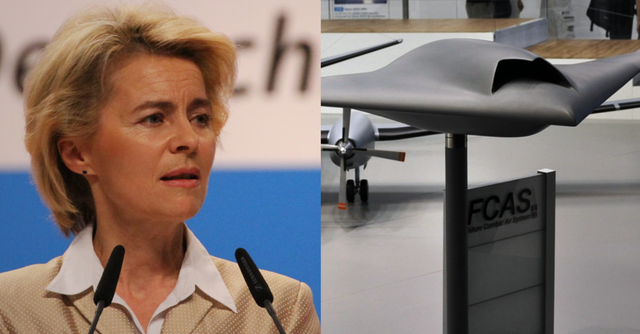
Following the announcement last week by the US Defense Department of its biggest ever arms deal involving the purchase of nearly 500 F-35 fighters, Europe replied in kind on Monday. At the world’s largest air show in Le Bourget near Paris, the German defence minister Ursula von der Leyen, together with her colleagues from France, Florence Parly, and Spain, Margarita Robles, signed major agreements to develop a joint European air combat system (Future Combat Air System—FCAS).
Ursula von der Leyen (left), Future Combat Air System (right). Credit: WikiMedia Commons.
The cost of FCAS, which is announced to be operational by 2040, is immense. Up to €8 billion will flow into joint development alone. Overall, costs are expected to be more than €100 billion. The Handelsblatt newspaper reports that “by the middle of the century” the FCAS project could devour “up to €500 billion.” The same sum would finance Germany’s entire education budget for 27 years!
The massive armaments project is part of plans to transform the European Union into a major military power capable of waging war independently of and, if necessary, against the United States.
According to a report posted on the official web site of the German Defence Department: “FCAS is not just a fighter plane, but a composite system.” Under the proposed “‘System of Systems,’ manned fighter aircraft and unmanned aerial vehicles (‘remote carriers’) would be integrated into a network. In addition, navy vessels and land vehicles could be included in the network. Air force, navy and army could thereby act closely together.”
After the unveiling of a first model of the new NGWS (New Generation Weapon System) at Le Bourget, von der Leyen said: “Today is an important day in two respects: firstly, the Franco-German fighter plane system is a big step forward in modernising the Bundeswehr (German army). But secondly, it is also a great day for the European Defence Union, because for the first time we are jointly launching a European fighter system,” Thirdly, it is “a great day for European industry, which will be given a huge boost by this fighter plane system.”
The inspector general of the German air force, Lieutenant General Ingo Gerhartz, praised the joint development of the NGWS as a sign of “Europe’s great innovative power.” The head of the French military aircraft manufacturer Dassault Aviation, Eric Trappier, assessed the project as an important step towards achieving autonomy with regard to armaments and military requirements. Up until now, European countries have tended to buy US defence equipment. “Now we are offering Europeans a European plane that is independent of US technology,” he told the French news channel CNews.
The decision by central European powers to develop a US-independent air combat system will further exacerbate transatlantic tensions.
Most recently, at the beginning of May the US administration warned the EU against excluding US arms companies from European defence projects, describing the creation of independent European military structures, such as the European Defence Fund and enhanced EU defence cooperation (Pesco), as “deeply worrying.” A US letter dated May 1 to the EU foreign policy chief Federica Mogherini stated that the provisions made for both projects represented “a dramatic step back in three decades of growing integration of the trans-Atlantic defence industry.”
In response to US threats and Washington’s preparations for war against Iran, which are also directed against the economic and geostrategic interests of European powers in the region, leading EU nations are aggressively stepping up their own foreign and defence policy.
In the “Strategic Agenda for 2019-2024,” which will be adopted at the EU summit in Brussels today, the EU sets out its claim to be a world power in the future. Europe strives to “reinforce its global influence” and “influence the course of world events,” the document reads. To achieve this goal, the EU must “move forward towards a genuine European Defence Union.” This would “allow Europe to take further responsibility for its own security” and “improve its strategic autonomy.”
These plans are explicitly directed at preparing for war. The section titles “Protective Europe” states that the EU should “focus on areas where cooperation can result in clear benefits, such as in defence industry and research, cyber-defence, military mobility, hybrid crisis management, and missions and operations abroad.” Leading political and military strategists openly declare that the EU is preparing for conflicts with other major powers, entailing the danger of a third world war.
We find ourselves “in a historically unique situation in which Europe is being challenged or under pressure from three major powers—from a revisionist Russia, an economically and politically expanding China and an America, under President Trump, moving on several fronts against the EU,” declared the new president of the German Council on Foreign Relations (DGAP), Tom Enders, in a recent interview. Enders was previously head of Europe’s second largest European arms company, EADS.
“There can only be one answer,” Ender continues. “The governments of Europe must not allow themselves under any circumstances to be further divided, but must find joint answers, especially in foreign policy, foreign trade and security policy. And those in charge should not be dissuaded by threats from Washington.”
Above all Enders maintains that Germany is obliged to take the lead in developing an independent European military and great power policy. We need “a public, non-ideological, strategic debate in Germany, based on the realities of power-politics, not sentimentalities, and starting from our special responsibility for the development of Europe.” A country that “pretends to have no national interests, but always takes the moral high road and as a vegetarian in a world full of carnivores ignores the need for military measures” made a “common foreign and security policy for Europe” impossible.
Thirty years after the reunification of Germany and the restoration of capitalism in Eastern Europe, the German ruling class is openly returning to its former militaristic traditions. In a commentary headlined “Europe Needs More,” Wolfgang Schäuble, acting president of the German Bundestag and former interior and finance minister, called for the rapid development of “a European army” as “an effective instrument of security and defence policy.” In addition, it was necessary to agree “upon the type of threatening situations joint forces should be used for,” he writes.
In order to enforce this war policy in the face of the growing popular resistance, Schäuble argues, among other things, to abolish parliament’s scrutiny of military intervention enshrined in the country’s Basic Law, following the crimes committed by German imperialism during the First and Second World Wars. Accordingly, every Bundeswehr mission outside NATO territory requires the prior approval of the Bundestag.
“If Europe is serious about common defence, we have to change national laws and seek legal harmonisation,” Schäuble writes. That applies “to all partners in the Union. Even Germany with its historically justified narrow constitutional requirements—note: parliamentary accord—will have to move.”
As was the case in the 1930s, massive military rearmament and preparations for war require an authoritarian and ultimately a fascist program. That is why French President Emmanuel Macron recently paid tribute to the fascist dictator and Nazi collaborator Philippe Pétain, and the ruling class in Germany calls for “more tolerance towards the right wing” (ex-president Joachim Gauck) while tolerating right-wing extremist terrorist structures with close links to parts of the military, police and intelligence apparatus.
The fact that all the imperialist powers are preparing for war makes clear that workers and young people are faced with revolutionary tasks. European capitalism cannot be tamed any more than American capitalism. In the Manifesto of the Fourth International published at the beginning of World War II, Leon Trotsky stated: “The task posed by history is not to support one part of the imperialist system against another but to make an end of the system as a whole.”
This task is raised again today with great urgency. In order to prevent a fresh lapse into world war and barbarism, the working class must take up a struggle against all of the capitalist warmongers based on an international socialist program.

Italy: Captain in court for saving people in distress at sea

Marianne Arens 

In Italy, the captain and nine crew members of the NGO ship Juventa are under investigation. Pia Klemp, who has rescued about 5,000 people in distress in a total of six missions, faces up to 20 years imprisonment and heavy fines.
Following her biology studies, the 36-year-old captain from Bonn, Germany, had worked for the marine conservation organization Sea Shepherd and participated in missions against illegal whaling. Klemp, who initially started as a simple deckhand, later becoming a petty officer, worked her way up to become captain. From 2015, she has participated in maritime rescue operations on several ships of the non-governmental organizations Youth Rescue and Sea-Watch.
In August 2017, the Juventa, belonging to the Berlin association Jugend rettet(Youth Saves) was confiscated in the harbour of the Italian island of Lampedusa. The official Maritime Rescue Center (MRCC) in Rome had piloted it to where several Coast Guard ships with blue lights flashing and armed crew were waiting for them and secured the ship.
Since then, the Sicilian prosecutor in Trapani has initiated a lawsuit against the captain and nine other crew members, who are accused of “aiding illegal immigration, which is punishable by up to 20 years in prison. Specifically, they are accused of having collaborated with people smugglers and returned dinghies to Libya for re-use. The prosecution is relying on fabricated evidence and statements. Italian intelligence agents had bugged the Juventa, intercepted the crew’s mobile phones, and placed undercover investigators in their ranks.
Pia Klemp believes that the allegations are easy to refute. The whole thing was nothing more than “fictitious, amateurish nonsense,” she told Switzerland’s Basler Zeitung. “We have only followed international law, especially the law of the sea, where it is the top priority to save people in distress,” Klemp said. She did not expect a conviction and was prepared to go “as far as Strasbourg” (the European Court for Human Rights) if necessary. But the trial was already having grave consequences: “Rescue at sea is being criminalized. We are already being paralyzed. And that’s why people are dying on the Mediterranean.”
The aid organizations SOS Méditerrannée and Doctors Without Borders (MSF) have explicitly warned that many more people could die. The risk of drowning when crossing the Mediterranean today is four times higher than last year. Since then, Italy has consistently blocked its ports for rescuers, with at least 1,151 people having drowned in the central Mediterranean.
Those who manage to be rescued at sea usually have a year-long odyssey through North Africa behind them. In Libya, thousands of refugees are trapped in barbarous internment camps, where they face torture, rape, slavery and even murder. An EU delegation had already officially defined these prisons as “concentration camps.”
But this is not stopping the EU states tightening up their laws to prevent refugees from escaping from this hell to Europe. On June 11, at the behest of far-right Interior Minister Matteo Salvini (Lega), the Italian government passed a decree further obstructing rescue at sea. It threatens private rescuers who bring those rescued into Italian territorial waters with fines between 10,000 and 50,000 euros.
News weekly Der Spiegel wrote on June 14, “The dreams of Europe’s hardliners have come true: rescue at sea is almost halted, the routes across the Mediterranean are more or less closed.”
However, it is not only Europe’s “hardliners” who are responsible for this, as Der Spiegel suggests. It is not just the representatives of the far-right such as Salvini, Sebastian Kurz (Austria) or Horst Seehofer (Germany) who are involved in the decisions, but also the Social Democratic governments in Spain and Malta and the Syriza government in Greece, a close partner of Germany’s Left Party.
Since 2015, the EU has withdrawn its own rescue vessels from the Mediterranean and financed violent militias such as the Libyan Coast Guard to act as the doorkeepers of the EU, preventing refugees from reaching Europe. At the same time, more and more people are being displaced by new armed conflicts in the Maghreb and Central Africa and are forced to flee.
On June 3, a group of lawyers filed for an injunction against the EU with the International Criminal Court (ICC) in The Hague accusing the EU of crimes against humanity because of its refugee policy. This policy has led to more than 14,000 deaths in the Mediterranean in the last three years. According to the 244-page indictment, the EU and the Italian government specifically have targeted NGOs “with intimidation, defamation, harassment and official criminalization.. This indictment and the WSWS report on it reveal that the EU has a deliberate policy of mass murder.
The fate facing the crew of the Juventa is not the only case in which those openly conducting rescue missions are being criminalized and hampered with legal proceedings. The London-based Institute for Race Relations (IRR) research group has recently produced a study about how often EU citizens end up in court for assisting refugees.
One month ago, Lifeline captain Claus-Peter Reisch was fined 10,000 euros in Malta for not having properly registered his ship, which had saved migrants from drowning, according to the court.
Even on land, the authorities are acting increasingly aggressively against people who help migrants, refugees and those without legal papers. Last year alone, the IRR listed 99 cases in which people had already been charged or convicted for even minor acts of assistance. In the previous year, there had been only half as many, namely 45 cases. As the Berlin Tagesspiegel comments, the Reisch and Klemp cases are just “the visible tip of a pretty impressive iceberg.”
The list included such scandalous cases as the mayor of Riace, who had taken refugees into his community. He was placed under house arrest while the Salvini government deported all immigrants from his village. It also affected six Tunisian fishermen who had rescued shipwrecked people, as well as a Spaniard living in Morocco who had volunteered to monitor the coast to inform sea rescue services of emergencies. A French mountaineer was also prosecuted after helping a Nigerian family on the Italian-French border and bringing the pregnant mother to a hospital.
Those carrying out sea rescues, such as Pia Klemp and Claus-Peter Reisch and many others who use their lives and money to help people who are fleeing, face lawsuits that could destroy their livelihoods. Last but not least, the apprehension of the WikiLeaks founder and courageous journalist Julian Assange from the Ecuadorian embassy and his detention in the maximum-security prison in Belmarsh has literally unleashed and intensified these attacks by state authorities. As the WSWS pointed out, it has ushered in “a new stage in the destruction of democratic rights.”
However, in its report the London group IRR also points to the increase in solidarity and readiness to help in the population. Opposition to this brutal policy is clearly growing throughout Europe and around the world. This is shown by the willingness to donate and the support that the rescue teams are receiving. A petition on Change.org calling for the immediate release of the Juventa crew has received well over 200,000 signatures so far.
Commenting on the Juventa captain, Peter Scott Smith, the son of well-known World War II veteran Harry Leslie Smith, said in a tweet, “In days gone by, Pia Klemp would have rescued Jews from annihilation. The fact that she could face twenty years imprisonment in 2019 for rescuing refugees in distress condemns the EU for hypocrisy and abetting crimes against humanity for allowing this show trial in Italy.”
In May, a foundation in St. Gallen awarded the crew members of Juventa the Grüninger Prize, which is endowed with 50,000 Swiss francs. The name commemorates the Swiss border guard Paul Grüninger, who, during the Nazi period, took Jews to Switzerland and was sacked as a result by the Swiss government.
At the conclusion of her interview with the conservative Basler Zeitung, Pia Klemp told the astonished journalists: “I do not want a society where someone has to be a cleaner for 50 years, and instead of a pension, has to apply for welfare, while elsewhere there are bankers who have millions in their accounts, even though they have contributed to the financial crisis. I just do not want this predatory, criminal capitalism.”
The lawyers for Pia Klemp and the Juventa crew expect an indictment before autumn.

US-Turkey conflict nears breaking point

Ulas Atesci

Amid US war preparations against Iran, tensions between Washington and Ankara are soaring over the Turkish government’s purchase of Russian S-400 anti-aircraft missiles in defiance of US threats.
On June 6, acting US Defence Secretary Patrick Shanahan wrote a letter to his Turkish counterpart, Hulusi Akar, threatening to break off military cooperation with Turkey, notably over the F-35 fighter program, and to subject Turkey to a wide range of sanctions.
Washington claims Turkey’s use of the S-400 would undermine NATO and US-Turkish military interoperability, and enable Russia to gain intelligence on the F-35.
“If Turkey procures the S-400,” Shanahan wrote, “our two countries must develop a plan to discontinue Turkey’s participation in the F-35 programme.” He then added: “While we seek to maintain our valued relationship, Turkey will not receive the F-35 if Turkey takes delivery of the S-400.” Shanahan also threatened to exclude Turkey from a Brussels meeting on the F-35 and to cancel training of Turkish F-35 pilots in America.
On Tuesday, Turkish President Recep Tayyip Erdoğan said Turkey would nonetheless take delivery of a Russian-made S-400 system “very soon.” That same day, a Turkish Defense Ministry statement complained that Shanahan’s letter was “not in line with a spirit of alliance” and was “improperly worded.”
While affirming that Ankara still has “the option to change course on the S-400,” Shanahan made clear that US retaliation against the Erdoğan government will go far beyond canceling Turkey’s order for more than 100 F-35s, and excluding Turkish companies from continuing to participate in the consortium that is building the F-35.
“Turkey’s procurement of the S-400,” said Shanahan, “will hinder [Turkey’s] ability to enhance or maintain co-operation with the United States and within NATO, lead to Turkish strategic and economic over-dependence on Russia, and undermine Turkey’s very capable defense industry and ambitious economic development goals.”
Washington is contemplating drastic methods to whip Ankara into line. Last August, its doubling of US tariffs on Turkish aluminum and steel exports led to a collapse of the Turkish lira, helping tip Turkey into its first recession since 2009. Shanahan threatened Ankara with sanctions under the 2017 anti-Russian Countering America’s Adversaries Through Sanctions Act (CAATSA).
“Pursuing the S-400 purchase,” warned Shanahan, “will cause a loss in jobs, gross domestic product, and international trade.”
“President Trump,” he added, “committed to boost bilateral trade from $20 billion currently to more than $75 billion, however that may be challenging if the United States imposes CAATSA sanctions. … There is strong bipartisan US Congressional determination to see CAATSA sanctions imposed on Turkey if Turkey acquires the S-400.”
On April 10, Republican and Democratic leaders of the US Senate Foreign Affairs and Armed Services Committees published a column in the New York Times titled “Turkey Must Choose between the US and Russia,” criticizing Turkey’s plans to buy the S-400 system and vowing CAATSA sanctions would be imposed if it did.
Ankara is trying to maneuver a path between the United States, its main military ally for three-quarters of a century, and Russia, with which it has formed a shaky alliance in recent years to counterbalance what it viewed as hostile US actions.
In its June 8 letter, Turkey’s Defense Ministry said Shanahan's letter is aimed at “finding a solution to the existing problems within the framework of strategic partnership” and “comprehensive security cooperation” and emphasizes “the importance of continuing negotiations.”
Erdoğan took a less conciliatory stance. “I’m not saying Turkey will buy S-400 defense systems, it has already bought them; we’ve closed the deal,” he told a Justice and Development Party (AKP) group meeting in Ankara on June 12. “This system will be delivered to our country next month.”
Ankara also threatened trade retaliation if Washington imposes sanctions. “There are steps we will take [against the US] if they impose [sanctions] against us. These steps will be announced when needed,” Foreign Minister Mevlüt Çavuşoğlu told the state-run Anadolu Agency on June 14. Previously, Ankara intimated that, if excluded from the F-35 programme, it might purchase Chinese J-31 or Russian Su-57 fighters.
This weekend, Erdoğan told reporters, “We will not swallow our words” on the S-400. But he nonetheless held out the possibility of reaching a deal with Washington: “All my hope is that we will have a thorough meeting with Mr. Trump at the G-20 summit.”
Serious as it is, the dispute between Washington and Ankara over the S-400 is merely the flashpoint for far deeper and intractable geostrategic conflicts.
For most of the 17 years that Erdoğan has led Turkey’s AKP government, he has backed and sought to profit from the never-ending wars of aggression the US has waged in the Balkans, the Middle East and North Africa since 1991. Nevertheless, US-Turkish relations have become increasingly explosive, especially since the eruption of the Syria war.
Initially, Erdoğan eagerly supported the drive the US launched in 2011 to overthrow Syrian President Bashar al-Assad’s Baathist regime. Turkey helped arm the Islamist militias Washington used as its shock troops in the first years of the war. But Ankara recoiled when, after the defeat of its Islamist allies, Washington made Kurdish nationalist militias—linked to the Kurdistan Workers Party (PKK) against which Ankara has fought a bloody counterinsurgency in southeast Turkey for the past 35 years—its main proxies in Syria.
Relations between Turkey and its traditional NATO allies unraveled still further when Washington and Berlin backed a failed 2016 coup attempt against Erdoğan. The western powers, especially the US, deemed it entirely unacceptable that Turkey had turned towards closer relations with Russia and China, amid growing its conflicts with the US and other NATO allies over strategic issues including their backing for the Syrian Kurdish militias.
It was shortly after the coup—which failed because Erdoğan, alerted by Moscow, was able to make a timely appeal to his voters to come into the streets to defend him—that the AKP began to talk about buying the S-400.
In the ensuing three years, Ankara has maintained its support for Al Qaeda-linked Islamist forces against the Russian- and Iranian-backed Syrian regime, while developing a shaky alliance with Moscow and Tehran based on limiting US power in Syria. The S-400 purchase is one of a number of arms and other commercial deals that is being touted by Moscow and Ankara as a means of solidifying their ties.
Recent months have seen intense US-Turkish talks. But there is no sign of a resolution to their conflicts, especially over Syria. Ankara has long insisted that it must extend the “safe zone” it currently controls in northwest Syria east of the Euphrates. Its aim is to smash the Kurdish-led proto-state there and chase the main US-linked, PKK-allied Kurdish militias from the region. Washington, however, continues to militarily support the Kurdish YPG, viewing the YPG-controlled enclave in northeastern Syria as an important beachhead for future operations against Damascus and the Assad regime’s Iranian and Russian backers.
According to an official from Syrian Democratic Forces (SDF), composed largely of ethnic-Kurdish troops, the US has sent an “aid convoy” of heavy weapons and military vehicles including 200 trucks to the northern Syrian town of Kobani, on the Turkish border. It is reportedly tasked with building “new bases” in the region.
Geopolitical differences are growing between the US and Turkey, including on US sanctions and war preparations against Iran, which is a major provider of energy to Turkey; Washington’s promotion of Israel and Saudi Arabia as its principal Mideast allies; and the US push to exclude Turkey from offshore Eastern Mediterranean energy resources.
Underlining the depth of the latter conflict, Ankara reportedly may position S-400 missiles near the Eastern Mediterranean.
Washington and the European Union (EU) powers have opposed Ankara’s efforts to get a share of that region’s energy resources. A June 14 summit in Malta that brought together France, Italy, Spain, Malta, Portugal, Greece and Cyprus released a joint declaration urging Turkey to halt “illegal” drilling in the region. It asked the EU “to remain vigilant on the matter and, in case Turkey does not cease its illegal activities, to consider appropriate measures in full solidarity with Cyprus.”
Washington and the EU see these resources as a critical alternative for Europe to Russian gas imports. Erdoğan replied: “No one can stop us from pursuing rights and interests of Turkish Cypriots in Eastern Mediterranean.” Over US and EU objections, a Turkish drill ship began offshore operations there on May 3.

Increased privatisation of UK mental health services jeopardises patient care

Ajanta Silva 

Notwithstanding the Tory government’s bogus promises for the National Health Service (NHS) via the 10-year Long Term Plan (LTP) to improve mental health services, harrowing stories of abuse, neglect and lack of services repeatedly make the headlines.
Drastic funding cuts, shutting down of mental health units, wards and entire hospitals, along with outsourcing of mental health services, have crippled the care that the most vulnerable people in society depend upon.
Years of funding cuts have not only put enormous pressure on emergency, ambulance and general practitioner services, they have exacerbated the suffering of people with mental health issues and learning disabilities, leading to increases in suicides and self-harm. Meanwhile, the treatment of people with mental health emergencies hundreds of miles away from their homes has become a regular occurrence due to lack of facilities.
In England, total bed capacity has been slashed from 160,254 in 2009 to 129,992 in 2019, according to official NHS England figures. Over the same period, available beds for mental illness and learning disability have been cut by a third, from 29,330 to 19,368.
Official figures show a drastic fall in the combined workforce of NHS England mental health nurses and learning disability nurses over the last decade, from 46,155 in 2009 to 39,549 in 2019. The number of doctors in specialist psychiatry training has plummeted by hundreds. Currently more than half of the mental health patients who need specialist care and support are first seen and taken to safety and care by the police, rather than specialist doctors, nurses and paramedics.
The main beneficiaries of this deliberate run down of services are the private companies who provide much of the available mental health services nationwide. During the Conservative-Liberal Democrat coalition government’s five years alone (2010-2015), 25 percent of mental health service contracts were awarded to private providers.
Although it is difficult to gauge the full scale of how much public money has been looted by private mental health care companies, several Freedom of Information (FOI) requests have shed some light on the sums involved.
In 2018, one such FOI request asked Hertfordshire Partnership NHS Foundation Trust how much money they had spent on inpatient beds in private psychiatric hospitals in each of the past five years. The data showed a dramatic increase. Hertfordshire spent just £1,126 in 2012-2013. In 2013-2014, this shot up to £222,284 and rose to £ 981,449 in 2014-2015, to £1,509,788 in 2015-16, and £1,463,838 in 2016-17. It should be noted that the huge rise from 2013-14 coincides with the introduction of the 2012 Health and Social Care Act, which allowed a vast increase in private sector involvement in the NHS.
In 2017, BBC FOI researcher George Greenwood reported he had sent FOIs to all 81 NHS mental health authorities across the UK. He wrote at the time, “From the 40 authorities able to respond in full, data shows the cost of treating patients privately went up from £71m in the 2012 financial year to a projected £101m for the 2016 financial year.”
Some recent documentaries and reports reveal the dire situation in mental health support and care.
*A BBC Panorama undercover investigation recently revealed the physical and psychological abuse and trauma suffered by patients with learning difficulties at privately run Whorlton Hall Hospital in County Durham. The private owner of the facility, Cygnet Health Care, issued a statement saying they were “shocked and deeply saddened” and suspended all the workers involved. But they did not explain how their business interests in maximizing the profits from NHS funding contributed to substandard care and institutional abuse.
Around 2,300 people with learning difficulties are in centres like Whorlton Hall, which are privately owned and profit from NHS funding. The hospital charges the NHS £3,500 a week for each patient.
*A second-year physics student at Bristol University, Natasha Abrahart, aged 20, who was suffering from social anxiety, committed suicide April last year. The coroner’s inquest recently held into her death ruled that a series of failures by mental health services had contributed to her death. Natasha had been referred by the university GP services to Avon and Wiltshire Mental Health Partnership NHS Trust in February 2018, following the first of several suicide attempts. The inquest found that there was “an unacceptable delay” in Natasha having a specialist assessment and her “risk of self-harm was not adequately assessed.”
NHS trusts have been forced to downsize their services and cut down bed numbers and staff due to the government’s funding squeeze. The inevitable outcome has been a devastating erosion of patient care and support. In 2017, Avon and Wiltshire Mental Health Partnership NHS Trust was looking to make cuts worth about £24 million.
*In April, The Priory Group, a private mental health care company, was fined £300,000 for breaching health and safety law following the death of a teenage girl in its care. Amy El-Keria committed suicide while receiving treatment at the Priory-owned Ticehurst House in East Sussex in November 2012. A previous inquest into her death, held in Horsham in 2016, was critical of staffing levels and training and risk assessment procedures at the hospital.
Sunday Mirror investigation found “at least a further 11 deaths following failings in care at The Priory group’s clinics since her case” in 2012. They reported that “a lack of aftercare plans left some needlessly vulnerable to taking their own lives.” The private hospital group left suicidal “patients unattended, with materials that could be used to take their own lives” and “falsified records were identified as matters of concern in two deaths.”
The Priory Group, owned by US company Acadia Healthcare since 2016, has been funneled billions of pounds from the NHS and Social Services budgets. In 2017 alone, The Priory Group had total revenue of £797 million. The vast majority of this came from the public purse. It received £418 million from the NHS and £302 million from Social Services.
In May, Corporate Watch, a non-profit organization, published a devastating exposure of The Priory Group’s profits and tax avoiding arrangements.
Corporate Watch noted that the fine the company received following Amy’s death “represents less than two days profit for the Priory group, which made an operating profit of £62 million in 2017.”
The expose found:
The Priory Group gave its boss at the time of Amy El-Keria’s death a £458,000 “golden goodbye” when he left that year—more than half again what the company was fined for the suicide.
Priory has paid out £171 million in interest to owners Acadia Healthcare in the two years since the US company bought it. And Advent International, the US investment firm that owned Priory at the time of Amy’s death, made a £375 million profit when it sold the company in 2016. In the year Amy El-Keria died, Priory received a £1 million tax rebate from the government, thanks in part to a Channel Islands tax avoidance scheme set up by Advent International.
Even if the Tory government puts another £20 billion into the NHS, as a part of the Long-Term Plan (LTP), it is inevitable that this money will mostly line the pockets of private company owners waiting to plunder lucrative parts of the NHS. The LTP’s main aim is not the restoring of already crippling services millions of people depend on, but making the looting of the NHS easier.

Sri Lankan government moves to criminalise “fake news”

Naveen Dewage

The Sri Lankan cabinet recently approved two proposals to amend the country’s Penal Code and the Criminal Procedure Code in order to criminalise “false news” and “hatred statements.”
Tabled by the acting Minister of Justice and Prison Reforms Ranjith Maddumabandara, one of the proposals calls for fines of up to 1 million rupees ($US5,715) or a five-year prison sentence, or both, for anyone found guilty of “false news distribution.” The other change would impose as yet unspecified fines or imprisonment for “hatred statements.”
Maddumabandara presented the planned measures following requests from parliament’s Sectoral Oversight Committee on National Security, which includes MPs from all political parties in the ruling coalition and the official opposition.
The request underscores the unanimity and determination of all factions of Sri Lanka’s political establishment to censor the internet and social media as well as print and broadcasting outlets.
The terms “false news” and “hatred statements,” which are not defined in the proposed measures, will be used to persecute all perceived political opponents, including, in particular, socialists, workers and youth challenging the government and the state apparatus.
Attempting to justify the laws, the government information department declared: “Law and order authorities as well as civil society leaders have been increasingly concerned about the rising social tensions and worsening ‘hate speech’ messaging both on the internet as well as in public statements by various groups in recent weeks following the shock suicide bombing attacks on Easter Sunday, April 21st.”
The so-called civil leaders and law-and-order authorities raising these concerns are none other than President Maithripala Sirisena, Prime Minister Ranil Wickremesinghe, parliamentary opposition leaders and the military and police top brass.
Sirisena responded to last April’s Easter Sunday terrorist attacks by reactivating the draconian Prevention of Terrorism Act (PTA), which grants wide-ranging powers to the police and the military, and by extending the draconian measures for a second month.
A total ban on social media was lifted only after users were warned “to act in a responsible manner.” Two weeks after the terror attacks the ban was re-imposed for two days when government and opposition-instigated racist thugs went on a rampage against Muslims. One person was killed, many others were injured, and widespread destruction of property took place. Police and security forces turned a blind eye to the attacks.
A year ago, in March 2018, Sirisena totally banned social media for about two weeks when Sinhala-Buddhist racist groups launched violent anti-Muslim attacks at Digana in the central hills district.
The “concerns” of Sirisena, Wickremesinghe and the parliamentary opposition about “false news” and “hatred statements” are as fraudulent as their claims that emergency laws and mass deployment of the military are needed to stop terrorist attacks. Key government and opposition leaders as well as the defence hierarchy were warned in advance of the Easter Sunday bombing attacks and have exploited the tragic death of hundreds of innocent people to introduce police-state measures.
Sri Lanka’s criminalisation of so-called false news and hate speech is a direct attack on freedom of expression and part of a broad-ranging international assault on the internet, social media and investigative journalism.
In the US, the Trump administration is collaborating with the giant Google and Facebook corporations to censor socialist and anti-war content on the internet. Similar restrictions are in place in the UK, Germany, France, India and other countries.
The escalating attacks on investigative journalism and freedom of the press are highlighted by the arrest and jailing of WikiLeaks founder Julian Assange in Britain and the Trump administration’s attempt to extradite him to the US on espionage charges.
Early this month Australian Federal Police launched unprecedented raids on the Sydney office of the state-funded Australian Broadcasting Corporation, a national network, and the home of a senior journalist for News Corp. The police seized hundreds of digital files in the raids, claiming the journalists had published secret government documents.
Underlying the determination of the ruling classes to censor and control the internet is their fear of the resurgence of working-class struggles internationally and growing interest in socialism. Internet and social media platforms are being widely used by workers and youth to organise their struggles and fight for their social and democratic rights.
Social media usage is widespread in Sri Lanka. According to recent reports, Sri Lanka, which has a population of just 21 million, has active social media usage by 6 million people, or almost a third of the country’s citizens.
As Colombo moves to criminalise “false news,” it is also seeking new methods to intensify its control of the internet.
The Sri Lankan president’s media division has reported that Chinese President Xi Jinping told Sirisena during his recent visit to Beijing that he would send technical experts and equipment to Sri Lanka to help “trace individuals who propagate false information through social media.” Xi’s offer was in response to requests from Sirisena.
China uses high-powered Internet surveillance techniques to clamp down on the growing opposition of workers, students and intelligentsia to the repressive bureaucratic regime.
Colombo systematically blocked websites during its 26-year communal war against the Liberation Tigers of Tamil Eelam. The war ended in 2009 but the blockades continued. Like its predecessor, the Sirisena-Wickremesinghe government has targeted social media and websites, and maintains its special Internet military intelligence unit established during the war.
Last November, the Telecom Regulatory Commission, which is under the control of President Sirisena, blocked lankaenews.com, and demanded the extradition of its editor-in-chief from the UK, after the publication began criticising him.
Shakthika Sathkumara, a writer, has been held in remand since April after being falsely accused of spreading hatred and disrupting communal harmony after he posted a short story in his Facebook account. He has been repeatedly remanded in violation of the International Covenant on Civil and Political Rights.
Sathkumara was taken into custody following a complaint by extreme-right Buddhist monks who are in the forefront of whipping up anti-Muslim sentiment.
Colombo’s planned new measures to censor and control the Internet and social media are clear moves towards the establishment of dictatorial forms of rule. Workers and youth must vehemently oppose this crackdown.