2 Jul 2019

Striking Coca-Cola workers rebel against union in Mexico City

Andrea Lobo

Hundreds of Coca-Cola workers in Mexico City and the neighboring State of Mexico have launched a wildcat strike against the transnational corporation and the pro-company union. The strike, which takes place in the heart of Mexico and the largest city in the western hemisphere, is yet another sign that the working class is moving into struggle against the world’s most powerful companies around the world.
About 200 workers at the distribution center in Tlalpan, Mexico City, decided during a mass assembly outside of the plant on Friday to strike. On Saturday, Coca-Cola plants of similar size in the Mexico City suburbs of La Viga and Zaragoza joined the strike and supported the demands advanced by their coworkers in Tlalplan.
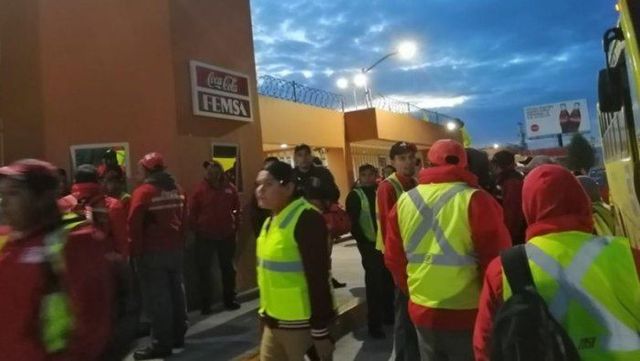
Coca-Cola workers walk out in Toluca [credit Angel Gonzalo Zamorano]
On Monday, workers at two more distribution centers in Iztacalco and Mixcoac stopped work, halting the distribution of Coca-Cola from the centers in the impoverished industrial belt on the southern periphery of the megacity. Though four of the plants were coerced back to work, there is no contract and the situation remains volatile. Another plant that walked out Wednesday remains on strike.
In recent weeks, Coca-Cola workers in Mexico have been compelled by management to sign an agreement that cuts their food vouchers and paid vacations, and eliminates sales commissions that can comprise from a third to a half of workers’ incomes.
“Sign your resignation or sign this piece of paper,” management told the workers.
As anger grew at plants, workers began talking to one another on social media.
Workers’ demands were democratically discussed and evolved quickly from getting their commissions back to deciding that “the solution is signing a new contract” with major improvements, particularly the 8-hour day.
The strike was carried out in opposition to the company and the pro-company union, which is affiliated with the Revolutionary Confederation of Workers and Peasants (CROC). “Our trade union simply didn’t do anything to support us on the question that we have really heavy workdays for unjust salaries,” one Tlalpan worker told reporters.
Management moved to threaten workers that they would not only lose the commissions but also all their seniority. Executives speaking to workers at the mass assembly sought to divide them, asking, “does at least one of you, because someone might, want to have a dialogue inside, to come in and talk?” All workers angrily responded “no!”
One worker yelled at a union leader: “Slaves used to work from daylight to daylight: they would enter at 7 and leave at 7. We don’t even have that. I leave at four from my house and come back after 10.” Workers receive 294 pesos or $15 per day and work six days each week.

Matamoros Coca-Cola workers strike in January
La Izquierda Diario interviewed striking workers who said: “One day, my son asked if I didn’t live at the house anymore because he never sees me.”
On Tuesday night, the company forced workers to sign that they agreed to the elimination of their commissions in exchange for no reprisals, with the CROC union and the company executives both continuing threats against workers. However, on social media workers warned Wednesday that “a strike already occurred in 2012, but union leaders sold out and nothing happened, and many got fired.”
The relief for the corporation was brief. At daybreak Wednesday, dozens of workers at a Coca-Cola distribution center in Coecillo, Toluca—35 miles west of Mexico City—walked out against the elimination of the commissions, with workers reporting that it signifies losing a third of their income, along with demands of a shorter workday.
Demonstrating the simmering opposition across the country, strikers in Toluca told reporters of La Izquierda Diario they had not heard about the strikes in Mexico City. “Our interests are the same as theirs,” one worker said.
The super-exploitation faced by Coca-Cola workers led them to carry out strikes even before the recent cuts. Some 400 Coca-Cola bottling workers in the northern border city of Matamoros struck this spring. The strike lasted more than two months, beginning as far back as January 31 as a wildcat strike demanding a 20 percent raise and US$1,600 bonus and lasting until April 5. Matamoros Coca-Cola workers walked out amid wildcat strikes by more than 70,000 manufacturing workers in maquiladora sweatshops in the city, which ended in a sellout agreement involving 140 firings.
On June 5, about 30 Coca-Cola drivers in Santa Rita, Durango, struck for a day to protest the 14-hour days and the elimination of paid vacations, with Milenio noting that workers simply dismissed any interaction with the Confederation of Mexican Workers (CTM) union.
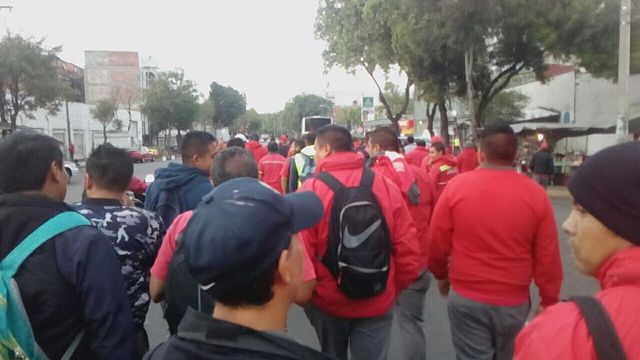
Strikers march in Tlalpan on Saturday [Credit: Winnyto Gutierrez]
Beyond a short piece by Forbes on Friday, focusing on the statements by the corporation, the corporate media in Mexico and internationally has been completely silent, fearful that Coca-Cola workers will decide to join their resistance against the cuts and even join the struggles of workers in other sectors amid the ongoing resurgence of working-class militancy in Mexico and internationally. These fears by the ruling class were reflected by a sharp fall of 1.44 percent in the stock prices of Coca-Cola Femsa, the branch in Mexico, as news of the strike in Toluca broke.
The approval by the Andrés Manuel López Obrador (AMLO) administration of a labor reform demanding that “independent” unions be allowed to compete for representation through a majority vote has produced a wave of activity among opportunistic trade union careerists backed by pseudo-left organizations—including the Socialist Workers Movement (MTS), which publishes La Izquierda Diario, the Stalinist Mexican Communist Party (PCM), the Political Organization of the People and Workers (OPT), and numerous others—hoping to replace the established and hated company unions of the CROC and the CTM.
This happens amid growing opposition to the administration of López Obrador and his bourgeois party Movement for National Regeneration (Morena) as it subserviently obeys the dictates of the fascistic Trump administration by sending 21,000 troops to the borders to crackdown on Central American immigrants. AMLO is also obeying the dictates of Wall Street through aggressive corporate tax cuts along the industrialized northern border and an open “austerity” program involving mass layoffs in the public sector.
The main objective of the labor reform and the reason why both big business parties of US imperialism and sections of the Mexican ruling class are promoting this legislation was explained by the Secretary of Labor, Luisa María Alcalde, to El Financiero: “With the reform, we reduce the chances of strikes like those in Matamoros because more authentic union representations, guarantee talks and no strikes… attracting dialogue and productivity.”
Mexican workers must expand their fight for the social right to a decent salary and the eight-hour day. Combating one of the largest and most powerful transnational corporations like Coca-Cola requires an international struggle in alliance with their class brothers and sisters across Latin American and in the US and Canada. Workers must build rank-and-file committees independent of the nationalist and pro-capitalist trade unions to expand their struggle.

China's Engagement with Africa: Where Does it Stand?

Anand Benegal


China’s engagement with the Africa continent has been analysed to examine a variety of aspects and a substantial portion of those analyses focus on the dept trap and resource curse concerns. However, an analysis of Beijing’s multidimensional relational policy comprising economics and culture and a comparison of China's presence in Africa with those of the US and the EU shows that China is the continent’s most favoured partner.

China's Multidimensional Partnership with AfricaFor some time now, China has consistently been Africa’s largest single trading partner, having surpassed the US in 2009. In terms of trade volume, only the EU-Africa partnership is far greater, at US$ 314 billion compared to China's US$ 170 billion in 2017. Similarly, Chinese FDI has shown dramatic growth, from US$ 74.8 million in 2003 to US$ 4.1 billion in 2017. According to McKinsey, thousands of Chinese firms employ and train millions of African workers, across diverse sectors including energy, infrastructure and manufacturing. Chinese commerce holds a diversified portfolio and is in Africa for the long-term, suggesting that profits from demographic dividend-driven growth is Beijing’s primary goal.

More controversially, the speed and secrecy in Chinese One Belt One Road project related investments have escalated China into becoming Africa’s largest creditor. These investments are typically long-term commitments in sectors such as transport, energy, mining, and communications. However, in Africa, China is viewed as a benevolent trustee. This is largely due to how Beijing has forged a thriving cultural partnership. Sino-African cultural relations range from research and education to language and culture. The Communist Party of China also provides diplomatic training to African politicians and entrepreneurs, which contribute to this favourable image among emerging African leaders. Sino-African research partnerships have garnered positive media reception for increasing employment and knowledge opportunities. Local telecommunications and agri-technology are among the most notable successes. A recent article in Nature goes so far as to state that “on the technological front, China is unmatched in Africa.”

Meanwhile, 59 Confucius Institutes (CIs) are involved in teaching Mandarin Chinese along with Chinese culture in over 30 African countries, second only to France's 115 Alliance Françaises in 35 African countries. CIs supplement diplomacy and promote cultural and educational outreach programmes. The stringency of China’s visa policy also means African countries do not fear brain drain. Despite some harboring fears over the one-sidedness of this cultural relationship, the wider African populace has welcomed these educational opportunities.

China, US and EU in AfricaThe conspicuous contrast is in military presence: the US has thousands of troops stationed across Africa, conducting counterterrorism and training operations. Precise force estimates are unclear, but the footprint is substantial—34 military outposts were observed in 2018. Likewise, the EU too holds military programmes. EU countries with sizeable military presence include Germany (in Mali, Somalia and Niger) and France (in Chad, Cote d’Ivoire, Djibouti, and Gabon). These external forces are often resented by the locals as the former tend to entangle themselves in regional conflicts. For instance, France launched airstrikes against political rebels in Chad in February 2019, and their siding with President Idriss Deby’s regime was heavily criticised.

China has only recently shifted from its non-intervention policy. Aside from establishing a military base in Djibouti, China has increased contributions to UN peacekeeping missions, offering to contribute 8000 troops and to train regional peacekeeping forces in 2015. While Western countries have a long history of continental military intervention, China has hitherto benefited from a lack of equivalent history. Beijing is trying to smoothen its growing military ambitions in Africa through diplomacy: the first China-Africa Defense and Security Forum took place in Beijing in June 2018. However, the nature of China’s response if/when embroiled in local/regional conflicts will be a factor that sculpts the trajectory of this relationship. Insofar, not having faced this issue has helped Beijing's popularity with African leaders, whereas poor handling of a regional conflict could affect Beijing’s popularity.

Popularity surveys by Afrobarometer (2014) and Pew Research Center (2016) show that regional African populations view China warmly. 51 African leaders were present at the Forum on Africa-China Cooperation in Beijing compared to 27 at the UN General Assembly held in October 2018. Although historically, the US has been Africa’s preferred ally, a 2017 Pew survey shows China overtaking the US in terms of popular favourability, in at least three out of six African countries surveyed, with a tie in one (Kenya). Consolidating the decline of the US’ popularity is the ongoing US-China trade war which adversely impacts African economies, bringing the continent closer to China.

China's multidimensional African policy has been a diplomatic victory compared to the US’s and the EU’s policies, which are heavily focused on regional security. Reacting to China, the EU unveiled a set of economic proposals towards Africa in September 2018, and the US’ National Security Advisor John Bolton announced a US-Africa strategy that December. These new proposals are similar to the multidimensional partnerships which currently underpin Sino-African relations.

Looking Ahead
The quick and emphatic marriage of economic and cultural diplomacy has been central to China’s rise in Africa. However, efforts to expand its military presence in conflict-ridden regions in the continent could affect this popularity among people and elites alike. How China navigates its security interests whilst evading the fallouts of regional conflicts could determine how its standing—as Africa’s most valued partner—progresses.

Understanding Climate Change as a National Security Concern

Avino Niphi


The scientific community has unequivocally confirmed the alarming severity of climate change impacts arising from excessive anthropogenic influence. Over the years, the frequency of extreme weather conditions has been observed to have a direct bearing on the availability of water in India and consequent effects on agricultural productivity, economic growth and social stability. In addition, the relationship between climate change, peace, security and development is also becoming more apparent.

Human security lies at the core of climate change impacts. However, the impact on human security is not accorded high priority status in national and/or regional policy-making agendas in most contexts. As the central security provider for the people it governs, the state would benefit from expanding the discourse on climate change to view it also as a national security concern. Doing so could facilitate overcoming the prevailing sluggishness in policymaking aimed at tackling climate issues while also keeping the focus on human security. Given how effects of climate change overlap with traditional security concerns within the policy domain, such an approach could provide an entry-point to formulating timely mitigation-based state responses.

On a transnational level, the impact that climate change could have on a country is much greater and could unfold as matters of national security. In this regard, the vulnerability of the Indo-Bangladesh region to climate change is a helpful case study to understand the inter-linkages in the long term national security concerns and priorities of both countries. Alongside India’s proneness to climate related risks, Bangladesh has been ranked the 7th worst weather affected country since 1998. Today, two-thirds of Bangladesh’s territory is situated less than five meters above sea level, significantly affecting the country’s agricultural productivity.

Climate Change and the India-Bangladesh ContextWhile both India and Bangladesh have managed to create a space for themselves in the international community through impressive economic growth rates and have stabilised their bilateral relations since the formation of Bangladesh in 1971, the dual consequences of climate change, i.e. environmental degradation and the perceived threat to national security due to the cross-border influx of migrants, have often manifested in bilateral relations. Intensification of these concerns could potentially roll back years of socio-economic progress in both countries as well as bilateral rapport-building.

An estimated 13.3 million people in Bangladesh are expected to be displaced by 2050 due to climate-change induced effects. In such a scenario, migratory responses among those affected seem inevitable. For a country that is locked by Indian territory on three sides, and by the Bay of Bengal on the fourth, the optimal recourse for climate displaced people in Bangladesh would be to relocate and seek refuge either in other parts of Bangladesh or into the other proximate regions, i.e. north-east Indian states and West Bengal. However, from the Indian perspective, the north-eastern states are not economically equipped to handle any major migrant influx; and West Bengal, the fourth most populous state, is likely to face demographic unrest as a side effect of mass influx of people. The resultant competition over opportunities and resources would pose a challenge to economic capacity and social stability in these areas while also creating a simultaneous decline in Bangladesh’s labour force and productivity. While frictions arising from cross-border migration from Bangladesh have already manifested in a variety of Indian states bordering Bangladesh, India’s Assam state emerges as a prime example where the issue has been identified as an act of “external aggression” by the former governor of Assam and the Indian Supreme Court.

It would thus be worthwhile for New Delhi and Dhaka to coordinate with each other to address the issue sustainably. Such coordination might, in fact, also help prepare both countries for a potential future scenario when large scale climate-induced migration from Bangladesh into India occurs.

Another issue that could possibly get aggravated due to climate change effects is the disputes over trans-boundary rivers. Tensions over trans-boundary river waters have been known to trigger a variety of conflicts in different parts of the world. Despite India and Bangladesh sharing 54 trans-boundary rivers, there exists only one water sharing treaty between the two, i.e. the Ganga waters sharing treaty, which was signed in 1996 for a period of 30 years (renewable by mutual consent). As a lower riparian, Bangladesh’s water security is directly vulnerable to the effects of upper riparian India’s activities on these rivers. Damming and other activities on these rivers in India have an impact on availability of water for irrigation, industry, energy demands, and public consumption in Bangladesh.

Equally, India’s national security and stability is connected to those of Bangladesh’s. The effects of climate change on Bangladesh are likely to be projected onto India, over and above the latter’s own vulnerability to climate change impacts. In order to safeguard its national interests, India, therefore, needs to coordinate with Bangladesh to begin managing these issues well in advance.

Given the circumstances, viewing climate change as a national security related concern could open conversations among governments regarding potential future scenarios. This provides an avenue for both countries to build capacities and introduce anticipatory measures in a timely manner. Mutuality of interests on these issues could also be amplified in policy discourses to speed up identification of remedial measures. Discussing climate change from a national security perspective with the same degree of attention and urgency as any other strategic concern is imperative also because it can provide a potent segue for prioritising climate change not only in the national and bilateral policymaking domain but also on the regional level.

Looking AheadIn January 2019, the UN Security Council demonstrated renewed interest in discussing the risks posed by climate change to peace, security and development. A similar debate in India on national security concerns linked to climate change would be extremely useful for related policymaking and public consciousness. This, in turn, will be contributory to fostering conditions necessary for ensuring human security since ensuring national security is not merely about protecting territory but also about providing protection for the peoples in that territory.

At present, India’s climate policy is fragmented and does not address the wider and impeding national security related concerns. While this study looked at the India-Bangladesh context, India also directly neighbours six other countries. Given that the cumulative impact of climate change also has the potential to catalyse conflict by aggravating unresolved domestic and transnational security issues, examining climate change as a national and regional security concern could help spark more comprehensive and coordinated domestic policy action as well as facilitate regional cooperation.

26 Jun 2019

Government of Ireland Africa Agri-food Development Program (AADP) 2020

Application Deadline: 2nd August 2019 (5.00pm on Friday).

About the Award: The Objective of the AADP is to develop partnerships between the Irish Agri-Food Sector and African countries to support sustainable growth of the local food industry, build markets for local produce and support mutual trade between Ireland and Africa.
It is intended that any investment by the AADP will be catalytic support with co-funding from the private sector. The fund is designed to leverage greater expertise, experience and investment from the Irish agri-food sector and projects should demonstrate results with a long-term developmental impact that will ultimately lead to sustainable benefits through investment by the private sector.

Irish agri-food expertise is extremely wide-ranging and examples of suitable AADP projects include:
  • Business development
  • Production system
  • Technology Transfer
  • R & D
  • Project Management
Type: Entrepreneurship/Grants

Eligibility: 
  • The partners involved must include one Irish registered agri food company and one local commercial entity in Africa;
  • All proposed projects must be commercial in nature and focus. Funding will only be awarded to Irish registered agri food companies.
  • AADP funding is up to a maximum of €250,000 per company for a full project or €100,000 for a feasibility study.
  • AADP funding will not exceed 50% of the costs of the project;
  • The funds contributed by the Irish registered agri food company must not comprise funding received from any other Irish Public funding source.
  • If an applicant company was previously successful in applying for AADP funding, it must explain clearly (in the application form) the new project goals/outcomes and how they differ from those in the initial funding round.
  • If an applicant company proposes to undertake a feasibility study, it should include a list of ‘potential’ partners with the application.
  • Projects will be supported in the following countries – Ethiopia, Kenya, Nigeria Malawi, Mozambique, Sierra Leone, South Africa, Tanzania, Uganda, and Zambia;
    • Funding from the AADF must bring about additionality and not replace existing funding;
    • Successful AADF funding applicants will be encouraged to engage with Irish NGOs where possible on various aspects of the projects i.e. Mechanical and Engineering, Project design, etc.
Evaluation Criteria: Applications will be evaluated against the following criteria:
  • Development Impact
  • Company expertise (Technical, financial etc)
  • Commercial viability
  • Risk Analysis
  • Monitoring and Expenditure
It is intended that any investment by the AADP will be catalytic support with co-funding from the private sector. The fund is designed to leverage greater expertise, experience and investment from the Irish agri-food sector and projects should demonstrate results with a long-term developmental impact that will ultimately lead to sustainable benefits through investment by the private sector.

Number of Awards: Not specified

Value of Award: Possible funding of up to €250,000 in total per company

How to Apply: 
Visit the Program Webpage for Details

Important Note: Only Irish Agri-Food companies can apply.

Award Providers: The Africa Agri-Food Development Programme (AADP) is a joint initiative between the Department of Agriculture, Food and the Marine and the Department of Foreign Affairs and Trade.

Vanier Canadian Graduate Scholarship 2020/2021 for Doctoral Study in Canadian Universities

Application Deadline: 6th November, 2019 20:00 EDT

Offered Annually? Yes

Eligible Countries: All

To be Taken at (country): Canada

About the Award: The Vanier Canada Graduate Scholarship (Vanier CGS) was created to attract and retain world-class doctoral students and to brand Canada as a global centre of excellence in research and higher learning. VCS supports students who demonstrate both leadership skills and a high standard of scholarly achievement in graduate studies in social sciences and humanities, natural sciences and engineering, and health. The scholarship is worth $50,000 per year for three years and is available to both Canadian and international PhD students studying at Canadian universities.
Information for nominating institutions: Nominating institutions are encouraged to consider diversity in discipline, gender, official language, and citizenship when considering which applicants to nominate for the Vanier Canada Graduate Scholarships (Vanier CGS) program.

Areas of research:
  • Health research
  • Natural sciences and/or engineering research
  • Social sciences and humanities research
Type: Doctoral (PhD)

Eligibility: Open to Canadian citizens, permanent residents of Canada and foreign students pursuing a doctoral degree at eligible Canadian universities
To be considered for a Vanier CGS, candidate must:
  • be nominated by only one Canadian institution, which must have received a Vanier CGS quota;
  • be pursuing your first doctoral degree (including joint undergraduate/graduate research program such as: MD/PhD, DVM/PhD, JD/PhD – if it has a demonstrated and significant research component). Note that only the PhD portion of a combined degree is eligible for funding;
  • intend to pursue, in the summer semester or the academic year following the announcement of results, full-time doctoral (or a joint graduate program such as: MD/PhD, DVM/PhD, JD/PhD) studies and research at the nominating institution; Note that only the PhD portion of a combined degree is eligible for funding;
  • not have completed more than 20 months of doctoral studies as of May 1, 2020;
  • have achieved a first-class average, as determined by your institution, in each of the last two years of full-time study or equivalent. Candidates are encouraged to contact the institution for its definition of a first-class average; and
  • must not hold, or have held, a doctoral-level scholarship or fellowship from CIHR, NSERC or SSHRC to undertake or complete a doctoral degree.
Eligibility of Degree Programs
  • Doctoral awards are tenable only in degree programs that have a significant research component. The research component must be a requirement for completion of the program, and is considered to be significant original, autonomous research that leads to the completion of a dissertation, major scholarly publication, performance, recital and/or exhibit that is merit reviewed at the institutional level. Clinically-oriented programs of study, including clinical psychology, are also eligible programs if they have a significant research component, as described above.
Selection Criteria:
  • Academic excellence, as demonstrated by past academic results and by transcripts, awards and distinctions.
  • Research potential, as demonstrated by the candidates research history, his/her interest in discovery, the proposed research and its potential contribution to the advancement of knowledge in the field, the potential benefit to Canadians, and any anticipated outcomes.
  • Leadership (potential and demonstrated ability), as defined by the following qualities:
  • Personal Achievement:
  • Involvement in Academic Life:
  • Volunteerism/community outreach:
  • Civic engagement:
  • Other
Value and Duration of Scholarship: $50,000 annually for three years.

Number of  Scholarship: Up to 166 scholarships are awarded annually.

How to Apply: Candidates must be nominated by the university at which they want to study. Candidates cannot apply directly to the Vanier CGS program.
It is important to go through the Application requirements in the Scholarship Webpage before applying.

Visit Scholarship Webpage for Details 

Award Providers: The Vanier’s scholarships are administered by Canada’s three federal funding agencies:
Canadian Institutes of Health Research (CIHR)
Natural Sciences and Engineering Research Council (NSERC)
Social Sciences and Humanities Research Council (SSHRC)

TED Fellows Programme (Fully-funded to Vancouver, Canada) 2020

Application Deadlines: 27th August, 2019 11:59pm UTC

Eligible Countries: International

To be taken at (country):  Vancouver, Canada

About the Award: The TEDGlobal Fellowships is designed to bring together young trailblazers from a variety of fields who have shown unusual accomplishment and courage. Instead of business people, professionals, policy wonks and government officials, the TED Fellows program focuses on doers, makers, inventors, advocates, filmmakers and photographers, musicians and artists, scientists, entrepreneurs, NGO heads, and human rights activists.
Twenty fellows will be selected to attend the TED Global conference to be held in April 2020. Participants will also have the opportunity to attend pre-conference programs with training by speakers.

Type: Fellowship

Eligibility: 
  • TED looks for different applicants than many other leadership-oriented programs. Instead of business people, professionals, policy wonks and government officials, the TED Fellows program focuses on doers, makers, inventors, advocates, filmmakers and photographers, musicians and artists, scientists, entrepreneurs, NGO heads, and human rights activists.
  • In addition to impressive accomplishment, fine character and a good heart are two very important traits the TED Fellows programme looks for in every potential TED Fellow. More than anything, this focus on character has defined the success of the TED Fellows program.
  • Candidates may apply to attend either TED or TEDGlobal.
  • Anyone over the age of 18 is welcome to apply
Selection Criteria: TED Fellows are selected by the program staff, with extensive reference checking and consultation with experts across all fields. Selections are made by the group as a whole, not by individuals.
There is no algorithm for how we select our TED Fellows. We select Fellows based on their accomplishments in their respective fields, the potential impact of their work and also, most importantly, their character. The ideal applicant is multidisciplinary in their pursuits, and is at a moment in their career to maximize the support of the TED Community.

Number of Awardees: Twenty(20)

Value of Fellowship: 
  • TED pays for round-trip economy airfare, ground transportation to and from the conference location, meals and shared accommodation on site.
  • The TED Fellowship programme has the ability to slingshot candidate’s career forward.
  • As a Fellow, the candidate will be introduced into a powerful network of innovators that can be future collaborators.
  • By attending and speaking at the TED Conference, candidate will not only have the ability to spread their message far and wide, but will also meet people who may be able to help your career.
  • Aside from the conference, Fellows have access to personal mentorship opportunities and speaker coaching following conference participation.
  • Once you are selected as a TED Fellow all flights (or equivalent) to and from the TED conference, any visa needs, room, board + food while at the conference, and a conference pass will be covered.
Duration of Fellowship: A 5 day stage program from April 15 to 19, 2020. . Also, one-year commitment that is centered around a TED Conference. However, “once a Fellow, always a Fellow”

How to Apply: Apply now

Visit Fellowship Webpage for details

Facebook’s Libra Isn’t a “Cryptocurrency”

Thomas L. Knapp

In mid-June, Facebook — in cahoots with 28 partners in the financial and tech sectors — announced plans to introduce Libra, a blockchain-based virtual currency.
The world’s governments and central banks reacted quickly with calls for investigation and regulation. Their concerns are quite understandable, but unfortunately already addressed in Libra’s planned structure.
The problem for governments and central banks:
A new currency with no built-in respect for political borders, and with a preexisting global user base of 2.4 billion Facebook users in nearly every country on Earth, could seriously disrupt the control those institutions exercise over our finances and our lives.
The accommodation Facebook is already making to those concerns:
Libra is envisaged as a “stablecoin,” backed by the currencies and debt instruments of those governments and central banks themselves and administered through a “permissioned” blockchain ledger by equally centralized institutions (Facebook itself, Visa, Mastercard, et al.).
To put it a different way, Libra will not be a true cryptocurrency like Bitcoin or Ether. Neither its creation nor its transactions will be decentralized and distributed, let alone easily made anonymous. A “blockchain” is just a particular kind of ledger for keeping track of transactions. It does not, in and of itself, a cryptocurrency make.
In simple terms, Libra is just a new brand for old products: Digital gift cards and pre-paid debit cards.
The only real difference between Libra and existing Visa or Mastercard products is that Libra’s value will fluctuate with the “basket” of currencies and bonds it’s backed by, instead of being denominated in one particular (also fluctuating — you experience the fluctuations as changes in the prices of goods) currency like the dollar or the euro.
When it comes to the goal envisaged by cryptocurrency’s creator, the pseudonymous Satoshi Nakamoto — to free money from control and manipulation by governments and central banks — Libra is a dead end. Instead of being manipulated by one government or central bank, Libra will be manipulated by all of them.
Cryptocurrency is, to get biblical, new wine in old wine skins — it bursts those skins, by design. Libra isn’t new wine. It isn’t even a new wine skin. It’s a blend of the same old wines, in the same old skins, with a fancy new label. And there’s nothing to suggest that the old wine is getting better with age.
Fortunately, these structural defects also mean that Libra isn’t a threat to real cryptocurrency. Accept no substitutes.

The Hydroponic Threat to Organic Food

Dave Chapman

In the last 7 years there has been a quiet redefinition taking place in the USDA National Organic Program that oversees organic standards. Large scale industrial producers have insinuated themselves into organic certification to transform what the green and white label stands for.
Original organic was based on a simple equation:
Healthy soil = healthy plants = healthy animals = healthy planet.
This equation leaves out the discussion of WHY these things are true, but it is a good roadmap for what organic agriculture is all about. The first given is always “healthy soil.” As we look deeper, we cannot study these parts separately, because plants and animals are integral parts of healthy soil system. No plants means no healthy soil. The same is true with animals. Soil and plants coevolved for 350 million years, and neither can be healthy in isolation from the other. The dance between plants, microbial life, and animal life in the soil is necessary for all.
Western soil science got started with the work of Justus von Liebig (1803-1873). From Liebig’s perspective, soil was a passive storage bin for plant nutrients. However, in Charles Darwin’s 1881 book The Formation of Vegetable Mould through the Action of Worms, these ideas were challenged by a vision of the soil as a living ecosystem. But Liebig’s viewpoint dominated Western soil science until the 1980’s when the role of organisms in soil formation became better understood. Liebig himself even turned away from his “storage bin” paradigm in the later part of his life, but our agricultural sciences continued to follow his earlier writings.
If we take away plants, soil can no longer be living. Plants provide the energy via photosynthesis for all animal and microbial life in the soil. These photosynthates are provided first as root exudates that feed the fungi and bacteria in exchange for which they gain the minerals that in turn feed the plants. The visible life forms are as important as the invisible microbial community. Soil animals go from burrowing woodchucks and gophers to snails, slugs and elongate animals such as earthworms, flatworms, nematodes, soil mites, springtails, ants, termites, beetles and flies. All of these species together create a community that is often called the soil food web.
Organic farming is based on protecting and enhancing this web of life. By cultivating the diversity of life, we create a stable ecosystem in the soil. Diseases or pestilence are symptoms of a loss of balance. So the organic farmer’s first job is to enhance the diversity of life in the soil community. This is done by providing materials and techniques to help build a soil carbon sponge.
Conventional agriculture is based on a very different strategy of control and simplification. By making systems that are as simple as possible, it becomes easy to control the inputs and outputs. The inputs are processed offsite to provide plant available nutrients. “Soil” becomes a device for holding roots. It is thus easier to make these systems replicable, much like the model of a McDonald’s restaurant. McDonald’s simplifies their systems as much as possible to serve the same hamburger to every customer around the world. In such a system the expertise is contained in the corporate staff who design the processes and provides the raw materials. The problem is a loss of nutrition in the final product. McDonald’s serves lots of calories that soothe customers’ cravings, but they fail at providing a healthy diet. The end result is the phenomena of customers who are simultaneously malnourished and obese.
Similarly, in a conventional agriculture system, the yields are high per acre, but, as Vandana Shiva has said, the yield of health per acre is low. As it turns out, we are part of that co-evolution of soil and plants and animals. Human nutritional needs are complex and beyond our full understanding at this point. But organic farmers believe that by embracing those natural systems, we can feed ourselves well, even if we never fully understand why.
As Einstein once said, there is a simplicity that comes before complexity that is worthless, but there is a simplicity beyond complexity that is priceless.
These simplified conventional systems have been promoted by an industry that profits by selling remedies to the unintended consequences of such crude simplicity. Their high yields are unsustainable without the liberal use of poisons. Plants grown in a soil devoid of biological complexity are very vulnerable to disease and insect attack. And of course, the more we use such poisons, the less healthy the soil becomes, so more pesticides are needed, and on and on.
In livestock production, the epitome of conventional agriculture is a Concentrated Animal Feeding Operation (CAFO) where animals are isolated from the land. Their food is grown far from where they live, so their manure is lost to the production system. There is no honoring of Albert Howard’s Law Of Return.
In vegetables and berries, the epitome of conventional agriculture is hydroponic production. Hydroponics is a system that relies entirely upon processed inputs to feed the plants. The old organic adage is, “Feed the soil, not the plant.” The guiding principle of conventional agriculture is: “Feed the plant, not the soil.” Obviously, hydroponic production is the most extreme example of this philosophy.
The practices of organic farming are ancient, but not all traditional farming systems could be called organic by the definition of such pioneers as Albert Howard. Some traditional agriculture was not sustainable and ultimately led to the downfall of civilizations. But organic principles have been practiced in the intensive farming of southeast Asia for over 4000 years. They were learned by Howard in India and subsequently taught in the West. Since then, soil science has confirmed Howard’s ideas to an astonishing degree. Every day we learn more and more about how soil communities function and about why such a system need not depend on pesticides to thrive. Every day we learn more about the connections between the soil microbiome and our own microbiome.
From this logic we derive a conclusion that is important to remember: that the absence of pesticides in a successful organic system is the result of how we farm, not the definition of it.
The organic movement has long believed that food grown in a healthy soil is the foundation of human health. In recent years it has become clear that agriculture is also deeply involved in the climate crisis, both as the problem and as the solution. Conventional agriculture contributes directly to the destruction of the living soil, leading to the spread of deserts and the warming of the planet. We have the skills and understanding to farm without chemicals in a way that will build a soil carbon sponge that can cool our warming planet. Our impediment to achieving this is social and political, not technical.
The inclusion of hydroponics in organic certification is thus not an example of innovation and improvement. It is an example of conquest and colonization. It is simply a hostile takeover of organic by economic forces. It has been widely resisted by the organic community, but the USDA continues to embrace hydroponics as organic just as they embrace CAFOs as organic. Their redefinition of organic is in opposition to the law and to international norms. The US once again becomes the rogue nation throwing away our mutual future so somebody can make a buck.
At this time, huge quantities of hydroponic berries, tomatoes, peppers, cucumbers, and greens are being marketed as “Certified Organic” in partnership with the USDA. And there is no way of identifying what is hydroponic in the organic label.
The Real Organic Project was created to challenge this process. Our efforts include the creation of an add-on label so that real organic farmers and eaters might be able to find one another in a deceptive marketplace.

Public decency law puts Saudi reforms in perspective

James M. Dorsey

A newly adopted Saudi law on public decency helps define Crown Prince Mohammed bin Salman’s vague notion of ‘moderate Islam.’
It also lays bare the pitfalls of his social reforms as well as his preference for hyper-nationalism rather than religion as the legitimizing ideology of his rule and his quest for control of every aspect of Saudi life.
In an indication that Prince Mohammed is walking a fine line, Saudi media reported that the government was still weighing how to implement the law almost two months after it was adopted.
“This (law) is an effort to balance the pressure from conservative elements of society that accuse the (government) of allowing things to go ‘out of control’. Effecting social change is an art form — you want to push as fast as possible without provoking a counter reaction. Not easy!” Ali Shihabi, founder of Arabia Foundation, a Washington-based, pro-Saudi think-tank, told Agence France-Presse.
The law comes on the back of a series of reforms in recent years that were designed to facilitate Prince Mohammed’s plans to streamline and diversify the Saudi economy and project the crown prince as a reformer.
The reforms included the lifting of a ban on women’s driving, relaxation of gender segregation, enhancement of women’s professional opportunities, the introduction of modern forms of entertainment and the curbing of the powers of the kingdom’s feared religious police.
Prince Mohammed also vowed to revert the inward-looking, ultra-conservative kingdom to a form of moderate Islam he claimed existed prior to the 1979 Iranian revolution.
Ultimately, Prince Mohammed’s short-lived reformist image was severely tarnished by the kingdom’s devastating war in Yemen; the brutal killing of journalist Jamal Khashoggi; the mass arrest of clerics, activists, journalists and academics; his failure to lift the kingdom’s male guardianship system; and the mushrooming number of people fleeing the kingdom, including dissidents as well as women seeking to escape repressive and abusive families.
Sparking ridicule on social media, the new law defines limits of Prince Mohammed’s social reforms and creates one more anchor for his repression of any form of dissent.
The law bans men’s shorts except for on beaches and in sports clubs. It also bans garments with questionable prints that like shorts “offend public tastes.” It forbids the taking of pictures or use of phrases that might offend public decency as well as graffiti that could be interpreted as “harmful.”
The bans packages public decency as representing Saudi “values and principles” in a nod towards Prince Mohammed’s promotion of a hyper-nationalist Saudi identity.
Yet, various of its restrictions are more in line with the kingdom’s long-standing austere interpretation of Islam while others reinforce the crown prince’s repression of anything that does not amount to an endorsement of his rule or policies.
The restrictions on clothing and this month’s closure on opening night of the kingdom’s first-ever alcohol-free ‘Halal’ disco constitute an apparent effort to cater to ultra-conservatives who oppose liberalisation of gender segregation and public religious rituals such as the muted lifting of rules that force businesses to close during prayers times.
The reforms, while significant in and of themselves, stop short of dismantling what politics scholar Brandon Ives terms ‘religious institutionalism’ or the intertwining of religion and state through a “plethora of institutions, policies, and legal codes.”
Religious institutionalism complicates Prince Mohammed’s attempt to replace religious legitimization of his rule with hyper-nationalism because of its success in fusing religion with Saudi culture.
“Religion and culture are now so intertwined in what it means to be Saudi that it is hard to separate the two,” said Eman Alhussein, author of a just published European Council of Foreign Relations report on Saudi hyper-nationalism.
As a result, some nationalists have joined religious conservatives in calling for limitations on what is deemed acceptable entertainment and media content.
Ms. Alhussein noted that some online critics were cautioning that the promotion of hyper-nationalism stripped Saudis of their values in a manner that weakens their loyalty to the regime.
“Nationalism in this increasingly strident form could eventually become a Trojan horse that undermines the state,” Ms. Alhussein warned.
Nationalism’s double edge is enhanced, Ms. Alhussein went on to argue, by the undermining of the buffer function of the kingdom’s traditional religious establishment. “The state will now be more accountable for its credibility, and potentially much more exposed,” she said.
Prince Mohammed’s refusal to tackle religious institutionalism impacts not only his attempts at consolidation of his power but also his effort to project the kingdom as an enlightened 21st century state.
The crown prince, in a bid to alter the kingdom’s image and cut expenditure, has significantly reduced spending on a decades-long, US$100 billion campaign to globally promote anti-Shiite, anti-Iranian strands of ultra-conservative Sunni Islam.
Prince Mohammed has at the same time ordered state-controlled vehicles that once promoted religious ultra-conservativism to preach tolerance, mutual respect and inter-faith dialogue instead.
Mr. Ives’ analysis suggests, however, that the kingdom’s U-turn is unlikely to lead to a clean break with support abroad of ultra-conservatism without the dismantling of religious institutionalism.
He argues that the domestic pressure that persuades states such as Saudi Arabia and Iran to support co-religionist rebel groups beyond their borders is generated not by religious affinity but by religious institutionalism that creates a political role for religious forces.
Mr. Ives’ arguments appear to be borne out by continued Saudi support for Islamist militants in Balochistan, the Pakistani province that borders on Iran, as well as Algeria and Libya and propagation of non-violent expressions of an apolitical, quietist, and loyalist interpretation of Islam in countries like Kazakhstan.
Saudi Arabia’s new public decency law in effect highlights the limitations of Prince Mohammed’s reforms.
In a private conversation last year with the Archbishop of Canterbury during a visit to Britain, Prince Mohammed reportedly put some flesh on the skeleton of his vision of moderate Islam.
When urged by the archbishop to allow non-Muslims to open places of worship in the kingdom, Prince Mohammed responded: “I could never allow that. This is the holy site of Islam, and it should stay as such.”