24 Feb 2020

How India’s Modi is Playing on Trump’s Ego to His Advantage

M. K. Bhadrakumar

One thing about U.S. President Donald Trump is that he can be brutally frank. Trump recently picked up the phone and called British Prime Minister Boris Johnson to convey his displeasure over the latter’s decision to allow Huawei to operate in the United Kingdom despite Washington’s repeated urgings not to do business with the Chinese tech company.
Washington even threatened that London would be expelled from the Five Eyes (intelligence-sharing arrangement between the U.S., Canada, the UK, Australia, and New Zealand) if it had anything to do with 5G developed by the Chinese company.
But Johnson stuck to his guns—rightly so, since the post-Brexit British economy hopes to get substantial blood transfusion from China to sustain its future growth and prosperity.
After a “furious” call from Trump, which ended abruptly when the U.S. president “slammed down the phone,” Johnson has since postponed his planned visit next month to Washington.
Therefore, Trump’s frank remarks about his forthcoming India visit on February 24-25 to Ahmedabad, Gujarat, should not come as a surprise. In response to a query from the media, he said on February 18:
“Well, we can have a trade deal with India, but I’m really saving the big deal for later on. We’re doing a very big trade deal with India. We’ll have it. I don’t know if it’ll be done before the election, but we’ll have a very big trade deal with India.
“We’re not treated very well by India, but I happen to like Prime Minister Modi a lot. And he told me we’ll have 7 million people between the airport and the event. And the stadium, I understand, is sort of semi under construction, but it’s going to be the largest stadium in the world. So it’s going to be very exciting. But he says between the stadium and the airport, we’ll have about 7 million people. So it’s going to be very exciting. I hope you all enjoy it.”
There is virtual certainty now that Trump won’t cancel the visit, as he’s wont to doing at the last minute if his attention wanders away to something more exciting.
Prime Minister Modi did a smart thing indeed by enticing Trump with the alluring prospect of 7 million people lining up the streets from the Ahmedabad airport to the newly built Motera Stadium in the city.
What can be more seductive to lure a populist politician than a mass rally? Modi understands Trump well like few people can.
Trump treats politics like a reality show. He is the very antithesis of a cerebral, erudite politician. Ideas don’t matter; words and showmanship are all that matter to him.
Trump derides intellectuality, has a flair for fake news, speaks untruths freely (even in his State of the Union speech), and is a living example of what Abraham Lincoln once said, “Nearly all men can stand adversity, but if you want to test a man’s character, give him power.”
But how come such a hugely successful businessman like Trump can be so naive as to believe that Modi will produce a human chain of 7 million Gujaratis?
Some Indian analysts estimate that something like 300,000 Gujaratis might actually line up to witness the nearly 14-mile-long Trump-Modi roadshow on February 24 from the airport to Motera Stadium.
Trump would have calculated that even if just about 10 percent of the people Modi promised actually show up for the roadshow, that would present a breathtaking image to be broadcast back to American TVs.
The overpowering impression that the spectacle would create in the American public will be that Trump is an immensely popular leader among mankind, contrary to how half of Americans speak of him.
To be sure, the Modi government is leaving no stone unturned. The government hopes to arrange 120,000 people to attend the rally at Motera Stadium. Three thousand buses will be deployed to ferry people from the districts to the stadium.
The state government is expected to spend nearly US$15 million on road renovation, security cover, cultural shows, decorations, etc., alone to give a fresh look to the Gujarat model of development.
Trump didn’t waffle on the reason why he is coming. He hinted that a trade deal remains elusive. His remarks also belied some annoyance with Delhi—presumably, for not being more helpful for his America First project or his family’s business interests in India.
But then, he happens to like Modi himself “a lot.” Suffice it to say, this visit needs to be seen as a favor he’s doing for Modi, whose invitation once as chief guest on Republic Day he’d turned down.
Trump sounded like the badshah (king) out to enjoy himself on an exciting hunting trip and is looking forward to much self-gratification, all arranged at no personal cost to himself.
What can the lowly subjects expect in return? In ancient times, the badshah would have thrown gold coins at the poor people lining the streets.

Philippine President Duterte ends US Visiting Forces Agreement

Joseph Santolan

On February 11, the administration of Philippine President Rodrigo Duterte gave official notice to the US Embassy in Manila of its intention to terminate the country’s two-decade-old Visiting Forces Agreement (VFA) with Washington. The move is the most serious rupture in relations between Manila and its former colonial master since the granting of formal independence on July 4, 1946. If not retracted, the termination will go into effect 180 days after the official notice.
The VFA was concluded as an executive agreement between the two countries in 1999 to allow the rotational presence of US military forces in the Philippines. It was seen as a means of reversing the impact of the 1991 decision of the Philippine Senate, by a one-vote majority, to refuse to extend Washington’s lease on its military bases in the country.
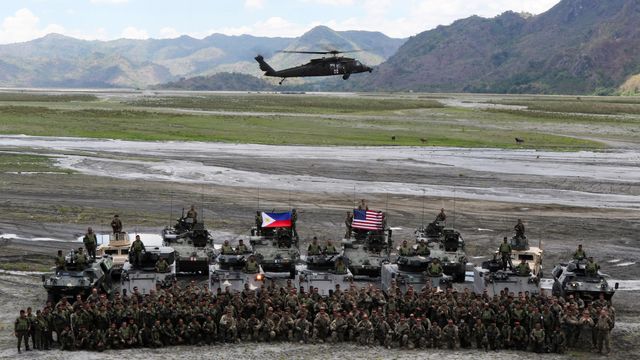
US and Filipino soldiers at 2019 joint live fire exercise [Credit: Wikimedia/John Etheridge]
Under the terms of the VFA, the US military has staged thousands of joint war games in the Philippines, including the annual Balikatan, or ‘shoulder-to-shoulder,’ exercises. Each year Washington has deployed increasing numbers of troops and military equipment to these exercises, which have shifted in focus from counter-terrorism activities to so-called maritime security, an expression of the Pentagon’s open warmongering against China in the South China Sea. At present about 300 such exercises are conducted every year.
Duterte is a right-wing populist whose fascistic ‘war on drugs’ has led to the extrajudicial killing of tens of thousands of poor Filipinos over the past three years. He represents the interests of layers of Filipino capitalists engaged in real estate development and those based in regions of the country at some remove from Manila. These layers are seeking a vast infrastructural investment to enhance their business positions and Duterte articulates these concerns in his signature ‘Build, Build, Build’ program, which proposes to invest billions in roads, bridges, dams, and new airports. The money for this, Duterte claims, will come above all from investment from China.
Washington has sought to shore up its economic decline by thwarting the rise of China, by all means including military. By asserting its ‘national interest’ in the South China Sea, the United States has brought tensions throughout the Asia Pacific region to the brink of war. Courting Beijing’s investment, Duterte has sought to distance Manila from this war drive, ignoring the ruling against China secured by the Aquino administration from the International Tribunal on the Law of the Sea.
Washington will happily fund and prop up tyrants and thugs around the globe until they cross US imperialist interests. As Duterte moved increasingly toward Beijing, Washington began to denounce him for human rights violations in his war on drugs despite the fact that the Obama administration initially provided millions of dollars in funding to Duterte’s murderous crusade before his geopolitical realignment became sharply defined.
Part of the human rights pressure on the Duterte administration was a bill that passed the US Senate in January, which imposed economic sanctions under the Magnitsky Act on Philippine political figures tied to the extrajudicial killings under Duterte and denied them admission to the United States. When Philippine Senator Ronald ‘Bato’ dela Rosa, a key Duterte ally and former head of police, who has been closely tied to extrajudicial murders for decades, was denied admission to the United States, Duterte responded by announcing that he was tearing up the VFA.
US Defense Secretary Mark Esper clearly articulated the perspective of US imperialism on this matter: the VFA was a critical aspect of Washington’s great power conflict with China. He told the press, “As we try and bolster our presence and compete with [China] in this era of great power competition, I think it’s a move in the wrong direction for the longstanding relationship we’ve had with the Philippines for their strategic location, the ties between our peoples, our countries.”
Beijing responded on February 17 when Foreign Ministry spokesperson Geng Shuang told a press briefing that the Philippines has the “right to uphold an independent foreign policy.” He continued, “It is also China’s belief that exchange and cooperation between countries should not only benefit those involved, but also advance regional and global peace and stability.” The military ties between Washington and Manila, Beijing argued, were not advancing global peace.
US President Donald Trump seemed to approach the matter as a business negotiation, responding in a press conference, “If they would like to do that, that's fine. We’ll save a lot of money.… My relationship, as you know, is a very good one with their leader [Duterte]. And we’ll see what happens.”
Duterte’s decision has sent shockwaves through the Philippine ruling elite, the older, more established layers that are intimately tied to Washington. They express their interests through the Makati Business Club (MBC), which stated that the military alliance with the United States was “critical” to “reserving peace and rule of law in the region.”
The Armed Forces of the Philippines (AFP) is heavily dependent on money from Washington. Between 2016 and 2019, the US supplied the Philippine military with $US550 million. The primary function of the AFP is as a domestic police force: dealing with insurgencies, suppressing dissent among the working class and peasant population, and arresting political activists. When Trump speaks of saving money it raises the specter of cuts to military aid, and Filipino capitalists see the menacing threat of social unrest. This is the perspective of the Makati Business Club when it speaks of “preserving peace” and “rule of law.”
In the days immediately following Duterte’s announcement, both Philippine Secretary of Foreign Affairs Teodoro Locsin and Defense Secretary Delfin Lorenzan, spoke in favor of retaining the Visiting Forces Agreement. The opposition, organized in the Liberal Party, expressed the need for Senatorial review of Duterte’s decision to end the VFA. Their protest is hobbled, however, by the fact that in the main these are same political figures who argued in the late 1990s that the VFA was an agreement, not a treaty, and as such did not require senatorial approval to be enacted.
The Liberal Party opposition remains a minority in the legislature and many of its leaders have sought to destabilize the Duterte administration by channeling social unrest behind anti-Chinese chauvinism as a means of targeting the president and his ties with Beijing. The opposition has capitalized on fears of the spread of the novel coronavirus to cultivate an ugly racism in the press and social media. “No Chinese Allowed” signs are cropping up on businesses and demands for the deportation of Chinese workers are being openly expressed by mayors.
The majority of Filipino politicians have, for the time being, allied themselves with Duterte. Philippine history demonstrates just how quickly such loyalties can be abandoned, particularly in the face of a possible military coup. The top brass of the AFP were trained in the United States, many are graduates of West Point and Annapolis, and their loyalty has always been more with Washington than with the occupant of the presidential palace of Malacañang.
With the termination of the VFA pending in the next six months, there will be high-level discussions between Washington and Manila and between the Pentagon and the AFP. US Assistant Secretary of State for Political-Military Affairs R. Clarke Cooper told the press that there would be “ongoing talks” about the VFA leading up to a US-Philippines Strategic Dialogue in March to discuss the issue.
The scrapping of the VFA threatens to end the immensely lucrative war games and possibly cut US funding, which represents a significant chunk of the AFP budget. There are without doubt “ongoing talks” of another sort being conducted in backrooms to plot extraconstitutional means of resolving the termination of the VFA.

Control of offshore gas and oil provokes conflicts in eastern Mediterranean

Jean Shaoul

The dispatch of Turkish troops to Libya, the bitter dispute between France and Italy over military policy at December’s NATO summit in London, and the formation of a French-Greek military alliance against Turkey indicate the extent to which oil and gas have become the source of ever widening conflicts.
While it was popularly understood that the US/UK-led invasion of Iraq was a war for oil, this is less well understood in the case of Libya, which contains the largest deposits of oil in Africa and in 2010 was one of the 10 largest oil producers in the world. The struggle for Libya and its oil has now, moreover, become embroiled in the escalating conflict over the newly discovered gas fields in the Levantine Basin.
A new “scramble for Africa” is being tied into a new “scramble” for the eastern Mediterranean, as Turkey, Greece, Israel, Egypt, Cyprus, Lebanon and the European powers compete over gas exploration, production licenses and pipelines.

Gas fields

According to a US Geological Survey report published in 2010, the Levantine Basin, which straddles the maritime borders of Cyprus, Egypt, Israel, Palestine, Lebanon and Syria, contains an estimated 1.7 billion barrels of oil and 122 trillion cubic feet (tcf) of gas. It estimates that eventually there will be enough gas to meet regional and European power demand for decades.
In 2009 and 2010, Israel discovered gas reserves of 11 trillion cubic feet in the Tamar field, and 22 tcf in the Leviathan field, ensuring sufficient capacity for both its domestic needs and exports, although some of these fields lie in waters claimed by Lebanon and Gaza.
In 2011, Cyprus discovered an estimated 8 tcf of gas reserves in the Aphrodite field. With Turkey claiming ownership of the natural resources around Cyprus, divided between Turkish and Greek zones since the 1974 war, this heightened tensions in the region, leading to violent ship collisions and even the suspension of drilling in 2016.
By far the largest field in the region is Egypt’s Zohr field, discovered in 2015, with an estimated 30 tcf. Located north of the Suez Canal, it is owned jointly by Italy’s Eni (50 percent), Russia’s Rosneft (30 percent), the Anglo-American BP (10 percent) and Egypt’s Mubadala Petroleum (10 percent). Last week, Egypt signed a $43 million oil and gas exploration deal with the German company Wintershall DEA to explore oil and gas in the East Damanhour Bloc in the Nile Delta.
In 2019, Egypt produced a record 2.52 tcf of gas—up by more than 30 percent since 2016—making it one of the biggest producers in North Africa and the Middle East. It exported 172.8 billion cubic feet (bcf) of gas.
Egypt is seeking to become a vital link for energy trading between the Mideast, Africa and Europe. It has two large-scale gas export terminals at Iduku and Damietta, the only ones in the eastern Mediterranean, which cool gas into liquids for export by tankers. Owners Royal Dutch Shell intend to use them to re-export gas produced by neighboring countries that do not have such terminals, strengthening Egypt’s economic ties with Israel and Jordan as it becomes a crucial partner to Europe.
Last month, Israel, which has no liquefaction terminals, began exporting gas to Egypt. The smaller Karish field will go online next year with its own pipeline to Egypt. While some of the gas will be sent back to fuel Israel’s power and manufacturing plants, most will be exported.
Israel had previously imported up to 40 percent of its gas from Egypt. The new arrangements followed the signing in 2018 of a deal to pipe $19.5 billion of offshore gas to the Egyptian export terminals by Israeli oil company Delek Drilling and Noble Energy of Houston, which together own Israel’s Leviathan and Tamar gas fields.
The terms of the deal, beneficial to Israel and brokered by the US, enabled Egypt to reduce the cost by $1.3 billion of the $1.76 billion it was legally required to pay Israel in compensation following the disruption to its contracted gas delivery after multiple insurgent attacks on its pipelines in 2011-12 by militant Islamists in the Sinai Peninsula. The deal involves a raft of shadow companies, registered in tax havens and linked to Egypt’s military.
Last year, Egypt signed a deal with Jordan to provide half its gas needs via the 1,200-kilometre-long Arab Gas Pipeline. Built in 2003, the overland pipeline has been extended to Israel via a 100-kilometre-long subsea section connecting Arish in Egypt to Ashkelon in Israel.
There are also small gas reserves off Gaza’s territorial waters. But it became impossible to carry out any exploration after Israel’s blockade of Gaza following Hamas’ success in the 2006 elections and its standoff with the Fatah-dominated Palestinian Administration in the West Bank. In 2015, the license holders, which included BP and Shell, transferred their stakes to Palestinian state companies.
Lebanon is believed to hold gas reserves of 96 tcf and oil reserves of 865 million barrels, but has been slow to explore its offshore resources, in part because of the great depth of its waters, the high cost, unresolved maritime border disputes with Israel, Syria and Cyprus and the country’s political instability. However, a consortium made up of France’s Total, Italy’s Eni and Russia’s Novatek is expected to start drilling in the Block 9 concession by the middle of this year, with next January set as the closing date for five more offshore blocks.
Syria is thought to have substantial energy resources in the Levantine basin, but it suspended exploration after the outbreak of the US-orchestrated proxy war for regime change in 2011. Russia, in the absence of any other bidders, took all the oil and gas contracts as its quid pro quo for supporting the Syrian regime, signing long-term agreements in return for 25 percent of total production. With the upgrading of its air and naval bases at Khmeimim and Tartus on Syria’s coast, Russia’s entry into the Levantine Basin adds another player into a region of competition and conflict.

Competing pipelines and alliances

Gas pipelines, owned by two competing geostrategic alliances, have caused tensions to rise markedly. Each seeks to secure a dominant position in European energy markets that are trying to eliminate their dependence on coal and oil by turning to gas.
The first is a new Russian-Turkish pipeline aimed at increasing Russia’s natural gas exports and raising Turkey’s status as an energy transit hub to Europe. Last month saw the inauguration of the first leg of TurkStream, an undersea pipeline running 930 kilometres (578 miles) from the Russian Black Sea coast to Kiyikoy, northwest of Istanbul, that will carry 15.75 billion cubic metres of Russian gas a year to Turkey for domestic consumption.
Another proposed pipeline, announced last July, will carry a similar amount via Turkey, Bulgaria, Serbia and Hungary, not through Greece as originally planned, further cementing Europe’s dependence on Russian gas. Together with the nearly completed Nord Stream 2, which carries gas via the Baltic Sea to Germany, they enable Russia’s Gazprom to send gas to Europe, bypassing Ukraine.
The second pipeline is one linking Israel and Cyprus’ gas fields to Greece that would transport the eastern Mediterranean’s rising liquefied natural gas (LNG) to the European Union (EU) and is backed by the US.
On January 3, Greece, Israel and Cyprus agreed to build a 1,900-kilometer (1,200 mile) EastMed pipeline through deep waters, at a cost of around €6-7 billion, to transport gas to Europe via Greece and Italy. The pipeline will run from Israel’s Leviathan gas field via Cyprus, Crete and the Greek mainland and is due for completion in the mid-2020s. Conceived in 2015, it is aimed at limiting Turkey’s influence in the region.
The three countries, part of the East Mediterranean Gas Forum, established by Cairo last July that includes Egypt, Jordan, the Palestinian Authority and Italy, are seeking to establish a regional gas market and an exporting hub to Europe. This would cut across Egypt’s ambitions to establish itself as an export hub, with an agreement in 2018 to construct a pipeline to Cyprus’ Aphrodite field.
In addition, DEFSA, Greece’s gas transmission system operator, having completed the expansion of its LNG terminal, the only one in southeast Europe, is now building compressors that will enable it to pump gas north into Bulgaria via the Trans-Balkan Pipeline and export US LNG to the Balkans. Exports are set to expand when the Gas Interconnector Greece-Bulgaria (IGB) project starts next year, in competition with TurkStream 2. It will avoid dependency on the Trans Adriatic Pipeline (TAP), which will start sending natural gas from Azerbaijan to Italy via Turkey and Greece.
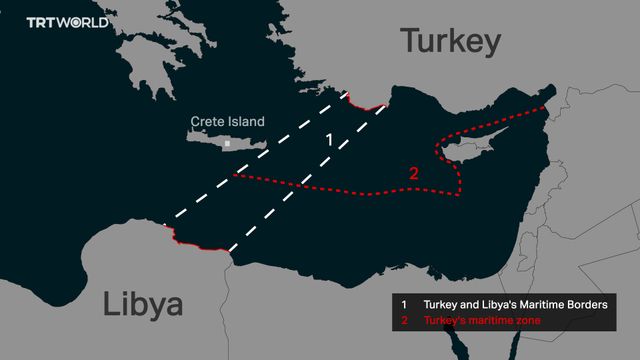
These plans also clash with Turkey’s plans to extend its control over energy resources in the region through its drilling for gas off the far west coast of Cyprus toward the southeast of the Greek island of Crete, Israel and Libya’s offshore waters. Ankara’s drilling operations are expected to be accompanied by a naval task force comprised of at least one frigate, two or three gunboats, and a submarine, as it seeks to acquire another drilling ship.
Russia, with its large oil and gas reserves, is Europe’s main energy provider, supplying 41 percent of its overall consumption. Hence its concern over gas exports from the eastern Mediterranean to Europe, because of the potential impact on its market share and energy prices. Russian President Vladimir Putin is expected to oppose such a project unless Russia is involved.
The EU, for its part, lacking its own energy resources and anxious to avoid dependency on Russia, has fast tracked its approval process for the pipeline.
The agreement to build the EastMed pipeline came just weeks after Turkey signed two agreements in November with Fayez al-Sarraj’s Government of National Accord (GNA), the internationally recognized government of Libya that is backed by Turkey, Qatar and Italy.
The GNA has little popular support and controls the capital Tripoli that has been surrounded by former CIA asset and warlord General Khalifa Hiftar, whose Libyan National Army (LNA), backed by France, Egypt, Saudi Arabia, the United Arab Emirates, Sudan and Russia, controls eastern Libya and its oil fields.
Under the first Turkey/GNA agreement, Ankara pledged military support for Sarraj’s beleaguered government. A second agreement in return delimited maritime zones between the two countries, vastly expanding Turkey’s territorial waters, which Greece and Cyprus also claim, denying the claims of Crete, Rhodes and other islands, and blocking the route of the proposed pipeline.
Since then, Ankara has expanded its gas exploration efforts and sent forces to Tripoli, including Islamist militiamen from Idlib province in Syria, where they were deployed as part of the NATO proxy war but are now surrounded by Syrian and Russian troops.
Turkish President Recep Tayyip Erdogan told reporters, “Turkey and Libya will be working jointly at present, but we could take a third, a fourth and perhaps a fifth partner on board. We are in agreement with Sarraj on this.”
He indicated that Somalia had offered Turkey joint oil exploration in its waters. Erdogan has also sought to enlist support from Tunisia and Algeria, as part of his declaration that 2020 is “Africa year,” offering help with offshore gas exploration as bait.
At the end of last month, Turkey’s Defence Ministry reported that two of its frigates off Tripoli had rescued 30 migrants from a dinghy in high seas and handed them over to the Libyan coast guard during NATO’s Operation Sea Guardian in the region. This was a message to European countries, particularly Germany, that the GNA and Turkey—with their support—would be an effective means of curbing the flow of migrants from Libya to Europe. It may indicate Ankara’s willingness to mend its relations with Europe in the wake of its rift with Moscow over Syria’s defeat of Turkey-backed Islamists in Idlib province.

Ever widening conflicts

These developments have largely taken place outside the control of Washington. The US views with mounting concern Russia’s expanding influence in a region it once controlled, especially following its disastrous wars of aggression in Iraq, Libya and Syria, and with Turkey’s closer relations with Russia and Iran, to the extent that it supported the 2016 coup against Erdogan. Embroiled in economic and trade disputes with the EU, it is trying to push the sale of its own LNG to Europe as an alternative to Russia.
The Trump administration is working through its local attack dogs and proxies, particularly Israel and latterly Greece. It is actively supporting its allies’ access to the region’s gas and Israel’s key role in exporting gas to its local clients Jordan and Egypt—acting as the chief broker in Israel’s gas agreements.
US corporations are engaged in some of the consortia directly involved in exploration, production and transportation and insuring the contracts. The Trump administration helped broker the original agreement to sell gas to Jordan and agreed to compensate Jordan through US aid money should popular opposition disrupt the deal.
In December, President Donald Trump approved the East Med Security and Energy Partnership Act that allows the US to support the Israel-Greece-Cyprus partnership through defence initiatives and lift the longstanding arms embargo on Cyprus, antagonizing Turkey, a key NATO-ally.
Energy minister Yuval Steinitz explained in welcoming Israel’s export of gas to Egypt, “Egypt is just the beginning. The plan is that much of the gas will be exported via Egypt to Europe, too.”
The EastMed pipeline serves to wean Europe off its dependency on Russia for its energy needs, as well as limiting Greece and Cyprus’ trade and investment deals with Moscow. In December, Trump signed into law a defence bill that includes sanctions, imposed by the US Congress, on the construction of both the Nord Stream 2 and TurkStream pipelines. These are part of a raft of measures aimed at choking Russia’s economy which is largely dependent upon the sale of arms and energy. As a result, construction on the nearly completed Nord Stream 2 has come to a halt, infuriating Germany and exacerbating tensions between Washington and Berlin visibly on show at the NATO Security Conference in Munich.
Greece violently objected to the Turkish-Libyan deal signed last year, expelling the Libyan ambassador to Greece in protest. Kathimerini wrote that the Greek and Greek Cypriot governments hurried to finalize the EastMed deal in order “to counter any attempt by the Turkish neighbour to stop the project.”
According to Greek reports, there has been a dramatic increase in the number of violations of its airspace by Turkish fighter jets. Turkish hackers paralysed the websites of the Greek Foreign Ministry and secret service, prompting Greek retaliation.
Such are the tensions between the two NATO members, which were on the verge of war in the 1990s, that the White House called on Greece and Turkey to resolve their differences. Despite this show of impartiality, US Secretary of State Mike Pompeo signed deals last October to build major new US military bases in Greece, saying Washington needs them “to help secure the eastern Mediterranean.”
It was the fear that Russia and Turkey would gain influence in Libya that led Germany to assemble the European powers in a conference in Berlin last month, ostensibly aimed at bringing peace to the civil-war torn country. The Berlin conference agreed to extend the ceasefire, established earlier through the mediation of Russia and Turkey, permanently and to the demobilization and disarming of the militias and monitoring of an arms embargo violated by everyone.
This cynical gathering can only be the prelude to a military occupation of the country to assert the European powers’ predatory interests. EU foreign policy head Josep Borrell, declared a priori, “If there is a cease-fire in Libya, then the EU must be prepared to help implement and monitor this cease-fire—possibly also with soldiers, for example as part of an EU mission.”
“We Europeans, since we don’t want to participate in a military solution, we barricade ourselves in the belief there is no military solution,” he told the European Parliament. “Nobody will be very happy if, on the Libyan coast, there is a ring of military bases from the Russian and Turkish navies in front of the Italian coast.”
Days later, France stepped in to assert its interests, dispatching French warships to the Aegean Sea and announcing the formation of a French-Greek military alliance.
It too has supported Hiftar and his LNA in eastern Libya against the Tripoli-based GNA, where the French oil giant Total has important oil interests, bringing it into conflict with Italy, whose oil company Eni is the largest oil and gas producer in Libya. France, which is dependent upon Hiftar’s support for its colonial wars in the Sahel, denounced Turkish policy in Libya, threatening to support Greece in a war with Turkey.
President Emmanuel Macron accused the Turkish president of “not respecting his promises” in Berlin, saying that “at this very moment” Turkish ships are taking Syrian Islamist mercenaries to Libya “in violation of explicit engagements taken by President Erdogan at the Berlin conference.” He added, “This threatens the security of all residents of Europe and the Sahel.”
After discussion with Macron, Egypt, which supports Hiftar, denounced the Turkey-GNA accords as “illegal foreign intervention” in Libya. On Monday, just weeks after the Berlin conference, the EU agreed to launch a new naval and air mission in the eastern Mediterranean, in international not Libyan waters, to stop arms reaching both factions in the Libya, re-establishing the arms embargo first imposed in 2011.
Austrian Foreign Minister Alexander Schallenberg, whose government opposes any immigration from Libya to Europe, insisted that the mission would not support or help migrants seeking to enter Europe. He said, “There is a basic consensus that we now want a military operation and not a humanitarian mission.”
The eastern Mediterranean, including North Africa, has become the focus of ever widening conflicts, with all the imperialist and regional powers determined to pursue their own rapacious demands for control over the region’s wealth and resources.
As US Defense Secretary Mark Esper warned at the Munich Security Conference, “We are now in an era of Great Power Competition,” meaning that “we must move away from low intensity conflict and prepare once again for high-intensity warfare.”
The stage is being set for explosive conflicts, potentially encompassing three continents, over the domination of North Africa and the Mediterranean Sea. But the eastern Mediterranean is only one of a number of potential flashpoints—the Horn of Africa, South China Sea or the Arctic to name but a few—where these competing strategic interests could lead to an all-out confrontation between major military powers, including nuclear-armed imperialist states. As far as the major powers are concerned, the entire world is in play, with devastating consequences for humanity.

OECD sounds corporate debt warning

Nick Beams

The Organisation for Economic Cooperation and Development (OECD), the 36-member body covering the world’s major economies, has issued a report detailing the rapid rise of corporate debt and the dangers its poses for the world economy in the event of an unexpected rise in interest rates or a recession.
It found that at the end of 2019 the global outstanding stock of non-financial corporate bonds had reached an all-time high of $13.5 trillion.
The OECD pointed to an “unprecedented build-up of corporate bond debt” since the financial crisis of 2008 and an increase of $2.1 trillion in 2019 alone due to the easier monetary policies pursued by the US Fed and other major central banks over the past year.
Its conclusions were based on a dataset of more than 92,000 corporate bonds issued by companies in 114 countries between 2000 and 2019.
The report found that in comparison to previous credit cycles “today’s stock of outstanding corporate bonds has lower overall rating quality, higher payback requirements, longer maturities and inferior investor protection.”
It noted the significant impact of the US Fed’s reversal of its monetary policy at the start of last year. In 2018 the US had lifted interest rates four times and was on course to continue this policy in 2019 in an effort to “normalise” monetary policy following more than a decade of ultra-low rates and quantitative easing in the wake of the 2008 crash.
However, Wall Street staged a rebellion in December 2018, with the largest falls for the month since 1931 in the midst of the Great Depression. The Fed immediately reversed course, shelving its plans for further increases and cut rates three times last year—a U-turn that was followed by major central banks around the world.
After decreasing in 2018, the issuance of corporate bonds jumped to $2.1 trillion in 2019, equaling the previous record high reached in 2016.
The spike is part of a longer-term trend. Since 2008, the annual global issuance of bonds has averaged $1.8 trillion, twice the annual average between 2000 and 2007. High levels of indebtedness were identified as one of the causes of the financial meltdown of 2008, but since then debt has increased.
Not only has the quantity of debt escalated, the quality has decreased. In every year since 2010 about 20 percent of all bonds issued has been non-investment grade (that is, so-called junk bonds) rising to 25 percent in 2019. This is the longest period since 1980 that the proportion of non-investment grade has been so high, an indication that “default rates in a future downturn are likely to be higher than in previous credit cycles,” the OECD report noted.
It also pointed out that the portion of BBB-rated bonds—the lowest level that enjoys investment-grade status, rose to 51 percent in 2019, compared to 39 percent in the period 2000-2007.
Lower quality bonds now dominate the total stock, it said. Last year only 30 percent of outstanding non-financial corporate bonds were rated A or above.
The length of debt maturity is also increasing, leading to potentially greater instability. “As longer maturities are associated with higher price sensitivity to changes in interest rates, the combination of longer maturities and declining credit quality has made bond markets more sensitive to changes in monetary policy,” the report said.
It also pointed to another significant trend—the move by non-financial corporations into financial markets. It noted that between 2009 and 2018 the value of corporate bond holdings by 25 large non-financial US companies tripled from $119 billion to $356 billion, with the company with the largest portfolio holding $124 billion in corporate securities.
Commenting on the report, OECD secretary-general Angel Gurria said the high levels of leverage in the corporate sector “make it essential to put in place reforms that make all parts of the capital markets fit for purpose.”
“This must include steps to improve the ability of equity markets to strengthen corporate balance sheets and support long-term investments,” he said.
But there is no sign of such “reforms” taking place. This is because increasingly the corporate debt market is not being used to finance investment in the expansion of investment and production. Rather, in conditions of ultra-low interest rates, debt is more and more being used by companies to finance share buybacks to boost the value of the company’s shares—one of the chief means by which wealth is siphoned to the upper reaches of the financial oligarchy.
Organisations such as the OECD always try to use the most measured language when pointing to the dangers inherent in the operations of the financial system. The report said the concentration of outstanding bonds “just above the demarcation line between investment and non-investment grade status may lead to substantial sell-offs that put corporate bond markets in general under stress, giving rise to stability concerns.”
The tone was relatively muted but the message was nonetheless clear—the escalation of debt, fueled by the monetary policies of the world’s major central banks, is creating the conditions for another financial meltdown.
The OECD is not the only organisation warning of the growing dangers in global debt markets. Last year an advisory report by the Robert Triffin International forum to the G20, the details of which became public last month, raised similar concerns.
“The risk of an unexpected and unplanned reversal of abundant global liquidity hangs over the world economy. Strong contagion across markets could make the endogenous dynamics of global liquidity very dangerous,” it said.
The decade of ultra-low interest rates and quantitative easing had created a situation where the world was awash with debt denominated in US dollars with no guarantors standing behind this debt.
The report noted that as the experience of 2008 had shown “the supply of private liquidity cannot be relied upon in periods of stress.” The official sources of liquidity such as IMF reserves, central banks swap lines and the euro zone bailout fund may not be sufficient if there is a scramble for US dollars in a period of crisis.
Government debt is also on the rise. Last week the rating agency S&P Global said it expected governments around the world to borrow the equivalent of $8.1 trillion in 2020, a 20 percent jump on the levels of 2015.
By the end of the year it forecasted government debt to reach a record $53 trillion, a 30 percent increase in the past five years.
Signs of the crisis pointed to by the OECD emerged last week when rating agencies cut the rating on the bonds of the US food giant Kraft Heinz to below the investment grade threshold, making it the largest so-called “fallen angel” in 15 years.
The Lex column in the Financial Times warned bluntly: “Expect more dropouts from the heavenly host.”
Such downgrades can have a cascading effect when investors are forced to sell the bonds of such “fallen angels” because their mandates require that they not hold non-investment grade debt.

Hesse, Germany: Right-wing extremist propaganda at state expense

Peter Schwarz

Shortly before the right-wing extremist terrorist attack in Hanau February 19, the Hesse state government sent posters to all schools slandering opponents of fascism and capitalism as “left-wing extremists.”
The poster series, “Enlightened instead of autonomous,” aimed at 9th and 10th grade students, could have been designed at the party headquarters of the far-right Alternative for Germany (AfD). It is a work of anti-communist propaganda. It shows how the establishment parties are systematically creating a political climate boosting the AfD and encouraging right-wing extremist perpetrators of violence. No matter how many people are murdered by fascists, “The enemy is on the left!” runs their motto.
Of the 10 posters claiming to educate pupils about “extremism,” eight are devoted exclusively to “left-wing extremism.” The topics range from anti-fascism, anti-capitalism and anti-imperialism, to anti-globalisation, anarchy and autonomous currents and socialism.
As an example of alleged “left-wing extremism,” poster 9 (“Anti-capitalism and left-wing extremism”) quotes the statement that capitalism is “responsible for poverty and hunger, for social inequality and exploitation, for environmental destruction and war.”
“Left-wing extremism” is also represented by the demands to “overcome capitalism, nationalize the banks, insurance companies and media, radically redistribute income and wealth from top to bottom, or from rich to poor” and to “abolish private property,” the poster reads. “Such a radical upheaval of property relations,” it says, “would violate the Basic Law, as the German constitution is called”.
Poster 8 (“Anti-fascism”) condemns “left-wing extremist anti-fascism,” which it identifies with the slogan “Behind fascism is capital—the struggle for liberation is international”. Thus, only a “democratic anti-fascism,” which does not question the existing capitalist social order is permissible.
“Left-wing extremists have their own conception of what and who is a fascist,” it continues. “For them, fascism is an extreme form of capitalism. For them, anti-fascism is not only the action against ‘Nazis,’ but also the struggle against the democratic constitutional state and capitalism ...” Anti-fascism serves the “left-wing extremists” as justification for actions against “other parties and their politicians,” against “scientists who come to results that do not fit into the extreme left-wing world view,” etc.
It continues in this style. In order to emphasize anti-communism, socialism is consistently equated with Stalinism. Any criticism of capitalism, be it of the consequences of globalisation, social inequality, war and right-wing violence, is synonymous with “left-wing extremism.”
After numerous teachers complained about the poster series to the German Trade Union for Education and Science (GEW), the union commissioned two experts, didactics professor Martina Tschirner from Goethe University and high school teacher Dr. Christoph Bauer, to produce a scientific report. The result is devastating.
“The material to be evaluated—‘Enlightened instead of autonomous’—clearly shows itself to be scientifically, pedagogically and didactically untenable,” says the 22-page expert report. “There is no trace of critical reflection, independent judgement and scientific orientation.” The two experts conclude, “In our view, the material should be removed from schools immediately.”
The experts’ criticism is directed against the concept of extremism presented by the poster series, which was directly adopted from the Office for the Protection of the Constitution, as the German secret service is called. “The texts and design of the posters are so close to the publications of the Office for the Protection of the Constitution that one is inclined to call the poster series a didactic and illustrated report on the secret service,” write Tschirner and Bauer. “Socialist ideas of an egalitarian (equitable) society are equated with clearly racist ideas that glorify National Socialism [Nazism].”
This is correct. Some of the poster texts are taken almost literally from the 2017 Annual Report of the Federal Office for the Protection of the Constitution, for which its then head Hans-Georg Maassen was responsible. Maassen had to resign later because he defended a right-wing extremist march in Chemnitz. Since then, he has openly promoted the politics of the AfD as the figurehead of the so-called Christian Democratic “Union of Values.”
The 2017 secret service report, for the first time, named the Sozialistische Gleichheitspartei (Socialist Equality Party, SGP) as a “left-wing extremist party” and “object of surveillance.” It did so exclusively because of the SGP’s socialist policies. Its agitation, according to the secret service in its justification, is directed “against the existing state and social order, which is generally denigrated as ‘capitalism,’ against the EU [European Union], against supposed nationalism, imperialism and militarism.” The Verfassungsschutz (secret service) does not accuse the SGP of any violations of the law.
At another point, the secret service denounced the view as “left-wing extremist” that “capitalism” was responsible for “all social and political grievances such as social injustice, ‘destruction’ of housing, wars, right-wing extremism and racism, as well as environmental disasters.”
In August 2018, the SGP warned that the decision to attack it had been taken at the highest levels of government. The grand coalition of the Christian Democrats (CDU/CSU) and Social Democrats (SPD) has reacted to growing resistance to its right-wing policies by strengthening extreme right-wing forces: “The attack by the Office for the Protection of the Constitution ... is aimed at the SGP, but targets anyone who is fighting against social inequality, militarism and oppression and who advocates a socialist perspective,” the SGP cautioned.
The Hanau killings, the latest in a long line of fascistic terrorist attacks, has confirmed this warning. Seventy-five years after Hitler’s death, fascists in Germany are raising their heads again—not because they have mass support, but because they are encouraged and supported by the state and the establishment parties.
The Hesse state legislature, a coalition of the CDU and Green Party, is responsible for the poster series “Enlightened instead of autonomous.” The propaganda has been financed by the Ministry of the Interior and distributed by the Hesse Centre of Competence against Extremism (HKE). Four ministries—the CDU-led ministries of the interior, culture and justice and the Green Party-led Ministry of Social Affairs—as well as the State Office for the Protection of the Constitution, the State Office of Criminal Investigation and the Hesse State Centre for Political Education are represented in the HKE steering group.
The Hesse CDU has a long, right-wing past. Alexander Gauland held leading positions in it for 40 years before founding the AfD in 2013 and becoming its leader. Volker Bouffier, the current Hesse state premier, covered up the involvement of the secret service in the murder series carried out by the neo-Nazi National Socialist Underground (NSU) as Hesse’s state interior minister, and to this day keeps the relevant files, which could also provide information about the murder of Kassel’s District President Walter Lübcke, under lock and key.
The Greens, who have been coalition partners of the CDU in Hesse for six years, have no problem supporting a policy that gives the AfD a boost and leads to racist terror, as in Hanau. They too are a right-wing, bourgeois party, which, in the face of growing dissatisfaction and opposition, supports stepping up the repressive powers of the state and militarism.

Iran elections show growing alienation from bourgeois-clerical regime

Jordan Shilton

Preliminary results for Iran’s parliamentary elections Friday show a victory of the bourgeois-clerical regime’s “principalist” faction, which advocates a more confrontational stance on US imperialism’s campaign of “maximum pressure” on Iran. Very low voter turnout in Tehran and other major cities underscored the regime’s deepening crisis. It is driven on the one hand by Washington’s economic sanctions and military threats, and on the other by mounting class tensions rooted in growing social inequality inside Iran.
The principalist or hardline faction of the ruling establishment advocates junking the 2015 Nuclear Accord struck with the United States and the European imperialist powers, and developing closer ties with Russia and China. Yesterday, its candidates appeared set to take around 200 of 290 parliamentary seats. Meanwhile, the “reformer” faction led by President Hassan Rouhani, which pushed for the deal with Washington and the European imperialist powers, secured just 17 seats, down from about 150 in the last parliament.
While the vote undoubtedly was a distorted reflection of popular anger at the 2015 accord’s failure to bring jobs and social improvements as Rouhani had promised, the reformers’ defeat also reflected the election oversight bodies’ barring of many of their candidates. The powerful Guardian Council, over which Supreme Leader Ayatollah Ali Khamenei holds sway, banned about half of the 14,000 candidates who asked to stand. Ninety-two sitting parliamentary deputies, almost one third of the total, were also prohibited from standing.
The election’s most important feature was the collapse in overall voter turnout. Reflecting mounting disillusionment with the entire regime, turnout plummeted from 62 percent in 2016 to just 42.6 percent on Friday. In Tehran, turnout was even lower, between 20 and 25 percent.
Iranian authorities did everything possible to boost turnout. Khamenei declared voting a religious duty, and opening hours for the polls were extended twice, for a total of six hours.
The regime also tried to divert attention from mounting social inequality, the fundamental cause of the growth of political opposition, by blaming external factors for the low turnout. Khamenei denounced an anti-Iranian campaign in the Western press for spreading “negative propaganda” about the coronavirus, which he claimed dissuaded people from voting. The virus has killed eight people in Iran, where 43 cases have been reported.
However, one election volunteer for principalist candidates in the city of Isfahan bluntly told the Financial Times: “It is difficult to make a person who cannot afford a piece of bread for his family’s dinner go to the poll, let alone vote for our favourite candidate.”
One Tehran resident remarked on the inability of any faction of the regime to provide relief from crippling US-led sanctions. “Why should we wait for the result?” the resident told the Guardian. “It is a foregone conclusion and has been fixed in advance. They can do what they want, and we just have to get on making a living. We face years more of sanctions.”
Bitter conflicts erupted inside the principalist faction in the lead-up to the elections. It failed to issue a united electoral list, as forces around former President Mahmoud Ahmadinejad confronted backers of outgoing parliamentary speaker Ali Larijani, notably over the position of Islamic clerics. The Ahmadinejad faction, which wants to weaken the clerics’ dominant role, appears to have emerged strengthened from the vote. Fourteen of Ahmadinejad’s closest supporters, including his former central bank governor, won parliamentary seats.
The election constituted, firstly, a defeat for the reformers’ strategy—approved by Khamenei and tolerated by the principalists—of cutting a deal directly with the imperialist powers. This strategy has been blown to pieces by the US repudiation of the nuclear accord in 2018, followed by the European powers’ refusal to defend it. The Trump administration’s reimposition of economic sanctions has slashed Iranian oil exports, Tehran’s main source of revenue, to virtually zero.
Tehran also faces a systematic US military build-up across the Middle East, aiming to consolidate US imperialism’s regional hegemony by building an anti-Iranian alliance including Saudi Arabia, Israel, and the Persian Gulf oil sheikdoms. These aggressive actions targeting Iran culminated in January, when Trump ordered the illegal drone murder of Iranian Revolutionary Guard Corps (IRGC) commander General Qassem Soleimani in Baghdad.
Above all, the election gave distorted expression to growing class conflict between the workers and the Iranian capitalist class. Western sanctions have devastated social conditions, driving up inflation and poverty rates. A report last year by the Iranian parliament’s research office projected that as many as 57 million of Iran’s 80 million-strong population would live in poverty by next month.
This dramatic social polarization is the product not only of US-imposed sanctions, but also of the Iranian ruling elite’s moves to overturn the social concessions made to the working class after the 1979 Iranian Revolution. Over the past four years, this has included severe austerity and price hikes for basic commodities. Water shortages, unaffordable groceries, and high unemployment are common complaints, especially for youth and workers.
Strikes and protests among teachers and other sections of workers have continued since December 2017 and January 2018, when mass protests against unpaid wages, expensive groceries and other basic necessities, and joblessness swept Iran.
This was part of a broader global upsurge of the class struggle, with strikes and protests internationally including against Iranian-backed regimes in Iraq and Lebanon last year. A 300 percent increase to gasoline prices last November provoked protests across Iran which were bloodily suppressed. According to Amnesty International, the regime killed over 300 people in a week of violent reprisals, during which the state cut off Internet access.
Further opposition to the regime erupted after the IRGC accidentally shot down a Ukrainian jetliner at the height of the war crisis over the US assassination of Soleimani in January. The downing of the plane, killing all 176 aboard, and Iranian authorities’ denials of responsibility triggered angry protests, mainly among students and middle class professionals.
As multiple imperialist wars tear the Middle East apart, the election sets the stage for further escalation in conflicts with Washington and the European powers, who have made clear they will stop at nothing to cut across Iran’s deepening ties to Russia and China.
On Sunday, Rouhani issued a statement insisting that the nuclear accord could still be “a good basis for new trust between us … The European Union is expected to stand up to America’s illegal actions.” However, European powers have refused to do so. Despite pledging to uphold the nuclear accord after Trump scrapped it, Paris, Berlin, and London have refused to take any practical steps to secure Iranian access to world markets; European companies abandoned Iran to evade US reprisals.
After taking control of parliament, the principalists also hope to capture the presidency in August 2021. Rouhani, who is badly weakened, will depend on the principalists’ approval to appoint ministers. Some reports speculated that throughout the remainder of Rouhani’s presidency, the principalists will blame reformers for all Iran’s social and political problems so as to strengthen their bid for the presidency.
As this bitter factional infighting mounts inside the Iranian bourgeoisie, a vast movement is building in the Iranian and international working class. The key task facing Iranian workers is to orient to this growing movement, reject both the Iranian regime’s principalist and reformist factions, and unify their struggles with those of their class brothers and sisters across the Middle East and the world against imperialist war, based on a struggle for socialism.

US defense secretary launches simulated nuclear attack against Russia in Pentagon war game

Andre Damon

As more than 20,000 US troops and 20,000 military vehicles began to arrive in Europe for the massive “Defender 2020” exercise targeting Russia, US Defense Secretary Mark Esper took part in a war game at US Strategic Command headquarters in Omaha, Nebraska involving the simulated use of nuclear weapons against Russian troops.
“The scenario included a European contingency where you’re conducting a war with Russia and Russia decides to use a low-yield, limited nuclear weapon against a site on NATO territory,” the Defense Department said in a background briefing Friday.
When pressed by reporters, the Pentagon made clear that as part of the exercise, the US launched a nuclear weapon against Russian troops in what the Pentagon called a “limited” response.
“I mean, in the course of the exercise, we simulated responding with a nuclear weapon,” the Pentagon briefer said.
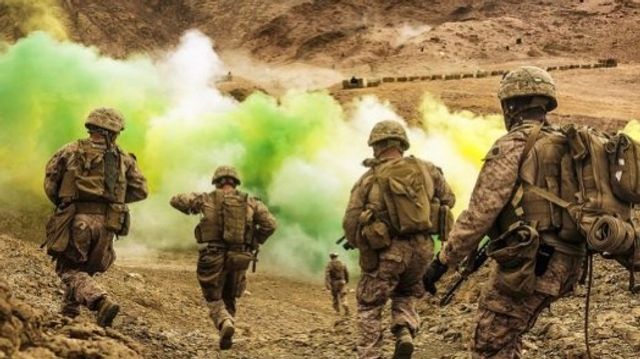
U.S. Marines run to firing positions during live-fire training in Jordan [Credit: Marine Corps, Staff Sgt. Dengrier M. Baez]
None of the reporters at the background briefing asked the obvious question: Whether the use of nuclear weapons by both the United States and Russia led to a full-scale nuclear exchange. But as journalist Fred Kaplan recently commented, “No one in officialdom has ever played a war game in which a ‘limited’ attack believably stays limited. Things spiral out of control pretty quickly.”
Russian authorities viewed the exercise as a threat. Konstantin Kosachev, the head of the foreign affairs committee of the Russian legislature’s upper house, linked the war game to the United States’ recent withdrawal from the Intermediate Range Nuclear Forces (INF) treaty.
“If you conduct exercises on a nuclear response to an attack by an enemy, you are thereby convincing people that such an attack is likely, and you need not to negotiate or sign arms control agreements, but arm yourself,” Kosachev told RIA Novosti on February 22.
Last year, the United States withdrew from the INF treaty, which prohibited the deployment of land-based missiles, including nuclear missiles, with ranges between 500 and 5,500 kilometers.
The US is massively expanding and modernizing its nuclear arsenal. In December, Washington tested a ballistic missile that would have violated the treaty.
[Credit: US Army via Twitter]
These moves are part of US preparations for what Defense Secretary Mark Esper, speaking at this month’s Munich Security Conference, called “high-intensity conflicts against competitors such as Russia and China.”
In Friday’s background briefing, the US officials went into detail on the US government’s sweeping $1 trillion plan to enlarge the US nuclear arsenal, making clear that “most of the nuclear modernization that you see before you started under the previous administration, started under the Obama administration. And we’re just continuing it.”
Over the past two months, the US Navy deployed several new “low-yield” warheads on Trident submarine-launched ballistic missiles. The move was widely condemned by arms control experts. Despite having just a fraction of the explosive force of normal nuclear warheads, these weapons are by all accounts indistinguishable from “strategic” nuclear weapons, the use of which would in most conceivable scenarios trigger a full-scale thermonuclear exchange and the end of human civilization.
As Kaplan recently warned, “For many years, arms control advocates have argued that low-yield nuclear weapons are destabilizing because they lower the threshold between conventional and nuclear war. They seem to be—they are designed to be—more usable as weapons of war, and therefore some president, in a crisis, might feel more tempted to use them.”
On Friday, the same day that the Pentagon disclosed the nuclear exercise, the first contingent of US tanks, troops and equipment arrived in the German port of Bremerhaven for “Defender 2020.” The exercise will involve 37,000 troops, including 20,000 soldiers transported across the Atlantic, in the largest US military deployment in Europe in 25 years.
“The security order that Europe believed it had with Russia no longer works,” Claudia Major, an expert in security and defense policy at a leading German think tank, told Deutsche Welle. “Russia is no longer a strategic partner. Europeans have to deal with the question again: ‘How do we defend ourselves in Europe?’”
The Trump administration’s threats against Russia come as the Democrats, joined by a faction of anti-Trump Republicans, intensify their anti-Russia campaign, centered on allegations that the Trump administration is insufficiently confrontational toward Moscow.
In a column titled “Why the Russians still prefer Trump,” Washington Post columnist Max Boot defended his claim that Trump has been “soft” on Russia. He wrote: “It’s true, as Republicans say, that Trump sent anti-tank missiles to Ukraine--but only under conditions that make them useless against Russia.”
He continued, “In July 2017, Trump ended a covert program of training and supplying moderate Syrian rebels—‘a move long sought by Russia,’ as the Post noted.” Boot added, “Trump has facilitated Russian designs not only in Syria but also in Libya.”
The Democratic impeachment drive was framed entirely on this pro-war basis, with Congressman Adam Schiff, speaking from the Senate floor on the second day of the impeachment trial of President Trump, declaring that “the United States aids Ukraine and her people so that we can fight Russia over there and we don’t have to fight Russia here.”
Last month, the Bulletin of Atomic Scientists, which for more than seven decades has maintained a Doomsday Clock, warned that human civilization is closer to midnight, i.e., total destruction, than at any other period in history, including the Cuban Missile Crisis at the height of the Cold War.
“Civilization-ending nuclear war—whether started by design, blunder, or simple miscommunication—is a genuine possibility,” the group said in its annual report. “Any belief that the threat of nuclear war has been vanquished is a mirage.”

22 Feb 2020

Canada: Environmental Evidence Summit 2020 Travel Bursaries for Developing Countries

Application Deadline: 9th March 2020

Eligible Countries: Low income countries (LIC) or lower-middle income countries (LMIC)

To be Taken at (Country): Ottawa, Canada.

About the Award: The purpose of these awards is to facilitate and increase participation in EES2020 and associated training opportunities for those who contribute to the use of evidence in their home countries and institutions. Funding for these travel awards is provided by CEE with support from the Africa Evidence Network. 

Type: Training, Conference

Eligibility: 
  • Be able and available to travel to and attend all three days of the Environmental Evidence Summit on June 3-5th, 2020 in Ottawa, Canada.
  • Must commit to contributing to the success of the conference (e.g., write a blog post, live tweet a session, present a poster)
  • Be a citizen of a low income country (LIC) or lower-middle income country (LMIC) according to the World Bank definition of LIC and LMIC:
    • See the LIC list at http://data.worldbank.org/income-level/low-income
    • See the LMIC list at http://data.worldbank.org/income-level/lower-middle-income
  • Be working and living in a LIC/LMIC, as of February 1, 2020
Number of Awards: Not specified

Duration of Award: June 3-5th, 2020

How to Apply: Please send a short paragraph (less than 500 words) to CEE that provides clear examples of your contribution to the use of evidence in environmental management in your home country and/or institution. Also include what you would like to take away from EES2020, any sessions or workshops that are particularly relevant to your interests and research, and suggest ways you could contribute to the conference. Please also indicate your estimated travel expenses and the availability of other funding to support your travel. 
A letter of support from your organization endorsing your travel and attendance at the conference must be sent with your application.
Applications can be sent to admin@environmentalevidence.org by March 9th 2020, with the subject “LMIC bursary application”. 

Visit Award Webpage for Details