3 Mar 2020

Do Stockholders Look Forward to a Decade of Very Low Returns?

Dean Baker

In spite of completely missing the crash of the stock bubble in 2000-2002 and the housing bubble in 2007-2010, people tend to think that the big actors in the stock market have great insight into the economy’s prospects. While I won’t claim to have a crystal ball that predicts the future of the economy (I had warned of both of those crashes), I did learn arithmetic in third grade.
There are some simple and important statements we can make about future stock returns, based on nothing more than arithmetic and the generally accepted projections for the economy’s performance. The basic story is that if we accept the projections for future profit growth from the Congressional Budget Office, or other official forecasters, then we are almost certain to see a decade of extraordinarily low returns to stockholders.
Real returns will almost certainly be less than 5.0 percent annually. This compares to a long period average of close to 7.0 percent. And this assumes no plunge in the market over the decade. Of course, if the market does plunge, real returns will be considerably lower.
The reason that returns will almost certainly be low in the next decade is that stock prices are high. If we look at Robert Shiller’s calculations of the price of the S&P 500 relative to ten years of trailing earnings, it was at 31.5 for February to date. That compares to an average of 20.6 in the 1960s, 12.7 in the 1970s, and 11.5 in the 1980s. A high price to earnings ratio means that people buying or holding stock are paying a high price for each dollar of earnings.
To see what this means more concretely, we can take the most recent price to earnings figure from Shiller’s data. Taking February’s prices over December’s earnings, we get a ratio of 23.7. Taking a somewhat broader, but somewhat dated measure, the value of all corporate equities was $49.6 trillion at the end of the third quarter. After-tax corporate profits were $1,869 billion, giving a price to earnings ratio for the market as a whole of 26.5.
The fact that these two figures are close should give us confidence that we are looking at the right numbers. It would not be surprising that the whole market would have a higher PE than the S&P 500. The index is by design composed of older well-established companies. Many smaller and newer companies may have high valuations based on growth prospects rather than current profits.
Anyhow, we can work from the slightly lower PE reported by Shiller for the S&P 500. The ratio of 23.7 implies an earnings-to-price ratio of 4.2 percent. This means that for each dollar a shareholder is paying for stock, they get 4.2 cents in earnings.
Companies pay out a portion of their earnings to shareholders as either dividends or share buybacks. (There are some differences between these mechanisms for tax purposes, but that really does not matter for this analysis.) Suppose that they pay 70 percent of their profits out to shareholders, which would be the high end of the recent range. This would mean that shareholders could get annual returns from direct payouts of 2.94 percent (0.7 * 4.2).
The other component of returns is capital gains. The actual course of the market over the next decade is anyone’s guess, but one thing we can say with absolute certainty is that if the price to earnings ratio remains constant, then share prices will rise at the same pace as corporate profits. And, we do have projections for the growth of corporate profits over the next decade.
The Congressional Budget Office projects that before-tax corporate profits will grow at an average annual rate of 4.15 percent over the decade from 2020 to 2030. It makes sense to use before-tax profits, because we don’t know what will happen to corporate tax rate over this period. The 2017 tax cut hugely reduced corporate taxes, however it is possible that if Trump is re-elected he will seek to reduce corporate taxes even further. On the other hand, all the leading contenders for the Democratic presidential nomination have pledged to raise corporate taxes, in most cases by quite a bit. Without knowing the outcome of these political battles, it is probably safest to assume the tax rate remains where it is currently.
This gives us an average annual nominal capital gain of 4.15 percent.  The average inflation rate projected for this period, as measured by the consumer price index, is 2.4 percent, which gives an average real capital gain of 1.75 percent. If we add that to the 2.94 percent return from dividends or buybacks, it comes to 4.69 percent. This is considerably below the 7.0 percent historic real return on stocks, that many investors bank on.
Of course, these are very crude calculations. No one knows that the price to earnings ratio will stay stable. Suppose it were to keep rising enough to give 7.0 percent real returns over the next decade. In that case, using the CBO profit projections, the price to earnings ratio for the S&P 500 would be over 30 by 2030. That is not obviously impossible, but the 70 percent dividend/buyback payout would get shareholders just 2.3 percent of the share price. That would mean to sustain a 7.0 percent real return, price to earnings ratios would have to rise even more rapidly in the following decade.
The situation would look even worse with the broader market. Starting with a price to earnings ratio of 26.5 to 1, the price to earnings ratio for the market as a whole would be over 35 by 2030. That would provide a dividend/buyback payout of just 2.0 percent.
It is possible that profits could grow more rapidly. For example, the Trump administration could be proven right and maybe we will see 3.0 percent real growth over the next decade, but there are not many people betting on that being the case. We could see a further shift to profit shares, although with profit shares already at an unusually high level, that does not seem likely. There could be further cuts in corporate taxes, but with the effective corporate tax rate projected at less than 11.0 percent in 2020, that seems unlikely even if the Republicans remain in power. In short, it seems almost inevitable that real stock returns over the next decade will be considerably lower than their long period average of 7.0 percent.
However, the 4.7 percent real returns that would be consistent with a constant price-to-earnings ratio is not necessarily bad in the current interest rate environment. Historically, the real return on long-term Treasury bonds has been close to 3.0 percent. By contrast, the current interest rate on a 30-year Treasury bond is roughly 2.0 percent, putting it slightly under the inflation rate. A 4.7 percent real return on stocks does not look bad in a context where the long-term Treasury bonds are providing a zero or small negative real return.
But even if a 4.7 percent real return might be reasonable in the current interest rate environment, it is not clear that it is consistent with investors’ expectations. Many investors are undoubtedly looking at the far higher returns of the years since the Great Recession and expect double digit returns to continue for at least the immediate future. They may be very disappointed if this turns out not to be the case.
The other part of this story that stockholders have to consider is that there are good reasons for thinking that future after-tax profits might be considerably lower than CBO has projected. On the before-tax side, there was a large shift in income shares from labor to capital in the immediate aftermath of the Great Recession. As the labor market has tightened, there has been some shift back towards labor. The CBO projections assume that this reversal does not continue. In fact, the projections assume that the profit share of national income actually increases slightly over the decade.
The other key factor in determining after-tax profits is the corporate tax rate. This is of course a political decision. While Republicans are unlikely to raise corporate income taxes to any substantial extent, they also are unlikely to lower them further. By contrast, there is widespread agreement among Democrats that corporations should pay more in taxes. Whatever the outcome of the 2020 elections, there is at least a reasonable prospect that corporate taxes will increase at some point over the next decade.
With the possibility of further shifts back from capital to labor and future increases in the corporate income tax, stockholders should view their investment as somewhat risky. If the labor share were to rise back to its pre-recession level, profits would drop by 10 percent, if price to earnings ratios were unchanged. That would wipe out more than two years of returns, as calculated above.
The same would be true if there was a 9.0 percentage point rise in the effective tax rate to 20.0 percent, roughly the level prior to the 2017 tax cut. That would also lead to a 10 percent drop in share prices, assuming a constant price to earnings ratio.
And, the interest rate on government bonds could rise. Most economists have been surprised that long-term interest rates have remained this low for as long as they have. The low rates could continue, but no one can rule out that they will rise back to their historic average of 3.0 percent real rates. If that were to be the case, a 4.7 percent real return in the stock market may not look very good.
In short, there are good reasons for thinking that current valuations in the stock market are high. That doesn’t mean that prices will plummet any time soon, but it does seem unlikely that anything like the recent growth will continue far into the future.

The Real Modi: Do the Killings of Muslim’s Represent India’s Kristallnacht?

Patrick Cockburn

On 9 to 10 November 1938 the German government encouraged its supporters to burn down synagogues and smash up Jewish homes, shops, businesses, schools. At least 91 Jews – and probably many more – were killed by Nazi supporters egged on by Joseph Goebbels, the minister for public enlightenment and propaganda, in what became known as Kristallnacht – “the Night of Broken Glass”. It was a decisive staging post on the road to mass genocide.
On 23 February 2020 in Delhi, Hindu nationalist mobs roamed the streets burning and looting mosques together with Muslim homes, shops and businesses. They killed or burned alive Muslims who could not escape and the victims were largely unprotected by the police. At least 37 people, almost all Muslims, were killed and many others beaten half to death: a two-year-old baby was stripped by a gang to see if he was circumcised – as Muslims usually are, but Hindus are not. Some Muslim women pretended to be Hindus in order to escape.
Government complicity was not as direct as in Germany 82 years earlier, but activists of the ruling Bharatiya Janata Party (BJP), led by Indian prime minister Narendra Modi, were reported as being in the forefront of the attacks on Muslims. A video was published showing Muslim men, covered in blood from beatings, being forced to lie on the ground by police officers and compelled to sing patriotic songs. Modi said nothing for several days and then made a vague appeal for “peace and brotherhood”.
The government’s real attitude towards the violence was shown when it instantly transferred a judge critical of its actions during the riots. Judge Muralidhar of the Delhi High Court was hearing petitions about the violence when he said that the court could not allow “another 1984” to happen, referring to the killing of 3,000 Sikhs by mobs in Delhi in that year after the assassination of former prime minister Indira Gandhi by her Sikh bodyguards. He said the government should provide shelter for those who had been forced to flee and questioned if the police were properly recording victims’ complaints.
The government says that Judge Muralidhar’s transfer had already been announced and claims that its speedy implementation of the move had nothing to do with his remarks.
Accusations of fascist behaviour by present day political leaders and their governments, similar to that of fascist regimes in Germany, Italy and Spain in the 1930s and 1940s, should not be made lightly. Such comparisons have been frequently leveled in recent years against nationalist, authoritarian populists from the US and the Philippines to Poland to Brazil. Often the allegation is believed by the accuser and, at other times, it is simply a term of abuse. Yet Modi and the BJP appear closer than other right-wing regimes to traditional fascism in their extreme nationalism and readiness to use violence. At the centre of their agenda is their brand of Hindu nationalism and a relentless bid to marginalise or evict India’s 200 million Muslims.
The rest of the world has been slow to grasp the gravity of what is happening in India because the Modi government has played down its project to shift India away from its previous status as a pluralistic secular state. The sheer number of people negatively affected by this change is gigantic: if the Muslim minority in India was a separate country then it would be eighth largest state in the world by population.
The violence in Delhi this week stems from the fear and hatred generated by the government-directed pincer movement against Muslims in India. One pincer is in the shape of the Citizenship Amendment Act (CAA), under which non-Muslim migrants can swiftly gain Indian citizenship but Muslims cannot. Even more threatening is the National Register of Citizens (NRC), which is likely to deprive many Indian Muslims of their citizenship. It was the non-violent protests and demonstrations opposing these measures that provoked the Hindu nationalist mobs into staging what was close to a pogrom earlier this week.
Just how far Modi and the BJP will go in their anti-Muslim campaign is already in evidence in Jammu and Kashmir, the one Indian state with a Muslim majority. It was summarily stripped of its autonomy last August and has been locked down ever since. Mass detentions and torture are the norm according to the few witnesses able to report what they have seen.
For 150 days after the government revoked Jammu and Kashmir’s special status, the internet was cut off and it has only been restored to a very limited degree since January. The security forces detain who they want and distraught family members complain that they cannot find their relatives or that they are too poor to visit them in prisons that may be 800 miles away.
The isolation of Kashmir has largely worked from the government point of view in sealing it off from the outside world. But would it make much difference if events there were better known? The burnings and killings in Delhi this week are well publicised, but regarded with a certain tolerance internationally: Modi can trade off India’s reputation as a ramshackle democracy and a feeling that “communal violence” is traditional in India, like hurricanes in Florida or earthquakes in Japan, and nobody is really to blame.
There has been an encouraging, though fiercely repressed, wave of opposition in India to the degradation of its non-sectarian traditions. The danger here – and the mobs in Delhi may be a sign of this – is that Modi and his government will respond to these protests by playing the Hindu nationalist card even more strongly.
Dealing with foreign criticism, the government may say that, regardless of its domestic political programme, it is supercharging economic growth and this excuses its other failings. Authoritarian regimes, with control over most of their own media, often make such claims and, when economic statistics show the opposite, they simply fake a new set of figures. A recent study of the Indian economy noted that, while overall economic growth had supposedly risen strongly, the growth in investment, profits, tax revenues, imports, exports, industrial output and credit had all weakened in recent years.
In one respect, Modi is in a stronger position than Germany after Kristallnacht. President Roosevelt responded with a statement denouncing antisemitism and violence in Germany and promptly withdrew the US ambassador. President Trump, on a two-day visit to India at a time that Muslims were being hunted down and killed a few miles from where he was sitting, said he was satisfied that Modi was working “really hard” to establish religious freedom.

Fiat Chrysler to lay off 1,500 Windsor Assembly workers in June

Carl Bronski

Fiat Chrysler Automobiles (FCA) announced last week that on June 29 the third shift at its Windsor, Ontario assembly plant will be eliminated resulting in the permanent layoff of 1,500 workers.
“This decision comes as the Company works to align volumes with demand while phasing out production of the Dodge Grand Caravan at the end of May,” said an FCA statement. Production of the Grand Caravan will end on May 22. A “transition period” will then begin to consolidate a two-shift operation by the end of June.
Workers leave Windsor Assembly
The job cuts will have an immediate knock-on effect in the city’s auto parts sector. Already, it is expected that local FCA suppliers Flex-N-Gate and Syncreon will shed at least 200 jobs due to the Chrysler retrenchment.
The Windsor plant, which builds the Chrysler Pacifica minivan, Pacifica Hybrid, Grand Caravan and Chrysler Voyager, has operated on a three-shift schedule since 1993. The plant is the largest employer in Windsor, which has been devastated by a steady reduction of auto production in the city, once called the automotive capital of Canada. There are about 6,000 workers currently employed at the Windsor plant, which underwent retooling in 2015 to build the Pacifica. The plant can build up to 1,500 vehicles per day.
The announcement of a final layoff date had been expected by autoworkers at the plant for some time. FCA had initially indicated its plans to end the third shift last March but had delayed issuing a conclusive end date as it calibrated production volumes with the plummeting sales figures of its Grand Caravan and Pacifica models. Sales numbers for the facility’s main product, the Chrysler Pacifica, have steadily declined in recent years. Last year purchases of the model dropped by 17 percent in the vital US market and by 38 percent in Canada. Sales of the Grand Caravan were down by 19 percent in the US and by 15 percent in Canada.
Unifor president Jerry Dias once again trotted out his increasingly threadbare beggar-thy-neighbour trade war “solution” to the decimation of auto jobs in Canada. “Every country in the world that has a major auto industry has a national strategy to preserve the jobs,” said Dias. “I take a look at Germany. I take a look at Japan. I take a look at Korea. I take a look at the different nations around the world.”
Dias, once again, is peddling nothing but nationalist snake-oil. The FCA announcement is only the latest in a string of far-reaching international assembly layoffs, which reflect a global jobs blood-bath in the auto industry as a result of deepening capitalist crisis. More than 500,000 jobs were destroyed last year in Europe, Asia and North America. Analysts expect job losses to increase over the course of 2020. More than 100,000 auto assembly layoffs were already planned by companies worldwide in year end announcements. Hundreds of thousands of related auto parts jobs will also be slashed.
Aware of the growing rank-and-file opposition to Unifor’s prostration before the auto companies, Unifor Local 444 president Dave Cassidy deemed it necessary to appeal to his membership to “trust your union.” Indeed Unifor (and its predecessor Canadian Auto Workers union) have presided over a decades-long policy of imposing brutal concessions contracts for phony job saving agreements. But the end of the third shift at Windsor FCA, 650 recent layoffs at Ford Oakville and the closure of assembly production at GM Oshawa last year are just the latest in a series of job cuts that includes the devastating 2010 mothballing of Windsor’s GM Transmission operation.
In November the Ontario Labour Relations Board ruled that Nemak could close its Windsor auto parts plant in 2020. Unifor claimed the early closure violated terms of a concessions agreement it signed in 2020. Unifor had shut down a two week strike by 180 Nemak workers last September against the closure threat and told workers to put their faith in arbitration instead with predictably disastrous results.
One veteran FCA Windsor worker told the World Socialist Web Site that workers had no confidence in Dias. “This was inevitable. I knew it was going to happen regardless of whatever Unifor did. We are phasing out the Grand Caravan on May 22 and are going down to two shifts by then. All the people are staying until June 29. I imagine it is to try and avoid chaos.”
It can hardly be a coincidence that the Windsor layoffs are timed to take effect in June, the same month that FCA (as well as GM and Ford) open up their contract negotiations with Unifor, whose contracts with the Detroit Three expire this September. It is expected that vehicle production in Canada on the part of the Detroit Three automakers will fall another 27 percent over the life of the next contract. FCA is clearly throwing down a gauntlet to insist on continued job cuts and more concessions to shore up its profitability.
The future of FCA’s Etobicoke casting plant is already in doubt. At the company’s Brampton assembly facility, which employs 3,400 workers, production capacity is already significantly underutilized as the future of the Dodge Challenger, Dodge Charger and Chrysler 300 sedans remain in limbo.
Autoworkers need to prepare now for the looming battles over jobs and wages, benefits and working conditions. First, workers must organize rank-and-file committees independently of the pro-corporate Unifor and fight for the broadest mobilization of not just autoworkers but all sections of the working class.
This is an international fight. It is not possible to fight globally-organized corporations on a national basis. Rank-and-file committees in Canada must link up with workers in the US, Mexico, Europe and Asia to wage a common fight to defend jobs and living standards.
Finally, this is a fight not just against this or that employer but against the entire capitalist system, which subordinates the needs of the working class—the vast majority of the planet’s population—to the relentless drive by the corporate and financial oligarchy for more private wealth.
The fight to defend jobs raises the question of who should run the factories. The insistence that workers have the inalienable right to a good-paying and secure job is an implicit challenge to the “right” of Bay Street and wealthy stockholders to own and control giant industries and to close them and destroy entire communities whenever they choose.
The broadest industrial mobilization of the working class against job cuts and concessions must go hand in hand with the organization of a political fight based on a socialist program directed toward the transformation of the auto factories into public utilities under the democratic ownership and control of the working class.

UK university workers face a political struggle against Johnson government

Robert Stevens

The strike by up to 50,000 lecturers, technicians, library and other university staff has entered its third week. It was called after the University and College Union (UCU) failed to reach an agreement following months of talks with the employers’ organisations.
University staff are opposing increased workloads, casualisation and pay restrictions. They are also resisting demands that they sharply increase their pension contributions. Universities UK (UUK) represents universities in the pension dispute and the Universities and Colleges Employers Association (UCEA) in the pay and conditions dispute.
Staff walked out yesterday and will return to work on Friday, having already struck for five days since February 20 as part of a rolling series of stoppages over 14 days. Industrial action will culminate next week with a five-day walkout.
The strike is the largest ever in higher education, with staff taking action at 74 universities. Around a million students were affected during the national strike in November/December of last year. With 14 additional institutions, another 200,000 students are impacted.
UCU members are fighting because they know there is no alternative. Not only are pensions on the line that many have paid into for decades, but the very future of further and higher education provision is at stake.
In 2018, the UCU sold out a national strike against pension cuts based on a promise by UUK to establish a Joint Expert Panel. A critical element in that betrayal was the UCU’s refusal to turn the struggle into a general offensive against the marketisation and privatisation of education at all levels.
The attacks facing university workers today, including the casualisation of large swathes of the sector, are the result of two decades of policies implemented by successive Labour- and Conservative-led governments to escalate the marketisation of education, with the aim of wholesale privatisation.
In 2017, the Conservative government’s Higher Education and Research Act established the framework for privatisation of higher education, aided and abetted by the retreats and betrayals of the UCU, the National Union of Students and the Labour Party under Jeremy Corbyn, which demobilised and stifled mass opposition from students and academic staff.
The act replaced the Higher Education Funding Council for England and the Office for Fair Access with a new Office for Students, which is to be a “market regulator” and “competition authority” for higher education. It is empowered to grant degree-awarding powers to new education providers without requiring them to demonstrate a track record of successfully delivering higher education, as was previously the case. These institutions will be allowed to use the word “university” in their titles, opening up the higher education “market” to private providers.
There are already six private institutions with degree-awarding powers, largely in business, management, law and health care-related subjects. There are at least 674 different private higher education providers with a student population of more than 160,000.
The new system has created winners and losers.
Many universities are facing financial pressures, with nearly one in four in deficit in England in 2018-2019 and warning of redundancies. This compares with one in ten universities in deficit in 2012-2013. In 2017-2018, when 32 universities in England recorded a financial deficit, totaling £173 million, 12 cut the number of academic staff by nearly 900 over three years. Under the new regime, universities will not be bailed out by the government and will be forced to close or merge with others.
Brexit is exacerbating the crisis, leading to a reduction in the number of European Union (EU) students, since they will have to pay fees at the even higher, overseas rate. It also means the likely end of EU funding for scientific research.
The drive by universities to increase income and cut costs has gone along with a sustained attack on the academic workforce. Most teaching today is done by a casualised, exploited, underpaid and insecure workforce. Many are employed on a variety of fixed-term, hourly paid, fractional and even zero-hour contracts.
According to a 2019 UCU survey, around 70 percent of 49,000 university researchers are on fixed-term contracts. Many more are employed precariously on contracts that are nominally open-ended, but with built-in redundancy dates. Fully 37,000 teaching staff are on fixed-term contracts, with most being hourly paid.
In their fight against these intolerable conditions, and to defend education as a social right, university workers confront a hostile force in the UCU. Having had to call the latest action due to the determination of its members to fight, the union has done nothing for months but beg for compromises from the UUK and UCEA, which refuse to budge.
The UCEA declines to meet any pay deal above a paltry 1.8 percent, under conditions in which pay has dropped in real terms by 21 percent since 2009. The UUK is similarly insisting that staff bear the brunt of funding the pension scheme.
The UCU’s London region declared Monday: “So far, the employers have not increased their pay offer” and have “made very limited concessions on casualisation, pay inequality and workload.” The union’s response was to call on members to attend a lobby today outside the negotiations to “help us make the case!” Its statement added, “The employers could negotiate to end the strike in the interests of staff and students.”
This struggle is against not just the employers, but against the Johnson government. A report issued this month, “Universities at the Crossroads,” by the right-wing Policy Exchange think tank, describes the higher education sector as “out of touch.” Licking their lips, the authors declare that due to “all the funding and competitive pressures on the sector, higher education is a ‘sitting duck’ [for the Conservative government] unless it takes more radical action to be more financially sustainable.”
Policy Exchange was founded by hard Brexiteer and leading Conservative Michael Gove, who as minister for the cabinet office advises Johnson on developing and implementing overall policy.
At the end of last year, the UCU called off another national strike just prior to the December general election, holding out the prospect of a Corbyn Labour government coming to power and acting as the saviour of higher education.
Just as workers cannot rely on the trade unions, which function as adjuncts of management, they cannot rely on the Labour Party—a tried and trusted party of big business. The first major education policy imposed by Blair’s government, in September 1998, was the introduction of tuition fees nationwide for undergraduate and postgraduate students.
All talk that Corbyn would have reversed any of this has been exposed as a fraud. After years of capitulating to every demand of the Blairites, Corbyn achieved nothing in his declared aim of opposing austerity, militarism and war—with Labour now set for an even sharper move to the right.
Right-winger Sir Kier Starmer is expected to win the leadership contest next month, with another of the candidates, Lisa Nandy, declaring, “We cannot carry on going around as a party making promises to nationalise everything or slash tuition fees.” The nominal “left” candidate Rebecca Long-Bailey speaks of a fight for “the soul” of education and support for strikers but will sit loyally in Starmer’s cabinet alongside Nandy.
Education workers must wrest the struggle from the suffocating confines of the UCU and establish rank-and-file committees that operate independently of the bureaucratic apparatus. They must unite workers and students throughout the entire education sector in opposition to the onslaught of the employers and the government.
These independent organisations must be animated by a perspective of building a new political leadership that opposes the pro-capitalist politicians of all the main parties and sets out to defend high-quality publicly funded education as a universal right.

Japanese government facing growing criticism over Covid-19 outbreak

Ben McGrath

Japanese Prime Minister Shinzo Abe delivered a speech on Saturday to try to address the growing criticism surrounding his government’s handling of the Covid-19 coronavirus outbreak. So far, there have been 259 confirmed cases of infection and six deaths. Twenty people are currently in critical condition. This excludes the 711 confirmed cases and six deaths aboard the Diamond Princess cruise ship docked in Yokohama.
Abe’s speech on Saturday contained little more than vague statements and proposals. He said, “Frankly, it isn’t possible to win this fight with only the government’s power. We must be resolved that the ongoing battle is critical and harsh. We are aware that we are causing trouble for the Japanese people but we also humbly ask cooperation from each and every person.”
The prime minister promised to adopt an emergency spending package in the following ten days, worth 270 billion yen ($US2.5 billion). This would be in addition to 15.3 billion yen ($US141 million) made available in early February.
By contrast, Abe’s cabinet in December approved another record military budget reaching 5.31 trillion yen ($US49 billion). The budget has risen for seven consecutive years.
Numerous public facilities have been closed including baseball stadiums, theme parks, and national museums until at least mid-March. On February 28, Hokkaido Prefecture declared a state of emergency with Governor Naomichi Suzuki calling on people to avoid going outside. Hokkaido has had the largest number of confirmed infections at 72.
Abe has been accused of inaction and ignoring the spread of Covid-19 in Japan. “Where is the leadership?” asked emeritus professor at Columbia University Gerry Curtis, last week. “Even now, he’s not out there, not talking to the public and mobilizing people.”
Koiichi Nakano, a political science professor at Sophia University, accused Abe of being in “denial.”
In mid-February, Abe’s approval rating dropped 8.3 points from January to 41 percent, the sharpest fall in two years, not least of all due to fears of Covid-19’s spread.
Indicating the lack of faith many have in Abe, Twitter user @shumi_wake suggested the prime minister was attempting to play down the number of infected patients. “Maybe the Japanese government wants to hold the Tokyo Olympics so they try to hide the number of infected people. Shinzo Abe is good at hiding.”
The government had hoped that through the hosting of the Olympics and increased tourism, there would be a boost to the economy, which is currently suffering from the sales tax increase from 8 to 10 percent in October. In December, the economy contracted 6.3 percent from the previous quarter and economists are predicting another drop in the next quarter in part due to Covid-19 fears.
Bank of Japan (BoJ) Governor Haruhiko Kuroda said on Monday, “The BoJ will monitor developments carefully and strive to stabilize markets and offer sufficient liquidity via market operations and asset purchases.” In other words, Tokyo will provide as big a financial cushion as necessary to bailout Japanese businesses.
For the broader population, the Japanese government’s response has been a mixture of incompetence and indifference. The government did not announce basic guidelines for dealing with Covid-19 until February 25. These include advising people to avoid large gatherings and to stay home and not visit hospitals if experiencing mild cold-like symptoms. Hospitals have even rejected people, refusing to test patients showing symptoms of the virus if they do not fall into one of two specific categories established by the Health Ministry: those who have come into contact with someone confirmed to have contracted Covid-19 and those who have traveled to infected areas of China and are showing symptoms.
The care of passengers aboard the Diamond Princess cruise ship has also been described as “chaotic” by Kentaro Iwata, a professor at Kobe University Hospital, who was part of the medical team on the ship. The last members of the crew left the ship on Sunday, bringing to an end the quarantine. However, some passengers who previously tested negative and were allowed to return home have now tested positive for the virus, raising fears of a wider infection and prompting criticism over the handling of the quarantine.
Last Thursday, Abe suddenly announced that schools throughout Japan would close through April, a period covering the end of the current school year and the beginning of the next. The decision led to confusion and anger, particularly among teachers and working class families who do not have the resources to provide childcare. Education Minister Koichi Hagiuda walked back Abe’s announcement later saying it was not legally binding and therefore voluntary.
A special education teacher at a Tokyo elementary school called Abe’s decision a stunt. “I feel that the government decided to close schools as a ‘performance,’ knowing that the economic impact would be small,” she said.
Abe claimed in his speech Saturday that “a new subsidies program will be established” to help families who face a loss of income if they must stay home to take care of their children. However, past experiences with caring for victims of disasters make clear that Abe’s pledge means little.
Nine years after the devastating earthquake and tsunami in 2011 that struck Fukushima, and produced a nuclear disaster, more than 40,000 people still remain evacuees, living in temporary housing or with friends or family members. The construction of promised public housing has also been a drawn-out process that has not met the needs of all. Fukushima Prefecture even passed a motion last October to file a lawsuit to evict evacuees from public housing for not paying rent. The affected households were not able to afford rent after losing their incomes in the disaster.
In other words, while the BoJ pledges immediate aid to big business, the world’s third largest economy is unable to make available the resources necessary to protect people and their livelihoods. No faith should be placed in Tokyo’s ability to handle the current Covid-19 outbreak or its long-term impact on the population. The response of the Japanese government makes clear the necessity for an internationally coordinated response to Covid-19 that is not beholden to the capitalist markets.

Coronavirus hits Russia as further news emerges of healthcare system in crisis

Andrea Peters

As the coronavirus spreads globally, Russia announced its first case in its capital city. An individual who recently returned from Italy tested positive for the illness on March 1, about a week after coming back from a ski trip in the country’s north. On February 27 he went to a local hospital reporting symptoms and was then transferred to an infectious disease unit in Moscow. The government is facing criticism for its handling of the case, as the man was initially placed in an open ward with other patients and only moved to isolation after a third test indicated he had contracted COVID-19.
Fellow passengers on his return flight to Russia have now been placed in at-home quarantine. In an indication of widespread fears over the virus, one such woman told the newspaper Gazeta.ru that the emergency medical personnel who came to her home to announce the quarantine described themselves as “dead men.”
Two Iranians traveling to Beijing and transiting via Moscow’s airport have also now tested positive for COVID-19. Moscow schools are closing swimming pools and large-scale events. As of Monday, twenty-four people in Moscow were hospitalized after being diagnosed with COVID-19.
Other states in the former Soviet Union are also reporting new cases, including Belarus, Armenia, Georgia, and Azerbaijan. The latter has now shuttered its schools and universities. In Ukraine, where a far-right government installed by the United States and Europe has ruled since 2014, violence erupted outside a sanatorium where Ukrainians from Wuhan, China were under quarantine. Protesters demanded they be driven out of the country. Twenty-five Ukrainians from the Diamond Princess cruise have refused to return to their country out of fear for their lives. Over 700 passengers of the Diamond Princess cruise had been infected with COVID-19, and four have died so far.
On Monday, Russian President Vladimir Putin declared that the situation in Russia is “entirely under control.” The country has already had a handful of cases among Chinese visitors and Russians returning from the Diamond Princess. All either recovered and have been released or remain in quarantine.
The Kremlin has responded to the spreading virus by closing borders, restricting travel, and promoting anti-Asian chauvinism. In February, Moscow sealed its 2,600-mile crossing with China. It has now placed restrictions on Chinese, Iranian, and South Koreans nationals entering the country. The government recently recommended that tour operators halt trips to these areas, as well as Italy. Train service between Moscow and Nice, France has been suspended. Russia is in the process of deporting 88 foreign nationals accused of violating quarantine rules, which were uncovered by tracking their movements with facial-recognition software.
News reports state that Moscow public transportation authorities are detaining individuals who “appear to be Chinese,” demanding their travel documents, alerting higher-ups, and even performing on-the-spot health checks. The only basis for doing so is individuals’ appearance.
Russian citizens are being caught up in the profiling, as many Russians are ethnic minorities with an outwardly Asian appearance. Last week, Moscow police conducted raids on apartments, dormitories, and hotels where Chinese people were thought to be living. The city’s mayor described the move as “unpleasant but necessary.”
In Yekaterinburg, a major industrial city in western Siberia, Cossack vigilante groups are “patrolling” neighborhoods where many Chinese people reside and instructing those with coughs to go to the hospital and making others wear face masks.
These police-based measures have nothing to do with protecting ordinary people. Rather, they are aimed at channeling fear and social discontent into what the government perceives as the safe harbors of racism and Russian chauvinism, and away from criticism of itself and the country’s wealthy, who will spare no expense on themselves should they fall ill.
For the masses of ordinary Russians, the coronavirus threat is hugely amplified by the deplorable state of the country’s public health system and the toll taken by decades of low wages, unemployment, deindustrialization, poverty, and diseases of despair, such as alcoholism.
In a staggering report released just days ago, the federal government’s own auditing agency found that nearly 33 percent of Russia’s medical facilities for children lack a central water supply, 40 percent have no central heating, 52 percent have no hot water, 35 percent have no sewer systems, and 47 percent have no access for the physically disabled. Of the thousands of facilities investigated, 14 percent are physically dangerous. Outside of the major cities, there are not enough pediatricians and hospitals cannot provide even basic comfort to sick children.
A health system in such a state cannot treat the sick, much less prevent the spread of coronavirus. If large numbers of ill people begin pouring into such facilities, these dilapidated and under-resourced hospitals will become an accelerant for the spread of infection.
As a result of a combination of western sanctions and failed import-substitution policies, there is a severe shortage of medicines in Russia, including HIV drugs, which have been experimentally used to treat coronavirus in China and elsewhere.
Furthermore, thirty years of the restoration of capitalism has hammered away at the health of Russia’s people. Life expectancy overall stands at just 70 years, with significant differences between men and women, the former of which are not expected to live beyond the age of 65. Alcohol consumption is among the highest in the world. Sixty percent of men and twenty-two percent of women smoke, making them particularly vulnerable to respiratory infections. On a per capita basis, Russians only trail behind Belarus in terms of cigarette consumption. The country ranks ninth in the world in terms of deaths by cardiovascular disease.
An overriding concern of the Russian government, like that of the United States and other leading countries, is the impact of COVID-19 on the economy and the wealth of the ruling class. The Kremlin’s minister of economic development declared last week that the virus has led to the depreciation of the ruble and a fall in the stock market. Trade with China is dropping by one billion rubles a day. The price of oil, a major source of revenue for the government, is also down. In his remarks insisting that everything is under control, President Putin claimed that the country’s reserve funds are sizable enough to withstand a significant global downturn.
On March 2, the Russian ministry of finance sought once again to provide assurances by insisting that the government was fully capable of preventing the spread of infection and managing its economic fallout.

Lack of preparedness puts US health care workers at greatest risk from coronavirus

Kate Randall

As of Monday evening, the coronavirus Covid-19 had claimed six lives in the United States, all of them in the state of Washington. There were at least 40 cases in the US and the disease is now present in at least 65 countries.
In this Feb. 29, 2020 file photo, a paramedic walks out of a tent that was set up in front of the emergency ward of the Cremona hospital, northern Italy. (Claudio Furlan/Lapresse via AP, file)
The US deaths come as the virus continues to spread, with the global death toll passing 3,000. The US State Department has raised travel restrictions for Italy and South Korea, where the outbreak has intensified in recent days.
At a press briefing Monday, the US government’s task force overseeing the federal response to the coronavirus, headed by evolution-denying US Vice President Mike Pence, sought to reassure Americans that their risk from the disease is low. Despite such dubious claims, there is increasing evidence that the US health care system is woefully unprepared to deal with the crisis, and that health care workers on the front lines are at the highest risk of infection and the accompanying dangers.
A Chicago physician, who spoke anonymously, told the WSWS: “The signs and indications are that Covid-19 will begin to quickly impact every community in the United States. I don’t think the health care system in the United States is remotely prepared to confront the magnitude of this health crisis. Worse, nurses and doctors will face the full brunt of this as they have in Wuhan. This should be a wakeup call, but the administration is in the business-as-usual mode.”
The risks facing health care workers are intrinsically bound up with the running down of US hospitals and other health care facilities, the underfunding of public health and the subordination of medical care to the profits of the health care industry. Despite the lessons from Ebola, SARS and other global pandemics, little preparation has been made to combat another new disease whose arrival was inevitable.
The threat to the health and well-being of health care workers is linked to the conditions at US hospitals and their ability to handle the influx of patients that could result from an escalation of the coronavirus crisis. In other countries affected by Covid-19, the virus has shown rapid spread in high-density settings, including hospitals.
Lawrence Gostin, the director of the World Health Organization (WHO) Collaborating Center on National and Global Health Law, said that if the virus affects the US the way it has other countries, health care facilities could be filled to capacity. “Not only will we see many deaths,” he told the Los Angeles Times, “but we’ll see anywhere from 5 to 20 percent of people infected needing hospitalization. How will America cope with that?”
National Nurses United (NNU) reports that nurses employed by the University of California met with UC officials four times, and had written repeatedly, beginning on January 28, to notify them about the urgency to prepare for the coronavirus and protect nurses. Janet Napolitano—the same official who recently ordered the firing of striking UC Santa Cruz grad students—did nothing.
Preliminary results from an NNU survey of registered nurses across the US on hospital preparedness found that only 27 percent report that there is a plan in place to isolate a patient with possible novel coronavirus infection, and 47 percent report that they don’t know if there is a plan.
Medical experts report that a surge in US cases, which is all but inevitable, would quickly overwhelm hospitals and amplify supply shortages. Hospitals rely on state and federal labs to test for the coronavirus. But the US health care workforce has been decimated over the last decade, with the number of full-time positions in state public health departments declining by about 15 percent between 2010 and 2019, to less than 92,000, according to the Association of State and Territorial Health Officials.
Many US hospitals are already at “surge capacity” treating patients sick with influenza. Hospitals are ill-equipped to deal with a large influx of coronavirus patients. According to Dr. Amy Compton-Phillips, chief clinical officer from Providence St. Joseph Health, a network of hospitals that includes Sacred Heart Medical Center in Spokane, Washington, said that there are only 10 special isolation rooms in the facility that can prevent the virus from escaping and infecting others.
Fourteen coronavirus patients have been tested and treated at the University of Nebraska Medical Center in Omaha (UNMC). While the hospital has a total of 42 beds to isolate patients, this will not be enough to treat all severely ill patients if the virus spreads dramatically, UNMC’s Shelly Schwelhelm told NPR.
Hospitals and other health care facilities are hot spots for Covid-19 and other virulent viruses. The delay in testing for the disease, fueled by incompetence at the Centers for Disease Control (CDC) that has inhibited testing, has put health care workers at additional risk. Without knowledge that patients are infected, hospital staff are unable to protect themselves.
The CDC recommends that all health care staff interacting with infected patients wear gowns, gloves, goggles and masks. But there is no assurance that this level of protection is adequate, given the lack of knowledge about the disease. Even with the current level of patients being treated, there is a potential shortage of protective gear for health care workers, including respirator masks, gowns and gloves.
Health care workers have already been placed at risk due to a lack of preparedness. At the University of California, Davis, a patient exposed hundreds of staff after the CDC did not allow her to be tested. Some 124 nurses and other staff were quarantined as a result.
US authorities have failed to heed the lessons of the current and prior infectious disease outbreaks. One small study of Covid-19 in Wuhan, China, the epicenter of the crisis, found that 41 percent of cases appeared to be hospital-acquired. Many infections in China have been attributed to health care worker fatigue and stress.
During the 2014-2016 Ebola virus epidemic in West Africa, health care workers were between 21 and 32 times more likely to be infected than those in the general adult population, according to WHO. In Liberia and Sierra Leone, Ebola took the lives of a staggering 6-8 percent of these nations’ health care workers.
The failure of US authorities to heed the lessons of such experiences is not due to a lack of understanding. For the US political establishment—and the health care industry—a premium is placed not on the health of the population and those on the front lines of providing their care, but on the profits of the health care industry and share values on the stock market.

Governments skimp on funds to fight the coronavirus, open cash spigots for the banks

Andre Damon

The 72 hours between the close of stock markets Friday and the end of the day Monday saw a disastrous expansion of the deadly coronavirus throughout the world. The number of cases rose in several European countries, while those in the United States grew nearly five-fold.
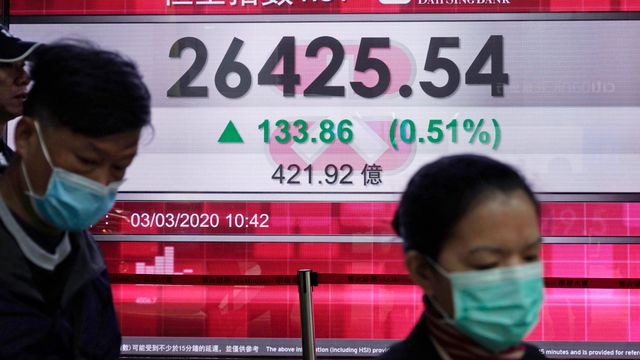
People walk past an electronic board showing Hong Kong share index outside a local bank in Hong Kong, Tuesday, March 3, 2020. (AP Photo/Kin Cheung)
Over that period, six people died from the virus in the United States after experts confirmed “community transmission” in three separate locations. A genetic study found that the coronavirus had been propagating through the population in Washington state for as much as six weeks, meaning that between 150 and over a thousand people had likely been sickened without being detected.
But despite this disastrous news, on Monday the Dow Jones Industrial Average closed up by 1,294 points—its biggest one-day point gain ever.
Nor was the market rebound based on any improvement in economic conditions. The Organization for Economic Cooperation and Development warned Monday of a global economic contraction in the first quarter of this year, while cutting its projection for economic growth for the entire year to the lowest level since 2009.
Rather, the markets were responding to something else: mounting pledges by central banks that they would cut interest rates and carry out asset purchases, placing an unlimited supply of cash at the disposal of the financial markets.
On Monday, before the US markets opened, Bank of Japan Governor Haruhiko Kuroda pledged to “offer sufficient liquidity via market operations and asset purchases.” The Japanese central bank moved immediately to pump nearly $5 billion into the financial markets.
Kuroda was joined by French Finance Minister Bruno Le Maire, who announced that the G7 economies would take “concerted action” in response to the epidemic, raising the prospect of a coordinated cut in interest rates by major central banks. The European Central Bank said later that it could cut interest rates to below zero and initiate a new round of asset purchases.
These announcements followed the statement Friday afternoon by Federal Reserve Chairman Jerome Powell, who pledged to “use our tools and act as appropriate to support the economy.” This was clear signal to the markets that the Federal Reserve is likely to cut interest rates even before its scheduled meeting on March 17–18, and do so in tandem with other central banks.
Only a pittance is being provided to slow the spread of the coronavirus pandemic, which threatens to kill millions of people, but unlimited funds are being made available to bail out the financial elite. While the Fed stands ready to pump trillions of dollars into Wall Street, the Trump administration has requested just $2.5 billion to fight the coronavirus outbreak, half of which will be transferred from other programs.
Governments are responding to the coronavirus pandemic the same way they dealt with the 2008 financial crisis—by giving trillions of dollars to the financial oligarchy while doing nothing for the great majority of the population.
The most striking characteristic of the response to the outbreak of disease in the US is the stunning lack of preparedness. Despite having had weeks of advanced warning, the Centers for Disease Control was totally unprepared to carry out large-scale testing for the virus, allowing it to spread more widely and potentially costing untold numbers of lives.
The disastrous response to the crisis has been conditioned by the systematic defunding of public health care infrastructure in the United States, part of the dismantling of social infrastructure that has accompanied the relentless, decades-long upward redistribution of wealth.
Just like the 2008 financial crisis, the ruling class is responding to the global coronavirus crisis by defending and expanding its own interests. A decade ago, tens of millions of families lost their homes, while the rich and super-rich were bailed out and made even richer.
The Federal Reserve and the US Treasury loaned nearly $7 trillion to the financial system, which was used to prop up over $30 trillion in financial assets. That set into motion the biggest financial bubble in human history, with stock market values quadrupling since 2009.
Once again, the ruling classes are responding to a new crisis—the most dangerous outbreak of infectious disease in a century—entirely on a class basis.
The central banks and governments know that it will be the working class and poor who will bear the overwhelming brunt of the disease. While the wealthy have the luxury of telecommuting or not working at all, workers will be forced—either by the threat of being laid off or the devastating impact of lost wages—to keep working in factories, warehouses, medical offices and retail facilities, exposing themselves to infection.
The ruling elite will ensure that it has access to the best medical care, while workers will languish in cramped and ill-supplied hospitals. Those who are among the 87 million Americans who are uninsured or underinsured will face the agonizing choice of foregoing care or facing financial ruin.
Workers must respond to the crisis, with no less determination than the ruling class, on the basis of their own class interests. As the International Committee of the Fourth International’s February 28 statement made clear:
The working class must demand that governments make available the resources required to contain the spread of the disease, treat and care for those who are infected, and secure the livelihoods of the hundreds of millions of people who will be affected by the economic fallout.
The statement continued:
In demanding that capitalist governments implement these emergency measures, the international working class does not abandon its fundamental aim: the ending of the capitalist system. Rather, the fight for emergency action will raise the consciousness of the working class, develop its understanding of the need for international class solidarity, and increase its political self-confidence.
The days since the publication of this statement have only underscored the dangers posed by the disease and the lengths to which the ruling elites will go to defend their wealth and privilege at the expense of society.

US, South Korea, and Japan: Recognising the Value of Alliances

Sandip Kumar Mishra

On 24 February 2020, South Korean Defence Minister Jeong Kyeong-doo met his American counterpart, Secretary of Defence Mark Esper, in Washington. The meeting did not result in a breakthrough on the issue of cost-sharing for US troop presence in South Korea. There have been six such inconclusive meetings between the two countries in the past few months.
US President Donald Trump is of the belief that Japan and South Korea must contribute to monetary burden-sharing for the presence of US troops in their countries. During his 2016 election campaign, Trump clearly stated that Japan and South Korea had not been paying "enough" for their own security, and labelled them "free-riders." After coming to power, he reiterated on multiple occasions his intention to try and impose the entire cost of these alliances on Japan and South Korea.
There are around 50,000 US troops in Japan and 28,500 in South Korea. This presence is part of US' obligations under the Treaty of Mutual Cooperation and Security with Japan and South Korea which was signed in the early 1950s. Of the total costs, Japan directly bears around US$ 2 billion, and South Korea, around US$1. In addition, there are several other indirect mechanisms through which Japan and South Korea pay the US to sustain troop presence in their respective countries, such as the compulsory annual purchase of US defence equipment. Between 2008 and 2016, South Korea made defence purchases worth US$ 22.5 billion from the US. These mechanisms also extend to trade deals, which are deliberately framed in favour of the US. 
There are also political costs to sustaining this alliance. For example, there are frequent reports of US troops misbehaving with civilians and Japanese and Korean defence personnel. The areas where US troops are stationed have witnessed several occasions of civil unrest. Korean and Japanese movies and novels have depicted the troops in a negative light as a reflection of popular resentment. Criticism has also been mounted on the basis of reported restrictions on Japanese and Korean defence decision-making on operational issues as a result of turf tensions with US troops. In response, South Korea has in fact gradually begun to take charge of the Combined Forces Command's peace and war-time controls.
Clearly, Japan and South Korea do not calculate the costs of their alliance solely on the basis of these issues. A thorough cost-benefit assessment of the value of the relationship sustains their relationships. They share a commitment to maintaining a regional order in which democracy, free market economics, human rights, and cooperative security are primary concerns, and the alliance with the US helps defend and expand these principles.
However, this value is apparently lost on President Trump, who has thus far been unable to see beyond a mechanical and immediate economic reciprocity. He does not appear to be interested in sustaining the existing order, and sharing its costs with US allies. After all, US troop presence in South Korea and Japan not only provides security to these allied countries but also augments US' regional military presence, particularly with regard to its contestation with China. More importantly, the US alliance system has a broader political goal: to help expand the influence of like-minded states in the region, and work together as a bulwark against revisionist and disruptive tendencies seen emerging from China, North Korea, and Russia. Of course, it may be useful to have a debate on the specifics of alliance cost-sharing – but this should not be at the cost of overshadowing other equally, if not more, important aims. Under Trump, the US has essentially imposed its interpretation of costs on Japan and South Korea, its long-term allies in the region. This displays either a lack of understanding, or a deliberate disregard for the real value of the alliance system. This may lead to narrow economic benefits for the US in the short-term, but significant political losses will be incurred in the long-term.  

2 Mar 2020

The Poverty Line is Too Damn Low

Shawn Fremstad

Earlier this month, the Trump administration announced that it is seeking public comment on producing “additional measures of poverty.” While the request has received little to no attention in the media, it offers an important opportunity to tell the government to adopt a modern poverty measure that reflects what it really takes to make ends meet in today’s economy.
The federal government currently reports on poverty each year using two different measures: 1) the Official Poverty Measure (OPM), and 2) the Supplemental Poverty Measure (SPM). According to the OPM, which set the poverty line for a family of four at $25,465 in 2018, 11.8 percent of Americans are poor. According to the SPM, which set the poverty line at $28,166 for family of four in 2018, 12.8 percent of Americans are poor. A major limitation of both the OPM and the SPM is that they use outdated poverty thresholds that fall below both broad public consensus and expert views on the income needed to not be poor.
In the notice, the administration says that it is “evaluat[ing] possible additional alternative measures of poverty distinct from the OPM and SPM” and that these additional measures “will not be intended to replace the OPM or the SPM” or “intended for use to estimate eligibility for government programs.” Despite these disclaimers, there is no reason why an alternative measure that improves on the OPM and SPM could not eventually displace one or both of them, especially if it better reflects broad public understanding of what it takes to make ends meet in today’s economy.
The administration’s notice does not propose any specific alternative measures, but it does make clear that they are considering both income-based and consumption-based measures of poverty. The former determines whether a household is poor by comparing its income to a poverty line, while the latter compares the amount a household estimates it spent on goods and services to a poverty line.
The notice includes 14 questions that the administration says it is particularly interested in hearing from the public on. Four of these questions are about poverty thresholds, the dollar amount that a family’s resources are compared to in order to determine whether it is counted as poor or not. Because both the OPM and SPM use poverty thresholds that are far too low, it is especially important that any additional measures of poverty have more adequate poverty thresholds than these measures.
This could be done most simply by adopting a poverty measure that sets the poverty threshold equal to 60 percent of median equivalized disposable income, the same threshold the United Kingdom currently uses as its main poverty measure. This would produce a poverty threshold of roughly $44,000 for a family of four today, compared to the OPM’s threshold of $25,465 and the SPM’s of $28,166.
Other questions the notice specifically asks for input on include: 1) what types of income and spending to count in determining whether a household has income above or below the poverty threshold, including whether to count: a) the value of health insurance; b) out-of-pocket spending on health care, transportation, and child care; and c) the value of education; and 2) whether to address the problem of survey misreporting. Other questions that are relevant, although not specifically mentioned in the notice, include: 1) whether student loan and other mandatory debt should be subtracted from income (as recently recommended by an expert commission in the United Kingdom); 2) whether to take the extra costs of disability and social care into account when measuring poverty; and 3) how to ensure the homeless and others who are less likely to be captured in household survey data are included in poverty counts.