23 Mar 2020

Canada registers 500,000 Employment Insurance claims in one week, as Coronavirus triggers jobs massacre

Roger Jordan

In just four days last week, Canada’s federal government received 500,000 applications for Employment Insurance (EI) from laid-off workers. The figure is far higher than the 425,000 total jobs lost in the eight months immediately following the eruption of the 2008 global financial crisis, and points to the countrywide job massacre that has been triggered by the spread of the coronavirus pandemic.
According to University of Calgary economist Trevor Tombe, last week’s EI applications equaled 2.6 percent of the total Canadian labour force. This is in line with percentage of the workforce that lost their jobs in July 1932, the worst month for layoffs and plant closures during the Great Depression.
But in reality, the current jobs crisis is even worse. As a result of the cuts made to unemployment benefits by Liberal and Conservative federal governments over the past 40 years and the rise of precarious contract work, just 40 percent of jobless workers qualify for EI, although this figure tends to rise in the first stages of a pronounced economic crisis, when many longtime workers lose their job.
All this suggests that the true number of workers who lost their jobs last week is many hundreds of thousands more than half-a-million, and could possibly be as high as a million.
Economic analysts are now projecting that Canada’s economic output will contract by a staggering 11 percent in the second quarter of 2020. In the United States, far and away Canada’s most important trading partner, output is expected to plunge 24 percent, according to Goldman Sachs.
The layoffs have swept across the entire economy. In the airline sector, Air Canada is laying off 5,100 flight attendants, while Air Transat will cut 2,000 jobs. Longview Aviation Capital, which manufactures twin-engine aircraft, will cut close to 1,000 positions at its production sites in Ontario, Alberta, and British Columbia. In the auto industry, tens of thousands of workers at the Detroit Three plants in Ontario and related parts suppliers have been, or soon will be, laid off, after workers protested over being made to work in unsafe conditions, packed together on assembly lines.
In the arts and entertainment sector, the Banff Centre for Arts and Creativity is laying off 400 workers. Hundreds of thousands of low-paid workers in theaters, cinemas, restaurants, the film and television industries, and tourist services are now out of work.
The best the many hundreds of thousands of workers of newly unemployed can hope for is that they receive 60 percent of their former salary, as under the current EI system, with the maximum benefit capped at $573 per week.
This will leave the vast majority struggling to make ends meet. For those not eligible for EI, the situation is even more dire. Last week the government announced a temporary Emergency Support Benefit, whose details were worked out in close consultation with Canadian Labour Congress President Hassan Yussuff. It is supposed to provide support for short-term contract, gig, and other workers who don’t qualify for EI. However, the details are vague, no benefits will be paid out until sometime next month, and people have to apply online through their Canada Revenue Agency account, providing additional obstacles, especially for lower-paid and immigrant workers, to accessing support.
As a companion to its Emergency Support Benefit, the Trudeau Liberal government also announced last week a temporary Emergency Care Benefit. Its stated aim is to provide support to workers who miss work because they: are ill with the conoravirus or have to go into quarantine, but don’t have employer-paid sick-leave; need to care for a family member sick with COVID-19; or must tend to their children because of conoravirus-forced school closures.
This benefit will pay just $450 per week, barely enough to meet the cost of rent in a large city, never mind expenses for groceries and other necessities of life, for a maximum of 15 weeks. Like the Emergency Support Benefit, the Emergency Care Benefit will not even begin providing support till sometime next month.
“My biggest worry is my rent,” a self-employed makeup artist now out of work told the National Post. “I can only survive for a month on what I have now.” Referring to the Trudeau government’s emergency benefits, she added, “It doesn’t give me much reassurance.”
While Trudeau’s Liberals are proposing to place workers who lose their jobs on rations, their generosity towards big business knows no bounds. With a $50 billion program to purchase mortgages from the banks, a regulatory change halving required bank-capitalization levels, and other measures, the Bank of Canada, the Office of the Superintendent of Financial Institutions, and other arms of the government have already placed $500 billion at the disposition of the financial elite. This does not take into account $10 billion in direct aid to business through a Business Credit Availability Program and $55 billion in tax deferrals that will overwhelmingly benefit big business and the rich. Just a fraction of the gargantuan sums being handed over to business and the financial elite, $26 billion, would suffice to pay all new 500,000 EI claimants $1,000 per week (roughly equivalent to the current average weekly wage) for the next 12 months.
Trudeau claimed at a press conference Sunday that more financial assistance is being prepared and will soon be announced. But there is no indication to suggest that any of these new measures will alter the Trudeau government’s policy of opening the Treasury wide to the financial elite and providing meager rations for working people.
The ruling class agenda is fully endorsed by the trade unions, which played a key role in crafting the Trudeau government’s pro-big business measures. As he began talks with the Liberals and representatives of the corporate elite on the government’s COVID-19 Economic Response Plan, CLC President Yussuff said that it was necessary to establish a “collaborative front” to tackle the coronavirus pandemic.
This “collaborative front” aims to protect the wealth of the capitalists, while offering a pittance to laid-off workers and Canada’s overstretched healthcare system.
The ruling elite has done virtually nothing to prepare for the COVID-19 pandemic, squandering the two-month “window” offered by China’s efforts to halt the disease’s spread. Trudeau and Deputy Prime Minister Chrystia Freeland only wrote to the provinces two weeks ago to inquire about the state of their stocks of medical equipment and supplies. Moreover, decades of austerity, implemented by all the establishment parties, from the Conservatives, and Parti Quebecois and CAQ to the NDP, have left Canada’s dilapidated hospitals ill-equipped to deal with the pandemic.
With 1,400 confirmed coronavirus cases in Canada and 19 deaths, doctors are already issuing dire warnings. On Saturday, doctors at the Royal Columbian Hospital in the Vancouver suburb of New Westminster warned that the rapid spread of the disease in Canada’s third most populous province and shortages of equipment and personnel could soon lead to the health care system being overwhelmed as in Italy. “Tragically,” wrote the Royal Columbian’s head of medicine, Dr. Gerald Da Roza, on behalf of the hospital’s physicians, “Italy has had to choose who can receive intensive medical care based on age and risk profile; please do not force us to implement similar policies here as our hospitals become overrun.”
The Liberal government’s placing of workers on rations, and its refusal to systematically mobilize society’s resources—currently monopolized by big business—to halt the spread of the virus, ensure the best treatment for all COVID-19 patients, and shield working people from the pandemic’s economic fallout underscore the urgent necessity of the working class intervening independently to assert its interests. A comprehensive program of testing, tens of billions of dollars to strengthen the healthcare system, and hundreds of billions to provide a secure, livable income to the millions of workers and their families impacted by the crisis are essential measures. They will only be realized in bitter struggle against the socially criminal policies pursued by the capitalist class and all their political representatives.


Catastrophic worldwide medical ventilator shortfall despite years of warning

Steve James

The rapid spread of coronavirus is threatening to overwhelm health services around the world, exposing the gutting of social provisions by the financial oligarchy.
A major component of this crisis is the catastrophic and criminal shortage of medical ventilators in quantities sufficient to confront a long predicted and inevitable pandemic.
Medical ventilators are relatively complex devices, normally costing up to $50,000. Under normal circumstances, the entire annual global production is estimated at between 40,000 and 50,000. A small number of companies, based in a handful of countries, build the complex devices, which require pressure generators, flow regulators, filters, valves, alarms, numerous sensors and software to allow control and display of the device’s activity and reports of the patient’s breathing. Production is generally licensed and subject to scrutiny and regulation.
Specialist clinical engineers and qualified medical staff are required to install and operate the devices, which need careful calibration and skilled supervision, without which the patient has little chance of survival.
But under conditions of crisis, when every country is suddenly trying to acquire thousands of the devices, suppliers and global supply chains are being stretched far beyond their capacities.
British hospitals, for example, have only 5,000 ventilators attached to intensive care beds. But British Health Secretary Matt Hancock conceded that “many times more” than current levels of supply were likely to be needed in the period immediately ahead. German hospitals have around 25,000, with another 10,000 on order. The US has 62,000 and an additional 99,000 obsolete machines in storage. France is still conducting a nationwide survey of its capacity.
While peak demand might be is impossible to predict, it will be many times current production capacity. Swiss-based Hamilton Medical—one of the world’s main producers, usually making 15,000 ventilators a year—has increased production by up to 40 percent. CEO Anthony Wieland warned Reuters of “a huge discrepancy between available ventilators and the need.”
Charles Bellm, managing director of ventilator component supplier Intersurgical, explained that one respiratory product sold by his company has attracted more orders since the start of 2020 than in the previous 15 years.
A 2015 survey in New York State, population 19.5 million, concluded that, based on an epidemic similar to the 1918 flu pandemic, 18,600 ventilators would be needed in that state alone. While in total the state could muster some 9,000 ventilators, most of these would already be in use. Therefore, at the peak of the disease, there would be a shortfall of nearly 15,600 machines—in a single US state.
Capacity in most countries is catastrophically inadequate, is likely to remain so, and medical staff will be forced, as has already occurred in Italy, to repeatedly choose which patients are left to die. Only the patients deemed most likely to survive with the use of ventilators will have access to treatment.
Making things worse is the fact that the common response to the escalating crisis is for each country to assert its own national interest.
In Italy, where over 1,300 people are already reliant on intensive care, the government has ordered 500 ventilators a month from the country’s only manufacturer, Siare Engineering in Bologna. The company anticipates being able to deliver 2,000 devices by July, twice its annual production, but has cancelled all international orders. German manufacturer Drägerwerk AG said that its order from the German government would take up its entire annual production.
The Financial Times noted that were even one country to impose an export ban on ventilators, prices would immediately ratchet up and global supplies collapse. Yet, last Sunday, European Commission President Ursula von der Leyen announced an export authorisation scheme to prevent vital medical equipment leaving the European Union (EU).
This move was made in the context of the revolting flag-waving stunts mounted by US President Donald Trump, British Prime Minister Boris Johnson and others to attempt to enrol sections of industry in patriotic drives for ventilator production.
In Britain, the result has been the blackest farce. The Conservative government hosted a conference call with around 60 leading figures from vehicle makers JCB, Land Rover, Honda, Ford and domestic gadget maker Dyson.
During the conference call, Johnson failed even his own abysmal standards of behaviour by jokingly referring to the scheme as “Operation Last Gasp.” His words perfectly captured his government’s sociopathic indifference to working people’s lives.
A two-page specification document for a “rapidly manufactured ventilation system” was circulated, along with the Brexit-inspired requirement that the devices should be “made from materials and parts readily available in the UK supply chain.”
The document helpfully included links to a YouTube video about ventilator design! The government also put up a web contact form for prospective ventilator makers, encouraging them to list their experience in medical matters.
Even among the assembled captains of industry, there was open incredulity. One executive warned that his company would need a “certified design” and “we can’t make one up.” Another car industry leader was blunter: “What makes them think we carmakers know how to make ventilators and that a car factory assembly line is even vaguely appropriate?”
Robert Harrison, professor of Automation Systems at WMG, University of Warwick, was quoted on The Manufacturer magazine website: “JCB, Rolls Royce or others could potentially manufacture ventilators. They have relevant skills and capabilities, but given that all the design and manufacturing related information could be supplied to them, getting the parts and the tooling to manufacture such a thing will be a significant task, perhaps taking many months.”
Craig Thompson, of Oxfordshire-based ventilator manufacturer Penlon, told the BBC, “The idea that an engineering company can quickly manufacture medical devices, and comply with the rules, is unrealistic because of the heavy burden of standards and regulations that need to be complied with.” Penlon has said it could eventually double production.
By Thursday, it was reported that three companies, Meggit, an aerospace consortium including GKN, Airbus and Thales, along with car makers Nissan and McLaren, had taken up the offer and intend to start work on a basic design. Five thousand of the rudimentary devices are intended to be available by the end of the month, far below requirements if they even work.
In the US, President Donald Trump last week invoked the Defense Production Act, pretending to compel manufacturers to make ventilators. Leading US corporations went along with the charade. But after a meeting at the White House, GM spokeswoman Jeannine Ginivan was distinctly non-committal. Ginivan said the automaker “are already studying how we can potentially support production of medical equipment like ventilators.”
Trump’s director of the National Economic Council, Larry Kudlow, took the opportunity to advance the proposal for unpaid labour, suggesting on Fox News that car workers might be mobilised to make equipment “on a voluntary basis for civic and patriotic reasons.”
Even should viable equipment be produced, there are equally pressing shortages of staff to install and safely operate the machines. Nicki Credland, chair of the British Association of Critical Care Nurses, told Nursing Times that there were not enough qualified intensive care staff to look after patients on the new machines, even if they get built. Current guidelines are for a nurse to patient ration of 1:1 or 1:2 depending on the condition.
Dr. Rinesh Parmar, chair of the Doctor’s Association UK, warned that systematic under-resourcing of the National Health Service and the exodus of staff has “ultimately left the country with a severe lack of intensive care nurses and doctors.” The same issues are posed in every country.

Retail and service industry workers demand safety measures, store closures and full compensation during coronavirus pandemic

Trévon Austin

As the coronavirus spreads rapidly throughout the United States, retail and service industry employees, primarily low-wage workers, have vociferously denounced corporations for continuing to stay open and not providing proper safety measures. The Centers for Disease Control and Prevention (CDC) has warned against large gatherings, but many retail workers across the US are put at risk by employers still requiring employees to work.
Retail workers, particularly in grocery stores, are at high risk of contracting COVID-19 as they interact with hundreds of customers on a daily basis. Many have stated they do not have paid sick leave, meaning workers are forced to choose between their paychecks and their safety. The predicament is compounded by employers’ failure to supply cleaning and sanitation supplies.
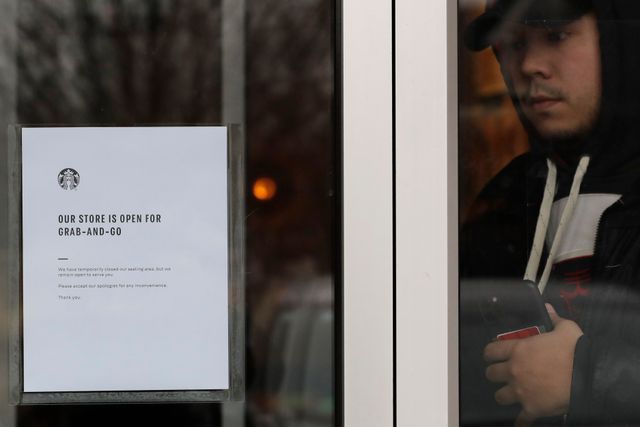
Baristas at Starbucks voiced their frustration last week with the company’s decision to only implement limited closures and safety measures in response to the pandemic. Starbucks has justified the decision to stay open by describing itself as an “essential business.”
A sign informs customers that the Starbucks is open for takeout. (AP Photo/Nam Y. Huh)
Aniya Johnson, a Starbucks barista in Philadelphia, told the World Socialist Web Site her experience has been “terrifying” and stated her coworkers were fearful of catching and spreading the virus.
“We know that most young people can be asymptomatic, leaving the elderly and babies at risk. Even with all the ‘precautionary measures,’ there are still ways that it can be spread. Management hasn’t really been too helpful. Store managers sympathize with you because they have to come to work, too. However, they have the advantage of not always being on the floor. Upper management gets to work from home and still go on about their day, as if store level concerns don’t exist. It’s frustrating.”
Johnson started a petition demanding that Starbucks suspend business at all locations and pay its workers during the duration of the coronavirus outbreak, and called for workers to stay at home today in protest. The petition has gathered over 37,000 signatures and compelled Starbucks to announce Friday the closure of its café stores and the limiting of its services to mobile ordering and drive-thru. Even with limited service, some Starbucks workers are still encountering hundreds of customers throughout their workday.
The company has also offered 30 days of paid leave to workers who feel unsafe. After that one month is up it is not clear what options will be available to workers. If a Starbucks worker comes into contact with someone who later tests positive for COVID-19 or contracts it themselves, they could qualify for “catastrophe pay.”
Dave, another Starbucks worker, did not feel that the company’s recent decision went far enough to protect workers and their communities. Dave responded to what he felt was an inadequate response by calling for a customer boycott and starting a social media group called “The Baristas Collective for Starbucks workers” to organize and make demands.
“The situation surrounding COVID-19 is stressful. We’re being told constantly that we need to stay home and practice social distancing. We hear that from every government and health authority, but Starbucks is saying otherwise. They gave us 30 days off as a publicity stunt.”
Last year the global coffee chain spent $12 billion on stock buybacks and dividends, rewarding its investors and pumping up its stock valuation. This same amount would be enough to cut every single employee around the world a $41,000 check, making clear that what the company is now offering is a mere pittance.
Dave spoke with multiple baristas across the US who say they are being actively discouraged from taking the 30 days paid leave and feel pressured to keep working at Starbucks.
“Baristas are in danger, their families are in danger, and their loved ones are in danger. Yet Starbucks doesn’t care. This corporation is putting thousands of lives at risk for a quick buck, and that’s why we’re organizing. It’s time to stand up,” he said.
Workers at the Whole Foods grocery chain, owned by Amazon CEO and world’s richest man Jeff Bezos, also conveyed their dissatisfaction with the way the company is handling the outbreak. A longtime employee who wanted to remain anonymous described upper management at Whole Foods lagging behind other grocers in their reaction. The worker said that the most immediate responses came from workers in the stores.
“I feel like we took on sanitation at my store before directions were handed down from above. As soon as our cooler emptied, we started scrubbing walls, floors, prep areas, everything. We sanitized all tables and shelves as they emptied. Our store leader hired a third-party company to sanitize as well,” the worker said.
“Regional and global leadership are disastrously inept. Full of yes men who have failed upward. No minds of their own for the most part. Most of them in my opinion are too young to have perspective on this real-life crisis—due to a cycle of continuous firing and rehiring. We are held together by the glue of a very few extremely competent folks, but most of the regional and global management is a disaster.”
Workers at retail giants Walmart and Target have also spoken out about the two companies not doing enough to protect staff during the outbreak. In several interviews with other news publications, workers said they were anxious about working in crowded conditions. Their frustration was aggravated by increased workloads, under-staffing and inadequate sanitation practices.
Several Target workers spoke to the Guardian about management dismissing workers’ fears of contracting or transmitting the coronavirus to family members. A Target employee in New Mexico told the publication he had been wearing a N95 protective mask out of concern for his niece, who is going through chemotherapy. Management told him he needed to obtain a doctor’s note in order to be permitted to continue wearing it.
“They said I would not be allowed to work with it until I had brought back this paper form. I told them it was not worth it to me to risk the life of a little girl. I told them, while trying to hold back tears, that this wasn’t right,” he said.
In a few cases, some workers have forced companies to shut down stores. Video game store chain GameStop recently announced that it would close all of its US locations after workers threatened to walk out because of unsanitary conditions. However, many retail workers remain in a vulnerable position on the front lines of the pandemic.

Africa threatened by sudden surge in coronavirus cases

Kumaran Ira

Coronavirus spread rapidly this weekend in Africa, jumping to over 1,300 detected cases, while there are over 335,000 confirmed cases and 14,000 deaths worldwide. At least 33 of the continent’s 54 countries are affected, though it is certain that many undetected cases or asymptomatic coronavirus carriers are circulating in Africa.
The continent’s entire population is at risk of becoming infected, a development which would rapidly swamp its inadequate and underfunded health systems. A horrific death toll would result if the virus spreads in the countryside, densely packed slums and working-class areas of the continent’s massive cities. A coordinated, international struggle to halt the spread of coronavirus in Africa is now an urgent necessity.
Africa must “prepare for the worst” as community spread of the virus has already begun, World Health Organization director Tedros Adhanom Ghebreyesus warned last Wednesday. Most African countries have now closed their borders to people arriving from countries hard hit by coronavirus, including the United States and the European countries
In North Africa, Egypt—the continent’s hardest-hit country, where Africa’s first case was recorded on February 14—has at least 294 cases and 6 dead. The military regime of General Abdel Fattah el-Sisi is contemplating a curfew and generalized stay-at-home orders for the population to try to halt the pandemic’s spread. Egypt is followed by Algeria (201 sick, 17 dead), Morocco (109 cases, 3 dead) and Tunisia (75 sick, 3 dead). The number of cases in Libya, a country devastated by the ongoing civil war provoked by the 2011 NATO war nearly a decade ago, is unknown.
Authorities in these countries have closed schools, mosques and universities, suspended flights towards high-risk countries, and banned mass gatherings. In Tunisia, the state is even asking its impoverished population to finance the struggle against the virus with donations.
Many West African countries are also hard hit. Senegal has confirmed 56 cases of COVID-19, the disease caused by coronavirus, and authorities are considering outlawing the sale of bread in neighborhood groceries in an attempt to halt the spread. They have also banned all public demonstrations on Senegal’s entire territory for 30 days.
The number of the sick is surging in other West African countries as well, including Burkina Faso, a country destabilized by French imperialism’s war in Mali; it has seen 75 cases including four dead, the first in sub-Saharan Africa. Ghana has 21 cases and Nigeria—Africa’s most populous country, with over 200 million inhabitants—has 30 confirmed infections.
In East Africa, the spread of the virus also poses enormous dangers with dozens of cases detected in many countries: Rwanda (17), Ethiopia (11), Kenya (15), Tanzania (12), Sudan (2), Seychelles (7), Somalia (1) and Mauritius (24 sick and two dead). Yesterday, Rwandan authorities closed their borders, imposed confinement orders on the population and put the country on lockdown.
According to Radio France Internationale, Kenyan authorities have arrested several individuals accused of profiteering or inciting panic over the pandemic. They arrested a 23-year-old man who had posted messages to Twitter accusing the state of lying about the first COVID-19 cases recorded in the country, and who now faces a $50,000 fine and up to 10 years in prison. Last night, the Kenyan government also moved to suspend all flights out of the country indefinitely starting Wednesday at midnight.
Cases have also been detected in Central Africa notably in Cameroon (40), the Democratic Republic of the Congo (23) and in the impoverished Central African Republic (3). Governments there are taking preventive measures to suspend all flights to and from at-risk countries and close schools, places of worship and bars.
Coronavirus is particularly threatening to Africa not only because of the lack of adequate health infrastructure in working class areas, slums and the countryside, but also because of the many AIDS and tuberculosis patients. These and other individuals with weakened immune systems risk developing extreme serious cases of COVID-19 that they could not survive without intensive care in a hospital equipped with respirators and other advanced equipment. With this equipment largely lacking as the virus rapidly spreads, a catastrophe that could claim millions of lives threatens the continent.
The COVID-19 contagion has spread significantly in South Africa, a country of 59 million people, with more than 274 cases as of this writing. “We must alert all South Africans that the risk of internal transmission has now arrived,” commented Health Minister Zweli Mkhize. “Once this infection begins to spread in taxis and buses, it will create a new dynamic.”
“We have seven million HIV+ people, and 2 million are not currently under treatment,” recalled professor Susan Goldstein, a health specialist and assistant director of the Wits Center for Health Economics and Decision Science, in an interview with Al Jazeera.
“Nor do we know either how things will go in very poor regions where there is no space for quarantines,” Goldstein added.
The coronavirus pandemic is again revealing the bankruptcy of the world capitalist system. African governments defend the interests of a narrow layer of capitalist elites, closely tied to imperialism, who have overseen the exploitation of low-wage labor by corporations from the old European colonial powers, American imperialism, and emerging Asian economies. They collaborate as well in imperialist wars launched in Africa by Washington or the European imperialist powers.
As a result, decades after these countries won formal independence from imperialism, basic social services and social infrastructure remain at best deeply inadequate. Most of the African population does not have health insurance and depends on public clinics or hospitals. Even in South Africa, one of the continent’s wealthier countries, 82 percent of the population does not have insurance. Public hospitals are critically short on staff and are frequently overwhelmed by epidemics.
It is essential to coordinate an international campaign to provide the medical equipment and staff necessary to stop the contagion in Africa.
Professor Mosa Moshabela of the School of Nursing Sciences and Public Health of the University of Kwazulu Natal, told Al Jazeera: “We cannot contain COVID-19 with our health system alone. If we look at how Italy [Europe’s coronavirus hotspot] is coping with the virus - we can’t do it.”
Addressing the catastrophic situation in Italy, where thousands are dying as hospitals are overwhelmed by the rapid onrush of patients in critical condition, the professor added: “We will be similar to that with the difference is that we don’t have a big old population but a high number of people who have TB and HIV. Those who are going to be affected the most are going to be between 20 and 60.”
It is urgent to sound the alarm on the danger of that without immediate action the disease could spread, become endemic, and potentially lead to a catastrophic loss of millions of lives. This danger is not, moreover, a threat for the African population alone. Given the close links in a globalized economy—notably between Europe, America and Africa through which this disease has spread—the growth of COVID-19 in any individual country poses an enormous threat of contagion to workers of all countries.

Italy’s health workers denounce ruling elite’s negligence on coronavirus

Marc Wells

The coronavirus pandemic escalated this weekend in Italy, with 1,500 dead and 13,000 new cases. Hospital systems are submerged, lacking basic supplies like safety masks that leave them completely unprepared for the massive epidemic.
The Conte government announced Saturday evening that all non-strategic production will be suspended: “Outside activities deemed essential, we will only allow work to be carried out in smart working mode and we will only allow production activities that are deemed in any case relevant for national production. … It is the most difficult crisis that the country has been experiencing since the second post-war period. The death of many fellow citizens is a pain that is renewed every day.”
In stark contrast with a tardy and inadequate response from the state, overworked health care workers are showing extraordinary dedication to patients. But the contradictions of a crippling system are bursting at the seams. Medical staff are increasingly discussing broader political questions, and that the pandemic is not only a health but a social and political crisis.
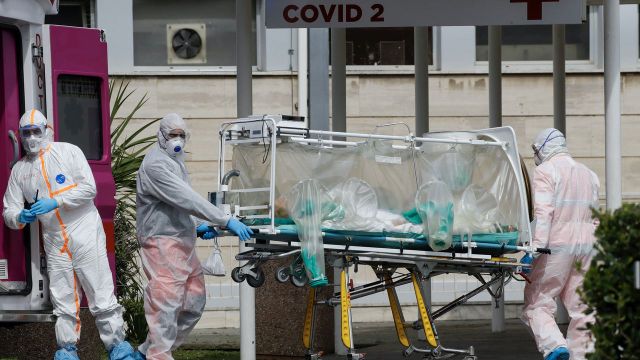
A patient in a biocontainment unit is carried on a stretcher from an ambulance arrived at the Columbus Covid 2 Hospital in Rome.(AP Photo/Alessandra Tarantino)
The WSWS spoke to Italian health care workers facing the growing wave of severely ill and dying patients. Monica Gigliofiorito is a registered nurse at the emergency room of the San Giovanni Addolorata hospital in Rome, currently deployed at the intensive care coronary unit.
Gigliofiorito said, “We have created special areas for the COVID-19 emergency, a buffer zone for those suspected of being infected. After a test and a CAT scan, we assess whether the patient needs COVID-19 specific care. If positive, then the patient gets transferred to Lazzaro Spallanzani National Institute for Infectious Diseases, since, outside ventilators and NIVs, we don’t have that specific type of intensive care.”
She explained that her hospital is not equipped to directly treat coronavirus patients, though they work with positive cases to send them to appropriate facilities for treatment: “We health care workers are absolutely exposed to risk. In my hospital we’ve reported two doctors testing positive, however it’s unclear whether they contracted it in the hospital. More than the doctors, we nurses are particularly exposed to the virus. Upon a new patient’s arrival, we wear an FPP2 mask, whose filter is weaker than an FPP3. But we are in Italy.”
Gigliofiorito observed, “We have excellent training for doctors and nurses in Italy, but the Lazio Region does not give us sufficient tools … Today I worked in the morning. We had 3 FFP3 masks, 2 FFP2s and several surgical masks. So, with a nursing staff of 20 in my unit, you can see how many have been exposed all day.
She added, “I love my job for many reasons. Unfortunately, I didn’t go all the way for a medical degree and I regret it. Still, as a nurse I received an excellent training and execute difficult tasks. But we are underpaid for what we do. After 24 years of service, I get 1,800-1,900 euros a month. In the last few years, governments shut down many public hospitals, moving towards privatization. The system has been a vehicle for exploitation: the entire ruling class took all the fat, there’s nothing left.”
She indicted the ruling elite’s neglect of the population: “At the beginning of the coronavirus phenomenon, it was known that it would spread from China everywhere, including to Italy.” However, she said, “No one sounded the alarm. I can show you official documents from the Gazzetta Ufficiale [official journal of legal record] that clearly warned of the problem as far back as at least February 5. And now I am terrified by the prospect that it will spread down south. One can only pray to God on that, as the death toll will be way higher than Bergamo.”
Gigliofiorito stressed the criminal negligence of the state: “The president of the Lazio Region, at the beginning of February, had the nerve to say that this was a simple and banal flu, that we were making too much noise. They did not want to test even us, medical personnel. In my department we had the first death from COVID-19, an 89-year-old woman, certainly with cardiac preconditions. When she died, they tried to hush the news, but couldn’t.”
She added, “Of course, the hospital was engulfed in a scandal. But no one worried about us, 25 nurses placed in quarantine. They only worried about testing us and giving us the results for one purpose: to rush us back on the job.”
The WSWS also spoke to a technician from Lombardy, who wished to remain anonymous: “I work with cancer patients who need to be treated with radiation. We have 150 to 200 patients a day. We don’t have an emergency room, so we don’t work exactly in the frontline. However, our demographic is most vulnerable to COVID-19, so we must take strict precautions.”
He explained, “I’ve had two patients who tested positive, although without symptoms. I also have two coworkers who have tested positive. We have been in daily contact, so we have all been exposed. They are now quarantined, but it’s very possible we’ve all been contaminated.”
“Tests are only given to those with clear symptoms: one must have high fever and heavy cough, or shortness of breath. Testing the full population is difficult. However, there has been a sort of abnegation, in addition to shortage of supplies, compounded by a difficulty of getting these supplies on the world market.”
He criticized the European Union’s role: “Europe is not so much a Union. They forgot about the alliance and are acting on the basis of ‘to each his own,’ if one looks at how the EU ignored our emergency.” In contrast, he said, “I also must say China’s contributions have been noteworthy.”
He described how EU governments ignored World Health Organisation warnings: “The priority is given to the stock values of Morgan Stanley and Goldman Sachs, but when the scientific community warns that half the world population will be affected by a deadly virus it’s considered crazy. This is a history classic.”
He said, “The loss of lives is the saddest part of all this. I cannot hide my anger when I read the daily death toll. After that, one gets news from the stock market, how this affects finance.” He added, “I get irate when in such a pandemic they think about a decline in their stock value. The situation in the real world is not rosy, but the response of the ruling elite is absolute folly, from my viewpoint ... 95 percent of the population doesn’t know whether it’s positive [i.e., infected].”
Pointing to the massive resources expended on bank bailouts after the 2008 Wall Street crash, such as for the failing Monte dei Paschi di Siena bank in Italy, he said, “History teaches a lot: the dramatic consequences we saw in Greece were caused by the speculations of a rapacious financial elite. They speculated on a people’s hunger to make money. … Our own micro-world has changed since the Lehman Brothers collapse.”
In contrast with the indifference of the financial aristocracy, he said, “I am in the business of health care. Frankly, I see human misery every day. People looking into my eyes and begging for help. ... I do not accept financial speculations on starvation and people’s deaths, or bets on the failure of an entire people.”

German government prepares for internet censorship and deployment of the armed forces

Ulrich Rippert

The COVID-19 pandemic is highlighting the class character of politics. The health care system has been cut to pieces, hospitals privatised and trimmed for profit, laboratory capacities and nationwide treatment options massively restricted.
Despite warnings from China, no preparations have been made to protect the population. The government cares only about the interests of big business and is making unlimited financial resources available to corporations and banks. Although the danger of the virus was known, and public life has been drastically restricted, many workers are being forced to continue their work without adequate protection.
Resistance is growing against this criminal irresponsibility by the government and employers. Various opposition groups are forming on the internet to refute government propaganda and describe and fight against the dramatic conditions in hospitals, rescue stations, care facilities and factories, but also the devastating effects of government measures on workers in precarious employment.
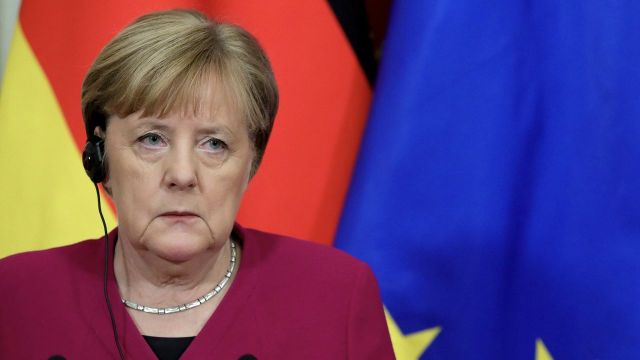
Angela Merkel (Wikipedia Commons)
Politicians have responded to this opposition with calls for censorship and dictatorial measures.
At the beginning of the week, Lower Saxony’s state Interior Minister Boris Pistorius (Social Democratic Party, SPD) called for sanctions against the distribution of so-called “fake news” in connection with the Coronavirus pandemic. He demanded that the government urgently intervene, saying, “It must be prohibited to publicly spread false allegations about the supply situation of the population, medical care or cause, ways of infection, diagnosis and therapy of COVID-19.”
According to Pistorius, the government must examine whether bans could already be based on the infection protection law. If not, the penal code or the law on administrative offences should be amended “as quickly as possible.”
The greatest misinformation currently being spread comes from the government itself. It claims that the German health care system is well prepared for the spread of the pandemic, and no one need worry. For weeks, the government played down the dangers.
Now that reality has refuted its propaganda, any criticism of it is to be criminalised and suppressed. If Pistorius has his way, the government will rigorously enforce its monopoly on information and opinion. This is a call for censorship and dictatorship.
Pistorius has long been known as a right-wing social democrat in the tradition of Gustav Noske, who during the November Revolution in 1918 allied with the German army and far-right Freikorps to suppress working-class opposition to the bourgeois order.
For seven years as Lower Saxony’s interior minister, he has been advocating a strict right-wing course against refugees and for stepping up the repressive powers of the state. In summer 2017, he presented an SPD position paper on domestic policy, the central point of which was strengthening the federal police force financially and with more personnel. One year later, more than 10,000 people demonstrated in Hanover against the new police law of Lower Saxony, which Pistorius had drafted, because it massively expands the powers of the security authorities while at the same time restricting elementary civil rights.
With his call for censorship and police-state measures, Pistorius speaks for a party that has always responded to crisis situations and resistance from the population by calling for the strong state and dictatorial measures. Pistorius comes from the same political stable as former German Chancellor Gerhard Schröder, who brutally smashed up the welfare systems with the “Hartz” laws. For the past three years he has also been living in a relationship with Schröder’s fourth wife, Doris Schröder-Köpf, from whom the former chancellor separated in 2015.
There is no doubt that the fight against the pandemic requires the restriction of social contacts and individual freedom of movement. However, it must not be allowed that the conditions for a dictatorship are created under the slogan “necessity knows no law!” The coronavirus pandemic, its ominous health, social and economic consequences and the drastic measures required to combat it raise the question of who exercises power and controls the state—the financial oligarchy or the working class?
The ruling class everywhere is trying to use measures against the Corona crisis to strengthen its power. According to information from DPA and Der Spiegel, the president of the Bundestag (federal parliament), Wolfgang Schäuble (Christian Democratic Union, CDU), for example, has proposed to the leaders of the parliamentary groups that they expand the Emergency Laws by amending the constitution.
The Emergency Laws, which were passed in May 1968 in the midst of the largest workers’ strikes and student protests of the post-World War II period, give the state quasi-dictatorial powers in crisis situations (natural disaster, uprising, war). Among other things, they allow for the Bundestag and the Bundesrat (the upper chamber of parliament) to be replaced by an emergency parliament, the “Joint Committee.” This committee consists of only 48 selected members but has the full powers of both chambers of parliament and would thus largely override the existing parliamentary system. Schäuble has now brought up the idea of including a similar regulation in the constitution for the case of an epidemic.
The deployment of the Bundeswehr (armed forces), which Defence Minister Annegret Kramp-Karrenbauer announced at a press conference on Thursday, must also be seen in this context. For the time being, the focus is on logistical tasks. The Bundeswehr has five hospitals of its own, 3,000 doctors, mobile military hospitals as well as logistics and transport capacities that can be used in the fight against the virus.
But Kramp-Karrenbauer has more in mind. In addition to the deployment of up to 50,000 soldiers, there is also talk of mobilizing 75,000 reservists. At the press conference, the defence minister emphasized that the troops will only be properly deployed when the civilian authorities and organizations “have reached the end of their capabilities.” She claimed that in the area of security and order, assistance from the military would “only be available under strict conditions,” but in a daily order to the troops she wrote, “We will help with health care and, if necessary, with ensuring infrastructure and supplies as well as maintaining security and order.”
Chief of Staff Alfons Mais wrote to soldiers saying the Bundeswehr now had the task of maintaining operational readiness for any required support. “We are at the beginning of a road whose direction and length we cannot yet estimated,” he declared.
In Bavaria, the conservative state government declared a disaster situation last Monday. This enables them to take far-reaching measures against the spread of the coronavirus and to call on citizens to help in the form of “services, material and work.” However, the disaster situation also means a far-reaching encroachment on democratic rights, which can be used to suppress social and political opposition. The working class must be on its guard.

Global economic slump accelerating

Nick Beams

As the coronavirus spreads, taking more lives at an escalating rate, its effects are penetrating ever deeper into the global economy.
Goldman Sachs warned last week that US gross domestic product (GDP) would contract by 24 percent in the second quarter. There are forecasts that up to 5 million jobs will be lost in the American economy this year, with the fall in economic output to total as much as $1.5 trillion.
Goldman expects, at this stage, that US output will contract 3.1 percent this year and the unemployment rate will rise to 9 percent from the current level of 3.5 percent. This is on a par with the jobless rate of 10 percent in October 2009, following the financial meltdown of 2008.
But just as the health impact of the virus was significantly underestimated, the same may apply to the current economic forecasts.
“Things look so gloomy right now that perhaps we should be grateful if we can get out of this health crisis with a brief recession,” Bernard Baumohl of the Economic Outlook Group told the Wall Street Journal.
“You just cannot rule out the prospect of a longer, more destructive depression,” he said.
In other words, a relatively short but deep recession is now the “best case” scenario.
The eurozone is expected to experience a fall of around 10 percent of GDP. But this forecast could well be exceeded. There is no end in sight to the spread of the virus and no clear assessment of the economic effect of the shutdowns being implemented to try to combat it.
In an interview with the Financial Times, the chief economist of the European Union, Paolo Gentiloni, indicated that officials were working on new measures.
“The consensus is growing day by day that we need to face an extraordinary crisis with extraordinary tools,” he said.
“This idea of a V-shape [recovery] that you can see in the first semester of 2020 is now completely impossible. We have no previous analysis of the impact of such a widespread lockdown in major economies.”
Gentolini conducted the interview as part of a political battle inside the EU over the economic and financial measures, bringing further into the open the widening rifts between leading member states.
Powerful forces in Germany and the Netherlands are opposed to all-European action, regarding this as a bailout for weaker economies such as Italy.
On the other side, the French Finance Minister Bruno Le Maire last week warned that failure to act in a unified manner meant the eurozone was in danger of disappearing.
European Financial Times columnist Wolfgang Münchau wrote yesterday that the situation facing the eurozone was “far worse” than the sovereign debt crisis of 2012.
“The coronavirus will prove to be an economic shock, a corporate solvency crisis and a political crisis all folded into one,” he said.
Münchau noted that European countries had fiscal stabilisers such as unemployment insurance, but these “shock absorbers” were designed to deal with “normal fluctuations.” They were not “big enough or strong enough for emergencies like this one.”
Pointing to the deepening divisions in Europe, Münchau wrote that not everyone would want to be in a monetary union with countries like the Netherlands where the prime minister was “ideologically opposed” to all-European measures. “This sort of unwilling partnership is not sustainable.”
In the absence of data on overall output, the Financial Times conducted a survey, particularly covering retail and services, to give some indication of what to expect.
It showed that vehicular traffic had halved in many of the world’s largest cities, while spending in restaurants and cinemas had collapsed.
Greg Daco, the chief US economist at Oxford Economics, said: “Looking at the data across various sectors of the US economy, it appears we could be heading for the most severe contraction in consumer spending on record.”
The rapid shrinkage in the real economy will further escalate the already severe crisis in the financial system, and extend from the stock and credit markets to the banks.
In a Financial Times comment, Sheila Bair, the former chief of the US Federal Deposit Insurance Corporation, wrote: “Big banks throughout the world are substantially exposed to the pandemic, particularly as it hurts corporate borrowers.”
Around the world, non-financial corporations covering every industry, including the hard-hit energy, transport, retail and hospitality sectors, had racked up debts to the tune of $70 trillion, she wrote.
“To survive, they are increasingly hoarding cash and tapping into their massive back-up lines of credit, placing additional strain on the banking system,” Bair wrote, noting that as bond markets “seize up,” bank credit may be their only source of cash.
But the ability to supply credit, she wrote, had been considerably weakened by the $325 billion paid out by the major global banks last year on dividends and share buybacks, some $155 billion of which was laid out by the eight largest banks in the US.
Meanwhile, fears are growing that the enormous pile of debt around the world could start to collapse as the economic effects of the coronavirus deepen and widen.
According to the Institute of International Finance, in a report published last November, total global corporate, government, finance sector and household debt had reached $253 trillion, equivalent to 322 percent of global GDP.
The unravelling could start in so-called emerging market economies where there is $72.5 trillion of debt, much of it denominated in US dollars. The growing dollar shortage in international markets, which has seen national currencies fall against the greenback, means obligations on interest and principal payments are rapidly rising.
This increase in the debt burden is occurring as all economies drop into recession, or something worse, and have less cash to meet their commitments.
It is not just emerging market economies that are affected. The Australian dollar, one of the most traded in the world, saw its rate against the US dollar drop to as low as 55 cents last week, compared to just under 70 cents a few months ago.
This means that the debt burden of a company or financial institution that had raised $100 million, when the Australian dollar traded at 70 cents to the US currency, would rise in Australian dollar terms from $A143 million to more than $A180 million when the Australian dollar fell to 55 cents, placing it under enormous strain as revenues drop.
The cash flow crisis is striking at the heart of the major economies as well.
In the UK, the Tory government is considering a plan to take out equity holdings in airlines and other companies because the economic stimulus packages announced so far are not sufficient to prevent collapses.
In the US, the Wall Street Journal has reported that “scores of US companies,” from the aircraft maker Boeing to the telecommunications Verizon, are “furiously lobbying” to be included in the bailout packages being prepared by the Trump administration that could run as high as $2 trillion.
For more than a century, the semi-official religion in the US has been the denunciation of socialism, which Trump had planned to make the centre of his re-election campaign.
Now the universal cry is: the state must intervene; once again billions must be handed to the corporations on an even larger scale than in the crisis of 2008.
The calls will only get louder. According to a Wall Street Journal report yesterday, investors and analysts say the more than 30 percent drop in the share market over the past month is not over, despite extraordinary actions by the Fed involving trillions of dollars.
Summing up the voracious outlook in corporate and financial circles, a representative of the global investment and banking firm State Street, told the Journal: “Market participants need to feel they are backstopped without question.”

Coronavirus total in US skyrockets as testing expands

Bryan Dyne

Officially confirmed coronavirus cases in the United States increased by nearly 14,000 over the weekend to 32,356, and the number of deaths more than doubled from 158 to 414. Worldwide, there were 60,000 new cases in the past two days, bringing the total to more than 335,000, along with just under 15,000 deaths. The United States now leads the world in new cases and is second only to China and Italy in the number of patients infected with COVID-19.
The majority of new cases have occurred in New York City, where there are now over 9,000 cases in the city alone and nearly 16,000 cases statewide, along with 114 deaths. New Jersey has surpassed both Washington and California to have the second largest number of cases in the country. Thirty states now have at least 100 cases and thirty-four have at least one death.
Despite having fewer cases than Italy, hospitals across the US are already being overrun. Nurses, doctors and other medical professionals are reporting a shortage or lack of masks, gowns, gloves and other personal protective equipment necessary to keep themselves from getting coronavirus in cities across the country, including New York, Los Angeles, Chicago and Seattle. There is also a shortage of intensive care units and ventilators, which are used to keep the most critically ill patients alive.
National Guard personnel stand at attention as they wait for patients to arrive for COVID-19 coronavirus testing facility at Glen Island Park, Friday, March 13, 2020, in New Rochelle, N.Y. (AP Photo/John Minchillo)
An intensive care nurse in a Midwestern city gave her account from being a front-line health care provider during this pandemic. “As I sit here after my 16-hour shift, 8 of it being our designated COVID floor, I can't keep quiet any longer. This is no joke people. This is nothing like the flu. This is nothing like anything I've experienced before in my 8 years that I've been a nurse. I don't think that people can understand the realness of this situation unless you are on the front line like me and all the other healthcare professionals.
“This is just the beginning. It will only get worse before it gets better. Numbers continue to rise. Hospital policies are changing by the hour. Step-down units are no longer that, they are designated coronavirus units because of their proximity to the ICU. I can't imagine what our healthcare would be like if we weren't doing everything we've been doing. like closing schools or social distancing. As healthcare workers, we've all been exposed. We all go back to our families, our young children or elderly parents and risk exposing them.
“Then we come back to the hospital for our next shift and even more uncertainty. Are we going to have the proper PPE to help keep ourselves safe? What if we are quarantined to the hospital for days and can't see our families? What would I do if I get it? Making plans with my husband about how I would be quarantined to my basement and how hard it would for my children to have to stay away. When will I get to see my parents again? This is no joke. So please stop saying this is all political or it is just an irrational fear. I know, because I’m it.”
Conditions in New York City are increasingly dire. Mayor Bill de Blasio, appearing on the NBC program “Meet the Press,” described the conditions in apocalyptic terms, warning there would be many, many deaths, some of which he attributed to the failure of the Trump administration to provide necessary medical supplies and equipment. “If the president doesn't act, people will die who could have lived otherwise,” he said.
“I'm worried about saving lives right this minute. And I don't see the federal government at this moment,” de Blasio continued. “April is going to be worse than March. And I fear May will be worse than April. So bluntly, it's going to get worse, a lot worse, before it gets better.”
Remarkably, Trump was not asked either about the huge rise in coronavirus positives or the warnings from de Blasio in the course of a 90-minute White House press briefing Sunday evening. The reporters had either internalized Trump’s threats against media questioning, from Friday’s press conference, or had been directed by their editors not to mention the skyrocketing infection total because it might further inflame popular anger.
Such acts of censorship and self-censorship will not save either the Trump administration or the entire social order of American capitalism as working people become aware, through bitter experience, of the complete indifference of the US ruling elite to the impending public health catastrophe.
Official Washington is preoccupied, not with saving lives, but with carving out various pieces of a new bailout bill, estimated at as much as $2 trillion, to reward the corporations and industries that control both the Republican and Democratic parties and dictate their policies. The bill stalled in the Senate Sunday, amid wrangling over its precise terms, but the bulk of the funding will go straight into the coffers of the giant corporations and the billionaires.
The sudden increase in new cases is partly a reflection of the increase of testing for COVID-19, particularly in New York. While both the United States and South Korea had their first confirmed cases the same day, January 20, it took the Trump administration two months to begin testing on a mass scale, with nearly 200,000 tests in the past seven days, compared to under 26,000 before then.
The experience in New York, and the example of countries which have tested aggressively, like South Korea, indicate that if testing were implemented in such a scale in other states, the case numbers would increase by a factor of five or even ten.
In addition, testing is still only provided to those who show symptoms of the coronavirus. New York City’s coronavirus web page explicitly says that, “Unless you are hospitalized and a diagnosis will impact your care, you will not be tested.” In other words, even if the level of testing currently being implemented in the city is implemented across the country and based on the level of hospitalization needed in China and Italy, it would still likely underestimate the number of infected people in the United States by a further factor of ten.
This has essentially been the policy of every state and the entire Trump administration since the coronavirus entered the country. It was established at the onset of the outbreak that COVID-19 can be transmitted from person to person even when an infected patient has no symptoms. Even as late as March 10, Trump patronizingly told the country that, “It will go away. Just stay calm. It will go away.” Millions of people in factories and distribution warehouses across the country have still not been provided with adequate safety equipment to continue working, even though these are areas where the virus can easily spread.
The only official document regarding the coronavirus from the federal government to the general population is the two-page guideline encouraging “social distancing” to “slow the spread” of the pandemic. As has been repeatedly pointed out by the World Health Organization, this is wholly insufficient. WHO has repeatedly pleaded with world governments to expand their testing capabilities and to test everyone with the symptoms of the coronavirus and everyone with whom they were in contact.
This is both to stop the pandemic now, as well as in the future. A study released last week by London’s Imperial College makes clear that the coronavirus will return even after large-scale efforts to prevent social gatherings. Even in the best-case scenarios, the disease still spreads to large sections of the population and, by their estimates, at least 1.1 million die in the US alone. The research underlines the fact that any type of mass quarantine is only truly effective when systematic testing is available to the entire population.
These numbers also assume that adequate care will be available for every coronavirus patient. The Society of Critical Care Medicine notes that there are only 96,600 intensive care units in the country and 62,000 ventilators. Even if they are all dedicated to helping coronavirus patients, which would sacrifice tens of thousands suffering other ailments, hundreds of thousands of people each day would not have access to these lifesaving devices.
The danger of loss of life in the millions is not the chief concern of the Trump administration or its counterparts in Europe, who have provided many trillions of dollars to financial markets and major corporations in the forms of bailouts and promises to purchase various toxic assets. At the same time, paltry sums to provide economic relief for the tens of millions of workers facing destitution from reduced hours, being laid off and a myriad of other financial hardships are still being haggled over in Congress by both the Republicans and Democrats.
There are also increasingly high-profile calls for the military to be deployed to deal with the pandemic. During yesterday’s broadcast of “Meet the Press,” New York City Mayor de Blasio called “for the military to be mobilized” and that soldiers “should be sent to places where this crisis is deep, like New York, right now.” He claimed that the US military is “the best logistical organization in the nation” and as such should be used to distribute masks, ventilators and other medically necessary equipment to combat the coronavirus.
Whatever the military is being used for in the short term, workers should have no illusions that the military will not be at some point ordered, alongside the police and National Guard, to suppress the growing social unrest from the increasing physical and economic suffering caused by the pandemic. There are already numerous reports, although currently being denied, that the governors of New York and California are considering declaring martial law to enforce the lockdown of their states.