1 Apr 2020

The UK and Covid-19 Crisis

Kenneth Surin

The UK has been preoccupied with its roiling Brexit psychodrama since 2016.
Brexit has to be seen in the larger context of the UK’s incomplete recovery from the 2008 financial crisis—a context which not only complicated the Brexit imbroglio, but also served as a wider arena for the exposure of several fractures in the UK’s political and constitutional arrangements.
These unresolved fractures— social (class divisions especially); economic (growing income disparities); cultural (the “culture wars” are integral to electoral alignments around Brexit); regional (the north-south divide); national (it is easy to forget that the UK is a multinational state, and the issue of Scottish nationalism and the status of northern Ireland featured prominently in Brexit decision-making); and European—are a further underlying context for the UK’s response to the COVID-19 pandemic.
BoJo Johnson has now tested positive for the virus, along with his health minister, and Prince Charles.
BoJo, who has only one register affording him ease and comfort, a breezy nonchalance, was bragging a short time before that about how he visited hospitals (for photo ops) and shook the hands of everyone he encountered.
The mainstream media should have shown him little sympathy for his reckless self-inflating opportunism, though this was not forthcoming. After all, the preening bastard was putting frontline health professionals at risk in an absolutely vital time merely for his photo ops.
BoJo is 55 years old, and thus not really in one of the COVID-19 risk categories (unless, given his unrelenting erotic enthusiasm, an undisclosed sexually-transmitted disease turns out to be a medical issue potentially complicating his positive test-finding), so he’ll survive this.
But, as is the case with his pal Trump in the US, something like the equivalent of a nation-wide Stockholm Syndrome has kicked in for BoJo.
BoJo, though not the proverbial rocket scientist, is much better informed generally (and less demented!) than his orange-hued American counterpart, and so, for instance, knows that hospitals caring for COVID-19 patients need more than 2 ventilators each, and that making egregious suggestions regarding possible “cures” for the virus is best left to those better trained in science and medicine!
At the same time, shades of Trump, BoJo’s approach to the COVID-19 crisis, while cavalier and careless, has actually ensued in a significant increase in his UK opinion-poll popularity!
The world is of course a rather strange place, but this is pretty much the functional equivalent of an inept African despot increasing his 89% popularity-rating to 99% simply because the Ebola virus afflicted his country, as he did fuck-all about it until it was too late!
Social media has invoked the Stockholm Syndrome as the most plausible explanation of such irrationality.
There are now 17,089 confirmed COVID-19 cases in the UK, with 1,228 deaths. However, the total number of people tested for the virus was 120,776, as of Saturday morning (testing began at the end of January).
Given that the UK’s population is just under 68 million, the number of people tested so far is pathetically small, and it is fair to assume that there are people with the virus among those untested.
The government wants to increase the number of tests to 10,000 a day by the end of March and 25,000 a day by mid-April.
Among the dead are 2 frontline NHS surgeons, their deaths almost certainly caused by a lack of adequate protective equipment.
BoJo has been all over the place in his response to the crisis.
He rejected EU coordination for the production and availably of ventilators (the UK is a member of the EU until the end of this year), fearing that this collaboration would be seen by hardline Brexiters as a weakening of his resolve to leave the EU.
BoJo urged people to stay away from at-risk relatives before telling reporters he would be going to see his mother on Mother’s Day (which fell on 22nd March in the UK).
In the letter being sent to 30 million households at an anticipated cost of £5.8m/$7.2m, BoJo writes mendaciously: “From the start, we have sought to put in the right measures at the right time. We will not hesitate to go further if that is what the scientific and medical advice tells us we must do”.
Not often mentioned at length by the government are the economic consequences of the COVID-19 outbreak. The costs incurred by Brexit will almost certainly put the UK economy into recession, and this will be compounded by the impact of the COVID-19 crisis.
UK economic output is expected to fall by an unprecedented 15% in the second quarter of 2020, and unemployment to more than double, according to the Centre for Economics and Business Research (CEBR), as businesses shut down and consumer spending plunges as a result of wide-scale lockdowns.
All this is in spite of £330bn/$411bn of government-backed loans for businesses, as well as an extension of business rates relief, both emergency measures taken as a result of the pandemic.
The government has also committed to paying 80% of the salary for workers unable to work during the pandemic, up to a maximum of £2,500/$3100 per month, if they are still on their employer’s payroll.
One further step taken by BoJo is to call in the team of spin doctors used by him in his general election victory a few months ago.
Spin doctors are only good for one thing– “controlling the message”—and propaganda put out by professional liars is the last thing the British public needs in these desperate times.
David Nabarro, Chair of Global Health and co-Director of the Institute of Global Health Innovation (IGHI) at Imperial College, London, said that now is not a “time for blame” but for “collective struggles”, but the Trump and BoJo strategy is the opposite, namely, using “populist” measures to divide and rule their respective electorates.
In any event, Dr Nabarro is wrong– “blame” and “collective struggle” are not mutually exclusive. I’m sure some Brits are not going to swallow everything dished out by BoJo’s spin doctors, and damn right they are!

Bangladesh: Garment workers strike over safety amid COVID-19 crisis

Wimal Perera

Garment workers in Bangladesh walked out late last month in opposition to bosses’ demands that they maintain production as COVID-19 continues to spread throughout the country.
Garment workers at the IFL factory in Dhaka’s Turag area demonstrated on Saturday outside their plant and later marched to demand a shutdown of the facility and payment of all wage arrears.
Thousands of garment workers, including from Safa Sweater and Jahin Textile in Gazipur, Siraj Garments in Mirpur and plants in Mohammadpur, Ashulia, also protested over the same issues. The demonstrations are part of a growing wave of working-class opposition around the world to employers’ demands that they keep working in the face of life threatening risks.
On March 23, the Bangladesh government, following warnings by medical experts, announced a nationwide shutdown or unofficial lockdown. It later declared that all government and private offices would remain closed between March 26 and April 4.
Emergency service providers, such as hospitals, food markets, utility service providers and cleaners, have to keep working. The banks are open for limited times, but all public transport, apart from the movement of essential goods, such as foods, oils and medicines, is not operating and all educational institutes are closed.
According to the Institute of Epidemiology, Disease Control and Research, 48 people have been confirmed COVID-19 positive, including five who have died, 15 who have recovered, and 28 under medical observation. These numbers, under conditions where there is no mass testing—as of March 29 only 1,185 people had been tested—and community transmission has already begun, are simply not credible.
Currently, 80 percent of factories owned by Bangladesh Garment Manufactures’ and Exporters’ Association (BGMEA) members and 60 percent of plants owned by Bangladesh Knit Manufacturers and Exporters Association (BKMEA) members have been closed.
On March 29, however, 985 factories, including 299 garment plants, remained open. BGMEA spokesman Monsur Ahmed told the media that some factories were still operating to produce Personal Protective Equipment (PPE) for doctors.
Prior to the unofficial lockdown, scores of companies, working in collaboration with the garment unions—the Shramik Karmachari Oikya Parishad and the Garment Sramik Odhikar Andolan unions—were maintaining production.
The anger of Bangladeshi factory workers is mounting because they are unable to practice “social distancing” in their plants or travelling to and from work. Shahena Akhter, a garment worker in the Chittagong Export Processing Zone, told the Daily Star: “It really scares me whether I would be touched by any infected person or not during my daily commute.”
There are almost five million people, mainly women, employed in about 4,000 garment plants in Bangladesh who face the prospect of losing their jobs because of falling orders from the US and Europe. Giant global retailers such as Wal-Mart, H&M, C&A, Mark and Spencer, Esprit, GAP and Li & Fung, make huge profits from these highly exploited workers, who are paid about $US95 a month or less.
According to the BGMEA, garment factories have been hard hit with $1.8 billion orders put on hold and another $1.4 billion cancelled, threatening the jobs of two million workers. With the garment industry contributing 84.21 percent to export earnings in the last fiscal year, this is having a major impact on the Bangladeshi economy.
Prime Minister Sheik Hasina during her televised March 25 Independence and National Day address, nervously urged the general public to “stay at home” and “strictly follow health instructions.” She did not call for the export-oriented industries or non-essential sectors to be marshaled to combat the coronavirus pandemic.
Hasina announced a “stimulus package” of 50 billion taka ($US595 million) for the export-oriented industries and politely suggested that they pay workers’ wages. There are no media reports as to whether big business heeded her request. Fearful of working class opposition, BGMEA President Rubana Huq later warned that any failure to pay wages would “create serious social unrest.”
The spread of COVID-19 has also placed thousands of oppressed tea estate workers at risk. About 500,000 workers in 163 tea gardens at Moulvibazar district have not worked since March 27. These workers live in overcrowded and unhygienic dwellings.
Oppressed people in urban areas, such as street vendors, hawkers, rickshaw-pullers, and trishaw and van drivers who have lost their meagre daily income are threatened with destitution, and are also vulnerable to infection.
Falls in foreign remittances, which constitute over 5 percent of GDP (about $17 billion in the 2019 fiscal year) are also impacting on the economy because some 630,000 Bangladeshi migrant workers have returned home since the coronavirus outbreak. About 10 million Bangladeshi’s work in the Middle East and other regions.
Hundreds of thousands of ordinary people are unaware of official health precaution warnings because authorities have not conducted any public awareness campaigns. “Social distancing” is virtually impossible for the urban poor.
Since the first case was detected on March 8, the government has pledged two billion taka for testing kits, Intensive Care Unit facilities and other protective clothing. But this equipment has not yet reached the hospitals.
Health and medical workers have not been properly trained or equipped. Three doctors and two nurses have been confirmed positive and 10 physicians and 12 medical workers are under self-quarantine. Fearful that they will contract the coronavirus, doctors and medical workers are reluctant to attend to infected patients. Hundreds of doctors at hospitals in Sylhet, Rajshahi and Khulna have staged strikes demanding PPE.
At the same time, the government is carrying forward militarisation programs, deploying the army and police, supposedly to enforce “social distancing.” On March 25, police opened fire on jute mill workers in Dinajpur protesting the closure of mills and demanding the payment of three weeks’ wage arrears. Five workers were wounded and a nearby tea-vendor killed in the shooting.
Fears are also growing about the vulnerability of around a million Rohingya refugees living in overcrowded and unsanitary camps in Cox’s Bazar. They lack basic facilities, such as clean water and medical facilities. Their freedom of movement has been restricted and access to phone and internet communication was stopped.
The Human Rights Watch told the media that entry restrictions on volunteer workers are blocking knowledge about the extent of coronavirus infections in the camps. Over 89,000 people are also at risk in the country’s seriously overcrowded prisons.
Mirroring the callous indifference of their ruling counterparts around the world, the Bangladeshi authorities are preparing the Khilgaon-Taltola graveyard in Dhaka for mass burials of COVID-19 victims.

COVID-19 pandemic leads to mass sackings in Australia

Martin Scott

As the COVID-19 pandemic continues to spread throughout Australia, the working class is bearing the brunt of the resultant economic collapse. Tight restrictions on international and interstate travel, social gatherings, live entertainment, sporting events, and “non-essential” retail trade have resulted in mass sackings across virtually every industry.
Westpac last week predicted the pandemic would cause more than 814,000 job losses, which would bring the official unemployment rate to 11 percent by June, more than double the February figure of 5.1 percent.
Warren Hogan, professor of economics at University of Technology Sydney, went further, estimating 1.8 million Australian workers will lose their jobs, meaning unemployment would rise to more than 15 percent.
In reality, the official unemployment figures vastly underestimate the number of people without secure jobs, and this distortion will only be increased as many employers demand workers accept reduced hours as a result of the economic crisis. Underemployment will also rise dramatically.
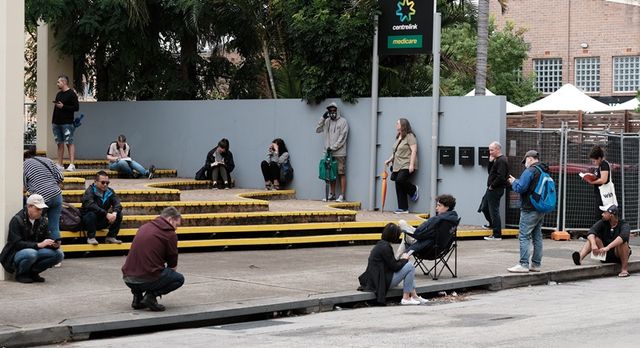
Workers attempting to practice social distancing while waiting to enter Leichardt Centrelink office
Food and beverage service workers were among the first to face the axe. Entertainment venues, bars, restaurants, cafes, and licensed clubs were forced to enforce stringent “social distancing” limits on March 16, before being shut down or reduced to takeaway service on March 23. Many of the 777,000 workers in the heavily casualised industry were immediately jobless without even the temporary safety net of paid leave or redundancy pay.
Workers in the entertainment industry have reported more than $316 million in lost income as a result of event cancellations, affecting more than 400,000 people.
The closure of gyms, fitness centres, and outdoor exercise groups across the country as a social-distancing measure resulted in more than 20,000 job losses in the exercise industry.
The three “stimulus” packages so far announced by the federal government have promised almost no support for these casual workers, who are instead being funneled into the poverty-level Jobseeker welfare system. The wave of sackings led to the collapse of the Centrelink web site, forcing hundreds of thousands of newly unemployed workers to queue for hours outside welfare offices in scenes resembling the 1930s Great Depression.
In an attempt to forestall the mounting economic crisis, the federal government has failed to close down shopping centres, despite the major public health risk presented to workers and customers. Nonetheless, most Australians have sensibly chosen to limit their purchases to essential items or shop online, resulting in sweeping closures of retail stores.
Major department store chain Myer has announced the closure of all 60 of its stores and stood down 10,000 workers. The company’s remaining staff have been forced to take a 20 percent pay cut.
The Cotton On group of clothing brands has closed 650 stores, sacking 22,000 workers. Mosaic, which owns Noni B, Rivers, and Katies, has sacked 7,000 at its 1,300 stores. Other major retailers, including Country Road, General Pants, RM Williams, the RAG Group (Tarocash, yd., Connor), and Athlete’s Foot have followed suit, resulting in the loss of at least 23,000 jobs.
Pacific Brands, which owns Bonds, Sheridan, and Bras ’n Things, yesterday announced the immediate closure of its stores and the sacking of more than 3,000 workers.
Camping and activewear retailer Kathmandu has retrenched 2,000 retail workers in Australia and New Zealand, while its senior executive team is taking a 20 percent pay cut.
Furniture sellers Adairs and Nick Scali have shut down a combined 218 stores and laid off their retail and customer support staff.
Despite Prime Minister Scott Morrison’s insistence that hairdressers should be exempt from the closure of non-essential businesses, Australia’s largest hairdressing chain, Just Cuts, has announced the temporary closure of all 190 outlets in Australia, leaving 2,500 stylists out of a job. While the company has justified this on the basis of valid concerns about the safety of workers, the real motivation behind the shutdown is a lack of customers.
The coronavirus has generated unprecedented public interest in news coverage. Commercial news bulletins have dominated television ratings in recent weeks, and the 7 p.m. ABC News scored its highest-ever ratings last Wednesday night.
Despite this, a sharp drop-off in advertising revenue as a result of the developing economic crisis has led to cost cutting and closures throughout the industry.
Numerous independent regional newspapers have ceased publication and stood down employees. Australian Community Media is considering a temporary halt to the production of some of its 160 magazines and local newspapers.
The Murdoch-owned News Corp has seen a 21 percent increase in new subscriptions since the pandemic began. Yet the company has flagged “inevitable” job losses, forced leave, and reductions to staff hours.
Advertising company Ooh Media has compelled most of its staff to take annual leave over Easter. The Southern Cross Austereo radio network has introduced pay cuts and overtime bans, and is requiring all workers to take at least 10 days of annual leave in the next 3 months.
The suspension of Australia’s major winter sporting codes and the postponement of the Tokyo Olympic Games have made a massive dent in the projected advertising revenues of the commercial television networks, and the sports themselves.
The National Rugby League (NRL) has proposed cutting 95 percent of its staff, and players face pay cuts of up to 87 percent. Players also learned last week that the NRL has withheld $15 million from their retirement funds over the last three years.
The Australian Football League has stood down 80 percent of its staff, while players have agreed to a 50 percent pay cut for at least two months.
Football Federation Australia, the governing body of Australian soccer, has stood down 70 percent of its staff.
Australia’s tourism industry, which directly employs around 1 million workers, has been almost entirely shut down as a result of travel bans.
The majority of the 30,000 aviation industry workers at Qantas and Jetstar have been stood down, while Virgin Australia has axed 8,000 of its 10,000 employees. This comes despite a $715 million bailout of the airlines announced in mid-March.
Virgin, which yesterday went into a trading halt, is reportedly seeking a $1.4 billion loan from the government. Qantas, which last year spent half a billion dollars on share buybacks, insists that it does not need further assistance from the public purse. However, if the Virgin deal goes ahead, the company has declared that it should be loaned $4.2 billion to “level the playing field.”
Brisbane-based travel agency Flight Centre has stood down or sacked 6,000 staff, while Helloworld has announced 275 retrenchments, stood down 1,300 employees and asked the rest to work reduced hours. Corporate Travel Management will let go about 1,000 staff.
In Sydney, SeaLink Travel Group has stood down 130 ferry workers and the National Roads and Motorists’ Association, which operates the Manly Fast Ferry and Fantasea Cruising, cancelled the shifts of 50 casual employees.
So far, the construction industry has been only minimally affected by the outbreak, but economic analysts have warned that a wave of mortgage defaults and business closures are likely to result in massive cuts to the sector.
The Construction, Forestry, Maritime, Mining and Energy Union continues to insist that the construction industry must not be shut down as the effect would be “devastating to workers and the economy.” Rather than demanding that workers be immediately granted leave with full pay, they are calling for minimal safety measures: the staggering of meal breaks and a reduction to the number of workers on site.
Devastating as the financial impact of the COVID-19 pandemic will be, the Australian economy was already facing a major downturn late last year, especially in the retail sector. The rapidly developing slump will now produce enormous social hardships as the government provides tens of billions in assistance to corporations, but limited aid to working people, and businesses exploit the opportunity to accelerate restructuring.

Canada’s governments exempt sections of industry from lockdowns, imperilling workers’ lives

Roger Jordan

Ontario and Quebec, Canada’s two most populous provinces, have officially been under government-ordered shutdowns of all but essential services and businesses since midnight Tuesday, March 24, to prevent the spread of the highly contagious and potentially lethal coronavirus.
But the reality is very different. The two right-wing governments, led respectively by Ontario’s Doug Ford and Quebec’s Francois Legault, have promulgated an expansive, almost catch-all definition of what constitutes an essential business. This is so they can
continue to force hundreds of thousands of workers to stay on the job, putting their health and well-being and those of their families at risk, in order to churn out profits for big business.
Ontario has banned all gatherings of more than five people, and Quebec all gatherings of more than two, yet they continue to insist workers should congregate in large numbers to perform tasks that have nothing to do with providing healthcare, food, power, telecommunications, or other life necessities.
Making a mockery of its official proclamation of a lockdown, the Ford government released a list of essential services March 24 that included 74 types of business. The list included “businesses providing staffing services, including temporary help,” and “businesses that extract, manufacture, process and distribute goods, products, equipment and materials, including businesses that manufacture inputs to other manufacturers (e.g. primary metal/steel, blow molding, component manufacturers, chemicals, etc. that feed the end-product manufacturer).” Even the liberal Toronto Star felt compelled, in unusually sharp language, to describe the government’s policy as “window dressing.”
The province’s construction sector is also continuing to operate, even though workers have repeatedly complained about the absence of measures to ensure basic hygiene and workplace safety. The Carpenters District Council of Ontario, which represents 30,000 construction workers, was forced by the anger boiling among its members to issue an appeal to the government to shut down work sites.
Although Quebec’s regulations are somewhat tighter, the government has allowed the mining sector and heavy industry, including aluminum smelters, to continue operating with reduced staff levels.
A similar development is taking place in Alberta, where the hard-right United Conservative Party government of Jason Kenney is preparing to declare the huge oil and gas sector an “essential service.” Making this policy all the more criminal, many of the sector’s major operations are in remote areas, with regularly rotating groups of workers living at close quarters in work-camps—an ideal environment for the virus to spread like wildfire.
While Kenney is at pains to ensure the profits of Big Oil, his government has announced the layoff of more than 20,000 public school teaching assistants, janitors, and other support staff. This will result in teachers, who are still obliged to go to work to prepare lesson plans and packages for students to use at home, having to work in schools that are not being cleaned and without the necessary administrative support.
Governments and big business’ criminal indifference towards workers’ lives is provoking ever stronger opposition among the working class. Last month, autoworkers at the Fiat Chrysler assembly plant in Windsor, which employs 6,000 people, stopped work for 24 hours due to safety concerns. Similar protests swept across auto plants in the United States, forcing the “Big Three” Detroit automakers to partially shut down their operations.
In Quebec, where the government initially sought to keep construction workers on the job, the Legault government was forced to retreat in the face of widespread protests and has now ordered most building sites shut down.
In Ontario, hundreds of thousands of construction workers are being forced to continue to work under unsafe conditions even as a growing number of construction workers test positive for COVID-19. Seeking to contain the mounting anger, a business rep for LiUNA Local 183 produced a video—since widely circulated on social media—in which he says, “My wife is crying every time I go home because she doesn’t know (if) I’m going to kill her (82 year-old) father,” with whom they live. Subsequently, he addresses a group of workers in the video: “When you’re in the work site there, you guys don’t have six feet around you. We’re all breathing on each other. Where’s your eating facilities? Are they sanitized? Do you have water to wash your hands when you eat your sandwiches?”
In an interview with CBC, construction worker Antonio Cruz emphasized his support for continuing work on urgently needed projects, but criticized the government’s insistence that industrial, commercial, and residential projects of all kinds proceed. “If it’s a hospital, you know, and medical facilities that we desperately needed, fine. I’m all for it. But residential, especially residential, it makes no sense.”
In response to mounting criticism and fears workers would take matters into their own hands, the Ford government issued new toothless “guidelines” to construction companies on Monday that urged them to reduce the number of workers on site, including through staggered shifts, to improve on-site sanitation, and better communicate the need for social-distancing and other good health practices.
The way governments are treating frontline workers in the healthcare system is, if anything, even more scandalous. The Ford government has lifted the training requirements for personal support workers in long-term care facilities, clearing the way for for-profit facilities to hire untrained workers at the minimum wage, and even use volunteers in facilities where dozens of COVID-19 deaths have already been reported.
Nurses, doctors, and other healthcare staff across the country are already working with insufficient protective equipment and other medical supplies in hospitals that are hopelessly overcrowded. This is the direct product of government inaction in the three months since the coronavirus first emerged, and decades of austerity policies that have gutted funding for healthcare and social services.
Nurses speaking to the Toronto Star angrily denounced the authorities. “You want to help your fellow nurse and you want to do your job,” commented one. “But at the same time, when you walk in and you see your entire worth as a human being is two masks in a brown paper bag—like, that’s all you’re worth to the hospital, that’s all your health is worth, is two masks for a whole shift—you’re like, what am I doing here?”
As the coronavirus pandemic has surged across Canada, the preoccupation of the federal Liberal and provincial governments of all stripes has been securing the profits and wealth of the corporate elite, not mobilizing society’s resources to fight the pandemic. The Trudeau government has funneled hundreds of billions of dollars into the coffers of the big banks and corporations, while offering a pittance for the overstretched healthcare system and the millions of workers who have lost jobs and income due to the pandemic.
Yesterday, with the Quebec government warning that it is three to seven days away from running out of N95 masks and other crucial supplies, Trudeau announced the federal government will spend $2 billion on securing “made in Canada” personal protective equipment (PPE) and ventilators, bringing to just $3 billion Ottawa’s additional heath care spending.
While allowing wide swathes of industry, like manufacturing and construction, to operate as normal, the Ford government has passed a $17 billion package of emergency measures to counter the pandemic and its economic fallout that is focused on providing billions in tax relief and credits to businesses. The measures, which were unanimously supported by the New Democratic Party, Green and Liberal opposition, include cuts to employer healthcare contributions, and a pitiful one-time $200 payment to parents for each child aged 12 or under.
Underscoring the fact that the ruling elite has already accepted that tens if not hundreds of thousands will die, it was reported Sunday that health authorities in Ontario have drafted a “last resort” set of guidelines for hospitals. The policy will determine how healthcare is to be rationed when medical facilities find themselves forced into triage—that is when the lack of ICU beds and utterly inadequate stocks of ventilators compels doctors to decide who will live and who will be left to die. This follows announcements in British Columbia, New Brunswick, Nova Scotia, and Quebec that so-called ethics committees are drafting guidelines to determine who will be denied life-saving care and who will get it under conditions where the health care system is overwhelmed by the influx of COVID-19 patients.
With media reports warning of a catastrophic situation emerging like that currently taking place in northern Italy and New York, Dr. Robert Fowler, a critical care physician at Sunnybrook Health Science Centre, said the public needs to prepare for a “worst case scenario” by having “difficult conversations” with loved ones about whether they would “even want ventilation or other invasive interventions” if they end up in an ICU ward.

UK warehouse and distribution workers protest exposure to COVID -19

Tony Robson & Dan Richardson

Major UK retailers have kept their workers on the job in unsafe conditions since Prime Minister Boris Johnson announced special measures to restrict movement and enforce social distancing.
This involves companies that are far from providing essential services, such as IKEA, the self-assembly furniture retailer, and fashion retailers Next, ASOS and Pretty Little Thing.
Following the adage, “Never let a serious crisis go to waste,” they have taken advantage of the suspension of High Street trading to increase their online sales. The burden has fallen on warehouse and distribution workers being made to sort and dispatch goods without any regard for their safety, including the inability to maintain social distancing and inadequate provision of washroom facilities.
Workers have taken to social media and spoken to the press, usually anonymously due to fear of disciplinary measures. South Yorkshire, in the north of England, is the site for many distribution centres, in Sheffield and other former industrial towns such as Doncaster and Barnsley and in surrounding villages on brownfield sites.
Britain’s new “Satanic Mills” are a byword for low pay, casualisation and sweat shop conditions. The threat posed by coronavirus has worsened these conditions in a way that would be instantly recognisable to Charles Dickens, who wrote of the hired “hands” of the nineteenth century mill workers—mere appendages of the machine without any intrinsic value other than to produce profits for their masters.
The Sheffield Star reported the anger of warehouse workers in the Doncaster area, citing a Next worker who had taken to Facebook, “accusing bosses of putting wealth before health.” Next operates several warehouses and distribution centres throughout the former Yorkshire coalfields, including Armthorpe in South Yorkshire and South Elmsall in West Yorkshire.
Daniella Falvey, who works at the South Elmsall distribution centre, posted on social media how workers were forced to take their breaks on the shop floor, or in their cars or the car parks because there is no canteen or rest area. Because of the nature of the work it was impossible to remain two metres away from co-workers. “We’re not key workers, so we can’t get childcare for our children. We’ve offered to take holidays or take unpaid leave. You have no idea what it is doing to us! Its non-essential work. Close down and stop spreading coronavirus for money.”
Photographs have circulated of Next workers having to take their lunch on the pavement outside the warehouse. It was only after these exposures that the company reluctantly took the decision to close its distribution centres from March 26. Workers have now been furloughed on full pay until April 11 and on 80 percent of their wages thereafter through the government subsidy offered to employers.
At the IKEA distribution centre in Armthorpe, a worker told the Sheffield Star, “All three shifts… days, afters and nights are depleted with co-workers self-isolating for two weeks. Yet managers are asking workers to all go one shift. It surely can’t be right gathering all workers in one shift.”
Online fashion retailer Pretty Little Thing has refused to furlough its employees. It employs around 1,000 staff at its distribution centre in Tinsley, on the outskirts of Sheffield, described by one worker on the BBC website as “a breeding ground for Covid-19.”
Workers told how there could be up to ten staff in the four-foot aisles they have to pass along in order to pick items for dispatch. The warehouse had just four small hand sanitisers, which were always empty. One worker said, “Going to work has the chance of killing me and infecting my grandson. To save lives, shut the place.”
At the ASOS distribution centre in Barnsley, operated by XPO Logistics, 500 workers walked out in protest last Saturday. ASOS is one of the largest employers in the former mining town, with a workforce of 4,000. The distribution centre is situated on the site of the former Grimethorpe colliery, a stronghold of the 1984-5 Miners Strike made famous by the 1996 film, “Brassed Off.” It was reported to be the poorest village in Britain by the European Union in 1994.
The GMB union has reported that in a survey of 460 workers at the distribution centre, 98 percent had reported they felt unsafe. The company had supposedly enacted safety measures the week before. Footage emerged of massed workers on a shift change. Workers complained of the lack of social distancing, absence of protective equipment and hand sanitiser as well as a fear that their co-workers might report to work with COVID-19 because otherwise they would only be able to claim the weekly Statutory Sick Pay of £94.25. On Facebook, photographs were posted of workers packed into Stagecoach buses, run by ASOS to take staff to work.
The local Labour council and the union which formally represents 2,000 workers on site have given their stamp of approval to the company. In its statement reported on BBC Look North, ASOS denounced workers’ concerns as panic mongering, adding, “As directed by the government and with the support of the Community Union and Barnsley Borough Council we are striking the right balance between keeping our warehouse operational, for the good of our employees and the wider economy, and maintaining the health and safety of staff, which is always our number one priority.”
While the GMB is ostensibly presenting the grievances of ASOS workers, it did so while presenting Next as a model employer. One worker posted on the GMB ASOS Facebook page, “Why doesn’t GMB organize a strike? Community Union on site is absolutely useless—they think about what’s best for the employer first, then employees! If you are so concerned about workers, do something!”
Next, IKEA, ASOS and Pretty Little Thing workers should organise themselves independently of the unions, in rank-and-file committees, to demand this rampant profiteering end immediately. Every worker not involved in essential services should be furloughed on full pay. Reduced pay is not an acceptable trade-off for protecting life. It is a gift to the employers. Anyone designated as a key worker must be provided with protective equipment, ensuring social distancing is applied and with proper rest room and washing facilities.
The retail giants have forfeited their justification to exist on an economic, social and moral basis and must be expropriated. Complex and extensive supply and distribution networks based upon the co-ordinated labour of millions must be harnessed to provide emergency support for medical supplies and food stuffs as public utilities. It is this socialist perspective and not the false narrative of “responsible capitalism” which should guide the actions of workers.

Ukraine passes IMF-backed land reform bill, social cuts as coronavirus spreads

Jason Melanovski

Ukraine’s parliament met Monday in what has been labelled a “historic” session to pass two pieces of legislation demanded by the International Monetary Fund (IMF) in exchange for a potential $5.5 to $8 billion loan package. The Ukrainian state – in the midst of an economic and social crisis caused by the ongoing civil war in eastern Ukraine and a rapidly growing coronavirus epidemic – faced certain default in the absence of the IMF’s backing.
Monday’s emergency parliamentary session was held as the Ministry of Health announced that the number of cases across the country had grown to 548 with 13 fatalities. Throughout the session all members of parliament and President Volodomyr Zelensky donned facemasks and gloves.
The first bill that passed was popularly known as the “anti-Kolomoisky” bill as it specifically targets the well-known oligarch Igor Kolomoisky. Kolomoisky had previously backed Zelensky throughout his 2019 presidential campaign but had since fallen out with the comedian-turned-president. A central element of their dispute was the return of Kolomoisky’s PrivatBank, which was nationalized by the previous Ukrainian president Petro Poroshenko.
It was widely expected that Zelensky would return the assets taken by Poroshenko to Kolomoisky. However, the bill passed Monday explicitly forbids any former owners of banks that have been declared insolvent or nationalized. The bill had been pushed very strongly by the IMF, the EU and the US and was central to the IMF’s granting of new loans to Ukraine.
Second, the parliament passed the so-called “land reform” bill that will end a decades-long moratorium on the sale of agricultural land. The moratorium is now set to be lifted in July 2021. The bill, which had been mired in parliament for months due to the widespread opposition of the Ukrainian working-class, was ultimately only able to pass during an emergency parliamentary session while the country has been put on shutdown due to the growing coronavirus epidemic. According to a recent Rating poll, 73 percent of the population are opposed to the bill.
The bill passed with some measures that were opposed by the IMF and Western imperialism, including limitations on the size of plots sold and a referendum on the sale of land to foreigners.
Agriculture makes up 40 percent of Ukraine’s GDP and it is estimated that the country, long known as the “bread basket” of Europe, possesses 32 million hectares of arable land, which would be highly desirable if opened to both wealthy foreign and domestic investors. By comparison, Germany – which has roughly double the population of Ukraine – has just 12 million hectares of arable land.
The passage of the bill was celebrated by Zelensky’s backers both in Ukraine and in the west. Appearing in an op-ed on the website of the Washington, DC-based think tank Atlantic Council, Zelensky’s spokesperson Iuliia Mendel called the measures “historic” and signaled that the limitations on the sale of land would be temporary, as the Zelensky government was already preparing “complementary” legislation that would help Ukraine’s land market function more “efficiently.”
Mendel also chalked up opposition to ending the land sale moratorium as nothing more than Ukrainians being “intimidated by political myths for nearly thirty years.”
Zelensky’s former right-wing Prime Minister Oleksiy Honcharuk hailed the opening of the Ukrainian agricultural land market as “Another post-Soviet vestige returning to the past!” and called the bill “historical” despite his opposition to its limitations.
Just prior to Monday’s vote, President Zelensky released a video address in which he pleaded for parliament to pass the IMF-backed legislation which he called a “crossroads” with “two paths.” According to Zelensky the first path was “the adoption of two vital laws. After that, we will receive support from our international financial partners in the amount of at least ten billion dollars. This is needed to stabilize the country’s economy and overcome the crisis.” The second path, or a failure to pass the laws he warned would lead to “economic downturn” and “default.”
The coronavirus epidemic and subsequent flight of foreign capital out of Ukraine have caused severe economic damage in what is already Europe’s poorest country according to the IMF. Ukraine implemented a quarantine, set to last until at least April 24, and has shut its borders to international travel.
A government spokesperson reported last week that as a result of the coronavirus the country’s GDP could shrink by 3.9 percent and inflation could increase by 8.7 percent. The spokesperson also reported that unemployment could hit 9.4 percent and that the budget deficit could triple. Ukraine already operates on a budget deficit of approximately $642 million and owes billions of dollars to the IMF in loan repayment.
In polls, 69 percent of Ukrainians indicated that they had suffered economically from the consequences of the pandemic. One in six said that they had lost their job or at least one source of income. Thirty-eight percent had experienced a decline in their regular family income and 16 percent had lost all forms of income. Of those who have lost income as a result of the quarantine, 45 percent only have enough money to make it through March, if at all. About a third had enough for March and April and only 16 percent would be able to make it for three months or more. An estimated 60 percent of Ukraine’s population were already living beneath the subsistence minimum before the coronavirus pandemic.
Now, on top of skyrocketing unemployment, the government has quickly revised the yearly budget and will make additional cuts to educational and social programs, gas bill subsidies, and compensation for houses destroyed by Ukraine’s army as result of the ongoing fighting in the east of the country. Meanwhile, as reported by the Ukrainian news website Strana.ua, military funding and IMF repayments will remain untouched.
The policies of the Zelensky government threaten the working class with a social and medical disaster of immense proportions. The Ukrainian government’s response to the spread of the virus has been criminally inadequate. According to the country’s Deputy Health Minister Viktor Lyashko there are approximately 1,117 ventilators available for the entire country of 40 million people.
The country’s former Health Minister has admitted that the country is even less prepared than Spain or Italy, where hundreds are now dying on a daily basis from COVID-19. Ukraine also had a substantial population of elderly people – constituting about a quarter of the total population – that are at particularly high risk of dying from the virus.
Last week the investigative publication Bihus revealed that Kiev’s Municipal Health Department was creating special “VIP” hospital rooms for state officials and their wealthy friends, where they would be treated in separate rooms by more experienced medical staff.
The attitude of the Ukrainian bourgeoisie and the Zelensky regime was revealed most openly by Health Minister Ilya Emets, who was forced to resign Monday due to honesty. Emets, who had previously stated that all of Ukraine’s “pensioners will die,” more recently told Ukraine’s 112 News, “We know the statistics, how many people are over 65 years old. It’s a shame, but the average life expectancy for men, I think, is 65. Therefore, I will say frankly that the financiers who should help us need to focus on those people who are still alive. I’m not joking and I’m not trying to scare you. I say all the time: do the math, see how much we need to allocate on living people, not corpses.”
Fully aware that the combined impact of these frontal assaults on the living standards and lives of the working class will provoke mass opposition, the municipal government of Kiev has already moved to officially employ the far-right “Municipal guard” to implement the quarantine in the capital. The Municipal guard includes fascist thugs from the neo-Nazi party Svoboda and C-14, a notorious far-right organization with close ties to the Ukrainian state.

Covid-19 pandemic poses gravest threat to world’s poorest countries

Jean Shaoul

The coronavirus has begun to take hold in Africa, the Middle East, Latin America, Asia and the Pacific Islands, threatening some of the most impoverished people on earth.
Many countries have introduced a combination of border closures, limitation or bans on international flights, shelter at home orders, shuttering of schools, universities and social venues and restrictions on movement for all but essential work and shopping. These measures, while necessary, are of limited value without testing suspected cases, tracking their contacts and treating the severely ill.
Crucially, even sheltering at home and self-isolation are impossible under conditions where one seventh of humanity lives in so-called informal housing—shacks, tents and shanty towns, constructed out of crude brick, straw, recycled plastic, cement blocks and scrap wood.
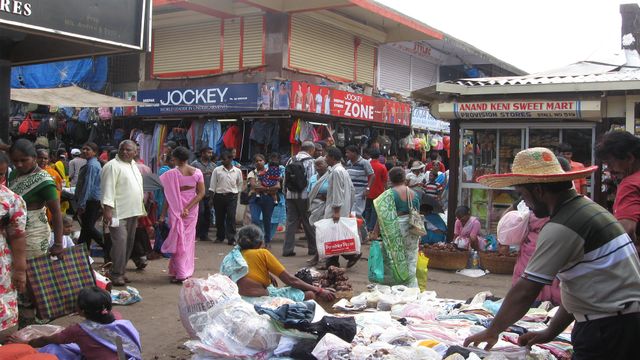
A Friday market in Goa, India. (Image Credit Flickr/Aaron C)
Most of the world’s urban poor occupy squalid, overcrowded slums, surrounded by pollution, excrement and decay, with limited or no access to sanitation, clean water and the basic amenities of modern urban life. The world’s most notorious slums include Ciudad Neza in Mexico City, with 1.2 million people; Dharavi in Mumbai, with 1 million people—the largest slum in Asia and location for the film Slum Dog Millionaire —Rocinha in Rio de Janeiro, the largest favela in Brazil with 200,000 people; Makoko, Lagos, with over 300,000 people, many of whose homes are built on stilts in a lagoon.
Residents live in homes that were detrimental to their health and safety even before the onset of the coronavirus. Self-isolating or quarantining is a non-starter in a single room shack that serves as bedroom, kitchen and living space, often for an extended family, with no running water and a communal toilet shared with dozens of others.
As the director of the International Labour Organisation’s (ILO) Social Protection department, Shahra Razavi, explained, “If the COVID-19 pandemic has sent the world one message, it is that we are only as safe as the most vulnerable among us.”
He warned, “Those who are unable to quarantine themselves or to get treatment endanger their own lives and the lives of others, and if one country cannot contain the virus, others are bound to be infected, or even re-infected. And yet, around the world, social-protection systems are failing miserably at safeguarding the lives and livelihoods of vulnerable groups.”
Medical treatment, let alone the intensive care required to treat those most severely affected by the coronavirus, is simply not available in the oppressed countries. Some 40 percent of the world’s population have no access to health insurance, whether public or private, or public health services. Around 800 million people spend at least 10 percent of their household budget on health care each year. The cost of medical treatment frequently plunges families into debt, with 100 million people falling into poverty because of the expense.
Many people simply cannot afford to get the treatment they need when they fall sick, under conditions where HIV/AIDS, malaria, yellow fever and tuberculosis, to name but a few, are widespread. For those who can afford treatment, even in the best placed African cities, there are only two doctors for 10,000 compared with 41 doctors per 10,000 people in Italy.
Without sick pay, the majority of workers cannot afford to take time off work to recover, jeopardising their own health and that of others. Of the 193 member states of the United Nations, less than two-thirds have social insurance schemes that provide sickness benefits. More than half the world’s 7 billion population have no social protection whatsoever. Those who are ill must choose between sacrificing their own health and feeding their families.
Millions of people across the advanced countries have already been laid off or furloughed as a result of the closures of nonessential shops, cafes, restaurants and cultural and leisure facilities and the precipitous fall in demand for travel, tourism, hospitality and related business sectors. Only 20 percent of the world’s population can claim any unemployment benefits, however meagre, forcing them to take whatever work they can find in the informal economy at slave labour rates.
According to the ILO, some 2 billion people—more than 61 percent of the world’s employed population—work in the informal economy. Some 86 percent of Africa’s employment is informal, 68 percent in Asia and the Pacific, 69 percent in the Arab States, 40 percent in the Americas and 25 percent in Europe and Central Asia. Along with low, unstable and insecure income, such work is synonymous with long hours and appalling working conditions, including lack of workspace and frequent harassment and intimidation.
Many African workers rely on the tourism and travel industry, which accounts for more than 10 percent of global GDP and which is unlikely to recover any time soon. Demand for natural resources, which accounts for 30 percent of Africa’s GDP, is falling as a global economic slump takes hold. Copper and oil are already trading at their lowest prices for years.
The 2008 global financial crisis gives a foretaste of the economic impact of COVID-19, which is expected to be far greater. Angola saw its GDP growth of 13.2 percent in 2008 fall to -0.6 percent in 2009, while Nigeria went from 6 percent to 3 percent. Sub-Saharan African countries saw their GDP growth fall from 5 percent to 2.5 percent, not enough to keep pace with the population growth.
Remittances, which in some countries account for 10 percent of GDP, have already been affected. South Asia, the Philippines and the Middle East have seen a reduction in the flow of remittances and vital foreign currency earnings they bring, as Saudi Arabia, the Gulf states, Hong Kong, Taiwan and other economies that rely heavily on migrant workers to construct their buildings, care for their sick and elderly and prepare their food, shut down parts of the economy to contain the spread of COVID-19. Returning workers will add to burgeoning unemployment rolls.
The Gulf, whose migrant workers sent home some $119 billion in 2017, is the world’s largest source of remittances after the US. Foreign workers account for about a third of Saudi Arabia’s 33 million population and almost 80 percent of its private sector workforce. Expatriates account for about 80 percent of the UAE’s population.
Under these conditions, workers have no option but to seize whatever opportunities they can to continue working, typically without any personal protection equipment or sanitizers. Travelling to work means sitting, packed like sardines in over-crowded buses or shared service taxis, stuck in traffic jams and exposing more people to infection.
Ethiopia’s Prime Minister Abiy Ahmed has called on the G20 countries to provide a $150 billion aid package for Africa—Africa Global COVID-19 Emergency Financing Package. Even were this sum to be allocated, it would not begin to address the sources of the current crisis, which lie in the economic and political relationships of imperialist domination, capitalist ownership and production.
The way out of the terrible poverty and brutal exploitation facing the mass of the population in the world’s poorest nations, including implementation of the measures necessary to combat Covid-19, is through a struggle against the corrupt national bourgeoisie--who live in grotesque luxury amid squalor--and the systematic imperialist exploitation over which they preside.
This demands the development of a social and political movement of the working class, fighting for state power and socialism. The allies of the workers of Africa, the Middle East, Latin America, Asia and the Pacific Islands are not the leaders of the G20, but the world’s working class—the only force that can overthrow of the existing social order and implement the global redistribution of wealth and internationally coordinated economic plan required to raise billions out of ever worsening social degradation.

Peruvian president authorizes military to use lethal force to enforce the national quarantine

Cesar Uco & Don Knowland

On the weekend, Peruvian President Martin Vizcarra pushed through a “Military and Police Protection Law” that exempts the armed forces and national police from any criminal liability for injury or death if they act “in compliance with their constitutional function and in the regulatory use of their weapons or other means of defense.”
Moreover, under this law, the “principle of proportionality,” which requires that the degree of force correspond to the level of resistance offered and the danger presented by the person being seized or the situation being controlled, is suspended.
The law shows that the ruling oligarchy, in anticipation of widespread unrest arising from the spread of the coronavirus and deepening economic crises, is prepared to employ repressive measures unencumbered by any legal restrictions or basic democratic rights.
On Monday, Vizcarra announced that more than 4,000 people were detained in police stations on Saturday March 28, and that 2,909 more were arrested on Sunday, March 29, for violating the compulsory social immobilization measures. These measures were adopted under the state of emergency that was put in place on March 16 in response to the coronavirus outbreak and extended last week to April 12.
Because of these large numbers, Vicarra said he was extending the current national curfew from 6 p.m to 5 a.m., and from as early as 4 p.m. in Tumbes, Piura, Lambayeque, La Libertad and Loret.
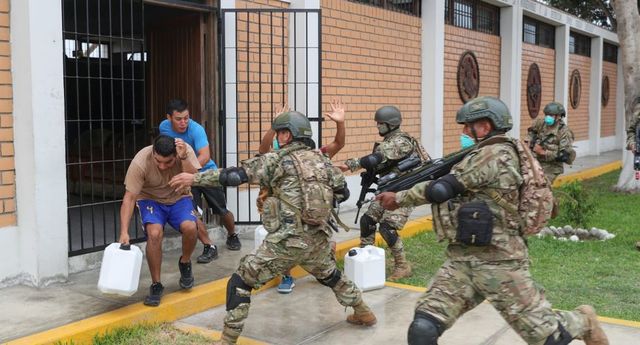
The brutality of what is anticipated was made clear in a video prepared by the Peruvian armed forces that was released on the weekend and made available on WhatsApp under the hashtag #YoMe Quedo en Casa” (I remain in my house).
The video begins with a figure of a fully armed soldier wearing a bulletproof vest and carrying an automatic rifle. The soldier proceeds to loudly bark commands as he narrates five scenes, each one ending with the threatening words of “if he resists the authority, the armed forces’ patrols will proceed to vigorously subdue, handcuff and throw ‘the suspect’ onto the ground, place their boot on his neck and take him to the nearest police unit.”
The five scenarios in the video involve a youth passively “resisting” military detention, four youths playing soccer, a small party of young adults dancing and drinking, young adults breaking into a commercial store to steal a few boxes of merchandise and an attempted attack on soldiers by a lone suspect.
None of what is shown in the video is likely to occur in wealthy or upper-middle-class neighborhoods.
Bloomberg reported Monday that Peru is undertaking a record fiscal stimulus and, as announced by central bank President Julio Velarde, will seek a contingency line of up to $18 billion from the International Monetary Fund to contain the economic freefall arising from the coronavirus pandemic.
Velarde also announced that the Finance Ministry plans to draw down an existing $2.1 billion contingency line from the World Bank.
The Central Bank had already cut its benchmark lending rate by 1 percentage point to 1.25 percent in March, but that had little measurable effect.
Although Peru had been held up as a paragon of financial and fiscal rectitude, since the arrival of the coronavirus in early March its bonds have been battered, and its currency fell to its weakest in 18 years this month.
According to Bloomberg, the package of economic measures the government is now proposing totaling 90 billion soles ($26 billion), includes some health care spending, but consists largely of tax breaks and loan guarantees for businesses, to revive an economy that has ground to a virtual halt after the government ordered a nationwide lockdown on March 16.
The stimulus package will equal 12 percent of gross domestic product, Finance Minister Maria Antonieta Alva said on Monday, a percentage exceeding that of the rescue package passed on Friday by the American Congress.
The stimulus package will include “short-term” measures such as cash handouts, including up to 30 billion soles in government-backed loans to small and medium-sized businesses, and “longer-term measures” to “rebuild” some decimated industries such as tourism.
The cash handouts contemplated are short-term because the Peruvian ruling class sees that as an insurance sop to quell mass unrest. The latest dictatorial measures show that what the Peruvian state is really preparing for: a prolonged period of military repression.

Washington harnesses coronavirus pandemic to promote Venezuela coup

Bill Van Auken

US Secretary of State Mike Pompeo launched on Tuesday a grotesquely cynical initiative, dubbed a “Democratic Transition Initiative,” aimed at furthering Washington’s longstanding campaign to provoke a proimperialist coup in Venezuela.
This so-called initiative is a blatant attempt to utilize the coronavirus pandemic as a weapon. It is seen by US officials as a means of intensifying the suffering of the Venezuelan people that has been inflicted by a succession of ever-tightening “maximum pressure” sanctions that have cut off the country’s oil exports, together with its access to food, medicine and other basic supplies on the world market. The result thus far, according to at least one estimate, has been the deaths of over 100,000 Venezuelans. With the spread of COVID-19, that toll can rise by hundreds of thousands more.
Last month, the State Department announced that it had initiated a policy of “Maximum-pressure March,” designed to utilize the pandemic along with the plummeting price of oil on the world market to force Venezuela into submission.
This policy found its most rabid expression in the US Justice Department’s announcement last month of indictments of President Nicolas Maduro and other top Venezuelan officials on trumped-up charges of drug trafficking and money laundering. While Washington has produced no credible evidence to support these charges, there is ample proof of its closest partners in the hemisphere, including the right-wing governments in Colombia, Honduras and Guatemala engaging in precisely such activities.
The rolling out of the “transition” plan in the wake of the indictments may be intended as some kind of carrot-and-stick strategy. US officials have suggested that it is telling Maduro to accept the scheme “or else.”
A top US official, speaking to reporters on condition of anonymity—in all likelihood the convicted war criminal Elliott Abrams, who is the Trump administration’s special envoy for Venezuela—called attention to the fate of Manuel Noriega. The late president of Panama and former CIA “asset” was indicted on drug-trafficking charges and then overthrown and seized through a 1989 US invasion that claimed the lives of thousands of Panamanians.
“History shows that those who do not cooperate with US law enforcement agencies do not fare well,” the official said. “Maduro probably regrets not taking the offer six months ago. We urge Maduro not to regret not taking it now.”
This is the Mafia-style operation that underlies the so-called “democratic transition.”
Its aim is to provoke a split within the Maduro government and, in particular, to convince Venezuela’s military to side with Washington in ousting the Venezuelan president.
This was also the central objective in the failed attempt to impose “transitional president” Juan Guaidó, a right-wing politician unknown to the vast majority of the population, who swore himself in at the beginning of 2019 and was immediately recognized by Washington and its allies. Guaidó’s repeated attempts to foment a coup, including a direct appeal for a military uprising a year ago, came to nothing, and his attempts to organize opposition rallies have manifestly failed to draw any significant participation in recent months.
The “democratic transition” is on one level a tacit admission that Washington’s strategy centered on bringing the US puppet Guaidó to power has proven an abject failure.
The mechanics of the “transition” are based upon Washington’s manipulation of various institutions in the Venezuelan state to produce the desired outcome of a regime subordinate to US imperialist interests.
It calls for the National Assembly, which the Maduro government has stripped of its legislative powers, to create a five-member “Council of State,” which, together with a “military advisor,” would assume all executive powers, thereby overthrowing the Maduro administration. This body is then supposed to organize elections within six to 12 months, with Washington and its regional allies ensuring the desired results.
The proposal makes an open appeal to the Venezuelan military, declaring, “The military high command (Defense Minister, Vice Defense Minister, CEOFANB Commander, and Service Chiefs) remains in place for the duration of the transitional government.”
It also makes clear that the “transition” will entail the reorientation of Venezuela back into the orbit of Washington’s regional military and financial domination. It demands the removal of all “foreign security forces,” an apparent reference to Cuban and Russian advisors in the country. It also states that in the course of the transition, “Negotiations begin with World Bank, IMF, and Inter-American Development Bank for major programs of support.” In other words, the plan is to shift Venezuela from its financial reliance on China and place it back under the thumb of Washington and Wall Street.
Trump held a telephone conversation Monday with his Russian counterpart Vladimir Putin which, according to Moscow, touched on the crisis in Venezuela. The Russian-based oil conglomerate Rosneft announced last week that it had sold all its interests in Venezuela to an entity wholly owned by the Russian government. It said it had done so to protect the interests of its shareholders. Rosneft’s subsidiaries had come under US sanctions because of the company’s providing the main vehicle for trading in Venezuelan oil as well as its providing gasoline for the Venezuelan market. Among its principal shareholders are British Petroleum and a Qatari oil company.
It is unclear what the significance of the trade-off will be. Russian officials insisted that it signaled no diminishing of Moscow’s support for the Maduro government, but rather an attempt to protect Rosneft from the US sanctions regime.
In presenting the “transition” plan to a State Department press conference Tuesday, Pompeo declared, “The United States has long been committed to finding a solution to the manmade crisis in Venezuela. The urgency for this has become all the more serious in light of the Maduro regime’s failure to adequately prepare for and address the global COVID-19 pandemic.”
Who does the US Secretary of State think he is kidding? When it comes to “failure to adequately prepare for and address the global COVID-19 pandemic,” there is no government in the world that can compete with that of the United States.
The Maduro government issued a swift rejection of Pompeo’s “transition.” Foreign Secretary Jorge Arreaza declared in an interview, “They can say what they want, when they want and how they want, but the decisions on Venezuela will be made in Venezuela, with its institutions and its constitution. We aren’t the puppets of the US.” He described the US plan as the product of Washington’s “obsession with taking control of Venezuela and its petroleum.”
In part, the “transition” scheme was no doubt floated in an attempt to deflect calls by the United Nations, the European Union, Russia, China and other countries and multilateral agencies for the US to lift a US sanctions regime that is tantamount to a state of war in order to facilitate the struggle against the coronavirus.
The Trump administration, it is clear, intends to do nothing of the kind. It is banking on the conditions that sanctions have created in Venezuela, shortages of medical supplies along with an increasing lack of access to clean water and electricity, to inflict a horrific death toll that can bring Venezuela to its knees. While the country’s threadbare public health system has thus far kept down the number of COVID-19 deaths, the United Nations has warned that Venezuela could be one the hardest-hit countries in the world.
Commenting on the “democratic transition” scheme advanced by Pompeo Tuesday, Juan Guaidó’s security aide Ivan Simonovis made the frank comment, “These are things that need to be done, so they can’t say they weren’t offered an alternative.”
The implication is clear. A fraudulent proposal for a “peaceful transition” is being floated in Washington as part of the preparation for the use of military violence to achieve the predatory aims of US imperialism. The danger of war is amplified by the interest of the Trump administration and the US ruling class in diverting outward the overwhelming popular anger over the failure of the existing capitalist order to protect masses of people from the ravages of the pandemic or to organize any adequate response to it.