16 Apr 2020

With the collapse of health care system, Ecuador is the epicenter of the coronavirus crisis in Latin America

Tomas Castanheira

The coronavirus pandemic in Latin America has had its most devastating impact in Ecuador. According to data released by the government on Wednesday, April 15, there were 7,858 confirmed cases of COVID-19 in the country and 369 deaths. The focus of the pandemic is the port city of Guayaquil, capital of Guaya province, which accounts for over 70 percent of the cases.
According to the official data, Ecuador is the second in terms of the absolute number of deaths from the disease on the continent, trailing only Brazil—with 1,736 confirmed deaths—which has a population that is 12 times larger.
However, as President Lenín Moreno himself admits, due to the general lack of tests, the official figures are a gross underestimate. Cynthia Viteri, the mayor of Guayaquil, from the Christian Social Party, said that mathematical projections made by experts point to more than 7,000 COVID-19 deaths in her city alone.
Jorge Wated, the leader of the task force organized by the government to collect bodies after the collapse of the funeral system, made a terrifying statement last Sunday. According to him, in recent weeks, 771 bodies have been removed by his team from residences in Guayaquil and another 631 dead from overcrowded hospital morgues. In some areas, bodies have been left in the street.
Although the task force has collected and buried many bodies, there are reports that at cemetery gates there are still rows of family cars carrying the bodies of their relatives inside sealed cardboard coffins.
Other families are condemned to endless searches to find the bodies of their loved ones. In a report to Agencia EFE, Liliam Larrea said that her father died on March 31 and she only was informed of the location of his body 10 days later. She was waiting for the weekend so she could remove him from an improvised morgue and transport him to the cemetery in her car.
She also reported that she had gone to three private clinics that refused to admit her father, who had respiratory problems, before being accepted by a specialized hospital. The doctor on duty at the hospital warned her to prepare herself, as her father “would not overcome this one,” although he arrived walking and conscious.
Health care professionals represent a considerable portion of coronavirus cases. The Ministry of Health reported about 10 days ago that more than 1,600 doctors, nurses and technologists were infected. More recently, the minister regretted that many doctors summoned on an emergency basis were deserting after discovering they would be sent to Guayaquil.
There is a total collapse of the health care system. Hospitals report a massive staff shortage, as many have taken medical leave after becoming infected. The Teodoro Maldonado Carbo hospital of the Ecuadorian Institute of Social Security (IESS) reported that it is operating with half the regular number of nurses in the ICU. “There is a nurse for every 16 critical patients, this is a difficult fight, we are not supplied,” the hospital staff told El Universo .
Nurses from the IESS hospital and other hospitals have protested on social media over the lack of basic equipment. “They send us to war without weapons. We don’t have the protective materials, especially the N95 masks, the disposable materials, and the clothes they give us are the disposable aprons, one for each shift, there is no disinfectant to wash our hands well ... and if we take sick days off, they start giving us white cards (dismissals),” reported a nurse from the Francisco de Ycaza Bustamente Hospital.
The immense social crisis faced by the Ecuadorian population is a result of the criminal negligence of the ruling class and Lenín Moreno’s government, which, following the International Monetary Fund’s (IMF) austerity agenda, has annihilated funding for health care.
At the end of March, as he tried to stifle the explosion of the pandemic in the country and the collapse of the health system, Moreno accelerated payment of US$320 million in debt, declaring that the government’s priority is “to bring credibility.” “That is why we have already received the support of the International Monetary Fund,” he said.
Last Sunday, the president made a new nationally televised statement, announcing a series of emergency measures to supposedly combat the coronavirus crisis in the country. In fact, through these measures, Moreno is taking advantage of the situation to advance his policies of attacks on the working class.
The government plans to create a so-called National Humanitarian Emergency Account, aimed at rescuing companies and providing basic aid to the poorer sectors of the population. To this end, it will tax for three months the profits of companies with an income larger than US$1 million, by 5 percent.
However, most of this fund will be financed by working class wages. Those who earn more than $500 a month will be required to make progressive contributions for nine months. Salaries of civil servants above $1,000 will also be taxed, at 10 percent.
Trying to cover up this attack with grotesque populism, Moreno announced that he will cut his own salary and that of other government officials by 50 percent. Even after these cuts, everyone will still receive over $2,000 a month, while they plan to allocate $60 in aid to the most impoverished for just two months.
At the same time, the government is preparing legislation for the urgent consideration of the national legislature. In the name of halting layoffs, it will propose “free negotiation between the parties” on the reduction of working hours and wages, as well as payment dates, in agreements valid for up to two years and with the option of renewal for two more! The content of this proposal is exactly the same as the labor reform that Moreno has been trying to approve since last year and was blocked by massive strikes and protests.
Instead of protecting workers, this measure will only give employers more freedom to continue the destruction of jobs. In the midst of the pandemic, a number of companies have invoked “force majeure,” using a clause in the Ecuadorian Labor Code to carry out mass layoffs without paying any compensation.
Moreno has attempted to shift the responsibility for these onto his predecessor, Rafael Correa, whom he served as vice president. About a week ago, Correa was sentenced for corruption to eight years in prison, together with a 25-year suspension of his political rights. He was accused of receiving illegal financing from companies. Referring to him, Moreno said: “The pandemic hit us at a critical moment, when we were trying to surpass a very tough economic crisis. A crisis caused by the irresponsible debts we inherited and the robberies of those who were just convicted.”
Moreno’s greatest fear, however, is not of his bourgeois political rivals, but rather the masses of workers and indigenous peasants. In his speech last Sunday, he launched an abstract threat, but one that must be understood as directed against the latent social opposition. “Be very careful,” said Moreno, “those who want to commit abuses, or who want to benefit from this serious, very serious situation. Personally, I will make sure that the law punishes these abuses with all its weight!”
In protest against the measures announced by Moreno, the Confederation of Indigenous Nationalities of Ecuador (CONAIE), along with unions and other organizations that claim to be of a “popular” character, called a “cacerolazo” (beating pans in protest) this past Sunday.
CONAIE, just as its opponent Moreno, addresses itself to Washington to resolve the political crisis in Ecuador. On April 7, it sent a letter denouncing the government and making a series of demands to the Inter-American Commission on Human Rights (IACHR), administered by the Organization of American States (OAS)—the same US-dominated body that recently legitimized a military coup in Bolivia. The letter concludes: “We trust in the intervention of the Inter-American Human Rights System, as well as in its objectivity.”
The opposition to the government led by CONAIE has the same political character that was seen in the mass uprising of October of last year: it works to demoralize the Ecuadorian masses of the city and the countryside and in order to politically subordinate them to the bourgeoisie.
The working class and the peasant population cannot overcome the deep social and economic crisis, extremely aggravated by the coronavirus pandemic, without confronting the country’s subordination to the profit interest of international capital and the national bourgeoisie. In this struggle, all sectors of the Ecuadorian ruling class are mortal enemies and are inextricably bound with imperialism.

The workers need to establish an independent political movement for a socialist government in alliance with the international proletariat, especially the working class of the rest of Latin America and the United States.

Pakistan “reopening” much of its economy as COVID-19 cases and deaths spike

Sampath Perera

Pakistan is among a growing list of countries whose governments, at the urging of big business, are willfully flouting the World Health Organization’s warnings against a premature return to work.
On Tuesday, Prime Minister Imran Khan announced that Pakistan’s three-week coronavirus lockdown, which was effectively imposed on the Tehrik-e-Insaaf (PTI) government by the provinces and the country’s powerful military establishment, is being extended until April 30. But Khan emphasized that this will only be a “partial lockdown,” adding that the “construction industry and other sectors will be opened from today in phases.”
Subsequently, the government announced that more than a dozen economic sectors are being allowed to resume at least partial operations, including mines, cement, chemicals, fertilizer, and most manufacturing. The government is especially keen to have major exporters like the garment industry back in production.
Claims that the government will ensure that workers’ safety will be protected are a cynical fraud. The authorities’ true attitude to workers’ health and safety was exemplified by their ordering police last week to viciously attack medical staff in Quetta, Balochistan who were protesting the government’s failure to provide them with masks and other safety equipment.
A 2019 report found that seven years after the Ali Enterprises factory fire in Karachi that killed almost 300 people, Pakistan’s garment workers continue to face “unsafe” working conditions, with whatever safety regulations exist on paper flouted by employers and un-enforced by the state.
Pakistan’s precipitous return to work threatens to greatly amplify the COVID-19 pandemic in a densely-populated, impoverished country of more than 200 million, with a public health system in ruins.
As it is, the novel coronavirus pandemic is anything but under control. The official figures show that since the beginning of the month the number of confirmed COVID-19 cases have almost tripled, from 2,291 to 6,383. Deaths, meanwhile, have risen from 31 to 111.
But these figures are in all likelihood reflective of the lack of testing more than anything else. To date, just 73,349 tests have been administered.
Last Saturday, Sindh province reported a 20 percent positive rate from the approximately 500 COVID-19 tests it had been able to perform over a 24-hour period. Most of these came from Karachi, the country’s commercial capital and home to over 20 million people living in squalid and extremely crowded conditions.
An adviser to the Khan government for commerce and investment, Abdul Razak Dawood, told Bloomberg late last week that companies with export orders will resume work, albeit with “precautionary measures including calling in only essential employees and ensuring regular disinfection.” Bloomberg reporters failed to ask who would be considered “non- essential workers” in factories producing for the world market under a regime of super exploitation.
Dawood’s comments were corroborated by Information Minister Firdous Ashiq Awan, who stated last Friday, “We are going to resume key sectors that employ millions.”
Even before Khan’s Tuesday announcement that the “lockdown” is being lifted for much of industry, factories that supply such global brands as Nike and Puma had resumed production. Last week, the PTI-led Punjab provincial government gave the green light for the reopening of 117 factories engaged in food processing, textiles, leather and auto parts manufacturing.
The PTI government’s rallying behind business’ call for the “reopening” of construction, manufacturing and other industries comes amidst mounting fears in ruling circles over the impact of declining exports on Pakistan’s ability to pay for imports or service its external debt.
With its foreign reserves rapidly depleting, the government has already appealed to the International Monetary Fund (IMF) for an emergency $1.4 billion bailout. This is apart from a $6 billion loan already in place.
Since the beginning of the pandemic, Khan has been outspoken in his opposition to taking urgent action to stop the spread of COVID-19, callously prioritizing business profit over the lives of the country’s workers and toilers.
Feigning concern for the tens of millions of urban and rural poor, he has repeatedly proclaimed that a lockdown will condemn them to “die from hunger.”
But it is Khan’s government that has been waging a ruthless class war against Pakistan’s workers and toilers, imposing brutal IMF-dictated austerity measures and pro-investor “reforms.” Even before the pandemic, the poverty rate was projected to rise to 40 percent by July from 31.3 percent a year earlier, due to low economic growth, double-digit inflation and the impact of the IMF-measures.
Throughout the pandemic, the real concern of Khan and his PTI government has been the impact that the measures needed to control and contain the spread of COVID-19 will have on business profits and the wealth and investments of the capitalist elite.
According to figures presented by the Pakistan-based Business Recorder, the country’s external debt is $110 billion and growing, with $13.5 billion in loan payments to be paid in 2020. Foreign portfolio investments that the government was banking on to ease the pressure are “no more the case,” the report highlighted. The IMF emergency loan, if approved, would prop up foreign reserves only temporarily.

IMF Managing Director Kristalina Georgieva was quick to remark that the Khan government “reaffirmed their commitment to the reform policies included in the current arrangement,” as soon as Pakistan requested emergency financing from the IMF’s COVID-19 fund. Her remarks refer to a spate of highly unpopular pro-investor measures, including privatization, regressive tax increases and the scaling back or elimination of price subsidies.

COVID-19 pandemic hits Lebanon, piling health crisis onto political and economic meltdown

Jean Shaoul

The coronavirus has hit Lebanon amid a spiraling political, economic and social crisis and causing widespread panic, food shortages and hardship.
While the number of confirmed cases and deaths is still relatively low, with some 658 cases and 21 deaths, according to official figures, Lebanon—one of the most heavily indebted countries in the world—faces meltdown.
Its corrupt political system, manipulated for decades by regional powers and French and US imperialism, has been paralysed for years. As a result of one of the earliest “experiments” in neo-liberalism, its venal bourgeoisie provides little in the way of health care for any but the elite.
Over 80 percent of the hospitals are private. Successive governments have slashed spending and failed to reimburse hospitals for their expenditure, so that now, with a severe US dollar shortage, there is an acute lack of life-saving medicines and key equipment. Those afflicted with the most severe form of the virus face almost certain death.
Last autumn, weeks of protest over the country’s deteriorating economic and social conditions led to the fall of the government headed by Prime Minister Saad Hariri, a political stooge of Saudi Arabia. On March 9, Hassan Diab, his successor, defaulted on a $1.2 billion eurobond amid the onset of the coronavirus outbreak, later extending the default to all overseas debt. According to plans leaked to Al-Jazeera, he is seeking $10 billion-$15 billion in external financing in return for further privatisation, slashing of public salaries, tax hikes and an official devaluation of the Lebanese currency which has already fallen on the black market by 50 percent since September.
On March 15, Diab declared a state of emergency and introduced lockdown measures, bans on public transportation and night curfews, which served to close down both the economy and the ongoing protests—with security forces clearing protest camps in downtown Beirut. At the same time, Lebanon’s crowded inter-generational households provide the ideal conditions for the rapid transmission of the virus.
Lebanon’s impoverished people, having lost their meagre income, now face hunger. Last November, well before the pandemic, the World Bank estimated that 45 percent of Lebanon’s 6 million people lived below the poverty line, up from 33 percent before September, and predicted the country’s bankruptcy would lead to a further rise to 50 percent in 2020. A massive 22 percent already live in extreme poverty.
Amid soaring inflation in food prices due to the de facto devaluation of the Lebanese pound and an expected shortage of wheat and other essential items, the government has announced it is to import 80,000 tonnes of wheat for the first time since 2014 and give some of the poorest families a one-off payment of $150. But it is unclear how this small sum is to be distributed. A further $12 million has been allocated to provide food and medicine for 100,000 vulnerable families, a tiny fraction of those in need.
The corruption and patronage networks of the major political parties have deeply discredited them, as witnessed by the popular slogan during the protests, “When we say all of you (should leave), we mean all of you.” They are now seeking to rally support by funding aid distribution and sanitising. Hezbollah and Amal, for example, have mobilised a team of 24,000 medical workers at a cost of $1.75 million.
Facing destitution, some workers are starting to defy the lockdown. Last month, a taxi driver set fire to his car after being fined for flouting lockdown orders. A vendor in Tripoli threw his produce on the streets after the police ordered him to close. Drivers of shared taxis blocked the main Tripoli-Beirut highway several times after a ban on their operation.
Protests and riots have broken out in Lebanon’s prisons and detention centres as prisoners demanded to be released before they die in conditions that constitute a petri dish for the virus. Last week, security forces fired rubber bullets, injuring at least four prisoners when a riot broke out in Tripoli’s Qoubbeh prison. It came a day after an escape tunnel several metres in length was discovered at Zahle Prison in the eastern Bekaa Valley. While the government had earlier announced the release of up to a third of its 9,000 inmates—those with fewer than six months left in their sentences—none have yet been released.
Lebanon hosts the largest number of forcibly displaced people per capita in the world, some 1.5 to 2 million Syrian and 475,000 Palestinian refugees, who have been badly affected by recent discriminatory measures. Samir Geagea, leader of the far-right Lebanese Forces Party, has led efforts to target refugees as spreaders of the virus, poisoning the atmosphere to divide the working class as part of a broader alignment of Christian and Sunni politicians, backed by the US and Saudi Arabia, against Hezbollah, backed by Iran.
His xenophobic diatribe has been taken up by at least 21 municipalities that have imposed discriminatory restrictions on Syrian refugees. Eight municipalities have imposed longer curfews on Syrian refugees than Lebanese citizens, threatening Syrians with legal action and confiscation of their documentation if they violate the curfew. Undocumented people are ineligible for free testing for COVID-19 and have been ordered to pay as much as 750,000 Lebanese lira (approximately $498) to cover the cost.
Lebanon has carried out few tests and is unable to obtain test kits due to the high international demand.
Many of the 250,000 migrants from Africa and Asia, employed mainly as domestic workers, are trapped in Lebanon by border closures, or are unable to afford a flight home. Others are effectively enslaved to employers who take away their passports. Al-Arabiya reported activist Zeina Ammar saying of domestic workers, “We’ve seen an increase in [suicide] cases, particularly emergency cases and requests for shelter and repatriation, during and caused by the economic crisis.”
These terrible social conditions are replicated across the region, where the pandemic’s human toll is likely to be catastrophic. The UN’s Economic and Social Commission for Western Asia (ESCWA), covering 18 Arab countries with a total population of 411 million, expects 8.3 million people to fall into poverty.
A further 2 million will become “undernourished.” With the closure of schools, children’s access to free school meal programmes has ended what was often the one nutritious meal of the day. This would bring the official number of people classified as poor to 101.4 million, a quarter of the population, and the “undernourished” to 52 million, likely a gross underestimate.
Mid-March, the agency was predicting job losses approaching 2 million, a figure likely exceeded already, given the impact of plummeting oil prices and the closure of non-essential businesses, with the services sector, the region’s main employment provider, particularly hard hit.
With little opportunity to earn a living outside the “informal” economy, which pays slave labour rates on a day-to-day basis, and without social insurance, the most vulnerable will be left without any means to survive, especially given the drastically curtailed remittances from family members overseas.
Some 26 million people in need are forcibly displaced—refugees and internally displaced persons (IDPs)—one-third of the 71 million forcibly displaced people worldwide, thanks to decades of wars and conflicts sponsored by the major imperialist powers and their regional allies. Nearly 16 million of these are moderately to severely food insecure.
At least 12 million refugees and IDPs live in Iraq, Syria, Lebanon, Jordan and Turkey, including 1 million people who have fled the recent fighting in Idlib. They join hundreds of thousands already displaced by the US-led war in Iraq, and refugees from conflicts in Sudan, South Sudan and Yemen. Many are trying to leave the camps that are nothing but death traps, with some even returning home.
The region also hosts millions of Palestinians displaced by the establishment of the State of Israel and the wars in 1948-49 and 1967, as well as Israel’s repeated conflicts with Lebanon and Gaza.

The Norwegian Refugee Council has warned that the virus will “devastate these communities” as it hits millions of conflict-afflicted people living in overcrowded and unsanitary camps and settlements with little in the way of health care.

Unemployment already at Great Depression levels in Australia

Mike Head

Fearful of social and political unrest, the Australian government is trying to hide the vast levels of joblessness inflicted on the working class over the past month, accelerated by the impact of the worsening global COVID-19 pandemic.
Treasurer Josh Frydenberg issued a media release on Tuesday saying Treasury analysis predicted the official unemployment rate would peak at 10 percent in the June quarter of 2020, virtually doubling the 5.1 percent recorded for February. He did not publish the analysis, however.
Even that forecast would indicate immense financial hardship and social distress. It would mean almost 1.4 million people out of work, an all-time record for Australia.
But this figure does not count the now “under-employed” workers, particularly casuals, who have lost most of their paid working hours. And the official statistics are a gross underestimate.
Last month’s Roy Morgan company survey found that unemployment for the second half of March jumped a staggering 1.4 million to 2.4 million (16.8 percent) and under-employment increased 374,000 to 1.52 million (10.6 percent).
In total, a record 3.92 million workers, or 27.4 percent, were either unemployed or under-employed by the end of March.
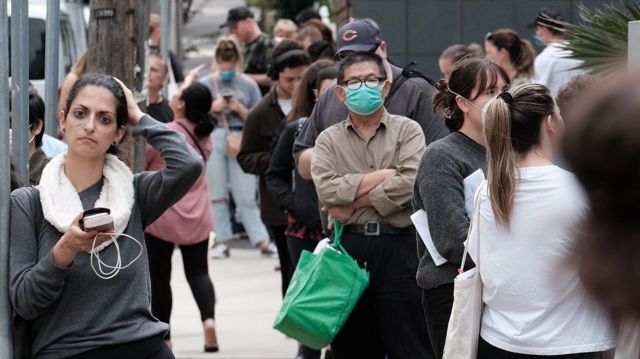
The queue outside a Centrelink office in Sydney last month
This surge produced Great Depression-style queues outside the government’s Centrelink welfare offices across the country, as laid-off workers lined up to apply for dole payments.
Roy Morgan CEO Michele Levine described it as “the biggest shock to the Australian economy, and workforce, since World War II—well beyond living memory for the vast majority of Australians.”
Today’s official unemployment figures, showing a rise to 5.2 percent, are from mid-March. That was before the belated COVID-19 partial lockdown ordered by federal, state and territory governments deepened the slump that was already underway because of the summer bushfire disaster and the downturn throughout global capitalism.
In Tuesday’s media release, Frydenberg claimed: “The Morrison government’s historic $1,500 fortnightly JobKeeper payment will support millions of Australian jobs as we build a bridge to the other side following the severe economic impact from the coronavirus.”
Except for the $130 billion “JobKeeper” wage subsidy scheme for employers, the treasurer said, the unemployment rate would have been 5 percentage points higher, peaking at around 15 percent.
There is no basis for these claims. Frydenberg said 800,000 businesses, including self-employed sole traders, had registered for the JobKeeper scheme, but provided no statistics on whether employers had kept workers on payrolls as a result.
Asked by a journalist if the government had any record of employers doing so, he gave no answer. Under questioning at a press conference, he stated: “I don’t have a definite number as for what percentage of those people will be stood down and what percentage of those people will continue to work.”
While it is an unprecedented bid to bail out business, the Liberal-National government’s $130 billion scheme was never likely to be sufficient, or take affect quickly enough, to avert mass unemployment.
Not only does the scheme exclude about 1.1 million casual workers and 1.4 million foreign workers on temporary visas, the payments to employers do not start until next month.
Many businesses, particularly smaller ones, will not survive until then. Others, especially big employers, may keep workers on their books but exploit the scheme to slash their wages to $1,500 a fortnight and impose sweeping cuts to conditions, such as leave entitlements and penalty pay rates.
That is the primary purpose of the bailout package, apart from disguising the levels of unemployment. Backed by the Labor Party and the Australian Council of Trade Unions (ACTU), the legislation pushed through parliament last week amended the Fair Work Act to enable employers to inflict such measures.
At the same time, ACTU secretary Sally McManus said the trade unions had told employers they could “get everything you want” with the cooperation of the unions.
Despite all these efforts to prop up the bankrupt capitalist order, the latest monthly National Australia Bank (NAB) business survey, released on Tuesday, reported that business confidence had plunged to minus 66 points. This was far worse than any other recording since the survey began in 1989 and much deeper than the minus 30 points in 2009.
Such a confidence collapse is another warning sign of evaporating demand, falling investment, corporate bankruptcies and further job losses.
NAB chief economist Alan Oster said: “We expect a recession of unprecedented speed and magnitude for the Australian economy over the next three quarters. This will see a sharp increase in unemployment.”
Referring to the government’s “stimulus” measures, totaling more than $320 billion in handouts, tax concessions, incentives and loans to the corporate elite, Oster said: “Policy makers have made a huge response that we think will be unable to offset the negative prints we will see in economic data in the near term.”
Oster said NAB remained “optimistic” that the government measures would “support a solid recovery once the virus is contained.” That “optimism” is belied by what is happening around the world as the COVD-19 death toll rises.
The government’s efforts to cover up the job carnage were further exposed yesterday when the International Monetary Fund (IMF) issued dire predictions for global and Australian capitalism.
The IMF forecast the biggest worldwide crash since the 1930s Great Depression, with global output falling by 3 percent in 2020—30 times more than during the 2008–09 economic breakdown.
Because of Australian capitalism’s dependence on raw material exports, tourism and income from international students, the IMF predicted a 6.7 percent drop in the country’s gross domestic product (GDP) for 2020, the largest fall since the 9.4 percent plunge in 1931.
The devastating joblessness and impoverishment confronting workers and young people in Australia is not just a product of the local coronavirus restrictions. Rather, it demonstrates the vulnerability of Australian capitalism to the global meltdown triggered by the pandemic.
The IMF forecast sharp downturns in all capitalist centres, including the US (-5.9 percent), Europe (-7.5 percent), Canada (-6.2 percent) and the United Kingdom (-6.5 percent). It said China, whose massive stimulus measures in 2008-09 prevented a recession in Australia by boosting iron ore and coal demand, would record growth of just 1.2 percent this year, far below its rates of a decade ago.
The IMF predicted V-shaped rebounds next year, including 6.1 percent in Australia. But that was based on the assumption that governments would end social distancing restrictions in the second half of this year, thus pushing workers back to work.
The fund warned that this “baseline” scenario would be upended if the pandemic lasted longer, leading to extended durations of containment, worsening financial conditions, and further breakdowns of global supply chains.
IMF chief economist Gita Gopinath said its forecasts were highly uncertain. “Many countries now face multiple crises—a health crisis, a financial crisis, and a collapse in commodity prices, which interact in complex ways.”
Well before the bushfire catastrophe and the pandemic, corporate investment was drying up in Australia, and workers also faced falling real wages, soaring rates of casualisation and the highest household debt levels in the world.

Now, as a result of capitalist governments failing or refusing to respond to the COVID-19 danger in time to save thousands of lives, workers have lost their jobs, many cannot pay their rents or mortgages and their lives are threatened by demands from governments and corporations to return to work, regardless of unsafe conditions.

Canada: Thousands of foreign-trained medical staff prevented from assisting in COVID-19 fight

Janet Browning

Across Canada, thousands of foreign-trained doctors and medical staff are being prevented from joining the front-line fight against the COVID-19 pandemic because of the country’s reactionary immigration system.
The numerous, onerous bureaucratic hurdles medical professionals trained in other countries must clear before being allowed to work, including the payment of tens of thousands of dollars for regulatory checks and certificates, has created a ludicrous situation in which highly qualified staff are not being permitted to assist Canada’s overstretched hospitals, clinics, and long-term care facilities, even as the pandemic surges.
As of yesterday afternoon, there were more than 28,000 confirmed COVID-19 cases in Canada, and 1,006 deaths.
In 2018, Canada ranked near the bottom among the 35 OECD countries for the ratio of doctors to citizens, with just 2.8 doctors for every 1,000 people. Only seven countries, including the United States and Mexico, ranked lower. Austria topped the list, with 5.2 doctors per 1,000 people—i.e., nearly double the rate in Canada.
In Ontario alone, there are 13,000 foreign-educated doctors and 6,000 foreign-educated nurses who are not working in their fields, according to HealthForceOntario.
The Alberta Association of International Medical Graduates (AAIMG), which represents 1,000 physicians from 82 countries, says the lengthy Alberta licensing process means many foreign doctors have had to take up jobs in fields unrelated to medicine. Alberta has not relaxed its licensing requirements in the midst of the pandemic, although it would clearly be in the public interest to do so. Many rural communities in Alberta, throughout Canada’s three northern territories, and in remote communities and indigenous reserves across the country lack doctors.
University of Calgary’s School of Public Policy (SPP) research associate Robert Falconer says it can take up to a decade to get a doctor’s licence in Alberta. “When you include the costs of things like tests and books, you’re also looking at around $14,000 to $28,000 per doctor to get re-certified,” he said. In the current situation, doctors are required to get several credential assessments, meaning all transcripts and work history must be submitted to up to four different regulatory bodies for review.
Where attempts have been made to modify this bureaucratic logjam, they have been ad hoc and disorganized.
Last Wednesday, the BC College of Physicians and Surgeons announced that it has fast-tracked a new bylaw to amend the province’s Health Professions Act so that international medical graduates can apply for a supervised associate physician licence to join the fight against the novel coronavirus pandemic. The amendment is now in a mandatory two-week review period, and there is no word on when, or if, it will be approved.
Without any public announcement, the College of Physicians and Surgeons of Ontario (CPSO) began last month to issue a short-term 30-day licence, called a Supervised Short Duration Certificate, by triggering a provision in existing provincial legislation. Internationally trained medical graduates who have passed their exams to practice in Canada, or have graduated from school in the past two years, can now apply for a supervised 30-day medical licence in Ontario to help fight COVID-19. The short-term licence allows some foreign-trained physicians and domestic medical school graduates to practice under supervision at public hospitals, psychiatric facilities and Crown agencies.
CPSO issued its first licence through the program in mid-March. Those who get a licence can apply to extend it an additional 30 days.
These temporary medical licences are the product of a provision within Ontario’s Medicine Act that has been in place since the early 1990s. The provision exists so that CPSO can issue these temporary licences in situations like pandemics, when there may be a shortage of physicians. In a written statement, CPSO told CBC Toronto it is working to fast-track applications so that physicians can start providing care for patients as quickly as possible.
However, before applying for the licence, applicants must meet four onerous conditions. Applicants must have: graduated from medical school in Canada, the U.S. or a school that was, at the time of graduation, listed in the World Directory of Medical Schools; practiced medicine, graduated medical school or passed Medical Council of Canada exams within the last two years; provided confirmation of employment from one of the approved categories of facilities laid out in the Medicine Act, including public hospitals; and found an identified supervisor who is a licensed practicing physician prepared to act as their supervisor.
Thus far, few doctors have applied, most likely because they are unaware of the program. As of April 3, CPSO had received only 12 applications, and had approved 10 of them. However, the college couldn’t say whether any foreign-trained doctors were among the 10 physicians who were issued temporary licences.
The failure of governments at all levels to effectively mobilize trained medical professionals to help combat the deadliest pandemic in a century provides yet another damning indictment of Canadian capitalism’s utter indifference to human life as the coronavirus spreads. Despite having been warned time and again about the risk of a pandemic, and having had the experience of the SARS outbreak in 2003, no steps were taken in advance to facilitate the integration of foreign-trained doctors and nurses into Canada’s chronically underfunded and understaffed health care system.
This failure will cost lives. Already, estimates suggest that 10 percent of all COVID-19 cases in Ontario are medical staff. As infection figures continue to rise, with the virus ripping through long-term care facilities across the country, the danger remains of the health care system being totally overwhelmed, not least due to a lack of staff.
Federal government epidemiologists project that between 11,000 and 22,000 Canadian lives could be lost over the course of this pandemic, which is the best-case scenario with the strongest control measures remaining in force. If these controls are weakened, or the health care system is overwhelmed, those deaths could well spike to more than 100,000.
In addition to the ruling elite’s negligent response to COVID-19, its refusal to allow foreign-trained medical professionals to practice is a direct product of Canada’s reactionary points-based immigration system. Canada’s immigration regulations, which are among the most stringent in the world, have been praised by the fascistic US President Donald Trump, who held them up as an example of policies he would like to implement.
Last month, Prime Minister Justin Trudeau announced an agreement with Trump to expand the Safe Third County Agreement to include desperate asylum seekers who enter Canada from the US “irregularly.” In a flagrant violation of international law, they will not be allowed to file an asylum claim in Canada, and will instead be automatically returned to the US and placed in the clutches of Trump’s thugs in the Immigration and Customs Enforcement (ICE) service.

This move, long demanded by the Conservatives, the Coalition Avenir Quebec (CAQ) and other right-wing Quebec nationalists was justified on the pretext that the refugee claimants could spread the coronavirus. This standard trope of the right and far-right blithely ignored the fact that Canada’s ruling elite has more than enough resources to provide safe quarantine for incoming refugees, which would have all but eliminated any threat of further infections.

Thousands of UK care home residents dead in COVID-19 pandemic

Robert Stevens

As in every country, the coronavirus virus has ripped through UK care and nursing homes, which house over 430,000 elderly and vulnerable people. Thousands of lives have been lost without being officially recognised.
Elderly care home residents are portrayed as caught up in an “unfolding disaster” and a “silent crisis.” A more apt characterization is the transformation of care homes into killing fields.
Yesterday, Boris Johnson’s Tory government announced that the coronavirus death toll rose by 761 to 12,868. But again, the government did not include care home fatalities due to COVID-19, or the deaths of people who died in their own homes.
The scale of what is being covered up is beginning to emerge.
According to the government, based on Office for National Statistics (ONS) figures published Tuesday, 217 people had died in care homes in England and Wales as of April 3. But these figures bear no relationship to reality.
Last week, Care England, representing the largest providers of care homes, estimated that the death toll was in the hundreds, but below 1,000. But its latest estimate, published yesterday, is that care home deaths have reached 1,400.
According to the Alzheimer’s Society, at least 2,500 deaths may have occurred in care homes.
According to one estimate by Mike Padgham of the Independent Care Group, which represents care homes and home care providers, the virus may have already taken the lives of at least 4,000 residents.
Reported cases include:
  • Burlington Court Care Home in Glasgow, where 16 elderly residents died in just over a week
  • Oak Springs in Wavertree, Merseyside, where 15 are suspected to have died from COVID-19. Fifty staff members developed symptoms or were unable to work due to underlying health conditions
  • Finborough Court, a home in Stowmarket, Suffolk, where eight died. Three of the deceased were confirmed COVID-19 victims, while the other five deaths are suspected to be connected to the virus
  • Castle View Care Home in Dumbarton, where eight residents have died
  • Hawthorn Green home in Stepney, east London, where seven residents have died
  • Wren Hall Nursing Home Selston, Nottinghamshire, where 10 residents died of suspected coronavirus over the Easter weekend. Manager Anita Peet said, “We are just having deaths all the time. Are people dispensable? It feels as if people are not worth saving. But that is certainly not how we feel. It’s getting harder and harder every day. We’re fighting a losing battle.”
The government’s refusal to admit the real death toll in homes was demonstrated by Minister for Care Helen Whately, who was asked on the Good Morning Britain TV show to respond to the Independent Care Group’s estimate of at least 4,000 deaths. When she smirked, GMB host Piers Morgan asked, “Why are you laughing?”
Even an audit by the pro-Conservative Daily Mail has found “at least 951 care home deaths from officially confirmed fatalities by care home operators and local authorities or local media reports.”
This week, three of the largest care home operators in Britain revealed that there had been 620 deaths in their homes from COVID-19 in recent weeks. The firms—Four Seasons Health Care, MHA and HC-One—run almost 700 homes between them. But there are 5,500 care home providers and the three firms account for only a small fraction of homes (less than 5 percent).
A clearer picture of the real number of deaths outside hospital was provided by the National Records of Scotland on Wednesday. It announced that 962 deaths had been registered in Scotland with COVID-19 mentioned on the death certificate. Of these deaths, 608 were in the past week. Most died in hospital, but the figures show that 38 percent of fatalities were outside hospital.
Some 237 deaths were in care homes (25 percent) and 128 (13 percent) in the home or outside of care. In the week from April 6 to 12, the virus was mentioned in 31 percent of all deaths registered in Scotland. According to Scottish National Party First Minister Nicola Sturgeon, 433 care homes in Scotland—40 percent of all homes—had recorded coronavirus cases.
Scotland’s population is 5.45 million. The UK’s is 66.65 million, suggesting that if the Scottish pattern was repeated, deaths outside hospitals would total from 13,000 to over 16,000.
However, a study by the London School of Hygiene and Tropical Medicine points to evidence from five other European countries—France, Belgium, Spain, Italy and Ireland—suggesting that between 42 percent and 57 percent of all COVID-19 deaths happen in care homes.
If one assumes a figure of 50 percent of all coronavirus deaths occurring outside hospital, then the total number of deaths in the UK is around 26,000. The same pattern obtains in other countries, few of which count those who have died outside hospital.
The mass deaths in care and nursing homes is a product of the government’s original plan to allow the entire population to become infected by a virus for which there is no vaccine in order to achieve “herd immunity.” For the ruling elite, the elderly are viewed as a drain on resources and a burden on the further accumulation of personal wealth and profit—with horrifying consequences.
The pro-Tory Daily Telegraph science editor Sarah Knapton wrote what is a staggering indictment of the government on Wednesday, noting that “433,000 older and vulnerable people living in social care have been largely abandoned.”
Knapton states, “On March 3—two days before the first death was recorded in Britain, when just 51 people had tested positive for coronavirus—the Care Provider Alliance issued urgent guidance advising care homes to consider restricting all visits from relatives until the pandemic was over.
“Recognising the danger, the industry body also told homes to restrict the use of new agency staff to reduce the risk of exposure to the virus, and to isolate residents if they were suspected of having it. Yet the Government procrastinated, and it was not until 10 days later [March 13] that official guidance was issued stopping anyone who was ‘generally unwell’ from visiting residents.”
During this period, the government was formulating its herd immunity policy, which was announced on March 12. A lockdown for those over 70 and vulnerable was not imposed by the Tories until March 16, 13 days after the Care Providers Alliance warning.
The lack of adequate personal protective equipment (PPE) for residents and staff is another huge factor in the surge of deaths. To make matters worse, elderly patients were sent from hospital to care homes to free up beds, sometimes bringing the coronavirus with them.
A growing number of elderly people in homes, many of whom were rejected for hospital treatment because they were not considered “high priority,” have died alone due to restrictions under the lockdown—particularly in care homes where the virus has taken hold. Relatives have had to say final goodbyes to loved ones through windows or over the phone.

On Wednesday, the government made a show of allowing relatives to see a loved one in person. In response, MHA, a charitable provider of care homes, made clear: “There is nothing stopping relatives saying goodbye in care homes now as long as they have sufficient PPE… So this goes back to the problem of there not being sufficient PPE for the staff, never mind families.”

French President Macron announces a premature end to quarantine in the interests of the financial elite

Alex Lantier

French president Emmanuel Macron delivered a televised address on Monday night to defend his government’s disastrous response to the coronavirus pandemic. Macron also announced an end date to the nationwide quarantine, without providing any health-based justification for doing so.
Across Europe, governments are compelling workers to return to work in the midst of an epidemic. In Spain and Austria, workers’ anger has erupted on social media in the face of return-to-work orders imposed by the trade unions, even as thousands of new coronavirus cases are reported each day. The British and Spanish governments openly declare that a majority of the population will have to catch the disease, in the hope that the survivors develop an immunity allowing them to continue to work.
Macron had already raised the need to return to the job, which would sustain the hundreds of billions of euros that the central banks and government are pouring into the financial markets. His speech Monday fell within the same basic framework. Without specifying what change in the situation would allow a safe ending of the quarantine, the president ordered a return to work, delaying it until May 11.
A family watches French President Emmanuel Macron's televised speech, Monday April 13, 2020, in Lyon, central France. (AP Photo/Laurent Cipriani)
Workers cannot trust the “president of the rich” with such a life-and-death question. A general quarantine was adopted in Europe only after a wave of strikes in Italy that spread to France, Spain, Great Britain and beyond. The question is posed of a movement of the working class to impose a rational, planned and scientific response to the pandemic on a global scale.
While an Odoxa poll indicates that 70 percent of the population do not trust the government, and that 88 percent think the quarantine should have begun earlier, Macron began his speech this week with congratulations to his own government. He praised himself for the fact that “the hospitals have been able to treat all those who were presented to them.”
In fact, the hospitals, on which Macron imposed austerity spending cuts immediately prior to the pandemic, were able to treat everyone only because they admitted a fraction of the most serious cases. Most patients were told to treat themselves at home; an unknown number of older patients died in retirement homes. The current 50 percent increase in the mortality rate among French people in their homes appears to reflect the death of non-hospitalized coronavirus patients.
The lack of masks and anti-bacterial gels in France, and of gloves and coats for nurses and healthcare workers, has worsened the pandemic that has killed 119,000 people internationally and over 15,000 in France. More than 6,000 nurses have been infected in France, while seven doctors and nine health staff have died. Hundreds of doctors have filed suit against Prime Minister Édouard Philippe and former Minister of Solidarity and Health Agnès Buzyn, which threatens the two officials with two-year prison sentences.
Macron referred in passing to these disasters before minimizing them as “misfirings.” With breathtaking indifference, the French president added: “We will draw all the necessary lessons in the appropriate time.”
The time to secure the required supplies of medical treatments and equipment is not in the vague future, but in the here and now.
Thousands of people across Europe and elsewhere are dying every day, even as Macron announced the end of the quarantine and the reopening of all schools in less than four weeks’ time, with the return of tertiary students delayed until the summer. He did not explain why elementary and secondary schools, as much key transmission mechanisms for the virus as the universities, should reopen, besides the obvious fact that this would be necessary to allow the students’ parents to get back to work and produce profits for business. Macron said that the reopening of schools would be “prepared with the social partners,” the trade unions.
Nonetheless, Macron indicated that the May 11 return was not assured, criticizing the so-called strategy of “collective immunity” advocated in Berlin and London. Instead of adopting this strategy and coldly allowing a majority of the population to become infected with the disease, Macron proposed betting on a coronavirus vaccine.
“Today, according to preliminary data that will soon be improved,” the president argued, “a very small minority of the French population has contracted COVID-19. This means that we are far from what specialists call collective immunity, the point at which the virus stops spreading of its own accord because enough of us have already contracted it. The most talented researchers in the world are working on this problem now—and France is internationally recognized in this field.”
This raises questions to which Macron gave no answer. He stated that the development of a vaccine would take “many months”—12 to 18, according to scientists. But he was silent on what should be done between May 11 and when that vaccine might be available.
Above all, Macron did not explain his attitude toward the strategy of “collective immunity.” Even assuming a mortality rate of one percent, allowing 70 percent of the population to become infected would lead to half a million deaths in France, and hundreds of millions internationally.
The fear of a social explosion in France and internationally is a decisive factor—although rarely referred to—in Macron’s policy. Terrified by two years of “yellow vest” protests and shaken by stoppages in the automotive industry and at Amazon in Europe and America, he chose for the moment not to adopt openly the same quasi-genocidal policy as elsewhere on the continent.
The risk of having to re-impose a quarantine following a renewed outbreak of the virus—a possibility that he briefly referred to—no doubt played a role. Nonetheless, there is no fundamental difference between the policy of Macron and that of Boris Johnson in Britain or Angela Merkel in Germany. All want to send workers back to work, without safe conditions, in order to boost the profits of the financial elite.
Macron hypocritically sought to soften this brutal class reality, declaring that “Our country depends entirely on men and women that our economy repays so little,” before invoking the Declaration of the Rights of Man and Citizen of 1789, “Social distinctions can be founded only on the common good.” “These words,” Macron continued, “are imposed upon us today,” adding into the bargain that a portion of the debt of African countries would be cancelled.
Workers cannot have any confidence in these empty promises. Macron is discredited by years of austerity and war, in addition to his catastrophic response to the coronavirus pandemic. This crisis has demonstrated that social distinctions based on class inequality play a disastrous and even fatal role in the world today. Macron is known as a ruthless and bloody defender of the financial elite. He is now negotiating with the business federation and the unions to impose a slashing of paid leave and unpaid overtime.
The working class must decide the conditions for any end to the quarantine, in complete independence from the parties and unions that collaborate with Macron. Through the formation of independent rank-and-file workplace and neighborhood committees, workers can fight for a safe end to the quarantine, which would necessarily involve no return to work for non-essential production, safe conditions for all workers in industries that are essential to fight the virus and guaranteed protection of all—including prisoners and refugees.

These demands require a struggle for socialism and against capitalism and the European Union, for the bringing down of Macron and the establishment of a workers’ government.

Steep fall in US economy and worse is to come

Nick Beams

Data from the US Commerce Department and the Fed released yesterday show that the American economy entered a steep decline in March with still worse to come this month.
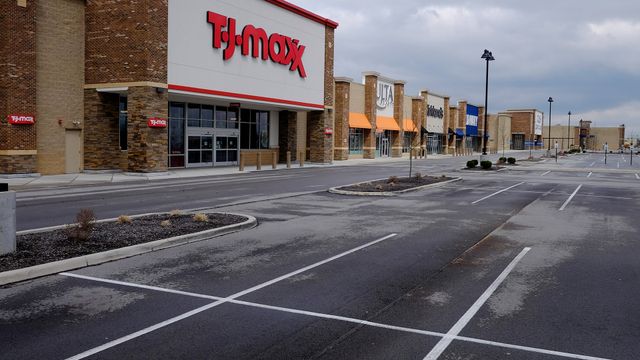
Retail sales, in seasonally-adjusted terms, fell by 8.7 percent from a month earlier, the biggest such fall since records began in 1992. Sales at clothing stores were down by more than 50 percent.
The percentage decline in spending on motor vehicles, furniture and electronics was in the double digits, the Commerce Department reported.
An empty parking lot is seen as retail stores are closed, Wednesday, April 15, 2020, in Whitestown, Indiana. (AP Photo/Darron Cummings)
Figures released by the Fed showed that industrial production, including manufacturing, mining, oil and natural gas production, dropped by a seasonally-adjusted 5.4 percent. This was the biggest monthly decline since 1946 when US industry was switching from war production.
In an indication of the collapse of economic confidence, the National Association of Home Builders reported that its housing market index for April had fallen to 30 from 72 the previous month. A level of 50 indicates neither expansion nor contraction.
The Fed’s “beige book,” based on anecdotal evidence from businesses around the country, said US economic activity had “contracted sharply and abruptly” and companies expected conditions to worsen with further job cuts. Over the past month almost 17 million workers have registered for unemployment benefit.
Any notion there will be a rapid recovery once the immediate effects of the pandemic pass—and there is no indication of that as the US death toll continues to rise—is being dispelled.
The senior economist at Oxford Economics, Lydia Boussour, said the drop in retail sales was “just the beginning of the consumer pull-back.”
“Plummeting consumer confidence, collapsing employment, and lockdown restrictions have compounded into an extraordinary and multi-faceted shock to consumer spending and brought the economy’s main engine to a sudden halt.”
Manufacturing output fell by 6.3 percent. The largest decline was in the production of motor vehicles and parts, which fell 28 percent, while the production of business equipment dropped 8.6 percent.
Oxford Economics issued a note to clients yesterday warning that factory activity would fall even further this month. “We anticipate industrial production will shrink by nearly 15 percent from peak to trough,” it said.
In a further indication that worse is to come, the Empire State manufacturing survey, which measures business confidence in New York, fell to minus 78.2 this month. This far exceeds its previous low of minus 34.3 recorded in February 2009 in the midst of the global financial crisis.
“The message is that it will be a brutal spring quarter for the economy,” Joshua Shapiro, an economist at the consulting firm MFR, told the Financial Times .
He said while there would a bounce back when the economy reopened, “returning to the levels of activity that prevailed pre-crisis is going to take a long time, and indeed probably will be measured in years for the most affected sectors.”
Craig Johnson, the president of the retail consulting firm Customer Growth Partners, told the Wall Street Journal the March decline was “literally unprecedented.” But April would the “cruelest month” because it was only in mid-March that the closure of large retail outlets began.
The International Monetary Fund has warned in its latest economic outlook that the world is entering the most significant contraction since the Great Depression, expected to amount to at least $9 trillion over 2020 and 2021. This is equivalent to the economic output of Germany and Japan combined. It has forecast that the US economy will shrink by 5.9 percent this year.
One of the clearest expressions of the crash now underway in the global economy is the crisis in the oil industry. Despite an agreement earlier this week by major oil producers to cut production by 9.7 million barrels a day, its price has continued to fall.
The executive director of the International Energy Agency (IEA) Fatih Birol, said: “The oil industry is experiencing a shock like no other its history.”
With oil prices now down to as low as $20 a barrel, many firms are facing bankruptcy, particularly in the US.
Whiting Petroleum filed for bankruptcy at the beginning of the month. Many of the US shale-oil producers that sprung up in the last decade, as oil prices rose, are certain to follow.
Rystad Energy has said that at $30 a barrel more than 70 US oil and gas producers would have problems meeting interest payments on their debts this year. At $20 a barrel for crude this would rise to about 140 companies.
In its monthly oil report, the IEA said demand in April would drop by 29 million barrels a day, equivalent to 29 percent of global oil consumption in 2019.
It said the global economy was “under pressure in ways not seen since the Great Depression” as businesses failed and unemployment rose, with activity in the transport sector falling “dramatically almost everywhere.”
One oil trader told the Wall Street Journal that if you bought a cargo today “you are not sure you will ever find a buyer for it because everyone has too much oil.” He expected that in a couple of weeks oil markets would become “dysfunctional.”
But amid the economic devastation caused by the COVID-19 pandemic and the misery for billions of workers around the world, there is money to be made… big money.
Earlier this week, the Financial Times reported on a London investment fund that had made a total of $2.6 billion in trades during March. More than $800 million came from trades in derivatives based on market volatility with a further $1.8 billion resulting from trades in share market, gold and credit derivatives.
The richest man in the world, Jeff Bezos, the founder of Amazon, has increased his wealth by $24 billion this year, taking his total fortune to more than $138.5 billion.
His former wife MacKenzie Bezos, who was left with a 4 percent share in Amazon as a result of her divorce settlement, has seen her net worth climb by $8.2 billion this year to $45.3 billion.
As a result of the increase in online shopping, shares in Amazon have been rising and jumped by 5.3 percent on Tuesday.
Bloomberg reported that while the wealth of the world’s 500 richest people in its Billionaires Index had taken an initial hit, it had surged by 20 percent since March 23.

The official mantra is “we’re all in this together.” But as one financial analyst told the news agency, the wealth gap “is only going to get wider with what’s going on now.”