17 Apr 2020

Australian governments pushing for premature return to work

Oscar Grenfell

At a meeting of the expanded “national cabinet” yesterday afternoon, the federal Coalition government, along with state Liberal and Labor governments, discussed plans to wind back lockdown measures over the coming months. They made clear that this would be aimed at forcing workers back on the job to resume the flow of corporate profits, despite the risk of a full-blown outbreak of COVID-19.
Speaking to the media after the meeting, Prime Minister Scott Morrison declared that the governments were preparing measures for the “road out” of the current crisis. He couched his comments in terms of reversing the dire impact on business activity of lockdowns instituted over the past month.
The announcement was prepared by a joint media-government campaign over the past fortnight, proclaiming that Australia has succeeded in “flattening the curve” of infections and slowing the spread of the coronavirus.
The claims are highly dubious, under conditions where most states still have highly restrictive testing criteria.
In New South Wales, for instance, the most populous state with the highest number of infections, criteria were “expanded” at the beginning of the month, but only to health and aged care workers showing symptoms and those in areas with a high number of confirmed infections. In other words, most people with symptoms are denied testing, while the estimated 35 to 50 percent of infected individuals who are asymptomatic have no prospect of being examined.
The government announcements, moreover, were made amid some of the lowest testing rates since early March. The day before the cabinet meeting, just 4,851 tests were conducted across the country, compared with more than 16,000 on March 29. From Monday to Thursday, only 1,000 tests per day were conducted in Victoria, which has a population of more than 6.3 million.
Clusters continue to emerge, including at two hospitals in Tasmania last week and at a number of medical facilities in Victoria.
Modelling released by the Actuaries Institute yesterday, based on World Health Organisation data, suggested that there may have been 20,000 people infected with the virus on April 9, well above the official figure of several thousand active cases. The report stated that community transmission of the virus is likely far more widespread than is indicated by official data.
Despite this, Morrison declared at the press conference that while existing lockdown measures would remain in place for the next four weeks, they will be reviewed and likely eased late next month.
Morrison outlined three policies that would supposedly manage the virus as lockdown measures are wound back. He claimed that testing would be dramatically increased, which raises the obvious question of why this has not yet been carried out.
The prime minister stated that clusters of confirmed infections could be met with localised lockdowns to be enforced by the Australian Defence Force—another indication of the repressive policies being prepared.
The government is also rolling out a mobile phone app that will track at all times those who sign up. This would supposedly allow the authorities to identify the phone number of anyone that a confirmed case has been in close proximity to for 15 minutes or longer. The measure, based on a model developed by the police-state regime in Singapore, would represent a major escalation of mass surveillance and other ongoing invasions of privacy.
The prime minister and Chief Medical Officer Brendan Murphy gave their most explicit comments to date on the “strategy” that has underlined the woefully-inadequate government response to the pandemic. They declared that they were not seeking to eradicate the virus, because of the negative business consequences of a sharp lockdown. Instead they were attempting to suppress it.
The admission underscores why it took so long for the state and federal governments to introduce lockdown measures last month. It indicates that the governments are preparing to force workers back onto the job while the virus circulates for the foreseeable future and periodic outbreaks become a “new normal.”
It is clear that teachers have been selected as the “guinea pigs” of the back to work campaign, which threatens to cause thousands of unnecessary deaths. On Wednesday evening, Morrison delivered a video message to teachers, hectoring them to ensure that schools remain open.
Morrison made clear that this was aimed at resuming business activity, cynically declaring that teachers could not force parents to decide whether to “put food on the table” by going out to work or staying at home to look after their children.
In reality, it is the federal and state governments, which have focused their response to the economic breakdown on providing billions to the corporations as they lay off workers, that are responsible for the deepening social hardship, not teachers.
Comments in the Australian and other media outlets of the financial elite were blunter, noting that reopening the schools was crucial to “kickstarting the economy,” and creating the conditions for employees to be pushed back into their workplaces.
Victoria is viewed as a test case, with the state Labor government of Premier Daniel Andrews forcing teachers back to the schools this week, despite widespread anger over a lack of safety precautions. Teachers are being compelled to go to schools, where they risk infection, while developing online curricula for the majority of students who are still learning remotely, greatly increasing their workload.
In New South Wales, the state Liberal government has signaled that it will begin a staged reintroduction of face-to-face classes starting on May 12. This is in line with calls from the state’s Teachers Federation for Year 12 and kindergarten students to begin attending schools again. As in every state, the unions have collaborated closely with the government, brushing aside the concerns of the teachers they falsely claim to represent.
In the Northern Territory, teachers are being forced to take classroom lessons and to prepare online classes. Measures for a full reopening of the schools are doubtless being discussed in other states and territories.
The stated rationale for resuming face-to-face teaching, that schools are unlikely centres of infection, is highly dubious. Earlier this month, a cluster of over 70 infections emerged at Marist College in the New Zealand city of Auckland. A number of schools in New South Wales and South Australia were forced to close prior to the end of Term One after cases were detected.
In reality, teachers are being subjected to dangerous conditions as the first step in imposing similar conditions on broader sections of the workforce. At the same time, tens of thousands of construction workers remain on the job at the behest of governments and the unions, despite the impossibility of practicing social distancing.
Behind the scenes, the ruling elite and its representatives are discussing how many people will be allowed to die to minimise any impact on corporate profits.
In an interview with Morrison last night, the Australian Broadcasting Corporation’s Leigh Sales noted that there have been no deaths under the 50- to 59-year-old cohort, and asked: “Is it fair to say that the people who are bearing the hardest burden of the economic shutdown are not the people who are at the most serious health risk?”
Sales asked whether it might be possible, as some business leaders have suggested, to “return to a sort of normal existence for everyone under 60 and lockdown measures restricted to older Australians and younger people with serious health issues.”
An article in the Australian Financial Review by Sam Lovick, headlined, “The next stage must be to let the virus spread,” was even more explicit. Hailing government moves to end the lockdowns, he wrote: “In the absence of a vaccine or a cure, the best policy involves a managed increase in spread so that some degree of herd immunity develops, seeking to protect those most at risk while it does.”
“How might we achieve this? One policy that is unlikely to work is to try to prevent every death. Why not? Because to do so we would need to eliminate infections entirely. That can only be done with severe and prolonged social distancing at prodigious economic cost (2 percent of GDP per month for at least 10 months, at least $400 billion).”
Lovick detailed two scenarios, allowing a “managed spread” of the pandemic. He claimed that under the first model, of a gradual easing of lockdown measures, “64,000 lives would be saved” because intensive care units would not be overwhelmed despite a rise in infections.
Under his second scenario, “Some 3,000 fewer lives are saved, largely because we are short around 500 ICU beds for one month. But the impact on GDP is much smaller at 4.1 per cent ($85 billion). The cost per life saved falls to $1.4 million. The cost of saving those additional 3,000 lives is $9 million each, more than society is normally willing to pay.”
In other words, the corporate and financial elite, and the governments that represent them are preparing to inflict thousands of deaths to shore up their bottom lines. This underscores the necessity for workers to immediately develop their own response to the crisis. As a first step, new organisations of struggle, independent of the corporatised trade unions, must be developed everywhere, to lead a fight against any premature return to work.


South Korea’s Democratic Party wins general election in landslide

Ben McGrath

On Wednesday, the ruling Democratic Party of Korea (DP) won a landslide victory in the South Korean general election, defeating the main opposition United Future Party (UFP) and retaining control of the National Assembly. Legislators serve four-year terms in the 300-seat unicameral body.
The DP won 163 seats outright while the UFP took only 84 with those totals rising to 180 and 103 when proportionally-allocated seats were added. To procure the additional seats, both parties took advantage of a new electoral law passed in December by setting up satellite parties known as the Together Citizens’ Party and the Future Korea Party respectively, with the explicit intention of merging these into the main parties.
The election is the first in 16 years that the ruling party has won a majority in the National Assembly and ensures that the Democrats and President Moon Jae-in will have full control of the government. A voting bloc controlling 180 seats or three-fifths of the total can pass almost any legislation except for changes to the constitution, which requires an additional 20 votes.
DP Chairman Lee Hae-chan stated after the election, “We will do our best to overcome the war against the coronavirus and the economic crisis so as to reward people’s support for us.” The DP was the beneficiary of the government’s response to the COVID-19 pandemic. Prior to the explosion of infections in February, public support for Moon had fallen to 41 percent while the Democrats approval rating stood at just 34 percent.
Hwang Gyo-an, who served as UFP chairman, stepped down from his position Wednesday night as his party’s defeat became clear. He remarked, “I will take all responsibility. As I promised earlier, I will give up my party post to hold myself accountable for the election outcome.” Resignations are a common practice in South Korean politics after an election loss and are largely ceremonial shows of contrition.
Hwang also lost his race against Lee Nak-yeon in Seoul’s Jongno district, where numerous government offices are located. Both men are former prime ministers, with Lee and Hwang serving under Presidents Moon and Park Geun-hye respectively. The race was seen as a potential presidential match-up in 2022 when Moon’s single term ends.
Despite the COVID-19 outbreak, voter turnout was an estimated 66.2 percent, the highest rate since 1992 and an 8.2 percent increase over 2016. While the establishment media celebrated this outcome, a third of the eligible voting population, or 14.9 million people, still did not vote, an indication of widespread discontent with the candidates and parties. The election was also the first in which 18-year-olds could vote, with the eligible age lowered last December from 19, adding 540,000 new voters.
The same law changed the basis for seats elected on a proportional basis and allowed the two biggest parties set up their satellites. Supposedly meant to help smaller parties win more proportional seats by changing how they are distributed, the legislation had the opposite effect as most of the minor parties have been swept from the National Assembly.
The third largest party in the legislature is now the pseudo-left Justice Party, which won one directly elected seat and five proportional seats, maintaining its total in the legislature. The Party for People’s Livelihoods (PPL), which held 20 seats before the election, was swept out of the legislature all together. The PPL consists of anti-Park Geun-hye conservatives as well as right-wing Democrats who were followers of former President Kim Dae-jung.
Other parties winning a handful of seats include the People’s Party (three proportional seats), which is a former ally of the PPL and led by Ahn Cheol-soo, and the Open Democratic Party (three proportional seats), another DP offshoot. Five so-called independents also won seats.
In its campaign, the DP capitalized on the COVID-19 pandemic to claim that it had successfully contained the outbreak. The government was well aware that another bungled response to a disease outbreak similar to that during the 2015 Middle East Respiratory Syndrome outbreak could generate widespread discontent, particularly as support for the government fell.
In the aftermath of the election, however, the Moon administration will accelerate its efforts to prop up big business and foist the burden of the pandemic onto the backs of workers. The International Monetary Fund predicts that South Korean economy will contract by 1.2 percent in 2020—the first period of negative growth since 1997–1998 Asian Financial Crisis.
In response to that crisis, the DP imposed the IMF’s demands for the pro-market restructuring of the economy. While in power under Kim Dae-jung and Noh Moo-hyun, the Democrats oversaw massive job cuts and the casualization of the workforce, the effects of which led to a real youth unemployment rate of nearly 25 percent, as well as stagnant wages, and other attacks on working conditions.
President Moon warned on Monday that “this may be (just) the beginning of pain” while claiming his administration would prioritize protecting jobs. What this means is more government handouts for big business, on top of the trillions of won already spent, supposedly to prevent further layoffs. The Bank of Korea has also already promised an unlimited amount of funds to financial firms.
In fact, major job cuts are being planned with tens of thousands of jobs on the chopping block. Workers have already faced firings, unpaid furloughs, and large wage cuts. In March alone, there were approximately 156,000 applications for unemployment benefits, a 24.8 percent increase over the same month in 2019 and the biggest since the 2008–09 global financial crisis.
The new legislature and the Moon administration will only accelerate these attacks which will provoke resistance from the working class. The government will not hesitate to use the police-state measures rolled out to combat COVID-19—such as the tracking of hundreds of thousands of people—against workers fighting to defend their jobs and health.
Workers, farmers, and youth must turn to their counterparts around the world who are also being driven into conflict with their ruling classes who are determined to enhance their profits and wealth whatever the costs to working people. What is needed is a unified struggle to reconstruct society on a socialist basis to protect the lives and meet the pressing social needs of the entire population.

More than thirty dead as tornadoes rip across southeastern US

Aaron Murch

Severe storms and tornadoes devastated several states in the Southeast over the weekend. Over 30 people have died across the region from the dozens of tornadoes which ravaged through Mississippi, South Carolina, and Georgia. The natural disaster comes as nationwide stay-at-home orders due to COVID-19 have left millions out of work and in precarious situations.
Over the course of about two days, 71 tornadoes were reported in nine different states across the South. Over a million homes lost power during the series of storms. Two days later, half a million people remain without power.
Hundreds of homes were destroyed as the tornadoes ripped through neighborhoods. Emergency crews were reportedly unable to reach many of the more devastated areas due to debris and damage to roads and bridges. Hundreds, if not thousands of people are now homeless, looking for refuge and therefore at greater risk of catching and spreading the virus.
According to reports, the tornadoes that hit Mississippi were particularly destructive, with the most powerful tornado being classified with the rare EF-4 rating with winds up to 170mph.
Strong gusts of wind, up to 80 mph in Georgia and Florida, along with deadly tornadoes, were also reported in those states. By Monday afternoon, tornado watches stretched as far north as Virginia and Washington DC, as well as parts of Maryland and Pennsylvania.
Southern Mississippi remains the hardest hit in the region with 11 reported deaths. Supercell thunderstorms arrived one after another on Sunday carving a path of destruction across several miles.
On Monday, Mississippi Governor Tate Reeves posted a series of tweets about the storms, the worst the state has seen in over a decade. Underscoring the severity of the storms, he wrote: “We are used to tornadoes in Mississippi. No one is used to this, ” the governor tweeted, “Winds topped 200 mph. The trail was long and devastating.”
Mississippi residents responded on Twitter by taking the governor to task for his failure to prepare properly for the COVID-19 pandemic, which some say exacerbated the impact of these already devastating storms.
“Tornado Emergencies,” a rare and more extreme weather warning issued when weather events merit a stronger response than the usual “Tornado Warning” designation, were also issued in Monroe, Louisiana; Chattanooga, Tennessee; and Walterboro, South Carolina.
Dozens have been injured across these impacted states whose hospitals are already flooded by COVID-19 patients.
In Georgia, at least eight people died as tornadoes tore through mobile home parks in Murray County and Bartow County.
Alexandra Vargas, a resident of Chatsworth, Georgia, described the scene as she got a tornado warning alert on her phone soon before the tornado coursed through her neighborhood. “It was like a train derailing,” Vargas said, describing the roar of the tornado, “Shook the entire house. And you could hear trees snapping and debris hitting the roof.”
In South Carolina, at least nine people were killed, including Jack Harvill, a 77-year-old security guard working at a BorgWarner auto parts production plant. Harvill, who was working security for the plant under the employment of American Security contractors, died from blunt force traumatic injuries when the building he was working in collapsed at around 3:30 a.m.
The causes of death for many in Mississippi and South Carolina were the result of trees crashing into mobile homes. One woman in Alabama took to social media to describe the destruction in their neighborhood and the impact on her family: “The power was out for three days. We’ve probably lost several hundred dollars worth of food.” Countless others have also posted on Twitter about the setbacks experienced because of these storms. One person wrote: “Power loss = loss of everything in the freezer. People will be forced to start from scratch as grocery stores are already running out of food because of the pandemic.”
The chief of forecast operations at the National Weather Service’s Storm Prediction Center, Bill Bunting, told New York Times reporters, “Unfortunately, it has played out like we feared. All of the ingredients, all the conditions we look for when we’re forecasting tornadoes and strong tornadoes were in place.”
In Monroe, Louisiana, a large tornado ripped through several neighborhoods and a nearby airport, with wind gusts up to 65 mph. In a statement, the Monroe city mayor said that some 200-300 homes were destroyed.

In a video that went viral on Twitter, a resident describes the aftermath: “It just wiped out everything around me.” Natural disasters such as these are made incalculably worse because of the immense social crisis gripping the region. Decades of neglect and defunding have led to crumbling infrastructure and job losses, all exacerbated by the rampant lack of health services and a gutted health care system. Such events on top of a deadly pandemic ravaging the nation could prove catastrophic to the poor and working-class populations that get hit the hardest.

US rural hospitals close amid COVID-19 pandemic

Gary Joad

Already reeling from decades of cutbacks and austerity, rural community hospitals in the US are teetering on the brink of collapse in the face of the COVID-19 pandemic, with many facing the possibility of closure, despite the increased need for their services.
According to the “fast facts” provided by the American Hospital Association (AHA), there are 6,146 hospitals in the United States. Of these, 5,198 are community hospitals, nonfederal medical facilities that are open to the public, providing short-term care or specialty services.
There are 1,821 rural community hospitals in the country, providing health care to 15 percent of the population, or 46 million people. However, the population within these regions has become older, poorer and sicker, with a significantly higher prevalence of chronic disease and numbers of uninsured than in urban areas.
Miller County Hospital in Georgia (Wikipedia Commons)
According to the North Carolina Rural Health Research Program, a part of the Sheps Center at the University of North Carolina at Chapel Hill, 170 rural hospitals have closed since 2005, with 128 closing since 2010. The number of rural hospital closures consistently reached double digits starting in 2013, with a high of 19 closures in 2019. There have already been eight closures so far this year, despite the global pandemic.
For example, earlier this month the Decatur County Hospital in Tennessee announced that it would close down on April 15. Established in 1963, the hospital had employed 100 and served a community of 12,000. It is the 14th rural hospital to close its doors in that state in the last 10 years. With this hospital closure, the state, which has only one hospital bed per 73,000 state residents, now has 21 counties with no hospital.
In West Virginia, which does not have a city over 50,000 and where 20 percent of the residents are senior citizens, two hospitals have recently closed.
According to a study released earlier this year by the Chartis Center for Rural Health, 453 rural hospitals are “vulnerable” to closure.
“None of the metrics we track to measure the stability of the rural health safety net are improving,” Michael Topchik, national leader of the organization, said in a statement, “and this research allows us to quantify just how severe the implications could be if the current situation worsens.”
Rural hospitals across the country have been overwhelmed by COVID-19 patients. In Blaine County, Idaho, a popular ski tourist destination, there were 351 confirmed cases of COVID-19, with many patients seeking care at the local 25-bed hospital. A hospital in Eagle County, Colorado, with a 56-bed capacity faced 314 confirmed COVID-19 cases virtually overnight.
Most hospitals, including rural facilities, maintain their solvency by selling access to imaging, emergency care, lab tests, physical therapy and outpatient procedures such as colonoscopy and upper gastrointestinal exams. However, these traditional sources of income have dried up as a result of the pandemic.
“If we’re not able to address the short-term cash needs in rural hospitals, we’re going to see hundreds of them close before this crisis ends,” Alan Morgan, chief of the National Rural Health Association (NRHA), told WGBH News in Boston on March 21. “This is not hyperbole.”
In an April 6 letter to the US Congress, the NRHA warned:
“The loss of revenue of the last few weeks due to the inability to provide non-emergency care is destabilizing core health services in rural America. Prior to the COVID-19 outbreak, nearly half of all rural hospitals were operating at a financial loss, and now these hospitals are facing catastrophic cash shortages. The rate of rural hospital closures was at crisis levels prior to the pandemic; it will soon become cataclysmic.”
Included in the recently passed CARES act is $100 billion in funds vaguely committed to reimbursing hospitals and providers for care of COVID-19 patients, to be reimbursed at Medicare rates, but few details have been provided as to how these funds will be dispersed.
The Kaiser Family Foundation estimates that between 2 and 7 percent of the uninsured will require hospitalization due to COVID-19, which translates to 670,000 to 2 million admissions. The average cost for non-ICU admission is $13,297, not including an additional 10 percent or more in physician fees, while an ICU bed and ventilator support for 96 hours could run as high as $40,218.
“This virus, and what it is causing for these hospitals, is the perfect storm that will close these hospitals at a time when this country really needs them,” Robin Rau, CEO of Miller County Hospital in southwestern Georgia, told WGBH.
“This is going to be the death blow to them,” she said. “We can talk all we want about the cost of health care in this country with this ridiculous health care system we have. But at a time like this, who for a minute would think about getting rid of rural hospitals.
Randy Tobler, chief administrator at Scotland County Hospital in northeastern Missouri, said that his facility will not make payroll to the end of May without immediate cash assistance. Another hospital administrator in northwest Missouri noted that its facility is being price-gouged, with critical items like N95 respirators costing $5 a piece, 16 times the usual price of 30 cents.
Michael Purvis, CEO of Candler County Hospital in Metter, Georgia, about 65 miles outside Savannah, reported a negative cash flow, with the loss of at least half of its customary care revenue. “If my billers and coders stay healthy, I can make it through April, maybe end of June,” Purvis told Kaiser Health News.
About 60 percent of the rural hospitals lost so far in the United States are in the South.

Governors Tate Reeves (Mississippi), Mike Parson (Missouri) and Kay Ivey (Alabama), however, have rejected self-quarantine recommendations for their states. Reeves issued an order to keep most businesses open, a marked hazard for Mississippi residents and neighboring Louisiana where COVID-19 infectivity is soaring.

UK universities use coronavirus crisis to make hundreds of temporary staff redundant

Simon Whelan

Many UK university staff on fixed-term contracts, visiting lecturers and student support workers have been laid off or informed their contracts will not be renewed.
In recent weeks, three British universities have announced hundreds of temporary contract redundancies in order to make financial savings. The University of Sussex and two from the prestigious Russell Group—the University of Bristol and the University of Newcastle—have cited the coronavirus pandemic as necessitating severe expenditure cuts.
With higher education largely suspended or going online during the pandemic, fear is mounting of precipitous falls in the numbers of international students coming to the UK. This, along with cuts in research grants next year, will cost universities hundreds of millions of pounds.
Attenborough Arts Centre, University of Sussex (Wikipedia Commons)
University budgets are expected to be cut by up to £800 million by autumn 2020, due to lost income from conferences, student accommodation, catering and other associated income streams.
The business model of the British higher education sector is dependent upon highly educated staff who are denied secure employment and must eke out their employment on temporary and zero-hour contracts, where they are paid hourly. More than 50 percent of UK university staff are on temporary and part-time contracts.
Sussex University has issued a document, “Financial Review from Sussex.” The Research Professional News website drew attention to a section on temporary staff, which states: “Non-business critical posts currently held by temporary or agency staff will need to be reviewed and terminated as soon as possible.” The document advises, “Where possible, the tasks should be reassigned to other members of your team or non-critical tasks may need to be temporarily suspended in order to focus on core business activity.”
This means that the workloads of those who remain employed after departmental staffing levels are reduced will grow exponentially.
The guidance adds that “posts currently held by tutors [and] work carried out by other casual staff, will need to be reviewed in light of forthcoming scheduled teaching and where possible, terminated as soon as possible.” Where tutors are employed on an “open-ended rather than a fixed-term basis,” managers should “discuss with [HR] the process which should be followed.”
Kathryn Telling, a lecturer in sociology at Sussex School of Law, Politics and Sociology, tweeted that she was “genuinely sickened” by the document.
Once the pandemic emerged in the UK, Sussex Vice Chancellor Adam Tickell wasted no time e-mailing the respective heads of departments demanding that finances require “immediate action.” He told departments that cost-cutting in progress prior to the emergence of the pandemic was being accelerated and demanded strict adherence.
Tickell’s e-mail contained a missive from Sussex Director of Finance Allan Spencer to terminate with immediate effect all educators on fixed-term contracts and those hired from employment agencies. All recruitment at Sussex is to be frozen indefinitely. Spencer recommended the immediate inclusion of those job offers made by Sussex’s recruitment, but which had not yet been formally accepted. Such a move is not only callous in the extreme but potentially leaves many educators in limbo.
The University of Bristol have dismissed 84 staff on temporary and short-term contracts. In an e-mail to affected workers, the temporary staffing service manager said their contracts would end early on April 9, due to the pandemic.
A spokesperson for Bristol university said callously, “These staff were given two weeks’ notice instead of the usual one week.”
Prostrating themselves before the employers, the University and College Union (UCU) threatened only to write to Education Secretary Gavin Williamson to politely ask that rather than laying the staff off, universities include them in the job furlough scheme whereby the government picks up 80 percent of their wages.
UCU General Secretary Jo Grady said, “Furlough arrangements should apply to all staff—including those on insecure contracts—and the government should extend the one-year visa extension for NHS staff to cover people working in our colleges and universities.”
Taking their lead from the suggestions made by the UCU, the Bristol spokesperson subsequently informed Cable, a public interest journalism website, “Where we can show as a result of COVID-19 we have had to lay staff off because the work no longer exists we hope to be able to apply for the furlough scheme. Universities have a complex set of arrangements and we require clarification from government about our eligibility to furlough individuals.”
Helen Rokliff is one of the workers who had her employment contract terminated early. She started work in the Bristol Maths Department in November 2019 on a temporary, zero-hour contract, which was due to end on April 30. She told Cable, “They [Bristol Temporary Staffing Service] gave assurance that they would pay until the end of the contract.
“That was about two or three weeks ago, and then about a week later, management told me they were so sorry, but they’ve retracted that and said they are only going to pay until April 9.”
Rockliff contacted the university requesting enrollment in the furlough scheme. “As far as I can see, it is applicable,” Rockliff added. “When I queried them about why they decided not to use it, they responded by saying that they could terminate my contract in a week and that the government guidelines weren’t very clear. I assume they just thought that’s the easiest course of action.”
Ashley Scott was employed on a temporary contract at Bristol for the last four years as a receptionist and administrator through the Temporary Staffing Service. “My contract came to its end just as the lockdown came into place,” Scott told Cable. “It had been rolled over in the past, but that wasn’t to be because of coronavirus. I’m now having to apply for universal credit and that’s proving to be really difficult. I feel like I’m stuck in limbo.”
An internal Bristol University e-mail seen by Cable explains to staff, “As a worker, your assignments are of a temporary nature, which can be ended earlier than anticipated by giving you one week’s notice. In the circumstances, we have made the difficult decision to review all of our temporary arrangements.”
In another email to faculties at Bristol, Deputy Vice Chancellor Guy Orpen celebrated their efforts in fighting coronavirus. “We can all be proud of the contribution the University community is making to the local, national and global effort; as a leadership team, we will continue to ask what more the University can and should be doing.” A former Bristol university employee responded, “I was wondering about sending them an email saying I’m trying to get you to extend your care for the community to your own staff!”
Bristol’s top brass will not be facing the loss of their privileged status. Vice Chancellor Hugh Brady enjoyed a salary increase of £9,000 last year, from £373,000 to £382,000. Half a dozen UK university vice chancellors are paid in excess of £500,000, and more than half earn at least £300,000 per year.
The UCU has a long record of suppressing the fight of its members against attacks on their jobs, terms, conditions and pensions. Opposed to rallying educators and university staff against the redundancies and accelerating casualisation of the Higher Education sector, Grady claimed, “Short-term reactions will have long-term consequences and any moves to reduce hours or make staff redundant are premature, unacceptable” as they were “counter to the government’s key aim of retaining jobs.”

This refers to the same Tory government that, in alliance with the universities, is seeking to slash the pay, pensions and livelihoods of university staff. Not opposed in principle to the cuts, Grady pleaded, “Universities should suspend any dismissals for at least the period of the crisis and then review staff needs. Staff dismissed at this time will find it almost impossible to secure alternative employment whilst the crisis continues.”

European states demand return to work as COVID-19 cases top 1 million

Johannes Stern & Alex Lantier

The number of confirmed COVID-19 cases across Europe surged to more than one million yesterday, rising 40,612 to 1,011,369, as governments across the continent intensified pressure on workers to end confinement measures and return to work.
While shelter-at-home orders and school and plant closures in Europe have limited COVID-19’s spread, the pandemic is raging. After the number of new cases in Spain fell several days running to 3,961 on April 14, it suddenly nearly doubled to 6,599 the following day—Spain’s ongoing return to work will accelerate the contagion.
France announced 753 deaths yesterday and a record number of new cases, rising 17,164 to 165,027. It was Britain, however, that recorded the most deaths, 861, as 4,617 new cases brought the UK total to 103,093, the sixth country to pass the 100,000 case mark.
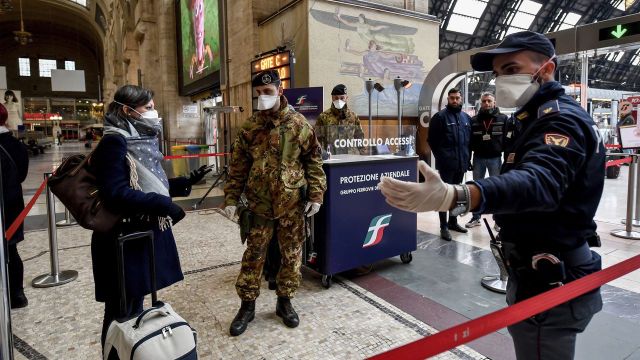
Police officers and soldiers check passengers leaving from Milan main train station, Italy, Monday, March 9, 2020. (Claudio Furlan/LaPresse via AP)
This underscores the politically criminal character of repeated calls from European governments for a return to work in coming days and weeks. With Spain having already ended shelter-at home orders for industrial workers on Monday, Italian workers are gradually returning to work with a final target date of May 4, and Germany and France have announced a return to work on May 4 and May 11, respectively.
Testifying before the French Senate, the president of France’s Scientific Council, Jean-François Delfraissy, predicted that a return to normalcy would rapidly lead to an explosion of new daily cases, which typically ranged from 2,000 to 4,000 during the lockdown, to 10,000 to 15,000.
This week, a report from France’s National Institutes of Health and Research (INSERM) warned of the dangers posed by return to work orders. “Ending shelter-at-home orders without an exit strategy would lead to a second wave of the pandemic that would completely swamp the hospital sector,” they wrote, adding: “The maximum number of intensive care beds is estimated at over 40 times capacity if there is not a clear strategy after the end of the lockdown.” While French President Emmanuel Macron called for reopening schools next month, experts urge waiting until September.
“We do not yet have a clear vision of how the epidemic will develop in coming weeks,” commented Professor Renaud Piarroux of the Pitié-Salpêtrière hospital in Paris, who said Macron’s call for a return to work on May 11 was “a sort of bet.”
Britain announced a three-week extension of its lockdown put in place on March 23 as public health workers continue to contract and die from COVID-19. Last Sunday, a pregnant 28-year-old nurse, Mary Agyeiwaa Anyapong, died after giving birth by caesarean section. The Nursing Notes organization also refuted government claims that 27 UK medical staff have died, whereas the true figure is 56: “We believe the difference stems from an omission of unregistered staff, locums/agency workers, allied health professionals, and social care.”
In Germany, after a video conference on Wednesday, Chancellor Angela Merkel and the prime ministers of the different German states agreed on a package of measures to gradually reduce the restrictions that have been in place until now to contain the spread of the pandemic.
According to the German government’s decision paper, the “decrees issued so far” such as social distancing regulations and contact restrictions will be “extended until May 3,” but schools are to be gradually reopened from May 4 at the latest. Initially, everyday school life is to begin in the highest elementary school classes, graduating classes and classes that will take exams next year. Also, at universities, examinations are to be held and libraries and archives opened.
In the German retail sector, shops with sales areas of up to 800 square meters will be able to reopen as early as next week, “as well as car dealers, bicycle dealers, bookstores, regardless of the sales area.” Among service providers “where physical proximity is essential, hairdressers should first prepare themselves to resume operations from May 4.”
The Germany government’s central goal, however, is to boost the economy and resume production, especially in the auto industry. The paper complains that in many cases “production problems and production stoppages have occurred in recent weeks independently of ordered closures because essential components were no longer supplied.”
Germany’s federal and state governments are now primarily tasked with supporting the economy by “restoring disrupted international supply chains.”
In order to lull the population into a false sense of security, the paper emphasizes that the restoration of “public life” and “disrupted value chains” must be “well prepared” and “accompanied in each individual case by protective measures in such a way that the emergence of new infection chains is avoided as far as possible.” The aim is “to ensure that health care facilities and nursing staff are fully supplied with medical masks that protect the wearers from infection.”
In other words, federal and state governments are preparing to ramp up the economy and public life and produce an explosion of new cases, even though there is not even a sufficient supply of medically adequate protective masks in the health care system! In fact, more and more hospitals are becoming hotspots of the COVID-19 epidemic. Due to the dramatic lack of protective equipment, more than 2,300 doctors and nurses have already become infected in German hospitals alone, according to the Robert Koch Institute (RKI).
“We must secure the successes we have achieved,” Merkel demanded at a joint press conference with Finance Minister Olaf Scholz (Social Democratic Party—SPD), Bavarian Prime Minister Markus Söder (Christian Social Union—CSU) and Hamburg Mayor Peter Tschentscher (SPD). One wonders what the Chancellor is talking about? Germany recorded over 300 deaths on Tuesday and Wednesday. On Thursday another 248 deaths were reported bringing the death toll to 4,052, far more than the 3,342 recorded in China, the original epicenter of the pandemic.
The policies of European banks and governments are setting them on a collision course with the working class. It was a wave of wildcat strikes and spontaneous walkouts by workers in Italy that forced the initial adoption of quarantine and shelter-at-home orders in Italy that then expanded across Europe. The European Union’s (EU) decades-long record of austerity and health care cuts stands utterly discredited. Nevertheless, banks and major corporations are working closely with the trade unions to plot a return to work to boost profits at the expense of workers’ lives.
While polls in France, Spain and Germany have all shown 80 percent of the population supporting shelter-at-home orders, there is little doubt that the bourgeoisie across Europe would prefer to order masses of workers back to work, and for many to their deaths, as soon as possible.
Merkel is calling for reopening international supply chains, however, under conditions where restarting production depends on reopening plants across southern Europe that were shut down by mass walkouts or strikes.
Last month, the French financial consultancy Rexecode warned of the international impact of “COVID-19 confinement of parts of northern Italy accounting for 55 percent of the country’s industrial production.” It noted, “The weight of Italy in European industrial supply chains far surpasses that of China, and certain countries are especially dependent. In France, textiles and machine tools are the most affected.”
European automakers are among the most exposed to disruptions in European and international supply chains. Volkswagen, Europe’s largest automaker, cited “falling sales and supply chain uncertainty” as the reasons for interrupting production at its plants, while PSA and Renault cited supply disruptions in Spain in their statements reporting their decision to mothball plants.

Workers cannot afford to leave the decision on a return to work in the hands of governments and union bureaucracies whose utter contempt for the lives of the population is an open secret. The resources in the trillion-euro bank bailouts must be impounded and used to finance scientific research, a vast emergency expansion of health care, and full and direct financial support for workers and small businesses impacted by the catastrophe, regardless of nationality or ethnic origins. This requires the unification of the struggles of the working class across Europe on a socialist program.

Coronavirus-driven slump has wiped out 22 million jobs in the US

Niles Niemuth

The US Labor Department reported Thursday that 5.2 million more workers had filed for unemployment last week, bringing the total number of claims in the last four weeks to an unprecedented 22 million. This marks the sharpest rise in unemployment ever recorded in the country and equivalent to all jobs created since mid-2009, the beginning of the official recovery from the Great Recession.
The unprecedented job losses come amid a wave of economic figures showing the shattering impact of the coronavirus epidemic on the American and world economy. On Wednesday, the Commerce Department reported the biggest monthly decline in retail sales since the figures were first compiled 30 years ago, 8.7 percent, more than double the previous monthly record, set during the 2008 Wall Street crash. Meanwhile the Federal Reserve reported the biggest decline in industrial production since the shutdown that followed the end of the Second World War in 1946.
Industries hit with full force by the coronavirus lockdowns suffered the worst. The US airline industry has collapsed, with just 4 percent of the typical number of daily passengers when compared to last year, as interstate and international travel has largely come to a halt. Big retailers are going out of business. Best Buy said it would lay off 51,000 store workers, 40 percent of the total, beginning Sunday. J. C. Penney failed to make a $12 million interest payment on debts Wednesday, putting it 30 days from outright default.
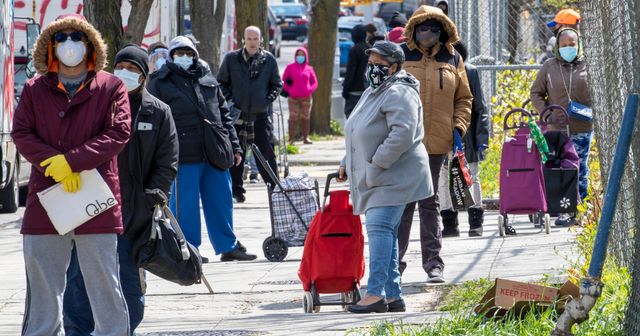
People wait in line at The Campaign Against Hunger food pantry, Thursday, April 16, 2020, in the Bedford-Stuyvesant neighborhood of the Brooklyn borough of New York. (AP Photo/Mary Altaffer)
The mass layoffs come as factories, restaurants, theaters, and most small businesses have been ordered closed by state governors to slow the spread of the deadly coronavirus, which has already infected over 670,000 in the US and killed more than 34,000.
While the states that remain epicenters of the disease—New York, New Jersey, Michigan and Louisiana—are beginning to see some signs that social distancing has eased the growth in the number of cases, there are reports that COVID-19 is now beginning to hit other states as well as small cities and rural areas of the country, resulting in the closure of slaughterhouses and meat processing plants.
One month into criminally belated government initiatives to contain COVID-19, millions of people are desperate for money, missing payments on their rent, mortgages, and auto loans as well as credit card and student loan debt. Thousands have been lining up for hours in every city and community to receive much needed food aid, including members of the middle class who have never before had to rely on such support.
Economists project that the US and the world economy will suffer the worst contraction since the Great Depression of the 1930s. Retail sales and industrial output in the US have already collapsed by record amounts and are expected to fall further even if social distancing measures are lifted.
Even though the unemployment figures reported so far are unprecedented, suggesting a current unemployment rate of 17 percent, they still do not capture the scope of the crisis facing the working class and small business owners. The weekly filings were limited by the Easter holiday weekend and many workers still report that they are unable to file a claim due to overloaded call centers, crashing websites and archaic application systems. Contractors and workers in the “gig economy” face long delays in gaining access to unemployment payments, while millions of undocumented workers have no hope of any sort of government assistance.
People who are fired from their jobs are ineligible for any unemployment and those who have recently moved from one state to another are having great difficulty filing. Every hurdle is placed in the way of workers to jump over in order to receive a few hundred dollars every week. It is estimated that as many as 35 million people could lose employer-paid health insurance due to the mounting layoffs. Nothing is being done for anyone who is not already rich.
The $349 billion Paycheck Protection Program, which was ostensibly aimed at helping small business owners keep their employees on the payroll, has already been exhausted, leaving tens of thousands of business owners and their employees in the lurch. Meanwhile among the “small businesses” which have received multimillion-dollar loans through the program are giant conglomerates including Potbelly Corporation, which employs 6,000 people and operates 474 sandwich shops in the US and internationally, and Ruth’s Hospitality Group, which operates a chain of more than 100 steakhouses across North America and Asia.
Under these conditions millions are being given the option of staying home and starving or going to work and risking illness and death.
President Donald Trump, who yesterday released his plan for reopening the American economy, is seeking to use the desperation of workers and the middle class to his advantage to force open the economy after funneling trillions of dollars to the big banks and corporations, a move that will lead to tens of thousands more deaths from COVID-19. Protests organized by Trump supporters against Democratic governors in Michigan, Kentucky and North Carolina and other states demanding an end to the lockdowns are a particularly backward expression of the very real desperation millions now confront.
Workers should reject with contempt this framework and fight for the democratic distribution of trillions of dollars in social aid to every section of society which is being devastated by the pandemic.
What is required to meet the interests of workers without sacrificing their lives and the lives of their families to the profits of Wall Street?
1. Nationalize the banks and large corporations, redirecting the trillions which are being funneled to the rich to fully support workers and small businesses for the duration of the pandemic.
The $6 trillion bailout authorized by the misnamed CARES Act, most of which has been funneled immediately to Wall Street, would be enough to provide every man, woman and child in America with a check of roughly $18,000. Instead, workers have had to wait weeks for a mere $1,200 stimulus, with many more left to wait months for any sort of cash aid. Thanks to a tax provision of the act, the average multimillionaire who owns a pass-through company will receive $1.6 million in stimulus. Billionaire Amazon CEO Jeff Bezos has cashed in on the pandemic, increasing his net worth by $23.6 billion, enough to give every Amazon worker a bonus of $31,000. The claim that there is no money for the needs of the working class has never been more of a lie.
2. No return to work for nonessential businesses, and safe working conditions guaranteed for all those who work in essential jobs until the pandemic is over.
If the lives of hundreds of thousands around the world are to be saved the coronavirus must be contained, until a vaccine is developed people have to maintain social distancing measures, which means keeping most businesses closed. Workers in hospitals, grocery stores, food processing, transportation and logistics must be given every possible protection from the coronavirus and provided full pay and have all health care costs covered if they get sick.
3. Full funding for testing, tracing and quarantine.

Testing for COVID-19 and efforts to control its spread are still criminally lacking in the United States. Hundreds of billions must be spent on developing, distributing and carrying out tests and subsequently tracing contacts of those who test positive and provide them with safe quarantine conditions. The answer to the historic economic crisis sweeping across the globe is not an immediate return to “normalcy” but a mass independent movement of the working class, leading behind it the best elements of the middle class, fighting for a reorganization of society to meet human need, not the rapacious and murderous needs of the profit system.

16 Apr 2020

Women PeaceMakers Fellowship Program 2020 for Women Building Peace (Funded to USA)

Application Deadline: 1st May 2020 at 11.59pm (-7 GMT).

Eligible Countries: International

To Be Taken At (Country): Institute for Peace and Justice (IPJ) at the University of San Diego’s Kroc School of Peace Studies, USA.

About the Award: Four Women PeaceMakers and four individuals, who represent international non-governmental organizations, will be selected as a cohort to build mutual learning and stronger partnerships between women peacebuilders and international organizations who are working to end cycles of violence.
During the 12-month Fellowship, the program will focus on Pillar II of the Kroc IPJ’s Peace Partnership Compact: Equitable Funding Partnerships, to strengthen and build more effective partnerships between local and global peacebuilders.
For 2019, the focus of the Program is on strengthening Funding Partnerships Between Local Women Peacebuilders and International Funders

Type: Fellowship (Professional), Training.

Eligibility: Applicants for the Women PeaceMakers fellowship must:
  1. Have worked for 5-10+ years as a peacebuilder and have worked directly in their local peacebuilding contexts;
  2. Demonstrates peacebuilding/peacemaking skills and attitudes;
  3. Be in a position to participate in all activities during the 12-month fellowship and apply what is learned at the conclusion of the residency program;
  4. Has worked directly with an international or national funder;
  5. Demonstrate local credibility and a strong social network within her country/community of practice;
  6. Speak sufficient English to relate personal experiences;
  7. This year we are looking to bring on an American (from the United States) Women PeaceMaker – such applicants are highly encouraged to apply.
Selection Criteria: International partners will likewise be selected based on their work in and support of more inclusive peace processes.

Value of Award:
  • There is no cost to participate in the Women PeaceMakers Program. Selected peacemakers will receive a per diem to cover basic living costs during the residency. This funding is to be used for meals and incidentals, and any local transportation needs apart from residency activities.
  • The program provides all funding related to securing a visa, travel and airfare to and from San Diego at the beginning and end of the residency, and lodging throughout the seven weeks.
  • The program encourages applicants to seek supplemental funding from other sources if needed, although the funding provided by the IPJ for those selected will be sufficient for the full seven weeks.
  • Housing will be provided at La Casa de la Paz, ​”The House of Peace,” on the campus of the University of San Diego in California
Duration of Program: 12 months
  • Fellowship dates: October 2020 – October 2021
  • San Diego Residency dates: November 7 – December 11, 2020
How to Apply: Apply Now
Please see the Program Webpage (Link is below) for information on Application.

Visit the Program Webpage for Details

Schwarzman Scholars 2021/2022 (Fully-funded Masters Scholarship) for International Students

Application Deadlines: 22nd September 2020 at 11:59 PM, Eastern Daylight Time (EDT).

Eligible Countries: All (except Mainland China, Hong Kong, Taiwan, and Macao)

To be taken at (country): Tsinghua University, Beijing, China (students live and study together on the campus of Schwarzman College, a newly-built, state-of-the-art facility, where all classes will be taught in English.)

Fields of Study:  Masters degree programmes in one of these three disciplines:
  • Public Policy
  • Economics and Business
  • International Studies
What will be taught: Business, Social sciences, Leadership skills

About the Award: The Schwarzman Scholars program will give the world’s best and brightest students the opportunity to develop their leadership skills and professional networks through a one-year Master’s Degree at Tsinghua University in Beijing – one of China’s most prestigious universities.
With a $350 million endowment, Schwarzman Scholars will be the single largest philanthropic effort ever undertaken in China by largely international donors. The extraordinary students selected to become Schwarzman Scholars will receive a comprehensive scholarship.
Schwarzman Scholars was inspired by the Rhodes Scholarship, which was founded in 1902 to promote international understanding and peace, and is designed to meet the challenges of the 21st century and beyond. Blackstone Co-Founder Stephen A. Schwarzman personally contributed $100 million to the program and is leading a fundraising campaign to raise an additional $350 million from private sources to endow the program in perpetuity. The $450 million endowment will support up to 200 scholars annually from the U.S., China and around the world for a one-year Master’s Degree program at Tsinghua University in Beijing, one of China’s most prestigious universities and an indispensable base for the country’s scientific and technological research. Scholars chosen for this highly selective program will live in Beijing for a year of study and cultural immersion, attending lectures, traveling, and developing a better understanding of China.

Type: Masters Degree

Offered Since: 2015

Eligibility: The following criteria must be met by all candidates:
  • Undergraduate degree or first degree from an accredited college or university or its equivalent. Applicants who are currently enrolled in undergraduate degree programs must be on track to successfully complete all degree requirements before orientation begins in 1 August 2021. There are no requirements for a specific field of undergraduate study; all fields are welcome, but it will be important for applicants, regardless of undergraduate major, to articulate how participating in Schwarzman Scholars will help develop their leadership potential within their field.
  • Age. Applicants must be at least 18 but not yet 29 years of age as of 1 August 2021
  • Citizenship. There are no citizenship or nationality requirements
  • English language proficiency. Applicants must demonstrate strong English Language skills, as all teaching will be conducted in English. If the applicant’s native language is not English, official English proficiency test scores must be submitted with the application. Acceptable test options are:
    • Test of English as a Foreign Language (TOEFL PBT)
    • Internet-based Test of English as a Foreign Language (TOEFL iBT)
    • International English Language Testing System (IELTS)
    This requirement is waived for applicants who graduated from an undergraduate institution where the primary language of instruction was English for at least three years of the applicant’s academic program.
Number of Awardees: Up to 200 exceptional men and women will be accepted into the program each year.

Value of Scholarship: 
  • Semi-finalist interview expenses, such as economy class air or train travel, group meals and one night in a hotel if needed, will be arranged and covered by the program.
  • Expenses for successful Schwarzman Scholars are also FULLY covered by the program.
  • It will include Tuition and fees, Room and board, Travel to and from Beijing at the beginning and end of the academic year, An in-country study tour,
  • Required course books and supplies, Lenovo laptop and smartphone, Health insurance, and
  • A modest personal stipend.
Duration of Scholarship: 1 year

How to Apply: There is no fee associated with applying to the Schwarzman Scholars program. To apply, you will need to complete and successfully submit an online application form, including all required documents and essays before the deadline date.
Visit the official website (link below) for complete information on how to apply to this scholarship programme.

Visit Scholarship Webpage for details

Google Journalism Emergency Relief Fund 2020 for Small & Medium News Organisations

Application Deadline:  29th April 2020 at 11:59 p.m. PT

About the Award: The Fund’s aim is to support the production of original journalism for local communities in the face of the COVID-19 pandemic. Operating globally, it will provide an easily-accessible route to financial assistance at this critical time.

Type:  Grants

Eligibility:  
  • Small and medium-sized news organizations producing original news for local communities during this time of crisis.
  • Eligible applicants must have a digital presence and have been in operation for at least 12 months.
  • The Fund is targeted at newsrooms employing between 2 – 100 full-time employee (FTE) journalists.
    • Local publishers employing more than 100 FTE journalists can still apply and will be considered subject to Google’s discretion, based mainly on differing needs in different countries/regions.
  • Organizations must be incorporated or registered in one of the eligible geographies. Unincorporated organizations must be based in one of the eligible geographies.
  • Eligible applicants need to have a focus on core news provision, i.e. not lifestyle, sports, business-to-business.
  • Eligible applicants can include for-profit or nonprofit traditional news organizations, digital natives, radio and/or TV broadcasters.
  • Government-owned entities and individuals are not eligible to apply.
Selection:  Initial selection of proposals will be done by teams of Google staff who have knowledge and experience in digital publishing and journalism in the regions detailed above. Applicants will then be contacted by email and offered funding before being asked to sign a funding agreement with Google. Selected applicants will then be required to enroll as a Google partner (if they are not already) in order to receive the funding.

Number of Awards:  Not specified

Value of Award:  Funds will be disbursed in one installment, in US dollars or Euros depending on region. Funding amounts will range from the low thousands for small hyper-local newsrooms to low tens of thousands for larger newsrooms, with variations per region.

How to Apply: Apply
You will be asked via our online application form above to provide basic information about your publication and overall organization (if applicable) and inform us of how the funds will be spent. By submitting an application, you accept and agree to the Journalism Emergency Relief Fund Terms and Conditions. Submissions will be reviewed and funded on a rolling basis. All applicants will be notified of the status of their application by email as soon as possible. Please note we expect a high volume of applications so we cannot guarantee a specific response time but will guide you as best we can along the way. It is our intention to provide funding as quickly as possible.

Visit Award Webpage for Details

Important Notes: Please note that certain eligible geographies may have specific laws that apply to the receipt of funding from the Journalism Emergency Relief Fund and you are responsible for your compliance with any such laws, including, for example, by obtaining all necessary permissions from relevant authorities prior to receiving funding.

Homeless, Hungry, Waiting for Government Help

Eve Ottenberg

A rent moratorium is knocking on Washington’s door. By early April almost 17 million people lost their jobs and 31 percent of renters did not pay. How could they? They have no income. A deadly pandemic has shut down businesses. People are afraid to go to the grocery store because of infection – the grocery store! That is, those who have money for groceries and aren’t lining up at the local food bank.
How are these 17 million supposed to pay rent, when before Covid-19 struck, a high percentage of them had barely $400 for an emergency? The idea that the $1200 from the feds will see them through more than one month’s rent and living is laughable. The unemployed either need a monthly universal basic income or a rent moratorium for the duration of the plague. Otherwise the U.S. will see tens of millions of people booted out on the streets.
A government that can bail out a fatally cost-cutting and incompetent corporation like Boeing – which was headed for bankruptcy before the pestilence, due to its negligent homicide of hundreds in two plane crashes – to the tune of billions of dollars, such a government can bail out its citizens, the innocent victims of an economic collapse they did nothing to cause.
Some states and localities have stepped up. They have instituted rent moratoriums. But these are mostly for a mere month or two, and this patchwork safety net has lots of holes. Some states have only stopped evictions for a few weeks; as of late March, many of these moratoriums ended after April 1. Just recently the New York City mayor called for a pause of rent increases on rent stabilized apartments. While this is helpful, it just doesn’t cut it. People have lost their jobs, can’t afford food and line up for miles at food banks. Rents, not just increases, need to be suspended.
Surprisingly in Florida, where the governor has been otherwise very behind-hand, a 45-day suspension of evictions and foreclosures went into effect on April 2. But California shrank from such a statewide eviction ban. Instead, the governor empowered local governments to do so. Some have, some haven’t. Meanwhile landlords want that $1200 the feds are handing out. But food and medicine come first. Nationally, evictions should be halted. A federal policy is needed.
Along with rent, people can’t pay for water and utilities. Almost 90 cities and states in the U.S. have stopped water shutoffs. The seven states are: Connecticut, Illinois, Louisiana, New Jersey, New York, Pennsylvania and Wisconsin. But few water departments will reconnect those they’ve already shut off; people in those impoverished households will have to find another way to wash their hands. For utilities, suspensions of cutoffs have been ordered in 23 states: California, Colorado, Connecticut, Illinois, Iowa, Kansas, Kentucky, Louisiana, Maine, Maryland, Massachusetts, Mississippi, New Hampshire, New Jersey, New York, North Carolina, Ohio, Pennsylvania, South Carolina, Tennessee, Texas, Virginia and Wisconsin. In other words and not surprisingly, utilities have zoomed ahead of landlords in recognizing their customers’ dire circumstances during a plague-caused lockdown. Or maybe real estate developers just have more clout in statehouses.
Even if the lockdown comes off soon, and some people can return to work in a month, they will still have unaffordable, outstanding bills. If these are not forgiven, it is hard to see how there will be any recovery. Landlords will evict millions, and millions will lose water and electricity. But so far, the Trump administration seems far more concerned with bailing out rich corporations that bet wrong in the stock market, or with bailing out the stock market itself. The message is clear: if you’re not wealthy, expect crumbs from the federal government, namely a one-time payout – two times, if we’re lucky – and an extension of unemployment benefits.
These actions are better than nothing, but the prospect of real help for the tens of millions who need it is not good. Republican senators begrudge a measly $600 unemployment increase, fretting that it will incentivize workers to stay home. These Scrooges have never had to scrimp by on a nearly empty checking account. In fact, several senators dumped stock after a classified briefing on coronavirus, violating a 2012 law. Nothing could make their priorities clearer: their stock portfolios come first, their constituents’ desperate need for food, shelter, water, heat and electricity – a distant last.