18 Apr 2020

Canadian elite promotes anti-China campaign over coronavirus

Roger Jordan

Canadian politicians, ex-diplomats, and academics are playing a leading role in an international campaign to blame China for the global coronavirus pandemic. This reactionary initiative has a two-fold purpose: to divert public attention away from Western capitalist governments’ disastrous response to the pandemic, which has manifestly prioritized investor profit over human lives; and to further expand Canadian imperialism’s military-strategic partnership with Washington in preparation for intensified great-power conflict, including war, with China.
US President Donald Trump led the way this week with his denunciations of China, blaming Beijing for allegedly failing to inform the international community quickly enough about the coronavirus. Trump also gave succour to conspiracy theories about the virus having been released from a Chinese high security lab and accused the World Health Organization of being under Beijing’s thumb. He used this latter claim to justify his criminal decision to slash Washington’s contributions to the WHO in the middle of a pandemic—a decision that risks the lives of millions of people worldwide.
Just hours before Trump launched his attack on the WHO, the Macdonald-Laurier Institute (MLI), an Ottawa-based think-tank with close ties to Canadian policy-making circles, published an open letter that asserted “the current global crisis has been caused by the (Chinese) regime.” The letter, signed by right-wing East European and British politicians and dozens of so-called China experts, was published by the MLI in conjunction with the London-based Henry Jackson Society, notorious for its ties to US intelligence agencies, and the Prague-based European Values Center for Security Policy. It termed the coronavirus China’s “Chernobyl moment,” adding, “The roots of the pandemic are in a cover up by CCP (Chinese Communist Party) authorities in Wuhan.”
There are undoubtedly criticisms to be made of Beijing’s response to the coronavirus. But the reality is that it is the criminal negligence of the major imperialist powers, Canada included, that is responsible for a pandemic—both long foreseeable and long foreseen—having a catastrophic impact on the lives and livelihoods of working people across Europe and North America.
If the pandemic has spread so rapidly, it is because the Trump administration, the Trudeau Liberal government, and the European powers failed to respond in a timely manner to the early warnings issued by China and the WHO. The Chinese authorities released the full sequencing of the virus on January 13, just two weeks after the first cases of an unknown lung disease were reported to the WHO. Although cases were reported in over a dozen countries by the end of the month, both the Trudeau and Trump governments continued throughout February to downplay the threat of a pandemic.
Only when it became clear in March that the coronavirus was spreading out of control in North America, and a number of strikes and protests by workers demanding more protection on the job had broken out, did Ottawa and Washington adopt social distancing measures and Canadian provinces and US states begin to order school shutdowns, later expanded to “non-essential” businesses. However, there was no emergency investment made by either Ottawa or Washington in strengthening their countries’ dilapidated and overstretched health care systems, or even anything comparable to the resources mobilized in China, where new hospitals were built in a matter of days to treat the sick.
As soon as the open letter was released, interim Conservative Party leader Andrew Scheer, the two leading candidates to succeed him, Peter MacKay and Erin O’Toole, and Conservative defence policy spokesman James Bezan rushed to sign it. From the start, a leading promoter of the letter was former Liberal Justice Minister Irwin Cotler. Two days before the open letter was officially launched, an article Cotler co-wrote with his former chief of staff and fellow letter endorsee, Judith Abitan, appeared in the Times of Israel, under the title “Xi Jinping’s China did this.”
These right-wing figures are attempting to use the pandemic as a pretext to intensify a long-running anti-China campaign that is intimately connected with the Trump administration’s aggressive anti-Beijing policy, but which enjoys widespread bipartisan support in Washington and increasingly in Canada.
This is underscored by a conveniently timed interview with US Secretary of State Mike Pompeo that also appeared this week in the hard-right Toronto Sun. Pompeo decried China’s handling of the coronavirus, before getting down to what was his real concern. He urged Canada to follow Trump’s “America First” lead and reduce its reliance on supply chains dependent on Chinese-based production.
He then turned to the issue of Chinese tech giant Huawei’s involvement in Canada’s 5G network. “We think that installing Huawei equipment in a country’s telecom infrastructure presents an enormous national security risk,” he declared. “This is an entity controlled by the Chinese government.” Pompeo went on to warn that the US would only transfer intelligence to allies through networks they know are “secure,” an implicit repetition of the threat to downgrade US-Canada intelligence sharing if Ottawa does not exclude Huawei from Canada’s 5G network.
While the Trudeau government has repeatedly delayed issuing a final ruling on Huawei, it has consistently lined up behind Washington’s ever more aggressive economic and military-geostrategic offensive against Beijing. In 2017, the Liberal government declared China to be one of the principal “global threats” confronting Canada in the 21st century, alongside Russia, as it announced plans to increase military spending by more than 70 percent by 2026.
The Liberals, with pivotal support from the trade unions, also negotiated an updated version of the North American Free Trade Agreement with Trump so as to consolidate North America as a US-dominated trade war bloc against China and the other overseas rivals of US and Canadian imperialism. The Trudeau government has also overseen the expansion of Canadian Armed Forces’ involvement in the US’ provocative military build-up in the Asia-Pacific region.
Moreover, Trudeau personally approved the RCMP’s Dec. 2018 arrest and detention of Huawei Chief Financial Officer Meng Wanzhou at Washington’s behest on trumped-up charges of breaching its illegal economic sanctions against Iran.
Underscoring Trudeau’s determination to preserve Canadian imperialism’s strategic partnership with Washington at all costs, the Prime Minister deliberately avoided making any criticism of Trump’s criminal decision to suspend funding to the WHO. Instead, he uttered a meaningless phrase about Canada’s determination to promote international collaboration in combatting the virus. It was left to the Minister of International Development, a second-rank figure in the government, to meekly note Canada’s “disappointment” at the White House’s move.
Notwithstanding the Trudeau government’s firm commitment to the Canada-US strategic partnership, sharp differences persist within the Canadian bourgeoisie over its China policy. The support of virtually the entire leadership of the Official Opposition for the open letter castigating Beijing is part of a long-running campaign of anti-China agitation that has also targeted the Liberal government’s supposed failure to adopt a hardline stance towards Beijing.
Prior to last year’s federal election, Scheer delivered a keynote foreign policy address, received with enthusiasm in ruling circles, that called for a “total reset” of Canada-China relations. He demanded Ottawa withdraw from the China-led Asian Infrastructure Investment Bank; pledged, à la Trump, to file a complaint against Beijing at the World Trade Organization for “unfair trading practices”; and vowed Canada, under a Conservative government, would join the US-led ballistic missile defence shield. The aim of this “shield” is to enable US imperialism to wage a “winnable” war against its nuclear-armed rivals, above all Russia and China.

From the early stages of the coronavirus pandemic, the Conservatives and their accomplices in right-wing media outlets like the National Post sought to foment anti-China sentiment in their criticisms of the Trudeau government. While they have railed against the Trudeau government for not joining Trump in imposing a travel ban on China in late January, they have, naturally enough, scrupulously avoided mention of the austerity policies, pursued by federal and provincial governments of all stripes for decades, that have ravaged the health care system and left it totally unprepared to deal with the pandemic. Nor have they made an issue of the astonishing fact that the federal government only bothered to write the provinces on March 10, over two months after China notified the international community about the virus, to inquire about their medical supply inventories and possible shortages.

Australian ruling elite seizes on pandemic to demand harsh economic restructuring

Mike Head

Big business and its governments in Australia are not just pushing for a premature return to work amid the worsening global COVID-19 pandemic, regardless of the obvious dangers to working-class lives. They are demanding a complete economic restructuring to accelerate the decades-long assault on social spending and workers’ jobs, wages and conditions.
“Never let a good crisis go to waste,” Australian Financial Review senior writer John Kehoe declared yesterday, invoking the phrase made infamous by British Tory Prime Minister Winston Churchill.
In fact, the escalating drive for a rapid reopening of workplaces, even as the international death toll continues to soar, and Australia’s deaths near 70, is bound up with a bid to use the emergency to impose drastic cuts to working class conditions as quickly soon as possible.
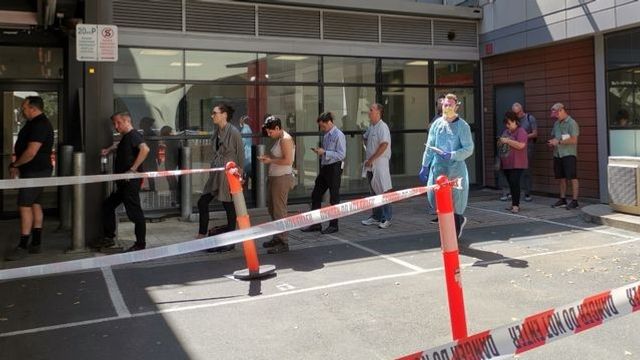
People queuing for coronavirus tests at Royal Melbourne Hospital
In increasingly rapacious language, the ruling elite is insisting that the coronavirus crisis provides a golden opportunity to pursue a brutal agenda, while introducing repressive measures, such as mass mobile phone surveillance, to monitor and suppress working-class unrest.
There must be no return to any sense of “business as usual,” Prime Minister Scott Morrison declared on Thursday, following the latest meeting of the bipartisan “national cabinet” of federal, state and territory leaders that currently runs the county by decree.
His Liberal-National government’s previous catch cries of securing a business “snap back” after “hibernation” have been replaced by calls for an aggressive “pro-growth agenda.”
Election promises would have to be ditched, Morrison said ominously. Nervous of the public response, he refused to specify, but that would certainly include slashing social programs to pay off the estimated $1 trillion government debt incurred by bailing out big business over the past month.
Yesterday’s Australian Financial Review editorial described “the coming recession” as a “burning platform.” It would be the launching pad for a multi-pronged program of expanded corporate tax cuts, more business de-regulation and the transformation of industrial relations to entrench the slashing of pay and conditions agreed to by the trade unions over the past month.
Perversely, the ruling class sees the international health disaster as a chance to inflict an historic assault on the working class. Such is the ruthless logic of the private profit-driven capitalist system that has failed to avert such long-predicted pandemics.
The editorial decried that the failure of one government after another to prosecute the “productivity drive based on enterprise bargaining” launched by the Keating Labor government and the unions in the 1990s.
Every government over the past two decades, from the Howard Liberal-National Coalition government of 1996 to 2007, and the Greens-backed Rudd-Gillard Labor governments of 2007 to 2013, to the current Coalition government, first under Tony Abbott and then Malcolm Turnbull, has tried but failed to deliver in the eyes of the financial elite.
Likewise, today’s editorial in the Australian, the Murdoch media flagship declared: “For two decades, Australia and its political leaders have been policy complacent—yet, at times, lucky, insulated, distracted, dysfunctional and exceptional. As bizarre and confronting as COVID-19 is proving to be, this curious malady presents a breathtaking opportunity for national reinvention.”
Speaking on Melbourne’s 3AW radio yesterday, Morrison was more explicit. He described the global financial breakdown of 2008–09 as “an entrée” compared to the “really bad news” now hitting the economy.
That meltdown a decade ago was exploited to boost corporate wealth to astronomical heights while imposing harsh austerity measures. These included cuts to public healthcare, contributing directly to the criminal lack of resources—testing, personal protection gear, intensive care beds, ventilators and hospital staff—to protect the population from COVID–19.
The new offensive will go far further as the burden of the bailouts is imposed on the working class. Economists are forecasting a federal government budget deficit of more than $100 billion by the 2020–21 financial year. This dwarfs the deficits left after 2009.
Business Council of Australia CEO Jennifer Westacott spearheaded calls at an Australian Financial Review Business Summit last month for governments and employers to exploit the crisis. The demands issued at that summit included massive tax and investment incentives for major corporations, on top of the $200 billion in high income tax cuts already legislation for commencement in 2022.
“And once and for all we need to make it easier to do business,” Westacott insisted. “We must not waste a second of this new level of co-operation in our society to get important things done.”
This “co-operation” referred to the role of Labor and the unions, which have backed all the massive bailout packages provided to big business, together with their provisions for employers to slash pay and conditions. Fearful of the working-class outrage that its agenda will provoke, the corporate elite is relying heavily on them.
This month, Australian Council of Trade Unions (ACTU) Secretary Sally McManus vowed on national television that employers could get “everything you want” by cooperating with the unions. She signed off on a deal with Industrial Relations Minister Christian Porter, who described her as his “best friend forever,” to back the government’s $130 billion wage-subsidy scheme, which gave the government and the employers the green light to slash jobs and conditions.
At the same time, on April 8, the ACTU hailed a Fair Work Commission ruling that altered 99 industrial awards to allow employers to force workers to take their annual leave at half their usual rate of pay and coronavirus-affected workers to take two weeks unpaid pandemic leave.
This week, McManus issued a statement hypocritically complaining that companies were asking the Morrison government for Fair Work Act regulations to permit them to force workers to agree to tear up their work agreements with just a day’s notice. But that power was granted by the legislation that Labor and the ACTU helped pass.
Last Thursday’s national cabinet meeting said one pre-condition for lifting pandemic restrictions, in just four weeks, was the introduction of a phone app to enable the government to track everyone’s movements, supposedly to contact anyone who has been in close proximity to a coronavirus victim.
Morrison yesterday refused to rule out trying to make this system of mass surveillance compulsory, although the public outcry forced him to retreat today to making it “voluntary.”
In the name of belatedly carrying out the testing and careful contact tracing that was required months ago, the governments, Coalition and Labor alike, are preparing police-state measures to suppress resistance by workers to being pushed back to work under these unsafe and transformed conditions.
Events in northwest Tasmania over the past few days, where eight people have died and thousands more have been placed in quarantine, provide another warning of the dangers facing workers. They also give an indication of the opposition building up, including among the health workers on the frontline of the pandemic, to the disastrous official response to the crisis.
More than 150 staff at the Mersey community hospital in Devonport wrote to the state government complaining of a “breakdown of trust” after a senior emergency doctor was told not to speak to staff about the hospital’s ability to manage the coronavirus outbreak.
The letter said the government’s promises of personal protective equipment and stronger infection control protocols were not delivered, with “an enormous, snowballing effect on staff wellbeing and anxiety.” The transfer of patients from hospitals in nearby Burnie, which had to be closed because of widespread COVID-19 infections, had “caused major unrest and undue stress” to staff and patients.

The hospital workers’ letter epitomises the determination of workers to protect themselves and the population from the catastrophic operations of the ruling class, and poses the necessity for the working class to take charge of society to reorganise it on the basis of human need, not private profit.

Ukrainian capital Kiev engulfed in smog from wildfires near Chernobyl

Jason Melanovski & Clara Weiss

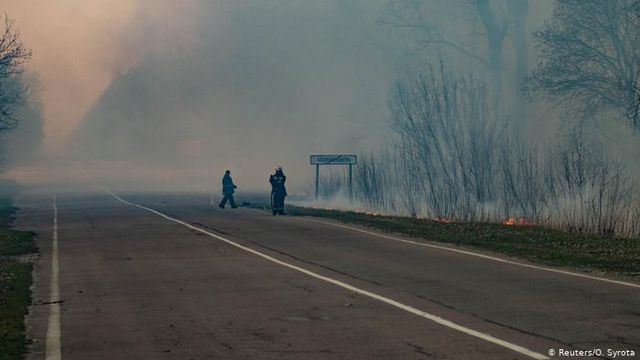
Since early April, wildfires have raged in the exclusion zone surrounding the Chernobyl nuclear power plant. Although temporarily extinguished on Tuesday, April 14, they reignited by Wednesday.
The fires broke out on April 4 within just 1 km of the defunct Chernobyl nuclear power station, according to Greenpeace Russia. While Ukrainian authorities blamed the fires on a local 27-year old man, the reasons for the outbreak remain unclear.
Smog over Kiev [Credit: AFP/Sergei Supinsky]
The Chernobyl nuclear power station and the nearby town of Pripyat have been located in a 30 km exclusion zone since 1986 when Chernobyl’s Reactor No. 4 exploded causing the worst nuclear accident in history, spewing over 50 tons of radioactive material into the atmosphere.
According to the New York Times, most of the radiation released by the 1986 disaster had settled into the soil. However, some was also absorbed by the roots of moss, trees and other vegetation in the surrounding area. The wildfires brought it to the surface, spreading radioactive particles in the smoke. Radiation readings close to the wildfires were elevated in the first half of April.
Initially, the wind carried the smoke mostly toward rural areas of Russia and Belarus. For the past week, however, smoke has also clouded the Ukrainian capital Kiev, home to 3 million people and located just 60 miles (100 kilometers) from Chernobyl. The smoke has become so thick that Kiev is now considered the city with the worst air pollution in the world, outstripping even cities like Shanghai.
While authorities have insisted that radiation levels in the capital were within the normal range, they urged residents to drink a lot of water, and stay indoors. They also advised the population to keep their windows shut and cover them with wet fabrics when opening them. The country is currently under lockdown because of the COVID-19 pandemic, minimizing to some extent the exposure of the population to the smoke.
There have been 4,662 confirmed cases of COVID-19 and 125 deaths in Ukraine.
There are many indications that authorities are downplaying the scale of the disaster. According to ABC News, 1,000 firefighters backed by aircraft have now been deployed to contain the fire, up from 450 a week ago. Firefighters have been forced to work 24-hour shifts within the Chernobyl contamination zone without radio-protective equipment. Photos circulating on Facebook showed exhausted firefighters sleeping on the ground without protective equipment. It was also reported that they were not even provided accurate maps of the exclusion area.
Throughout the ordeal, Ukrainian authorities have maintained they had the “situation under control” and that the fires had caused no increased risk of radiation to surrounding areas including the capital of Kiev which is located just 100 km (62 mi) from Chernobyl. On Monday, Volodymyr Demchuk, a senior official from Ukraine’s emergency service stated that “There is no threat to the Chernobyl nuclear power plant, waste fuel storage or other critical facilities.”
However, on April 4, the Ukrainian government was caught deliberately lying about the scale of the fires claiming that they were a mere 20 hectares in size, while satellite imagery from Greenpeace showed the fire covered around 12,000 hectares. Other satellite images taken by NASA Worldview and confirmed by Reuters also proved fires had extended far into the exclusion zone.
Rashid Alimov of Greenpeace Russia also contradicted the government’s claim that the fires posed no radiation risk by stating the fires could release radionuclides or atoms that emit radiation into the atmosphere. “A fire approaching a nuclear or hazardous radiation facility is always a risk,” Alimov said.
On April 5, just two days after the start of the fire, Yegor Firsov, head of Ukraine’s state ecological inspection service, posted on Facebook a video with a Geiger counter showing radiation levels at the fire 16 times above normal. According to Greenpeace, the fire spread to at least 20,000 hectares, the equivalent of 7 percent of the area.
The government’s brazen lies were further exposed by Chernobyl tour operator leader Yaroslav Yemelianenko who posted on Facebook that the fires were now only a kilometer from the station itself and around 2 kilometers from a site containing radioactive waste. He added that “The local authorities report that everything is under control, but in fact the fire is rapidly spreading across new areas.”
Yemelianenko also appealed to President Volodmyr Zelensky for help and suggested that Zelensky’s incompetence in dealing with the fires was a result either of the cabinet “not being told the real situation, or they’ve chosen the Soviet policy of hushing it up, as they did in ’86.”
The haphazard and self-serving response from the Zelensky government mirrors the behavior of both the capitalist and Stalinist regimes that have preceded him.
The scale of the disaster in 1986 continues to be deliberately downplayed and tens, if not hundreds, of thousands of people affected by it have been left without adequate medical and financial support.
A 2006 United Nations report contends that the Chernobyl accident caused just 56 deaths, but the Ukrainian government continues to pay 35,000 pensions to spouses of victims of the disaster. However, the historian Kate Brown spoke to Ukrainian scientists who estimated that at least between 40,000 and 150,000 people died in Ukraine alone. The radioactive materials also spread widely into Belarus and Russia, contaminating tons of milk and other produce that were sold in the Soviet Union at the time.
The fact that firefighters are now forced to work around the clock shifts without radio-protective equipment is an indictment of both Zelensky and the previous capitalist regimes. It is well known that wildfires occur regularly in the area surrounding Chernobyl. Yet there was clearly no plan whatsoever to contain, let alone, prevent another outbreak of fires around the world’s most dangerous radioactive site.
While the initial explosion at Reactor No. 4 took place over 30 years ago, the sarcophagus that was constructed around it in the years immediately following the accident now faces “the high probability of collapse” and is scheduled to be dismantled by 2023. The sarcophagus itself was covered by a “New Safe Confinement structure” in 2016, which is essentially a shell that will surround the reactor while the sarcophagus is dismantled and the area is remediated. Scientists estimate that radiation remediation efforts will last until 2065. Ukrainian governments have turned much of the area immediately surrounding the site of the disaster into a tourist attraction.

Calls for early reopening of UK schools met with widespread opposition

Tom Pearce

Government ministers are now considering beginning a phased reopening of schools next month amid the worsening coronavirus pandemic. This follows a study by university researchers released earlier this month calling for schools to reopen “as soon as practical.”
According to the Times, the plan is for primary schools to start reopening along with nurseries in a “regionalised approach,” starting with those in areas outside coronavirus hot spots such as London and Birmingham. Gavin Williamson, the Conservative government’s education secretary, wants schools to reopen “in tandem” with changes to government advice about people going back to work. But there are reports that “some ministers are pushing for pupils to return before half-term next month.”
This week, Denmark became the first European country to start reopening its schools, despite parents refusing to send their children into an unsafe environment.
Labour leader Sir Keir Starmer has weighed into the debate and said that school re-openings should be prioritised in any end to the lockdown. The new leader cites concerns regarding the widening gap between disadvantaged pupils and the more privileged. The real concern, however, is that Labour be seen to be in the forefront of calls to end the lockdown so as to revive the economy and restore Labour’s reputation as the friend of business and finance.
The safety of teachers continues to be ignored by politicians. The National Education Union wrote to Prime Minister Boris Johnson calling for an end to speculation on school reopenings, knowing that no answer will be forthcoming. Dr. Patrick Roach, general secretary of the National Association of Schoolmasters Union of Women Teachers, said that people would be “horrified” if schools were used as a testing ground for the easing of restrictions.
Teachers need protection more than ever after reports of three teacher deaths from COVID-19. Primary head teacher Wendy Jacobs died at the end of March in Barrow-in-Furness in Cumbria. Last week, a 35-year-old secondary teacher, Emma Clarke, contracted the virus and died in Runcorn, Cheshire. Neither had previous complications. Kate Fox, 56, a literacy teacher from Birmingham, died after complications. This is despite government guidance stating, “The scientific advice indicates that educational staff do not require personal protective equipment.”
The current UK guidance states that PPE “is needed by medical and care professionals providing specific close contact care, or procedures that create airborne risk, such as suctioning and physiotherapy, for anyone who has coronavirus (COVID-19) and is displaying symptoms.”
The guidance adds, “If you are not providing this care to someone with the virus and displaying symptoms, PPE is not needed. Asymptomatic people (people with the virus but not displaying symptoms) have a reduced viral load and so risk of transmission is considerably reduced.”
None of these assertions matches the experience of workers in public roles. Even medical and care professionals have not been provided with the correct equipment to combat the disease and are dying by the dozens as a result. Public transport workers and postal workers are also dying, even as the government and the employers insist that PPE is not needed. Royal Mail workers have had to fight for PPE and take independent strike action as the unions look on.
Teachers will have to do the same to protect their health. As a result of the changing evidence and deaths, teachers are demanding PPE and insisting that they should not be guinea pigs for a lockdown exit strategy.
The advocates of a reopening of schools often cite a preliminary study led by University College London (UCL) researchers on the impact of school closures on limiting the spread of COVID-19, which looked at the previous virus spread of SARS and MERS. The report was published in the Lancet Child and Adolescent Health. Following its publication, “Send the pupils back for the good of the economy,” was the message peddled by the media outlets.
One co-author of the study, Russell Viner, who is president of the Royal College of Paediatrics and Child Health, stated that the benefit gained from closing schools had to be weighed against the costs. “Children’s education is damaged and their mental health may suffer, family finances are affected, key workers may need to stay home to look after children and vulnerable children may suffer most.”
The study found that school closures “markedly increased the economic cost to the nation, in particular through forced absenteeism by working parents, in the UK, France, Belgium and the Netherlands. Costs have been estimated to be as high as 0.2–1 percent of UK national gross domestic product (GDP) per annum for school closure for 12–13 weeks, or up to 3 percent of GDP for an eight-week closure in US studies.”
Instead of closing schools, the study suggested that head teachers “suspend affected classes or year groups, or changing the school organisation structure to reduce student mixing (e.g., by closing playgrounds, cancelling non-essential activities and meetings, keeping students in constant class groups or classrooms, increasing spacing between students in classes, shortening the school week, and staggering school start and lunch or break times across year groups or classes).”
Some of these points are included in the advice that the UK government is giving schools that are currently looking after key workers’ children and ministers believe they can now be implemented in the phased return.
Despite the report being largely inconclusive due to a lack of scientific evidence on the spread of Covid-19, it didn’t stop the media latching onto the headline that schools should reopen.
Robert Dingwall, a professor of sociology at Nottingham Trent University, told the BBC, “This is an important study that confirms what many of us suspected, namely that the public health benefits of school closures were not proportionate to the social and economic costs imposed on children and their families. It also underlines how the assumptions used in modelling the pandemic may rest on very flimsy foundations in terms of scientific evidence.
“This work suggests that UK schools could, and should, begin to reopen as soon as practicable after the initial wave of cases has passed through.”
This led to uproar and despair from teachers, who have been struggling with the challenge of continuing classes while working from home—with teachers taking to social media and sharing their concerns with the online community. On Twitter @AlwaysComputing wrote, “What have I just seen on the BBC??? Shutting schools isn’t helping apparently. Forget about teachers’ health as well as the children and families. Their suggestion of what we should be doing is just mind blowing.”
@BadleyThomas tweeted, “Why even give this quarter-baked slip of an idea any air time?”
@LanghoLynne10 said: “Not a teacher but a Chair of Govs who cares about the health and well-being of all staff and children this is madness #notonmywatch”
@simonrenshaw wrote, “That report today was crackers. It’s like they didn’t look at the initial report from Imperial. Their modelling was pretty clear what happens when schools reopen. Why anyone would suggest this after such a short period is baffling.”
Teacher and parent Jeremy Taylor wrote to the Guardian asking, “How are pupils meant to travel to school? On crammed buses needed by key workers to get to work, driven by bus drivers, who once again will be put at risk. It’s important that the education community debunks this nonsense.”
Secondary School teacher Caiti Walter wrote, “[A]s long as the advice to the general public remains that we all stay at home, it would be nonsensical to remove social distancing expectations for school staff only.”
Teacher Kate Stockings told ITN news it “wouldn’t be realistic and would be ‘impossible’ in any school to expect students to stay two metres apart. It is dangerous to explore the possibility of opening schools again whilst social distancing measures are firmly in place across society.”

Head teachers have called for an end to the “pretence” that social distancing in schools is possible. Speaking on the BBC Radio 4 Today programme, a headteacher of a London school said, “Schools will open at some point. But what I don’t want is for people to perpetuate the lie, and it is a lie, that social distancing [in schools] is possible, it just isn’t.”

UK government’s herd immunity policy denounced by leading scientist

Robert Stevens

In the last week, the UK has become the centre of the coronavirus pandemic in Europe. On Friday, a further 847 people were announced to have died in hospital, bringing the official death total to 14,576. The dead included the former England soccer international, Norman Hunter, a member of the 1966 World Cup winning squad.
Boris Johnson’s Conservative government did nothing to prepare for the pandemic and instead pursued a policy of herd immunity—which envisaged the mass infection of tens of millions with COVID-19 and the deaths of possibly hundreds of thousands.
The policy was described in the most brutal terms, behind closed doors, at the end of February by Johnson’s key adviser, Dominic Cummings. According to the Times, some Tories present summarised his position as “herd immunity, protect the economy, and if that means some pensioners die, too bad.”
Herd immunity had to be formally abandoned in March due to widespread opposition, including from Imperial College London scientists advising the government. However, it is becoming ever clearer that, aside from imposing a temporary lockdown to prevent the National Health Service (NHS) being overrun, the policy remains in place to this day.
On Friday, the herd immunity policy was denounced by Professor Anthony Costello whose criticisms make clear that nothing substantive, other than the lockdown, has ever been implemented. Costello is professor of international child health and director of the Institute for Global Health at the University College London. From 2015 to 2018, he was director of maternal, child and adolescent health at the World Health Organisation.
Speaking to the Daily Telegraph he said of the government’s response to COVID-19, “It is a total mess and we have been wrong every stage of the way. We have to change our policy and at the moment I don’t hear anything to suggest we are. They keep talking about flattening the curve which implies they are seeking herd immunity, but what we should have done is crush the epidemic and then keep it down.”
Costello warned that the UK would be forced—in the absence of any widespread testing regime—to succumb to eight to 10 waves of coronavirus before the population would be able to achieve “herd immunity.” His prognosis was based on statements by the government’s chief scientific adviser, Sir Patrick Vallance, that herd immunity required the infection of about 40 million of the UK’s 66 million population.
Costello warned, “The recent estimates, even from the chief scientific officer, is after this wave we could have only maybe 10–15 percent of the population infected. So the idea of herd immunity would mean another five, six waves, maybe, in order to get to 60 percent.”
Costello insisted, “We won’t get herd immunity if what the latest models show are correct.” He cited a study by Dutch scientists which found that just 3 percent of the Netherlands population acquired immunity as the pandemic reached its peak there; and research from UCL neuroscientist Professor Karl Friston who believes that on average just 6.4 percent of people in Europe will have acquired immunity—via their own naturally produced antibodies—by the end of the first lockdown phase.
Each wave would lead to mass deaths. Speaking to the House of Commons Health Select Committee yesterday, Costello said, “This [first] wave could see 40,000 deaths [in the UK] by the time it’s over.”
Given that the UK has already recorded nearly 15,000 deaths in hospital and estimates that there could easily be the same number of deaths outside of hospital, even the grim figures provided by Costello could be an underestimation.
Costello said that lockdown could not be successful if imposed as a stand-alone policy: “It should be combined with testing, tracing and digital apps that have been used so successfully in South Korea.” None of these policies have ever been implemented, even when promised repeatedly.
The government announced, just as the pandemic was taking hold in the UK, that there would be no more systematic testing, as everyone who had symptoms should stay at home and self-isolate. With people continuing to die in their hundreds, the Tories were forced to pledge 100,000 tests a day by the end of this month. They are still nowhere near the target.
Instead of population-wide testing, they claimed weeks ago that antibody tests to see who had contracted COVID-19, and then produced antibodies naturally to withstand it, was the way forward. Two million home test kits were purchased by the government from China for at least £16 million, which proved unreliable. Scientists are now saying that all such tests are inaccurate, and that immunity will not be achieved anyway due to virus mutations.
The transformation of exhibition centres in London, Birmingham and Manchester into Nightingale field hospitals has been a disaster. London’s 4,000 capacity Nightingale hospital received just 19 patients over the Easter weekend and had just 30 patients on Tuesday. They are incapable of treating COVID-19 patients with pre-existing conditions—who are the vast majority—and refuse to take them. Existing hospitals in London have been forced to double their own intensive care units, sacrificing other care facilities and even operating theatres, to deal with the catastrophe.
However, the more fundamental reason why hospitals have been able to cope without resort to the Nightingale facilities is because thousands of COVID-19 patients are dying in residential care homes or in their own homes. Government advice remains to stay home and self-isolate if you believe you have been infected with COVID-19. Many do so and limit themselves at best to contacting their GP or ringing the NHS 111 line. By the time some realise they have become dangerously ill and contact the NHS for help, it is already too late. Others delay contacting the NHS out of concern that they will place an unnecessary strain on the service, or due to fear that a trip to hospital will mean death anyway.
Among its most criminal actions is the government’s failure to keep the necessary stockpiles to provide health workers with the personal protective equipment (PPE) required to safely treat COVID-19 patients. This has led to mass infections and deaths of health workers, patients and other public workers. According to Nursing Notes, 61 medical workers were reported to have died as of Friday morning.
On Thursday, the Royal College of Nursing’s ruling council were warned that the National Health Service only has enough long-armed gowns—essential to treat coronavirus patients—to last for the next 48 hours.
Under conditions of acute crisis, with Johnson recovering from a brush with death after becoming a victim of his own policy, the government is unable to sanction immediately lifting the lockdown and forcing millions back to work—along the lines of a number of European governments and the Trump administration in the US. But such demands are being led by Labour leader Sir Keir Starmer, who is demanding the government publish an “exit strategy” with schools reopening as a central component.
Any such move will be socially explosive. Millions of workers, having seen the mounting death toll and its devastating impact on the NHS, will simply refuse to return to work in unsafe conditions with their lives at stake in the midst of a pandemic.

According to the findings of a survey this week by the Office of National Statistics, over four in five adults in the UK (84.2 percent) said they were very worried or somewhat worried about the effect that the coronavirus is having on their life. Another poll by the Institute for Public Policy Research and YouGov found that nearly three-quarters (72 percent) of health workers were dissatisfied with government actions on prevention and testing. A massive 96 percent of the public wanted the government to go further with action to protect health and care workers.

Pentagon activates military units to defend Washington

Bill Van Auken

An elite US military unit that is best known for providing color guards, fife-and-drum corps and 21-gun salutes for presidential inaugurations and funerals has been placed under “operational command” for far more sinister purposes. These include the defense of the US government against “foreign or domestic” enemies and the potential evacuation of top officials in the event that Washington, DC slips out of the government’s control.
A report by journalist William Arkin published in Newsweek magazine Thursday reveals that the Joint Task Force National Capital Region (JFT-NCR) was activated last month amid the intensifying crisis generated by the criminality and neglect of the US government in the face of the most widespread and deadly outbreak of the coronavirus pandemic anywhere on the planet.
The Newsweek article follows Arkin’s reports last month that standby orders had been issued in early March to activate contingency plans “not just to protect Washington but also to prepare for the possibility of some form of martial law.” He cited an internal military contingency plan known as CONPLAN 3502 (Civil Disturbances Operations) providing for domestic military deployments to suppress “riots, acts of violence, insurrections, unlawful obstructions or assemblages, group acts of violence, and disorders prejudicial to public law and order.”
Newsweek reported that “now, planners are looking at a military response to urban violence as people see protection and fight over food and, according to one senior officer, in the contingency of the complete evacuation of Washington.”
Noting that the Pentagon dismissed these reports, insisting that National Guard troops were under the command of governors and that federal troops were operating under the direction of FEMA, Arkins writes:
“And yet the activation of Joint Task Force National Capital Region, including almost 10,000 uniformed personnel to carry out its special orders, contradicts those assurances. JTF-NCR is not only real and operating, reporting directly to the Secretary of Defense for some of its missions, but some of its units are already on 24/7 alert, specially sequestered on military bases and kept out of coronavirus support duties to ensure their readiness.”
Arkins reports on the deployment of two Blackhawk helicopter companies of the Illinois National Guard to Fort, a US Army installation in Virginia near Washington. He points out that, unlike other guard units activated during the coronavirus crisis, these companies are not under the control of the state’s governor, but rather under “strict federal duty as if they were to be shipped to Afghanistan or Iraq. Except that in this case, the battlefield is in Washington, DC.”
The helicopter units have been mobilized in conjunction with the Joint Emergency Evacuation Plan (JEEP), which calls for evacuating the Pentagon’s command out of the Washington area, and the Atlas plan, which provides for the evacuation of civilian executive, legislative and judicial leaders to ensure “Enduring Constitutional Government."
Washington, as with other areas of the country, is under a state of emergency imposed by its mayor, Muriel Bowser. As yet, it has not faced the full brunt of the pandemic. According to official figures, the number of coronavirus cases in the city stood Friday at 2,476, and the number of deaths at 86. It could still face a major surge of the disease. But as to an evacuation to maintain continuity of government, where would the president, his cabinet, the Congress and the Supreme Court go that they would not be taking the virus with them?
Among the military forces that are on alert for mobilization to the US capital are, according to Newsweek, “quick reaction infantry units from the 82nd Airborne Division at Ft. Bragg, North Carolina, and the 101st Airborne Division from Ft. Campbell, Kentucky—units that would normally be rushed to the Middle East in some crisis."
In addition, according to the report, special operations troops, “the so-called National Mission Force”, have been sequestered in “operational facilities" in Washington, divided into separate units to avoid one group from infecting the other.
These preparations are not being made to combat the coronavirus pandemic, which has killed, according to official figures, some 37,000 Americans.
Rather, they are part of the preparations of the US ruling establishment and its political representatives to confront rising social anger and resistance as tens of millions have lost their jobs, and the corporations and the government are preparing to force millions to return to work under conditions in which their health and lives, along with those of their families, will not be protected.
As many millions of American workers have been left without jobs and incomes, forced to line up for food donations and deprived of adequate medical care, the financial oligarchy has gorged on itself on the trillions of dollars lavished upon it by the US government. The vast social chasm separating these two poles has become so naked that an explosion of class struggle is inevitable.

This is why the plans for a military defense of the US capital and even an evacuation of the government are being dusted off and put into operation.

Chinese economy contracted by 6.8 percent in first quarter

Nick Beams

In a foretaste of what is to come in the rest of the world when official data are released, China, its second largest economy, has recorded a 6.8 percent year-on-year decline in gross domestic product for the first quarter of the year.
Compared to the last quarter of 2019, output was down 9.8 percent. It was the first year-on-year contraction since Beijing began reporting quarterly data in 1992.
The fall was larger than had been predicted, with the median forecast of economists polled by Bloomberg putting the contraction at 6 percent.
The announcement of the plunge in the Chinese economy comes just days after the International Monetary Fund forecast the world economy would shrink by 3 percent this year and experience a loss of output over 2020 and 2021 of $9 trillion.
It has predicted that China will maintain a positive growth rate of 1.2 percent for the year as the effects of the coronavirus pandemic start to wear off and production resumes.
But the Chinese economy is very much dependent on what happens in the rest of the world. It faces the danger of a second wave of infections if the pandemic is not brought under control elsewhere and its economy will be hit by a global slump.
Reporting on its outlook report earlier this week, IMF chief economist Gita Gopinath said: “The rest of the global economy is now in the grips of the pandemic and there are severe containment measures around the world so that would have a big negative impact in terms of external demand on China’s growth.”
Under conditions where the economy was already experiencing a significant slowdown—last year’s growth was just 6.1 percent, its lowest level in almost three decades – the pandemic has delivered a major blow to the Xi Jinping regime’s aim of having the economy double in size in the decade 2010–2020.
That may still be possible if growth surges to 6 percent in the rest of the year but this appears highly unlikely given global conditions and the significant internal contraction.
Other data, released with the GDP result, showed that fixed asset investment fell by 16 percent in the first quarter compared to last year, while infrastructure spending, which forms a key component of the Chinese economy, was down 20 percent.
In the recent period, Chinese government and financial authorities have sought to make the economy more consumer-based. However, retail sales fell by 16 percent in March.
Exports also fell in March by 6.6 percent after plummeting by 17.2 percent in January and February.
According to an economic research firm, Trivium China, cited by the Wall Street Journal, Chinese business activity has returned to about 83 percent capacity, up from the level of roughly 70 percent a month ago but now appears to have flattened to a level of 80 percent.
“That last 20 percent is going to be harder than all the progress made so far,” Trivium said in a note to its clients this week.
The Journal described the economy as still being in a “fragile state.” While many of the restrictions have been lifted new ones have also been enacted, including on international flights, in order to try to prevent a second wave of infections.
Accurate jobs and unemployment data for China are always somewhat difficult to obtain because a considerable part of its labour force comprises migrant workers from the country side.
According to estimates by UBS economists, nonfarm employment fell by 78 million in the first quarter, comprising 50 million to 60 million in the service sector and 20 million in the industrial and construction sectors. This is out of a total working-age labour force of 900 million.
The official urban unemployment rate, widely regarded as an understatement, stood at a record high of 6.2 percent at the end of February, and can be expected to rise still further in the coming months, even if the economy returns to positive growth.
Facing political hostility because of its repressive policies and the growth of social inequality, the Xi Jinping regime rests on its capacity to promote economic expansion and maintain what it calls “social stability.” The government sets a target of providing at least 10 million more urban jobs each year.
But according to UBS economist Wang Tao, even as the labour market recovers, nonfarm employment will fall by 14 million this year, wiping out the job gains of the past two years.
It was significant that as Xi toured areas affected by the county’s lockdown measures in early February he insisted that there should be “no large-scale layoffs.”
The government confronts a major problem in finding employment for the record number of college graduates now coming on to the labour market.
Earlier this week at a State Council meeting, Premier Li Keqiang said the government cared more about job creation than it did about the GDP growth target and noted that “the employment situation is dire for college graduates this year.”
In 2009, the government responded to the global financial crisis and the loss of 23 million jobs with a massive stimulus package, comprising government spending of around half a trillion dollars and an expansion of credit. Overall, the stimulus measures are estimated to have amounted to about 16 percent of GDP at the time.
But that option is not open to it in the present crisis because of the consequences of its previous measures. Growth rebounded after 2009. But the result was housing market bubbles, the construction of ghost towns and massive debt. According to the Institute of International Finance, the ratio of total debt to GDP expanded from 173 percent in 2008 to around 300 percent by 2019.
Accordingly the government and the People’s Bank of China (PBoC) have eschewed the kind of measures seen in other major economies. The government has given some tax breaks for companies and provided additional funds for banks to lend to struggling companies. The PBoC has shifted to a somewhat looser monetary policy by lowering one of its key lending rates.

But given the state of the world economy and the hammer blows China has already suffered, it is doubtful such measures will be able to halt the downward slide and maintain the “social stability” on which the Xi regime, ruling in the interests of an ultra-wealthy oligarchy, depends.

17 Apr 2020

India and the Coronavirus

Conn Hallinan

While the corona virus has focused much of the world on Europe and the United States, India promises to be the greatest victim of the disease. But other than a slick public relations campaign, the government of Prime Minister Narendra Modi has done little to confront the crisis. Indeed, a number of policy moves by Delhi have likely fed the spread of the dangerous virus.
When Modi announced a 21-day nationwide shutdown on March 24, he did so without any warning. Almost before the Prime Minister had finished talking, panicked city residents—mostly middle class—poured into the streets to stock up on food and medicines, almost certainly accelerating the spread of COVID-19.
The shutdown instantly made tens of millions of people jobless, setting many of them in motion toward their home villages. Since public transportation has been shut down, that involved journeys of over 300 miles. And because many villages are blocking outsiders, where migrants will get food and water is anyone’s guess.
Except for a few independent news sources, much of the chaos set off by the March 24 orders has gone unreported. Using a combination of financial pressure and outright censorship, Modi and his rightwing Bharatiya Janata Party (BJP) have silenced much of the media. Newspapers and broadcast outlets are finding that criticism of Modi or the BJP results in the loss of government advertising, a major source of revenue. Modi has also filed expensive and difficult to fight tax cases against opposition media outlets.
In the case of the corona virus, the government got the Supreme Court to order all media to “publish the official version” of the health crisis, which, in practice, has meant feel-good stories.
The success that the BJP has had in corralling India’s 17,000 newspapers, 100,000 magazines, and 178 television news channels has been sharply condemned by media organizations. Reporters Without Borders rates India a lowly 140 out of 180 countries on its freedom index.
Modi has led a high-profile campaign to create a regional response to the COVID-19 crisis. On March 15, Modi convened a teleconference of the South Asian Association for Regional Cooperation (SAARC) to create a corona virus emergency fund and exchange medical information. On March 26, Modi expanded the effort to draw in the G-20, an international forum of wealthy governments and banks that includes the European Union.
But there is suspicion that Modi’s regional and international efforts have more to do with repairing his government’s reputation than confronting the health crisis.
Modi’s unilateral seizure of Jammu and Kashmir in violation of the Indian constitution—and subsequent crackdown on any and all opposition to the takeover—was widely condemned internationally. The recent move by the Modi government to redefine “citizenship” in a way that excludes Muslims has also been wide criticized. The United Nations High Commissioner for Human Eights, Michelle Bachelet, called the law a violation of several international agreements that India is a party to.
There has been scant follow through with the SAARC or the G-20, and the government has done little at home. India’s public health system is fragile at the best of times, with only 0.5 hospital beds for every 1,000 people. In contrast, Italy has almost seven times that figure.
One important independent outlet reporting on the Covid-19 crisis has been Rural India Online, part of the People’s Archive of Rural India (PARI), a network of reporters and photojournalists who report on India’s rural dwellers who make up 70 percent of the population.
P.Sainath, PARI’s founder and editor—a winner of the prestigious Ramon Magsaysay Award and Amnesty International’s Global Award for Human Rights—is sharply critical of the Modi government’s actions, and PARI’s reporters have covered what the mainstream media has been intimidated from reporting: the massive number of poor who have taken to the roads to return home, cancer patients sleeping outside of hospitals in the hope of getting treatment, and day laborers who cannot afford to miss any work. One told PARI reporter Shraddha Agarwal, “Soap won’t save us if we die of hunger first.”
PARI reporters have also done a number of stories on India’s sanitation workers, few of whom have been provided with gloves or masks. “The government is saying clean hands constantly,” Mumbai sanitation worker Archana Chabuskwan told PARI reporter Ivoti Shinoli. “How do we do that?” Hand sanitizers are too expensive—Chabuskwan makes $2.63 cents a day—water supplies are iffy and social distancing is impossible. “We have to share a public toilet with hundreds of people.”
If sanitation workers do get sick—or, for that matter, any of Mumbai’s 20 million residents—they are in trouble. Government hospitals currently have 400 ventilators and 1,000 intensive care beds available for the entire city.
India’s health crisis is longstanding, and while the actions of the Modi government will almost certainly worsen the current crisis, for the past 30 years Indian governments—right and center—have cut back on health care and privatized much of the system. “We have one of the lowest health expenditures—barely 1.2 percent (as a share of the GDP) in the world,” writes Sainath. Almost a quarter of a million Indians die each year of tuberculosis and 100,000 children from diarrhea.
The US spends about 17 percent of its GDP on health.
According to Sainath, “Health expenditures across India today are possibly the fastest growing component of rural family debt.” A study by the Public Health Foundation of India found that in 2011-12 some 55 million people had been impoverished by health costs, 38 million by the cost of medicine alone.
That is what a substantial part of India’s 1.3 billion people face as COVID-19 ramps up, and they are unlikely to get much help from the BJP or Modi. When China finally went public with the dangers posed by the corona virus, India was convulsed with sectarian riots touched off by some of Modi’s cabinet members. Over 50 people were killed in New Delhi and hundreds injured as rightwing mobs organized by the Rashtyria Swayamsevak Sangh (RSS) rampaged through the streets.
The RSS—an organization that philosopher and political commentator Aijaz Ahmad describes as the “oldest, largest and most successful far-right group in the world today”—is the real power behind Modi. The BJP is largely a front for the RSS, a Hindu fundamentalist organization that is “profoundly hierarchical and secretive,” according to Ahmed.
The top-down, no warning decree on the corona virus is typical of the way the RSS functions. In 2016—again, with no warning—Modi unilaterally canceled all 500 and 1,000 rupee notes, throwing the country into currency chaos and further impoverishing large numbers of poor Indians.
The RSS’s major goal is the creation of a Hindu-centered state, and it is not shy about using violence to do that, either of the mob variety, or by assassination. Gunmen have killed several prominent opponents of the RSS over the past several years, killings that have never been solved.
The focus on religion has skewed the government’s priorities. The chief minister of India’s most populous state, Utter Pradesh, spent $91 million to build a huge statue of the god Ram, while short changing emergency medical facilities.
With much of India’s mainstream press either co-opted or cowed, it is alternative sources like the People’s Archive of Rural India that has picked up the slack and reported what is happening to the vast majority of Indians that live outside the huge metropolises, as well as what slum dwellers and city sanitation workers are facing.
So far, Modi and the RSS have avoided having to answer for the increase in violence and the social priorities that have widened the gap between rich and poor. But COVID-19 may change that.
The PARI has put forth a series of demands to address the current crisis, including the immediate distribution of surplus grains, a shift from cash crops to food crops, and the nationalization of private medical facilities nationwide.
The COVID-19 crisis is the third disease to go pandemic since the great 1918-20 flu, which may have killed up to 100 million people. But climate change is producing conditions that favor the growth of diseases like the corona virus and vector-driven pathogens like dengue and malaria. The next pandemic is just around the corner, and unless there is a concentrated effort to make health care a human right, it is only a matter to time before the next mega-killer strikes.