21 Apr 2020

Coronavirus Capitalism: Entrenching Dispossession and Dependency

Colin Todhunter

There is surprisingly a certain degree of optimism around at the moment, despite virtually entire populations and economies on lockdown. Although things are really bad for millions right now due to the effects of lockdown, economist Mariana Mazzucato believes that the Covid-19 crisis will shine light on societal and economic systems all across the world, exposing some of the deep-rooted flaws of capitalism.
After lockdown ends, Mazzucato believes societies can be reshaped to become more inclusive. She says an overly financialised business sector has been siphoning value out of the economy by rewarding shareholders through stock-buyback schemes, rather than shoring up long-run growth by investing in research and development, wages and worker training. Mazzacuto thinks we can use the current state of emergency to start building a fairer and more sustainable economy with the state playing a leading role to serve the public interest over the long term.
Her optimism is also shared by others who think that out the wreckage of the current crisis, the state and citizens can work together to shift towards more stakeholder capitalist or even more socialist oriented societies.
The reality, however, may merely mean the entrenchment of the prevailing system. For example, does anyone really believe that the ruling Conservative administration in the UK genuinely cares about the well-being of ordinary people or has any kind of commitment to publicly funded institutions? The Conservative Party has devastated millions of lives courtesy of an ideologically driven austerity agenda for over a decade. And for over three decades, it has been waging war on workers, unions and the public sector on behalf of global capital.
The situation is not unique to the UK. In India, successive administrations have been facilitating neoliberal policies that have led to a wholly avoidable agrarian crisis, marked by farmer suicides, child malnourishment, growing unemployment, increased informalisation, indebtedness and an overall collapse of agriculture. If anything, the current Modi administration has been keen to further open up the sector to the demands of Western agrocapital.
Things in the US hardly merit optimism for radical change either. The Federal Reserve estimates over 47 million will lose their jobs in the US, taking unemployment to almost a third of the labour force. This is more than during the Great Depression of the 1930s. However, in a series of short explanatory films for the layperson, analyst John Titus shows that US capitalism and the privately owned Fed are not going to change their spots: Wall Street and its top executives will continue to enrich themselves, while the public will suffer throughout the duration of lockdown, which could persist in various forms for 18 months.
Even if we take a brief, more general look at what is happening, we can see that, for instance, factory farms in the US are expected to receive $23.5 billion in stimulus money. The Center for Biological Diversity and allies have urged congress to direct these funds to small and mid-size farmers instead of big agri-food concerns. With the threat of environmental regulation rollbacks also on the cards, it is clear the current crisis is being used to consolidate the position of major players in the sector.
Consider too that, according to a recent piece in the New York Times, the $2 trillion-plus coronavirus relief package making its way through US congress will give bailouts to a number of key industries and companies that have indulged in the types of shameful activities that Mazzucato outlines. The airline industry is expected to get some $50 billion in cash and loans and Boeing, which asked for $60 billion, is widely expected to receive some part of a $17 billion fund.
During the past decade, most of the companies in line to get taxpayer money did not prepare for a downturn. For example, the airline industry, which is prone to booms and busts, collectively spent more than $45 billion on stock buybacks over the past eight years. Viewed in context, The New York Times says the relief package still amounts to a bailout of private capital and the endorsement of self-enriching practices.
Further Neoliberal reforms
The current crisis is hitting workers hard across the world, possibly more so in India than elsewhere. Consider that nearly half of India’s workforce of 467 million is self-employed, 36 percent are casual wage workers, while only 17 percent are regular wage workers. Two-thirds of them work without contracts and more than 90 percent lack any social security or health benefits in the workplace. The six-week coronavirus lockdown has made survival extremely difficult for them.
But is there hope on the horizon? World Bank Group President David Malpass recently stated that poorer countries will be ‘helped’ to get back on their feet after the various lockdowns that have been implemented in response to the Covid-19 crisis. However, before getting anyone’s hopes up too much, this ‘help’ will be on condition that neoliberal reforms and the undermining of public services are implemented and become further embedded.
Malpass says:
“Countries will need to implement structural reforms to help shorten the time to recovery and create confidence that the recovery can be strong.  For those countries that have excessive regulations, subsidies, licensing regimes, trade protection or litigiousness as obstacles, we will work with them to foster markets, choice and faster growth prospects during the recovery.”
Ranil Salgado, mission chief for India at the IMF, echoes the views of Malpass by saying that when the economic shock passes, it’s important that India returns to its path of undertaking long-term reforms.
In the face of economic crisis and stagnation at home, this would seem like an ideal opportunity for Western capital to further open up and loot economies abroad. On 20 April, the Wall Street Journal ran the headline ‘IMF, World Bank Face Deluge of Aid Requests From Developing World. Scores of countries are asking for bailouts and loans from financial institutions with $1.2 trillion to lend. An ideal recipe for fuelling dependency.
Global conglomerates will be able to hollow out the remnants of nation state sovereignty, while ordinary people’s rights and ability to organise and challenge the corporate hijack of economies and livelihoods will be undermined by the intensified, globalised system of surveillance that beckons.
This is a sentiment shared by economics professor Michel Chossudovsky, who implies Covid-19 provides ideal cover for rebooting the global economy via a global debt crisis and the subsequent privatization of national states. The current crisis will certainly have the effect of impoverishing hundreds of millions of workers and increasing the national debt of nations. It could prove so devastating to economies that bailout packages from global financial institutions might saddle nation states with debts that prove almost impossible to pay back.
Dollar denominated loans will help secure the global hegemony of the dollar, which has been looking increasingly fragile in recent years.
At the same time, with mass unemployment and workers’ pay decimated, ordinary people in both rich and poor countries will have finally reached the finishing line in the race towards the bottom. Workers’ rights and well-paid jobs will be at a premium, with a global reserve army of labour waiting in the wings to snap up any work that is available.
In India, neoliberal reforms have already devastated many livelihoods and the US – via the WTO and World Bank – has since the 1990s been pushing India to further open up to Western goods and corporations. Pressure has been applied to further reduce subsidies to the farm sector and to dismantle mechanisms which have ensured some degree of food security for the hundreds of millions who rely on state support.
As the lockdown plays out in India, we see stories of fractured supply chains and of farmers who cannot sell their produce. In rural areas, millions of migrant workers have returned to the countryside. Rural affairs commentator P Sainath paints a dreary picture of the impacts of India’s lockdown. He discusses the desperate plight of migrant workers, a shortage of cash to buy food and a potential shortage of food as farmers are unable to complete their harvests.
He notes that Dr. Sundararaman, a former executive director of the National Health Systems Resources Centre, asserts that there is a desperate need to “identify and act on the reverse migrations problem and the loss of livelihoods. Failing that, deaths from diseases that have long tormented mostly poor Indians could outstrip those brought about by the corona virus.”
But no doubt cash-rich Western capital which will gain from the trillions being pumped into the system will see many strategic opportunities to benefit. It has been pushing via the World Bank to bring Indian agriculture under corporate control for a long time. This would involve forcing GMO food crops into the country, the displacement of peasant farmers, corporate consolidation and commercialisation based on industrial-scale monocrop farms incorporated into global supply chains dominated by transnational agribusiness and retail giants.
This would amount to the wholesale restructuring of Indian society. What we could see is the acceleration of existing processes which have already led to what Sainath describes as a crisis of civilisation proportions.
Across the world, people need to question the narrative, the data and the data collection methods surrounding Covid-19 and assess whether lockdowns and their devastating effects are in line with the risks involved. Because, five years from now, given what is at stake and the massive hardships being endured, it will then be too late to look back and say it was all based on flawed data and wrongheaded responses and was driven by vested interests who were set to benefit financially.

New Zealand government moves to end lockdown

Tom Peters

New Zealand Prime Minister Jacinda Ardern announced yesterday that the government will ease its COVID-19 lockdown measures next Tuesday, April 28, five days later than originally planned, but sooner than some experts had advised.
Nearly one month ago the government imposed level 4 restrictions (the top level in its COVID-19 alert system), closing schools and requiring most “non-essential” workers to stay home. Next week this will be reduced to level 3, meaning manufacturing, construction and forestry businesses, and many smaller enterprises, will be allowed to restart. An estimated 500,000 more people will return to workplaces and schools will partially reopen.
The decision is calculated to appease businesses, which had called for the lockdown to be lifted immediately. Right-wing commentators internationally have argued that society must accept a “trade-off” between workers’ health and the economy, i.e., profits for big business. Ardern emphasised that the five-day delay to lifting level 4 restrictions will cost only two business days.
The announcement that New Zealand will reopen large parts of its economy, despite new COVID-19 cases being announced each day, will be presented in the corporate media as an example for other countries to follow.
The Ardern government’s pro-business response to the pandemic has been glorified internationally. On April 19 the Atlantic hailed Ardern’s “leadership style, focused on empathy,” saying she “may be the most effective leader on the planet.” The Financial Times went even further, calling Ardern a “saint.” There have been similar statements from CNN, BBC, the Guardian, the Washington Post and other outlets.
The reason for this avalanche of praise is that, far from being based on “empathy,” the Labour Party-led government’s main response to the pandemic has been to spend tens of billions of dollars bailing out businesses and the financial markets. To prop up capitalism, this wealth must ultimately be extracted from working people through intensified exploitation and austerity.
Already, tens of thousands of workers have been sacked and others have suffered wage cuts of 20 percent or more under the government’s “wage subsidy” scheme for businesses.
Speaking with TVNZ last night, Finance Minister Grant Robertson acknowledged that some experts had called for a longer lockdown, but the government had “considered economic matters” as well as public health. Ardern told Radio NZ (RNZ) today: “The longer you stay in lockdown the more likely you are to give yourself the best chance of success. That has to be traded against the huge economic impact and the toll on livelihoods.”
New Zealand has reported a total of 1,445 cases of COVID-19, with 14 new cases in the last two days. Thirteen people have died from the virus. Four percent of cases are classed as community transmission, with their source unknown.
University of Auckland professor Shaun Hendy, who provided modelling data to the government, told RNZ yesterday the level 4 lockdown should be extended for two more weeks. “We can’t right at the moment say we’ve eliminated the disease; we’re still seeing cases daily and we’d really need to see those cases drop down to zero,” he said. Hendry added that the reproduction rate for the virus was likely to go up under level 3.
Another government advisor, epidemiologist Michael Baker told TVNZ today: “The modelling work says it would be good to stay in lockdown a couple more weeks just to improve our chance of wiping out the virus—but we have got to get people back in work.” He described the five-day extension as a “difficult trade-off,” but hoped that keeping level 3 restrictions for two weeks would be enough to extinguish the virus.
Speaking to RNZ, Baker posed the question: “Why did New Zealand allow its public health infrastructure to get to such a poor point?” He pointed to “many warnings” about the lack of preparation for a pandemic, including the 2016 Havelock North water contamination crisis and last year’s measles epidemic, which spread from New Zealand to Samoa.
New Zealand public hospitals are drastically underfunded, with severe shortages of nurses, doctors and other staff, and rationing of personal protective equipment. Despite the level 4 lockdown, there have been positive cases of COVID-19 reported among healthcare workers, supermarket workers, aged care residents and staff, and at least one meat processing worker.
There is considerable anxiety among workers about the ending of restrictions, especially the move to reopen schools. An online petition to Ardern, started by a teacher and signed by nearly 35,000 people, calls for “no schools or ECE [early childhood education] centres to open during alert level 3.”
The petition points out that it is impossible to enforce social distancing among young children, as is required under level 3 for other workplaces. The New Zealand Herald reports that “the Early Childhood Council, whose 1300 childcare services have about 65,000 of the 200,000 children enrolled… is still recommending that its centres should stay closed because of the risk of spreading the coronavirus.”
To justify the reopening of schools, the government’s director-general of health Dr Ashley Bloomfield told the media: “Children and teens tend to have low infection rates and they don’t become as unwell if they do get infected, and they don’t tend to pass the virus on to adults.”
Such statements distort the scientific evidence. While most children do not develop symptoms, they can easily contract and spread COVID-19.
Rod Jackson, an epidemiologist at the University of Auckland, told the New Zealand Herald schools should remain closed because there were likely to be undetected cases in the community which could be spread by children. He pointed out that NZ’s biggest COVID-19 cluster is centred around Marist College, where adults and children tested positive.
International research suggests that children are acting as carriers for the virus without being detected, due to the lack of testing. A study published on April 16 in the Journal of Public Health Management and Practice estimated that for every one child hospitalised in the US with a severe case of COVID-19, 2,318 others could be infected. The authors predicted the number of children hospitalised could soar if nothing is done to stop the spread.
For the ruling class, however, the reopening of schools is vital in order to send hundreds of thousands of parents back to work, regardless of the risk to health and lives.
The union bureaucracy is working closely with the government and big business to suppress opposition to this agenda. The Post-Primary Teachers’ Association and the New Zealand Educational Institute have not endorsed the petition to keep schools closed. The unions, which opposed calls for schools to be closed prior to the government announcing its level 4 lockdown, issued statements yesterday welcoming the reopening.

Protests and looting break out in Colombia over failure to distribute aid amid COVID-19 quarantine

Cesar Uco & Bill Van Auken

Protests and looting broke out last week in Colombia’s major cities over the abject failure of the right-wing government of President Iván Duque to provide promised aid to working people left without income or food amid a nearly month-long coronavirus quarantine.
Riot police attacked protesters banging pots in the street with tear gas in southern Bogotá’s impoverished district of Ciudad Bolívar, while looting was reported in several parts of Medellín, the country’s second largest city, as well as in Vichada province’s capital of Puerto Carreño and in Sincelejo, the capital of the northern province of Sucre.
There were also reports of the hijacking and looting of trucks carrying goods, forcing the closure of a road between Cordoba and Antioquia provinces.
When Duque first imposed the nationwide quarantine on March 25, he promised to provide emergency financial aid and food deliveries to Colombia’s poorer areas, where much of the population is employed in the so-called informal sector, making their money through casual labor and street vending, with little means of support.
Since then, food has failed to arrive, and the main emergency aid program, the so-called “Solidarity Income,” which was supposed to provide the poor with a meager 160,000 pesos ($41), has been suspended amid charges of systematic embezzlement and a failure to make payouts to those who need them.
Popular anger over the government’s malign indifference to mass suffering, defense of the interests of the rich and rampant corruption boiled over as Duque has continued to clash with Colombian governors and mayors over his demand for the reopening of the economy.
As of Sunday, the official number of coronavirus cases in Colombia stood at 3,792 and the death toll at 179. As in every country, these figures are a gross underestimation of the real toll of the deadly virus. Health Minister Fernando Ruiz himself admitted last week that 12,000 people have been infected, roughly four times the official estimate. No doubt the number of deaths is a similar or greater multiple, with many people never reaching a hospital.
As elsewhere in the country, in Cali, Colombia’s third most populous city, residents of impoverished districts have hung red rags from their windows to indicate that they are without food and need aid.
Mábel Avendaño, environmental coordinator of Cali’s Tercer Milenio neighborhood told the Spanish news agency EFE that people had taken to the streets in protest because “they locked us up for a month and a half and told us that they were going to bring us food.”
“People are hungry, they’re leaving their homes, risking their lives, and they haven’t brought them food. We were told that we had been sent two trucks but they have sent us nothing; we’ve received nothing ... We need help,” said Avendaño, one of the leaders of a protest that saw over a hundred people take to the streets banging pots and pans, while many more joined in from inside their homes.
The mayor of Bogotá, Claudia López, claimed that aid from the city had benefited 262,561 families, out of over a half a million who had applied for assistance, and in a city of 7.5 million people, most of whom are out of work. The boast only underscores the complete lack of preparation to meet the crisis unleashed by the pandemic and the callous indifference of Colombia’s bourgeoisie to the plight of the working class and poor.
This lack of preparation is also expressed in the catastrophic state of Colombia’s health care system. At least four Colombian health care professionals are known to have died from COVID-19. In the north of the country, near the Panamanian border, doctors at the Clinica Apartadó walked out for the second time in a week Monday, protesting both the lack of personal protective equipment and the failure to receive a paycheck for the last three months. One carried a sign referring to the cheering for medical workers saying, “What good is the applause if our families are going hungry and our colleagues are dying.”
The economic impact of the pandemic upon Colombia is already devastating. According to the daily El Tiempo, the IMF is warning that “the direct and indirect effects of the pandemic are expected to generate the first recession in Colombia since 1999,” with a negative 4 percent growth rate, which would make it the worst crisis in Colombia’s history.
Under these conditions, the government of President Duque has been thoroughly discredited. The main government aid program, which was supposed to prevent Colombians from going hungry, has been suspended while authorities investigate how massive amounts of money allocated for it were diverted into ghost accounts set up for dead and non-existent people. This has stopped the distribution of $75.5 million out of the wholly inadequate $126 million allocated to prevent starvation.
Colombia’s weekly Semana reported that the country’s National Registrar has already discovered 35,000 ghost accounts to which money has been sent.
The legislation establishing the program included in its first paragraph a clause granting immunity to all public officials from criminal investigations or charges, in apparent anticipation of massive embezzlement.
Duque, responding to the demands of Colombian and foreign capital—and in direct consultation with Washington—has called for an immediate reopening of the country’s economy saying that he favors a plan to “recover productive life without social life.” Thus far, however, mayors and governors have opposed this plan, maintaining in place orders restricting social mobility. Colombia’s medical professionals have warned of the collapse of the country’s health care system. According to most estimates, the pandemic in Colombia will not peak before the second half of May at the earliest.
The nationwide quarantine, and the growing hunger among the population, is only intensifying the extreme tensions that erupted into a series of mass protests and strikes in November and December of last year. This movement of the Colombian working class was directed against rising social inequality and unemployment as well as the series of reactionary fiscal policies imposed at the behest of the International Monetary Fund and the World Bank.
These policies shifted social resources to private capitalist interests at the expense of the working class and were paid for through continuous cuts in social programs, with education and health the most affected. The coronavirus has exposed the criminality of these policies, which are now leading to the unnecessary deaths of working people and health care professionals.

Mass COVID-19 infection among migrant workers in Singapore

Gustav Kemper

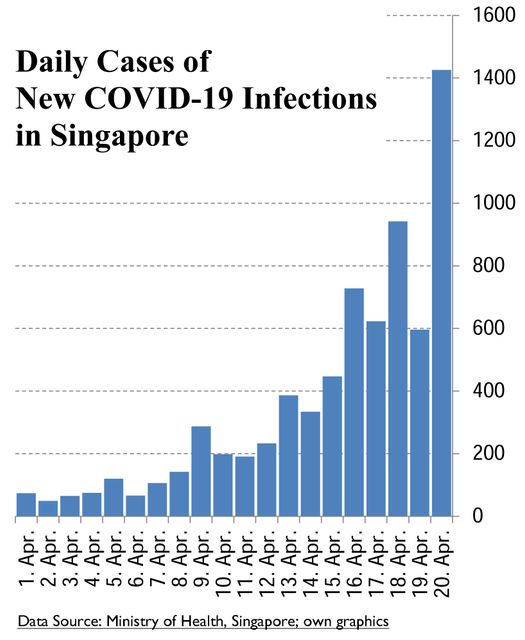
The Singapore Ministry of Health reported 1,426 new COVID-19 infections by noon on Monday alone, 95 percent of them among temporary workers from India, Bangladesh and other countries in Southeast Asia who are crammed into inhumane dwellings.
The city-state, a former British colony, was praised in the early weeks of the coronavirus epidemic for its strict measures—tracing COVID-19 cases back to the first infected person—to contain infections in the native population. A different story in the city-state is now emerging, hidden behind the shiny skyscrapers of the financial centre and the pompous hotel complexes.
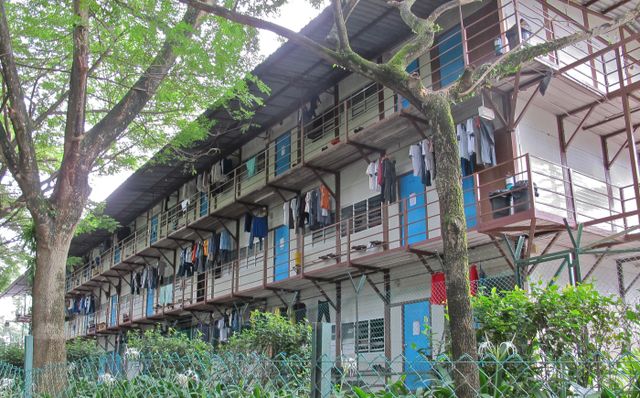
Dormitory in Singapore
Among Singapore’s nearly 6 million inhabitants are some 323,000 workers who built these skyscrapers, Changi Airport, the subways and the HDB flats—the homes of the locals. They are housed in “foreign workers dormitories,” where 8, 12, 18 or even up to 25 workers share a room with bunk beds.
In the largest of these camps, Sungei Tengah Lodge—far from the city centre—about 25,000 workers are accommodated in this way in several blocks of flats. The S11 dormitory in the district of Punggol houses up to 13,000 workers in a fenced area. In this camp, 1,123 patients had already tested for COVID-19 as of Saturday.
These “purpose-built dormitories” (PBDs), which are under the regulation of the Ministry of Labour, are run by private companies. This group of dormitories consists of 43 complexes that can accommodate between 3,000 and 25,000 workers per complex. Twenty-two of these have groups of infected people and 13 had been quarantined through the end of last week.
This means that workers cannot leave their block. Workers report on their social media platform that any violation will be punished with a fine of 10,000 Singapore dollars (about US$7,000) or six months in prison. Workers also write about the fear they feel when they see 15 ambulances driving into the block every day and newly infected people with more severe symptoms being driven to hospital. In addition, there is the lack of contact between them. “You can’t watch videos on the Internet all day,” reports one of the workers.
A total of about 200,000 workers live in the PBDs, with another 95,000 in “Factory-Converted Dormitories,” each of which can accommodate 50 to 500 workers, also under the registration of the Ministry of Labour. Another 28,000 or so workers live in containers directly at their workplaces (“On-Site Housing”), accommodating up to 40 workers each. These shelters are only checked occasionally.
These conditions exist in a tropical climate, where average temperatures vary between 28 and 32 degrees Celsius (82° to 90°F) and humidity is around 80 percent—in buildings without air conditioning.
The dormitories are run by private companies that have no concern for workers’ health. Even the government did not show much interest in the health protection of these workers, despite the rapid spread of the virus under such living conditions being predictable and inevitable.
After cessation of the construction work due to the spread of the pandemic, workers are stuck in congested dormitories because only those needed for urgent work—including Singapore’s garbage collection service—were allowed to leave the complex and were now housed separately.
Daily new cases of new Covid-19 infections in Singapore
Since a 48-year-old construction worker from Bangladesh tested positive for COVID-19 on March 28, the infection statistics among temporary workers have risen sharply. On Monday, Johns Hopkins University registered 8,014 infected persons in Singapore. Temporary workers now account for 90 percent of the new infections registered daily, with only a minority tested so far.
The Ministry of Health first became aware of the spread of infection in these dormitories when the infection figures reported by the hospitals increased dramatically beginning in April. The government has now ordered that the infected workers be separated from the healthy ones, and that some of the sick be moved to military camps or empty gymnasiums or ships. But the measures will probably have little effect, as the infection has spread further among workers living in close quarters. Not all workers have yet been tested.
A New Zealand professor, Mohan Dutta, told the Guardian of interviews he had conducted with 45 migrant workers in Singapore: “Participants told me that even up until Monday they don’t have access to soap and adequate cleaning supplies.” He added that many feared an outbreak was inevitable due to the living conditions in the dormitories. The workers had told him that there were only five toilets and showers per 100 workers, so they often had to stand in line. Workers complained that the food provided since the crisis was also poor in nutritional value.
A specialist in infectious diseases at the National University of Singapore Hospital, Professor Dale Fisher, told the Guardian that thousands of new infections were to be expected in the dormitories of temporary workers. He said the workers “are all 30 to 40 years old, which is good, but still when you’re dealing with these massive numbers you’re going to get a good number of sick 30- to 40-year-olds. The risk [in such cramped dormitories] is completely different and the preparation and the anticipation wasn’t there.”
The hard construction work with frequent overtime and often a heavy strain on the lungs due to smoking are also increasing the risk of infection. Fisher added: “If we don’t stop it there [in the dormitories] the hospitals will get overwhelmed.”
He told the Straits Times in Singapore that he expects between 5 and 10 percent of infected temporary workers to be hospitalized, with up to 2 percent of critical illness expected. The number of deaths among contract workers in Singapore is usually not released until later.
Referring to slum areas in India and other Southeast Asian countries, he warned, that the message to other places was, “if you have an overcrowded setting it is just so vulnerable. …When people say India’s shutdown has been extended—I can’t think of anything other than shutting down. It’s like the only defence you’ve got.”
The problem of limited capacity of hospital beds on one hand and the exploding numbers of infected workers on the other poses a big problem that Associate Professor Hsu Liyang of the National University of Singapore suggests to solve by triaging of patients: “COVID-19 cases should be triaged and those with minimal risk of complications should be sent to community isolation facilities immediately rather than face a period of observation in an acute hospital.”
With globalization and the economic opening of China, Singapore has grown rapidly since the 1980s, bringing with it hundreds of thousands of temporary workers to be used in the construction industry at low wages. Labour agencies arranged the formalities for work permits, promising wages between 800 and 1,300 Singapore dollars (US$560-US$900). But a large part of the wages is later deducted for “agency fees,” accommodation and food, so that the workers can only transfer a small amount of money from their wages to their families in their home countries.
The authoritarian regime in Singapore suppresses any movement of workers fighting for better working or living conditions. Those who resist are immediately deported and, in some cases, lose everything they have saved up in their hard work through fines. While many of the Singaporean workers participate in fundraising campaigns for their foreign colleagues, the control of the dormitories in the fight against the spread of the virus is now carried out by the army, a “task force” of 750 men under the leadership of Brigadier General Seet Uei Lim.
In the crisis, the “gold standard” of the highly praised Singapore—like capitalism in any other country—turns out to be what it really is: a brutal class society.

COVID-19 lockdown leaves Gulf states’ migrant workers penniless in unsanitary conditions

Jean Shaoul

Millions of migrant workers in Gulf countries have been laid off without income in the wake of the COVID-19 pandemic. Their plight is terrible. Unable to return home because of travel restrictions or their countries’ refusal to accept them, they have been left to fester in lockdown, confined to overcrowded, unsanitary dormitories without access to either health care or help.
The impact on their health and finances will ricochet across the world due to the vast numbers and diversity of migrants in the Persian Gulf.
While the obscenely rich princes and emirs of the Arabian Peninsula can shelter in their palaces to reduce the risk of infection and access the health care so necessary for survival, the conditions of life for those workers who cater to their every whim are the complete opposite. Effectively imprisoned, they are not only more likely to get infected; they are unable to get treatment or manage the terrible consequences of the expanding economic catastrophe.
This indisputable fact of class life finds its supreme expression in the venal House of Saud and other petro-monarchies, which exploit the labour power of a massive army of migrant workers, largely from Pakistan, India, Bangladesh, Nepal, Sri Lanka, the Philippines, Egypt, Syria, Palestine and Africa.
Migrant workers make up 9 million of Saudi Arabia’s 33 million population; 7.8 million of the United Arab Emirates’ (UAE) 9.2 million; 2.34 million of Qatar’s 2.6 million; 500,000 of Bahrain’s 1.6 million; 1.8 million of Oman’s four million; and 3.15 million of Kuwait’s 4.5 million. This constitutes 24 million people, or nearly half of the six countries’ 54 million population and two thirds of its workforce.
Migrant workers in the Gulf account for 12 percent of the nearly 200 million migrant workers globally, who travel across national borders and whose conditions are not much better. Another 760 million move within their own countries in search of work: more than 400 million in China and 40 million in India, although this is likely a gross underestimate.
In the Gulf, migrant workers labour in construction, sanitation, transportation, hospitality and domestic service for a pittance, under the notorious kefala system that binds them to their employer and prevents them changing jobs in a modern form of indentured servitude. Working long hours in horrendous conditions in the scorching heat, they are forced to live for years alone in labour camps that are little short of prisons, in order to send home money to their families who would otherwise starve.
The crowded conditions in which they live and work provide a fertile breeding ground for the coronavirus. Migrant workers are not only victims but potential carriers too, taking the epidemic back to their families, often in remote villages unable to deal with a health crisis. This means that their villages or home countries have in some cases greeted potentially infected homecomers with suspicion.
Without the most basic rights, migrant workers are typically the first to be hit by an economic downturn. As the first cases of the coronavirus hit the region in March, governments shuttered their economies, imposed self-distancing restrictions and banned international travel, although some sectors, such as construction and oil and gas, have continued to work, exposing migrant workers to the virus.
While the number of COVID-19 cases is still small compared to the US and Europe—some 26,653 confirmed cases and 167 deaths as of April 20—these are likely to be an underestimate given the lack of testing. Already it appears that the migrants have borne the brunt of the virus, with Saudi Arabia reporting on April 5 that foreigners made up half of its then 4,000-plus COVID-19 cases. Qatar, amid a construction boom as it prepares to host the 2022 World Cup, found hundreds of cases among migrants.
Paid not much more than $200 per month, many workers have amassed substantial debts before they had even begun working, in order to pay the agents and middlemen who found them work in the Gulf and organised their travel. Their loss of income affects not only themselves but also their families who receive billions of dollars in remittances every year.
This explains why their own governments have given the nod to the Gulf states’ atrocious treatment of migrant workers: their remittances provide a crucial safety net for the impoverished masses, thereby deflecting popular anger. These conditions also form the standard that corporations and governments around the world are now seeking to emulate.
Oman, Qatar and the UAE are compounding the migrants’ plight by blocking voice and video calls over apps such as WhatsApp, Facetime and Skype in order to protect the commercial interests of their own telecom companies. A group of 29 rights groups, protesting against the ban on Internet calls during the pandemic, issued a statement saying, “This has caused serious problems for the people living in those countries, especially the majority of migrant workers and foreign national residents who need to connect and communicate with their families and communities overseas.”
While the Gulf countries have announced aid packages, these are for their own citizens, not foreign labourers. Running out of food and money, with nowhere to turn in countries that treat them as slave labour, these workers face starvation.
A survey carried out by the Business and Human Rights Resource Centre (BHRRC) raised its “deep concern” over the safety of migrant workers in the Gulf. It revealed that most of the construction companies taking part in the survey (and only half replied) in the UAE and Qatar were not doing enough to protect their workers. It found that work on construction sites in Qatar was continuing despite the pandemic despite the lack of personal protective equipment (PPE) for workers at the World Cup sites, with workers having to bring their own masks. Social distancing at work and in living quarters, which were often unsanitary, was impossible, yet none of the companies had any plans to improve their accommodation or provide PPE.
Most workers were forced to work even if they were unwell, as only four companies guaranteed job security for those unable to work due to ill health, and only three said that workers forced to self-isolate would be paid in full.
So bad are the conditions in the UAE that the Kerala Muslim Cultural Centre in Dubai has petitioned the Indian High Court, calling on the government to repatriate its citizens. Haris Beeran, a lawyer representing the petitioners, told the UAE-based the National, “We know of 10,000 people just from Kerala who want to come back home.” He added, “Many workers no longer have jobs [and] some people are on visit visas that have expired. They don’t have any means to live in the UAE and would rather return to their family at this time.”
Pinarayi Vijayan, chief minister of the Indian state of Kerala, has called on Indian Prime Minister Narenda Modi to organise the repatriation of Indian workers in the Gulf. Some 3 million Indians work in the Gulf, nearly a million from Kerala. Modi has refused to do so before India’s own nationwide lockdown ends.
There are also thousands of migrant workers languishing in the Gulf states’ overcrowded prisons and detention centres, further exacerbating the likelihood of the virus spreading uncontrollably. According to Human Rights Watch, many migrant workers, particularly those who have fled ruthless employers or are undocumented because their employers have withheld their papers, spend long periods in detention centres prior to deportation.
The UAE has warned countries refusing to repatriate their workers that it may take action against them. Kuwait has sought to deport workers it claims are violating quarantine instructions and has called on Egypt and India to repatriate citizens working there “illegally.”
Saudi Arabia has deported nearly 3,000 Ethiopian migrants to Addis Ababa, as part of a broader plan seen by Reuters to deport 200,000 Ethiopians, with other Gulf States expected to follow suit. Catherine Sozi, the UN humanitarian coordinator for Ethiopia, told Reuters, “Large-scale migratory movements which are not planned make the transmission of the virus much more likely to continue. We are therefore calling for the temporary suspension of large-scale deportations.”
Without controlling the spread of the virus in humane conditions and treating its victims—citizens or migrants—the human toll will grow exponentially as the disease spreads across the world.

UK government in crisis over back-to-work drive

Steve James

Boris Johnson’s government is deeply split over how quickly it can shift from a policy of containing the COVID-19 pandemic, which has so far cost over 16,500 lives in Britain, to a full-scale return to work.
Big business and the banks, having fleeced the working class of at least £135 billion on a government bailout, is clamouring to restart the extraction of profit from the working class. Currently, a 35 percent drop in gross domestic product is anticipated if the lockdown lasts until June. Clawing this back from the working class is now British capitalism’s primary objective.
The difficulty the Conservative government faces is the overwhelming opposition to such a move by the working class. Politico reported that a government source stated, “There is a Fleet Street desire for us to lay out exit strategies, but it is not where the public are. The public are seeing death numbers and thinking we’ve got to do everything we can to stop the spread of the virus.”
Having openly declared a policy of “herd immunity” and then been belatedly forced to impose a lockdown due to widespread public anger, Johnson and his ministers are weakened and deeply discredited. This has been made worse by their inability to reverse the impact of their earlier policy—exemplified by the absence of testing, an inability to provide even medical staff with personal protective equipment (PPE) and leaving the old and infirm to die in care homes along with thousands more who never see a hospital before succumbing to the disease.
This has led to the grotesque spectacle of Johnson himself, his special adviser Dominic Cummings and Health Secretary Matt Hancock, all with blood on their hands, urging their fellow criminals, including Cabinet Office Minister Michael Gove, Chancellor Rishi Sunak and Cabinet Secretary Sir Mark Sedwill, to put the brakes on plans to end the lockdown within weeks.
Johnson is also concerned that too early a reduction in restrictions would cause a second peak in COVID-19 cases, which, because of the exponential nature of the virus transmission, could “do the most damage to health and the most damage to the economy.”
The dispute is framed for public consumption on the R-number—the reproduction rate of the virus—with Gove and Sunak wanting to contemplate lifting restrictions as soon as the R number falls below 1, meaning the number of total infections falling. Gove told the cabinet, “I’ve come to the view that we need to run this hot.”
These divisions are being played out in the pro-Tory media. Last weekend’s Sunday Times article, “38 DAYS when Britain sleepwalked into carnage” by the Insight team, exposed Johnson and his government’s extraordinary complacency and incompetence.
On January 24, Hancock at the first emergency Cobra (Cabinet Office Briefing Room A) meeting described the threat from coronavirus to public health as “low.” This was despite a L ancet editorial that day warning of a pandemic comparable to the 1918 Spanish flu. The meeting lasted only an hour. Boris Johnson was not even present, choosing instead to attend a Chinese New Year event.
Over the next five weeks, Johnson missed four further Cobra meetings. His spokesman claimed Britain was “well prepared for any new diseases.” An unnamed senior adviser told Insight, “Boris didn’t chair any meetings. He liked his country breaks. He didn’t work weekends.”
Rather than being “well prepared,” Britain was badly equipped for a pandemic. Stockpiles of personal protective equipment (PPE) had dwindled and expired. Key worker training had been neglected. Repeated warnings of mass casualties were ignored. The Sunday Times’s source reported members of the pandemic advisory group would joke “‘Haha let’s hope we don’t get a pandemic,’ because there wasn’t a single area of practice that was being nurtured for us to meet basic requirements for [a] pandemic, never mind do it well.”
Even when the scale of the looming disaster began to dawn on the government, almost nothing was done. The source continued “Almost every plan we had was not activated in February.” No testing was done in February, no PPE were ordered, indeed some existing stocks were exported.
A health department “insider” concluded, “We were doomed by our incompetence, our hubris and our austerity.”
The result of this policy is now being played out. This weekend saw reports of hospitals on the brink of exhausting their supplies of PPE and of oxygen. Last Friday, Public Health England changed its advice to medical staff, suggesting that full-length gowns offering a high level of safety from infection could be replaced with “disposable plastic aprons.” Alternatively, hospitals should ration supplies of “fluid-repellent gowns” to the most “aerosol-generating procedures and surgery.” Some 84 tonnes of gowns were reported to be either en route, held up, or due to arrive from Turkey.
Currently, the government admits to around 50 deaths of National Health Service (NHS) staff. Nursing Notes has logged double that figure when careworkers are included.
The Tory-supporting Daily Telegraph highlighted the government and health authorities’ failure to respond to Exercise Cygnus in 2016, which warned of catastrophic NHS failings in the event of a respiratory flu-type pandemic and 750,000 deaths.
With the government in deep crisis, new Labour Party leader Sir Keir Starmer has stepped forwards as a potential saviour. Backed by the public service trade unions, Starmer has already repaid the confidence placed in him by big business as a reliable replacement for Jeremy Corbyn. Writing to then-acting Prime Minister Dominic Raab last week, Starmer confirmed “the Labour Party’s intention to work constructively with the government on managing this crisis and helping to protect people’s lives and livelihoods.”
Starmer outlined his central concern. “Overcoming this crisis requires taking the British public with you. Millions of people have...exceeded government assumptions about their willingness to make sacrifices and stay at home.”
Starmer stopped short of openly proposing a government of national unity but has operated as if this was already in place ever since. Starmer has requested the government set out its criteria for ending the lockdown as soon as possible, including outlining which sectors of the economy will be started first. He made a vague reference to the need for increased testing but made no mention of any figure beyond the government’s own hopelessly inadequate figure of 25,000 daily by mid-April.
Since then, Starmer has formed a political alliance with leading hard-right Tories such as former Brexit Secretary David Davis and former party leader Ian Duncan Smith in championing a “back-to-work” strategy. Working together in intimate discussions with leading business figures, Duncan Smith told the Times we need to “accept and admit we are coming out of lockdown.” The British people, he continued, “need to know that the sun is rising at some point, in an economic sense.”
Starmer was backed yesterday by former Labour Prime Minister and unindicted war criminal Tony Blair, whose Institute for Global Change proposed various “trial and error” models between re-opening as much of the economy as possible and a death rate deemed politically manageable.
The document, “A sustainable exit strategy: managing uncertainty minimising harm,” outlined a “contingent exit plan” that varied between a “hard lockdown” if daily deaths were over 500, a “soft lockdown” if deaths were between 100 and 500, and a “soft open” if deaths were less than 100. Blair wants top business figures from across industry to be bought directly into government to bring their “collective firepower” to bear on determining government policy.
It is a measure of the desperation within ruling circles and their disconnect from popular sentiment that they would entertain the belief that Starmer, Blair and business leaders acting as coronavirus “Tsars” could secure popular support for a policy that will cost so many lives—not just in the inevitable “second wave” spoken of by Johnson, but successive waves of the pandemic. Rather, the conditions are rapidly emerging for an explosion of the class struggle against any government formation that tries to impose the dictates of the corporations and banks.

US farm relief program hands billions to agribusiness while millions lack food

Alex Findijs

The United States Department of Agriculture (USDA) announced plans on Friday, April 17, for a farm relief program. Funded largely through the CARES Act, the $19 billion package will be used to funnel funds to corporate farms while providing little assistance for the vast majority of small or working farmers.
Like other government programs to help farmers, most of this money will end up in the hands of agribusiness. The majority of farmland is owned by farms grossing over $500,000 in sales, a figure that demonstrates the demise of the American family farm. In total, $16 billion will be handed directly to farmers, of which $9.6 billion goes to the livestock industry. This funding will be given largely as reimbursements for “losses” and will not be contingent upon providing food to those in need.
The remaining $3 billion will be used to purchase $100 million each of produce, meat and dairy that will be distributed to food banks, nonprofits and community and faith organizations every month. This is a paltry sum, amounting to just 27 cents a day for every food insecure person, a figure that will only decline as America’s now 22 million unemployed seek assistance.
It will also provide funds to distribute 1,000,000 meals a week to children in “a limited number of rural schools.” How this would actually be done given the wide dispersion of such students, many of whom rode buses for an hour or more to reach their schools, is unclear.
This bailout is intended to offset financial losses from the collapse of distribution systems during the pandemic. While grocery stores are having difficulty keeping their shelves stocked, much of the food in the pipeline is packaged in bulk quantities for institutional buyers such as restaurants and schools.
The closure of restaurants, schools and other institutional buyers has resulted in farmers destroying millions of pounds of food as their distribution chains are disrupted. This is not because there is no demand, but because transitioning to retail packaging is too costly. It is cheaper to destroy food than to repackage it and send it elsewhere.
This mass destruction of crops and dairy products comes at a time when millions of Americans have lost their jobs and are now turning to food banks to feed their families. Some food banks are reporting an increase in demand as high as 300 percent. Lines of cars in the thousands have been reported queuing up at food banks across the country.
But even if all the available food was sent to food banks, they lack the necessary resources and equipment to handle such an expansion in supply. A study of food banks in San Diego County, California, found that in 2015 less than half of food banks had enough refrigerator space and only 54 percent had enough freezer space to service people in need. If food banks around the country did not have enough storage space before the pandemic, there is no reason to believe that they are prepared to handle a huge rise in demand or supply.
Feeding America, one of the largest organizations representing food banks, estimates that an additional $1.4 billion is needed to cover the increasing operating costs of food banks, an insignificant amount compared to the $2 trillion granted to bail out the banks and corporations.
Whether or not food banks and charities can handle a massive influx is not issue for the capitalist class and the state that protects it. They do not care whether people receive enough food, as long as the agricultural industry remains profitable and the pretense of aid is maintained.
There is not even mention in the legislation of providing agricultural and food processing workers with aid. Without proper protective equipment, these workers are at great risk, and migrant workers in particular are threatened with destitution without income support.
Farm laborers earn between $15,000 and $24,499 a year, according to official figures, with a quarter living below the poverty line. Already working and living in horrid conditions, these workers face privation during a global health crisis. Suffering similarly horrendous conditions, meat packing workers are kept on the job while the virus is allowed to tear through their plants. It has already taken several lives and infect ed hundreds of workers. These workers need aid far more than the capitalists who exploit them.
The ruling class has made it clear with this relief program that it only cares about protecting profits at the expense of workers. Kenneth Sullivan, CEO of the meatpacker Smithfield Foods, said, “We have to operate these processing plants even when we have COVID. If we don’t, we sadly won’t have food.”
This is a falsehood. Tens of millions of pounds of food are being destroyed while the USDA estimates that 2.4 billion pounds of meat sits in cold storage—enough to cease all meat packaging for several weeks until protective measures are put in place.
An estimated 3.7 million gallons of milk are dumped every day, enough to provide all 37 million food insecure people with two quarts a week. There is plenty of food to last while measures are taken to protect workers, both citizen and immigrant. The claim that workers must die to keep production flowing is a nefarious lie.
What the working class needs is not a haphazard dumping of goods into food banks and charities, but an adequate income so that all working people can afford to buy food, and an adequate supply so that the food is available to those who want it.
This should be combined with a coordinated effort to reorganize food supply chains to meet social needs. The vast resources of the state and private industry must be placed under the control of the working class, with a coordinated and scientific plan for the safe harvesting and distribution of agricultural goods.
The retooling of currently unused supply chains is a necessary and far from impossible task. Restaurants, schools and hotels must have their cold storage resources reconverted into temporary distribution centers for those in need. One restaurant in Baltimore, Maryland, called La Cuchara, has already repurposed its supply chain to create a makeshift grocery store. The widespread capacity for converting existing resources is apparent.
But such changes must be made to feed the working class, not to benefit the capitalists who would sacrifice millions of workers to the virus to keep their profits flowing.

Oil price contracts take historic plunge into negative territory

Nick Beams

In a day of chaos in the international oil market yesterday, futures contracts expiring today on US-produced West Texas Intermediate crude dropped to as low as -$40.32 per barrel, meaning that producers were paying buyers to take them off their hands.
The price at the close of trading was -$37.63 compared with $18.36 a barrel on Friday. It is the first time in history that oil prices have gone into negative territory.
The reason for the collapse is the lack of storage capacity in the US because of the collapse in demand due to the impact of the COVID-19 pandemic and the associated lockdown measures.
The main US storage facility is at Cushing, Oklahoma, a town of 10,000 people. The storage hub was at 70 percent capacity last week with traders saying it would be filled within two weeks. This prompted the futures selloff because the holder has to deliver 1000 barrels for every contract they hold to Cushing.
Traders in the futures market described the chaos.
Phil Flynn, senior market analyst at Price Futures Group, told the New York Times: “We saw a total collapse in the market. There was everybody selling it into the hole with no buyers. They’re going to have to drive down to a price where someone wants to buy it, and no one wants to buy it.”
The director of energy futures at Mizuho in New York told the Times: “I’m 55 years old, and I worked on the trading floor in college. I’ve been through the first Gulf War, second Gulf War, World Trade Center, dot-com crisis, and nothing came close to this. It could get worse. This situation we are in is that bad.”
In an interview with Bloomberg, Michael Lynch, the president of Strategic Energy and Research, said: “The background psychology right now is just massively bearish. People are concerned that we are going to see so much build-up of inventory that it’s going to be very difficult to fix in the near term and there is going to be a lot of distressed cargoes on the market. People are trying to get rid of the oil and there are no buyers.”
Some futures traders are still betting on a revival and so contracts for June remain positive. But an even bigger crash could be in the making when they become due.
Stephen Schork, the editor of an oil-market newsletter, told the Financial Times: “It just gets uglier from here.”
The rapid rise in US unemployment—22 million workers have applied for jobless benefits in the past month—means that fewer and fewer Americans will be driving in the coming months, pushing down summer demand for petrol, usually the peak period.
“This summer is dead on arrival,” he said. “The biggest demand months are not going to happen.”
Global oil demand, which was 100 million barrels a day in 2019, has now fallen by 30 million barrels due to the pandemic.
Prices for oil deliveries in June remain positive but the most actively traded futures contracts fell by 18 percent yesterday to close at just over $20 per barrel. Back in January they were trading at $65 per barrel.
The price of contracts for Brent crude remains positive because it is stored on tankers which still have a capacity to take additional supplies but it is only a matter of time before this runs out. At the end of March there were 109 million barrels of oil stored on tankers at sea. Last Friday it has risen to 141 million.
The oil price crash has shattered the agreement orchestrated by US president Donald Trump for Russia and Saudi Arabia to cut oil production by 9.7 million barrels a day. Trump claimed the deal would save “thousands of jobs” in the US oil industry. But like so many of the other assertions by the blowhard in the White House this pronouncement has been torn to shreds within a matter of days.
Speaking at a press briefing yesterday, Trump said the administration was looking at increasing the holdings of the Strategic Petroleum Reserve. “This is a great time to buy oil,” he said.
The idea was first floated several weeks ago but Congress refused to supply the funds for purchases. Trump said the administration was looking to fill up national petroleum reserves by as much as 75 million barrels and “one way or the other it will be full.”
But such is the extent of the contraction it is doubtful this will halt the slide, any more than the agreement with Russia and Saudi Arabia did.
The crash in the futures market will accelerate the already rapid decline in the physical market where prices are already down by more than 60 percent from the start of the year.
Even before yesterday’s historic events, Bloomberg reported that some buyers in Texas were offering as little as $2 a barrel for some oil streams. “In Asia,” it noted, “bankers are increasingly reluctant to give commodity traders the credit to survive as lenders grow ever more fearful about the risk of a catastrophic default.”
The crash is ripping through the US oil industry. Last week producers shut down 13 percent of oil drilling operations but this has not been sufficient to counter the oversupply.
The shale industry, which produces around 10 million barrels a day, providing what Trump has hailed as “US energy dominance,” now faces a rapid decline, if not a collapse.
And it could have ramifications that reach into financial markets. Much of shale oil production has been financed by high-yield junk bonds and risky leveraged loans, predicated on oil prices of at least $60 per barrel. If major defaults occur this could have large knock-on effects in financial markets and eventually reach the banks.
In the middle of last month, the Financial Times reported that most oil companies, with the exception of Exxon [Mobil] and Chevron were on “life support” and that even with oil prices at $57 a barrel “the US shale industry was already struggling to generate cash and retain investor support in 2019” and 42 companies, with $26 billion in debt, had filed for bankruptcy.
In the month since that report, the situation has become dramatically worse at a speed never seen before in history.

Global COVID-19 infections, deaths rise amid drive to revive corporate profit-making

Benjamin Mateus

Despite more than four billion people on the planet being in some form of isolation, the number of new cases throughout the world continues to grow at a steady pace of approximately 75,000 per day. The staggering daily death toll of 5,000 to 7,000 is a reminder of the deadly nature of the pandemic that has brought much of the world to a standstill.
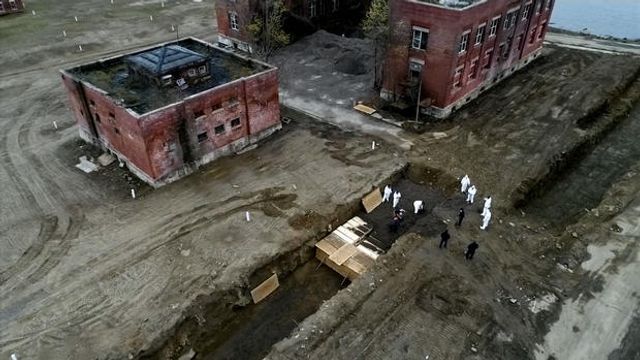
Mass grave on Hart Island, New York City’s Potter’s field
Nearly 800,000 cases have been reported in the US, representing 32 percent of all infections internationally. The death toll to date is 42,458, almost 2,000 on Monday alone. The US accounts for a quarter of overall fatalities.
The number of cases in the hot spots of New York and New Jersey continues to steadily increase, with still harrowing fatalities. On Monday, nine states each confirmed over 1,000 new cases. By all accounts, given the still very limited access to testing, the figures for infections and deaths from COVID-19 are underestimates.
This is the public health situation with over 90 percent of the US population under some form of stay-at-home order since President Trump declared a state of emergency over a month ago. The economic and social calamity resulting from these measures to rein in the pandemic is only partially reflected in the record number of people—over 22 million—who have filed for unemployment insurance over the past four weeks. Millions of those laid off have lost their health insurance, and thousands are lining up at food banks in cities across the country to receive food to feed their families.
However, rather than using the vast riches of the country to care for the people, the political establishment, from the fascistic Trump to Congress and both big business parties, to growing numbers of state governors and mayors, is working in concert to force a premature return to work that will only add more human fuel to the viral fire.
There is no evidence, despite the constant media talk of “a turn for the better,” that the pandemic is under control. The bogus “guidelines” for reopening the economy announced by Trump last week mark the end of any pretense of a nationally coordinated effort to contain the disease. In reality, they are a green light to force workers back to work, with no protections in place against the virus, to satisfy corporate America’s demands for fresh profits even at the cost of untold thousands of lives.
Health care facilities in Boston, Detroit, New York City, Chicago and Los Angeles continue to be overwhelmed with COVID-19 patients. There are more than 180 refrigerated trailers stationed behind New York City hospitals to hold corpses under conditions where funeral homes and morgues are beyond capacity. In one instance, more than 20 bodies were piled on the sidewalk of a Brooklyn funeral home. Many of the dead who are not claimed will be buried in mass graves with thousands of forgotten others.
The state of Ohio, with nearly 13,000 cases, made headlines reporting that 73 percent of the inmates at the Marion Correctional Institution were infected with COVID-19. Testing of inmates revealed that 1,950 prisoners were positive for the virus, accounting for 20 percent of all cases in Ohio. Along with these, 154 of the institution’s staff members tested positive.
Michigan has also noted that a significant number of its prisoners and staff tested positive for the coronavirus. However, there is no present policy to track COVID-19 in prison populations. The American Civil Liberties Union Ohio advocacy counsel Claire Chevrier noted in her Twitter account, “This was a policy choice.”
Illinois Governor J.B. Pritzker reported that hospitalizations are up seven percent, the majority of cases in the state occurring in Chicago and adjacent counties. The hardest hit areas are the poorest sections of Cook County and South Chicago, including impoverished black and Hispanic sections of the working class.
Massachusetts now ranks third in the number of COVID-19 cases, as new surges are reported in Boston’s poor neighborhoods. The death toll is expected to surpass 2,000 this week. According to Governor Charlie Baker, the hospitals are starting to see the effects of the surge.
Last week in Colorado, the JBS meatpacking plant in Greeley had to close after more than 50 of its employees contracted the coronavirus. The union that represents the 3,000 workers at the plant reported that two workers had died.
In an effort at damage control, Vice President Mike Pence told reporters that his task force would quickly bring in resources for COVID-19 testing. Meanwhile, Governor Jared Polis, a Democrat, told CNN, “It will close long enough to test every worker and clear workers to return to work. Those that are cleared are going to return after a short closure…”
Georgia Governor Brian Kemp, whose state saw 1,242 new cases yesterday with 94 deaths, announced that he would allow some businesses, including gyms and hair salons, to open again this week, and hospitals could resume elective surgeries on April 24. Similar announcements were made by the governors of Tennessee and Vermont.
Florida Governor Ron DeSantis opened the beaches on April 17 for “essential activities.” Democratic Louisiana Governor John Bel Edwards, in one of the worst hit states, said he was hoping to lift social distancing restrictions by May 1. Minnesota is allowing recreational activities like golfing, boating and fishing to commence this week.
New York Governor Andrew Cuomo, whose state has been the epicenter of the pandemic in the US, said, “It’s time to start opening the valve slowly and carefully,” and suggested that upstate New York might reopen sooner than New York City.
In a revealing comment, the Wall Street Journal wrote on Friday that Trump had “asked White House aides for economic response plans that would allow him to take credit for successes while offering enough flexibility to assign fault for any failures to others.”
He plans to starve the states of the resources they need until they allow businesses to reopen, while shifting blame for any repercussions on the states.
Virtually every reputable medical and public health institution has warned that such a reckless course will cost thousands, and perhaps millions, of lives.
An internal document obtained by the Washington Post from the Federal Emergency Management Agency and the Centers for Disease Control warns that the White House’s plan “would entail a significant risk of a resurgence of the virus.” The memo states, “Inside the White House, it has been clear to officials since last week that there is no longer much of a debate—at least with the president—about starting the reopening process May 1… rather, the debate this week has been over how to implement the return, what data could be used to justify the decision, and how to build public support for it to provide the president maximum political cover…”
Yesterday also saw a new report released by Harvard University in conjunction with multiple affiliated institutions. It states that the United States would need to deliver over five million tests per day by early June, scaling up to 20 million by late July, to sufficiently test two to six percent of the population and provide sufficient capacity to test its essential workers.
Since April 6, the US has performed only some 150,000 tests per day, despite the repeated boasting by the White House that it has conducted millions of tests. The shortfall in testing is multifaceted—supply chain issues, inadequate testing centers, non-validated tests, a shortage of the necessary reagents for PCR testing and appropriate swabs. Additionally, because the tests were permitted for public use by the FDA under emergency measures, they have yet to be validated, and many in the health community have voiced concerns over false-negative tests.
At Monday’s White House Press conference, Lieutenant General Todd T. Semonite, commanding general of the US Army Corps of Engineers, gave a briefing on the building of field hospitals at various locations around the country, such as McCormick Place in Chicago, Miami Beach Convention Center, Colorado Convention Center, TCF Center in Detroit and Javits Center in New York. These are densely populated urban centers.
Many of these hospitals stand ready and empty. It is clear that the government is preparing for the second wave of casualties. The director-general of the World Health Organization, Dr. Tedros Adhanom Ghebreyesus, said on Monday, “The worst is yet to come.”
Meanwhile, much of the focus of the media and the political establishment is on the completion of negotiations to push through yet another round of bipartisan corporate bailouts, in the form of an additional $450 billion centered on the cynically misnamed “Paycheck Protection Program.”
With each passing day it becomes clearer to millions of workers in the US and around the world that there is a total divergence in interests between the great bulk of humanity and the tiny, parasitic elite that dominates the world economy and its political establishments. The struggle to put an end to capitalism and establish socialism is literally a matter of life and death.