22 Apr 2020

As COVID-19 deaths pass 17,000, UK corporations scramble for bailout funds

Robert Stevens

The official number of deaths in Britain due to COVID-19 is heading towards 20,000. A further 873 fatalities were announced yesterday, taking the official total to 17,337.
This is just those who have died in hospital and does not include those who have died in residential care homes or at home. Due to the delay in recording and registering deaths of mainly elderly people, the latest figures relating to deaths outside hospital only go to April 10.
In England and Wales, the number of COVID-19 fatalities in care homes more than quadrupled in a week, according to the Office of National Statistics (ONS). Deaths rose to 1,043—up from 217 the previous week. These are significant underestimations, with various care organisations already reporting up to 7,500 COVID-19 related deaths in care homes.
On Wednesday, the Financial Times published its own analysis of the ONS data and based on extrapolations concluded that "a conservative estimate" showed that the "coronavirus pandemic has already caused as many as 41,000 deaths in the UK." It added, "The estimate is more than double the official figure of 17,337 released by ministers on Tuesday, which is updated daily and only counts those who have died in hospitals after testing positive for the virus."
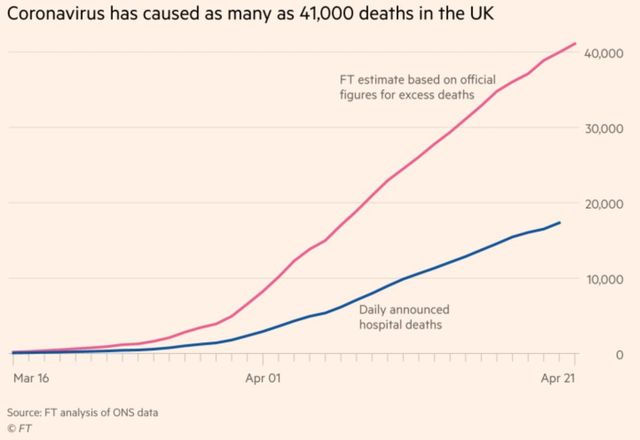
The coronavirus pandemic has already caused as many as 41,000 deaths in the UK (graphic credit: Financial Times)
The FT noted, "The ONS data also showed that deaths at home and in care homes had also jumped sharply during the pandemic. In the week ending April 10, deaths in care homes reached 4,927, almost double the figure of 2,471 a month earlier."
The newspaper concluded, "As 24 per cent of deaths normally occur in care homes in the UK, the analysis suggests that just under 11,000 more people than normal have died in residential care since the start of the outbreak."
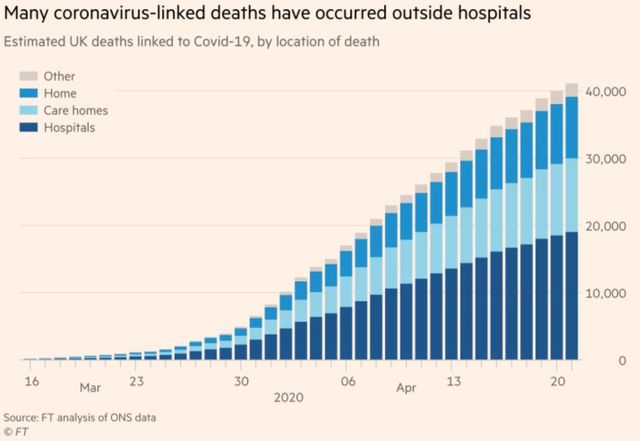
Many coronavirus linked-deaths have occurred outside hospitals (graphic credit: Financial Times)
The ONS figures showed that 18,516 total deaths were registered just in the week to April 10. The impact of the pandemic can be seen as these fatalities were 75 percent above normal for England and Wales and the highest level for more than 20 years. During the same week, the average number of deaths over the last five years was 10,520. 
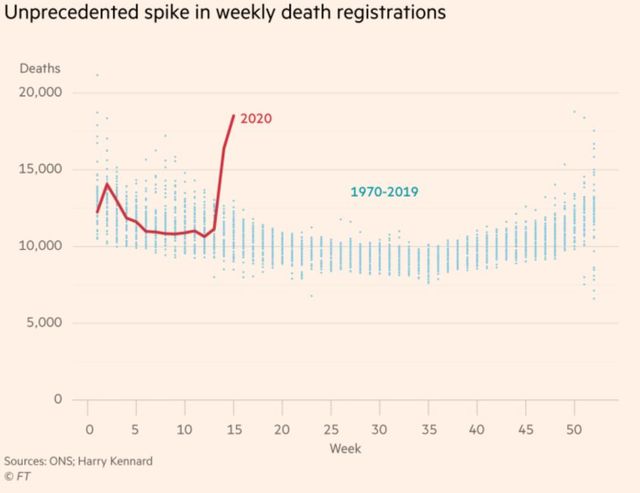
The unprecedented spike in weekly death registrations (graphic credit: Financial Times)
Despite the widely cited claim from one Oxford University scientist that the coronavirus peaked on April 8, hundreds continue to die every day. On just two days in the last week did coronavirus deaths in the UK not top 800.
The social crisis triggered by the coronavirus crisis is worsening daily. On Tuesday, it was reported that the number of people applying for the punitive Universal Credit benefit had shot up by 1.8 million in just the six weeks to April 12. According to a poll by the Citizens Advice charity, a fifth of people in Britain had already applied for welfare benefits or were expected to do so as a result of the virus. Millions are out of a job as companies laid them off temporarily or permanently as the lockdown began on March 23. The Financial Times reported that the Department for Work and Pensions was forced to make “513,000 advance payments to those in urgent need of money in the four-week period to April 12.”
Unemployment is expected to surge further with the FT noting KPMG chief economist Yael Selfin stating that as more than a third of all UK jobs were in sectors highly affected by the lockdown, unemployment could rise close to 9 percent.
The Resolution Foundation said that a six-month lockdown could see unemployment top 5 million in 2021 as the government phases out the Coronavirus Job Retention Scheme (CJRS).
CJRS was announced nearly a month ago by Tory Chancellor Rishi Sunak and represents a staggering bailout for the corporations worth hundreds of billions. It allows firms to furlough employees with the government paying cash grants of 80 percent of their wages up to a maximum of £2,500, initially for three months.
Last Friday, as the government announced that the lockdown would last at least another three weeks, Sunak announced that the CJRS would be extended until June.
On Monday, the scheme officially opened for companies to make claims. On the first day more than 140,000 firms applied, 67,000 claims within half an hour of it going live.
It is estimated that the number of workers employed by companies who have applied so far is more than 1 million.
More companies than the government forecast have already applied for a bailout. According to the Resolution Foundation, up to 8 million workers could be furloughed over the coming weeks. Other estimates are that 11 million workers (a third of the entire workforce) will eventually be moved into the scheme—with big businesses shoveled up to £60 billion in the process.
With millions of workers laid off and their immediate future insecure, many will be forced into permanent unemployment. Guardian economics editor Larry Elliott pointed to an analysis to be published this week by the National Institute of Economic and Social Research. “They estimate that the US unemployment rate will have risen almost five-fold in April to 20 percent ... On the assumption that furloughed workers are in reality unemployed, Blanchflower and Bell predict unemployment in the UK will rise by 5 million to more than 6 million by the end of May. If they are right, this would give the UK a jobless rate similar to that of the US—about 20 percent.”
Blanchflower and Bell are correct in their assessment, says Elliot, that “furloughed workers are really an army of the hidden unemployed, and they will become a lot more visible if during the second half of this year, the government ends the wage subsidies but the economy does not snap back as quickly as ministers hope.”
Wages of workers on the scheme are set to be continually slashed. The Sunday Telegraph offered a glimpse of the discussions taking place in ruling circles to pile the debt burden on the working class, editorialising, “One suggestion is to extend the furlough into the autumn but cover only 50 percent of salaries to limit costs.” Further social opposition could be sparked, noted the newspaper with “Ben Broadbent, the Bank of England’s deputy governor” warning that “even when the lockdown is eased there will be substantial popular resistance to returning to normal activity.”
Everything is being done to satisfy the profit lust of the corporations. John Lewis furloughed its entire 14,000 department store staff under the government’s scheme, and will also profit to the tune of £135 million this year due to the business rates holiday—part of an additional £22 billion “coronavirus boost” for the corporations.
Virgin Airlines’ multi-billionaire tax exile Richard Branson previously called for UK aviation companies to receive a £7.5 billion bailout from the state. He is now preparing the final touches for Virgin’s raid on the public purse of around £500 million. Last month, Branson lost no time in instructing Virgin Airlines staff to take eight weeks of unpaid leave. Branson claimed this week that his airline faced collapse: “The reality of this unprecedented crisis is that many airlines around the world need government support and many have already received it.”
Branson, with a personal fortune of over £4 billion, owns a 51 percent stake in Virgin Airlines. His state bailout extortion has elicited anger from Virgin workers and among the working class in general. Over 95 percent of people replied “No” to a Twitter poll asking, “Should the UK government give him [Branson] the £500 million bailout he wants?”
One of the many Twitter users denouncing Branson commented, “I’m stunned by the brass neck of this man. I suppose you don’t make it to £4.7 billion personal wealth without being a sociopath. I don’t know if he is, but to have the cheek to ask for £500 million in public funds when you’ve avoided tax for 14 years...”
Another said, “Nurses are starting shifts and they are down to their last set of PPE [personal protective equipment]. Richard Branson is down to his last private Caribbean island. Difficult to know where to spend that £500 million isn’t it [?]”

Germany: Opening Berlin schools risks the lives of teachers, pupils and their families

Carola Kleinert & Andy Niklaus

On Wednesday, federal and state governments decided to gradually “relax” the current restrictions introduced to combat the coronavirus pandemic. “We must learn to live with the pandemic,” Chancellor Angela Merkel stressed. This includes the gradual opening of schools, which are to progressively resume operations from May 4.
Shortly after Merkel’s press conference, it became known that the gradual opening of schools will indeed begin as early as this week. Nationwide, those graduating high school will have to take their exams starting next week. Students in the tenth grade will have to start attending schools as of April 27. Starting May 4, sixth grade students will have to return.
At the same time, the social distancing and hygiene rules and the general ban on contact will remain in force. The young people, who are only allowed to travel in pairs or only as part of their families, must return to schools that had already come under harsh criticism before the coronavirus crisis because of their dilapidation, the uncleanness of their sanitary facilities and the lack of hygiene facilities and hot water.
While the state government of North Rhine-Westphalia (NRW), under state premier Armin Laschet (Christian Democratic Union, CDU) and Education Minister Yvonne Gebauer (Free Democratic Party, FDP), has already come under criticism on social media for its ruthless policies against students, resistance is also forming in Berlin against the state executive’s policy of opening up the city.
Berlin’s Senator for Education, Youth and Science Sandra Scheeres (Social Democratic Party, SPD), who had already proven her anti-social attitude towards working people and their children by closing schools and day-care centres far too late in the pandemic, suggested days ago that the schools should be quickly opened again.
It is not even clear whether teachers and pupils will be equipped with protective masks. Will a compulsory test be introduced to identify infected students or teachers? What will happen to pupils and young people from households with infected family members who belong to the risk groups? Are they really allowed to stay at home, and what happens to their final grades?
What about the public transport that students will have to use? Busses and trains are themselves vectors for spreading the virus. Finally, young people are faced with the question of how the enormous psychological pressure that has been weighing on them for weeks will be taken into account when assessing their examination results.
The level of protection standards that Scheeres has in mind can be seen from her assurances that—now—there should be soap everywhere!
Just as the Left Party, the SPD and the Greens at federal and state level agreed to all the rescue packages for the financial elite and corporations, they are now ruthlessly pushing for a lifting of measures to combat the pandemic.
The position is that the population should become accustomed to the idea that the pandemic is a “normal state” and that infection with and death from COVID-19 is “unavoidable.” NRW Education Minister Gebauer cynically declared, “There will ... be school communities that have to mourn the death of teachers, school directors or family members, which can sometimes have a lasting effect on school life.” In the opinion of those in power, workers and young people must simply accept this.
As the Sozialistische Gleichheitspartei (Socialist Equality Party) wrote in a statement on April 13, there is a “vicious class logic” behind these efforts. “Workers are treated as a kind of disposable product. Their deaths are regarded as a normal requirement for the generation of profit. Those who succumb to the virus can be replaced.”
The ignorance and cynicism of those with political responsibility is increasingly meeting with resistance from broad sections of the population.
For example, Kristine, a nurse, posted on Twitter angrily and stunned, “So I’m sending my three children back to 3 different schools together with thousands of other students? Then I go to the hospital to work and then I go to the seven elderly people who must still be cared for. Ingenious.”
Many students, like Noel, say they do not want to go to school until things improve, “I don’t want to be to blame for my mother being in intensive care soon.”
Sherly noted, “My beloved father works in the hospital and, even as someone at risk himself, helps with the breathing of Covid-19 patients for hours every day under strict safety measures. And when I come home from school, I’m supposed to bring it home? No, thanks.”
Another student tweeted, “I think this is all so stupid. We are like test subjects. Sure, education is precious. But human life is priceless.”
Stefan Hermanns wrote that he would not send his daughter to school, but wanted to be at school himself on Monday morning to check the hygiene rules. “If it depends on the hygienic conditions whether schools open again, there will be no classes in Berlin for the next five years,” Hermanns said.
With the hashtag #prosecuteScheeres, Sabine tweeted about hygiene in Berlin schools: “Now let’s be honest, anyone who talks about maintainable hygiene standards in schools has not seen a normal school from the inside for a long time.”
Larissa Selda asked indignantly, “What’s the point of staying home if I’m going to get infected anyway because I must go outside?” She demanded, “I want the health of all citizens to be prioritised and no exams, until there is a solution that will limit any new infections by far.”
The connection between the rush to open up the schools and the class issues is obvious to many.
Chris tweeted, “When politicians seriously open up schools & make people take their final exams, it just shows sooo blatantly that business is more important to them than human lives”.
Simone Buchholz posted, “Nobody knows how the ailing schools are going to cope with the hygiene thing, but everyone knows who will pay for it: parents/mothers.”
Dennis commented, “14 days ago: ‘We are not relevant & of course we are also concerned about your health, we are closing down & bringing in short-time work’. Hardly any relaxation, today they call: ‘From Monday on we’ll be working full double shifts again’. Honestly, we’re all just puppets!”
In his tweet, Kurt Meier drew attention to the class question and the drastic redistribution of wealth from the bottom to the top of society that has been going on for decades: “What schools in Germany have long been known for: small classes, good supervision, cleanliness and good hygiene, ... oh, those were the private schools where the grandchildren of the #Leopoldina [National Academy of Science] people are.”
Rebel Heart wrote, “Education and keeping the economy running are unfortunately way more important to our politicians than health or human life.”
Johann van de Bron from North Rhine-Westphalia explained, “In the last few days, we have heard from teachers, scientists, parents, bus drivers, pupils, etc. that hygiene measures can’t be maintained in school! And that is also my assessment. If Laschet decides to #openschools, then we get an uncontrolled infection. NRW has 2.5 million school pupils. Even if only 4-5 years are sent back to school, this is surely more than half a million children and young people in schools, on the way to school, on playgrounds ...”.
In order to protect the health and lives of students and teachers, the working class must take up the struggle for a socialist programme. The ruling class and its stooges in the political establishment ruthlessly pose the interests of making a profit against the interests of the working class. This has been mercilessly demonstrated by the pandemic.

Erdogan opposes lockdown as Turkey’s COVID-19 pandemic overtakes China

Ulas Atesci

Overtaking China and Iran in terms of the number of confirmed COVID-19 cases, at 90,000, Turkey has emerged as the country in Asia with the most cases. Workers are the hardest hit layer in society, as the government’s priority, from the beginning, has been to keep workers in non-essential industries at work to keep production, exports and profits high.
The government is thrusting aside repeated warnings from the Turkish Medical Association (TTB), which has demanded once again a stop to all production in uncritical sectors with full payment to contain infections across the country. It is siding entirely with the banks’ profit interests even as COVID-19 cases surge in the workplaces.
While President Recep Tayyip Erdoğan’s government has begun only weekend curfews in the 30 largest cities and Zonguldak since April 11, also calling a four-day lockdown from April 23 to 26, these measures remain ineffective. Medical specialists have warned that limited lockdowns lead populations to go out more intensely immediately afterwards. Many factories and workplaces in uncritical sectors—metal, construction, shipyard and textile—remain open thanks to special dispensations.
On NTV, Erdoğan’s spokesperson, İbrahim Kalın, explained the government’s refusal of a longer lockdown: “Its cost to the economy would be much heavier.” That is, countless thousands of lives of workers can be sacrificed to protect the interests of the capitalist ruling class amid an unprecedented pandemic crisis.
The Health and Safety Labour Watch (İSİG) published a report last Friday on COVID-19 infections in workplaces in Turkey from March 11 to April 10. It examined 855 COVID-19 positive cases in at least 159 different workplaces; of these, at least 52 have died. The report also stated that workers in at least 30 different workplaces across the country went on wildcat strikes during this period due to positive cases and lack of necessary safety measures in the workplaces—as is the case all over the world.
According to another report by the Istanbul Workers’ Trade Unions Platform, as of April 17 there are over 2,200 positive cases among workers in Istanbul; at least 28 have died of COVID-19.
The Confederation of Revolutionary Trade Unions (DİSK) also published a report on the outbreak among its members. It found that by April 17, 2.8 per thousand DİSK members had fallen ill, compared to 0.9 per thousand in the Turkish population overall. At least 378 DİSK members are positive; four have died. Hasan Oğuz (33), a construction worker and workplace representative at Galataport site in Istanbul, was one of them.
Though it has approximately 135,000 members, DİSK has admitted that it stopped production in only 11 workplaces with over 1,200 workers across Turkey—though it declared on March 30 that in 48 hours it might invoke the constitutional right to not work in unsafe conditions, if the government acts to ensure safe conditions.
Whatever their posturing, DİSK and other union confederations are deeply implicated in the collaboration between the government, big business and trade unions. This is a trap for the working class. The critical question for workers in factories, workplaces and neighbourhoods is building independent rank-and-file committees to protect themselves and oppose not only the pandemic, but the government as well.
While the Turkish Health Ministry reported a first case on March 11, the total number of cases has surpassed 90,000 as of April 20, with more than 2,000 in the official death toll. Ten days before, as of April 10, the total number of cases was 45,000 with about 1,000 deaths.
Although state officials continue to boast of Turkey’s relatively low COVID-19 death rate, it is widely believed that it is a serious underestimation. The TTB accused the Health Ministry of not using COVID-19 codes proposed by the World Health Organization to calculate the death toll.
The World Socialist Web Site had previously cited demographic research, showing that there are about 1,500 excess deaths for Istanbul between March 11 and April 7 compared with the same period in previous years. The New York Times has also reported that the “true death toll may be much higher” in Turkey, as Istanbul “alone recorded about 2,100 more deaths than expected from March 9 to April 12, based on weekly averages from the last two years.”
Moreover, the situation among health care workers is getting worse. The Istanbul Medical Chamber (ITO) said on Monday, “the number of health care workers infected has approached 2,000,” adding that nine had died in Istanbul. It criticized the lack of face masks. Many people and health care workers still are unable to obtain masks. The Trade Union of Public Employees in Health and Social Services (SES) said on Tuesday, “We estimate that there are more than 8,000 positive-diagnosed health workers across the country.”
Dr. Mustafa Tamur, an official from The Family Physicians Association in Istanbul, said on Sunday: “To date, no single item or protective clothing or pair of glasses have been provided to any family physician in Istanbul,” adding that there are about 200 COVID-19 cases among family physicians in the city.
Though there are officially more than 4,000 new cases and at least 120 new deaths every day in Turkey, the government and media are trying to put a brave face on things, amid an escalating back-to-work campaign by governments internationally.
After Health Minister Fahrettin Koca claimed last Tuesday that they had brought the pandemic’s spread across Turkey under control, on Monday Erdoğan said he expects a return to normal at the end of May: “Our goal is to most meticulously implement measures and reduce the pandemic procession to levels that would allow for the normalisation of our country after the Ramadan holidays.”
Workers are the worst affected section of the population, not only in terms of infections and deaths but also due to immediate implications of the pandemic.
In Al-Monitor on April 9, economist Mustafa Sönmez calculated the number of unemployed workers in Turkey has risen to 7.5 million, with a nearly 3 million surge in this period. He predicted it could reach 10 million. About 270,000 mostly small companies employing more than 3 million workers have applied for unemployment benefits. Moreover, a new law allows employers to put workers on unpaid leave for up to six months on just 39 lira ($6) daily.
While class divisions are increasingly being exposed and anger among workers to the government response is mounting, Erdoğan’s main priority is to contain not COVID-19, but the threat from below. Erdoğan listed “public order” as one of his government’s key priorities during the pandemic. In fact, the pandemic has clearly shown that a revolutionary struggle by the working class to replace the existing order with socialism is the only way to protect millions and provide the most essential needs for all.

Oil price plunge continues

Nick Beams

Oil prices and oil futures continued to fall sharply yesterday following Monday’s chaos, which saw contracts on West Texas Intermediate (WTI) crude fall to as low as -$40 a barrel, meaning that sellers were willing to pay buyers to take them off their hands.
The price of Brent crude, the international benchmark, fell to below $20 a barrel for the first time in 18 years as the slide in futures contracts for WTI continued. Even as WTI futures contracts for May plunged into negative territory on Monday, June futures contracts remained above $20.
Yesterday they fell to as low as $6.50 at one point, before rising to $11.57 at the end of the day—a drop of 43 percent.
A further decline seems almost certain. According to Louise Dickson, an analyst at Rystad Energy: “The contagion has spilled over to WTI June 2020 deliveries, which could also be well on their way into the red as we move towards physical delivery dates.”
The head of commodities trading at the financial firm ING, Warren Patterson, told the Financial Times that storage next month “will be even more of an issue.” In the “absence of a meaningful demand recovery, negative prices could return for June.”
Analysts at Citi have said if the global storage worsens, the price of Brent “could chase WTI down to the bottom.”
The spot price for Brent crude dropped to as low as $17.51 per barrel yesterday before recovering to $19.33—a fall of 24 percent for the day.
Some commentators have dismissed Monday’s plunge as a “technical” glitch, a kind of “flash crash,” resulting from the rapid exhaustion of storage capacity at the main US facility in Cushing, Oklahoma. But as one writer in the Financial Times noted, “this looks like the financial market equivalent of arguing that coronavirus is ‘just like the flu’.”
There are increasing calls for some form of government bailout for the industry.
The co-head of oil trading at Tarfigura, a large exporter of American crude, told the New York Times: “We are worried that the currently disorderly market has adversely damaged the industry. In the short term some form of government assistance is likely needed because the price levels we are currently transacting at are unsustainable for US producers.”
US President Trump’s attempt to halt the price slide by having Russia and Saudi Arabia cut production by 9.7 million barrels a day is now rendered a dead letter. As a result, he has indicated that government bailout measures may be forthcoming.
Yesterday Trump tweeted that he had “instructed the Secretary of Energy and Secretary of the Treasury to formulate a plan which will make funds available so that these very important companies and jobs will be secured long into the future.”
Tens of thousands of jobs have already gone. The oil and gas industry axed 51,000 jobs in March, a reduction of 9 percent. A further 15,000 workers lost their jobs in ancillary services such as construction and the manufacture of oil drilling equipment.
This is just the beginning. The chief executive of an oil-field services company, Dan Eberhart, told Bloomberg that “a tidal wave of bankruptcies is about to hit the sector.”
Even before the pandemic hit, many oil-producing companies were facing growing problems because of the fall in oil prices due to the slowdown in the global economy in 2019 after a brief upturn the previous year.
Many smaller oil companies are expected to file for bankruptcy in the coming period, adding to instability in financial markets. According to a report in the New York Times, citing data from Moody’s, production companies have $86 billion in debt falling due between 2020 and 2024. Pipeline companies have debts of $123 billion they have to repay or service over the same period.
The so-called shale oil revolution, which has transformed America into the largest oil producer in the world, leading Trump to hail “American energy dominance” last year, was based on ultra-low interest rates and the expectation that prices would remain elevated.
This led to the issuing by oil producers of high-yield junk bonds to fund production. As a result, according to analysis from JP Morgan Chase, energy companies were the largest single issuers of junk bonds in 10 of the last 11 years. But since the fall in oil prices, starting in 2016, some 208 producers have filed for bankruptcy involving $121.7 billion in total debt.
The pandemic and the associated lockdowns have functioned as an accelerant to a process that was already underway.
Small companies are not the only ones affected. This week S&P Global Ratings cut the credit rating of Exxon Mobil, citing the impact on its cash flow caused by the plunge in oil prices. Earlier Moody’s had downgraded its rating of Occidental Petroleum, which took on $40 billion of debt as a result of a takeover battle for Anadarko last year.
Job cuts are taking place across the board, not least in so-called clean energy production. Last week BW Research issued a report that this sector—involving solar panel manufacturing and electric cars—had lost more than 106,000 jobs last month, with employment in energy-related industries falling by more than 303,000.
An article by Neil Irwin in the New York Times yesterday warned the COVID-19 crisis went far beyond the shortages of some consumer goods. It had delivered a “deflationary shock” to the economy that would “almost surely persist beyond the period of widespread lockdowns.”
The economic effects so far—the rise in jobless claims by 22 million in the past month, with more to come, the contraction in the airline industry, restaurants and auto production, and now the plunge in oil prices—had longer term implications.
They pointed to a “deflationary collapse—a glut of goods and services and consequently falling prices—that surpasses anything seen in most people’s lifetimes,” Irwin concluded.

Senate passes another bipartisan bailout for business

Barry Grey

On Tuesday, the US Senate passed another bipartisan bailout bill, whose benefits will once again go disproportionately to wealthy employers. The centerpiece of the bill is a new infusion of $310 billion of taxpayer money into the so-called “Paycheck Protection Program” (PPP), a provision of the $2.2 trillion CARES Act enacted at the end of March.
The PPP is supposedly aimed at aiding small businesses and preserving the jobs of their employees. In reality, the program is designed to make it difficult for mom-and-pop businesses to obtain relief, while funneling a substantial portion of the allotted funds to large enterprises with thousands of employees, and enriching Wall Street banks that make millions in processing fees and interest payments.
The new bill was passed by unanimous consent, with no Democratic senators rising to oppose it. It takes only one dissenting senator to block a unanimous consent vote and force a roll call vote. That would have disrupted the rush by the White House and both parties to enact the measure this week, since senators, currently dispersed around the country due to the pandemic, would have had to assemble in the Capitol.
Democratic House Speaker Nancy Pelosi had previously announced that she would hold a vote in the lower chamber either Wednesday or Thursday. President Trump tweeted his support for the bill on the eve of the Senate action and urged Republicans to vote for it.
The program extends low-interest loans backed by the federal Small Business Administration (SBA) and allows the loans to be forgiven if the recipients rehire furloughed or laid-off employees and devote 75 percent of the loans to payroll, utility or rental costs for a period of eight weeks. It was presented to the public as being open only to businesses with fewer than 500 workers and less than $2 billion in revenue.
However, after lobbying by restaurant and hotel chains, Congress agreed to the insertion of a provision making such companies eligible for PPP money, as long as none of their individual locations employed 500 people. As a result, multimillion- and billion-dollar chains such as Ruth’s Chris steakhouses, Shake Shack, Potbelly and J. Alexander were given priority by Wall Street banks, including JPMorgan, Bank of America and Wells Fargo. They approved loans for large companies ranging from $15 to $20 million each, while hundreds of thousands of family-owned restaurants, beauty and barber shops, gas stations and small retail outlets were shut out.
The PPP was allotted $349 billion under the CARES Act, a small fraction of the trillions allocated by the Treasury and the Federal Reserve to bail out major corporations and banks and prop up the stock market. The program is administered by the SBA but conducted through major banks, which actually approve and administer the loans. These financial institutions are seeking to maximize their profits and minimize their risk by extending larger loans to bigger companies.
Such was the demand that the program ran out of funds last Thursday, less than two weeks after it was launched. More than 25 percent of the value of the loans that had been approved went to fewer than 2 percent of the firms that got relief.
There are 30 million small businesses in the US, employing hundreds of millions of workers. Many are being bankrupted by the shutdown of much of the economy caused by the pandemic and the government’s failure to contain it.
Eleven percent of restaurant owners surveyed by the National Restaurant Association say they expect to close permanently by the end of this month. UBS Bank said 200,000 US restaurants, one in five, could go out of business. Nationally, 8 million restaurant workers have already been laid off. For the vast majority, the government program will do nothing to save their jobs.
The bill passed by the Senate on Tuesday includes, in addition to the $310 billion in new money for the PPP, $60 billion for a separate rescue program nominally for small businesses that also ran out of funds last week. The Economic Injury Disaster Loan program includes $50 billion in loans and $10 billion in grants.
Sixty billion dollars of the new PPP funding is to be handled by smaller “community” banks, with the intention of ensuring that minority-owned businesses get a share of the money.
The Democrats had made a show of pushing for additional money for hospitals and coronavirus testing, as well as for aid to state and city governments that are facing massive deficits due to collapsing tax revenues, and for more funding for the food stamp program. There is nothing in the series of corporate bailout bills enacted since the eruption of the coronavirus crisis to address the staggering growth of hunger in America. The consequences of repeated cuts in the food stamp program and social programs more broadly under Obama as well as Trump are now seen in massive food lines spreading across the country.
In the end, the Democrats settled for a completely inadequate $75 billion for hospitals and a derisory $25 billion for testing in the bill, whose total cost is pegged at $484 billion. They abjectly dropped their demand for relief to state and local governments and additional funding for food stamps.
The failure to secure aid to the states and localities is particularly significant. Depression levels of unemployment and negative economic growth are bankrupting state and local governments across the country.
While there is universal acceptance within both parties that unlimited amounts of public funding must be supplied to the corporate-financial elite to offset the impact of the economic collapse triggered by the pandemic, when it comes to the jobs, pensions, wages, schools and health care of the working class, the opposite principle applies. The only possible response, the ruling class declares in one voice, is the most brutal austerity.
Trump, for his part, is deliberately withholding aid from states and cities in order to pressure them to reopen their economies more quickly. He and Republican congressional leaders have held out the possibility of discussing such aid in a new round of bailout legislation.
According to the Center on Budget and Policy Priorities, state tax revenues may fall by $500 billion over the next three years. Moody’s Analytics warns that states may face combined deficits of $158 billion to $203 billion through the 2021 fiscal year. More than 2,100 cities across the country expect budget deficits this year.
Governors and mayors, Democrats no less than Republicans, are already imposing spending freezes and cuts. New Jersey’s Democratic governor, Phil Murphy, has frozen more than $1 billion in spending and cut property tax rebates for homeowners. Virginia Governor Ralph Northam, a Democrat, is seeking to freeze $2.3 billion in new spending that had been approved by lawmakers, scuttling a program for free tuition at community colleges and canceling an increase in the state minimum wage.
Washington State Governor Jay Inslee, also a Democrat, this month vetoed budget items projected to cost $445 million over three years, including a plan to hire 370 school guidance counselors. Michigan may have a deficit as high as $7 billion over the next 18 months.
New York’s Democratic mayor, Bill de Blasio, announced last week that he would slash over $2 billion in city services over the next year. He plans to close public pools, reduce sanitation pickups, suspend the summer youth employment program and impose a hiring freeze.
Detroit’s Democratic mayor, Mike Duggan, has threatened to throw the city back into bankruptcy and bring in an emergency financial manager to impose new cuts in social services, pensions and jobs.

Nova Scotia gunman kills 22 in Canada’s deadliest mass shooting

Roger Jordan

In a horrific rampage across rural northern Nova Scotia, Canada, 51-year-old Gabriel Wortman shot and killed at least 22 people over the course of Saturday night and Sunday morning. Police officers investigating the deadliest mass shooting in Canadian history say the owner of a small denturist business in Halifax opened fire at 16 separate crime scenes before he was caught and fatally shot by RCMP officers in Enfield, approximately 100 kilometres from the start of his killing spree.
Indicating that the massacre was planned in advance, Wortman wore a mock-up RCMP uniform and drove a decommissioned police car outfitted to look as if it were still in service. Information on his background indicates that he had been a wannabe RCMP officer since his teens. One neighbour told the Canadian Press that Wortman purchased several old police cars over the years. He also reportedly collected RCMP memorabilia.
Investigators say most of Wortman’s victims appear to have been chosen at random, but he began by targeting several people known to him. According to a police source cited by the Toronto Sun, Wortman first shot his ex-partner and her new boyfriend at around 10 p.m. Saturday, before getting in his car and targeting neighbours.
In the small community of Portapique, where Wortman began his rampage, several victims were found slain in their homes, and five buildings were set on fire. Although some victims have yet to be identified, the gunman killed a police officer, two frontline health care workers, an elementary school teacher, two correctional officers, a retired firefighter, and a family of three. The authorities warn that the death toll may rise when all the burnt-out buildings are examined.
Wortman owned two denturist clinics in Halifax and nearby Dartmouth. He also owned several properties, including a large home in Portapique, which lies around 130 kilometres northwest of Halifax. It cannot be said whether the coronavirus pandemic and its economic fallout played a role in triggering Wortman’s outburst of violence, but it is known that his businesses were closed under the province’s lockdown. Although he has been described as a millionaire, it is possible that Wortman was under financial stress given the stock market crash and other recent economic shocks.
Because Wortman’s bloody rampage was spread over a wide area, many Nova Scotians know someone directly impacted by the massacre. A Halifax anti-violence activist held an online candlelit vigil to allow friends and relatives to pay their respects without breaching the social distancing regulations in place to curb the spread of the coronavirus.
Whatever the immediate trigger may have been for Wortman’s bloody rampage, the Nova Scotia mass shooting is an expression of an increasingly dysfunctional society. Riven by social inequality and mass poverty and led by a ruling elite mired in foreign aggression and war, Canadian capitalism is a brutal social order that regularly engenders outbursts of homicidal violence. Since 2014 Canada has witnessed a rash of mass killings, including several with links to right-wing extremism. These include:
• June 4, 2014: Justin Bourque opened fire on RCMP officers with an assault rifle in Moncton, New Brunswick, killing three and injuring two.
• December 29, 2014: An Edmonton man suspected of domestic violence killed six adults and two children in two homes in the city.
• January 29, 2017: Alexandre Bissonette, a student with far-right views, assaulted the Quebec City mosque. He killed six worshippers and injured another eight.
• April 23, 2018: Alek Minassian drove a white van along a Toronto sidewalk, killing 10 passers-by and injuring 16 more.
• July 23, 2018: A gunman opened fire in the Greektown area of Toronto, killing a 10-year-old girl and an 18-year-old woman. Thirteen people aged between 10 and 59 were injured, including a teenager who was left paraplegic.
• August 10, 2018: A gunman opened fire in Fredericton, New Brunswick, fatally wounding two police officers and two civilians.
• July 28, 2019: A 23-year-old man in Markham, Ontario, killed four members of his family by slitting their throats with a knife.
During 2019, Toronto, Canada’s largest city, saw its worst year of gun violence ever, with 760 people being shot, 43 of whom died. During one August weekend, there were 17 separate shootings. The rate of gun violence has tripled since 2014. In 2017, Canada-wide firearm homicides reached a 25-year high.
Prime Minister Justin Trudeau offered, much like the Democrats do in the United States, empty platitudes in response to last weekend’s events, and asserted that the surge in gun violence can be combatted by imposing stricter gun controls. “In regards to gun control, we took very serious commitments in the election campaign and have moved forward—and are moving forward on them—to ensure that we’re strengthening gun control in this country,” said Trudeau on Monday.
Aside from the obvious cynicism of such pronouncements, given that the Liberals have failed to impose any tougher gun laws despite being in power for well over four years, Trudeau’s remarks are a deliberate evasion. The Prime Minister does not want to, and cannot, honestly discuss the underlying social and political causes for the surge in gun violence in Canada over recent years, because to do so is to indict the right-wing, pro-austerity, pro-war policies embraced by the entire political establishment.
The precipitous rise of social inequality and spread of absolute poverty and homelessness, particularly in Canada’s urban centres, are one driving force of the increased violence. Since the Liberal federal government imposed the largest social spending cuts in Canadian history during the 1990s, all political parties have operated on a consensus of offering ultra-low tax rates for corporations and the super-rich and starving social services and the public sector with austerity budgets.
In January, the Canadian Centre for Policy Alternatives’ annual report revealed that the country’s top 100 CEOs earned 227 times more than the average worker in 2018, which was a record high. A report from the Toronto Foundation noted last year that the typical person in the poorest 50 percent of the city’s population made $6,000 less in 2016 than they had in 1982, using 2016 dollar values as a measure. By contrast, the average person in the top 1 percent makes $99,400 more than in 1982.
Remarking on the sharp rise in gun violence in Toronto over recent years, Wendy Cukier, head of the Coalition for Gun Control, told NPR in August 2019, “Absolute poverty is not necessarily a driver of violence, disparity is, so inequality in terms of opportunities. And we’re seeing the divisions in Toronto increasing in recent years. And there’s no question that that’s driving it.”
The glaring levels of social inequality are being ratcheted up still further by the federal government’s response to the coronavirus. Trudeau’s Liberals, with the support of all opposition parties, have bailed out the banks and big business to the tune of at least $650 billion, all of which will be recouped by stepped-up exploitation of the working class and intensified austerity measures. Meanwhile, workers laid off due to the crisis are being placed on rations in the form of the Canada Emergency Response Benefit, which pays out a mere $2,000 per month for a maximum of four months.
Canadian society is also pervaded by militarism and war. Canada has been at war virtually uninterruptedly since the Canadian Air Force joined NATO’s bombardment of Serbia in 1999. From Afghanistan to Haiti, Libya to Syria, and Iraq, Canadian imperialism has been implicated in a long series of bloody US-led wars of aggression and regime-change operations that have collectively killed millions and destroyed entire societies.
Politicians regularly declare that the great global problems confronting the Canadian ruling elite can be resolved through the force of arms. In 2017, for example, then Foreign Minister Chrystia Freeland stated in presenting the Liberal government’s new national defence policy that “hard power,” i.e. war, was a key part of Canada’s past and would remain central to its future.
The explosion of militarism and war has gone hand in hand with a glorification of the police and intelligence services in the name of the so-called “war on terror.” Wortman’s infatuation with the police was undoubetdly nourished by this general reactionary climate.

US safety agencies bow to corporations as workers file record number of complaints

Jessica Goldstein

Last week the Washington Post reported over 3,000 complaints had been filed with the US federal Occupational Safety and Health Administration (OSHA) by workers against employers for failing to implement or adhere to safety measures to protect workers from infection with COVID-19.
The “largest share of complaints come from health-care workers” according to the article, some of whom “have been given ‘plastic ponchos’ and masks made out of paper towels... a lack of hand sanitizer or soap...But the complaints span a broad variety of workplaces, including Yosemite National Park, factories and funeral homes.”
Information about complaints specifically related to coronavirus safety is not readily available anywhere on the federal OSHA website. The Post was only able to obtain the information through the Freedom of Information Act, an indication that the statistics that concern workers the most are specifically being suppressed and that workers have made far more complaints.
It is unlikely that OSHA has issued citations for the coronavirus-related complaints, since the poorly funded and undermanned agency—with 2,100 inspectors responsible for the health and safety of 130 million workers—only issues citations after an investigation.
Combined with COVID-related complaints filed with individual state OSHA offices, the total number filed is significantly higher than what the Post has reported. WTVR Richmond 6 News reported that Virginia state OSHA staff have handled more than 3,000 complaints by phone and email from employees and employers related to COVID-19. Oregon state OSHA has received 2,747 complaints about workplace conditions since March 2, but has not issued a single citation, according to the Portland Tribune.
In Iowa, Democratic legislators have filed an OSHA complaint urging Tyson Foods to close its plant in Waterloo following the closure of Tyson’s Columbus Junction plant, where two workers died of COVID-19. Workers from Columbus Junction were transferred to Waterloo with no quarantine time in between.
In a separate letter addressed to Tyson, the lawmakers cited an anonymous complaint by a worker who revealed the danger faced by thousands of food processing workers across the US. “I can’t practice social distancing, because of my work. There are a lot of people in front of me and beside me. They gave the workers an unsown fabric mask. They offer a small bonus to keep the workers. They said the workers can call in [to take the day off] without getting a point, they also said that if they call in they will lose the bonus. Tyson did not care about the worker’s health and safety; they only care about their business.”
Iowa is one of a handful of US states with no shelter-in-place order. The Iowa Democrats who filed the complaint are aware that OSHA is incapable of shutting down job sites, which can only be done through a court order. Iowa Republican Governor Kim Reynolds told Des Moines WHO TV 13 that there are no plans to close the Waterloo plant.
On Monday, the New York Times editorial board published an opinion piece urging the agency to clamp down. “OSHA has precedent on its side for tougher rules. During the H1N1 flu outbreak, it made C.D.C. rules enforceable, requiring the use of face masks and other measures to slow transmission. It has failed to act so far this time, however.”
Like all aspects of the health system, OSHA is woefully unprepared to deal with the immediate demands of the working class in the wake of the pandemic. The federal and state agencies are drastically understaffed, thanks to personnel cuts carried out by successive Democratic and Republican administrations, and have long bowed to the profit interests and prerogatives of the corporations.
OSHA has made clear that in spite of the crisis, in most cases it will not be able to respond any more quickly than usual to requests for investigations. On average, it takes OSHA six months to complete an investigation in response to a complaint. It has recommended that employers conduct their own investigations and report back to the agency, which will inevitably result in countless cover-ups.
The Centers for Disease Control (CDC) guidelines for workplaces only recommend that employers take measures to protect workers during the pandemic, including cleaning and disinfecting frequently touched surfaces and social distancing of six feet between workers, and that employees who feel sick should not come to work. If workers become ill, they are recommended to self-monitor for 14 days, but there is no recommendation for implementing widespread testing.
There are no general guidelines for personal protective equipment, other than for critical workers, for whom some kind of face mask at all times is recommended, and no recommendations that employers pay for sick leave and health insurance.
Like the CDC, OSHA only recommends that employers do the “right thing,” and has no legal power to enforce guidelines. Even if businesses are found to have committed serious violations, whatever fines OSHA imposes can be challenged, and are regularly reduced, even when workers are killed.
OSHA is an agency of the US Department of Labor, which is headed by Labor Secretary Eugene Scalia, the son of the late ultra-right Supreme Court justice. Scalia is a member of US President Donald Trump’s recently announced “Opening Our Country Task Force.”
Along with the state, US corporations rely on the trusted service of the trade unions to keep workers on the job and coordinate a return to work under unsafe conditions. The United Food and Commercial Workers (UCFW) has tried to block every job action by workers against unsafe conditions, even as the union itself reports that at least 1,500 of its members have been infected and 30 have died from COVID-19. Smithfield Foods, in Sioux Falls, South Dakota, was only shut down after meatpacking workers protested in opposition to the UFCW.
The United Auto Workers (UAW) is involved in plotting a return to work at auto companies in the coming weeks, complete with bogus “safe work playbooks,” created by the companies, which will do nothing to effectively stop the spread of the virus. The auto industry in the US was shut down only after rank-and-file workers took matters into their own hands with walkouts and other job actions in March, which the union actively opposed.
Federal laws do not require an employer to notify workers if an employee tests positive for the novel coronavirus, which can prevent effective contract tracing and contain the spread of the virus. There are no laws that require employers to follow CDC recommendations for social distancing and PPE, and there are no guidelines as to what constitute “essential” industries. Workers in the US are left at the mercy of business demands with no protection from the unions, state or any of its agencies.
On Monday the National Law Review published a detailed overview of OSHA’s guidelines for workplace inspections arising out of hazards caused to workers by the pandemic. It states that, “OSHA clarifies that fatalities and imminent danger exposures related to COVID-19 will be prioritized for inspections, with particular attention given to healthcare organizations and first responders,” and that inspections in the very highest risk workplaces are not guaranteed but “may” warrant an on-site inspection.
For all other workplaces, even those where workers are at high risk from constant contact with the public and other workers, such as in meatpacking plants, Amazon warehouses and grocery stores, OSHA will only offer phone and antiquated “fax” inspections in most cases.
OSHA has developed a pyramid of Risk of Worker Exposure to SARS-CoV-2 for its official website which ranges from low to very high risk. OSHA states that most US workers fall within the “low risk” category. According to its standards, manufacturing, food processing, retail workers in close contact with other workers and the public only fall under “medium risk,” despite the recorded deaths and outbreaks, due to the fact that they are not medical or morgue workers.
In reality, all workers are at risk for contracting COVID-19 as long as workplaces remain open without mass testing and contact tracing measures in place to contain the spread of the pandemic. The “level of risk” assigned by OSHA is nothing more than a way to justify the corporate ruling class’s demands that workers either stay on the job or are forced back to work in unsafe conditions while the pandemic proliferates.
Workers in the US and worldwide will draw invaluable political lessons from the life-or-death struggle against orders to sacrifice their lives for corporate profit. They cannot allow their fate to be left up to the Democratic Party, state agencies and the unions. Now is the time for workers to take the initiative by forming rank-and-file committees to demand the closing of non-essential workplaces, with full compensation for affected workers, and universal testing, protective gear and a safe working environment for essential workers, which is supervised by rank-and-file committees in conjunction with health care professionals.

21 Apr 2020

Why the OPEC+ Deal is a Many-Splendored Thing

M. K. Bhadrakumar

A perfect deal is where all protagonists get something out of it. All oil-producing countries stand to gain if the oil price rebounds. In bare bones, the OPEC+ group led by Saudi Arabia and Russia finalized, in a nail-biting photo finish on April 12, an agreement to steeply cut oil production by a combined 9.7 million barrels per day (bpd) for May and June to rebalance the supply and demand in the world market and nudge the prices to go up amid the coronavirus pandemic.
It capped days-long tortuous international negotiations that also included the United States. Additional cuts are expected from producers outside the OPEC+ group. Experts anticipate that by the second half of the year, oil prices would be nearing $40 per barrel.
The world’s oil producers are joining together for the largest cooperative production initiative in history. The tectonic plates are shifting in the geopolitics of oil.
Historically, the U.S. rallied against the oil cartel as a threat to the American economy. However, not only has Washington joined the latest production program, but the success of that program may actually hinge on the U.S., where oil production has doubled in a single decade.
U.S. President Donald Trump has held direct talks in recent days with the heads of Russia, Saudi Arabia, and Mexico. Although the U.S., the world’s largest producer, has not offered firm production cuts, Trump and the U.S. Energy Department have emphasized that market forces will bring U.S. declines.
That is to say, cuts can come from government action via corporate decisions, as companies either shut-in production or file for bankruptcy. The estimates are that the U.S. production is projected to fall by 2 million barrels per day by the end of this year and perhaps more. “According to industry figures, the U.S.’s drop in output could see exports shrinking from over 3 million bpd in 2019 to almost [zero] in the coming months, removing a key concern for both Russia and the Saudis amid fears of a U.S. takeover of their traditional markets.”
This meets with the declared twin objectives of Saudi Arabia—to defend its market share and also to kill if not slow down U.S. shale oil production. The alternative for Saudis would have been to regain market share at enormous cost by producing enough oil to keep prices in the low to mid $20s and sustain that for two years.
As for Russia, thanks to the deal, it will receive an extra $70-80 million in revenues per day.
Trump tweeted on April 12, “The big Oil Deal with OPEC Plus is done. This will save hundreds of thousands of energy jobs in the United States. I would like to thank and congratulate President Putin of Russia and King Salman of Saudi Arabia. I just spoke to them from the Oval Office. Great deal for all!”
Having said that, at its core, OPEC+ deal stems from a matrix of understanding between Trump and Putin. Saudi Arabia understood that it had better stay out of their way. Putin sized up accurately how important it is politically for Trump to keep the shale industry afloat to preserve jobs. The industry employs over 10 million Americans and accounts for 7 percent of the U.S.’s GDP.
The big question is, where is the quid pro quo? There has always been a lurking suspicion that Putin had a game plan while triggering the fall in oil price in such a contrived fashion that resulted in the loss of billions of dollars of income for the Russian economy.
Quite obviously, the free fall of oil price precipitated an existential crisis for the U.S. shale industry in an election year in America that sooner rather than later was bound to bring Trump onto the center stage. Whether Putin choreographed it or not, that was exactly what happened.
As for Trump, a constructive engagement with Russia is something he wanted all along. Three precious years have been lost due to the Mueller investigations on “Russia collusion” and so on. But after successfully outmaneuvering his opponents in the impeachment drama, Trump is now unbound. Putin understands that, too.
In this particular affair, Trump is salvaging the interests of Big Oil, which carries enormous clout with the political class, think tanks, the media and Wall Street—and, of course, the “Deep State.” Simply put, it is inconceivable today that anyone in the Washington Beltway, however Russophobic, would dare to protest against Trump negotiating one-on-one with Putin to salvage Big Oil.
There is a broad consensus among the American elite that Putin holds the key to unlocking the oil crisis that can severely damage the U.S. economy when it is already heading into a deep recession.
In fact, between April 10 and 13, Trump and Putin spoke to each other three times. Trump knows he is on the right side of history and his interlocutor can be trusted to keep his word. Trump’s tweet on April 12 (quoted above) drips with confidence. He is striding toward a detente with Russia.
On the other hand, with an eye on the U.S. election cycle, Putin’s interest lies in wrapping up a big picture deal with Trump on Russian-American relations as quickly as possible because a potential Joe Biden victory in November could mean that the U.S. doubles down on Russia.
Putin has set a September timeline. He has proposed the idea—and Trump has welcomed it—of a summit meeting of the permanent members of the UN Security Council in September “in any place in the world” to discuss global issues in the wake of the coronavirus pandemic.
Interestingly, on April 10, even as the OPEC+ deal was being finalized, Putin utilized a session with two three-member crews of U.S. and Russian astronauts (with one majority-Russian crew taking over the International Space Station from the other majority-American crew on April 17) to touch on Russian-American relations.
Putin said the cooperation in space “is a vivid example of an effective partnership between our countries for the benefit of the entire humanity.” He then added, “We are now also trying to organize work on current problems. I do not like speaking about this but I have to. I mean the fight against the pandemic, as well as the situation in the global markets. The President of the United States and I discussed these issues just yesterday, and we will speak more on that topic. So, fortunately, cooperation is developing, and not only in space but also in other areas.”
Most significantly, a Kremlin statement on the conversation between the two leaders two days later, on April 12, said that “Current issues of ensuring strategic security were also discussed.” The agenda of discussion has broadened and deepened dramatically.
Meanwhile, China is also positioning itself for the summit in September. Moscow consulted Beijing before making the proposal for the summit. (Putin acknowledged that Moscow had proposed the summit to “several of our colleagues and as far as I understand, saw a positive reaction.”) Beijing was quick on its feet to voice support (within 24 hours) to Putin’s proposal regarding the summit to resolve global challenges.
All in all, therefore, we should not miss the wood for the trees. The OPEC+ deal is about much more than oil. It kickstarted a sequence of great-power cooperation involving the U.S., Russia, and China, which would be far-reaching in the post-pandemic world politics.
Such convergence is a clear indicator of how the global pandemic and the global oil crisis remain deeply entangled, and the recovery of the U.S. economy is linked to them. “[T]he shattering impact of COVID-19” is affecting the global oil crisis, which, as U.S. Energy Secretary Dan Brouillette  put it, “transcends the interest of any one nation and requires a swift and decisive response from us all.”
The world is witnessing here the spirit of internationalism occurring, as OPEC President Mohamed Arkab said on April 9, “in the midst of a human tragedy on a scale perhaps not seen… [for] more than a century. The pandemic [which has infected more than 2 million people and killed more than 138,000 as of April 16] has reached almost every corner of the planet.”