22 Apr 2020

France and COVID-19: Incompetence and Conceit

Patrick Howlett-Martin

On December 31, 2019, the Chinese government informed the World Health Organization of an epidemic of animal origin in Wuhan, reporting similarities to SARS-CoV (Severe Acute Respiratory Syndrome Coronavirus, originally appearing in 2002 in the province of Guangdong) and to MERS-CoV (Middle East Repiratory Syndrome, originally appearing in Saudi Arabia in 2012). On January 12, Chinese scientists shared the completely sequenced genome of this new coronavirus with the entire international scientific community.
The epidemic had already killed 80 people in China and thousands were infected. The city of Wuhan (11 million inhabitants) and the province of Hubei (60 million inhabitants the city of Wuhan included) were isolated on January 25-26. Factories, offices, stores, schools, universities, museums, and airports were all closed down.Urban transportation in the city was significantly reduced. As a precaution, the authorities extended the Chinese New Year vacation by one week (January 23-31) to cover the incubation period for the virus among the inhabitants of Wuhan who left the city and could have been infected. They set up shelter hospitals (“fangcang”) in gymnasiums, conference centers, hotels, and other facilities to separate the symptomatic and the likely-infected from their healthy relatives. With the number of ill people exceeding local hospital capacity, the authorities set up two 1,200-bed hospitals in fifteen days and summoned medical and voluntary nursing personnel from all over China. More than 42,000 healthcare personnel responded. Despite the use of Personal Protective Equipment, 4.4% of them (3,387) had tested positive and 23 had died as of April 3 according to the Chinese Red Cross. The lockdown was strict and neighborhood committees were mobilized to ensure food deliveries to the inhabitants. Masks were requisitioned and distributed to the population. Street fixtures and furniture were disinfected, even banknotes were disinfected. The average age of the ill was 55 and 56% of them were men. No case of infection was reported in anyone under the age of 15.
All this information was shared in international medical journals by Chinese doctors and researchers starting on February 20. The creation of hospitals ex nihilo in the space of a fortnight was given ample coverage in the media but the French authorities did not appreciate the gravity of the implications: they preferred to view the initiative as the Chinese marketing their public works. In mid-January, COVID-19 cases were recorded in Bangkok, Tokyo, and Seoul. Thermal sensors were installed in the airports of China, Korea, Thailand, Taiwan, Hong Kong, and Singapore. On January 26, the authorities in Hong Kong cancelled all sports and cultural events. A testing campaign began in the city on February 18.
And what of France? On January 24, the Ministry of Health announced that three patients coming from China had been hospitalized with the coronavirus. The French National Institute of Health and Medical Research (INSERM) outlined two scenarios for the spread of COVID-19: one high-risk, the other low-risk. Given air traffic, the countries estimated to be the most exposed were Germany and the United Kingdom. Italy was not even mentioned. The Minister of Health, Agnès Buzyn, commented on the INSERM scenarios that same day as she left the Council of Ministers: “the risk of secondary infection from an imported case is very low and the risk of propagation of the virus in the population is also very low.”
On January 30, France repatriated 250 French citizens and 100 European immigrants from Wuhan, putting them in quarantine in southern France. On February 10, a British citizen coming from Singapore infected five other people in the small Alpine ski resort of Contamines-Montjoie. A summary screening did not detect other cases at the resort. The infected were hospitalized. Buzyn reminded us on that occasion that “the risk of infection is very low; only close and sustained contact with an infected person can increase it.”
At that point, with 900 reported dead in China, WHO Director-General Tedros Adhanom Ghebreyesus made clear reference to the danger of global propagation, “we may only be seeing the tip of the iceberg.”
But in France the authorities—duly warned but strangely untroubled—took no particular measures. On March 6, while at the theatre with his wife, President Macron stated, “Life goes on. There is no reason, except for the more vulnerable members of the population, to change our outing habits.” His aim was to encourage the French to continue to go out despite the coronavirus epidemic and the lack of protective masks. That same day, the Italian government decided to lock down Lombardy, extending the provision to the entire country the following day. While Macron was enjoying the performance, there were 613 cases of coronavirus in France and the number was doubling every three days (roughly the same rate recorded by Chinese physicians in Wuhan in January and seen in South Korea and Italy). Extrapolating this exponential growth, it could be estimated that on March 16 there would be approximately 6,500 cases; the final official figure was 6,633.
The French government was all focused on the pension reform, president Macron’s top priority. Protests were organized in all French cities: retirees, railway workers, physicians, lawyers, fire fighters, and students all took to the streets. The demonstrations were violently suppressed by the police. Economists were in unanimous agreement—a rare event—that the proposed reform would harm all categories of worker except those in the upper income brackets. Sociologists warned the government about the deepening social schisms, as had been thrust into the public eye earlier with the 12 months revolt of the gilets jaunes [yellow vests]. These protests had been staged every Saturday for nearly a year in all cities in France, drawing in a broad range of the hardest-hit social and occupational categories, a large portion of whom were pensioners. But all for naught: on Saturday afternoon, February 29, with the chamber of the Assemblée nationale -where the debate on the bill was taking place—almost empty because of the of the day, the government seized the opportunity of the COVID-19 pandemic to pass pension reform by constitutional decree. On that date, gatherings of more than 900 people were prohibited because of COVID-19. The authorities no longer risked protests by the people in the street.
But the Macron administration did not stop there. Against the advice of the medical team and the stadium manager, it authorized a Juventus–Olympique Lyonnais football match for the Round of 16 in the Champions League. Three thousand Italian fans were in Lyon on February 26: at that time Italy had 21 coronavirus deaths and 900 people infected. Dr. Marcel Garrigou-Grandchamp, who had warned the new Minister of Health on the morning of the match, published an opinion piece on the website of the Fédération des Médecins de France on March 31, where he spoke of an “explosion” in coronavirus cases in the Département du Rhône some two weeks after the OL–Juventus match. A similar sequence of events had taken place in Italy with the Atalanta B.C. – Valencia match on February 19, termed a “bomba biologica” by many Italian physicians. It was March 4, fifteen days after the match, that the number of cases in the Lombard city of Bergamo exploded, making it the most heavily impacted city in Italy. Walter Ricciardi, Italian representative to the WHO, acknowledged that the match had been a “catalyst for the propagation of the virus”. The Paris-Nice 8-stage professional cycling race was held as scheduled from March 8th to the 15th. More significantly, the government confirmed the first phase of municipal elections on March 15, after it had ordered the closure of schools and universities on March 12 and the shutdown of most stores, bars, and restaurants on March 14. There are 34,000 communes in France that had to organize the elections with local volunteers: volunteers and voters without adequate protection—there were no masks available. The government had requisitioned them for hospital personnel, where the shortage was critical. Half of the voters stayed home for safety’s sake. To make matters worse, Agnès Buzyn announced her candidacy for mayor of Paris on February 16, less than one month before the election, to take the place of the government’s candidate, Benjamin Griveaux, who had been discredited when an explicit video he had sent to a young woman was posted online. Buzyn left the Ministry of Health in the middle of the Coronavirus crisis. The healthcare workers who had organized numerous strikes over the previous eleven months to protest the deterioration of public hospitals felt belittled. Losing by a wide margin, Buzyn declared in an interview for Le Monde that the election had been a “masquerade”. The lockdown was not ordered until the day after the elections, politique oblige.
The new Minister of Health, Olivier Vérant, a member of parliament with the party in power, took up the government’s mantra, one that every minister and secretary of state is expected to chant in unison: “masks are useless, the tests are unreliable”. They all swear by handwashing and lockdowns. No reference is made to the way things had been handled in Seoul, Hong Kong, or Taiwan, where free masks were distributed and people were required to wear them, and large-scale testing was carried out, and where economic life goes on, in slow motion, but it goes on. Today, with 23 million inhabitants, Taiwan has recorded 6 COVID-19 deaths; Hong Kong, with 7 million inhabitants, has lost 4. As for the French doctors who were in Wuhan working alongside their Chinese colleagues and thus well informed, they were not even consulted.
The French police stop and fine transgressors, solitary walkers or joggers, while the metro, airports, trams, and buses are all operating and supermarkets and tobacconists are open for business. The police are themselves without masks and many fall victim to the virus, becoming potential carriers. The same is true of healthcare and administrative personnel, working without personal protective equipment in retirement homes. The authorities refused to report the number of victims among healthcare workers, citing “medical secrecy” concerns. The elderly die but are not counted in the official statistics. Nor are those who die at home. Now that their numbers are so high and can no longer be ignored, we discover that the residents of these retirement homes account for 40% of the deaths recorded in France. They are not hospitalized. Their treatment? Paracetamol for the mildly afflicted, morphine for the rest. Close to half of the nursing staff in retirement homes are affected by the epidemic. But the government is powerless: it does not have sufficient testing solution and will not allow tests to be conducted in retirement homes unless there is a confirmed case there. Ubuesque!
The borders remain open. President Macron refuses to close the border with Italy, which the leader of the Rassemblement National party, Marine Le Pen has been demanding since February 26. For the Head of State, the problem posed by the epidemic “can only be resolved through perfect European and international cooperation.” The events of the following days would quickly contradict this wishful thinking. Every country has closed in on itself. But not France. There are no health controls at French airports, train stations, or ports. Not even today, April 18, 2020, when the official death toll has reached 18,000. In the worksite next to my home, Italian workmen come to work, without protective equipment, every morning on the 7:35 train from Ventimiglia, getting off at the Gare d’Eze: no checks when they depart, no checks when they arrive. Italy has now officially recorded more than 23,660 deaths. On its April 18 evening newscast, the television station Antenne 2 aired the report by journalist Charlotte Gillard, who had taken an Air France flight from Paris to Marseille: the plane was packed, not a free seat, the passengers did not have masks, no one’s temperature was checked on either departure or arrival.
We gradually learn from news reported in the press that France currently has no stores of masks or test kits. For economic reasons—annual savings of 30 million euros—the country’s strategic stocks were depleted in 2012 and never replenished. On the eve of 2020, when the coronavirus epidemic began to spread, France’s supplies consisted of zero FFP2 masks, 117 million adult surgical masks, and 40 million pediatric masks! The hospitals are experiencing critical mask shortages. The nursing staff in retirement homes have no protection (no gloves, no masks, no sanitizing gel). There is no more sanitizing gel available in pharmacies or stores. Doctors and nurses do not have the equipment they need. As for hospitals, they have neither enough beds nor enough ventilators to adequately cope with the epidemic.
The French authorities do not admit it publicly. And they seem to drag their feet for reasons that are impossible to grasp. They did not expect this. And when it began to materialize, they denied it for reasons that can only be called conceit, a traditional mark of distinction among the French political elite. The French regions authorities, realizing the government deficiencies, order and purchase their supplies directly from China. When they arrive, they are requisitioned by the state: thus 4 million masks that were ordered from China by Bourgogne-Franche-Comté for the nursing staff in its retirement homes were confiscated on the tarmac of the Basel-Mulhouse airport by the police on April 4, using methods that would make a gangster blush. As for the rare mayors who have stocks of personal protective equipment and graciously make them available to the local population, requiring the use of masks, they are taken to court by the Ministry of the Interior, which wants to preserve its royal prerogatives. On April 16, the Council of State, the highest administrative body in France, asserted its regal status by limiting the power of mayors. The decision calls to mind its role in 1942-1944 during the Vichy regime. It stays true to itself; it serves the State, not the Nation.
The nurses in the intensive care units in Paris hospitals report that given the shortage of beds and ventilators, they are essentially practicing battlefield medicine. This means there is a triage among the sick, choosing between those considered too old and those the doctors feel have a better chance of recovery. It is no coincidence that the two European countries least afflicted by the pandemic are well-equipped Austria and Germany, which have not, so far, experience a shortage of beds or ventilators. In France, veterinarians are lending their ventilators to hospitals! Instead of nationalizing private clinics as they have done in Ireland, they transport patients long distances in medical trains, helicopters, or buses to less congested hospitals in the province or abroad (Germany, Switzerland, Luxembourg), increasing the possibility of infecting healthcare personnel and the risk of death. The statistics are biased because patients over the age of 75 do not have access to the ICU services: this is a sad fact for retirement homes.
It was not until March 28 that the Minister of Health, Olivier Véran, announced: “More than a billion masks have been ordered from France and other countries for the coming weeks and months.” This was the man who a few days earlier repeated publicly, in a sort of litany, that masks were useless.
In its decision of April 15 on the screening and protection of the elderly, the Council of State revealed the extent of the disaster. Assailed by associations demanding that people living in retirement homes and their caregivers be systematically tested and that protective equipment (masks, sanitizing gel) be distributed, the Council of State limited itself to reciting the paltry figures promulgated by the government (“40,000 tests per day will be available across the country by the end of April; 60,000 will be available in the weeks to come”). So in mid-May, France will be ready to do close to what Germany has already been doing since a month and a half: 500,000 tests per week. As for masks, the “current orders amount to some 50 million masks”. However, give the delivery rate, it will take nine months to receive them all.
There are 430,000 healthcare personnel and 752,000 pensioners in retirement homes and health centers. All told, there are close to a million healthcare professionals (210,000 active doctors and 700,000 nurses and nursing assistants) in France.
Under these conditions, it is clear that Macron’s announcement of the end of the lockdown and the resumption of school classes on May 11 is a gamble. If all teachers were to return to the classroom, that would mean 870,000 masks per day—reuse of masks is contraindicated. And if all the students return on this date, or even gradually, they would have to be supplied with more than 12 million masks per day.
Even with the President publicizing the “grand public” mask, a French invention no doubt handcrafted locally, the end of the lockdown on May 11 and the resumption of school classes is at best a gamble; without reliable masks to protect the entire population, it is a risky and irresponsible act.
The end of a health crisis that the authorities did not anticipate will be all the more painful for the French, both fiscally and socially, with the President and his administration coming out of this ordeal diminished and wholly discredited.

COVID-19 Pandemic: India Fourth Worst Affected Country In Asia

P. S. Sahni & Shobha Aggarwal

Worldwide 168 Countries Have Fewer Cases, Deaths Than India
The grim message conveyed by the title of this article should make rulers in India sit up. Their initial complacency coupled with child-like attitude of being contended with the fact that Indians are better off than their counterparts in Europe and North America is the most mean, inhuman and unscientific way of dealing with COVID-19 pandemic. As a first step those at the helm of affairs in India should visit the following website daily for an update on where humanity stands: https://coronavirus.jhu.edu/map.html
This clarificatory note becomes necessary in the context of COVID-19 pandemic and India. The daily hourly news broadcasted (6 AM to 11 PM) on the state-controlled All India Radio gives a 10-minutes account – over a dozen times per day – of firstly developments in India and secondly, a passing, reference occasionally to what the rest of the developed world is going through; all the negativities of the countries in Europe and North America are highlighted. A few 1-hourly special broadcasts (8AM, 2PM, 8PM) are aired every day with reporting being aggressively nationalistic and exclusionist. The single projected leader of the country is praised no end for his benevolence e.g. sending Hydroxychloroquine (HCQ) to countries who have requested or not requested this drug of dubious role; and very ordinary people singing praises – by way of being quoted in these programmes – for receiving a few hundred rupees or so in their bank accounts courtesy the only leader of the country under this scheme or that scheme. Scores of doctors remind the listeners to maintain social distancing and wear a mask. There is not a word of criticism aired by any of these worthies about the policy being pursued in combating the COVID-19 pandemic. Indians are reminded ad infinitum by a particular bureaucrat – a Joint Secretary to boot – in the Union Health Ministry to be content with the fact that many countries in Europe and USA have more cases and deaths than in India. Some questions and comments are in order:
  • Are Indians supposed to feel happy/contended that others in developed countries are suffering and are worse off than Indians?
  • Why does the Indian Government not display courage and honesty to admit that about 168 countries have fewer cases and fewer deaths than India? Why not learn from their experience?
  • An impression is being given that aggressive lockdown is the brainchild of Indian Government; the scientific way in which China has used it for full 77 days is never acknowledged.
  • That lockdown and massive testing (as undertaken in China) together gives the best results; yet such testing was delayed in India.
  • That countries with massive testing (South Korea) undertaken right at the early stage of the infection got good results.
  • That countries without complete lockdown but full voluntary compliance of social distancing, use of mask have also fared better (Sweden).
  • The All India Radio has been constantly bombarding us with the information that half of India does not have any infection; but we are never informed that it was northern Italy which bore the brunt and not its southern part; just as South Korea had huge number of cases, while North Korea escaped unscathed because of early closure/sealing of its international borders.
  • The Chinese scientist had shared the genome structure of n-Coronavirus publicly on 10-11 January, 2020; the German medical scientist reportedly had the testing kits ready – hold your breath – by 16 January, 2020! Three months down the line the Indian Government is still struggling to get these kits imported!! Who all have then been found sleeping when India had sufficient time to be fully geared to face the COVID-19 pandemic? Those medical scientists, bureaucrats and politicians need to be named.
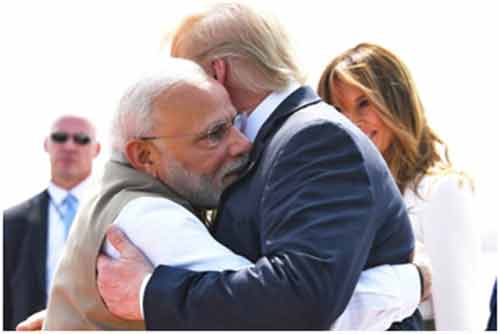
PM Narendra Modi hugs Donald Trump at Ahmedabad airport / Photo: @narendramodi / Twitter
Both leaders – President Donald Trump and Prime Minister Narendra Modi had met in Delhi on 25 February, 2020 for signing business deals including defense deals. Were these leaders oblivious to the unfolding COVID-19 pandemic?
The real heroes/heroines in the resistance against the spread of COVID-19 pandemic
The medical personnel – doctors, nurses, para medicals; sanitation workers; social workers e.g. ASHA workers involved in door-to-door surveys for detecting those people with flu-like symptoms; ensuring their isolation and quarantine at home; tracing of people in contact with positive cases or those with travel history are performing a thankless job. The medical personnel in clinics/hospitals are risking their lives to contain the spread of the virus; often working without the full personal protection gear; getting infected in the process and braving death. They are the real heroes/heroines in the national task.

Ethanol and Hunger in India

K.P. Sasi

With more than 200 million hungry people, India is the home to the largest number of hungry people in the world.  More than 190 million people in India sleep without food daily. One out of 4 to 5 children in India is malnourished. Malnourished people are prone to different diseases much more easily than the nourished lot. Needless to say that this population of hungry people in India can be seen as the most threatened section due to COVID -19. While the number of deaths and suicides due to the lockdown is increasing among the poor in India, the real figures of indirect deaths due to the lockdown  are either not estimated properly or not being reported properly. But our Government has come out with a beautiful solution to India’s hunger. Since there is a contrast between overfilled stock of grains in India, this stock of surplus food grain is going to be used for the production of ethanol to produce sanitizers to fight COVID-19! Let the hungry people in this country feed themselves on ethanol at least !
India has millions of tonnes of grain reserve, while millions of people are hungry. The Food Corporation of India has 77 million tonnes of food grains, four times more than the buffer stock. A portion of this stock can be used to deal with the existing hunger in India. But there is a need for a political will for that. It is in the context of the severe threat of hunger due to lockdown that the Government of India has decided to convert part of its rice stock for producing alcohol-based hand sanitisers to fight COVID-19. The Government actions to deal with the requirement of food for the migrant labour and India’s poor is already subjected to criticisms at an international level. In 13 states during the lock-down period, NGOs and civil society actions fed more hungry people than the Government. In Gujarat, the NGOs fed 93% of the people who were provided meals. This is what Modi’s Gujarat model is all about. So, why contribute to the Government when better results are provided by NGOs and civil society actions?
21,000 people in the world die daily in the world due to hunger and the largest section of them are from Asia and Africa. Hunger is still much bigger issue than any COVID-19, and the Corona virus is only an added problem to the hungry population.  No Government has undertaken any systematic and committed action to solve the problem of hunger.
I have heard an upper class, upper caste woman telling her husband about their eight year old son: `I think he has some problem these days. He doesn’t eat properly. He ate only 7 idlies today morning !’
Over eating has been creating serious health problems in the developed world. I wouldn’t be surprised if somebody tells me that COVID-19 has hit the Americans most because of their overeating and subsequent health disorders due to overeating. A section of the middle class with pretensions on their social consciousness in India, tell their children: People are dying in this country due to hunger. So, don't waste your food.'. The education given is:Since people are dying without food, the solution is just eat the food yourself! Do not question your Government on the irony between overstocked grains and the existing hunger. Do not question the Government on the large amounts of wastage of food. Do not demand for an equitable and sustainable distribution of food and wealth. Do not question the corporate powers on the contamination of food with deadly chemicals. Do not question the communal fascists who try their level best to divide our people on communal lines through food. Do not question the Government’s misuse of public money in the purchase and production of arms instead of feeding its hungry electorate. The social education to our children remain as `let the charity begin and end with our own stomachs.’
Just the wastage of resources by our Government is enough to feed India’s hungry people. Our expensive world’s biggest statues, our costs on militarisation, armaments, bombs and their research by utilization of a large section of skills and expertise of the scientists and technically skilled people, the economic costs of human rights violations, our wastage of resources on international travels and tours of a small section of our leaders to make international deals and contracts to sell India’s natural resources, the economic costs of destruction of India’s land, water and forests, the failure to deal with large number of farmers’ suicides, our insufficient public health services, corporate control of India’s agricultural economy and displacement of a large section of our population from their own lands and similar other issues must become as a focus of education for our youth in order to make them understand the relationship of their own food with the rest of the society. It is time that our own children see the connections between their food and India’s burning issues. It is the privilege of the well-fed people to ignore the most burning issues related to food and health. The reality is that one climate change is enough to break this pretension.
And in this hour of darkness, it is time to think fresh on why COVID-19 has left such a big scar on India’s integrity to its own people. Let us hope we will not let this scar to grow into a bigger disaster threatening our democracy, justice and peace.

Real jobless rate could reach 30 percent in Australia

Mike Head

A report by a business and government-backed think tank has effectively undercut efforts by Australian governments to cover up the mass unemployment caused by the coronavirus crisis and its devastating impact, especially on low-paid and casualised workers.
The Grattan Institute report, released on April 19, calls into question the claims of the Liberal-National government and the bipartisan “national cabinet” of state and territory leaders that the government’s unprecedented $130 billion JobKeeper wage subsidy scheme will keep unemployment down to 10 percent.
Titled Shutdown: estimating the COVID-19 employment shock, the report states: “Using our preferred method of estimating the job shock, we estimate that about 3.43 million Australians could be out of work as a result of the response to COVID-19. If all of these people were classified as ‘unemployed’, the unemployment rate would rise to 30.2 percent . ” That would be nearly 3.5 million jobless workers.
As the report explains, this reality will be disguised because “not all the people who lose work as a result of COVID-19 will be classed as unemployed.” Some will receive pay from their employer via the JobKeeper program “even if they’re not at work.” Many others will be forced into reduced hours, some will drop out of the workforce and others will not be counted because the official unemployment statistics exclude anyone working as little as an hour a week.
Even so, “the crisis will have an enduring impact on jobs and the economy for years to come. More than half of all workers in the hospitality industry could lose their livelihoods, as will many workers in retail, education, and the arts.”
While saying it is too early to reliably gauge the true figure, the report says its upper estimates would indicate the highest jobless levels “since the Great Depression in the 1930s.” And there would be no quick turnaround. “History tells us that recovery from periods of high unemployment is rarely fast.”
The report indicates that the pandemic’s impact is exacerbating poverty and social inequality. It states: “Lower-income workers are twice as likely to be out of work as high-income earners. Younger Australians and women are also likely to be hit harder, because they are more likely to work in occupations and industries most affected by the shutdowns.”
According to the report, about 40 percent of low-paid workers—those on less than $150 a week in personal income—are likely to be thrown out of work. By contrast, people earning more than $3,000 per week have less than half the risk of losing work.
The lower a person’s income, the more likely their job is at risk. That was “predictable” because industries like hospitality and retail require workers to be in close contact with other people, whereas professional jobs generally usually involve less “proximity to other people and more can be done from home.”
Nearly 40 percent of workers in the hospitality industries, including restaurants and accommodation, were short-term, casual workers who will be ineligible for the JobKeeper program. The “arts and recreation services” industry followed closely behind hospitality.
This will mean widespread impoverishment. The report notes: “Many Australians are poorly placed to support themselves through a substantial period of little or no income.” It cites research showing that “half of working households had less than $7,000 in the bank before this crisis” and had “5.6 weeks’ income or less in the bank.” Even worse, “a quarter of all working households have less than one weeks’ income in the bank.”
The JobKeeper scheme excludes about 1.1 million casual workers, international students and 1.4 million foreign workers on temporary visas. Moreover, the payments to employers do not start until next month. Many businesses, particularly smaller ones, will not survive until then. Other employers may keep workers on their books but exploit the scheme to slash their wages to $1,500 a fortnight—the level of the wage subsidy—and impose deep cuts to conditions, such as leave entitlements and penalty pay rates.
One indicator of the actual lack of employment prospects was that the average number of weekly job posts on the hiring website “Indeed” at the start of April was 50 percent below where it was at the same time in 2019.
Grattan researchers used a range of methods to estimate the size of the “employment shock” and cautioned that the precise magnitude remained unclear, both in Australia and internationally. But even if the JobSeeker wage subsidies hid some of the impact, the official unemployment rate would likely rise to between 10 and 15 percent.
Another report this week gave some idea of the reality behind the JobSeeker scheme. A special survey by the Australian Bureau of Statistics found between the first week of March and the first week of April, nearly 400,000 workers lost their jobs, and three million more lost working hours.
So far, the federal and state governments, Liberal-National and Labor Party like, have handed more than $325 billion to big business and the banks, including $130 billion via JobSeeker, since the coronavirus triggered the current crisis. But the Grattan Institute implores governments to go further. The economic shock from COVID-19 “is going to be so big” that more business rescue packages will be needed, although the report makes no specific proposals.
The Grattan report warns that the economic breakdown is not solely a product of the domestic lock down measures. It notes this month’s IMF World Economic Outlook, which forecasts the global economy to contract by 4.2 percent in 2020, with a 6.7 percent contraction in Australia.
The report states: “Sharp slowdowns in demand among Australia’s major trading partners will sharply reduce demand for Australian exports. For example, the Chinese economy contracted by 6.8 percent in the March quarter of 2020, compared to the same period a year earlier.
“Economists at the Reserve Bank of Australia have estimated that a 5 percentage point decline in Chinese GDP alone would reduce GDP growth in Australia by up to 2.5 percent. Australia’s other major trading partners are likely to record similarly severe economic contractions in the June quarter of 2020.”
In addition, the prolonged closure of the country’s borders would choke off a large share of Australia’s economic growth in recent years—net overseas migration.
The Grattan report shows why the corporate elite and its political servants in parliament, like their international counterparts, are pushing for a premature return to work, despite the worsening worldwide pandemic. They must seek to extract the cost of the breakdown out of the labour power of workers, and exploit the crisis to accelerate the decades-long assault on social spending and workers’ jobs, wages and conditions.

Australia’s national cabinet continues back-to-work push

Oscar Grenfell

Following a meeting yesterday of the national cabinet, Prime Minister Scott Morrison touted a limited easing of restrictions put in place when the corovarius pandemic hit Australia in February as another step on the “road out” out of the current crisis.
The national cabinet, composed of state and territory leaders and the federal government, has in recent weeks spearheaded a push for an end to lockdown measures, which have been denounced by sections of big business as an impediment to their profit-making activities. After its meeting last Thursday, Morrison declared that all restrictions would be reviewed in four weeks time.
Speaking to the media yesterday, Morrison reiterated May 11 as the date for such a review. He did announce, however, that level two and some level three elective surgeries and medical procedures would be resumed beginning next week.
This is particularly aimed at ensuring a continued flow of revenue to private hospitals and medical facilities, which account for almost half of health coverage across the country after decades of cuts to the public system.
Private hospitals have already been the recipient of an effective government bailout, forecast to cost at least $1.3 billion. Earlier this month the government announced a plan to “integrate” the private and public systems because of low capacity in public hospitals. The measure provides hundreds of millions of dollars to private facilities, without in any way impinging on their profit imperatives.
Despite the relatively modest character of yesterday’s announcement, Morrison declared that it was “an important decision because it marks another step on the way back. There is a road back.”
That the national cabinet did not announce a more drastic easing of restrictions may be due to ongoing indications of community transmission of the virus, despite claims that the “curve of infections” has been “flattened.”
The possibility of rapid COVID-19 outbreaks was underscored by the emergence of a cluster of cases in Tasmania over the past week-and-a-half that resulted in the closure of two hospitals and the quarantining of 1,200 health workers. At least 72 medical staff and 23 patients were infected.
Countries previously touted as models to be emulated, such as Singapore, have witnessed a large spike in cases after removing restrictions on the basis that infection rates had declined.
State and federal governments are doubtless fearful that an aggressive, enforced return-to-work will produce widespread opposition. Already there is substantial ferment among construction workers and teachers, who have been forced to stay on the job by governments and the trade unions, despite the risks to their health. Polls over the past week have shown that at least half the population thinks it is too soon to relax the lockdown measures.
There is also a debate within the ruling elite on how best to advance its interests. This week, more than 250 economists, including former Reserve Bank and Treasury officials, issued an open letter warning that “it would be a mistake to expect a premature loosening of restrictions to be beneficial to the economy and jobs, given the rapid rate of contagion.”
Other sections of the political establishment, however, are pressing for a rapid return to work, whatever the costs to the lives and health of workers. Their views were crudely summed up by University of New South Wales economist Gigi Foster, who declared on the Australian Broadcasting Corporation’s “Q&A” program last Monday that it would have been better if no lockdown measures had been imposed, even if this had resulted in a “very extreme epidemic.”
Foster also promoted the discredited “herd immunity” strategy, under which governments deliberately allow mass coronavirus infections. This program, which is not supported by any scientific or medical evidence, has resulted in mass deaths in Britain.
Other financial commentators have published articles proclaiming that the cost to business of the lockdown measures has been too great, even when weighed against the thousands of deaths that otherwise may have occurred.
As it is, the push for a return to work appears to be proceeding at this stage primarily through the easing of restrictions at a state level. Yesterday morning, New South Wales Premier Gladys Berejiklian announced that face-to-face teaching would resume on May 11, with students initially attending school one day a week.
Berejiklian invoked the dubious claim that school students are less likely to contract and transmit COVID-19 than others. She declared that the staged character of the reopening would mean that only a quarter of students would be on a school campus at any one time. The premier did not attempt to explain why such limitations would be necessary, if, as she has asserted, the risk of the virus spreading at schools is low.
In reality, one of the largest clusters of the virus in New Zealand emerged at a school in Auckland earlier this month. Prior to the conclusion of term one in Australia, a number of schools in NSW and South Australia were forced to close after infections were detected. The reason for the urgency to reopen the schools is that it is viewed as essential to forcing workers back onto the job.
The May 11 date for NSW schools reopening is significant, coinciding with the end of Victoria’s “state of emergency,” and the national review of lockdown measures. This indicates that behind the scenes, plans for an easing of restrictions are more advanced than has publicly been acknowledged.
The content of these discussions was hinted at by Western Australian Labor health minister Roger Cooke. In declaring that his government was preparing to roll back restrictions and that the hospital system was “ready” for an outbreak, Cooke reiterated that the national strategy was not for the elimination of coronavirus, but its suppression.
Attempting to eradicate COVID-19, Cooke said, would “set you up for 12 months or 18 months of complete isolation, and I think ultimately we want the Western Australian community and economy to be much more open in relation to that.” Instead the virus should be kept at a “controllable level,” so that measures could be taken to “rejuvenate the economy.”
The primary concern of governments and the corporate elites they represent is now “economic growth,” by ensuring the profits of big business and the banks. To that end, state and federal governments have rolled-out stimulus measures, transferring hundreds of billions to the largest corporations, while doing virtually nothing for the record number of workers who have been left unemployed.
The ruling class views the current crisis as an opportunity to impose a further pro-business restructuring of workplaces, centred on the destruction of conditions and “surplus” positions. To that end, editorials and comments in the financial press, including today’s Australian, have urged governments to act on the “opportunity” presented by the pandemic.
The implications were underscored by Virgin Australia’s announcement yesterday that it had entered into voluntary administration. The move imperils the jobs of over 16,000 workers at the airline, which will be restructured to make it more attractive to private equity firms and potential shareholders.
Federal government representatives, who resisted calls for a bailout of Virgin, have declared that the announcement does not mark the end of the airline, but will result in it being more “efficient” and “sustainable,” code words for it being transformed into a more profitable enterprise through ruthless cost-cutting.
Australia Post yesterday announced a major overhaul of its operations, including the reduction of metropolitan letter delivery services from daily to every second day, an extension of delivery times for intrastate letters and the abolition of the priority mail letter product. The company has not yet announced any sackings, but the statements of its executives, who have described the move as the largest restructuring in its history, signify that retrenchments are on the agenda.

Kazakhstan: Hospital workers demand resignation of government official over spread of COVID-19

David Levine

The Central Municipal Clinical Hospital in Almaty, Kazakhstan’s largest city, was shut down last week after 182 staff members tested positive for the SARS-Cov-2 virus, the coronavirus which causes COVID-19. Many patients also have tested positive.
Dr. Ernar Pirimkhan told the US-funded Radio Free Europe/Liberty outlet: “Ninety-eight percent of the employees in the surgery department, where I work, have tested positive for the virus.” Shortly after the interview, Pirimkhan also tested positive.
The hospital had been staffed by approximately 1,000 workers. Of the infected workers, some were transferred to a Ministry of Internal Affairs convalescent facility, while others have remained within the hospital itself, which has been placed under quarantine. The head physician was fired on April 14.
The hospital shutdown was accompanied by intense conflict between state officials and health care workers. Almaty’s chief public health officer, Aizat Moldagasimova, had told a television news station on April 12 that medical workers themselves were at fault for the spread of the infection. She was recorded as saying, “One of the causes is medical workers’ own lack of compliance with safety measures. They haven’t had the vigilance that they’re supposed to have. Perhaps they thought that this is a clinic for non-infectious diseases. Perhaps they hoped that there wouldn’t actually be so many patients.”
The video clip containing Moldagasimova’s statement was subsequently removed from the television station’s website, but many Internet users saved it and disseminated it on social media. In response, hospital doctors and other staff demanded that Moldagasimova be removed from office. In an announcement posted on Facebook on April 13, gynecology department head Gaukhar Amireyeva declared that she and 32 other doctors plan to sue Moldagasimova for defamation.
The medical workers insist that the confusing information and lack of supplies from the city Health Department led to the situation: Initially, the hospital was not designated as a facility that would receive coronavirus patients. Health care workers were therefore neither given the necessary personal protective equipment (PPE) nor expecting to receive COVID-19 patients. However, ambulances were ordered by the city health department to take people suspected of being positive to the hospital, which had been left unprepared to deal with them.
One doctor told RFE/RL: “Ambulance workers clad in [personal protective equipment (PPE)] brought the patients with fever and symptoms of pneumonia to our hospital’s internal-diseases department...transporting them through a common corridor. It’s an airborne infection [and] many employees in the department got infected. We tried to isolate the department as much as we could. [Eventually,] we got protective clothing.”
In a blatant attempt to suppress criticism and opposition by the workers, authorities hospitalized Amireyeva on April 14, one day after the letter demanding Moldagasimova’s resignation was issued, despite the fact that she had tested negative for the virus the previous day and was in good health. These efforts backfired as Amireyeva’s supporters video recorded her attempted hospitalization and then spread those videos on social media as well. The city government quickly released her and issued a public apology, claiming that her name had accidentally been confused with the name of another worker at the hospital who happens to bear the same initials.
The confrontation between health care workers and the government comes as the country, whose first COVID-19 case appeared on March 13, has been in a national state of emergency since March 15. Severe lockdown and social distancing measures have been enacted in the country’s major cities, including Almaty, Nur-Sultan, and Shymkent. While the official total number of cases in the country as of April 21 was 1,995, with 19 deaths, the government’s response to the crisis has been characterized by extreme inconsistency, disarray, and repressive control over news sources and any travel by citizens outside their homes.
Among other measures, video surveillance systems have been activated in the cities to ensure that people leaving their homes do so only within the strict boundaries of shelter-in-place orders.
As of April 17, 423, or approximately one-quarter, of the country’s coronavirus cases were among medical personnel, with over half of those cases in Almaty. Almaty’s Children’s Municipal Clinical Hospital for Infectious Diseases also reported 30 positive tests among hospital staff.
Conditions similar to those confronting health care workers at the Central Municipal Clinical Hospital in Almaty prevail across the country and internationally.
Tolkynay Ordabayeva, an infectious disease specialist from Jambyl Region told RFE/RL that she came to work on April 2 and 3 with a high fever from COVID-19 because she was the only such specialist available in the Merki District, which is home to nearly 85,000 people. She went on to explain that nurses had been compelled to make their own masks as hospital supplies ran low; she had received dirty PPE from hospital administration; and that she had been compelled to release coronavirus patients without testing due to a deficit of tests.
Similar horrifying reports about conditions in hospitals have emerged from the US, which has the highest number of recorded cases of any country in the world; Great Britain, where over 100 health care workers have died from COVID-19; and Russia, where nurses and doctors have walked out of their jobs for lack of PPE. Mass protests by health care workers have also taken place in Latin America .
The Kazakh government is acutely aware of these rising class tensions internationally and is exercising strict control over information on the conditions of the coronavirus pandemic. A government website on the pandemic, www.coronavirus2020.kz , contains a “Fake News and Fact-checking” section that, among other matters, reported on April 5 that a health care worker was arrested for allegedly spreading false information.
The Kazakhstan economy is expected to shrink precipitously, not only as a result of the coronavirus pandemic, but also due to the drop in oil prices. The government has promised a 42,500 tenge (about US$99) monthly subsidy during the state of emergency to all workers and self-employed individuals who have either lost their jobs or been forced into temporary leave. According to the Ministry of Labor and Social Protection, as of April 17, 6.7 million people had applied for the meager payment (i.e., more than one third of the country’s total population) and 3.5 million had already received it. The total amount of emergency government subsidies paid to individuals will be many times exceeded by emergency government subsidies to businesses, which are expected to run in several trillions of tenge.

Brazil’s Bolsonaro escalates coup threats as ruling class pushes “back-to-work” orders

Miguel Andrade

As ever more ominous reports emerge from across Brazil of the collapse of health systems and an increased death toll due to the uncontrolled spread of the COVID-19 pandemic, last weekend saw two days of fascist marches denouncing the partial economic shutdowns decreed by governors and mayors and calling for an immediate return to normal economic activities.
Brazil currently has more than 42,000 confirmed cases and 2,700 deaths, but authorities admit the real number of cases is up to 15 times higher than the official count, and that thousands of people have died with symptoms of COVID-19 but were never tested. Images of rows of fresh graves dug in São Paulo and videos of convoys of hearses heading to cemeteries have already circulated in the international media.
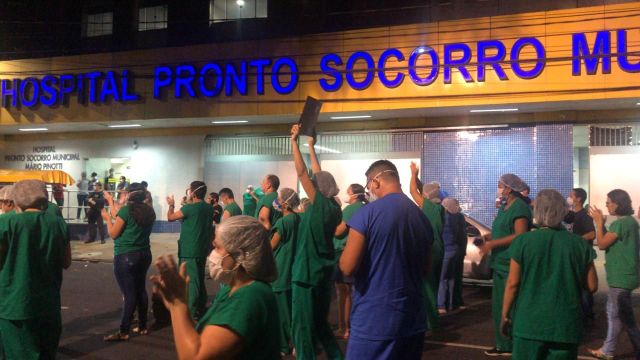
Nurses block street in protest against unsafe conditions in Belém (WhatsApp)
On Saturday, large Brazilian cities such as São Paulo, Rio de Janeiro, Brasília, Fortaleza and Porto Alegre saw convoys of hundreds of upper-middle-class demonstrators hypocritically calling for the economy to be “reopened” from safely inside their cars, only to be heckled and pelted with eggs when they drove through working class neighborhoods. On Sunday, Brazilian Army Day, fascist demonstrators gathered in front of the Army headquarters in the capital Brasília to demand that Bolsonaro shut down Congress and the Supreme Court for supporting the partial economic shutdowns decreed by governors and mayors.
They once again called for the revival of “AI-5”—i.e., “Institutional Act number 5”—a 1968 decree by the 1964-1985 military dictatorship that outlawed opposition, suspended habeas corpus and legalized political kidnappings, torture and executions.
Facing opposition from Congress, state governors and the Supreme Court against his attempt to override the partial economic shutdowns, Bolsonaro has charged that the Congress is attempting to provoke an economic crisis in order to force him out. On Sunday, he ranted before the demonstrators that “we don’t want to negotiate anything,” and that politicians “should understand they are subject to the will of the people” to reopen the economy, adding that “now the people should be in power.”
For over a year, fascist movements have used calls for the revival of the vicious methods of the former dictatorship to mobilize the most violent and disoriented layers of Brazilian society in favor of the removal of any restraint to capitalist profit-making and alignment with US imperialism. Now, such forces have been mobilized to denounce the partial economic shutdowns decreed by governors and mayors across the country as an intolerable obstacle to crisis-ridden Brazilian capitalism.
Even before the pandemic, Brazil had already faced five years of economic crisis due to falling commodity prices and declining demand, along with decreased investments from its main economic partner, China. Now. It must rush to keep up with efforts of the imperialist powers to re-open their economies in order to mitigate the impact of the pandemic on its competitiveness. But in doing so, it faces growing working-class resistance.
Popular anger is fueled by the consensus among the ruling class, including its representatives within both Bolsonaro’s opposition among Brazil’s traditional right wing and the “left”, led by the Workers Party (PT), that nothing will be done to counter the catastrophic impact of the pandemic upon workers’ lives, health and living standards. All that is on offer is starvation aid to the most impoverished layers, equal to less than half their average incomes. Violent means are being prepared to counter social opposition.
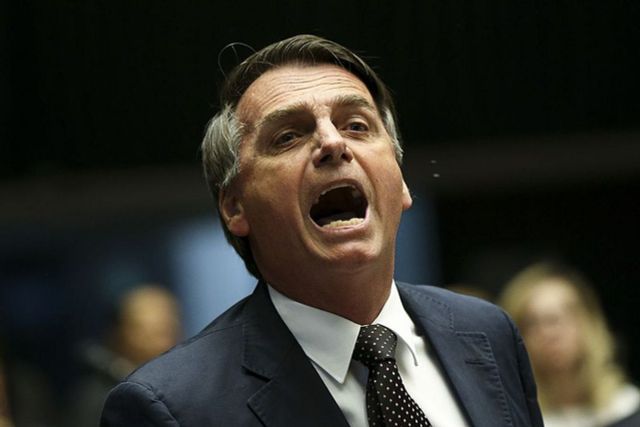
Jair Bolsonaro (Wikipedia Commons)
Brazilian governors were quick to issue an open letter criticizing Bolsonaro’s participation in the fascist demonstration and declaring support for the House and Senate leaders “in face of the declarations by President Jair Bolsonaro regarding their attitude and offending the democratic principles that rule our nation.” This was followed on Monday with governors’ announcements of back-to-work directives, even as state health authorities warn that not one Brazilian state has managed to control the pandemic’s spread.
Both state officials and editorials in Brazil’s leading newspapers have denounced Bolsonaro’s speech at the rally, while in the same breath minimizing it as inconsequential. They have pointed to perfunctory statements by military personnel to claim that, except for Bolsonaro’s behavior, all the other political actors in the Brazilian establishment are defending democratic principles.
This attitude was summed up yesterday in the editorial of O Estado de S. Paulo, which regularly features the writings of Brazilian military officials in its opinion pages: “It is comforting to realize, however, that, this time, authorities from every institution in the Republic reacted strongly against another offense to democracy by Bolsonaro and his followers.”
Such a statement is wishful thinking at best. O Estado de S. Paulo was referring to reports of frantic closed-door Sunday meetings between congressional, Supreme Court and military leaders that reportedly resulted in a Monday statement by the Defense Ministry that the Armed Forces “work to maintain peace and stability in the country, always obeying the Constitution.” The reality is, however, that the COVID-19 pandemic has unleashed an intense crisis within the ruling class over how to defuse the crisis and threatens to provoke a constitutional breakdown.
These developments come barely days after the dismissal of Brazil’s health minister, Luiz Henrique Mandetta, last Thursday. Mandetta had been universally praised by bourgeois political parties and editorial boards for publicly criticizing Bolsonaro’s photo-ops with crowds of supporters as countering social distancing recommendations. In the crisis leading up to his dismissal, the unanimous prediction of congressional officials and media pundits was that Mandetta would be kept on the job by the “adults in the room”—i.e., the military in Bolsonaro’s cabinet, including his chief of staff, Gen. Water Braga Netto, and his vice president, Gen. Hamilton Mourão. They could be counted upon, it was claimed, to keep Bolsonaro in check.
In fact, Bolsonaro’s appearance at the fascist rally Sunday for the “reopening of the economy” expressed his confidence that the ruling class will close ranks behind his extreme-right policies.
Bolsonaro has for a month put pressure on governors to reopen local economies, reaching the point of requisitioning health equipment production from all national manufacturers, without a timetable for their distribution, forcing governors to engage in direct negotiations with Chinese companies. Now, the Brazilian Internal Revenue Service has opened an investigation against one of the governors, Maranhão state’s Flávio Dino, from the Communist Party of Brazil (PCdoB), for bypassing both the federal government and US imperialism in bringing ventilators from China through Ethiopia.
Only last week, Bolsonaro’s congressional base succeeded in stalling a bill providing states compensation for the drop in sales tax collections, with Economy Minister Paulo Guedes declaring it would provide a “malign encouragement” to governors to extend the shutdowns against the federal government’s will.
Governors, including in the opposition-held impoverished Northeast, previously adopted a tactical criticism of Bolsonaro’s bluntness in stating that workers must return to work and confront infection and death from the coronavirus or starve. Now, they are closing ranks behind the back-to-work orders, while simultaneously adopting Bolsonaro’s reckless promotion, without scientific backing, of hydroxychloroquine for treating COVID-19.
In the country’s epicenter of the pandemic, São Paulo, with more than 14,000 confirmed cases, 1,000 deaths and thousands of unprocessed exams, retail is set to be reopened on May 11, before what the government itself predicts will be the “peak” of the pandemic.
The Army has already admitted that it is searching for mass burial sites in the country’s second-wealthiest city, Rio de Janeiro, while northern states such as Pernambuco, Ceará and Amazonas have declared that their health care systems are already in a state of collapse.
As in every other capitalist country, the COVID-19 pandemic is exposing and deepening the crisis of Brazilian capitalism and laying bare the bankruptcy of all factions of the ruling class, which is unable to formulate any alternative to the unfolding social catastrophe. This includes the social democratic and pseudo-leftist formations claiming to speak for workers, represented in Brazil by the PT and its petty-bourgeois backer, the Socialism and Liberty Party (PSOL).
Both are terrified of the consequences of breaking ranks with the ruling class and of encouraging, even if accidentally, any social opposition to Bolsonaro’s government. PSOL President Juliano Medeiros reacted to growing public indignation over Bolsonaro’s authoritarian campaign by cynically writing in the pro-PT Fórum that “for the president to be removed, it is necessary for the center-right to break with the government.”
He admitted that “when Bolsonaro crosses the line as he did yesterday, those against it become desperate for some initiative. It is normal. On social media the left leaders become the target of all kinds of demands, ‘enough with censure motions’ some say, ‘do something’ demand others,” only to conclude: “but the center parties also need to be addressed. The ball is not in our court, but in theirs. Indignation must be channeled to demands to the presidents of the House and Senate.”

India: Modi government moves to “reopen” economy as virus cases surge

Wasantha Rupasinghe & Keith Jones

Led by Prime Minister Narendra Modi and his Hindu supremacist Bharatiya Janata Party (BJP), India’s central government is encouraging state governments and district authorities in wide swathes of the country to begin “reopening” the economy, even as COVID-19 cases and deaths surge.
Yesterday, Indian authorities reported 1,577 new COVID-19 cases, the largest increase to date, and 47 additional deaths. This brings the official tallies to 18,601 cases and 595 deaths.
Maharashtra continues to be the hardest hit state, with 4,666 cases and 232 deaths. With more than three thousand COVID-19 cases, Mumbai, India’s commercial capital and second largest city, accounts for almost two-thirds of Maharashtra’s novel coronavirus infections.
Alarmingly, authorities appear to be failing in their efforts to stop the spread of the disease in Dharavi, a Mumbai slum. With 700,000 people living in an area little more than 2 kilometres square, Dharavi is one of the most densely populated places on the planet. Confirmed COVID-19 cases in Dharavi now exceed 175, including 11 deaths.
India is ostensibly under nationwide lockdown until May 3. But in extending the original 21-day shutdown order for a further 19 days on April 14, Modi, egged on by big business, announced that outside of areas deemed coronavirus “red zones” many industries would be allowed and encouraged to reopen starting Monday this week.
Sectors greenlighted for reopening include manufacturing, especially facilities located in Special Economic Zones and Export Oriented Units, tea, coffee and rubber plantations, oil and gas production, and construction. With the complicity of the political establishment, Indian employers violate the country’s lax occupational health and safety regulations virtually at will, but the authorities are claiming companies can be trusted to enforce “social distancing.”
Under the BJP government’s reopening guidelines, public work projects under the Mahatma Gandhi National Rural Employment Guarantee (MNREG) can also resume with the approval of local authorities. The routinely oversubscribed MNREG is supposed to provide 100 days of menial, minimum-wage work per year to one member of every rural household that wants it.
Modi, the BJP government and the corporate media have cynically sought to justify their push for a premature return to work by pointing to the desperate plight of the hundreds of millions of workers and toilers whom the lockdown has deprived of their jobs and any income.
Criminally, Modi imposed the lockdown with less than four hours warning, and without making any provision for the large majority of Indian workers who are dependent on “informal sector,” subsistence day-labour jobs. While the government subsequently threw together a package of “relief” measures, this assistance amounts to starvation rations. Moreover, only a fraction of the newly jobless have been able to access it.
Underlining that it views India’s workers and toilers as dispensable, the BJP government has added not a single additional rupee to this “relief,” even as it has extended the lockdown to 40 days.
The BJP government’s reopening plan is as recklessly improvised as its lockdown.
For starters, Indian authorities have no idea as to the true extent of the contagion, since, from the outset, they have rationed tests. To date, in a country of 1.37 billion people less than 450,000 tests have been administered.
Given the lack of testing, the government’s claims to be able to distinguish COVID-19 “Green” and “Yellow” zones, where there is reputedly “minimum risk” of the virus and businesses and industries can restart, from “hot spots” or “Red” zones, where it claims the lockdown must remain in full force, are a cruel fraud.
Second, India manifestly lacks the capacity to conduct mass-testing and contact-tracing and its health care system is in shambles. For decades, India’s government, whether led by the Congress Party or the BJP, has invested 1.5 percent of GDP or less in health care.
Under these conditions, Modi’s push to reopen India’s economy so that big business can resume its sweatshop exploitation of the working class threatens to magnify the ruinous impact of the highly contagious and lethal novel coronavirus many times over.
The government’s ill-prepared lockdown and miserly relief have already caused immense hardship, especially for the poorest sections of the working class, the migrant workers and other day labourers.
Left by the government to fend for themselves, millions of migrant workers who had been employed in Delhi, Mumbai and other major centres sought to return on foot to their native villages. While some succeeded, the vast majority were intercepted along the way and forced into makeshift internal refugee camps, after the government suddenly realized its impromptu lockdown had precipitated a mass migration that threatened to spread the coronavirus across rural India.
Conditions in these camps, which the authorities have largely left to NGOs and charities to organise and provision, are generally appalling. Common complaints include: lack of food and water, overcrowding, poor sanitation, mosquitoes and police harassment. Everywhere workers, angry at their effective detention by the state, have one question on their lips, “Why can’t we be sent to our villages?”
The reports from the poorer districts of Delhi and other major Indian cities are no less harrowing. On April 18, the News18 website published a report titled, “‘Should we watch them die of hunger?’ These new mothers can’t even breastfeed their babies due to lockdown.” It documented how new mothers in a poor district of Gurgaon, an industrial city on the outskirts of Delhi, are unable to feed their children because their husbands are without work and income. Neetu, whose husband has been unable to practice his trade as a cobbler, told News18 she had not had a full meal since she gave birth to her fourth child on April 7. “Some medicines had also been prescribed,” she added, “but I don’t think I’ve had any. I feel dizzy mostly and weak always. My child is also weak.”
These conditions are provoking growing opposition and have led to clashes between poor workers and police in Mumbai, Surat and other cities.
Meanwhile, due to a lack of Personal Protective Equipment (PPE), hundreds of doctors, nurses, and other medical staff have become infected with COVID-19.
On Tuesday, a coronavirus positive doctor who was being treated at Teerthanker Mahaveer University (TMU) medical college in Moradabad, Uttar Pradesh died.
In Mumbai, more than 200 medical personal have been infected and the city’s Central Wockhardt Hospital has been closed for two weeks due to a large coronavirus outbreak among the staff.
Earlier this week, Swati Rane, a frontline healthcare worker and vice president of the Clinical Nursing Research Society, told Al Jazeera the situation in the city’s hospitals is chaotic. She explained that currently the main the source of COVID-19 infections among medical staff is not COVID-19 wards, but other wards, operation theatres, and emergency departments where the staff are being denied PPE. ‘They are at risk,” said Rane, “as they do not even wear N-95 masks, which are important. If complete PPE is not possible, at least give them masks, gloves and gowns."
Across India state authorities have responded to a flood of complaints from doctors and other medical staff over the lack of PPE with threats of reprisals and repression.
Last Saturday, The Wire published an open letter from more than two dozen doctors and public health activists that called for PPE for all medical staff, food security for all Indians and the maintenance of public transport as an essential service to ensure access to health care for those living in rural and remote areas.
The letter also opposed the attempts of the BJP government, its Hindu right allies, and much of the corporate media to scapegoat Muslims for the spread of the pandemic. “This communalization of the pandemic, particularly targeting Muslims will prevent us,” declared the open letter, “from using this opportunity to identify gaps in our public health system and put pressure on the government to plug these gaps so that we are much more prepared for any future outbreak. Blaming one community while not holding the government accountable serves no purpose.”

Israel: Gantz agrees to national emergency government with Netanyahu

Jean Shaoul

On Monday, after weeks of stalled talks, Bennie Gantz, leader of the opposition Blue and White bloc, signed up to a “national emergency government” headed by indicted criminal Benjamin Netanyahu.
The decision of the former Israel Defence Forces (IDF) chief of staff to join the xenophobic, ultra-nationalistic and expansionist government Netanyahu has dominated for the last 11 years, signifies that the dictatorial regime imposed for decades on the Palestinian working class will now be extended to the Israeli working class.
Far from protecting the population from the devastating health and economic effects of the deadly coronavirus that has caused a catastrophic collapse of Israel’s economy—the new government’s ostensible brief—its real purpose is to protect the wealth of Israel’s corporate and financial elite, suppress social unrest in Israel and Palestine and drive down wages and living conditions in an untrammelled pursuit of profit.
Gantz was upfront about the undemocratic nature of the deal, saying, “We have prevented a fourth election.” Despite campaigning in three inconclusive general elections in less than a year, vowing never to serve under him and pledging to preserve the rule of law, Gantz’s unity deal keeps Netanyahu in power and shields him from justice, while busting up his own coalition bloc.
The new unity government is set to last three years, with Netanyahu serving as premier and Gantz as defence minister and deputy prime minister for 18 months, at which point Gantz will become prime minister and Netanyahu his deputy.
The coalition will introduce a law enabling Netanyahu to serve as deputy prime minister despite being charged, which means that Netanyahu, who is due to stand trial on charges of bribery, fraud and breach of trust next month, will continue to occupy leading positions and an official residence even as he conducts his legal defence. He will be able to veto any senior judicial nomination—including attorney-general—which gives him the power to control the judiciary. Gantz has also agreed that if the Supreme Court disqualifies Netanyahu from serving as prime minister or as deputy prime minister because of the charges against him, new elections will be held, under conditions where his own bloc has split.
Netanyahu has bought the support of his coalition partners by enlarging the cabinet to 36, giving equal seats to his own Likud-aligned bloc and what remains of Gantz’s Blue and White bloc, now dubbed the White bloc.
Netanyahu has agreed to give the justice portfolio to Avi Nissenkorn from Gantz’s party. Gabi Ashkenazi, another former IDF chief of staff, will become foreign minister. This means that the two external posts, foreign and defence affairs, go to military men, who are deemed more politically acceptable to Israel’s backers in the US and European capitals.
Such is the right-wing nature of Gantz’s bloc that Orli Levy-Abekasis, who ran on a joint ticket with the so-called left parties Meretz and Labour, will serve as a Likud minister, while Labour Party leader Amir Peretz will become the Economy Minister and Itzik Shmuli, one of the leaders of the 2011 anti-government protests, taking over the welfare portfolio.
Netanyahu and Gantz will jointly head a special “coronavirus-emergency forum.” One of Gantz’s 18 cabinet seats will go to an Arab minister (not party member).
In an important concession to Netanyahu’s fascistic partners, Gantz has agreed to legislation to be introduced by July authorizing Israeli’s sovereignty and annexation of Palestinian land it has illegally occupied since the 1967 war, following US President Donald Trump’s “deal of the century.”
Gantz’s capitulation to Netanyahu followed his inability to form a government under his own leadership without the support of the third largest party, the Arab Joint List, an anathema to Israel’s political establishment and his potential allies, who whipped up a ferocious media campaign, branding the Arab legislators as “terrorists in suits.” New to politics and differing little politically from Netanyahu, his shift was always in the cards.
His move, signaled a month ago, split the Blue and White bloc, with Yair Lapid of the Yesh Atid faction and Moshe Ya’alon of the Telem faction, both of whom have served in Netanyahu’s governments, refusing to join a national emergency government.
This political chicanery takes place amidst the most severe economic crisis Israel has ever faced. With a healthcare system ravaged by decades of privatization and cuts and in no position to cope with the pandemic, Netanyahu moved early to impose stay at home orders, shutter schools, universities and non-essential business and close its borders. He offered loans and grants to businesses.
As of April 21, there are nearly 14,000 confirmed cases and 181 deaths, although these are unlikely to be the full toll. As cases mounted among the ultra-orthodox, whose leaders refused to adhere to the social distancing restrictions, on April 2, the government declared Bnei Brak and several ultra-orthodox neighbourhoods in Jerusalem “restricted zones.”
In anticipation of social unrest, Netanyahu has authorised widespread surveillance powers—routinely used against the Palestinians in the occupied territories—to trace via their cell phones Israeli citizens, who have been in contact with coronavirus patients. Such powers for Shin Bet, Israel’s domestic spy agency, have now become part and parcel of the state’s surveillance apparatus.
The closures have taken a devastating toll on social and economic life, all but killing Israel’s vital tourism and hospitality sector and leading El Al Airlines to seek government aid. Some 26 percent of workers are now jobless, up from 3.6 percent in February. Nearly 40 percent of Tel Aviv’s tenants (46 percent of all the city’s residents rent their home) are unable to pay next month’s rent, with another 30 percent saying that within a few months they too will not be able to pay.
On Sunday, in the latest of several similar protests, hundreds of self-employed workers demonstrated outside the Knesset and in several locations throughout the country, protesting the lack of social assistance from the government. One furious protestor told Channel 12 news: “We voted for you. You were chosen as one who knows how to manage wars. In the coronavirus war you have failed! …You need to get up and get out!”
On the same day in Tel Aviv, several thousand people wearing face masks and waving black flags rallied in Tel Aviv under the banner of “Save the Democracy,” calling on Blue and White not to join Netanyahu’s coalition government. One placard read, “Let democracy win.” Some had written “Minister of Crime” on their masks, in reference to Netanyahu’s trial for corruption.
The situation is even more devastating in the occupied Palestinian territories, where, as of Monday, there were 449 confirmed cases of the coronavirus and three deaths. The Palestinian Authority, which runs parts of the West Bank with around 200 intensive care beds with ventilators, has estimated it needs $120 million in aid to cope with the coronavirus. Gaza, whose resources have been decimated by Israel’s 13-year-long siege, has only 87 adult intensive care beds with ventilators for its 2 million people.
Official unemployment is at least 17 percent in the West Bank and 47 percent in Gaza, where three quarters of the population are already dependent upon humanitarian aid. Even if the closures contain the spread of the pandemic, the economic impact is set to cause mass starvation.