25 Apr 2020

Food delivery workers in Brazil join international strikes against unsafe conditions

Tomas Castanheira

Over the past few days, food delivery workers have carried out strikes in several countries demanding safe working conditions in the face of the coronavirus pandemic and an increase in delivery rates to ensure the workers a livable income.
In São Paulo, the largest city in Brazil, workers went on strike last Friday, April 17, and resumed their action on Monday. Also on April 17, hundreds of delivery workers in Teresina, Piauí, in the northeast of the country, protested for security—against the constant robberies they suffer during work, for which they receive no compensation from companies.
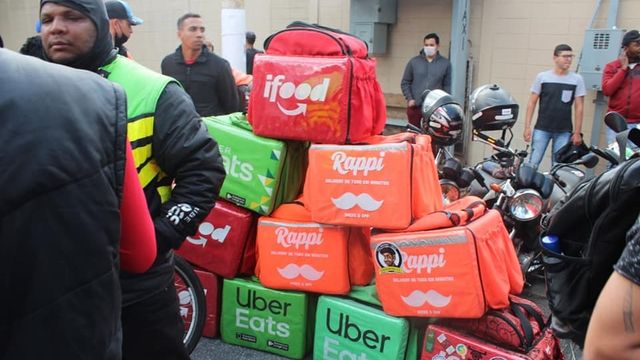
Delivery workers protest in the streets of São Paulo, Brazil [Credit: Facebook/Treta no Trampo]
These actions took place just one day after the workers protested in Spain, denouncing the same precarious conditions faced by Brazilians. Like the Spanish, Brazilian workers drove down the main avenues of their cities, honking the horns of their motorcycles.
On Wednesday, new demonstrations took place in other countries, after an international delivery workers’ strike call was circulated. In Argentina there were protests in Buenos Aires and Cordoba. In Quito, Ecuador, dozens of employees of Glovo demonstrated in the streets and in front of the office of the Spain-based company.
Everywhere these workers are subjected to brutal exploitation by the same transnational companies, such as Uber, Rappi, iFood and Glovo. Governments of several countries have defined their work as an essential service during the pandemic, without the companies, however, being forced to provide the basic conditions for the preservation of workers’ health.
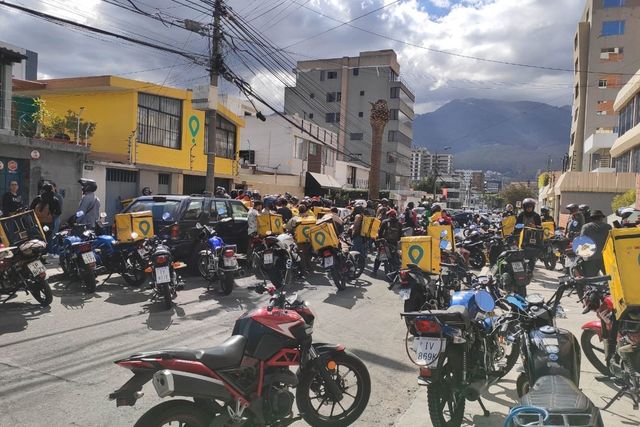
Workers protest in front of Glovo office in Quito, Ecuador [Source: Twitter]
Workers protesting on Paulista Avenue, in downtown São Paulo, denounced the conditions that they confront: “We are in the front line and we don’t have the support of even a hand sanitizer, we don’t receive a mask, we don’t receive anything,” said one of them.
Another declared: “Nobody takes a stand in the media. iFood does not take a stand... There is no representative from our class. We are here, working hard every day and if a biker falls, he is on his own. We want a stand [from the company].”
The workers say that the delivery rates given by the companies are getting lower and lower. “I risk my life to earn 2, 3, 4 reais (less than one dollar). It becomes impossible to work like this,” said a handicapped worker, who delivers food on his wheelchair.
While workers have their income increasingly squeezed and are forced to work endless hours to guarantee starvation wages, the transnational corporations are fiercely competing among themselves, eager for ever larger slices of the global market.
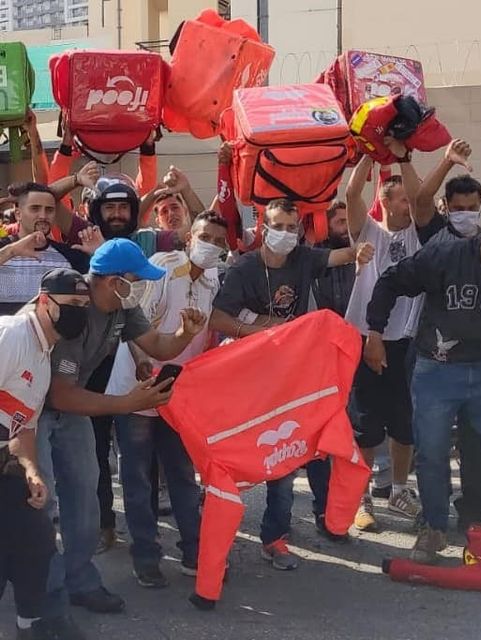
Food delivery workers protest in the streets of São Paulo, Brazil [Credit: Facebook/Treta no Trampo]
The São Paulo-based iFood, with operations in other Latin American countries, announced this month that it will merge with Domicilios.com to create one of the largest delivery companies in Colombia. Controlled by shareholders such as Jorge Paulo Lemann, the wealthiest man in Brazil, iFood is fighting for the Latin American market directly against Rappi, which is based in Colombia and last year received an investment of US$1 billion from the Japanese conglomerate SoftBank.
In the midst of the coronavirus pandemic, the number of orders for the food delivery Apps has increased in Brazil, as restaurants have been closed in the country’s main cities. But the number of delivery workers has grown even more steeply. Rappi registered a 300 percent growth in the number of registrations. And iFood received 175,000 new registrations in March, compared to 85,000 in February.
Behind this explosion in the number of delivery workers is the growing social desperation of the masses of unemployed and underemployed people in Brazil, as well as those who had their wages cut or were laid off during the pandemic. Most of these workers are not able to access the meagre R$ 600, about half a minimum wage, decreed as emergency aid by the Brazilian government.
Jair Bolsonaro, Brazil’s far-right president, is carrying out a campaign to sabotage any measures to contain the coronavirus, and has announced that he will reopen his civic-military schools early next week, as a means of forcing general reopening of schools and workplaces in the country. Asked about the explosion of deaths from COVID-19 in Brazil, he answered, “I am not a gravedigger.”
With the same indifference to the piling up of corpses, the heads of Brazilian states and municipalities are already announcing a reopening of the economy. The state of São Paulo is the main epicenter of the disease in the country, accounting for more than a third of all deaths and with an increasing mortality rate. Despite this, Governor João Doria of the Brazilian Social Democratic Party (PSDB), who has been exalted by the media and the pseudo-left as a “reasonable” politician in comparison to Bolsonaro, announced that a “gradual” resumption of activities in the state will start on May 11.
Brazilian politicians are pursuing the same course as bourgeois governments across the planet, forcing a premature return to work in order to guarantee the flows of profits to the capitalist oligarchy.
The food delivery workers’ strikes, on the other hand, express the growing resistance of the world working class to the capitalist class’s response to the coronavirus pandemic. In Brazil, they join a wave of strikes and protests against unsafe working conditions, from the March call center workers’ rebellion to the recent nurses’ strikes and protests, which began last week.
This movement must develop an ever-closer coordination between the struggles of workers from different countries, adopting a socialist and internationalist program. The fortunes of transnational corporations and their shareholders must be expropriated and redirected to benefit the interests of the majority of the world’s population, first and foremost to combat the pandemic, guarantee the incomes of the working class and save lives.

Coronavirus sweeps through Russian medical facilities

Andrea Peters

Numerous medical facilities across Russia are under quarantine, as the coronavirus spreads among physicians, nurses and patients alike. A deficit of masks and personal protective equipment (PPE) in hospitals and clinics in Saint Petersburg, Moscow and other cities has caused health care workers to contract COVID-19 from those they are treating. Sick staff are now struggling to care for themselves, their colleagues and patients in institutions under lockdown. Coronavirus infections in Russia continue to rise unabated, with nearly 70,000 officially diagnosed, a seven-fold increase compared to two weeks ago.
At the Vreden Institute of Trauma and Orthopedics in Saint Petersburg, several hundred people have been in quarantine for half a month, with workers inside reporting that most are infected. Once the virus was detected at the facility, the staff decided who would remain to care for the patients and who would leave and place themselves under home quarantine. Despite attempts to wall off areas with plastic sheeting, medical workers who stayed were unable to effectively isolate coronavirus victims within the building. The institution turned into a hot spot.
Explaining his work treating patients despite himself being ill, one doctor told the news outlet Meduza, “What else were we to do? There was no choice.” Staff who have recovered and tested negative for COVID-19 are now returning to aid their colleagues.
At the Luberetsky regional hospital outside of Moscow, more than 50 medical workers in the neurology ward have gotten coronavirus. Similar numbers have been infected at the hospital in Zlatoust, a city of about 175,000 west of Chelyabinsk in Siberia. In Vladivostok, a city in Russia’s far east, 42 people at the local hospital have COVID-19, of whom 17 are employees. At an eye clinic in Krasnoyarsk, 89 people, including 13 doctors, are sick.
The fact that medical facilities that are not directly involved in the treatment of coronavirus have become incubators of the disease is an indication of the absence of basic diagnostic and infection-control resources at these facilities.
Employees at the Luberetsky hospital are demanding an investigation of the institution’s administration, which they blame for causing the outbreak. Workers only received low-quality PPE a month after COVID-19 was detected there. “The suits are transparent, easily torn, the material is like cotton, 30 masks were given out; apparently we will have to wash them,” one physician told Gazeta.ru. He added, “We still have no respirators. We were given very little disinfectant, and it was explained that this would be until mid-June.”
The Kremlin has acknowledged that “some” regional governments are short on supplies but insists that regional health ministries must address the situation. In an effort to direct social anger away from the federal government, at a meeting with local officials this week, Prime Minister Mikhail Mishustin declared that oblast representatives had not properly submitted their requests to a 33-billion-ruble fund intended to increase the supply of hospital beds, PPE, and ventilators. As a result, much of the fund went unused.
Even as Russia’s infections rise, the Kremlin’s health minister has declared the coronavirus situation to be “under control.” Different branches of the federal government have given conflicting indications of when the virus peak is supposed to hit—from early to mid-May. The quarantine measures currently in place throughout the country are expected to last until at least May 9.
In Moscow, movement is controlled through passes that grant an individual permission to travel within the city for essential purposes. The initial result of the pass system was long lines that violated social distancing rules in the capital’s metro stations, as police checked individuals’ documents. Moscow mayor Sergei Sobyanin called this week for these measures to be extended throughout Russia.
As the closure of clinics and hospitals because of COVID-19 outbreaks causes a larger health crisis, economic hardships in Russia intensify. In addition to laying off workers, many companies keeping employees on the books are failing to pay them.
Official data put out by the Ministry of Labor claim that there have been just 44,000 layoffs since the start of the year, bringing the total number of unemployed workers in the country to 735,000. Rosstat, the federal statistical service, says that 3.4 million Russians are out of work, which puts the jobless rate at about 4.6 percent. The Ministry of Labor’s data is based on unemployment filings, whereas Rosstat uses a survey to gather its information.
Economists, however, argue that both sets of data are a vast undercount. When broader standards are applied for calculating who is unemployed, the real number of people in need of work is about 4 million. The Institute for Economic Growth estimates that if the quarantine remains in place for another two to three months, a further 4.5 million people will be laid off. If it continues for another six months, the number will rise to 14 million.
When the Kremlin initiated the countrywide quarantine weeks ago, President Vladimir Putin declared that the month of April would be a “paid holiday” for Russia’s workers. However, it issued no direct payments to the population and made no funds available to employers to offset their costs, such that most companies ignored the decree. By the middle of the month, the country’s prime minister announced the creation of a 150-billion-ruble fund to support wage payments. However, it is widely understood that this is not enough to secure the incomes of millions affected by the crisis.
This week, the Sberbank head German Gref insisted that the Russian government could not give money directly to the population because, unlike elsewhere in the world, the country does not have a mechanism by which to do so. Meanwhile, banks are freezing credit lines for consumers. Putin appealed to financial institutions on Thursday to not stop lending money to the population but outlined no concrete measures to address the situation.
Although there are widespread news reports of rising prices for basic consumer goods—such as sugar, eggs, buckwheat, potatoes, tomatoes, and lemons—the government said this week that it would not impose price controls. It insists that the collapsing value of the Russian ruble, which is trading at around 74 to the dollar, as compared to 60 to the dollar before the COVID-19 crisis hit, is driving up costs for producers. Limiting what they can charge customers for their products will drive them out of business, says the government.
The unprecedented fall in global oil prices is unleashing a massive revenue crisis for the Russian government. In order to comfortably meet its planned expenditures and avoid drawing on the National Welfare Fund (NWF), a multibillion-dollar emergency reserve, the country’s main export needs to trade at around $40 a barrel. Currently, that number stands at $8 a barrel.
Demand for the commodity has cratered due to the pandemic, leading to a glut on the market. The deal recently reached between Russia and Saudi Arabia, after weeks of conflict over production levels, has failed to arrest the price drop. Russia’s natural gas revenues are also falling.
Finance Minister Anton Siluanov reported that with a price of $20 a barrel, the state will spend two trillion rubles a week from the NWF, draining the fund entirely by 2024, six to ten years earlier than anticipated. Ultimately, the state will have to respond with the imposition of severe austerity measures.
Social anger is building in Russia over the combined health and social crisis. On April 20, 1500 protesters gathered in Vladikavkaz, a city in north Ossetia, to demand government aid for those being left destitute by the crisis.

COVID-19 pandemic pushes UK charity sector into crisis

Ben Trent

“They [the English bourgeoisie] who have founded philanthropic institutions, such as no other country can boast of . ... As though you rendered the proletarians a service in first sucking out their very life-blood and then practising your self-complacent, Pharisaic philanthropy upon them, placing yourselves before the world as mighty benefactors of humanity when you give back to the plundered victims the hundredth part of what belongs to them! Charity which degrades him who gives more than him who takes; charity which treads the downtrodden still deeper in the dust, which demands that the degraded, the pariah cast out by society, shall first surrender the last that remains to him ... shall first beg for mercy before your mercy deigns to press, in the shape of an alms, the brand of degradation upon his brow.”
Frederick Engels, 1845, The Condition of the Working Class in England.
One hundred and seventy-five years after Friedrich Engels, the cofounder of scientific socialism alongside Karl Marx, wrote these lines, the charity sector is a multibillion pound industry. According to the National Council for Voluntary Organisations (NCVO), the UK currently has 166,000 charities, with an annual turnover of £48 billion.
The Daily Mail and the Sun reported in 2019 that charities, including Macmillan Cancer Support, World Wildlife Fund and Marie Stopes, had been awarding senior leaders five figure bonuses, reaching a peak of £200,000.
The coronavirus pandemic, however, has caused the charitable sector an unprecedented challenge. Estimated figures see charities set to lose up to £4 billion over a 12-week period. A survey conducted by the Institute of Fundraising, NCVO and the Charity Finance group found that hundreds of large charities expect to see their income fall by nearly a third in the coming year due to the pandemic.
At the end of March, the WSWS reported that in the nine days preceding March 24, 470,000 people applied for assistance through Universal Credit, more than eight times the average. With a 700 percent spike on March 27, things look set to get worse. We noted, “the Nomura investment bank predicted further surges in the unemployment rate to eight percent in the April-June quarter, rising to 8.5 percent in the next three months,” amounting to a figure of 2.75 million people unemployed.
The coalescence of an economic crisis and the spread of the deadly coronavirus, almost unchecked by the UK government, has seen a devastating increase in the use of food banks along with a host of other charitable services. Numerous charities have also had to step in to staunch the overflow of the pandemic, which the National Health Service has been unable to cope with due to a decade of being gutted of resources.
During the government (1979-1991) of Prime Minister Margaret Thatcher, the watchword of the day was that there was “no such thing as society.” This clarion call heralded an offensive to break up the welfare state, the social victories secured by the working class in the aftermath of the Second World War granted in order to avert the threat of socialist revolution. Thatcher’s neoliberal agenda saw 18 years of Tory rollbacks. Moreover, the Labour Party’s victory of 1997 saw this continue under the premiership of Tony Blair.
Without having to tackle issues such as massive unemployment, Blair was able to continue the Thatcherite agenda of rolling back welfare provisions and carrying out privatisation by stealth. Blair and Gordon Brown’s governments saw significant groundwork in the privatisation of the NHS, with the introduction of “independent sector treatment centres” (ISTCs) and the opening up of the National Health Service (NHS) “internal market” to “any qualified provider” (AQP), under Brown in 2009.
The 2008 financial crash, along with the election in 2010 of the viciously right-wing Conservative/Liberal Democrat coalition led by David Cameron, saw a dramatic escalation of the attack on state provision. Social welfare and services were slashed, with local authorities forced to make monumental savings year on year, all with no genuine opposition from the Labour Party.
The past decade saw a massive increase in poverty and social hardship. According to Cameron, charities could fill the gulf left behind by the destruction of all social and health care services by the welfare state. His “big society” would see a whole host of philanthropic NGOs (non-governmental organisations) take on the challenges previously met by the state.
This myth is now crumbling in the face of the escalating social crisis. “Charities will have planned on raising millions of pounds which is going to be irrevocably lost because of the impact of coronavirus,” stated Peter Lewis, chief executive of the Institute of Fundraising. “The cancellation of high profile events, such as the London Marathon, as well as thousands of smaller events run by local charities across the country, closure of shops, and a halt on public fundraising activity have already caused huge problems for charities who quite simply can’t plug the gap in such a short time.”
On March 31, the Financial Times rang the alarm bells for the UK government . In an article titled, “Charities need a lifeline to respond to coronavirus—and rebuild society afterwards,” the FT warned that many charities will face liquidation due to a projected reduction of income by 48 percent, as detailed by figures released by the Institute of Fundraising. The article insisted, however, “After the immediate crisis has passed, charities will play a critical role in rebuilding society,” making clear that there will be no possibility of the state resuming any social responsibility that might cut into the sacred profit margins of big business.
The FT’s message was heard loud and clear. Within barely two weeks Chancellor of the Exchequer Rishi Sunak made great fanfare of a pledge of a measly £750 million to charities, a pittance compared to the £350 billion that has been made available for banks and giant corporations to squander. Nevertheless, it provided a lifeline in the short-term to keep the charity sector alive, albeit barely breathing, to justify far bigger cuts in social provision to come.
The pledge sees almost half (£360 million) going to charities to shore up key services, such as St. John’s Ambulance and hospices, which aid the NHS. Further it will go to victims’ charities and vulnerable children’s charities to alleviate local authorities as well as the Citizen’s Advice Bureau.
A further £370 million will be made available to small- and medium-sized charities.
Echoing the language of the FT, Sunak stated that the pledge “will ensure our key charities can continue to deliver the services that millions of people up and down the country rely on,” as well as acknowledging that “our charities are playing a crucial role in the national fight against coronavirus, supporting those who are most in need.”
Health Secretary Matt Hancock proclaimed that the “entire charity sector has stepped up as part of our national effort to tackle coronavirus, from helping our NHS heroes to ensuring the most vulnerable among us are cared for properly.”
This “national effort,” much like Cameron’s “big society,” is used to obfuscate the class issues at stake. While the super-rich have hightailed to their luxurious country estates, workers across Europe are being corralled back to work in a complete disregard for their health. Big business is being bailed out by the UK government, while Conservative think-tanks have workers’ pensions in their sights, a taste of austerity to come.
For the charities which are not able to claim this grant, and for those still going to fall short despite the grant, the meagre services they provide must now be cut to the bone.
As Sunak himself declared, with barely disguised contempt, “I can’t stand here and say I can save every single job, protect every single business or indeed every single charity. That’s just simply not possible.”

Scottish National Party spearheads UK-wide return to work campaign

Robert Stevens

Scottish National Party (SNP) First Minister Nicola Sturgeon’s mapping out of a Scottish exit from the lockdown and return to work has been embraced by Britain’s ruling elite and its media.
Boris Johnson’s Conservative government has been fatally compromised by the horrific consequences of its de facto herd immunity policy and failure to protect the working population—that has officially led to almost 20,000 deaths and far more in reality.
Under these conditions, Sturgeon’s supposed “progressive” credentials, backed in Scotland, England and Wales by the Labour Party and the trade unions, offer an avenue for big business and banks to engineer a political shift towards a return to work.
This takes place under conditions in which people are dying daily in the hundreds and in which no systematic COVID-19 testing of the population has been carried out. Yesterday, a further 768 were reported dead, with Britain set to pass the grim milestone of 20,000 deaths today. The newly opened website for key workers showing symptoms of COVID-19 crashed due to unmet demand after 16,000 people secured either a test at a drive-in centre or a home test kit.
Sturgeon insisted, “What we will be seeking to do is find a new normal—a way of living alongside this virus.”
She declared, “It may be that certain businesses in certain sectors can reopen” with “employees and customers two metres distant from each other.” The Scottish population had to prepare for multiple lockdowns, “with little notice” because the “horrendous reality” was that everyone must get ready for repeated cycles of infection.
Sturgeon’s speech accompanied the release of a 26-page document by the Scottish government, “COVID-19—A Framework for Decision Making.” It states in more explicit terms than Sturgeon did publicly that the lockdown had to end in order to “do everything possible to avoid permanent, structural damage to our economy.”
The foreword states, “It is clear that we cannot immediately return to how things were just over 100 days ago. But it is equally clear we cannot stay in complete lockdown indefinitely, because we know that this brings damaging consequences of its own. So we must adapt to a new reality.”
The report details how “Our plans to respond and recover must take account of the possibility of a cycle of lifting and re-imposing restrictions. The steps we take to rebuild our economy or restore some degree of normality in society must recognise the possibility of restrictions being re-imposed quickly. That will require fundamental change to how all sectors of society organise themselves.”
The SNP government does not try to pretend that any of this is based on a scientific approach. Instead, it glorifies a reckless suck-it-and-see policy that will see many die. It states: “If, after easing any restrictions, the evidence tells us we are unable to contain the transmission of the virus, then we will have to reimpose them, possibly returning to lockdown with little notice. While we will do our best to avoid this, it is possible that such a cycle may happen more than once until we reach a point when we have in place an effective vaccine.”
The trade unions are intimately involved in enforcing a return to work. The document states, “We have already begun the conversation on how to respond, re-set, restart and recover with our business community and our trade unions.”
Without explaining how reopening the economy will facilitate a declared aim of “Stopping a resurgence of the pandemic,” the report states this “will allow us to work with our partners in business, trade unions, local government, the voluntary sector and in broader society to redesign workplaces, education settings and other premises so they are places where spread is minimised—allowing people to get back to work, children to return to school, and our young people to continue their education through our colleges or universities …”
The SNP’s initiative was welcomed by leading forces in the Tory government demanding a return to work—including former conservative leader Ian Duncan Smith and David Davis. Duncan Smith has said getting schools to reopen, in particular primary schools, is “key to unlocking labour.”
These layers are already in an alliance with newly elected Labour leader Sir Keir Starmer and powerful sections of business in championing a “back-to-work” strategy.
A right-wing media campaign is underway in the push for a return to work. The Daily Mail published a piece Thursday including photos of people queuing outside newly opened stores of DIY chain B&Q and a Five Guys burger chain outlet in Edinburgh, headlined, “Britain votes with its feet.”
On Friday, Rupert Murdoch’s the Sun editorialised, “We must end lockdown as soon as it’s safely possible before our economy is completely destroyed,” while Murdoch’s Times ran an editorial headlined, “Back to Work.”
Jaguar Land Rover will resume production gradually at its Solihull plant and at its engine manufacturing operation in Wolverhampton from May 18. Aston Martin Lagonda will reopen its new plant in South Wales even earlier, on May 5. Construction conglomerate Taylor Wimpey resume work on some sites on May 4. The Vistry Group—formerly Bovis Homes—will recommence operations at 90 percent of partnership sites and a significant number of its housing sites from next Monday.
A timetable is being laid down, with the weekend to be used by the ruling elite to mount a propaganda campaign for a return to work. BBC Political Editor Laura Kuenssberg, who has intimate connections to the Tories, said Friday, “One interesting thing I think we might see more of before we actually get a big announcement [regarding dates for a mass lockdown exit] from the Westminster Government is more of what has been described to me as ‘prodding.’”
The Daily Telegraph, under a front-page emblazoned with “Johnson back at the controls Monday,” declared that the prime minister, who nearly died of COVID-19 and required seven days of treatment in hospital, “is planning to return to No 10 as early as Monday to take back control of the coronavirus crisis amid Cabinet concerns the lockdown has gone too far.”
Johnson is held up as the man who can seize the rudder of state and end the “prevarication” of those ministers who have been deputised in his absence.
The ruling class is set on a head-on confrontation with the working class. The constant references in daily Downing Street briefings to “flattening the curve” confirm that the government continues to pursue its herd immunity strategy. With an enforced return to work, this will open the way to another wave of the pandemic, likely worse than the first.
Many workers will have no jobs to go back to and those who remain in a job will confront demands for wage cuts and speedups in workplaces with little or nothing in the way of safety measures. Such are the explosive consequences that the Times felt it necessary to caution, “Protections should be put in place for employees who believe they are being pressurised to return to work in unsafe conditions … it is hard to see how they could reopen otherwise, since if staff didn’t feel safe many would refuse to turn up for work.”

Macron government uses more lies to push May 11 return to work

Will Morrow

The administration of French President Emmanuel Macron is aggressively promoting a full reopening of the economy on May 11 that will directly lead to thousands of additional coronavirus deaths. The government is relying on the trade unions to suppress widespread opposition in the working class to the end of confinement and force workers back to their jobs.
The government has announced that it will provide more details about its plan for an end to confinement early next week, most likely on Tuesday. Last Thursday, in a call with local elected officials across the country, Macron clarified that the reopening of schools on May 11 would not be obligatory for all, but would be “done voluntarily,” with parents given the choice of keeping their children at home.
This only ensures that those who return their children to school come mainly from the working class and the poorest segments of the population, who will not have the choice to work from home beginning on May 11, or conduct homeschooling or of otherwise minding their children. The government is cynically exploiting the fact that thousands of families depend on 1-euro subsidized lunch programs provided by school cafeterias to feed their children. They will have little choice but to send them back to school to eat.
Over the past week, the government has stepped up its propaganda agitating for a reopening of schools. Macron’s Health Minister Olivier Véran gave an interview on France Inter ’s morning program yesterday that was remarkable only for the number of lies he was able to fit into a 10-minute segment.
Although the role of children as asymptomatic carriers of the virus remains undetermined by scientists, Veran downplayed the potential impact of reopening classes. “There is the question of whether children are contagious or not,” he said. “This question has been asked often for many weeks. Here too there are arguments both for and against (emphasis added). The latest scientific arguments that have come to me say that for children under 10 transmit the virus less than adults. ... That is why we are working with measures that are very operational, which will permit us to provide for safe teaching of the students.”
When the journalist asked him to specify the measures he was referring to, Veran refused, declaring instead that “children must return to the school. … At a certain point, they will have to return progressively to a school setting.” At another point in the interview, he argued that small children were very good at learning social distancing measures. He added that, in any case, reopening schools was necessary to “combat inequality,” with first priority for a return to classes for “those children in difficulty, those in trouble at home, and we have to provide the means, and … pose the conditions that would permit children to return to school.”
Veran said that while it would be many months before a vaccine could be created and reliably mass produced, “In the meantime, we will have to live with the virus.”
In other words, the virus and its deadly toll must come to be seen as a part of daily life. The maintenance of confinement “is a complicated question,” he continued. “We cannot confine half the planet for six months or a year, until there is a vaccine; and since we are not sure that a confinement would stop the spread of the virus. … We are obliged at each step to measure what we are doing in order to have a major positive health impact for France, but without having too much of an impact on the other side.”
Veran had directly contradicted his own claim that a prolonged confinement may not stop or severely limit the spread of the virus, earlier in the same interview, when he said he accepted a new model released by a mathematical team in France this week, estimating that at least 60,000 additional lives in the country had been saved due to the confinement.
However, his comment that a confinement may have “too much of an impact on the other side” means, in plain language, that although tens of thousands of lives would be saved, these must be weighed against the potential damage to French corporate profits due to a prolonged shutdown of the economy.
As for Veran’s statement that nonessential production could not be stopped until a vaccine is produced, this is simply based on the premise that capitalist property and the financial elite’s monopolization of social resources must remain inviolable. The wealth of the 40 wealthiest individuals in France on Forbes’ 2019 rich list totaled over 288 billion euros—more than 10 times the amount allocated by the Macron administration toward limited unemployment payments in the past three months.
Veran admitted that the government had no clear idea of the number of cases in France, which means that it has no idea how quickly the virus will spread with the end of the confinement. “I do not know exactly how many French people are infected,” he said. “We have models, we have studies, but I’ve learned with this virus to remain extremely cautious towards data that isn’t set in stone.”
Anger is growing in the working class over the criminal policies of the Macron administration. Yesterday, the weekly Le Canard Enchaîné cited a letter written April 18 by Georges-François Leclerc, the police prefect of Seine-Saint-Denis north of Paris, stating that 15,000-20,000 workers were unable to feed themselves properly due to the administration’s refusal to provide adequate support throughout the lockdown, with children and students who rely on school programs most at risk. Leclerc reportedly warned of mass riots and a social explosion, warning: “What was achievable in a month of confinement cannot be maintained for two.”
This week has already seen the eruption of protests and unrest in the impoverished suburbs around Paris and other major cities against police violence and social inequality.
The Macron administration is depending upon its close collaboration with the trade unions to suppress the opposition in the working class and force workers back to work.
While making empty criticisms of the return to work, the CGT is supporting it in practice and closely collaborating with Macron. Yesterday, CGT President Philippe Martinez gave an interview with Sud Radio in which he declared that he believed schools should not be opened until September because it would be unsafe for teachers because of the propagation of the virus.
Asked by radio host Patrick Roger if he would therefore call on teachers to refuse to open schools, Martinez scoffed and replied, “No, no, I think I have already explained it clearly: We are calling on people to work insofar as the conditions are safe.” The CGT is already overseeing the return to work of autoworkers, with Toyota reopening one of its assembly lines in Onnaing on Thursday.
Calling for further collaboration with Macron, Martinez said that “even though during this period we have had a bit more contact with the government, in any case I hope that after this crisis the government and the president of the republic will consider that the trade unions are useful.”
The fight against a return to work cannot be conducted through the trade unions, which are the allies of the government and the employers against the working class. Workers need their own organizations, independent action committees, to organize an industrial and political offensive against any return to work in industries that are nonessential for the fight against the virus. This must be connected to a socialist program for a workers government, the expropriation of the capitalist class and devotion of society’s resources toward the fight against the pandemic, including the guarantee of decent living conditions to all workers and safe working conditions in essential industries.

Spain: Podemos Labour Ministry accepts that hundreds of thousands will die from COVID-19

Alejandro López

An extraordinary leaked document from the Spanish Labour Ministry, led by Podemos minister Yolanda Díaz, states that the Spanish government accepts that 70 percent of the population will become infected with COVID-19, with one third of employees infected at each workplace. That is, the Spanish government is basing its policies, including its forcing of millions of nonessential workers back to work, on its willingness to accept millions of infections and hundreds of thousands of deaths in Spain.
On Wednesday, the private Spanish wire serve Europa Press reported on a leaked contract from the Public State Employment Service, an agency of the Labour Ministry, with Quirón Prevención, an occupational risk prevention company. The state service was hiring Quirón Prevención to test its employees doing essential work related to COVID-19’s economic impact, like processing unemployment claims and temporary redundancies. The department has experienced a number of sick leaves due to COVID-19 in the past month.
To justify applying for the emergency contract, the agency stated: “[T]he experience accumulated in recent weeks shows that the appearance of a case among the staff who provide minimum services may indicate contagion to other workers. This makes it necessary to take measures to find out, on a voluntary basis, whether or not those in contact with our staff are infected or not in order to prevent their return to work, or to do so in a safe way so they don’t transmit the virus.”
It continued, stressing that COVID-19 testing is necessary “given that almost all workplaces will present a case, the transmission ratio is approximately 1 to 3 and the health authorities’ forecast is that around 70 percent of the population will be infected in the coming months.”
This is the first public acknowledgment of the infection forecasts being made by Spain’s Socialist Party (PSOE)-Podemos government. These estimates signify that around 70 percent of Spain’s population of 47 million, or 33 million people, will be infected. Based on the 3.4 percent case fatality rate for COVID-19 estimated by the World Health Organization (WHO), this means the PSOE and Podemos accept that around 1.1 million people would die.
By way of historical comparison, current estimates are that the Spanish Civil War (1936-1939) led to approximately 500,000 deaths from all causes: deaths in combat, bombings and executions, as well as disease, famine and other causes. About 3.3 percent of the Spanish population died in the war, with another 7.5 percent being injured.
Such a massive and horrific death toll irrevocably marked the consciousness of the working class. Eighty years later, Spain still remembers the suffering provoked by the military-fascist coup that sparked the war. Countless paintings, statutes, memorials and songs commemorate this historical event. It is estimated that 20,000 books have been written on the civil war.
Now, however, the Spanish government is accepting—in the fine print of a contract for an agency most Spaniards have never heard of—that over twice the number of victims of the Spanish Civil War could die.
This response exposes the bankruptcy and criminality of the capitalist system. The key measures to halt the spread of the virus are lockdown, mass testing, and isolation and treatment of the sick. Workers in essential industries who must continue working need personal protective equipment like face protection (masks, goggles and face-shields), gloves, gowns or other clothing. However, the ruling class systematically pushes to run business as usual, risking millions of lives in order to railroad workers back to work to produce profits for the banks and major corporations.
In particular, the Labour Ministry’s revelations about the PSOE-Podemos government’s infection projections make clear the political criminality of the government’s back-to-work order issued on April 13. Millions of construction workers, metalworkers, builders, cleaners, factory and shipyard workers, sanitation and security employees, autoworkers and other workers at nonessential jobs returned to work, after factories and construction sites had closed for a two-week shelter-at-home period.
This policy, advanced by the government in collaboration with the social-democratic General Union of Labour (UGT) and the Stalinist Workers Commissions (CCOO) unions, is needlessly and recklessly exposing millions to infection. Now it is clear that the government bases this policy on a staggering indifference to human life: it is willing to accept the deaths of hundreds of thousands of workers.
To a remarkable extent, this explosive story has been buried in Spanish media. There has been barely any coverage except for few right-wing newspapers—La RazónEl Confidencial and ABC—which posted back-page coverage, buried amid their right-wing criticisms of the government over the pandemic. While these papers downplayed the story, pro-government papers like El País and eldiario.org kept silent, as they all support the government’s back-to-work policy. All agree that workers must be forced back to work so profits can be extracted, placing profits over lives.
The fact that this policy is acknowledged by the Ministry of Labour, which is under a Podemos minister, underscores the vicious hostility of anti-Marxist populist parties to the working class. Podemos’ Greek ally, Syriza, took power and imposed billions of euros in cuts to spending on basic social programmes including pensions, health care and education, shredding basic labour rights and building concentration camps for refugees. Podemos, now that it is in government, is deliberately sending millions of workers to be infected by a deadly virus.
On Wednesday evening, the ministry said the percentage that it had cited in its contract was “inaccurate” and a “misunderstanding.” Trying to explain away the “inaccuracy,” it said that it did not have a forecast for the number of infections in Spain. Instead, “transmission rates and also the incidence of cases in the Spanish population will be determined by Spanish health authorities as a result of epidemiological studies that they are realizing,” and that are in fact slated to start on Monday.
This reply is astonishing and strains credulity. If one is to believe the Ministry of Labour, however, three months after the WHO mission to China reported human-to-human transmission, and seven weeks since the WHO declared COVID-19 a pandemic, one of the countries hardest hit by the virus, with over 22,000 deaths, has still made no forecast of how the pandemic would unfold. Such an argument beggars belief, and strongly suggests that top state officials are simply lying to the public.
If it were to be true, however, it would underscore that the government’s back-to-work policy was not based on any scientific assessment or attempt to protect the workforce—but simply a blind demand for workers to go back to work and risk their lives to create profits for the capitalist class.

German government endangers the health and lives of millions with return to work and schools

Johannes Stern

One week after the decision by Germany’s federal and state governments to relax the coronavirus restrictions, the agreed upon measures are being aggressively implemented. The ruling elite is endangering not merely the health of millions of workers, school students, their families and friends, but also their lives.
A number of state governments—including the Social Democrat/Left Party/Green government in Berlin—forced thousands of students back to school earlier this week to sit their final exams. Regular classes for some school years began in the state of North Rhine-Westphalia on Thursday. Other states—including Hesse, Bremen, Hamburg, Brandenburg and Thuringia—will follow suit next week.
The policy of “gradual opening” (Chancellor Angela Merkel) is increasingly being exposed as a comprehensive plan to rapidly accelerate the revival of public life and the economy. In large cities, shops, including large shopping centres, are open once again. The federal government’s decision to limit shop openings to stores with an area of less than 800 square metres was a dead letter from the start. Larger businesses have evaded the regulations by partitioning their stores. The Administrative Court in Hamburg then overturned the regulation completely on Thursday.
Merkel, who spoke out at a press conference on Monday against what she had described as an “orgy of discussions about opening,” is in reality organising this “orgy of discussions.” In her government statement to the federal parliament on Thursday, she stated that she unconditionally agrees with the initial relaxations agreed between the federal and state governments, but merely finds their implementation “too bold.” Egged on by the media and big business, politicians from the government and opposition parties are seeking to outdo each other with ever more radical plans.
On Wednesday, Social Democrat Family Minister Franziska Giffey demanded an even more rapid opening of schools and kindergartens. “We have to talk about how we can achieve a gradual, a step-by-step opening of kindergartens and schools,” she said on the television show “RTL-Frühstart.” It is “not the case that everything can just stay shut until the summer.”
A central component of the policy is a revival of production, above all in the auto industry. “We are working hard to maintain supply chains,” stated Andreas Scheuer (Christian Social Union, CSU) during government questions in parliament on Wednesday. Daimler and Volkswagen, with the full support of the trade unions, have already restarted the assembly lines in several plants. Further plants will follow next week, including VW’s main plant in Wolfsburg, where some 63,000 workers are employed.
The government is justifying its “back to work” policy with references to “first successes” (Merkel) in the struggle against the coronavirus. This is intentional fake news. The reality is that the pandemic is continuing to accelerate its spread around the world, and the numbers of new infections and deaths are still rising in Germany. On Wednesday, the total number of deaths passed 5,500 and infections surpassed 153,000—the fifth highest number worldwide.
According to the Robert Koch Institute (RKI), Germany’s federal agency for infectious disease control, the number of deaths reached a record high over the past week. More than 300 coronavirus deaths had been reported during several single day periods, reported RKI vice president Dr. Lars Schaade at a press conference on Tuesday. The reproduction rate is also rising once again. Although it dropped to 0.7 last week, it rose back to 0.9 this week, approaching the critical figure of 1.
The dangerous implications of these developments are clear. If the reproduction rate increases above 1, this means that each infected person infects more than one other person, which will lead to an exponential growth of coronavirus. According to scientific modelling, the German health care system would be overwhelmed by October with a reproduction rate of 1.1, and in July if it rises to 1.2.
To put the matter bluntly: with its policy of reopening the economy, which has already led to an increase in the reproduction rate, the ruling elite is preparing a catastrophe and encouraging the development of conditions seen in Italy and the United States, where health care systems collapsed under the burden of the pandemic. The terrible consequences are well known. Severely ill patients can no longer receive treatment and end up being left to die. The pictures from Bergamo and New York, where the army disposed of bodies piling up on the streets, quickly spread around the world.
Serious scientists and epidemiologists insist that such an escalation can only be prevented in Germany if social distancing measures are maintained and intensified, and a programme of mass testing and contact tracing is adopted.
On Wednesday, the head of virology at Berlin’s Charite hospital, Christian Drosten, who advised the government for some time, warned against “gambling away the advantage Germany has achieved.” On Monday, he stated in his podcast that the “activity of the epidemic could suddenly” return “in a disproportionate way or with unexpected power” if the reproduction rate “goes above 1 again.” Even now, the Charite’s intensive care wards are “increasingly full,” even though there has not yet been in Berlin “a situation with a particularly high transmission rate.”
Gabriel Leung of the University of Hong Kong, who advised the World Health Organisation and the Chinese government, told Der Spiegel in an interview that a rapid easing of the restrictions would be “irresponsible.” “If you have such a large outbreak like it is currently in Europe, you have to use a sledgehammer,” he warned. The aim “above all is to ... reduce the current reproduction rate.” It needs to “decline a long way below 1 in order for the number of infections to reach an acceptable level.”
The parliamentary debate on Thursday underlined the reactionary interests behind the criminal indifference being displayed by the government towards scientific knowledge and warnings. The ruling class sees the coronavirus pandemic as an opportunity to intensify its aggressive class policy and great power ambitions. Representatives of the government and opposition parties left no doubt about this. The health and social wellbeing of the population must necessarily be sacrificed, according to this policy, on the altar of capitalist private profit.
“Everything we decide costs money—lots of money—that someone has to pay back at some point,” stated Ralph Brinkhaus, head of the Christian Democrat/Christian Social Union parliamentary group with reference to the multibillion-euro bailout packages, which have been adopted over recent weeks with the full backing of all parties. The message is clear: the vast sums of money, which above all went to the major corporations, banks and the super-rich are now to be squeezed out of the working class. This is why the return to work cannot go fast enough for the ruling elite.
A second factor is the geostrategic and economic interests of German imperialism, which after losing two world wars is once again attempting to dominate Europe in order to play a role as a world power.
“What we need now are pragmatic and goal-directed measures for Europe to emerge stronger from the crisis. That’s exactly what we want; because only a strong Europe can at the end of the day be able to compete globally with world powers like China and the United States,” stated Katja Leikert, deputy leader of the CDU/CSU parliamentary group.
The coronavirus pandemic is not slowing the return of German imperialism; it is accelerating it. On Wednesday, the government decided to participate in the European Union’s “Irini” mission off the coast of Libya with 300 soldiers, a reconnaissance plane, and one warship. The operation is aimed at consolidating fortress Europe against refugees and at setting the stage for new operations of plunder on the African continent.
Also on Wednesday, Defence Minister Annegret Kramp-Karrenbauer told the parliamentary defence committee about one of the largest military purchases in post-war Germany: the replacement of its aging Tornado fighter jets with 93 eurofighters and 45 US-made F-18 jets at a total cost of almost €20 billion. The latter are aimed at securing Germany’s “nuclear participation” and the transporting and deploying of American nuclear warheads.
At the same time, the development of a new fighter jet programme by Germany, France and Spain is being maintained. The estimated cost for the programme is €500 million.
The World Socialist Web Site warned in a previous perspective, “If the ruling elite has its way, the society that will emerge from the crisis will be characterised by an intensification of the tendencies that existed prior to it—increased inequality, exploitation, poverty and war.”
Seventy-five years after the downfall of the Nazi regime, humanity once again confronts the alternative, socialism or barbarism. Articles are now appearing in the media in fascistic tones calling for the virus to be allowed to spread at the cost of a large number of lives in order to allow production to restart and the predatory interests of German imperialism to be pursued.
“Anyone who wants to combat the spread of the virus by all means, also combats death by all means,” stated the Munich-based sociologist Bernhard Gill in a guest comment for Der Spiegel. “By contrast, in a spreading regime ... dying is a natural procedure, which is painful for the individuals involved, but viewed from a distance creates space for new life.”
To avert the imminent catastrophe, the subordination of society to the profit interests of a tiny super-rich elite must be ended. Large holdings of wealth and key industries must be nationalised and the billions and trillions currently flowing into the accounts of the banks and military must be deployed to build hospitals, protect the population and ameliorate the social consequences of the virus.
This requires the mobilisation of the widespread opposition in the working class to the capitalist policy of reopening the economy on the basis of a socialist and internationalist programme.

Hong Kong arrests prominent pan-democrat activists

Ben McGrath

On April 18, Hong Kong police arrested 15 prominent activists and politicians associated with the city’s pan-democrat political bloc. They have been charged with unlawful assembly in regard to their participation last year in demonstrations on August 18 and October 1 and 20, which were part of the broader mass protest movement sparked in June by a controversial extradition bill. Some have been released on bail and all are expected in court on May 18.
Those arrested include founder of the Democratic Party Martin Lee, a leader of the Labour Party Lee Cheuk-yan, businessman Jimmy Lai, and former lawmaker Margaret Ng. Leung Yiu-chung, the only currently sitting lawmaker in the Legislative Council, and Figo Chan, 24, one of the student leaders of the protest movement, were also arrested.
Beijing expressed “resolute support” for the arrests and accused those detained of being “radicals,” who “ignore the intervention of external forces in the internal affairs of Hong Kong” and “even seek foreign countries to sanction Hong Kong.”
US Secretary of State Mike Pompeo seized on the arrests to denounce China on Twitter last Saturday, saying, “Arrests of pro-democracy activists in Hong Kong are deeply concerning—politicized law enforcement is inconsistent with universal values of freedom of expression, association, and peaceful assembly.”
In response, China’s Foreign Ministry accused Washington of “condoning evil acts and making a travesty of the rule of law by ignoring facts, distorting the Sino-British Joint Declaration, and trying to exonerate anti-China troublemakers in Hong Kong on the pretext of ‘transparency,’ ‘the rule of law’ and ‘a high degree of autonomy.’”
The US is using the arrests to continue its campaign of ramping up tensions with Beijing across the board. Earlier this week, the US navy provocatively sent warships into the South China Sea, near territory claimed by Beijing. The Trump administration has unleashed a propaganda campaign blaming China for the COVID-19 pandemic to divert attention from its own criminal responsibility for the disaster at home.
As tens of thousands die, millions of Americans file for unemployment, and workers strike against unsafe and deadly conditions, the entire ruling elite in Washington has accused Beijing of covering up the spread of the virus and insinuated on the basis of no evidence that it originated in a Wuhan laboratory.
It is in this context that Beijing is deeply concerned that Washington may try to use unrest in Hong Kong or another part of China for the latter’s own benefit. The Trump administration has not the slightest concern for democratic rights in China or anywhere else. For all of Pompeo’s talk of “universal values of freedom of expression,” he is a leading official in a government that has carried out the persecution of journalists like Julian Assange and whistleblower Chelsea Manning for exposing crimes committed by the US state.
In addition to the recent arrests, Luo Huining, the head of Beijing’s Liaison Office in Hong Kong, on April 15 called for the passing of controversial national security legislation, shelved in 2003 due to mass protests. The law, known as Article 23 of Hong Kong’s Basic Law, would allow the city government to “enact laws on its own to prohibit any act of treason, secession, sedition, subversion against the Central People’s Government, or theft of state secrets.”
To justify the arrests, China exploited the close relations these politicians have with the US state. Martin Lee has long advocated a more accommodating stance towards Beijing while making open appeals to US imperialism. Last May, Lee, along with Lee Cheuk-yan and Margaret Ng, met with US Secretary of State Mike Pompeo and other senior US officials in Washington, shortly before the protests began.
Jimmy Lai’s longtime assistant Mark Simon is a former US naval intelligence officer with close ties to the CIA. He has aided Lai in securing meetings with leading US officials over the years including talks last July with Pompeo, as well as former National Security Advisor John Bolton and Vice President Mike Pence, among others. Lai has also supplied funds to several pan-democrat politicians in the past.
Last November, during the Halifax International Security Forum, which is held in Halifax, Canada, but based in Washington, Figo Chan, the student leader, accepted the John McCain Prize for Leadership in Public Service. Senior United States government officials used the 2019 forum to place additional military and economic pressure on China in pursuit of its goal of forcing Beijing to accept US imperialist domination.
These figures played various roles in last year’s protests that erupted in June as millions demonstrated against an extradition law that would allow political opponents of Beijing to be arrested and sent to the mainland.
Those arrested last Saturday, along with the entire pan-democrat bloc, worked to prevent the movement from orienting to the working class in Hong Kong, and also China, without which any struggle for democratic rights is impossible. As such, the pan-democrats created the conditions in which Beijing and the Hong Kong ruling class could recover and clamp down on the pro-democracy movement.
Beijing hopes that it can now silence and intimidate workers and students in Hong Kong to prevent a resurgence of protests, on the pretext that the opposition was purely the product of “external forces.” However, the movement maintained its intensity in large part because they were fueled by attacks on democratic rights and poor working and social conditions. Hong Kong is one of the most socially unequal cities in the world.
The underlying anger in Hong Kong has not disappeared, but in order to defend living conditions and democratic rights the protest movement needs a revolutionary leadership base in the working class on the principles of socialist internationalism. Only in this way can such a movement fight against the police state measures of the Chinese regime while resisting the attempts of US imperialism to exploit the opposition for its own purposes.

Sri Lankan president says military to impose “discipline” when lockdown ends

K. Ratnayake

Sri Lankan President Gotabhaya Rajapakse declared on Monday night that he plans to use the military and police to impose discipline on Colombo, the country’s largest city, after the government lifts its coronavirus lockdown.
The curfew, he said, was in order to enable “social distancing.” Sections of the police and the military will be needed to “ensure that the situation remains under control, as it was during the war, and ensure that people would not make unnecessary visits and that they act in a disciplined manner.”
Rajapakse’s remarks were made during an hour-long interview, monitored by one of his advisors, and relayed through the electronic media. The event was held in order to create the impression that the government had done everything possible to “control” the virus and to promote its moves to “reopen the economy” in the face of rising COVID-19 infections in Sri Lanka and internationally.
The government previously planned to lift the curfew in the Western Province, which includes Colombo district, last Monday. This was changed after the sudden increase of infections in the district. The curfew will now be lifted this coming Monday.
Rajapakse’s threatening statement is a warning to the entire working class. Deploying military has nothing to do with “social distancing” but is in preparation for the suppression of any unrest in the working class.
Sri Lankan industrialists and big business interests have declared that they plan to cut jobs by 30 percent and slash pensions and other social benefits.
Over the past week, several factories in free trade zones located in the Western Province and other parts of the country were reopened with about 20 percent of their previous workforce.
The World Bank has predicted that Sri Lanka’s economic growth this year will contract to 3 percent amid lower growth rates in South Asia of between 2.8 and 1.8 percent. Facing mounting debts and an economic decline, the Rajapakse government is preparing ruthless attacks on workers and the poor. It initially plans to call back a section of the public sector to run state services.
President Rajapakse’s “war” reference is to Colombo’s brutal three-decade conflict against the separatist Liberation Tigers of Tamil Eelam. He was defence secretary during the final years of the conflict that ended in May 2009.
Under his watch, according to UN estimates, tens of thousands of Tamil civilians were killed during the last months of Colombo’s bloody military operations. Sri Lanka’s current defence secretary, retired Major General Kamal Gunaratne, and Army Commander Lt. General Shavendra Silva were in the forefront of this murderous campaign. Rajapakse denies that any war crimes were committed.
During the conflict, Colombo used its repressive Emergency Regulations and the Prevention of Terrorism law, not just in the North and East but throughout the entire country. Hundreds of abductions occurred along with murders and physical attacks against political opponents and journalists, including the killing of Sunday Leader editor Lasantha Wickrematunge and the disappearance of journalist Prageeth Eknaligoda.
After the war, the military and police were used to suppress demonstrations of workers and the poor. In 2011, the police shot one worker when 40,000 Katunayake Free Trade Zone workers protested against pension cuts. In 2012, a fisherman was killed by police commandos at a protest in Chilaw, and in 2013, the military gunned down three young people during a demonstration demanding clean water at Weliweriya in the suburbs of Colombo.
After his election as president last November, Rajapakse quickly appointed senior military officers to fill key government posts, and, following the outbreak of the coronavirus pandemic, further militarised his administration. This included the elevation of an Army Commander to head the National Centre for Prevention of COVID-19 and the appointment of retired Air Martial Roshan Gunatilake as the Western Province governor.
During Monday’s interview, Rajapakse boosted the military and highlighted, in particular, the role of state intelligence. Sri Lanka’s chief of intelligence, he declared, played “a major role in this process, together with me.” State intelligence was used to collect information on those infected, trace their contacts and ensure that these individuals were sent to quarantine centres. These, and other measures, are in preparation to implement government and big business demands to force people back to work in unsafe conditions.
Several senior medical experts, along with health workers and related personnel, have publicly criticised the government’s return to work agenda. Despite this, Rajapakse claimed in his interview that “economic experts are of the view that if we further delay this [return to work], the economy will face a massive problem.” Daily wage workers, he said, “have been very badly affected,” adding that the Western Province contributes more than 50 percent to the Sri Lankan economy.
Rajapakse’s concern about the plight of daily wage workers is bogus. The government has only provided meagre relief packages for low income workers and the poor while ensuring that the Central Bank hands over billions of rupees to big business and banks.
Like other world leaders who ignored decades of warnings by medical scientists, Rajapakse falsely claimed that his government “understood the danger of this epidemic early on, and took decisive steps to control it.”
The truth is that Rajapakse rejected calls for a total lockdown declaring, “Other countries may have the best medical facilities, but we managed to cure infected people with our efforts.” This statement was based upon a single infected individual—a Chinese tourist—discovered in Sri Lanka who was treated and recovered from the disease.
The truth is that Rajapakse rejected calls for a total lockdown when an infected individual—a Chinese tourist—was discovered in Sri Lanka and recovered. “Other countries may have the best medical facilities,” Rajapakse declared at that time, “but we managed to cure infected people with our efforts.”
No mass testing, however, was begun, as recommended by the World Health Organisation and called for by Sri Lankan medical specialists. In fact, in the past two months just on 6,000 people have been tested. The Director of Health has admitted to the media, moreover, that these tests were restricted by funding problems and the limited numbers of health workers.
This Rajapakse administration, like previous governments, presides over a rundown and poorly funded health service. Apart from meagre funding for existing hospitals, no new funds have been provided to overhaul the health system. Health workers still do not have adequate personal protection equipment and are risking their lives and those of their patients.
Rajapakse admitted during his interview that “tourism, small and medium industries, apparel industry and others that earned foreign exchange have faced severe setbacks… Even if we bring our economy to a satisfactory level through systematic measures, we will still face difficulties unless the global economy becomes normal.”
But this crisis, he continued, “is a good opportunity for us to change economic strategy and direct it towards the indigenous economy… [but] we cannot only be self-sufficient in agriculture, we can also export our agricultural products to other countries.”
Rajapakse’s nationalist demagogy is to cover up the fact that his government is unleashing class war and plans to impose the burden of this crisis onto the backs of workers and the poor.
The working class must take the president’s return-to-work measures and threats to use the military seriously. It must respond by mobilising independently from every faction of the ruling class, rallying the rural poor and the oppressed, and uniting with the international working class to fight for a socialist program.