30 Apr 2020

German photomontage artist John Heartfield: A new online exhibition

Sybille Fuchs

Numerous museums forced to close by the COVID-19 pandemic have placed current or past exhibitions online, thereby providing the public access to them.
The Academy of Arts (Akademie der Künste—ADK) in Berlin, which controls the estate of the legendary left-wing photomontage artist John Heartfield (1891-1968), has placed online a virtual, multimedia presentation of photos, documents and audio-visual testimonials dealing with Heartfield’s life and work. The online presentation, Kosmos Heartfield, is available in English.
The ADK exhibition, John Heartfield—Photography plus Dynamite, was due to have opened at the end of March.
The virtual exhibition is well done and, in many respects, highly relevant in the present situation. More than virtually any other visual artist, except perhaps his friend George Grosz (1893-1959), Heartfield is associated with the struggle against reactionary forces in Weimar Germany (1919-1933). His innovative and slashing political montages became directed at the rise of Nazism in particular.

John Heartfield's The Hand Has 5 Fingers
As Christoph Vandreier vividly describes in his book Why Are They Back?, which bears one of Heartfield’s photomontages on its front cover, militarists, nationalists and fascists are once again coming out of the pores of crisis-ridden capitalism as in the 1920s and early 1930s and taking up leading positions in the state apparatus, police, military, judiciary and intelligence agencies. Reactionary ideologies are being revived in the universities and frequently picked up and promoted in the media.
Once again, and for the first time since the end of World War II, a far-right party, the Alternative for Germany (AfD), sits in the German parliament as the official party of opposition and occupies leading posts in Bundestag committees. Its xenophobic and anti-refugee policy has been increasingly adopted as official German government policy.
John Heartfield was born on June 19, 1891 in Berlin-Schmargendorf, the son of the writer Franz Held (actually Franz Herzfeld) and his wife Alice. He was the first of four children. He changed his name, Helmut Herzfeld, to an English one to protest Germany’s chauvinist, anti-English propaganda during World War I.
Heartfield was one of a small group of artists and intellectuals who decisively opposed war and militarism in a period when many others went to war enthusiastically, praising the virtues of combat as a “cleansing thunderstorm.” Heartfield’s poor health and nervous conditions meant he was able to avoid murderous trench warfare.
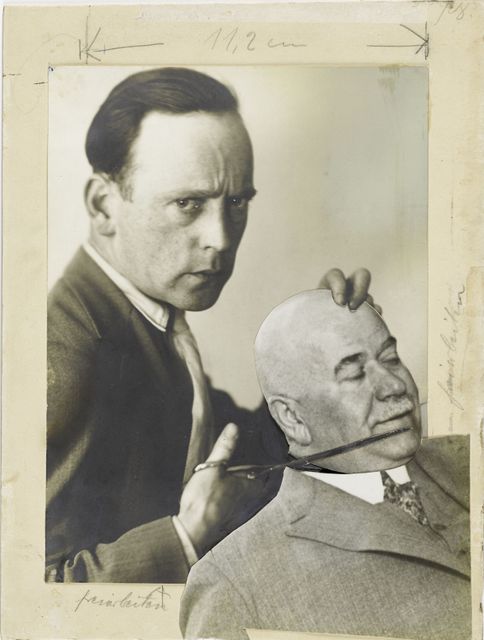
John Heartfield, Self-Portrait with the Police Commissioner Zörgiebel
The AKD online presentation explains that he gave up his plan, conceived in his youth, to become a great painter, and committed himself as an artist to the struggle against war and reaction.
The structure of the presentation is based on the five fingers of a worker’s hand designed by Heartfield for a German Communist Party (KPD) election poster in 1932 (an appeal for workers to vote for slate no. 5, the KPD ticket). The five sections deal with the chronology of his life, the places he lived in, his various artistic genres, his use of materials and the motifs for his work. Heartfield’s eventful and difficult life is vividly described in the online exhibition and it is not necessary to deal here in any detail with the facts of his biography.
The presentation also illustrates Heartfield’s artistic environment, which included such figures as Bertolt Brecht, Grosz, Else Lasker-Schüler, Johannes R. Becher and Erwin Piscator, as well as the entire group of artists associated with the Dada movement—Max Ernst, Hannah Höch, Raoul Hausmann and Otto Dix. Heartfield’s opposition to war was shared by his close friend Grosz whom he had known since 1914. Grosz also adopted an English-sounding first name in protest German chauvinism during World War I.
Heartfield’s younger brother, Wieland Herzfelde, also played an important role. The two brothers founded the magazine Neue Jugend (New Youth) and later the Malik Verlag (Malik Publishing House), which specialised in contemporary political art and Communist literature during WWI. Heartfield designed the covers for the books published by the Malik Verlag. In typical Dada fashion, he designed a portfolio for Grosz, which appeared in Neue Jugend in 1917.

John Heartfield, War and Corpses, the Last Hope of the Rich
A closer examination, however, of Heartfield’s biography, his problems, the political decisions he made, and the prevailing political circumstances would have helped a contemporary audience to better understand the artist’s rather tragic role and fate. The presentation notes that Heartfield joined the KPD immediately after its foundation in 1919 (as did Grosz). He received his party book from KPD leader Rosa Luxemburg herself, but his decision to side with the working class remains unexplained in the current exhibition.
In fact, Heartfield regarded a workers’ revolution along the lines of the Russian October Revolution of 1917 as the only alternative to capitalist exploitation and warmongering. Further research in the Akademie’s online archive reveals the numerous references, photos and documents that testify to his intense preoccupation with the Russian Revolution. Like many other artists and intellectuals, Heartfield regarded the Communist Party as the only political force that could effectively combat capitalist reaction and its drive towards dictatorship.
It was therefore not surprising that Heartfield produced the powerful photo montages which appeared on the front pages of the KPD newspapers Die Rote Fahne (The Red Flag) and the Arbeiter-Illustrierte-Zeitung (AIZ, Workers Pictorial Newspaper). Many of these montages can be seen in the presentation and a complete documentation is available in the ADK Heartfield online archive.
In the course of the 1920s, the AIZ developed into a publication that found support not only in the working class. The paper published contributions by leading artists and writers such as Käthe Kollwitz, Anna Seghers, Erich Kästner, Maxim Gorki and Kurt Tucholsky (Theobald Tiger). It was also during this period that the KPD increasingly came under the influence of the reactionary Stalinist bureaucracy.
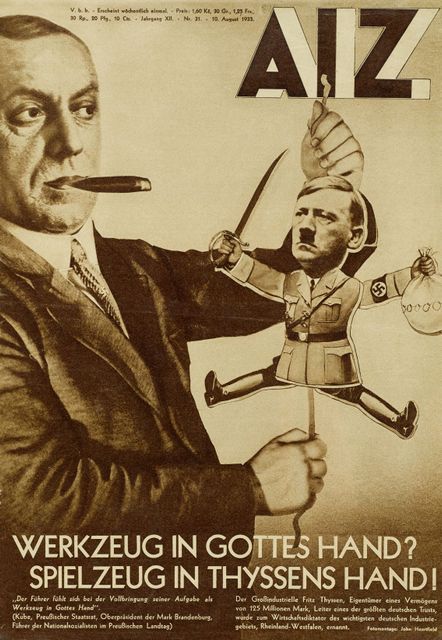
John Heartfield, Tool in God's Hand? Plaything in Thyssen's Hand
Heartfield’s adherence to the KPD, which became completely subordinate to the Stalinist leadership and policies, is not without tragedy. His photomontages vividly exposed the manifold connections between capitalist crisis, the preparations for a new war and Nazism, but he ignored or chose not to see the role played by the KPD in sabotaging a successful struggle by the working class to prevent the seizure of power by Hitler.
Like many of his friends and intellectuals, Heartfield did not question, at least in public, the catastrophic policy of the KPD. Under the influence of Stalin, the KPD refused to fight for a United Front with workers in the Social Democratic Party (SDP)—the policy advocated by the Left Opposition and Leon Trotsky. Instead the KPD denounced the Social Democrats as “social fascists,” helping to open the door for Hitler.
Heartfield remained loyal to the AIZ in Prague where he fled after escaping from a gang of Nazi thugs by jumping from the balcony of his apartment in Berlin in 1933. In exile in Prague along with many other Communists, Social Democrats and left-wing intellectuals who had fled Germany, he created some of his most impressive and politically astute photo montages. He continued to work for his brother’s Malik Verlag, also forced into exile.
Heartfield’s trip to the Soviet Union in 1931 is not mentioned in the presentation. There is also relatively little information about his half-year stay in the USSR in the ADK online archive and in the exhibition catalog. He lived in Moscow with the writer Sergei Tretyakov, a friend of Brecht and a leading member of the Russian avant garde, who, like many other artists and intellectuals, was not prepared to accept the official Stalinist doctrine of “Socialist Realism” in artistic production. Tretyakov was a victim of the Stalinist purges in 1937. In Odessa, Heartfield helped build the exteriors for Erwin Piscator’s film Revolt of the Fishermen (1934) based on the novel by Seghers.
In 1938, the Nazis occupied Czechoslovakia and Heartfield began his second exile, in London. He chose flight to the West rather than fleeing east into Stalin’s sphere of influence. This was no accident—he evidently avoided exposing himself to Stalin’s repression. In England, however, he still did not break with Stalinism and remained a member of the country’s KPD community in exile. He was involved in various activities organised by German artists in exile, in particular the Free German Cultural Association (Freier Deutscher Kulturbund).
In the summer of 1940, he was interned as an “enemy alien,” but released after seven weeks for health reasons.
After the war, his first attempt to return to Germany was initially delayed for health reasons and then became problematic following the outbreak of the Cold War. The Stalinist regime in postwar East Germany regarded with suspicion emigrants seeking to return from Western exile who might be too independent-minded. Even after Heartfield was able to return, he had problems building on his previous successes in the German Democratic Republic. The narrow-minded GDR cultural bureaucracy disparaged his photomontages as “formalistic.”
In 1951, he wrote in his résumé: “I work as a freelance artist. I work with my brother Professor Wieland Herzfelde. From now on, my printing work and montages are always undersigned ‘Heartfield Herzfelde.’” The very fact that the artist bore an English name made him an object of suspicion.
Heartfield was able to make some advances in the theatrical field in the GDR, but in a relatively conventional manner. He was unable, however, to recreate his powerful collaboration with Piscator in the 1920s. His admission to the GDR ruling party, the SED, and then to the East German Academy of Arts only took place following the personal intervention of Brecht in 1957.
Heartfield died on April 26, 1968 in East Berlin.
Should the ADK exhibition with its 400 items eventually open to the public, it is well worth visiting. It is due to travel to Zwolle (Netherlands) and London.
The Photography plus Dynamite catalog by Angela Lammert, Rosa von der Schulenburg and Anna Schultz is available from the Academy of the Arts bookshop at a special price of €29.90 (from July €39.90) plus shipping costs. In the foreword, the ADK draws attention to the growing influence of far-right radicalism today.

Majority of US veterans back full withdrawal from Afghanistan, other overseas conflicts

Warren Duzak

A new poll reveals that more than half of US military veterans surveyed believe that the US government should be less engaged in foreign wars, an increase of about nine percent compared to the same poll conducted last year. A large majority of military veterans and the families of troops and veterans also support a full withdrawal from Afghanistan.
Seventy-three percent of veterans and 69 percent of military families support a full withdrawal of US troops from Afghanistan, while 57 percent of veterans polled expressed opposition to continued “military conflicts overseas,” the Military Times reported.
More than half of veterans backing full withdrawal “offered strong support for the idea,” the Military Times also reported, while only “7 percent said they think the country should be more involved.”
The results of this year’s poll, conducted by Concerned Veterans for America, shows an increase in antiwar sentiments compared to the 2019 survey, which showed 60 percent of veterans and families wanted a complete withdrawal.
About two-thirds of veterans also said they want to see a reduction in US spending on foreign aid, and about 17 percent said they wanted to see an overall decrease in US military funding (34 percent said they wanted an increase).
National security ranked only fourth among survey participants’ top political priorities, well behind the first choice, health care.
Immigration and the US national debt ranked second and third. There was a margin of error of 3.5 percent, the Military Times noted.
The invasion of Afghanistan in 2001, following the September 11 attacks on the World Trade Center and the Pentagon, marked the beginning of a nearly 19-year-long war, the longest in US history, as well as the onset of a so-called “global war on terrorism” that was used to justify the war of aggression against Iraq, as well as bombings, assassinations, renditions and torture in other parts of the globe. This was followed by the war on Libya and the bloody proxy war for regime change in Syria, both of which relied upon elements linked to Al Qaeda, the supposed target of the US war on terrorism.
Under both the Republican administrations of Bush and Trump, as well the Democratic one of Obama, the pretext of combating terrorism has been utilized to justify global militarism aimed at shoring up declining US hegemony.
Late last year, The Washington Post published “The Afghanistan Papers,” revealing the same pessimism in the military’s leadership now reflected in the military’s rank-and-file veterans and their families.
As the World Socialist Web Site noted in December:
“What emerges from the interviews, conducted with more than 400 US military officers, special forces operatives, officials from the US Agency for International Development (USAID) and senior advisers to both US commanders in Afghanistan and the White House, is an overriding sense of failure tinged with bitterness and cynicism. Those who participated had no expectation that their words would be made public.”
The death, suffering and criminal waste of vast resources in Afghanistan boggles the mind. Of the 3,500 dead in coalition forces, the majority, 2,300, were American, the Watson Institute at Brown University reported as part of its “Cost of War” project.
The institute also reported 157,000 Afghan deaths resulting from the war, likely a significant underestimation.
Brown University also summed up the “costs” of wars and military action in Iraq, Syria, Afghanistan and Pakistan at $5.9 trillion.
The price tag for all of the “Post-9/11 wars” was more than $6.4 trillion, and, according to the “Cost of War’s” conservative estimate, 801,000 fatalities were directly caused by the wars and “several times as many indirectly.”
Moreover, 21 million people, including millions of young children, have become refugees or “displaced” persons.
To put that in perspective, it is as if Norway, Sweden and Denmark were depopulated, or almost one-half the population of Spain or Argentina. In the United States it would mean the depopulation of all three states of Tennessee, Indiana and Missouri or the entire state of New York or almost all of Florida.
It is important, however, not to be fooled by the “concern” of the group “Concerned Veterans for America.” It was created by billionaire businessman Charles G. Koch and cut from the same cloth as the Cato Institute, Heritage Foundation and Americans for Prosperity.
“(M)aintaining our presence in these countries puts American lives at risk, wastes valuable taxpayer dollars, and saps valuable human and material resources from confronting more immediate and persistent threats to American security and prosperity (emphasis added),” Concerned Veterans for America explained.
It continued: “American security interests can be protected by strengthening the long-term economic stability of our country, maintaining a strong military able to deter adversaries’ actions before they happen, committing ourselves to the deliberate employment of Americans abroad, and a vigorous defense of our nation if attacked or threatened.”
In creating a new veterans group, Koch is seeking to influence public opinion for the purpose of making the shift from wars on terrorism to “great power” conflicts with China and Russia, posing the threat of nuclear war. Just as ominously, “confronting ... threats to American security” means for Koch and his fellow billionaires, the growing militarization of the police and the use of troops to control the working class.

Food banks face supply and volunteer shortages as mass hunger rises in the US

Alex Johnson

Food banks in the United States are facing a crisis of epic proportions as tens of millions of people across the country are finding themselves in need of aid from food pantries and soup kitchens to stave off hunger. The coronavirus pandemic has brought alongside it a staggering rise in joblessness and wage reductions, driving underfunded charitable food services to the brink due to the explosion in need.
In scenes that recall the long breadlines during the great depression of the 1930s, millions over the past month have been compelled to wait in massive line ups and drive-through food banks to seek emergency food assistance. Major cities such as San Antonio, Las Vegas and Cleveland are witnessing lines up to six miles long at pop-up distribution points, where thousands of recently furloughed and unemployed people are waiting hours for grocery boxes. Now, the shortening of food supplies in food banks is bringing a significant portion of the American population face to face with the very real prospect of starvation.
Demand for food aid is growing against the backdrop of an unprecedented economic and health care crisis. In the United States, the death toll from COVID-19 accounts for more than one-quarter of the global total, surpassing 61,000, and is poised to climb to more than 70,000 next week. US infections have now reached over 1 million, one-third of all infections worldwide.
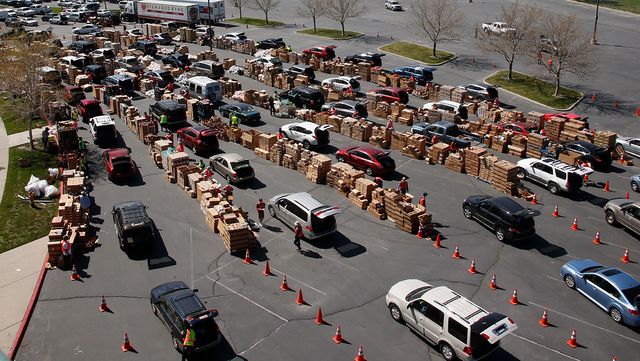
Cars line up for food at the Utah Food Bank's mobile food pantry at the Maverik Center Friday, April 24, 2020, in West Valley City, Utah. (AP Photo/Rick Bowmer)
Since late March, over 27 million people filed unemployment claims, on top of 7 million that had already been unemployed. This is a significant undercount of the number now out of work, with millions ineligible to file since they are independent contractors or undocumented immigrants.
The corporate and financial oligarchy, along with the media and political establishment is exploiting the widespread social suffering sparked by the virus’ spread in a reckless effort to compel workers to risk their lives going back to work under conditions in which the pandemic is showing no signs of slowing down. Health experts have warned that a hasty return to work will result in a second wave, which could cause a return to nationwide lockdowns and business closures on an even greater scale, not to mention an acceleration of the already skyrocketing death toll.
Under the current conditions, Feeding America, which is one of the largest non-profit food bank organizations in the US, is already struggling to maintain its supplies. According to Chief Operating Officer Katie Fitzgerald, its food banks are seeing a 40 percent increase in demand. Officials for the organization are reporting that they are fielding double to quadruple the number of requests for assistance than they have normally had to deal with.
In an interview with CNN earlier this month, Fitzgerald said her organization has suffered a “significant and fast plummet” of meal lending from their retail and supermarket partners. Its donations from food manufacturers total 580 million meals and their inventory has dropped by over half just this month. Due to the decline in donations, Feeding America and many other non-profits have turned to purchasing supplies directly from food manufacturers and distributors, but this may take up to four weeks to reach the hundreds of food banks in the organization’s network.
Inventories for food banks depend mostly on donations from giant supermarket conglomerates such as Walmart and Kroger. But due to the rise of purchases from consumers, supplies for food banks are beginning to diminish rapidly as shelves in retail and grocery stores go empty. As a result, deliveries to food pantries have been vastly reduced, making it nearly impossible to accommodate the flood of newly unemployed clients
Fitzgerald raised concern over the possibility that food banks will not have enough in their stock to feed the growing surge of hunger-stricken people, some of whom are members of the middle class who have never had to use such services. According to one Pennsylvania-based distributor, which supplies more than 40 food banks in the state, the wholesale cost of rice alone has almost tripled and will not be available until June.
Vast sections of the working population have sought meal assistance over the last two months. At pantries in Silicon Valley, home to 74 billionaires, the demand for food has increased by over 50 percent each week. First-timers at these services have ranged from security and cafeteria staff furloughed by tech companies, to teachers and restaurant workers, accounting for half of those needing food. Even more affluent individuals have been forced to seek relief. One operator of Nevada’s Three Square food bank said, “when you see a Lexus in line at 4 a.m. prepared to wait six hours, you know there’s a real need,” in reference to drivers in luxury vehicles queueing for food boxes.
Earlier this month in San Antonio, Texas, a jaw-dropping 10,000 people showed up in their cars to a food distribution drive-through service. The center usually saw 400 people before the pandemic occurred. Much of the semi-truck loads of food were handed out to newly laid-off hospitality staff whose last paycheck had been exhausted, according to the president of the food bank.
On top of dwindling supplies, food banks are confronting a shortage of personnel. Food banks rely on roughly 2 million volunteers to assist in packing and distribution. Most of these individuals are elderly people who are especially vulnerable to getting sick due to coronavirus and have been forced to stay home. This has been the case for communities across the country that have been crushed by rising demand but with minimal hands to process foods. Social distancing regulations have also made it even more difficult for volunteers to coordinate and distribute food to clients
In the Los Angeles Regional Food Bank, the number of volunteers dropped dramatically at the initial outbreak, in large part because of statewide social distancing guidelines—which require that workers remain six feet apart—and regular staffers staying home either to self-quarantine or out of fear of contracting COVID-19.
This sudden explosion in need comes under conditions where hunger was already a persistent problem for Americans. A Department of Agriculture report released last year found that 37 million people in the United States were affected by hunger issues at some point in 2018. Households with children are also more likely to experience food insecurity and these households rely heavily on food banks and similar hunger-relief institutions. In 2019, an estimated 40 million Americans received free meals or groceries through a network of 200 food banks and 60,000 pantries, schools, soup kitchens and shelters, according to Feeding America. The majority of these meals were typically given to the working poor, elderly and disabled.
Even as the need grows, food banks across the country have started to close down because of the decrease in volunteer staffing, or they are incapable of acquiring sufficient cleaning supplies to keep work conditions safe. Nearly a third of food pantries nationally have closed in recent weeks, according to the New York City Mission Society. Small food banks in New York City, which has over 162,000 cases of COVID-19 and 12,000 deaths, have closed due to shortages of both volunteers and food.
California, New Jersey, Texas and Washington, DC have seen their food banks shuttered in response to insufficient donations. In Washington, Capital Area Food Bank saw a decrease of 75 percent in donations after just one week. CEO of the organization, Radha Muthiah, told CNBC that the speed of the virus’ spread did not give the non-profit enough time to anticipate the dramatic rise of needy clients. “What typically would take us eight to 12 days once we placed an order for a truckload of food can take up to eight weeks for our food supply to arrive,” Muthiah reported.
In New Jersey, Community Food Bank, the state’s largest nonprofit, lost about 800,000 pounds of bulk food donations in March and April. In Pennsylvania, food banks are spending an extra $1 million a week but are still turning hungry families away. As a testament to the anarchy of capitalist production, food shortages through non-profits have occurred while dairy farms and producers are dumping millions of dollars’ worth of milk into the ground due to the collapse of traditional dairy markets, and poultry farmers are euthanizing chickens and smashing eggs by the tens of thousands.
Grace Klein Community, which operates a pantry service in Birmingham, Alabama, is reporting that it projects to go $3.6 million over budget by August as food clientele and utility costs—electricity, cleaning materials, boxes and overtime—have tripled. Lisa Scales, president of a Pittsburgh food bank, indicated the money spent on food alone has tripled, warning “with so many businesses shutting, we’re concerned community donations won’t sustain this level.”
Fifty-five out of the 550 feeding programs to which Second Harvest, a food bank based in Central Florida, provides food have already shut down due to staffing shortages. In Florida, coronavirus cases have now surpassed 32,000, making it the eighth largest hotspot in the country. The number of Floridians needing assistance has ballooned over the past month as a result of increasing joblessness and the particular difficulty which workers in the state face in getting access to unemployment payments. Second Harvest’s local interactive map that shows food locations is now getting 1,200 clicks a day, which is up from 35 before the pandemic began.
While hundreds of thousands have submitted jobless claims in the state, a large percentage has still yet to see either a stimulus check or unemployment benefits, forcing many into food banks. The Florida Department of Economic Opportunity (DEO) released data showing that, as of last Friday, one in four jobless Florida workers got their claim denied by the state. By Sunday, that number had increased to 40.3 percent. As of Sunday evening, more than 263,000 Florida residents had their claims ruled “ineligible” by the DEO. This is the reality for millions all across the US left without any form of income and still waiting for their much hyped $1,200 stimulus check.
Second Harvest food bank, which is based in Orlando, has been forced to double its meal distributions to 280,000 a day. Donations from local retailers to the organization have dropped to near zero and have forced the non-profit to purchase $350,000 worth of groceries instead of $85,000 for a three-week supply. Organizations like Second Harvest have had to rely on the infusion of supplies from the federal Emergency Food Assistance Program. The federal program, which provides aid to organizations throughout the US, has received just $850 million in two recent congressional stimulus packages, a pittance compared to the trillion-dollar bailouts for the major corporations and banks.
Many food banks, including Second Harvest, have yet to receive any emergency funding authorized by the EFAP, which has caused major alarm that food supplies may begin to drastically diminish in the next few weeks. After noting that some pantries have been forced to turn away hungry and desperate people, the CEO of Second Harvest, Dave Krepcho, told CNN “my concern is that we will see food and funding dwindle” and that the “level of service would diminish considerably.” He warned that tens of thousands of people in the Central Florida area will be placed in a situation where they will have no access to food.
In Louisiana, which has been another major hotspot of the pandemic’s spread, at least one in three people are at risk of hunger, compared with one in five before this crisis, according to Natalie Jayroe, president of South Harvest food bank. “We think it will conservatively cost us $15m for six months,” she revealed in an interview with the Guardian. “In south Louisiana, we’ve been through our share of disasters but this is different.”

Coronavirus deaths go unrecorded in Indonesia

Owen Howell

While Indonesia stands on the brink of an unprecedented social disaster, which could result in the loss of thousands of lives, two members of the government’s COVID-19 taskforce announced on Monday that a return to “normal lives” would be possible by July.
Indonesian Disaster Mitigation Agency chief Doni Monardo and Professor Wiku Adisasmito, told a press gathering that these hopes were based upon a decline in coronavirus infections. Adisasmito said: “Previously, we thought that the peak would be reached around May. But with the trend, at least in the last week, it’s going down.”
Soon after the announcement, infectious disease experts, epidemiologists, and data analysts contradicted these assertions. The numbers of daily cases over the week preceding the announcement—375, 283, 357, 436 (a record high), 396, 275, and 214—do not indicate a clear downward trend.
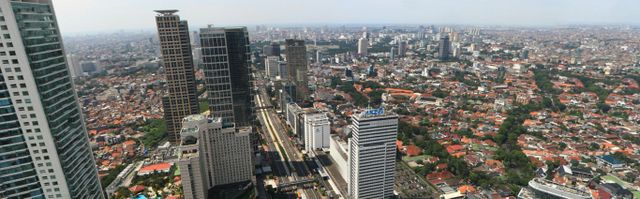
Jakarta, Indonesia (Photo: Vian Kadal/Wikipedia)
The official total has reached 9,771 infections, having grown more than five times within the space of a month. As a result of widespread community transmission, all of Indonesia’s 34 provinces are affected.
The pandemic tallying website Worldometer shows Indonesia has one of the lowest testing rates in the world. At the beginning of the week it had conducted only 59,000 tests, or 210 tests per million people. The government claims to be waiting on some 479,000 reagents to arrive from South Korea and China, but as with previous deliveries, these will only allow a temporary boost to the testing rate.
At the end of last month, government spokesman on COVID-19 affairs Achmad Yurianto admitted that between 600,000 and 700,000 people have likely come into contact with individuals infected by the virus. The official case numbers are, therefore, likely to be far from the reality.
At the moment, the country has one of the world’s highest mortality rates, and the death toll of 784 fatalities is the highest in Asia outside of China.
The real death toll could be far higher.
A recent review by Reuters of the most current data from 16 provinces has shown that there were at least 2,212 deaths of patients suffering from acute symptoms of COVID-19. As they were not tested, they have not been counted in the official toll. If all of these people were indeed victims of the coronavirus, this would mean that the country’s total has already reached nearly 3,000 deaths.
This discovery follows another Reuters review, published two weeks ago, of statistics which found that Jakarta cemeteries had experienced a 40 percent rise in burials in March.
Government officials have divulged that many of the country’s 19,897 suspected coronavirus sufferers had not been tested due to the number of specimens awaiting processing at under-staffed laboratories. As a result, some had died before their samples were analysed.
As the spread of the virus worsens, medical facilities across the country are overwhelmed and under-equipped. The severe scarcity of personal protective equipment (PPE) is putting health workers at extreme risk of contracting the disease. At least 26 doctors, including the directors of two hospitals, and nine nurses have died from the virus. Most health workers are using cheap plastic raincoats as medical gowns.
In a hospital in the Sumatran province of Aceh, for instance, 40 suspected coronavirus cases are being treated. One patient died and, days later, doctors discovered he had tested positive for the virus. They had treated him over the course of a week without any protective gear.
A doctor working at a government hospital in Labuan Bajo on the island of Flores spoke to the Los Angeles Times about the situation facing the Indonesian healthcare system. She remained anonymous, as workers at her hospital were prohibited from speaking to the media. She said: “We’re terrified. We’re using homemade face shields. Doctors are developing mild symptoms. Three have been quarantined… The central government didn’t take COVID seriously. So no one was prepared for this.”
The virus’ impact on health facilities threatens to grow even worse after a mass exodus of people from the major cities to the countryside over the past week.
The closure of non-essential workplaces in Jakarta has left millions of workers jobless and without sufficient financial assistance. A government stimulus package provided a paltry $US7 billion as a social safety net for the millions who were laid off. Most have consequently had no choice but to return home to their villages.
Last Monday, President Joko Widodo declared a domestic travel ban leading up to the religious holiday of Idul Fitri, which was anticipated to see tens of millions moving to the country. Trains and buses were overcrowded in a rush of passengers hoping to escape the cities, before the ban came into effect on Friday. More than 14,000 people left Jakarta last week.
Even though the ban, which will remain until June, is set to prevent any further spread of virus to the provinces, it has left vast sections of the working class stranded in viral hotspots like Greater Jakarta, and unable to meet the cost of living.
Dozens of workers have described their plight to foreign media outlets. Edi, a factory worker, has lost his income and cannot afford to pay his rent of $US50 a month. “I can’t live in Jakarta without a job,” he told Al Jazeera. “I can’t afford it, so I decided to go home before the ban.”
In comments to the LA Times, Diro, a 25-year-old ride-hailing motorcycle driver, said he would need further government assistance to survive in Jakarta. Despite wanting to return to his hometown in Central Java and fall back on his family for support, he explained: “I’m afraid if I go back home, I could spread the virus there. I may look healthy, but I don’t know if the virus is already inside me.”
The government proposal for a return to business as usual by July, under such conditions, is part of an international campaign by the ruling elites to force workers back onto the job in the interests of corporate profit, despite the immense health risks.
The government response to the crisis has provoked widespread anger, with many denouncing its initial denial of the problem in February and March, along with its current resistance to impose a full lockdown. Discussion on social media has erupted, with the Twitter hashtag #LockdownOrDie being used widely.
The pandemic response has included partial lockdown measures in only two provinces, Jakarta and West Sumatra. Unrestricted movement in tourism centres, most notably the Balinese capital Denpasar, continues.
Indonesian President Joko Widodo has justified his opposition to a lockdown by claiming to be concerned about its potential impact on the working poor. This is belied by his administration’s refusal to provide anything more than token social assistance during the crisis.
Indonesia is a country of astonishingly high levels of wealth inequality, which have only grown during Widodo’s time in office. Nearly 10 percent of the nation’s 273 million people earn less than one dollar a day. The four richest individuals, on the other hand, have a combined wealth greater than the poorest 100 million.
The pandemic is being viewed by the Indonesian financial oligarchy, not as a public health crisis, but as a market event.
The COVID-19 taskforce announced earlier this month that the shortage in medical equipment would be quickly addressed. Around 3,000 garment factories would be retooled to produce 17 million items of PPE. It was claimed that within a week one million face masks would be produced per day.
These promises, however, went unfulfilled despite Indonesia's substantial manufacturing capacity. The country, for instance, is the largest producer of cars in Southeast Asia. The government could enable a speedy manufacturing of desperately-needed health equipment, but this would not be profitable.
Instead, Widodo has in recent weeks implemented a string of emergency measures, worth around $US28 billion, aimed primarily at ensuring the corporate sector can return to normal as soon as possible, with only a fraction allocated for an already buckling healthcare system.

British Airways announces 12,000 redundancies amid global airline jobs massacre

Thomas Scripps

British Airways (BA) has announced plans to slash 12,000 jobs, nearly 30 percent of its workforce.
Chief Executive Alex Cruz, on a basic salary of over £1.3 million, wrote to staff, saying, “There is no government bailout standing by for BA and we cannot expect the taxpayer to offset salaries indefinitely. Any money we borrow now will only be short-term and will not address the longer-term challenges we face. … The scale of this challenge requires substantial change so we are in a competitive and resilient position, not just to address the immediate Covid-19 pandemic, but also to withstand any longer-term reductions in customer demand, economic shocks or other events that could affect us.”
BA’s message is clear: It is sacrificing its employees to keep the company competitive for the benefit of its shareholders. The company will consult with the British Airline Pilots Association (BALPA) and the Unite and GMB unions over the next 45 days to discuss implementing the losses.
This decision, which will devastate tens of thousands of lives, is a warning to the working class of the economic “reconstruction” being prepared by business and ruling circles everywhere in the wake of the coronavirus pandemic. Millions of workers will be made to pay the price of preserving the wealth of a tiny minority of society.
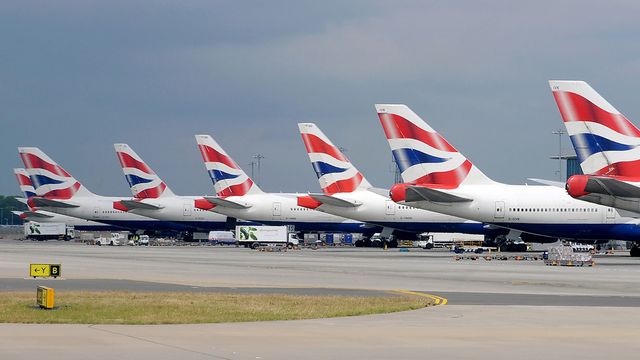
British Airways planes at London Heathrow Airport (Photo: Ken Iwelumo/Wikipedia)
No sacrifice is to be made by the corporate elite. While BA’s parent company IAG has made much play of cancelling its proposed 2019 final dividend of €337 million, it chooses not to mention that 2019’s interim dividend of €287 million has already been paid. Before that, Bloomberg reported in September 2019 that “IAG felt able to return 1.3 billion euros to shareholders in dividends over the past year.” These massive pay-outs were made possible by a 2016 pay deal that saw employees give concessions—including the closure of a pension scheme that saved the company an estimated £800 million—to ensure the company’s “survival.”
At the end of March, the company was sitting on €9.5 billion of cash and undrawn general and committed aircraft finance facilities.
Similar processes are underway across the airline industry in Britain and internationally. EasyJet has furloughed 4,000 of its UK-based cabin crew on 80 percent wages, and Virgin Atlantic, owned by multibillionaire Richard Branson, has furloughed 8,000 workers, while seeking hundreds of millions in bail-out funds from the government. Workers at Heathrow Airport are being forced to accept a 15 percent pay cut or face redundancy.
The aerospace manufacturer Airbus is due to furlough 3,000 workers in Wales and is reportedly contemplating permanent job cuts, with decisions expected in mid-June. Guillaume Faury, Airbus CEO with a salary of 1.3 million, said, “For us, the urgent priority is to implement a short-term cash containment plan. … We are doing this, and address[ing] the longer-term cost structure to ‘right-size’ the company.”
On Tuesday, Scandinavian Airlines (SAS) announced it would be cutting 5,000 permanent jobs—half of its workforce. Norwegian Airlines has said that practically all its planes will remain grounded until 2021 and that its fleet will be some 30 percent smaller when it begins flying again.
Australian carrier Qantas has put 20,000 staff on leave, and Air Canada has done the same with 15,000 of its workers. In the US, 4,800 pilots at American Airlines have taken short-term leave on reduced pay and more than 700 are taking early retirement.
German airliner Lufthansa is in talks with the government for a multibillion-euro loan but nonetheless warns it will emerge from the crisis a much smaller operator, with anything between 10,000 and 18,000 job losses. Its subsidiary GermanWings, with 1,400 jobs, is shutting down operations entirely.
Every cut is facilitated by the trade unions, which conducted a rotten series of sellouts in the airline industry in 2019 and are now preparing the way for a new round of assaults by the employers.
BA’s announcement comes just three weeks after a deal was agreed on by Unite and GMB, which saw more than 22,000 workers furloughed on 80 percent of their salaries. At the same time, BALPA agreed to a temporary 50 percent pay cut and unpaid leave for BA’s 4,000 pilots. The unions promised that these deals, representing a substantial loss of income and pensions, would prevent redundancies. Instead, they have paved the way for mass sackings.
In response to BA’s announcement, Unite General Secretary Len McCluskey said lamely, “With the majority of BA’s workers on furlough, we would have expected [Alex Cruz] to work with both us and the government to honour the spirit of the government’s job retention scheme.”
Nadine Houghton, GMB’s national officer, claimed, “We believed we had reached some relative, albeit temporary, respite for them following the agreement to furlough 80% of BA’s staff—now this.”
Speaking for BALPA, Brian Strutton said in a statement, “This has come as a bolt out of the blue from an airline that said it was wealthy enough to weather the COVID storm and declined any government support. BALPA does not accept that a case has been made for these job losses and we will be fighting to save every single one.”
There will be no such fight by any trade union, least of all BALPA. Last year, BALPA delayed and ultimately cut short the first pilots’ strike at BA in 40 years, pushing through essentially the same deal that had been rejected by more than 90 percent of its membership several months earlier. Strikes at the Ryanair carrier were also called off by BALPA, while Unite cancelled a series of planned strikes by airport workers.
All of this took place in the context of a rising international wave of militancy in the European airlines sector. The unions will jump at the opportunity to suppress and disperse any resistance to the latest job cuts with reference to the pressures of the COVID-19 pandemic. GMB has already indicated its retreat, announcing its intention simply to “limit the impact on our members” and work on “bringing that number [12,000] down.”
The impact of the coronavirus on the airline industry is massive. IAG is grounding 90 percent of its fleet in April and May, with a return to 2019 passenger levels expected to take several years. The company reported an operating loss of €535 million in the first quarter and is expecting a worse result for the second. The global airlines trade association, the International Air Traffic Alliance, predicts that airlines around the world could lose a total of $300 billion due to the pandemic, threatening 25 million jobs.
There are two opposed responses to this situation.
Under capitalist production for profit, smaller and less profitable airliners will go to the wall and be absorbed by the major corporations, who will engage in a massive international struggle between themselves, all on the basis of an unprecedented destruction of jobs and conditions. The trade unions, rooted in the national capitalist economy and bound by a thousand threads to the interests of the employers, will do everything they can to demobilise opposition to this vicious cost-cutting drive on behalf of their corporate masters.
The alternative response—the reorganisation of the world economy to meet the needs of humanity and not private profit—requires the mobilisation of the international working class, not bound to any nation or corporation, in a fight for socialism. To defend their livelihoods, workers must establish rank-and-file committees, independent of the union bureaucracies, in every workplace in every country to wage a globally unified fight for this perspective.

Aid group warns of 3.2 million COVID-19 deaths, 1 billion infections in war-torn countries

Bill Van Auken

The rapid worldwide spread of the coronavirus pandemic threatens to kill as many as 3.2 million people and infect one billion in countries that have been ravaged by war and the displacement of masses of refugees, an international aid group has warned.
The International Rescue Committee (IRC) warned that even as the worldwide number of coronavirus infections exceeds 3.2 million and the global death toll approaches a quarter of a million, far more deadly consequences are inevitable in what it refers to delicately as the “fragile” countries.
“These numbers should serve as a wake-up call: the full, devastating and disproportionate weight of this pandemic has yet to be felt in the world’s most fragile and war-torn countries,” the IRC warned.
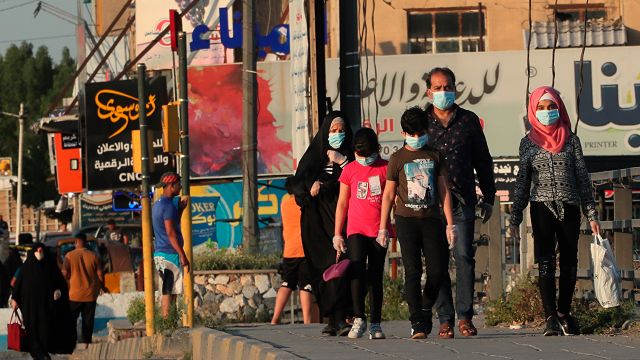
Baghdad, Iraq, April 10, 2020 (AP Photo/Hadi Mizban)
Chief among these “fragile” countries, according to the aid agency, are Yemen, Afghanistan, Syria and Iraq, all of them societies that have been decimated by direct US military interventions and proxy wars.
The IRC’s projections are based on epidemiological modeling and data produced by the Imperial College London and the World Health Organization, which are based in large part on mortality patterns recorded during the early outbreak of the pandemic in China.
On this basis, it acknowledges that its horrendous death toll projections “may be conservative at best.” It states: “The ICL/WHO model uses the best available mortality data, from China, which presupposes that levels of medical care available therein would be available elsewhere. As the IRC has previously warned, fragile states have nowhere near the healthcare capacity provided in China.”
It points out that in Venezuela, which has been subjected to a US sanctions regime that is tantamount to a state of war, more than half of the doctors have left the country and 90 percent of hospitals are plagued by shortages of medicine and critical supplies.
Moreover, the report states, the refugee camps of the Middle East and South Asia are 8.5 times more densely packed than the Diamond Princess cruise ship, where transmission of the virus was up to four times faster than in Wuhan, China. In these camps, social distancing is a patent impossibility.
Among the countries most threatened by the spread of the coronavirus, according to the IRC report, is Yemen, where the first confirmed expansion of the virus was reported on Wednesday, going from one port worker who was infected to five Yemenis with the disease. As in every one of the war-ravaged countries covered in the IRC report, these figures are less than the tip of the iceberg under conditions in which there is no significant testing of the population.
The cluster of new cases in Yemen was detected in the port city of Aden, which has become a focal point for a further escalation of the military conflict that has raged in Yemen since Saudi Arabia invaded the country in 2015 in an attempt to reimpose the unelected US-backed puppet government of President Abd Rabbuh Mansur Hadi.
Islamist forces in the Southern Transitional Council, backed by the United Arab Emirates (UAE) have seized control of Aden, proclaiming an independent southern state, opening the prospect of a new round of fighting with forces loyal to Saudi Arabia and Hadi. The UAE is pursuing its own interests in the conflict, seeking to cement its hold over the Horn of Africa where it has considerable commercial interests.
Meanwhile, despite a self-proclaimed truce by the Saudi monarchy, airstrikes by the Saudi-led forces against areas controlled by the Houthi rebels in northern Yemen increased by 30 percent last week, according to the Yemen Data Project, which monitors the war.
Saudi air strikes—some 257,000 of them since 2015—are carried out with US-supplied warplanes, bombs and missiles, and facilitated by logistical support from the Pentagon. With this US support—implemented under the Democratic Obama administration and continued and deepened under the Republican administration of Trump—they have decimated hospitals in Yemen, leaving the country largely defenseless against the spread of the coronavirus.
The five-year-long war has killed at least 110,000 Yemenis, while leaving hundreds of thousands more wounded. An estimated 75,000 children under the age of five have starved to death since the onset of the war, while at least 14 million people are on the brink of starvation. On top of this, both the US and the UN have slashed aid to the impoverished and war-ravaged country. The death toll from the coronavirus in the country would be fueled by comorbidities that include hunger and the worst cholera epidemic in history.
A similar threat is posed in Libya, which once boasted one of the most advanced health care systems in Africa but was left decimated by a 2011 US-NATO war for regime change that toppled and murdered the country’s former leader Col. Muammar Gaddafi. Since then, Libya has been a battlefield between opposing militias, backed by rival powers seeking control over the country’s oil reserves, the largest on the African continent.
The IRC warned that a response to the COVID-19 pandemic in Libya has been severely undermined by continuing fighting which has included the targeting of health care infrastructure. Two field hospitals were shelled on Wednesday, wounding five paramedics. The Al Khadra Hospital in Tripoli was also hit three times over the past month, forcing the shutdown of one of the only facilities designated for the treatment of patients with COVID-19. In the past week, four other hospitals were forced to suspend operations because of the fighting.
Most at risk in the country are some 700,000 refugees and migrants, subject to brutal persecution and many of them imprisoned in terribly overcrowded detention camps through which the virus can spread like wildfire. At least 80 percent of them have no access whatsoever to healthcare.
Similar conditions prevail in Syria, Iraq and Afghanistan, whose combined death toll from nearly two decades of US wars of aggression numbers well over one million. All of them have seen basic social infrastructure, including health care systems, decimated.
In these countries, as all over the planet, the coronavirus is exposing and cruelly exacerbating conditions that had already been created by capitalist exploitation and imperialist aggression.
Despite the shocking warnings of the IRC report, the agency’s recommendations for confronting the danger are strikingly inadequate and spineless. They include the plea, “Donors should ensure immediate COVID-19 response financing reaches frontline responders,” and a call for governments to “limit restrictions on the movement of humanitarian personnel, humanitarian and COVID-19 supplies, essential medicines, and food.”
Unmentioned is the Pentagon’s involvement in ongoing military interventions in Yemen, Syria, Iraq and elsewhere, the slashing of US aid to the affected countries, Washington’s decision to cease funding the WHO and the sanctions regimes that have cut off vitally needed supplies to Iran and Venezuela.
This is hardly surprising given the composition of the IRC. The New York-based agency is headed by David Miliband, the former British Labour Party foreign minister. Its board of overseers includes no less than four former secretaries of state and war criminals: Henry Kissinger, Madeline Albright, Gen. Colin Powell and Condoleezza Rice, as well as CEOs of various US banks and corporations, including Goldman Sachs, Bank of America, Citibank, Morgan Stanley, American Express and PepsiCo. The agency’s supposedly humanitarian operations are an instrument of and totally subordinated to the strategic interests of US imperialism.

UK coronavirus death toll passes 26,000 as government admits to 4,000 fatalities outside hospitals

Robert Stevens

The UK coronavirus death toll reached 26,097 yesterday.
Confirming the naked criminality of the Johnson government’s pursuit of its “herd immunity” policy, it admitted that an additional 3,811 deaths took place between March 2 and April 28. Around 70 percent of these were "outside hospital settings," mainly in care homes and private residences.
In addition to the 3,811 deaths, a further 765 fatalities were reported in the 24 hours to 5 p.m. Tuesday, of which around 600 died in hospital. Deaths in hospitals in England alone are approaching 20,000 (19,740).
The UK is fast becoming the centre of the pandemic in Europe and is set to surpass the 27,682 deaths already recorded in Italy. Italy’s death toll is the second worst in the world after the United States, which has 61,656 deaths.
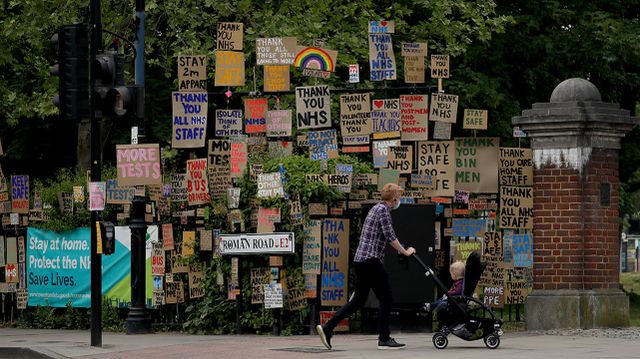
A man wearing a face mask pushes a child in a buggy past signs supporting the National Health Service (NHS) in east London, Monday, April 27, 2020 (AP Photo/Matt Dunham)
The government is only now releasing the number of deaths in care homes due to growing public outrage over elderly and vulnerable people being allowed to die without any protection, as the coronavirus ripped through residential homes that have been turned into killing fields.
Despite its admission of thousands more deaths outside hospitals, the government is still vastly under-reporting the true number of COVID-19 fatalities. The Office for National Statistics (ONS) has already reported 6,000 deaths in care homes, and in just the two weeks to April 24, the Care Quality Commission was notified of 4,343 deaths from COVID-19 in care homes.
In Scotland, deaths as a result of COVID-19 account for half of reported fatalities in care homes. The National Records of Scotland reported Wednesday that by April 26 there had been 2,272 COVID-19-linked deaths. Of these, 338 of the 656 deaths recorded between April 20 and 26 were in care homes.
Speaking to BBC Radio Four Tuesday, Professor David Spiegelhalter, a University of Cambridge statistician, said, “What we are seeing is a massive increase in deaths. … While COVID deaths in hospitals have been steadily declining since April 8 and now number around 400-450 a day, new Care Quality Commission data show that last week there were around 350-400 COVID deaths in English care-homes each day. When we add in deaths at home, this suggests there are now about as many COVID deaths out of hospital as in hospital. And while hospital deaths are steadily decreasing, there is no sign yet that we are past the peak in care homes.”
The government’s daily figures have never included the figures recorded by the ONS of more than 880 people with coronavirus dying at home in England and Wales since the first death in the UK at the end of February. The ONS has also recorded 190 coronavirus deaths in hospices.
Even the pro-Tory Daily Mail reported Wednesday that the new “tally still falls thousands short of the reality. … The Government will only include people who have tested positive for the virus in its statistics, despite rationing almost all the testing kits to hospitals for the first month of the outbreak, meaning thousands of people may have died without ever being diagnosed.”
The Tories are anticipating thousands more deaths. Asked to respond by Sky News reporter Kay Burley to the statement that “our death toll in Britain is on track to being the worst in Europe,” Environment Secretary George Eustice replied, "We’ve been on similar trajectories to France and Italy. … It may well be that we are, who knows, we don’t know that at the moment.
Earlier this week, Financial Times analysis of ONS data concluded that a “conservative estimate” of “UK excess deaths by April 21 was 41,102.”
Even as the real picture of the catastrophic loss of human life emerges, the Tory government, in alliance with the Labour Party and the unions, is moving ahead with a “mass return to work” policy, as the goal is referred to by the Trades Union Congress.
The government’s official stance is that no major decision to end the lockdown will be taken before the next review date on May 7. But behind the scenes, every mechanism is being put in place to ensure a de facto return. On Wednesday, the Daily Telegraph reported that Boris Johnson “is preparing to water down [lockdown] restrictions within days.” The newspaper explains that of the five tests that were set out earlier this month to be passed before easing the lockdown, four have been or are close to being met.
One of the “tests” is a “‘sustained and consistent’ fall in the daily death rate”—but no matter! The newspaper also reports, “The fifth hurdle, which ministers have always said is the most important, was described in official government documents on Monday as a confidence that “any adjustments to the current measures will not risk a second peak of infections.”
Such niceties will not be allowed to stand in the way of sending millions back to work, with the Telegraph noting, “Yesterday the wording was changed to say the aim was to avoid a second peak ‘that overwhelms the NHS’—making it easier for ministers to say the test had been met. Matt Hancock, the Health Secretary, has repeatedly trumpeted the fact that the NHS has never been overwhelmed during the whole of the current crisis, which means that ministers could now argue that the NHS would be able to cope even if infections rose sharply again.”
The underfunded and destaffed NHS has faced a constant crisis in the face of the coronavirus that has cost the lives of many doctors and nurses who have not been provided with the necessary personal protective equipment (PPE). Nursing Notes reported that by Wednesday morning, “at least 148 health and social care workers are now believed to have died of COVID-19.”
A raft of companies, including high street chains, major manufacturers and building companies, have already opened or are planning to soon reopen. The government announced yesterday that with immediate effect, all “non-essential” retailers would be permitted to operate click-and-collect services—with the only proviso that their customers remain outside the store in a queue before collecting goods.
The Telegraph reported it had “learnt that ministers are in talks with business leaders over a flexible furlough scheme that will allow them to bring their workforce back part-time and share the cost with the Treasury, which could form a central pillar of a plan to get Britain back to work.”
Central to the back-to-work plan is for schools to be reopened. Education Minister Gavin Williamson said yesterday that pupils would return to schools in a “phased approach.”
So compromised is the Tory government that Johnson depends on the support of the Labour Party and the trade unions to spearhead the back-to-work campaign. Labour leader Sir Keir Starmer took to the pages of the Financial Times on Tuesday to insist the lockdown must end, declaring, “If lockdown is necessary for that [reducing the COVID-19 infection rate], we support it. But we can’t park the next set of decisions. They are in danger of being slow on their exit strategy.”
He asked, “Are you going to prioritise schools? Which bits of the economy do you want to ensure are able to work most quickly[?] … All of the exit strategies I’ve seen [in other countries] have given an indication of what might happen with schools, what might happen in business sectors, and we need to have the same conversation.”
The trade unions are involved in high-level talks with ministers and business leaders in seven sectors of the economy in organising the back-to-work operation. On Monday, the Trades Union Congress issued a 23-page report, “Preparing for the return to work outside the home: a trade union approach.” The document represents the “TUC’s initial thinking on how to manage the mass return to work at the end or easing of lockdown.”
The needs of British capitalism, not the health of millions of people, are the main priority of the trade union bureaucracy, which declares, “Working people will need to return to work outside the home at some point in the coming months. The TUC does not take a position on the science of how to manage a pandemic, or the speed or nature of any return to work. It is invidious to argue about the relative priority of public health or economic growth: both are important to the well-being of working people.”

Sri Lankan president continues to entrench autocratic rule

K. Ratnayake

Media reports have confirmed that the Sri Lankan defence ministry has stationed thousands of soldiers in up to 16 schools in Colombo and in other areas, including the North and Central provinces. The soldiers were dispatched to Colombo on Monday, during the all-island curfew.
This week M. M. Ratnayake, an additional secretary to the education ministry secretary, revealed that the schools would “serve as lodging for the Armed Force personnel who are deployed for duty from distant areas.” The comments were in response to a Facebook post by Akila Viraj Kariyawasam, the education minister in the previous United National Party (UNP)-led government, who said the schools are to be used as quarantine centres.
Yesterday, retired Major General Kamal Gunaratne, the current defence ministry secretary, also denied schools were being used as quarantine centres. There was a huge influx of soldiers, he said, because they had been recalled from leave and the armed forces needed additional camps to accommodate them. Gunaratne did not explain why most of the soldiers were dispatched back to Colombo.
Last week the army deployed its Quick Action Battalion to bolster existing security force operations at Colombo’s main entry points. The battalion was reportedly needed to prevent coronavirus victims entering the capital.
None of the parliamentary opposition parties, including the UNP, has challenged President Rajapakse or the military hierarchy as to why such large numbers of soldiers were brought to Colombo. These parties, like the Rajapakse administration, depend on support from the military, and are reluctant to criticise its actions.
Nor have they questioned why the government has deployed the military, replacing police, for the “external security” of parliament, even though the secretary of the parliament himself insisted parliament’s security is usually conducted by the police.
These moves raise the danger that Rajapakse, who has the closest ties to the military hierarchy, is putting troops in place that could be used to mount a coup. He is already in breach of the constitution regarding the holding of general elections. All of this is taking place under guise of combating the pandemic.
Instead of challenging Rajapakse, the main opposition parties on Monday issued a 10-point appeal to the Sri Lankan president urging him to reconvene parliament and offering their support. The appeal, which was signed by the UNP, its breakaway group Samagi Jana Balavegaya, the Sri Lanka Freedom Party, the Tamil National Alliance, the Sri Lanka Muslim Congress and the plantation unions’ parties, was released on the same day as the troops were being sent to Colombo.
The letter urged Rajapakse to “respond positively to this offer of responsible cooperation” which was made “without any strings.” It added: “We are prepared to lend our support to the government in parliament… so that the governance of the country can proceed properly and lawfully” and according to the constitution. The opposition parties even promised not to draw any salaries for their service.
While it did not sign the appeal, the JVP, along with the other opposition parties, has backed the government’s actions in previous all-party meetings and also called for a reconvening of parliament.
Rajapakse has ignored Monday’s 10-point appeal, indicating that he will maintain his extra-constitutional agenda. Last week he told the media: “Whatever the cause may be, I have no hope of reconvening the old parliament.” He then accused the opposition parties of attempting to “create a constitutional crisis.”
Using the abject capitulation of the opposition parties, Rajapakse is systematically preparing a power grab and rallying support from the military leadership. Far from opposing the moves towards autocratic rule, the opposition parties are offering their support.
Despite their tactical differences, the overriding concern of both Rajapakse and the parliamentary opposition is the rising social anger of workers and poor over the ruling elite’s deepening attacks on jobs, wages and living conditions.
Last week, former parliamentary speaker Karu Jayasuriya warned party leaders not to create “another crisis” by demanding the reconvening of the parliament. Only the Supreme Court, he said, could rule on constitutional issues and that he would only respond to such a decision.
Amid this deepening political crisis, the number of coronavirus infections in Sri Lanka continues to rise, inching towards 700 or almost double the figure reported a week ago and despite very few people being tested. Like governments all around the world, however, Colombo is attempting to claim the pandemic is not very serious or that there are falling numbers of people being infected.
Yesterday, the National Institute for Infection Diseases (IDH), Sri Lanka’s only premier hospital for coronavirus treatment, admitted that its 140-bed capacity was full. The facility’s pitifully low capacity highlights the neglected and rundown level of healthcare in Sri Lanka. Even after coronavirus infections began being reported, Colombo refused to allocate adequate funds to restructure and expand existing hospitals or build new treatment centres.
Following their imperialist masters in the US and Europe, the Indian and Sri Lankan governments are demanding the reopening of the economy and for employees to return to work.
Sri Lanka capitalism is mired in a deep crisis. Yesterday, Moody’s international rating agency said Sri Lanka faced “simultaneous domestic and external shocks” that impact on its “fragile fiscal position, as indicated by widening budget deficits, a growing debt burden and weakening debt affordability.” It predicted that its debt to GDP ratio would soon reach 100 percent.
Yesterday the Central Bank’s fund-raising sale of $US68 million denominated bonds ended in failure. Only $18 million in bonds were purchased. Last week, one economist calculated that the Central Bank would print 8 billion rupees to “boost” the economy.
Big business continues to demand the government provide massive financial assistance. The Ceylon Chamber of Commerce wants 350 billion rupees or 3.5 percent of GDP in total financial assistance. Several companies have told the trade unions they will not pay workers’ salaries for three months. Fearing the eruption of mass struggles by workers, the unions have issued pathetic appeals to Rajapakse for support.
Last week, Rajapakse told private sector management that they should only recall a third of their workforce. Nothing was said about what would happen to the wages and jobs of the remaining workers.
Last November, Rajapakse promised the ruling elite that he would establish a “strong and stable” government to deal with the mass working-class opposition that shattered the coalition government of President Maithripala Sirisena and Prime Minister Ranil Wickremesinghe. But weeks after Rajapakse became president, plantation workers, miners and teachers launched protest strikes. These were followed by ongoing demonstrations outside his office in central Colombo by some of the 15,000 sacked by his government.
Rajapakse’s preparations to take on the working class was spelled out by his defence secretary in early March. The government, the defence secretary said, had merged “military and civil capabilities through ‘Integrated Contingency Planning’ to enable the military to work alongside civilian first-responders in order to mitigate the impact of disaster situations, workers’ strikes and civil unrest, and take the lead if necessary.”
Rajapakse is using the pandemic disaster to tear up constitutional norms and the rule of law in preparation for a presidential dictatorship. Step by step, the so-called opposition parties are encouraging Rajapakse’s anti-democratic agenda.