1 May 2020

Sixty-eight Amazon workers fall ill with COVID-19 at Winsen, Germany warehouse

Marianne Arens

Hardly any other company is profiting so massively from the coronavirus pandemic as the international logistics company Amazon, whose owner and CEO, Jeff Bezos, has increased his wealth to $120 billion. While Bezos has amassed over $25 billion during the pandemic, Amazon workers remain exposed to great danger many weeks after the pandemic began.
In Amazon’s HAM2 Winsen distribution centre, located south of Hamburg, at least 68 of 1,800 employees were infected with COVID-19 by April 23, first reported in an April 23 article in Manager-Magazin. Only on that day did the management react by handing out masks to some workers.
Winsen is a new and ultra-modern site that’s equipped with hi-tech robots. It should have the best conditions to establish workflows to ensure the safety of critical workers. Nevertheless, even at this location, workers are insufficiently protected.
Like everywhere else, Amazon allowed work to continue almost unrestricted during the lockdown, and the virus was able to spread unhindered. For a long time, workers were forced to work in highly unsafe conditions—without face masks, gloves, goggles or COVID-19 testing—and this has remained virtually unchanged to this day.
It was already known two weeks ago that “more than a dozen employees had fallen ill with COVID-19”, as the Elbe-Geest weekly reported on April 17. On March 25, a report by news weekly Der Spiegel said there had been at least three confirmed cases of coronavirus in the Winsen logistics warehouse. Management simply placed markings on the floors indicating social distancing, staggered the start and break times and used more plant buses than usual to take staff to the station in order to reduce overcrowding.
At the same time, the company implemented hourly bonuses of two euros in Germany and Austria and 60 cents in Poland, in order to create an incentive for employees not to take sick leave. This contributed to the fact that many of those urgently in need of the money did not stay at home, even when they were already ill. When the Winsen facility opened two years ago, many unemployed people and refugees were hired, who are dependent on every euro.
Almost all Amazon employees are now worried that they could become infected and pass this on to their families. This is evident from letters received by the amazon-watchblog.de website and other media. Several employees anonymously criticise the fact that washrooms in the distribution centre are cleaned far too rarely. Crowds and congestion are still forming at the time clocks, turnstiles and entrance gates. Anyone who leaves the workplace a few minutes too early to avoid standing in line faces a deduction from their working time.
Amazon workers cannot rely on the service sector union Verdi in any way whatsoever. As employees from Winsen reported, management worked with the works council to conceal the first positively tested COVID-19 case in the dispatch centre for almost 14 days.
In order for Amazon to accept the introduction of a works council in one of its thirteen warehouses in Germany, Verdi officials dutifully comply with all of management’s machinations. The attendance bonus of two euros per hour, which obviously contributed to the spread of COVID-19, was also approved by Verdi works council representatives. A member of the works council at the Leipzig distribution center told the newspaper taz that the works council had no conception of how to deal with coronavirus and was “waiting for the worst case” to happen.
A trial before the Wesel Labour Court revealed that even the surveillance cameras in the halls are operated with the consent of Verdi and the works council. Amazon had boasted that they would monitor the “social distancing” in the halls by surveillance camera, adding that the data would be transferred abroad and made anonymous.
Amazon Rheinberg’s works council had apparently successfully filed a complaint against this last step—the transfer of the data to servers abroad. In a report on the ruling, the court said that it “assumed that the transfer of the data abroad was contrary to the works agreement on the installation and use of surveillance cameras in force at the company.” It found that this “violated the works council’s rights of co-determination.” In other words, an agreement with the works council on camera surveillance had already existed for a long time.
The total number of the 13,000 Amazon employees in German logistics centres who have been infected by COVID-19 has not been established, because unlike the professional players in the German football league, and like all ordinary workers, they are only tested when acute cases are already causing a stir in their surroundings.
In the United States, Italy, France and Spain, several Amazon employees have already spontaneously refused to work, so as not to be exposed to the coronavirus danger. Through spontaneous strikes, they have also defended employees who had been dismissed for their brave protests. Following strikes in New York City, Chicago and Detroit, Amazon workers also stopped work in Minneapolis on April 27 to protest the firing of one of their colleagues. At least two Amazon workers in the US have already died of COVID-19, both in California.
In France, a court decision last week forced Amazon to temporarily close six shipping centres and clean them up because the risk of coronavirus infection affecting nearly 10,000 workers was so obvious. Previously, hundreds of Amazon workers in France had used their legal right to stay away from work if they were at risk.
The International Committee of the Fourth International (ICFI) and its section in Germany, the Sozialistische Gleichheitspartei (Socialist Equality Party, SGP), call on Amazon workers to join together in action committees independent of the unions like Verdi, to fight together with Amazon colleagues around the world, for the following demands:
  • Immediate cessation of operations in Winsen with full pay for all workers in quarantine! Full medical care for every single sick person, protection of the families and full financial security! Security for both refugees and temporary workers!
  • Continuation of work at Amazon only for socially critical items, under conditions that guarantee maximum safety for the employees. It is necessary to equip every employee with personal protective equipment and provide regular tests for all.
  • Regular cleaning of all distribution centres under the control of workers’ committees, which work independently of the company and trade union and are advised by reliable medical experts, virologists, etc.
The trillion-dollar corporation has all the means and possibilities to easily meet these demands, but as an Amazon worker in the US said, “The corporation only cares about profits, it doesn’t care about our lives.” Therefore, it is urgent that this vast network of distribution centres and be transformed into public enterprises and placed under the democratic control of the working class—without compensation for their owners and large shareholders. There is no reason why this wafer-thin layer of the super-wealthy should be enriched by the distribution of vital goods.

Russian workers protest animal-like conditions at oil field as prime minister hospitalized with COVID-19

Andrea Peters

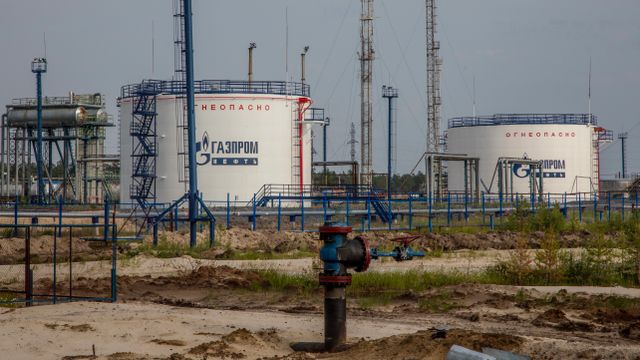
A coronavirus outbreak among workers at a Siberian oil field owned by the Russian energy giant Gazprom sparked angry protests this week, with employees demanding safe working conditions and proper care for those who have fallen ill. “Where are the masks?! Where is the quarantine?! We are not pigs!” yelled workers, as they demanded that management appear and answer their charges.
The demonstrations took place as the country’s official number of COVID-19 infections rose to more than 106,000 on Thursday (after the country’s highest single-day increase, 7,099 new infections) and Russia’s prime minister, Mikhail Mishustin, was hospitalized with the illness. Medical workers in the country are struggling to treat patients and contain the virus without adequate equipment.
On Monday, hundreds at the Chayandinsky oil field in Yakutia gathered to denounce Gazprom for quarantining them en masse without separating the healthy from the ill, giving them any protective gear, or reporting data on the actual number of infections. They give us “animal feed” and “keep us like pigs,” workers can be heard yelling on the video that has now spread widely over the Internet. The same day, protesters used logs to block the road to a nearby town, refusing to reopen it to traffic until the company responded to their demands.
A Gazprom oil producing facility situated in the Yamal region, Russia.(AP Photo/Petr Shelomovskiy)
Operations at the oil field, which employs 10,500, have been shut down since mid-April, when the company claims the first coronavirus cases were uncovered. Relatives of the workers insist that infections first appeared in late March. Once it shuttered operations, Gazprom refused to let anyone leave the location and to isolate the sick. Oil workers describe being held “captive” for weeks on end without any information about the results of COVID-19 tests administered by the company or indication as to when or how they might be sent home.
By mid-week, Gazprom authorities announced they had made arrangements to begin transferring workers off the field and back to their home cities, where they will be either placed under observation in self-isolation or sent to hospitals for treatment. Bashkiria, a western Siberian region with the capital city Ufa, announced 1,800 residents would be returning there from the Gazprom operations.
However, despite official proclamations welcoming the workers back home, returning COVID-19 patients will find themselves in overstretched hospitals unable to provide proper medical care. A doctor at Ufa’s main regional hospital issued a video appeal on Thursday to President Vladimir Putin and Kremlin leaders asking for an investigation into the hospital’s top administrator. For weeks he and his colleagues have been without adequate personal protective equipment (PPE) or any means to wash themselves. Conditions at the hospital were nightmarish even before the pandemic. Now they work essentially without sleep.
Across Russia, reports are surfacing of medical workers becoming ill and dying from coronavirus. In Saint Petersburg, officials report that 250 health care personnel are being treated for COVID-19. At the Botkinsky Hospital in Moscow, 121 have become infected. According to the Ministry of Health, 70 health care personnel across the country have died thus far from the disease. The Russian news media carried stories this week of two separate incidences of medical workers involved in battling coronavirus falling from windows, one resulting in death. Some regional governments have promised families of the dead that they will receive 1 million rubles (US$13,430) as compensation for their loss.
A major driver of high rates of infection among health care personnel is the widespread shortage of PPE. At Kommunarka hospital in Moscow, one of the capital city’s centers for treating the infectious disease, the entire nursing staff quit this week over poor working conditions and low wages. In addition to not having PPE, they said they had been denied adequate food and accommodations. They had yet to receive bonuses promised to doctors and nurses involved in the fight against COVID-19. Hospital administrators told them that since Putin made the promise, the nurses should “call and write him.”
Tensions over the virus and its impact are spreading, with Russian social media flooded with commentary protesting the miserable state of the country’s health care system and the government’s response. On Tuesday, the leader of the political party Just Russia, Sergei Mironov, warned the Duma that the country would soon be facing “hunger protests” if measures were not taken to provide more aid to the population.
Two days later, however, Kremlin spokesman Dmitri Peskov noted that a recent remark he made indicating that the government could issue payments to citizens to help offset the economic effects of the crisis had been misinterpreted. There are no plans to provide any sort of direct support. Meanwhile, unemployment and wage arrears continue to grow in Russia, where the official “stay-at-home” order has been extended through May 11.

Johnson pledges to “restart the economy” as pandemic rages in UK

Robert Stevens

Boris Johnson’s Conservative government continued discussions with big business and trade union leaders yesterday to map out a “mass return to work.”
Talks continued despite Wednesday’s announcement of thousands more people who perished in care homes of COVID-19 being added to a grim death toll that has now reached nearly 27,000.
Yesterday, deaths continued to mount, with 674 new fatalities announced, taking the official total to 26,711. Deaths in hospitals in England alone surpassed 20,000. Of the new deaths, 169 people died outside hospital either in care homes or “in the community.”
The continuing loss of life barely registered with a national media obsessed with reporting which chain store is opening its doors, when the lockdown “exit strategy” will be announced, and with Johnson’s new baby. Only the Daily Mirror and Independent front paged with the horrific death toll, but even then the story was placed below a photo of the “baby joy” smiling faces of Johnson and partner Carrie Symonds.
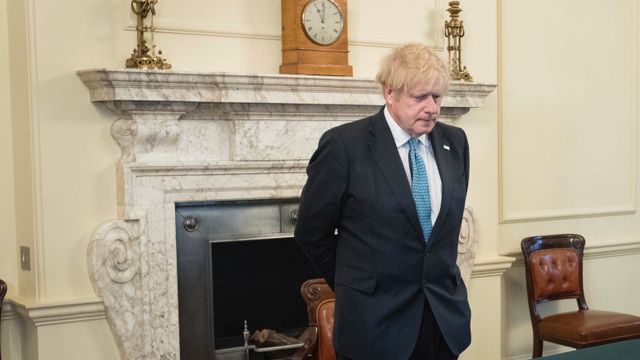
Britain's Prime Minister Boris Johnson stands inside 10 Downing Street, London, Tuesday April 28, 2020. (Stefan Rousseau/Pool via AP)
Speaking at his first daily Downing Street press conference in five weeks, Johnson piled lie upon lie, declaring that “for the first time we are past the peak of this disease … and on the downward slope.”
This was as the Daily Mail noted: “Revised UK figures including deaths outside hospitals showed that there have been nine days when the death toll topped 1,000—ranging from April 7 to as recently as April 24.”
Over 10,000 new cases of COVID-19 were reported in the 48 hours prior to yesterday’s briefing. Johnson lied about the first phase of the pandemic being over even as 6,032 new cases of coronavirus were reported in the previous 24 hours—the second highest daily total in the UK so far. These were on top of the 4,076 new cases of COVID-19 reported Wednesday and brought confirmed cases to 33,175 in the last week alone.
Johnson claimed that the government “did the right thing at the right time.” This is another lie. Any decrease in the rate of infection, as indicated in the fall of the reproduction (“R”) value of the virus to between 0.6 and 0.9, as claimed by government science adviser Sir Patrick Vallance, and fall in the rate of deaths, is the result of measures that the government was forced to implement—social distancing and the lockdown—that it now proposes to abandon.
In particularly offensive comments, Johnson declared his government had worked wonders and “avoided an uncontrollable and catastrophic epidemic where the reasonable worst-case scenario was 500,000 deaths.” Instead, the UK had come through “some huge Alpine tunnel” and “we can see the sunlight and pasture ahead of us.”
Nursing Notes reported yesterday that at least 156 health and social care workers are believed to have died of COVID-19. Yet Johnson—whose government has brought the National Health Service to its knees through billions in cuts, destaffing and privatisation—declared, “At no stage has our NHS been overwhelmed, no patient went without a ventilator, no patient was deprived of intensive care, we have five of the seven projected Nightingale wards.”
This conceals the fact that as part of its “herd immunity” policy, the population was told to stay away from hospitals and “self-isolate” if they had COVID-19 symptoms. Some were refused admittance to hospital, were not tested and died, as they were not deemed a “priority.” Others died because they were so ill when they attended hospital that they could not be saved.
A new study published by scientists at the University of Liverpool found that a third of patients admitted to hospital in the UK after being infected with COVID-19 died there. A huge number of the deaths have taken place outside hospital, with care home for the elderly and vulnerable transformed into killing fields.
Johnson responded to questions from journalists as to why the UK death rate was so high and what lessons could be learned by deferring to Chief Medical Officer Sir Chris Whitty, who said that no lessons could be learned while a pandemic was underway but only when it ended.
Giving his government a clean bill of health was vital as Johnson announced that next week he would outline a plan to “restart the economy.” Answering a question from the BBC’s Laura Kuenssberg, Johnson said, “We mourn for every life lost,” before adding that “we mourn for the economic damage as well that the country is sustaining …”
His main concern was the risk of “a second bout” or a “second bad spike” of COVID-19 “because that would really do lasting economic damage and that’s why we’ve got to calibrate our measures and make sure we unlock the economy gradually.”
These plans have been in the making for weeks, formulated in ongoing discussions between ministers, business leaders and the trade unions. The Financial Times reported Thursday, “The government is set to issue detailed ‘workplace by workplace’ guidance on how Britain can safely go back to work, as the prime minister prepares to announce that coronavirus is being contained.
“Alok Sharma, business secretary, is aiming to produce by the weekend around 10 papers setting out in ‘granular detail’ how the economy can start to reopen once Mr Johnson orders the easing of the lockdown.”
According to the FT, only token measures will be put in place to ensure workers’ safety, with the main advice centred on employees washing their hands. “Government officials say the papers will include advice to restrict access to communal spaces, such as canteens; greatly enhanced use of hand washing and sanitising; and the avoidance of face-to-face work.”
Under the new guidance “office workers will continue to be advised to work from home where possible—avoiding congestion on public transport—with revised shift patterns in all sectors to help maintain distance in the workplace.”
This is pie in the sky. During the lockdown between 7 million and 10 million workers have been daily forced to use overcrowded public transport networks, particularly in London.
The Daily Mail reported that Rolls Royce, Aston Martin, Bentley, Nissan, Jaguar Land Rover and Vauxhall are finalising plans to resume operations. Some major retailers are already fully back in operation ahead of any measures to be announced next week. Yesterday, hardware chain B&Q opened all its 288 stores, after opening them gradually from April 14. McDonald’s, British Steel and construction firm Persimmon are to reopen this month.
Confederation of British Industry director-general Carolyn Fairbairn outlined its five point plan “for a gradual, successful reopening of the UK economy” based on “conversations with unions, health workers, transport leaders and international peers.”
Writing in the Financial Times, she declared, “Businesses are rightly impatient to get back to work. … Impatience must not be confused with recklessness. Restarting must be done with the utmost care. Move too soon and the UK will be back to square one with renewed controls. But while it may not yet be time to end lockdown, it is time for a restart plan, time for government to work with business like never before. The country must be prepared for the complexity of revived economic activity. The government is starting to make strides on this. It should accelerate.”
There is no scientific rationale for any return to work by anyone but essential workers. It is being carried out under conditions in which only a fraction of the population have been tested for the virus. On Wednesday—weeks after the government claimed that 100,000 tests a day would be carried out by the end of April—just 81,611 tests were conducted. The previous day only 52,429 people were tested.
Most advocates of a return to work, including Labour Party leader Sir Keir Starmer, insist that schools should be reopened as a first step—claiming that the young are barely affected by the virus. But a study led by German virologist Christian Drosten, reported yesterday, found that even though children tend to have far milder symptoms of the disease, those infected seem to have the same levels of coronavirus circulating in their body as adults. The danger exists that were schools to reopen, they would serve as transmission areas for the spread of the virus. The study warned, “We have to caution against an unlimited reopening of schools and kindergartens in the present situation, with a widely susceptible population and the necessity to keep transmission rates low. … Children may be as infectious as adults.”

At least 31 US states easing restrictions despite rising pandemic death toll

Kate Randall

In the US as of Thursday evening there were nearly 1.1 million cases of COVID-19 and nearly 64,000 deaths. More than half of these deaths have taken place in just the past two weeks. Globally, cases have risen to over 3.3 million, with 234,000 deaths. This means that more than a quarter of all deaths have been in the US.
Despite the daily rising figures, at least 31 US states will be easing social distancing measures over the next few days, allowing some businesses, restaurants, malls and public places to reopen. While the loosening of restrictions varies from state to state, none of these states has met even the Trump administration’s weak “advisory” on reopening, which said states should wait for COVID-19 cases to decline for 14 consecutive days before the reopening process begins.
A study by the Center for Infectious Disease Research and Policy (CIDRAP) at the University of Minnesota predicts that the novel coronavirus is likely to keep spreading for at least another 18 months to two years, until 60 to 70 percent of the population has been infected. The study authors recommend that the US prepare for a worst-case scenario that includes a second big wave of infections in the fall and winter.
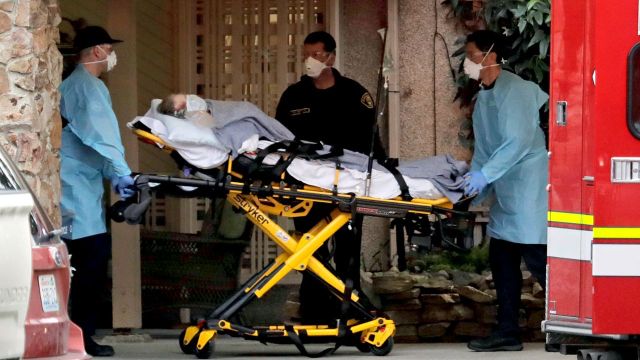
Kirkland Fire and Rescue ambulance workers load a patient into an ambulance, Tuesday, March 10, 2020, at the Life Care Center in Kirkland, Wash., near Seattle (AP Photo/Ted S. Warren)
Mike Osterholm, who directs CIDRAP, told CNN, “The idea that this is going to be done soon defies microbiology.”
Director of the National Institute of Allergy and Infectious Diseases Dr. Anthony Fauci warned Thursday that states need to proceed carefully as they roll back restrictions. “When you pull back there will be cases, and what we need to do is make sure [states] have in place the capability of identifying, isolating and contact tracing individuals,” he said.
However, President Donald Trump—with his approval rating for his handling of the crisis falling to a record low of 43 percent according to a new Morning Consult poll—is promoting a reckless and criminal policy, placing the health and lives of countless millions of Americans in danger. The White House policy is based not on the health of the US population, but on boosting Wall Street and filling the coffers of the giant corporations.
Federal guidelines encouraging people to social distance, in place for 30 days, were allowed to expire Thursday after Trump indicated he did not intend to extend them. Referring to the restrictions, the president told reporters Wednesday, “They’ll be fading out, because now the governors are doing it.”
Southern states Georgia, Oklahoma and South Carolina paved the way for reopening beginning last week. Governors in several states—including Alabama, Maine, Tennessee and Texas—allowed stay-at-home orders to expire on Thursday. Additional states, including Iowa, Florida, North Dakota and Wyoming, will be lifting more restrictions on Friday. Less dense states, including Alaska and Montana, are also beginning to reopen.
In one of the nation’s most wide-ranging moves, Texas Governor Greg Abbott, a Republican, is allowing retail stores, restaurants, movie theaters and malls to reopen at 25 percent capacity. Beaches in Galveston will be allowed to open. In Alabama, Republican Governor Kay Ivey allowed many retail stores as well as beaches to reopen Thursday, while in Maine, Governor Janet Mills, a Democrat, will allow barber shops, hair salons and pet groomers to reopen beginning Friday.
However, many of the most populous states, including California, Michigan, New York and Illinois, are continuing their extended shutdowns. In California, Governor Gavin Newsom, a Democrat, ordered Orange County beaches to stay closed after residents flocked to beaches during last weekend’s high temperatures.
Deaths from COVID-19 in Massachusetts have gyrated in the 100 to 250-a-day range, with no indication that the “curve” has begun to flatten. New Jersey recorded 458 new virus-related deaths on Thursday, the most that the state had reported in a single day since the pandemic began. New York recorded 306 new deaths Thursday, as the death numbers very slowly decline. The state’s death toll has risen to a staggering 23,780, more than one third of the US total.
In Lansing, Michigan on Thursday, demonstrators crowded into the lobby outside the House chambers at the state’s Capitol, shouting to be allowed onto the House floor. The protesters, many not wearing masks and toting rifles on their shoulders, demanded to be allowed onto the House floor in protest over Michigan’s state of emergency.
The demonstrators carried signs reading, “You’re Killing Small Businesses” and “Impeach Whitmer,” referring to Michigan’s Democratic Governor Gretchen Whitmer. Many sported hats and other paraphernalia supporting Trump’s reelection campaign. While the Republican-controlled state legislature voted not to extend Michigan’s state of emergency, Governor Whitmer said the state of emergency would continue by executive order.
As the battle plays out over the reopening of major cities and more populated states, many sparsely populated areas of rural America are seeing a rapid rise in COVID-19 cases. Many of the hospital systems in these areas are ill-equipped to deal with a sudden surge of cases, and the lack of testing has not provided a roadmap for local health officials to prepare.
Despite the rural settings, many people in these areas work in large-scale industries, such as food processing. Angela Hewett, associate professor in infectious disease at the University of Nebraska Medical Center, noted in a recent briefing of the Infectious Diseases Society of America that one of the reasons the virus is rising is because it is running rampant among workers in factories and farms. “These are not places where typically people can work from home,” Hewett noted.
The Dartmouth Atlas Project tracks the top 10 regions with the fastest growth rates in COVID-19 cases. It finds that these are primarily in metropolitan areas with large-scale factories, located primarily in rural states. The project aggregates county-level data to form 306 geographical areas known as “hospital referral regions,” i.e., where people get their health care.
Vox.com notes that Houma, Louisiana, population 32,000, in Cajun country, has almost as many cases per capita within its hospital region as Chicago. Greeley, Colorado, home of a large JBS meatpacking plant, has more cases per capita within its hospital region than Washington, DC.
The Chartis Group reports that 63 percent of rural hospitals don’t have intensive care unit (ICU) beds. Many rural hospitals have lost a substantial portion of their income due to the suspension of outpatient services and face financial ruin and shutdown, leaving communities without a local hospital. If the models of epidemiologists prove true, peaks of COVID-19 in rural areas may still be weeks away. The drive to reopen states and relax social distancing places vulnerable populations in these areas in extreme peril.

As US unemployment reaches Great Depression levels, millions still unable to obtain assistance

Shannon Jones

More than 3.8 million workers in the US filed for unemployment benefits last week as the country faced the worst economic crisis since the Great Depression. More than 30 million American workers have filed unemployment claims since the beginning of statewide lockdowns in response to the coronavirus pandemic in March. That number far exceeds the 22.4 million new jobs created since November 2009 at the end of the last recession.
The economic fallout from the COVID-19 pandemic is continuing to spiral upwards even as deaths related to the deadly virus are still averaging well over 2,000 a day. To date some 62,000 people have died in the US because of the pandemic, about 27 percent of the global total.
The crisis has seen the largest number of workers filing unemployment claims in US history, about one sixth of the total workforce. Millions more workers have lost their employment but have not filed claims because of their immigration status or because they were self-employed, contract workers or others who typically are not eligible. In addition, the Economic Policy Institute (EPI) estimated 12 million workers did not file claims because state unemployment claims systems were overwhelmed making it too difficult.
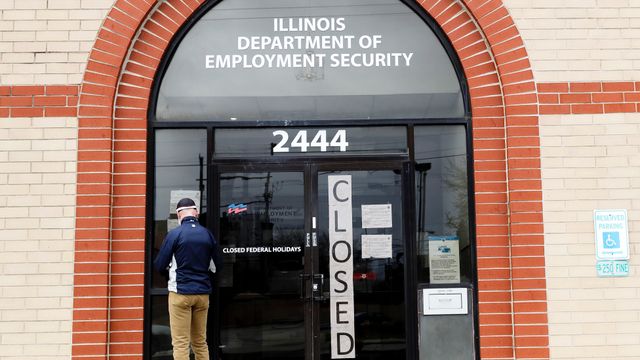
A man checks information in front of Illinois Department of Employment Security in Chicago, Thursday, April 30, 2020. (AP Photo/Nam Y. Huh)
A childcare worker in Washington state who had her hours cut and applied for benefits was denied after weeks of futile attempts. “When I called, there was a voice recording stating that they were experiencing extremely high call volumes and I had to call back later,” she told the WSWS. “I heard that same voice recording for three weeks straight, during which I called the technical support number and the claims number at least four times per week.” She added, “without unemployment benefits, I’m not sure we will be able to make it past May.”
Her friend said he had not been able to collect benefits because of a lack of sufficient hours. “There is a pressure for me to go back to work, but I have been terrified to go back because of the risk to my health and those around me.”
A Ford worker in Michigan who was laid off in March said, “So far I have only gotten one check. The month is almost up, and I have to make decisions about rent.”
Economists believe the real jobless rate is rapidly nearing the record 25.6 percent reached during the height of the Great Depression.
Underscoring the irrationality of the capitalist profit system, health systems across the US have furloughed tens of thousands of medical workers, including doctors and nurses in the midst of the massive health crisis.
According to a US government estimate, the economy shrank by a 4.8 percent annual rate in the first quarter of this year. According to one estimate it may shrink at a 40 percent annual rate in the second quarter, a collapse without precedent.
Of those who have applied for benefits, only 18 million claims have been approved, meaning millions face destitution. Consumer spending fell 7.5 percent in March, the worst monthly figure ever recorded. April’s fall will likely be far worse.
In California alone, 3.78 million workers or 19.6 percent of the workforce have submitted unemployment claims. This week the state for the first time allowed so-called gig workers, independent contractors and the self-employed to file as well.
Meanwhile, in Pennsylvania, more than 131,000 workers filed a claim in the week ending April 25. That brings the state’s total in six weeks to more than 1.6 million, 24.7 percent of the state’s workforce.
Michigan has been one of the states hardest hit by layoffs in proportion to the size of its workforce. There have been well over 1.2 million claims for unemployment benefits, representing almost a quarter of the state’s workers.
Compounding the crisis, EPI estimates 12.7 million workers have lost employer-paid medical insurance in the midst of the pandemic, the worst health crisis in 100 years. Countless families face the impossible choice of forgoing treatment or facing crippling debts.
Corporations are using the pandemic to carry out further downsizing. Aircraft manufacturer Boeing, beset by crisis over the 737 MAX, has announced the layoff of 10 percent of its workforce. The company restarted production at its Seattle, Washington area factories last week. Ride hailing service Lyft says it will lay off 1,000 employees, 17 percent of its workforce.
In an effort to blackmail workers to return to work even as the deadly disease continues to spread, several states are announcing measures to deny unemployment benefits to those who refuse to return because of health concerns. The state of Tennessee said it may “potentially disqualify claimants from receiving unemployment insurance benefits” if they refuse to return to a job where they have been temporarily laid off. In Iowa, where more than 1,000 COVID-19 cases are tied to one Tyson pork processing plant in Waterloo, state officials posted a notice saying: “ATTENTION EMPLOYERS: If you have offered work to employees and your employee refuses to return to work, you must notify Iowa Workforce Development.”
On Tuesday, the Trump administration issued an executive order forcing meat processing facilities to stay open, including the Smithfield Foods pork plant in Sioux Falls, South Dakota, were at least two workers have died. The administration is also moving to protect the giant food processing companies from any legal liabilities for sickening and killing workers.
The US Labor Department also declared, “Barring unusual circumstances a request that a furloughed employee return to his or her job very likely constitutes an offer of suitable employment that the employee must accept.”
Archaic state unemployment filing systems have been overwhelmed by the mass of claimants.
Florida had the largest increase in new claims this month, a 7,330 percent increase over April 2019. During the week of April 20, 432,465 filed for unemployment benefits in Florida compared to 5,900 for the same week last year. Overall there have been 1,592,236 new claims since the start of the lockdowns compared to 35,215 in the same period last year, a 4,521 percent increase
The state’s website has been unable to handle the huge increase, forcing those seeking assistance to try again and again to process their claims. Some give up. Last week, according to a report in the Associated Press, 7 of 8 Florida claimants from mid-March to early April were waiting to have their unemployment applications processed. California had two-thirds of its claims waiting and New York, 30 percent.
Tens of millions have not gotten the meager $1,200 federal stimulus payments authorized by Congress. Only a little over half of the money allocated has been disbursed, and there appears to be little explanation of what is holding up the rest of money needed by desperate households. According to the House Ways and Means Committee the government began doling out paper checks on April 20 to 5 million households a week to be spread over the next 20 weeks. Nothing in the stimulus bill prevents creditors from garnishing the payments, though a few states have said they will block that.
Meanwhile, many family-owned small businesses have found themselves shut out from receiving loans under the Paycheck Protection Program as big businesses gobble up the money. Many who do get help find out it comes with multiple strings attached.
Capitalism has demonstrated its inability to respond in a rational and humane manner to the COVID-19 pandemic. Instead of providing the billions needed to meet the health care crisis and provide relief for the unemployed and small businesses, virtually unlimited resources have been made available for Wall Street. The corporations have seized on the pandemic to force through a further restructuring of social relations in the interests of the wealthy, including demands for the slashing of public pensions and a further driving down of wages.
As the death toll rose and unemployment levels reached depression levels, the stock market continued its unprecedented rise this week, assured by the Federal Reserve that it will continue to receive injections of trillions of dollars, and by the concert efforted by both parties to force workers back into the factories and other workplaces.
The only answer to the reckless and homicidal policies of the ruling class is the independent mobilization of the working class against capitalism. This requires that workers break with the political parties of big business and the pro-corporate unions and advance a socialist program based on the reorganization of society in the interests of the working class.

Could COVID-19 Further Endanger Multilateralism?

Seema Joshi

The COVID-19 crisis brings to light three indicators that could pose more risks to multilateralism: a lack of accountability from global powers as well as international institutions, rising nationalism, and an absence of coordinated responses. If anything, this crisis shows us that while that we need more globalism, the political dynamics unleashed by it will see less—unless corrective measures are considered and implemented.
Accountability and Irresponsible Leadership
China’s inordinate delay in sharing information with the international community has wreaked havoc globally. The lack of early travel restrictions despite Chinese awareness of COVID-19’s contagiousness allowed the virus to spread quickly. It has now been detected in over 200 across the world.
Several countries, such as the USUK, Germany, and France, have raised questions about China’s role in triggering the pandemic. The lack of Chinese accountability so far has gone beyond health repercussions, and has, among others, incurred huge socio-economic costs, as is evident from the unprecedented reduction in economic activity, lost working hours, increasing informalisation of the workforce, rising global unemployment, as well as the outbreak’s gendered impact.
Chinese negligence and culpability in the onset of this crisis is clear. However, an independent analysis would be amiss if it did not also consider instances of irresponsible leadership displayed in all stages of the pandemic, particularly by important global players.
US President Donald Trump’s approach in a case-in-point. He has compared this deadly virus to a flu, made initial public comments about his lack of concern because everything was under control,” dismissed the virus as a Democrat “hoax,” and, a few months before the outbreak, eliminated a key US public health position in Beijing set up to help detect disease outbreaks in the country. Through these actions, President Trump initially underappreciated and misrepresented, and has since completely politicised, the biggest crisis the world has seen since the Second World War.
There is also the question of the mismanagement, and effective Chinese ‘takeover’ of the World Health Organisation (WHO)—a multibillion-dollar international agency mandated to provide global leadership on health matters.” Despite this pandemic being the sixth global emergency declared by WHO since 2009, the organisation does not appear to have had any solid strategy already in place to respond to crises like these.
Rising Nationalism
Another major fallout is the reinforcement of nationalism on a stage that was already beginning to show signs of weakening globalism and multilateralism. Anti-China and anti-Asian sentiments were an early indicator. Since then, the pandemic has necessarily motivated leaders—even those heavily invested in globalism—to swiftly secure their own countries and peoples first.
One example is German Chancellor Angela Merkel’s decision to ban most exports of protective medical equipment.” Mr Trump offered to fund Cure Vac AG, a German bio tech company, to develop a COVID-19 vaccine exclusively for the United States.” Australian Prime Minister Scott Morrison advised international visitors go home so Australia could “maximise” its own “economic supports.”
In some countries governed by conservative leaders, moves have been made to consolidate further power. These developments that have occurred in response to COVID-19 will have consequences for a post-pandemic world.
Lack of Response Coordination 
When a health crisis involves communicable diseases that make national boundaries irrelevant, there is a requirement for multilateral responses. However, most reactions so far have been local or national in nature.
Some countries have opted for partial lockdowns (Sweden); others for a complete lockdown (India). Singapore, Hong Kong, and Taiwan have adopted non-pharmaceutical initiatives, including social distancing and travel restrictions. Some have declared an emergency (Japan), and China, which is now apparently emerging out of the crisis, is relaxing restrictions and claiming normalcy. Even countries like Italy and Spain that are part of an established bloc, have for the most part addressed the crisis individually, despite the EU technically being a union of states.
National measures are crucial—that is a given. However, coordinated regional and global responses are equally important. Both, in fact, must work in tandem. No attempt has so far been made by the so-called major powers to seek cooperation after the onset of the virus. India’s call for a joint SAARC mechanism was an early exception. The G20 statement followed much later, and it remains to be seen if word will be matched with deed. Indeed, the US has decided to defund the WHO till its Congressional investigation into WHO’s management of the pandemic is through.
Conclusion
COVID-19 has triggered and exacerbated a cross-cutting range of challenges. Among others, it opens up disadvantaged people and groups to further vulnerabilities. In this light, the relevance of international bodies like the UN Human Rights Commission (UNHRC) and WHO become even more central. A serious rethink on formulating disaster management and response strategies with collective global leadership is in order. The current interest as well as preparedness are both inadequate, as is the idea of a ‘global community’.
The irony is that it is exactly when the world needed more globalism—not less—that this pandemic seems to have exacerbated the decline of multilateralism. To be fair, there are several underlying issues involved, including the need to protect local jobs from predatory pricing engaged in by economies like China, and the lack of transparency and accountability in several global organisations, most notably the WHO. However, the solution to this lies in reforming those bodies and putting in place targeted measures against rule-breaker states.

Strange Bedfellows: COVID-19 and the New Japan-China Camaraderie

Sandip Kumar Mishra

The COVID-19 pandemic has led to fractures in bilateral relationships with China amid growing international condemnation of Beijing’s handling of the crisis, with one notable exception: Japan. Quite strangely, the crisis has bought about a rare Japan-China bonhomie.
Japan was one of the first few countries to send thousands of masks, protective gear, and other medical supplies to China at the onset of the outbreak. On 23 January, Oita, Wuhan’s sister city in Japan, sent 30,000 surgical masks. Tokyo’s tallest building was lit up in red to express solidarity with China. This gesture was officially acknowledged by the Chinese foreign ministry, who said that the country would remember this gesture “forever.” The appreciation is not limited to the government alone. Chinese social media has also seen similar expressions of gratitude for Japanese assistance. One post in particular went viral on Weibo: “Though we have different mountains and rivers, we share one moon under the same sky.”
As per official record, until the first week of February, Japan had provided 6.3 million masks, 11 million gloves, 1,79,000 protective gear, 78,000 goggles, 16,000 thermometers, and 1.15 ton of disinfectant to China. Another consignment of Japanese medical supplies reached China in mid-February. In the same month, ruling party members of the Japanese Diet donated a portion of their March salaries to China’s fight against COVID-19.
When the virus spread to Japan, China reciprocated the support. It sent testing kits when the Diamond Princess cruise ship was quarantined just off the coast of Yokohama. Billionaire businessman Jack Ma pledged a donation of nearly 1 million masks in early-March, and Huawei donated masks to a university hospital in Nagoya. By mid-March, China sent a second round of masks and other medical supplies to several Japanese cities, including Hokkaido, which was the first to declare a state of emergency. Chinese expats across Japan formed Mask Panda Action, a volunteer group, to distribute masks for free.
Sure, there have been some anti-China protests and incidents in Japan, but these were minor and scattered. In addition, such sentiment is not new—it surfaces often when tensions between Japan and China rise. In fact, it underscores why the camaraderie being displayed now is such a rare spectacle.
Japan is considered an important bulwark with serious counterbalancing potential against an ‘aggressive’ China in East and Southeast Asia. In the past decade, it has had confrontations with China in the East China Sea and beyond. Japan is also a crucial US ally and a pillar of the Indo-Pacific strategy. These tensions have permeated from the official level to shaping Japanese public outlook toward China. Together, these reasons make the current bilateral amity something to make special note of.
In response to the pandemic, Japan has announced a US$ 2 billion stimulus package for those Japanese companies that want to shift production from China to Japan, and another US$ 200 million for companies that would like to move to a third country. Tokyo has cited business distress in these companies, rather than COVID-19, as the justification for the move. This could be read as an effort to avoid apportioning blame on China. On the other hand, the announcement could also be seen in light of falling exports to China as a result of the US-China trade war, with Japanese companies already contemplating a ‘China plus one’ strategy well before this crisis.
In fact, Tokyo had begun working to mend its relationship with Being in the months preceding the pandemic—particularly after Japanese Prime Minister Shinzo Abe’s visit to China in October 2019. Abe’s visit was important as it happened to commemorate the 40th anniversary of the conclusion of the Treaty of Peace and Friendship between Japan and China. A reciprocal visit by Chinese President Xi Jinping scheduled for mid-April has now been postponed, but both countries seem committed to improving relations.
Of course, this short-term bonhomie does not necessarily mean that the bilateral relationship will easily be able to overcome its deep structural issues. This global crisis has severely impacted China’s already deteriorating image and soft power, and the country’s lack of transparency at the initial stages of the outbreak has elicited sharp reactions from across the world. US President Donald Trump has on multiple occasions referred to COVID-19 as a ‘Chinese virus’ or  the ‘Wuhan virus’, effectively holding China responsible for the pandemic.
It is likely that once the situation stabilises, the US and others will attempt to persuade Japan to once again move away from China. Beijing might also react differently if Japanese companies ultimately end up shifting base from China. Future scenarios, particularly one in which the pandemic does more damage to the country, could see public sentiment once again turn against China. Despite these challenges, which will finally determine the long-term trajectory of the bilateral relationship, it is certain that Japan-China amity is having a moment—and this is an interesting development because of the same set of pre-existing issues.

30 Apr 2020

Is India Becoming Paranoid?

Ajay Gudavarthy

Rumours can shape mass psyche if they are based on familiar cultural cues
 
Many had thought that the crisis created by the Covid-19 pandemic and the lockdown would bring back basic questions about healthcare, education and capitalism, but we are witnessing instead a preoccupation with conspiracies.
Many continue to believe that the Muslims and the Tablighi Jamaat are singularly responsible for spreading the viral pandemic, and that a kind of bio-jihad has been initiated against the Hindus.
Rumour and conspiracy seem to stick easily and very few wish to check the veracity of information it is based on.
Right-wing social organisations are making the most of these floating rumours and producing a new mass psychology of conspiracy. In fact, denying a conspiracy itself ends up looking like one.
Why do rumours and conspiracy become templates for politicising public issues? How and why the Novel Coronavirus can spread is very clear, and anyone who really wants to know can easily find this out.
The pandemic this virus has wrought is not afflicting India alone but is a global phenomenon. So how can one community and one organisation alone be responsible for spreading it?
Yet, there is an emergent psyche that is finding an easy resonance with this way of seeing the crisis. This is not the first time that rumours or conspiracy have taken over mass psychology. There were earlier glaring instances, such as of the idols of the Hindu god Ganesha drinking milk all over India. There was the infamous instance of a “monkey-man” in Delhi where it was believed that a monkey-headed man was attacking passers-by.
It is a very well known fact that rural India is replete with rumours and myths of such kinds, especially stories of ghosts doing the rounds.
Earlier, there were rumours, but now they have been scaled up to a collective belief that there is a grand conspiracy against India or Hindus. This is slowly and gradually resulting in public lynchings, as a paranoia is created by the notion that some deep conspiracy is afoot.
The recent case of two sadhus being lynched was a response to a rumour. The lynching of health workers is becoming a new normal, including the case of a doctor being denied a decent burial by a mob—not to mention the lynching of Muslims and Dalits.
We have degenerated very quickly into a blood-thirsty collective. Suspicion and mistrust are growing, and the pandemic that needs trust to fight is turning us into a paranoid society instead.
Right-wing politics is only waiting to reap the benefits from such a situation.
There are multiple reasons why rumours and conspiracies so easily become part of mass psyche. In India, the State holds the society together. We are a collection of motley communities and the State was the conduit linking the various communities.
Today we are staring at a context where the State itself is actively promoting conspiracy theories. It is creating a false agenda in a manner that further augments fissures on the ground.
The new question that needs to be answered is: how does a fragmented society fight a unified State that is creating a culture of paranoia?
It is important to break down the modalities of rumours and how they are converted into conspiracy to then become part of mass psyche.
Rumours hold the potential to become part of a mass psyche only when they tap into cultural codes that people are already familiar with. It has to look and feel familiar, believable, and unfair and unjust.
One has to concede that the Right has a grip over how these cultural codes of memory, myth, trust and popular beliefs that structure our thinking work. The Right also understands how people respond to everyday emotions.
It is this combination of culture and emotions that creates believability, which is then manufactured into a conspiracy and mass paranoia – because what is being told looks and feels both authentic and unjust.
There are modalities through which we trust something or repose trust in someone. There are familiar codes, emotions and responses that we look for. For instance, we would admire someone who takes responsibility for a “mistake” even when they are not precisely, or entirely, responsible for the act.
It conveys the message that for the larger good, you are willing to be the “fall guy”. This is the general template on which reciprocity works. It was recently visible in the way Prime Minister Narendra Modi pleaded for forgiveness for imposing the lockdown. He conveyed that although it was not his intention to cause anybody trouble, he was forced to take a harsh decision, and yet he is pleading guilty.
The optics of such statements makes for an authentic and authoritative act. We tend to trust what appears vulnerable and affable, even independently of the authenticity of the content; for instance we trust the intention to please or make us happy, even if the content of the act may itself not be exactly pleasing.
This can be seen with the cultural world of advertisements. Most advertisements either make exaggerated claims or are simply not true. When deodorant-manufacturers claim that those using their brand will be swarmed by good-looking women, that is not a fact, neither is the claim going to come true, yet we appreciate the “good thoughts” of the manufacturer.
In this case, the in-authenticity of the content actually makes for a more pleasing context. The advertiser’s charlatanism is not meant to cheat you, but inspire you. The intention, therefore, is not the same as the content.
The separation of content from intent cannot be read merely as a manipulation but also as an authenticity. This was clearly visible on many occasions during the course in power of the current regime: often, the content and quality of its performance was separated from the intent. Demonetisation is a good instance of this. In such cases, the very act of separation makes it more authentic.
It is these cultural codes that determine our responses. Once such cultural codes have taken over to fill people with rumours that are meant to create hatred and polarise communities, it is not sufficient to critique the content because the mass psyche is receiving it through codes and not necessarily content.
It is important to reoccupy those codes and encode them with different meanings. Without tapping into cultural codes, trying to convey alternative political meanings can itself be perceived as highly inauthentic, which further strengthens mass paranoia.